A lot of buyers ask for “the boiling point of silicone oil” as if it were a single catalog number, then run into trouble when the fluid starts smoking off light fractions, viscosity drifts, or a heater loop gums up long before any clean bulk boil is seen. On the plant floor, that turns into unstable heat transfer, seal complaints, off-spec product, and awkward shutdowns that always seem to land in the busiest week of the quarter. The cost is rarely just the fluid replacement; it is lost production, extra maintenance hours, contaminated batches, and a procurement decision made on the wrong property.
Silicone oil does not have one universal boiling point. Most industrial silicone oils are mixtures or polymeric fluids, so they often show a boiling range, gradual volatilization, or thermal decomposition rather than a sharp single-point boil. In practice, buyers should evaluate viscosity grade, molecular weight distribution, operating temperature, flash point, and exposure conditions together, not boiling point alone.
That distinction matters because a 5 cSt PDMS fluid and a very high-viscosity silicone fluid do not behave the same way under heat, and neither behaves quite the way a simple solvent does. If you are selecting fluid for heating, damping, lubrication, or release service, the useful question is less “what is the boiling point?” and more “at what temperature does this grade stop being commercially stable in my equipment?”
Silicone oil chemistry
Silicone oil boiling behavior is driven far more by molecular architecture than by the label “silicone oil.” Two products with similar viscosity on a datasheet can heat very differently if one is a clean linear PDMS fluid and the other carries cyclic residues, phenyl substitution, reactive Si-H groups, or a package of additives. If you are trying to predict whether a silicone oil will show a clean boiling point, the first question is not brand or trade name; it is what siloxane structure is actually in the drum.
At the chemistry level, most industrial silicone oils are built on a siloxane backbone: repeating Si-O-Si linkages with organic side groups attached to the silicon atoms. The most common family by a wide margin is polydimethylsiloxane, or PDMS, where those side groups are mainly methyl groups. That combination matters. The Si-O backbone is flexible, the bond geometry is different from a hydrocarbon chain, and intermolecular forces stay relatively low compared with many organic heat-transfer or lubricating fluids. That is one reason silicone fluids often remain usable across a broad temperature range, but it is also why “boiling point” becomes a slippery term once you move beyond low-molecular fractions.
Main silicone oil families and why they do not volatilize the same way
The generic phrase “silicone oil” covers several materially different chemistries. From a plant and procurement standpoint, these are not interchangeable if heating, evaporation loss, or thermal exposure matters.
- Linear PDMS fluids
- The standard industrial silicone oil family.
- Usually the reference point for discussing viscosity grades from roughly 5 cSt upward into very high-viscosity materials.
- Lower-viscosity grades contain shorter chains and usually show higher volatility.
- Higher-viscosity grades tend to have lower vapor pressure and may not present a sharp atmospheric boiling event before gradual mass loss, smoke generation from impurities, or thermal degradation becomes the practical limit.
- Cyclic siloxanes
- These are ring structures rather than linear chains.
- They are much more volatile than high-molecular linear fluids and often dominate the first material driven off during heating if purification is incomplete.
- In practice, a drum of nominal silicone oil with elevated cyclic content may appear to “boil early,” even though the base fluid itself is not the fraction leaving first.
- Phenyl-modified silicones
- Some methyl groups are replaced with phenyl groups.
- Often selected for better low-temperature behavior, radiation resistance, or improved thermal characteristics in specific applications.
- Volatility and heat tolerance depend on substitution level and molecular design; you cannot generalize one boiling value across the whole family.
- In many cases they tolerate heat differently from straight PDMS, but cost goes up and compatibility can shift.
- Methyl hydrogen silicones
- Contain Si-H functionality.
- Used more often as reactive intermediates, water repellents, or crosslinking-related materials than as simple inert fluids.
- Heating behavior can be complicated by reactivity, catalytic sensitivity, and impurity effects. Treat any boiling-point assumption with caution.
- Amino-modified silicones
- Built for surface activity, textile treatment, conditioning, or adhesion-related behavior.
- The amino functionality changes polarity, substrate interaction, and sometimes thermal response.
- These are not fluids you should evaluate like plain PDMS heat-transfer media.
- Fluorosilicones
- Fluorinated side groups improve fuel and solvent resistance.
- They are useful where standard PDMS would swell or dissolve, but volatility and thermal stability must be judged by the specific chemistry, not by the word “fluoro” alone.
- Supply cost and procurement lead time are usually less forgiving than commodity PDMS.
- Specialty copolymers and modified fluids
- Polyether-modified, aryl-modified, alkyl-modified, or mixed-function siloxanes.
- These can be tuned for wetting, defoaming, release, lubrication, or process aid performance.
- Once you enter this category, a single boiling point is often the wrong specification. Distillation curve, volatile content, weight loss on heating, and application-specific thermal aging become more useful.
The trade-off is straightforward: the more you tune silicone fluid chemistry for a specific surface, compatibility, or process function, the less likely a generic thermal number will describe its behavior well. Buyers sometimes push for one “boiling point” line on the COA because it is easy to compare. In many specialty silicones, that shortcut creates bad selections.
Chain length and molecular weight distribution decide whether you see a clear boil or a broad loss profile
A pure, low-molecular substance can show a reasonably defined boiling point at a given pressure. Industrial silicone oils usually do not behave that cleanly because they are distributions, not single molecules.
Shorter siloxane chains have higher vapor pressure. As chain length increases, vapor pressure drops and the fluid becomes less likely to show measurable boiling under atmospheric pressure before other events interfere. That sounds simple, but on the floor the mechanism matters:
- Short-chain molecules leave first.
- Their removal changes the composition of the remaining fluid.
- The effective distillation temperature shifts upward as heating continues.
- Viscosity can rise slightly in the residue because the light fraction is gone.
- In recirculating systems, the vent or condenser load may come from that light tail, not from bulk fluid failure.
That is why a low-viscosity silicone fluid may show noticeable evaporation or distillation behavior, while a much higher-viscosity grade can sit at elevated temperature with limited measurable boil-off yet still suffer slow oxidation or contamination issues. The conclusion that “higher viscosity means better thermal performance” holds only up to a point; once pumpability, heat transfer, startup temperature, or residue formation starts to dominate, the preferred grade can flip.
Molecular weight distribution matters almost as much as average molecular weight. Two nominally similar PDMS fluids can have different volatility because one has a broader low-end tail. In procurement terms, this is where supplier process control shows up in your vents, condensers, and mass-loss data.
End groups, low boilers, and purification often explain the boiling behavior you actually see
End groups are not a minor detail. Hydroxy-terminated, trimethyl-terminated, alkoxy-functional, or reactive end-capped siloxanes can behave differently in storage and under heat. End groups influence stability, moisture sensitivity, and the tendency toward further condensation or side reactions.
Three practical contributors often dominate “apparent boiling”:
- Residual cyclic content
- Especially relevant in incompletely stripped PDMS or fluids derived from equilibrated siloxane systems.
- These low-molecular cyclics can flash off well before the bulk fluid reaches the temperatures the buyer associates with silicone oil service.
- Unreacted low boilers or solvent residue
- Leftover diluent, process solvent, or low-molecular siloxane fractions can create early vapor release.
- Operators may call this boiling. Lab review often shows it is contamination or incomplete finishing.
- Manufacturing purification
- Vacuum stripping, devolatilization, filtration, and finishing quality change the thermal signature of the delivered product.
- Better purification usually means lower initial mass loss, cleaner heating, and more predictable vent behavior.
A single silicone oil grade can show different apparent boiling behavior depending on residual low-boiling content and purification level.True
This follows directly from standard chemical engineering behavior of multicomponent fluids: early vapor release is governed by the most volatile fraction present, not by the average composition named on the label.
In practice, this is where plant complaints start. A customer says the silicone oil is “smoking” or “boiling too early.” The first check should be whether the product is the intended fully stripped grade, whether the container picked up moisture after partial use, and whether the heating profile is exposing local hot spots at the heater sheath or plate surface.
Additives and formulation can make a boiling-point number misleading
Not every silicone oil sold into industry is a neat base fluid. Some are formulated products with inhibitors, stabilizers, fillers, antifoam components, corrosion-related additives, or performance modifiers. Once that happens, the thermal response becomes composite.
Typical effects include:
- Stabilizers or inhibitors
- Can delay oxidation or suppress specific degradation pathways.
- They do not necessarily raise true boiling point; they change when visible breakdown, color change, or odor appears.
- Fillers
- Used in pastes, compounds, or greases rather than clear oils.
- Can hold volatile fractions, alter heat transfer within the mass, and complicate lab boiling tests.
- Performance additives
- Wetting agents, surfactant-like modifiers, or specialty package components may volatilize or decompose separately from the base siloxane.
- A first weight-loss event may belong to the additive package, not the silicone backbone.
The boundary here is important: once you are dealing with formulated release agents, textile softeners, antifoams, or specialty treatment fluids, comparing products by one boiling-point figure is usually not technically defensible. Ask for volatile content, TGA behavior, flash point, recommended operating temperature, and if necessary a controlled heating test on the actual production sample.
What leaves first in a plant heater is often not the base fluid
The material that comes off first during heating is frequently the light fraction, not the intended bulk silicone oil. I have seen operators blame the base fluid when the real source was condensed moisture from a vented tote, trace cleaning solvent in a make-up tank, low cyclic carryover, or degradation products formed at localized hot spots.
When you heat silicone oil and observe early bubbling, vent load, odor, or condensate, check these in order:
- Entrained moisture
- Common after poor drum resealing, humid storage, or tank breathing.
- Water can produce misleading early bubbling even in a hydrophobic fluid if enough is mechanically dispersed.
- Residual solvent or cleaning liquid
- Shows up after line flushing, tote washing, or shared transfer equipment.
- Usually the cheapest explanation and often overlooked.
- Low-molecular siloxane fraction
- Supplier finishing issue, wrong grade, or aging-related fractionation.
- Degraded species from overheating
- Especially around electric heater surfaces, dead legs, or fouled heat-transfer surfaces.
- The bulk tank temperature may look safe while film temperature at the metal surface is much higher.
- Actual bulk fluid volatilization
- Usually later in the sequence for higher-molecular silicone oils under atmospheric conditions.
That distinction matters commercially. If the first evaporating fraction is moisture or residual cyclics, changing to a more expensive silicone chemistry may solve nothing. If the issue is broad molecular distribution or inadequate purification, the fix is usually tighter grade selection and supplier confirmation of volatile content, not a generic move to “higher temperature silicone oil.”
Thermal properties compared
A silicone oil is not “good to 250 C” just because a datasheet shows a high flash point or a decomposition number. For plant decisions, you need to separate at least six different ideas: boiling point, vapor pressure, evaporation tendency, flash/fire behavior, thermal stability, and long-term thermal endurance. Mix those up, and the usual result is not an academic error; it is fluid loss, viscosity drift, smoke, fouling, or a warranty argument nobody enjoys.
Boiling point, in the strict thermodynamic sense, is the temperature where a liquid’s vapor pressure equals the surrounding pressure. That definition works cleanly for a pure compound with a narrow molecular identity. It gets messy with many silicone fluids, especially polydimethylsiloxane, or PDMS, sold as viscosity grades rather than as single molecules.
A commercial silicone oil usually contains a distribution of chain lengths, and often some low-molecular-weight fractions sitting at the light end of that distribution. The lighter fractions begin contributing measurable vapor pressure and evaporation well before the bulk fluid reaches any single “boiling point” that would make sense for the whole product. In practice, that is why buyers who insist on one universal boiling-point number for all silicone oils usually end up with a value that tells them less than they think.
Boiling point versus vapor pressure, evaporation rate, and mass loss
For open tanks, heated baths, coating lines, release-agent systems, and any service with surface exposure to air, vapor pressure and evaporation behavior are usually more decision-useful than nominal boiling point. A fluid can sit far below its atmospheric boiling condition and still lose mass steadily if its vapor pressure is high enough and the operating setup keeps sweeping vapor away.
The mechanism is simple but often overlooked:
- Vapor pressure sets the thermodynamic tendency of molecules to leave the liquid surface.
- Air movement, tank geometry, and exposed area determine how quickly those molecules are removed from above the liquid.
- Temperature amplifies the effect sharply; a modest temperature increase can push light fractions out much faster.
- Residence time decides whether that loss is trivial or expensive.
That is why the same silicone oil can behave acceptably in a loosely covered reservoir but lose enough mass to create makeup-fluid cost and viscosity shift in an open recirculating bath.
Use the metrics this way:
- Boiling point
- Best for understanding pure-compound behavior or reduced-pressure distillation.
- Weak predictor for open-system service loss in broad-distribution silicone fluids.
- Vapor pressure
- Best single physical indicator of tendency to volatilize at a given temperature.
- Most useful when compared at the actual operating temperature, not at room temperature.
- Evaporation rate
- Better than boiling point for practical open-system loss.
- Strongly dependent on test method, airflow, exposed area, and duration, so cross-datasheet comparisons need care.
- Mass loss on heating
- Often the most operationally relevant screening tool for open heated systems.
- Captures what users actually pay for: fluid leaving the system, often with composition shift in the residue.
If a supplier provides only one high-temperature number, ask for one of these instead:
- Vapor pressure versus temperature
- Noack-type volatility or comparable evaporation test, if applicable
- Weight loss after a defined temperature/time exposure
- Change in viscosity after the same exposure
Those four together tell you much more about field behavior than a solitary boiling-point claim.
A fluid with a high flash point can still show noticeable evaporation loss at temperatures far below that flash point.True
Flash point concerns momentary ignition of vapor above the liquid under a defined test. It does not mean vapor generation is negligible below that temperature, only that the vapor concentration has not reached ignitable conditions in that test setup.
Flash point and fire point are not boiling point
Flash point is the lowest temperature at which vapor above the liquid can ignite momentarily under specified test conditions. Fire point is higher: the temperature at which combustion can be sustained. Neither one is the same as boiling point, and neither one guarantees low volatility in service.
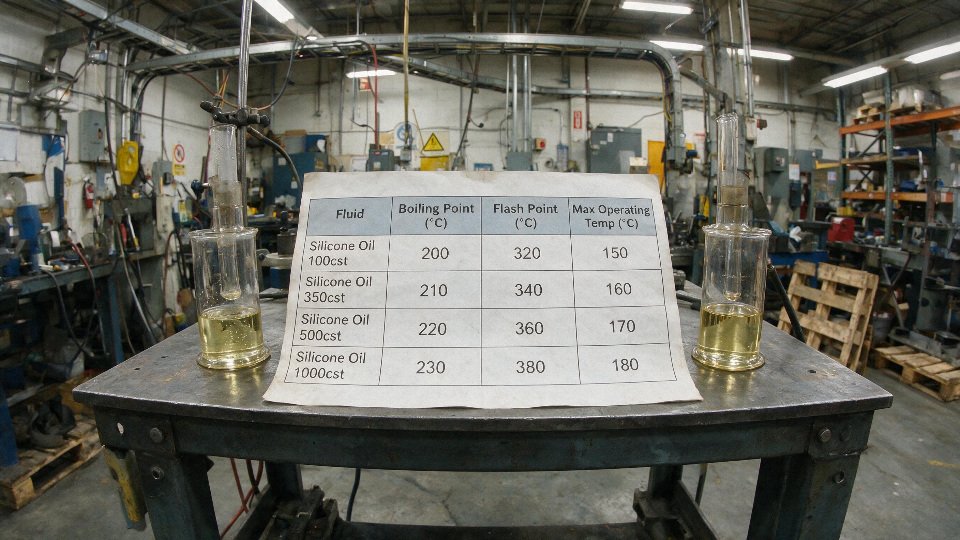
Typical flash points for many silicone oils fall roughly from about 150 C to above 300 C, depending on molecular weight and formulation. That sounds reassuring, and in one sense it is; these fluids often have good fire-safety margins compared with many hydrocarbon fluids. But the commercial mistake is to read a high flash point as proof that the oil will not evaporate or fractionate below it.
Here is where the confusion starts on the plant floor:
- A fluid may have low enough vapor generation at 180 C that it does not flash in a standard cup test.
- The same fluid may still lose light ends continuously over a week of operation at 180 C in an open kettle.
- As those light ends leave, the remaining fluid can become more viscous, transfer heat differently, and in some cases form deposits faster.
Flash point is mainly a fire-handling and storage-related parameter. It matters. It is just not the right metric for predicting operating loss or fluid life by itself.
Thermal stability is not the same as thermal endurance
Many users ask, “What temperature can this silicone oil withstand?” The honest answer is that two different limits are hiding inside that question.
Thermal stability refers to resistance to chemical breakdown: bond scission, depolymerization, oxidation, and formation of volatile or crosslinked byproducts. Thermal endurance is broader and more practical: how long the fluid can stay in service before its properties drift beyond what the process can tolerate.
For many PDMS fluids, typical recommended bulk operating temperatures are often around 150 to 250 C, depending on grade and exposure conditions. That range is not a universal decomposition threshold. It is a practical operating band shaped by several failure paths:
- Decomposition onset
- Elevated temperature can start chain scission or rearrangement.
- In inert conditions, behavior may differ from behavior in air.
- Oxidation resistance
- Air exposure, catalytic metal surfaces, and contamination can accelerate degradation.
- Copper, iron fines, process residues, and acidic carryover can shorten life dramatically.
- Viscosity drift
- Loss of low fractions can raise viscosity.
- Chain breakdown can lower viscosity.
- Either direction can cause trouble, depending on pump clearances, heat-transfer design, or coating thickness targets.
- Deposit or gel formation
- Once oxidation byproducts or high-molecular-weight residues appear, heat-transfer surfaces foul and local film temperatures rise.
- Then degradation speeds up. It is a familiar spiral in neglected hot-oil loops.
The trade-off is straightforward. Higher-viscosity, higher-molecular-weight silicone fluids usually give lower volatility and often better high-temperature retention, but they sacrifice low-temperature flow, ease of pumping, and sometimes heat-transfer responsiveness. Lower-viscosity grades are easier to handle and often preferred for wetting or damping, but they tend to carry a bigger volatility penalty at elevated temperature. The preferred choice flips if startup temperature, fine metering, or fast circulation matters more than fluid-loss control.
This conclusion stops holding if the formulation is specialty-modified rather than standard PDMS. Additives, end-blocking chemistry, fillers, or phenyl modification can change volatility, oxidation behavior, and low-temperature performance enough that grade-by-grade review becomes mandatory.
High-temperature selection: pour point, viscosity index, and heat-transfer capability
Pour point is a low-temperature property, but it still matters in high-temperature systems that cycle down, sit outdoors, or restart in winter. If the fluid thickens excessively at startup, the pump cavitates, the bypass lifts, and operators overheat the heater waiting for circulation to stabilize. I have seen more than one system blamed on a “bad heater” that was really a cold-flow problem.
Viscosity index matters because it tells you how sharply viscosity changes with temperature. A favorable viscosity-temperature relationship helps keep pumpability at startup and adequate film behavior when hot. For circulating systems, that affects:
- Pump sizing and motor load
- Flow regime through jackets or coils
- Seal leakage tendency
- Heat-transfer coefficient
Heat-transfer capability should be read cautiously. Silicone fluids are often chosen for broad usable temperature range and cleanliness, not because they are the strongest heat-transfer media on every metric. If your duty is tight and film temperature at the heater wall runs much higher than bulk temperature, fluid selection has to consider local overheating risk, not just bulk setpoint. Datasheet thermal conductivity and specific heat values help, but they do not replace a proper loop calculation.
Pressure changes everything
Under vacuum, the observed “boiling” or strong volatilization of silicone oil can occur at much lower temperature than atmospheric data suggests. That is not a contradiction; it is the direct result of the vapor-pressure-equals-surrounding-pressure rule. Reduced-pressure distillation of silicone fractions relies on exactly this effect.
Pressure-related cases need to be separated:
- Vacuum service
- Light fractions can strip out quickly.
- Pump contamination, condensate loading, and chamber haze become practical concerns.
- Reduced-pressure processing
- A fluid acceptable at atmospheric pressure may show objectionable volatility once pressure drops.
- Ask for vapor pressure data across the intended pressure-temperature window.
- Sealed systems
- Apparent bulk loss may be low because vapors remain contained.
- That does not mean no volatilization occurred; the volatiles may condense elsewhere, pressurize headspace, or attack seals.
- Vented but enclosed systems
- Condensation on covers, ductwork, or instrumentation often reveals volatility long before bulk inventory loss looks serious.
The specification mistake that keeps repeating
A single flash point or a single decomposition temperature is not proof of suitability for continuous high-temperature duty. It is, at best, one piece of the screening picture. Buyers should require a service-temperature discussion tied to exposure condition: open or closed system, air or inert atmosphere, residence time, contamination risk, pressure, and allowable property drift.
If the application is continuous hot service, the safer procurement approach is to request:
- Recommended bulk operating range under the intended exposure condition
- Vapor pressure or volatility data near actual operating temperature
- Mass loss and viscosity change after timed heat aging
- Compatibility information for seals, metals, and process contaminants
- Confirmation of whether the system is open, sealed, or under vacuum
That is the set that prevents most bad assumptions before the first drum arrives.
Typical temperature ranges
For plant decisions, treat silicone oil temperature behavior as a product-class question, not a single-number property. Low-molecular siloxanes and very low-viscosity fluids can show measurable atmospheric boiling or distillation ranges, while standard medium- and high-viscosity PDMS oils often become limited by volatility loss, oxidation, or gradual degradation before you ever get a neat one-point “boiling temperature” that is useful in service.
Low-molecular siloxanes and very low-viscosity fluids
At the light end of the family, some siloxanes behave much more like ordinary organic liquids: they evaporate, distill, and can be assigned practical boiling ranges under atmospheric pressure. That is most relevant for cyclic siloxanes and very low-viscosity linear fluids used in cosmetics, defoaming blends, carriers, or specialty processing aids.
What matters here is chain length and molecular weight distribution. Shorter siloxane molecules have higher vapor pressure at a given temperature, so the fluid can transition from “slow loss by evaporation” to “clear boiling or distillation behavior” within a temperature band narrow enough to matter for process design. In practice, that means a 5 cSt-type fluid and a much heavier PDMS oil are not even close from a venting, condenser, or loss-rate standpoint, even if both get called “silicone oil” on a purchase request.
A few practical implications:
- Storage and heated mixing: low-viscosity silicone fluids can build measurable vapor load if heated in open tanks.
- Drying and coating lines: if the fluid is used as a carrier or process aid, oven-zone temperatures and residence time will directly affect material loss and emissions.
- Vacuum service: under reduced pressure, the apparent boiling or stripping tendency shifts downward, sometimes sharply.
- Contamination control: these lighter fractions are the ones most likely to migrate, condense on cooler surfaces, or interfere with downstream painting, bonding, or optical cleanliness.
This is where buyers get into trouble by asking for “silicone oil, same as before” without locking grade, viscosity, and volatility specification. Two fluids with similar room-temperature appearance can behave very differently once the vessel jacket is at 180 C.
Standard medium- to high-viscosity PDMS oils
For common industrial PDMS fluids in moderate and high viscosities, the useful answer is usually not a boiling point. These materials often have very low volatility under atmospheric conditions, and as viscosity rises, the practical upper temperature limit is more often set by oxidation in air, long-term viscosity drift, formation of low-boiling breakdown products, or residue formation than by clean bulk boiling.
That is why many datasheets for industrial PDMS oils focus on:
- viscosity grade
- flash point
- volatility or evaporative loss
- pour point or low-temperature behavior
- recommended bulk operating temperature
Typical recommended bulk operating temperatures for many PDMS fluids fall around 150 to 250 C, depending on grade, air exposure, residence time, and whether the system is open or closed. That is a service recommendation, not a boiling point. A fluid may tolerate brief lab exposure above that range, but a reactor kettle running day and night with oxygen ingress, hot spots at heater walls, and a lazy maintenance routine is another matter.
The mechanism is worth being clear about. In air, heat and oxygen can gradually cleave or rearrange siloxane chains. That can produce smaller volatile fragments, which then escape, while the remaining fluid may thicken, lose dielectric stability, or leave deposits. So the observed plant problem is often not “it boiled,” but:
- oil consumption rises
- vent filters foul
- condensate appears in the headspace line
- odor increases near the expansion tank
- heat transfer or lubrication performance drifts over time
Once you move into medium- and high-viscosity PDMS oils, “boiling point” stops being the best screening parameter and becomes a poor proxy for service life. Volatility curve and oxidation stability tell you more.
Phenyl-modified silicone oils
Phenyl-modified silicone oils usually broaden the usable envelope, but not in a simplistic “higher boiling equals better” way. They are often selected because phenyl substitution can improve low-temperature fluidity and, in selected formulations, support better thermal resistance than standard dimethyl systems.
The trade-off is that performance depends heavily on composition. Phenyl content, molecular weight, additives, and intended duty all matter. One phenyl-modified fluid may be aimed at low-temperature instrument damping; another may be built for elevated-temperature bath service. You should not generalize from one supplier’s phenyl fluid to the whole category.
In procurement terms, ask for:
- viscosity at the relevant temperatures, not just at 25 C
- volatility or mass loss data at elevated temperature
- oxidation stability test basis, if the fluid will see air
- compatibility with seals, paints, and plastics in the system
- recommended continuous and intermittent temperature limits
That last point matters because some phenyl-modified oils look excellent in short-duration thermal screening and then age differently in long-residence industrial loops.
Specialty heat-transfer silicone fluids
Engineered heat-transfer silicone fluids are a separate buying class. These are typically formulated and qualified around published operating windows, expansion behavior, vapor pressure characteristics, and volatility control rather than around a headline boiling point alone.
If the duty is a closed-loop thermal system, the supplier should provide data relevant to that service, such as:
- recommended bulk and film temperature limits
- expected vapor pressure versus temperature
- thermal stability under inerted or low-oxygen conditions
- compatibility with system metallurgy and elastomers
- fluid monitoring or replacement criteria
The preferred choice flips here: for a simple mold-release dilution or damping application, broad silicone-oil category data might be enough; for a heat-transfer skid, it is not. You need product-specific documentation because system pressure control, expansion tank design, pump NPSH margin, and vent handling all depend on the actual fluid behavior.
High-grade silicone oils are often specified by volatility and recommended operating temperature instead of boiling point.True
For many higher-viscosity PDMS and specialty industrial fluids, atmospheric boiling is not the most useful service metric. Suppliers typically publish viscosity, flash point, volatility loss, and operating temperature guidance because these better predict plant performance.
Why test conditions change the answer
The same silicone fluid can appear “stable to X temperature” in one document and show significant loss in another because the test setup is different. That is not necessarily marketing games; sometimes it is just different physics.
Key variables to check:
- Open cup vs closed vessel: open systems allow volatiles to escape continuously, which can accelerate apparent loss and oxidation.
- Air vs nitrogen: oxygen exposure often becomes the life-limiting factor before boiling does.
- Short lab test vs long residence service: a two-hour heat soak does not predict a 24/7 system with months of residence time.
- Thin film vs bulk fluid: thin films evaporate and oxidize faster because surface area is higher.
- Local hot spots: heater surfaces, pump seals, and dead legs can run much hotter than bulk temperature.
In practice, a fluid that looks acceptable in a sealed beaker can disappoint badly in an open day tank over a summer shutdown cycle. I have seen this especially where the level is low, the nitrogen blanket is absent, and the vent line runs warm enough to avoid condensation.
Do not copy values across unrelated applications
A frequent buying mistake is lifting a boiling point or flash point from a cosmetic-grade or laboratory silicone fluid and applying it to an industrial thermal, electrical, or lubrication duty. That shortcut fails because the product class, molecular distribution, purity targets, and service conditions are different.
Avoid these substitutions:
- cosmetic volatile silicone data for industrial heat-transfer design
- lab reagent values for transformer, dielectric, or damping service
- one supplier’s 10 cSt fluid data for another supplier’s modified blend
- flash point as a stand-in for continuous operating temperature
- room-temperature viscosity as a predictor of high-temperature stability
If you need a number for design, define the application first: fluid class, viscosity grade, atmosphere, pressure, residence time, and whether the system is open or closed. Without those inputs, a “boiling point of silicone oil” value is usually too loose to support equipment sizing or a responsible purchase specification.
Measurement and test methods
A silicone oil can only be given a single boiling point if it behaves like a reasonably pure, discrete compound. Many industrial silicone fluids do not. They are often molecular distributions, sometimes with low-end volatiles and high-end fractions in the same drum, so the lab result that matters most depends on whether you are worried about vacuum outgassing, open-bath loss, heater fouling, or fire review.
That is why buyers get into trouble when they lift one certificate number and treat it as a complete thermal limit. A vapor-pressure datum, a flash point, a TGA weight-loss curve, and a decomposition onset are answering different questions, under different conditions, and they should not be compared as if they were interchangeable.
Which test method fits which silicone oil question?
| Method | What it actually measures | Best use case | Main limitation |
|---|---|---|---|
| Standard boiling point test for pure compounds | Temperature at which vapor pressure equals test pressure, usually 1 atm unless specified | Low-molecular, narrow-cut siloxanes or defined pure materials | Often not meaningful for broad-distribution PDMS fluids |
| Distillation range test | Temperature span over which fractions vaporize | Mixed or lower-viscosity fluids with significant volatile fractions | Can blur evaporation and decomposition if the sample is thermally unstable |
| Vapor pressure test | Pressure exerted by vapor at given temperature | Vacuum process design, degassing risk, seal and pump loading | Needs temperature-specific data; one point is rarely enough |
| Thermogravimetric analysis (TGA) | Weight loss versus temperature/time under controlled atmosphere | Screening volatility, oxidation sensitivity, decomposition onset | Small sample, idealized heating, often gentler than plant hot spots |
| Evaporation loss test | Mass loss after defined time/temperature exposure | Open baths, release coatings, heat-transfer systems with venting | Strongly dependent on air flow, surface area, dwell time |
| Differential scanning methods | Endothermic/exothermic events during heating | Detecting transitions or reaction onset | Not a direct boiling measurement |
Standard boiling point and distillation methods
For a narrow, well-defined siloxane fluid, a standard boiling point or a distillation curve can be useful. This is most credible for lower molecular weight materials where the vapor phase composition tracks the liquid phase in a predictable way. In practice, once you move into many PDMS process fluids, especially medium and higher viscosities, the sample does not boil like a simple solvent. It loses lighter fractions first, then the remaining liquid shifts composition as temperature rises.
That mechanism matters on the plant floor. If the lab reports an early distillate temperature, the maintenance team may assume the whole fluid is volatile at that point. It is not. What is happening is selective loss of the low end, which can change viscosity, foam behavior, and heat-transfer performance long before the bulk fluid is “gone.”
A single boiling point is often not the most decision-useful thermal value for industrial silicone oil.True
For many PDMS fluids used in industry, boiling behavior is better represented by volatility curves, evaporation loss, or decomposition behavior because the product may be a molecular distribution rather than a pure compound.
TGA, DSC, and related thermal analysis
TGA is one of the most useful screening tools because it shows when mass loss starts and how fast it progresses under a controlled ramp or isothermal hold. Under nitrogen, early weight loss usually points to volatile fractions or depolymerization tendencies. Under air, the curve may shift because oxidation starts contributing. That difference is not academic; it often separates a fluid that behaves acceptably in a sealed system from one that degrades quickly in an open reservoir.
DSC and related differential scanning methods help identify thermal events, but they are not direct boiling tests. A broad endotherm may reflect volatilization, while an exotherm can indicate oxidation or reaction. If someone uses a DSC onset as a stand-in for service temperature, I would push back immediately. It is a lab event, not a process guarantee.
Vapor pressure and evaporation loss: the most practical pair for operations
If the fluid will see vacuum, vapor pressure data are usually more useful than any nominal boiling point. What matters is not “when does it boil at 1 atm,” but “how much vapor load will I generate at my actual temperature and pressure.” That affects pump sizing, condenser loading, contamination of vacuum lines, and whether your chamber reaches target pressure in a sane amount of time.
For open baths or vented tanks, evaporation loss testing is often the better predictor. The mechanism is simple enough: higher temperature, larger exposed surface, stronger air movement, and longer dwell all increase loss. But the trade-off is easy to miss. A heavier, lower-volatility grade may cut make-up consumption, yet it can also raise viscosity enough to hurt wetting, pumping, or heat transfer at startup. The preferred choice flips when process uniformity matters more than consumption rate.
Sample condition can distort the result before the test even starts
Bad samples produce bad thermal data. Watch these points:
- Moisture
- Entrained water can create early mass loss, bubbling, or apparent low-temperature volatility.
- In some setups it also disturbs distillation behavior and obscures the true low-end siloxane profile.
- Dissolved gases
- Air or process gases can come out of solution during heating and look like a volatility event.
- This is common after aggressive pumping, recirculation, or poor drum handling.
- Contamination
- Hydrocarbon carryover, cleaning solvent residue, or process byproducts can depress apparent onset temperatures.
- Metal fines and catalyst residues can push degradation the other way by promoting decomposition.
- Sampling bias
- Top-of-drum samples may overstate light ends if the package has been cycled hot and cold.
- A line sample downstream of a hot pump can already be partially altered.
In practice, if the fluid has seen service, ask how it was sampled, stored, and degassed before trusting the report.
Why method-to-method comparison goes wrong
A certificate value is only meaningful with its test method, pressure, atmosphere, heating rate, sample mass, and endpoint definition. A vapor-pressure value at one temperature cannot be compared directly to a boiling point from another pressure basis. A flash point from one cup method should not be lined up against an evaporation-loss result and treated as confirmation of thermal stability.
The section’s main conclusion stops holding when you are dealing with a tightly specified pure siloxane rather than a broad industrial fluid; in that narrower case, a conventional boiling point can be both measurable and commercially useful. For most plant decisions, though, you need the property tied to the failure mode you are trying to avoid.
Bench data vs plant behavior
Bench thermal analysis is cleaner than production equipment, sometimes too clean. A few milligrams in a uniform pan do not replicate a heater sheath running hot, a pump dead-head condition, thin film on a vessel wall, or an expansion tank with poor venting. Oxidation and local overheating usually show up earlier in service than the lab curve suggests, especially where the fluid sees metal surfaces, stagnant corners, or repeated air entrainment.
If you are choosing a fluid for a hot circulating loop or a vacuum-enabled process, ask for the actual test basis behind every thermal value and match it to your equipment geometry, pressure, residence time, and exposure to air. That usually tells you more than the headline number on the data sheet.
Operating limits in service
For most industrial users, the practical limit on silicone oil is not a single boiling point but the temperature-time-exposure combination at which the fluid starts losing useful life faster than the process can tolerate. In service, continuous operation is usually set by oxidation rate, local film temperature, and contamination control before it is set by any textbook boiling value, and that is why two plants can run the same nominal PDMS grade with very different drain intervals.
A batch kettle that sees 230 C for 45 minutes and then cools is a different job from a closed-loop heat-transfer skid sitting at 210 C around the clock. Residence time matters because degradation is cumulative. A fluid can survive short excursions that would be uneconomical or unstable as a permanent condition, especially if those excursions happen in a low-oxygen, well-circulated system. The same nominal bulk temperature becomes much harsher when the fluid is held there continuously, recirculated through hot surfaces, and exposed to air in a vented tank.
Typical guidance for many PDMS fluids lands roughly in the 150 to 250 C bulk range depending on grade and exposure conditions, but that range is only useful if you add the missing qualifiers:
- whether the system is open or effectively sealed
- whether the temperature is continuous or intermittent
- whether the fluid is heated by a clean jacket, electric element, or fired heater
- how much oxygen is in the headspace
- whether the fluid is clean and dry
- whether local hot surfaces run far above the measured bulk temperature
If you ignore those qualifiers, you end up buying on the wrong property sheet and blaming the oil for what is really a system design problem.
Continuous vs intermittent limits
A practical way to think about operating limits is by separating bulk operating temperature from short-term upset temperature.
- Continuous service temperature is the temperature the fluid sees for long residence times, often many hours or continuously.
- Intermittent or excursion temperature is a short-duration spike during startup, shutdown, sterilization, upset heating, or low-flow events.
- Local maximum temperature is what the fluid film actually sees at the heater wall, in a stagnant branch, or in a dead zone. This is often the hidden failure point.
The mechanism is straightforward. Higher temperature increases chain scission, oxidation, and volatilization rates. Even if the bulk sump reads within the supplier’s stated range, every pass across an overheated surface strips some low-molecular-weight fraction, creates more reactive fragments, and nudges the fluid toward viscosity drift and deposit formation. That damage is not always visible on day one. It usually shows up later as foaming, darkening, filter loading, or a flash point that has moved in the wrong direction.
The trade-off is familiar on the plant floor:
- Run hotter and you get faster heat-up, lower apparent viscosity, and more throughput.
- Run cooler and fluid life improves, but cycle time, heat-transfer rate, or line productivity may suffer.
Where that balance flips depends on the cost of downtime and the thermal sensitivity of the process. In a small batch system with easy drain-and-fill, operators may accept shorter fluid life. In a multi-zone production line with long piping, expansion tanks, and production commitments, losing a fluid charge to oxidation or sludge is usually more expensive than giving up a few degrees of temperature margin.
Air exposure is often the life-limiting factor
In open systems, vented reservoirs, and poorly managed expansion tanks, oxygen exposure is often the main driver of fluid aging. Silicone oils are thermally robust compared with many mineral oils, but in air at elevated temperature they still oxidize, and the oxidation products create plant problems long before anyone is talking about a clean, equilibrium boiling event.
Common service effects include:
- viscosity increase or, in some cases, split behavior where volatiles drop out first and the remaining bulk thickens
- deposits and varnish on hot surfaces
- sludge in low-flow zones and filters
- acidity changes that can attack sensitive system components or indicate breakdown chemistry
- stronger odor and color change
- shorter service life and more frequent top-up
Expansion tanks deserve special mention because they are often treated like passive hardware. In practice, they can be the oxidation engine of the whole loop if they run too hot or carry too much exposed surface area. If hot fluid sits in a large, oxygen-rich headspace, the tank becomes a slow reactor. A lot of systems that “mysteriously” lose fluid quality are simply exposing too much hot oil to air.
A vented expansion tank can shorten silicone oil life even when the measured loop bulk temperature looks acceptable.True
Oxidation rate depends strongly on oxygen exposure and local temperature, not just the main-loop bulk reading. Hot oil in a vented tank or open reservoir ages faster than the same fluid in a well-sealed, low-oxygen circuit.
What actually helps: blanketing, sealing, headspace control
If you want the fluid to last, reducing oxygen and vapor loss is usually money better spent than chasing a few degrees on the datasheet.
The most effective controls are:
- Inert gas blanketing
- Nitrogen is the usual choice.
- It reduces oxygen in the headspace and cuts oxidative attack.
- It also helps suppress loss of lighter fractions, especially in warm storage or expansion volumes.
- The detail that gets missed: blanket pressure should be controlled, not improvised with a half-open cylinder regulator and no alarm.
- Sealed-loop design
- A properly sealed heat-transfer loop limits air ingress and volatile escape.
- It keeps fluid composition more stable over time.
- Mechanical seal condition, vent integrity, and startup purge discipline matter here. A “closed” loop with a leaky seal pot is not really closed.
- Headspace management
- Keep expansion tanks as cool as practical.
- Minimize unnecessary fluid residence time in the tank.
- Avoid oversized, hot, poorly insulated vessels with large vapor space.
- Place the tank and piping so the hottest oil is not idling where it sees the most air.
These controls have a trade-off too. More sealed and more inerted systems are less forgiving during maintenance. You need better procedures for venting, charging, leak checking, and sampling. But if the fluid charge is large or downtime is expensive, that discipline usually pays for itself.
Equipment details that routinely override the bulk temperature reading
A clean instrument reading in the main loop can hide damaging local conditions. In heat-transfer service, wall temperature and fluid film temperature are what the oil experiences first, and they can exceed bulk temperature by a wide margin if circulation is poor or the heater is over-fluxed.
The main failure points are usually these:
- Heater surface temperature too high
- Electric elements with high watt density are a common culprit.
- Fired heaters and poorly tuned burners can also create sharp local peaks.
- Once the boundary layer overheats, the fluid decomposes at the surface and lays down deposits, which then insulate the surface and drive the metal temperature even higher. That feedback loop is ugly and usually gets expensive.
- Poor circulation
- Low pump capacity, a throttled valve, clogged strainers, or gas entrainment reduce velocity.
- Lower velocity thickens the thermal boundary layer and raises film temperature.
- This is the counter-intuitive case many teams miss: the setpoint may be acceptable, but the oil still fails because stagnant or slow-moving zones are cooking locally.
- Fouling
- Deposits on the heat-transfer surface reduce heat-transfer coefficient.
- To deliver the same duty, the heater surface runs hotter.
- That hotter surface accelerates more decomposition, which creates more fouling.
- Pump shear and mechanical distress
- Silicone oils are not usually selected on shear stability the same way as some hydraulic fluids, but high recirculation rates through worn pumps, restrictive fittings, or cavitating conditions still damage fluid quality indirectly.
- Shear often couples with heat, aeration, and contamination. The problem is rarely “shear alone.”
- Dead legs and local hot spots
- Instrument branches, bypasses, idle jackets, and badly sloped lines trap fluid.
- Trapped fluid sees long residence time and repeated heating.
- The bulk loop may test fine while one blind branch generates decomposition products that seed the rest of the system.
Contamination can mimic boiling trouble or accelerate breakdown
Not every foaming event or vapor release means the silicone oil itself has reached a meaningful boiling condition. In my experience, contamination is one of the first things to check when operators report “it started boiling” at a temperature that should not have caused that behavior.
Look for these categories:
| Contaminant | Typical source | Likely effect in service |
|---|---|---|
| Water | Washdown ingress, leaking heat exchanger, wet top-up container | Foaming, popping, apparent boiling, pump noise, oxidation acceleration |
| Residual solvents | Incomplete cleaning, process carryover, line commissioning | Early vapor release, flash point depression, odor, unstable sampling results |
| Acids | Process contamination, cleaning chemicals, catalyst residues | Accelerated degradation, acidity shift, possible corrosion interactions |
| Alkalis | Caustic cleaning residues, process carryover | Polymer breakdown pathways can accelerate; deposits and instability may follow |
| Metal salts or fines | Corrosion products, catalyst residues, wear debris | Catalytic degradation, discoloration, sludge, filter loading |
| Process chemicals | Seal leaks, jacket breach, cross-contamination | Unpredictable viscosity change, foaming, compatibility problems |
A few practical warnings:
- Water contamination often shows up as crackling, micro-foaming, pressure fluctuation, or sudden venting at temperatures far below where the silicone oil itself would be expected to volatilize significantly.
- Residual solvents from cleaning can fool a buyer into thinking the delivered fluid is wrong, when the issue is actually a dirty system.
- Acids, alkalis, and metal contaminants can shift degradation pathways enough that the fluid ages much faster than the base chemistry would suggest.
The boundary here is simple: if contamination is active, temperature recommendations based on clean-fluid data stop being reliable. At that point you need sampling and, if the consequence is high, a lab review rather than another argument about the datasheet.
Maintenance indicators worth tracking
Do not wait for smoke, severe odor, or heater trips. Silicone oil usually gives earlier signals if someone is looking.
Track these indicators:
- Viscosity drift
- Rising viscosity often points to oxidation, polymer growth, or loss of lighter fractions.
- Falling viscosity can indicate contamination by lower-viscosity material or chain scission.
- Trend matters more than a single number.
- Volatile content
- Increased light ends or abnormal loss rate can indicate decomposition or contamination.
- This affects vent behavior, odor, and sometimes apparent “boiling.”
- Flash point change
- A lower flash point may suggest contamination by volatile material.
- A higher flash point can occur after lighter fractions have been stripped away.
- Always verify with the current test method used by your lab or supplier; method differences matter.
- Color and odor
- Darkening, burnt odor, or sharp chemical smell are useful screening signs.
- They are not definitive diagnosis by themselves, but operators often notice them before instruments do.
- Sludge and deposit formation
- Check low points, strainers, and heater surfaces.
- Sludge is not just a cleanliness issue; it is evidence that the fluid has been outside a stable operating window somewhere in the system.
- Filter loading rate
- A sudden increase usually tells you the fluid is generating insolubles or carrying contamination.
- This is one of the best low-cost trending tools in service loops.
If a system is trending the wrong way, the next step is usually not “raise the top-up rate and keep running.” It is to identify whether the driver is oxygen exposure, contamination, or local overheating. That distinction decides whether you need fluid replacement, a hardware fix, or simply better headspace control.
Application-specific selection
The right silicone oil is selected by duty, not by the label “silicone oil” and not by one boiling-point number. In plant terms, you match the fluid’s volatility profile, thermal stability, viscosity, and contamination tolerance to the way the process actually heats, shears, exposes, or atomizes it; otherwise a fluid that looks acceptable on a datasheet can still smoke off, gum up, lose dielectric margin, or foul product.
A common buying mistake is to compare only viscosity grade and flash point. That is too thin a screen. Two PDMS-based fluids can both be called silicone oil, both sit in a similar cSt range at 25 C, and still behave very differently once you put them into a vented kettle, a sealed loop, a textile tenter, or a vacuum chamber.
Heat-transfer systems
For circulating heat-transfer service, thermal stability and volatility under continuous film temperature matter more than any nominal bulk boiling figure. A fluid may tolerate a reasonable bulk temperature in the reservoir yet still degrade at the heater wall if local film temperature runs too high because of poor flow, fouling, or undersized pump capacity.
Selection usually comes down to five checks:
- Continuous bulk temperature window
- Many PDMS fluids used industrially are operated roughly in the 150 to 250 C range, depending on grade and exposure conditions.
- That is not a universal permission slip. Open expansion tanks, air ingress, and long residence at peak temperature all shift the practical limit downward.
- Heater film temperature limit
- This is where systems get into trouble.
- A clean electric heater with good circulation may stay controlled; a scaled or partially blocked heater can run the fluid film much hotter than the measured bulk oil.
- Once the film overheats, low-molecular fractions volatilize first, viscosity can drift, and deposits start building. Then heat transfer gets worse, not better.
- Pumpability at start-up
- High-viscosity grades can be acceptable hot but miserable on a winter morning or after a weekend shutdown.
- If the pump cavitates or the bypass cracks open repeatedly during start-up, the problem is often cold viscosity, not pump quality.
- Seal and elastomer compatibility
- Check seals, hoses, sight-glass gaskets, and valve seats against supplier data.
- In practice, weak points are often not the main mechanical seal but odd small parts: level transmitter diaphragms, sample valve seats, cheap O-rings fitted during maintenance.
- Supplier guidance on venting and expansion
- Closed loop versus vented loop changes volatility losses and oxidation exposure enough that the same fluid can have very different service life.
The trade-off is straightforward: heavier, more thermally robust grades usually reduce evaporative loss, but they can cost more, pump worse at low temperature, and complicate draining or line cleaning. That preference flips if the system cycles cold often or has narrow passages.
Lubrication and damping
In lubrication and damping service, the decision usually starts with viscosity grade, but it should finish with volatility, oxidation resistance, low-temperature mobility, and compatibility with the wetted materials. A damper fluid that gives the right feel at room temperature can thin out too much when warm, while a lubricant chosen only for high-temperature stability may create drag or poor response at low temperature.
Work through these factors:
- Viscosity at operating temperature, not just 25 C
- Industrial grades span roughly 5 cSt to 100000 cSt.
- For damping, force response is often highly sensitive to temperature because the device geometry is fixed. A few cSt on paper can mean a noticeable change in actuation feel.
- Volatility loss under open or semi-open exposure
- Thin grades are easier to apply and often better at low temperature.
- They also tend to lose mass faster in warm, ventilated housings or lightly sealed mechanisms.
- Oxidation and deposit tendency
- Silicone fluids are generally oxidation-resistant compared with many hydrocarbon oils, but high-temperature air exposure still ages them over time.
- In small lubricated components, even slight residue can change torque or interfere with sensors.
- Compatibility with plastics and elastomers
- Do not assume “silicone-safe” across the board.
- Swelling, extraction of additives, or stress cracking risk depends on the polymer, additives, contact time, and temperature.
- Contamination sensitivity
- In precision assemblies, dust pickup or migration can be more limiting than thermal capability.
If the application is a lightly loaded, enclosed damper, low volatility and stable viscosity curve may outweigh absolute lubricity. If it is a broad-area release-lube or a wipe-on maintenance product, migration and residue often become the main headache.
Electrical and dielectric uses
For dielectric service, purity and moisture control usually outrank nominal boiling behavior. You are buying dielectric strength retention over time, not just a fluid that survives heat.
Key checks:
- Dielectric strength and dissipation factor from current supplier test data
- Moisture sensitivity and water pickup controls in storage and filling
- Thermal aging behavior under expected electrical load and hotspot conditions
- Particle and ionic contamination limits
- Flash point and fire-safety parameters, verified against the current product data and applicable equipment requirements
A fluid can look thermally acceptable yet lose electrical performance if it takes on moisture, picks up metal fines, or degrades into polar byproducts. The section’s main conclusion stops holding if the system is not clean and dry; in electrical service, contamination can dominate fluid chemistry.
Release, textile, and process-aid applications
Open-air application changes the picture. Here, evaporative loss, misting behavior, substrate interaction, and residue profile often matter more than static heat resistance.
Focus on:
- Application method
- Spray, gravure, dip, roll-coat, and wipe application expose very different surface areas.
- Higher surface area means higher apparent loss rate, even with the same fluid.
- Open-air residence
- A fluid on a hot textile line or mold surface behaves nothing like the same fluid in a closed reservoir.
- Residue on the substrate
- Some processes want persistent slip or release film.
- Others need low transfer, low cratering risk, or downstream paint/adhesive compatibility.
- Cleanability
- If the line requires periodic washdown or product changeovers, persistent silicone residue can become a quality issue.
Antifoam and defoamer formulations
In defoamers, silicone oil is often only one component of the delivered product. The observed thermal behavior can be controlled as much by the carrier, emulsion system, hydrophobic solids, or dilution medium as by the silicone fluid itself.
Check the full formulation context:
- Is it a neat silicone fluid, an emulsion, or a compound?
- What is the carrier phase doing at process temperature?
- Does dilution medium evaporate first and change foam-control performance?
- Will shear or pH break the emulsion before temperature becomes the limiting issue?
- Does the product leave deposits on sensors, filters, or heat-exchange surfaces?
This is a classic trade-off: the most persistent defoamer is not always the cleanest one, and the easiest-to-disperse emulsion is not always the most thermally durable.
Vacuum and diffusion pump contexts
In vacuum duty, vapor pressure curve and backstreaming tendency are the decision drivers; “boiling point” by itself is too blunt to be useful. A fluid with unacceptable vapor pressure at operating vacuum will contaminate the chamber long before any conventional boiling discussion matters.
Use these criteria:
- Vapor pressure versus temperature curve
- Backstreaming risk under actual pump and baffle configuration
- Purity and low-boiling fraction control
- Resistance to cracking or decomposition at hot surfaces
- Compatibility with process vapors and cleaning practice
For vacuum and diffusion pump selection, vapor pressure data are more decision-relevant than a single boiling point value.True
Under vacuum, contamination and achievable base pressure depend on vapor pressure across the operating temperature range and on low-volatility purity profile, not on one atmospheric boiling figure.
Food-contact, cosmetic, or pharmaceutical-adjacent uses
If the application sits anywhere near regulated product contact, verify status before discussing performance. The right starting questions are whether the specific grade has the required regulatory documentation, what the purity profile looks like, and whether low-volatility fractions and residuals are controlled for that use.
Confirm, in writing:
- Application-specific regulatory status
- Grade-specific purity and residual profile
- Relevant migration, extractables, or low-volatility information where applicable
- Packaging cleanliness and traceability
- Change-control commitment from the supplier
A technically suitable fluid that lacks the right documentation is not suitable. Procurement finds that out late, usually after trials, and that is expensive.
Procurement data checklist
For temperature-critical service, do not buy silicone oil on viscosity and flash point alone. A workable RFQ package needs product identity, thermal-behavior data tied to a test method, impurity control, compatibility evidence, consistency controls, and supply-chain terms that match how the fluid will actually be stored, heated, circulated, and replaced. If any one of those is vague, the commercial risk usually shows up later as drift, deposits, seal leaks, odor complaints, or short fluid life.
A lot of bad purchases start with a line item like “silicone oil 100 cSt.” That is not a complete specification. In practice, two fluids with the same nominal viscosity can behave differently in a hot sump or thin-film contact because molecular distribution, residual low boilers, and purification route are different.
Product identity: what the supplier must name clearly
Ask for these items in writing:
- Chemistry type
- PDMS or other silicone-fluid family
- Any modification that changes thermal behavior or compatibility
- Nominal viscosity grade
- Common industrial grades span roughly 5 cSt to 100000 cSt, but the grade alone is not enough
- Molecular structure description
- Linear, end-blocked, broad-cut vs narrow-cut distribution if the supplier can disclose it
- Whether the product contains intentionally retained low-molecular components
- Intended application class
- Heat transfer, damping, dielectric, release, vacuum diffusion, textile processing, defoaming carrier, and so on
That last point matters more than many buyers expect. A fluid sold into a release or polishing application may share a viscosity number with a heat-service fluid, yet have a different impurity profile or volatility target.
Thermal data set: ask for a complete package, not a single headline number
Request the following, with test method and test pressure stated:
- Vapor pressure at one or more relevant temperatures
- Volatility or evaporation loss under defined conditions
- Flash point
- Recommended bulk operating temperature range
- Decomposition guidance or thermal stability notes
- Distillation or boiling-related data, if applicable to that grade
- Any caution on use under vacuum, air entrainment, or open-surface heating
Mechanism matters here. In a hot circulating system, low-boiling fractions leave first, which shifts viscosity, raises odor and vent loading, and can concentrate heavier fractions or contaminants in the loop. A flash point does not tell you that rate. Vapor pressure and evaporation-loss data are usually more decision-useful for high-temperature service.
Flash point is enough to judge high-temperature suitability.False
Flash point only indicates ignition behavior under a defined test. For fluid life, emissions, and consumption in service, buyers also need volatility or evaporation loss, vapor pressure, operating-range guidance, and decomposition information.
Impurity and low-boiler control: where many failures quietly start
Ask specifically about:
- Residual cyclics or other low boilers
- Important for vapor formation, odor, mass loss, and vacuum performance
- Moisture
- Relevant where hydrolysis-sensitive process media or electrical service are involved
- Acidity or acid number, if applicable
- Small numbers can still matter in long hot residence times
- Metal contamination
- Trace metals can accelerate degradation or create deposits in some systems
- Particulate cleanliness
- Especially for narrow passages, metering pumps, and fine nozzles
The trade-off is straightforward: tighter purification and narrower low-boiler control usually cost more, but that premium is often cheaper than topping up fluid every month or cleaning varnish off heater surfaces during shutdown.
Compatibility, quality consistency, and supply stability
Do not accept “generally compatible” as an answer. Require compatibility comments or test history for:
- Metals in contact
- Elastomers and seal materials
- Plastics, hoses, sight glasses, and coatings
- Process media that may contaminate the oil in service
Then verify supply consistency:
- Batch-to-batch viscosity tolerance
- Purification method or finishing method, at least at a high level
- Scope of the certificate of analysis
- Change-control policy for raw materials or process
- Production site stability and export supply continuity
This is where the boundary of a generic recommendation shows up. A standard CoA may be fine for a simple open bath, but it stops being enough when the fluid is going into closed heat-transfer loops, vacuum equipment, or customer-facing processing where trace volatiles become a quality issue.
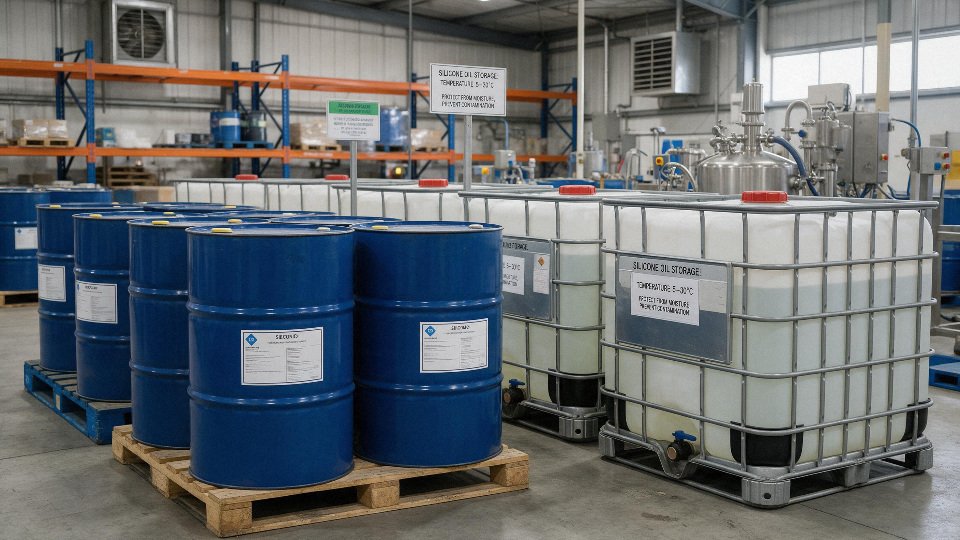
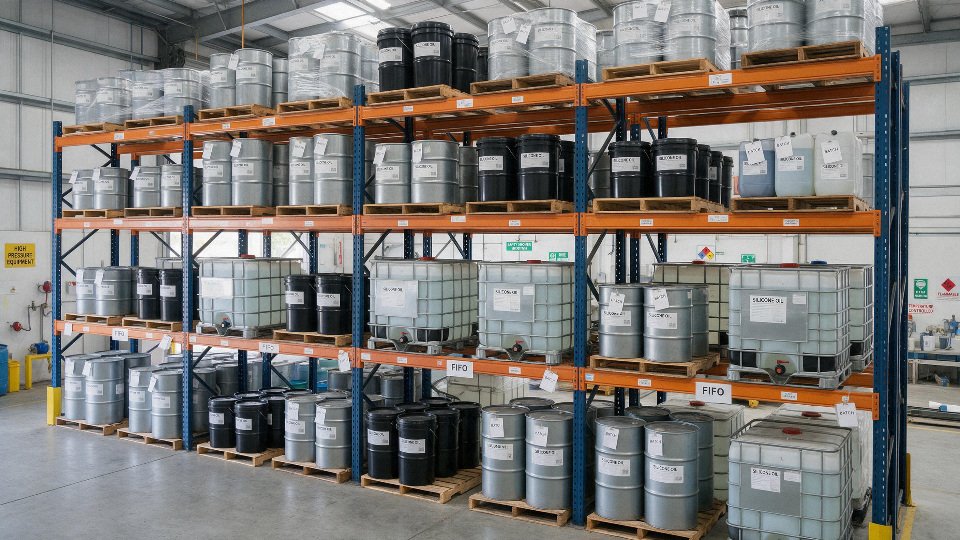
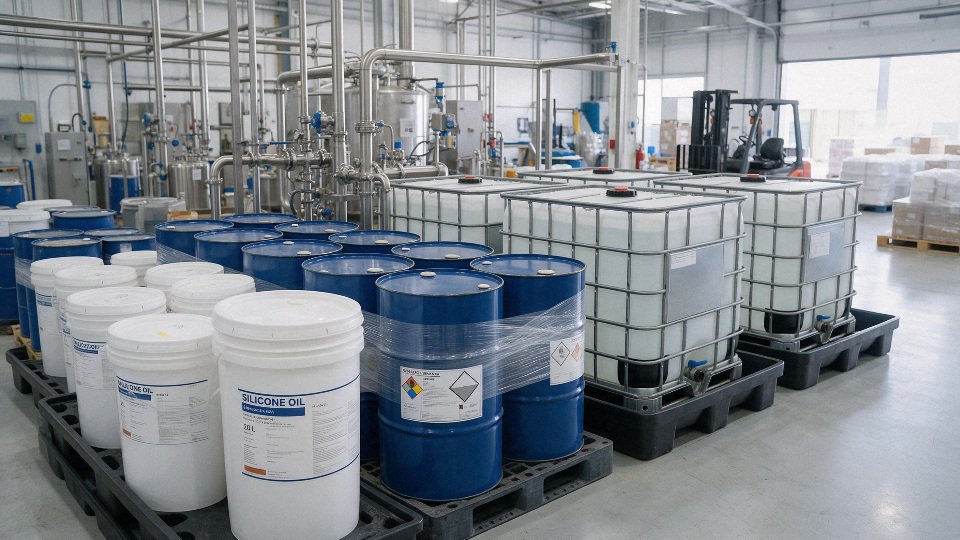
Packaging, logistics, and commercial risk controls
For export and plant handling, confirm:
- Drum, IBC, or bulk delivery options
- Net weight and fill tolerances
- Shelf life
- Storage temperature guidance
- Resealing, nitrogen blanketing, or moisture-protection needs if any
- Lead time by package type and region
Commercially, also ask:
- Sample policy and sample lead time
- Technical review support for the actual application
- After-sales troubleshooting scope
- Response time expectations for global industrial accounts
- Complaint handling and replacement terms

If the supplier cannot map its data package to your exact duty, send them the operating temperature window, atmosphere, residence time, materials of construction, and whether the system is open, closed, or under vacuum. You will get a much better answer than “our 100 cSt grade is commonly used.”
Frequently asked questions
Does silicone oil have a fixed boiling point?
Usually no. Most industrial silicone oils are not treated like a pure solvent with one sharp boiling temperature; they are fluid mixtures or molecular distributions, so they tend to show a boiling range, rising vapor loss, or decomposition behavior rather than one clean number.
At what temperature does silicone oil start to evaporate?
Evaporation starts well below any reported “boiling point.” In practice, the onset and rate depend on:
– molecular weight distribution
– viscosity grade
– open vs closed system
– air flow over the surface
– residence time at temperature
– contamination with low-boiling fractions or solvent
That is why a bath can lose fluid slowly at temperatures that are still far below the flash point and nowhere near any lab boiling estimate. For production planning, mass loss over time is often more useful than asking for a single start temperature.
Is flash point the same as boiling point?
No, and mixing them up causes bad equipment choices. Flash point is the temperature at which enough vapor forms above the liquid to ignite under a defined test method; boiling behavior is about vapor pressure becoming high enough for bulk vaporization. A silicone oil can have a flash point in the broad range often seen for these fluids, roughly 150 to above 300 C depending on grade and formulation, without that number telling you its true high-temperature service limit.
**Why do some data sheets omit boiling point?****
Because for many silicone oils, a single boiling-point value is not technically representative. Suppliers may publish viscosity, flash point, volatility, pour point, and recommended operating range instead, since those data are usually more decision-relevant for heat transfer, release coating, damping, or vacuum applications.
A missing boiling point on a silicone-oil data sheet automatically means poor quality.False
Often the omission reflects the fact that the product does not exhibit one clean, universally useful boiling point under normal industrial interpretation. The quality question is better answered by volatility, thermal stability, lot consistency, and application test data.
Can silicone oil decompose before boiling?
Yes. Under enough heat, especially with air exposure, catalytic contamination, or long residence time, some silicone fluids begin to degrade before they ever show a neat boiling event. The mechanism matters: oxidation and chain scission can generate lighter fragments, which then increase odor, smoke, volatility, and viscosity drift. Once that starts, the fluid may still look usable for a while, but heater fouling and deposit formation usually follow.
Does higher viscosity mean higher heat resistance?
Not automatically. Higher viscosity often correlates with higher molecular weight, which can reduce volatility and often raise flash point, but it does not guarantee better thermal life in every service. The preferred choice flips when your process needs fast heat transfer, pumpability at startup, or narrow control at low temperature; then an overly viscous oil can create circulation problems that hurt the system before thermal stability becomes the limiting factor.
**How does pressure affect silicone oil boiling behavior?****
Lower pressure lowers the temperature at which volatile fractions come off. In vacuum service, that means a fluid that behaves acceptably in an atmospheric bath may show noticeable outgassing, foaming, or fraction loss once pressure drops. Under elevated pressure, apparent boiling is suppressed, but that does not remove decomposition risk.
What test data matter most for open heating baths?
For open systems, ask for:
– flash point, with test method identified
– recommended continuous bulk operating temperature
– volatility or evaporation-loss data versus temperature and time
– oxidation stability, if available
– viscosity change after heat aging
– residue or deposit tendency after thermal exposure
Open baths are punished by air contact and surface renewal. If the supplier only provides a flash point, you still do not know how fast the bath will shrink or thicken over a few months of production.
What test data matter most for vacuum service?
For vacuum duty, focus on:
– vapor pressure data at the actual operating temperature range
– mass loss under vacuum, if available
– outgassing behavior
– viscosity at operating and startup temperatures
– any decomposition or fractionation notes from supplier testing
If a vendor cannot provide vapor-pressure-related information, you are estimating blind. For a critical vacuum process, sample testing under your actual pressure, temperature, and dwell time is worth more than a generic brochure claim.
How should silicone oil be stored to preserve thermal performance?
Use basic chemical-housekeeping discipline:
– keep containers sealed to limit moisture, dust, and solvent contamination
– store away from heat and direct sun
– use clean transfer pumps, hoses, and fittings dedicated to silicone service where possible
– avoid mixing grades unless the supplier confirms compatibility
– label opened drums with date and batch
– keep drums and totes closed between draws; half-open bungs in a warm warehouse are asking for trouble
A surprising amount of “thermal failure” starts as storage or handling contamination. Rust fines, amine residues, cleaning solvent carryover, even the wrong gasket compound can shorten fluid life once the system gets hot.
Your next product verification
A usable purchase decision starts from the duty, not from a single quoted boiling point. For silicone oil, the right grade is usually the one that survives your actual temperature profile, volatility limit, atmosphere, pressure, and contamination sensitivity with acceptable fluid life, even if no one can give you one universal “boiling number” that applies cleanly to the service.
If the system runs at modest bulk temperature but creates hot films on heater walls, pump clearances, or mold surfaces, that detail will decide the grade faster than any catalog shortcut. The same fluid can behave acceptably in a nitrogen-blanketed closed loop and lose too much mass in an open, air-exposed bath.
Qualification workflow
- Define the true bulk operating temperature
- Record normal, maximum, and upset temperature.
- Separate continuous temperature from short excursions; a 20-minute overshoot is not the same as 24/7 operation.
- Estimate the highest film or surface temperature
- Check heaters, jackets, cartridge elements, hot transfer surfaces, and low-flow areas.
- In practice, fluid degradation often starts here first, not in the tank average.
- Identify whether the system is open or closed
- Open baths, vented tanks, and wiped-film exposure raise volatility and contamination concerns.
- Closed systems usually control loss better, but only if venting, condensation, and expansion design are sound.
- Confirm pressure conditions
- Vacuum service, reduced pressure, or repeated pressure cycling can shift evaporation behavior enough to change the grade choice.
- Do not assume atmospheric data applies directly.
- List all contact materials
- Include elastomers, seal faces, hose liners, coatings, reservoir materials, and any process-contact substrate.
- A fluid that is thermally acceptable can still create trouble through seal swell, extractables, or surface transfer.
- Set a fluid-life expectation
- Decide whether you need weeks, months, or multi-year service between changes.
- That target affects acceptable viscosity drift, color change, volatiles loss, and maintenance frequency.
Minimum supplier package to request
- Technical data sheet
- Viscosity grade, typical flash point range, density, pour point if relevant, and recommended use range.
- Certificate of analysis
- For the actual lot or agreed supply standard.
- Thermal-property method details
- Test method, sample condition, atmosphere, and whether values are typical, specification limits, or development data.
- Compatibility guidance
- Especially for seals, coatings, plastics, and process-contact surfaces.
- Trial sample
- Enough volume for bench aging, loss testing, and a short plant trial.
A common buying mistake is accepting a property table without asking how each number was obtained. If the supplier cannot distinguish between a general product-family statement and lot-specific quality data, procurement risk goes up quickly.
Plant-side verification before full release
- Run a small-batch thermal aging test at your expected bulk temperature and, if possible, a higher film-temperature simulation.
- Track evaporation or mass loss over time under your actual exposure condition: open air, inert gas, or partial vacuum.
- Perform a seal and gasket compatibility check on the specific elastomers in service.
- Build a startup inspection plan:
- venting
- foaming observation
- filter loading
- odor or smoke changes
- viscosity shift after the first run period
If you are narrowing a grade now, send SiliconChemicals your bulk and peak temperatures, target viscosity, open or closed system type, pressure condition, contamination sensitivity, and any regulatory or material-compatibility requirements. With that, they can review the application and recommend a matched silicone oil grade or a customized organosilicon solution for trial evaluation.