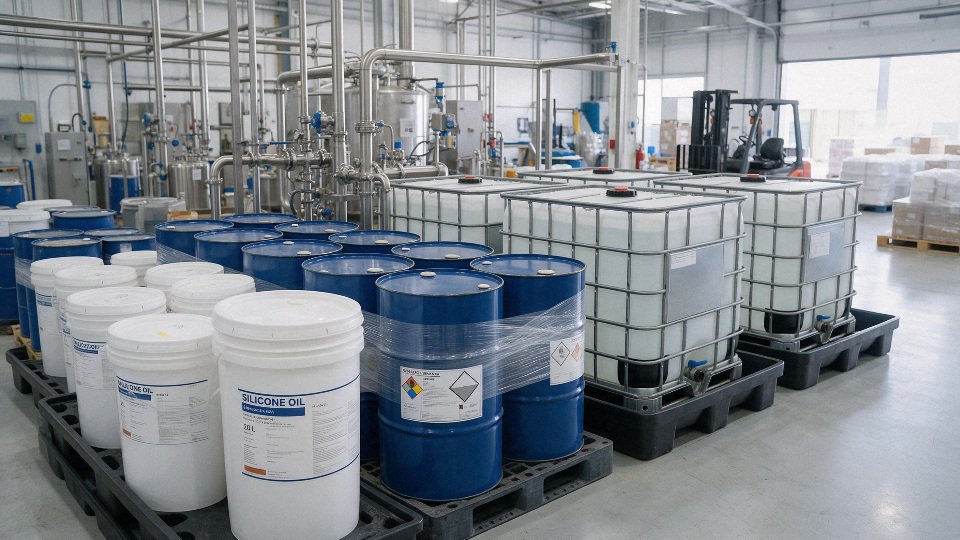
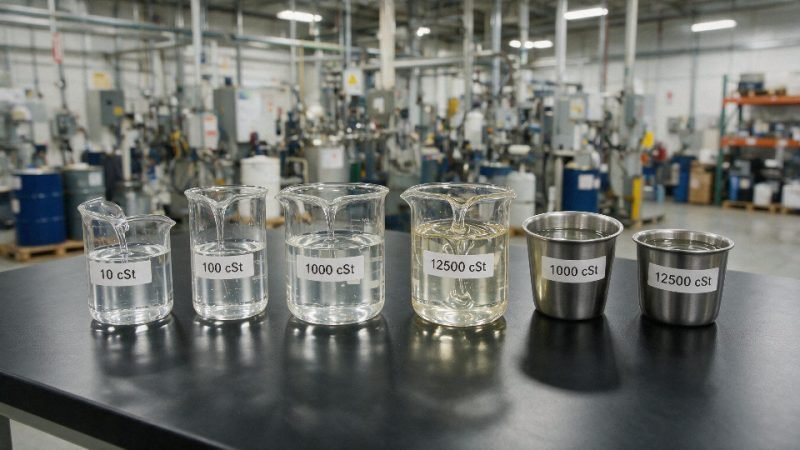
A silicone oil that is too thin will leak past seals, lose film strength, and stop damping or lubricating the way the machine was designed to. Too thick, and you get slow response, poor wetting, harder pumping, cold-start trouble, and operators compensating elsewhere in the process. That turns into scrap, unstable cycle times, nuisance maintenance, and buying the wrong grade twice. The fix is not guessing by “light” or “heavy” oil, but matching viscosity to temperature, shear conditions, part geometry, and the job the fluid actually has to do.
Silicone oil viscosity typically ranges from about 0.65 cSt to above 1,000,000 cSt at 25 C, depending on molecular structure and product type. Common industrial grades include 10, 50, 100, 350, 1000, 12,500, and 60,000 cSt, with silicone oils usually changing viscosity less with temperature than many mineral oils.
That broad range is exactly why viscosity causes so many buying mistakes. Two drums can both be called “silicone oil” and behave nothing alike in a dosing line, release coating, damper, textile bath, or vacuum pump service. The useful question is not just “what is the viscosity,” but which viscosity band holds its performance once your line heats up, slows down, or sits through winter startup.
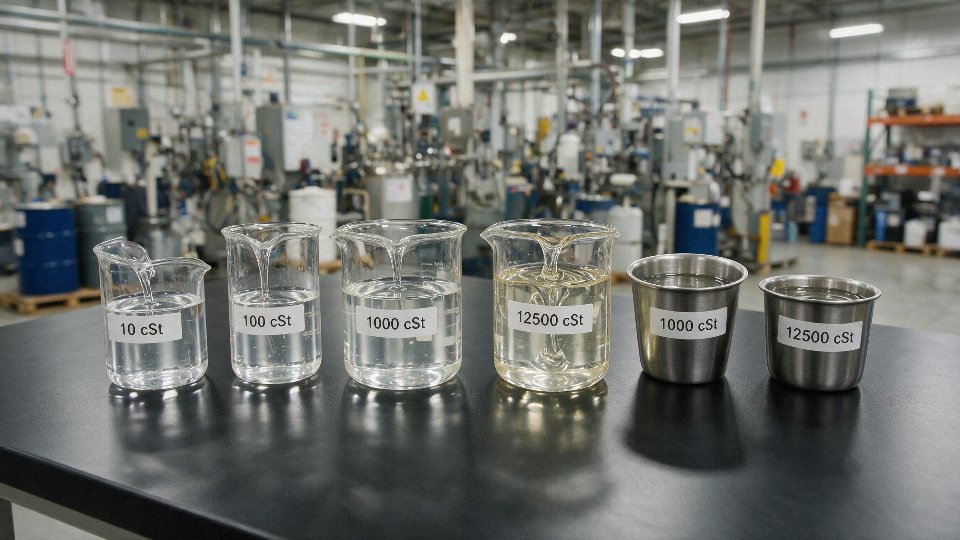
Typical viscosity ranges
Silicone oil sold commercially spans roughly 0.65 cSt to well above 1,000,000 cSt at 25 C, but that headline number hides an important purchasing reality: most industrial buying happens in a much narrower band of standard grades such as 10, 50, 100, 350, 1000, 12,500, and 60,000 cSt. The right grade is driven less by a catalog number than by how the fluid must move, wet, stay in place, and be metered inside your process.
A buyer asking for “silicone oil viscosity” is usually trying to solve one of four plant-floor problems:
- The fluid must spread quickly over a substrate
- It must stay put long enough to lubricate, release, damp, or protect
- It must be pumpable and doseable through existing equipment
- It must hold performance across a temperature swing without the process drifting out of spec
That is why the same chemistry family can appear as a water-thin fluid in one application and a heavy, stringy material in another.
Commercial viscosity bands and what they mean in practice
The broad commercial market can be split into three practical bands, with a fourth upper end where terminology starts to change.
| Practical band | Approximate viscosity at 25 C | How it behaves in handling | Typical use pattern |
|---|---|---|---|
| Very low to low viscosity | about 0.65 to 20 cSt | Fast spreading, easy pumping, low film build | Carrier fluids, release, rapid wetting, specialty blends |
| Medium viscosity | about 50 to 1,000 cSt | Balanced mobility and persistence | Lubrication, damping, textile treatment, cosmetic and process uses |
| High viscosity | about 5,000 to 60,000 cSt | Slow flow, thicker residual film, harder metering | Defoamers, polishes, durable surface films, some dielectric and damping uses |
| Extremely high viscosity / gum-like | above about 100,000 cSt and extending upward | Very slow flow to non-flowing appearance | Silicone polymer intermediates, gum systems, compounding rather than simple fluid service |
Those boundaries are practical, not absolute. One supplier may market a 5,000 cSt product as a high-viscosity fluid; another may place it in a mid-high band. What matters on site is whether the material still behaves like a pumpable liquid in your storage, transfer, and application system.
Silicone oil viscosity can extend from below 1 cSt to above 1,000,000 cSt, depending on molecular structure and grade.True
This is consistent with established commercial silicone fluid ranges, but the exact upper and lower limits depend on chemistry type, molecular architecture, and supplier product definitions.
Common grade names buyers actually see
In day-to-day procurement, silicone oils are often identified by nominal viscosity grade at 25 C. The common naming convention is simple: a product sold as 10 cSt or 1000 cSt is generally targeted to that nominal viscosity class, subject to supplier tolerance and test method.
Typical grades frequently encountered include:
- 5 cSt
- 10 cSt
- 50 cSt
- 100 cSt
- 350 cSt
- 1000 cSt
- 5000 cSt
- 12,500 cSt
- 60,000 cSt
These numbers are useful shorthand, but they are not the whole specification. In purchasing, it is worth confirming:
- The test temperature, usually 25 C
- The test method used by the supplier
- Whether the grade is a straight dimethyl silicone fluid or a modified silicone
- The acceptable viscosity tolerance
- Whether the product is sold by nominal value or a tighter internal control band
I have seen buyers assume that one supplier’s 350 cSt will drop straight into a dispensing system tuned around another supplier’s 350 cSt. Sometimes it does. Sometimes the line starts pulsing, the needle drips differently, or the coating weight shifts just enough to create rework.
Low-viscosity grades: where fast wetting matters more than staying power
Low-viscosity silicone oils, typically from sub-1 cSt up through 10 or 20 cSt, are chosen when the fluid has to move easily and cover a surface quickly. These are the grades that tend to behave well in fine dosing, light spray application, or formulation work where the silicone is one component among several.
Common uses include:
- Release agents where a thin, even film is needed without heavy residue
- Spreading fluids for rapid substrate wetting
- Carrier fluids in specialty formulations
- Light surface treatment systems where low drag-out matters
- Applications requiring quick leveling after application
The mechanism is straightforward: lower viscosity reduces internal resistance to flow, so the fluid moves into surface features and forms a film faster. That helps with wet-out and coverage, but it also means the film can migrate, drain, or transfer away more easily. If the process needs persistence under load or over time, very low viscosity often becomes a liability.
A release-coating line is a good example. A 5 cSt fluid may give excellent initial spread and easy atomization, but if the substrate is warm or the line speed is high, the film may become too mobile to maintain the target deposit uniformly. At that point, stepping up viscosity can improve control even if the fluid is still chemically similar.
Medium-viscosity grades: the broad industrial working range
For a lot of factories, 50 to 1,000 cSt is the practical center of the market because it balances mobility with enough body to stay where you put it. This is where many buyers land if they are not chasing extreme wetting or an unusually heavy residual film.
Typical applications include:
- Lubricants for specific low-load or specialty service conditions
- Hydraulic damping in controlled-motion devices
- Cosmetic bases and personal-care formulations
- Textile treatment where hand feel and surface effects matter
- General process fluids in equipment or formulation systems
The trade-off sits right in the middle of this band. As viscosity rises, the fluid usually gives better film retention and often more stable damping behavior, but you give up easy pumping, quick filling, and sometimes blend speed. In a cool plant, that trade-off becomes more noticeable. A material that transfers fine in July may become sluggish in January if the day tank is near an exterior wall and nobody heat-traces the line.
For damping service, this middle band is often where engineering decisions are made. Too low, and the motion control becomes loose or inconsistent. Too high, and startup torque rises, response slows, or assembly becomes messy. The best grade is usually the one that delivers the target motion profile across the actual operating temperature, not the one with the highest nominal viscosity on paper.
High-viscosity grades: film durability at the cost of handling ease
Once you move into roughly 5,000 cSt, 12,500 cSt, 60,000 cSt, and upward, the fluid starts behaving like a heavy, persistent material rather than a general-purpose process liquid. These grades are chosen when the silicone must remain on the surface, resist displacement, or contribute body to a formulation.
Common uses include:
- Defoamer systems, often as one component in a broader formulation
- Polishes where durable gloss and film presence matter
- Damping fluids needing stronger resistance to movement
- Dielectric fluid uses in cases where the formulation calls for heavier silicone fluids
- Compounds requiring a durable surface film
This is the range where a common misunderstanding causes trouble: higher viscosity is not automatically better. You gain film thickness, residence, and often a more durable surface effect. You may lose:
- Pumpability through small lines or long transfer runs
- Accurate metering from gear pumps, piston fillers, or time-pressure dispensers
- Heat transfer efficiency where fluid circulation matters
- Mixing speed and batch turnaround
- Clean drain-down from drums, totes, and process vessels
In practice, the penalty often shows up as labor. Operators start warming drums with improvised methods, using larger suction hoses, or manually scraping product from transfer containers. That may be acceptable in a small specialty line. It is a bad habit in a plant trying to run repeatable output across shifts.
When “viscosity grade” becomes “polymer” or “gum”
At the extreme upper end, silicone materials may still be described by viscosity, but the word “oil” stops being fully useful. Very high apparent viscosity can shift the product classification toward silicone polymer or silicone gum, and that change affects more than terminology.
Handling differences can include:
- Need for heavier-duty mixing or kneading equipment
- Limited or impractical pumping with standard fluid-transfer hardware
- Different packaging formats
- Different expectations for dilution before use
- Different purchasing and storage logic than ordinary liquid silicone oil
That boundary matters because a buyer may specify “high-viscosity silicone oil” expecting a thick but pourable fluid, while the supplier may offer a material that behaves more like a soft gum. At that point, line compatibility, unloading method, and sample validation become more important than the nominal viscosity figure.
The practical decision is not to chase the highest or lowest number, but to match viscosity to the job the fluid must do after it leaves the drum. If you are comparing grades across suppliers, the next check should be whether the quoted viscosity is measured at the same temperature and whether your transfer, dosing, and application equipment can hold control at that grade.
What controls viscosity
Silicone oil viscosity is controlled first by molecular architecture, not by a single generic “silicone” property. Chain length, side-group chemistry, branching, formulation additives, and temperature all push flow resistance in different ways, which is why two fluids both labeled 100 cSt at 25 C can behave quite differently once they are heated, pumped, sprayed, or laid down as a film.
The useful buying lesson is straightforward: nominal viscosity is only the entry point. If the fluid has to meter cleanly through a gear pump, wet a substrate, survive heat, release foam, or stay stable in an emulsion, you need to look at what is creating that viscosity, not just the number on the COA.
Chain length and molecular weight
For standard linear silicone fluids, viscosity usually rises as polymer chain length and molecular weight increase. Longer chains have more opportunity to entangle and drag past one another, so the internal friction goes up and the fluid flows more slowly under the same shear and temperature.
That sounds obvious, but it matters on the plant floor because the same increase in chain length that gives you better film persistence or lubricity can create practical handling changes:
- Higher pump starting torque
- Slower drum emptying in winter
- Longer mixing times
- More air entrainment during transfer
- Harder filtration through fine cartridges
- Slower leveling on coated surfaces
At the low end of the range, very short-chain silicone fluids can pour almost like light solvents. As molecular weight climbs, the feel shifts from free-flowing liquid to syrup-like behavior, then into very heavy gum-like material at the highest viscosities. Somewhere in that transition, your equipment choice changes too. A fluid that moves happily through centrifugal transfer at low viscosity may need positive-displacement pumping once you get into the heavy grades.
The mechanism is not just “thicker equals harder to move.” Longer polymer chains also broaden the gap between lab viscosity and application behavior. In practice, a high-molecular-weight fluid is more sensitive to shear history, residence time in heated lines, and contamination with small amounts of solvent or incompatible process fluid.
Why silicone oils flow differently from many hydrocarbon fluids
Silicone oils are unusual because the siloxane backbone is highly flexible and the intermolecular attraction between chains is relatively low compared with many hydrocarbon-based oils. That combination is a big part of why silicone fluids often keep a more stable viscosity over temperature and remain workable across a wide operating window.
The Si-O-Si backbone has a bond geometry that lets the chain move with less rotational resistance than a typical carbon-chain fluid. At the same time, many common silicone oils, especially dimethyl types, do not pack together as tightly as hydrocarbon molecules with stronger cohesive interactions. So even when molecular weight is high, the fluid can still retain a characteristic smooth flow profile.
That is one reason silicone oils are often selected where temperature swing matters:
- Outdoor dosing systems
- Release coatings exposed to seasonal shifts
- Heat transfer or thermal bath service, where allowed by the product design
- Textile, paper, and finishing lines where startup and steady-state temperatures differ
Silicone oils usually show a smaller viscosity change with temperature than many mineral oils.True
This is a well-established material behavior of many silicone fluids, but the exact difference depends on the specific silicone chemistry, viscosity grade, and the mineral oil being used as the comparison benchmark.
There is a trade-off, though. The same low intermolecular attraction that helps flow can also influence wetting, spreading, migration, and compatibility. A buyer who looks only at viscosity may miss the fact that a silicone fluid can move beautifully through the piping but behave unexpectedly on a substrate or in a mixed formulation.
How side groups change viscosity and behavior
Side-group chemistry can move viscosity directly, and just as often it changes the broader flow behavior around the viscosity number. Methyl is the common baseline for many standard silicone oils, but once you shift to phenyl, amino, epoxy, polyether, or fluoro modification, you are not just tweaking thickness. You are altering polarity, compatibility, surface interaction, thermal behavior, and sometimes the way the fluid responds under shear.
A practical breakdown:
- Methyl-modified silicone oils
- Usually the reference point for standard dimethyl silicone fluids
- Good flow stability across temperature
- Often used where inertness and broad process latitude matter
- Phenyl-modified silicone oils
- Can change low-temperature behavior, refractive properties, and heat resistance
- May show different solvency and compatibility versus straight dimethyl fluids
- Useful where thermal exposure or specialty optical performance matters
- Amino-modified silicone oils
- Introduce polar functionality
- Often used for textile softness, conditioning, or substrate affinity
- Viscosity alone becomes a weak predictor because deposition and interaction with the surface start to matter more
- Epoxy-modified silicone oils
- Can improve reactivity or adhesion-related performance in certain formulations
- Processing window depends heavily on the rest of the system, especially catalysts and cure conditions
- Polyether-modified silicone oils
- Often selected for emulsification behavior, wetting, or defoaming balance
- Their water affinity and formulation compatibility can shift apparent viscosity in finished systems
- Fluoro-modified silicone oils
- Used where chemical resistance, low surface energy, or specialty interface behavior is needed
- Usually a case where cost rises sharply, so the property package has to justify it
This is where purchasing mistakes happen. Two products may be listed at the same nominal cSt, but if one is a simple dimethyl fluid and the other is functionally modified, the line behavior, substrate response, and storage stability may diverge enough to matter commercially.
Linear, branched, and resin-like structures
Linear silicone oils are the cleanest case for predicting viscosity from molecular weight. Once branching enters, the relationship gets less intuitive. Branching can increase apparent bulkiness, alter chain mobility, and change how the molecules occupy space, so the measured viscosity and the shear response can shift away from what a buyer expects from a linear fluid of similar nominal molecular weight.
Structures worth separating:
- Linear fluids
- Most predictable flow behavior
- Easier to relate grade selection to pumpability and coating feel
- Branched fluids
- Can show different response under mixing or pumping
- May build body without behaving exactly like a longer linear chain
- Materials with crosslink tendency or resin-like character
- Can move toward much higher apparent viscosity
- Often less forgiving in storage and process control
- More likely to show application-specific behavior that the simple cSt number does not capture well
The boundary here is important: if you are no longer dealing with a neat fluid but with a reactive intermediate, highly structured oligomer, or resin-containing blend, standard viscosity comparisons become less transferable. In that case, test method, shear rate, solids content, and age of the sample start driving the result.
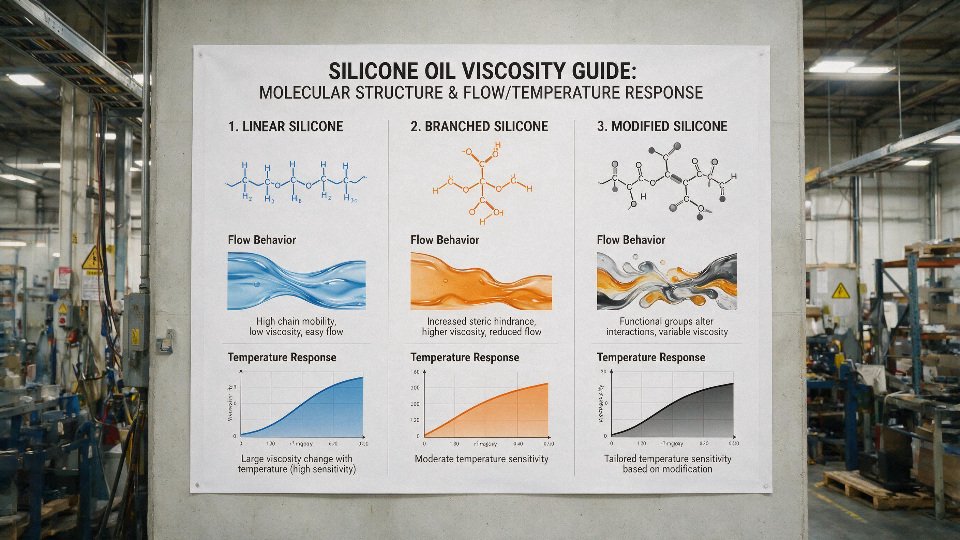
Formulation ingredients can change the measured viscosity
Once silicone oil is part of a formulation, the measured viscosity may reflect far more than the base fluid. This is especially common in emulsions, release systems, defoamers, textile auxiliaries, and specialty surface-treatment packages.
Ingredients that often shift viscosity or apparent flow behavior:
- Fillers
- Increase bulk viscosity
- Can create structure or thixotropy
- Particle size and dispersion quality matter as much as loading
- Emulsifiers or surfactants
- Change phase structure in emulsions
- Can raise or lower apparent viscosity depending on droplet size and system balance
- Solvents
- Usually reduce viscosity, sometimes dramatically
- Also alter evaporation rate, flash point, and wetting
- Catalysts
- May have little immediate viscosity effect at low levels, but can change storage stability or trigger viscosity drift if the system is reactive
- Antifoam actives and carriers
- The active silicone may be low or moderate viscosity, while the finished product’s handling is dominated by carrier oil, hydrophobe, silica, or emulsion structure
In procurement terms, this is why substituting on “same cSt” alone is risky. If one supplier quotes the neat silicone fluid and another quotes a formulated product, the viscosity numbers may look comparable while the delivered process performance is not.
Temperature, molecular distribution, and why equal 25 C viscosity is not enough
A 25 C viscosity spec is useful, but it is not a complete predictor. Silicone oils usually retain viscosity more consistently over temperature than many mineral oils, which is one reason they are preferred for applications that see cold starts, hot running, or both. Still, the actual operating curve depends on chemistry and molecular distribution, not just the headline grade.
Two products with similar nominal viscosity at 25 C can differ because of:
- Volatility
- Lower-molecular-weight fractions may evaporate under heat
- Over time, that can shift viscosity upward in service and change residue behavior
- Molecular weight distribution
- A narrow distribution may give more consistent performance batch to batch
- A broader distribution can affect pour feel, evaporation profile, and process stability
- Interfacial behavior
- Surface tension, wetting, and compatibility with substrates or additives affect how the fluid spreads, beads, releases, or migrates
- This often matters more than bulk viscosity in coatings, defoaming, and finishing work
- Shear response in the actual formulation
- Especially relevant in emulsions, filled systems, and modified fluids
So if the job is sensitive, do not stop at the nominal cSt value. Check the application temperature range, whether the product is neat or formulated, the functional groups present, and whether volatility or surface behavior could change the result after the fluid leaves the drum.
How viscosity is measured
A silicone oil viscosity number is only comparable if four things match: the viscosity type, the temperature, the test method, and the reporting basis. A label like “100 cSt” is not a complete technical description by itself; without the measurement conditions, buyers can compare two fluids that look equivalent on paper and behave differently in the line.
The first distinction is simple but often missed in procurement documents: kinematic viscosity is not the same as dynamic viscosity.
- Kinematic viscosity is usually reported in cSt or mm²/s. It reflects how fast a fluid flows under gravity relative to its density.
- Dynamic viscosity is usually reported in mPa·s or cP. It reflects the shear resistance of the fluid itself.
- The two are linked by density:
dynamic viscosity = kinematic viscosity × density - That means a conversion from cSt to cP is only valid if you know the fluid density at the same temperature.
In practice, many silicone oil data sheets use kinematic viscosity because it is the standard language for a lot of industrial fluid grades. That works well for specification and incoming QC, but it can trip people up in application design. A pump vendor may want dynamic viscosity for pressure-drop or torque calculations, while your chemical supplier quotes kinematic viscosity. If the density assumption is wrong, the calculated load on the pump or atomizing behavior in a spray system can be off enough to matter.
Common test methods and what they are good at
No single instrument covers the full silicone oil range equally well. Labs choose methods based on viscosity level, expected shear behavior, and the standard being followed.
- Capillary viscometry
- Common for low to medium viscosity silicone oils
- Measures the time for a set volume of fluid to pass through a calibrated capillary under controlled conditions
- Well suited to Newtonian fluids, which many standard silicone oils approximately are within normal test ranges
- Often used when the product is sold by a nominal cSt grade
- Rotational viscometry
- More common for higher-viscosity materials or when a broader operating range is needed
- Measures torque required to rotate a spindle or geometry in the sample
- Useful when flow behavior under shear matters to the application
- Method details matter a lot: spindle type, speed, geometry, and temperature all affect the reported number
- Temperature-controlled standardized testing
- This is not a separate instrument so much as the discipline around the test
- The bath, chamber, or test cell must hold the sample at the stated reference temperature long enough for the whole sample to equilibrate
- Current supplier documentation and the cited standard should always be checked, especially for acceptance testing or dispute resolution
Why temperature control matters so much
Even though silicone oils usually change viscosity less with temperature than many mineral oils, they still change enough that sloppy temperature control creates bad data. This shows up fastest on lower-viscosity grades. If you test a fluid that is nominally 10 cSt or 50 cSt and your sample is even a little warmer than the stated reference point, the result can drift enough to trigger a false out-of-spec call or a pointless supplier argument.
The mechanism is straightforward: as temperature rises, molecular mobility increases and internal resistance to flow drops, so measured viscosity falls. On the bench, the error often comes from poor equilibration rather than the instrument itself. A sample taken from a warm warehouse, transferred into a room-temperature tube, and tested too quickly may not actually be at the stated 25 C throughout. In my experience, this is one of the most common reasons two labs get different answers on the same drum.
What must be reported with the viscosity value
A useful viscosity value needs context. Without it, the number is little more than sales shorthand.
Include or request all of the following:
- Viscosity type
- Kinematic or dynamic
- Units
- cSt, mm²/s, cP, or mPa·s
- Reference temperature
- Often 25 C, but not always
- Test method or standard
- The exact standard, or at least the instrument method, if no standard is cited
- Result basis
- Nominal grade, typical value, minimum/maximum limit, or lot-specific COA value
That last point matters commercially. A product sold as a 100 cSt grade is usually not an absolute single-number material. It is typically a commercial grade centered around a target viscosity with an acceptable production window. One supplier may market on nominal grade, another on typical viscosity, and another on a specification band. Those are not interchangeable.
Two silicone oils both sold as 100 cSt can be materially different for quality control and process setup if one value is a nominal grade at 25 C and the other is a typical test result under different conditions.True
The same nominal grade can sit within different supplier tolerance windows, and differences in temperature, method, and reporting basis can shift the stated value enough to create false equivalence.
Batch tolerance, uncertainty, and commercial acceptance
Manufacturers do not run viscosity production to a mathematically exact point every batch. Polymerization control, blending accuracy, raw material variation, and test uncertainty all show up in the final number. Good suppliers define an acceptable viscosity window for each commercial grade, then verify lot results against that window.
From a buyer’s side, separate these three things:
- Process variation
- Normal lot-to-lot movement within the supplier’s allowed range
- Measurement uncertainty
- Instrument, operator, calibration, and temperature-control limits
- Specification nonconformance
- A batch that actually falls outside the agreed acceptance band
The trade-off is practical. Tighter viscosity windows improve process consistency in dosing, coating weight, spray performance, or release behavior, but they can also increase cost, lead time, or batch rejection risk. The preferred balance flips when the application becomes sensitive to small rheological changes, such as precision metering, fine atomization, or narrow coating uniformity targets.
Why plant-floor checks help, but do not replace lab data
Operators notice viscosity indirectly all the time:
- pouring speed from a pail
- drum emptying time
- pump amperage trend
- spray fan shape
- misting behavior
- wet-out on the substrate
Those clues are useful. They often catch a problem before the lab does. But they are not controlled measurements, and they mix viscosity effects with temperature, nozzle wear, line pressure, contamination, and even whether the tote sat near a steam line overnight. A spray pattern that looks “heavier” may be viscosity, or it may be a partially fouled tip.
So use field observation as a screening signal, not as release data.
The main boundary here is simple: if your process is insensitive and the fluid is used in a broad, forgiving way, nominal grade may be enough for purchasing. Once the application depends on repeatable flow, metering, atomization, or film build, you need the actual test conditions and acceptable viscosity window on the purchase specification. Comparing one supplier’s 100 cSt fluid at 25 C with another supplier’s 100 cSt fluid measured under different conditions is how false equivalence gets written into a PO and discovered only after startup.
Temperature and shear behavior
Silicone oil usually holds its viscosity across temperature swings better than many mineral oils, but that does not mean the working viscosity stays constant enough to ignore. In plant terms, the right grade is the one that lands in the usable viscosity window at actual operating temperature, not the one that feels right in a room-temperature sample jar.
The practical reason buyers care is straightforward: the same silicone oil can behave acceptably in a lab at 25 C, then miss the process once the line is at 60 C, the tank is in winter cold soak, or the dosing skid is cycling at high speed. Silicone fluids are often chosen because their viscosity changes less with temperature than many hydrocarbon oils, which is a big advantage in systems that need predictable damping, metering, lubrication, dielectric performance, or surface coverage over a broad temperature range.
Why temperature matters so much in service
Viscosity falls as temperature rises. That is true for almost any liquid, but silicone oils typically show a flatter viscosity-temperature curve than many mineral oils. In practice, that higher viscosity index means:
- Damping force stays more consistent as ambient temperature changes
- Metering drift is reduced across day-night or seasonal variation
- Pump start-up is easier in cold conditions for a given nominal viscosity
- Film thickness and leakage behavior are usually more predictable over temperature
The mechanism matters. As temperature rises, molecular mobility increases and internal resistance to flow drops. Silicone fluids, especially common dimethyl-based types, tend to resist that drop better because of their molecular structure. That helps in equipment where the process cannot tolerate a big swing in flow resistance or damping force.
Still, “better than mineral oil” is not the same as “immune.” A 100 cSt grade at 25 C may still become too thin for a seal, dashpot, or open-film lubrication point once the housing runs hot. On the other side, a 1000 cSt grade that doses fine in summer may become sluggish enough in an unheated warehouse or outdoor installation to overload a small gear pump or stall a pneumatic metering unit at start-up.
Silicone oil viscosity is unaffected by temperature in normal use.False
Silicone oils usually change viscosity less with temperature than many mineral oils, but they still thin when heated and thicken when cooled. Selection should be based on the actual operating temperature range, not the nominal viscosity at 25 C alone.
Low-temperature fluidity and cold-start behavior
This is one of the places where silicone oils earn their keep. Many grades stay mobile at low temperature where other fluids become waxy, sluggish, or simply unpumpable. That is why they are common in:
- Damping and motion-control devices
- Precision instrumentation
- Some aerospace and aviation-adjacent fluid applications, subject to system-specific qualification
- Outdoor electrical and mechanical equipment exposed to winter starts
- Small metering assemblies that cannot tolerate a big breakaway torque spike
On a plant floor, cold-start problems usually show up before anyone talks about rheology. Operators see delayed prime, pulsing flow, cavitation noise, relief valve chatter, or a dosing head that misses the first few cycles. If the fluid is too viscous at the lowest expected start temperature, you get:
- Higher suction losses
- Slower response in narrow tubing and needle valves
- More pressure drop across filters, strainers, and static mixers
- Greater motor load on positive displacement pumps
- Inconsistent shot size until the fluid warms
The preferred choice flips when low-temperature pumpability matters more than room-temperature leakage control or dwell. A thinner grade may start and meter cleanly in winter but give up sealing margin or damping force once the unit is fully warm.
High-temperature behavior: viscosity stability is not the whole story
A silicone oil can keep a relatively stable viscosity trend with temperature and still fail the application at elevated temperature. That distinction gets missed in purchasing specs all the time.
At higher temperature, you need to think about at least four different issues:
- Working viscosity: the fluid may become too thin to maintain film, seal, or damping resistance
- Evaporation loss: lighter fractions or lower molecular weight fluids can volatilize faster, especially in open or vented systems
- Oxidative degradation: air exposure, catalytic metals, and contaminants can accelerate fluid breakdown
- Residue and deposits: even where bulk viscosity looks acceptable for a time, thermal stress can leave gums, varnish, or silica-like residues depending on chemistry and conditions
The trade-off is simple enough: lower viscosity grades often flow and meter better, but they can have higher volatility and lower stay-in-place performance at heat. Higher viscosity grades may reduce migration and evaporation loss, but they are harder to handle during filling, transfer, and precision dosing.
Boundary condition: once the application moves into sustained high-temperature exposure, especially with air exchange, hot metal contact, or long residence time, you cannot rely on a viscosity data sheet alone. You need supplier thermal-aging data for the specific grade, and in many cases a site trial or compatibility test with the hardware.
Shear behavior in pumps, sprays, mixers, and coating lines
Many pure dimethyl silicone oils behave close to Newtonian over ordinary industrial shear ranges. That means their viscosity is mainly set by temperature and grade, not by whether the fluid is moving slowly in a tank or faster through a pump and line. For engineers, that is helpful: pressure drop, flow, and metering behavior are easier to predict.
In practice, that usually means:
- A pump curve stays fairly interpretable
- Shot size from positive displacement metering is more repeatable
- Atomization behavior in spray systems depends strongly on base viscosity, nozzle design, and pressure, not on dramatic shear-thinning
- Coating thickness control is more stable if temperature is controlled
But this is where people get caught: not every silicone-based product behaves like a pure Newtonian fluid. Formulated systems can deviate, especially if they contain:
- Fillers
- Thickeners
- Reactive components
- Emulsified phases
- High solids loading
- Additive packages that build structure at rest
Those products may show shear-thinning, thixotropy, or time-dependent recovery. A fluid that pumps well through a rotor-stator or gear pump may still level poorly after application, or a product that looks thick in a pail may spray better than expected once shear breaks down the structure. You need the actual formulation data, not assumptions based on “silicone oil” as a category.
What this changes in equipment selection
If you are sizing pumps, nozzles, filters, trace heating, or metering heads, use the viscosity at the actual line temperature and expected shear conditions. Room-temperature viscosity is useful for purchasing shorthand, but it is not enough for design.
A quick check list catches most avoidable mistakes:
- Confirm the fluid temperature at storage, transfer, dosing, and point of use
- Ask for viscosity-temperature data, not just one nominal cSt value at 25 C
- Check whether the product is a pure silicone fluid or a formulated system
- Verify low-temperature start-up viscosity against pump suction limits
- Verify high-temperature evaporation and aging behavior for open or hot-zone service
- Test atomization, coating, or dispensing on the actual hardware if pattern quality matters
A silicone fluid that looks perfect on a bench can turn into a leakage problem at heat or a dosing problem in cold weather. If the application window is narrow, the next useful step is not debating one more nominal grade; it is plotting the required viscosity band against the actual temperature range of the process and checking that against the supplier’s grade-specific data.
Application-driven grade selection
A workable silicone oil grade is the one that stays inside your process window while delivering the surface, motion, or formulation effect you actually need. The best choice is rarely the highest viscosity, the highest stated purity, or the broadest marketing claim; it is the grade that survives your temperature, substrate, line speed, and downstream cleanliness limits without creating a new problem two steps later.
On the plant floor, viscosity data becomes useful only when tied to how the material is applied and what failure mode matters most. A 350 cSt fluid that performs well in a wipe-on polish may be a poor fit in a high-speed spray release line. A low-viscosity fluid that wets beautifully in a textile finish may migrate too far, lose hand control, or interfere with later coating or bonding. That is where grade selection usually flips.
Release and mold applications
For release work, lower-to-medium viscosity grades are often preferred when you need fast spreading and thin, uniform transfer, while higher viscosities are used when persistence matters more than clean release appearance. In practice, the right range depends on how the oil is delivered, the mold geometry, the substrate surface energy, and how much residue the next operation can tolerate.
A few decision points matter more than the catalog grade list:
- Spreadability and wetting
- Lower viscosity oils usually wet faster and cover more area per unit mass.
- They suit wipe, dip, mist, or very light spray application, especially on fine-detail molds.
- If the substrate is hard to wet or the line is cold at startup, a lower viscosity can reduce misses and patchy release.
- Transfer control
- Too low a viscosity can over-transfer to the molded part.
- That becomes a problem before painting, printing, adhesive bonding, or secondary coating.
- In rubber and plastics work, this is where operators start complaining about “mystery contamination” that is really over-application plus too mobile a release fluid.
- Residue and buildup
- Higher viscosity grades tend to stay where you put them better, but they can build up on mold surfaces if the application rate is not controlled.
- Buildup changes part surface appearance, can trap fines, and eventually affects dimensional consistency or venting.
- Application hardware
- Air-assisted spray nozzles, felt wipers, and micro-dosing systems each have a practical viscosity ceiling.
- A grade that looks fine on paper may atomize poorly, string at the nozzle, or require heating to stay consistent.
The mechanism is straightforward: viscosity affects film thickness, mobility, and the rate at which the oil redistributes across the tool surface. That feeds directly into release uniformity and residue level. More persistence usually means more residual material unless dosage is tightened.
The trade-off is sharp here. Lower viscosity improves coverage and detail penetration; higher viscosity improves staying power and often reduces reapplication frequency. The preferred choice flips when downstream cleanliness becomes stricter than mold life extension, or when the mold runs hot enough that a lighter fluid evaporates or migrates too quickly.
Lubrication and damping applications
In lubrication and damping service, viscosity selection starts from motion and temperature, not from a generic “thicker is better” rule. If the fluid is too thin at operating temperature, you lose film strength or damping force; if it is too thick at startup, you get drag, poor response, cavitation risk in some geometries, or simply a device that will not move as designed.
Typical use cases split into two groups:
Boundary or light-load lubrication
- Slides, guides, plastic-metal contact points, slow mechanisms
- Seal lubrication
- Light-duty instrument or appliance components
For these, medium viscosities are commonly chosen because they balance mobility and retention. You want enough body to stay in the contact zone, but not so much that the mechanism feels gummy in cold conditions.
Damping and controlled motion
- Dashpots
- Door closers
- Instrument damping
- Small actuators and precision rotary elements
Here the viscosity is part of the functional design, not just a lubricant property. Drag force depends on fluid viscosity, gap geometry, and motion speed. A small viscosity change can materially alter response time in a narrow-clearance damper.
Selection checks should be explicit:
- Operating temperature range, including cold start
- Motion profile: continuous, oscillating, intermittent, shock load
- Leakage path size and seal design
- Target damping force or response time
- Contact material compatibility
- Whether the unit is serviceable or sealed for life
Silicone oils usually change viscosity with temperature less dramatically than many mineral oils, which is one reason designers use them in broad-temperature devices. But that does not mean one grade covers every climate. A unit that feels perfect at 25 C can become sluggish at 0 C or under-damped at 80 C if the viscosity margin is narrow.
A common purchasing mistake is to match only the nominal room-temperature cSt value from an incumbent product. If the equipment geometry, seal friction, or service temperature changed, that one-point match may miss the actual functional window.
Defoaming and process aid applications
In defoaming, the viscosity of the silicone fluid matters, but it is not the same thing as antifoam performance. Many buyers over-focus on the oil viscosity and under-check active content, carrier system, dispersion quality, and compatibility with the foaming medium.
A higher-viscosity silicone oil is not automatically a better defoamer.True
Antifoam efficiency depends on how the active phase enters and destabilizes the foam lamella, which is strongly affected by formulation architecture, particle phase if present, compatibility, and dosage method—not viscosity alone.
What to separate during selection:
- Base-fluid viscosity
- Influences handling, pumping, emulsification behavior, and persistence.
- Can affect droplet size and distribution in formulated antifoams.
- Active content
- A diluted antifoam and a concentrated one may use similar silicone fluid types but behave very differently at the point of addition.
- Compatibility
- If the silicone phase is too compatible with the liquid, it may not break foam efficiently.
- If it is too incompatible, it can create surface defects, craters, or deposits.
- Foam system
- Aqueous latex, fermentation broth, pulp processing, metalworking fluid, and solvent-borne coatings all need different antifoam logic.
In practice, viscosity matters most through the delivery path: storage stability, metering reliability, and dispersion after addition. The best grade for a paper machine white-water system may be wrong for a coating kettle even if both are “silicone-based defoamers.” Site testing usually decides the final choice.
Textile, leather, and paper treatments
For softening and surface treatment, medium viscosities are often the starting point because they give a workable balance of penetration and deposited feel. Lower viscosities penetrate faster and can feel lighter; higher viscosities usually build a richer surface effect but can interfere with absorbency, printability, or later lamination if overdone.
What buyers should check:
- Hand feel target
- Dry, silky, slick, waxy, bulky, or soft are not the same finish.
- Penetration depth
- Surface-rich effects and through-penetration require different mobility.
- Pickup control
- Padding, kiss-roll, spray, and exhaustion processes tolerate different viscosities.
- Downstream processability
- Printing, dyeing correction, gluing, embossing, and coating adhesion can all change after silicone treatment.
On leather lines especially, a heavier fluid can improve fullness and slip but may make edge finishing or topcoat adhesion more temperamental. In paper treatment, too mobile a fluid may penetrate away from the surface zone where release or slip is needed. You end up paying for silicone that is no longer doing useful work.
Cosmetics and personal care intermediates
Low-viscosity silicone oils are usually selected for light spread and a dry after-feel; medium grades bring more cushion and persistence. Volatile-modified or mixed systems are often used when formulators want fast initial slip without a heavy residue, but exact selection depends on the full formulation and the target market’s regulatory framework.
Selection should cover:
- Spreadability on skin or hair
- Residual feel after evaporation or absorption
- Compatibility with oils, waxes, emulsifiers, and actives
- Emulsion stability or anhydrous clarity
- Packaging and dispensing behavior
The boundary here is important: viscosity alone does not predict sensorial performance. Two fluids with similar nominal viscosity can behave differently if volatility, molecular architecture, or blend composition differs. Personal care work also has ingredient listing and regional compliance constraints, so procurement cannot treat it like a simple industrial substitution.
Electrical and thermal applications
For dielectric and heat-transfer related service, the right viscosity is the one that still circulates, insulates, and remains stable at service temperature. A low-viscosity fluid may improve heat transfer by circulating more easily in some system designs, but if volatility is too high or the operating temperature is near the fluid’s practical limit, losses and maintenance rise quickly.
Key checks include:
- Dielectric function required
- Service temperature, not just room temperature
- Natural convection versus pumped circulation
- Volatility and evaporation loss
- Materials compatibility with seals, varnishes, and plastics
- Supplier documentation for the specific grade
A fluid that is excellent in a sealed instrument may be unsuitable in an open or semi-open thermal system. This is one of those applications where you must verify the current equipment manual and grade-specific data rather than infer from the generic category.

Hydrophobic treatment and polishes
Medium-to-higher viscosity grades are often chosen when film persistence, gloss retention, and water beading matter most. Lower viscosities can level well and apply easily by spray or wipe, but they may produce a shorter-lived effect if the surface sees abrasion, repeated washing, or outdoor exposure.
Selection usually turns on:
- Application method: aerosol, trigger spray, wipe, dip, or machine buff
- Surface type: painted metal, stone, plastic, leather, rubber
- Desired finish: high gloss, satin, low-residue, anti-streak
- Durability requirement
- Recoat frequency acceptable to the end user
If the polish has to level fast on a large panel, an overly viscous fluid can drag or haze unless diluted or reformulated. On the other hand, if you go too light, the finish can look good for an hour and disappoint after the first cleaning cycle.
Process chemistry and formulation use
In formulations and process chemistry, viscosity is often only the second or third screening parameter. Reactivity, compatibility, flash point, volatility, and regulatory profile can eliminate a grade before viscosity is even discussed.
Use a practical screening order:
- Confirm the silicone oil is chemically appropriate for the system.
- Check compatibility with the main phase and additives.
- Screen safety and regulatory constraints for the intended market.
- Review operating temperature and handling method.
- Then optimize viscosity for application, mixing, dosing, or end-use performance.
That order saves time. I have seen teams spend days debating 100 cSt versus 350 cSt only to find the chosen fluid cannot be used because the downstream coating fisheyes, the flash point margin is wrong for the process, or the market requires a different ingredient profile.
Specification and purchasing checks
A silicone oil purchase is not properly specified when the PO says only “100 cSt.” That tells you one property, at one condition, and it is not enough to protect process stability, material compatibility, or repeat supply. For buying teams, the practical job is to verify product identity, viscosity definition, linked physical properties, compatibility, and supplier control before price is compared.
Check the exact product identity first
Two fluids can share a nominal viscosity and behave very differently in service because the base chemistry is different. A dimethyl silicone oil is not interchangeable with a phenyl-modified fluid, an amino silicone fluid, or a polyether-modified silicone just because the cSt number lines up on the data sheet.
At minimum, confirm which of these you are actually buying:
- Dimethyl silicone oil
- The standard reference family for many industrial uses
- Usually chosen for lubrication, release, damping, heat transfer in certain ranges, and general process use
- Often the benchmark when buyers casually say “silicone oil”
- Phenyl-modified silicone fluid
- Used where low-temperature behavior, refractive properties, or specific thermal/oxidative characteristics matter
- Can shift cost upward, so this needs to be intentional, not accidental substitution
- Amino silicone fluid
- Typically selected for softening, textile treatment, or surface interaction where reactivity/polarity matters
- Compatibility and end-use performance can be very different from non-functional dimethyl grades
- Polyether-modified silicone
- Common where wetting, spreading, emulsification, or defoaming behavior is required
- Often more sensitive to formulation compatibility and water-system behavior
- Custom blend or formulated fluid
- May include mixed silicone fractions, additives, stabilizers, or diluents
- Needs tighter definition because blend drift over time can show up as batch-to-batch performance change before it shows up in a simple viscosity check
In practice, a lot of procurement mistakes start with internal shorthand. Maintenance says “send me 350 cSt silicone,” purchasing sources the lowest quote, and production later finds residue, seal swell, or poor wetting because the chemistry was not the same as the qualified product.
Verify how the viscosity number is stated
Nominal viscosity without tolerance, test temperature, and method is an incomplete specification. A fluid listed as 100 cSt at 25 C is not directly comparable to one reported at another temperature, and a broad manufacturing tolerance can matter if the application depends on metering, film build, damping response, or spray behavior.
Check these points on the technical data sheet and, if the application is sensitive, on the certificate of analysis:
- Nominal viscosity
- Example: 50 cSt, 100 cSt, 1000 cSt
- Allowable tolerance or grade band
- Some applications can absorb normal variation
- Others cannot, especially where pump calibration, dispense volume, or motion damping is tuned tightly
- Reference temperature
- Usually stated at 25 C, but this must be confirmed
- Test method
- The method matters when comparing suppliers
- If one supplier uses a different method or reports dynamic rather than kinematic values without clear conversion context, comparisons can go sideways quickly
- Whether the quoted value is typical or guaranteed
- “Typical” is useful for engineering reference
- Procurement and quality should know which values are contractual
A viscosity value without its reference temperature and test method is not a fully usable purchasing specification.True
Silicone fluid viscosity is condition-dependent. To compare supplier offers or control incoming quality, buyers need the nominal value tied to a stated temperature and test method, ideally with an acceptable tolerance range.
Review the linked properties that often decide whether the fluid actually works
Viscosity gets the attention, but several other properties determine whether that viscosity remains useful in the line, on the part, or in storage. This is where technical buying usually separates a stable process from a recurring complaint file.
| Property | Why buyers should check it | Where it becomes critical |
|---|---|---|
| Density | Affects mass-volume conversion, fill weight, dosing, and inventory calculations | Drum filling, metering, export weight, formulation batching |
| Refractive index | Can indicate chemistry family and matter in optical or specialty uses | Optical fluids, inspection liquids, specialty formulations |
| Flash point | Safety, storage, transport, and heating margin | Heated tanks, hot-process dosing, plant safety review |
| Volatility | Drives evaporation loss, residue change, odor, and long-run stability | Open systems, heated application, thin-film use |
| Pour point | Indicates cold-start handling behavior | Winter storage, outdoor tanks, cold-region shipping |
| Surface tension | Affects spreading, wetting, release, and defoaming behavior | Coatings, release agents, textile and treatment lines |
| Dielectric properties | Needed where electrical insulation performance matters | Electrical equipment, dielectric baths, specialty electronics uses |
Here is the mechanism buyers often miss: lower-volatility, tighter-cut material may cost more per kilogram, but it can reduce top-up frequency, filter loading, smoke generation, and drift losses in heated or open systems. The opposite is also true. If you over-specify for a simple closed system, you may just be paying for performance you do not use.
The preference flips when the process is contamination-sensitive, heated, or appearance-critical. In those cases, the “extra” property control is not premium overhead; it is what prevents scrap and cleanup.
Confirm compatibility with the whole system, not just the main substrate
Compatibility has to be checked against everything the fluid touches:
- Substrates
- Metals, glass, paper, textiles, plastics, rubber parts, coated surfaces
- Elastomers and seals
- Gaskets, O-rings, pump diaphragms, hose liners
- In the plant, this is where surprises show up first, especially with older transfer pumps and mixed seal inventories
- Plastics
- Sight glasses, reservoirs, dosing components, caps, liners
- Coatings and adhesives
- Silicone carryover can interfere with downstream painting, printing, bonding, or labeling
- Process chemicals
- Solvents, surfactants, additives, cleaning agents, emulsifier systems
- Packaging materials
- Drum liners, IBC components, cap seals, tote gaskets
A compatibility statement should not be treated as universal. It depends on temperature, contact time, concentration, and whether the silicone is neat, diluted, emulsified, or blended. If the line is sensitive, ask for a bench test with the actual materials in contact.
Ask how the supplier controls consistency over time
A supplier can deliver a good sample once and still be a poor long-term source if grade control is weak. For recurring industrial supply, ask about:
- Lot traceability
- Retention samples
- Impurity control
- Low boilers, gels, particulates, moisture, catalyst residues, reactive carryover where relevant
- Batch-to-batch viscosity consistency
- Change control
- Raw material changes, process changes, site transfers
- Scale stability
- Can the supplier hold the same grade quality when your volume increases from trial drums to regular container loads?
This matters because viscosity-related performance failures are not always caused by the measured cSt value itself. A fluid can test on target and still foam more, filter worse, or leave different residue because trace composition shifted.
Evaluate logistics and the commercial package
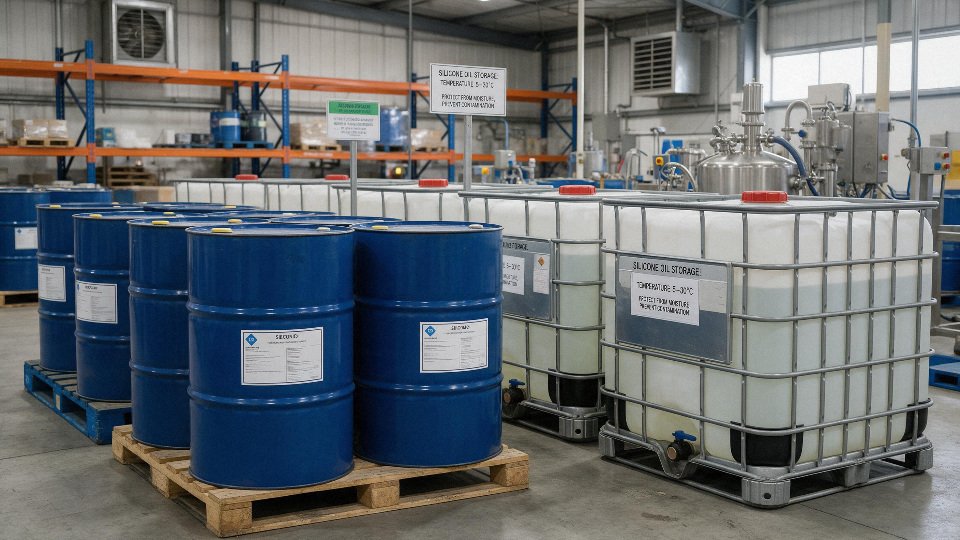
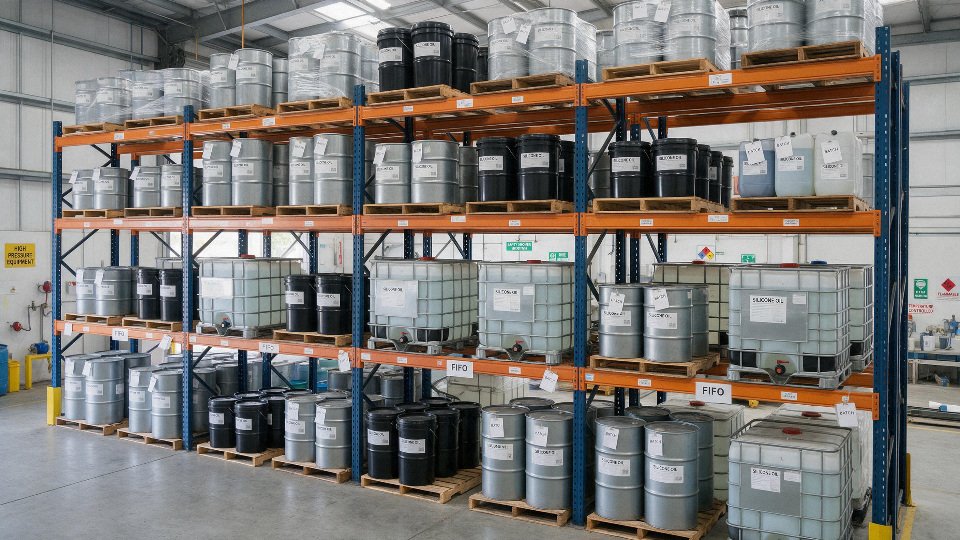
The right technical grade still fails commercially if supply format and documentation do not fit the operation.
Check these items:
- Supply format
- Drum, pail, IBC, or bulk
- High-viscosity grades may need different unloading arrangements, especially in colder seasons
- Lead time
- Standard stock grade versus made-to-order or custom blend
- Export documentation
- SDS, COA, packing list, commercial invoice, origin documents if needed
- Regional compliance support
- Confirm what the supplier can actually provide for your destination market and end use; do not assume universal coverage
- Freight and handling impact
- Viscous material can increase unloading time and transfer losses
- Cost-performance trade-off
- Unit price, delivered cost, usage rate, process loss, reject risk, and maintenance effect all belong in the comparison
The plant-floor version of this is simple: the cheapest cSt-equivalent product may become the expensive one if it blinds filters early, traps air, leaves residue on parts, or forces operators to heat drums just to transfer it. That is not a theoretical purchasing lesson; it shows up as labor, downtime, scrap, and annoyed production supervisors by the second or third lot. The section’s logic stops being enough only when the application is highly specialized or regulated, in which case supplier qualification has to be backed by formal testing against your exact process and current compliance requirements.
Frequent viscosity troubleshooting
Most silicone-oil “viscosity problems” are not a bad drum of fluid. They usually trace back to one of six causes: temperature mismatch, unit confusion, contamination, grade substitution, aging or separation, or a transfer system that is adding resistance and making a normal fluid look wrong. Before you reject material, check the condition under which the number was measured and the condition under which the complaint shows up.
Temperature mismatch between the certificate, the warehouse, and the process
A silicone oil that looks perfect in the lab can seem sluggish on a cold warehouse morning or unexpectedly loose near a heated application head. Supplier viscosity values are commonly tied to a stated test temperature, often 25 C, while your tote may be sitting at 8 C in winter or feeding into a line running at 45 C. The number did not change; the operating condition did.
What to check first:
- Compare the certificate test temperature with the actual fluid temperature at sampling.
- Measure the drum or tote core temperature, not just ambient air.
- Check whether the complaint occurs:
- at cold start only
- after the line has warmed up
- only on night shift or in winter
- only at the applicator, not at the tank
- If the fluid is recirculated, verify whether pump heat or tank heating is thinning it during operation.
The mechanism matters here. Lower temperature increases resistance to molecular movement, so feed pressure rises, flow slows, and level sensors can start lying to operators because air entrainment changes. Silicone oils usually hold viscosity better over temperature than many mineral oils, but “better” is not “constant.” The conclusion stops holding if the product is not a straight silicone fluid but a modified system with solvents, additives, or emulsified components; those can shift more sharply.
Unit confusion: cSt, cP, and mPa.s
A fair number of receiving disputes come from reading kinematic viscosity as dynamic viscosity, or treating them as interchangeable without checking density. For low-density fluids, the error may be modest; for modified systems or filled products, it can be enough to affect pump sizing, dosing time, and supplier acceptance.
Use this quick conversion logic:
- cSt = kinematic viscosity
- cP = dynamic viscosity
- mPa.s = numerically equivalent to cP
- Relationship: dynamic viscosity = kinematic viscosity × density
So if a product is 100 cSt and density is roughly 0.96 g/cm3, dynamic viscosity is about 96 cP, not 100 cP. That difference is small in some applications and very noticeable in fine metering or spray work. In practice, unit mistakes show up when one team buys from a data sheet listing cSt and another team sets equipment by cP.
A silicone oil listed at 350 cSt is not automatically 350 cP.True
Dynamic viscosity depends on density. cP equals cSt multiplied by density in g/cm3.
Contamination that changes flow and performance
If viscosity shifted after opening, transfer, blending, or line use, contamination is more likely than spontaneous fluid change.
Common contamination sources and what they do:
- Water
- can cause haze, spitting, poor wetting, or unstable flow in some formulations
- in modified systems, may trigger separation rather than a simple viscosity shift
- Solvents
- usually thin the fluid and change evaporation behavior
- can make a normal grade look “wrong” at the point of use
- Process oils or hydraulic leaks
- may thicken or thin depending on what got in
- often show up as changed odor, color, or residue pattern
- Fillers or fines
- raise apparent viscosity, plug filters, and create erratic dosing
- Surfactants
- may not change bulk viscosity much but can alter spreading and make operators think the oil became thinner
- Reactive chemicals
- can destabilize modified silicone systems or cause gel particles, phase split, or skin formation
A useful shop-floor check is to compare three samples: sealed original container, day tank, and point-of-use sample after the filter. That isolates where the change enters.
Grade substitution, mixed batches, and supplier changes
Product names can be misleadingly similar across suppliers. “1000 silicone oil” may refer to nominal viscosity, but the tolerance band, molecular-weight distribution, additive package, and even naming convention can differ. Two fluids that both pass a broad incoming check can still handle differently in pumps, coaters, or release applications.
Look for these warning signs:
- New supplier or alternate source approved on commercial terms only
- Mixed partial drums from different lots
- Internal relabeling without original batch traceability
- Material that meets nominal viscosity but behaves differently during startup, deaeration, or wetting
The trade-off is familiar: broad substitution can reduce purchase price, but it increases process variation. That flips only when the application is genuinely noncritical and transfer, surface behavior, and volatility are not sensitive.
Aging, volatilization, oxidation, and separation
Stored silicone oil is usually stable, but not all systems age the same way. Straight dimethyl silicone fluids are generally robust; modified silicone systems are less forgiving.
Failure modes worth checking:
- Loss of lighter fractions
- open storage, warm tanks, or repeated venting can make the remaining fluid seem thicker
- Oxidative change
- more relevant under heat, air exposure, and catalytic contamination
- Phase separation
- common in modified or blended systems if stored cold or left too long
- Settling of additives or fillers
- top sample looks thin, bottom sample looks heavy
If the fluid recovers after controlled mixing and temperature equilibration, you may be dealing with separation rather than permanent degradation. If it does not, hold the batch and test against fresh retained sample.
When the pump is the problem, not the oil
A fluid can appear “too viscous” because the system is undersized or restricted. I have seen normal silicone oil blamed when the real issue was a clogged 20-micron cartridge, a long 1/4-inch line, or a dosing valve chosen for solvent rather than oil service.
Check the hardware before blaming the fluid:
- line diameter and length
- filter rating and differential pressure
- suction conditions and drum follower performance
- pump type and speed
- pressure regulator setting
- nozzle, needle, or valve restriction
- whether the system traps air at high points

If “high viscosity” is really an incompatibility problem
Sometimes the fluid flows fine in bulk but fails on the part: poor leveling, fisheyes, crawling, beading, or patchy release. That is often blamed on viscosity because the defect looks like poor flow. The actual root cause may be interfacial incompatibility with the substrate, contamination on the surface, or an additive package that changes wetting rather than viscosity.
If bulk transfer numbers look normal but coating or spreading fails, test surface tension, substrate cleanliness, and compatibility with adjacent chemistries before changing viscosity grade. That one mistake can send a plant in circles for a week.
Frequently asked questions
What is the viscosity of standard dimethyl silicone oil at 25 C?
There is no single “standard” viscosity for dimethyl silicone oil at 25 C. In industrial supply, polydimethylsiloxane fluids are commonly offered in grades such as 10 cSt, 50 cSt, 100 cSt, 350 cSt, 1000 cSt, 12,500 cSt, and 60,000 cSt, with the broader category running from roughly 0.65 cSt to well above 1,000,000 cSt depending on molecular structure and formulation.
If a buyer asks for “standard silicone oil” without a grade, most suppliers will come back with a clarification request, and rightly so. On a plant floor, 100 cSt and 1000 cSt are both ordinary catalog products, but they pump differently, wet surfaces differently, and behave very differently in blending or metering.
Is silicone oil more viscous than water?
Usually yes, at least for the grades most factories actually buy. Water is about 1 cSt at room temperature, while many industrial silicone oils start around 10 cSt and go upward by orders of magnitude.
That said, not every silicone fluid is thicker than water. Some very low-viscosity silicone fluids, around the sub-1 cSt range, can be in the same neighborhood. If the comparison matters for dosing, spraying, or leak behavior, use the actual datasheet value at the stated temperature rather than the product family name.
How do cSt and cP differ for silicone oil?
cSt is kinematic viscosity; cP is dynamic viscosity. The conversion depends on density:
- cP = cSt × density
- For many silicone oils, density is close to 1 g/cm3, so cSt and cP may look numerically similar
- They are not interchangeable unless density is known at the same temperature
This is where quotation and specification mistakes happen. A buyer may request 100 cP, assuming that means 100 cSt; if the density is not exactly 1, the product may land slightly off target. In a tight dosing or coating process, slight matters.
Does silicone oil viscosity decrease when heated?
Yes. Silicone oil gets thinner as temperature rises, just like most liquids used in processing and lubrication.
The practical distinction is that silicone oils usually change less with temperature than many mineral oils. That is one reason they show up in equipment that sees cold starts, warm running conditions, or outdoor temperature swings. Still, “less change” does not mean “no change”; if your process window is narrow, verify the viscosity at the actual operating temperature, not just at 25 C.
Which silicone oil viscosity is best for lubrication?
There is no best universal grade. For light instruments, small dampers, or fine mechanisms, lower to mid-range viscosities may be suitable; for slow-moving interfaces, sealing support, or damping-heavy applications, higher viscosities are often chosen.
The right grade depends on:
- Load and contact geometry
- Speed or cycle rate
- Operating temperature range
- Material compatibility
- Whether the oil must also provide damping, sealing, or release behavior
In practice, if the mechanism has tiny clearances or a narrow feed line, a grade that looks fine on paper can still starve the point of lubrication when the plant is cold in winter.
Which grade is used for defoamers or release agents?
Often lower-viscosity to medium-viscosity silicone fluids are used as components in defoamers and release systems, but there is no single default grade across all formulations.
Performance depends on the whole system, not viscosity alone:
- Carrier compatibility
- Surface tension effects
- Emulsification package, if water-based
- Application method: wipe, spray, gravure, dip, internal additive
- Substrate and contaminant chemistry
A release agent for rubber molds and a defoamer for aqueous processing may both contain silicone, but they are not selected the same way.
Two silicone oils with the same nominal viscosity can perform differently in production.True
Nominal viscosity alone does not capture volatility, purity, additive package, molecular weight distribution, foam tendency, or compatibility with the process system.
Can two 100 cSt silicone oils perform differently?
Absolutely. Same nominal viscosity does not guarantee same field performance.
Differences can come from:
- Molecular weight distribution
- Volatile content
- Purity and trace contaminants
- Additives or stabilizers
- Density
- Surface behavior on the target substrate
- Batch-to-batch consistency and filtration level
This shows up fast in coating, release, and precision lubrication work. One 100 cSt fluid may spread cleanly and stay stable; another may cause fish-eyes, carryover, or a slight odor issue under heat.
How should viscosity be specified when requesting a quotation?
Use a complete request, not just a number. At minimum, include:
- Target viscosity value
- Unit: cSt or cP
- Reference temperature, usually 25 C
- Product type, such as dimethyl silicone oil
- Intended application
- Any limits on volatility, color, odor, or impurities
- Packaging size and annual volume
- Whether you need technical data, COA format, or sample approval first
A good RFQ line is much closer to “dimethyl silicone oil, 100 cSt at 25 C, for release-coating dilution, low volatile preference, 200 kg drums” than simply “silicone oil 100.” That saves a lot of back-and-forth and reduces the risk of testing the wrong fluid.
Which grade should you verify
Start with the operating window, not the grade number. In practice, the right silicone oil is the one that still pumps, wets, stays in place, and releases cleanly across your actual temperature range and line conditions, not the one a buyer recognizes from the last project. A familiar 100 cSt or 350 cSt grade is often a decent starting point, but it is a poor final decision rule if the dosing method, surface interaction, or motion profile has changed.
A workable shortlist usually comes from five plant-floor questions:
- What is the true service temperature range?
Use the cold-start and hottest sustained condition, not the lab ambient. A grade that looks fine at 25 C can become slow to meter in a winter warehouse or too mobile near heated tooling. - How is it applied or moved?
Hand wipe, drip feed, needle dosing, spray, roll coat, bath, and recirculating lubrication systems all tolerate different viscosity windows. Small-bore lines, fine nozzles, and timed dispensing generally punish overly high viscosity first. What does it touch?
Metal, rubber, plastics, coated surfaces, paper, textiles, and release liners do not all respond the same way. Wetting, spreading, migration, and compatibility can shift the preferred grade more than buyers expect.What motion profile does the application see?
Static film retention, intermittent motion, high-speed sliding, oscillation, and splash conditions push the selection in different directions. Too low, and the film runs off or gets displaced. Too high, and you can get drag, poor replenishment, or metering inconsistency.What film behavior is actually required?
Fast spread, persistent cushion, anti-foam carryover control, release uniformity, or surface feel each points to a different viscosity band.
Once that window is defined, narrow the grade by application role, not habit:
- Carrier / fast-wetting fluid: often lower viscosity grades
- General-purpose lubrication / damping: often mid-range grades
- Cushioning / long residence / migration resistance: often higher viscosity grades
- Thick film or compound base: much higher viscosity, sometimes requiring modified chemistry or blending
That preference flips when the process hardware becomes the constraint. A heavier oil may improve retention on the part, but if it causes erratic shot size through a small metering valve, the line will not hold spec.
Do not stop at nominal cSt. Verify the full specification package with the supplier:
- Viscosity tolerance at the stated test temperature
- Volatility or low-boiler content, especially for heated service
- Compatibility with substrates, seals, hoses, and any residual chemistry in the process
- Modification chemistry, if the oil is not a straight standard silicone fluid
- Packaging and handling fit for your plant: drum, pail, tote, or bulk
Nominal viscosity alone is enough to qualify a silicone oil grade for production use.False
Two fluids can share a nominal viscosity but differ in volatility, additive package, compatibility, and process stability. Those differences show up quickly in heated lines, surface defects, seal life, or batch-to-batch consistency.
Before release to production, run a representative sample or pilot lot in the real process:
- Use the actual pump, valve, spray head, or coating method
- Check startup behavior at the coldest expected condition
- Watch for wetting defects, residue, migration, misting, or flow lag
- Confirm consumption rate and housekeeping impact
- Recheck the finished part or downstream operation, not just the application step

For a useful supplier review or quotation, send the data that actually determines fit:
- Target viscosity or current grade reference
- End use and application method
- Operating and storage temperature range
- Substrate or contact material
- Required package size
- Any regulatory or documentation needs
- Estimated annual volume
SiliconChemicals supplies organosilicon materials across a broad industrial range and can help align silicone oil viscosity with both application performance and supply planning. If you are ready to screen a grade, send the use case, target cSt, temperature window, package requirement, and annual demand, along with part or process details where relevant; the next practical step is a technical grade match followed by sample evaluation or quotation against confirmed supply requirements.