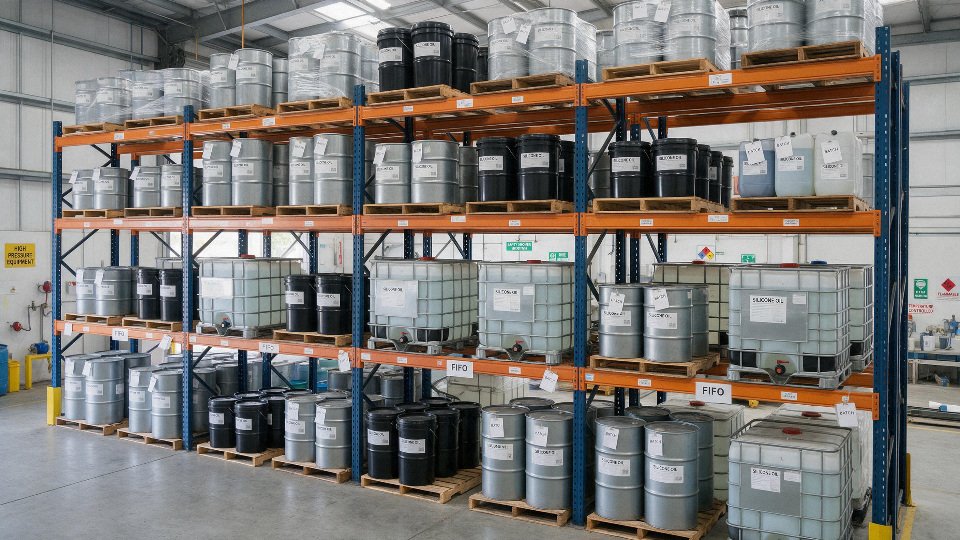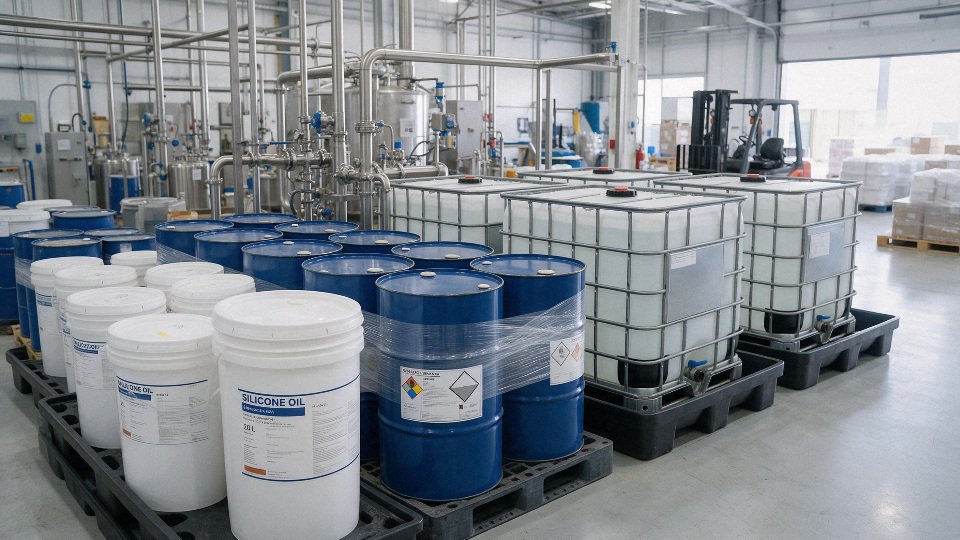
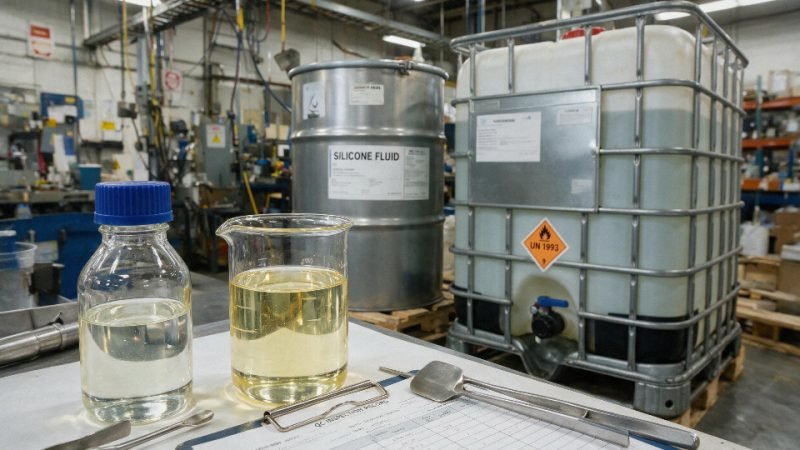
A drum labeled silicone oil that looks hazy, amber, or full of fine specks is not something a production team should wave through on trust. On the plant floor, appearance is often the first fast check that catches contamination, phase issues, oxidation, water pickup, or simple product mismatch before the material ever reaches a mix tank, dosing skid, release liner, mold, or textile bath. Miss that early signal and the bill usually shows up later as scrap, unstable coating weight, foaming, filter plugging, customer complaints, or a batch that has to be quarantined while purchasing and quality argue over whether the supplier sent the right grade.
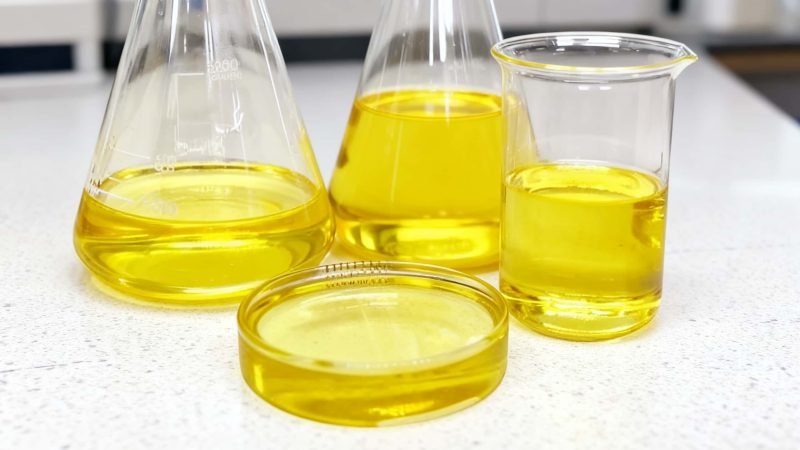
Silicone oil usually looks like a clear, colorless to slightly yellow liquid with no visible suspended matter. Its exact visual impression still depends on viscosity and packaging: a very low-viscosity grade can look almost like water, while a high-viscosity grade may pour slowly and appear heavier or more glossy, even when the chemistry is normal.
That simple visual description is where most buyers stop, and it is also where expensive mistakes start. Appearance can tell you quite a lot, but only if you connect what you see to viscosity range, handling history, contamination risk, and the specific silicone family you are actually buying rather than assuming every “silicone oil” should look the same in every drum, tote, or sample bottle.
Visual traits and texture
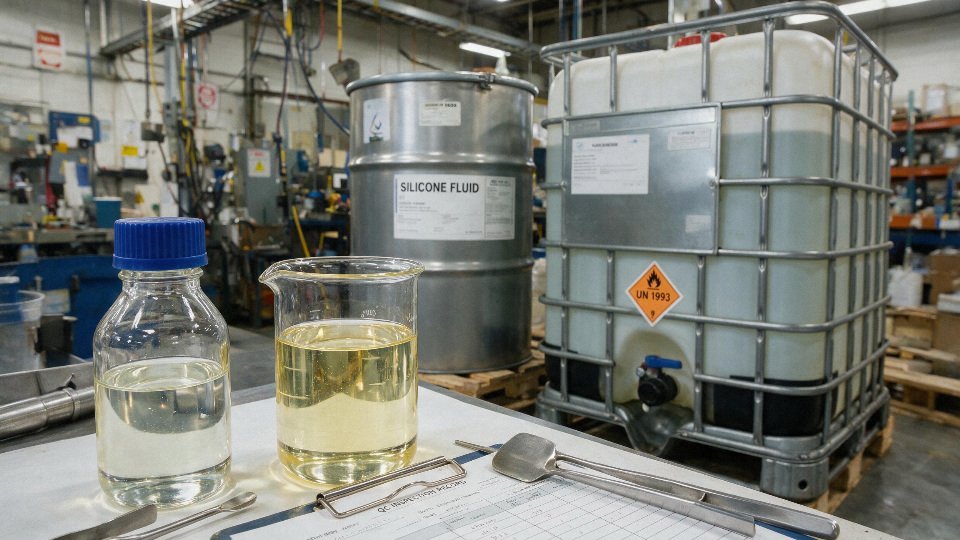
Silicone oil usually presents as a clear, glossy liquid ranging from water-white to faint straw tint, but that description is only reliable if you also look at haze, flow pattern, film behavior, and whether the liquid stays uniform after standing. In plant handling, those cues often tell you more than a quick glance at “clear in the drum,” especially when you are checking incoming material, tracing contamination, or trying to distinguish a low-viscosity fluid from a heavy PDMS grade without a lab result in hand.
Color in commercial supply
Color is the first thing people notice, and also the easiest thing to over-interpret.
For standard dimethyl silicone oils, the normal expectation is:
- Colorless to water-white
- Very faint straw tint
- Slightly yellow appearance in heavier grades, aged stock, or some packaging conditions
Commercial acceptance language often reads as clear, colorless to slightly yellow, with no visible suspended matter. That is a useful receiving benchmark, not a full identity test.
A few practical observations matter here:
- Thin layers look paler than bulk liquid. A silicone oil that appears nearly colorless in a sample vial may look faintly straw-colored in a full drum, IBC sight strip, or thick sight glass.
- Modified silicone fluids can run darker. Functional or specialty-modified materials may show a light amber cast even when they are usable and on-spec. You cannot apply the appearance standard of a basic dimethyl fluid to every silicone-based product line.
- Aged or heat-exposed material may yellow. Oxidation, contamination, or thermal history can push the appearance from water-white toward yellow or amber. That does not automatically tell you the fluid is unusable, but it does mean you need to check what changed rather than wave it through.
- Container lighting fools people. Blue-tinted drums, warehouse sodium lamps, and amber sample bottles can all shift what the eye reports.
The mechanism is simple enough: color usually changes because trace impurities, thermal degradation products, or additives absorb visible light. The trade-off is that a strict “must be crystal colorless” visual rule helps catch off-condition stock early, but it can also reject acceptable specialty grades that naturally carry a slight tint. The conclusion stops holding once you move away from standard dimethyl silicone oils into modified systems, compounded blends, or recovered fluids.
Transparency and clarity
A good silicone oil sample is normally fully transparent, with no visible haze, cloudiness, sediment, fibers, or layered separation. If you tilt a clear bottle against light, the liquid should transmit light cleanly, with a sharp background image through the fluid.
What trouble looks like depends on where you are viewing it:
- In bottles or lab jars
- Fine haze appears as a soft loss of sharpness through the liquid
- Specks or fibers often show up near the shoulder or on the bottom heel
- Water contamination may show as slight milkiness, especially after agitation
- In drums or pails
- Settled solids collect at the lower rim or around the suction zone
- A floating layer can indicate contamination by an incompatible lighter fluid
- Sidewall streaking may reveal residue from previous handling or poor drum cleanliness
- In sight glasses
- Cloudiness is easier to spot when the line is flowing slowly
- Small entrained bubbles can mimic haze; if they clear after standing, it was air, not necessarily contamination
- Two-phase separation often shows as a boundary line rather than uniform dullness
- In process lines
- A normally clear silicone oil turning cloudy in a transfer line can point to water ingress, incompatible additive carryover, or temperature-related solubility change
- Stringy or gelatinous fragments usually indicate degraded material, incompatible mixing, or residue sloughing off the line wall
A clear appearance alone confirms the silicone oil is clean and the correct grade.False
Many off-spec or contaminated silicone oils remain optically clear. Low-level volatile contamination, wrong viscosity cut, or molecular distribution shifts may not create visible haze. Visual inspection is useful, but it does not replace viscosity, refractive index, moisture, or compatibility checks where the application is sensitive.
In practice, slight haze is one of the most argued-about receiving issues because it can come from very different causes: cold storage, fine particulate, water pickup, or just microbubbles from rough filling. You need the context before you quarantine a batch.
Flow behavior by viscosity
If you handle enough silicone fluids, viscosity shows up visually long before the lab sends the certificate.
Low-viscosity grades, roughly at the thin end of the category, tend to:
- Pour quickly
- Drip in discrete drops
- Level fast after agitation
- Show a relatively flat surface soon after movement
- Run off a rod or spatula with little stringing
Medium grades typically:
- Pour in a steady stream
- Form a smooth coating on the container wall
- Drain more slowly from valves and sample cocks
- Leave a rounded meniscus in sight tubes and beakers
High-viscosity grades often:
- Move sluggishly
- Exhibit stringing or tailing during transfer
- Cling to drum walls and sampling tools
- Form thicker films that level slowly
- Trap bubbles longer after pumping or mixing
That visual shift tracks molecular weight and chain length distribution. As viscosity rises, internal resistance to flow rises, so the fluid stops behaving like a fast-draining liquid and starts showing ropey discharge, slower surface recovery, and more persistent coating on metal and glass. It is a useful shop-floor cue, but only a rough one. Temperature changes the picture fast. A fluid in a cold warehouse in January can look one or two “viscosity classes” heavier than the same batch at 25 C.
The trade-off here is practical: visual flow checks are quick and cheap for receiving or line-side verification, but they are too coarse for grade confirmation where the process window is tight. If your application depends on a narrow viscosity band, you still need the actual test result, not a judgment based on how the sample strings off a dip rod.
Surface appearance and wetting behavior
Spread a little silicone oil on steel, glass, or a coated panel and the appearance is usually smooth, glossy, and very uniform, with a clean reflective surface. Many grades leave a slick film that looks “polished” rather than greasy.
The wetting behavior is one of the more recognizable visual traits:
- On some substrates, it beads readily
- On others, it forms a thin, mobile film
- Edges often pull into smooth rounded contours rather than jagged ones
- The film usually looks clean and low-tack rather than sticky
This is where people compare it to hydrocarbon oils and get tripped up. Hydrocarbon oils often look heavier, greasier, and more adhesive on touch surfaces. Silicone oil usually feels more lubricious and less tacky, with a distinct slippery film that is easy to spread but not always easy to wash away.
That comes from low surface tension and the structure of the fluid. The same property that helps silicone oil wet and lubricate also lets it migrate onto adjacent surfaces, seals, labels, rollers, and inspection windows if housekeeping is poor. On a machine, a tiny leak can travel farther than expected and create a much larger apparent contamination zone than a mineral oil leak of similar volume.
Touch and handling impression
Where manual observation is relevant and safe, silicone oil tends to present as:
- Very slick
- Smooth rather than gummy
- Low tack for many standard grades
- Light-feeling in thin viscosities, cushiony in heavier viscosities
- Less “oily greasy drag” than many petroleum-based lubricants
That said, touch is only a supporting cue. Gloves, skin condition, ambient temperature, and contamination from prior samples all distort the impression. On a receiving dock or maintenance bench, visual film behavior on a clean spatula or glass plate is usually more trustworthy than someone saying, “This feels about right.”
The point buyers and plant people sometimes miss is simple: a silicone oil can look excellent and still be wrong for the job. Wrong viscosity, incompatible chemistry, excess volatiles, or subtle off-spec molecular distribution may remain invisible. If appearance matters to your application, use it as the first screen, then verify the property that actually controls performance.
Chemistry behind the appearance
Silicone oil looks clear and often stays clear for reasons built into its molecular structure, not just because it was filtered well at the factory. The Si-O-Si backbone, the type of organic side groups attached to it, and the spread of molecular weights together control how the fluid bends light, flows, resists gelling, and responds to heat, moisture, and contamination.
Most buyers hear “silicone” and picture a generic slippery liquid. That is too loose to be useful. From a plant and purchasing standpoint, appearance starts with chemistry: what polymer family it is, how it was finished, and what was left behind from synthesis or modification.
Why the siloxane backbone looks different from hydrocarbon oils
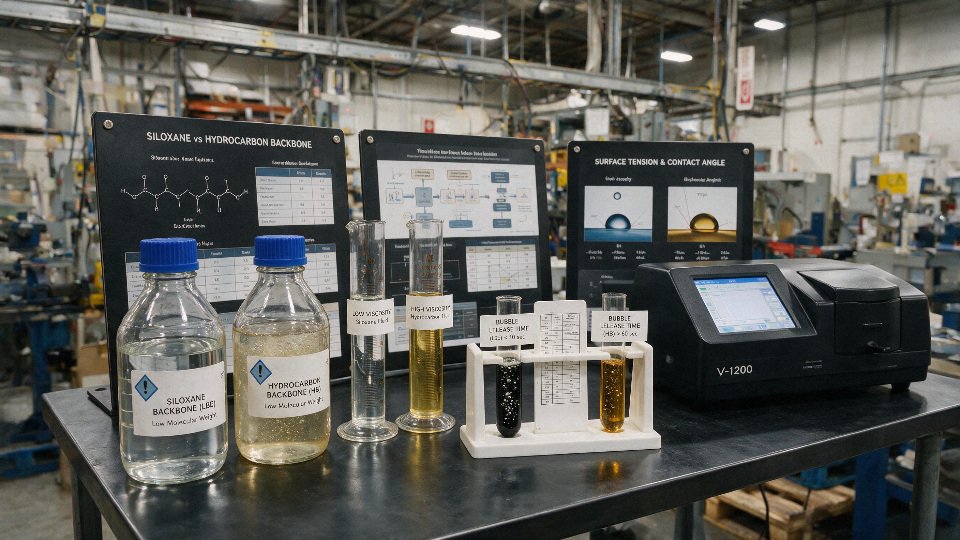
The backbone in most silicone oils is a repeating siloxane chain, Si-O-Si, rather than the C-C and C-H framework found in mineral oils or many synthetic hydrocarbons. That difference matters because the Si-O bond is longer and more flexible, and the bond angles along the chain are relatively open. In practice, that gives the molecule unusual mobility, low intermolecular attraction, and a fluid character that often stays stable across a broad temperature range.
That molecular flexibility shows up visually in two ways:
- The fluid often remains clear and mobile even when a hydrocarbon oil of similar apparent thickness would start looking waxy, cloudy, or sluggish at lower temperature.
- Surface behavior is different. Silicone oils tend to wet some surfaces in a very distinctive way, forming smooth films and a “glassy” look on metal, glass, or plastic parts.
Optical clarity also ties back to uniformity. Common dimethyl silicone oils typically have a refractive index around 1.396 to 1.404 at 25 C, which is relatively consistent within that chemistry class. If the product is clean and single-phase, light passes through with little scatter, so the eye reads it as water-clear or nearly so even when the fluid is much more viscous than water.
The thermal side is worth separating from appearance. Silicone oils are not magic fluids, but the siloxane backbone usually keeps viscosity change with temperature more moderate than many petroleum oils. That is one reason a drum that pours cleanly in a cold warehouse in January may still look acceptable by eye, while another fluid has already gone hazy or partially crystallized. The boundary here is chemistry-specific: once you move away from simple dimethyl fluids into heavily modified silicones, low-temperature clarity can change a lot.
How chain length changes what you see when it pours
Viscosity in silicone oil is mainly a chain-length story, with some contribution from molecular weight distribution and end-group chemistry. The broad category spans roughly 0.65 cSt to well over 1,000,000 cSt at 25 C, and those fluids do not “look” the same in handling even if they all meet a basic clear-appearance criterion.
Shorter chains and lower molecular weight fractions behave more like thin solvents:
- fast leveling
- quick meniscus collapse
- easy bubble release
- very little stringing during transfer
As chain length increases, the visible flow changes:
- the stream thickens and rounds off
- drain time from a spatula or dip rod increases
- stringing becomes obvious
- entrained air takes longer to escape
- surface ripples damp out more slowly
This is where operators sometimes misread quality. A high-viscosity silicone oil can look “heavier” or slightly distorted in a bottle simply because it holds bubbles and drains slowly, not because it is contaminated. On the other hand, a broad molecular weight distribution can create handling behavior that feels wrong on the floor: too much low-boiling fraction can add odor or volatility; too much very high molecular weight tail can make pumping and deaeration harder than expected.
The mechanism is straightforward. Longer chains become more entangled, which raises internal resistance to flow. That does not usually make the fluid opaque by itself, but it changes how suspended microbubbles persist, and those bubbles can give a temporary haze that disappears only after rest or vacuum deaeration.
How side groups shift color, refractive index, and haze tendency
Not all silicone oils are dimethyl fluids, and this is where appearance starts to diverge in ways that matter to technical buyers.
Methyl silicones
These are the standard benchmark for “clear, colorless to slightly yellow liquid with no visible suspended matter.” They usually offer the cleanest appearance and the most predictable refractive index range for general industrial use.
Phenyl-modified silicones
Phenyl groups typically raise refractive index and can improve some low-temperature and optical-performance characteristics, depending on formulation. They may also shift the visual impression slightly compared with straight dimethyl fluids, especially in thicker grades or when viewed in bulk. Not necessarily darker, but less “water-like.”
Amino-modified silicones
Amino functionality often introduces a greater tendency toward yellow tint, odor, or appearance drift over time, especially if the product has seen heat, air exposure, or reactive contamination. In textile, softener, and release applications, this is a common source of confusion because slight color does not automatically mean failure, but it can be unacceptable in transparent or light-colored systems.
Epoxy-modified silicones
These can remain clear, but compatibility with other formulation components becomes a bigger variable. If the epoxy-functional silicone is blended into a system with the wrong solvent, catalyst residue, or moisture exposure, haze can develop even when the base silicone itself is sound.
Polyether-modified silicones
These are often selected for emulsification, wetting, or compatibility with waterborne systems. The trade-off is that they can show more tendency toward haze, opalescence, or phase instability because the polyether segment changes polarity. A fluid that is perfectly clear in a sealed sample bottle may turn slightly cloudy after contact with hard water, surfactants, or a different additive package.
Fluoro and other specialty-modified silicones
Fluoro-modified silicones can shift density, solvency behavior, and compatibility with oils, fuels, or aggressive chemicals. Appearance may still be clear, but once blended into mixed-fluid systems, phase separation risk rises quickly if the rest of the formulation is not matched to it.
The practical point is simple: side groups improve function, but every modification narrows the window in which “clear and colorless” remains a reliable acceptance shortcut.
What residuals and impurities do to appearance
A lot of appearance problems are not polymer problems. They are finishing problems, storage problems, or formulation problems.
Common contributors include:
- Residual catalysts: can promote post-reaction color formation, odor, or viscosity drift
- Low-boiling cyclics and other volatiles: may add odor and, in some uses, change clarity after heating or vacuum exposure
- Moisture: can trigger haze, especially in modified silicones or systems containing reactive silanes
- Unreacted intermediates: may shift color, smell, or compatibility
- Fillers or insolubles: show up as sediment, sparkle, or persistent turbidity
- Stabilizers and additives: sometimes essential, but they can introduce slight color or phase issues if overdosed or poorly dissolved
A clear appearance alone does not prove the silicone oil is high purity.True
Clarity only confirms there is no obvious visible suspended matter or phase separation under the viewing condition. Residual volatiles, catalyst traces, low-level color bodies, or reactive impurities can still be present and may only show up in odor, analytical testing, aging, or application performance.
In procurement specs, this is why visual inspection should sit beside viscosity, volatile content if relevant, moisture where critical, and any application-specific compatibility checks.
Why silicone oil often stays clear, and why it still sometimes clouds
Silicone oil usually holds visual clarity over a wide operating range because the backbone does not crystallize or wax the way some organic oils do. That helps in cold rooms, outdoor storage, and cycling service. It is one reason maintenance teams like it in instruments, damping devices, and specialty lubrication points where appearance during startup matters.
Still, clear does not mean invulnerable. You can lose clarity through several different paths:
- Oxidation or thermal aging
- usually shows first as color shift, odor, or viscosity change
- rate depends on temperature, air exposure, residence time, and contamination with catalytic metals or residues
- Contamination
- water ingress, process dust, fines from pumps, dirty transfer hoses, and mixed-oil cross-contamination are common culprits
- in practice, the half-clean tote and the reused camlock cap cause more trouble than the base chemistry
- Compatibility failure
- blending with incompatible oils, solvents, plasticizers, or additives can create clouding, stringy precipitates, or a second phase
- Micro-emulsion formation
- a fluid can turn milky or opalescent not because the silicone backbone has broken down, but because tiny dispersed droplets are now scattering light
- this often misleads troubleshooting teams into calling the product “burned” or “polymerized” when the actual issue is water, surfactant carryover, or wrong mixing order
That last point matters on the plant floor. If a silicone oil sample goes hazy after contact with washdown moisture, residual detergent, or a formulation tank that still holds another additive, the visual symptom can look severe while the polymer itself is largely intact. Before blaming the supplier, check the transfer path, container dryness, and what else was in the vessel. Quite a few “bad batch” claims end up being an emulsion or contamination problem, not backbone degradation.
Viscosity and temperature effects
A silicone oil that looks perfectly normal at one temperature can look like a different product a few hours later, and that shift is often operational rather than quality-related. Cold conditions make the same oil look thicker, slower, and sometimes optically less clean; heat makes it look looser, faster, and better-wetting, often without changing its basic clarity at all.
That matters because buyers and operators tend to judge a drum, tote, sight glass, or sample bottle by eye first. In practice, many “this batch looks off” comments come from temperature history, viscosity grade mismatch, or trapped air, not from actual contamination. The catch is that appearance still tells you something useful if you know what to watch.
What cold does to silicone oil visually
As temperature drops, silicone oil viscosity rises. You see that immediately in three places:
- Pour rate slows from bottle, pail, or day tank
- Drain-down gets longer on glass, steel, or plastic surfaces
- Bubbles rise more slowly, so the sample can look temporarily duller or slightly hazy
For standard dimethyl silicone oils, that thickening with cold is normal behavior. It does not by itself mean the material is out of spec. A 50 cSt grade at room temperature may pour freely; the same fluid after winter transport or sitting near a loading bay door can suddenly behave like a much heavier oil during receiving inspection.
Cold also tends to expose weak points in the system rather than in the base fluid. If the oil contains trace moisture, process carryover, incompatible additives, or some modified silicone chemistry, low temperature can make a faint haze more noticeable. The mechanism is simple: higher viscosity slows settling and bubble release, while reduced solubility or phase compatibility at lower temperature can make fine dispersed matter easier to see. That is why a contaminated or modified system may look much cloudier after a cold night than it did during summer filling.
The boundary here is important: this rule holds for normal handling temperatures and common silicone oil grades. If a product is near its specific low-temperature limit, contains specialty modifiers, or has been blended for a particular end use, visual behavior should be checked against the supplier’s current product data rather than assumed from generic dimethyl oil behavior.
What heat changes, and what it usually does not
At elevated temperature, silicone oil flows faster, levels faster, and tends to wet surfaces more readily. In a transfer line, that shows up as easier priming, lower apparent resistance, and quicker sight-glass movement. On a coated surface or release application, the film spreads farther before stopping, so users often describe the oil as “thinner” even when the chemistry is unchanged.
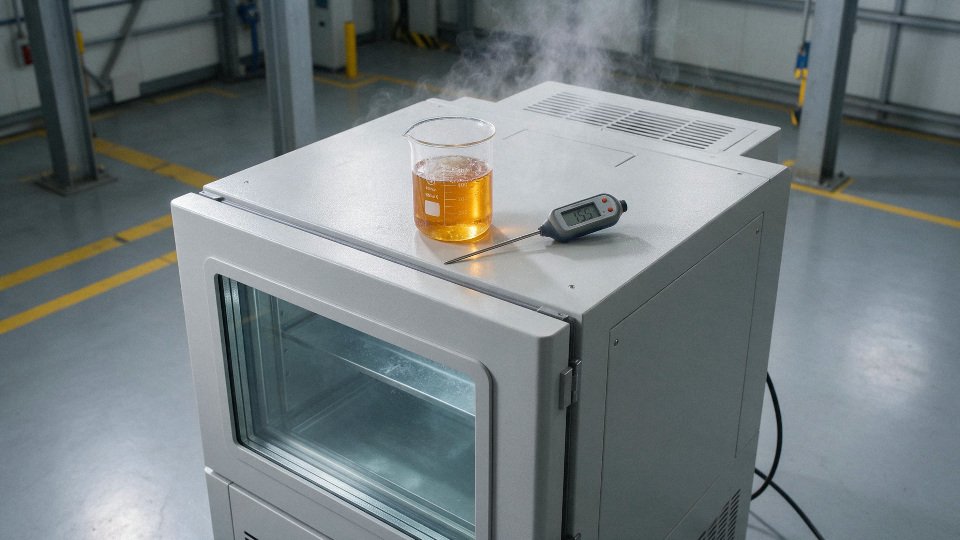
What usually does not change much is bulk visual clarity, assuming the oil is clean and thermally stable within its intended operating range. A clear, colorless to slightly yellow silicone oil should remain visually clear as it warms, even though it behaves very differently in motion. If the sample darkens, develops suspended matter, or throws off volatiles during heating, that is not something to wave away as a normal temperature effect; it needs a closer look at contamination, over-temperature exposure, oxidation conditions, or product selection.
There is a trade-off here that shows up on plant floors all the time:
- Heating a higher-viscosity grade improves transfer and dosing
- The same heating can increase leakage through worn seals, loosen fitting weeps, and change dose consistency if the pump was tuned cold
- Better wetting can help coating uniformity
- That same extra spread can hurt edge definition, release pattern control, or deposit thickness
A line that “runs beautifully hot” may also start over-applying material.
How different viscosity grades look in use
A static bottle can be misleading. Silicone oils span roughly 0.65 cSt to over 1,000,000 cSt at 25 C, and the visual difference between grades becomes obvious only when you move them.
| Relative grade | In a lab bottle | In pump/transfer service | On a surface |
|---|---|---|---|
| Very low viscosity | Looks almost like a light solvent or very thin mineral oil; quick swirl collapse | Fast line response, easy priming, can slip past loose clearances | Rapid spreading, thin film, quick drain-off |
| Medium viscosity | Clear liquid with noticeable body; steady pour | Predictable metering in many standard systems | Controlled wetting, visible continuous film |
| Very high viscosity | Moves slowly, long stringing, delayed level recovery | Needs positive-displacement pumping or heating in many setups | Thick hold-up, slow leveling, persistent film build |
That visual spread matters commercially because equipment selection follows it. A very low viscosity silicone oil may behave fine through simple gravity feed or a small gear pump, while a very high viscosity grade may need jacketed lines, larger suction geometry, slower pump speeds, or follower-plate style handling depending on the package and throughput target. You do not want procurement buying “silicone oil” as if appearance in the drum is enough to define transfer behavior.
Fast field checks: what operators can judge in a minute
If you need a quick relative viscosity read without a viscometer, these visual checks are useful:
- Meniscus shape
- Lower-viscosity oils usually show a quicker-settling, less persistent deformation after the container is tilted.
- Higher-viscosity oils hold a drawn meniscus longer.
- Bubble rise speed
- Shake or invert gently and watch entrained air.
- Fast bubble release suggests lower viscosity; slow rise and lingering fine bubbles suggest higher viscosity or a colder sample.
- Drain-down on a clean surface
- Put a small amount on clean glass or metal and watch the run pattern.
- Short residence and broad spread point toward lower viscosity; narrow, slow, thicker trails point higher.
- Pour cutoff
- Low-viscosity grades break cleanly.
- High-viscosity grades often rope, string, or tail at the lip.
These are comparative checks, not acceptance tests. They help you separate “this is colder than yesterday” from “this might be the wrong grade.”
Why temperature history changes what you see
A sample taken right off a winter truck, one pulled from a heated day tank, and one drawn after months in warehouse storage may not look the same in the first few minutes of inspection. That does not automatically mean one is bad.
Temperature history affects appearance through several paths:
- Recent cooling raises apparent thickness and slows bubble release
- Recent heating lowers apparent viscosity and can temporarily make transfer behavior look “better than normal”
- Transport agitation entrains air, which can mimic haze until the sample rests
- Prolonged storage may separate trace contaminants, settle foreign matter, or simply allow the fluid to fully de-aerate and look brighter
In practice, if a sample arrives looking dull or heavier than expected, let it equilibrate to a known temperature before making a judgment call. For silicone oils, viscosity comparisons only mean much if the sample temperature is controlled or at least recorded. The same goes for refractive appearance; common dimethyl silicone oils often sit around a refractive index of about 1.396 to 1.404 at 25 C, and that benchmark only helps if the measurement temperature is right.
Similar appearance, very different performance
Two silicone oils in clear bottles can look nearly identical and still behave very differently in service. That is one of the easiest purchasing mistakes in this product family.
A low-viscosity and a medium-viscosity oil may both meet a broad visual acceptance description such as:
Clear, colorless to slightly yellow liquid with no visible suspended matter is a common appearance acceptance criterion for silicone oil.True
That appearance standard is useful for incoming inspection, but it does not identify viscosity grade, temperature behavior, or application suitability. Those need product data and, for critical use, application-specific testing.
The performance gap shows up only under load or motion:
- In heat transfer, viscosity affects circulation and heat exchange behavior
- In damping, it changes resistance force and response time
- In release, it shifts film persistence and transfer rate
- In lubrication, it influences film thickness and leakage tendency
- In defoaming, spreading behavior and incompatibility balance may matter more than a bottle check suggests
So yes, appearance is useful. It tells you whether the oil is broadly clean and visually normal. It does not tell you, by itself, whether you have the right grade for the pump, the coating head, the damping assembly, or the process window you actually need to run tomorrow morning.
Appearance across silicone oil types
A clear, water-white liquid is only the benchmark for one major family: standard dimethyl silicone oil. Once you move into phenyl, amino, polyether, or other functional silicone fluids, color and clarity can shift quite a bit without indicating off-spec material. Procurement and formulation decisions go wrong when buyers treat “silicone oil” as a single visual category instead of a chemistry family.
The practical reason is simple. Different side groups, end groups, stabilizers, residual catalysts, and formulation aids change how the fluid transmits light, picks up moisture, or carries trace color bodies. On the plant floor, that matters because receiving inspection often starts with a drum sample under room light, and people tend to judge too quickly from appearance alone.
Standard dimethyl silicone oil
This is the appearance most technical buyers expect unless the data sheet says otherwise.
Standard dimethyl silicone oil is usually a clear, colorless to slightly yellow, highly transparent liquid with no visible suspended matter. In a clean glass bottle, low- to medium-viscosity grades can look almost like a very clean mineral spirit at first glance, except the flow behavior and surface feel are different. Higher-viscosity grades stay just as clear if they are in good condition, but the thicker body can make them look optically “heavier” during pouring.
A few practical points help avoid bad calls at incoming inspection:
- Clarity should hold through the full sample depth.
- A thin film on a spatula can hide slight haze that shows up in a 100 mL jar.
- Slight yellowing is not automatically contamination.
- Many common acceptance descriptions allow colorless to slightly yellow material.
- No visible suspended matter remains the key screen.
- Fibers from drum liners, rust fines from poor packaging, or dried sealant fragments are not normal.
- Viscosity changes visual impression.
- A 10 cSt fluid and a 100,000 cSt fluid may both be fully clear, but the thicker fluid can trap bubbles longer and look less “bright” until it settles.
For many users, dimethyl oil is the visual reference standard because common grades sit in a refractive index range around 1.396 to 1.404 at 25 C. That contributes to the familiar transparent look. The section’s main conclusion stops holding once you leave plain dimethyl chemistry; buyers should not use this water-clear benchmark to reject every modified silicone fluid.
Phenyl-modified silicone oil
Phenyl-modified silicone oil often stays clear, but it usually does not look exactly like standard dimethyl fluid under the same light. The optical character is a little denser and, depending on formulation and substitution level, you may see a faint straw tint that is normal for the chemistry rather than a sign of oxidation or dirt.
What changes here is the aromatic phenyl group. It shifts optical behavior, including refractive index, so two equally clean fluids can look slightly different in the same bottle. In practice, that means a buyer familiar only with dimethyl oil may describe a perfectly acceptable phenyl fluid as “darker” or “less water-white” even when it is within spec.
That visual shift matters commercially because phenyl-modified oils are often selected for low-temperature performance, damping behavior, or particular thermal and dielectric needs. If the application requires those traits, rejecting a lot because it is not visually identical to dimethyl oil can create unnecessary delays.
Watch for these distinctions:
- Clear but not necessarily water-white
- A faint yellow cast can be normal.
- Higher optical density
- The liquid may appear to bend light differently through the bottle wall.
- Color must still be consistent lot to lot
- A stable faint tint is one thing; drifting color over deliveries deserves review against the supplier’s standard.
A mild caution from experience: if a phenyl fluid suddenly arrives markedly darker than prior lots, do not argue from memory alone. Pull the current product specification, compare retained samples if you have them, and check whether the supplier changed grade, phenyl content, or additive package.
Amino silicone oil
Amino silicone oil is often pale yellow to amber, and for many textile, softener, and finishing grades that is normal. Expecting a water-clear appearance from amino-functional material is one of the more common buyer mistakes, especially when the purchase order says only “silicone oil” with no chemistry detail.
The amino functionality and the way these materials are neutralized, stabilized, or emulsified can introduce visible color. That does not automatically mean degradation. In textile plants, operators sometimes compare an amino fluid drum against a dimethyl release-agent drum and assume one of them must be wrong. Usually both are fine; they are just different product families.
The trade-off is straightforward:
- Amino modification gives the performance many users want for:
- softness
- lubrication
- substrate affinity
- hand feel in textiles and fiber treatment
- What you give up is the very water-white visual profile associated with standard dimethyl fluids
Appearance checks for amino grades should focus on the right things:
- expected color band from the supplier
- absence of phase separation if supplied in formulated form
- no sludge, gel particles, or sediment
- no strong off-odor suggesting process upset or contamination
The preferred buying rule flips if the application is optical, electronic, or otherwise sensitive to color contribution. In those cases, the amino family may be the wrong chemistry altogether, not just the wrong visual grade.
Polyether-modified silicone fluids
Polyether-modified silicone fluids can range from clear to slightly hazy, and that spread is wider than many buyers expect. Their appearance depends heavily on composition, moisture uptake, and how close the product sits to self-emulsifying behavior.
This is one family where mechanism matters. The polyether segment increases compatibility with polar systems and often improves wetting or spreading, but it also changes how the fluid interacts with ambient moisture and with trace contamination. In a humid plant, a drum left open near a washdown area can pick up enough moisture to shift from bright clear to slightly dull or hazy, even if the base chemistry is still broadly correct. That does not mean every hazy sample is usable, but it does mean visual inspection alone is a weak tool here.
Typical visual patterns include:
- Clear and transparent
- common in some neat, well-dried grades
- Slight haze
- can appear in moisture-sensitive or highly modified compositions
- Cloudiness near incompatibility limits
- especially after cold storage, water pickup, or mixing with the wrong diluent
- Early emulsion-like look
- some grades sit close enough to emulsification behavior that rough handling can create temporary visual confusion
For formulators, the trade-off is usually worth it when wetting, slip control, defoaming balance, or substrate interaction matters more than crystal-clear appearance. For procurement, the lesson is to tie acceptance to the exact grade and storage condition. A polyether-modified fluid received clear in summer and slightly hazy after a winter transit leg may need equilibration and retesting before rejection.
Reactive and specialty modified silicone oils
Reactive and specialty modified silicone oils do not share one standard look. Epoxy, carbinol, fluoro, alkyl, and other functional types may be clear, slightly tinted, or occasionally less optically bright than benchmark dimethyl oils because their end groups and additive systems are doing different jobs.
The main buyer risk here is false standardization. Specialty fluids are often chosen because they need to react, bond, lower surface energy, improve compatibility, or survive unusual exposure. Those same modifications can affect color and clarity in ways that are normal for the product.
A practical screening list helps:
- Check whether the product is sold as:
- neat fluid
- stabilized reactive intermediate
- diluted blend
- formulated additive package
- Compare appearance against the supplier’s current specification, not a generic internal note.
- Look for changes that matter:
- sediment
- gel specks
- persistent phase split
- unusual darkening versus retained lot
- Separate normal functional tint from evidence of instability.
All silicone oils should look clear and colorless.False
That description fits many standard dimethyl grades, but amino, phenyl, polyether, and other modified silicone fluids may show normal differences in tint, haze, or optical character depending on chemistry and stabilization.
Silicone emulsions versus neat silicone oils
This is the easiest visual split and one of the most important.
Silicone emulsions are typically milky, off-white, or opaque, while neat silicone oils are usually transparent or at least translucent. If a receiving team expects a clear fluid and opens a pail of silicone emulsion, they may think the product has gone bad when in fact they ordered a different product class.
The distinction matters operationally because emulsions and neat oils behave very differently in:
- pumping
- dilution
- freeze sensitivity
- microbial control
- application method
- drying and film formation
A neat silicone oil separates from an emulsion not just by look, but by use case. You do not want a maintenance crew charging an oiling system with an emulsion, and you do not want a textile line expecting water-based handling from a neat high-viscosity oil.
Practical note for procurement
Appearance expectations should always be tied to the exact chemistry, grade, and specification sheet, not to a generic purchase label such as “silicone oil.” That is especially true when multiple plants, distributors, or regional buyers use the same shorthand for products that are chemically different.
A receiving or sourcing checklist should include:
- exact product family and functional modification
- expected color range
- clarity requirement
- allowable suspended matter standard
- viscosity at the stated test temperature
- storage and transport conditions that can affect appearance
- whether the material is a neat oil, emulsion, or formulated blend
If you are comparing suppliers, ask them to state appearance in the same way on both the quotation and the technical data sheet. “Clear liquid” by itself is too loose to protect a buyer. For application review, the useful inputs are the substrate material, contaminant or process chemistry involved, approximate film or add-on thickness, working area, required finish, target line rate, and clear part photos or representative samples. With that, SiliconChemicals can review grade fit and confirm an appropriate product recommendation against the actual use case rather than the label alone.
Normal versus abnormal signs
A silicone oil sample is usually acceptable if it is clear, free of visible suspended matter, consistent in color with the approved grade, and it flows the way that viscosity grade should flow at the actual sample temperature. Once you see haze, sediment, persistent foam, skinning, stringy material, or an odor change alongside a visual change, treat it as a hold-and-check condition rather than a cosmetic issue.
The practical mistake I see most often is judging a drum by one glance under poor lighting. A high-viscosity silicone fluid can look “thicker than last time” simply because the warehouse is cold; a low-viscosity grade can look suspiciously thin if someone expected a 350 cSt product and received a 10 cSt grade. Appearance is a first screen, not a release test by itself.
What normal looks like in receiving, storage, and use
For common dimethyl silicone oils, a normal incoming sample is typically:
- Clear to the eye in a clean glass vial or bottle
- Colorless to slightly yellow
- Free from visible fibers, specks, haze, or settled solids
- Uniform from top to bottom after standing
- Consistent with the approved lot standard or retained sample
- Flowing in a way that matches the specified viscosity grade at the sample temperature
That “slightly yellow” point matters. Buyers sometimes reject a lot because it is not water-white, even though the agreed acceptance standard is clear, colorless to slightly yellow with no visible suspended matter. If the product family includes modified silicone chemistry, some tint can be inherent to the chemistry rather than a defect. The right comparison is against the product specification and previous approved lots, not against an idealized picture of every silicone oil looking identical.
Expected flow behavior is just as important as color. A fluid around 1 cSt will run almost like a light solvent. A 1,000 cSt material pours slowly. Above that, especially into the tens or hundreds of thousands of cSt, what you see at the bung or sample valve can look more like syrup than “oil” in the ordinary sense. That is still normal if the grade and temperature line up. The conclusion stops holding once the sample temperature is unknown or uncontrolled, because viscosity-driven appearance changes can easily be mistaken for quality drift.
Cloudiness and haze: usually contamination, incompatibility, or temperature history
Cloudiness is one of the most useful early warning signs because silicone oils that should be optically clear generally do not turn hazy without a cause. The common causes are:
- Water ingress
- Condensation in partly used drums
- Poorly sealed totes
- Wet transfer lines or washed vessels not fully dried
- Incompatibility with other oils or additives
- Mineral oil carryover
- Ester or glycol contamination
- Residual surfactants, defoamers, or process aids
- Low-temperature effects
- Temporary phase haze after cold storage
- Separation of blended components in modified systems
- Fine particulate or micro-contamination
- Dust
- Rust fines
- Filter media debris
- Worn seal particles
Mechanistically, haze appears when the fluid no longer presents a single uniform optical phase. Tiny water droplets, incompatible organic droplets, or fine particles scatter light even when the contamination level is too low to settle quickly. That is why a sample can look only slightly milky yet still create trouble in coating, release, or lubrication service.
A useful plant-floor check is simple observation under stable conditions:
- Take a clean sample from the middle of the container, not just the top skin or bottom heel.
- Let it warm to a known room temperature if it arrived cold.
- View it in a clear container against both dark and light backgrounds.
- Compare with a retained conforming sample of the same grade, if available.
If haze clears completely after temperature normalization, low-temperature separation may have been the trigger. If it does not, move to water content, compatibility, and contamination checks. In practice, I would also ask what else ran through that pump or hose. Shared transfer gear causes a lot of “mystery haze.”
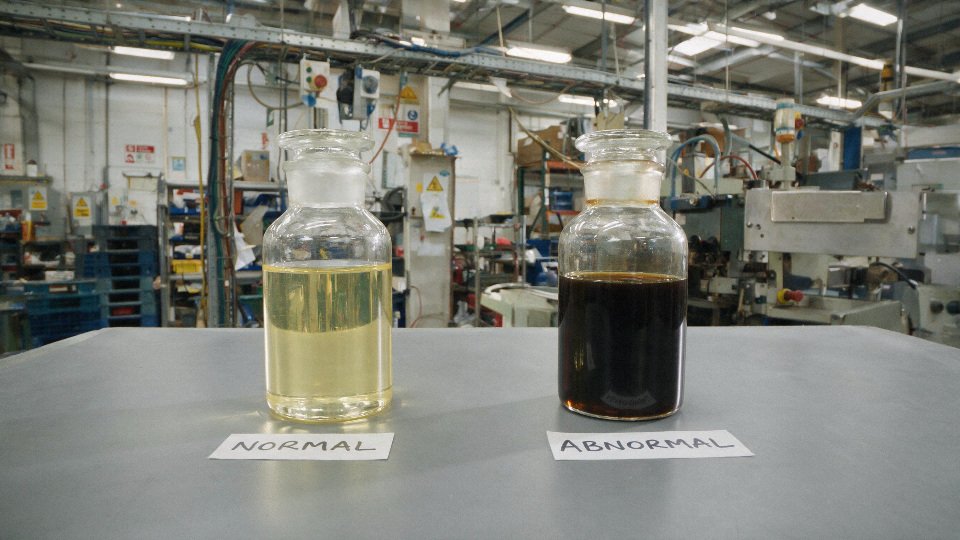
Darkening or yellowing: not always a reject, but always a question
A modest color shift does not automatically mean the fluid is unusable. It often means something changed in raw materials, thermal history, additive condition, or equipment cleanliness, and that change needs context.
Common causes include:
- Thermal stress during processing or storage near heat sources
- Oxidation of additives in modified formulations
- Residual catalyst or byproduct carryover
- Contamination from carbon steel tanks, old gaskets, or dirty drums
- Intentional modification chemistry that naturally gives a pale yellow to amber tone
The trade-off here is straightforward: color is a quick screen, but it is a poor standalone predictor of performance. A slightly yellower lot may still meet viscosity, volatility, and application requirements. On the other hand, if the fluid was previously water-clear and now arrives noticeably darker with a burnt or sharp odor, that combination deserves escalation.
A darker silicone oil is always degraded and unusable.False
Color change can result from benign formulation differences, trace residues, or intentional modification chemistry. It becomes meaningful when tied to specification drift, odor change, solids, or failed application testing.
Sediment, gel particles, skin formation, or stringy material: hold the lot
If you see settled matter, floating gel bits, a surface skin, or filament-like stringing that was not characteristic of the approved grade, the safest assumption is contamination, partial crosslinking, or storage instability until proven otherwise.
Look for these patterns:
- Hard sediment at the bottom
- Rust, dirt, catalyst residues, filler carryover, packaging debris
- Soft gel particles
- Early crosslinking, incompatible additive interaction, aged modified fluid
- Surface skin
- Air/moisture exposure in reactive systems
- Long storage in partly filled containers
- Stringy or cobweb-like material
- Polymerization or crosslinked fragments
- Contamination from sealants, adhesives, or reactive silicone residues
This is where procurement and warehouse practice show up visibly. A drum stored half-full for months with repeated warm-cold cycles can pull in moist air through the bung. A tote that once held another specialty fluid and was not fully reconditioned can seed gel or insolubles. Some issues come from the package, not the reactor.
Foam and entrained air: temporary bubbles are normal, persistent foam is not
Silicone oils can trap air during filling, pumping, or shaking, especially at higher viscosity. Freshly agitated samples may show dispersed bubbles that rise and break with time. That is normal entrained air.
Persistent foam is different. Watch for:
- Fine bubbles that remain for an extended period instead of clearing
- A stable foam cap after mild agitation
- Repeated foaming in service where the same grade previously ran clean
Possible causes include:
- Contamination with surfactants or cleaners
- Mixing with incompatible oils
- Wrong product substitution
- Excessive recirculation or pump shear in a poorly designed loop
The mechanism is simple enough: temporary entrained air clears when bubble mobility and surface drainage allow collapse. Contaminants that lower interfacial tension or stabilize the bubble wall make those bubbles survive much longer. That can affect pump performance, dosing accuracy, heat transfer, and optical appearance all at once.
Odor is secondary, but it helps connect the dots
Silicone oil is usually judged visually first, but smell can support the diagnosis. An unusual solvent-like, acidic, burnt, or sharp odor together with haze, darkening, or solids often points to:
- Volatile contamination from nearby chemicals or reused containers
- Decomposition from overheating
- Wrong product or mislabeling
- Residual low-boiling species outside normal expectation for the grade
Odor alone is not enough to reject a lot, because some modified silicones have a characteristic smell. Odor plus an appearance shift is much more informative than either one alone.
A visually perfect fluid can still fail in service
A silicone oil can look completely normal and still be wrong for the job. Visual inspection will not reliably detect viscosity drift within a tighter process window, volatility issues in high-temperature use, trace incompatibility with a substrate, or contamination at levels low enough to affect coating defects before the eye catches anything.
So if application performance matters, keep the sequence disciplined:
- Use appearance as an incoming screen
- Verify viscosity at the specified temperature
- Check any critical property tied to the application:
- Volatility
- Refractive index
- Compatibility
- Surface behavior
- Dielectric performance
- Confirm with a bench or line trial when the process is sensitive
That last point saves a lot of argument between QA, purchasing, and production. A drum that looks fine is not automatically fit for a release coating, cosmetic base, dielectric bath, or defoaming system. Visual condition tells you whether the material is obviously compromised; it does not prove the material is functionally correct.
Inspection and testing checkpoints
A disciplined incoming check for silicone oil starts with controlled visual inspection, then confirms identity with a small set of physical-property tests, and only then moves to purity or application-specific performance work if the product and risk justify it. If you rely on appearance alone, you will miss some bad batches and reject some good ones for the wrong reasons.
Appearance is still useful. It is just not enough by itself, especially once you are dealing with different viscosities, modified silicone chemistries, repacked drums, winter deliveries, or production lines that are already carrying traces of other fluids in hoses and sample bottles.
Visual inspection under controlled lighting
Do the first check in a repeatable way, not under a yellow warehouse lamp with a dusty sight glass.
- Use a clean, transparent sample bottle or glass jar.
- Let the sample reach a known temperature, usually close to room temperature or your internal reference temperature.
- Inspect against both a white background and a dark background.
- Use stable white lighting; daylight-balanced bench lighting is better than whatever is above the receiving dock.
- Look at both a still sample and the sample after gentle inversion.
Check these items separately:
- Container cleanliness
- Inspect the drum top, bung area, IBC valve, and any transfer fitting before opening.
- Dirt around the opening is a common source of false “contamination.”
- In practice, a rusty cap ring or oily dust on the drum lid tells you more about handling discipline than about the fluid itself, but it still matters because it can enter the batch during sampling.
- Color
- Common acceptance language is clear, colorless to slightly yellow, with no visible suspended matter.
- Compare side by side with a retained approved sample if you have one. Human eyes are poor at judging slight tint shifts in isolation.
- A mild color difference is not automatically a failure; the decision depends on product type, specification, and end use. Optical, cosmetic, electronics, and release-coating applications usually need tighter control than a general-purpose process aid.
- Suspended matter and haze
- Hold the sample to the light and look for fine particles, cloudiness, or a faint milkiness.
- Haze can come from moisture, incompatible contamination, microbubbles, or cold storage effects.
- If haze disappears after the sample warms and stands, temperature and entrained air are more likely than chemical instability.
- Layering
- Any visible phase separation is a serious flag unless the product is specifically designed as a multiphase blend.
- Layering usually points to contamination, formulation error, or severe incompatibility.
- Foam
- Some entrained air after filling or transfer is normal, especially in mid- to high-viscosity grades.
- Persistent foam that does not break as expected can indicate contamination with surfactants, process residues, or a mismatch between product design and handling conditions.
- Sediment
- Look at the bottom of the sample after standing.
- Sediment can come from dirty packaging, filler residues, catalyst residues in specialty fluids, or external contamination during decanting.
Basic identity checks paired with appearance
Visual acceptance should be paired with a few low-cost measurements that confirm you received roughly the right fluid.
| Check | What it helps confirm | What the result depends on |
|---|---|---|
| Kinematic viscosity at defined temperature | Grade identity, lot consistency, dilution or mix-up | Test temperature, shear history, product chemistry |
| Density | Broad composition check | Temperature, modification level, impurities |
| Refractive index | Useful identity screen for many silicone oils | Temperature, chemistry, purity |
| Color number or turbidity, where relevant | Supports visual judgment with a numeric value | Product specification and end-use sensitivity |
A few points matter here.
- Viscosity must be measured at a defined temperature, commonly 25 C if that is how the grade is sold. Silicone oil spans from about 0.65 cSt to more than 1,000,000 cSt at 25 C, so a small temperature error can create a misleading result, especially in lower and mid-range viscosities.
- Density is a useful screening test, but not a fingerprint by itself.
- For common dimethyl silicone oils, refractive index is often around 1.396 to 1.404 at 25 C. That is a helpful range, not a universal pass/fail for every silicone fluid family.
- If the supplier gives typical values rather than guaranteed limits, treat them correctly. Typical is a process benchmark, not a contractual specification.
The mechanism is straightforward: contamination or product substitution changes composition first, and composition shifts viscosity, density, and refractive index through different physical paths. That is why these tests work well together. A batch can still look clear while being off-grade.
Purity and composition tests
When the product is going into a sensitive formulation, electrical service, or a process with little tolerance for residues, move past identity checks.
- Volatile content
- Relevant for heat-transfer use, release coatings, vacuum service, and processes sensitive to fogging or weight loss.
- Elevated volatiles may indicate low-molecular fractions, incomplete stripping, or contamination.
- Moisture
- Important where hydrolytic sensitivity, dielectric performance, or downstream reaction stability matters.
- Moisture can also explain haze or erratic processing.
- Acid value, where applicable
- Not every silicone oil needs this check, but it matters for some modified fluids, degradation investigations, or contamination screening.
- Verify applicability against the product type and supplier method.
- Gas chromatography
- Useful for checking cyclic content, residual low boilers, or composition irregularities in certain fluids.
- This is especially relevant when emissions, volatility, or regulatory content thresholds matter.
- Infrared spectroscopy
- Good for confirming functional groups and distinguishing a standard dimethyl fluid from modified chemistries.
- IR is often underused in incoming inspection, but it is a fast way to catch the wrong family of material.
The trade-off is cost versus risk. Routine GC on every incoming drum is hard to justify for a low-risk internal utility fluid. It is entirely justified for a high-value coating line where one wrong lot can scrap product for a full shift. The conclusion stops holding if your process is highly regulated or qualification-controlled; then “basic incoming inspection” may not be enough regardless of cost.
Performance-linked tests for specific uses
If silicone oil is a functional material rather than just a generic fluid in your process, test the property that actually drives success.
- Dielectric properties for electrical insulation or damping fluids
- Thermal stability for heat-transfer or high-temperature exposure
- Lubricity for release, slip, or mechanical contact applications
- Defoaming efficiency for antifoam use
- Spreadability and surface tension for wetting, leveling, and surface-treatment work
- Compatibility with substrates or polymers for sealants, elastomers, plastics, coatings, and textiles
A common buyer mistake is approving a batch because it matches viscosity and appearance while ignoring the functional property that matters in service. A fluid can be visually perfect and still underperform because the additive package, molecular architecture, or residual low-boiler content is wrong for the job.
Sampling discipline
Most false alarms in incoming appearance checks come from bad sampling, not bad silicone oil.
- Clean and dedicate sampling tools where possible.
- Purge valves and dead legs before collecting the actual sample.
- Do not sample a cold drum and judge it immediately if the delivery truck came in from winter conditions.
- For large containers, consider stratification risk and sample only after the container has equilibrated and, where appropriate, been mixed according to supplier guidance.
- Label sample point, temperature, time, and container ID.
- Keep a retained sample from approved lots for comparison.
I have seen perfectly acceptable product called “cloudy” simply because the sample thief had rinse solvent residue in it, or because the top of the IBC was warm and the bottom was still cold.
Supplier documentation to review
The paperwork should support the bench observations, not replace them.
- Certificate of analysis for the delivered batch
- Technical data sheet
- Clear distinction between guaranteed values and typical values
- Batch number and traceability back to production
- Recommended storage conditions and shelf-life guidance
- Packaging type and handling notes
- Any formal change-control or notification practice for raw materials, process, or specification updates
A clear-looking silicone oil can still be off-grade, contaminated, or unsuitable for the intended application.True
Appearance is a useful first screen, but identity, purity, and performance properties can drift without obvious visual change. The right test set depends on the product type and service risk.
Application context for appearance
Appearance matters very differently by use case. In some systems, a small amount of haze or gel is an early warning of failure risk; in others, a perfectly clear fluid can still be the wrong product and give you poor process results. The practical question is not “Does it look clean?” but “What can appearance reliably tell us in this service, and what can it not?”
Lubrication and damping systems
For lubrication, dashpots, instrument dampers, and similar closed mechanical systems, visible clarity and freedom from suspended matter are genuinely useful screening checks. A silicone oil that shows particles, stringy gel, phase separation, or a viscosity mismatch on handling should not go straight into equipment, because those defects can shift friction behavior, damping response, and wear life.
What matters on the plant floor:
- Particles and hard contamination
- Can score close-clearance parts, especially in metering valves, small-bore dampers, and fine bushings
- Often show up first as erratic motion, stiction, or noise rather than immediate seizure
- Gel or partially crosslinked material
- Changes flow through orifices and narrow passages
- Common symptom: damping curve becomes inconsistent across temperature or cycle count
- Wrong viscosity grade
- A clear fluid can still be wrong if the kinematic viscosity does not match the design basis
- In practice, operators often spot this during filling: one drum pours like light solvent, another like syrup
The mechanism is straightforward. In damping service, flow resistance through a small gap or orifice sets the force response; if contamination blocks that flow path, or if viscosity is off, the force-displacement behavior shifts. That can mean overshoot, sluggish return, or unstable motion, depending on the equipment. In lubrication service, the path is different but the consequence is similar: the oil film either forms correctly or it does not.
This conclusion weakens once the system is very tolerant of contamination and wide viscosity variation, which is rare in precision equipment but not unusual in rough utility mechanisms.
Heat transfer and dielectric applications
In heat-transfer loops and dielectric service, visual clarity is still worth checking, but it is only a first-pass contamination screen. A fluid can be water-clear and still be a poor choice if its thermal stability, volatility, oxidation resistance, or electrical properties do not match the duty.
A few points buyers often miss:
- Color alone is not a thermal-performance metric
- Slight tint does not automatically mean poor heat-transfer service
- Darkening can indicate aging, but you need service history and lab data before calling the fluid failed
- Clarity helps catch gross contamination
- Water ingress, solids, rust fines, or mixed fluids may show up visually
- That is useful, especially after maintenance outages or top-up events
- Electrical service needs property confirmation
- Dielectric strength, dissipation factor, moisture level, and supplier documentation matter more than a water-white appearance
If a transformer-adjacent or electronics process is involved, the manual, qualification file, and current supplier data need to govern acceptance, not just what the sample bottle looks like.
Textile, personal care, and coating intermediates
For modified silicone fluids used as textile softeners, personal care ingredients, or coating intermediates, a slight yellow cast may be acceptable or even typical for the chemistry. Procurement teams sometimes over-focus on drum appearance and under-focus on what the customer will actually see after dilution, emulsification, or cure.
What usually matters more:
- Emulsion appearance after make-down
- Haze stability
- Absence of oiling-out
- Particle size consistency, where relevant
- Effect on finished substrate
- Hand feel on fabric
- Gloss, leveling, slip, or crater behavior in coatings
- Visual residue on light-colored goods
- Odor and storage behavior
- Especially important in personal care and consumer-facing applications
A pale modified silicone that performs cleanly in the formulation is often the better commercial choice than a colorless fluid with the wrong functionality.
Release agents, antifoams, and processing aids
At low treat rates, appearance can be actively misleading. A release fluid, defoamer, or process aid may look perfectly normal in the drum yet fail in use because the key variable is surface activity, compatibility, or dispersion behavior, not bulk appearance.
Typical failure patterns include:
- Antifoam that stays clear in the container but has poor knockdown
- Release agent that looks clean yet transfers badly or causes paint/print defects downstream
- Processing aid that separates after addition because the carrier system is wrong for the formulation
That is the trade-off: visual acceptance is easy and fast, but its predictive value drops sharply as dosage falls and the application depends more on interfacial behavior than on the bulk fluid itself.
Laboratory, medical-adjacent, and high-purity uses
In these applications, the appearance standard tightens and the paperwork burden rises with it. Buyers usually need stricter control of color, odor, visible particulates, packaging cleanliness, batch consistency, and supporting documentation than they would for a utility-grade industrial oil.
A slight tint can be acceptable in some silicone fluid applications, while a colorless appearance alone does not prove fitness for use.True
This is consistent with common industrial practice across modified silicone grades, additive applications, and performance-driven selections. Acceptance still depends on the specific application, qualification protocol, and supplier documentation.
A common procurement mistake
One of the more expensive mistakes is rejecting a suitable modified silicone because it is slightly yellow, then approving a water-white fluid that has the wrong function, wrong compatibility, or wrong viscosity profile. That usually shows up later as coating defects, unstable emulsions, weak release, or wasted line time.

Frequently asked questions
Does silicone oil always look clear and colorless?
No. The common acceptance standard for many dimethyl silicone oils is a clear, colorless to slightly yellow liquid with no visible suspended matter, but that is not a universal rule across every silicone fluid type or viscosity. Modified grades, aged material, and certain additive-containing products can look different while still being saleable for the intended application.
Why does some silicone oil look yellow?
Slight yellowing is often traceable to raw-material carryover, thermal history, oxidation, catalyst residues, or the chemistry of a modified silicone fluid rather than an outright defect. In practice, the question is whether the color is normal for that product grade and stable batch to batch. If the yellow tone is deeper than the supplier’s normal range, or it comes with haze, odor change, or acidity drift, it deserves a lab check.
**Is cloudy silicone oil always bad?****
Not always, but it is never something I would wave through without context. Cloudiness can come from entrained air after pumping, temporary low-temperature haze, moisture contamination, incompatibility with another fluid, or particulate contamination; the cause matters more than the symptom alone.
A quick shop-floor screen helps:
– Let the sample stand undisturbed and see whether the haze clears
– Warm it gently to a controlled room temperature if it arrived cold
– Compare against a retained approved sample in the same container style
– Check whether the cloudiness is uniform or includes settling, flocs, or strings
– Review whether the drum was rolled hard, recirculated, or nitrogen-blanketed before sampling
If haze persists after de-aeration and temperature normalization, stop treating it as cosmetic.
Can silicone oil look like water?
Low-viscosity grades can, yes. At around the thin end of the range, silicone oil may pour and wet surfaces in a way that visually resembles water, but the behavior is not identical; spread, bead shape, evaporation behavior, and feel are different. Do not identify it by eye alone.
What does high-viscosity silicone oil look like?
Usually like a very heavy, smooth, glossy syrup to a gel-like flowing liquid, depending on viscosity. Once you get into the very high cSt ranges, it may form long strands when poured, level slowly in a sample jar, and trap bubbles longer after agitation. That delayed bubble release is normal up to a point; persistent foam stability is a separate issue.
How can I tell silicone oil from mineral oil?
You usually cannot confirm that reliably by appearance alone. Silicone oil is often clearer, more water-white, and has a different slip and surface-wetting behavior than mineral oil, but overlap is wide enough that visual judgment is not a safe purchasing or quality decision.
Useful differentiators are:
– Refractive index
– Viscosity at a defined temperature
– Density
– FTIR or another identity test
– Odor and volatility behavior, as supporting clues only
Appearance alone can reliably distinguish silicone oil from mineral oil.False
Clear, colorless appearance is common in both categories. Identity should be confirmed with physical-property data or instrumental testing, not visual inspection alone.
Does silicone oil have a strong smell?
Typically no. Most standard silicone oils have little to no strong odor. If a drum has a sharp, sour, solvent-like, or burnt smell, I would suspect contamination, residual volatiles, or thermal degradation before I assumed that odor was normal for the product.
Can appearance confirm food-grade, cosmetic-grade, or electronic-grade suitability?
No. Appearance can screen out obvious problems, but it cannot certify regulatory status, purity level, residue profile, or application-specific cleanliness. Those claims need the correct grade designation, supplier documentation, and in some cases lot-specific testing.
Why does silicone oil foam after shaking?
Usually because you have mechanically entrained air faster than the fluid can release it. Viscosity, container headspace, filling method, contamination with surfactants, and temperature all affect foam behavior. Thin grades may flash bubbles quickly; thick grades can hold them annoyingly long, especially in narrow sight glasses and tote samples.
What should I do if two batches look slightly different?
Start with disciplined comparison, not assumptions.
- Confirm both samples are the same product code, viscosity grade, and production specification.
- Bring them to the same temperature before judging color or clarity.
- Compare in matching clean glass containers over the same white and black background.
- Check the COA against the agreed acceptance items, not just color by eye.
- Review storage history, drum age, and whether one batch was mixed or pumped before sampling.
- If the visual difference remains, ask the supplier for the normal batch-to-batch appearance range and whether the difference correlates with any measured property.
A slight appearance shift with no movement in agreed quality parameters may be commercially acceptable. If the product goes into optical, personal care, food-contact, or electronics work, the tolerance for “looks close enough” gets much tighter, and that is where retained samples and supplier confirmation earn their keep.
Your next quality verification step
A silicone oil lot is acceptable only if its appearance matches the exact fluid grade and end use you intend to run, not a generic idea of what “good silicone oil” should look like. Start from application needs, then verify whether the observed look is normal for that chemistry, viscosity, and handling history before you approve, quarantine, or reject anything.
If you buy by product family name alone, you are leaving too much to interpretation. A defoamer carrier, a release coating fluid, a cosmetic intermediate, and a heat-transfer silicone may all be called “silicone oil,” but they are not judged the same way on color, clarity, odor, trace volatiles, or suspended matter.
- Define the requirement from the process backward
- Chemistry type: dimethyl, phenyl-modified, amino-modified, polyether-modified, or another functional fluid
- Viscosity grade at the stated reference temperature, usually 25 C
- Purity level needed for the application: industrial, formulation-grade, or tighter controlled material
- Critical performance need: optical clarity, lubrication stability, foam control, dielectric behavior, release performance, or process compatibility
- Check appearance against the approved specification for that grade
- Do not assume every acceptable silicone oil must be water-white
- For many common dimethyl fluids, a typical acceptance description is clear, colorless to slightly yellow, with no visible suspended matter
- Compare the lot to the approved retained sample if you have one; this catches drift that a broad written spec can miss
- Verify under consistent conditions: same container type, same lighting, same sample depth, roughly the same temperature
- If appearance is off, diagnose before rejecting
- Temperature history: high-viscosity fluids can look hazy, sluggish, or bubble-laden after cold storage; some clear up after controlled warming and settling
- Contamination: water, dust, rust fines, transfer hose residue, or mixed product usually shows up as haze, phase separation, specks, or persistent turbidity
- Aging or oxidation: darkening, odor shift, gel bits, or skin formation can point to thermal abuse or long storage
- Wrong material: a refractive look, flow behavior, or color outside the normal range for that grade may mean mislabeling or a line changeover problem
The mechanism matters here: moisture and light volatiles can change how the sample scatters light, while viscosity shift changes how fast entrained air escapes. In practice, a pail pulled from an unheated warehouse in winter often looks worse than the same lot does 24 hours later in a conditioned QC room. That does not excuse contamination, but it does change the first decision.
- For any important order, require supporting verification
- Certificate of analysis matched to the batch number
- Retained sample comparison against prior approved material
- Targeted lab checks: viscosity, refractive index, and, where relevant, moisture or volatile content
Appearance alone is not a reliable release criterion for silicone oil.True
Visual inspection is useful for screening, but final acceptance for important production use should be tied to the approved grade specification and supporting test data such as viscosity and refractive index.
- For new sourcing or qualification, ask for evidence that survives production reality
- Representative sample from the intended commercial grade, not a hand-picked lab bottle
- Processing trial in your actual system: pumpability, dosing, mixing, wet-out, or end-use behavior
- Batch-to-batch consistency data over time
- Supplier traceability, production control, and export documentation discipline

If you are trying to decide whether a current lot is usable, send the application, substrate or formulation context, contaminant concern if any, target viscosity range, required finish or performance, and clear photos of the sample. SiliconChemicals can review the appearance issue against the likely fluid type, recommend the right silicone fluid, and outline a practical verification plan based on sample evaluation and supporting batch documents.