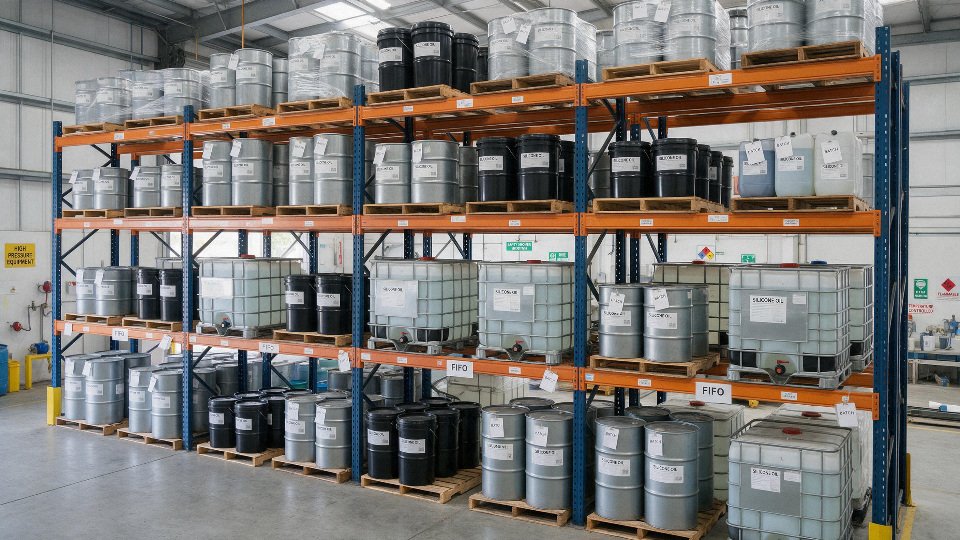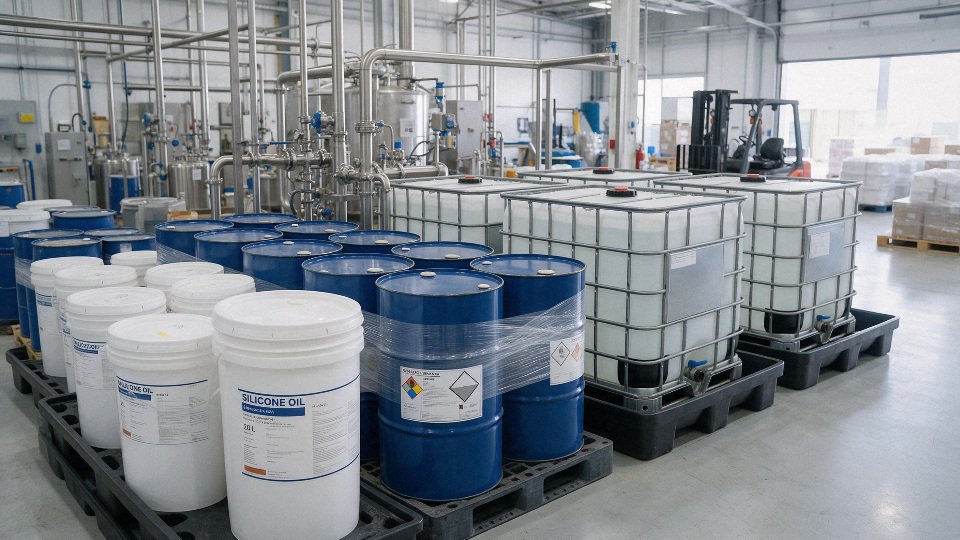
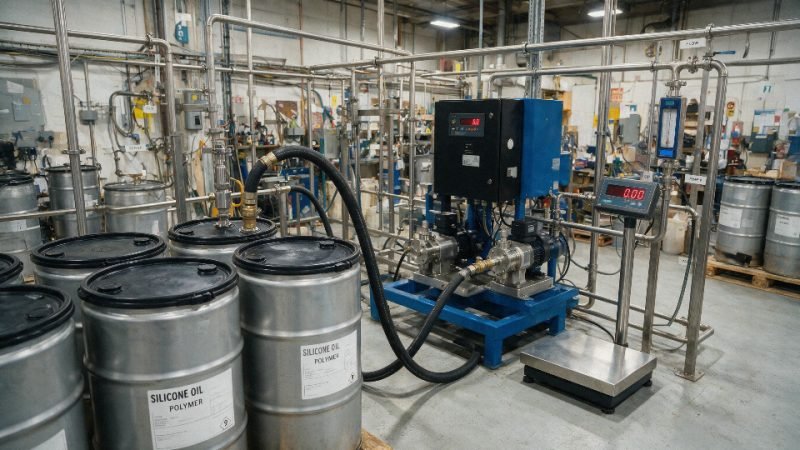
A drum labeled “silicone oil” is not enough when you are sizing a dosing pump, checking fill weight, converting liters to kilograms for purchasing, or troubleshooting a level transmitter that never quite matches inventory. Get the density wrong and the problem shows up fast: metering drift, bad mass balance, underfilled product, shipping calculation errors, and sometimes a pointless argument between production and purchasing over where the material “went.” The practical fix is to work from the actual fluid type and temperature, because silicone oil density is narrow enough to estimate sensibly, but not so fixed that you can ignore grade and operating conditions.
At 25 degrees C, common dimethyl silicone oils typically have a density of about 0.95-0.98 g/cm3. Density usually falls as temperature rises, often by roughly 0.0007-0.0010 g/cm3 per degree C depending on the grade, while high-phenyl or specialty modified silicone fluids can exceed 1.00 g/cm3.
That small spread is exactly why this topic trips people up. Silicone oil is often treated like a single commodity, yet a warehouse conversion, a process setpoint, and a procurement spec can each need a different level of accuracy; what is “close enough” for a bulk quote may be wrong for a calibrated feed system or a customer COA check.
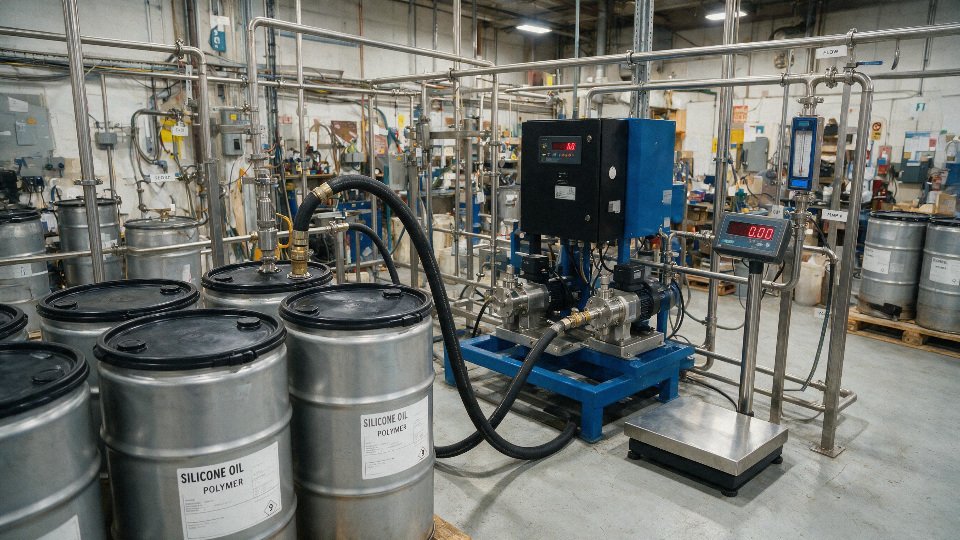
Typical density ranges
For buying, batching, and tank-calculation work, most common dimethyl silicone oils sit around 0.95-0.98 g/cm3 at 25 °C, with chemistry driving the bigger shifts and viscosity only nudging the number within that band. Once you move into phenyl-containing or specialty modified fluids, density can climb above 1.00 g/cm3 or, in some modified systems, drop away from the dimethyl range enough that two products with similar cSt values no longer behave the same in mass-based inventory or fill calculations.
That matters on the plant floor more than people expect. A buyer may match viscosity and assume the fluid is interchangeable, then discover the tote weight, blend ratio, pump calibration, or residence-time estimate is off because the replacement has a different substituent package or additive load. I have seen this most often in release-agent concentrates and specialty lubricant packages where the data sheet headline is viscosity, but the density tells you a lot about what is actually in the drum.
Standard dimethyl silicone oils
For standard polydimethylsiloxane, or PDMS-type dimethyl silicone oils, the commercial benchmark is fairly tight. At 25 °C, many industrial grades fall in the following practical range:
| Dimethyl silicone oil family | Typical viscosity band | Typical density at 25 °C | What usually drives the difference |
|---|---|---|---|
| Low-viscosity dimethyl fluids | roughly 5-50 cSt | about 0.95-0.96 g/cm3 | molecular weight, narrow formulation differences |
| Medium-viscosity dimethyl fluids | roughly 100-1,000 cSt | about 0.96-0.97 g/cm3 | chain length, small grade-to-grade variation |
| High-viscosity dimethyl fluids | roughly 5,000 cSt and up | about 0.97-0.98 g/cm3 | higher molecular weight, sometimes broader product tolerance |
The pattern is useful, but it gets overstated. As viscosity rises within the same dimethyl family, density usually rises a little because molecular structure and packing change with chain length. Still, the movement is modest. If you are comparing two neat dimethyl fluids from the same chemistry class, a jump from low cSt to very high cSt does not produce the kind of density swing you would see by changing to a phenyl-modified or fluorinated fluid.
That distinction matters in procurement. If your receiving team converts liters to kilograms for stock reconciliation, using one fixed factor for all dimethyl grades is often acceptable for rough planning, but not for final financial reconciliation or automated dosing. The error may be small per drum and annoying rather than catastrophic. Across multiple IBCs every week, it adds up.
A practical caution from blending operations: high-viscosity silicone oils can trap air and warm up during pumping or recirculation, especially through undersized lines or a gear pump that is not happy with the shear. If someone “checks density” on a warm, aerated sample and compares it against a 25 °C data sheet value, they may blame the supplier for what is really a sampling issue.
Phenyl and methyl phenyl silicone fluids
Once phenyl groups enter the structure, density commonly moves upward, often enough to cross 1.00 g/cm3 depending on phenyl content and product design. That is the first family where buyers should stop assuming silicone oil will always be lighter than water.
Phenyl-containing fluids are used where low-temperature flexibility, oxidation resistance, refractive index, damping behavior, or broader thermal stability are needed. The aromatic substitution changes more than one property at once:
- It usually increases density relative to straight dimethyl fluids.
- It often changes viscosity-temperature behavior.
- It can alter solvency and compatibility with plastics, elastomers, and additives.
- It may change cost sharply, which matters if the product is sold by volume but consumed by weight.
Typical commercial behavior looks like this:
| Silicone fluid type | Typical density tendency at 25 °C | Notes |
|---|---|---|
| Standard dimethyl silicone oil | about 0.95-0.98 g/cm3 | baseline reference |
| Methyl phenyl silicone fluid | often near or above 1.00 g/cm3 | depends on phenyl substitution level |
| Higher-phenyl silicone fluid | can exceed 1.00 g/cm3 more clearly | verify exact product data; broad family, not one universal number |
The mechanism is straightforward: replacing some methyl groups with phenyl groups increases the mass contribution of the substituent and changes intermolecular behavior. The result is a denser fluid, but not necessarily a simple linear increase from one grade to the next. Manufacturer formulation choices still matter.
The trade-off is where selection gets practical. Phenyl modification can improve performance in demanding thermal or optical applications, but you pay for it in raw material cost and sometimes in compatibility complexity. If your process only needs generic lubrication, water repellency, or a stable antifoam base, phenyl content may be expensive overkill. The preference flips when the fluid has to keep its functional window across harsher temperature conditions or meet a specific optical/electrical requirement.
Specialty modified silicone oils
Specialty modified silicone fluids spread much wider than most catalog tables suggest. Amino, epoxy, polyether, fluoro, and alkyl-modified grades are not just “silicone oil with a tweak”; the modifying group can move density above or below standard dimethyl values and can change how meaningful the comparison even is.
Amino-modified silicone fluids
Amino-modified fluids are often used in textile finishing, personal care intermediates, softeners, and surface-treatment systems. Their density may sit near the dimethyl range or shift upward depending on amine functionality, backbone design, and whether the product is neat or partially formulated.
In practice, these are frequently sold into applications where reactivity or deposition matters more than neat-fluid density. That said, density still affects pump settings, mix calculations, and package fill weight.
Epoxy-modified silicone fluids
Epoxy-modified grades are common in coatings, release systems, and reactive additive packages. Density can move upward from the dimethyl baseline because the epoxy-containing side groups add mass and alter the molecular architecture.
Here the boundary is important: if the product is a reactive intermediate meant to be further formulated, its data-sheet density is useful. If it is already blended with catalysts, solvents, or surfactants, the base-silicone comparison starts losing value.
Polyether-modified silicone fluids
Polyether-modified silicones are used heavily in wetting, leveling, foam control, and agricultural or coatings adjuvant work. Their density can land above the dimethyl range, often because the polyether segment contributes significant mass and polarity, though exact values depend strongly on EO/PO ratio, substitution level, and whether the product is water-compatible.
These are a classic source of confusion on purchase specs. Two polyether silicones can have similar viscosity and completely different behavior in dilution, cloud point, and density because the polyether architecture is doing a lot of work behind the scenes.
Fluoro-modified silicone fluids
Fluoro-modified grades are one of the clearer cases where density may move materially upward. Fluorinated groups are heavy, and the fluid is often selected for chemical resistance, low surface tension characteristics, or demanding specialty environments.
The catch is cost and specificity. These products are usually not drop-in substitutes, and any estimate on density or treat rate needs the exact grade. Broad family averages are not reliable enough for engineering decisions.
Alkyl-modified silicone fluids
Alkyl modification can shift density either way, depending on the chain length and substitution pattern. Some alkyl groups can pull the product toward lower-density behavior than aromatic- or polyether-modified systems, even if the viscosity headline looks familiar.
This is where many spreadsheets fail. Viscosity is easy to compare, so teams compare it. Density, compatibility, volatility, and surface behavior are where the substitution chemistry actually starts separating one commercial grade from another.
Two silicone fluids with similar viscosity can have meaningfully different density.True
Viscosity reflects flow resistance, while density reflects mass per unit volume. In silicone fluids, backbone substitution, side-group chemistry, and additive loading can change density without forcing the same proportional change in viscosity.
Formulated products are not the same as neat silicone oil
Emulsions, antifoams, release agents, and compounded heat-transfer or processing fluids should not be judged by base-fluid density alone. In these products, the final density is often dominated by non-silicone components, dispersed phases, carrier fluids, fillers, or water.
Common examples:
- Silicone emulsions: density depends heavily on water content, surfactant package, and solids level.
- Antifoam compounds: hydrophobic silica, emulsifiers, oils, and carrier systems can shift density away from the neat silicone base.
- Release agents: solvents, waxes, reactive additives, and resin components may control the final value more than the silicone itself.
- Compounded thermal fluids: if a product contains blended base stocks or performance additives, treat it as a formulated fluid, not a generic silicone oil.
The mechanism here is simple but easy to miss in purchasing: once you formulate a product, density becomes a whole-system property. A 30% silicone emulsion does not “inherit” the neat silicone density in any useful way for drum-weight prediction or meter calibration. You need the product-specific data sheet, and if the formulation can vary by batch or solids range, you need the exact commercial specification tied to that SKU.
So if you are comparing offers, ask one question early: is this a neat silicone fluid or a formulated product? If it is formulated, use the finished-product density only. If it is neat, then family-level benchmarks are useful for first-pass screening, but final design, costing, and dosing should still be tied to the exact grade and the reference temperature in the supplier’s current documentation.
What controls density
Start with chemistry and temperature, not the viscosity number on the drum. For common dimethyl silicone oils, density is mainly set by molecular structure and then shifted by temperature, while viscosity is only a loose secondary clue. That is why two fluids sold at similar centistoke grades can sit at different densities if their side groups, additive packages, or dilution levels are not the same.
The useful way to think about density is simple: how much mass is packed into a given liquid volume. In silicone fluids, that comes from both the atoms present in the molecule and how those molecules occupy space in the liquid state. The plant-floor consequence is straightforward. If you are using density for incoming inspection, batching by mass-to-volume conversion, or checking line contamination, you need to know what part of the formulation actually moves the number.
Siloxane backbone and side groups
At the base level, silicone oil density starts with the siloxane chain itself, the repeating Si-O backbone with organic side groups attached to silicon. Dimethyl silicone fluids, the most common class, carry mostly methyl groups. That gives a fairly consistent density band at a given temperature because the backbone chemistry is similar from grade to grade.
What changes the number is the balance between:
- Atomic mass of the substituent groups
- How tightly the molecules can pack
- How much free volume exists between chains
- Whether the fluid contains only one chemistry or a blend
A heavier side group raises mass per unit volume if the liquid structure does not expand enough to offset that extra mass. A bulkier group can also change molecular packing, sometimes in ways that are not obvious from molecular weight alone. In practice, density is never just “heavier atoms = higher density,” though that trend often holds.
For standard methyl-only fluids, the siloxane chain tends to produce density values below water at room temperature. That is one reason silicone oils usually separate upward in water-contaminated sumps or wash systems, although emulsification can muddy that picture fast.
Why phenyl, fluoro, and other modifications shift density upward
Once you move away from methyl-only fluids, density can climb noticeably. High-phenyl silicone fluids are the familiar example. Phenyl groups bring more mass than methyl groups, and specialty modified fluids with substantial phenyl content can exceed 1.00 g/cm3, depending on the formulation and temperature.
The same logic applies, often more strongly, to fluorinated modifications. Fluorine-containing groups can push density higher because fluorinated substituents contribute significant mass and alter intermolecular spacing differently from methyl groups. The exact result depends on how much fluorination is present and whether the product is a true modified silicone fluid or a broader specialty blend.
Other functional modifications can move density as well, including:
- Phenyl substitution
- Usually raises density relative to dimethyl fluids
- Often chosen for optical, low-temperature, or thermal performance reasons, with density change as a byproduct buyers need to account for
- Fluorinated groups
- Commonly raise density further
- May also change compatibility, surface behavior, and seal interactions
- Polar or specialty reactive groups
- Can shift density up or down depending on group type and concentration
- Usually cannot be generalized responsibly without supplier data
The trade-off is that the chemistry selected for performance may complicate handling assumptions. A buyer looking only at viscosity might treat two fluids as interchangeable, then find metering drift because the mass delivered per liter changed. That matters in release coatings, cosmetics, antifoam concentrates, and silicone-based intermediates where the process recipe is mass-sensitive.
Higher-viscosity silicone oil always has higher density.False
Viscosity and density are related only loosely in silicone fluids. Chain length can raise viscosity strongly while changing density only modestly, and side-group chemistry or dilution can shift density more than viscosity grade alone would suggest.
Chain length, molecular weight distribution, and why viscosity is not a density shortcut
Longer siloxane chains generally mean higher molecular weight, and higher molecular weight usually means higher viscosity. But that does not create a clean one-to-one density progression. In silicone fluids, moving from a low-viscosity dimethyl grade to a much higher-viscosity dimethyl grade often changes density only slightly compared with what buyers expect from hydrocarbon systems.
Why the weak link? Because viscosity is governed largely by how molecules resist flow, which depends on chain length, entanglement, and intermolecular interactions. Density is governed by mass packed into volume. Those are related, but not tightly enough to predict one from the other with confidence.
In commercial terms:
- A large viscosity increase may produce only a small density change
- Two similar viscosity grades can differ in density if side-group chemistry differs
- Broad molecular weight distribution can affect flow behavior more than it affects density
- Residual low-boilers or solvent can pull density down even if apparent viscosity still lands near target
This is where buyers get tripped up. A 100 cSt and 350 cSt dimethyl silicone oil may not differ much in density at the same test temperature, while a phenyl-modified 100 cSt product can differ materially from both. So viscosity grade is useful for pump sizing and film behavior, but it is a poor stand-alone tool for density prediction.
The boundary on this conclusion is chemistry family. Within a tightly controlled single-family dimethyl line, density may trend gently with grade and can be a practical rough check. Once you cross into modified fluids, blends, or compounded products, that shortcut stops being reliable.
Additives, fillers, volatiles, and solvent dilution in commercial products
Pure silicone fluid behavior is only part of the picture. Commercial products often include components that shift measured density enough to matter in procurement and QC.
The main contributors are:
- Additives
- Stabilizers, wetting agents, anti-foam packages, or reactive modifiers can shift density depending on their loading and chemistry
- Fillers or dispersed solids
- If the product is not a clear neat fluid, suspended mineral or functional fillers can raise apparent density substantially
- Measurement method matters because settling can skew the sample
- Residual volatiles
- Short-chain siloxanes or other low-boiling fractions often lower density and can change over storage or venting
- Solvent dilution
- Hydrocarbon solvent typically pulls the blend density downward because many hydrocarbon oils and solvents sit around 0.80-0.90 g/cm3
- Other diluents may push the result differently, depending on composition
- Moisture or process contamination
- Water ingress, cleaning-agent carryover, or wrong-line cross-contamination can move density in either direction
A practical example: a drum sampled right after blending may test slightly differently from one sampled after sitting if the product contains any non-uniform additive or entrained air. That is not exotic lab theory; it is ordinary warehouse behavior. I have seen incoming checks rejected simply because the sample was pulled cold, without remixing, from a tote that had been through a winter shipment.
Temperature is the first thing to verify on any density number
Density falls as silicone oil temperature rises because the liquid expands. For common silicone oils, the change is often on the order of roughly 0.0007 to 0.0010 g/cm3 per degree C, but the actual slope depends on the grade and chemistry.
That sounds small until it is not. A 20 °C difference between warehouse temperature and datasheet temperature can shift the observed density enough to trigger a false concern, especially if your acceptance band is tight. This is why every density value needs a stated test temperature, and why “density = 0.96” by itself is incomplete purchasing information.
In practice, check these points before arguing about off-spec material:
- Confirm the reference temperature
- 25 °C is common, but not universal
- Verify the test method
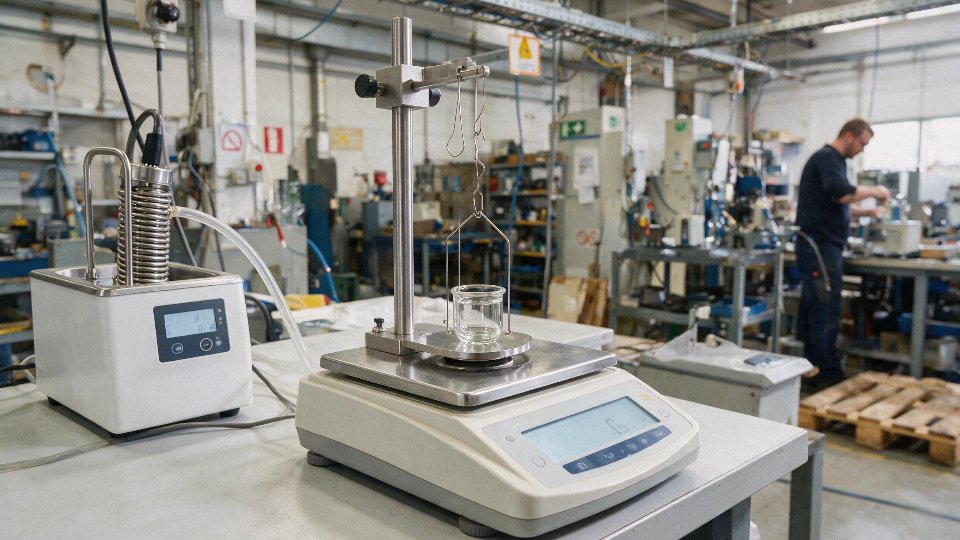
- Hydrometer, pycnometer, digital density meter, and in-line instruments do not behave identically
- Condition the sample
- Let the fluid reach test temperature; a cold viscous sample can also trap bubbles
- Look for entrained air
- Pump recirculation, top-fill turbulence, or poor sample handling can bias the reading low
- Make sure the sample is representative
- Especially for compounded or partially settled products
When density is a diagnostic signal, not just a catalog property
A density check can catch problems that viscosity misses. That is especially true when composition drift is small enough that viscosity still lands inside the supplier’s spec band.
Watch density closely when you are trying to detect:
- Wrong-material receipt
- Similar-looking silicone fluids from different chemistries can overlap in appearance and even in viscosity
- Lot-to-lot composition drift
- Small shifts in phenyl content, solvent level, or volatile balance may show up in density before they become obvious elsewhere
- Contamination in a process tank
- Hydraulic oil, cleaning solvent, water, or another silicone grade can all move density
- Excess stripping or volatile loss during use
- Heated recirculating systems sometimes lose lighter fractions first
- Blending errors
- Off-ratio addition can leave viscosity near nominal while density slides outside the expected band
That does not make density a universal fingerprint. Different issues can push the value in the same direction, and some contamination events barely move density at all. Still, as a screening tool it is underrated because it is fast, cheap, and hard to fake if the sample is taken properly. If density shifts while viscosity stays put, the next step is usually compositional review, not an immediate assumption that the lab made a mistake.
Temperature and measurement conditions
A silicone oil density value is only meaningful when it is tied to a stated temperature, method, and sample condition. For common dimethyl silicone oils, a 5 degrees C difference can shift the reported density by roughly 0.0035-0.0050 g/cm3, which is enough to create arguments in receiving inspection, inventory conversion, or batch-yield reconciliation even when nobody is actually wrong.
Most buyers see density stated at 25 degrees C, but 20 degrees C is also common, especially in older technical literature, European documentation, or labs that still align with long-standing liquid property conventions. Some suppliers also report at 23 degrees C, 15 degrees C, or simply “at room temperature,” which is not a controlled reference and is not suitable for comparison unless the actual lab temperature is recorded. If you compare one datasheet at 20 degrees C with a customer COA measured at 25 degrees C, the apparent mismatch may be nothing more than thermal expansion.
The practical effect is straightforward: silicone oil gets less dense as temperature rises. Typical change is often around 0.0007-0.0010 g/cm3 per degree C, depending on chemistry and grade, so the correction is small per degree but not small over a normal plant temperature swing. In a warehouse that runs 18 degrees C in winter and 32 degrees C in summer, the same tote can give visibly different density readings and therefore different volume-to-mass conversions.
That matters in three places more than people expect:
- Receiving inspection
- A lab checks incoming product against a specification written at 25 degrees C.
- The sample is measured at 21 degrees C without correction.
- The result reads high and gets flagged as suspect, even though the material is on grade.
- Inventory reconciliation
- Bulk silicone oil is purchased by mass but stored and transferred by volume.
- If density used in the ERP system assumes one fixed temperature, stock calculations drift.
- The error gets worse on large tanks, outdoor lines, or sites with seasonal variation.
- Process mass balance
- Dosing skids, blend sheets, and batch records often convert liters to kilograms.
- A few thousandths of g/cm3 sounds minor, but on multi-ton campaigns it can move reported yield, active content, or solvent ratio enough to trigger an investigation.
In practice, if density is being used for commercial acceptance or process control, the reference temperature should be written on the specification line itself, not buried in a footnote.
Common reference temperatures on datasheets
The number itself is less important than consistency. These are the reference points most engineers run into:
| Reference basis | Where it commonly appears | Practical note |
|---|---|---|
| 20 degrees C | Older European-style datasheets, some lab SOPs | Often reads slightly higher than the same fluid at 25 degrees C |
| 23 degrees C | Some laboratory environments, especially where ambient control is set there | Acceptable if clearly stated, but awkward for comparison with commercial specs |
| 25 degrees C | Common in global industrial product data | Usually the safest default benchmark for comparing silicone oil grades |
| 15 degrees C | Some bulk liquid logistics and petroleum-style references | Less common for silicone oils; verify before using for conversion |
| Unstated “room temperature” | Informal reports, internal notes | Not reliable for specification or dispute resolution |
A supplier density value and a customer lab value can both be correct if they were measured at different temperatures or by different methods.True
Density is temperature-dependent, and different instruments and standards can produce slightly different results within their normal uncertainty. Without matching conditions, the numbers are not directly comparable.
Which test method should you trust?
The best method depends on why you are measuring density: quick receiving check, formal COA generation, troubleshooting contamination, or high-accuracy inventory conversion.
Pycnometer
A pycnometer is still a solid reference method for many labs. You weigh a calibrated volume of liquid at a controlled temperature, then calculate density from mass and known volume.
- Strengths:
- Good traceability when handled properly
- Useful as a referee method
- No electronics to drift quietly in the background
- Limits:
- Slow
- Sensitive to operator technique
- Errors show up fast if the flask is not truly temperature-equilibrated or if bubbles cling to the wall
For viscous silicone oils, filling can be tedious. A trapped bubble in the neck is enough to spoil the result.
Hydrometer
Hydrometers are common for quick checks, but they are blunt tools for close-tolerance work.
- Strengths:
- Fast
- Low cost
- Useful on the shop floor for broad screening
- Limits:
- Reading depends on meniscus handling and operator judgement
- Temperature correction is often ignored
- High-viscosity fluids may not let the hydrometer settle cleanly
If the spec window is tight, a hydrometer is usually not the right basis for acceptance.
Oscillating U-tube density meter
For most modern quality labs, this is the practical choice. The instrument measures how the oscillation frequency of a U-shaped tube changes when filled with the sample; that shift correlates to density.
- Strengths:
- Fast and repeatable
- Good precision
- Built-in temperature control on many models
- Limits:
- Needs proper calibration and cleaning
- Sensitive to entrained air
- Residual contamination from the previous sample can bias results, especially when switching between very different viscosities or chemistries
The mechanism is worth understanding: the instrument assumes the tube contains a uniform fluid. If microbubbles are present, the average mass in the tube drops, and the apparent density reads low. That is why a beautifully calibrated instrument can still give bad numbers on a poorly handled sample.
Sample condition is where many bad density numbers start
Before blaming the supplier or the instrument, check the sample itself.
- Entrained air
- Common after pumping, shaking, or sampling from a return line
- Usually drives density low
- Worse with higher-viscosity silicone oils because bubbles escape slowly
- Moisture pickup
- Silicone fluids are generally not highly hygroscopic like some solvents, but open containers can still pick up moisture or condensation
- The effect depends on product type and contamination level
- More likely to matter in humid plants and partially filled drums
- Volatile loss
- If the sample contains lower-boiling components and sits open, composition can shift
- Density may move up or down depending on what is lost
- This is more relevant to specialty blends than to a simple stable fluid
- Cross-contamination
- Sampling from a wet thief, reused bottle, or line with residual oil from another grade can distort the result
- Even a small amount of hydrocarbon oil, solvent, or cleaning fluid can move density enough to confuse grade identification
- Insufficient equilibration time
- A sample pulled from a warm production line and tested immediately in a 25 degrees C lab is not actually “at 25 degrees C”
- The outside of the bottle may feel normal while the bulk liquid is still off-temperature
- Viscous fluids need longer to stabilize than people assume
Units and conversions without creating your own error
Density for silicone oils is commonly reported as g/cm3 or kg/m3. Specific gravity also appears, especially in commercial documents.
Use these conversions carefully:
- 1 g/cm3 = 1000 kg/m3
- 0.965 g/cm3 = 965 kg/m3
- Specific gravity is the ratio of the fluid density to water density at a stated reference condition
Two cautions matter here:
- Specific gravity is not identical to density unless the water reference basis is explicitly aligned. If someone writes “SG = 0.97” without saying at what temperature and relative to which water reference, you need clarification before using it in design or trade calculations.
- Do not over-round intermediate values. If you convert 0.9638 g/cm3 to 964 kg/m3 for convenience, that is fine for a rough tank estimate. It is not fine if you then convert back and use the rounded figure to argue a specification dispute.
The section’s main conclusion stops holding when density is being used only as a broad identification check rather than a quantitative control variable. In that limited case, a rough reading may be enough. But if density is tied to payment, formulation, or release testing, match the temperature, match the method, and let the sample settle before anyone decides the material is off-spec.
Density versus viscosity
They are not interchangeable. In most silicone oil buying decisions, viscosity tells you far more about how the fluid will move, lubricate, damp, spread, or pump, while density mainly matters for mass-per-volume calculations, phase behavior, and package-to-process conversion. A higher-viscosity silicone oil is often only slightly denser than a lower-viscosity grade, and sometimes not meaningfully so for equipment selection.
That point gets missed all the time on plant floors because both numbers sit near each other on a datasheet and both change with temperature. They answer different questions.
- Density = mass per unit volume
Used when you need to know how many kilograms are in a drum, how many liters correspond to a recipe mass, whether one liquid will sit above or below another, or how a level reading converts to inventory. - Viscosity = resistance to flow
Used when you need to know whether the oil will drain off a part, feed through a metering pump, hold a lubrication film, settle bubbles slowly, or give the right damping feel.
A simple example makes the distinction clearer. If you are filling a reactor by volume, density tells you how much actual mass of silicone oil you charged. If that same oil then has to pass through a small gear pump, wet a substrate evenly, or control motion in a damper, viscosity becomes the dominant property. The first problem is about quantity. The second is about behavior in motion.
Why buyers often overread density
A common purchasing shortcut is to assume that if one silicone oil is much thicker, it must also be substantially heavier. For common dimethyl silicone oils, that usually is not true. Across a broad commercial viscosity range, density at the same temperature may shift only modestly, often staying within roughly the mid-0.95 to high-0.97 g/cm3 band for standard grades, while viscosity can change by orders of magnitude.
A 1000 cSt silicone oil is always much denser than a 100 cSt silicone oil.False
For standard dimethyl silicone fluids, viscosity can increase dramatically with molecular structure and chain length while density changes only slightly. You need the actual datasheet value at the stated temperature rather than inferring density from viscosity grade.
This matters commercially because it changes what should drive specification control:
- If your concern is pump sizing, line pressure, start-up torque, or nozzle behavior, specifying density tightly will not protect you from a bad fluid choice.
- If your concern is inventory reconciliation, gravimetric batching, or export shipping mass, density belongs in the purchase specification.
- If your concern is both, you need both values and the temperature at which they were measured.
In practice, I have seen plants reject incoming drums because the density was a few thousandths off an internal target, while the actual line problem was that winter warehouse temperatures pushed viscosity high enough to starve a metering head. The wrong property was being policed.
Where viscosity does the heavy lifting
Viscosity is the property that most directly governs how silicone oil behaves once it starts moving or being forced through equipment.
- Lubrication film formation
Higher viscosity usually helps maintain film thickness under moderate load and low speed, but that gain comes with higher drag and poorer flow into tight clearances during cold starts. Damping and motion control
Dashpots, instrument dampers, and controlled-close mechanisms are highly viscosity-sensitive. A small temperature drop can make the same fluid feel completely different in operation.Pumping and metering
As viscosity rises, pressure drop through hoses, filters, static mixers, and needle valves rises sharply. The mechanism is straightforward: thicker fluid resists shear more strongly, so the pump must generate more pressure to maintain the same flow.Coating spread and leveling
Lower-viscosity fluids generally wet and level more easily, but they may also migrate faster, run off edges, or penetrate porous surfaces more deeply than you want.Defoaming and air release behavior
This gets tricky. Lower viscosity often helps a fluid spread quickly over foam lamellae, but very low viscosity can also change residence and compatibility behavior in ways that reduce practical defoaming efficiency in a specific formulation. Lab screening matters here.
The trade-off is not subtle: higher viscosity can improve retention, film persistence, and damping, but it raises pumping load, slows drainage, and can punish you during cold weather start-up. The preferred choice flips when the process moves from static retention to high-throughput transfer or fine metering.
Where density actually matters
Density earns its place in fewer decisions, but those decisions are still important.
- Volume-to-mass conversion
If a formulation is written in kilograms and the transfer system meters liters, density is the bridge. Get it wrong and the batch ratio drifts. Layering and phase position
Whether the silicone oil sits above or below another liquid depends partly on relative density. This affects settling tanks, separators, contamination diagnosis, and spill behavior.Tank gauging and inventory
Level instruments read volume or height; accounting usually wants mass. Density closes that gap.Shipping, packaging, and fill weight
Drum, IBC, and tote quantities are often discussed by volume in sales and by weight in logistics. Density is what keeps those two conversations aligned.
Temperature shifts both, but not equally
Temperature moves both properties in the same practical direction for most silicone fluids: hotter fluid is less dense and easier-flowing. The scale of change is very different. Density often drops only slightly, roughly on the order of 0.0007 to 0.0010 g/cm3 per degree C depending on grade, while viscosity can fall much more dramatically over the same interval.
That asymmetry is why a process can stay mass-balanced yet become operationally unstable. Your tank level and batch weight may still look normal, but pump slip, coating thickness, drain time, or damping response can shift hard with ambient temperature. Summer and winter complaints in the same line are often viscosity problems wearing a density disguise.
The main boundary here is specialty chemistry. Once you move into high-phenyl or modified silicone fluids, density may rise above 1.00 g/cm3 and composition effects become large enough that you should stop generalizing from standard dimethyl grades.
Do not use density as a shortcut for “bigger molecule” or “better heat resistance”
That shortcut causes expensive mistakes. Density is not a reliable proxy for molecular size, viscosity grade, or thermal stability across silicone oil families. A modified fluid can be denser because of its chemistry, not because it will lubricate better, survive heat better, or pump worse in the way you expect.
If thermal stability is the issue, ask for the relevant thermal data and oxidation behavior for that specific chemistry. If flow behavior is the issue, use viscosity-temperature data, not density alone. If the fluid must both dose accurately and run through existing hardware, buy against a property set, not a single convenient number on the first line of the datasheet.
Application impacts
Density matters in silicone oil service anywhere the fluid is bought, metered, charged, blended, or sold by volume, but it is rarely the first screening property. In most plants, density changes tank calculations, fill weights, dosing accuracy, and phase behavior; the actual process winner is still usually selected first on thermal stability, viscosity curve, volatility, compatibility, and end-use performance. The practical mistake is not ignoring density completely, but treating it as if it predicts everything else.
Heat transfer and thermal management
For heat-transfer loops, density shows up first in inventory and expansion math, not in maximum service temperature. A dimethyl silicone fluid at 25 degrees C may sit around 0.95-0.98 g/cm3, then drop as the system heats, so the same vessel volume carries less mass than a water-based operator instinct might suggest. That affects:
- Initial charge calculations
- Expansion tank sizing
- Level-sensor interpretation
- Pump calibration when flow is inferred from volumetric rather than mass-based measurements
- Purchased volume versus installed mass reconciliation
In practice, this becomes obvious during commissioning. A system charged “to line” at ambient can look comfortably full, then show a different operating level once the fluid is hot and expanded. If the expansion allowance is too tight, operators end up venting product, fouling catch pots, or chasing level alarms that are really just thermal density change plus volumetric expansion. You do not size the entire loop from density alone, but you absolutely use the correct density-temperature relationship when converting tank volume to kilograms and when setting low-level and refill points.
There is also a commercial side. Buyers often compare heat-transfer fluids by price per drum, while operations consumes and accounts for them by kilograms in the loop. Two fluids with similar viscosity can give slightly different installed mass per tote or per IBC. It is not a dramatic swing, but on a large jacketed reactor farm or a central thermal oil skid, it is enough to distort inventory records if purchasing, stores, and production are all working from different temperature assumptions.
The boundary here is simple: if your system is controlled by direct mass flow measurement and the supplier provides a validated density-temperature table, density becomes mostly a conversion variable. If you are estimating from sight glasses, manual dip charts, or generic PLC scaling, it becomes an operating variable very quickly.
Lubrication and damping
In damping devices, instrument dashpots, closed gear units using silicone fluids, and small precision assemblies, density affects fill mass and sometimes settling behavior inside the housing. It does not replace viscosity as the main control on damping force, but it changes how much fluid mass is carried by the component and how the oil behaves against trapped gas, suspended fines, or wear debris.
A few points that matter on the floor:
- Higher-density fluid raises filled-part mass slightly, which can matter in balanced moving assemblies or calibrated devices
- Fill-by-volume and fill-by-weight methods will not match unless density is corrected at the actual fill temperature
- In closed reservoirs, density influences how fast entrained contaminants or additive-rich droplets separate if the system has any immiscible fraction
- Air release behavior is not determined by density alone, but density differences can affect how bubbles migrate in narrow cavities
This is one of those cases where the trade-off is easy to miss. A fluid with the right damping viscosity but the wrong charging assumptions can leave units underfilled in winter or overfilled in summer if the line doses volumetrically. On small devices that may sound trivial, but enough overfill can change response, leak tendency, or seal compression.
Personal care and textile processing
In formulation work, density has a direct handling value because raw materials are often transferred on volumetric pumps while recipes are written by weight. Silicone oils and silicone emulsions in personal care and textile finishing are especially sensitive to this mismatch. A 100 L transfer is not 100 kg, and if the batching software or operator habit assumes a water-like density, the formula drifts.
That drift shows up in several ways:
- Finished solids or active content misses target
- Emulsion phase balance shifts
- Sensory profile changes in personal care systems
- Fabric hand, slickness, and pickup can move off spec in textile finishing
- Drum-to-drum dosing repeatability worsens on the line
Mechanistically, density matters because it sits between the storage tank and the formulation scale. If a lotion, serum, or textile softener uses a silicone fluid or emulsion dosed by liters but controlled by weight percentage, even a modest density error propagates into active level. Then the downstream effect is not just bookkeeping. Emulsifier demand, droplet stability, and deposition behavior can change, particularly in formulations already running near the edge on phase stability.
The preferred control method flips with plant setup. In a lab or premium cosmetics line, mass-based dosing usually removes the problem. In high-throughput textile finishing, where operators often work from day tanks and simple flowmeters, density correction is worth building into the work instruction rather than assuming everyone will do the conversion correctly at 6 a.m. on a Monday shift.
Release agents, polishes, and coatings
For release coatings, furniture and automotive polishes, and silicone-containing coating packages, density matters less than surface tension and compatibility, but it still affects day-to-day process behavior.
Watch for these practical consequences:
- Package fill consistency when product is sold by volume but QC releases by weight
- Stratification risk in multi-component systems where silicone fluid sits with hydrocarbon solvent, water, wax, or resin phases
- Settling or creaming tendency when pigments, waxes, or fillers are present
- Spray and wipe product consistency if the blend is not fully uniform before filling
High-phenyl or specialty modified fluids can run denser than standard dimethyl grades, and once you start blending across dissimilar phases, the density gap becomes part of the separation problem. It will not by itself decide whether a system is stable, but it changes the driving force for layer formation. I have seen otherwise acceptable bench blends separate faster in warehouse storage simply because the production batch had a different solvent ratio and sat through a temperature swing the lab never simulated.
Antifoam and process aids
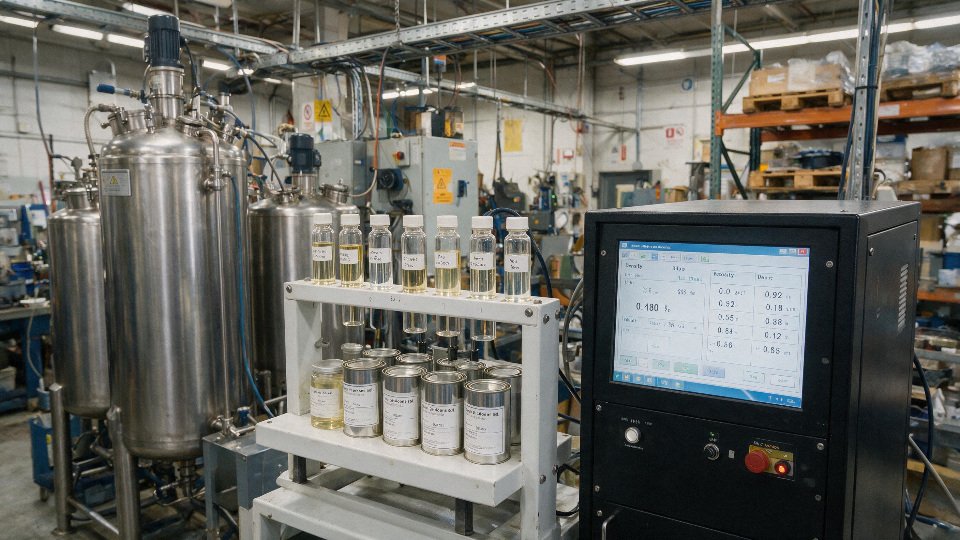
For antifoams, density matters through dispersion and residence behavior inside the customer’s system. Many silicone antifoam concentrates or compounds are not used neat; they are dispersed into aqueous or mixed-process media where flotation, settling, and local overconcentration can become practical problems.
What density influences here:
- Whether droplets tend to rise, remain suspended, or settle relative to the continuous phase
- How well the antifoam stays uniformly distributed in holding tanks or feed lines
- How quickly a diluted product separates during idle time
- Whether the customer gets consistent actives from the first tote draw to the last
This is not a simple “heavier is better” or “lighter is better” call. A density closer to the process medium can support suspension, but antifoam performance still depends heavily on droplet size, carrier system, silica content where relevant, agitation intensity, and the chemistry of the foaming liquor. If a customer says an antifoam “worked in the trial but not in production,” density-related separation during storage or feed dosing is one of the first things worth checking.
Electrical and specialty industrial uses
In dielectric and specialty industrial service, density affects charge mass, reservoir design, and sometimes leak detection or contamination interpretation. It does not define dielectric performance, which must be verified from the supplier’s electrical data and application test, but it does affect how much fluid mass sits in a transformer-like housing, test cell, or sealed component for a given fill level.
Also check adjacent-material compatibility, because the wrong assumption is often that density is the issue when the failure is actually swelling, extraction, or seal softening in gaskets, potting compounds, hoses, or sight-glass seals. In these systems, density is part of the design package, not the whole package. If the fluid will be charged into a fixed-volume reservoir and expected to remain stable over temperature, use the supplier’s current density data at the actual charging and operating temperatures, then verify seals, plastics, and coatings against that specific grade rather than the generic term “silicone oil.”
Procurement and specification checks
Density belongs in the purchasing spec, but not always in the driver’s seat. For standard dimethyl silicone oil bought for heat transfer, lubrication, release, damping, or general process use, density is usually a supporting identification property checked alongside viscosity and appearance; for specialty phenyl-modified, functional, or purity-sensitive fluids, it becomes more critical because a small shift can signal chemistry drift, wrong blend ratio, contamination, or off-grade substitution.
A lot of buying mistakes happen because density gets treated either as the whole story or as an irrelevant line item. Both are wrong. In practice, density is most useful as a fast screening tool: it helps confirm whether the delivered material is broadly the chemistry you expected, whether the packing list mass matches the shipped volume, and whether a lot looks consistent with prior receipts. It stops being enough the moment the application depends on volatility, low-temperature behavior, dielectric performance, surface response, or a reactive end-group. A fluid can hit the expected density and still fail the job.
When density should be a critical acceptance criterion
Use density as a tighter acceptance criterion in these situations:
- Specialty chemistry where density tracks composition
- High-phenyl silicone fluids
- Functional silicone fluids with defined modification level
- Blends where the ratio between components materially affects optical, dielectric, or thermal behavior
- Applications vulnerable to substitution or dilution
- Export supply chains with multiple handling points
- High-value grades where hydrocarbon or lower-grade silicone substitution is a known commercial risk
- Materials repacked locally from bulk containers
- Bulk inventory control and transfer accounting
- ISO tank or IBC receipts where invoicing, storage capacity, or batch charging is done by mass but received by volume
- Automated dosing systems that assume a mass-per-stroke relationship
- Purity-sensitive end uses
- Cosmetic, personal care, electronics, textile finishing with strict residue limits, or formulations sensitive to moisture and volatiles
- In these cases density alone is not enough, but a drift in density is often the first visible warning
Treat density as a supporting property, not the main buying lever, when you are purchasing a standard non-functional dimethyl silicone oil and the process outcome depends more heavily on viscosity stability, volatility, flash point, or compatibility with seals and substrates. A narrow density spec on a commodity grade can create false rejects without improving plant performance, especially if different suppliers report at different temperatures.
What should sit beside density in the purchase specification
If density is the only numerical line in the buying spec, the spec is incomplete. At minimum, technical buyers should ask for a property package that can actually separate acceptable lots from merely similar-looking lots.
| Property | Why it matters in procurement | Typical buying use |
|---|---|---|
| Density | Identity check, mass-volume conversion, chemistry consistency | Receiving check, tank inventory, fraud screening |
| Viscosity | Main functional control for flow, film thickness, damping, lubrication | Primary acceptance criterion for many standard grades |
| Refractive index | Useful secondary identity marker, especially for modified fluids | Confirms chemistry family or blend consistency |
| Volatile content | Affects odor, weight loss, fogging, residue, flash behavior | Critical for coatings, personal care, electronics |
| Acid value | Screens residual catalyst, degradation, or contamination | Important for stability and downstream compatibility |
| Moisture | Can affect hydrolysis-sensitive systems, foaming, storage stability | Critical for reactive systems and some finishing lines |
| Flash point | Safety, transport handling, heated process suitability | Required for EHS review and process risk assessment |
| Color | Basic quality consistency, contamination indicator | Useful for customer-facing or optical applications |
| Functionality | End-group or modification type defines actual performance | Essential for reactive, emulsifiable, or specialty use |
| Application-specific purity | Metals, ions, odor, insolubles, cyclics, ash, etc. | Required where formulation or regulation demands it |
A buyer’s habit I recommend: split the spec into three bands.
- Primary performance properties
- Usually viscosity, functionality, volatile content, and any application-specific purity item
- Identity and consistency properties
- Density, refractive index, color, appearance
- Safety and handling properties
- Flash point, moisture, packaging condition, labeling, transport classification
That structure helps procurement avoid over-negotiating the wrong parameter. I have seen teams push hard on density tolerance, get a nice-looking number, then discover the fluid had higher volatile content and more odor than the line could tolerate.
How to read supplier datasheets without comparing the wrong numbers
A single density number means very little unless four things are attached to it:
- Reference temperature
- Density at 25 degrees C is a common benchmark for silicone oil, but some suppliers may report at 20 degrees C or another condition.
- Since density typically drops by roughly 0.0007-0.0010 g/cm3 per degree C, a 5 degree C difference can move the reported value enough to create a false comparison.
- Test method
- The method may be based on pycnometer, digital density meter, or another standard laboratory approach.
- You do not need every supplier to use the same instrument, but you do need a comparable method and clearly stated temperature control.
- Nominal value versus specification limit
- Datasheets often show a typical value.
- Purchase contracts and COAs should show an acceptance range or guaranteed limit.
- Material description
- “Silicone oil” is too broad.
- The datasheet should identify chemistry family, viscosity grade, and any modification or functionality.
A density value without temperature and test method is not sufficient for supplier comparison.True
Silicone oil density changes with temperature, and the reported number can shift enough across common reference conditions to make two equivalent products look different on paper. Buyers need the reference temperature and method before judging equivalence or nonconformance.
The mechanism matters here. If procurement compares a 0.963 g/cm3 figure at 20 degrees C from one supplier against 0.959 g/cm3 at 25 degrees C from another, they may think one fluid is denser or “higher grade.” That difference may be mostly temperature, not chemistry. The trade-off is straightforward: if you insist on strict numerical matching without aligned test conditions, you reduce supplier options and may increase cost without gaining control of the process.
Lot consistency, COA expectations, and incoming inspection
For global sourcing, especially with ocean transit and multi-month inventory cycles, lot discipline matters more than brochure values.
Set expectations for:
- Certificate of analysis per lot
- Lot number, production date, retest or expiry guidance where applicable
- Reported values for the agreed critical properties
- Reference test method and temperature for density and viscosity
- Retention samples
- Supplier-held retention sample for complaint investigation
- Buyer-held sealed retain from incoming lot, especially for drums and IBC receipts
- Keep long enough to cover storage plus downstream complaint window
- Incoming inspection plan
- Full test on first approval lots and supplier changes
- Reduced plan for stable, approved sources
- Triggered full review if COA trend drifts, packaging damage appears, or process complaints rise
- Trend review
- Do not just check pass/fail.
- Plot density and viscosity by lot over time. A drift inside spec can still warn of a process shift at the supplier.
The boundary here is practical: not every plant needs a full lab on every receipt. If the material is a mature commodity grade from a stable source, a sensible plan is identity confirmation plus periodic verification. If the fluid feeds a high-value formulation or regulated export product, more aggressive incoming control usually pays for itself the first time it prevents a blocked production run.
Packaging, logistics, and why density matters to receiving
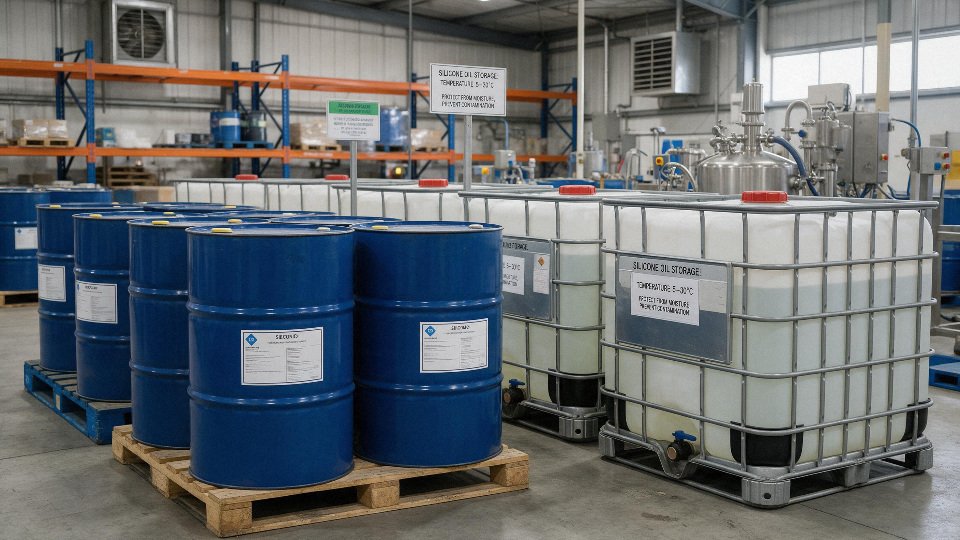
Density becomes very concrete at the dock. Drums, IBCs, and ISO tanks are often loaded, sold, or transferred by one unit and reconciled by another.
Key checks:
- Mass-to-volume conversion
- Tank farm space is volumetric.
- Purchasing and customs documentation may be mass-based.
- The conversion depends directly on the agreed density at the stated temperature.
- Fill quantity verification
- A “full” drum or IBC can look normal and still be short on mass.
- For bulk receipts, use density with temperature-corrected volume data before arguing shortage or overfill.
- Temperature on receipt
- A hot ISO tank in summer sun and a cool warehouse drum in winter will not reconcile to the same apparent volume.
- If the transaction basis is sensitive, record receipt temperature.
- Packaging selection
- Drums suit smaller lot segregation and easier quarantine
- IBCs reduce handling labor but increase contamination risk if cleaning control is weak
- ISO tanks improve freight economics for volume buyers, but sampling and line-clearance discipline need to be tighter
In plant terms, this is where accounting errors become operating errors. If your dosing skid assumes a nominal density that is off, batch charging by volume can quietly shift the actual mass input. For some silicone oil uses that barely matters; for formulated blends or downstream export packs, it can move the product outside label claim or customer expectation.
Sourcing from China: balancing verification, documentation, and cost
A strong China supply option can be commercially attractive because the organosilicon manufacturing base is deep, upstream integration is better than many buyers realize, and container economics can be favorable on repeat lanes. The sensible approach is not to buy on price alone, and not to reject on origin alone either. Buy on controlled equivalence.
That means asking the supplier for:
- Complete technical data tied to the offered grade
- A lot-specific COA on shipment
- Export documentation aligned with the material and destination requirements
- Packaging details and net/gross weight control
- A sample or pre-shipment verification route for critical applications
Cost competitiveness matters, but only after the material definition is tight. If two suppliers are close on density but one gives clearer method disclosure, better lot traceability, and cleaner export paperwork, that supplier is usually cheaper by the time the shipment clears, enters stock, and runs through the line without an argument between QA and production.
Quality deviations and troubleshooting
A density reading that misses the expected range is often the first sign that the drum, tote, or process sump does not contain exactly the fluid you think it does. In practice, though, density alone is not enough to call a lot bad: warm samples, air entrainment, and normal test scatter can shift the number enough to trigger false alarms, while contamination and cross-mixing usually show up in at least one other property at the same time.
A density result outside the expected range should always be interpreted together with sample temperature and at least one companion identity or quality test.True
Density is temperature-sensitive and can be shifted by contamination, misgrading, entrained air, or simple measurement-condition error. A single off-spec density value is not a reliable standalone diagnosis.
When density reads lower than expected
If a common dimethyl silicone oil comes in meaningfully below its expected value at the correct reference temperature, the usual suspects are dilution, the wrong grade, trapped air, or a sample that was simply tested too warm. The practical risk is not just “light product”; it is loss of film strength, faster evaporation, changed pump behavior, and in some applications a finish that looks acceptable at startup but fails after a few hours or after cure.
Start with the most common causes:
- Sample temperature above the stated reference
- Silicone oil density drops with temperature, often on the order of roughly 0.0007 to 0.0010 g/cm³ per °C depending on the grade.
- A sample tested 10 °C warm can look off by a full few thousandths, which is enough to create a purchasing dispute if no one checks the lab sheet carefully.
- This is the first thing I would clear before opening a nonconformance report.
- Entrained air or foam
- Common after aggressive drum pumping, recirculation through a high-shear bypass, or sampling from a return line instead of a quiet point.
- Air lowers apparent density and can also distort viscometer readings.
- Let the sample stand, or pull a fresh sample from a low-turbulence point.
- Solvent dilution or volatile contamination
- Hydrocarbon solvent, residual cleaner, or a low-boiling process fluid can depress density.
- The mechanism is straightforward: lower-density volatile material displaces heavier silicone fluid by volume, and the blend reads light.
- This usually also shifts flash point, odor, evaporation behavior, and often viscosity.
- Incorrect grade or mislabeling
- A lower-density silicone family or a differently modified fluid may have been filled into the wrong packaging.
- This turns up more often during grade changes, toll filling, or when similar drum labels are stored in the same bay.
When density reads higher than expected
A high density result, once temperature error is ruled out, usually points to contamination by a heavier component or receipt of the wrong modified fluid. The commercial issue is bigger than the lab number: dense contamination often means chemistry has shifted too, which can affect wetting, dielectric behavior, compatibility with elastomers, or release performance.
Typical causes include:
- Cool sample condition
- A sample tested below the stated reference temperature will read high.
- This sounds obvious, but it is a routine winter problem in unconditioned receiving rooms.
- Wrong modified silicone fluid
- High-phenyl or specialty modified fluids can run above 1.00 g/cm³.
- If the density comes in high and refractive index also moves, that is a strong clue that the chemistry family changed rather than the lot merely picking up a little contamination.
- Additive carryover
- Antiwear packages, fillers in concentrated preblends, metalworking additives, or process residues from a shared line can lift density.
- This is especially plausible where flush discipline is weak or transfer hoses are shared between silicone and non-silicone products.
- Contamination by heavier non-silicone materials
- Plasticizer residues, chlorinated materials, glycol-based fluids, or some process intermediates can move density upward.
- In a plant, this tends to happen at interfaces: tote unloading stations, reused IBCs, or day tanks with poor line identification.
What density change usually means about the broader fluid condition
Density drift matters because it rarely travels alone. If oxidation, contamination, or cross-mixing is strong enough to move density measurably, it has usually already changed some combination of viscosity, volatility, optical properties, or compatibility. That is the mechanism to keep in mind: the molecules occupying the fluid volume have changed, so the fluid’s handling and end-use behavior usually changes with them.
Three patterns matter most:
- Oxidation
- Depending on service severity, oxidation can raise viscosity, generate volatiles, and alter refractive behavior.
- Density change may be small compared with viscosity change, so density is not the most sensitive early warning here.
- The boundary is important: in mildly aged silicone oil, density can remain close to nominal while performance has already drifted.
- Process contamination
- Water, solvents, cleaners, hydraulic oil, heat-transfer fluid, and product carryover all show different signatures.
- One contamination route can lower density while another raises it; that is why “off density” is a symptom, not a root cause.
- Cross-mixing
- Mixing one silicone oil with another is not always catastrophic, but it can be enough to move a tight process out of control.
- A textile finish line, for example, may tolerate small density variation if add-on is gravimetrically controlled, while a precision release coating or dielectric fluid application may not.
Companion tests that actually confirm the diagnosis
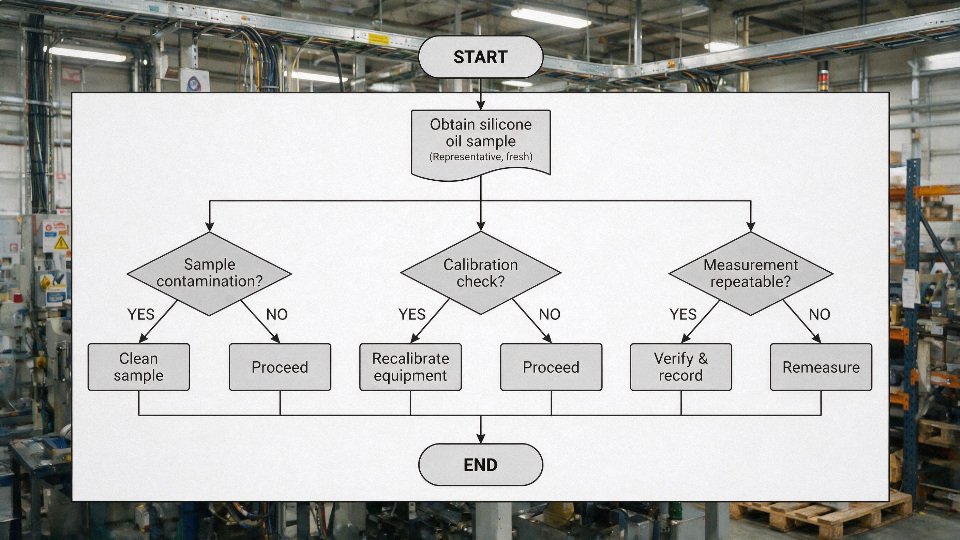
Do not troubleshoot density in isolation. Use a short test set that distinguishes temperature error, contamination, and misidentification.
| Test | What it helps confirm | Typical value of the result |
|---|---|---|
| Viscosity | Wrong grade, oxidation, dilution, cross-mixing | Often the fastest second check; density and viscosity drifting together is more meaningful than density alone |
| Refractive index | Chemistry family change, especially phenyl modification | Useful for telling apart similar-looking silicone fluids |
| GC for volatiles | Solvent dilution, light-end contamination, degradation volatiles | Best choice when density is low and odor or evaporation also changed |
| Moisture | Water ingress from storage or process | Necessary where hydrolysis-sensitive systems or drying ovens are involved |
| Non-volatile content | Dilution by solvent or volatile contamination | Common receiving test for formulated fluids rather than neat base oils |
| Infrared identification | Wrong product family, non-silicone contamination, cross-mix evidence | Strong identity check when labeling error is suspected |
How much deviation is noise, and when is it actionable?
Small variation is normal. A few thousandths can come from sample temperature drift, instrument calibration, or pulling a foamy sample from the wrong valve. I would treat the reading differently depending on the application:
- Low-sensitivity uses
- Dust control, general lubrication, demolding in forgiving processes.
- Slight density drift may be acceptable if viscosity, appearance, and application performance are still normal.
- Moderate-sensitivity uses
- Heat transfer, textile finishing, antifoam blending, general process aid service.
- An off-density lot should trigger at least a confirmatory second sample and one companion lab test.
- High-sensitivity uses
- Electrical insulation, precision coating, medical or personal-care intermediates, release systems with tight add-on control.
- Even modest unexplained deviation should put the lot on hold until identity and contamination risk are cleared.
The preferred action flips with process sensitivity. A batch that runs fine in a bulk lubrication sump may be completely unacceptable for a coating head metering a thin film, because the cost of being wrong is scrap, customer claims, or line cleanup rather than just a little performance drift.
Escalation logic for operators, lab, and procurement
- Plant operator
- Re-sample from a stable point.
- Record actual sample temperature.
- Check for foam, recent top-up, hose misconnection, or recent line flush.
- Quarantine only if the deviation persists after a basic recheck or if the process is quality-critical.
- Lab analyst
- Verify temperature correction and instrument calibration.
- Run viscosity first, then choose refractive index, GC, moisture, non-volatile content, or IR based on the suspected failure mode.
- Compare against the retained sample or certificate data for the same lot if available.
- Procurement or quality team
- Put the lot on conditional hold if the result remains outside the agreed acceptance range.
- Request supplier batch COA, packing confirmation, and any changeover or cleaning records relevant to filling.
- If the material is already in use, tie the lab result to application risk before deciding on return, concession, or restricted use.
Where the density miss is small and fully explained by sample temperature or air, this can stop at the operator or lab level. Where identity is uncertain, or the lot is for a sensitive application, the right move is to hold material, preserve samples, and get the supplier involved before the product reaches tanks, mixers, or customer shipments.
Frequently asked questions
Is silicone oil denser than water?
Usually no. Common dimethyl silicone oils are typically around 0.95-0.98 g/cm3 at 25 degrees C, so they are slightly less dense than water at the same temperature and will usually float.
The exception is not rare enough to ignore in purchasing. High-phenyl or other specialty modified silicone fluids can reach or exceed 1.00 g/cm3, which means they may behave differently in phase separation, leak tracing, or tank stratification. If the fluid family is not clearly stated on the datasheet, do not assume it will sit above water just because it is called “silicone oil.”
Does density increase with viscosity?
Not reliably, and this catches people out all the time. Within a given silicone chemistry family, higher viscosity grades may show small density differences, but viscosity and density are not locked together strongly enough to use one as a proxy for the other.
A 100 cSt and a 1000 cSt dimethyl silicone oil can both sit inside the same broad density band. Viscosity is driven mainly by molecular chain length and flow behavior; density shifts are usually much smaller and are also affected by formulation and temperature. If your pump sizing, fill-by-weight accuracy, or separator design depends on density, use the stated density value for that exact grade, not the viscosity grade name.
What is the density of 100 cSt silicone oil?
For a common dimethyl 100 cSt silicone oil, a practical benchmark is often around 0.96 g/cm3 at 25 degrees C, give or take a few thousandths depending on supplier, additive package, and test condition.
That is a working estimate, not a universal catalog truth. One supplier may report at 25 degrees C, another at 20 degrees C, and that alone can move the number enough to look like a discrepancy if you are checking inbound material.
What is the density of 1000 cSt silicone oil?
A common 1000 cSt dimethyl silicone oil is also typically in the 0.97 g/cm3 range at 25 degrees C, again with grade-to-grade variation.
The practical point is that the jump from 100 to 1000 cSt is large in flow behavior but modest in density. So if your process issue is slow drainage, air entrainment, or metering lag, the viscosity increase matters much more than the density change.
How does temperature change silicone oil density?
As temperature rises, density drops. A typical rule-of-thumb for many silicone oils is roughly 0.0007-0.0010 g/cm3 lower density per degree C increase, but the exact slope depends on the grade.
That sounds small until you are doing mass-volume conversion in bulk storage. A 20 degree C shift can change the apparent density enough to affect inventory reconciliation, dosing by volume, or acceptance checks on a truckload. In practice, plants get false alarms on “off-spec density” simply because the sample was read warm near the line instead of stabilized in the lab.
Can density confirm product authenticity by itself?
No. Density is useful as a screening check, but it cannot prove identity or authenticity on its own.
Different silicone fluids can overlap in density, and some adulterated products can still land near the expected number. If authenticity matters, especially for release coatings, cosmetics, electrical fluids, or critical process aids, combine density with viscosity, refractive index if relevant, volatile content, appearance, and supplier traceability. For higher-risk applications, keep a retained approved sample and compare against it under the same test conditions.
Density alone can verify that a silicone oil is genuine.False
Density can flag obvious substitution or contamination, but overlapping density ranges across legitimate and adulterated fluids make it an incomplete identity check. Use it with other QC data and supplier documentation.
Why do two supplier datasheets show different numbers for similar grades?
Start with the test basis before assuming the materials differ. Small density differences often come from different reference temperatures, different reporting precision, or slightly different product chemistries under the same broad commercial label.
Check these items:
- Reported temperature, such as 20 degrees C vs 25 degrees C
- Fluid family: dimethyl, phenyl-modified, or other specialty type
- Whether the value is typical, minimum/maximum, or a release-spec target
- Sample condition, especially moisture pickup or volatile contamination
- Unit format and rounding, for example 0.965 vs 0.97 g/cm3
If two numbers still do not reconcile, ask for the current product data sheet, certificate of analysis format, and the supplier’s density test method. That usually clears it up fast.
How do I convert density from g/cm3 to kg/m3?
Multiply by 1000.
Examples:
- 0.95 g/cm3 = 950 kg/m3
- 0.97 g/cm3 = 970 kg/m3
- 1.02 g/cm3 = 1020 kg/m3
This conversion is exact, not an estimate. It is handy when your lab reports in g/cm3 but your tank calculations, pump curves, or ERP system use kg/m3.
Verify your required density
For most buyers, the next decision is simple: if you need a fluid around 0.95-0.98 g/cm3 at 25 degrees C, a standard dimethyl silicone oil is usually the first place to look; if your process needs density at or above 1.00 g/cm3, you are typically into phenyl-modified or other specialty silicone fluids. The choice flips only when another requirement overrides density, usually low-temperature behavior, dielectric performance, compatibility with a formulation, or a fixed viscosity window.
Density should not be selected in isolation. In practice, the wrong chemistry often shows up later as seal swelling, phase separation, poor wetting, metering error, or a line that was calibrated by liters when the production team actually consumes by kilograms.
Start with the actual process need
Before you ask a supplier for “a silicone oil with density X,” pin down what that number is solving.
- Define the application
- Heat transfer, damping, release, lubrication, dielectric insulation, antifoam carrier, personal care base, textile finish, or formulation additive
- Whether density matters for dosing accuracy, float/sink behavior, blend ratio, fill weight, or only for material identification
- Confirm the operating temperature
- Storage temperature
- Normal running temperature
- Peak or upset temperature
- Any seasonal extremes if the material is bulk-stored outdoors
- Set the viscosity target
- Required viscosity grade or allowable range
- Whether the process is pump-limited, spray-limited, metering-limited, or film-build-limited
- Check the formulation environment
- Contact with solvents, resins, surfactants, elastomers, metals, plastics, or active ingredients
- Water exposure, shear level, and whether the fluid must remain clear and single-phase
- State the density reference temperature
- 25 degrees C is common, but not universal
- If your plant checks incoming material at 20 degrees C, 23 degrees C, or line temperature, say so explicitly
That last point matters more than many purchasing teams expect. A fluid that looks “off-density” on the shop floor is often just being compared at the wrong temperature. With silicone oils, a modest temperature shift can move the measured value enough to trigger a false rejection if your receiving standard is vague.
Match the density band to the likely fluid family
A practical first screen looks like this:
| Likely requirement | Typical fit | What to watch |
|---|---|---|
| Roughly 0.95-0.98 g/cm3 at 25 degrees C | Standard dimethyl silicone oil | Confirm viscosity grade and temperature basis |
| Around or above 1.00 g/cm3 | Phenyl-modified silicone fluid | Verify low-temperature performance and cost impact |
| Density target tied to a formulation or special function | Specialty modified silicone fluid | Compatibility and application testing usually decide the grade |
The trade-off is straightforward. Higher-density modified fluids can solve blend design, optical, or functional requirements, but they often bring a narrower application window, higher cost, or different compatibility behavior. If your process only needs stable lubrication or release performance, paying for a specialty density target without a functional reason usually adds cost without adding production value.
Ask suppliers for the data that actually protects the purchase
Request these before you approve a grade:
- Technical datasheet
- Density value with reference temperature
- Viscosity, appearance, volatility or other application-relevant properties
- Certificate of analysis template
- Which properties are released per batch
- Whether density is reported as a typical value, specification item, or both
- Test method
- Internal method or recognized standard basis
- Sample conditioning requirements, especially temperature equilibration
- Tolerance band
- Acceptable density range, not just a nominal figure
- Whether the tolerance changes by grade
- Sample availability
- Lab sample, pilot quantity, and if relevant, pre-production lot
- Regulatory or transport documents
- SDS
- Product compliance statements required by your market or end use
- Transport classification if you are importing, exporting, or shipping by air or sea
A single density value without temperature, method, and tolerance is not enough to release a silicone oil for production use.True
Density is temperature-sensitive, and supplier data may be reported as typical, guaranteed, or measured by different methods. Those differences can create false acceptance or false rejection unless the purchase basis is aligned.
Validate the grade before full release
Use a short pilot sequence:
- Incoming density check
- Measure at the same reference temperature used in the specification
- Use clean glassware or a calibrated density meter; dirty sample cylinders cause more trouble than people admit
- Viscosity confirmation
- Do not assume the right density means the right flow behavior
- Confirm the viscosity grade on the same retained sample
- Compatibility testing
- Check blend stability, substrate response, seal compatibility, and any visual change over time
- If the fluid enters a formulation, run a hold test, not just a fresh-mix check
- Production-scale mass-volume calibration
- Reconcile tank level, pump stroke, and fill weight calculations using the approved material
- This is where small density differences become packaging loss, overfill, or recipe drift
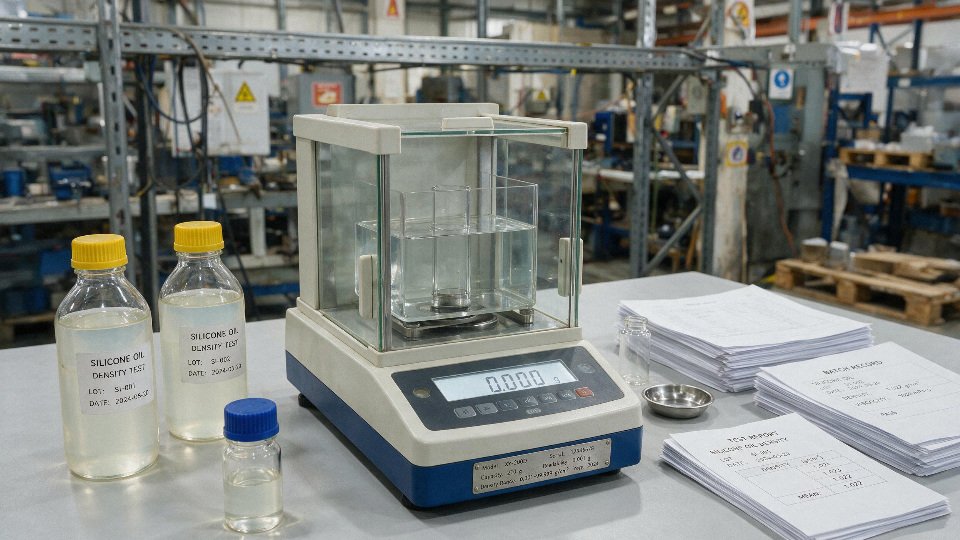
If you are ready to narrow the grade, send SiliconChemicals your target viscosity, operating temperature, density requirement, substrate or formulation environment, and required finish or process rate, along with clear part photos or a sample where relevant. Based on that, SiliconChemicals can recommend a suitable silicone fluid grade, propose sample evaluation, and support a supply plan aligned with your application and purchasing conditions.