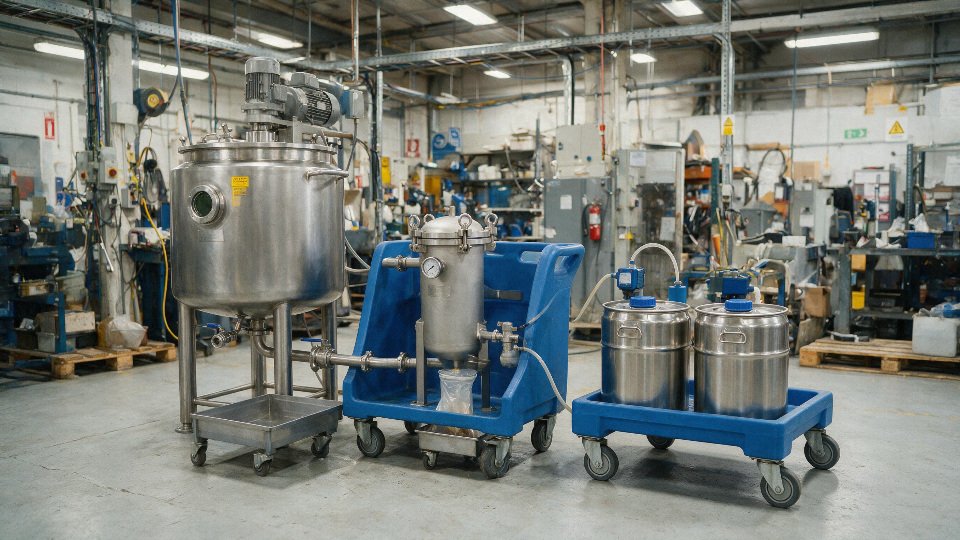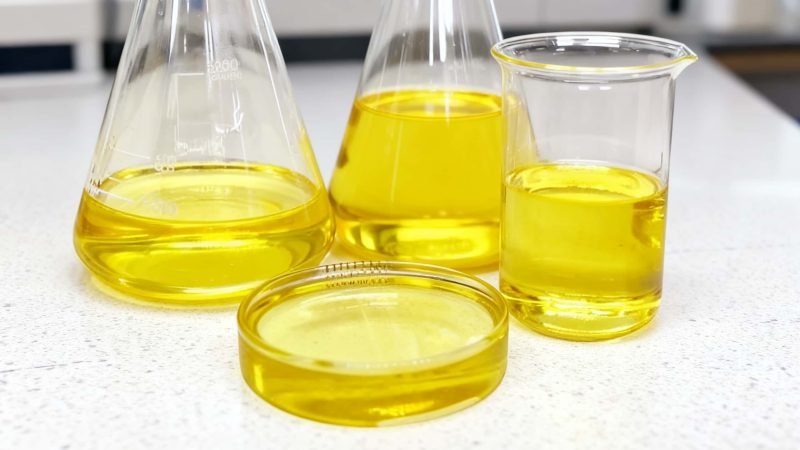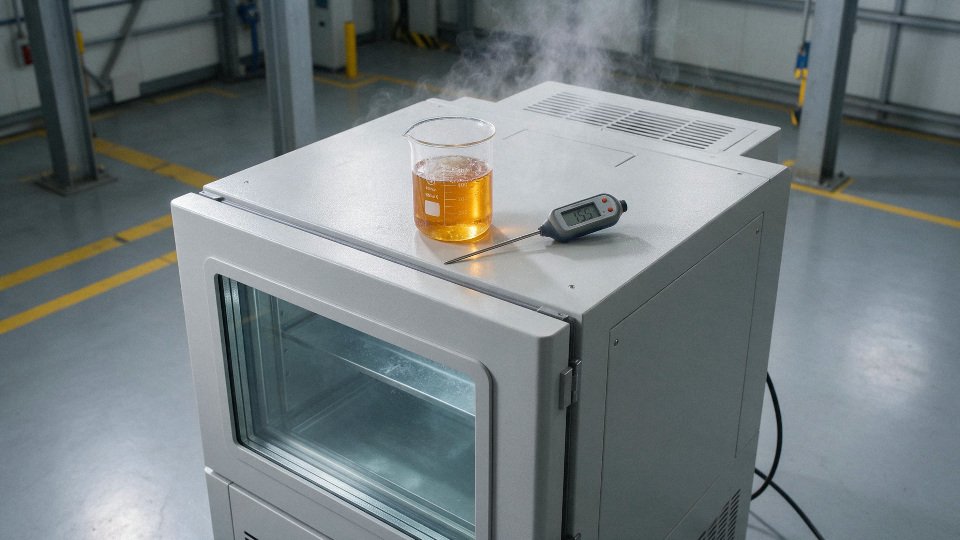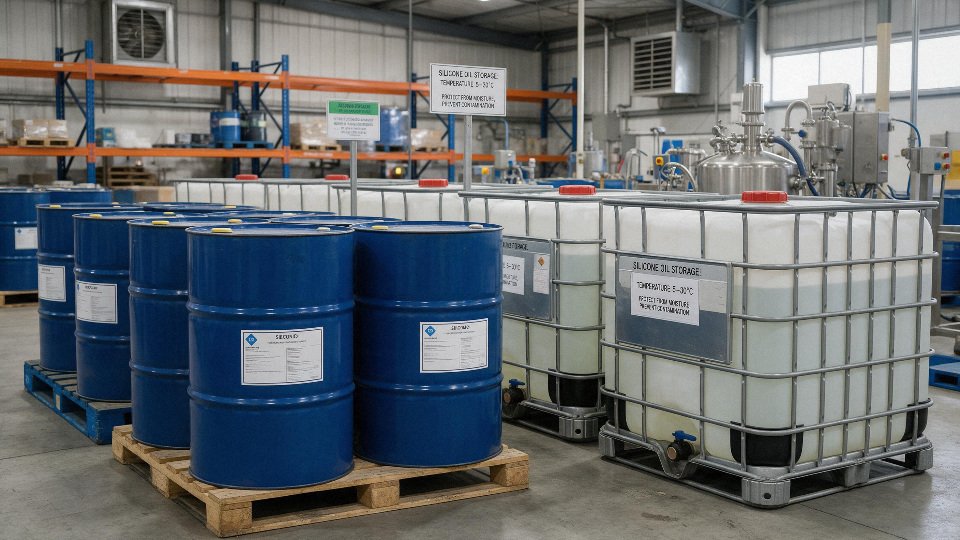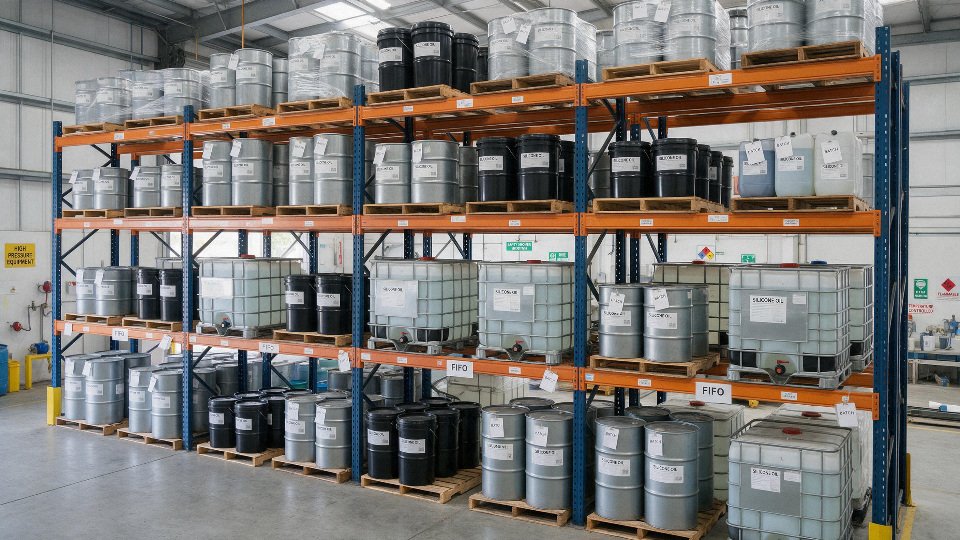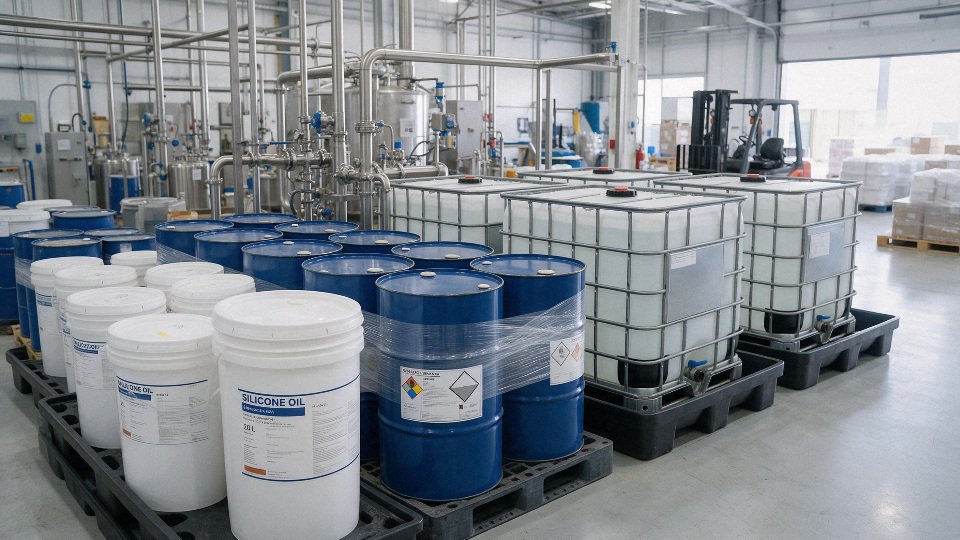
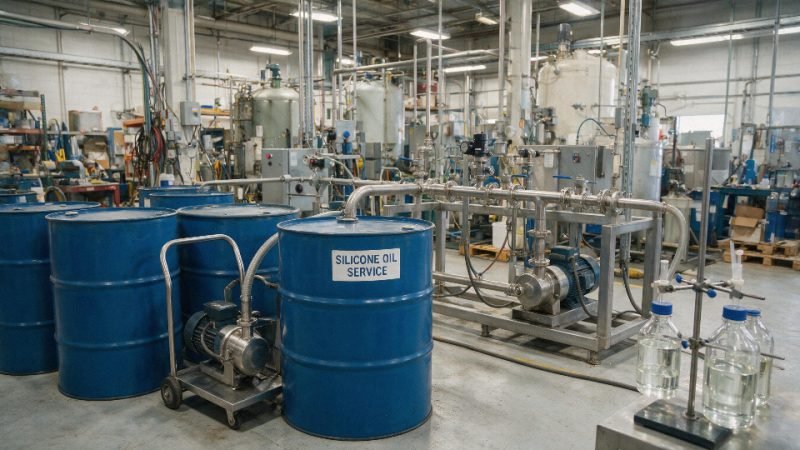
A fluid that looks interchangeable on a drum rack can cause a surprising amount of trouble once it is in service. Pick the wrong oil and you can end up with erratic lubrication, poor release, foam carryover, seal compatibility complaints, or heat-transfer performance that falls apart at temperature. On a plant budget, that turns into scrap, line stoppages, extra cleaning labor, and premature changeouts. Silicone oil earns attention because its property profile is unusual: very wide viscosity availability, low surface tension, good thermal stability in the right range, and electrical and water-repellent behavior that mineral oils and glycols usually do not match.
Silicone oil is valued mainly for stable viscosity behavior, low surface tension, broad usable temperature range, and chemical inertness relative to many conventional fluids. Common PDMS grades run from about 0.65 cSt to above 1,000,000 cSt at 25 C, many sit near 20 to 21 mN/m surface tension, and standard dimethyl types are often used roughly from -50 C to 200 C, subject to formulation and application limits.
That sounds straightforward until you put it against an actual duty: heat transfer versus damping, release versus contamination risk, dielectric use versus volatile loss, or cosmetic feel versus processability. The useful question is not whether silicone oil has “good properties,” but which properties stay valuable under your load, temperature, shear, substrate, and cost constraints.
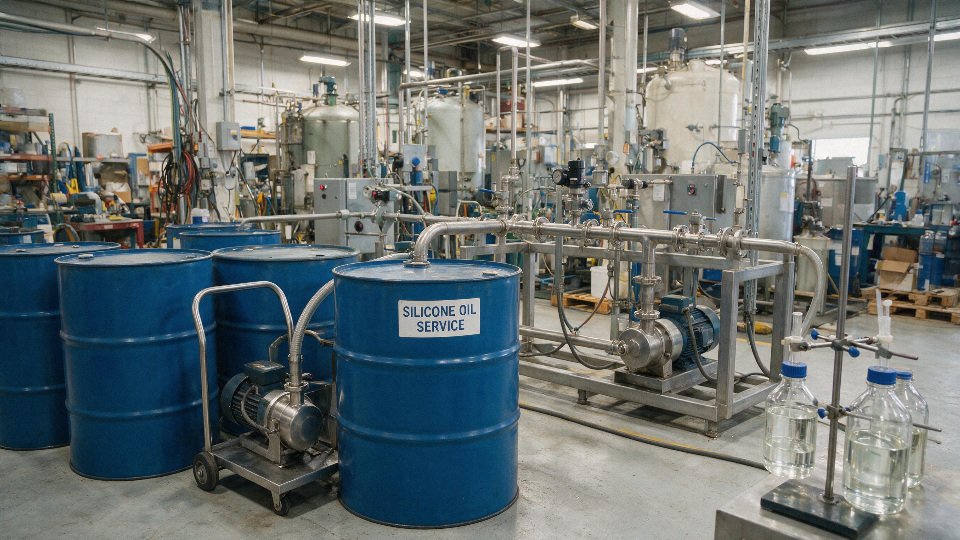
Chemical structure and fluid behavior
Silicone oil behaves the way it does because its polymer chain is built around a siloxane backbone, not a carbon chain. That single structural difference explains most of the buying-relevant performance: broad temperature tolerance, low surface tension, stable viscosity across temperature swings, easy spreading, and the persistent contamination problems plants run into when silicone gets where it should not.
The base structure in most industrial silicone oils is a repeating Si–O–Si chain, commonly polydimethylsiloxane, or PDMS. Silicon and oxygen form a longer, more flexible bond arrangement than a typical C–C or C–O organic backbone, and the methyl groups attached to silicon rotate with relatively little steric resistance. In practice, that means the chains move easily, slide past each other with low internal friction, and keep flowing at temperatures where many hydrocarbon fluids have already thickened badly.
That flexibility is not just a chemistry textbook point. It shows up in production lines as:
- more stable pumpability through seasonal temperature changes
- less dramatic viscosity rise in cold rooms or outdoor storage
- smoother wetting and release behavior on many substrates
- less drag in thin-film applications such as defoamers, release coatings, and some textile or paper treatments
The same chain mobility also helps explain why standard dimethyl silicone oils can often operate over roughly -50 C to 200 C, though the actual usable limit depends on grade, atmosphere, dwell time, contamination, and whether the issue is viscosity drift, oxidation, evaporation, or deposit formation. A buyer should not treat the broad temperature window as a blanket approval for every heater bath, gearbox, or food-contact line.
Why silicone oil spreads so easily
Low intermolecular attraction is one of the defining features of silicone oil. Many PDMS fluids sit around 20 to 21 mN/m surface tension at room temperature, which is low enough to make them spread rapidly over many solid surfaces and crawl into very small clearances.
That gives silicone oil several practical advantages:
- good leveling in coating additives and polishes
- effective wetting in mold-release and anti-foam systems
- light, smooth lubricity in plastic, elastomer, fiber, and precision-contact applications
- easy film formation at low add-on levels
But this is where buyers often overread the benefit. Easy spreading and low friction do not mean universal load-carrying performance. Silicone oil can provide excellent boundary slip in light-duty contacts, especially where temperature stability matters, yet it is usually not the right answer for high-load metal-to-metal extreme-pressure duty unless the formulation was built for that service and tested there. The trade-off is straightforward: you gain mobility, wetting, and thermal behavior, but you may give up film strength under heavily loaded asperity contact compared with purpose-designed EP mineral or synthetic lubricants.
How molecular weight changes viscosity, volatility, and staying power
As molecular weight rises, silicone oil generally becomes more viscous, less volatile, and more persistent on the surface. That is why commercial viscosity grades can range from roughly 0.65 cSt to beyond 1,000,000 cSt at 25 C. Those grades are not just “thicker or thinner”; they behave differently in storage, dispensing, migration control, and downstream contamination risk.
A practical way to think about it:
| Structural tendency | Typical effect in use | Operational consequence |
|---|---|---|
| Lower molecular weight | Lower viscosity, higher volatility, faster spreading | Easier dosing and penetration, but more odor, loss by evaporation, and migration |
| Mid-range molecular weight | Balanced flow and film persistence | Common choice for general process fluids, release, damping, and additive use |
| Higher molecular weight | Higher viscosity, lower volatility, stronger film persistence | Better residence time and reduced evaporation, but harder pumping, slower leveling, more residue risk |
Mechanistically, longer chains entangle more and resist flow, so viscosity climbs. At the same time, larger molecules are less likely to escape into vapor phase, so volatility drops. That is useful if you need a film to stay put on a hot mold, slow-moving seal, or damping device. It stops being useful when the fluid has to meter through a small needle, recover from splashing, or wash out during line changeover.
The main boundary here is contamination-sensitive production. In paint shops, optical assembly, adhesive bonding, or any line where surface cleanliness is critical, even a low-viscosity silicone fraction can create disproportionate trouble because it migrates easily and only a trace amount is enough to trigger fisheyes, craters, or bond failure.
Structure variants and what they change
Not all silicone oils are plain linear dimethyl fluids. Small structural changes can move performance quite a lot.
Linear and slightly branched fluids
- Linear PDMS is the standard reference type: predictable flow, low surface tension, broad utility.
- Slightly branched structures can change rheology, film retention, and shear response. In some formulations they improve cling or persistence, but they can also make cleanup and transfer behavior less forgiving.
Phenyl-modified silicone oils
- Better low-temperature fluidity in some formulations
- Improved refractive index and useful optical behavior
- Often better thermal or radiation performance than straight dimethyl types
These grades are often chosen where thermal cycling or optical properties matter more than pure cost.
Amino-modified silicone oils
- Increased affinity for certain substrates, especially fibers and some treated surfaces
- Used where softness, lubrication, or durable deposition is needed
The catch is reactivity and compatibility. Amino functionality can improve substantivity, but it can also change emulsion behavior, yellowing tendency, and interaction with finishing chemicals.
Epoxy-modified silicone oils
- Better potential for anchoring into reactive systems
- Used in some coating, release, and surface-modification packages
They are chosen less for “slickness” alone and more for controlled compatibility with resin chemistry.
Fluorinated silicone oils
- Lower surface energy in some systems
- Distinct solvent, fuel, or chemical resistance profile
- Premium cost, usually by a wide margin
These grades make sense where plain silicone oil loses too much stability or compatibility, not as a default upgrade.
End groups, low-boilers, and why buyers should care
End groups and residual low molecular weight fractions matter more than many datasheets suggest. Two silicone oils with similar nominal viscosity can behave differently in odor, flash-off, extractables, and regulatory review because one contains more cyclics, short-chain species, or a different terminal chemistry.
Watch these points during qualification:
- Residual low molecular weight fractions: can raise odor, volatility, fogging, and extractables
- End-group chemistry: affects reactivity, hydrolytic behavior, and compatibility with emulsifiers or crosslinking systems
- Purity profile: matters for electronics, personal care, medical-adjacent, and contamination-sensitive industrial uses
- Regulatory acceptability: cannot be inferred from “silicone oil” as a category; specific composition and impurity profile must be checked against the target market and application
Silicone oil's chemical inertness guarantees compatibility with paints, seals, and cleaning systems.False
Silicone oils are often chemically stable in many environments, but operational compatibility is a separate issue. Their low surface tension, mobility, persistence, and substrate interaction can cause paint defects, seal swell or slip changes, difficult wash-off, and trace contamination problems even when no obvious chemical attack occurs.
That last point causes expensive mistakes. A fluid can be chemically quiet and still be a plant-floor nuisance. In coating plants, one leaking silicone-lubricated component upstream of a paint booth can create weeks of defect chasing. In assembly, a silicone release aid can migrate onto bond surfaces. In cleaning systems, standard alkaline wash stages often remove soil well but leave enough silicone residue to interfere with downstream printing or adhesion. So the chemistry story is not just “inert equals safe.” The right question is whether the specific structure stays where you need it, leaves when you need it gone, and remains acceptable to every process that follows.
Core physical properties
Silicone oil selection lives or dies on a short list of measurable properties: viscosity, how that viscosity shifts with temperature, density-related dosing behavior, wetting tendency, volatility, low-temperature flow, heat-transfer characteristics, and shear response. Those numbers are not paperwork details; they decide whether the fluid meters cleanly, stays in place, forms a stable film, damps motion consistently, or slowly disappears from the system.
Viscosity grades: what the cSt number means on the plant floor
A silicone oil sold at 1 cSt behaves like a very light fluid that will run through clearances, wick into porous surfaces, and atomize or spread easily. At 100,000 cSt and above, you are dealing with a material that pours slowly, traps bubbles, and often needs time, warm storage, or positive-displacement handling. The common grade span is wide, roughly 0.65 cSt to above 1,000,000 cSt at 25 C, so treating “silicone oil” as one fluid class is a procurement mistake.
Kinematic viscosity in cSt is simply the fluid’s resistance to flow under gravity, normalized by density. In practice, buyers usually use it as a handling and end-use shorthand:
- Very low viscosity, about 0.65 to 5 cSt
- Fast spreading
- Easy pumping and spraying
- Useful in light release, carrier, wetting, and some damping applications
- Higher evaporation risk, especially at elevated temperature
- More likely to migrate into unwanted areas
- Low to medium viscosity, about 10 to 350 cSt
- Common range for general industrial lubrication, textile treatment, polishes, mold release blends, and process additives
- Still easy to meter with standard gear or diaphragm systems
- Good compromise between film persistence and flowability
- High viscosity, about 500 to 12,500 cSt
- Better staying power on vertical surfaces
- More stable film build for cushioning, damping, and antifoam carrier systems
- Filling and transfer become slower; air entrainment starts to matter
- Ultra-high viscosity, roughly 30,000 cSt upward into the hundreds of thousands and beyond
- Used where stringiness, tack, damping resistance, or residence on the substrate matters
- Handling usually requires slower dosing, larger lines, follower plates, heated rooms, or ram systems depending on package size
- QA sampling gets harder because the sample itself may not level in the cup during a routine check
A common mistake is selecting only by “thicker lasts longer.” That works up to a point, then line speed, pumpability, and coating uniformity start fighting back. On a fiber line or release-coating station, a grade that is too heavy can produce streaking, poor leveling, and more residue pickup on guides and rolls.
How viscosity changes with temperature
Silicone oils are valued partly because their viscosity changes less with temperature than many mineral oils or organic fluids. That high viscosity index is one reason they show up in instruments, controls, and systems that must start cold and still behave reasonably when hot.
The mechanism is straightforward: the siloxane backbone remains flexible over a broad temperature band, so the fluid’s resistance to flow does not spike or collapse as sharply as many carbon-based fluids. In service, that translates into:
- Easier cold starts
- Pumps draw the fluid sooner
- Metering lag is reduced
- Dashpots and control devices do not go from “free” to “locked up” overnight in winter storage
- More predictable hot-running behavior
- Film thickness still drops with temperature, but often less abruptly than with many organic fluids
- Damping force or dispense rate usually stays within a tighter operating window
This advantage has a boundary. If the application depends on a very specific viscosity at one exact operating temperature, broad “good temperature stability” is not enough; you still need the viscosity-temperature curve for that grade and, ideally, a test at your actual shear rate and duty cycle.
Typical service windows for standard dimethyl silicone oils are often cited around -50 C to 200 C, but that is formulation dependent and not a blanket design limit. Seals, venting, contamination, residence time, and low molecular weight fraction can tighten the actual usable range.
Density, refractive index, compressibility, and thermal expansion
These are quieter properties, but they affect equipment sizing and process consistency more than many buyers expect.
- Density
- Silicone oils are often a bit denser than many hydrocarbon oils, though exact values depend on grade and chemistry.
- That matters in mass-to-volume conversion. If your dosing skid is calibrated by liters but your formulation is controlled by kilograms, using a generic oil-density assumption will shift batch composition.
- In level measurement, density also affects float response and differential-pressure calculations.
- Refractive index
- Relevant in optical coupling, lens polishing media, transparent mold release systems, and quality inspection.
- Small mismatches can matter in optical assemblies; this is not a property to estimate from a general silicone family description.
- Compressibility
- Silicone oils are liquids, not gases, but they are not perfectly incompressible.
- In hydraulic force transmission or precision instrumentation, compressibility influences response lag and stiffness.
- Usually acceptable in low-force damping and control devices; less attractive where rigid hydraulic response is the whole point.
- Thermal expansion
- Silicone oils expand noticeably with temperature rise.
- In closed reservoirs, sight glasses, sealed dashpots, and fill-for-life housings, insufficient headspace can create pressure drift, seal stress, or apparent overfill.
- I have seen this missed on small bench instruments where the fluid was fine, but the housing design assumed a lower-expansion organic oil.
Surface tension and wetting: useful on the substrate, troublesome in the wrong place
Many PDMS silicone oils sit around 20 to 21 mN/m at room temperature, which is low compared with many conventional fluids. That low surface tension is why silicone oil spreads so effectively and why contamination concerns are taken seriously in coating, painting, and bonding plants.
Low surface tension is one of the most commercially important physical properties of silicone oil because it drives both useful wetting and hard-to-control contamination.True
This is established surface science and matches common plant experience. The same property that improves release, leveling, and fiber lubrication also allows trace carryover to spread over large areas and interfere with later coating or adhesion steps.
What that means in practice:
- Wetting and spreading
- Thin, uniform films can form with relatively low add-on
- Useful in release agents, textile/fiber treatment, polish systems, and leveling additives
- Defoaming
- Low surface tension helps the fluid enter foam lamellae and destabilize them
- Performance still depends on formulation, dispersion, carrier compatibility, and particle phase where relevant; not every silicone oil is automatically a good defoamer
- Release
- Good coverage and low adhesion tendency support mold release and anti-stick behavior
- Over-application can transfer downstream and create secondary finishing problems
- Contamination risk
- Small amounts can migrate onto nearby parts, conveyors, gloves, or packaging
- Paint shops, adhesive bonding cells, and printing lines usually need strict segregation
- Once silicone contamination gets into a finishing area, troubleshooting turns expensive fast
The trade-off is clear: the better the spreading, the easier it is to get functional coverage at low dosage, but the harder it becomes to confine the fluid only to the intended zone.
Volatility, flash point, evaporation loss, and low molecular weight content
Short-chain and low-viscosity silicone fluids behave very differently from heavier grades in open systems. They often evaporate faster, can have lower flash points, and may lose mass over time even if the remaining fluid is still chemically stable.
The distinction is not just viscosity by itself. Low molecular weight content matters because lighter fractions preferentially evaporate, especially under:
- high surface area exposure
- air sweep or forced ventilation
- intermittent heating
- vacuum service
- long residence time in shallow trays or thin films
For a mold-release wipe, some evaporation may be acceptable or even useful. For an instrument fill fluid, evaporative loss can shift calibration, create headspace bubbles, or change damping response. In heat-transfer or bath applications, asking only for “thermally stable silicone oil” is not enough. You need volatility data under relevant temperature and exposure conditions, plus confirmation of allowable flash point against your plant safety rules and the current supplier documentation.
Pour point and low-temperature flow
Silicone oils usually remain fluid at temperatures where many hydrocarbon oils become sluggish or waxy. That is one of their strongest practical advantages in cold environments, seasonal storage, outdoor equipment, and instruments that need repeatable movement after shut-in.
Why they keep flowing is tied to molecular flexibility and weak tendency to crystallize in the same way as many conventional oils. The benefit shows up as:
- lower startup torque
- less strain on small metering pumps
- faster stabilization in actuators and dampers
- fewer winter complaints from remote equipment users
That said, “still fluid” does not mean “same performance.” At sufficiently low temperature, viscosity still rises, response still slows, and elastomer seals may become the limiting factor before the fluid does.
Heat capacity and thermal conductivity in heat-transfer service
Silicone oil can tolerate temperatures that would oxidize or degrade many organic fluids, but thermal stability alone does not make it the best heat-transfer medium. Heat-transfer performance depends on a combination of heat capacity, thermal conductivity, viscosity, pumpability, fouling tendency, and operating film temperature.
A fluid can survive the heat and still move it inefficiently if:
- viscosity is too high at the operating temperature
- thermal conductivity is modest
- circulation rate drops because the pump is oversized for pressure but undersized for flow
- local hot spots drive volatilization of lighter fractions
This is where selection often flips. If the plant needs broad temperature tolerance, chemical inertness, or compatibility with sensitive equipment, silicone oil may be the right compromise. If the duty is strictly heat-transfer efficiency in a narrow controlled range, another fluid family can outperform it. Site-specific thermal calculations are required; there is no responsible universal ranking.
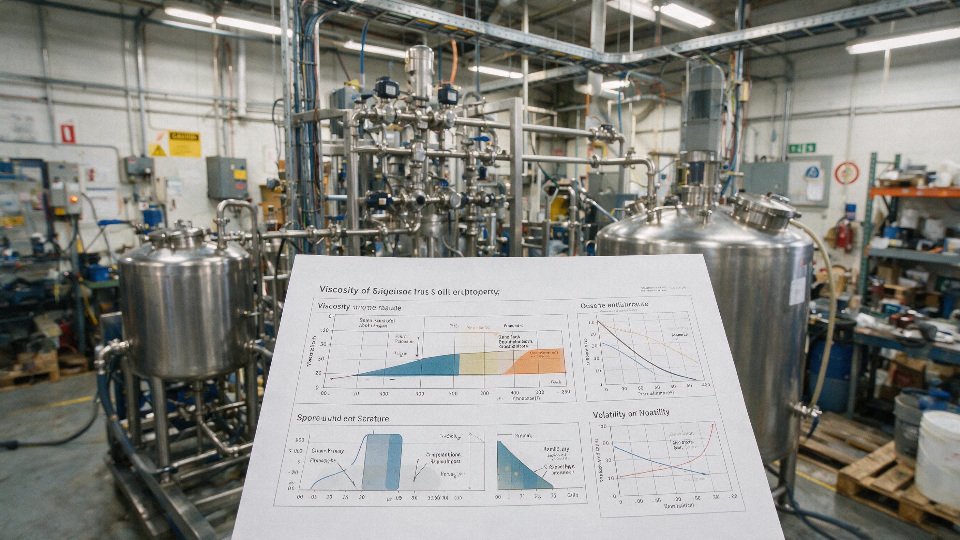
Shear behavior and damping response
Most silicone oils are treated as Newtonian over a useful operating range, meaning viscosity stays fairly constant with shear rate compared with strongly shear-thinning fluids. That is why they are widely used in dashpots, controlled-motion devices, gauges, and instrumentation fills.
For damping service, the fluid’s job is to convert motion into a controlled resistive response. The practical levers are:
- viscosity grade at operating temperature
- gap geometry inside the device
- stroke speed or oscillation frequency
- air release behavior
- volumetric expansion over the temperature cycle
Higher viscosity increases damping force, but not for free. It also raises fill time, slows bubble release, increases cold-start sluggishness, and can make assembly messier than the drawing suggests. In my experience, technicians tolerate a slightly lighter fluid better than a nominally perfect heavy grade that traps microbubbles and drifts for two shifts before settling.
For buyers comparing grades, the useful question is not “Which viscosity is best?” It is “At our temperature range, motion speed, and allowable response lag, what viscosity window gives stable damping without maintenance headaches?” That answer usually comes from a device test, not from catalog viscosity alone.
Thermal, electrical, and chemical performance
Silicone oil earns its place in hot, electrically sensitive, and chemically mixed environments because it usually keeps its viscosity, insulation behavior, and surface properties over a wider operating window than mineral oil or many organic synthetics. That advantage is conditional, not absolute: air exposure, catalytic metals, process contamination, strong acids or alkalis, and localized overheating can push a fluid that looks stable on paper into residue formation, electrical drift, or compatibility trouble.
Standard dimethyl silicone oils are commonly used across roughly -50 C to 200 C service windows, but that broad range only holds when the actual system is clean, reasonably sealed, and not creating hot spots above the bulk fluid temperature. In practice, a plant can have a loop reading 180 C at the tank while a heater sheath, pump seal face, or stagnant corner is seeing much higher film temperature, and that is where trouble starts.
Thermal stability and what actually limits it
Silicone oil is well known for thermal stability under both continuous and intermittent heat, but the mechanism matters. The Si-O backbone is more thermally robust than many carbon-chain fluids, so the fluid resists the rapid cracking and varnish formation that you see with overheated mineral oils. That is the reason silicone oils are often chosen for heat transfer, damping, diffusion pump service, or high-temperature lubrication points where organic oils oxidize too fast.
The limiting factors are usually not the nominal bulk temperature. They are these:
- Air and oxygen exposure
- In a closed or low-oxygen system, silicone oil generally lasts longer.
- In open baths, thin films, vented reservoirs, or misted service, oxidation accelerates.
- Oxidation can raise acidity, shift electrical properties, and produce volatile fractions or residues.
- Catalytic contamination
- Metal fines, certain metal salts, process catalysts, and curing chemistry residues can speed degradation.
- Copper, iron contamination, and process carryover deserve attention in electronics, textile, and heat-transfer service.
- The fluid itself may still look clear for a while, which fools operators into thinking it is healthy.
- Process contaminants
- Water, solvents, cleaning agents, polymer fines, carbonaceous debris, and combustion products can all change stability.
- A small amount of contamination may matter more than a moderate temperature increase, especially in precision systems.
- Localized overheating
- Dead legs, fouled heat-transfer surfaces, low-flow pockets, and oversized heaters are common causes.
- The fluid can survive temperatures that would quickly destroy mineral oil, but prolonged overheating still forms silica-like or carbonaceous residues that stick to valves, foul level switches, blind temperature probes, and cut heat-transfer efficiency.
That last point catches people out. They switch to silicone oil, solve the bulk oxidation problem, then ignore heater loading or poor circulation. Six months later the fluid is not “burned” in the familiar mineral-oil way, but control valves start hanging up and sensor response slows because deposits have built where the metal runs hottest.
A high thermal stability rating does not guarantee indefinite life at 200 C in an open, contaminated system.True
Bulk service temperature guidance assumes formulation-specific conditions. Fluid life still depends heavily on oxygen exposure, residence time, hot-spot temperature, and contamination.
Electrical properties for insulation and electronics
For insulating and electronic uses, silicone oil is attractive because it combines low surface tension with useful dielectric behavior. Buyers usually focus on dielectric strength, but that is only one part of the picture.
| Property | Why it matters in service | What shifts it |
|---|---|---|
| Dielectric strength | Withstands voltage without breakdown in gaps or immersed assemblies | Moisture, particles, dissolved gases, contamination, electrode geometry |
| Volume resistivity | Limits leakage current through the fluid | Water pickup, ionic contaminants, thermal aging byproducts |
| Dielectric constant | Affects capacitance and field distribution | Fluid chemistry, temperature, formulation changes |
| Dissipation factor | Indicates dielectric loss and heating under AC fields | Contamination, polar impurities, aging products |
In transformers, capacitors, sensors, ignition systems, and electronic potting or immersion environments, a clean silicone oil can perform very well because it remains fluid across a wide temperature span and sheds water from surfaces. Its dielectric constant is also relatively stable compared with some alternatives. But no responsible engineer should generalize one supplier’s electrical test sheet across all silicone oils. Electrical values depend on purity, viscosity grade, additive package, moisture content, and the exact test method.
The trade-off is straightforward: silicone oil may offer better thermal endurance and low-temperature fluidity than many insulating oils, but it can cost more, and contamination control has to be tighter than some buyers expect. A drum left breathing humid air through a bad bung seal can lose electrical performance long before the viscosity changes enough to raise alarms.
Water repellency, moisture response, and hydrolytic behavior
Silicone oil is strongly hydrophobic, with many PDMS fluids showing surface tension around 20 to 21 mN/m at room temperature. That low surface tension helps wet substrates and spread into narrow gaps, while still repelling bulk water. In equipment, that often means better release behavior, reduced water adhesion, and less persistent emulsification than some organic fluids.
Still, “water repellent” does not mean “chemically indifferent to all wet conditions.”
Neutral and mildly wet environments
- Silicone oil is generally stable in neutral conditions.
- Short-term water contact usually does not cause immediate hydrolysis problems.
- Free water can still hurt electrical performance or promote corrosion elsewhere in the system.
Strongly acidic or alkaline conditions
- Hydrolytic stability drops in the presence of strong acids or strong bases.
- Cleavage or rearrangement of siloxane bonds can occur, depending on chemistry and exposure.
- The risk rises with temperature, residence time, and the presence of catalytic species.
This is where plant language like “it only sees washdown” is too vague to be useful. Neutral condensate, alkaline CIP residue, and acidic process mist are completely different exposure cases. The conclusion that silicone oil is chemically durable stops holding once the fluid is subjected to strong acid or caustic contamination for enough time at elevated temperature.
Compatibility with metals, non-metals, and coatings
Silicone oil is broadly compatible with many metals, glass, and ceramics, and that is one reason it gets specified for mixed-material assemblies. It is often suitable with:
– Stainless steels
– Aluminum alloys
– Glass
– Porcelain and technical ceramics
– Many engineering plastics
– Selected elastomers and seal materials
But compatibility is never a category-level guarantee. It must be checked against the exact formulation and exposure condition, especially for:
– Plastics that can stress crack, swell, or soften under long soak or elevated temperature
– Elastomers where volume swell, hardness shift, or compression-set changes affect sealing
– Coatings, inks, and paints that may de-wet, fisheye, lose adhesion, or become impossible to recoat after trace silicone contamination
– Adhesive-bonded assemblies where migration to the bond line causes failures
In procurement terms, this means a generic “compatible with rubber and plastic” statement is not enough. Ask for immersion data if available, then run your own panel test at actual temperature, duration, and mechanical stress. A seal that survives a bench soak at 23 C may fail fast in a cycling valve at 140 C.
Oxidation, radiation, and specialty fluid choices
Where oxidation stress is high or radiation is present, phenyl-modified silicone fluids can outperform standard dimethyl types. The phenyl groups can improve resistance in some high-temperature, low-temperature, and radiation-exposed applications, which is why they show up in certain aerospace, electronics, and specialty heat-transfer duties.
That does not make them universally better. They are usually more expensive, sometimes harder to source in the exact grade, and may shift viscosity-temperature behavior or other handling characteristics. The preferred choice flips back to standard dimethyl fluids when the environment is not harsh enough to justify the premium or when the system values cost and broad availability over specialty endurance.
Fire behavior is often misunderstood
Silicone oil often has a high flash point compared with many hydrocarbon fluids, which is useful for safety margin and handling. It is not nonflammable. Under enough heat, atomization, wick effect, or contact with ignition sources, it can still burn.
If the application has a formal flame-retardant requirement, insurer requirement, or internal fire-risk limit, verify against current supplier documentation and the actual governing standard. A high flash point alone does not satisfy those obligations, and some systems need specially formulated fire-resistant fluids rather than general-purpose silicone oil.
Functional limitations and tradeoffs
Silicone oil is excellent in the jobs it suits, but it is not a universal replacement for mineral oil, PAO, ester, or process-specific fluids. The main failure modes are predictable: weak boundary lubrication under heavy contact stress, material-compatibility surprises, contamination of finishing operations, and costly misuse in regulated applications where “silicone oil” is far too broad a specification.
One reason buyers get caught out is that silicone oil often looks good on a property sheet. Low surface tension, broad temperature capability, chemical inertness, dielectric strength, and viscosity options from very thin to very heavy grades all sound like a flexible toolbox. On the plant floor, though, the question is not whether the fluid has attractive standalone properties; it is whether those properties line up with the contact mechanics, downstream process sensitivity, and cleaning discipline of the line.
Boundary lubrication limits under load
Under severe boundary lubrication, silicone oil usually loses to dedicated EP and anti-wear lubricants. If the machine spends much of its life in metal-to-metal contact, shock loading, slow-speed high-torque starts, or heavily loaded sliding interfaces, silicone oil is rarely the safe default.
The mechanism matters. In full-film lubrication, viscosity carries much of the load by keeping surfaces separated. In boundary conditions, that fluid film collapses and protection depends on surface-active chemistry, additive packages, and reaction films. Standard dimethyl silicone oils are not generally selected for the kind of chemically active EP performance you get from purpose-built gear oils, chain oils, or metalworking lubricants.
Typical problem areas include:
- Worm gears and enclosed gears with high tooth pressure
- Plain bearings with low speed and high unit load
- Sliding cams, guideways, and intermittent indexing mechanisms
- Chain drives or open mechanical linkages exposed to impact loading
What you gain with silicone oil in these cases may be temperature range or material compatibility with some seals. What you sacrifice can be wear life. The preferred choice flips if the duty is light-load release, damping, heat transfer, dielectric insulation, or lubrication where low traction and broad thermal stability matter more than EP film strength.
Compatibility with elastomers, plastics, adhesives, and coatings
Compatibility is one of the most common selection mistakes because “chemically inert” gets misread as “safe for everything.” In practice, silicone oil can swell some elastomers, extract plasticizers from certain compounds, soften adhesives, or change the friction and appearance of coated surfaces.
Watch these material groups closely:
- Elastomers: NBR, EPDM, FKM, silicone rubber, and specialty blends can respond very differently depending on formulation, filler package, cure system, and temperature.
- Plastics: Polycarbonate, acrylic, ABS, nylon, acetal, and filled engineering plastics may show stress cracking, softening, or dimensional change in some service conditions.
- Adhesives and sealants: Pressure-sensitive adhesives, some acrylics, urethanes, and coating tie-layers can lose bond strength if silicone migrates into the bond line.
- Coatings and inks: Surface-energy changes can create wetting defects long before you see obvious material attack.
A generic compatibility chart is enough to approve silicone oil against seals and plastics.False
At best, a generic chart is a screening tool. Compound formulation, temperature, exposure time, stress state, and fluid grade all affect the result. Critical parts need supplier confirmation or immersion testing on actual materials.
The boundary on any broad compatibility statement is simple: once the part is under stress, heat, or long dwell time, handbook assumptions get weaker.
Silicone migration and paint-shop defects
A few ppm in the wrong place can ruin a finishing line. Trace silicone transfer is notorious for causing craters, fisheyes, poor coating wet-out, and rework in paint, printing, laminating, and adhesive-bonding operations.
This is less about bulk fluid performance and more about surface chemistry. Because many silicone oils have surface tension around 20 to 21 mN/m at room temperature, even tiny residues can create local surface-energy differences. The coating pulls back from those spots, and the defect shows up two operations later, which makes root cause work messy.
Common migration paths are not exotic:
- Aerosolized mist from pneumatic or conveyor lubrication
- Operator gloves, rags, and maintenance tools carrying residue
- Shared benches, totes, packaging contact surfaces, and roller coverings
- Overuse of release agents near paint, print, or bonding cells
If a plant has a paint shop, label-printing line, lens coating area, or structural adhesive process nearby, silicone control needs to be treated like contamination control, not just lubricant handling.
Gas solubility, aeration, foaming, and fluid handling
There is a practical irony here: silicone chemistry is widely used in formulated antifoams, yet neat silicone oil in dynamic equipment can still suffer from gas entrainment, aeration, or foam persistence depending on viscosity, agitation, return-line design, and contamination. That distinction gets missed.
In tanks, pumps, damping systems, and circulating loops, check:
- Return-line splash and reservoir residence time
- Pump suction conditions and entrained air
- Agitator speed and vortex formation
- Fine-pore leakage paths that keep feeding dissolved or dispersed gas
- Filter placement that creates local pressure drop and degassing behavior
The trade-off is straightforward. Low surface tension and useful rheology may help in some process roles, but in poorly designed dynamic systems the same fluid can become hard to deaerate cleanly. You do not estimate this reliably from chemistry alone; you need system geometry, flow regime, and a bench or pilot run.
Cost, cleanup, and regulated grades
Silicone oil generally costs more per kilogram than commodity mineral oil, sometimes by a lot depending on grade, purity, and packaging. That premium is justified only when longer service life, thermal stability, dielectric performance, process yield, or product function actually reduces total cost.
The hidden commercial penalties usually show up in three places:
- Cleanup labor: Residual films spread easily, resist ordinary washdown, and transfer to product-contact or packaging surfaces.
- Cross-contamination risk: One maintenance mistake can affect an entire finishing or assembly area.
- Wrong-grade purchasing: Food, pharma, medical, electronics, and personal care applications may require specific purity, documentation, or regulatory status that a generic industrial grade does not provide.
For those sectors, grade selection matters more than the generic chemistry label. Buyers need the exact fluid identity, intended-use status, impurity profile where relevant, and current supplier documentation checked against the actual application and local compliance requirements.
Industrial use cases
Silicone oil earns its place where a fluid has to do more than just lubricate. Its low surface tension, broad viscosity range, thermal stability, electrical behavior, and clean feel let it serve as a lubricant in one plant, a heat-transfer medium in the next, and a formulation aid in products that never see a machine room. The catch is that the same property that makes it valuable in one application can create a failure mode in another, so the application category matters more than the generic label “silicone oil.”
Lubrication and damping fluids
For small mechanisms, instruments, and sealed components, silicone oil is usually chosen for consistency across temperature swing rather than extreme load capacity. It is particularly useful in damping, light lubrication, and controlled motion where mineral oils either thicken too much in cold conditions or oxidize too fast around heat sources.
Common categories include:
- Instrument damping fluids in gauges, meters, and control devices
- Automotive dashpots, fan clutches, switchgear components, and selected trim or actuator mechanisms
- Office equipment such as printers, copiers, and paper-feed subsystems
- Consumer devices with hinges, sliders, rotary controls, and quiet-motion features
- Precision assemblies where low volatility, clean operation, or plastic compatibility matter
The mechanism is straightforward: viscosity sets the resistance to motion, and the relatively stable viscosity-temperature behavior helps keep the damping curve usable over a wider temperature band than many conventional oils. In practice, that means a door closer, dial damper, or optical adjustment mechanism feels less erratic between winter startup and a hot enclosure condition.
The trade-off is load carrying. Silicone oils are not the automatic answer for gears, bearings, or sliding contacts under high contact stress. Where the duty is boundary lubrication or shock loading, the preferred choice often flips to a hydrocarbon, ester, or grease system with stronger film strength and additive support. A lot of bad selections come from seeing “excellent lubricity” in marketing language and applying it to metal-on-metal contacts that actually need anti-wear chemistry.
Heat-transfer and thermal bath fluids
In thermal baths, jacketed reactors, temperature control units, and specialty process lines, silicone oil is selected when a broad working temperature window and oxidation resistance matter more than absolute heat-transfer efficiency. Standard dimethyl silicone oils are often considered for roughly -50 C to 200 C service, but actual upper and lower limits depend on grade, residence time, air exposure, and system design.
Typical uses include:
- Laboratory oil baths
- Reactor jackets and recirculating temperature control loops
- Calibration baths and metrology equipment
- Specialty process heating lines where contamination risk from aromatic heat-transfer fluids is unacceptable
- Intermittent high-temperature service where hydrocarbon fluids coke too quickly
What matters operationally is not just the bulk temperature. Pump seal design, expansion tank arrangement, local film temperature at heaters, and exposure to air all affect fluid life. A silicone fluid that survives well in a closed, nitrogen-blanketed loop may age much faster in an open bath with hot spots on electric elements.
Compared with many dedicated heat-transfer fluids, silicone oils can give up some heat-transfer efficiency because viscosity and specific thermal properties may not be optimal for every loop. You often pay for stability with lower heat transfer coefficient or higher pumping demand at a given temperature. That is usually acceptable in small precision systems; it is less attractive in large utility-scale loops where energy and fluid cost dominate.
Electrical and electronic uses
Silicone oil is used in selected electrical and electronic systems as a dielectric fluid, processing aid, protective medium, or moisture-management component. The reason buyers keep coming back to it is the combination of electrical insulation, hydrophobicity, and thermal endurance.
Application groups include:
- Dielectric fill fluids in certain transformers, capacitors, sensors, and specialty electrical assemblies
- Wetting and deaeration aids during encapsulation or potting operations
- Carrier or process fluids in thermal interface material manufacture
- Moisture-barrier and water-displacing functions in selected connectors, ignition systems, and sealed electronics
- Optical and sensor assemblies where a stable clear fluid is needed
Here the trade-off is compatibility and contamination control. Silicone migration can be a serious issue in nearby painting, printing, bonding, or contact surfaces. A few ppm in the wrong place can create fish-eyes in coatings or interfere with downstream adhesion. In mixed-use plants, this is less a chemistry problem than a housekeeping problem: shared filling tools, open containers, and contaminated gloves cause trouble.
Silicone oil can be used as a dielectric fluid, but suitability cannot be generalized across all electrical equipment.True
Electrical use depends on dielectric requirements, flammability expectations, equipment design, compatibility, and the supplier's validated grade data. Buyers should verify against current equipment documentation and fluid-specific technical data.
Textile, leather, paper, and fiber treatment
Textile and related finishing operations use silicone fluids and modified silicone systems for hand feel, slip, sewability, softness, and surface water management. In these sectors, silicone oil is rarely just a standalone fluid poured neat onto the line; it is often part of an emulsion or modified formulation tuned for substrate interaction.
Common outcomes sought are:
- Softer hand on woven and knit fabrics
- Lower fiber-to-metal friction in processing
- Better sewability and reduced needle heating
- Surface slip on yarns and threads
- Water repellency or easy-care effects on fabrics, leather, and paper
- Reduced dusting and smoother converting on paper webs
The mechanism is surface orientation. Low surface tension helps the silicone phase spread over fibers and form a thin lubricious film. That can reduce friction, improve drape, and change tactile feel with relatively low add-on.
The boundary is clear, though: untreated PDMS fluid is not a cure-all finish. Durability to washing, printability, recoatability, and fabric shade can all shift depending on whether the system is non-reactive, amino-modified, epoxy-modified, or otherwise functionalized. Procurement teams should buy against the finishing objective, not just the base fluid name.
Release, anti-stick, and process-surface applications
Release behavior is one of the oldest and most commercially important uses for silicone oil and silicone-derived systems. Rubber molding, plastic processing, packaging lines, and conveyors all use it where sticking costs throughput.
Typical use points:
- Mold release in rubber and selected plastics processing
- Anti-stick treatment on chutes, guides, and handling surfaces
- Release and slip functions in packaging conversion
- Conveyor lubrication in light-duty or contamination-sensitive handling
- De-molding support in composite or specialty forming operations
The gain is cleaner release and lower force. The sacrifice is downstream contamination risk. If parts will be painted, bonded, metallized, or printed later, release residues can create expensive rejects. A release system that looks perfect at the press can become a quality claim two processes later.

Personal care, antifoam, surface care, and chemical intermediate roles
These categories are commercially distinct, but they share a common reason for using silicone fluids: they modify surface behavior very efficiently.
- Personal care and cosmetics: used for spreadability, silky feel, gloss, controlled volatility, water resistance, and sensory tuning. Choice depends heavily on fluid type and volatility profile; not every silicone fluid belongs in skin or hair formulations.
- Antifoam and process additives: used in coatings, inks, fermentation, wastewater treatment, petrochemicals, and food processing where the grade is suitable for the process and regulatory context. Foam control performance depends on dispersion quality, incompatibility balance, and dose; too compatible and it does nothing, too incompatible and you get defects.
- Construction, polishes, and household care: used for gloss, water beading, wipe feel, and protective film on stone, metal, furniture, auto-care, and appliance surfaces.
- Chemical intermediates and carriers: used as backbone fluids or carriers for emulsions, modified silicones, and reactive downstream products where the base fluid’s viscosity and reactivity profile determine how the finished system can be processed.
That last category matters to buyers because silicone oil is often not the final product but the platform material. Once it is being used as an intermediate, the procurement focus shifts from simple physical properties to batch consistency, residual volatiles, functional-group control, and how reliably the supplier can support downstream modification.
Grade selection criteria
A workable silicone oil grade is selected from the application backward, not from a viscosity chart forward. Start with what the fluid must actually do on the line or in the product, then narrow viscosity, chemistry, purity, and package form around that duty. Buyers who purchase on “100 cSt PDMS” alone often get a fluid that matches the catalog but misses the process.
The same nominal silicone oil can behave very differently once it is sprayed onto hot tooling, metered through a fine needle, mixed into a release compound, or trapped against an EPDM seal for six months. In practice, grade selection is less about one property than about matching a fluid to a sequence of exposures: storage, transfer, application, service, contamination, and cleanup.
Start with the required function
If the job is unclear, the grade selection will drift. A release agent, dielectric fluid, foam-control component, and sensory additive may all be called “silicone oil” internally, but they are not bought to the same standard.
Use the required function to screen the grade first:
- Lubrication
- Prioritize viscosity stability across operating temperature, low volatility, and material compatibility.
- Check whether the duty is boundary lubrication, light sliding, assembly aid, or long-term sealed lubrication. Silicone oils are useful in some low-load and wide-temperature cases, but they are not universal replacements for hydrocarbon, PAG, or PFPE lubricants.
- Wetting and spreading
- Low surface tension is usually the reason silicone is being considered.
- For coating, textile, personal care, or mold-contact applications, spreading speed and uniformity matter as much as bulk viscosity.
- Release
- Separate mold release, paper release, label release, and anti-stick surface treatment. The fluid can be the same family, but the preferred modification package often changes with substrate polarity and downstream painting or bonding requirements.
- Dielectric insulation
- Focus on electrical properties, purity, oxidation resistance, moisture behavior, and consistency.
- Ionic contamination and volatile content become more serious here than they are in a simple mechanical release application.
- Thermal stability or heat-transfer duty
- The usable window for many standard dimethyl silicone oils is roughly -50 C to 200 C, but that is not a universal design limit.
- Residence time at temperature, air exposure, and local hot spots usually determine life more than the brochure number.
- Antifoam
- Antifoam selection is usually about controlled incompatibility, not full compatibility.
- The active oil may be very low dose, but dispersion quality and carryover behavior matter more than kinematic viscosity on its own.
- Sensory feel or carrier-fluid use
- Odor, color, residue, volatility profile, and skin or substrate feel become critical.
- Buyers often underestimate how much “clean feel” depends on the volatile fraction and the modified silicone package, not just low viscosity.
Match viscosity grade to how the fluid is applied and how long it must stay put
As a broad supply range, silicone oil kinematic viscosity can span about 0.65 cSt to more than 1,000,000 cSt at 25 C. That headline range is useful, but it does not select a grade by itself. The same 100 cSt fluid that meters nicely at 22 C may atomize poorly in winter, drip off a vertical surface, or leave too much carryout in a fast indexing machine.
Viscosity choice should be screened against four operating variables:
- Operating temperature
- Higher temperature lowers viscosity in service, which improves flow but reduces film retention.
- Low-temperature startup can be the hidden failure point. A filling system that runs acceptably at 30 C may cavitate or under-deliver at 10 C if the suction side is marginal.
- Shear environment
- In pumps, nozzles, mixers, doctor rolls, and high-speed bearings, apparent handling behavior matters.
- Silicone oils are often selected because their viscosity-temperature behavior is favorable, but that benefit does not cancel poor metering geometry or excessive shear residence.
- Required residence time on the substrate or in the system
- Short-lived wetting or flash spread generally favors lower viscosity.
- Persistent release films, damping, or seal lubrication usually push toward higher grades, unless cleanliness or migration limits force a compromise.
- Application method
- Spraying: lower viscosity usually atomizes and spreads better, but misting, overspray, and contamination risk rise quickly.
- Dipping: moderate viscosity can improve coating pick-up, though drainage and edge build-up need checking.
- Precision dosing or needle dispense: the grade must match pump type, needle ID, cycle time, and temperature control.
- Filling closed systems: air release, transfer time, and trapped-bubble behavior can be as important as nominal viscosity.
The mechanism is simple enough: viscosity controls film thickness, transfer behavior, and leakage path resistance, and each of those affects consumption rate, process repeatability, and contamination. Raise viscosity and you usually gain retention and reduce migration, but you sacrifice ease of application, line speed, and cleanability. That trade-off flips when the process is temperature-controlled and metering accuracy matters more than persistence on the part.
A common plant-floor miss: buyers pick the grade from the final-use requirement, but the line has to survive drum unloading, tote pumping, filter passage, and nozzle cleaning first. If your operators are warming pails with a heat gun to get the fluid moving, the selected grade may already be wrong for the process.
Select the chemistry platform around substrate and performance target
Standard dimethyl silicone oil is often the starting point, not the default end point. Once the function is defined, choose the chemistry family that fits the substrate interaction and the performance target.
| Chemistry platform | Usually chosen for | Watch-outs |
|---|---|---|
| Dimethyl silicone oil | General lubrication, release, dielectric use, thermal stability, carrier-fluid roles | Can have poor compatibility with some polar systems; may interfere with coating or bonding |
| Methyl phenyl silicone oil | Improved low-temperature behavior or specific thermal/electrical needs depending on formulation | Cost and property balance must be checked against actual duty |
| Amino-modified silicone oil | Textile hand, softening, adhesion to some substrates, surface conditioning | Can yellow, interact strongly with surfaces, and create downstream coating issues |
| Epoxy-modified silicone oil | Reactive or adhesion-related functions in coatings and treatment systems | Formulation stability and cure interaction need verification |
| Polyether-modified silicone oil | Wetting, leveling, defoaming balance, emulsifiability, waterborne system compatibility | Water sensitivity, foam behavior, and hydrolytic stability depend on structure |
| Fluorinated silicone oil | Difficult chemical environments, low surface energy targets, specialty release or lubricant use | High cost, narrower sourcing, stronger need for application testing |
| Other modified silicone oils | Niche release, compatibility, sensory, or process-specific behavior | Do not generalize from family name alone; structure details matter |
Do not choose a modified silicone oil by functional group name alone. Two amino-modified oils can behave very differently on cotton, PU foam, release paper, or a painted plastic part because substitution level, molecular weight, and carrier system change deposition and compatibility.
Nominal viscosity alone is enough to qualify a silicone oil for repeat industrial use.False
Viscosity is only one screen. Surface interaction, volatile profile, impurity level, package form, and batch consistency often determine whether the oil performs cleanly and repeatably in production.
Define purity and compliance requirements before RFQ stage
For technical buying, “industrial grade” is too vague to protect the user. If purity matters, write the requirement into the inquiry and purchase documents.
Check whether the application needs controls on:
- Volatile content
- Relevant for odor, fogging, evaporation loss, residue control, and enclosed electrical or optical systems.
- Ionic impurities
- Important in dielectric, electronics-adjacent, and sensitive process environments.
- Odor and color
- Often ignored until customer complaints or visual defects appear, especially in consumer-facing products.
- Heavy metals and restricted substances
- Must be aligned with the product’s market and regulatory pathway.
- Biocompatibility or food-contact status
- These are documentation and use-condition questions, not assumptions. Verify the exact grade and the intended-use basis.
- Documentation package
- Typical procurement needs may include COA, SDS, TDS, lot traceability, restricted-substance declarations, and any application-specific statements the customer contract requires.
This is one place where the section’s main conclusion stops holding: if the grade is entering a regulated medical, food-contact, or highly sensitive electrical application, a practical plant-level selection shortcut is not enough. You need exact supplier documentation, current regulatory status, and often application-specific verification.
Check compatibility under actual process conditions, not handbook shorthand
Silicone oil compatibility problems are usually found late because static charts look better than the operating system behaves. Swelling of elastomers, stress cracking of plastics, fisheyes in coatings, adhesive bond failure, and impossible cleaning are all familiar failure modes.
Screen compatibility with:
- Elastomers
- NBR, EPDM, FKM, silicone rubber, and others can respond very differently depending on temperature, exposure time, and compression state.
- A gasket that survives splash contact may fail in static immersion.
- Plastics
- Polycarbonate, acrylics, ABS blends, and filled engineering plastics deserve application testing if the fluid sits against them or migrates under stress.
- Adhesives and coatings
- Silicone contamination can destroy paintability and bond strength at very low transfer levels.
- This is common in mixed-process plants where one line uses a release fluid and the next line expects perfect wet-out.
- Solvents and cleaning agents
- Ask a plain question: how will maintenance remove this fluid from guards, tooling, floors, and parts?
- A grade that performs well but cannot be cleaned from the process economically may raise total cost, not reduce it.
In practice, compatibility should be checked with the full contact profile: concentration, temperature, dwell time, mechanical stress, and post-cleaning condition. A bench coupon test beats a handbook assumption every time.
Choose the package form for the line, not just the chemistry
The same active silicone can be supplied as a neat oil, emulsion, compound, or formulated blend. That choice affects operator handling, application consistency, contamination risk, and downstream processing.
- Neat oil
- Best when the process needs maximum control over concentration and no added water or carrier.
- Usually cleaner in composition, but can be harder to disperse and easier to over-apply.
- Emulsion
- Useful where water-based handling, dilution, or safer application is preferred.
- Watch emulsion stability, freeze-thaw behavior, microbial control, and residue after drying.
- Compound or paste
- Better for staying in place, assembly lubrication, or targeted release.
- Harder to meter precisely and harder to clean.
- Formulated blend
- Can solve wetting, sprayability, or deposition problems that neat oil cannot.
- The trade-off is more variables: carrier evaporation, flammability, labeling, storage behavior, and supplier-change risk.
Look at total cost of ownership, then audit the supplier
The cheapest drum price often loses once the fluid is on the floor. Consumption rate, reapplication frequency, nozzle fouling, scrap, rework, cleaning labor, maintenance interval, and even warranty exposure belong in the grade decision.
A slightly higher-cost grade can still win if it:
- reduces over-application
- holds a stable film longer
- lowers defect rates
- cuts cleaning time
- avoids customer complaints tied to odor, migration, or surface contamination
One procurement point gets missed constantly: supplier process control, batch consistency, and analytical traceability often matter more than nominal viscosity. A fluid that arrives every month at “100 cSt” but drifts in volatile fraction, odor, color, or modification level will create line variation that operators blame on weather, pumps, or raw material changes elsewhere.
Ask suppliers how they control:
- raw material sourcing and lot segregation
- in-process viscosity adjustment
- volatile and impurity monitoring
- retained samples and batch traceability
- change-notification practice
- COA content and release testing
If you are qualifying a silicone oil for a production line, send the supplier the actual application details: substrate material, contaminant or duty type, approximate film or layer target, working area, required finish, process temperature, and application method. That usually shortens the trial cycle far more than debating one viscosity grade at the desk.
Quality control benchmarks
A serious silicone oil purchase should be backed by more than a generic COA and a viscosity number. For industrial buying, the minimum standard is lot-level property data tied to traceability, plus application-relevant testing that reflects how the fluid will actually fail: by volatility, contamination, dielectric weakness, seal attack, foaming, or thermal drift, not by label alone.
The practical difference between a reliable supplier and a trading desk with a drum-filling line usually shows up here. Two fluids can both be called “100 cSt silicone oil,” yet behave very differently in a heater bath, release coating line, cosmetic base, or transformer accessory because low boilers, moisture, residual acidity, or broad molecular distribution were never controlled tightly enough.
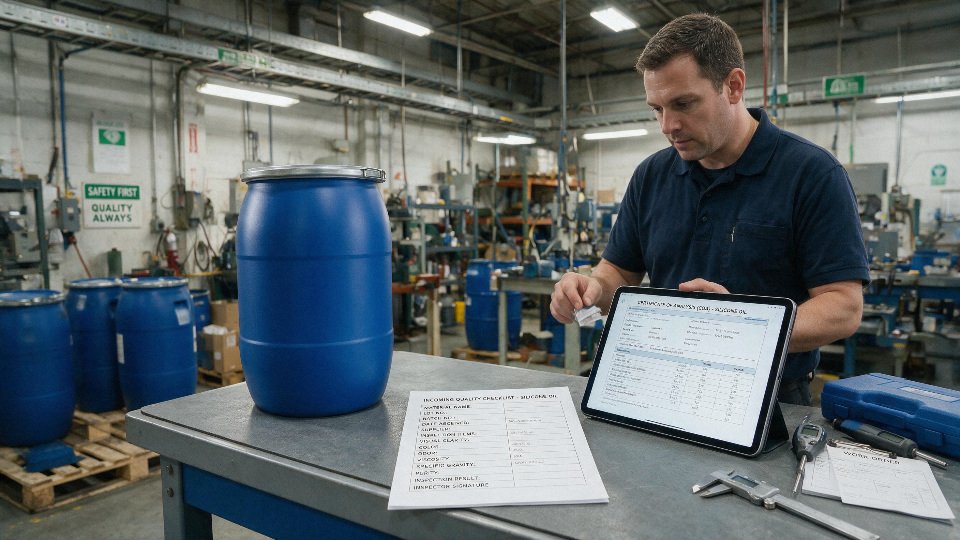
Core certificate items to request on every lot
At a minimum, the certificate of analysis should include these items, with test methods identified where possible:
- Kinematic viscosity at 25 C
- This is the primary grade-defining property.
- Ask for the actual measured value, not just “conforms.”
- For tight-process applications, ask for the acceptable tolerance band around nominal grade.
- Appearance and visual clarity
- Clear, haze-free appearance matters because suspended contamination often shows up here first.
- Haze can indicate moisture, insolubles, or cross-contamination during filling.
- Color
- Usually reported by a recognized color scale.
- A color shift does not always mean failure, but for high-purity or optical-sensitive applications it can be an early warning.
- Density and refractive index
- These are useful identity checks and can help catch off-spec blending or substitution.
- In practice, buyers often overlook them, but they are good cross-check parameters for incoming inspection.
- Volatile content
- This matters whenever evaporation, odor, fogging, or weight loss is a concern.
- A fluid with acceptable viscosity can still fail in service if low-boiling fractions are too high, especially in heated or vacuum-exposed systems.
- Flash point
- Important for storage, transport classification review, and hot-process risk assessment.
- Verify against current supplier documentation and applicable site safety rules.
- Acid value
- Relevant for stability and compatibility, especially where sensitive metals, catalysts, or electrical components are involved.
- Moisture
- Critical where hydrolytic sensitivity, dielectric performance, or process consistency matters.
- Not every silicone oil application needs a tight moisture limit, but electrical grades and moisture-sensitive formulations usually do.
A viscosity-only COA is enough to qualify industrial silicone oil.False
Viscosity confirms grade, but not low-boiler content, contamination, moisture, dielectric quality, or compatibility risks. Those are common field failure routes.
Advanced analytical methods worth requesting
For higher-consequence applications, ask what the supplier can verify beyond the routine COA.
- GC for cyclics and low boilers
- Useful for identifying volatile fractions that drive evaporation loss, odor, fogging, and some regulatory concerns.
- This is especially important for heat-transfer, personal care intermediates, and closed-space applications.
- FTIR for structural confirmation
- Good for confirming the fluid family and detecting obvious substitution or contamination.
- It is not a full purity test, but it is a fast identity control.
- GPC for molecular distribution
- Helpful when consistency of film behavior, lubricity, or processing matters.
- The mechanism is simple: broader molecular distribution can shift volatility, shear response, and deposit tendency even when nominal viscosity matches.
- Dielectric testing for electrical grades
- Breakdown strength, dielectric loss, and volume resistivity should be verified for fluids sold into electrical service.
- This is one area where “industrial grade” and “electrical grade” should not be treated as interchangeable.
Application-specific qualification tests
If the oil is going into a defined process, request tests that mirror that duty:
- Thermal aging
- Evaporation loss
- Foam tendency and air release
- Spreadability or wetting behavior
- Demulsibility
- Seal compatibility with actual elastomers used on site
- Dielectric breakdown for insulating service
The trade-off is cost and time. Full qualification adds lab work, but it is still cheaper than cleaning a foaming bath, replacing swollen seals, or scrapping coated product because a release fluid changed behavior after a few weeks at temperature. This conclusion weakens if the application is very forgiving, low temperature, and non-critical; then a lighter approval protocol may be enough.
Packaging, storage, and shelf-life controls
Quality can be lost after production. Ask about:
- Packaging material compatibility
- Clean filling conditions
- Tamper-evident sealing
- Nitrogen blanketing where relevant
- Recommended storage temperature
- Opened-container handling rules
- Shelf-life and re-test policy
Moisture pickup, drum contamination, and mislabeled transfers are ordinary warehouse problems, especially once partial drums start circulating between maintenance and production areas. A good supplier will state how product should be stored and what changes, if any, trigger reinspection.
Traceability and supplier-system discipline
Look for:
- Lot-to-batch traceability back to production records
- Change-control notification for raw materials, process, or test methods
- Retained samples for complaint investigation
- Documented corrective action system
- Export documentation accuracy and consistency
Sourcing from Chinese organosilicon clusters
China’s organosilicon clusters offer real advantages: upstream integration, broad capacity, and export familiarity can improve lead time and cost position. The catch is that those supply-chain strengths only matter if QA discipline is stable from reactor to drum. For serious buyers, the right question is not “Can this supplier quote lower?” but “Can they deliver the same lot-to-lot behavior six shipments from now, with evidence?”
Frequently asked questions
What is silicone oil made of?
Most industrial silicone oils are based on siloxane polymers, usually polydimethylsiloxane (PDMS), with a backbone of alternating silicon and oxygen atoms and organic side groups attached to the silicon. Those side groups are often methyl groups in standard grades, but they can also be phenyl, vinyl, amino, polyether, or other functional groups when the fluid is modified for a specific job.
Is silicone oil the same as silicone fluid?
In most purchasing and plant discussions, yes. “Silicone oil” and “silicone fluid” are often used interchangeably for liquid siloxane products, though some suppliers use “fluid” as the broader term and reserve “oil” for lubricating or process-liquid grades.
Why does silicone oil have low surface tension?
Because the methyl groups on the PDMS chain present a very low-energy surface, the fluid spreads easily across many substrates. That is why standard PDMS oils often sit around 20 to 21 mN/m at room temperature, which is one reason they work well in defoaming, release, wetting, and lubrication-type applications.
What viscosity grade should I choose?**** Start from the process, not the catalog. Low viscosities, roughly below 10 cSt, are chosen where fast spreading, light damping, or easy pumping matters; mid-range grades are common for heat transfer, lubrication, and general process use; very high viscosities are used for damping, sealing, or where the fluid must stay put on the surface. The right grade depends on temperature, shear conditions, dosing method, film thickness, and whether migration is acceptable.
Can silicone oil be used at high temperature?
Usually yes, within limits. Standard dimethyl silicone oils commonly serve in roughly -50 C to 200 C duty, but the actual upper limit depends on residence time, oxygen exposure, contamination, and whether the system is open or closed. A hot open bath and a sealed instrument do not age fluid the same way, so the manual and supplier data matter.
Is silicone oil electrically insulating?
Many silicone oils have good dielectric behavior and are used in electrical and electronic applications. That said, insulation performance depends heavily on water content, ionic contamination, particulate cleanliness, and the specific grade, so do not assume any silicone oil is suitable for transformers, sensors, or high-voltage use without verified test data.
Does silicone oil mix with water or mineral oil?
Silicone oil generally does not mix with water. Compatibility with mineral oil is limited and grade-dependent; some blends separate quickly, others appear stable for a while and then haze or stratify, especially with temperature cycling.
Can silicone oil damage rubber or plastic parts?
Sometimes. Silicone oils are gentler than many hydrocarbons, but certain elastomers and plastics can swell, soften, craze, or lose strength depending on polymer type, additives, temperature, and contact time. In practice, seals, tubing, sight glasses, and adhesive-bonded assemblies should be checked by immersion test, not guesswork.
Is silicone oil safe for food, cosmetic, or medical use?**** Only specific grades are. A standard industrial PDMS fluid is not automatically acceptable for food-contact, personal-care, or medical use. Buyers should ask for the exact regulatory and compositional documentation for the intended market, because purity, residual volatiles, additives, and manufacturing controls all matter.
How should silicone oil be stored and handled?
– Keep containers sealed to limit dust, water pickup, and cross-contamination.
– Store in clean, dry conditions away from strong oxidizers and incompatible chemicals.
– Use dedicated pumps, hoses, and drums where contamination control matters.
– Warm high-viscosity grades gently if needed for transfer; do not overheat the drum skin.
– Verify housekeeping controls, because spilled silicone oil creates a serious slip hazard.
What are the signs of silicone oil degradation?
– Viscosity drift outside the expected range
– Increased volatility, odor, smoke, or evaporative loss at temperature
– Darkening, haze, gel particles, or sediment
– Foam behavior changing from normal process behavior
– Deposit formation on heaters, seals, or vent areas
– Electrical properties dropping in sensitive applications
All silicone oils are chemically inert and maintenance-free.False
Silicone oils are often more stable than hydrocarbon fluids, but they still degrade from heat, air exposure, catalytic contamination, moisture, and process carryover. Condition monitoring is still needed in critical service.
When should modified silicone oils be used instead of standard PDMS fluids?
Use modified grades when plain PDMS gives the wrong balance of wetting, compatibility, lubricity, reactivity, or temperature response. Polyether-modified fluids are often chosen for emulsification or improved spreading in water-based systems; phenyl-modified grades can improve low-temperature or some high-temperature behavior; amino-, epoxy-, or other functional types are used where adhesion, textile hand, or surface interaction matters. Once the job depends on a specific interfacial effect rather than just “a stable silicone liquid,” standard PDMS usually stops being enough.
Your specification checklist
A workable silicone-oil inquiry is not “need 100 cSt silicone fluid.” It is a short operating specification that lets a supplier screen out the wrong chemistry before you waste a week on samples. If you define the duty, the temperature envelope, the contact surfaces, and the acceptance criteria up front, grade matching gets faster and the first trial is usually much closer.
Start by locking down the minimum inputs before you ask for pricing or samples:
- Primary function
- Heat transfer
- Lubrication
- Release
- Damping
- Dielectric insulation
- Defoaming
- Textile, personal care, or surface treatment use
- Actual temperature range
- Normal operating temperature
- Start-up and shutdown extremes
- Short-duration excursions
- Whether the fluid sees air, moisture, or sealed conditions
- Viscosity target
- Preferred grade at the relevant temperature, not just at 25 C
- Whether pumpability, wetting, retention, or film strength is the main reason for that target
- Allowable viscosity drift over service life, if the process is sensitive
- Substrate and material contact
- Metals, elastomers, plastics, coatings, adhesives, paper, textiles, electronics, or food-contact-adjacent components
- Any known issues with seal swell, paint defects, cratering, or downstream bonding
- Compliance and cleanliness needs
- Internal cleanliness limits
- VOC, odor, ash, ionic residue, or specific regulatory requirements
- Whether the application needs a standard fluid, higher-purity material, or documented restricted-substance compliance
- Packaging and handling format
- Drum, pail, IBC, bulk
- Clean-room or closed-transfer needs
- Dispensing method, storage time, and whether partial-container contamination is a risk
Once that is clear, run verification in stages:
- Bench test
- Check wetting, spread, foam behavior, separation, or feel against the current fluid.
- Compatibility screening
- Test against seals, hoses, plastics, coatings, and any product-contact surfaces.
- Pilot trial
- Run under real temperature, shear, dwell time, and contamination conditions.
- Analytical confirmation
- Verify viscosity, appearance, volatility or residue profile, and any critical internal QC item.
- Supply qualification
- Confirm lot consistency, lead time, packaging integrity, COA format, and change-control expectations.
Switch from a generic grade request to a customized or modified silicone fluid when one of these shows up:
- One fluid must satisfy conflicting needs, such as wetting plus low transfer
- Standard PDMS creates coating, bonding, or contamination problems
- Temperature, dielectric, or cleanliness limits are unusually tight
- The process is sensitive to carryover, migration, or residue
- Pilot results are close, but not inside the operating window
That switch matters because the gain is usually application fit; the trade-off is higher qualification effort and sometimes longer supply alignment. The rule stops holding if the application is simple utility use with broad tolerance and no sensitive downstream interface; in that case, a standard grade is often the right commercial answer.
Send a supplier the following for fast technical matching:
- Process description and equipment type
- Current fluid name and the exact problem you want to fix
- Required performance metrics
- Contamination or downstream-process constraints
- Estimated annual volume and pack size
- Clear part, line, or application photos; samples if the interface is hard to describe
If you are ready to narrow grades, treat the next step as a specification review and sample-validation exercise. Share the substrate material, contaminant type if relevant, approximate layer thickness or applied amount, working area, required finish, target rate, and clear photos or samples; SiliconChemicals can then review the application, match a suitable silicone fluid or modified silicone option where needed, and arrange sample evaluation against your stated requirements.