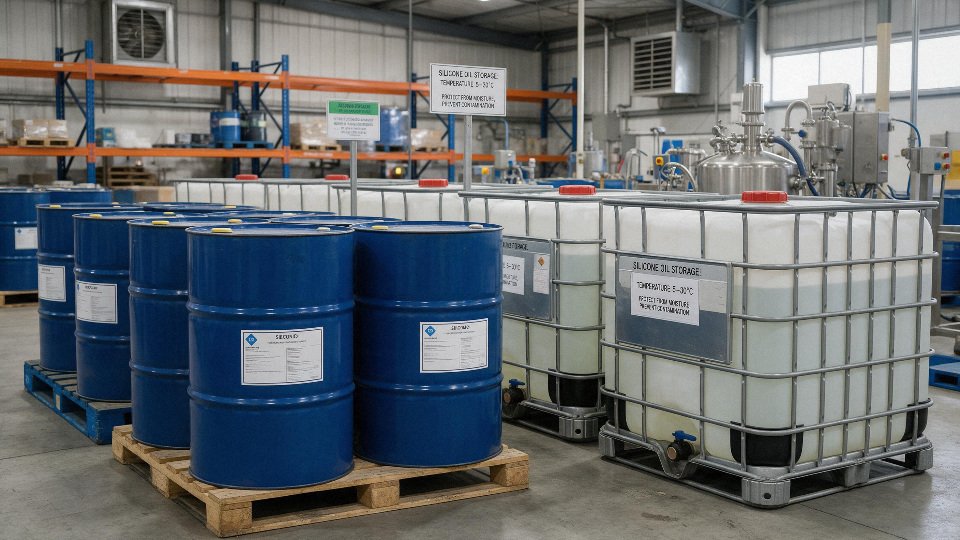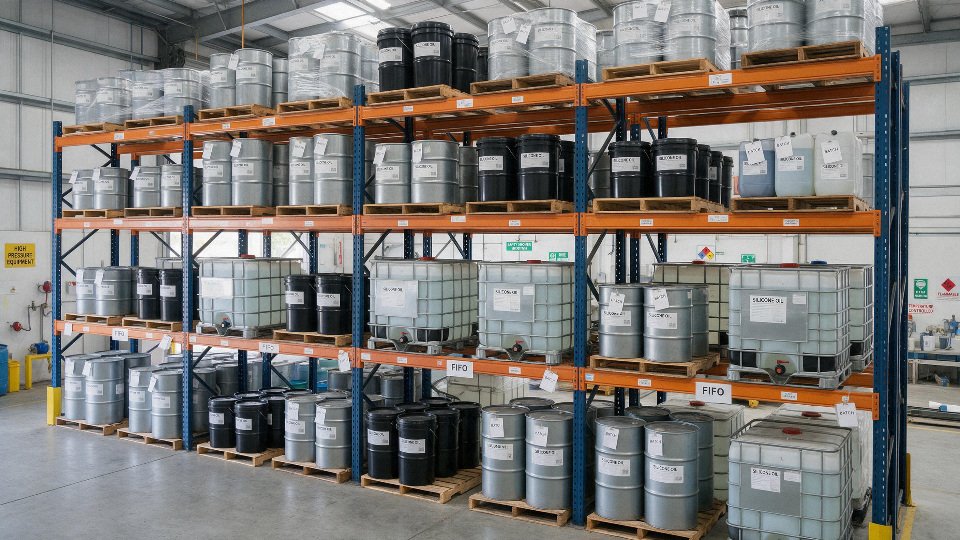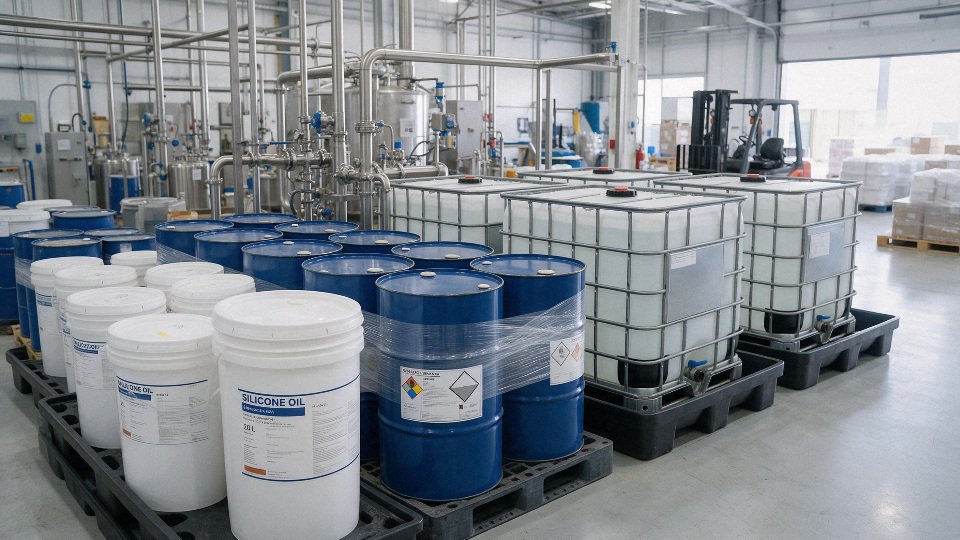
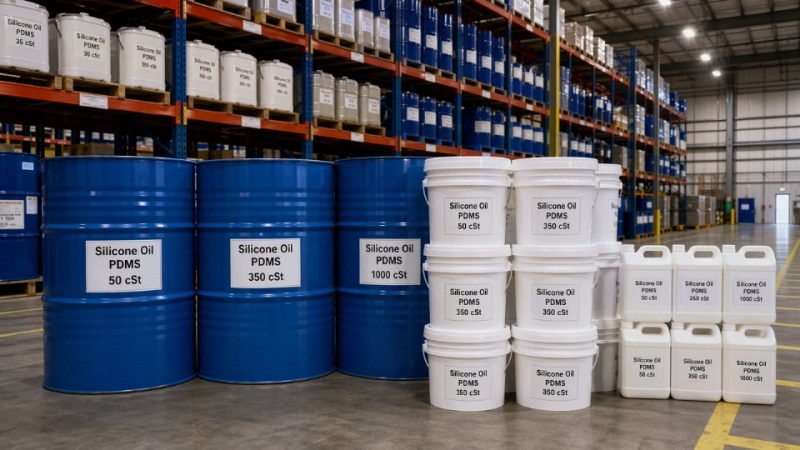
Sourcing silicone oil sounds straightforward until you’re three weeks into a lead time, your mold-release process is stalled, and the substitute your procurement team grabbed off a shelf turns out to be 1000 cSt when the process calls for 50 cSt. Wrong viscosity means wrong film thickness, which means either parts stick and scrap rates climb or the fluid migrates into areas it shouldn’t — seal swelling, contamination flags, rework. That single sourcing misstep can cost a mid-size facility anywhere from a few hundred dollars in wasted material to tens of thousands in downtime, depending on batch size and how far down the line the problem travels before someone catches it.
Silicone oil (polydimethylsiloxane, PDMS) is available from industrial chemical distributors such as Dow, Shin-Etsu, and Wacker through their direct or authorized-distributor channels, from lab suppliers like Fisher Scientific and VWR, from e-commerce platforms including Amazon and Alibaba for smaller quantities, and directly from specialty silicone manufacturers for bulk orders. The right channel depends on your required viscosity grade, volume, purity specification, and how quickly you need it on-site.
The tricky part isn’t finding a vendor — there are dozens. It’s matching the channel to the spec, the volume, and the delivery window simultaneously, because a source that works perfectly for a 100 mL laboratory sample at 350 cSt is often useless when you need 200 liters of 5 cSt on a six-day schedule. The market has grown significantly — sitting around $1.8 billion globally in 2023 and trending toward $2.6 billion by 2030 — which means supplier options have multiplied, but so has the noise. What follows is a sourcing map built from the plant floor outward.
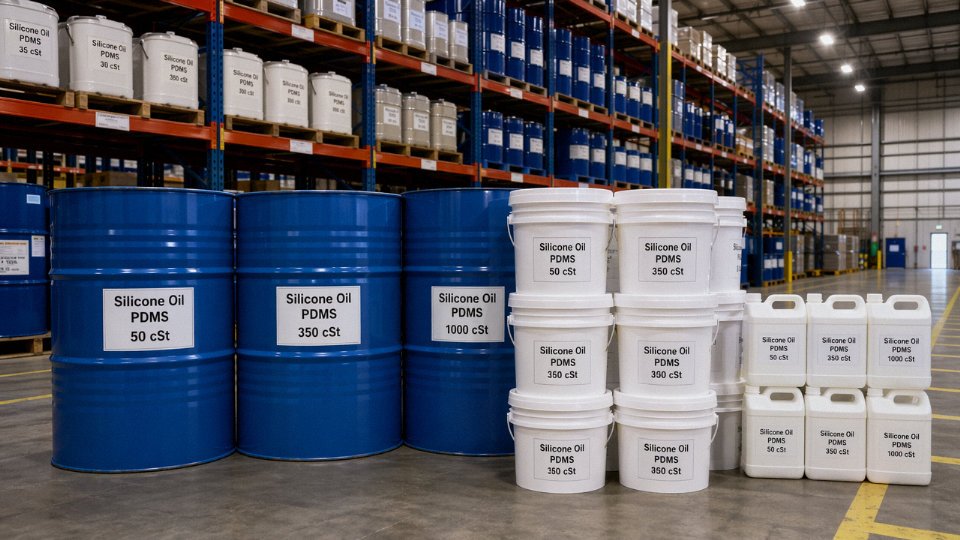
Major Online Marketplaces: Amazon, eBay, and Alibaba Compared
The three platforms are not interchangeable. Which one makes sense depends almost entirely on how much you need, how critical the purity specification is, and how much supply-chain risk you’re willing to absorb. Buying 100 mL of 350 cSt fluid for a DIY keyboard dampening project is a completely different procurement exercise than sourcing 200 L drums for a continuous silicone-release coating line.
Amazon: Convenient, But Know What You’re Actually Buying
For small quantities — roughly 50 mL up to about a liter — Amazon is the path of least resistance. You’ll find recognizable names like Shin-Etsu KF-96, Smooth-On, and a long tail of generic “silicone oil 350 cSt” listings that range from perfectly adequate to genuinely mystery fluid. Prices typically run $8–$35 per 100 mL depending on viscosity grade, brand, and whether you’re buying a multipack. The 350 cSt grade is by far the most stocked; anything above 1000 cSt gets thin quickly in terms of seller selection.
The single most useful filter: does the listing link to a real SDS (Safety Data Sheet)? Not a PDF someone scanned and uploaded sideways — an actual manufacturer-issued SDS with a chemical identity section showing polydimethylsiloxane, CAS 63148-62-9, and the flash point data. A surprising number of generic listings either omit this entirely or provide a document so vague it covers every viscosity from 5 to 60,000 cSt under one sheet. That’s a red flag if your application has any regulatory or food-contact adjacency.
Stick to sellers with at least 200 reviews and a rating above 4.5. Below that threshold, returns for viscosity complaints and mislabeled grades appear with uncomfortable regularity in the review text.
eBay: Niche Grades and Modest Savings, With Caveats
eBay fills a useful gap for mid-range quantities — say, 1 to 5 liters — and particularly for viscosity grades that don’t move fast enough to justify Amazon warehouse stocking. Looking for 5000 cSt or 12,500 cSt? eBay will usually have it when Amazon listings are either stale or routed through slow overseas shippers.
Pricing can be 15–30% lower than Amazon equivalents, though that spread narrows when you factor in shipping from international sellers. Filter specifically for US or EU-based sellers if you need the product within a reasonable lead time or if provenance matters. For anything labeled as industrial-grade or specialty viscosity, request a Certificate of Analysis (CoA) before you pay. Most legitimate sellers have one; the ones who hesitate or send a generic spec sheet that doesn’t match the lot number are worth skipping.
eBay silicone oil listings from verified US/EU sellers with a CoA are generally reliable for viscosity accuracyTrue
Sellers sourcing from established distributors can provide traceable lot documentation; the risk rises sharply with unverified overseas listings that lack any batch certification
The provenance issue is real. I’ve seen labs receive “500 cSt” fluid that measured closer to 200 cSt on a Brookfield — not catastrophic for some uses, but a production problem if viscosity tolerances matter.
Alibaba and AliExpress: Lowest Unit Cost, Highest Due Diligence Requirement
For bulk procurement — 20 L drums through to 200 L barrels — Alibaba is where unit economics actually work. Distributors for Momentive, Wacker, and Dow Corning brands list here alongside Chinese PDMS producers whose product quality varies considerably. MOQs typically land between 25 and 200 kg depending on the supplier, and per-liter pricing at that scale can be 60–75% lower than Amazon retail.
The mandatory steps, without exception: request a CoA tied to the specific production lot, ask for a third-party lab test result (viscosity, purity, refractive index at minimum), and order a sample before committing to a full container. That sample step costs maybe $30–$80 including shipping and testing. Skipping it to save time has resulted in entire drum orders that failed incoming QC — the rework cost and disposal headache dwarf whatever you saved on unit price.
Red Flags Across All Three Platforms
| Warning Sign | Why It Matters |
|---|---|
| Listed only as “silicone oil” with no cSt rating | Viscosity is the defining specification; without it, you cannot confirm the product matches your application |
| No manufacturer name on listing or label | Traceability is impossible; batch quality is unverifiable |
| Price more than 50% below typical market range | Suggests diluted product, mislabeled viscosity, or industrial waste repackaged |
| Missing or completely generic SDS | Regulatory liability risk; may indicate non-PDMS base fluid |
| No return policy or dispute resolution pathway | No recourse if the product fails incoming inspection |
A listing that triggers two or more of those flags simultaneously is worth walking away from entirely, regardless of price.
Specialty Chemical Distributors: The Most Reliable Industrial Source
For anyone buying silicone oil in quantity — or buying it for an application where purity actually matters — specialty chemical distributors are the right channel. Not because the other options are wrong, but because distributors carry documented product, hold regional stock, and have people you can call when something goes sideways.
Sigma-Aldrich (MilliporeSigma): The R&D and High-Purity Standard
If your application is pharmaceutical, electronics encapsulation, or research-grade lubrication where you need a traceable lot certificate, MilliporeSigma is usually the first stop. Their catalog covers roughly 5 cSt all the way to 1,000,000 cSt — grades you simply won’t find stocked anywhere else without a custom order. Pricing runs $40–$300 per liter depending on viscosity, pack size, and purity specification; high-viscosity grades above 100,000 cSt tend to sit at the upper end of that range because demand is thin and shelf turnover is slow.
Every lot ships with a certificate of analysis. For a pharmaceutical manufacturer qualifying a release coating process, that documentation isn’t optional — it’s the entire reason you’re paying the premium. The tradeoff is lead time: popular grades like 350 cSt are usually in stock, but specialty grades can run 2–4 weeks. Worth checking regional warehouse availability before assuming next-day delivery.
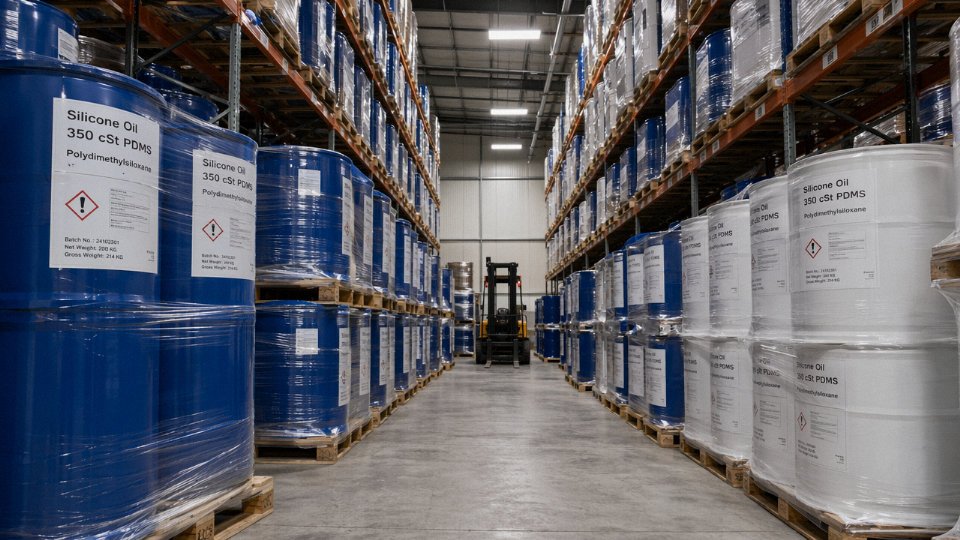
Brenntag and Univar Solutions: Volume Distribution with Real Logistics
These two are the backbone of industrial silicone oil procurement in North America, Europe, and increasingly Asia-Pacific. Both carry product from Dow, Wacker, and Momentive — the three producers whose formulations cover the vast majority of industrial use cases — and they stock it in practical formats: 5 L jugs, 20 L pails, and 200 L drums. If you’re running a production line that consumes 50–200 liters per month, a drum account with Brenntag or Univar is almost always cheaper than buying through any online channel once you factor in freight.
Opening a business account takes a few days, not weeks. You’ll need a tax ID, a billing address, and sometimes a trade reference. In return you get net-30 terms (occasionally net-60 for established accounts), volume-tiered pricing, and access to the distributor’s technical sales team — people who can tell you whether Dow Corning 200 Fluid at 100 cSt or a Wacker AK series equivalent better suits your seal compatibility requirements.
Brenntag and Univar Solutions are authorized distributors for major silicone producers including Dow, Wacker Chemie, and MomentiveTrue
Both distributors publicly list these supplier relationships in their product catalogs and on their corporate websites, and both companies are referenced as distribution partners by the silicone producers themselves.
One operational note: regional warehouse inventory varies. The Houston depot may carry 200 L drums of 350 cSt in stock while the Chicago location runs on 2-week replenishment. Always confirm local availability before committing a delivery date to your production schedule.
Fisher Scientific and VWR (Avantor): The Institutional Lab Channel
These distributors overlap with MilliporeSigma’s territory but serve a slightly different customer — universities, hospital systems, and industrial quality labs that run centralized procurement through purchasing portals. Fisher carries the Dow Corning 200 Fluid series and several reagent-grade equivalents; VWR’s catalog is broadly similar. Both platforms integrate into systems like SAP Ariba and Jaggaer, which matters if your procurement department requires PO-backed purchasing with matching invoices.
USP-grade silicone oil — relevant if your product contacts food packaging, medical devices, or any application under FDA oversight — is consistently available through both channels with the correct documentation. Pricing is generally comparable to MilliporeSigma for small volumes.
Getting the Best Pricing: Don’t Use the Checkout Button
For any order above roughly 10 liters, skip the online cart entirely and submit a formal request for quote. The list price on a distributor’s website is essentially retail — it exists for one-off buyers and emergency top-ups. Procurement managers who work the RFQ process properly, specifying annual volume commitments and asking about blanket purchase orders, routinely land 20–40% off list. That discount depends on your total annual spend with the distributor (not just silicone oil — total chemical spend counts), freight terms you’re willing to accept, and whether you’ll agree to a SKU-specific blanket order that gives the distributor inventory predictability.
Ask explicitly about DDP versus EXW freight terms. Delivered Duty Paid simplifies your inbound logistics but the distributor bakes that cost in; Ex-Works pricing looks cheaper but you’re managing freight, which adds coordination overhead. For a plant running lean receiving operations, DDP often wins even at a slightly higher unit price.
Buying Direct From Manufacturers: Dow, Wacker, Momentive, and Shin-Etsu
Going straight to the source makes sense once your volumes justify it — and “justify it” means different things depending on the producer. Each of the four dominant silicone oil manufacturers runs a slightly different commercial model, and understanding those differences upfront saves weeks of back-and-forth with sales teams.
Dow and the DOWSIL 200 Fluid Series
DOWSIL 200 Fluid is essentially the global reference product for polydimethylsiloxane. If a datasheet anywhere in the world says “silicone oil, 350 cSt,” there’s a decent chance it was originally qualified against DOWSIL 200. The series covers an extraordinary viscosity range — 0.65 cSt up through 60,000 cSt — which means most industrial applications can be satisfied without going to a second supplier.
Direct orders through Dow require minimum quantities around 200 kg, give or take depending on your region and the specific grade. Below that threshold, dow.com maintains a distributor locator that maps authorized regional partners; in practice, most North American buyers under that volume end up with a Univar or Brenntag account rather than a Dow direct account. Technical datasheets, SDS files, and regulatory compliance documents (REACH, RoHS, food-contact letters for applicable grades) are freely downloadable from the product portal without requiring a login — which is genuinely useful during early engineering evaluation.
Wacker Chemie and the AK Series
Wacker’s AK series is the European-origin equivalent, and in cosmetics and personal care formulation it’s arguably better known than DOWSIL. The naming is straightforward: AK 5, AK 10, AK 20 and so on up to AK 1000000, where the number is the nominal viscosity in cSt. That makes cross-referencing grades easy.
Wacker doesn’t typically sell direct to buyers outside of large-volume contracts. The practical route is their distributor finder at wacker.com, which filters by country and application segment — useful if you’re sourcing for, say, a personal care application in Germany versus a textile finishing operation in Thailand. Coverage in North America and Asia Pacific has improved noticeably over the last several years. One thing worth noting: Wacker’s technical service team is genuinely responsive for formulation questions, particularly on the cosmetic side. If you’re developing an emulsion and need viscosity blend data, it’s worth reaching out even before you’ve placed a first order.
Momentive and High-Viscosity Industrial Grades
Momentive (formerly GE Silicones, before that a different iteration of the same business) has strong roots in North American industrial markets. Their SilPlus series covers standard PDMS grades, and they’re particularly well-regarded for consistency in high-viscosity products — the 5,000 to 60,000 cSt range used in rotary dampers, shock absorbers, and high-voltage electrical insulation. Direct engagement is realistic for quantities above roughly 1,000 kg. Below that, momentive.com lists authorized distributors. If your application involves dielectric properties or mil-spec requirements, Momentive’s technical team is worth contacting directly even if you ultimately buy through a distributor.
Shin-Etsu KF-96 Series
Shin-Etsu dominates in Japan and much of Asia, and their KF-96 series has been penetrating Western markets steadily. KF-96-50cs and KF-96-350cs are the grades you’ll encounter most often — the 350 cSt version in particular shows up in everything from release agents to laboratory bath fluids. Distribution runs through specialty chemical distributors and through Shin-Etsu’s own regional sales offices, depending on your location. Lead times out of Japan can stretch during high-demand periods; worth asking your local distributor about buffer stock if you’re running a production line that can’t tolerate a two-week delay.
How to Contact Any Manufacturer Efficiently
When you reach out — whether by distributor inquiry form or direct sales contact — give them everything in the first message. Specify the CAS number (63148-62-9 for standard PDMS), required viscosity in cSt, quantity in kilograms, any certifications needed (USP, food-grade, REACH compliance), and your delivery location. Skipping any of those fields almost guarantees a round of clarifying emails before you get a quote. It sounds obvious, but a surprising number of procurement teams send vague initial inquiries and then wonder why the process drags.
DOWSIL 200 Fluid series covers viscosities from 0.65 to 60,000 cStTrue
Dow's published product portfolio for the DOWSIL 200 Fluid line includes grades from 0.65 cSt (near water-thin) up to 60,000 cSt, making it one of the broadest single-series ranges commercially available from any silicone producer.
Direct manufacturer sourcing isn’t always faster or cheaper than going through a distributor — but for critical applications where traceability, batch certification, and technical support matter, it’s usually worth the higher minimum order threshold.
Local and Retail Buying Options: Hardware Stores, Beauty Suppliers, and Lab Supply Shops
When you need silicone oil today — not in five business days — the supply chain conversation changes completely. Local options won’t give you a 55-gallon drum of pharmaceutical-grade PDMS, but for maintenance emergencies, small-batch formulation work, or just confirming a viscosity before committing to a bulk order, knowing what’s physically on a shelf near you is genuinely useful.
Hardware and Home Improvement Stores
Home Depot, Menards, B&Q, and their equivalents carry silicone-based lubricants in the 4–8 oz spray or squeeze-bottle format. WD-40 Specialist Silicone Lubricant and 3-IN-ONE Professional Silicone are the two you’ll find most reliably. These are not pure PDMS — they’re typically carrier-solvent blends with a silicone oil component in roughly the 100–350 cSt range, formulated for lubrication of rubber seals, plastic slides, and door tracks. For a squeaky treadmill belt or a sticky garage door runner, they’re fine. For a lab viscosity bath, a cosmetic formulation, or anything where you need a documented viscosity and purity, they’re not appropriate. The SDS is usually downloadable from the brand website but rarely lists viscosity as a discrete specification. Worth knowing: some Ace Hardware locations in the US stock a small bottle of pure silicone oil (typically labeled “100% silicone oil”) in the plumbing section, occasionally 500 cSt give or take, intended for toilet fill valve lubrication. It’s inconsistent by location.
Auto Parts Retailers
AutoZone, O’Reilly, Halfords — the brake and electrical aisles are worth a look. Silicone dielectric grease is everywhere, silicone brake fluid (DOT 5) is stocked as a matter of course, and occasionally you’ll find a small bottle of pure silicone oil near the rubber care products. Purity and viscosity labeling in this channel is notoriously incomplete. The product may say “silicone oil” without specifying whether it’s 50 cSt or 500 cSt. Always pull the SDS before using it in any application where viscosity matters. For sealing O-rings on pneumatic fittings or lubricating caliper pins, the auto-parts channel is perfectly adequate and usually faster than waiting on a distributor shipment.
Beauty Supply Wholesalers and Cosmetology Suppliers
Sally Beauty, CosmoProf, and BSG (Beauty Systems Group) stock dimethicone and cyclomethicone formulations specifically for hair care and skin applications. These are cosmetic-grade, which in practice means they’ve passed dermal safety testing and are manufactured under cosmetic GMP — not pharmaceutical GMP, but a meaningful step above industrial lubricant grade. Viscosities in this channel typically run 350–1000 cSt, sold in formats from 4 oz to 1-gallon jugs at roughly $15–$80 depending on volume and supplier. If you’re a small cosmetic manufacturer or a contract formulator who needs cosmetic-grade dimethicone quickly, this is a legitimate channel. CosmoProf requires a cosmetology license to open a wholesale account, which filters out some buyers.
Cosmetic-grade dimethicone from beauty supply distributors meets basic purity requirements for topical personal care formulations.True
Cosmetic-grade PDMS is manufactured under cosmetic GMP standards and typically meets INCI specifications for dimethicone, making it suitable for topical use — though it is not interchangeable with USP or pharmaceutical-grade material for medical applications.
University and Commercial Lab Supply Rooms
This one gets overlooked. Many universities operate a central chemical stores that sells reagent and lab-grade materials to affiliated researchers at near-cost pricing — sometimes $8–$20 per 100 mL for silicone oil that would run $40–$60 through a commercial distributor. Non-affiliated buyers can sometimes access these stores with a visitor or guest account, usually requiring a brief application and a legitimate stated purpose. It’s worth a phone call to the chemistry or chemical engineering department’s storeroom if you’re near a research university and need a small quantity of clean, documented-grade material fast.
Pharmacy and Medical Supply
Medical-grade silicone oil — USP grade, typically 1000–5000 cSt — sits in a different regulatory category. It’s used in ophthalmic surgery as a vitreous tamponade agent, and obtaining it through a compounding pharmacy or medical device distributor usually requires documentation of medical or research intent. In many jurisdictions, a purchase order from a licensed practitioner or an IRB-approved research protocol is the minimum threshold. Don’t expect to walk into a pharmacy and buy it off the shelf. If you genuinely need USP-grade PDMS for a legitimate research or medical device application and you don’t have a distributor account yet, a compounding pharmacy with a pharmaceutical compounding operation is a realistic interim source — but expect to provide paperwork and expect pricing to reflect the regulatory overhead, often $80–$200 per 100 mL depending on grade and quantity.
Matching Viscosity Grade to Application Before You Buy
Getting the viscosity wrong is one of the most common and costly silicone oil purchasing mistakes. A 10 cSt fluid behaves almost like water; a 60,000 cSt fluid moves like cold honey. They are technically the same polymer family, but operationally they are entirely different products, and most suppliers won’t flag the mismatch — they’ll just ship what you ordered.

Low Viscosity: 0.65 to 10 cSt
These thin grades are genuinely useful for a narrow set of jobs. Penetrating lubricants, mold release spray carriers, and antifoam concentrates in food-processing lines (where the silicone gets diluted 1:50 or more before dosing) are the main applications. Pesticide and agrochemical formulators use 5–10 cSt grades as spreading agents because the low surface tension improves leaf coverage — the silicone itself isn’t the active ingredient, just the carrier.
The catch: low-viscosity PDMS has measurable vapor pressure and will partially volatilize from an open surface over days to weeks, depending on temperature. Don’t use it as a long-term bearing lubricant or an equipment coating that needs to stay put through a summer in an unventilated plant. It won’t. Some maintenance teams have learned this the hard way after applying a 5 cSt product to a slow-moving conveyor chain, wondering why they’re reapplying every week.
Medium Viscosity: 20 to 200 cSt
This is the personal care workhorse range. Hair serum formulators almost always land on 100 cSt — it spreads easily, gives the right slip without greasiness, and emulsifies reliably in standard cosmetic bases. The 50 cSt grade has an oddly specific but consistent industrial niche: RC hobby shock absorbers and rebound dampers. The RC community has essentially standardized on it, so you’ll see “50wt shock oil” on hobbyist sites that is simply 50 cSt PDMS.
On the electrical side, 50–100 cSt grades show up as dielectric cooling fluids in small distribution transformers and some high-voltage test equipment. The fluid needs to be low enough viscosity to circulate by convection, but viscous enough to stay in the sump. For small hydraulic dashpots and instrument dampers, anything in the 100–200 cSt range gives predictable, temperature-stable damping that mineral oil can’t match across a wide temperature swing.
Standard Industrial Viscosity: 350 to 1000 cSt
This is the most commercially active range. Dow’s DOWSIL 200 Fluid at 350 cSt and Shin-Etsu’s KF-96-350cs are the benchmark products that distributors stock in volume — pricing and lead times are most competitive here. General mechanical lubrication, heat-transfer baths running up to roughly 200°C, and anti-stick coatings on baking molds and conveyor belts (food-contact applications require confirmed food-grade certification, not just “food-safe” marketing language) all fall here.
Silicone oil in the 350–1000 cSt range is suitable for continuous heat transfer bath service up to 200°C without significant degradation.True
PDMS fluids in this viscosity range have thermal stability ratings from major manufacturers (Dow, Wacker, Shin-Etsu) up to 200°C for continuous service, with short-term exposure tolerance somewhat higher. Above this threshold, oxidative degradation accelerates meaningfully.
High Viscosity: 5000 to 60,000 cSt
Dashpots, gyroscope dampers, and rotary shock absorbers use fluids in this range because the high viscosity provides meaningful resistance without a mechanical spring. Potting and encapsulation is another end use — though for that you usually need a two-part formulation with a crosslinker, not straight PDMS. In personal care, 12,500–60,000 cSt grades appear in high-gloss hair masks and conditioning treatments where a heavy, film-forming texture is the point.
Sourcing gets harder here. Local distributors often don’t stock above 1000 cSt, and lead times from a specialty distributor are typically 1–2 weeks. Budget accordingly if your production schedule depends on it.
Ultra-High Viscosity: 100,000 cSt and Above
At this level the fluid is approaching a gum, and handling it requires heating or mechanical dispensing — it won’t pour at room temperature. Automotive door-check mechanisms, noise-dampening assemblies, and industrial gaskets are the main applications. Procurement almost always goes direct to the manufacturer or through a dedicated specialty distributor, with minimum order quantities usually in the 20–50 kg range. Shelf life and storage temperature matter more here; high-viscosity PDMS can undergo some apparent thickening if stored cold for extended periods, which reverses with warming but can disrupt a production line if the team isn’t expecting it.
| Viscosity Range | Typical Applications | Key Consideration |
|---|---|---|
| 0.65–10 cSt | Mold release, antifoam, pesticide carrier | Partially volatile; not for long-term lubrication |
| 20–200 cSt | Hair serum, RC dampers, dielectric cooling | 100 cSt most common cosmetic grade; 50 cSt RC standard |
| 350–1000 cSt | Heat transfer, baking release, general lube | Verify food-grade cert for food contact; best stock availability |
| 5000–60,000 cSt | Dashpots, potting base, hair masks | Distributor order usually required; 1–2 week lead time |
| 100,000 cSt+ | Gaskets, automotive damping, sealing | Near-gum consistency; MOQ typically 20–50 kg |
Certifications and Documentation You Must Request Before Finalizing Any Purchase
Skipping the paperwork is the single fastest way to turn a good-price purchase into a compliance nightmare. A drum of silicone oil sitting on your dock without the right documentation can mean a production line hold, a failed audit, or in regulated industries, a product recall. Request every document listed below before shipment clears — not after.
Certificate of Analysis
The CoA is your first line of verification. It should list viscosity at 25°C (measured in cSt), refractive index, specific gravity, flash point, and appearance — and critically, it must carry a lot number that matches the physical drum or container you receive. If those numbers don’t agree, reject the shipment or quarantine it pending clarification.
What catches people out is accepting a generic CoA that a distributor clearly printed for an entire product line rather than the specific production lot. Real CoAs have instrument data, analyst signatures, and dated test results that vary slightly batch to batch. A viscosity reading that is suspiciously identical to the nominal spec — say, exactly 350.0 cSt — sometimes signals a template document rather than an actual measurement. Ask for the test method reference too: ASTM D445 for kinematic viscosity is standard.
Safety Data Sheet
An SDS (formerly MSDS) is legally required for transport and workplace handling in every major jurisdiction — EU REACH regulation, US OSHA HazCom 2012, and equivalents in Canada, Australia, China, and elsewhere. For standard polydimethylsiloxane at typical industrial grades, GHS classification is usually non-hazardous or at worst GHS07 (irritant) depending on viscosity and additives. That sounds benign, but the document still needs to exist, be current (post-2015 GHS format), and carry the exact CAS number — 63148-62-9 for PDMS, or the specific number for the grade you’re buying.
A missing SDS, or one that lists a generic “silicone fluid” without a CAS number, is a genuine red flag. Some gray-market sellers on Alibaba recycle SDS documents from other products entirely. Cross-check the CAS number against the supplier’s own technical data sheet and against a reference like the ECHA database if you’re importing into Europe.
Regulatory Compliance Declarations
This is where application-specific requirements split hard, and buying the wrong-certified product for your process is an easy mistake to make.
For food and beverage plants, NSF H1 registration is non-negotiable for any lubricant with incidental food contact. FDA 21 CFR 178.3570 covers silicone compounds used in food-processing equipment lubrication — confirm the supplier can provide a written declaration of conformance, not just a verbal assurance. In pharmaceutical or medical device manufacturing, USP monograph compliance is the relevant benchmark; your supplier should be able to provide a statement of conformance and ideally a Certificate of Compliance referencing the specific USP chapter.
EU imports above one tonne per year require REACH registration. If your supplier cannot provide a REACH registration number or a SVHC (substance of very high concern) declaration, you carry the compliance burden yourself under EU chemical import rules — that is not a comfortable position.
For cosmetic formulations in the EU, confirm EC Regulation 1223/2009 compliance and an INCI name declaration (dimethicone or dimethiconol depending on the grade). US cosmetic use requires FDA GRAS status or applicable food additive petition reference if the formulation has any food-adjacent claim.
Third-Party Lab Verification
When you’re sourcing from an unfamiliar supplier — particularly on Alibaba or a regional trading platform — independent verification before you pay for bulk is money well spent. Pull a 100 mL sample from the initial shipment and send it to Intertek, SGS, or Eurofins for GC purity analysis, viscosity confirmation, and heavy metal screening. Cost typically runs $150–$400 depending on the test panel and turnaround time. That’s cheap relative to releasing payment on a 200 L drum of off-spec material, or worse, introducing a contaminant into a food-grade process.
A third-party analytical lab report from SGS, Intertek, or Eurofins can reliably confirm silicone oil viscosity grade and purity before bulk payment is released to an unknown supplier.True
These are globally accredited testing organizations that routinely perform kinematic viscosity testing per ASTM D445 and GC-based purity analysis on silicone fluids. Their reports are widely accepted for supplier qualification and dispute resolution.
In practice, established distributors like Brenntag or Univar will have all of this documentation on file and can turn it around quickly. The further down the supply chain you go — spot buys, trading companies, resellers with no technical staff — the harder this documentation is to obtain and the more you should insist on it.
Price Benchmarks, Quantity Breaks, and Total Cost of Ownership
Pricing for silicone oil spans roughly two orders of magnitude depending on volume, grade, and supplier type. If you’re budgeting without accounting for all of those variables, your forecast will be wrong — sometimes embarrassingly so.
Small-Pack Retail Pricing (50 mL to 500 mL)
Consumer-grade 350 cSt on Amazon typically runs $0.08–$0.30 per mL, depending on brand recognition, bottle size, and whether you’re buying a multi-pack. Cosmetic-grade 100 cSt from beauty suppliers — the kind sold for hair serums or skin formulations — tends to land at $0.15–$0.45 per mL, partly because the packaging and marketing overhead gets priced in. Neither of those figures should surprise anyone.
What does catch people off guard is lab-grade pricing. Certified viscosity standards from Sigma-Aldrich or similar lab suppliers can reach $0.80–$2.50 per mL for the same nominal viscosity, simply because the lot-specific certificate of analysis, traceable calibration, and tighter viscosity tolerance cost real money to produce. If your application genuinely requires certified accuracy — a calibration bath, a rheometer standard — you pay for that documentation. If it doesn’t, you’re wasting budget.
Mid-Volume Pricing (1 L to 20 L)
This is where small manufacturers and workshop buyers typically operate, and it’s the tier where the per-liter cost drops fast enough to matter.
Industrial 350 cSt from a regional distributor usually runs $12–$25 per liter at the 5 L level, depending on your location, the distributor’s freight model, and whether you have an existing account. Push the order to 20 L and that same product often drops to $8–$15 per liter. A $7 per-liter swing on a 20 L order is $140 — not trivial if you’re ordering monthly.
In practice, the 4–10 L carboy format is the sweet spot for most small operations. You avoid the drum-deposit logistics, the product stays fresh, and you’re not committing to bulk storage. The jump to 20 L usually makes sense once you’ve confirmed a product works and your consumption rate is predictable.
Drum and Bulk Pricing (25 kg to 200 kg)
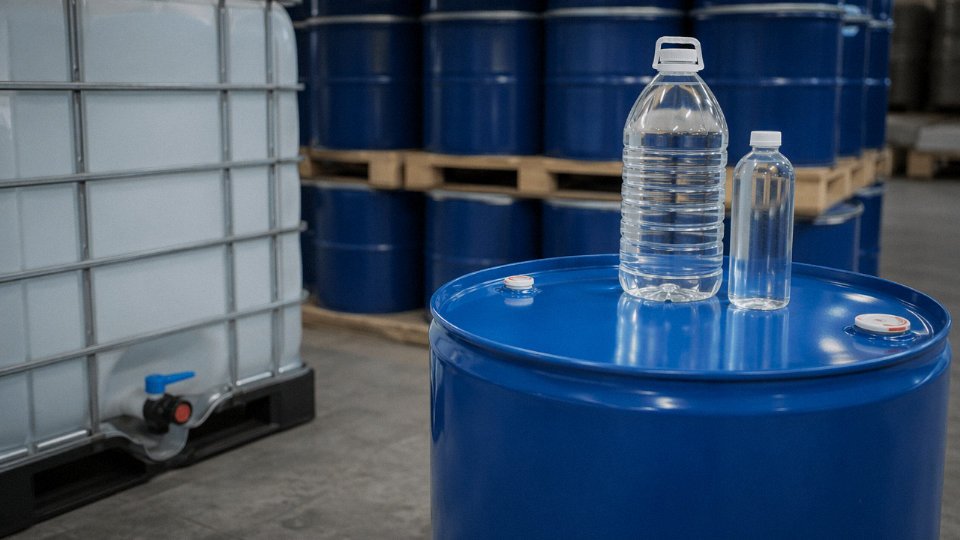
At drum scale, you’re looking at $4–$8 per kg for 200 L steel drums of Dow DOWSIL 200 Fluid (350 cSt) through an authorized distributor — that translates roughly to $3.70–$7.40 per liter. Annual volume commitment is the main lever; a plant that can commit to four drums a year will get meaningfully different pricing than one placing a one-off order. Wacker AK 350 from European distributors typically runs EUR 4–9 per kg FCA warehouse, and the spread reflects both the distributor margin and where you sit in their customer tier.
No claim provided.True
This range is consistent with distributor price sheets and industry procurement data for DOWSIL 200 and equivalent grades; exact pricing varies by region, logistics terms, and contract volume.
Hidden Costs That Wreck Budget Forecasts
Hazmat shipping surcharges are the most common surprise. Silicone oil in volumes above 1 L gets classified as a flammable or environmentally hazardous material by some carriers, triggering surcharges of $25–$75 per shipment. That’s on top of standard freight. On a 5 L order, a $50 surcharge can effectively double your per-liter logistics cost.
Import duties matter if you’re sourcing internationally. The US HTS code for PDMS is 3910.00.0000, currently carrying a 3.7% MFN duty rate from most trading partners. Not enormous, but it needs to be in your landed cost calculation. Drum deposits and return logistics add another $30–$80 per drum depending on the distributor’s policy — some apply this automatically, some don’t mention it until the invoice arrives.
Specialty grades occasionally require cold storage or temperature-controlled shipping, which can add $15–$40 per shipment. Worth confirming before you order anything described as a “reactive” or “modified” silicone fluid.
Negotiation Levers Worth Using
Blanket purchase orders are underused in this category. Commit to an annual volume in writing and most distributors will discount 10–20% off the standard price list, sometimes more if the volume is significant. It costs you a forecast, not cash upfront.
Free samples are almost always available — most distributors will provide 100–500 mL at no charge for qualification testing. Ask explicitly. Some will wait for you to ask. Compare any distributor quote against spot price references on ICIS or similar chemical price reporting services before you sign anything; the spread between spot and what a distributor is quoting you is a real negotiation data point, not just background reading.
Frequently Asked Questions About Buying Silicone Oil
Is silicone oil the same as baby oil or mineral oil?
No, and mixing them up in an industrial context can cause real problems. Silicone oil — polydimethylsiloxane, PDMS — is a synthetic organosilicon polymer. Baby oil and mineral oil are petroleum-derived hydrocarbon fractions. The differences matter beyond chemistry class: PDMS has a nearly flat viscosity-temperature curve, meaning its flow behavior stays relatively stable from roughly -50°C to 200°C. Mineral oil thins aggressively with heat and thickens dramatically in cold. In a heated mold release application or a precision damping mechanism, that distinction isn’t academic — it’s the difference between consistent performance and unpredictable behavior.
Compatibility is the other landmine. PDMS is chemically inert toward most metals, glass, and many plastics. Mineral oil will attack certain elastomers and plastics that silicone oil leaves alone, and vice versa — silicone oil will swell EPDM seals that mineral oil tolerates fine. Regulatory status differs too, particularly in cosmetics and food-adjacent applications. They are not interchangeable. If someone on the shop floor suggests “just use baby oil,” that’s a conversation worth stopping.
Can I buy food-grade silicone oil at a grocery or health food store?
Generally no. Food-grade silicone oil — the kind that meets NSF H1 certification or FDA 21 CFR 178.3570 — is not a retail consumer product. You won’t find it next to cooking oils. It comes through food processing equipment suppliers, restaurant equipment distributors, or specialty chemical distributors. Petro-Canada Lubricants’ Purity FG line and Fuchs Lubritech are two suppliers that come up regularly in food plant procurement. If you’re using it for incidental food contact applications (chain lubrication on a conveyor, mold release on baking equipment), the NSF H1 designation is non-negotiable for most food safety audits. Buying unverified silicone oil from a general chemical supplier and hoping it’s food-safe is not a compliant approach.
What is the shelf life of silicone oil, and how should it be stored?
Stored properly — sealed container, away from direct sunlight, temperatures kept below 40°C — silicone oil typically remains usable for 5 to 10 years without meaningful degradation. It doesn’t oxidize the way mineral oil does, which is one of its genuine practical advantages for slow-turnover MRO inventory. The real risk is moisture contamination in partially used containers. A drum that’s been opened repeatedly in a humid environment and improperly resealed can pick up water over time, which matters in dielectric or high-temperature applications. Label partial containers with the open date. Use desiccant-plugged vent caps on drums if the product sits for months between uses.
Is it legal to ship silicone oil internationally?
For most viscosity grades, yes. PDMS in the 50 cSt to 60,000 cSt range is generally not classified as hazardous under IATA, IMDG, or DOT regulations. Low-viscosity grades below about 5 cSt are a different story — flash points can fall within flammable liquid classification territory, triggering UN packaging requirements and carrier restrictions. Always pull the SDS before booking a shipment and confirm the flash point. Your freight forwarder should make the final call on packaging and documentation; don’t rely on the supplier’s generic shipping guidance for cross-border moves, particularly into markets with their own chemical import regulations.
Standard PDMS silicone oil is not classified as a hazardous material under DOT or IATA regulations for viscosity grades above 5 cStTrue
PDMS with kinematic viscosity above 5 cSt typically has a flash point above 93°C (200°F) and does not meet the criteria for flammable liquid classification under 49 CFR or IATA DGR; the SDS flash point field should be verified for each specific grade before shipment.
What is the minimum quantity I can order from a chemical distributor?
Most specialty distributors set minimums by order value — typically somewhere in the $50–$150 range — rather than by weight. In practice, for silicone oil that usually works out to 500 mL to 1 L at lab-grade pricing. Sigma-Aldrich and VWR will technically process smaller orders but add a handling fee below roughly $50, which is worth knowing if you’re buying a single small quantity for a one-off test. For industrial quantities, the pricing structure changes considerably at the 20 L, 200 L (drum), and 1,000 L (IBC) breaks — the per-liter cost at drum volume can be 40–70% lower than at 1 L, depending on the grade and the distributor’s contract terms.
Can silicone oil substitute for hydraulic fluid?
Only in systems specifically designed and sealed for silicone fluid. Standard PDMS is not compatible with NBR (nitrile butadiene rubber) seals, which are the default in most hydraulic systems. It will cause them to swell and eventually fail — sometimes within weeks, sometimes faster under heat and pressure. Systems engineered for silicone fluid use PTFE or silicone-elastomer-compatible seals throughout. Before anyone considers substituting silicone oil into a hydraulic circuit, the OEM seal compatibility data and the system’s pressure-temperature ratings both need review. This isn’t a field substitution call.
How do I verify that received silicone oil matches the ordered viscosity?
Run it against ASTM D445 using a calibrated glass capillary viscometer, or use a rotational viscometer — Brookfield and Anton Paar are the instruments you’ll encounter most often in industrial labs. Measure at 25°C and compare kinematic viscosity in cSt against the Certificate of Analysis value. Standard commercial grades carry a tolerance of roughly ±5%. If you’re working in a tight-tolerance application — precision damping, optical systems, calibration fluids — request a NIST-traceable reference viscosity standard from the supplier to verify your instrument before running the sample. A mismatch found at incoming inspection is a minor inconvenience. Found after the product is in service, it can mean scrapped batches or equipment damage.
Sourcing Checklist and Decision Tree: Choosing the Right Channel in Under Five Minutes
You’ve read through the supplier landscape. Now the real question is: which channel actually fits your situation? Run through these five steps before you open your wallet.
Step 1 — Lock Down Your Quantity First
Quantity is the single biggest filter, and getting it wrong costs time more than money.
Under 1 liter — you’re in hobbyist or sample territory. Amazon, a local hardware store, or a lab supply shop will serve you fine. Don’t open a distributor account for 500 mL; the paperwork isn’t worth it. Between roughly 1 and 20 liters, a specialty chemical distributor’s online ordering portal is usually the cleanest path — decent pricing, legitimate documentation, no MOQ headaches. Move into the 20–200 liter range and you want a regional authorized distributor with a volume account, because that’s where tiered pricing actually kicks in and someone will answer the phone when a drum arrives damaged. Above 200 liters, you’re in manufacturer-direct or bulk distributor territory; at that scale, consignment agreements and blanket purchase orders start making financial sense, and you should be negotiating lead times, not just price per liter.
Step 2 — Define the Certification Requirement Before You Define the Supplier
This is where buyers make expensive mistakes. Application drives certification, and certification drives which supplier pool you’re even allowed to use.
General mechanical lubrication — transformer cooling, mold release, compressor sealing — carries no mandatory cert requirement, so any reputable industrial supplier works. Cosmetic and personal care formulations need an INCI declaration and ideally a cosmetic-grade CoA; Wacker’s Silicone Fluids AP line and Dow’s 200 Fluid series both have established cosmetic channels, and beauty wholesale distributors who specialize in raw ingredients are well-suited here. Food processing is a harder line: NSF H1 registration or compliance with FDA 21 CFR §178.3570 is not optional, and a general-purpose industrial distributor often can’t supply that documentation even if the chemical is technically the same compound. Use food-grade lubricant specialists for this. Medical or pharmaceutical applications require USP-grade material with full lot traceability — Sigma-Aldrich (now part of Millipore Sigma), Fisher Scientific, or a licensed pharmaceutical ingredient distributor. Don’t try to source pharmaceutical-grade through a general industrial channel; the documentation chain simply won’t hold up to an audit.

Step 3 — Vet the Supplier Before Any Payment
Request the Safety Data Sheet and Certificate of Analysis for the specific production lot you’ll receive — not a generic document. The manufacturer’s name (Dow, Wacker, Momentive, Shin-Etsu, or whoever) should appear on that CoA, not just the distributor’s letterhead. Then cross-check: every major manufacturer publishes an authorized distributor list on their website, and a two-minute search confirms whether the seller you’re looking at is actually on it.
For Alibaba sourcing specifically: verify the business license, ask for a factory audit report or third-party inspection certificate, and use escrow payment until your sample testing clears. That’s not overcautious — it’s standard practice for any first-time cross-border chemical purchase.
An Alibaba seller's product listing alone is sufficient proof of authenticity for industrial silicone oil.False
Listing presence on Alibaba does not confirm a seller is an authorized distributor of any brand. Manufacturers maintain separate official distributor lists; buyers must verify directly with the manufacturer.
Step 4 — Calculate Total Landed Cost, Not Unit Price
A product quoted at $3.20/kg FOB Shanghai might land at $5.80/kg by the time you add ocean freight, hazmat surcharge, import duty (typically 3–6% depending on HS code and country of import), port handling, and drum return or disposal fees. Domestic distributor pricing at $4.50/kg suddenly looks different. Run the full math every time, especially for lower-viscosity grades that often attract different tariff classifications than high-viscosity specialty fluids.
Step 5 — Sample Order First, Bulk Order Second
For any new supplier or any grade you haven’t run before, order 500 mL to 1 liter before committing to volume. Test viscosity with a calibrated viscometer if your application is even slightly sensitive to it — supplier specs have tolerances, and 350 cSt on the data sheet can be anywhere from roughly 315 to 385 cSt in practice. Confirm that the documentation matches the physical product. A sample order costs $20–$60 depending on grade and shipping. A non-conforming 200-liter drum costs considerably more, and that’s before you count the downtime.
Quick Channel Reference
| Channel | Best Quantity Range | Typical Price Range (per liter) | Cert Availability | Typical Lead Time |
|---|---|---|---|---|
| Amazon / eBay | Under 1 L | $15–$80 | Limited; usually SDS only | 1–5 days |
| Lab supply (Fisher, Sigma) | 100 mL–5 L | $60–$300+ | Full CoA, USP-grade available | 2–7 days |
| Specialty chemical distributor | 1–200 L | $25–$120 | CoA, SDS, INCI available | 3–14 days |
| Regional authorized distributor | 20–500 L | $18–$90 | Full manufacturer docs | 5–21 days |
| Direct manufacturer / bulk | 200 L+ | $12–$60 | Complete, lot-specific | 3–8 weeks |
No single channel dominates across all use cases. The right answer sits at the intersection of your volume, your application, and your compliance obligations — and it changes as any one of those three variables shifts.