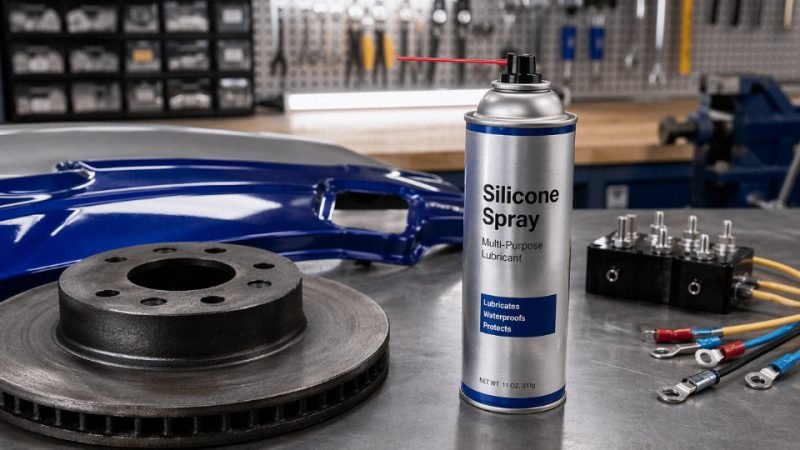
Silicone spray gets grabbed off the shelf because it works fast, leaves no mess you can see, and stops squeaks in about thirty seconds. The problem is that it migrates — onto painted surfaces, into porous substrates, across mating faces that need friction to function — and once it’s there, you often don’t know until something fails downstream. A single overspray event near an automotive repaint zone can contaminate a panel so thoroughly that the coating fisheyes weeks later, and stripping and respraying one panel runs $500–$3,000 depending on vehicle class and paint system. At assembly scale, silicone-related rework averages $150–$800 per affected unit and accounts for somewhere between 12 and 18 percent of contamination-linked warranty claims in plants that have actually tracked it.
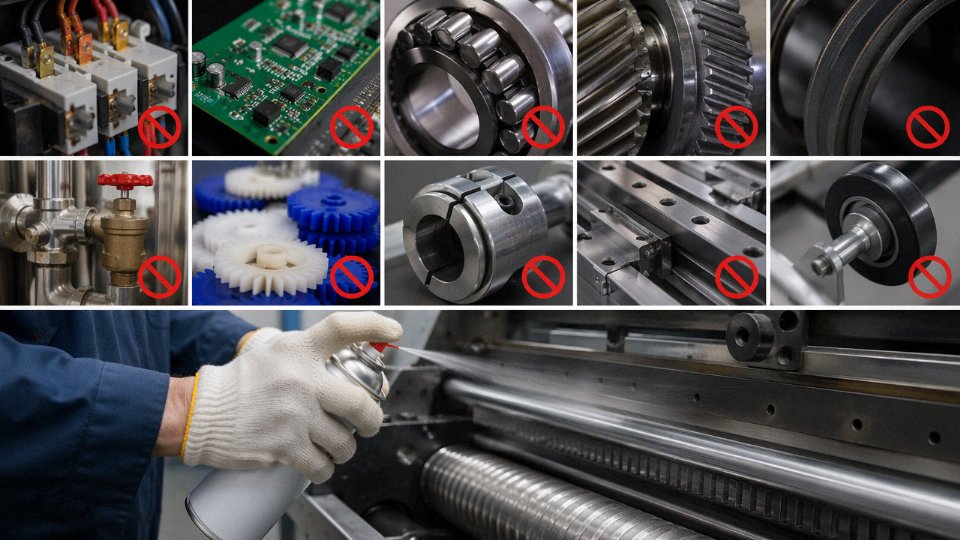
Silicone spray should not be used on surfaces to be painted or bonded, electrical contacts, oxygen-handling equipment, rubber seals in certain chemistries, plastic components under load, or any surface where a friction-dependent connection must hold. The silicone’s PDMS carrier penetrates porous materials up to 2–5 mm deep and can persist for six months to two years, making contamination very difficult to reverse.
What surprises most people — including experienced maintenance techs — is how far the problem extends beyond the obvious “don’t spray it near fresh paint” advice. The real list of incompatible applications cuts across electrical, mechanical, structural, and process environments, and the failure modes look completely unrelated to lubrication at first glance. That’s what makes misapplication so costly and so hard to catch.
Never Use Silicone Spray on Any Surface You Plan to Paint, Bond, or Coat
This is where silicone spray causes the most expensive damage — and it rarely announces itself until you’re already in a rework loop that costs real money.
The core physics is straightforward. PDMS molecules are non-polar, extremely low surface energy, and they spread aggressively across any substrate they contact. Most solvent-borne automotive topcoats need a substrate surface energy of roughly 38–44 mN/m to wet out properly. Waterborne basecoats are even more demanding, typically requiring 40 mN/m or above. Silicone contamination drags surface energy on steel down to somewhere in the 22–28 mN/m range — well below the critical wetting threshold. The coating can’t spread. It pulls back from the contaminated zones and craters, producing the classic fisheye pattern that every automotive painter dreads.
Why Even a Trace Amount Triggers Full Panel Rejection
The contamination threshold in OEM automotive finishing is genuinely low. Quality labs at assembly plants routinely reject panels where surface energy tests — usually a dyne pen or a drop-shape analyzer — indicate residual silicone at concentrations as low as 0.1 mg/cm². That’s essentially invisible to the naked eye. You can’t see it, you can’t smell it, and the panel looks clean. The paint goes on, fisheyes appear in the flash or cure stage, and now you’re looking at a full strip-and-repaint on a panel that can run $500–$3,000 depending on size, paint system, and whether it’s a production line or a body shop rework bay.
In automotive assembly plants specifically, silicone-related contamination accounts for roughly 12–18% of all contamination-driven warranty and rework claims, with per-unit rework costs typically running $150–$800. Those figures assume the defect is caught before shipment. If it isn’t, the downstream warranty costs are higher and harder to trace.
| Surface Condition | Typical Surface Energy (mN/m) | Paint Adhesion Outcome |
|---|---|---|
| Clean, degreased steel | 40–48 | Normal wetting, good adhesion |
| Lightly silicone-contaminated steel | 28–34 | Marginal — fisheye risk present |
| Heavily silicone-contaminated steel | 18–26 | Cratering and fisheye, full rejection |
| Typical solvent-borne topcoat requirement | 36–42 minimum | — |
| Typical waterborne basecoat requirement | 40–44 minimum | — |
Bond Failure in Structural Adhesives
Silicone contamination doesn’t just wreck paint. It’s arguably worse when a structural adhesive is involved. Epoxies, polyurethanes, and cyanoacrylates all rely on a combination of mechanical interlocking and polar chemical interaction with the substrate surface. PDMS films block both mechanisms simultaneously — the film occupies the surface sites the adhesive needs, and its non-polar character prevents the hydrogen bonding and van der Waals interactions that drive adhesion.
Controlled peel tests on silicone-contaminated coupons show bond strength reduction in the range of 40–90%, depending on adhesive chemistry, film thickness, and cure conditions. That’s not a subtle degradation. A joint that should carry 12 MPa might fail at 2–3 MPa. In anything structural — automotive hem flanges, composite bonding in aerospace work, or industrial frame assemblies — that failure mode can be catastrophic rather than cosmetic.
Silicone contamination can reduce structural adhesive bond strength by 40–90% compared to clean substrate performanceTrue
Controlled peel and lap-shear test data from adhesive qualification studies consistently show this range; the actual reduction depends on PDMS film thickness, adhesive type, and surface preparation quality.
Powder Coating and Anodizing
Powder coating is a different process but the same failure logic applies. Silicone acts as a release agent between the powder and the substrate during cure — the same mechanism that makes it useful in molding applications works directly against adhesion here. The result is blistering and peeling, sometimes within weeks of application rather than years. Anodizing is more forgiving of minor contamination, but silicone in masking or handling steps can cause uneven oxide layer growth and adhesion failures in any subsequent bonding or sealing operation.
Remediation if Contamination Is Suspected
If there’s any chance silicone spray touched a surface before painting or bonding, don’t assume a single wipe-down is enough. The right protocol is multiple washes — typically three or more passes — with isopropyl alcohol at 99% concentration, or a dedicated silicone-removing prep solvent (products like Sherwin-Williams DX330 or equivalent). Wipe in one direction with clean cloths; don’t scrub back and forth and redistribute the contamination. After cleaning, verify surface energy with dyne pens or contact angle measurement before committing to paint or adhesive application. If the surface tests below your paint system’s minimum wetting requirement, clean again. Contamination that has penetrated a porous primer or composite substrate can be effectively impossible to remove without stripping back to bare substrate — which is exactly the scenario you’re trying to avoid.
The simplest operational rule: silicone spray and any surface destined for paint, adhesive, or coating belong in completely separate areas of the facility. Overspray travels further than most people expect, and the contamination can persist for six months to two years on porous substrates.
Keep Silicone Spray Away from All Braking, Clutch, and Friction-Dependent Components
This is the category where getting it wrong doesn’t cost you money — it costs someone their life. Everything else in this article is about rework budgets and warranty claims. This is different.
What Silicone Does to Brake Friction Coefficients
A properly bedded brake pad running against a cast iron rotor operates at a coefficient of friction somewhere between 0.35 and 0.45 μ, depending on pad compound, rotor condition, and temperature. That range is what your vehicle’s brake bias, ABS calibration, and stopping-distance ratings are all built around.
Silicone contamination — even a light overspray that you might not even see on the rotor surface — can drag that coefficient down to 0.10–0.15 μ. That’s not a marginal degradation. At 60 mph, a vehicle that normally stops in roughly 120–140 feet can require well over 300 feet to stop under those conditions, depending on vehicle weight, tire grip, and how uniformly the contamination has spread. You’ve essentially turned your brake system into something closer to wet ice.
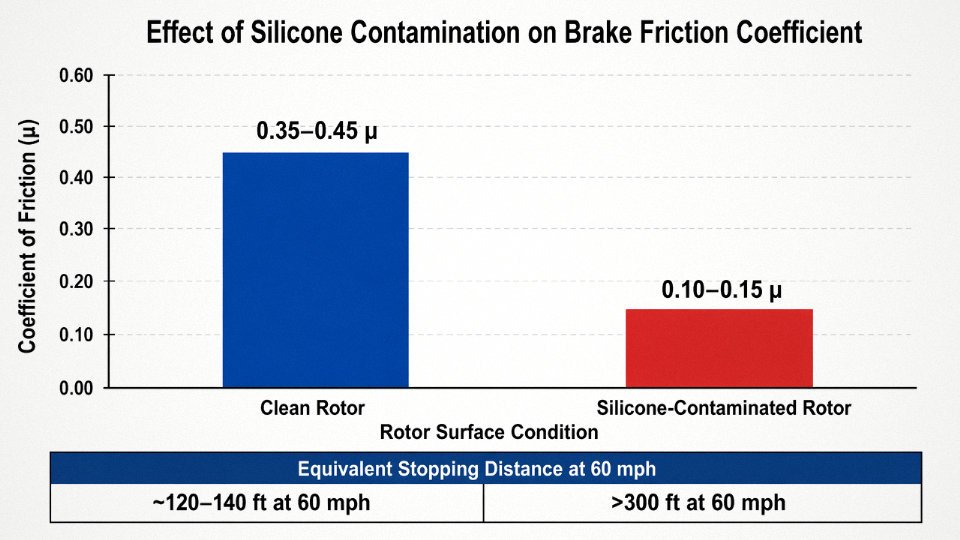
Silicone contamination can reduce brake pad friction coefficient from ~0.40 μ to as low as 0.10–0.15 μ, more than doubling stopping distance at highway speed.True
PDMS films on rotor and pad surfaces act as boundary lubricants, drastically reducing the friction interface. This is consistent with tribological testing data on contaminated friction pairs and is recognized in automotive safety engineering literature.
Why PDMS Is So Difficult to Remove from Rotors and Pads
Cast iron rotors have a slightly porous, microscopically rough surface that actively traps PDMS. The silicone doesn’t just sit on top — it bonds to the iron oxide layer. Normal braking temperatures during moderate city driving reach roughly 150–250°C at the rotor surface. PDMS begins to volatilize and thermally degrade only above 300°C, which typically requires sustained hard braking or track-style use. So for the majority of real driving conditions, the contamination simply sits there and gets worked deeper into the pad material with each braking cycle.
Ceramic pads are arguably worse. Their low-metallic or ceramic matrix is porous enough that PDMS penetrates the friction surface and can’t be mechanically abraded away without destroying pad geometry. In practice, any pad or rotor that receives silicone contamination should be treated as scrap. Cleaning with brake cleaner will reduce surface residue, but it won’t fully recover the friction interface — especially on pads.
Motorcycle and Bicycle Disc Brakes: Especially Vulnerable
Motorcycle chain maintenance is one of the most common real-world routes to brake contamination. The rear rotor sits close to the sprocket and chain, and an aerosol can with any kind of silicone content — including some multi-purpose sprays that aren’t marketed as silicone lubricants but contain PDMS as a carrier component — can easily mist onto the rotor during routine chain lubrication.
Smaller rotors mean less thermal mass, so the contamination-to-rotor-surface-area ratio is worse. A 220 mm motorcycle rotor contaminated across even 30% of its braking track is a serious problem. Bicycle hydraulic disc brakes are even more unforgiving — the rotors are tiny, pad replacement requires bleeding, and the whole system assumes a completely dry, contamination-free interface. One accidental spray near a bicycle disc brake setup can mean immediate pad and rotor replacement before the bike is safe to ride.
Operational warning: Never use silicone spray anywhere in the vicinity of an uncovered wheel assembly. If you’re lubricating a rear derailleur or suspension linkage, mask the rotor with a rag or remove the wheel first. It takes 90 seconds and it’s not optional.
Clutch Discs and Flywheel Surfaces
Clutch contamination follows the same physics but with a slightly different failure mode. Instead of a sudden loss of braking force, you get progressive slippage — initially under hard acceleration loads, then gradually under normal torque. The disc glazes quickly because silicone reduces the heat dissipation that normally occurs during engagement, and glazing compounds the slip problem.
A clutch disc that’s been contaminated by silicone overspray — say, from someone lubricating a nearby throttle cable or firewall grommet without masking the bellhousing area — will typically start showing shudder and slip within a few hundred miles. Full replacement runs $400–$1,500 depending on the vehicle, with front-wheel-drive transverse layouts on the higher end because of labor access. You can’t remediate it. The disc comes out.
Liability Is Real
If silicone spray was used near braking components prior to an accident with extended stopping distance, that’s a discoverable fact in litigation. Spray cans leave residue. Mechanics’ notes and shop records get subpoenaed. Using the wrong product in the wrong place and not documenting a correction creates direct negligence exposure — for a professional shop, for a fleet maintenance operation, for anyone who touched the vehicle.
What to Use Instead on Adjacent Components
The components near brakes and clutches still need lubrication — just not silicone.
| Component | Correct Lubricant | Why |
|---|---|---|
| Caliper slider pins | Dry PTFE lubricant or dedicated caliper pin grease | Silicone-free, compatible with rubber boots |
| Dust boots (caliper, wheel cylinder) | Silicone-free rubber lubricant (e.g., glycerin-based) | Prevents boot degradation without friction contamination risk |
| Clutch cable/pivot points | Dry PTFE or light lithium grease | Stays put, doesn’t migrate to friction surfaces |
| Brake hardware (anti-squeal shims) | Copper or ceramic-based brake caliper paste | High-temp stable, applied only to backing plate — never pad face |
| Wheel bearing areas | Dedicated bearing grease | Contained application, no overspray risk |
The principle is simple: anything within about 18–24 inches of a friction surface should use a lubricant that was specifically designed and tested for that environment. Silicone spray’s low viscosity and aerosol delivery make it almost impossible to apply with the precision that brake system proximity demands.
Electrical Contacts, Connectors, and Switches: Why Silicone Spray Is the Wrong Fix
The confusion here is understandable, and it trips up experienced technicians, not just beginners. Dielectric silicone grease — the thick, translucent paste you apply deliberately to spark plug boots, battery terminals, and high-voltage ignition connectors — is legitimate, well-established practice. It seals the rubber interface against moisture and corona discharge without bridging the metal contact surfaces themselves. Aerosol silicone spray is a completely different animal. Same base chemistry, radically different behavior in application.
When you hit a low-voltage signal connector with aerosol silicone, the carrier solvent flashes off and leaves a thin, uniform film of PDMS across every surface inside — including the actual contact faces. That film is an insulator. Contact resistance in a clean automotive or industrial signal connector typically runs somewhere in the 5–50 milliohm range depending on connector age, plating condition, and mating force. After silicone spray contamination, you can watch that climb into the hundreds of ohms over weeks, sometimes faster if the connector sees heat cycling. A sensor signal that nominally swings 0–5 V suddenly has enough resistive loading to throw the reading outside the ECU’s acceptance window.
The frustrating part is the non-linearity of how it progresses. The first week after contamination, resistance may only be slightly elevated and the fault is intermittent — shows up on a cold morning, clears itself as the connector warms and expands slightly, and leaves no freeze-frame data the technician can act on. That’s the electrical gremlin pattern that can consume four or five diagnostic hours before anyone thinks to pull the connector and look for an oily film. Thermal cycling is the mechanism: the PDMS film redistributes and thickens slightly with each heat-cool cycle, and what was marginal becomes a consistent fault over time.
Aerosol silicone spray deposits an insulating PDMS film on electrical contact surfaces that progressively increases contact resistance, causing intermittent sensor faults and ECU errors.True
Polydimethylsiloxane is a well-characterized electrical insulator. Aerosol delivery coats all exposed surfaces indiscriminately, including contact faces. Resistance increase from PDMS films on low-force signal contacts is documented in automotive connector engineering literature and failure analysis reports.
Relay and switch internals are worse. When a relay switches under load, it arcs across the contact gap. Normally, that arc is brief and the contact surfaces self-clean to a degree. When silicone is present on the contacts, the arc partially combusts the PDMS and deposits carbonized silica — SiO₂ — directly onto the contact surface. SiO₂ is a ceramic. It does not conduct, it does not wear away easily, and it builds up with every switching cycle. The relay that someone sprayed “to stop it from sticking” will have a pitted, fouled contact surface within a few hundred cycles. You have turned a cheap, replaceable relay into a definite replacement item, often on an accelerated timeline.
PCBs deserve a separate warning. Aerosol silicone overspray drifts — the fine mist from even a targeted spray can settle on nearby open boards. The PDMS film is hydrophobic, which sounds protective, but it actually traps moisture beneath it against the copper traces rather than shedding it cleanly. Electrolytic corrosion proceeds under the film, invisible until it’s caused a trace failure. The same film prevents conformal coating from bonding properly if you later try to protect the board, because most acrylic and urethane conformal coatings simply won’t adhere to a silicone-contaminated substrate.
What to Use Instead
The decision really isn’t complicated once you separate the two use cases:
| Situation | Wrong choice | Right choice |
|---|---|---|
| Contact surface (pins, terminals, relay contacts) | Aerosol silicone spray | Contact cleaner (IPA or dedicated electronics cleaner), then DeoxIT or equivalent for oxidation |
| Rubber boot or seal on a connector | Neither aerosol spray nor solvent | Dielectric silicone grease, applied sparingly to the rubber only |
| PCB cleaning or protection | Any silicone spray | IPA or electronics-grade cleaner; conformal coat afterward if environment demands it |
| Stuck or stiff switch body (plastic/nylon) | Silicone spray squirted inside | Dry lubricant or contact-safe lubricant specified for electronics |
DeoxIT D5 or similar contact treatment products work by chemically reducing the metal oxide layer that causes high resistance, then leaving a thin conductive film — the opposite of what PDMS does. For spark plug boots and battery post insulation, dielectric grease earns its place. For anything with a conducting contact surface that needs to pass signal or power reliably, aerosol silicone spray doesn’t belong anywhere near it.
Oxygen-Enriched Environments and Industrial Gas Systems: A Combustion and Contamination Risk
Most maintenance technicians understand that silicone spray is flammable in the conventional sense — the aerosol propellant burns, the solvent carrier burns. That’s not the hazard being discussed here. The real danger is what happens to PDMS itself when it contacts oxygen-enriched atmospheres, and it’s a failure mode that has appeared in industrial fatality investigations often enough that three separate international standards bodies felt compelled to address it explicitly.
Why Oxygen Changes Everything
In ambient air (roughly 21% O₂), PDMS is chemically inert enough that most people treat silicone spray as essentially harmless. Push oxygen concentration above 23.5% by volume — the threshold used by ASTM G63 and ASTM G94 as the definition of “oxygen-enriched” — and the ignition energy required for organic compounds drops dramatically. At 30–40% O₂, materials that wouldn’t sustain combustion in air burn vigorously. At 100% O₂, steel wool ignites from a spark. PDMS, which is an organic polymer regardless of how “inert” it feels on your workbench, becomes a viable fuel source under these conditions. The ignition can propagate through contaminated tubing faster than any manual intervention is possible.
In oxygen-enriched atmospheres above 23.5% O₂, PDMS and other silicone-based compounds can ignite at significantly lower temperatures than in normal air, posing a documented combustion hazard.True
This is consistent with ASTM G63 and ASTM G94 test protocols and is cited in multiple oxygen-system incident investigations by bodies including the US Chemical Safety and Hazard Investigation Board.
ISO 15001, which governs equipment for medical gas supply, is equally unambiguous: silicone- and petroleum-based lubricants are prohibited in oxygen service unless the specific formulation has been tested and approved under oxygen-compatibility protocols. The standard doesn’t leave wiggle room for “low-silicone” sprays or “just a quick squirt on the threads.”
Medical Gas Pipeline Systems
Hospitals are not typical industrial environments, but oxygen delivery infrastructure runs through them at pressures up to roughly 55–60 psi in most piped systems, and the pipeline serves flowmeters, regulators, Schrader valve outlets, and anesthetic machine connections. Both HTM 02-01 (the UK Health Technical Memorandum for medical gas pipeline systems) and NFPA 99 (the US Health Care Facilities Code) explicitly prohibit silicone spray in proximity to oxygen outlets and regulators. In practice, this means maintenance staff who use a generic silicone spray to free a stiff valve or “protect” a metal fitting have created a contamination event that, depending on the hospital’s protocol, can trigger a full system decommission and requalification of that branch — a costly and operationally disruptive outcome entirely aside from the safety risk.
Industrial Compressed Gas and Process Systems
Semiconductor fabrication and pharmaceutical clean rooms run into a different but related problem. Even in systems that aren’t oxygen service, PDMS degrades under elevated temperatures or in the presence of certain oxidizing catalysts into cyclosiloxane vapors — primarily D4 and D5. These vapors are notorious for poisoning platinum-group catalysts used in hydrogenation and oxidation reactors. A single contamination event upstream can deactivate a catalyst bed worth tens of thousands of dollars. In semiconductor fabs, D4/D5 deposition on optical surfaces or process chambers requires cleaning procedures that take equipment offline for hours. Compressed air systems feeding these environments typically have silicone contamination limits in the single-digit ppb range. Aerosol silicone spray used anywhere near an air intake or compressor station is simply incompatible with that requirement.
Breathing Apparatus and SCUBA Regulators
This is where well-meaning maintenance causes direct personal danger. Silicone aerosol spray is sometimes used to lubricate o-rings on SCUBA regulator first and second stages or self-contained breathing apparatus — usually because someone doesn’t have approved silicone grease on hand and reasons that “it’s still silicone.” The problem is that aerosol delivery deposits a thin, poorly controlled film on demand valve seats and inlet valves. That film can cause a second stage to free-flow (uncontrolled gas release, which depletes a tank rapidly underwater) or, depending on film thickness and surface geometry, create inhalation resistance that a diver notices as increased breathing effort at depth. Neither outcome is acceptable. Regulator manufacturers are consistent on this point: the correct lubricant is a specific oxygen-compatible silicone grease applied sparingly to o-rings only, not aerosol spray applied to assembled components.
What You Should Actually Use
For oxygen service — whether that’s a hospital pipeline fitting, an industrial oxygen lance connection, or a breathing apparatus component — the approved options are narrow. PTFE-based dry lubricants (provided the PTFE itself has been verified for oxygen compatibility and isn’t carrying a silicone or hydrocarbon carrier), Krytox greases (perfluoropolyether-based, chemically inert under oxygen enrichment), and purpose-formulated oxygen-compatible greases that carry documentation of ASTM G63 test compliance. The documentation matters. “Silicone-free” on a label is not the same as oxygen-service approval.
| Application | Prohibited | Correct lubricant |
|---|---|---|
| Medical oxygen regulators / outlets | Silicone spray, petroleum grease | Krytox or tested PFPE grease per ISO 15001 |
| Industrial O₂ pipework fittings | Silicone spray, pipe dope with PDMS | PTFE tape (O₂-grade) or Krytox |
| SCUBA / SCBA regulator o-rings | Silicone aerosol spray | Approved silicone grease (sparingly, o-rings only) |
| Semiconductor fab compressed air | Any silicone lubricant near intake | Oil-free compressor, PTFE-lined fittings |
| Pharmaceutical clean room valves | Silicone spray | Food-grade PTFE or PFPE, per system spec |
A can of silicone spray costs a few dollars. The consequences of using it in the wrong gas system range from a requalification shutdown to an ignition event. That’s not a risk-benefit calculation worth entertaining.
Plastics That Crack, Rubber That Swells, and Foam That Dissolves: Material Compatibility Failures
The “safe for plastics” claim printed on most silicone spray cans is one of the more misleading phrases in the hardware aisle. It’s not technically a lie — PDMS itself is largely inert toward many polymer families — but it ignores the solvent carrier, which does the damage long before the silicone ever deposits onto the surface.
The Carrier Solvent Is the Real Attacker
Most aerosol silicone sprays use naphtha, acetone, or HFC-based propellants to keep the PDMS in suspension and get it to atomize properly. Those carriers hit the substrate first. Polystyrene (PS) and ABS dissolve or craze almost on contact with acetone-based carriers. Acrylic (PMMA) hazes and microcrack. Polycarbonate — used in machine guards, instrument lenses, and automotive lighting housings — is particularly vulnerable to stress cracking when any residual mechanical load is present; the solvent doesn’t have to fully dissolve it, it just initiates cracks at stress concentrations that weren’t visible before. The silicone film eventually deposits on what is now a compromised surface, and you’ve created a problem that looks like a coating failure months later rather than a lubrication mistake made today.
In practice, injection-molded enclosures, transparent covers, and anything with visible optical surfaces should never get aerosol silicone unless the technical data sheet explicitly names that polymer as compatible with that specific formulation.
'Safe for plastics' labeling on silicone spray cans guarantees no damage to all plastic typesFalse
The label typically refers to PDMS film compatibility, not the carrier solvent. Acetone, naphtha, and HFC propellants in common formulations will attack polystyrene, ABS, acrylic, and polycarbonate, causing stress cracking, hazing, or dissolution — independent of what the silicone itself does.
Natural Rubber and Elastomer Seals
PDMS is actually reasonably compatible with most synthetic rubbers on its own. The problem, again, is the hydrocarbon solvent carriers. Natural rubber swells appreciably in naphtha-based solvents — sometimes 10–30% volume increase depending on the formulation and exposure time — and that swelling is not always reversible. EPDM, widely used in hydraulic and pneumatic systems, door seals, and outdoor gaskets, can absorb hydrocarbon solvents and lose its compression set resistance. Neoprene is similarly vulnerable. For any seal in a hydraulic circuit, a pneumatic valve body, or a water-tight enclosure, applying the wrong silicone spray means a seal that feels fine today but has lost meaningful elasticity within a few hundred operating cycles.
Silicone-on-Silicone Is Also a Problem
This one surprises people. Keyboard membranes, silicone O-rings, medical-grade silicone tubing — applying aerosol silicone spray to these parts causes surface tackiness and, with repeated applications, dimensional swelling in the 5–15% range depending on the formulation and exposure duration. That’s enough to push an O-ring out of its designed compression range and cause a leak. The degradation of mechanical properties — tensile strength, elongation at break — follows over weeks rather than immediately, so the connection to the “maintenance” application is usually lost.
Open-Cell Foam and Upholstery
Silicone spray wicks into open-cell polyurethane foam immediately and permanently. You cannot wash it out. The foam becomes hydrophobic, repels cleaning solutions, and acts as a dirt magnet for anything oily or particulate-laden. For automotive seat foam, furniture cushioning, or acoustic panels, a single overspray event effectively ruins the substrate for any subsequent treatment or professional cleaning.
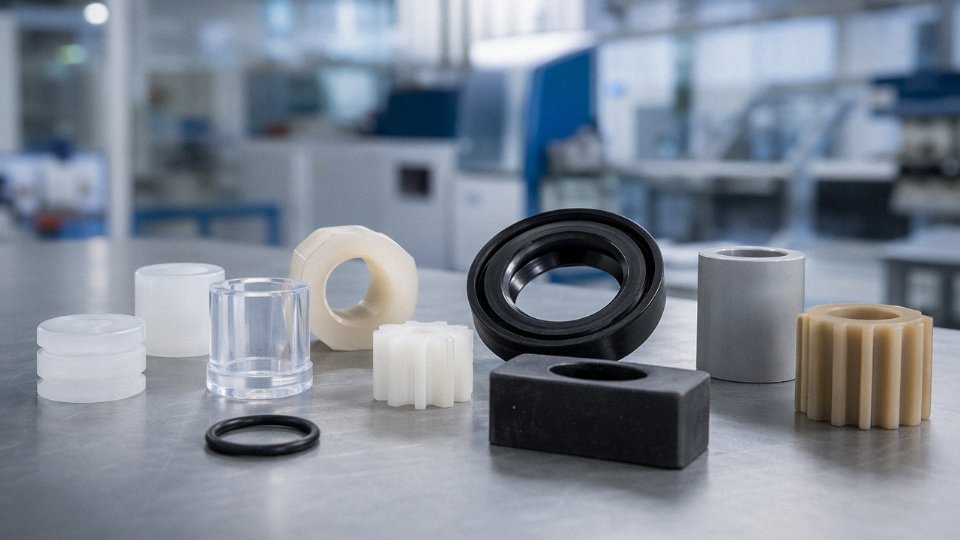
Compatibility at a Glance
| Substrate | PDMS Film Effect | Carrier Solvent Risk |
|---|---|---|
| HDPE | Neutral to beneficial (slip) | Low |
| LDPE | Neutral | Low–moderate |
| PP | Neutral | Low |
| PVC | Neutral; may plasticize over time | Moderate |
| ABS | Neutral if solvent clears | High — crazing, dissolution |
| Polycarbonate | Neutral if solvent clears | High — stress cracking |
| Natural Rubber | Moderate swelling from PDMS | High — hydrocarbon swelling |
| EPDM | Low from PDMS alone | Moderate–high |
| Neoprene | Low from PDMS alone | Moderate–high |
| Silicone Rubber | Tackiness, dimensional swelling | Moderate (depends on carrier) |
| Polyurethane Foam | Permanent hydrophobic saturation | High — irreversible wicking |
Risk levels assume typical naphtha or acetone-carrier formulations. HFC-propellant products vary — check the SDS.
The Only Reliable Rule
If the substrate isn’t explicitly named as compatible in that product’s technical data sheet — not the can label, the actual TDS — test a hidden area and wait a full 24 hours before applying broadly. Solvent attack and stress cracking often don’t show up in the first few minutes. A 24-hour hold under ambient conditions, ideally with the part under its normal mechanical load, will reveal crazing, swelling, or surface change before you’ve committed the whole assembly.
Floors, Ladders, Stairs, and Any Walking Surface Where Slip Resistance Is Safety-Critical
This is probably the misuse pattern that ends up in court most often, and it usually starts with someone trying to silence a squeaky stair tread or lubricate a sliding door track. One quick spray, job done — until someone goes down hard six hours later when the carrier solvent has fully evaporated and left behind a thin, nearly invisible PDMS film on the surrounding floor.
What the Numbers Actually Mean on a Hard Floor
Smooth concrete in good condition typically has a static coefficient of friction (CoF) somewhere around 0.55–0.65 — enough that a person carrying a load can stop, pivot, and recover without incident. Apply a light film of silicone spray and that figure can drop to 0.10–0.15, depending on surface porosity and how much product landed there. OSHA’s recommended minimum for walking surfaces is 0.5; the ADA mandates at least 0.6 for ramp surfaces. A silicone-contaminated floor doesn’t approach either threshold. It’s closer to wet ice.
Polished concrete, sealed epoxy floors, and glazed tile are the worst cases because they’re already near the lower edge of acceptable CoF — silicone contamination pushes them into genuinely dangerous territory instantly. Rough aggregate concrete absorbs the carrier but the PDMS still migrates across the surface, so you don’t get a safety pass just because the floor “looks textured.”
The Cleaning Problem Nobody Warns You About
Water won’t touch a cured silicone film. Standard floor cleaner won’t, either. Even steam cleaning typically moves the contamination around rather than removing it, which can actually spread the hazard. Full remediation requires a dedicated silicone-stripping solvent — usually an alkaline degreaser with a pH above 11, applied with mechanical scrubbing, sometimes twice — followed by a CoF test before the area is returned to use. In a production facility, that means a section of floor potentially out of service for a day or more. The contamination can persist for six months to over a year on non-porous surfaces; on anything with micro-porosity (aged concrete, grout lines, textured safety-grating), you can be looking at the far end of that range.
Ladders, Scaffold Boards, and Overspray Contamination
In manufacturing environments, the floor often isn’t the primary exposure route — overspray is. A maintenance tech lubricating conveyor components or a die-casting machine with a silicone aerosol at 40–80 psi generates a fine mist that drifts two to four feet beyond the target, easily landing on adjacent ladder rungs, step plates, or grating. OSHA 1910.23 requires that fixed industrial ladders maintain adequate grip — there’s no specific CoF number cited, but “adequate” evaporates quickly when the rung has silicone on it and the technician is wearing leather-soled boots.
Standard mop-and-bucket cleaning removes silicone spray contamination from hard floorsFalse
PDMS forms a low-surface-energy film that strongly resists water-based and most surfactant cleaners. Removal requires dedicated alkaline silicone strippers combined with mechanical abrasion; standard mopping typically redistributes the contamination rather than eliminating it.
The Homeowner Pattern That Creates Premises Liability
Squeaky stair tread, sliding garage door track, noisy treadmill — these are the three most common domestic misuses. The mechanics are predictable: the spray lubricates the target joint for a few weeks, but the overspray soaks into the surrounding wood or concrete, and household traffic slowly spreads the film. A visitor slips on what appears to be a clean, dry stair. Under premises liability law, applying a substance you know — or should know — creates a slip hazard, and then failing to remediate it, qualifies as foreseeable negligence in most jurisdictions. The fact that the container doesn’t say “do not use on floors” is not a defense a homeowner or facility manager wants to test in front of a jury.
What to Use Instead
For squeaky wood joints and flooring tracks, dry graphite powder or dry PTFE spray (the kind that dries fully after the carrier flashes off, leaving no wet film) does the job without any CoF penalty. Treadmill decks specifically need food-grade mineral oil or the belt lubricant the treadmill manufacturer specifies — usually a 100% silicone oil without aerosol carrier, applied in a controlled quantity directly to the belt’s underside, not broadcast-sprayed. Garage door tracks respond well to purpose-formulated lithium-based or dry PTFE track lubricants; the standard aerosol silicone can is genuinely the wrong tool for that job, and most door hardware manufacturers say so in the maintenance documentation if you read it.
The blunt operational rule: if a person’s foot, hand, or boot is going to contact a surface, silicone spray has no business anywhere near it.
Firearms, Precision Instruments, and Mechanisms That Accumulate Debris in Silicone Films
Walk into almost any hardware store or gun shop and you’ll find someone recommending silicone spray as a quick fix for a stiff bolt or a squeaky scope mount. It’s cheap, widely available, and it does — briefly — make things feel smoother. That’s the trap.
The Sticky Residue Paradox Nobody Warns You About
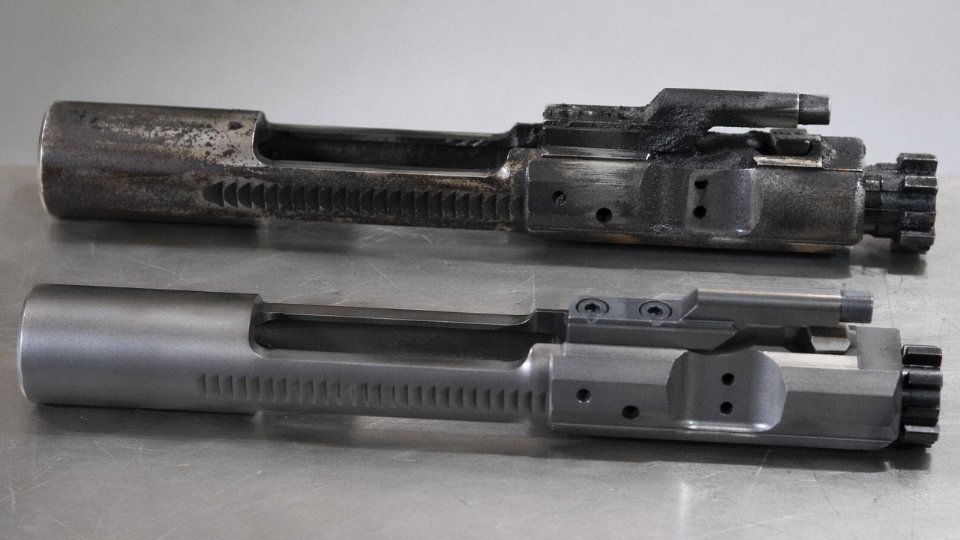
Fresh PDMS film feels slick and inert. That’s accurate, for maybe the first few hours. As the carrier solvent flashes off, what remains is a thin polymer layer that, under heat cycling and UV exposure, begins to oxidize and cross-link. In a firearm chamber or bolt carrier group, where temperatures during rapid fire can spike to 150–300 °C depending on round count and barrel profile, this process accelerates dramatically. The resulting film isn’t the clean, dry lubricant you applied — it’s a progressively tackier matrix that grabs and holds whatever passes through: burnt powder, metallic wear particles, unburnt propellant fragments.
This is the residue paradox. You applied a lubricant and ended up with a debris trap.
What This Does to Semi-Automatic Firearms
In gas-operated semi-automatic rifles and pistols, the bolt carrier group needs to cycle cleanly through thousands of repetitions. Carbon fouling is inevitable — that’s why CLP formulations exist. The problem with silicone contamination is that it undermines the very cleaning process meant to address fouling.
Burnt powder residue binds to the silicone film and bakes into a varnish-like deposit that standard solvent patches don’t dissolve easily. You end up with increasing cycling friction, bolt carriers that feel gritty and sluggish rather than crisp, and — under sustained use — failure-to-eject because the extractor is dragging against a fouled chamber wall coated with this composite mess. In full-auto or burst-fire applications the timing is tight enough that any increase in friction changes the cyclic rate and reliability threshold measurably. Armourers who’ve inherited a weapon someone “maintained” with silicone spray often report that stripping it down for the first time reveals a brownish-grey lacquer that takes a bronze brush and dedicated carbon solvent to remove fully.
CLP (cleaner-lubricant-protectant) formulations are the correct choice for firearm lubrication rather than silicone sprayTrue
CLP products are specifically formulated to penetrate, suspend, and flush carbon fouling while leaving a thin, thermally stable lubricant film compatible with firearm operating temperatures. Silicone spray is not formulated for this purpose and creates adhesive residue under heat cycling.
The right lubricant here is a petroleum or synthetic-base CLP — products like Mil-Comm TW25B grease on the bolt carrier rails, or a light application of a purpose-made gun oil on the feed ramp. Not silicone.
Optical Instruments: A Haze You Cannot Tissue Off
Silicone mist — and aerosol cans are genuinely misty; you’re not depositing a neat film, you’re depositing a fog — settles on optical surfaces and polymerizes there just as it does on metal. On a telescope primary mirror, a rifle scope’s internal lenses, a microscope objective, or camera sensor glass, this creates a diffuse haze that scatters light and reduces contrast. The danger isn’t just the haze itself. Trying to wipe it off with standard lens tissue risks dragging any embedded particulate across a coated surface that can cost several hundred dollars to replace. Professional ultrasonic cleaning in an optical-grade solvent is usually the only way to remove it properly, and on coated mirrors or AR-treated lenses even that isn’t guaranteed.
Keep aerosol silicone completely away from any optical work area. A can discharged across a bench contaminates surfaces a meter away.
Clocks, Watches, and the Nanoliter Problem
Mechanical watch movement lubrication is a discipline unto itself. Watchmakers apply specific synthetic oils — often different formulations for the barrel, gear train, and escapement — in quantities measured in nanoliters, using oilers with tips finer than a human hair. Aerosol silicone spray doesn’t just apply the wrong lubricant; it floods the movement with an incompatible material that displaces correctly applied oils, migrates into jewel bearings by capillary action, and can swell any plastic or nylon components in the gear train (and modern movements use more plastic than many owners realize). The consequence is timing drift — a watch that was accurate to ±5 seconds per day might run 30–60 seconds fast or slow after contamination — plus potential pivot wear once the correct lubricant has been displaced. A full service from a competent watchmaker to undo this runs roughly $150–$400 depending on movement complexity. All because someone reached for a spray can.
Precision Measurement Tools: Small Films, Real Errors
Micrometers, calipers, and gauge blocks depend on clean, flat measuring faces with defined surface finish. Silicone film build-up on those faces introduces dimensional offset in the range of roughly 0.005–0.02 mm, depending on how many applications have accumulated. That sounds trivial until you’re holding a tolerance of ±0.01 mm on a machined bore. Gauge blocks especially — wringing them together is possible only with clean, uncontaminated surfaces; silicone residue prevents proper wringing contact entirely and can trap abrasive particles that score the lapped faces.
The correct protection for measurement tools is a light film of dedicated instrument oil or a dry-clean storage environment with VCI (volatile corrosion inhibitor) packaging. Not spray lubricant of any kind.
What to Use Instead
For firearms: CLP for general cleaning and lubrication, a grease like Militec or similar on high-load surfaces, and dry-film moly or PTFE where dust contamination is a field concern. For clock and watch mechanisms: manufacturer-specified instrument oils applied by a competent watchmaker. For precision sliding surfaces on measurement equipment and optical instrument focus racks: dry-film PTFE or molybdenum disulfide applied sparingly to the sliding element only, never near optics or measurement faces.
Silicone spray isn’t universally harmful — it has genuine applications. Precision mechanisms and optical surfaces just aren’t among them.
Frequently Asked Questions About Silicone Spray Misuse and Safe Alternatives
Can I use silicone spray on rubber seals and O-rings?
It depends heavily on the rubber compound, and getting this wrong can destroy a seal in weeks. PDMS itself is generally compatible with fluoroelastomers like Viton and with PTFE-encapsulated seals — those will tolerate silicone-based lubricants reasonably well. Natural rubber and EPDM are a different story. The carrier solvent in most aerosol cans (typically naphtha or a light petroleum distillate) will swell or degrade these materials on repeated exposure, even if the PDMS component is harmless on its own. Most people never notice because the initial application feels fine; degradation shows up 4–12 weeks later as a weeping seal or a compression fitting that won’t hold pressure.
The better call for any O-ring or seal lubrication is proper silicone grease — not spray. A grease stays where you put it, has no carrier solvent, and gives you controlled film thickness. Spray is convenient; it’s not the right tool here.
Is silicone spray safe near food preparation surfaces?
No, unless the can specifically states NSF H1 or cites FDA 21 CFR 178.3570 compliance. Most hardware-store aerosol silicone sprays carry neither certification. In a food plant or commercial kitchen, using non-certified lubricant in any incidental food-contact zone is a regulatory violation, not just a hygiene concern. Food-grade silicone sprays exist and are clearly labeled — if the can doesn’t state the certification explicitly, assume it isn’t compliant.
Standard aerosol silicone spray is food-safe because silicone is inertFalse
PDMS may be inert, but the carrier solvents, propellants, and additive packages in most commercial silicone sprays are not NSF H1 or FDA 21 CFR 178.3570 certified. Only explicitly food-grade formulations with documented certification are acceptable in food contact or incidental contact zones.
Can silicone spray damage car paint if used on rubber trim?
Yes, routinely. Overspray — even careful application with a rag — migrates from trim onto adjacent paint and clear coat. The result is adhesion failure in wax, ceramic coatings, and paint sealants, plus uneven, blotchy water-beading that’s nearly impossible to correct without a full decontamination clay bar treatment and sometimes a light polish. Given that silicone contamination can persist on a painted surface for anywhere from 6 months to well over a year, this is a gift that keeps giving. Use a trim-specific dressing applied with an applicator pad, kept off the paint entirely.
Why does silicone spray make my treadmill worse after a few weeks?
Because the PDMS film traps belt dust and fine rubber debris almost immediately, and under the heat cycling of normal use it oxidizes into a progressively tackier residue that increases deck-to-belt friction beyond the original spec. Treadmill manufacturers nearly universally specify 100% silicone oil — not spray — applied in a thin line transversely under the belt. The oil is lower viscosity and doesn’t carry propellants or solvents that accelerate oxidation. Spray is simply the wrong product form for this application.
Can I use silicone spray to loosen rusted bolts?
No. Silicone has negligible capillary action and won’t wick into the rust microstructure between thread faces. It’s a surface lubricant, not a penetrant. For seized fasteners, use an actual penetrating oil — PB Blaster, Kroil, or a similar low-viscosity penetrant — let it soak for at least 30 minutes (overnight is better on severe rust), and apply heat from a propane torch if the substrate allows it. Silicone spray on a rusted bolt will do roughly nothing useful.
Is silicone spray safe inside a car door lock cylinder?
In practice, no. It feels like it works for the first week or two, then the film collects grit from normal key insertion, and in cold weather the residue can thicken enough to cause sluggish or seized operation. Graphite powder is the traditional answer for lock cylinders and still the most reliable one — it lubricates without attracting debris and doesn’t change viscosity with temperature. Dedicated lock-cylinder lubricants (typically graphite suspension or dry PTFE) work well too.
What should I use instead of silicone spray for general workshop lubrication?
| Application | Better Product | Why |
|---|---|---|
| Slides, guides, plastic-on-plastic | Dry PTFE spray | Non-attracting, leaves minimal residue |
| Metal-to-metal load-bearing | White lithium grease | Handles contact stress, stays in place |
| Wet or marine environments | Marine-grade grease | Resists water washout |
| Locks, keyholes, tight mechanisms | Graphite powder | Dry, no debris attraction, cold-stable |
| O-rings and seals (assembly) | Silicone grease | No carrier solvent, controlled film |
| Corroded fasteners | Penetrating oil (Kroil, PB Blaster) | Actual capillary penetration into rust |
Silicone spray has legitimate uses — releasing molds, lubricating nylon tracks, preventing sticking on clean non-contact surfaces. The problem is the aerosol format and the migration behavior make it a poor general-purpose choice, and the can’s convenience causes people to reach for it when a more specific product would do far less collateral damage.
How to Decontaminate Surfaces After Accidental Silicone Spray Application
Here’s the uncomfortable truth: silicone contamination is one of the hardest surface problems to fully reverse. PDMS doesn’t just sit on top of a substrate — it forms covalent bonds with metal oxide surfaces and penetrates porous materials. Standard degreasers, acetone, mineral spirits, even MEK at room temperature make only partial progress. You can reduce the contamination level enough to pass a casual inspection and still fail a water-break test or a paint adhesion check two coats later.
The first decision, before reaching for any solvent, is honest triage: how heavy was the application, how long ago, and what’s the substrate? Light misting caught within an hour on bare steel is a different problem from a soaked rubber gasket that sat contaminated for a week.
Painted and Pre-Paint Surfaces
This is the scenario with the most financial consequence — repaint jobs run $500–$3,000 per panel depending on vehicle class, paint system, and shop rates, and the rework cost inside an assembly plant averages $150–$800 per unit.
A three-stage wipe-down is the minimum credible approach. First pass: a dedicated silicone remover such as PPG DX330, Sika Aktivator 205, or a comparable product from your paint system supplier — not a generic degreaser, which may emulsify rather than fully lift PDMS. Wipe in one direction with a clean lint-free cloth, fold the cloth after each pass, never double-dip. Second pass: repeat with a fresh cloth and fresh product. Third pass: use a new cloth dampened but not saturated, and finish with a final dry wipe. Let the surface off-gas fully — 10 to 15 minutes minimum, longer in cold or humid conditions.
Before applying any coating, verify surface energy. Dyne test inks (typically 36–38 dynes/cm is a minimum threshold for most basecoats) or a simple water-break-free test will tell you whether you’ve actually removed the contamination or just diluted it. If water beads anywhere, the surface is not ready. Period.
A single wipe with acetone is sufficient to remove silicone spray before painting.False
Acetone has limited effectiveness against PDMS at room temperature and does not restore adequate surface energy for coating adhesion. Dedicated silicone removers combined with surface energy verification are required.
Brake and Clutch Components
Light contamination — say, overspray that barely touched a rotor during a spray job nearby — may be recoverable. Flush the rotor thoroughly with brake cleaner (chlorinated or non-chlorinated; chlorinated cuts silicone residue somewhat better in my experience), allow complete evaporation, then perform a controlled bedding sequence starting with low-speed, light-pressure stops to generate some heat and mechanically abrade the contact surface. Inspect the pads after bedding for uneven or glazed contact patterns.
Heavy contamination doesn’t give you that option. Replace the pads. A $40 set of pads is not worth a compromised stopping event. No reasonable argument exists for keeping heavily contaminated friction material in service.
Electrical Connectors
Flush with an appropriate contact cleaner — IPA-based or a fluorocarbon-based product depending on the connector material — and allow full evaporation, which takes longer than most people wait: at least 5 minutes, often more in recessed connector bodies. Inspect under magnification for any residual haze or film on contact surfaces. In practice, connector replacement is frequently cheaper and more reliable than attempting full decontamination of a multi-pin connector with silicone in the contact gaps. Budget $10–$80 for common automotive or industrial connectors versus the labor cost of three cleaning attempts and a callback.
If the connector goes back into service, use an appropriate dielectric compound applied sparingly to the connector body — not the contact surfaces — and only if the original design called for it.
Floors and Walking Surfaces
Apply a commercial silicone degreaser — not a standard floor cleaner, which won’t touch PDMS — agitate with a stiff scrub brush to break up the film mechanically, then vacuum or wet-extract the emulsified residue rather than mopping it around. Two passes minimum, with drying time between them. Before reopening the area, verify the coefficient of friction with a portable slip meter; most safety standards require a COF of at least 0.5 for walking surfaces, and a silicone-contaminated floor can drop well below that. Don’t rely on visual inspection alone — a floor can look clean and still be dangerously slick.
Precision Instruments and Firearms
Don’t reach for a solvent and a cotton swab on a watch movement, a rifle scope, or a precision measuring instrument. IPA and similar solvents can strip lubricants from places you can’t see, and swabbing with cotton leaves fibers in mechanism gaps. Professional ultrasonic cleaning using an appropriate aqueous cleaning solution — not ultrasonic with solvent, which presents its own hazards — is the reliable path. Typical service costs run $50–$150 for a handgun or simple instrument, $150–$300 or more for a complex optical sight or watch movement with full disassembly. For firearms specifically, confirm the cleaning shop has appropriate licensing and that the instrument is checked for function under the original specification before returning to use.