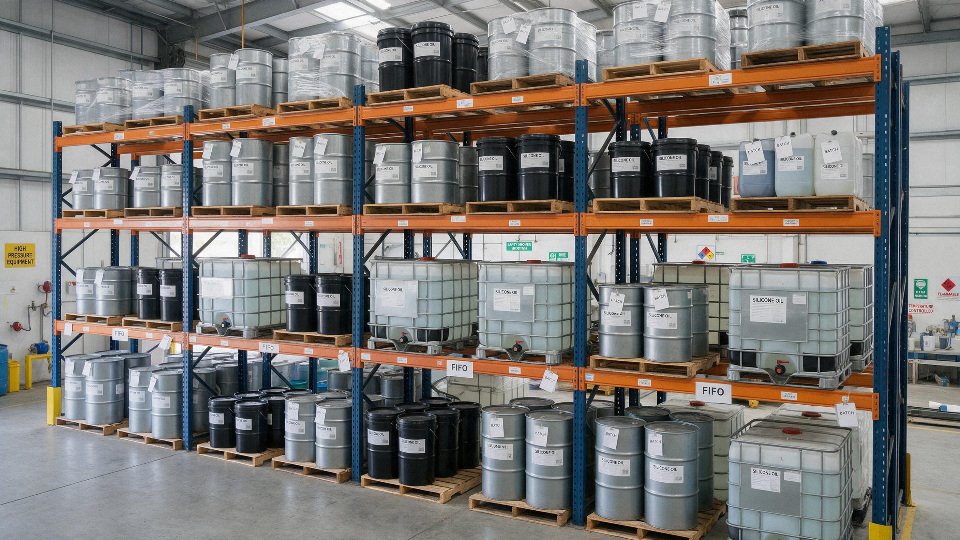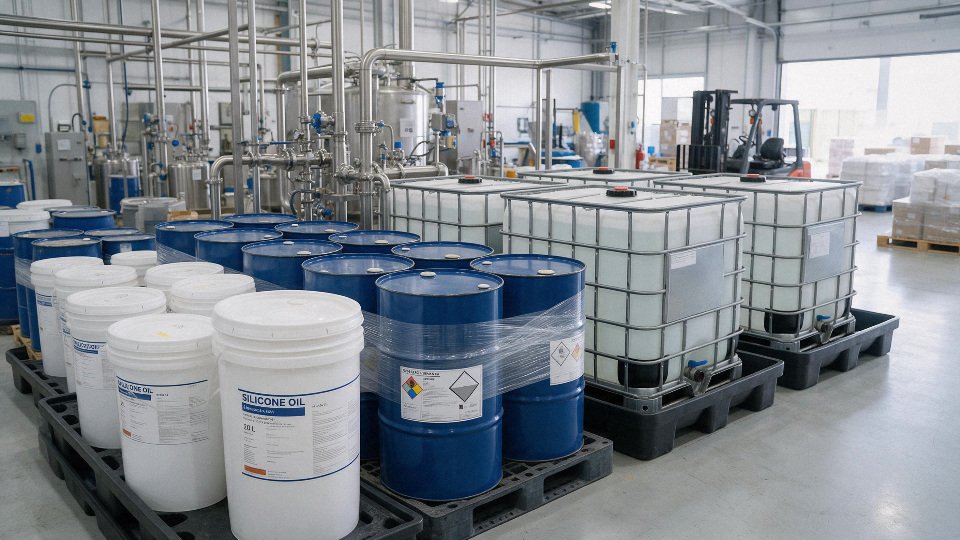
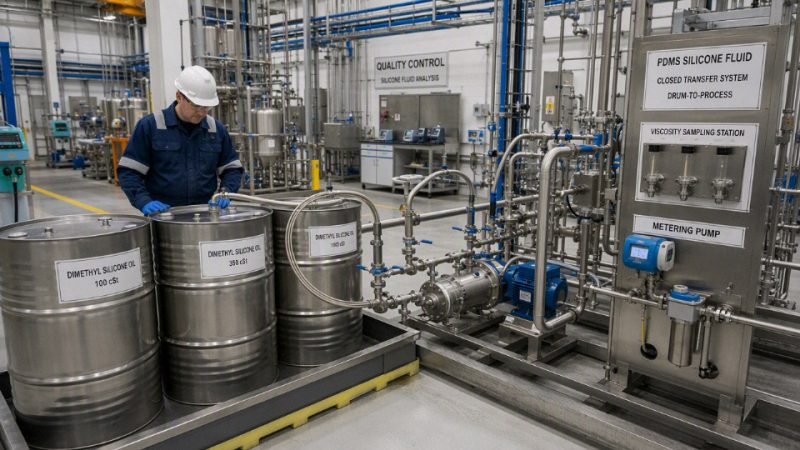
A fluid that looks harmless on paper can still cause plenty of trouble in a plant if the buyer treats it like “just another oil.” The wrong dimethyl silicone oil grade can leave a release system inconsistent, throw off a textile or cosmetic formulation, leak through pumps that were never selected for its actual viscosity, or sit in stores because nobody matched the product to temperature and shear conditions. That turns into scrap, line stoppages, overpaying for unnecessary purity, or the more common problem: buying a cheap grade twice because the first one never fit the job.
Dimethyl silicone oil is a polydimethylsiloxane-based fluid, usually called PDMS, used where stable viscosity, wide temperature tolerance, lubricity, surface slip, dielectric performance, or water repellency matter. Depending on molecular weight and grade, it can range from roughly 0.65 cSt to over 1,000,000 cSt at 25 C, which is exactly why application fit matters more than the generic product name.
That broad viscosity span is where most of the confusion starts. Two drums can both be sold as dimethyl silicone oil and behave nothing alike on a coating head, in a defoamer blend, or inside a metering system with a small gear pump and a tired mechanical seal. The useful question is not simply what it is, but which version does what, where its advantages are genuine, and where the usual assumptions stop holding.
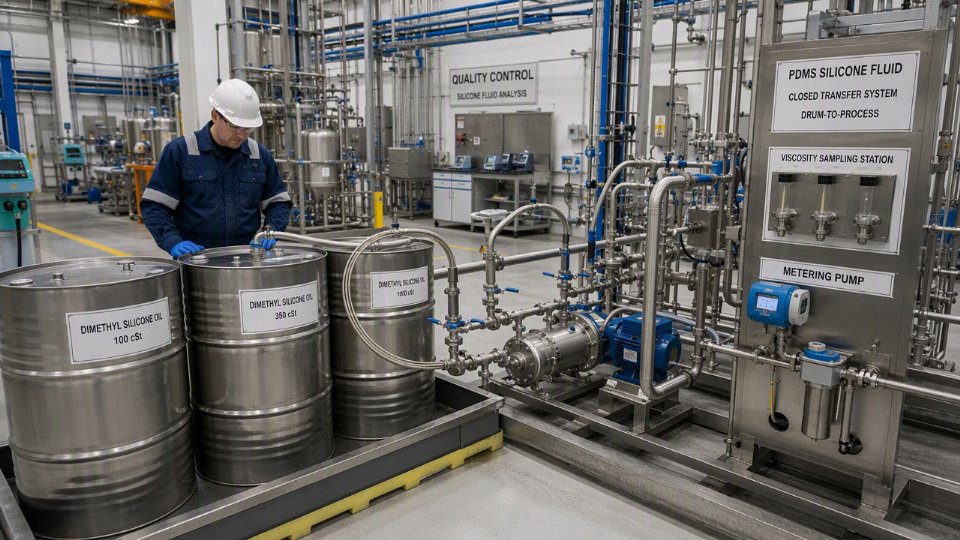
Molecular structure and chemistry
Dimethyl silicone oil behaves differently because its backbone is not carbon-based in the usual lubricant sense. The Si-O-Si chain with methyl side groups gives the fluid an unusual combination of flexibility, weak intermolecular attraction, and thermal stability that hydrocarbon oils, PAOs, glycols, and esters only match in pieces, not as a package. That chemistry is the reason the material often keeps a usable viscosity-temperature profile, spreads easily on surfaces, and stays water-repellent where conventional oils would either thicken too much, oxidize faster, or wet differently.
At the molecular level, dimethyl silicone oil is generally a polydimethylsiloxane, or PDMS, fluid. The repeating unit is built around a siloxane linkage, Si-O-Si, with two methyl groups attached to each silicon. That sounds like textbook chemistry, but on a plant floor it matters because bond geometry drives handling behavior. The Si-O bond is relatively strong, while the siloxane chain is also quite flexible due to bond angle and rotational freedom. In practice, that means the molecules can move and reorient without packing tightly the way many hydrocarbon chains do.
That looser packing changes several bulk properties at once:
- Lower intermolecular attraction than many hydrocarbon fluids
- Lower surface tension and easier spreading over solids
- Better low-temperature flow than many mineral oils of similar room-temperature viscosity
- Less dramatic viscosity change with temperature compared with many petroleum-based oils
- A characteristic compressibility profile that differs from mineral lubricants and matters in damping and hydraulic niches
The methyl groups are doing their share of work too. They shield the backbone, make the molecule non-polar, and contribute to hydrophobicity. Water generally beads rather than mixes, which is useful in release, textile treatment, defoaming systems, and moisture-barrier applications. The same low polarity also helps explain the fluid’s dielectric behavior. Silicone fluids are widely used as insulating and heat-transfer media because they combine electrical insulation with a practical thermal operating window, though the exact suitability still depends on grade, cleanliness, moisture content, and the equipment design.
How chain length and end groups change the fluid
For most commercial dimethyl silicone oils, the basic architecture is linear PDMS, often trimethylsiloxy-terminated. In plain language, you have a chain of repeating siloxane units capped at both ends with relatively non-reactive trimethylsiloxy groups. Those end groups matter because they reduce unwanted reactivity compared with hydroxyl-terminated material and help produce a more stable, predictable fluid for general-purpose industrial use.
Chain length is one of the main levers behind viscosity:
- Shorter chains mean lower molecular weight, lower viscosity, and usually higher volatility
- Longer chains mean higher viscosity, lower volatility, and lower mobility
- Broader molecular weight distribution can widen performance scatter, especially in evaporation, fogging, and consistency from batch to batch
This is where buyers sometimes get tripped up. Two fluids can both be sold as dimethyl silicone oil, but if one has more low-molecular fractions or higher cyclic content, it may show more odor, greater evaporative loss, more fogging on hot surfaces, or different flash behavior. In sensitive applications such as cosmetics-adjacent processing, electronics, optical surfaces, automotive interiors, or enclosed heating systems, those small fractions can become the whole problem.
Low-viscosity grades are especially sensitive to volatile content. If a line operator says a silicone fluid “smells sharper” than the last lot, that may not mean contamination; it can point to residual cyclics, low-boiling fractions, or processing differences upstream. For procurement, that means viscosity alone is not a complete specification when the application is closed-space, high-temperature, or emissions-sensitive.
Why the chemistry shows up so clearly in plant performance
The chemistry translates into a set of behaviors that are easy to observe in use but often misunderstood.
| Property | PDMS chemistry effect | Operational consequence |
|---|---|---|
| Surface tension | Low due to weak intermolecular attraction and methyl-rich surface | Spreads quickly, useful in release and wetting control; can also cause migration where you do not want it |
| Hydrophobicity | Non-polar methyl groups repel water | Water shedding, anti-stick behavior, moisture resistance |
| Viscosity-temperature behavior | Flexible siloxane chain changes mobility less abruptly than many hydrocarbons | Broader usable temperature window, depending on grade |
| Oxidative resistance | Backbone is not a standard carbon chain, so oxidation pathway differs from mineral oils | Often better heat-aging stability than many hydrocarbon fluids in moderate service |
| Dielectric performance | Low polarity and good insulating character | Suitable for many electrical-fluid applications if purity is controlled |
| Compressibility | Higher than many mineral oils | Useful in damping, but can be a drawback in precision hydraulic power transmission |
That last point is a genuine trade-off. Silicone fluids can be excellent in dashpots, instrument damping, and specialty heat-transfer or insulating roles, but they are not a drop-in hydraulic replacement everywhere. If system stiffness and volumetric response are critical, the higher compressibility relative to many mineral hydraulic oils can become a design limit. The usual rule that “silicone is more stable, so it is better” stops holding when the machine depends on low compressibility, strong boundary lubrication, or seal compatibility tuned around another fluid family.
How PDMS differs from mineral oil, PAO, glycol, and ester fluids
The difference is structural, not just a slight improvement in formulation.
Versus mineral oil
Mineral oils are mixtures of hydrocarbon molecules with a broad composition spread. They usually rely heavily on additive packages to manage oxidation, wear, foam, and viscosity behavior. PDMS starts from a different backbone, so low surface tension, hydrophobicity, and broad temperature fluidity are built into the molecule rather than added on later.
Versus PAO
PAOs are synthetic hydrocarbons and much more uniform than mineral oil. They perform well across temperature and oxidation conditions, but they are still hydrocarbon fluids. PDMS generally remains more distinctive in surface behavior, dielectric use, and very broad viscosity availability, from roughly 0.65 cSt to well above 1,000,000 cSt at 25 C depending on grade.
Versus glycols
Glycols are typically more polar, often water-miscible or water-sensitive depending on type, and selected where fire resistance or solvency matters. PDMS is far more hydrophobic and usually less interactive with polar contaminants. That can be an advantage or a disadvantage depending on whether you need water compatibility.
Versus esters
Esters can offer excellent lubricity and good temperature performance, but their polarity and hydrolytic behavior are different. PDMS is usually less aggressive in some moisture-exposed environments, but esters often outperform silicone fluids in lubricity-sensitive contacts. In bearings or gear meshes, chemistry at the surface can matter more than bulk fluid stability.
Stable does not mean universally inert
Dimethyl silicone oil is chemically stable in many industrial environments, but not indestructible. The main failure routes are worth naming clearly:
- Strong acids or strong bases can cleave siloxane bonds
- Certain catalytic metals or residues can accelerate degradation
- High shear in the presence of air can promote chain scission in some systems
- Process contamination can change odor, color, foam, dielectric properties, or thermal life
- Elevated temperature plus oxygen exposure still requires grade-specific verification against the supplier’s data and the equipment manual
A common plant example is a system that runs acceptably for months, then starts showing drift after a cleaning chemical change or after metal fines begin circulating from a worn pump. The fluid did not “randomly fail”; the chemistry boundary changed.
Dimethyl silicone oil is chemically inert in all process environments.False
It is stable in many service conditions, but strong acids, strong bases, catalytic contaminants, air-shear exposure, and certain high-temperature conditions can degrade siloxane fluids or change performance enough to matter in service.
Where sensitive applications are involved, ask for data not only on nominal viscosity but also on cyclic content, volatile fraction, residual catalyst, and any application-specific compliance documents. That is the difference between buying a fluid that merely looks right on a datasheet and one that behaves properly in an oven, a closed reservoir, an optical assembly, or a product-contact process.
Core performance properties
Dimethyl silicone oil earns its place in industrial formulations because it stays usable across a very wide viscosity range, holds flow behavior more consistently with temperature than many organic fluids, wets and releases surfaces easily, and remains electrically non-conductive under the right conditions. The catch is that the same low surface energy and mobility that make it valuable for slip, leveling, release, and defoaming can also create stubborn contamination, adhesion failure, and coating defects if the grade or handling practice is wrong.
The useful part for buyers is not that dimethyl silicone oil is “good” in the abstract. It is that several property groups come together in one fluid family, and you can tune them mainly through viscosity grade, purity, and formulation context. That is where specification work either goes smoothly or causes months of nuisance problems on the line.
Viscosity behavior across temperature
One of the first reasons engineers move from mineral or some synthetic organic fluids to dimethyl silicone oil is its high viscosity index and comparatively stable flow over temperature swings. In practical terms, a silicone fluid that feels thin enough for pumpability at startup often does not become as excessively thin at elevated operating temperature as a comparable hydrocarbon fluid.
That matters in plants where ambient conditions move around:
- Outdoor dosing systems
- Seasonal packaging lines
- Electrical equipment with thermal cycling
- Damping devices that must behave predictably from cold start to warm running condition
The published viscosity range is broad, from about 0.65 cSt to above 1,000,000 cSt at 25 C, but that number alone is not enough for selection. You still have to match grade to the stage that matters most in the process:
- Low viscosity grades: easier spreading, easier pumping, faster penetration, quicker deaeration in some systems, but higher migration risk and usually higher evaporation loss than heavier grades
- Medium viscosity grades: common working range for general-purpose processing, heat transfer, damping, release, and textile or polish applications
- High viscosity grades: better persistence, lower volatility, stronger film retention, but harder transfer, slower leveling, and more difficult cleanup
The mechanism is simple enough: as temperature rises, intermolecular resistance to flow drops in all fluids, but dimethyl silicone oil usually changes less sharply than many organic oils. That steadier viscosity can reduce drift in dispensing rate, film thickness, or damping response. In practice, that means fewer adjustments from a winter morning start to an afternoon run under hot machine guards.
The boundary here is important. Stable viscosity does not mean universal pumpability. Very high viscosity grades can still be hard to meter through small-bore lines, especially with long suction runs, marginal seals, or cheap gear pumps. On the floor, I would verify line size, pump type, and coldest startup temperature before signing off a heavy grade.
Surface tension, wetting, leveling, slip, and defoaming behavior
Low surface tension is where dimethyl silicone oil becomes either a process asset or a contamination headache.
Because it spreads readily, it can:
- Improve surface coverage
- Promote leveling in some coatings and polishes
- Reduce drag and give slip or hand-feel modification
- Assist release on molds, guides, knives, and contact surfaces
- Destabilize foam films in selected systems, which is why silicone-based defoamers are so effective at low dosage
The same mechanism drives all of these effects. A low-surface-energy fluid tends to move to interfaces, spread over them, and change how liquid films behave. In a coating bath, that may flatten minor surface irregularities. In a foaming system, it can rupture lamellae and collapse bubbles. On a release application, it forms a surface that other materials do not want to stick to.
That does not mean every dimethyl silicone oil is automatically a good defoamer or coating additive by itself. Defoaming performance depends heavily on viscosity, dispersibility, carrier system, and whether the silicone is compounded with silica or other ingredients. A neat fluid and a formulated defoamer are not interchangeable.
The trade-off is where people get caught:
- Better spreading often means greater migration
- Better slip often means worse recoatability
- Better release often means poorer downstream bonding or printing
- A tiny amount of silicone carryover can cause crater defects or fisheyes in paints, inks, and adhesives
Low-energy surfaces are especially sensitive. If a plant runs painting, bonding, laminating, or plasma treatment anywhere near silicone handling, process segregation matters. Separate wipes, dedicated spray tools, isolated storage, and clear maintenance discipline are not overkill here. One mechanic using the wrong aerosol near a coating line can create days of troubleshooting.
The same low surface energy that improves release and slip can also create repaint and bonding defects if silicone contamination is not controlled.True
This is a well-established processing issue in coatings, printing, adhesive bonding, and refinishing operations. The degree of risk depends on dosage, surface preparation, substrate energy, and whether the silicone is intentionally formulated into the system or unintentionally transferred as contamination.
Thermal stability and oxidation resistance
Compared with many organic fluids, dimethyl silicone oil usually offers good thermal stability and oxidation resistance, which is why it shows up in heating baths, damping units, electrical applications, and high-temperature release systems. Typical service temperature windows are often cited around -50 C to 200 C, but that should be treated as a starting range, not a blanket approval.
The real limit depends on:
- Exposure time
- Presence of air
- Metal catalysts or contaminants
- Shear and local hot spots
- Water ingress
- Grade purity and any stabilizer package
In closed or low-oxygen systems, the fluid generally holds up better. In open systems with constant air exposure, splashing, or thin films on hot metal, oxidation and volatilization become more significant. Short peaks above normal operating temperature may be tolerable in some grades, but repeated peaks are not the same as continuous duty.
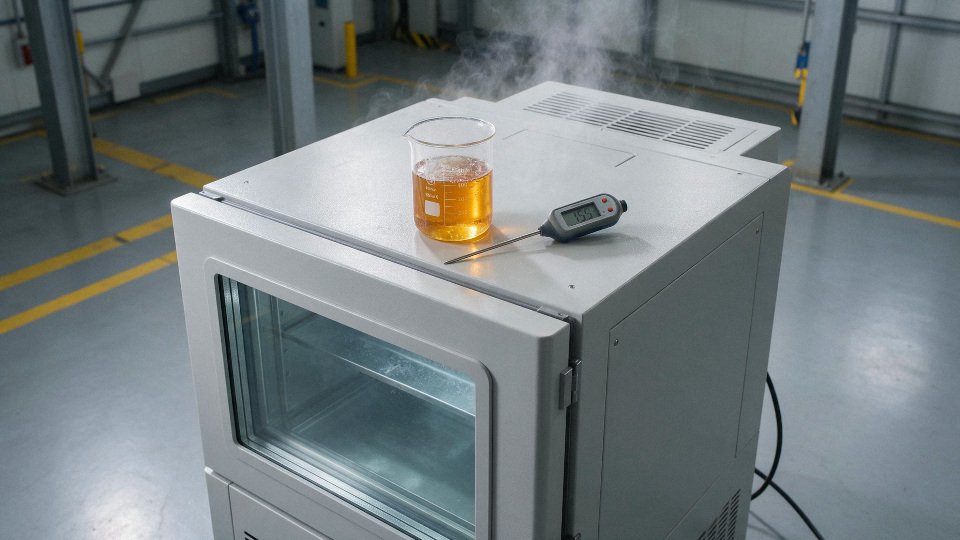
A common plant-floor mistake is assuming a fluid can live at a heater setpoint just because a brochure lists a maximum temperature. What matters is the actual film temperature at the heat transfer surface, not just the bulk temperature in the tank. If there is coking, residue, viscosity drift, or increased odor, check localized overheating first.
Electrical behavior: insulation, damping, and heat transfer support
Where electrical non-conductivity is required, dimethyl silicone oil is often used because it can combine dielectric performance with fluidity and thermal stability. Typical properties of interest include:
- Dielectric strength
- Volume resistivity
- Dielectric constant
- Dissipation factor over operating temperature and frequency range
Those values are grade- and condition-dependent, and they are sensitive to contamination. Moisture, ionic residues, suspended solids, and degradation products can reduce electrical performance sharply. So while the fluid family is suitable for insulation and damping uses, the application lives or dies on cleanliness control.
Typical use cases include:
- Electrical insulation fluids in specialized systems
- Damping media for instruments or motion-control assemblies
- Non-conductive heat transfer roles where a fluid must move heat without creating a current path
The trade-off against purpose-built dielectric fluids or heat transfer fluids is that dimethyl silicone oil may not always be the optimum on cost, thermal conductivity, or equipment-specific approvals. If a component must meet a formal electrical standard or OEM qualification, use the current supplier data and the equipment manual, not category-level assumptions.
Lubricity, release, water repellency, volatility, odor, and optical clarity
Dimethyl silicone oil has useful lubricity, particularly in light-duty, boundary-contact, anti-stick, and surface-conditioning situations. It works well on:
- Rubber-to-metal contact points
- Plastic guides and chutes
- Release films and mold-contact surfaces
- Light mechanisms where smooth motion matters more than load carrying
The limitation is load. Under high contact pressure or severe boundary lubrication, silicone fluids usually do not match specialized ester, PAO, or extreme-pressure hydrocarbon lubricants designed for gear teeth, heavily loaded bearings, or metalworking. You gain cleanliness, release, and temperature breadth; you may give up load-carrying film strength.
Other property advantages often matter just as much in buying decisions:
- Water repellency: useful on treated surfaces and in moisture-sensitive interfaces
- Lower volatility at higher viscosities: helps persistence, though this is not the same as zero loss
- Low odor potential in purified grades: relevant in consumer-adjacent or enclosed-process environments
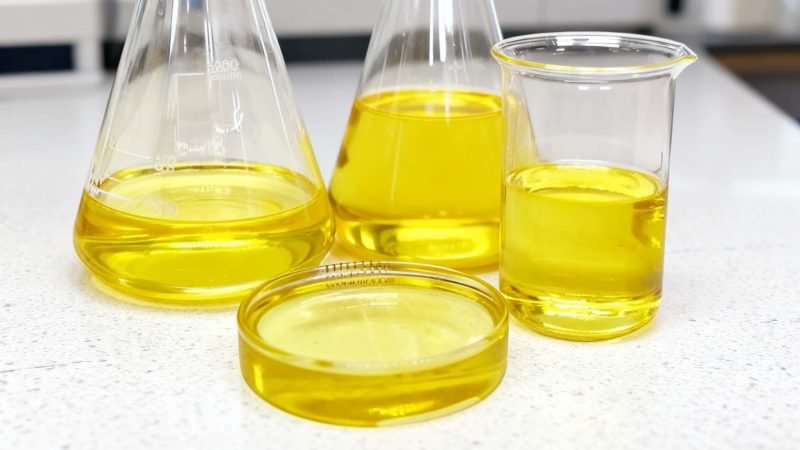
- Optical clarity and refractive index near 1.396 to 1.403 at 25 C: useful in specialty optical, cosmetic, and inspection-sensitive applications where haze or color would be a problem
If the application touches coating, bonding, printing, or refinishing anywhere downstream, the selection should not stop at viscosity. You need to lock down purity, migration tolerance, transfer path, and cleanup method, because the property that helps one station run better can quietly poison the next one.
Grades and viscosity classes
Dimethyl silicone oil is sold less as a single product than as a viscosity-and-purity family. In purchasing terms, the first cut is usually kinematic viscosity at 25 C, but that only gets you into the right neighborhood; the grade still has to match volatility limits, regulatory position, electrical cleanliness, and whatever the fluid is expected to do in your process.
A buyer who specifies only “100 cSt dimethyl silicone oil” often gets a usable fluid, but not always a stable process. The grade can drift in practical behavior if molecular weight distribution is broad, low boilers are not well stripped, or the supplier is working to an industrial standard while the application really needs cosmetic, electrical, or low-volatile control.
Viscosity classes the market actually uses
Commercial suppliers typically segment dimethyl silicone oil from very low viscosity fluids, around 0.65 cSt and 1 cSt, through medium grades such as 10, 50, 100, 350, and 1000 cSt, up into very high viscosity materials that can run far above 100,000 cSt and, in some product lines, beyond 1,000,000 cSt at 25 C. Those bands are not arbitrary. They reflect different handling methods, different quality concerns, and different end uses.
Very low viscosity fluids
These are the fast-spreading, low-resistance grades used where wetting, slip, light damping, or transient lubricity matter more than staying power.
Typical uses include:
– personal care and cosmetic systems where spreadability and light sensory feel are important
– textile or fiber finishes that need a light hand
– specialty release or polishing formulations
– light damping applications in small mechanisms, where a higher-viscosity fluid would over-brake motion
The catch is volatility and migration. At the low end, fluid loss through evaporation or slow bleed becomes a bigger issue, especially at elevated temperature or in open systems. A bench trial that looks fine at room temperature can fail after a few days near a warm motor housing or under plant summer conditions.
Medium viscosity grades
This is the broadest commercial band and, frankly, where a lot of industrial buying happens. Grades in the tens to low thousands of cSt are common for:
– general-purpose lubrication of plastics, elastomers, and light mechanisms
– antifoam carriers and process additives
– mold release formulations
– hydraulic or damping service in selected equipment designs
– intermediate-feel personal care or household formulations
This range often gives the best balance between pumpability, film persistence, and manageable volatility. In practice, these are the grades that can still move through normal drum pumps or tote systems without forcing you into heated lines, oversized transfer pumps, or very slow batch addition.
High and very high viscosity grades
Once you move into the heavy grades, you gain film thickness, lower tendency to migrate, and often better persistence on a surface. That is why these materials show up in:
– heavy damping
– specialty lubrication where a durable silicone film is useful
– antifoam concentrates and carrier systems
– silicone compounding and blending operations
– sealants, greases, and process intermediates
The trade-off is straightforward and often missed by non-process buyers: higher viscosity is not automatically better. It can cut volatility and improve retention, but it also makes pumping harder, slows tank emptying, worsens dispersion in some formulations, and can leave an undesirably heavy feel in personal care or coating systems. In a plant with cold winters, a grade that transfers fine in July may become a loading dock problem in January unless the packaging, pump type, and line sizing were chosen with some margin.
Grade families beyond viscosity
A second layer of segmentation comes from purity level and application-specific controls. This matters because two fluids with the same nominal cSt can behave differently in downstream use.
Common commercial grade families include:
– Standard industrial grades for general lubrication, release, defoaming, and process use
– Cosmetic or personal-care grades where odor, appearance, impurity profile, and consistency from lot to lot are tighter concerns
– Electrical grades where dielectric behavior, cleanliness, moisture control, and low contaminant carryover matter
– Food-contact oriented grades, where available, tied to specific formulation choices and regulatory documentation rather than viscosity alone
– High-purity or low-volatile grades for applications sensitive to fogging, emissions, residue, or evaporative loss
Food-contact positioning especially needs care. There is no universal “food grade silicone oil” shortcut that covers every country, process, and contact condition. Buyers need the current supplier documentation, intended-use statement, and applicable local compliance basis checked against the actual exposure scenario.
How viscosity is measured and why cSt can mislead
Kinematic viscosity is usually reported in centistokes, cSt, at 25 C. That convention is useful because it lets the market compare like with like, but only if the temperature and test method are aligned.
If one supplier reports at 25 C and another reports at 40 C, the numbers are not directly comparable. The same problem shows up when buyers pull data from an old internal spec sheet, a distributor catalog, and a technical data sheet without checking test conditions. Silicone fluids are temperature sensitive in the normal way fluids are: as temperature rises, viscosity drops. So a mismatch in test temperature can make a perfectly ordinary grade look heavier or lighter than its competitor.
For process design, you usually need more than one point:
– viscosity at the specified reference temperature, often 25 C
– expected operating temperature range
– any low-temperature handling constraint for storage and transfer
– whether the supplier controls viscosity narrowly lot to lot or only within a broad commercial band
If transfer, spraying, metering, or mixing is critical, a single cSt value is not enough to size equipment responsibly.
Quality markers buyers should ask about
Three grade markers often separate a stable supply from a headache.
End-group control
Chain ends affect fluid behavior, shelf stability, and compatibility in some formulations. Not every application is sensitive, but reactive systems, compounding, and tightly tuned coatings often are.
Molecular weight distribution
A narrow distribution usually gives more predictable viscosity, evaporation profile, and processing behavior. A broad distribution can still be acceptable in many industrial uses, but it may create drift in leveling, damping feel, or batch-to-batch consistency.
Low-volatile content
Stripped, low-volatile grades matter where fogging, odor, condensable emissions, or mass loss at temperature are concerns. The mechanism is simple: lower-molecular-weight fractions leave first, which can change viscosity over time and deposit silicone where you do not want it, on optics, contacts, packaging interiors, or downstream surfaces.
A higher-cSt dimethyl silicone oil always gives better performance.False
Higher viscosity often reduces volatility and migration, but it can also hurt pumpability, mixing, dispersion, response time in damping, and final feel or surface appearance. The preferred grade flips with the application and operating temperature.
Do not confuse straight dimethyl silicone oil with modified silicone fluids
Straight dimethyl silicone oil is the baseline PDMS-type fluid. Modified silicone fluids are different products built to change compatibility, refractive behavior, reactivity, lubricity, or surface activity.
Common modified families include:
– Phenyl-modified silicones for improved low-temperature behavior, optical properties, or thermal response in certain applications
– Amino-modified silicones for substantivity and conditioning, especially in textile and personal care systems
– Polyether-modified silicones for emulsifiability, wetting, and surfactant-like behavior
– Reactive-functional silicones carrying groups used for crosslinking, grafting, or bonding into a system
That distinction matters in procurement because substitution errors are expensive. A buyer sees “silicone fluid,” matches viscosity, and assumes interchangeability. Then the line starts foaming differently, the emulsion breaks, the coating fisheyes, or the cured system changes hardness. Viscosity matches do not make different silicone chemistries equivalent.
If your use case involves emissions limits, cosmetic sensory targets, electrical insulation, regulated contact, or any formulated system where compatibility is touchy, the next filter after viscosity should be grade family and purity controls, not price per kilogram. The right comparison is application-specific, and if the supplier cannot tell you how the fluid is controlled beyond nominal cSt, you still do not have enough information to buy confidently.
Industrial application landscape
Dimethyl silicone oil earns its place across very different industries because the same base fluid combines low surface tension, broad temperature usability, chemical inertia, dielectric behavior, and controllable viscosity in one package. That does not mean one grade fits all: the fluid works for many jobs, but the successful product is usually the right viscosity, purity level, and formulation system matched to a very specific contact surface, temperature profile, and dosing window.
A buyer who treats “PDMS fluid” as a single commodity usually ends up with one of two problems. Either the product is technically fine but commercially wrong, because the viscosity or purity drives unnecessary cost, or it is cheap but unstable in the actual assembly, coating, bath, or package. In practice, application success often turns on details that get missed in a first RFQ: whether the part has polycarbonate windows, whether the line uses corona-treated film, whether the system sees intermittent 180 C exposure rather than a steady 120 C, whether downstream painting is planned, whether trace siloxane transfer is acceptable.
Lubrication and damping uses
For light-load motion control, dimethyl silicone oil is often chosen not because it is the strongest lubricant, but because it stays predictable over temperature and time better than many hydrocarbon fluids. That is why it shows up in instruments, dashpots, small shock absorbers, metering mechanisms, valve elements, camera or optical adjusters, and mixed plastic-metal contacts where smooth motion matters more than extreme pressure performance.
Typical use cases include:
- Instrument damping
- gauges
- pointer mechanisms
- rotary controls
- door closers and small dashpots
- Precision motion control
- syringe pumps
- laboratory mechanisms
- valve stems and seals
- actuator damping chambers
- Friction reduction at mixed surfaces
- plastic-on-metal tracks
- elastomer contact points
- low-load gears and slides
- assembly aids for seals and gaskets
The mechanism is straightforward. Viscosity sets resistance to motion; fluid film continuity reduces stick-slip; low volatility and relatively stable viscosity-temperature behavior help the mechanism feel similar in winter startup and summer production. In a dashpot, for example, moving from a low-viscosity PDMS to a much higher viscosity grade raises damping force, but it also changes fill behavior, bleed paths, and response lag. Purchasing sometimes focuses only on nominal cSt; maintenance then finds the assembly either too loose at high temperature or too sluggish at cold start.
The trade-off is equally plain. PDMS fluids are usually excellent for smoothness and damping stability, but they are not the first choice for heavily loaded metal-to-metal gearboxes or boundary-lubrication duty with shock loads. If the contact pressure is high and anti-wear chemistry matters, the preferred fluid may flip to a formulated lubricant system rather than neat dimethyl silicone oil.
Release and anti-stick uses
If the main requirement is clean separation rather than load-bearing lubrication, dimethyl silicone oil is a practical tool. It is used as a mold release and anti-stick aid in rubber and plastic processing, in paper and film handling, on some conveyors, and as a processing aid where reducing surface adhesion keeps the line moving.
Common release and anti-stick applications include:
- Rubber and plastic mold release
- compression molding
- transfer molding
- some extrusion and calendering support steps
- Web and sheet handling
- paper guides
- film rollers
- slitting and winding contact surfaces
- Conveyor and chute treatment
- tacky product handling
- intermittent anti-stick treatment
- Processing aids
- temporary surface slip
- demolding support in composite or elastomer operations
What makes it suitable is low surface energy. A thin transferred film interferes with adhesion between the processed material and tool or handling surface, so parts release more cleanly and webs move with less drag. On the floor, this often reduces tearing, edge pickup, and line stoppages caused by tacky buildup.
The limitation is contamination sensitivity downstream. A release film that is excellent for demolding can create paint fisheyes, print defects, adhesive bond failure, or coating craters later. That is why release applications need more discipline than people assume:
- Confirm whether any downstream printing, bonding, painting, or plasma treatment is planned.
- Decide whether the silicone is intended to remain on the part or only on tooling.
- Set a dosing method that avoids over-application.
- Check compatibility with the substrate and the mold elastomers.
- Verify residue limits with production samples, not lab coupons alone.
On many lines, the problem is not “wrong chemistry” but too much chemistry. A release aid applied a little too generously can migrate, attract dust, and create a much larger quality issue three operations later.
Electrical and electronics uses
In specialized electrical assemblies, dimethyl silicone oil is valued for dielectric behavior, moisture resistance, and stable damping characteristics. It is used as a dielectric fluid, insulating or damping medium, moisture-protection component, and in some assemblies as a heat-transfer fluid where the thermal duty is modest and compatibility has been checked carefully.
Typical categories are:
- Dielectric and insulating service
- transformers or components designed for silicone fluids
- high-voltage test or specialty assemblies
- capacitor or connector-related applications where the formulation is approved
- Damping media
- relays
- switches
- instrument housings
- optical/electronic positioners
- Moisture protection
- water-displacing or moisture-barrier formulations
- sensitive assemblies needing inert fluid coverage
- Thermal transfer in niche systems
- sealed baths
- controlled laboratory devices
- specialty electronics where thermal loads are known
All dimethyl silicone oils can be used interchangeably as insulating fluids in electrical equipment.False
Electrical use depends on dielectric properties, purity, moisture level, additive profile, material compatibility, and the equipment maker's approval. Commodity industrial grades should not be assumed suitable for critical electrical service without verification against supplier data and the equipment design requirements.
Here purity matters more than many buyers expect. Trace volatiles, ionic contamination, moisture, or unsuitable additives can affect dielectric performance, deposit formation, odor, fogging, or long-term assembly cleanliness. In electronics, a “good enough” industrial fluid can become an expensive rework issue if it creeps onto optical surfaces or attacks stress-cracked plastics.
Textile, leather, and fiber uses
For finishing and process chemistry, dimethyl silicone oil is often selected for hand feel, lubricity, sewability, and water-repellent contribution. It is used directly in some formulations and as a base for emulsions or modified systems in textile, leather, yarn, and fiber treatment.
Relevant performance targets include:
- Softer hand and smoother surface feel
- Lower fiber-to-metal and fiber-to-fiber friction
- Better sewability and reduced needle heating
- Improved drape or slickness
- Support for water repellency in suitable systems
- Surface conditioning for leather finishing
The useful property profile here is a mix of lubricity and surface modification. On a sewing line, reduced friction can cut thread breakage and lower needle temperature. On a finishing line, the same chemistry can improve softness and perceived quality. But the trade-off is that neat PDMS is not automatically the best textile finish; emulsification quality, bath stability, pickup control, and wash durability often matter more than the base fluid alone. If durable softness or durable repellency is required, modified silicones or crosslinkable systems may outperform plain dimethyl silicone oil.
Personal care and household uses
In personal care and household formulations, dimethyl silicone oil is used because it gives slip, spreadability, gloss, conditioning, and antifoam behavior with a low-tack sensory profile. You see it in skin and hair products, polishes, fabric-care products, and various consumer formulations where the product needs to feel clean rather than greasy.
Typical functions include:
- Skin feel enhancement and spreadability
- Hair conditioning and gloss
- Shine in polish systems
- Surface protection in household care
- Antifoam support in suitable formulations
- Improved water resistance or smooth after-feel
This category is strongly grade-dependent. The same family name covers fluids used in industrial processing and fluids intended for personal-care formulations, and those are not interchangeable by assumption. Regulatory status, residual profile, odor, color, impurity control, and formulation compatibility all need confirming against the target market and local requirements.
Paints, inks, coatings, and construction chemicals
Used carefully, dimethyl silicone oil can improve leveling, slip, mar resistance, and foam control in coatings-related systems. It also appears in construction formulations where surface effects, flow, or process foam matter. The word “carefully” matters because compatibility limits are common.
Where it is used:
- Paints and industrial coatings
- leveling support
- slip and anti-block adjustment
- crater control in certain systems
- mar resistance enhancement
- Inks and overprint systems
- surface slip
- rub resistance support
- flow adjustment
- Construction chemicals
- defoaming support in selected systems
- workability and surface modification in niche formulations
The mechanism is low surface tension migration to the interface. A small amount can improve flow and surface smoothness; too much or the wrong grade can destabilize the film, reduce intercoat adhesion, or create recoat problems. This is one of the clearest dosing-window applications for PDMS: a few tenths of a percent can help, while a bit more can hurt. On solventborne systems, waterborne systems, UV systems, and cementitious mixes, the preferred fluid or modified derivative may differ sharply because compatibility and dispersion behavior change.
Process and chemical industry uses
Across process plants, dimethyl silicone oil appears in antifoam formulations, polishing media, certain vacuum pump fluid windows, and as a carrier fluid in specialty formulations. The reason is usually not one property but a practical bundle: inertness, tunable viscosity, low surface tension, and reasonable thermal stability in the intended window.
Common process uses include:
- Antifoam and defoamer formulations
- Carrier fluid for actives or surface-treatment packages
- Polishing and finishing media
- Vacuum pump fluids in some service windows
- Laboratory and specialty process baths
The boundary here is important. Vacuum service, oxidation exposure, high-temperature residence time, and contact with aggressive chemicals all change suitability. A PDMS fluid that performs well in intermittent moderate-temperature duty may not be the right choice for deep vacuum, strong oxidizers, or long high-temperature residence without degradation concerns. Those cases need equipment-specific review and, usually, a fluid supplier recommendation tied to the actual pressure-temperature-chemical profile.
Across all these categories, the base fluid is only the starting point. Purity affects electronics and personal care; viscosity governs damping, spread, and carryover; additive packages control emulsion behavior, defoaming efficiency, or coating compatibility; and substrate interaction decides whether the fluid helps release, causes defects, or simply migrates somewhere you do not want it. If the application is critical, send the supplier the substrate, contaminant or contact media, approximate film thickness, operating temperature range, and the exact finish or motion behavior you need. That usually gets you to the right shortlist much faster than asking for “standard silicone oil.”
Limitations and failure risks
Dimethyl silicone oil solves a lot of problems, but it is not a universal substitute for every lubricating, release, damping, or processing fluid. The biggest mistakes I see are straightforward: specifying it into high-load contacts that need extreme-pressure chemistry, letting trace contamination reach paint or bonding operations, and assuming “chemically inert” means “no compatibility or housekeeping risk.”
Mechanical load limits in bearings, gears, and compressors
If the contact is heavily loaded, shock-loaded, or relies on anti-wear and extreme-pressure additives to survive, dimethyl silicone oil is usually the wrong first choice. It can perform very well in light-to-moderate duty, damping, instrument, and temperature-stable lubrication service, but it generally does not match dedicated gear oils, compressor oils, or heavily additized bearing lubricants where boundary lubrication dominates.
The mechanism matters. In a full-film regime, fluid viscosity separates surfaces, so a silicone fluid can work well if speed, load, and geometry keep the oil film intact. Once the system drops into mixed or boundary lubrication, survival depends much more on surface chemistry and additive response. Standard dimethyl silicone oil does not inherently provide the same load-carrying chemistry as sulfur-phosphorus gear packages or compressor formulations built for valve deposits, wear control, and oxidation resistance under pressure.
Typical problem areas include:
- Worm gears or enclosed gearsets with high tooth pressure
- Slow oscillating contacts where hydrodynamic film is weak
- Compressor designs with demanding valve, seal, or discharge conditions
- Cam followers, slides, or loaded plain bearings with intermittent start-stop duty
- Systems exposed to contamination that thins the film or strips boundary protection
The trade-off is simple enough on the plant floor:
– You gain wide temperature capability, oxidation stability under the right conditions, and predictable viscosity behavior over temperature.
– You give up load margin in applications where metal-to-metal contact is a normal operating mode.
That conclusion stops holding when the machine is specifically designed around silicone fluid properties: low load, adequate film thickness, suitable metallurgy, and proven field history or test data from the equipment builder. Without that, treating dimethyl silicone oil as a drop-in “premium lubricant” is expensive optimism.
Why paint, printing, adhesives, and sealants react badly to trace silicone
A few ppm in the wrong place can wreck a finishing line. In coating, ink, adhesive, and sealant operations, dimethyl silicone oil is notorious for causing fisheyes, craters, wetting defects, poor printability, and bond failure because very small amounts can migrate onto surfaces and sharply lower local surface energy.
That is why one leaking pump seal, one reused rag, or one maintenance aerosol used near a coating booth can create a quality problem that operators blame on paint mix, oven profile, or humidity for two shifts before anyone checks for silicone contamination. Once present, silicone can transfer by gloves, conveyors, packaging, overspray carryover, or maintenance tools.
Watch for these symptoms:
- Circular craters or fisheyes in paint or varnish films
- Ink repellency on treated films, labels, or molded parts
- Adhesive bonds that peel cleanly with little fiber tear or cohesive failure
- Sealants that bead up instead of wetting the substrate
- Inconsistent corona, plasma, or flame-treatment results because contamination keeps reappearing
The practical controls are not complicated, but they do require discipline:
- Segregate silicone fluids, greases, wipes, and dispensing tools from paint and bonding areas.
- Do not use silicone-based maintenance products near coating or printing lines unless the process owner has approved them.
- Specify dedicated PPE, benches, and cleaning supplies where contamination risk is high.
- Verify cleaning protocols on the actual substrate; some residues smear rather than leave.
- If bonding is critical, run adhesion testing after the full production handling sequence, not just on freshly cleaned lab coupons.
Trace dimethyl silicone oil contamination can cause coating and adhesion defects even when the residue is not visible.True
This aligns with established wetting and surface-energy effects in paint, ink, adhesive, and sealant processes. The exact failure threshold depends on substrate, formulation, cure system, and cleaning history, so plant-specific testing is still required.
Gas solubility, air entrainment, and bubble retention
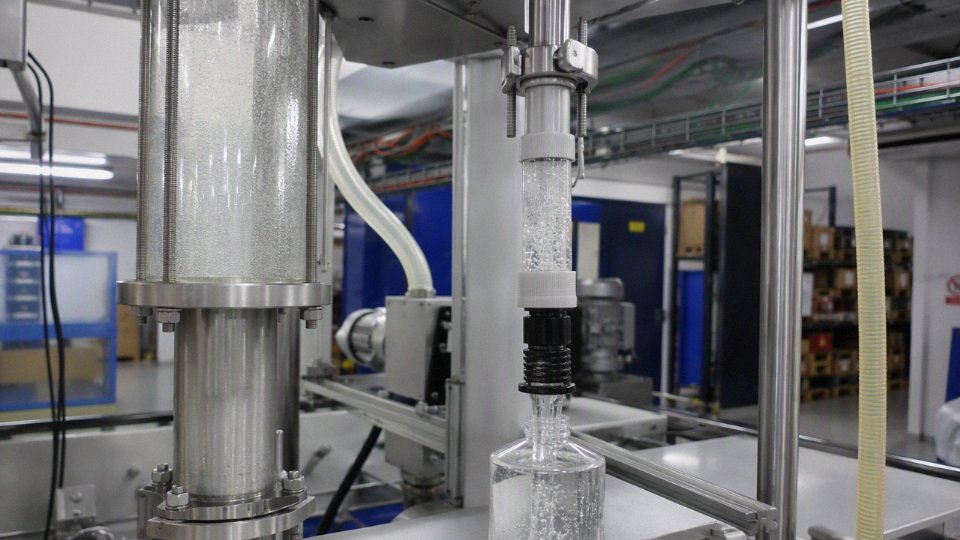
Silicone fluids are often described as low-foaming, which is only partly useful. In practice, some systems still struggle with entrained air, dissolved gas release, or persistent bubbles because foam behavior depends on viscosity, tank design, return-line geometry, pump type, agitation, and residence time.
Common triggers include:
- High-speed mixers or splash lubrication
- Narrow reservoirs with poor deaeration volume
- Return lines discharging above the liquid surface
- Sharp bends, suction leaks, or undersized piping
- Transparent dampers or instruments where even small bubbles affect performance
The mechanism is operational, not just chemical. Agitation breaks air into the fluid, and poor geometry gives those bubbles nowhere to disengage. Higher viscosity grades can retain bubbles longer simply because rise velocity drops. In damping or metering devices, that can show up as erratic force, delayed response, cavitation-like noise, or inconsistent fill.
Compatibility with elastomers, plastics, and porous materials
Compatibility is one of those topics people oversimplify because dimethyl silicone oil is “mild” compared with many hydrocarbons. Mild is not the same as universally compatible. Depending on polymer type, crosslink density, fillers, plasticizers, temperature, and contact time, the fluid can cause swelling, softening, extraction of additives, stress cracking, or property drift.
Materials that deserve explicit validation include:
- Elastomers used in seals, O-rings, diaphragms, and hoses
- Soft plastics and transparent plastics in sight glasses or covers
- Porous sintered materials
- Rubber-coated rollers
- Foams, felts, and absorbent liners
- Cable jackets and potting-adjacent components
A bench soak is a start, not a full answer. For procurement and scale-up, test the actual grade at the actual temperature, then check:
– Dimensional change
– Hardness change
– Tensile or compression-set shift where relevant
– Mass change from uptake or extraction
– Optical haze or crazing for clear parts
– Recovery after aging, not just initial exposure
Thermal and chemical degradation is still possible
Under normal industrial conditions, dimethyl silicone oil is stable enough to earn its reputation. Under strong acid, strong alkali, catalytic contaminants, hot reactive metal surfaces, or long open-air exposure at elevated temperature, that reputation can mislead buyers.
Failure routes commonly involve:
– Chain scission or rearrangement promoted by acidic or alkaline conditions
– Catalytic effects from certain metal salts or residues left from process chemistry
– Surface overheating at heaters, bearings, or hot plates beyond bulk fluid temperature
– Oxidative change from prolonged open exposure, especially in thin films
The practical consequence is not always a dramatic “burnt oil” event. Sometimes it is slow viscosity drift, volatile formation, residue build-up, gel-like deposits, or changes in dielectric and wetting behavior. If the application runs near the upper end of the service window, verify against the current supplier data and run a time-at-temperature test with the actual metallurgy and contamination profile.
Low-viscosity grades can migrate, fog, or transfer where cleanliness matters
Low-viscosity dimethyl silicone oils are useful because they spread easily, wet small clearances, and handle at low temperature. That same mobility creates risk in closed optical assemblies, automotive interiors, electronics-adjacent spaces, and clean-manufacturing environments where fogging, condensable volatiles, or transfer films are unacceptable.
Problem patterns include:
- Lens or sensor haze in enclosed assemblies
- Interior trim contamination or condensate on glass
- Transfer to packaging, films, or parts downstream
- Residue on fixtures in clean processing areas
- Mass loss that changes damping or lubrication over time
This is where procurement gets caught: one buyer compares only viscosity and price, while the application really depends on volatility profile, purity, and residue behavior under the service temperature cycle. Those are not safe to generalize across all suppliers or all PDMS grades.
“Inert” does not mean “ignore housekeeping and disposal”
Because dimethyl silicone oil is often described as inert and non-toxic in general handling terms, some plants treat it casually. That is a mistake. Spills are extremely slippery, contamination can travel farther than people expect, and disposal still has to follow local waste rules, the product safety documentation, and whatever contamination the used fluid has picked up in service.
At minimum, control it like a process-sensitive fluid:
- Label and segregate storage
- Prevent cross-contact with paint, print, and bonding operations
- Clean spills immediately with methods that remove residue, not just visible liquid
- Keep used fluid streams separated if contamination affects disposal route or reclaim options
- Verify site obligations against the current SDS, local regulations, and customer cleanliness requirements
If the application sits anywhere near high load, high cleanliness, or critical adhesion, the safe path is not to assume suitability from the name alone. Match the grade to the duty, test compatibility on the actual stack-up, and isolate silicone handling from any process that can be ruined by trace transfer.
Selection and specification factors
A workable dimethyl silicone oil specification starts with the job the fluid must do, not with a viscosity number copied from an old purchase order. If the operating function is wrong, the rest of the spec can be perfectly written and still fail on the line because the same base chemistry behaves very differently as a lubricant, release aid, dielectric fluid, damping medium, or carrier.
Most bad RFQs I see sound like this: “Need 350 cSt silicone oil, clear, industrial grade.” That is not enough to buy safely. You need to define what success looks like in the process, what can go wrong, and which properties actually control that outcome.
Start with the operating function
The first filter is the fluid’s primary role. One material can cover several jobs, but the selection logic changes with each.
- Lubrication
- Focus on viscosity, film retention, temperature stability, seal compatibility, and whether the contact is light-duty or boundary-heavy.
- Dimethyl silicone oil works well for light mechanisms, plastic-plastic or plastic-metal interfaces, and wide-temperature motion.
- It is usually not the first choice for high-load metal gear or bearing duty where extreme-pressure performance is needed.
- Release
- Specify substrate, molding temperature, transfer tolerance, and whether any downstream bonding, printing, or coating follows.
- A release fluid that works beautifully in molding can be a disaster in paint or adhesive stations 20 meters later.
- Dielectric insulation
- Electrical performance, moisture control, ionic cleanliness, oxidation behavior, and long-term stability matter more than “slipperiness.”
- Here, contamination control is often the difference between a stable process and nuisance failures.
- Antifoam carrier
- The oil may be acting mainly as a delivery medium inside a formulated defoamer.
- In that case, dispersion behavior, compatibility with the process liquid, and dose-response matter more than raw bulk viscosity alone.
- Surface feel or cosmetic slip
- For textile, personal care intermediate, or specialty finishing uses, odor, color, volatility, sensory profile, and residue become selection drivers.
- Purity tends to matter more here than in a simple mechanical release job.
- Damping
- Viscosity consistency across temperature is central.
- A fluid that feels right at room temperature but thins too much at 60 C or stiffens at winter startup is not a damping solution; it is a warranty problem.
- Heat transfer
- This is a narrower use case and needs caution.
- Thermal stability, volatility, pumping behavior, and system design all have to line up; not every dimethyl silicone oil grade is suitable.
- Processing aid
- In compounding, fiber treatment, polishing, or additive delivery, the key question is whether the oil should remain in the product, flash off partly, or be removed later.
A short internal note like “used as release” is still too vague. Release for rubber molding with no downstream finishing is a different world from release on a coated metal part that must later accept adhesive.
Match viscosity to application mechanics
For most industrial buyers, viscosity is the first number discussed and the most misused. A higher-cSt grade is not automatically “better quality.” It simply resists flow more, tends to persist longer, and usually shows lower volatility than a very low-viscosity grade, though exact behavior depends on molecular distribution and formulation.
What viscosity should you start with? Use the mechanics of the application:
| Application condition | What usually pushes viscosity lower | What usually pushes viscosity higher |
|---|---|---|
| Thin spreading or wetting | Fast coverage, easy atomization, low drag | Less relevant unless transfer must be controlled |
| Film persistence | Short-lived film acceptable | Longer retention, lower migration, better stay-put behavior |
| Damping | Quick response, lighter feel | Stronger damping force, slower movement |
| Release | Fine uniform coating, easy wipe-down | Longer release life, less frequent reapplication |
| Temperature swings | Better low-temp flow | Better hot-zone retention if volatility is controlled |
| Shear or pumping | Easier pumping and metering | Better residence on surface, but harder handling |
The mechanism matters. As viscosity rises, the fluid generally forms a thicker, more persistent film and is less prone to running off hot or vertical surfaces. The trade-off is slower spreading, harder metering, poorer atomization, and in some systems more drag than the process can tolerate. In practice, this is why the preferred grade often flips: a hand-applied release wipe may favor a medium or higher viscosity, while an automated micro-dose spray system often needs a lower-viscosity fluid or a formulated dilution route.
Temperature shifts the decision. A grade that meters cleanly at 25 C may become sluggish in an unheated plant at 5 C. I have seen winter complaints blamed on “bad batch quality” when the real issue was a drum pump trying to move a fluid that had simply gone too thick for the transfer setup. Hose length, pump type, nozzle size, and even whether the line has a cheap ball valve or a proper metering valve all start to matter.
Volatility tolerance also sits inside the viscosity decision. Lower-viscosity silicone fluids tend to be more volatile, which may be good if temporary presence is acceptable, but not if the process needs a durable film or low evaporative loss. That does not mean you can generalize a single evaporation number across the category. If loss-on-heating or fogging matters, ask for the supplier’s test method and grade-specific data, and if the application is sensitive, run a bench or pilot trial under your actual exposure time and temperature.
The main conclusion on viscosity stops holding when the fluid is part of a formulation rather than used neat. In emulsions, compounds, and additive packages, apparent handling and deposited film behavior may be controlled as much by the carrier system and additives as by the base oil cSt.
Define the purity level your process actually needs
A generic “clear liquid” description is not a specification. Purity needs vary sharply by industry and downstream sensitivity.
Check these items as applicable:
- Color
- Important where optical appearance, product aesthetics, or visual inspection matter.
- Odor
- Relevant for consumer-facing goods, indoor applications, and enclosed processing areas.
- Cyclic content and low volatiles
- Often important where evaporative loss, fogging, residue transfer, or regulatory review is involved.
- Moisture
- Matters in electrical use, moisture-sensitive formulations, and some specialty processing lines.
- Acidity
- Low acidity is usually preferred where corrosion risk, catalyst sensitivity, or long-term stability matter.
- Ionic contamination
- Particularly relevant in dielectric, electronics-adjacent, and high-cleanliness service.
- Particulate level
- Critical for precision coating, electronics, optics, and any fine metering or nozzle-based process.
The right purity target depends more on the downstream process than on the silicone oil category itself.True
A release application on rough industrial tooling can tolerate contaminants that would be unacceptable in dielectric, optical, electronics-adjacent, or high-appearance applications. The use case defines the cleanliness threshold.
Do not over-specify purity just because “cleaner sounds safer.” Ultra-tight particulate or low-volatile requirements raise cost and can narrow the supplier pool without changing process performance. On the other hand, under-specifying purity is a false economy if the fluid can foul sensors, haze surfaces, interfere with electrical behavior, or leave deposits that trigger rework.
Check compatibility before you write the PO
Compatibility is where many otherwise sound selections fail. Dimethyl silicone oil is broadly useful, but it is not universally welcome on every substrate or in every downstream operation.
Review compatibility with:
- Substrates
- Metals, elastomers, engineered plastics, rubber compounds, paper, textiles, glass, and coated surfaces can each behave differently.
- Seals and hoses
- Verify with the actual elastomer in pumps, drum taps, dosing systems, and machine seals.
- Plastics
- Stress cracking, swelling, surface smearing, or appearance change should be checked, especially on transparent parts.
- Coatings, inks, adhesives, and paints
- Silicone transfer can cause fish-eyes, wetting defects, bond loss, or print rejection.
- Additives already in the process
- Surfactants, resins, fillers, and solvents can change how the oil deposits, migrates, or separates.
- Cleaning route
- If the fluid must later be removed, confirm that the plant’s actual cleaning chemistry and cycle can remove it reliably.
A small wipe test is not enough for critical lines. If painting, printing, or bonding follows, run a contamination trial through the actual process sequence. A fluid that seems harmless in the first station can show up later as coating craters, tape-test failures, or random adhesion drift that wastes days of troubleshooting.
Specify the operating envelope and supply requirements
A purchasing spec should cover the whole supply and use envelope, not just the fluid identity.
Include these items:
- Normal and peak temperature exposure
- Use the actual fluid temperature and dwell time, not just room temperature or machine nameplate conditions.
- Typical dimethyl silicone oil service windows are often cited around -50 C to 200 C, but grade, exposure time, air contact, and formulation all affect what is practical.
- Regulatory or market-specific constraints
- If your market needs restricted-substance review, food-contact evaluation, cosmetics compliance support, or special declaration formats, state that early.
- Do not assume every industrial grade comes with the same documentation package.
- Packaging format
- Drum, pail, tote, bulk, or small pack changes handling cost and contamination risk.
- For low-use specialty grades, oversized containers often create shelf-life and housekeeping problems.
- Batch consistency
- Ask which parameters are routinely controlled lot-to-lot: viscosity, refractive index, color, moisture, volatile content, or others relevant to your use.
- If the process is sensitive, define acceptable certificate-of-analysis items before qualification.
- Sampling and retention
- For critical applications, keep retained samples from incoming lots. It sounds bureaucratic until a line upset appears three months later.
Decide whether neat dimethyl silicone oil is actually the right format
Sometimes straight oil is correct. Sometimes it is only the starting point.
Consider alternatives if the application needs:
- Water-based application or easier cleanup
- A silicone emulsion may be more practical than neat oil.
- Better substrate affinity or specific surface effects
- A modified silicone can outperform plain dimethyl silicone oil.
- Paste, grease, or controlled placement
- A silicone compound may reduce migration and improve handling.
- Balanced multi-property performance
- A formulated blend may solve issues that a single neat fluid cannot.
This is the main trade-off buyers miss. Neat dimethyl silicone oil is simple, predictable, and often economical per kilogram. A formulated product may cost more upfront but cut application rate, reduce transfer defects, improve operator handling, or reduce maintenance frequency. That is often where the real money sits.
Optimize for total process cost, not drum price
A cheaper fluid is only cheaper if it holds process stability. If a higher-grade silicone oil reduces refill frequency, downtime, reject parts, cleaning labor, or seasonal adjustment, its delivered cost per acceptable part can be lower even at a higher unit price.
Look at:
- Consumption rate per part or per shift
- Reapplication interval
- Scrap or rework tied to surface defects
- Cleaning frequency
- Pumpability and dosing stability
- Maintenance events linked to residue, evaporation loss, or contamination
- Changeover complexity across seasons or product variants
In practice, this is where experienced plants separate from price-only buying. A line that runs three shifts usually feels volatility loss, nozzle fouling, transfer contamination, and batch inconsistency much faster than a lab test does. If the application is important enough to affect uptime or customer quality, define the process conditions clearly and qualify against those conditions, not against a brochure description.
Quality control and handling
For most industrial buyers, product quality is verified with a small set of routine checks, but the useful part is not the list of tests. It is making sure your method, sample condition, and acceptance limits match the supplier’s data sheet and certificate of analysis; otherwise, you can reject a good batch or approve one that will drift in use.
Incoming inspection usually starts with quick-release checks and then moves to the few properties that matter most to the application.
- Appearance
- Check for clarity, haze, suspended matter, gel, or phase separation.
- A water-clear fluid can still be off-spec, but visible haze often points to moisture pickup, contamination, or storage abuse.
- Kinematic viscosity
- One of the most important release parameters because it reflects polymer chain length and directly affects flow, film build, damping behavior, and pumpability.
- Compare only at the same stated temperature, typically 25 C, and with the same test method.
- Refractive index
- A useful identity and consistency check; typical dimethyl silicone oil values near 25 C are often around 1.396 to 1.403, depending on viscosity and purity.
- In practice, this is a good cross-check for mix-ups or dilution, not a full quality verdict by itself.
- Specific gravity
- Helps confirm product identity and can flag contamination if it shifts unusually from the supplier’s normal range.
- Flash point
- Relevant for storage, transport classification, and process safety review, especially on lower-viscosity grades with more volatile fraction.
- Moisture
- Often overlooked until it causes foaming, poor dielectric behavior, hydrolysis-sensitive downstream reactions, or trouble in coating lines.
- Volatile content
- Important where evaporation, fogging, odor, residue control, or high-temperature stability matters.
- Acid value, where relevant
- Not every plant checks it on every lot, but it can matter for sensitive formulations, long-life fluids, or applications near reactive substrates.
- Cleanliness
- This can mean simple visual cleanliness, particle count, or a practical patch test, depending on how sensitive the end use is.
The main trap in supplier comparison is test-method mismatch. Viscosity is the classic example: if one lab conditions the sample at 25 C long enough and another tests a cold drum sample that just came off a winter truck, the numbers will not line up. Volatility results are also method-sensitive because exposure time, temperature, airflow, pan geometry, and sample mass can shift the outcome. If the numbers are close to the limit, method alignment matters as much as the material itself.
A few controls help avoid false disputes:
- Pull samples from a representative point, not just the top of the drum.
- Let the sample equilibrate to the test temperature.
- Use clean, dry containers with compatible seals.
- Record batch number, sampling date, and container condition.
- Compare against the agreed method, not a generic internal shortcut.
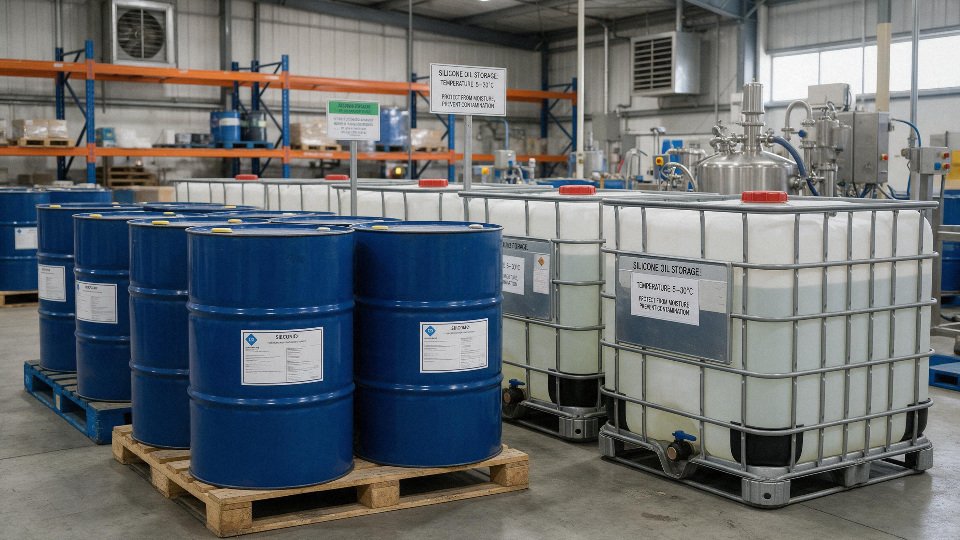
Storage and transfer practice
Dimethyl silicone oil is generally stable in storage, but only if the plant treats it like a controlled process fluid rather than a harmless utility oil.
- Keep containers sealed when not in use.
- Store in a clean, dry area away from dust and water ingress.
- Avoid unnecessary temperature cycling; repeated heating and cooling can pull moisture in through breathing and make transfer viscosity inconsistent.
- Use dedicated pumps, hoses, and couplings where contamination risk is high.
- Keep it away from reactive chemicals, especially if the same transfer tools also see acids, alkalis, peroxides, amines, or metal-containing additives.
The mechanism is simple enough: contamination at trace level may not change the fluid’s appearance, but it can still alter surface behavior, cure response, foam tendency, or downstream adhesion. That is why a maintenance fitter using the “nearest clean hose” can create more quality damage than a visibly dirty drum.
Housekeeping and plant-floor controls
Handling failures are usually mundane.
- Clean spills immediately; silicone oil on painted concrete becomes a persistent slip hazard.
- Control mist and aerosol generation during high-speed filling or spraying.
- Do not use shared rags, funnels, or open pails near coating, printing, bonding, or painting areas.
- Segregate use points if the facility also runs adhesive, ink, or paint lines that are sensitive to silicone trace contamination.
That last point matters. A tiny amount of transferred silicone can cause fish-eyes, wetting defects, or bond failure in nearby processes, and the source is often poor housekeeping rather than the bulk material itself.
Packaging, traceability, and supplier control
Common packaging formats include:
- Drums for manageable lot control and easier sampling
- Intermediate bulk containers where consumption is steady and internal handling is set up for them
- Tank delivery for large-volume users with dedicated storage and unloading systems
- Lined containers when cleanliness, compatibility, or export-route protection justifies the extra control
For export supply chains, packaging choice is not just a freight issue. Transit time, port storage temperature, seal integrity, pallet stability, and relabeling requirements all affect what arrives at the plant.
A disciplined buyer will review each certificate of analysis, retain a reference sample from critical batches, and log where each lot was used. Long-running industrial processes should also require supplier notification of meaningful changes: raw material source, manufacturing site, stabilization package, test method, packaging configuration, or specification limits. If your process is sensitive enough that one off-batch can stop a line, that change-control expectation should be written into the supply agreement, not left as a courtesy.

Frequently asked questions
Is dimethyl silicone oil the same as silicone oil?
Not exactly. In purchasing language, “silicone oil” is often used loosely for several silicone-based fluids, while dimethyl silicone oil usually refers specifically to polydimethylsiloxane-type fluids with methyl groups on the siloxane chain. That distinction matters once you get into compatibility, volatility, regulatory review, or whether a supplier is actually offering a modified silicone rather than a straight dimethyl fluid.
A drum labeled “silicone oil” may still be acceptable, but buyers should confirm:
- Chemical type: straight dimethyl fluid or modified silicone
- Viscosity at 25 C
- Volatile content, if carryover matters
- Whether it is neat fluid or part of a formulated product
What is the difference between dimethyl silicone oil and silicone emulsion?
A dimethyl silicone oil is the neat hydrophobic fluid; a silicone emulsion is that fluid dispersed in water with emulsifiers and, in many cases, preservatives or stabilizers. On the plant floor, that changes pumping, dilution, drying behavior, residue pattern, and how the material interacts with downstream coatings.
The practical differences are:
- Dimethyl silicone oil
- 100% or near-neat active fluid
- Used where direct lubrication, heat transfer, release, or blending into a non-aqueous formulation is needed
- Harder to rinse off equipment once spread
- Silicone emulsion
- Water-based delivery system
- Easier to apply in textile, polish, mold-release, or surface-treatment lines where water handling is already built in
- Performance depends not only on silicone content but also droplet size, emulsion stability, and drying conditions
If a line has ambient drying only, an emulsion may leave uneven film if the water phase does not break cleanly.
How is viscosity selected for a new application?
Start from the function, not the catalog. Low-viscosity grades are chosen when you need spreading, fast wetting, or low drag; higher-viscosity grades are used when you need film persistence, damping, or reduced migration.
A practical screening sequence:
- Define the job: release, lubrication, damping, gloss, antifoam base, dielectric fill, or additive.
- Check the application method: wipe, spray, dip, metering pump, roll coat, or sealed fill.
- Set the temperature range in service and during application.
- Review migration tolerance: can the fluid creep into bearings, seals, labels, or bond areas?
- Run a small trial with two or three viscosities rather than one “middle” grade.
The mechanism is straightforward: higher viscosity usually builds a thicker, more persistent film, but it also raises drag, slows leveling, and can trap contamination. That preference flips if the line needs rapid spreading or very thin controlled deposit.
Is dimethyl silicone oil safe for skin-contact or consumer products?
Sometimes, but that is not something to assume from the chemical name alone. Suitability depends on purity, residual volatile profile, intended exposure, local regulatory requirements, and whether the supplier offers a grade specifically positioned for personal-care, food-contact, or other regulated use.
Ask for:
- Product regulatory statement for the target market
- Purity or impurity profile where relevant
- Safety data sheet
- Confirmation of intended-use suitability from the supplier
For consumer-facing use, internal approval should sit with regulatory and quality, not only procurement.
Can it be used as a lubricant at high load?
Usually not as the primary answer for heavily loaded metal-to-metal contacts. Dimethyl silicone oil performs well for light lubrication, plastic/rubber compatibility in many systems, damping, and wide-temperature service, but its boundary lubrication under high load is limited compared with fluids designed with anti-wear or extreme-pressure additive systems.
Typical caution zones include:
- Slow, high-contact-pressure metal sliding
- Shock-loaded mechanisms
- Gear sets or cams needing anti-wear chemistry
- Applications where the fluid film is repeatedly squeezed out
In those cases, test under the actual load, speed, surface finish, and material pair. Bench friction data from a supplier is useful, but it does not replace an application rig.
Does it conduct electricity or support corrosion?
Dimethyl silicone oil is generally used as an electrically insulating fluid, not a conductive one, and it does not inherently promote corrosion the way water-bearing contaminants do. The catch is contamination: moisture, ionic carryover, wear debris, acidic process residue, or dirty transfer containers can change both dielectric behavior and corrosion risk.
Dimethyl silicone oil can be treated as non-corrosive in every electrical application without further testing.False
Base fluid behavior is usually favorable, but dielectric performance and corrosion risk depend heavily on contamination, package cleanliness, temperature, and the specific equipment design.
For electrical or anti-corrosion service, request current supplier data and verify against the equipment manual.
Will it affect painting, printing, or adhesive bonding?
Yes, very often. Even a thin silicone transfer film can cause fisheyes, craters, poor ink wetting, label failure, or weak adhesive bond strength. This is one of the most expensive silicone-related mistakes in mixed-process plants because the contamination can come from overspray, gloves, rags, transfer rollers, or reused totes.
If painting, printing, or bonding is anywhere downstream:
- Isolate silicone handling tools and work areas
- Confirm allowable residue limits with the coating or adhesive supplier
- Run surface-energy or wetting checks if defects appear
- Trial the full process, not just fluid application
What tests should be requested from a supplier before approval?
Request the tests that control your risk, not a decorative certificate pack. Common approval items include:
- Viscosity at 25 C
- Appearance and clarity
- Refractive index near 25 C, where relevant
- Volatile content or loss on heating, if evaporation matters
- Moisture, if dielectric or moisture-sensitive use is involved
- Acid value or other contamination indicators, if critical
- Compatibility or application trial support where the use is sensitive
For high-risk uses, keep a retained sample and compare incoming lots against the approved baseline.
How should it be stored and what is the typical shelf-life expectation?
Store it sealed, clean, and out of unnecessary heat. In practice, a dry indoor warehouse with stable temperature, closed original packaging, and dedicated transfer tools prevents most problems; half-used drums with dirty pump wands create more trouble than age does.
Typical shelf-life expectations depend on grade, packaging, and contamination control, so buyers should confirm the supplier’s stated period rather than assume a universal number. What matters operationally is whether the material still meets agreed release tests at use time.
Your grade verification checklist
If the application brief is still “we need silicone oil,” you are not ready to quote, trial, or buy. A workable verification package should pin down function, temperature, viscosity behavior, material compatibility, and quality constraints tightly enough that a supplier can recommend a grade without guessing and your plant can test it without creating a contamination headache.
- State the actual job the fluid must do
- Lubricate, damp, release, defoam, insulate, transfer heat, protect a surface, or act as a process aid
- Note whether the duty is continuous or intermittent
- Clarify whether the system is:
- open to air
- closed or sealed
- static
- dynamic, with shear, recirculation, or pumping
That matters because the same nominal viscosity can behave very differently in a sealed dashpot versus an open wipe-on release step. Open systems usually put more pressure on volatility, odor, carryover, and housekeeping.
- Define the operating window, not just a single setpoint
- Normal temperature range
- Startup and upset temperatures
- Exposure time at high temperature
- Ambient conditions if the process runs in winter cold, summer heat, or humid packaging areas
Typical dimethyl silicone oil service can fall roughly in the -50 C to 200 C range, but the usable limit depends on grade, dwell time, formulation, and the exact duty. A short high-temperature excursion is not the same thing as months of hot continuous exposure.
- Set a target viscosity window
- Current fluid viscosity, if replacing an incumbent
- Desired feel, film thickness, drainage, damping, or residence behavior
- Pumpability and metering method
- Whether viscosity consistency at 25 C is enough, or whether the temperature-viscosity curve matters
The market spans about 0.65 cSt to well above 1,000,000 cSt at 25 C, so asking for “silicone oil” without a window is like asking for “rubber” without hardness.
List every material the fluid may touch
- Metals and metal finishes
- Plastics
- Elastomers and seals
- Coatings, inks, paints
- Adhesives, labels, tapes
- Electrical components or insulation materials
In practice, trouble often starts at the edges: a gasket that swells, a painted panel that fisheyes later, or an adhesive bond line that suddenly loses wetting after trace silicone transfer. If there is any downstream coating, printing, laminating, or bonding step, flag it early.
Write down the non-negotiables
- Low volatiles
- Odor control
- Dielectric performance
- Color or visual clarity
- Purity expectations
- Market-specific regulatory or customer requirements
A standard industrial grade is not automatically suitable for odor-sensitive, electrical, or high-purity applications.True
Those use cases often tighten limits on volatiles, appearance, contamination risk, or electrical properties beyond what a general-purpose grade is designed to control.
Ask the supplier for the documents that actually support a decision
- Technical data sheet
- Certificate of analysis for the offered lot or standard release specification
- Recommended application range and known use limits
- Sample for bench and line-side testing
- Run a controlled trial
- Check primary performance
- Observe migration, residue, and contamination behavior
- Review cleaning impact
- Test downstream compatibility, not just immediate function
A fluid that works perfectly in the first hour can still create scrap three stations later.
Use trial data to choose the grade path
- Standard industrial grade
- Higher-purity grade
- Modified silicone alternative if straight dimethyl silicone oil does not hold the line
If you want SiliconChemicals to recommend a grade and quote it accurately, send the substrate material, contaminant or process role, approximate layer thickness or use level, working area, required finish, target rate, and clear part photos or representative samples where practical. From there, SiliconChemicals can review the application, suggest a suitable dimethyl silicone oil or modified silicone option within its organosilicon supply range, and support the next step with technical documents and sample evaluation.