Water that clings where it should bead up is not just a cosmetic nuisance. On a production floor it drives corrosion under films, dirt pickup, inconsistent release, wet electrical surfaces, and coating defects that show up two steps later instead of at the station that caused them. The cost is usually hidden in scrap, rework, cleaning labor, customer complaints, and line interruptions, which is why engineers keep coming back to silicone oil when they need a practical route to water repellency without rebuilding the whole process.
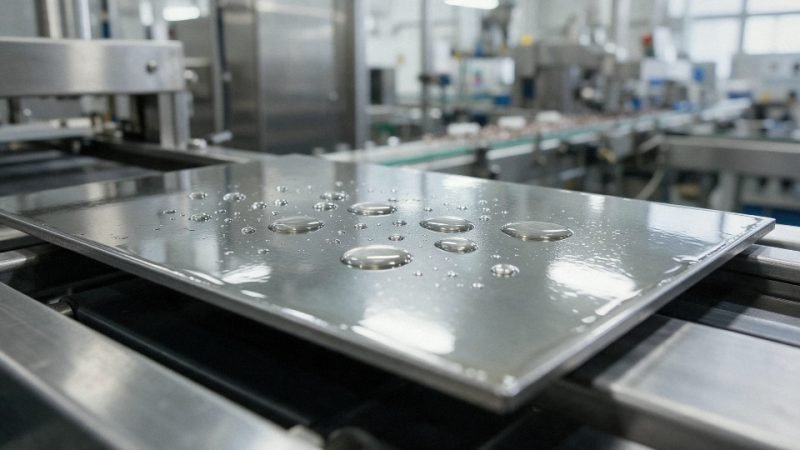
Silicone oil is water repellent because its molecular structure presents very low surface energy methyl groups at the surface, so water cannot spread easily across it. In practice, polydimethylsiloxane fluids sit around 20-21 mN/m surface tension at 25 degrees C, far below water at about 72 mN/m, which is why silicone-treated surfaces often show water contact angles around 95-110 degrees when the film and substrate are right.
That simple explanation is true, but it is not the whole buying or process answer. Whether silicone oil actually gives stable water repellency depends on how the film forms, what substrate it is sitting on, how much contamination is present, and whether you need a temporary lubricious layer or a durable treated surface that survives handling, washdown, heat, and time.
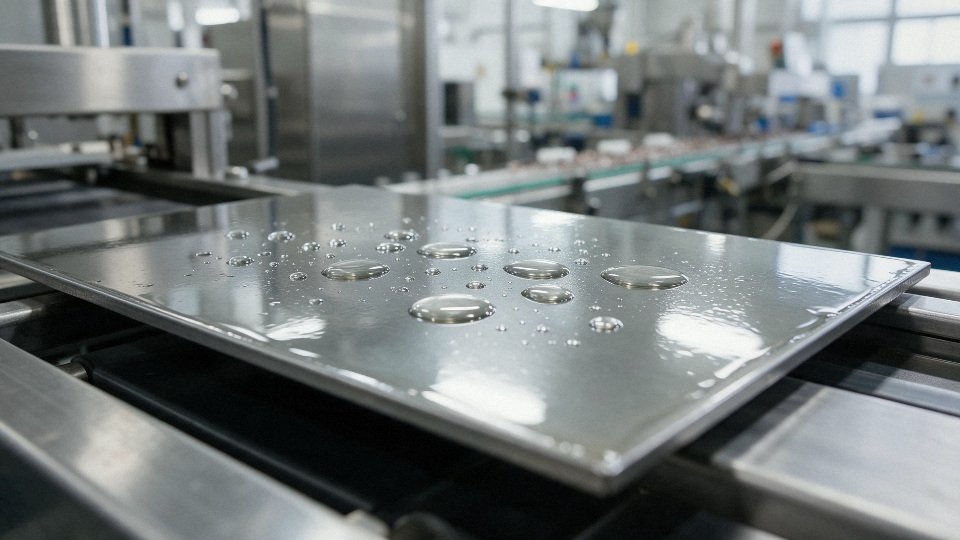
Molecular structure and polarity
Silicone oil is water repellent because the surface that water actually touches is usually dominated by nonpolar organic groups, not by water-friendly sites. In standard polydimethylsiloxane (PDMS), the siloxane chain gives the fluid its mobility, while the outward-facing methyl groups keep the exposed surface low in energy, so water has little incentive to spread or adhere.
The part many buyers miss is that “silicone” is not one fixed chemistry in practical use. The base architecture matters, the side groups matter, the molecular weight matters, and the way the fluid sits on a substrate matters just as much. A neat drum of PDMS fluid, a thin wiped film on aluminum, and a modified silicone in a textile bath can behave very differently even though all three get called silicone oil on a purchase order.
What the basic silicone oil structure looks like
The workhorse structure is polydimethylsiloxane, usually written as a repeating Si-O-Si-O backbone with two methyl groups attached to each silicon. Those repeating units form a chain:
- Backbone: alternating silicon and oxygen atoms
- Side groups: mostly methyl groups, written as -CH3
- Chain length: short fluids to very high-viscosity materials, depending on degree of polymerization
- End groups: can be trimethylsiloxy, hydroxyl, vinyl, or other functional terminations depending on grade and downstream use
That geometry is not a small detail. The silicon-oxygen backbone is relatively open and flexible compared with a typical carbon-carbon polymer chain, and the methyl groups project outward from the chain. So when the fluid forms a surface film, what tends to face the air side is a dense population of methyl groups.
On the plant floor, that shows up as familiar behavior: the fluid spreads easily over many solids, forms a slick boundary layer, and water beads rather than wets. You can see the same chemistry behind mold release, antifoam action, water repellency, and slip effects, even though the applications are different.
Why methyl groups make water unhappy on the surface
Water likes surfaces that can give it favorable interactions, usually through polarity, hydrogen bonding, or high-energy adsorption sites. Methyl groups offer almost none of that.
A methyl group is:
- Nonpolar or only very weakly polarizable at the scale that matters for wetting
- Unable to hydrogen-bond with water
- Low in surface energy compared with many metals, oxides, or polar polymers
Water molecules strongly attract each other. That internal cohesion is why liquid water has a high surface tension, roughly 72 mN/m at 25 degrees C. PDMS fluids are much lower, around 20-21 mN/m at 25 degrees C depending on grade. That mismatch matters. When water lands on a silicone-rich surface, replacing water-water interactions with water-silicone interactions is not very favorable, so the droplet pulls back into a bead rather than spreading into a film.
This is the direct wetting mechanism:
- Water contacts the surface.
- The surface offers few strong polar interaction sites.
- Adhesion between water and the surface stays low.
- Cohesion inside the water droplet dominates.
- The droplet contracts, increasing contact angle.
That is why silicone-coated surfaces often show water contact angles around 95-110 degrees, depending on substrate, coating continuity, contamination, cure state, and additive package. Not every silicone surface lands at the same number, and no responsible supplier should promise a universal angle without substrate and application details.
Why the Si-O backbone still matters if methyl groups do most of the wetting work
The low-energy methyl shell explains a lot, but not the whole story. The siloxane backbone gives silicone oils a kind of interfacial agility that hydrocarbon oils do not reproduce in quite the same way.
The Si-O bond is longer and the bond angle is broader than a standard carbon-carbon chain arrangement, which contributes to high chain flexibility. That flexibility lets the polymer segments rearrange at an interface. In simple terms, the molecule can keep presenting the lowest-energy groups where they do the most good, especially at the air interface.
That leads to two practical effects:
- Surface reconstruction: if a film is disturbed, heated, or partially contaminated, mobile chains can often reorient so that methyl groups again dominate the outer surface
- Persistent low-energy character: the air-facing side of the coating tends to remain silicone-rich, which helps maintain repellency
This does have a boundary. If the substrate is rough, porous, chemically active, or contaminated with surfactants, oils, process residues, or cleaning salts, the silicone chains may not form a clean, continuous low-energy interface. In those cases, the molecular advantage is still there, but the measured repellency can fall short because the surface is no longer chemically uniform.
The siloxane bond is polar, so silicone oil should attract water.False
The Si-O bond is polarizable, but wetting depends on the chemistry exposed at the outermost interface. In standard PDMS, methyl groups dominate that interface, so the observed surface behavior is usually hydrophobic despite bond-level polarity within the chain.
Silicone oils versus hydrocarbon oils
Hydrocarbon oils can also repel water. If you put a mineral oil film on a surface, water usually beads to some extent. The difference is that silicones often do it with a more unusual combination of interfacial behavior, temperature tolerance, and stability.
A practical comparison looks like this:
| Property | Typical silicone oil behavior | Typical hydrocarbon oil behavior |
|---|---|---|
| Surface tension | Lower, often around 20-21 mN/m for PDMS fluids | Higher than PDMS in many cases |
| Water repellency mechanism | Low-energy methyl-rich surface plus chain mobility | Nonpolar hydrocarbon surface, less interfacial flexibility |
| Thermal stability | Usually better at elevated temperature | Often narrower useful range |
| Service temperature range | Typically wider, formulation-dependent | Usually narrower |
| Oxidative resistance | Often stronger than many hydrocarbon oils | Can oxidize or varnish more readily |
| Compatibility with some elastomers/plastics | Must be checked case by case | Also must be checked, but different swelling pattern |
The trade-off is not one-way. Silicone oils are not automatically the better choice in every water-repellent duty.
Situations where hydrocarbon oils may still win include:
- Tight cost targets on noncritical temporary water shedding
- Applications where silicone contamination will disrupt downstream painting, printing, bonding, or plating
- Systems where migration or transfer must be minimized and a different chemistry anchors better
- Cases where foam, slip, or release side effects from silicone are undesirable
In practice, that contamination point matters a lot. A few ppm of silicone carryover in the wrong finishing line can create fisheyes, craters, or coating defects that cost far more than the fluid itself.
How side-group modification changes water repellency
Not all silicone oils stay fully methyl-substituted. Suppliers modify the side groups to change compatibility, reactivity, refractive index, lubricity, softness, or anchoring. Once you do that, water repellency can improve, stay about the same, or drop sharply depending on what groups are introduced and how many.
Phenyl modification
Phenyl groups are used for thermal performance, low-temperature behavior in some systems, radiation resistance, and optical effects. They often retain hydrophobic character, but the interfacial behavior is not identical to pure methyl PDMS.
- Can improve some high-temperature or specialty performance
- Often keeps reasonable water repellency
- May alter spreading, viscosity-temperature behavior, and compatibility
Amino modification
Amino-functional silicones are common in textiles, personal care, and surface treatment because they anchor better to some substrates and improve softness or lubricity. The amino group is polar.
- Better substrate affinity in many systems
- Water repellency may drop if polar groups are highly exposed
- Can improve durability of deposited film even while lowering intrinsic hydrophobicity
That is a classic trade-off: you gain retention and substantive deposition, but you sacrifice some pure water-beading performance if the surface becomes too polar.
Epoxy modification
Epoxy-functional silicones are used where later reaction or adhesion promotion is needed.
- Can bond into coatings or cured networks
- Useful when permanence matters more than maximum beading
- Polar functionality can reduce water repellency if present at the outer surface
Polyether modification
This one often surprises buyers. Polyether-modified silicones are widely used as surfactants, wetting agents, foam control components, and emulsifiers precisely because they are more compatible with water than plain PDMS.
- Strongly improved water dispersibility or emulsifiability
- Often much lower water repellency than unmodified PDMS
- Chosen when controlled wetting is desired, not when maximum hydrophobing is the main job
If someone offers a “silicone” additive for a water-based system, you need to check whether it is a hydrophobe, a compatibilizer, or a surfactant. Those are not interchangeable products.
Fluoro modification
Fluoro-modified silicones can drive surface energy even lower.
- Can produce very strong repellency to water and sometimes oils
- Usually more specialized and more expensive
- Regulatory, environmental, and application-specific review is often needed depending on chemistry and region
Alkyl modification
Longer alkyl side groups can tune compatibility with organic phases and change slip and hydrophobe balance.
- May improve performance in some organic-rich systems
- Can increase hydrophobic character in certain formulations
- The result depends heavily on substitution level and final surface orientation
The common misunderstanding about polarity
The phrase “silicone is nonpolar” is too crude to be accurate, and “silicone is polar because Si-O is polar” is also too crude to predict performance. Wetting behavior is controlled mainly by the outermost molecular layer and how that layer reorganizes under actual use conditions.
So the right engineering view is:
- The Si-O backbone is polarizable and structurally important.
- The methyl-rich outer surface is what usually governs water repellency in PDMS-based oils and coatings.
- The final result depends on surface composition, mobility, contamination, and modification level, not on one textbook statement about one bond.
That distinction matters when troubleshooting. If a silicone-treated surface stops beading water, the cause is often not that “silicone lost its hydrophobic chemistry.” It is usually one of these:
– the wrong modified silicone was selected,
– the dosage was too low for full coverage,
– the film was displaced or extracted,
– the substrate chemistry overrode the surface effect,
– or process residues masked the silicone-rich interface.
Surface energy and wetting
A silicone-treated surface repels water because it presents a much lower-energy interface than bare metal oxides, glass, ceramics, paper fibers, or most polar plastics. In practice, that means water would need to give up too much of its own cohesive stability to spread, so it pulls itself into droplets instead; on a decent silicone film, static water contact angle is often roughly 95-110 degrees, while the same substrate untreated may wet far more readily.
That is the practical bridge between chemistry and what operators actually see: beading, poor sheet flow, easier runoff, and less water hang-up after rinse or exposure. But static beading is only the first layer of the story. Two surfaces can show similar droplet shape in a photo and behave very differently once the line starts, parts heat up, dust lands, or spray pressure goes on.
The core wetting terms engineers should actually care about
A lot of confusion in buying discussions comes from mixing up related terms. They are connected, but they are not interchangeable.
- Surface energy: the energetic cost of creating new surface on a solid. High-surface-energy solids, such as clean glass or oxidized metals, tend to attract liquids more strongly. Low-surface-energy solids, such as silicone-coated surfaces, give liquids less incentive to spread.
- Surface tension: the equivalent concept for a liquid-air interface. Water is high, about 72 mN/m at 25 degrees C. Representative polydimethylsiloxane fluids are much lower, about 20-21 mN/m at 25 degrees C.
- Interfacial tension: the tension at the boundary between two phases, such as water and a silicone film. Wetting depends on this boundary as much as on the liquid’s own surface tension.
- Contact angle: the angle a droplet edge makes with the surface. Higher angle usually means poorer wetting by that liquid.
- Spreading coefficient: a way of asking whether the liquid gains or loses energy by forming a thin film over the surface. If spreading is energetically unfavorable, the droplet stays beaded.
- Hysteresis: the gap between advancing and receding contact angle. This tells you how “sticky” the droplet is on the surface, which often matters more than a single static angle.
If you strip the math away, wetting comes down to a competition. Water wants to stay bonded to itself because of its high cohesion. The solid surface may or may not offer enough attraction to pull that droplet outward. Silicone shifts that balance toward cohesion within the droplet, so spreading becomes energetically unfavorable.
A high static contact angle alone does not guarantee easy water roll-off.True
Droplet mobility depends strongly on contact angle hysteresis, surface contamination, roughness, and whether the silicone film is uniform or patchy. A surface can look hydrophobic in a lab photo yet still hold water under tilt, spray, or condensation.
Why water beads up on silicone-treated surfaces
The short answer is mismatch: high-tension water meets a low-energy silicone interface and cannot lower total system energy by flattening into a film. That mismatch is why silicone coatings and silicone oil treatments often outperform untreated mineral surfaces for simple water shedding, even at very low coating weights.
A clean mineral surface usually has polar or oxidized sites that interact readily with water. Water can hydrogen-bond or otherwise anchor itself, so the droplet footprint grows. Apply even a very thin silicone layer, and those higher-energy sites become masked by methyl-rich silicone chemistry. The topmost nanometers matter most here; bulk substrate properties still affect adhesion and durability, but wetting is dominated by what water touches first.
That is why a very low add-on can change wetting dramatically if coverage is continuous. You do not need a visibly thick coating to move the surface from “water spreads” to “water beads.” In production, that can be a benefit and a trap. Material consumption may look efficient, but if coverage is not uniform, the untreated islands become nucleation points for wetting, staining, or retained droplets.
Mechanistically, the path is straightforward:
- Silicone deposits on the substrate.
- The surface presented to air and water shifts to lower energy.
- Water sees less favorable adhesion to the surface.
- The droplet minimizes contact area and raises contact angle.
- If hysteresis is also low, the droplet releases and rolls off more easily.
The trade-off is durability. A film optimized for extreme mobility and rapid self-leveling may not stay where you need it under abrasion, repeated washing, porous uptake, or part handling.
Static angle is not enough: advancing, receding, and droplet mobility
A common plant-floor mistake is using one bead photo as the whole acceptance standard. It is useful, but incomplete.
What matters in operation is often this set of behaviors:
- Advancing contact angle: how the droplet front behaves as more liquid is added or as the droplet moves over dry surface.
- Receding contact angle: how the trailing edge releases as liquid drains or the surface is tilted.
- Contact angle hysteresis: the difference between those two values.
- Sliding or roll-off behavior: whether droplets move under gravity, vibration, airflow, or line motion.
Low hysteresis usually means less pinning. High hysteresis means the water may still cling, even if the initial droplet looks nicely rounded. This is why one treated panel may sheet dry under a slight tilt while another panel with similar static angle holds a necklace of droplets along scratch lines, dust streaks, or coating defects.
In practice, contamination drives a lot of these failures. Fine mineral dust, residual surfactant, hand oils, corrosion salts, and process carryover can all create local high-energy spots. Water pins at those spots first. On packaging lines, textile finishing lines, or release-coated webs, operators often blame the silicone chemistry when the actual issue is inconsistent cleaning, bath contamination, or over-dilution.
Thin films, self-leveling, and where mobility helps or hurts
Silicone oil’s low surface tension helps it spread over many substrates, and its mobility helps it self-level into a more continuous film. That is one reason it can produce a useful wetting shift at low application levels. If the process is reasonably controlled, the fluid can cover micro-asperities and reduce exposed high-energy patches better than some less mobile chemistries.
This is helpful when the substrate is smooth to moderately rough and the treatment is not under severe mechanical stress. Typical examples are release liners, anti-stick topcoats, textile hand modification, temporary water shedding, or surface conditioning before a converting step.
But there is a limit. Excessive mobility can become a liability on porous, fibrous, or heavily handled surfaces.
Typical failure paths include:
- Migration into the substrate instead of staying at the air interface
- Transfer to adjacent layers, tooling, rollers, or packaging
- Depletion from high-contact zones
- Uneven redistribution after heat cycling
- Lower resistance to wipe-off or detergent exposure
The preferred balance flips when the service environment becomes harsher. A free silicone oil or very mobile low-viscosity fluid may bead water well on day one but lose practical performance faster than a more anchored, reactive, or higher-viscosity system. The right choice depends on what “water repellent” has to survive: one shipping cycle, repeated cleaning, outdoor weathering, or constant part-to-part rubbing.
Roughness can improve repellency, or quietly ruin it
Roughness is not automatically good or bad. It amplifies whatever wetting regime the surface is already tending toward.
On a well-covered hydrophobic surface, micro-roughness can increase apparent contact angle because the droplet sits partly on air pockets and touches less solid. That is the textbook upside. In practice, moderate texture sometimes makes a treated part look much more water repellent than a polished panel with the same chemistry.
The downside shows up just as often on the factory floor:
- Rough surfaces need more complete coverage to avoid exposed polar peaks and valleys.
- Deep texture can trap fines, salts, oils, and cleaners.
- Porous or blasted surfaces can wick silicone away from the outer interface.
- Patchy film thickness across rough features raises hysteresis and droplet pinning.
- Mechanical contact hits peaks first, so wear can localize quickly.
A representative case is a cast or shot-blasted metal component. The first bead test after treatment may look impressive because roughness amplifies the apparent angle. After handling, rinsing, or dust exposure, water starts hanging in low spots and around contamination islands. The surface still “tests hydrophobic” in a static sense, but drying behavior and stain resistance are already sliding backward.
So the boundary here is clear: roughness helps only if the silicone film remains continuous and clean at the interface. Once roughness starts driving contamination retention or nonuniform coverage, the same texture that improved beading can hurt actual water shedding.
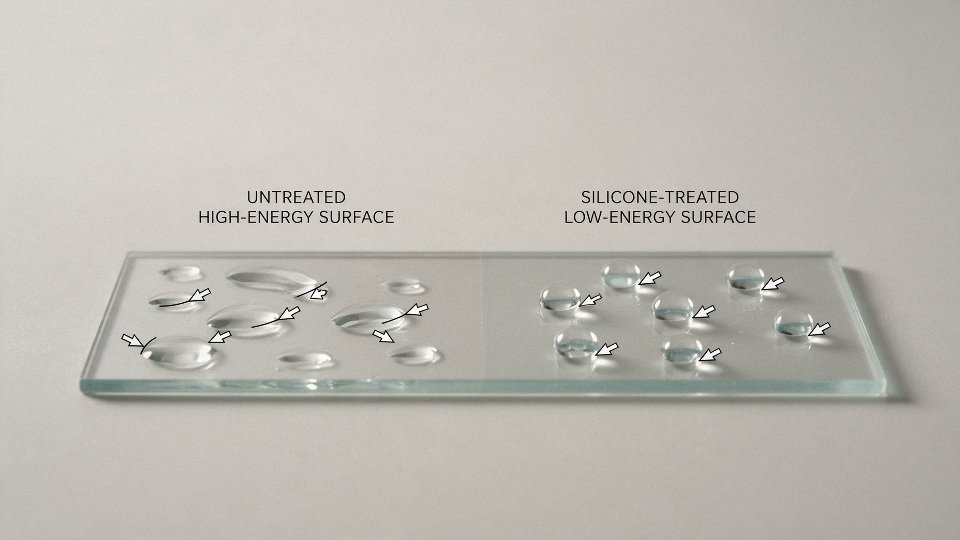
Dynamic conditions expose the gaps that simple bead tests hide
Under dynamic exposure, some silicone-treated surfaces that look excellent in a benchtop droplet photo show their weak points quickly. Condensation, spray impact, hydrostatic pressure, and surfactant-laden water change the wetting problem.
A few conditions matter disproportionately:
- Condensation: tiny droplets nucleate everywhere, including defects and contamination sites. Surfaces that shed large placed droplets may still fog with pinned microdroplets.
- Spray impact: incoming momentum can temporarily force water into texture and defects, overcoming what a static droplet test suggests.
- Pressure or immersion: sustained contact gives water more time to exploit pores, scratches, or incomplete coverage.
- Surfactants in water: detergents, process additives, or natural contaminants lower water surface tension. Once the liquid tension drops, the silicone-water mismatch narrows and wetting often increases sharply.
That last point is easy to miss in purchasing specs. A treatment that performs well against clean tap water may behave very differently against wash water, cooling water with additives, agricultural spray solutions, or field contamination. The mechanism is simple enough: lower liquid surface tension reduces the energetic penalty for spreading, so contact angle falls and pinning often rises.
For any application where runoff, self-cleaning, anti-wetting, or dry appearance matters under use conditions, lab screening should go beyond a static bead image. At minimum, test fresh and aged samples, include tilt or sliding observation, and use the actual water chemistry if you can get it. Clean DI water on a smooth coupon is fine for baseline comparison; it is not a reliable proxy for every plant or outdoor service condition.
Performance drivers
A silicone-treated surface can look strongly water repellent on day one and still fail in service if the fluid is too mobile, too thin, poorly anchored, or exposed to the wrong cleaning and wear conditions. In practice, repellency strength and service life are controlled less by “silicone oil” as a category than by viscosity, molecular weight distribution, application method, substrate interaction, and what the surface sees after installation.
Viscosity: spreading versus staying put
Low-viscosity silicone oils spread fast and wet complex geometry easily, but they also migrate, drain, and transfer more readily. High-viscosity grades usually stay where you put them and hold a more persistent film, though they are harder to apply uniformly and can leave patchy coverage if the process is not set up well.
A useful way to think about viscosity is not “better” or “worse,” but what failure mode you are trying to avoid.
- Low viscosity fluids
Typically chosen when you need:- Fast leveling
- Easy dilution or emulsification
- Penetration into fine pores, textile bundles, or tight clearances
- Low application-force processes such as wiping, spraying, misting, or dip coating
Common trade-offs:
- Higher migration to adjacent surfaces
- Greater risk of transfer to packaging, rollers, gloves, or downstream parts
- Lower film retention on vertical or warm surfaces
- More sensitivity to over-application because excess fluid keeps moving
- Medium viscosity fluids
Often the practical middle ground for industrial finishing because they:- Still spread reasonably well
- Give better holdout than very light fluids
- Are easier to meter consistently through standard pumps and nozzles
- Reduce, but do not eliminate, migration problems
In many plants, this is where operators land after fighting either misting from very light grades or poor atomization from heavy ones.
- High viscosity fluids
Usually selected when:- You need a persistent lubricious or hydrophobic film
- The surface runs hot enough to thin the oil after application
- Drain-off and edge pull-back are causing nonuniform coverage
- Contact transfer must be minimized
Typical drawbacks:
- Harder pumping, especially in winter or in unheated lines
- Poor spray pattern unless pressure and nozzle selection are right
- Risk of ribs, streaks, or uncoated spots on low-energy substrates
- More material left on the surface, which can hurt appearance or secondary operations
The mechanism is straightforward: lower viscosity improves surface flow and initial area coverage, while higher viscosity increases resistance to shear, runoff, and displacement. If the surface sees handling, wipe-down, or gravity-driven drainage, a fluid that beads water well immediately can still lose functional coverage faster than a more viscous or chemically anchored system.
Commercial silicone oils span from only a few cSt to well above 1,000,000 cSt, but no responsible engineer should generalize performance from one viscosity point across the whole family. The right range depends on application temperature, substrate topography, coating method, and whether the goal is release, feel, lubrication, or durable repellency.
Molecular weight and volatility: what leaves, what stays
Lower-molecular-weight fractions tend to evaporate, bleed, or migrate faster than heavier fractions. That matters twice: first for long-term hydrophobic performance, and second for regulatory or contamination control in applications where volatile siloxanes or transferable residues are restricted.
This is where buyers get caught by a nice-looking lab panel. A freshly treated coupon may show strong beading because mobile low-molecular-weight components rapidly orient at the surface. After heat aging, warehouse storage, or a few wash cycles, that same advantage can disappear if those fractions have moved off, flashed off, or redistributed into the substrate.
Watch for these effects:
- Volatilization under heat
- More likely with lighter fractions
- Accelerated by large surface area, airflow, and thin films
- Relevant around ovens, heated rolls, lamps, engine compartments, and electronics
- Migration or bleed
- Shows up on plastics, elastomers, coated papers, and laminates
- Can contaminate bonding zones, labels, print areas, or optical surfaces
- Often worsens at elevated temperature or under compression
- Regulatory suitability
- Depends on market, application, and exact composition
- Cannot be judged from “silicone oil” alone
- Must be checked against current supplier documentation and end-use restrictions
A lower-viscosity silicone oil is always less durable in water repellency service.False
Often, but not always. Lower viscosity can mean poorer retention, yet durability depends on molecular weight distribution, substrate absorption, anchoring chemistry, environmental exposure, and application rate. A light reactive system may outlast a heavier nonreactive fluid if it bonds to the surface.
Application rate and film thickness: coverage has a window
Too little silicone leaves discontinuous coverage; too much creates its own problems. Most field failures are not from “bad chemistry” but from being outside the usable coat-weight window for that substrate and process.
At the low end:
- Surface peaks get coated while valleys stay exposed
- Porous substrates absorb the treatment before a continuous surface film forms
- Water repellency looks inconsistent across the part
- Contact angle varies badly from one zone to another
At the high end:
- Dirt pickup increases because the surface remains tackier or more mobile
- Dust embeds into the film and water beading drops even though silicone is still present
- Breathability can fall in paper, nonwovens, and fabrics
- Downstream bonding, painting, printing, sealing, or overmolding may become unreliable
The trade-off is not subtle on the plant floor. Operators often add more when they see weak beading, but if the root cause is poor wetting, wrong viscosity, or poor substrate preparation, extra add-on just buys contamination and rework.
Substrate chemistry: the same oil behaves differently on different surfaces
Silicone fluid performance depends heavily on what it is sitting on. A smooth glass plate, a zinc-coated sheet, a kraft paper web, and a filled EPDM profile do not present the same surface chemistry or roughness, so they do not retain or display silicone the same way.
Metals and glass
- Usually need very thin, uniform coverage for visible beading
- Smooth surfaces make defects obvious: skips, fisheyes, wipe marks
- Nonreactive oils can be displaced easily by handling, detergents, or condensate
- For durability, silane or reactive systems often outperform neat fluids
Cellulose, paper, wood, and natural fibers
- Absorbency is the main complication
- A low-viscosity fluid may penetrate into the structure instead of remaining at the air interface
- Water repellency may need higher add-on or a reactive/emulsion system designed for porous substrates
- Excess treatment can affect printability and stiffness
Mineral-filled surfaces, concrete, and ceramics
- High porosity and alkaline character can matter
- Surface roughness increases area but also increases material demand
- Silane/siloxane systems that chemically interact or condense in the pore structure are often favored over simple fluid deposition
Elastomers and plastics
- Compatibility varies widely
- Some polymers allow migration or blooming; others show poor wetting without pretreatment
- Mold-release history, slip additives, and antistats can interfere with uniformity
- Silicone transfer can be a major issue if the part goes to adhesive bonding or decoration
Fabrics and technical textiles
- Fiber type, weave density, finish history, and wash exposure all matter
- A fluid can give immediate beading but poor laundry durability
- Handle, drape, air permeability, and sewability may shift with coat weight and binder choice
Crosslinkable versus nonreactive systems: immediate effect versus anchored durability
If the requirement is short-term slip and quick water beading, a nonreactive silicone fluid often does the job. If the requirement is retained repellency after washing, abrasion, weathering, or heat cycling, crosslinkable emulsions, silicone resins, or silane-based systems usually give the stronger field result because they anchor to the substrate or form a more coherent network.
That is the counter-intuitive point buyers sometimes miss: the surface that beads water most dramatically right after application is not always the one that performs best after weeks or months.
Why the preference flips over time:
- Nonreactive fluids
- Fast effect
- Easier processing
- Lower cure complexity
- Greater migration and removal risk
- Reactive or crosslinking systems
- Need cure control, pH control, moisture control, or catalyst management depending on chemistry
- Usually less forgiving in storage and process setup
- Better resistance to washing, wiping, and some forms of weathering once properly cured
The boundary here matters. A reactive system only outperforms if it is actually cured and compatible with the substrate. Poor cure, bad line temperature, wrong catalyst balance, or contaminated surfaces can leave you with neither immediate performance nor durability.
Environmental stressors and formulation effects
Service conditions strip away weak repellency quickly. Heat, UV, oxidation, abrasion, detergent washing, steam, pressure, and aggressive solvents each attack the finish through a different path:
- Heat lowers viscosity and accelerates volatilization or migration
- UV and oxidation can degrade organic groups or supporting binders
- Abrasion physically removes the top hydrophobic layer
- Detergents and steam emulsify or displace loosely held silicone
- Pressure or compression can force fluid redistribution into the substrate
- Solvents may dissolve, swell, or wash out the treatment
Formulation choices can help or hurt:
- Emulsifiers improve waterborne handling but may raise effective surface energy if left behind
- Carriers affect penetration, drying, VOC profile, and application safety
- Catalysts improve anchoring in reactive systems but can narrow process latitude
- Fillers and co-additives can improve feel, anti-block, or mechanical properties, yet some protrude through the film or leave a less hydrophobic surface
- Residues from defoamers, surfactants, or cleaners often explain weak beading better than the silicone itself
A plant-floor warning here: if beading gets worse after a line washdown or after humid summer startup, do not blame the silicone first. Check residual cleaner, bath contamination, cure conditions, and whether the emulsion broke properly on the substrate. Those are common failure points, and they are fixable.
Application-specific behavior
Silicone oil works very well where you need low surface energy, moisture shedding, lubrication, or a soft boundary film, but it is not a universal waterproofer. Its best fit is as a surface-active aid or thin hydrophobic layer; when the job requires deep penetration, repeated washing resistance, paintability, or long-term exposure to dirt, detergents, or immersion, the chemistry usually needs to shift toward reactive silanes, modified silicones, or a different system altogether.
The practical question is not “is silicone oil water repellent?” but “what form of silicone, on what substrate, under what abuse?” That is where buyers get into trouble. A low-viscosity PDMS fluid that gives a nice beading effect on a lab sample may fail quickly on a laundered fabric, contaminate a paint line, or migrate in a food-packaging structure if the whole system is not designed around it.
Textiles and leather
On fabrics and leather, silicone oil is often chosen first for feel, not just water repellency. It gives a soft hand, improves drape, reduces fiber-fiber friction, and can make water bead initially. That combination is attractive on garments, upholstery, technical fabrics, and some leather finishing lines.
The catch is durability.
- Simple silicone oils
- Good for softening and short-term hydrophobic effect
- Usually easier to apply by padding, exhaustion, or spray
- Limited laundering resistance unless fixed by a binder or reactive group
- Can reduce absorbency, which may be good for outerwear and bad for towels or performance textiles
- Durable water-repellent textile finishes
- Usually rely on reactive silicone emulsions, amino-functional silicones, silicone resins, or non-silicone DWR systems
- Better wash fastness because the finish anchors to the fiber or to a film-forming network
- More controlled balance between repellency, hand feel, and breathability
The mechanism matters here. A mobile silicone oil can migrate over the fiber surface and lower wetting, but laundering introduces surfactants, heat, flexing, and mechanical shear. Those conditions strip or redistribute the oil. A more durable finish sacrifices some softness or process simplicity in exchange for retention after multiple wash cycles.
Breathability is another trade-off buyers often oversimplify. A light silicone treatment can preserve water-vapor transmission reasonably well because it sits as a thin discontinuous or semi-continuous layer on fibers rather than blocking every pore. Push the add-on too high, or combine it with a heavy binder, and you start closing pore space. Then the garment feels clammy even if the spray rating looks better on day one.
Leather behaves similarly but with extra variability because hide structure, fatliquor package, and topcoat system all matter. On unfinished or aniline leather, too much mobile silicone can create unevenness, recoat problems, or a greasy touch that the customer did not ask for.
Construction materials
For masonry, concrete, natural stone, and roof tiles, the target is usually capillary water ingress, not standing-water decoration. Silicone oil can make the surface hydrophobic, but straight silicone oil is often a weak choice when the buyer actually needs penetration into a porous mineral substrate.
Why silane or siloxane systems often do better:
- Low-molecular-weight silanes can penetrate finer pores more effectively
- Reactive systems can bond within the mineral network
- Properly designed treatments reduce liquid water uptake while keeping vapor permeability relatively high
- Deep penetration usually improves weathering resistance compared with a surface film alone
This is where the mechanism flips the buying decision. A higher-viscosity silicone oil may bead water nicely on the outer face of a brick or concrete coupon, yet offer limited depth. If the surface abrades, chalks, or weathers, the effect drops off. Penetrating silane/siloxane systems tend to perform better against repeated rain exposure because the hydrophobic zone is inside the capillary structure, not just sitting on top.
That said, the conclusion stops holding if the substrate is very dense, already sealed, or contaminated with salts, curing compounds, or old coatings. In those cases, penetration can be poor regardless of chemistry, and site testing matters more than brochure language.
Straight silicone oil is usually the best choice for waterproofing concrete.False
It can improve surface water beading, but for porous mineral substrates, reactive silane or siloxane systems are often preferred because they penetrate capillaries better and typically preserve vapor permeability more effectively. Performance depends on pore structure, moisture content, surface preparation, and application rate.
Paper and packaging
In paper and packaging, silicone oil shows up more often around release and anti-stick performance than as a standalone moisture barrier. It can help reduce wetting and sticking, and silicone-treated surfaces are common in release liners and some converting operations.
The practical limits are just as important:
- Printability often drops on low-surface-energy silicone-treated surfaces
- Adhesive anchorage can become inconsistent
- Migration control matters in multilayer structures and coated papers
- Food-contact suitability must be checked against the exact grade, local regulation, and end-use conditions
A plant-floor headache here is downstream converting. The silicone that solves release in one station may cause ink wet-out defects or label adhesion problems in the next. People blame the press first; often the root cause is a coating transfer issue or too much mobile silicone at the surface.
For moisture resistance, paper usually needs a more complete barrier strategy than silicone oil alone. Wax, polymer coatings, extrusion layers, or specialty barrier formulations may be more appropriate if water vapor transmission or grease holdout is the real design target.
Electrical and electronic uses
Silicone oils are valued in electrical and electronic applications because they are hydrophobic, electrically insulating, and stable over a useful temperature range. They can help with condensation resistance, moisture shedding, and dielectric isolation in selected assemblies.
Typical use logic includes:
- Thin moisture-resistant films on components or connections
- Damping and insulating fluids in specialized devices
- Surface protection where intermittent condensation is the issue
- Lubrication of seals and connectors exposed to humidity
But there are hard limits. Surface hydrophobicity does not guarantee reliability under conductive contamination, salt fog, dust loading, or full immersion. If a component runs in a dirty enclosure, the oil film can trap particulates. Once you have a conductive pathway through contamination, the benefit narrows quickly. For critical insulation design, dielectric behavior must be verified on the exact grade, geometry, temperature range, and contamination profile; it should not be inferred from “silicone” as a category.
Automotive and industrial maintenance
In maintenance shops, silicone oil is popular because it lubricates and sheds water on rubber, plastic, and some metal surfaces. It is commonly used on weatherstrips, trim, cable pulls, light mechanical interfaces, and as a general anti-squeak aid.
What it does well:
- Restores slip on rubber and elastomers
- Reduces water retention on exposed surfaces
- Helps prevent sticking and squeak in low-load contact points
- Can improve short-term cosmetic appearance on plastics and trim
What gets people in trouble:
- Silicone contamination near paint or powder-coat lines
- Poor recoat adhesion on treated parts
- Sensor, optical, or contact-surface contamination if oversprayed
- Dust pickup on wet films, especially in dirty maintenance environments
A little goes a long way. In mixed-use plants, one aerosol silicone product drifting into a body-shop or adhesive station can create fish-eyes, rework, and a lot of finger-pointing.
Personal care and consumer products
In personal care, the conversation shifts from “water repellent” to “sensory profile plus water resistance.” Silicone oils can give slip, spreadability, gloss control, and a smooth after-feel while also helping formulations resist wash-off to some extent.
The buying variables usually are:
- Volatility
- More volatile silicones improve spread and dry feel
- Less volatile grades give longer-lasting lubricity and film presence
- Viscosity
- Lower viscosity often feels lighter and spreads faster
- Higher viscosity can build cushion and persistence, but may feel heavier
- Formulation compatibility
- Surfactants, emulsifiers, oils, waxes, and actives can change deposition and sensory outcome
- Some systems intentionally emulsify silicone well; others need the silicone to remain more discrete at the surface
Some modified silicones are deliberately made more water-compatible so they can emulsify, deposit from a rinse-off product, or cooperate with surfactant systems. That is a good example of the trade-off: to improve formulation handling or spreading, you often give up some pure hydrophobic behavior.
Regulatory and market acceptance also vary by product type and geography. There is no responsible shortcut here; the exact INCI identity, residual profile, intended use, and market must be reviewed against current requirements.
Mold release and process aids
For mold release, silicone oil helps because low surface energy and lubricity reduce adhesion between the molded part and the tool. It can also improve process cleanliness by reducing sticking on guides, chutes, and contact surfaces.
Residue control is the whole game.
- Too little release agent raises sticking, scrap, and cycle interruptions
- Too much can transfer to parts, interfere with bonding or painting, and foul downstream equipment
- Viscosity and application method affect film thickness and migration
- Closed-mold and high-finish parts usually need tighter control than rough industrial moldings
In practice, the right release chemistry depends on whether the molded part will be painted, bonded, printed, or welded later. Silicone often works brilliantly until the next operation starts failing.
Agricultural and specialty formulations
In agriculture, not all silicone-based adjuvants are meant to repel water. Some are modified specifically to lower spray surface tension and improve wetting or spreading on leaves. That sounds opposite to hydrophobicity because, in a sense, it is.
The distinction is important:
- Conventional silicone oils tend toward water shedding and lubrication
- Organomodified silicones can become self-emulsifying or strongly surface-active in water
- Some adjuvants are designed to spread spray droplets rapidly over hydrophobic leaf surfaces
- Others balance retention, rainfastness, and uptake depending on the pesticide and crop
A buyer looking at “silicone” as one family can easily pick the wrong product here. The preferred choice flips based on whether you need the water to bead, sheet, spread, or carry an active into contact with a difficult surface. That is why application review should start with substrate, fluid system, contamination load, and downstream operations, not just a request for “a hydrophobic silicone oil.”
Limits and failure modes
Silicone oil stays water repellent only while a continuous, compatible, reasonably clean low-energy film remains at the surface. The usual failure is not that silicone suddenly “stops being hydrophobic,” but that something on the line changes the surface the water actually sees: surfactant residue, bare patches, wear, solvent attack, dirt loading, or absorption into the substrate. That distinction matters, because the corrective action is often process control, not a different chemistry.
Surfactant contamination can defeat beading fast
A silicone-treated surface can show neat water beading one shift and poor beading the next if soaps, detergents, alkaline wash residues, or emulsifier carryover get involved. The mechanism is simple: water on its own has high surface tension, roughly 72 mN/m, while PDMS-type silicone fluids sit around 20-21 mN/m at 25 °C. Once surfactants lower the water-side tension and help the liquid bridge across the surface, the beading advantage shrinks sharply.
Typical plant-floor sources include:
- Parts washer residues not fully rinsed off
- CIP chemistry carryover from upstream equipment
- Emulsified cutting fluids
- Release-agent blends containing wetting aids
- Operator wipe-down sprays marketed as “no-residue” but not actually neutral to wetting
This is why a lab droplet test with DI water can look excellent while field performance with wash water, coolant mist, or detergent-bearing condensate looks mediocre. In packaging, textile, paper, and molded-part handling, that mismatch shows up a lot. If the service liquid contains surfactants, test with that actual liquid or a representative contaminated water mix, not just clean water.
A silicone-coated surface that beads pure water well will also resist detergent-containing water equally well.False
Surfactants can lower liquid surface tension enough to improve wetting on silicone-treated surfaces, so field performance may be much weaker than a DI-water contact-angle test suggests.
Incomplete coverage creates local failure, not gradual underperformance
Patchiness is one of the most common reasons users overestimate silicone oil performance. A surface does not need to be mostly untreated to fail; a few local bare or thin spots are enough to create wet-out points, streaking, or water tracks that spread beyond the original defect.
Common causes are straightforward:
- Poor pre-cleaning, especially oils, mold-release residues, oxide fines, or handling contamination
- Uneven spray pattern or atomization
- Insufficient dwell time before draining or wiping
- Excessive absorption into some areas of a porous or rough substrate
- Inconsistent add-on due to line speed variation or bath depletion
In practice, operators often judge coverage by gloss or slip. That is unreliable. A surface can feel “silky” and still have islands of weak coverage. Rough or mixed-energy substrates are especially unforgiving because water finds the high-energy sites first.
If the substrate is porous, fibrous, blasted, etched, or otherwise high-area, surface concentration matters more than total consumption. You can put down a fair amount of silicone oil and still leave too little at the actual outer interface.
Mechanical removal is easy to underestimate
Nonreactive silicone oils are mobile fluids, not permanently anchored coatings unless they are part of a cured or bonded system. Wiping, abrasive contact, repeated part stacking, flexing of films or fabrics, and dust acting like lapping compound can all thin or displace the surface layer.
The trade-off is familiar: lower-viscosity oils spread more easily and can restore coverage by migration, but they also tend to be easier to transfer, wipe off, or pick up on adjacent materials. Higher-viscosity grades usually resist run-off and handling transfer better, but they may apply less uniformly and can leave heavier feel, more dirt retention, or slower leveling. The preferred choice flips when the service condition changes from static moisture shedding to repeated contact or abrasion.
Watch for these field symptoms:
- Water repellency strong immediately after application but poor after handling
- Better performance on sheltered surfaces than on contact points
- Failure concentrated on fold lines, rollers, guides, or wipe zones
- Silicone transfer to packaging, gloves, or downstream bonding surfaces
That last point matters commercially. If the line includes printing, painting, adhesive bonding, or labeling later, a mobile silicone film can solve one problem and create another.
Chemical incompatibility is usually a system issue
Silicone oil is chemically stable in many environments, but not universally immune. Solvents can extract or redistribute it. Hydrocarbon-rich soils can spread on it. Strong acid or alkali exposure, depending on concentration, temperature, and dwell time, can alter the surrounding surface or interfere with the silicone layer’s behavior. Uncured coatings, sealants, inks, or adhesives may also interact with the oil, causing craters, fisheyes, weak adhesion, or localized dewetting.
The mechanism here is not always chemical destruction of PDMS itself. Often it is one of three things:
- The silicone is dissolved or washed away by a compatible solvent
- A foreign liquid wets and masks the low-energy surface
- The substrate or adjacent coating changes enough that the silicone can no longer remain continuous
Boundary condition: the broad conclusion that silicone oil is durable holds reasonably well in mild service, but it stops holding in aggressive washdown, solvent-rich, or multiphase contamination environments unless compatibility has been checked with the exact fluids, temperatures, and contact times involved.
Aging, oxidation, and dirt loading still matter
Silicones are more stable than many organic oils, but long service life is not automatic. Heat, UV, corona, ozone, or oxidizing environments can slowly change surface composition or reduce the mobility that helps the film self-level. Even without major chemical change, airborne dust, carbon black, process fines, and oily dirt can build a new top layer that water contacts instead of the silicone.
That is why an old treated surface may show:
- Higher contact angle hysteresis even if static contact angle still looks respectable
- Water pinning rather than easy roll-off
- More dirt retention and darker appearance
- Greater sensitivity to finger marks or process splash
A single contact-angle number misses a lot here. Roll-off angle, hysteresis, wash durability, and visual contamination after service often tell you more about useful repellency.
Porous substrates and misleading test results
On paper, leather, wood, mineral-filled composites, some textiles, and rough molded parts, silicone oil can wick inward or spread into internal voids. The result is a decent add-on by weight but poor surface coverage where repellency is needed. A second pass or a viscosity change may help, but sometimes the right fix is a more substantive treatment chemistry rather than simply adding more oil.
High initial contact angle is also easy to over-read. It does not prove:
- stain resistance
- oil repellency
- detergent resistance
- abrasion durability
- long-term outdoor life
- compatibility with downstream bonding or coating
One misunderstood point is worth stating plainly: silicone oil is strongly water repellent, but it is not inherently oleophobic. Many oils and low-surface-tension organics will spread on silicone-treated surfaces more readily than water. Once that oily film is present, later water behavior can change completely; the water may sheet, pin, or carry dirt instead of beading cleanly.
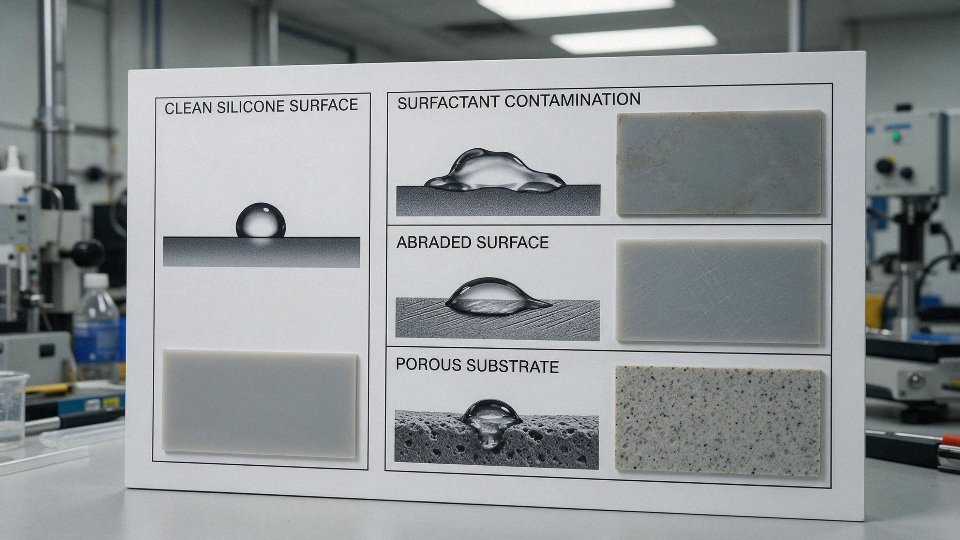
If performance matters beyond a quick beading demo, evaluate the full service sequence: what hits the surface first, what cleans it, what rubs it, what gets absorbed, and what process comes after. That is usually where the true pass/fail boundary shows up.
Material comparisons
Silicone oil is usually the right choice when you need durable water beading, broad temperature tolerance, electrical compatibility, and easy processing without building a thick barrier film. It is not the universal winner: fluorinated systems still lead where oil repellency matters, silanes often last longer on masonry, and acrylic or polyurethane coatings outperform it when the job is true moisture blocking rather than surface water shedding.
Procurement teams get into trouble here by comparing products only on purchase price per kilogram. In practice, the decision rides on what the chemistry is actually doing on the surface: sitting as a mobile low-energy fluid, reacting into the substrate, or curing into a continuous film. That mechanism drives dosage, rework risk, durability, compliance exposure, and how much customer complaint you inherit six months later.
Silicone oil versus mineral oils and hydrocarbon fluids
Mineral oils can look attractive on a spreadsheet because they are familiar, cheap, and easy to source. For short-term water shedding on some surfaces, they can work. The gap shows up once the line sees heat, oxygen, electrical duty, or a requirement for clean, stable appearance.
A practical comparison is below.
| Property | Silicone oil | Mineral oil / hydrocarbon fluid |
|---|---|---|
| Water repellency | Strong; typical silicone-treated surfaces can show about 95-110° water contact angle depending on substrate and film quality | Hydrophobic, but usually less effective and less stable as a low-energy surface treatment |
| Surface tension | About 20-21 mN/m at 25°C for PDMS fluids | Typically higher than PDMS; depends on cut and formulation |
| Thermal stability | Generally better across a wider temperature window | More prone to thermal degradation and thickening at elevated temperature |
| Oxidation resistance | Usually better | Usually poorer, especially with air exposure and heat |
| Dielectric behavior | Commonly preferred in electrical applications | Often less stable electrically over time |
| Volatility / evaporation pattern | Depends strongly on viscosity and molecular distribution | Light fractions can evaporate or migrate; heavier grades can leave greasy residue |
| Residue behavior | Clear, slippery, persistent surface feel | Oily residue, yellowing or varnish risk depending on service |
The mechanism matters. Silicone oil presents methyl-rich groups at the surface, which lowers surface energy efficiently. Mineral oils are hydrophobic too, but they do not create the same stable low-energy interface, and they oxidize more readily. Once oxidation starts, you can get odor, color shift, viscosity drift, or sticky deposits. In a dusty plant, that turns from a chemistry issue into a housekeeping and reject issue fast.
The trade-off is simple: hydrocarbons often win on unit price and sometimes on compatibility with existing oil-based systems. Silicone oil usually wins on service stability, especially where heat, oxidation, or dielectric reliability matter. That advantage narrows in low-temperature, noncritical applications where replenishment is frequent and residue is acceptable.
Silicone oil versus fluorinated repellents
If the requirement is only water repellency, silicone oil often gives a better cost-to-performance balance. If the surface must resist both water and low-surface-tension oils, fuels, fingerprint soils, or aggressive staining liquids, fluorinated chemistries still hold ground in some niches.
The reason is straightforward. Silicone lowers surface energy well, but fluorinated surfaces can push it lower still, especially against oils. That is why fluorinated repellents historically dominated high-end textile, paper, and specialty coating applications that demanded both hydrophobicity and oleophobicity.
Procurement and EHS teams, though, cannot ignore the compliance side:
- Fluorinated systems face much heavier environmental and regulatory scrutiny in many markets.
- Product stewardship expectations are tighter, especially around persistent fluorinated substances.
- Qualification cycles can be longer because customers ask harder questions on composition and downstream compliance.
- Cost per effective treatment area is often materially higher.
That does not mean “avoid fluorinated” as a blanket rule. It means use them where the performance gap is real and proven. Examples can include anti-smudge surfaces, severe stain resistance, or applications involving oily contaminants that silicone will not repel effectively. For general water shedding, release aid, dielectric fluid duty, or low-energy surface modification without oil repellency, many buyers are actively replacing fluorinated options with silicone-based systems or hybrid packages.
Silicone oil can replace fluorinated water repellents in every application.False
Silicone oil is often a practical replacement where water repellency is the main requirement, but fluorinated systems still outperform in some oil-repellent and stain-resistant applications. The choice depends on the contaminant profile and compliance requirements.
Silicone oil versus silane and siloxane masonry treatments
On porous mineral substrates such as concrete, brick, sandstone, and render, free silicone oil is often the wrong benchmark. Penetrating silane and certain siloxane masonry treatments are designed to move into pore structure and then anchor or react in place. That usually gives better long-term weathering resistance than a mobile silicone fluid sitting mainly near the surface.
Key distinctions:
- Penetration: low-molecular-weight silanes generally penetrate deeper into fine pores than high-viscosity silicone oils.
- Bonding: reactive masonry treatments can chemically attach or condense within the substrate; silicone oil typically does not form that same bonded network.
- Durability: bonded hydrophobes tend to survive rain washout and UV exposure better on porous inorganic materials.
- Appearance risk: excess silicone oil can darken the surface, create uneven wet patches, or interfere with later overcoating.
Where silicone oil does fit is in temporary water shedding, dust suppression, mold release around mineral handling, or as part of a formulated treatment rather than as the primary masonry water repellent. The conclusion stops holding if the substrate is not porous or if the system is specifically engineered as a silicone resin or reactive emulsion rather than a simple fluid.
Silicone oil versus waxes and paraffins
Waxes and paraffins are still common because they are cheap, familiar, and can give strong initial water resistance. They are especially common in packaging, board treatment, textiles, and low-cost temporary protection. Their weakness is mechanical and thermal behavior.
Compared with wax systems, silicone oil generally gives:
- less brittle surface feel
- better softness and slip
- better retention under repeated flexing
- less cracking of the hydrophobic layer
- more stable feel across temperature swings
Waxes win when a firmer, more “dry” film is desired and when melt-process economics are already built into the line. They can also be easier to combine with certain paper and board converting operations. But once the coated article is bent repeatedly, creased, or exposed to warm conditions, wax films can craze, print, or transfer. A thin silicone layer stays mobile and lubricious, which helps on flexible substrates, though that same mobility can be a drawback if you need paintability or adhesive bonding later.
Silicone oil versus acrylic and polyurethane barriers
This is one of the most common specification mistakes: treating silicone oil as if it were a barrier coating. It is not. Silicone oil mainly changes wetting behavior at the surface. Acrylics and polyurethanes, when properly formulated and cured, can form continuous films that physically slow liquid water ingress, dirt pickup, and sometimes vapor transmission.
That means the comparison should start with the job definition:
- If you need water beading, release, slip, or a breathable water-shedding finish, silicone oil is often enough.
- If you need measurable barrier performance, scrub resistance, abrasion resistance, or a paint-like protective layer, acrylic or polyurethane systems are usually the right class to evaluate.
- If you need both, you are often looking at a layered or hybrid system.
The trade-off is processing complexity. Barrier coatings usually need tighter surface prep, film-build control, curing conditions, and defect management. Silicone oil is much easier to apply, but easier to remove or disrupt in service too. Anyone who has seen a barrier coat blister over contaminated steel knows that “simpler chemistry” is not always the simpler project.
Silicone oil versus reactive silicone emulsions and resins
A silicone oil can deliver immediate repellency because the fluid reaches the surface quickly and presents a low-energy interface without much curing. Reactive silicone emulsions and silicone resins are different animals. They are selected when you need the silicone character plus a more fixed, cured, or crosslinked network.
Use silicone oil when you want:
- rapid wetting modification
- lubricity and slip
- easy incorporation into a formulation
- adjustable viscosity from a few cSt to well above 1,000,000 cSt depending on use
Use reactive emulsions or resins when you need:
- wash durability
- lower migration
- better rub resistance
- improved retention after weathering or cleaning cycles
That comes with more process control. Emulsion stability, pH sensitivity, cure conditions, catalyst effects, and substrate interaction all matter. A plant that can meter and mix simple fluids reliably may still struggle with reactive silicone systems if housekeeping and batching discipline are weak.
Procurement factors that matter more than price per drum
For buying teams, the useful comparison is total cost of ownership, not list price.
Check these points before issuing or changing a spec:
- Dosage efficiency
- Compare delivered performance at equal add-on or equal coated area, not equal purchase mass.
- A more expensive silicone may need much less to reach the same water repellency.
- Processing complexity
- Ask whether the product needs heating, dilution, emulsification, controlled cure, or special mixing order.
- Cheap chemistry that slows the line or increases scrap is rarely cheap.
- Durability in the actual duty cycle
- Verify exposure to heat, UV, washdown, abrasion, flexing, and contaminant type.
- Lab beading on a clean panel is not service life.
- Regulatory and customer acceptance
- Check market-specific restrictions, declaration requirements, and downstream customer standards.
- This is especially sensitive for fluorinated products and for applications with food, textile, or consumer contact implications.
- Supplier-to-supplier consistency
- For silicone oils, viscosity alone is not enough. Molecular distribution, volatile content, trace catalysts, and additive package can change behavior.
- On the plant floor, that shows up as foam changes, leveling differences, fish-eyes, odor, or cure interference elsewhere in the line.
- Residue and downstream compatibility
- Confirm whether the treated part will later be painted, bonded, printed, laminated, or overmolded.
- Silicone contamination can create expensive downstream defects if that interface is not controlled.
If you are narrowing alternatives for a specific formulation or production line, the shortest path is usually a side-by-side trial on the actual substrate with the actual contaminant and post-process sequence. Surface chemistry that looks interchangeable on a datasheet often stops being interchangeable the moment the part hits dust, heat, flexing, or an operator’s gloves.
Testing and verification
A silicone oil finish is not “verified” because water beads once on a clean lab panel. It is verified when the treated surface meets a defined wetting target, keeps that performance after the service exposures that matter, and can be reproduced batch after batch under plant conditions. In practice, that means using a small set of complementary tests rather than betting everything on a single contact-angle number.
Lab screening methods
Start with screening that matches the substrate and the failure risk.
- Static contact angle
- Useful for quick ranking of treated films, molded parts, glass, metal panels, and smooth coated surfaces.
- Typical silicone-treated surfaces often show about 95-110 degrees water contact angle, but that range depends heavily on substrate roughness, film continuity, and any surfactant or modifier left in the system.
- Good for development and supplier comparison.
- Weak on porous or highly textured substrates, where the droplet shape can mislead.
- Dynamic contact angle or roll-off behavior
- Advancing/receding angle, hysteresis, or simple tilt tests tell you whether water merely beads or actually sheds.
- This matters on textiles, release liners, exterior coatings, and any application where standing droplets are still a problem.
- A surface can show a respectable static angle and still hold water if hysteresis is high because the film is patchy or contaminated.
- Spray rating
- Common for fabrics and treated flexible materials.
- Better aligned with use conditions than a bench droplet test because it reflects impact, spreading, and partial penetration.
- Results depend on test method, operator discipline, and fabric construction, so lock the method before comparing suppliers.
- Cobb testing for paper and board
- Appropriate where the commercial question is water uptake over a fixed time, not just visible beading.
- Particularly useful in paper converting, packaging, and specialty treated cellulose.
- If Cobb is your key metric, contact angle becomes a supporting indicator, not the acceptance criterion.
- Hydrostatic pressure testing
- Relevant for barrier fabrics, coated membranes, and some protective materials.
- This checks resistance to water penetration under pressure, which is a different mechanism than simple surface wetting.
- Silicone oil may improve surface repellency without delivering high hydrostatic resistance unless the structure and film continuity support it.
- Absorbency or pickup measurements
- Gravimetric uptake, immersion pickup, blotting response, or timed penetration tests are useful on porous substrates.
- These often correlate better with field complaints than glossy photos of round droplets.
The mechanism is straightforward: low surface energy helps the droplet resist spreading, but end-use failures often happen by penetration through pores, defects, or worn zones, not by idealized wetting on a pristine patch. That is why a packaging paper, woven fabric, and cast film should not be screened with the same single favorite test.
Surface characterization
Once screening shows promise, verify that the surface actually received a consistent treatment.
- Film uniformity
- Check visually, by microscopy if needed, or by mapped wetting measurements across the width.
- Edge-to-center variation is common on pilot coaters and dip lines with unstable drainage.
- Add-on level
- Use gravimetric gain, extractables, ash-substitution approaches where relevant, or coating weight calculations.
- Too little add-on gives patchy repellency; too much can create transfer, dust pickup, or downstream bonding problems.
- Extraction tests
- Solvent or detergent extraction can show whether the silicone is loosely deposited or more firmly retained.
- This is often where an apparently good finish gets exposed.
- FTIR or similar analytical checks
- Useful for confirming silicone presence, comparing batches, or troubleshooting whether a failed sample was under-treated or contaminated.
- Not every plant needs routine FTIR, but it is valuable in supplier qualification and complaint analysis.
- Substrate cleanliness verification
- Residual surfactant, machining oil, release agent, or even fingerprints can distort results.
- In my experience, dirty coupon prep causes more false negatives than most teams want to admit.
A high contact angle by itself is enough to qualify a silicone oil treatment for production.False
A single contact-angle result does not capture durability, penetration resistance, process variation, contamination sensitivity, or end-use exposure. Qualification needs application-relevant performance and reproducibility checks.
Durability testing
Durability should be selected from the actual service environment, not copied from a generic textile or coating spec.
- Laundering or wash resistance for garments, reusable wipes, and treated fabrics
- Abrasion for handling wear, conveyor contact, folding, or rubbing surfaces
- Weathering and UV exposure for outdoor parts, construction materials, and exterior coatings
- Heat aging where ovens, hot-fill, engine-bay temperatures, or heated storage matter
- Condensation cycling for repeated wet-dry service and cold-room transitions
- Chemical resistance against detergents, process fluids, weak alkali, acids, or cleaning agents likely to contact the surface
There is a trade-off here. A mobile, low-viscosity silicone can give easy initial coverage and strong beading, but it may migrate or wash down more readily; a more anchored or higher-build system can last longer, though sometimes at the cost of hand feel, transparency, bonding, or process speed. The preferred choice flips once the service exposure becomes harsher than the value of a very slick initial finish.
Process-control indicators
For incoming QC and production consistency, track the variables that usually drift first:
- Viscosity
- Solids content
- Emulsion stability
- Particle size, if emulsion or dispersion based
- pH, where formulation stability depends on it
- Batch-to-batch appearance and separation behavior
Silicone oils span viscosities from a few cSt to well above 1,000,000 cSt, so “same chemistry” does not mean same process behavior. Small shifts in viscosity or emulsion stability can change pickup, leveling, and cure response enough to move repellency results, especially at high line speeds.
Field validation
Pilot and in-use trials catch what the lab misses.
- Line speed can cut dwell time and reduce film formation
- Drying conditions can leave residual water, surfactant, or incomplete fixation
- Local water chemistry can destabilize emulsions or alter substrate wetting
- Ambient contamination from oils, dust, softener carryover, or recycled process liquor can change outcomes
- Operator habits such as bath make-up order or tank residence time often matter more than the SOP suggests
The main boundary on all lab conclusions is simple: if production introduces contamination, uneven drying, or different pickup than the test setup, bench data stops predicting service reliably.
Acceptance criteria design
Write acceptance criteria around the end-use risk, not around the easiest test to run.
- Define the functional requirement:
- visible beading,
- delayed water penetration,
- reduced pickup,
- wash durability,
- outdoor retention,
- or pressure resistance.
- Tie each requirement to measurable tests:
- contact angle for smooth surfaces,
- spray rating for fabrics,
- Cobb for paper,
- hydrostatic pressure where barrier performance matters,
- plus retention after selected durability cycles.
- Set limits with practical tolerances:
- include sample conditioning,
- test liquid quality,
- number of replicates,
- and pass/fail logic for batch release.
- Include at least one process indicator and one performance indicator.
- That combination catches both formulation drift and application failure.
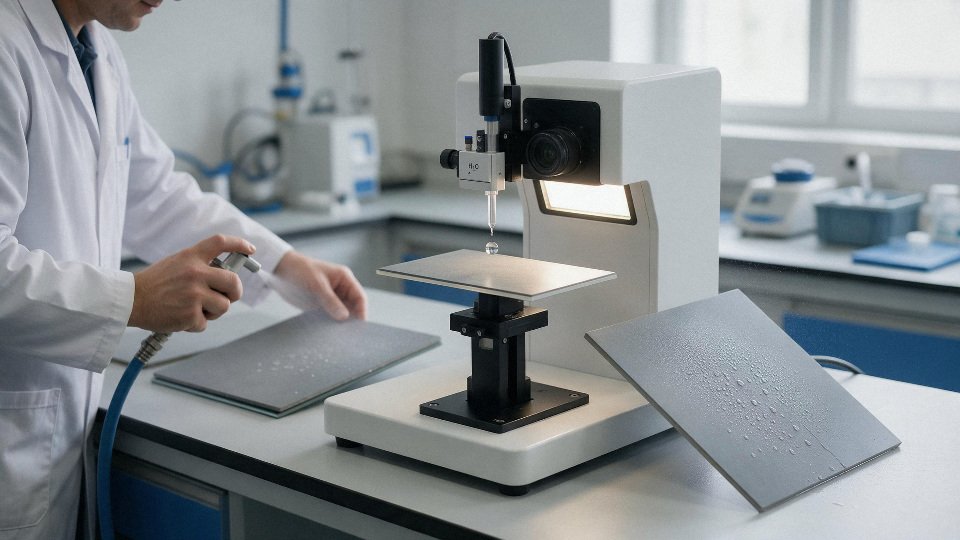
A cosmetic bead test is fine for a sales sample. For engineering release or supplier approval, the spec should answer a harder question: what level of water repellency must survive which exposure, on which substrate, with what allowed variation. That is the point where silicone oil performance becomes a controlled product characteristic rather than a nice demo.
Frequently asked questions
Does silicone oil dissolve in water?
No. Standard silicone oils such as PDMS are essentially water-insoluble, so they separate from water rather than forming a true solution. They can be emulsified with surfactants for application, but that is a dispersed system, not dissolution.
In plant terms, that distinction matters. A stable emulsion can look like “water-based silicone,” yet after drying the deposited silicone phase is still hydrophobic and water-insoluble. If your process includes rinse tanks, alkaline wash, or high-shear recirculation, check whether the product is a neat fluid, an emulsion, or a reactive microemulsion because cleanup behavior and deposition efficiency differ a lot.
Can silicone oil make any surface waterproof?
No. Silicone oil can improve water repellency on many substrates, but it does not automatically create a durable waterproof barrier on every surface. Porosity, contamination, surface energy, film continuity, and mechanical wear decide whether you get beading, short-term splash resistance, or a coating that actually holds up outdoors.
It struggles on badly contaminated parts, very smooth low-energy plastics without pretreatment, and surfaces exposed to abrasion or detergent attack. Waterproofing also implies hydrostatic resistance, seam integrity, and defect-free coverage; a low-surface-energy fluid alone does not guarantee that.
Why does water still stick to some silicone-treated parts?
Usually one of five causes is responsible:
- Poor surface preparation
Oil, mold release, polishing compound, corrosion products, or even fingerprints can block uniform spreading. - Discontinuous film
Too little add-on, poor dilution control, or uneven drying leaves untreated islands where water anchors. Wrong formulation for the substrate
A simple fluid may bead water on glass yet underperform on porous mineral surfaces that often need reactive chemistry.Surface roughness and defect geometry
Some textures trap water mechanically. You may still measure a decent contact angle but see stubborn droplets.Aged or contaminated treatment layer
Dust, surfactant carryover, detergent residue, or process oils can mask hydrophobicity.
If a treated part fails unexpectedly, do not jump straight to “bad silicone.” Check cleanliness, coat weight, cure history if applicable, and whether the surface was touched by anything containing surfactants after treatment.
Is silicone oil better than silane for stone and concrete?
Usually not for long-term mineral-substrate impregnation. Silanes and silane/siloxane systems are often the stronger choice for stone, masonry, and concrete because they can penetrate and chemically anchor within the pore structure.
Silicone oil can provide short-term water shedding or surface slip, but on exterior concrete it is often the wrong tool if you need deep penetration, vapor permeability retention, and weathered durability. The choice flips if the job is not structural waterproofing but lubrication, release, gloss, antifoam behavior, or temporary hydrophobing.
**Does higher viscosity always mean better water repellency?****
No. Higher viscosity can improve film persistence and reduce migration, but it does not automatically raise water repellency. In practice, low-to-medium viscosity grades often wet and spread more uniformly, while very high viscosity products may leave patchy coverage unless the application method is set up for them.
The trade-off is simple: thicker fluids usually stay put better, but they are harder to meter, dilute, atomize, and clean. For textiles, paper, or fine-feature parts, excessive viscosity can hurt coverage more than it helps retention.
**Can silicone oil also repel oils and solvents?****
Generally no. Silicone oil is good at repelling water because of its low surface energy, but many hydrocarbon oils and organic solvents wet silicone-treated surfaces much more easily than water does.
If the requirement is both water and oil repellency, look at fluorinated or specially modified systems, then verify current regulatory and customer restrictions before you commit. Silicone is often chosen where water beading, slip, and temperature stability matter more than oleophobicity.
How long does a silicone oil treatment last?
It depends on whether the layer is simply deposited or chemically fixed, and on the service environment. A light wipe-on film may last hours to weeks in handling conditions; a well-designed cured or bonded system can last much longer, but outdoor UV, abrasion, detergent wash, steam, and repeated flexing all shorten life.
Without substrate, add-on level, and exposure details, any supplier claiming a universal service life is guessing. Ask for durability data tied to a defined test method, not a marketing statement.
Silicone oil treatment life can be predicted from viscosity alone.False
Retention depends on substrate chemistry, film continuity, mechanical wear, wash exposure, temperature, and whether the silicone is merely deposited or chemically anchored. Viscosity is only one variable.
Will silicone oil interfere with painting, printing, or bonding?
Very often, yes. Silicone contamination is notorious for causing fisheyes, craters, poor ink wetting, adhesive failure, and inconsistent lamination.
This is one of the most expensive shop-floor mistakes because very small transfer levels can create downstream defects. If parts may later be painted, printed, heat sealed, or bonded, involve those process owners before approving any silicone-containing treatment.
Is silicone oil safe for textile, personal care, or food-related applications?
Only some grades, and only within the applicable regulatory framework. “Silicone oil” is a broad category; suitability depends on composition, residual volatiles, additives, purity, and the exact end use.
For textiles, ask about skin-contact expectations, wash durability, and restricted-substance compliance. For personal care, request cosmetic-grade documentation and ingredient status. For food-related applications, verify the exact intended contact scenario against current supplier declarations and the applicable local regulations; do not assume industrial-grade material is acceptable.
What data should I request from a silicone oil supplier before qualification?
- Product identity
- Chemical type and whether it is neat fluid, emulsion, modified silicone, or reactive system
- Nominal viscosity range and test method
- Solids content if supplied as an emulsion or dispersion
- Performance data
- Water contact angle or equivalent repellency data, with substrate and test conditions stated
- Durability results after wash, abrasion, heat, humidity, or weathering, if relevant
- Surface tension data where useful for wetting comparisons
- Application guidance
- Recommended add-on level, dilution range, drying or cure conditions
- Compatibility limits with surfactants, resins, catalysts, pigments, or other bath components
- Quality and handling
- COA items, typical value range, shelf life, storage conditions
- Emulsion stability window if applicable
- SDS and contamination-control guidance
- Regulatory and downstream-risk information
- VOC or volatile content where relevant
- Compliance declarations for the target market
- Statement on paintability, printability, or bondability impact if downstream finishing is possible
- Qualification support
- Representative sample availability
- Technical review based on your substrate, contaminant load, process line, and performance target
Your product selection checklist
The right silicone choice usually comes down to three things: what the surface is, what the service does to the coating, and what failure you can actually tolerate. If you specify only “water repellent silicone oil,” you will almost certainly buy either too little durability or too much cost. A workable selection starts by narrowing the chemistry to the substrate and duty cycle, then tightening the specification window to what your line can apply and control.
1. Start with the substrate and service condition
- Porous substrates
Paper, textile, leather, mineral surfaces, wood, and some construction materials behave differently from films or metals because the liquid can wick in instead of staying at the surface. Penetration can help durability, but it also raises consumption and can change hand feel, printability, or breathability. Nonporous substrates
Glass, coated metals, plastics, rubber, and finished films rely more on surface coverage and anchoring. Here, poor wetting uniformity, dewetting defects, or transfer issues often matter more than simple hydrophobicity.Service exposure to check up front
- Repeated washing or rinse cycles
- Abrasion or handling wear
- Heat exposure during use or downstream processing
- UV and weathering
- Detergents, surfactants, or alkaline cleaners
- Short splash contact versus prolonged immersion
A common mistake on the plant floor is selecting from a benchtop beading result on a clean coupon, then sending the same chemistry onto a line where detergent residue, corona treatment decay, or oven profile changes the whole outcome. Immersion and detergent exposure are the usual points where a simple non-reactive fluid stops being enough.
2. Define the real performance target
Pick the primary target before discussing product grade. “Water repellent” can mean several different things in production:
- High initial beading or contact angle
- Durable repellency after washing or weathering
- Breathability retention on porous goods
- Dielectric stability for electrical uses
- Release performance
- Slip or sensory feel
- Compatibility with printing, bonding, coating, or painting steps
This is where the preferred choice flips. A low-surface-tension silicone that beads water nicely may still create trouble if the next operation needs adhesion or ink laydown. In practice, the best product is often the one that delivers enough repellency without creating a downstream defect that costs more than the benefit.
3. Match the chemistry class to the job
- Straight PDMS fluid
Best when you need basic hydrophobicity, lubrication, dielectric properties, or release with relatively simple processing. Often economical, but durability on exposed surfaces is limited unless the system has a way to anchor. Modified silicone fluid
Useful when compatibility, substrate wetting, feel, or co-formulation matters. Organic modification can improve dispersion or interaction with the substrate, though it may trade off some pure hydrophobic character.Silicone emulsion
Practical for water-based processing and easier handling on many lines. Check particle size, emulsion stability, and what happens during drying; poor emulsion fit shows up as streaks, spots, or uneven pickup.Reactive siloxane or silane treatment
Better for durable anchoring on suitable substrates, especially where washing, abrasion, or weathering matter. The mechanism is different: instead of just sitting on the surface, the material can bond or condense into a more permanent treatment layer. That usually improves retention, but process control gets tighter.Hybrid system
Often the right answer when one chemistry alone cannot balance repellency, adhesion, flexibility, and process compatibility.

4. Set the key specification window
Ask suppliers to define the usable range, not just a nominal grade name.
- Viscosity
Commercial silicone oils can range from a few cSt to above 1,000,000 cSt. Lower viscosity usually improves spreading and handling; higher viscosity can improve film persistence and reduce migration, but it may complicate pumping, mixing, and uniform application. Active content
- Volatility profile
- Flash point, where solvent handling or heated application makes it relevant
- Particle size, for emulsions
- Impurity or residue limits, especially for electronics, coatings, or appearance-sensitive goods
A higher-viscosity silicone oil is always more water repellent.False
Higher viscosity can improve persistence or film retention, but water repellency depends on the surface formed on the substrate, film continuity, chemistry, and service conditions. It is not a universal predictor of beading or durability.
5. Verify application fit on your line
- Dilution method and mix stability
- Line speed and residence time
- Drying or curing requirement
- Wet pickup or coating weight control
- Compatibility with existing additives, defoamers, catalysts, and equipment seals
This section’s main conclusion stops holding if the line cannot deliver the required film consistently. A strong chemistry applied with unstable dilution water, poor agitation, or marginal oven capacity will lose to a less ambitious product that the line can actually run every shift.
6. Confirm compliance and supply reliability
Before scale-up, ask for:
- Technical data sheet
- Certificate of analysis
- Regulatory documents relevant to your market and end use
- Batch-to-batch consistency approach
- Packaging options matched to your consumption rate
- Logistics lead time and replenishment support
7. Request evidence before committing plant time
- Benchmark samples
- A written test protocol
- Comparative data on your actual substrate
- Pilot-trial or application review support
If you are screening suppliers, ask them to define what they expect to outperform and under which test conditions. That separates a serious technical proposal from a brochure claim very quickly.
If you want a practical recommendation, send SiliconChemicals your substrate material, contaminant or service exposure, approximate treatment level or layer thickness, working area, required finish, target line rate, and clear part photos or samples. With that, the team can recommend a suitable silicone oil or siloxane-based water-repellent system and support sample evaluation against your process conditions.