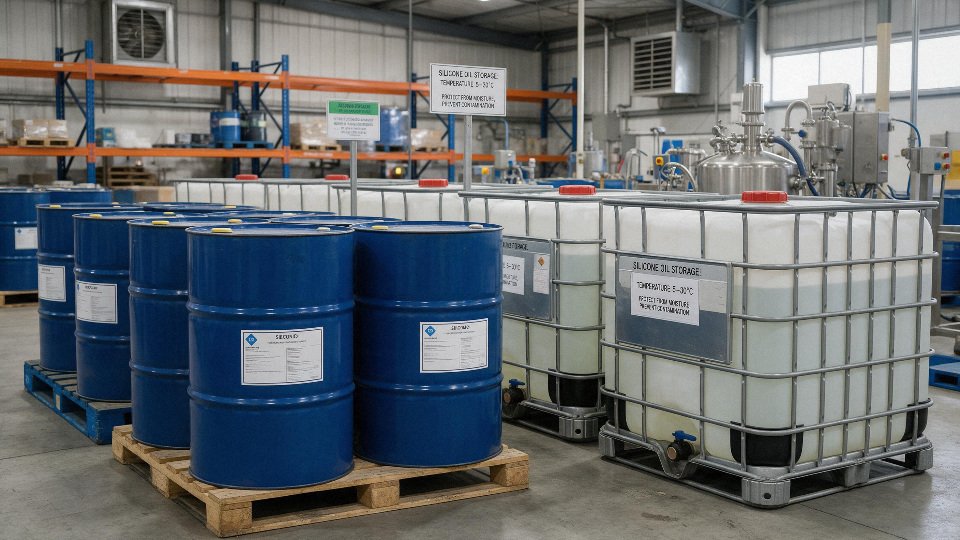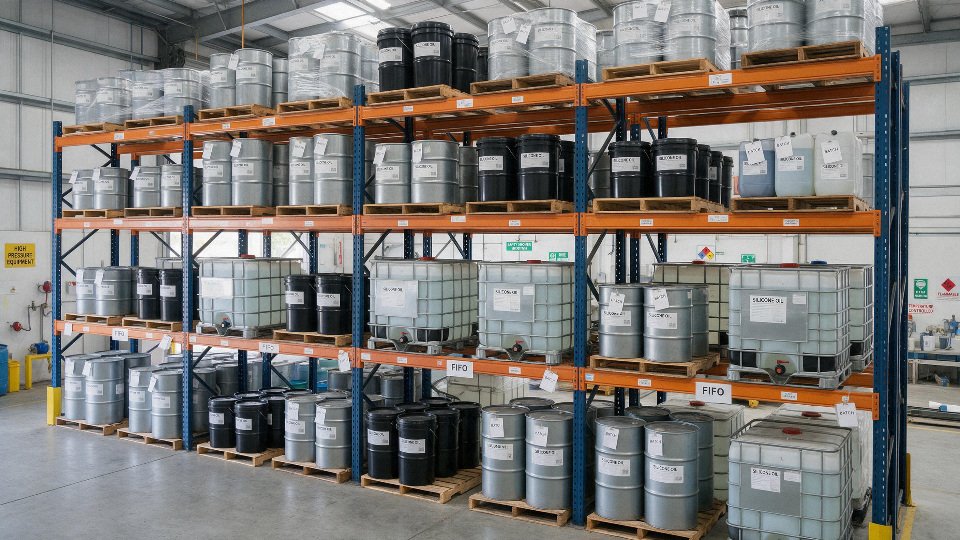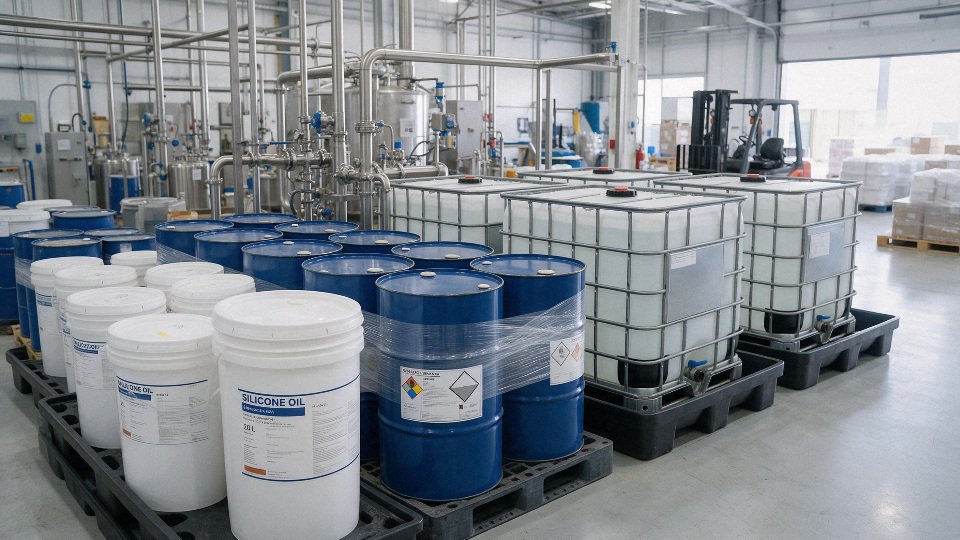
Specifying the wrong process oil doesn’t just mean a suboptimal lubricant — it means seized actuators at 3 a.m., food-line shutdowns triggered by a failed FDA compliance audit, or a batch of silicone rubber compounds that never cured properly because someone swapped in a mineral oil that poisoned the catalyst. The cost of that confusion lands somewhere between a maintenance callout and a full product recall, depending on how far downstream the mistake travels before anyone catches it.
Silicone oil (polydimethylsiloxane) and white mineral oil are both clear, odorless process fluids, but they differ sharply where it counts: silicone oil spans a viscosity range of 0.65 cSt to over 1,000,000 cSt at 25°C and carries a flash point above 300°C, while food-grade white oil runs 2–500 cSt at 40°C with a flash point of roughly 135–200°C depending on grade. Silicone oil costs USD 3–12/kg versus USD 1.2–3.5/kg for white oil in bulk. The right choice depends on your temperature window, regulatory environment, and whether the fluid ever contacts a platinum-cure silicone system.
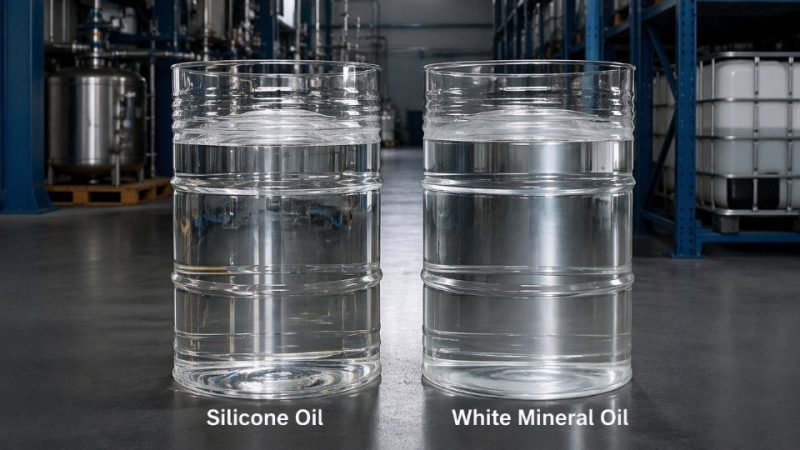
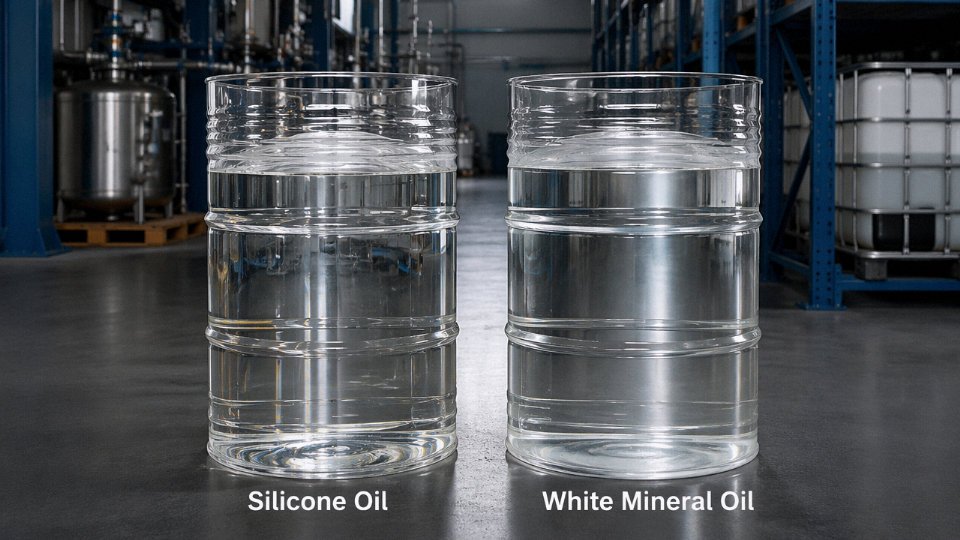
What makes this comparison genuinely tricky is that the two fluids look nearly identical in a drum, behave similarly at room temperature in casual handling, and both show up on supplier quote sheets as “lubricating oil” — which is how procurement teams end up consolidating them into a single line item, usually right before something expensive goes wrong.
Chemical Composition and Molecular Architecture That Drive Performance Differences
The reason these two oils behave so differently in service comes down to their backbone chemistry — and once you understand that, most of the downstream performance differences stop being surprising.
Silicone Oil: The Si–O Backbone and Why It Matters
Silicone oil — polydimethylsiloxane in its most common form — is built on an alternating silicon-oxygen chain with methyl groups hanging off each silicon atom. That Si–O bond carries a dissociation energy of roughly 450 kJ/mol, compared to about 346 kJ/mol for a C–C bond in a hydrocarbon. That gap is not trivial. It means the backbone resists thermal scission and oxidative attack at temperatures that would already be degrading a mineral oil. In practice, silicone oil remains serviceable from roughly –60°C up to 200°C or higher in continuous service, with flash points typically above 300°C — though the exact upper limit depends on viscosity grade and whether you’re running in an open-bath configuration or a sealed system.
The methyl side groups are non-polar, flexible, and relatively far apart due to the Si–O bond angles. This gives the molecule an unusually low internal friction — which is why silicone oil can be formulated across an extraordinary viscosity range, from 0.65 cSt all the way to 1,000,000 cSt at 25°C, while the viscosity-temperature relationship stays comparatively flat. Engineers describe this as a high viscosity index in practical terms, though strictly speaking “viscosity index” is defined for mineral oils. What it means on the plant floor: a damping fluid in a precision instrument stays predictably viscous whether the line is cold at startup or hot mid-shift.
White Mineral Oil: Hydrocarbon Structure and the Refining Hierarchy
White mineral oil is a fully refined petroleum fraction — paraffinic, naphthenic, or a blend — where nearly all aromatics, sulfur compounds, and reactive species have been removed. The carbon chains are saturated, branched (in paraffinics) or ring-structured (in naphthenic grades). Both types work as lubricants and process fluids, but their cold-flow and solvency behavior differ enough to matter in some applications.
The refining pathway is where food-grade and technical-grade white oil diverge significantly. Technical-grade goes through hydrotreatment to strip unsaturates and reduce aromatic content, but not necessarily to USP/NF pharmaceutical standards. Food-grade — required under Codex Alimentarius and NSF H1 / H2 classifications — demands a deeper hydrotreatment followed by dewaxing, plus rigorous aromatic content verification. The IP346 test (DMSO extract method) must typically show less than 3% extractable aromatics to meet food and pharmaceutical acceptance. If a supplier cannot produce IP346 data on demand, that is a procurement red flag, full stop.
Viscosity in white oil is controlled by chain length and degree of branching. Longer, less-branched chains give higher viscosity but also poorer low-temperature flow. The usable viscosity range for white oil runs roughly 2–500 cSt at 40°C — narrower than silicone by orders of magnitude, and the viscosity-temperature relationship is steeper. On a cold morning startup in an unheated facility, a 100 cSt white oil will be noticeably stiffer than the same viscosity-grade silicone oil.
Impurity Profiles You Cannot Ignore
For silicone oil, the impurity concern that comes up in regulatory work is cyclic siloxanes — specifically D4 (octamethylcyclotetrasiloxane), D5, and D6. These low-molecular-weight cyclics are byproducts of the polymerization process and are present in varying concentrations depending on how thoroughly the manufacturer has stripped them out. D4 and D5 carry environmental persistence concerns and are restricted under REACH in wash-off products in Europe. If you are specifying silicone oil for a food-contact or personal care adjacent application, ask your supplier explicitly for D4/D5/D6 content data — not all technical data sheets include it by default.
Food-grade white mineral oil must pass the IP346 DMSO extraction test with less than 3% extract to confirm low aromatic content.True
The IP346 test is the standard method referenced by regulatory bodies including the EU and USP for determining the polycyclic aromatic content of mineral oils intended for food, pharmaceutical, and cosmetic contact. The 3% threshold is widely cited in food-contact material regulations and supplier qualification requirements.
Surface Tension and What It Means Operationally
Silicone oil sits at roughly 20–21 mN/m surface tension. White mineral oil typically runs 28–32 mN/m depending on viscosity and refining depth. That 8–10 mN/m gap sounds academic until you’re dealing with a foam-control application or a mold-release coating that needs to spread into tight geometry.
Low surface tension means silicone oil wets and spreads over most substrates aggressively — useful in release coatings, antifoam formulations, and thin-film lubrication of polymer parts. It also means silicone contamination in a paint or adhesive line is genuinely difficult to remediate; even trace amounts can cause fish-eye defects. White oil spreads more moderately, which in some textile and personal care applications is actually preferable — you want the oil to stay where you put it rather than wick laterally. The polarity difference also affects how each fluid interacts with elastomer seals, a topic the compatibility section covers in detail.
Thermal, Oxidative, and Electrical Property Benchmarks Side by Side
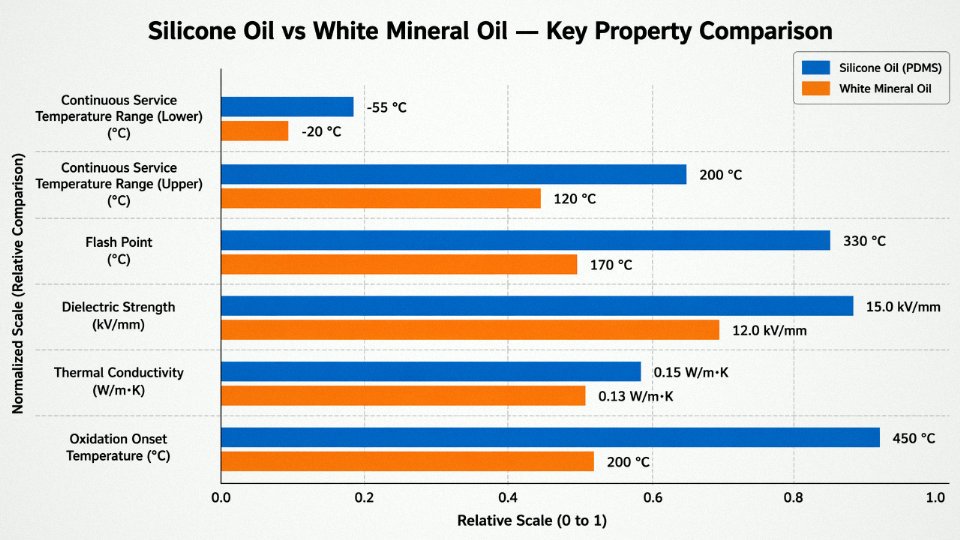
These two oils occupy completely different bands on almost every performance axis that matters to a process engineer. The table below anchors the discussion; the details that follow explain what drives each figure and where the published spec can mislead you in practice.
| Property | Silicone Oil (PDMS) | White Mineral Oil | Key Dependency |
|---|---|---|---|
| Continuous service temp (lower) | –60°C | –20°C (some pour-point-depressed grades to –35°C) | Viscosity grade, base stock refining depth |
| Continuous service temp (upper) | +200°C standard; +250–300°C with antioxidant package | +100 to +120°C | Presence of O₂, film thickness, contaminants |
| Flash point | >300°C (high-vis grades) | 135–200°C | Viscosity / distillation cut |
| Dielectric strength | 15–20 kV/mm | 10–15 kV/mm | Moisture content, dissolved gas |
| Thermal conductivity | ~0.16 W/m·K | ~0.13 W/m·K | Temperature; both drop slightly with rising temp |
| Oxidation onset (PDSC) | 280–320°C typical | 170–210°C (uninhibited); 220–260°C inhibited | Antioxidant loading, metal catalyst presence |
Continuous Service Temperature and What the Limits Actually Mean
The –60°C lower bound for silicone oil is real, but it assumes a low-viscosity grade — something in the 5–50 cSt range. A 100,000 cSt silicone oil will gel at cold temperatures and become functionally useless in a dynamic seal application long before you hit –60°C. White oil has a narrower useful window on both ends. At sustained temperatures above about 110°C, uninhibited white oil starts to oxidize measurably; by 130°C you are consuming antioxidant reserves at a rate that makes annual oil changes optimistic. In bath heating or temperature-controlled manufacturing lines, that distinction matters more than most procurement specs acknowledge.
Flash Point and Hazardous Area Classification
Silicone oil’s flash point above 300°C puts it in a genuinely favorable position for ATEX Zone 1 or NEC Class I Division 1 environments — not because it is non-flammable (it will burn under the right conditions), but because the auto-ignition threshold is so high that normal process upsets are unlikely to trigger ignition. Insurance underwriters and process safety engineers will notice. White oil at 135–160°C flash point (the lower end of the commercial range, typical of lighter-viscosity food-grade grades) sits much closer to common process temperatures and will require more rigorous leak-detection and ventilation provisions.
Silicone oil is completely non-flammableFalse
Silicone oil (PDMS) does have a flash point, typically above 300°C for high-viscosity grades, but it is combustible under sufficient heat and ignition energy. It is significantly less flammable than white mineral oil but should not be treated as a fire-safe fluid without proper hazard assessment.
Dielectric Strength and Electrical Insulation Applications
The 15–20 kV/mm range for silicone oil versus 10–15 kV/mm for white mineral oil sounds like a modest gap, but at high-voltage transformer design voltages — say, 132 kV — that difference translates directly into insulation geometry and ultimately into the size and weight of the transformer tank. Silicone fluid transformers are a real product category for exactly this reason. Both fluids are sensitive to moisture; even 50–100 ppm of dissolved water can drop measured dielectric strength substantially, so the incoming acceptance test (typically IEC 60156) matters as much as the nominal grade spec.
Oxidative Stability
Silicone oil’s oxidation resistance comes from the Si–O backbone, which is inherently more stable than C–C and C–H bonds under thermal stress. PDSC testing typically shows oxidation onset above 280°C for standard PDMS. White oil, being fully saturated and deeply refined, performs better than most industrial mineral oils — but it is still a hydrocarbon, and at sustained elevated temperatures the antioxidant package depletes and cannot be easily regenerated in-service. In systems running above 90°C continuously, plan for oil analysis every six to twelve months rather than relying on a fixed change interval.
Thermal Conductivity and Compressibility
The conductivity difference — 0.16 versus 0.13 W/m·K — is modest but directionally consistent. In a heating bath or jacketed reactor, silicone oil’s slight edge helps with temperature uniformity, though the dominant variable is usually fluid velocity and bath geometry, not conductivity by itself. On compressibility: silicone oil is noticeably more compressible than white oil under elevated pressure, and in hydraulic circuits operating above roughly 150–200 bar, that compliance introduces lag in actuator response. For precision hydraulic applications, this is not a minor footnote — it is a reason to choose white oil or a dedicated hydraulic fluid instead.
Regulatory and Safety Approval Landscape: FDA, USP, EU, and Beyond
Procurement managers often assume that if something is “food-grade,” the label settles the question. It doesn’t. The regulatory landscape for both silicone oil and white mineral oil is layered, jurisdiction-specific, and genuinely easy to misread — especially when a single fluid is used across food contact, pharmaceutical, and cosmetic applications in the same facility.
White Mineral Oil Under FDA: Two Different Authorizations That Are Not Interchangeable
The FDA regulates white mineral oil under two distinct sections of 21 CFR, and confusing them creates real compliance exposure.
21 CFR 172.878 authorizes white mineral oil as a direct food additive — meaning it can actually appear in the finished food product, as a release agent on bakery pans, a dust suppressant on grain, or a coating on fresh produce. The oil must meet specific purity criteria: viscosity no less than 65 cSt at 40°C, and defined limits on aromatic hydrocarbon content. This is the stricter authorization. If your process involves the oil contacting food that a consumer will eat, this is the regulation you need to satisfy.
21 CFR 178.3620 covers a different scenario: incidental food contact. Think lubricants used on food-processing machinery where the oil might migrate in trace amounts to the food surface, but is not intentionally added. The viscosity threshold here is lower — oils from roughly 15 cSt and above are covered, depending on subpart — and the application scope is broader. Many H1 lubricants are formulated with white mineral oil qualified under 178.3620. Using a 178.3620-only oil in a 172.878 application is a compliance violation, even if the fluid looks identical on a TDS.
All food-grade white mineral oils are interchangeable for direct food contact applicationsFalse
FDA 21 CFR 172.878 (direct food additive) and 21 CFR 178.3620 (incidental food contact) have different viscosity requirements and application scopes. An oil qualified only under 178.3620 is not authorized for intentional addition to food.
Silicone Oil (Dimethylpolysiloxane) Under FDA and NSF
Dimethylpolysiloxane is authorized under 21 CFR 173.340 as a defoamer in food processing (up to 10 ppm in the finished food) and under 21 CFR 176.200 and 175.300 as a component in paper and adhesives that contact food. For release agent applications in baking and food manufacturing, 21 CFR 172.878 does not cover silicone — that authorization is specific to mineral oil. Silicone’s defoamer clearance comes through a separate pathway, and the use-level limits are tighter.
NSF H1 registration is the practical, plant-floor standard for food-zone lubricants in North America. Both silicone-based and white-mineral-oil-based lubricants can carry H1 registration, but the registration is product-specific — not ingredient-specific. An NSF H1 certificate on a silicone grease does not make all silicone oil H1-compliant. Verify the specific NSF registration number before spec’ing a lubricant into a food-zone application.
EU REACH, Regulation 10/2011, and the Plastic Contact Question
In the European Union, both oils fall under REACH (Regulation EC No 1907/2006) for general chemical safety. For food contact specifically, Regulation EU No 10/2011 governs plastic food contact materials. This is where things get complicated: white mineral oil used as a plasticizer or processing aid in polyolefin films has well-established compliance pathways with specific migration limits, generally below 6 mg/kg in food. Silicone oil, by contrast, is not included in the Union positive list under 10/2011 as a standalone substance for plastics — compliance for silicone in EU food contact applications typically relies on national-level frameworks (Germany’s BfR recommendations, for instance) or article-level safety assessments rather than a single harmonized authorization.
Pharmaceutical and Cosmetic Grades: USP, COSMOS, and the Bio-Based Shift
Pharmaceutical-grade white mineral oil must comply with the USP–NF monograph for “Mineral Oil” or “Light Mineral Oil,” which specifies viscosity ranges, UV absorbance limits (to control polynuclear aromatic content), and solid paraffin contamination tests. Silicone oil appears in the USP as Dimethicone (polydimethylsiloxane with terminal trimethylsiloxy groups), with viscosity grades from roughly 20 cSt to 1,000 cSt commonly used as excipients in topical formulations and tablet coatings. Both are widely accepted in pharmaceutical manufacturing, but the grade qualification process — including supplier audits, certificates of analysis against the specific monograph, and change control documentation — is not trivial and shouldn’t be treated as a rubber stamp.
In cosmetics, the regulatory story diverges sharply. COSMOS and Ecocert organic standards prohibit conventional silicone oil because it is petrochemical-derived and not readily biodegradable. White mineral oil, also petroleum-derived, faces similar restrictions but can sometimes appear in specific conventional cosmetic formulations under defined limits — it’s categorically excluded from certified organic products. This has pushed formulators toward bio-based silicone alternatives (silicones synthesized from bio-ethanol-derived precursors, for example), though supply is limited and price premiums currently run 3–5× over conventional polydimethylsiloxane, depending on grade and volume.
Occupational Safety: Low Hazard, but Not Zero Risk
Both fluids carry relatively benign occupational health profiles under normal handling conditions. Neither carries an established OSHA PEL for mist. The ACGIH TLV for mineral oil mist is 5 mg/m³ as an 8-hour TWA, with a notation for potential carcinogenicity specifically linked to highly refined oils — which white mineral oil, by definition, is, placing it in the lower-risk category compared to naphthenic or aromatic process oils. Silicone oil mist has no established TLV, but heated dimethylpolysiloxane can generate formaldehyde at temperatures above roughly 150°C, which is a real concern in heated-roll or oven-release applications. That one gets underestimated in risk assessments.
Skin and eye contact with either fluid is generally low-severity — minor irritation at most — but mist generation from spray applicators or high-speed machinery deserves proper local exhaust ventilation regardless of the theoretical hazard classification.
Application-by-Application Breakdown: Where Each Oil Wins, Loses, or Ties
The two oils rarely compete on every front simultaneously. In most real applications, one is clearly preferable and the other is a compromise at best, a liability at worst. What follows is a direct rundown by application area — not exhaustive, but covering the cases that generate the most confusion and the most expensive mistakes on the plant floor.
Plastic and Rubber Processing
For mold release on tooling running above 150°C — injection molds for technical polymers, compression molds for rubber goods — silicone oil is the standard choice. Its thermal stability and low surface energy give reliable release without carbonizing on the tool face. If you’re molding silicone rubber parts specifically, white oil is a contamination risk; even trace amounts can interfere with cure.
White oil wins in PVC and polyolefin compounding, and this is a point that trips up a lot of formulators. Silicone oil migrates to the surface of polyolefin articles over time, and that migration creates a low-energy skin that kills ink adhesion and laminate bond strength. A packaging film that prints beautifully on day one and starts rejecting ink by week three is a classic symptom. For internal lubricants and anti-tack agents in PVC or LLDPE, food-grade white oil is the right call — cost-effective, compatible, and it doesn’t cause downstream converting failures.
Food and Pharmaceutical Machinery Lubrication
Both oils compete here, and both are available in NSF H1-registered grades. White oil holds the cost advantage for general chain lubrication, slide ways, and gear applications where temperatures stay below roughly 100°C. Silicone oil earns its price premium at temperature extremes — oven conveyor chains running at 200°C or above, for instance, or any application where the lubricant also needs to provide dielectric isolation around motors or sensors. The price delta (white oil at USD 1.2–3.5/kg versus silicone at USD 3–12/kg, depending heavily on viscosity grade and order volume) is real but often justifiable when you account for relubrication frequency at elevated temperatures.
Textile and Fiber Finishing
White oil dominates spin-finish formulations for synthetic fibers — polyester, nylon, polypropylene. It blends well with antistatic and emulsifying components in ways that silicone oil simply doesn’t, and it’s significantly cheaper per kilogram at textile-industry volumes. Silicone oil comes into its own for premium fabric softening (that distinctive slick hand feel) and in high-temperature fiber drawing processes where white oil would oxidize or smoke.
Cosmetics and Personal Care
These are genuinely different markets with different consumer expectations. White mineral oil functions as an emollient and occlusive agent — barrier creams, baby oil, petrolatum-based ointments. Silicone fluids (dimethicone, cyclomethicone) solve different formulation problems: they spread with essentially zero drag, leave no greasy residue, and give hair products their slip. Substituting one for the other isn’t a minor tweak; it changes the product’s sensory profile entirely.
Electrical and Electronic Applications
Silicone oil wins here with no serious competition from white oil. Dielectric strength, volume resistivity, and thermal stability over a wide range make PDMS fluids the standard in transformer cooling, high-voltage switchgear, and as carrier fluids for conformal coatings. White oil sees use in cost-sensitive low-voltage applications, but engineers specifying anything above distribution-level voltages or temperatures above 90°C shouldn’t be reaching for mineral oil.
Silicone oil has a flash point above 300°C, making it significantly safer than white mineral oil for high-temperature electrical applications.True
Silicone oil flash point is typically above 300°C; white mineral oil flash point ranges from roughly 135–200°C depending on viscosity grade. The gap is real and meaningful for fire-risk assessments near live electrical equipment.
Heat Transfer Baths and Laboratory Equipment
For lab baths and pilot-plant heat transfer loops running from –60°C up to around +250°C, silicone oil is the only practical choice that covers the full range in a single fluid. White oil is acceptable — and appreciably cheaper — for moderate-temperature baths up to 100–120°C. Above that range, oxidative degradation and viscosity shift become problems fast, and you’re draining and refilling more often than the cost savings justify.
Defoaming and Anti-Foam Agents
This one is lopsided. Polydimethylsiloxane at 100 cSt or 350 cSt is one of the most effective defoamers known — effective at dosages of 10 to 100 ppm in most aqueous systems, with performance that white oil simply can’t match as an active ingredient. White oil does appear in anti-foam formulations, but typically as a carrier or diluent for the silicone active, not as the working component itself. If someone is pitching white oil as a primary defoamer for a fermentation or wastewater application, push back.
| Application | Preferred Choice | Key Reason | Watch-Out |
|---|---|---|---|
| High-temp mold release (>150°C) | Silicone oil | Thermal stability, release properties | — |
| PVC/polyolefin compounding | White oil | No migration-induced adhesion failure | Silicone causes printing failures |
| Food machinery, moderate temp | White oil (NSF H1) | Cost | Relubrication interval shortens above 100°C |
| Food/pharma machinery, high temp | Silicone oil (NSF H1) | Temperature range | Price premium |
| Synthetic fiber spin finish | White oil | Additive compatibility, cost | — |
| Premium fabric softening | Silicone oil | Hand feel, heat resistance | — |
| Transformer/dielectric fluid | Silicone oil | Dielectric strength, flash point | White oil unsuitable above low voltage |
| Lab heat transfer bath 120°C | Silicone oil | Stable across full range | — |
| Defoaming (primary agent) | Silicone oil | Active at 10–100 ppm | White oil is a carrier, not the active |
Viscosity Selection Guide: Matching Grade to Process Requirements
Getting viscosity wrong costs more than most engineers expect — not just in performance, but in scrap rates, seal failures, and equipment teardowns that nobody scheduled. The two oils don’t share a common viscosity reference temperature (silicone oil is typically reported at 25°C; white oil follows ISO 3448 at 40°C), which already creates confusion before you’ve opened a datasheet.
Silicone Oil Grades: What Each Viscosity Range Actually Does
At the low end, 5 cSt polydimethylsiloxane is thin enough for heat transfer bath applications and optical-coupling fluids where you need low drag and good thermal contact. It also works as a mold release carrier fluid. Go lower than 5 cSt and you’re looking at measurable evaporation losses at elevated temperatures — a real operational concern in open-bath systems running above 150°C.
The 50 cSt grade is probably the most versatile on the silicone side. Thin-film lubrication of plastic-on-plastic interfaces, rubber molding release, and light textile machinery guides all land here. It spreads well, doesn’t pool, and doesn’t attack most elastomers — though always verify with your actual seal compound. Fluorosilicone seals are fine; standard nitrile is not.
From 100 to 350 cSt, you’re mostly in defoamer and personal care territory. Antifoam emulsions for fermenters and paper mills typically use 100 or 200 cSt silicone oil as the active phase. The film persistence improves with viscosity up to a point; above 350 cSt you start to see dispersibility problems in water-based systems.
At 1,000 cSt the oil is noticeably thick — comparable to a light gear oil by feel — and this is the standard damping fluid grade for dashpots and rotary dampers. Instrument panels, hinges, slow-close mechanisms. The 12,500 cSt and higher grades are used as bases for dielectric grease and vibration-damping compounds; at these viscosities you’re usually blending in fumed silica or other thickeners, so the base oil’s clean-room handleability matters.
White Oil Grades Under ISO 3448
Light white oils (roughly 2–10 cSt at 40°C) are the textile industry’s workaround for fiber lubrication — low enough viscosity to penetrate fiber bundles without leaving visible residue, and food-grade versions (USP, FCC) are used as base fluids in cosmetic leave-on products. Medium grades, 15–68 cSt, cover the bulk of industrial applications: chain lubrication on food conveyor lines, plastics processing (mold release, extruder vent purging), and machinery lube where the operator wants something clean and non-staining. Heavy white oils, 100–500 cSt, are used in pharmaceutical laxative formulations, cable flooding compounds, and as processing aids in rubber compounding.

The Viscosity Index Gap and Why It Matters Operationally
Silicone oil carries a viscosity index typically in the 150–400 range depending on molecular weight and formulation. White mineral oil sits at roughly 95–110. That gap is consequential. A 100 cSt white oil at 40°C might be down to 15–20 cSt at 100°C — thin enough to lose its film in a loaded bearing. The same nominal-viscosity silicone oil loses proportionally far less, staying closer to 60–70 cSt at that temperature. For equipment running wide temperature swings — outdoor machinery in northern climates, or an injection molding press that cycles from cold startup to 180°C barrel temperatures — the silicone oil’s flatter curve means you’re not re-specifying viscosity for two different operating windows.
Cold starting is the other side of the same issue. Silicone oil pour points for low-viscosity grades run below –60°C. White oil pour points depend heavily on the dewaxing depth during refining — typical range is –12°C to –30°C — and a poorly dewaxed batch can gel at temperatures that wouldn’t bother you with most synthetics. If you’re specifying lubricant for outdoor equipment in northern Canada or Scandinavia and you need white oil for regulatory reasons, confirm the pour point for every new lot, not just the grade spec sheet.
Silicone oil can be directly substituted for white oil at the same ISO viscosity grade without reformulationFalse
The reference temperatures differ (25°C for silicone, 40°C for white oil per ISO 3448), the viscosity-temperature curves have different slopes (VI gap of roughly 50–300 points), and surface chemistry differences mean spreading behavior, seal compatibility, and additive interactions all change. A viscosity-matched substitution still requires full application testing.
Using a Viscosity-Temperature Nomograph to Cross-Specify
If you genuinely need to find a white oil grade that approximates silicone oil’s behavior at a given operating temperature, a ASTM D341 viscosity-temperature chart is the right tool — not a rule of thumb. Plot your silicone oil’s known viscosities at two temperatures to anchor its slope, then plot white oil candidates. The diverging slopes make clear that any match is only valid at one temperature point, not across a range. That’s the caveat that prevents a clean 1:1 swap.
In practice, most cross-specification attempts are driven by cost pressure — white oil is cheaper, usually by a factor of 2–6x depending on grade. The nomograph exercise is worth doing to understand exactly how far apart the two fluids will behave at your process extremes, so the decision is made with eyes open rather than discovered during a production run.
Compatibility, Material Interaction, and Contamination Risks in Mixed Systems
Seal selection alone has killed more lubrication programs than any viscosity misjudgment. Get the elastomer wrong and you’re looking at swollen seals, leaking actuators, and a maintenance crew chasing a ghost problem for weeks before someone thinks to check what oil went in.
Elastomer and Seal Compatibility
Silicone oil is generally benign toward most synthetic elastomers, but it will swell natural rubber (NR) meaningfully — volume swell of 20–60% depending on oil viscosity and immersion time — and certain EPDM compounds absorb it enough to lose their sealing force over months of service. White mineral oil creates the opposite problem: it aggressively attacks nitrile rubber (NBR) and neoprene, both of which are still extremely common in hydraulic and pneumatic seals, gearbox shaft seals, and food-equipment gaskets.
| Seal Material | Silicone Oil Compatibility | White Mineral Oil Compatibility |
|---|---|---|
| NBR (Buna-N) | Good | Poor — significant swelling |
| EPDM | Fair — monitor over time | Good |
| Natural Rubber | Poor — high swell risk | Fair |
| Neoprene (CR) | Good | Poor — moderate to severe attack |
| PTFE | Excellent | Excellent |
| Viton (FKM) | Good | Good |
| Silicone Rubber | Poor — absorbs silicone oil heavily | Good |
In practice, plants running white oil on food conveyor chains often have NBR O-rings in their quick-disconnect fittings without realizing it. Three months in, the seals are puffy, the joints weep, and the root cause gets misattributed to supplier quality rather than fluid incompatibility.
Cross-Contamination in Food and Pharma Environments
Silicone oil is a notorious process contaminant in packaging lines. A single wipe-down of a conveyor with a silicone-containing release spray — even once, months earlier — can leave surface concentrations high enough to cause label delamination, heat-seal failures, and adhesive bond failures on secondary packaging. The contamination is invisible, odorless, and doesn’t show up on routine swab tests unless you’re specifically running FTIR or contact-angle measurement.
White oil carryover into silicone sealant formulations is the reverse hazard. Even small hydrocarbon contamination (roughly 1–3% by weight, depending on the sealant system) can interfere with platinum-catalyzed cure, leaving a permanently tacky or uncured surface. In medical device assembly where silicone adhesives bond catheter components, this is a product recall scenario, not just a rework situation.
Miscibility and Shared Lubrication Systems
Silicone oil and white mineral oil are essentially immiscible at room temperature. Mix them in a sump and you get phase separation — a visible layering or emulsion depending on agitation level, neither of which lubricates predictably. Centralized lubrication systems where someone switched products without flushing the reservoir are a real source of this problem. The oils won’t chemically react, but the mixture delivers inconsistent viscosity to bearings, and any additive packages (anti-wear, EP additives) formulated for one base stock won’t distribute properly through the other phase.
Flush completely and verify with a clean-fluid sample before switching between these two product types in any shared system.
Paint, Coating, and Adhesion Failures
Silicone oil surface contamination causes the classic fisheye defect in solvent-borne and waterborne paint systems — circular craters in the wet film where the coating dewets around a silicone droplet. Even airborne silicone mist from a nearby release agent application can contaminate a paint line 10–15 meters away. Standard remediation is an isopropanol (IPA) wipe-down followed by a contact-angle check; for severe contamination on metal substrates, atmospheric plasma treatment restores surface energy reliably, though it adds cycle time and equipment cost.
A single application of silicone-based release spray in a production area can cause paint fisheye defects on parts processed hours laterTrue
Silicone oil has extremely low surface tension and high vapor mobility at elevated temperatures; trace airborne deposition is sufficient to disrupt coating adhesion, which is why automotive OEM paint shops typically ban all silicone-containing products from the spray booth area entirely
Water Interaction and Humid or Washdown Environments
Silicone oil is strongly hydrophobic — contact angles typically above 100°, often reaching 105–110° on smooth surfaces — which means water sheets off rather than emulsifying into the lubricant film. That’s useful in open-gear applications and marine environments where water ingress is constant. White oil behaves differently: it has moderate demulsibility, and per ASTM D1401 testing, most grades separate from water within 20–40 minutes at 54°C, which is acceptable for enclosed systems but less forgiving in food wash-down environments where high-pressure hot water cycles hit the equipment repeatedly throughout a shift. In those conditions, white oil can form stable water-in-oil emulsions that dilute the lubricant film and promote microbial growth — a hygiene risk that food safety auditors will flag immediately.
Total Cost of Ownership: Price, Service Life, Disposal, and Carbon Footprint
Unit price is where most procurement conversations start — and unfortunately where they often end. That’s a mistake. White oil’s price advantage at the invoice level can dissolve completely once you account for relubrication labor, waste disposal fees, and downtime.
Unit Price Benchmarks by Grade and Region
Food-grade white mineral oil runs roughly USD 1.2–3.5 per kg in bulk, depending heavily on viscosity grade (H1-certified light grades sit at the low end; heavier, more refined grades push toward the top), supplier region, and contract volume. North American and European spot pricing tends to run 15–30% above Asian bulk pricing, largely because of regional refinery capacity and logistics. Silicone oil — polydimethylsiloxane across its working viscosity range — costs USD 3–12 per kg, with low-viscosity grades (under 100 cSt) priced closer to the floor and high-viscosity specialty grades, heat-transfer fluids, or anything with a pharmaceutical certificate of conformance pushing well above USD 8/kg. Supply region matters here too: Wacker’s European production and Shin-Etsu’s Asian output often price differently for the same specification, and lead times vary enough to affect working capital.
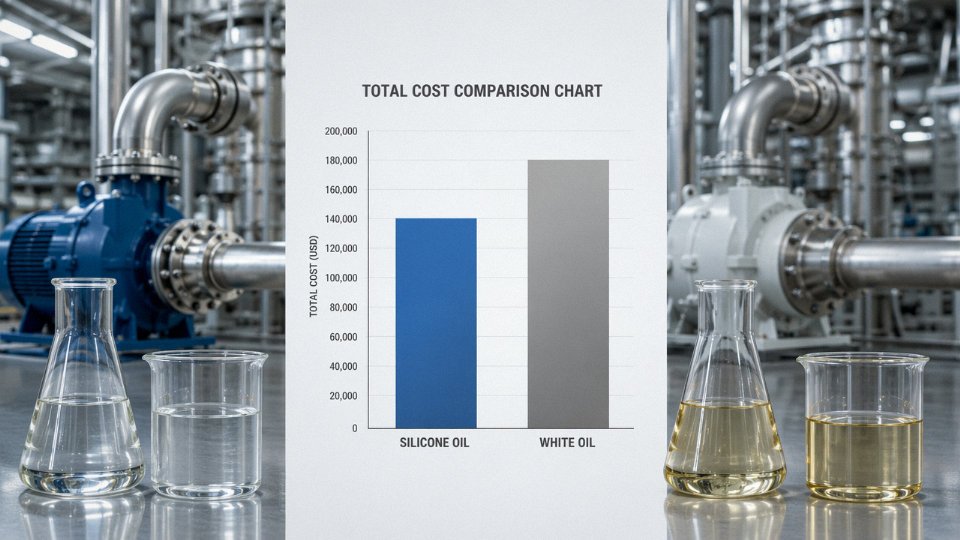
On raw material cost alone, white oil wins by a factor of 2–4x. But that’s only the beginning.
Service Life Changes the Math Entirely
In sealed electrical assemblies — motor capacitors, transformer bushings, potted sensors — silicone oil routinely runs 10–20 years without replacement. That figure depends on operating temperature and seal integrity, but it’s realistic in low-to-moderate temperature applications below 150°C. White mineral oil in open or semi-open systems degrades through oxidation, contamination, and viscosity shift. Relubrication intervals in food-plant machinery typically fall between 500 and 2,000 operating hours, with the range driven by temperature, load, and whether the system is genuinely sealed or just described that way in the maintenance manual.
A practical scenario: a food-processing conveyor running roughly 8,000 hours per year with white oil on a 1,000-hour relubrication cycle needs about 8 service interventions annually. Factor in technician time (30–60 minutes per event including lockout/tagout), waste oil collection and disposal, and the cost of the fluid itself, and you’re looking at a real annualized cost that can be 3–5x the raw material cost. A sealed silicone oil fill on the same conveyor, designed correctly, might see one inspection per year and fluid replacement every several years. The crossover point depends on labor rates — which vary dramatically between a plant in rural Iowa and one in Germany — but in high-wage environments, service life often justifies silicone’s price premium outright.
Disposal: Hazardous Waste Classification Is Not a Small Line Item
Spent white mineral oil contaminated with food residue, metal particles, or cleaning chemicals is classified as hazardous waste under EPA 40 CFR Part 261 in the US if it fails the toxicity characteristic leaching procedure — and many plant managers are surprised to learn their used lube oil qualifies. Disposal costs for hazardous waste typically run USD 0.50–2.00 per liter depending on region and contamination level, and proper manifesting adds administrative overhead.
Silicone oil waste is less straightforward. It isn’t acutely toxic, but it doesn’t biodegrade meaningfully either. Incineration is the most common disposal route; high-temperature combustion converts PDMS to silica, CO₂, and water. Hydrolysis-based chemical recycling exists at pilot scale, and Dow and Wacker both run take-back or recycling programs for industrial silicone fluids, though volumes accepted and geographic coverage vary.
Silicone oil has a higher cradle-to-gate carbon footprint per kilogram than white mineral oilTrue
Chlorosilane synthesis — the industrial route to polydimethylsiloxane — is energy-intensive, producing roughly 8–15 kg CO2e/kg of silicone fluid. White mineral oil, as a petroleum refinery co-product, carries approximately 2–4 kg CO2e/kg. However, when normalized to service hours rather than mass, silicone oil's much longer service life often produces a lower per-hour carbon burden in applications where that longevity is actually realized.
The per-kilogram carbon comparison favors white oil. The per-service-hour comparison frequently doesn’t.
Supply Chain Concentration and Dual-Sourcing
Silicone oil supply is genuinely concentrated. Dow, Wacker, Shin-Etsu, and Momentive account for the substantial majority of global PDMS production. That’s four major producers for a material used across electronics, personal care, food processing, and medical devices simultaneously. During supply disruptions — the 2020–2021 silicone shortage being a recent example — lead times stretched to 20+ weeks and spot pricing spiked. White oil has broader supply from regional refineries, but it tracks crude oil pricing, so cost volatility is a different kind of problem rather than no problem.
For critical applications, dual-sourcing silicone oil across at least two of the major producers is worth the slightly higher qualification cost. White oil qualification is generally less painful given supplier breadth, but locking in a single refinery source without a backup still leaves you exposed to turnaround schedules and regional logistics disruptions.
Emerging Alternatives and Technology Trends Affecting Both Markets
The fluids market doesn’t stand still, and both silicone oil and white mineral oil are facing real competitive pressure from a new generation of synthetics and bio-derived alternatives. This isn’t hype — procurement managers at food and pharmaceutical plants are already fielding samples, and a few early adopters have switched entire lubrication programs. The economics aren’t always compelling yet, but the regulatory trajectory is.
Bio-Based Synthetic Esters and PAGs Moving Into White Oil Territory
Synthetic esters — particularly those derived from rapeseed or sunflower fatty acids — have been creeping into food-machinery lubrication for the past decade, and the pace has picked up. Many carry NSF H1 registration, putting them on equal regulatory footing with food-grade white oil for incidental food contact. Performance-wise, they outrun mineral white oil on viscosity index (typically 140–180 vs. 95–110 for comparable mineral grades) and oxidative stability, which matters at chain oven temperatures or in continuous fryers running above 150°C.
Polyalkylene glycols (PAGs) tell a similar story. Water-soluble PAG grades have found a foothold in textile processing — sizing machines, warp lubricators — where white oil was standard for years. The switch usually requires rinsing validation because PAGs behave very differently during aqueous washout, but where that’s been confirmed, PAGs often extend drain intervals by 1.5–2× compared to mineral oil, depending on operating temperature and contamination load.
The honest caveat: bio-ester pricing runs roughly USD 3.5–7 per kg in industrial quantities, against USD 1.2–3.5 for bulk food-grade white oil. That gap narrows when you account for extended service life, but it’s a real barrier for high-volume, low-margin operations like poultry processing or bulk grain handling.
PAO Synthetics Challenging White Oil in Pharma and Food Contact
Polyalphaolefin (PAO) oils deserve a separate mention because they’re not just marginally better than mineral white oil — they’re genuinely different in character. PAO is essentially free of aromatics, has extremely low sulfur, and passes NSF H1 and USP White Petrolatum-adjacent specifications in certain formulations. For pharmaceutical tablet presses or capsule-filling equipment where extractable hydrocarbon profiles matter, PAO is increasingly the preferred drop-in replacement. Cost premium is modest: expect roughly USD 2–5 per kg versus USD 1.2–3.5 for white oil, depending on viscosity grade and order volume. That’s often justified by the cleaner regulatory story alone.
PAO synthetic oils contain no aromatic hydrocarbons and meet NSF H1 registration requirements in suitable formulations, making them viable white oil substitutes in food-contact lubrication.True
PAO is produced by oligomerization of alpha-olefins, yielding a purely paraffinic, aromatic-free structure. NSF H1 registration is granted based on ingredient review, and several commercial PAO products carry this status.
Bio-Silicone and the EU Cyclic Siloxane Problem
On the silicone side, Dow’s EcoSilicones initiative — polydimethylsiloxane synthesized from methylchlorosilane intermediates derived from bio-ethanol rather than fossil-derived methanol — represents the first serious attempt at a lower-carbon silicone oil. The chemistry is functionally identical; the difference is feedstock origin. Current cost premium is substantial, somewhere in the range of 30–60% over conventional PDMS depending on viscosity grade and contract volume, and supply is constrained to specific production lines. Wider availability is probably a 3–5 year horizon, not imminent.
The regulatory pressure on cyclic siloxanes is more immediate. EU REACH restrictions already ban D4, D5, and D6 above 0.1% concentration in rinse-off cosmetics, and draft proposals are circulating that would extend restrictions to industrial applications. Most industrial silicone oils are predominantly linear PDMS with cyclic siloxanes as trace byproducts or lower-molecular-weight fractions — but any formulator or end user in the EU should be auditing their supplier’s cyclic siloxane content now, not after a restriction expands. Suppliers vary considerably in how tightly they control D4/D5 residuals.
IoT Sensors and What They’re Doing to Consumption Patterns
Smart factories are changing the consumption math for both fluids. Real-time viscosity sensors — inline units from manufacturers like Hydramotion or Anton Paar that mount directly in fluid lines — are enabling condition-based relubrication rather than fixed-interval changes. In practice, this cuts fluid consumption by 15–35% at plants that have deployed them, depending on how conservative the previous fixed-interval schedule was and how variable the operating conditions are. The impact on white oil is significant in centralized lubrication systems for conveyors and packaging lines. For silicone oil in high-precision applications like optical coating or medical device assembly, contamination sensors that detect particulate or water ingress are reducing the incidence of process failures that previously triggered unscheduled full-system flushes.
The broader point is that the “which fluid wins” question is increasingly inseparable from “how is the fluid being managed.” A plant running blind on fixed schedules with conventional white oil may be using three times the volume of a smart-monitored system running a premium synthetic. That changes the TCO calculation considerably.
Frequently Asked Questions
Can I substitute white oil for silicone oil in a transformer or high-voltage application?
No. This substitution will get you into serious trouble, and it’s worth being specific about why.
Transformer and switchgear fluids need to hold their dielectric properties under sustained thermal stress — often at continuous temperatures well above 150°C, with transient spikes higher still. White mineral oil, depending on viscosity grade, flashes somewhere between 135°C and 200°C, and its oxidative stability degrades meaningfully above 90–100°C under the air exposure that occurs in vented equipment. Polydimethylsiloxane fluids, by contrast, have flash points typically above 300°C and retain acceptable dielectric strength across a much wider service range.
The specific failure sequence if you use white oil in a high-voltage application: accelerated oxidation forms polar degradation products, those products lower the fluid’s dielectric breakdown voltage, and under load conditions you eventually get partial discharge leading to transformer failure — not immediately, but at the worst possible moment, usually mid-season when the unit is running hot.
White mineral oil can be used as a direct drop-in substitute for silicone transformer fluid in high-voltage equipmentFalse
White oil's lower flash point (135–200°C vs. >300°C for silicone oil), narrower thermal service range, and inferior oxidative stability under high-temperature operating conditions make it unsuitable for most transformer and high-voltage applications. Using it as a substitute creates real dielectric failure risk.
Is silicone oil safe for food contact?
It depends entirely on the application and grade. FDA 21 CFR §173.340 permits dimethylpolysiloxane as a defoamer in specified foods at concentrations up to 10 ppm — not more, and not in every food category. NSF H1 registered silicone fluids are approved for incidental food contact as lubricants in food processing equipment, meaning lubrication points where contact with food is possible but not intentional or continuous.
White mineral oil has a broader direct food additive status. USP/NF-grade white mineral oil is an approved release agent, protective coating, and direct additive in certain applications under 21 CFR §172.878. That’s a meaningfully different regulatory position — white oil can be applied directly to food surfaces (dried fruits, cheese rinds, baking pans) in regulated amounts, whereas silicone oil generally cannot.
In practice, food plants use both, but for different jobs. Silicone for equipment lubrication; white oil for product-contact coatings and release applications. Conflating them during a sanitation audit will not go well.
Why does silicone oil cause paint fisheye defects, and how do you fix it?
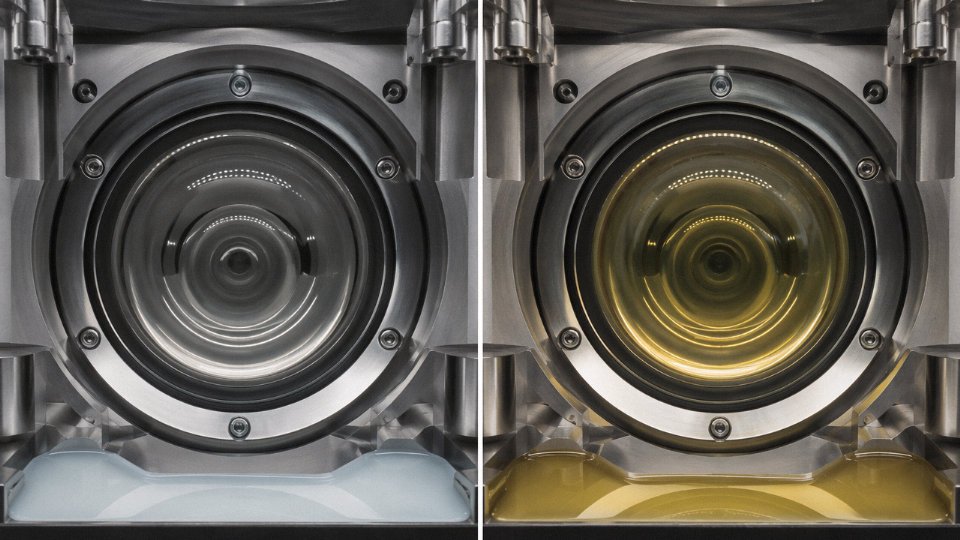
Silicone oil has extremely low surface energy — roughly 20–21 mN/m, compared to 28–35 mN/m for most alkyd or polyurethane topcoats. When even trace amounts of silicone contaminate a substrate, the coating film can’t wet out uniformly. It pulls away from contaminated spots, forming the characteristic craters painters call fisheyes. You don’t need much; a light mist of silicone-based mold release drifting onto parts in an adjacent station can contaminate an entire batch.
The fix is a two-step problem. Mechanical cleaning alone rarely resolves it — solvent wiping with a compatible cleaner (MEK or isopropanol, depending on your substrate) followed by a bonding primer or adhesion promoter is the standard approach in automotive and appliance finishing. In high-sensitivity lines, the real answer is eliminating silicone-containing products from the spray environment entirely. Some plants ban silicone aerosols from any area within 30 meters of a paint booth, which sounds aggressive until you’ve reworked a full day’s production.
What viscosity of silicone oil is equivalent to a 100 cSt white oil?
You can’t directly compare them without accounting for the reference temperature difference. White oil viscosity is conventionally rated at 40°C; silicone oil viscosity is conventionally rated at 25°C. A fluid that reads 100 cSt at 40°C is thinner than a silicone fluid reading 100 cSt at 25°C.
Silicone oil also has a very flat viscosity-temperature curve (high viscosity index, typically 150–400 depending on grade), so the crossover point shifts depending on your actual operating temperature. The rough working guidance:
| White Oil Grade (cSt @ 40°C) | Approx. Equivalent Silicone Oil (cSt @ 25°C) | Notes |
|---|---|---|
| 15–22 cSt | 20–35 cSt | Operating temp assumed ~40–60°C |
| 46–68 cSt | 50–100 cSt | Mid-range process lubrication |
| 100 cSt | 100–150 cSt | Verify at your actual process temp |
| 220–320 cSt | 200–350 cSt | Heavy film, slow-moving contact |
These are starting-point estimates, not specifications. Always run a bench viscometer check at your actual operating temperature before committing to a grade in a new application.
Can silicone oil and white oil be mixed together?
They don’t mix — they phase-separate. Polydimethylsiloxane and paraffinic mineral oil are chemically incompatible in most practical concentration ratios. If they end up in a shared sump or reservoir, you’ll see two distinct layers, and neither phase will perform as intended. The silicone fraction loses its lubricant film continuity; the mineral oil fraction can pick up trace silicone that degrades its surface tension behavior in downstream applications.
This matters most in maintenance situations — using the wrong top-up fluid, or inadequately flushing a system before switching fluid types. A full drain-and-flush with a compatible solvent or carrier fluid before changing over is not optional.
Which oil is better for baby skin care or pharmaceutical ointments?
White mineral oil, USP grade, is the pharmacopoeia-standard ingredient. It’s listed directly in the USP/NF as a skin protectant and ointment base, and decades of clinical use back the safety profile. You’ll find it in everything from baby oil to petrolatum-based creams.
Dimethicone (essentially low-to-medium viscosity silicone oil) is also used in skin care — specifically as a barrier ingredient in diaper rash creams and wound protectants, where it creates a water-resistant, non-occlusive film. Both have distinct regulatory pathways; they’re not interchangeable in a formula. Swapping one for the other changes the skin-feel, occlusion level, and active classification in most regulatory jurisdictions.
How do I dispose of used silicone oil versus used white oil?
Used white mineral oil is classified as used oil under EPA 40 CFR Part 279 in the US, which means it qualifies for re-refining or fuel blending at a licensed used-oil processor — the same infrastructure that handles used motor oil. This is relatively straightforward and reasonably economical.
Used silicone oil is a different problem. It doesn’t blend with petroleum streams and most re-refiners won’t take it. The primary disposal route is high-temperature incineration (above 1,000°C) to fully combust the siloxane backbone; incomplete combustion produces silica particulate and, in some conditions, low-level silicone oligomers. Under EU waste framework regulations, spent silicone fluid typically falls under hazardous waste codes depending on what contaminants it has picked up in service, even if the base fluid itself is not acutely hazardous.
Practically speaking, disposal cost for silicone oil runs noticeably higher than for equivalent volumes of mineral oil — a real factor in total cost of ownership that purchasing teams often underestimate at the specification stage.