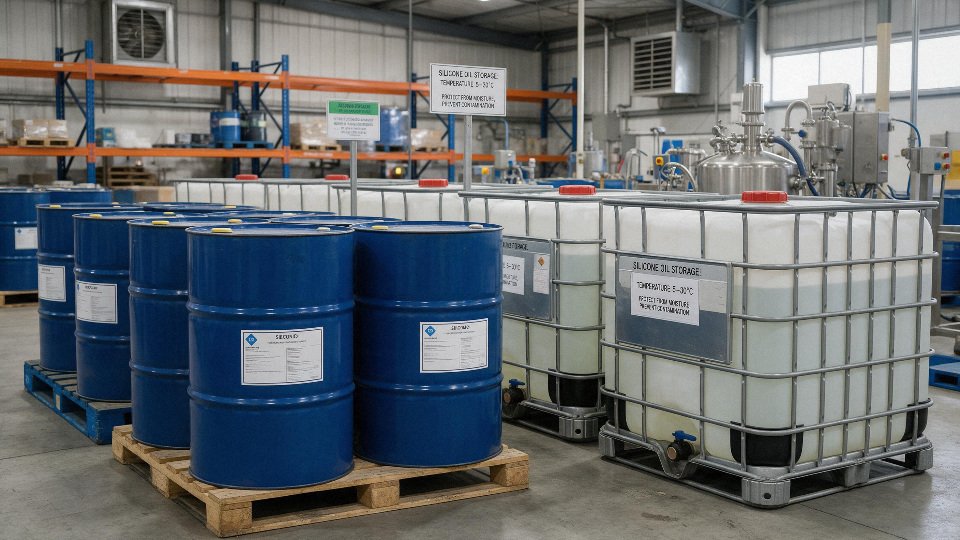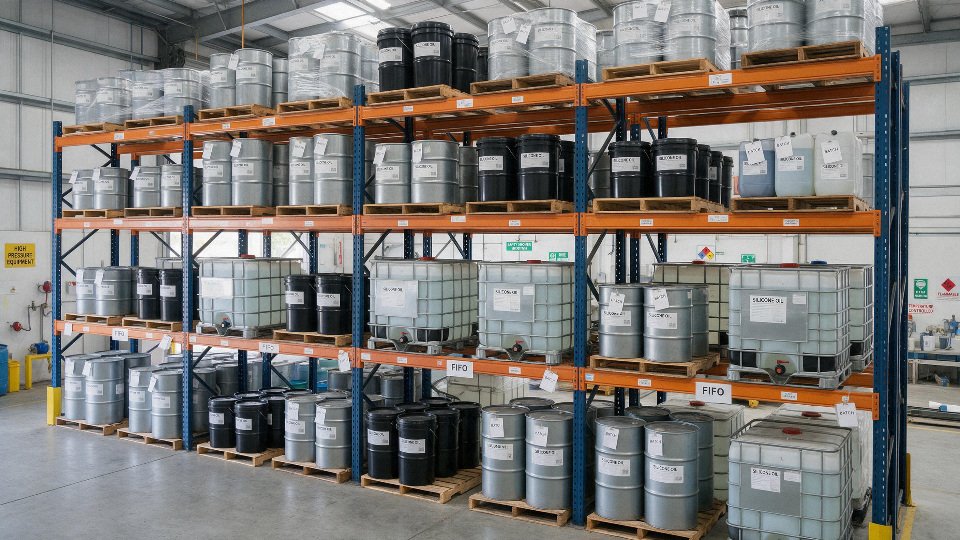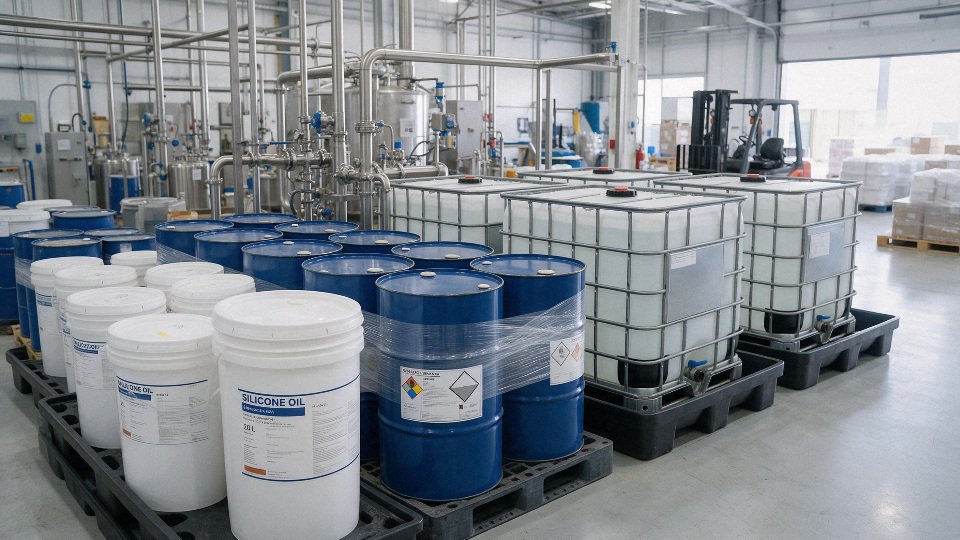
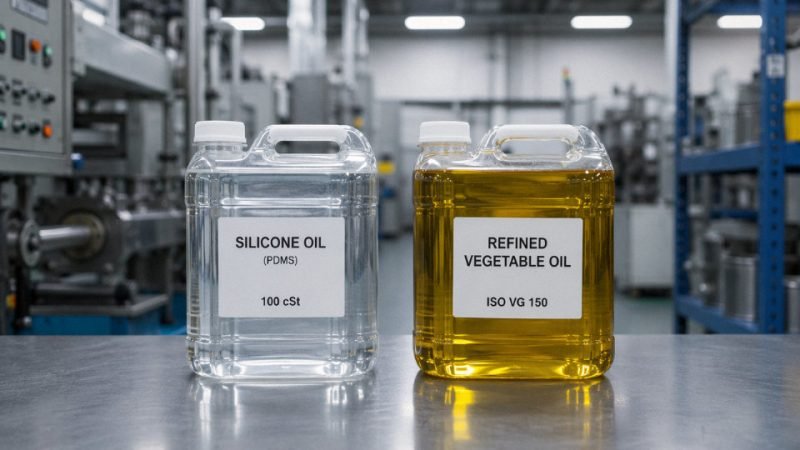
Specify the wrong fluid in a gearbox or food-processing chain drive, and the consequences stack up faster than most maintenance budgets can absorb — seized bearings, contaminated product batches, unplanned line stoppages that ripple back into delivery schedules and customer penalties. The choice between silicone oil and vegetable oil sounds straightforward until you’re standing in front of a spec sheet trying to reconcile viscosity grades, FDA compliance requirements, oxidation stability, and a supplier quoting lead times that don’t match your shutdown window.
Silicone oil and vegetable oil serve fundamentally different roles: silicone oil (typically polydimethylsiloxane) offers viscosities from under 1 cSt to over 2,000,000 cSt and holds stable from roughly −60°C to 200–300°C continuous service, making it the default for extreme-temperature or long-service applications; vegetable oils run 30–90 cSt at 40°C, degrade oxidatively above roughly 180–220°C, but are genuinely food-safe, biodegradable, and cost significantly less per litre in most markets.
What makes the comparison genuinely tricky is that neither fluid wins outright — the right answer depends heavily on operating temperature, incidental food contact risk, re-lubrication interval, and what your local waste disposal regulations look like. A hydraulic damper running at 150°C in a paint-cure oven has almost nothing in common with a conveyor system inside a cold-storage bakery, yet both applications might land on your desk the same week.
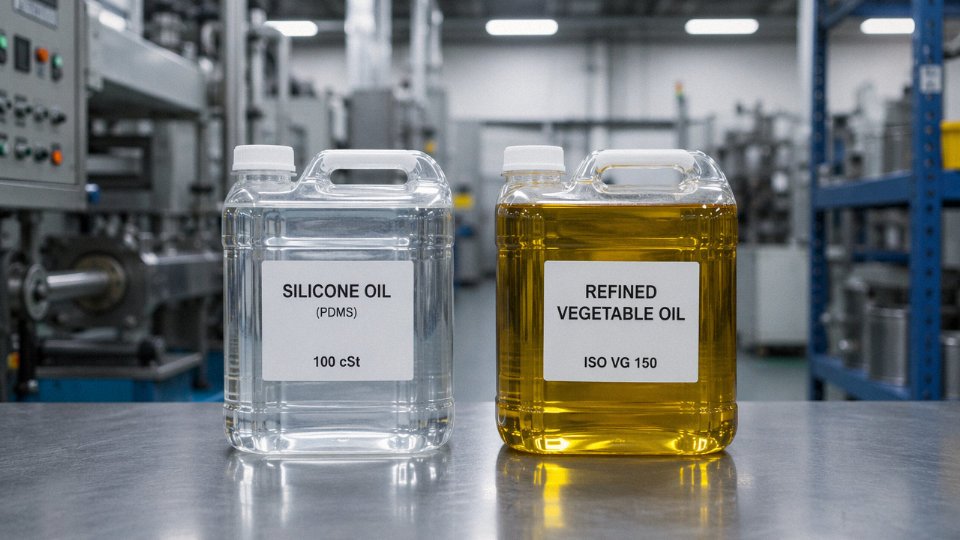
Molecular Structure and Physical Property Profiles Side by Side
The performance gap between silicone oil and vegetable oil isn’t arbitrary — it’s written directly into their molecular architecture. Understanding that architecture is what separates a sound fluid selection from an expensive mistake.
The Si–O Backbone of PDMS
Polydimethylsiloxane is built on a repeating silicon-oxygen chain rather than the carbon-carbon spine of organic compounds. The Si–O bond energy runs around 445 kJ/mol, meaningfully higher than a C–C bond at roughly 347 kJ/mol, and the Si–O–Si bond angle opens up to about 143° compared to the ~109° of a tetrahedral carbon backbone. That unusual geometry gives the siloxane chain exceptional rotational freedom — the chain is floppy, in the best possible sense — which explains the extraordinarily wide viscosity range: from 0.65 cSt for low-MW trimethylsiloxy-terminated fluids all the way past 2,500,000 cSt for high-polymer grades at 25°C. No organic oil comes close to that span.
That same chain geometry drives low surface tension, typically 20–21 mN/m for standard PDMS grades. Practically speaking, the fluid wants to spread. It will creep across metal surfaces, wick under seals, and contaminate adjacent components if containment isn’t designed for it — something operators using it as a mold release or anti-foam sometimes learn the hard way. The Si–O backbone also has no polar sites for water to hydrogen-bond onto, so PDMS is inherently hydrophobic and resists moisture uptake even in high-humidity environments like food-processing washdown areas.
Triglyceride Structure and the Oxidation Problem
Vegetable oils are triglycerides: a glycerol backbone esterified with three fatty acid chains. The relevant performance variable is how many of those chains contain carbon-carbon double bonds — the degree of unsaturation. Iodine values for common refined oils range from around 78 (olive, lower unsaturation) up to 136 or higher for sunflower oil, and that number is a direct proxy for oxidative vulnerability. Each double bond is a site where oxygen, heat, or transition-metal catalysts can initiate a chain reaction of peroxide formation and polymerization. In a circulating lubrication system running above roughly 100°C, a high-IV oil will start to thicken, form varnish deposits, and eventually gel — clogging orifices that were sized for a fluid with a viscosity a third of what it’s become. Refined soybean oil typically starts showing measurable oxidative degradation above around 180°C; sunflower oil is broadly similar. Those are not hard failure cliffs; they’re gradual degradation slopes, which can be worse because the problem isn’t always obvious until the damage is done.
Property Comparison: PDMS 100 cSt vs. Refined Soybean and Sunflower Oil
| Property | PDMS 100 cSt | Refined Soybean Oil | Refined Sunflower Oil |
|---|---|---|---|
| Density at 25°C (g/cm³) | ~0.96–0.97 | ~0.91–0.92 | ~0.91–0.92 |
| Viscosity at 40°C (cSt) | ~90–110 | ~28–35 | ~30–40 |
| Viscosity Index (VI) | >300 | ~170–200 | ~150–190 |
| Pour point (°C) | –50 to –65 | –10 to –16 | –10 to –18 |
| Flash point (°C) | ~300–315 | ~325–330 | ~315–325 |
| Smoke point (°C) | N/A (non-combusting) | ~230–240 (refined) | ~225–235 (refined) |
| Dielectric strength (kV/mm) | ~14–16 | ~10–14 | ~10–13 |
| Surface tension (mN/m) | ~20–21 | ~33–35 | ~32–34 |
| Refractive index | ~1.40–1.40 | ~1.47–1.48 | ~1.47–1.48 |
Figures depend on supplier grade, refining method, and temperature; treat these as working ranges, not spec-sheet guarantees.
Viscosity-Temperature Behavior and Why VI Actually Matters
A VI above 300 means PDMS viscosity barely budges across a wide temperature swing — useful in applications that see both cold startup and sustained high-temperature running, like outdoor hydraulic equipment cycling from –20°C winters to summer operating temperatures. Vegetable oils, with VI in the 150–220 range, aren’t bad by petroleum standards, but they thin considerably as temperature climbs, and more critically, they don’t recover. Once oxidative degradation has altered the molecular weight distribution, the viscosity-temperature curve shifts permanently. You can’t reverse that with a top-up.
Silicone oil maintains stable viscosity across a wider temperature range than vegetable oil due to its high viscosity indexTrue
PDMS typically exhibits a viscosity index above 300, meaning viscosity changes are minimal across a broad temperature range. Vegetable oils have a VI of roughly 150–220 and, unlike PDMS, suffer irreversible viscosity changes once oxidative degradation begins above their smoke points.
Solubility and Contamination Control
Here’s a practical difference that rarely gets enough attention at the design stage. Both fluids are immiscible with water — but that’s where the similarity ends. Vegetable oils dissolve readily in non-polar organic solvents: hexane, mineral spirits, most standard industrial degreasers. If a vegetable oil contaminates a bearing housing or a food-contact surface, cleanup is straightforward with the right solvent and warm water with an alkaline surfactant. Silicone oil, on the other hand, resists most common cleaning agents. It doesn’t dissolve in alcohols, it laughs at aqueous cleaners, and removing a PDMS film from a surface typically requires a dedicated silicone-stripping solvent or a strong chlorinated cleaner — neither of which you want anywhere near a food line. In a mixed-use plant where both silicone and food-grade lubricants are in use, cross-contamination of a silicone fluid into a product stream can be particularly stubborn to remediate and may require scrapping an entire batch if the application is regulated. That asymmetry matters to both maintenance planners and procurement teams choosing which fluid goes where.
Thermal Stability and Oxidative Resistance Under Real Operating Conditions
Temperature is where the gap between these two fluid families stops being academic and starts costing you money.
Silicone Oil’s Operating Envelope — and How It Eventually Fails
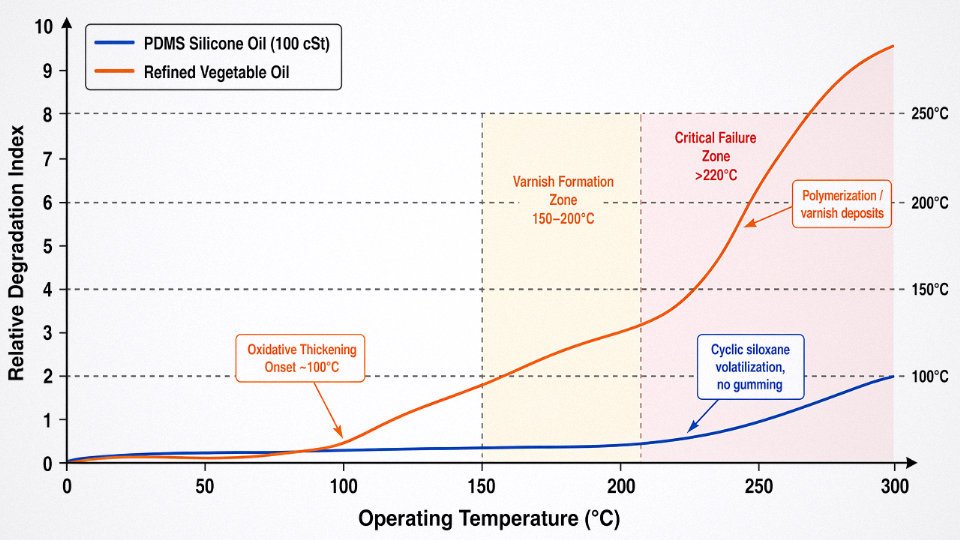
Standard polydimethylsiloxane (PDMS) grades carry a continuous service rating of roughly 200°C in open systems, and up to around 150°C in closed systems where volatile degradation products can’t escape. That ceiling climbs to 260–300°C with phenyl-modified silicones, where the phenyl substituents on the Si–O backbone interrupt the regular chain geometry and raise thermal stability meaningfully. The degradation mechanism matters here: silicone doesn’t oxidize the way organic oils do. Instead, under prolonged heat, the Si–O–Si backbone undergoes depolymerization — the chain unzips back into cyclic siloxanes, primarily D4 and D5 (octamethylcyclotetrasiloxane and decamethylcyclopentasiloxane). These are volatile, low-viscosity species. In practice this means a silicone bath running near its upper limit will lose viscosity gradually and leave very little deposit — almost the opposite of what happens with vegetable oil. The failure mode is fluid loss and viscosity drift, not gumming. That distinction matters enormously for maintenance planning.
Vegetable Oil Thermal Failure: Smoke, Varnish, and Worse
Vegetable oils degrade through a fundamentally different pathway. Most refined vegetable oils — sunflower, canola, soybean — have smoke points in the 180–230°C range depending on refining quality and free fatty acid content. Above that, oxidative polymerization accelerates rapidly. The unsaturated fatty acid chains (linoleic, linolenic) react with oxygen to form hydroperoxides, which break down into aldehydes, ketones, and eventually cross-linked polymers. On plant floor terms: varnish. Gum. Brown sticky deposits that clog orifices and bond to metal surfaces with surprising tenacity.
Acid value increases over time as hydrolysis and oxidation proceed, which accelerates corrosion of copper alloys and certain coatings. Auto-ignition temperature for most vegetable oils sits in the 360–400°C range — which sounds safely distant until you factor in a hot spot on an unlagged pipe or a malfunctioning heater element running against a pooled leak.
Vegetable oils are suitable for continuous closed-loop heat-transfer service above 200°CFalse
Oxidative polymerization and fouling at these temperatures make vegetable oils impractical for closed-loop heat-transfer loops; silicone fluids or synthetic hydrocarbons are specified instead.
Oxidation Stability Testing: What ASTM D2272 Actually Shows
The RPVOT (Rotating Pressure Vessel Oxidation Test, ASTM D2272) gives a useful if imperfect benchmark. When you run a standard 100 cSt PDMS against high-oleic sunflower oil under identical conditions, the difference is blunt: the sunflower oil typically hits its pressure-drop endpoint — indicating oxidation induction failure — somewhere between 30 and 120 minutes, depending on initial free fatty acid level and antioxidant package. PDMS shows no induction endpoint within normal test limits. It’s not that silicone is marginally better; it’s in a different category for this test.
Heat-Transfer and Freeze-Thaw Applications
Jacketed reactor systems and laboratory circulator baths routinely use PDMS fluids for service from roughly –80°C up to +200°C in a single fluid. That’s a 280-degree working window with one product, no changeover. Vegetable oils are almost never specified for closed-loop heat-transfer duty. The fouling risk alone disqualifies them — a heat-exchanger surface coated in polymerized linseed-style deposits is a maintenance problem that compounds quickly.
Cold performance deserves more attention than it usually gets in procurement specs. PDMS pour points run as low as –60°C for lower-viscosity grades, though higher-viscosity silicones (above roughly 1,000 cSt) do stiffen significantly below –40°C. Vegetable oils cloud at somewhere between 0°C and –20°C depending on fatty acid saturation profile — high-oleic varieties perform better than standard soybean oil in the cold, but none of them compete with silicone in freeze-thaw cycling environments like outdoor equipment in northern climates or cold-room conveyor systems. A system that runs fine in July and seizes in January because someone spec’d the wrong lubricant is an avoidable problem.
Lubrication Performance: Load Capacity, Wear Protection, and Machinery Compatibility
Silicone oil is one of the most misapplied lubricants in industrial settings. It looks like a lubricant, it flows like a lubricant, and it comes in a convenient aerosol can — so maintenance techs spray it on everything. That habit causes real problems.
Why Silicone Oil Struggles Under Load
Polydimethylsiloxane is non-polar and has exceptionally low surface energy. That’s exactly why it releases from molds and repels water so well. It’s also exactly why it doesn’t adsorb onto metal surfaces the way a good boundary lubricant needs to. Under sliding metal-on-metal contact — a cam follower, a worm gear, a plain bearing running at moderate-to-heavy load — PDMS offers very little film strength once the hydrodynamic wedge breaks down. The metal asperities meet, and there’s essentially nothing chemically bonded to the surface to protect them.
Silicone oil (PDMS) performs poorly as a boundary lubricant for metal-on-metal contacts under loadTrue
PDMS lacks polar functional groups that adsorb onto metal oxide surfaces. Without chemisorption, it cannot form the protective boundary film that prevents asperity contact under high load or low-speed conditions — a well-documented limitation in tribology literature.
Run an ASTM D4172 four-ball wear test and the difference is stark. High-oleic canola oil typically produces a wear scar diameter in the 0.35–0.45 mm range under standard test conditions. PDMS fluids of similar viscosity commonly land at 0.60–0.80 mm — sometimes worse, depending on the viscosity grade and test load. That gap translates directly to bearing surface wear in real equipment.
Where Vegetable Oil Has a Genuine Mechanical Advantage
Vegetable oils contain ester linkages and, depending on refining level, residual free fatty acids. Those polar groups adsorb onto metal oxide surfaces and form a thin, tenacious boundary film that holds up even when the lubricant film is locally depleted. This is why chain oils, open gear lubricants, and agricultural equipment lubricants have historically leaned on vegetable or animal fat-derived bases. High-oleic sunflower and canola variants are particularly good here — their elevated oleic acid content reduces oxidative instability while maintaining the polar adsorption behavior.
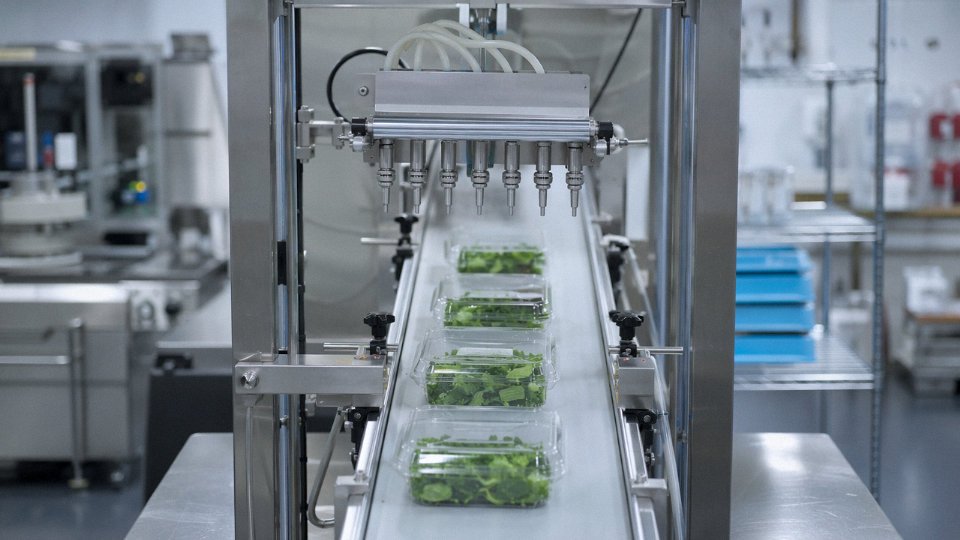
For food-processing conveyors with incidental food contact, NSF H1-registered vegetable-based lubricants are a practical fit. They provide real load-carrying capacity, they’re acceptable under food safety frameworks, and they biodegrade rather than accumulating in floor drains or soil. Outdoor hydraulic equipment — log splitters, agricultural implements — benefits similarly, especially where environmental spillage is a regulatory or liability concern.
Where Silicone Oil Is Actually the Right Call
Silicone oil earns its place in a narrow but important set of applications. Plastic-on-plastic sliding mechanisms — think conveyor guide rails, plastic cam surfaces, printer mechanisms — don’t demand polar boundary films, and PDMS’s low surface energy actually reduces stick-slip behavior that can cause positioning errors or noise. It doesn’t swell most synthetic rubbers (EPDM, neoprene, Viton — though verify compatibility for your specific compound), making it useful for O-ring assembly, seal lubrication, and low-load rotary equipment where elastomer compatibility matters more than load capacity. Damping applications — rotary dampers, torque-limiting mechanisms — exploit viscosity stability across temperature rather than film strength.
Additive Chemistry and Its Limits
Vegetable oil bases accept extreme-pressure and anti-wear additive packages reasonably well. The ester chemistry provides natural solvency for sulfur-phosphorus EP additives, zinc dialkyldithiophosphate (ZDDP) AW packages, and pour-point depressants. You can build a genuinely capable gear oil or hydraulic fluid on a vegetable base.
Silicone oil largely refuses to cooperate. PDMS is chemically inert by design — that inertness that makes it thermally stable also means most conventional additives won’t dissolve or stay homogeneous in it. In practice, you can’t meaningfully boost its load capacity with standard additive chemistry. Some specialty formulations exist, but they’re expensive and limited in availability.
Material Compatibility Warnings
One practical trap with vegetable oils: oxidation products are sticky. A conveyor that runs fine for six months can develop gummed seals, clogged filters, and varnished internal passages if oil change intervals slip — particularly in warm environments above roughly 60–70°C. Seasonal temperature swings accelerate this, and in my experience the problem appears faster than most maintenance schedules anticipate.
Silicone oil has its own compatibility issue worth flagging: it can swell silicone elastomers, which surprises people. It also degrades certain solvent-based and alkyd coatings and is notoriously difficult to remove from painted surfaces before recoating. If your equipment has silicone rubber seals or recently painted housings, verify compatibility before switching to a PDMS-based lubricant.
The decision usually comes down to load type and surface material combination more than anything else. Heavy metal-to-metal load with food contact requirements points clearly toward a vegetable-based NSF H1 product. Light-load plastic or rubber mechanisms needing chemical inertness point toward silicone. Anything in between warrants a proper tribology review rather than a guess.
Food Safety, Regulatory Compliance, and Incidental Food Contact Requirements
Picking the wrong lubricant for a food-processing line isn’t just a quality problem — it’s a regulatory exposure. The fluid choice ripples through your HACCP plan, your third-party audit, and potentially an FDA inspection report. Both silicone-based and vegetable-based lubricants can be made food-safe, but “food-safe” is not a single certification. It’s a stack of overlapping requirements, and the gaps between them catch plants off guard.
NSF International Registration Categories
NSF’s H1, H2, and H3 designations are the practical shorthand most food-plant engineers and procurement teams actually use on the floor.
H1 is the one that matters most here: lubricants registered H1 are acceptable for incidental food contact — meaning the fluid may occasionally and unavoidably touch food, but not intentionally and not at levels that affect safety. H2 fluids are for equipment where there is absolutely zero possibility of food contact; they have far fewer formulation restrictions but should never end up near product streams. H3 is a narrow category covering soluble (edible) oils used on hooks, trolleys, and similar equipment.
Both dimethylpolysiloxane-based silicone fluids and refined vegetable oil-based lubricants can be formulated to H1 registration. The critical word is formulated — the base oil alone doesn’t earn the registration. Every additive, thickener, anti-corrosion package, and even colorant in the final product must appear on NSF’s approved ingredient list. A silicone fluid with an unlisted rust inhibitor fails H1 regardless of how benign the base is. Procurement teams buying on price from unfamiliar suppliers should always verify the NSF registration number directly on the NSF White Book database, not just accept a supplier’s claim on a data sheet.
FDA Regulations and GRAS Status
Under 21 CFR 178.3570, the FDA permits lubricants with incidental food contact on food-processing equipment provided the formulation meets specific compositional limits. Dimethylpolysiloxane (PDMS) — the workhorse silicone fluid — carries a separate and arguably stronger regulatory position: it is listed as Generally Recognized as Safe (GRAS) as an anti-foaming agent at concentrations up to 10 ppm in food under 21 CFR 173.340. In practice, that GRAS status gives silicone fluids a defensible position that refined vegetable oil lubricants don’t automatically inherit. Vegetable oil lubricants used in incidental-contact applications still operate under 178.3570, but they don’t have the equivalent GRAS anti-foaming listing.
Dimethylpolysiloxane (PDMS) silicone fluid is FDA GRAS-listed as an anti-foaming agent in food at up to 10 ppm.True
21 CFR 173.340 explicitly permits dimethylpolysiloxane as a defoaming agent in food processing at a maximum of 10 ppm, giving PDMS-based silicone fluids a recognized safety basis beyond general lubricant regulations.
EU Compliance Pathways
In Europe, the governing framework is EC 1935/2004, which sets general safety principles for all food-contact materials. There is no single EU-wide approved lubricants list equivalent to NSF H1, which is genuinely messy from a compliance standpoint. Food-grade PDMS fluids are assessed under EFSA guidance on food-contact substances, and national-level approvals (Germany’s BfR recommendations, for instance) are often used as supporting evidence. Vegetable oil-based lubricants and food-grade white mineral oils go through a similar substance-specific EFSA assessment route. Plants exporting to multiple EU markets should expect to assemble country-by-country documentation rather than relying on a single certificate.
Allergen Risk — An Underappreciated Hazard
This is where vegetable oil lubricants introduce a risk category that silicone fluids simply don’t. Soy-based, peanut-based, or certain tree-nut-derived vegetable oils are derived from major allergen sources. If a lubricant seeps into a product stream on a line that is also certified allergen-free — or worse, certified free of that specific allergen — the consequences range from a product recall to a serious adverse consumer event.
Silicone oil carries no known allergen risk. That alone is why several bakery and confectionery plants running allergen-controlled environments have moved away from vegetable oil lubricants entirely on high-risk contact points, regardless of H1 status.
Operational warning: If your facility holds a “free-from” claim (nut-free, soy-free), verify the botanical origin of every vegetable oil lubricant used on or near food-contact surfaces. An H1 registration does not screen for allergen risk.
Documentation Requirements for Audit Compliance
Under FSMA, BRC Global Standard Issue 9, and SQF Edition 9, the documentation burden for food-contact lubricants is specific and non-trivial. Auditors will expect to see the current SDS, a Certificate of Analysis (CoA) with lot number, the NSF registration number (cross-referenced to the live NSF database, not a printout from two years ago), and evidence of lot traceability linking lubricant batches to the production dates on which they were in use.
In practice, plants that buy lubricants through a general MRO distributor often find traceability records fragmented or missing. A direct-purchase relationship with the lubricant supplier, or at minimum a distributor who can provide lot-linked CoAs, is worth the slightly higher administrative overhead when a BRC auditor asks for records going back 12 months.
Biodegradability, Environmental Fate, and Sustainability Credentials
The sustainability case for each fluid is genuinely complicated, and procurement officers who reduce it to “vegetable oil is green, silicone is not” are going to make poorly-informed decisions. Both fluids carry real environmental trade-offs, and they play out at very different points in the lifecycle.
Ready Biodegradability: What the OECD 301B Test Actually Tells You
Under OECD 301B — the standard 28-day ready biodegradability test — refined vegetable oils typically reach 60–98% mineralization, comfortably clearing the 60% threshold that classifies a substance as readily biodegradable. The exact figure depends on oil type and degree of refining; crude or partially processed oils with higher free fatty acid content tend to score toward the higher end. Standard polydimethylsiloxane (PDMS) silicone fluids come in well below 10% under the same protocol — not readily biodegradable, full stop.
PDMS silicone oil achieves less than 10% biodegradation under OECD 301B within 28 daysTrue
Multiple regulatory submissions and peer-reviewed ecotoxicology studies confirm PDMS does not meet the ready biodegradability threshold of 60% under OECD 301B. This is consistent across molecular weight ranges used in industrial fluids.
What that classification does not mean is that PDMS accumulates in food chains or behaves like a chlorinated persistent organic pollutant. PDMS adsorbs strongly to soil particles and sediment — essentially becoming immobilized — where slow abiotic hydrolysis and microbial breakdown proceed over months to years depending on temperature, pH, and clay content. Bioaccumulation potential is low; the log Kow (octanol-water partition coefficient) is molecular-weight dependent, and higher-MW PDMS fractions have such low water solubility that they simply don’t enter aquatic food webs at meaningful concentrations. The environmental hazard profile is more “slow and localized” than “spreading and accumulating.”
Ecotoxicity: The Spill Scenario Most People Get Backwards
Here’s where a lot of sustainability conversations go sideways. Vegetable oil, despite being readily biodegradable, is not environmentally benign in a spill event. A significant release into a waterway creates a high biochemical oxygen demand (BOD) load as microbial degradation consumes dissolved oxygen — the same mechanism that makes untreated sewage so damaging to river ecosystems. Small streams with limited dilution are particularly vulnerable. PDMS fluids, by contrast, show low acute aquatic toxicity, with LC50 values for fish and invertebrates typically above 1,000 mg/L — essentially non-toxic at realistic environmental concentrations. So the fluid that biodegrades faster can, paradoxically, cause more acute ecological damage per liter spilled.
Carbon Footprint: Manufacturing Emissions Dominate Silicone’s Lifecycle
Cradle-to-gate carbon footprint is where silicone oil looks genuinely worse. Refined soybean oil runs roughly 1.5–3.0 kg CO2e per kilogram — the range depends heavily on farming practices, fertilizer intensity, and processing energy at the refinery. PDMS production, rooted in energy-intensive chlorosilane synthesis from elemental silicon and methyl chloride, typically lands in the 8–15 kg CO2e per kilogram range. The gap is real and significant. For a plant running several hundred kilograms of fluid annually, that’s a meaningful Scope 3 emissions difference on an ESG report.
That said, silicone’s longer service life and wider reuse intervals can partially offset the manufacturing carbon burden — a fluid changed once every two to three years versus a vegetable oil changed every few months changes the per-year emission calculus considerably. Do the math for your specific application before drawing conclusions.
End-of-Life Pathways
Used vegetable oil has a well-established recycling route: transesterification into fatty acid methyl esters (FAME) for use as biodiesel. Collection infrastructure exists in most industrialized markets, and some food-processing plants already participate in used-oil collection programs as a minor revenue or offset stream. Used silicone oil can be reclaimed and re-refined — several specialty processors offer this — but the volumes are lower and the logistics patchier. In practice, incineration with energy recovery is how most industrial used silicone fluid gets disposed of. It’s not ideal, but it’s managed, and the calorific value is reasonable.
Vegetable Oil’s Less-Discussed Supply Chain Liabilities
Palm oil deserves a direct mention. It remains one of the most cost-competitive vegetable oil bases for industrial lubricant formulations, and it carries documented deforestation and land-use risks in Southeast Asia that are increasingly scrutinized under EU deforestation regulation and corporate ESG frameworks. Soybean oil carries its own agricultural footprint — pesticide loading, monoculture soil health issues, and the fact that its price is directly coupled to global food commodity markets. That last point matters operationally: vegetable oil-based lubricant pricing can swing 20–40% within a single year during commodity disruptions, which creates real procurement planning headaches. Silicone oil pricing is more stable, tied more closely to silicon metal and methyl chloride feedstocks than to weather events in the Brazilian interior.
For sustainability managers trying to build a defensible ESG position: vegetable oils win on ready biodegradability and cradle-to-gate carbon, full stop. Silicone wins on supply chain stability, ecotoxicity in spill scenarios, and end-of-life predictability. Neither is a clean answer.
Cost Analysis, Supply Chain Dynamics, and Total Cost of Ownership
Unit price is the number procurement managers see first, and it almost always overstates the cost advantage of vegetable oil. Food-grade polydimethylsiloxane at 100 cSt runs roughly USD 4–10 per kg in bulk, depending on order volume, supplier tier, and whether you need NSF H1 certification documentation included. Refined food-grade high-oleic canola or sunflower oil typically lands at USD 1.50–3.50 per kg from commodity distributors — so silicone oil costs somewhere between 2× and 5× more per kilogram on the invoice. That gap is real. It is also, in most continuous-duty systems, misleading.
The Fluid-Life Multiplier Changes the Arithmetic
Silicone oil in a closed recirculating system — think a sealed gearbox or a closed-loop chain lubrication circuit — can run 3–7 years before any meaningful change-out, provided contamination is controlled and the system stays within the fluid’s thermal envelope. Its chemical inertness means there is essentially nothing for oxygen to attack; viscosity drift is minimal unless you introduce water ingress or particulate contamination.
Vegetable oil does not get that luxury. In the same closed recirculating system operating at moderate temperatures (even 60–80°C, which is routine near ovens or heated conveyors), oxidative degradation sets in over months, not years. Depending on temperature, air exposure, and the presence of metal catalysts like copper fittings, a food-grade vegetable oil charge may require change-out every 3–12 months. In a warm, high-cycle food plant running 8,000 hours per year, the realistic interval often sits at the shorter end of that range.
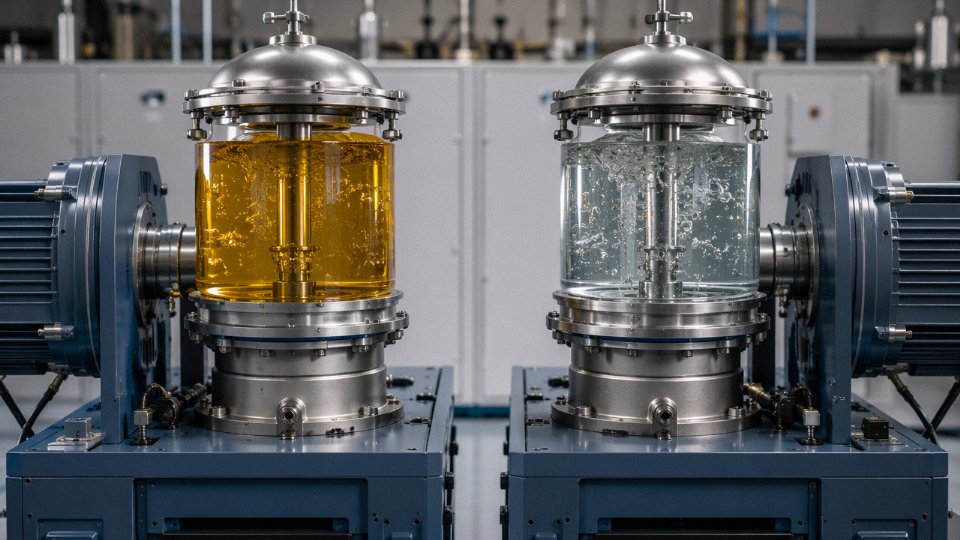
A Simplified TCO Scenario: Food-Grade Conveyor Lubrication
Take a mid-sized conveyor lubrication circuit: roughly 40 liters of fluid, running 8,000 hours per year in a food processing environment at 70–90°C ambient near the equipment.
With vegetable oil at a 6-month change interval, you are looking at two full flush-and-fill cycles per year. Each cycle realistically takes 4–8 hours of maintenance labor — draining, flushing with a compatible cleaner, refilling, and documenting for food safety compliance. At industrial maintenance labor rates of USD 45–90 per hour (varies by region and skill level), that is USD 180–720 in labor per change, plus disposal fees of roughly USD 0.30–0.80 per liter for food-contact-grade waste oil, plus the fluid cost itself. Run the numbers across two cycles: annual fluid and maintenance cost for the vegetable oil system lands roughly in the range of USD 600–1,800, not counting any unplanned downtime from a degraded fluid causing chain wear or valve sticking.
With silicone oil, that same 40-liter circuit might go 3–4 years between changes. Annualized, the fluid cost is a fraction of the sticker shock, and you drop to roughly one planned maintenance event every few years instead of two per year. For a plant running tight maintenance schedules, that labor reduction alone often justifies the price differential.
Silicone oil's higher unit price is offset by longer service life in closed lubrication systemsTrue
Silicone oil's chemical inertness and oxidative stability mean change intervals of 3–7 years are achievable in controlled systems, compared to 3–12 months for vegetable oils under similar thermal conditions, reducing annualized fluid and labor costs substantially.
Supply Chain Risk Profiles Are Different in Kind, Not Just Degree
Vegetable oil pricing follows agricultural commodity indices — CBOT soybean oil and Euronext rapeseed futures are the primary references for canola and sunflower derivatives. Annual price swings of 30–60% are not unusual, and they can happen fast, as anyone sourcing oil-based lubricants during 2021–2022 discovered. Budget forecasting becomes genuinely difficult when your fluid cost is effectively a commodity bet.
Silicone oil pricing is more stable year to year, but it carries a different structural risk: supply concentration. The core feedstocks — silicon metal and methanol — and a significant share of PDMS manufacturing capacity sit in China, Germany, and the United States. Major finished-fluid suppliers (Dow, Wacker, Shin-Etsu, Momentive) maintain global distribution networks with typical lead times of 2–8 weeks for standard grades, longer for specialty viscosities or custom NSF H1 certified formulations. A force majeure event at a major Chinese silicone intermediate producer can ripple into delivery delays within a quarter, as happened in the broader silicone supply chain in 2021 — not a theoretical risk.
Practical Sourcing and Certification Considerations
Food-grade vegetable oils are available through commodity distributors with short lead times, sometimes under a week for standard volumes. The catch is technical grade consistency. Lot-to-lot variation in free fatty acid content, moisture, and peroxide value is real, and unless you are buying from a supplier with documented food-grade lubricant specifications rather than just food-ingredient specs, you may be getting inconsistent performance. That distinction matters for NSF H1 compliance paperwork.
For silicone fluids, the major suppliers carry NSF H1 certification for standard food-grade grades, and documentation is generally clean and traceable — an advantage during FSMA or BRC audits. Smaller distributors may resell without maintaining the certification chain, so verify directly with the manufacturer’s lot documentation, not just the distributor’s CoA.
The honest summary for a TCO model: use unit price as a starting point only. Build in change intervals, labor hours per event, disposal cost, and a commodity risk factor for vegetable oil or a supply concentration risk factor for silicone oil. In most systems running more than 4,000 hours per year at elevated temperatures, the TCO math closes the gap between the two fluids considerably — and in some cases inverts it entirely.
Industry-Specific Selection Guide: Matching the Right Fluid to the Right Application
Most of the technical properties covered earlier — viscosity-temperature behavior, oxidative stability, load capacity, regulatory status — only matter once you anchor them to a specific machine, environment, and compliance obligation. What follows is an application-by-application breakdown, written to be used as a working reference rather than a summary.
Food and Beverage Processing Machinery
For oven chains, baking mold release pins, and high-temperature conveyor bearings running at 180–260°C, NSF H1 registered silicone oil (typically 100–1,000 cSt PDMS, depending on bearing clearance and operating speed) is the defensible choice. It doesn’t carbonize at those temperatures, it won’t trigger a smoke alarm in a tunnel oven, and re-lubrication intervals stretch considerably compared to anything plant-derived. In practice, a baking line running three shifts will see chain wear accelerate sharply if someone substitutes a vegetable-based product in a high-heat zone — the oil oxidizes, thickens, and eventually lacquers the chain pins.
For low-temperature chain lubrication — refrigerated conveyor systems running at 0 to 10°C, open gear systems on mixers, or any externally-lubricated component in a facility that holds an environmental discharge permit restricting mineral oil — NSF H1 vegetable-based lubricants (typically sunflower or high-oleic canola formulations) are appropriate and often required to satisfy local wastewater consent. They’re cheaper per liter than H1 silicone products and widely available through most food-grade lubricant distributors.
Pharmaceutical and Medical Device Manufacturing
USP-grade PDMS silicone oil (typically 350–1,000 cSt) is the standard fluid for lubricating elastomeric stoppers, syringe plungers, and tubing assembly jigs. It’s chemically inert against most elastomers, it’s extractable-and-leachable tested under USP and ISO 10993, and it doesn’t support microbial growth the way organic oils can. Vegetable oils are essentially disqualified here — oxidative degradation byproducts are difficult to control in a validated process, and tree-nut or legume-derived oils carry real allergen declaration obligations under EU and FDA frameworks that most QA teams won’t accept in a sterile manufacturing suite.
USP-grade silicone oil (PDMS) is chemically inert and widely validated for direct contact with pharmaceutical elastomers and medical-grade polymers.True
PDMS silicone fluids meeting USP specifications have undergone extractables and leachables testing and are listed in the FDA Inactive Ingredients Database; they are routinely specified in ISO 10993-compliant device documentation.
Agricultural and Forestry Equipment
Biodegradable hydraulic fluids and chain oils meeting ISO 15380 Type HETG (triglyceride-based) are the correct specification for tractors, harvesters, and forestry machinery operating near watercourses or inside certified organic operations. Regulators in Germany, Scandinavia, and parts of Canada have made this non-negotiable for certain site classifications. Silicone oil is simply not a realistic option in high-volume hydraulic circuits — the cost differential is large, seal compatibility needs careful engineering, and it offers no advantage in this environment. Use the vegetable-based fluid, check the seal materials against the supplier’s compatibility data, and monitor viscosity quarterly since HETG fluids degrade faster than mineral oil under sustained high-load cycles.
Electronics and Precision Instrumentation
Low-viscosity PDMS (1–10 cSt, depending on the damping coefficient required) has no vegetable-oil equivalent in this space. Gyroscope damping cavities, dashpots in precision analytical instruments, and tilt-sensor mechanisms all depend on fluid behavior that stays consistent across temperature swings of perhaps -40 to 85°C. The dielectric strength of PDMS — roughly 14–16 kV/mm, varying with fluid purity and viscosity grade — also makes it viable as a transformer coolant and insulating medium in distribution equipment. Vegetable oil has no meaningful role in electronics applications.
Release Agent Applications
Silicone oil spray releases from mold surfaces because PDMS surface energy is exceptionally low — around 20–21 mN/m. In injection molding, die casting, and bread-pan release, that translates to clean part ejection and minimal residue. The operational problem with vegetable-based cooking sprays (the PAM-type aerosol products common in commercial bakeries) is polymerization: after 20–30 heat cycles, a sticky brown varnish accumulates on pan surfaces, requiring mechanical or chemical cleaning that adds labor and shortens pan service life. Silicone-based pan release is cleaner over time, though it costs more upfront.
Outdoor and Marine Equipment
Vessels certified under EU Ecolabel or Blue Angel programs, and equipment operating in US EPA Vessel General Permit zones, must use environmentally acceptable lubricants (EALs) in any system with a credible spill pathway to water. Vegetable-oil-based stern tube lubricants, hydraulic fluids, and deck machinery greases meet the biodegradability and aquatic toxicity thresholds those programs require. Silicone oil is acceptable only in sealed components with no realistic discharge path — a waterproof bearing housing, for instance — and even then, procurement teams should check whether the certification program auditors will accept it.
| Application | Preferred Fluid | Key Constraint Driving the Choice |
|---|---|---|
| Oven chains / high-temp conveyor | NSF H1 silicone oil | Thermal stability above 180°C |
| Refrigerated conveyor / open gears | NSF H1 vegetable-based | Biodegradability, cost, discharge permit |
| Syringe plunger / stopper lubrication | USP PDMS silicone | Inertness, extractables compliance |
| Forestry / near-waterway hydraulics | ISO 15380 HETG vegetable | Environmental regulation, biodegradability |
| Precision instrument damping | Low-cSt PDMS silicone | Viscosity stability across temperature range |
| Baking pan / mold release | Silicone spray | Low surface energy, no polymerization |
| Marine deck machinery | Vegetable-based EAL | Discharge permit, aquatic toxicity limits |
Frequently Asked Questions About Silicone Oil vs Vegetable Oil
Can I substitute silicone oil for vegetable oil in a food-grade lubrication application?
Not without a regulatory check first. The silicone oil must carry an NSF H1 registration specifically covering incidental food contact, and it needs to comply with FDA 21 CFR or EFSA requirements for the food category you’re processing — dairy, meat, bakery, and beverage lines each carry different exposure assumptions. Plenty of procurement teams have made this swap based on a supplier’s generic “food-safe” claim, only to fail a third-party audit because the product lacked the right registration for their specific process. The NSF White Book is searchable and free; verify the exact product code before you change anything on the line.
NSF H1 registration is required for lubricants with incidental food contact in most food manufacturing facilities worldwideTrue
NSF H1 is the globally recognized certification for lubricants where incidental food contact is possible; it is referenced by FDA, EFSA, and most major food safety schemes including SQF and BRC.
Is silicone oil toxic to humans?
Food-grade dimethylpolysiloxane (PDMS) has a very low acute toxicity profile. FDA permits it as an anti-foaming agent under 21 CFR 173.340 at up to 10 ppm in processed foods — it passes through the digestive tract essentially unchanged. That said, the word “silicone oil” covers a wide catalog. Industrial-grade fluids often contain platinum or tin catalysts, reactive crosslinkers, or proprietary additive packages that were never evaluated for ingestion. Grade selection is not a formality. Using a drum of industrial transformer-cooling fluid as a food machinery lubricant because it “looks the same” is the kind of shortcut that ends in a product recall.
Why does silicone oil not go rancid but vegetable oil does?
Rancidity is an organic chemistry problem. Vegetable oils are triglycerides loaded with unsaturated fatty acid chains — those carbon-carbon double bonds are reactive sites. Oxygen attacks them, producing peroxides that break down further into aldehydes, ketones, and free fatty acids. That’s the smell. Hydrolysis driven by heat or moisture accelerates the same cascade. Silicone oil’s backbone is inorganic Si–O bonds with methyl side groups; there are no double bonds to oxidize. The degradation pathway that ruins a bottle of cooking oil over weeks simply doesn’t exist for PDMS. This is why silicone oil in a sealed gearbox or a lab bath looks the same after two years as it did on day one.
Which oil is better for the environment?
Vegetable oil biodegrades rapidly — typically exceeding 60% mineralization in 28 days under OECD 301B conditions. PDMS usually comes in under 10% in the same test. For outdoor machinery, agriculture equipment, or anything operating near waterways, that difference is decisive. Silicone oil is genuinely persistent in soil and sediment.
The picture gets more complicated over a full lifecycle. Silicone oil’s service intervals can run 3–5× longer than vegetable oil in high-temperature or high-humidity applications, which cuts change-out waste, transport, and disposal frequency substantially. PDMS also shows low aquatic bioaccumulation — it doesn’t climb food chains the way some petroleum additives do. Neither fluid is the clean winner in every scenario; the right answer depends heavily on application, geography, and spill probability.
Can silicone oil and vegetable oil be mixed together?
No. They are immiscible — pour them together and they will phase-separate, usually within minutes to hours depending on viscosity. In a lubrication circuit, this creates an unstable emulsion that does real damage: the vegetable oil phase supports microbial growth in warm, humid environments, oxidation accelerates at the phase boundary, and the mixture will plug filters and potentially swell certain elastomer seals faster than either fluid alone would. If you’re transitioning a system from one fluid to the other, a thorough flush with a compatible solvent or the new base oil at volume is not optional.
Which is more viscous, silicone oil or vegetable oil?
Common vegetable oils — soybean, canola, sunflower — land in roughly the 50–80 cSt range at 40°C. Silicone oil spans from 0.65 cSt (thinner than water) up past 2,500,000 cSt (closer to a soft gel), so the question doesn’t have a single answer. A 5 cSt silicone fluid is far less viscous than olive oil; a 60,000 cSt grade is dramatically thicker than anything you’d press from a seed crop. Grade selection drives everything, which is why silicone oil datasheets always specify viscosity grade prominently.
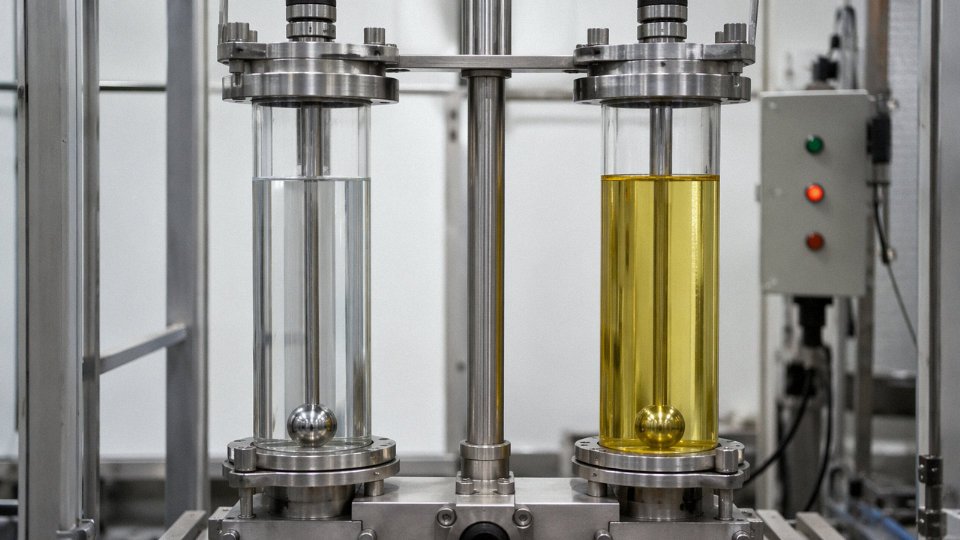
Is vegetable oil a suitable heat-transfer fluid for laboratory baths?
Refined food-grade oils work in a pinch up to roughly 160–180°C, and plenty of small labs have done exactly this to avoid the cost of a purpose-built fluid. The problems accumulate over time: oxidation darkens the oil, deposits form on the bath walls and heating element, and viscosity drifts as the fatty acid profile changes. Above about 180°C the smoke point becomes a real issue — both a fire hazard and a fume exposure concern. For any bath running above 100°C with any regularity, silicone oil is the practical choice. Its thermal stability to 200–250°C continuous service (grade-dependent), low vapor pressure, and resistance to deposit formation mean the bath stays clean and the fluid lasts. The unit price premium over cooking oil pays back quickly in reduced cleaning time and fluid replacement frequency.