Choosing the wrong dielectric fluid for a transformer doesn’t announce itself immediately — it shows up months later as an unexpected fire in a basement substation, a failed insurance claim because the fluid didn’t meet the site’s fire-safety classification, or a procurement manager explaining to ownership why a unit rated for 30 years needs rewinding at year 11. The fluid choice affects cooling efficiency, fire risk, maintenance intervals, and total cost of ownership in ways that a simple nameplate comparison won’t capture.
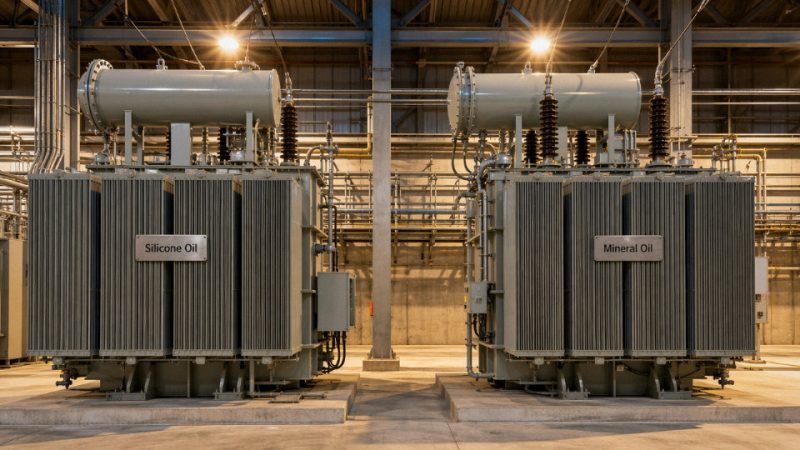
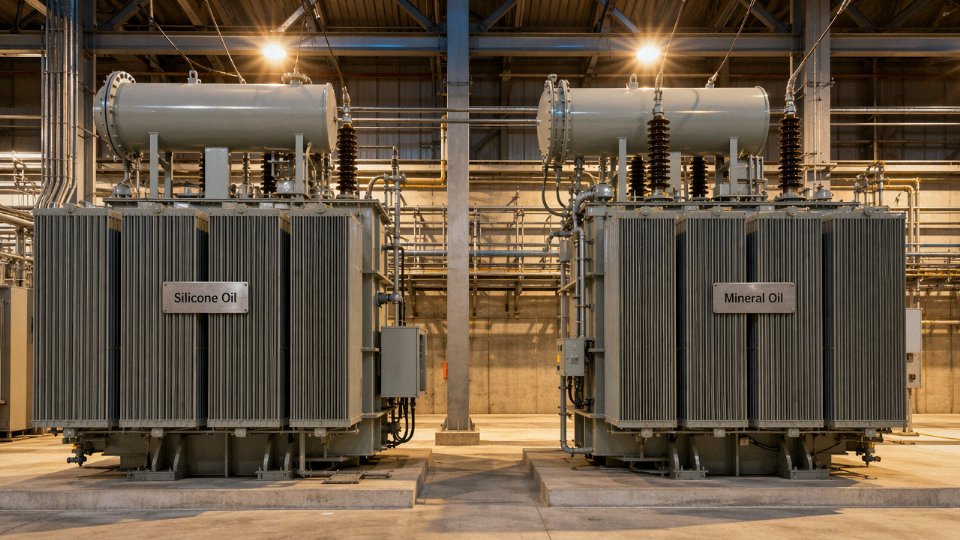
Silicone transformer oil and mineral transformer oil differ primarily in fire safety, dielectric performance, and cost. Silicone oil offers a flash point above 300°C and dielectric strength of roughly 15–20 kV/mm, versus mineral oil’s 140–170°C flash point and 10–15 kV/mm — but silicone oil typically costs 8–15× more per liter, making fluid selection a genuine engineering and financial trade-off rather than an obvious upgrade.
What makes this comparison genuinely complicated is that neither fluid wins cleanly across every application. A utility-scale outdoor substation in a low-fire-risk rural corridor operates under completely different constraints than a cast-resin-or-fluid debate for an indoor hospital transformer in a building where evacuation is slow and fire suppression is expensive. The next sections break down exactly where each fluid earns its place — and where the price premium either justifies itself or doesn’t.
Molecular Chemistry and Physical Properties: What Each Fluid Is Actually Made Of
The performance gap between silicone and mineral transformer oils isn’t arbitrary — it’s baked into the chemistry at the molecular level. Understanding that chemistry is what separates a procurement decision from a guess.
Silicone Oil: The PDMS Backbone
Silicone transformer fluid is almost always polydimethylsiloxane, commonly written as PDMS. The repeating Si–O–Si chain is the defining structural unit, and that bond carries an energy of roughly 452 kJ/mol. Compare that to the C–C backbone in mineral oil at around 346 kJ/mol, and you immediately understand why silicone resists thermal degradation and oxidative attack so much more aggressively. Higher bond dissociation energy means you need substantially more thermal energy to initiate chain scission or oxidation — which translates directly into longer fluid life in hot-spot conditions. The methyl side groups hanging off the silicon also contribute: they’re chemically inert, hydrophobic, and don’t polymerize the way hydrocarbon radicals do when they break free under stress.
The Si–O bond in polydimethylsiloxane has higher dissociation energy than the C–C bond in mineral oil hydrocarbons, giving PDMS inherently greater thermal and oxidative stability.True
Si–O bond dissociation energy is approximately 452 kJ/mol versus roughly 346 kJ/mol for C–C bonds in aliphatic hydrocarbons, a difference well-documented in polymer chemistry literature and consistent with silicone fluid's known performance at elevated temperatures.
Mineral Transformer Oil: A Complex Hydrocarbon Blend
Mineral transformer oil is not a single compound. It’s a refined petroleum fraction — a mixture of naphthenic rings, paraffinic straight and branched chains, and residual aromatics. The ratio of these fractions determines the final fluid’s properties, and refiners manipulate it deliberately. Naphthenic oils, which dominate the global transformer fluid market, typically have lower pour points and better low-temperature flow than paraffinic grades, making them the default choice for most utility and industrial transformers. Aromatic content is tightly controlled — high aromatics improve oxidation inhibitor absorption but hurt dielectric performance and raise environmental flags. Per IEC 60296, uninhibited naphthenic transformer oils fall into viscosity classes roughly between 8–12 mm²/s at 40°C, though inhibited variants and heavier grades can push beyond that depending on the application.
Physical Properties Side by Side
The table below reflects realistic ranges — actual values shift with exact grade, temperature, and inhibitor package. Don’t treat these as absolutes; use them as a starting framework and verify against your specific fluid’s datasheet.
| Property | Silicone Oil (PDMS) | Mineral Transformer Oil |
|---|---|---|
| Density at 25°C | 0.96–0.97 g/cm³ | 0.85–0.89 g/cm³ |
| Kinematic viscosity at 25°C | 50–100 cSt (grade-dependent) | 8–18 cSt |
| Kinematic viscosity at 100°C | 12–25 cSt | 2–4 cSt |
| Pour point | –50°C to –65°C | –30°C to –45°C (naphthenic) |
| Flash point | >300°C | 140–170°C |
| Fire point | >350°C | 160–180°C |
| Thermal conductivity | ~0.16 W/(m·K) | ~0.12–0.13 W/(m·K) |
| Specific heat capacity | ~1.46 J/(g·K) | ~1.8–1.9 J/(g·K) |
| Coefficient of thermal expansion | ~0.00108/°C | ~0.00070–0.00075/°C |
Silicone’s higher thermal expansion is worth flagging for conservator and tank design — it’s not dramatic, but in a sealed system you’ll see more pressure swing over a wide temperature cycle than with mineral oil.
Viscosity Across Temperature: Why It Matters at Cold Start
Silicone’s viscosity-temperature curve is unusually flat. A PDMS fluid running at 100 cSt at 25°C might only climb to 150–200 cSt at –40°C. Mineral naphthenic oil, by contrast, can jump from 12 cSt at 25°C to well over 1,000 cSt at –30°C depending on grade — sometimes higher. In outdoor substations at northern latitudes, that matters enormously at startup. Thick cold oil doesn’t circulate properly through the windings and radiators, so hot-spot temperatures spike before the fluid warms up and thins out. It’s a real failure mechanism, not a theoretical one.
Water Absorption and What It Means for DGA
PDMS is inherently hydrophobic. Its saturation limit for dissolved water sits around 150–200 ppm depending on grade and temperature, which sounds like more tolerance than mineral oil’s roughly 50–70 ppm saturation — and in one sense it is. Silicone won’t hold much water in solution, so ingress moisture tends to stay as free water at interfaces rather than dispersing through the fluid. The practical consequence for dissolved-gas analysis is subtle but important: the DGA interpretation guidelines developed over decades for mineral oil (Rogers ratios, Duval triangle) don’t map cleanly onto silicone-filled transformers. Technicians running standard DGA on silicone-insulated equipment without silicone-specific interpretation tables risk misdiagnosing fault conditions. That’s an operational blind spot that catches maintenance teams off guard, especially when a transformer has been retrofilled from mineral oil and the documentation doesn’t clearly flag the change.
Dielectric Performance Under Voltage Stress: Breakdown Strength, Resistivity, and Partial Discharge Behavior
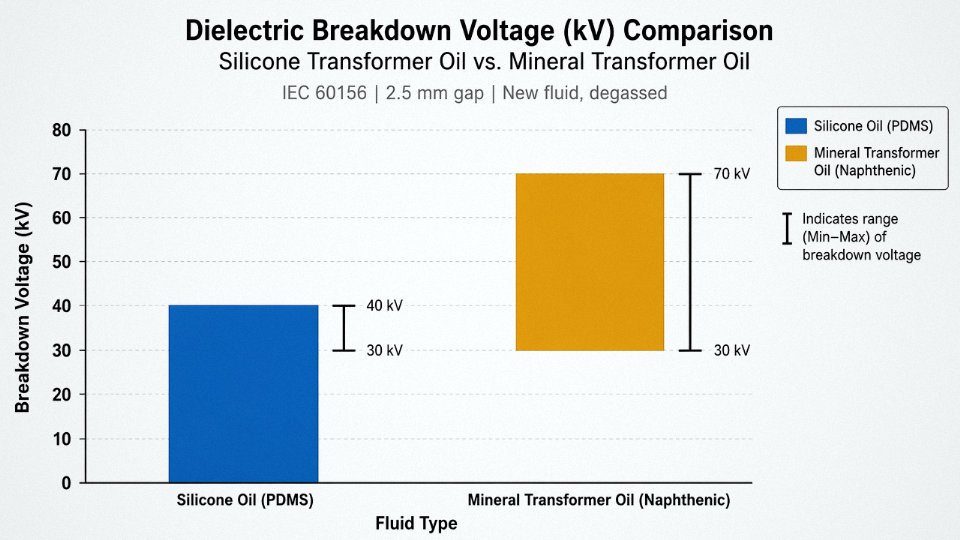
Testing methodology matters before you even look at the numbers. IEC 60156 uses a 2.5 mm electrode gap with a controlled voltage ramp of 2 kV/s; ASTM D877 uses a 2.54 mm flat-disc electrode geometry, while D1816 uses VDE mushroom electrodes at a smaller 1 mm or 2 mm gap. The choice of test method changes the reported value — sometimes substantially — so comparing silicone oil “breakdown voltage” from one supplier’s datasheet against mineral oil from another’s is meaningless unless the test geometries match. Procurement managers should insist on same-method comparisons.
Under IEC 60156 at 2.5 mm gap, new silicone oil typically tests in the 30–40 kV range. New mineral oil spans a wider window — roughly 30–70 kV depending on grade (naphthenic versus paraffinic), refining depth, and how carefully the oil was dried before testing. A poorly degassed mineral oil sample can drop below 30 kV even when fresh out of the drum, which tells you something important: mineral oil’s dielectric performance is highly sensitive to moisture and dissolved gas content, whereas silicone oil is somewhat more tolerant of trace moisture because of its hydrophobic molecular surface. That does not make silicone oil immune to moisture-induced degradation — it isn’t — but the sensitivity is different.
Relative Permittivity and Its Consequences for Field Grading
Silicone oil sits around εᵣ = 2.7–2.8. Mineral oil is lower, typically 2.1–2.3. That gap sounds small but it has real engineering consequences in oil-paper insulation systems. The electric field distribution between oil gaps and cellulose pressboard is governed by the inverse ratio of their permittivities. Mineral oil’s lower permittivity concentrates more stress in the oil gap relative to the paper — which is exactly what classic IEC 60076-based winding insulation designs were optimized around for decades. When you substitute silicone oil into a transformer originally designed for mineral oil, the field distribution shifts. In practice, for distribution-class units below roughly 36 kV, this shift is usually tolerable with no changes. Above 66 kV, it warrants a full insulation coordination review. I’ve seen procurement teams skip this step and then wonder why their reinsulated unit failed a factory acceptance test.
Substituting silicone oil into a transformer originally designed for mineral oil requires engineering review of insulation coordination at voltages above 66 kVTrue
Silicone oil's higher relative permittivity (≈2.7–2.8 vs ≈2.1–2.3 for mineral oil) alters the electric field stress distribution in oil-paper insulation systems, which are designed under IEC 60076 around the lower permittivity of mineral oil. This is not a theoretical concern — IEC 60836 and transformer OEM guidance both flag this as a design parameter requiring review.
Volume Resistivity, Leakage Current, and Tan δ
Volume resistivity for new silicone oil exceeds 10¹⁴ Ω·cm. Mineral oil typically falls in the 10¹¹–10¹³ Ω·cm range depending on base stock and additive package. That order-of-magnitude difference shows up directly in insulation power factor (tan δ) measurements — silicone oil tends to give very low tan δ values, often under 0.001 at 90°C, which makes it genuinely useful in high-temperature service where mineral oil’s tan δ climbs steeply. Higher resistivity also means lower ionic leakage current through the bulk fluid, which matters for the accuracy of partial discharge (PD) measurements and for reducing capacitive coupling interference in on-line monitoring systems.
Partial Discharge Behavior
Partial discharge inception voltage (PDIV) and extinction voltage (PDEV) comparisons between the two fluids are less straightforward than the breakdown voltage comparison. Silicone oil’s slightly higher permittivity means that in a mixed oil-solid insulation geometry, the fraction of voltage appearing across the oil gap is modestly lower than with mineral oil — which tends to raise the apparent PDIV in oil gaps while shifting stress toward the solid insulation. Whether that trades well or poorly depends entirely on where the weakest element in your insulation system sits.
Aging and Contamination: Different Failure Modes, Same End Result
Mineral oil degrades through oxidation. Oxidation byproducts — organic acids, sludge, polar compounds — progressively reduce resistivity, raise tan δ, and can drop breakdown voltage significantly over years of service in sealed or breathing transformers running without adequate inhibitor maintenance. Silicone oil resists oxidative degradation well. Its dominant aging mechanism in service is particulate and metallic contamination, and moisture ingress through failed seals. The dielectric properties of silicone oil remain remarkably stable in clean, sealed systems, but a contaminated silicone-oil unit can degrade faster than expected because the fluid’s low surface tension allows fine particles to stay suspended rather than settling. Regular oil sampling and particle counting — not just the standard BDV test — is the appropriate maintenance discipline for silicone-oil transformers.
Thermal Management and Cooling Efficiency: Heat Transfer Coefficients, Hot-Spot Temperatures, and Overload Capacity
Silicone oil’s dielectric advantages are well-documented, but its thermal behavior is where procurement managers and transformer design engineers often get surprised — usually after the unit is already in service.
Thermal Properties: Where the Numbers Actually Come From
Silicone oil (polydimethylsiloxane) carries a thermal conductivity of roughly 0.15 W/(m·K), compared to about 0.13 W/(m·K) for a typical naphthenic mineral oil. That gap looks small on a datasheet. The complication is specific heat capacity: silicone oil runs around 1.5 kJ/(kg·K), while mineral oil sits closer to 1.7 kJ/(kg·K). So silicone conducts heat marginally better per unit of cross-section, but stores less heat per kilogram. The combined volumetric heat capacity — density times specific heat — ends up meaningfully lower for silicone, which matters when you’re calculating how quickly a transformer tank can absorb a sudden load spike before the oil temperature climbs.
Neither fluid is bad. But neither is neutral, and treating them as thermally equivalent when sizing a replacement unit is a mistake that shows up as chronic overtemperature alarms six months after commissioning.
Natural Convection in ONAN Cooling: Viscosity Is the Hidden Variable
In ONAN (oil-natural, air-natural) cooling — still the dominant mode for distribution transformers below roughly 10 MVA — convective flow velocity inside the tank drives heat transfer from winding surfaces to radiator panels. Silicone oil’s viscosity at 40–60°C is noticeably higher than mineral oil’s at the same temperature range, typically enough to reduce natural convective flow velocity by somewhere between 15% and 30% in identical tank geometries. The exact penalty depends on tank height, winding channel width, and the specific silicone fluid grade.
IEC 60076-7 thermal models were developed primarily with mineral oil in mind. Applying them unmodified to a silicone-filled transformer will underpredict hot-spot temperatures. You need corrected thermal parameters — specifically adjusted winding-to-oil gradient exponents and oil time constants — calibrated either by thermal simulation or by factory heat-run testing on the actual unit.
Hot-Spot Temperatures at Rated Load
Run the IEC 60076-7 model with properly corrected parameters and you’ll typically see silicone-oil-filled transformers running 5–10°C higher top-oil and hot-spot temperatures at rated load compared to a thermally equivalent mineral-oil design. The range depends on radiator area, load profile, and ambient temperature — a unit in a 45°C ambient outdoor substation will be at the worse end of that range.
A 6°C increase in sustained hot-spot temperature halves cellulose insulation life according to the Arrhenius aging model applied in IEC 60076-7.True
IEC 60076-7 Annex A uses an Arrhenius-based aging acceleration factor where the reference is 98°C hot-spot; each approximately 6°C rise doubles the aging rate, halving expected insulation life at that sustained temperature.
That is not a rounding error. A transformer designed for 30 years of service life could realistically be looking at 15 years if the thermal derating of silicone oil in ONAN service isn’t compensated by design.
Overload Capacity: A Genuine Advantage With a Real Catch
Where silicone oil genuinely earns its price premium — and it is substantial, roughly 8–15× per liter over mineral oil depending on volume and supplier — is thermal stability above 200°C. Mineral oil starts to degrade meaningfully at sustained temperatures above 120–130°C; silicone fluid remains chemically stable well past 200°C. For short-duration emergency overloads, this matters.
The catch is that the higher base hot-spot temperature in ONAN operation shrinks the thermal headroom you’re trying to exploit. Starting 8°C hotter at rated load means you reach the emergency overload ceiling faster.
Practical Mitigation: What Actually Works on the Plant Floor
Three approaches address this in real installations. First, increase radiator surface area by roughly 20–30% compared to the equivalent mineral-oil tank — this is the most common fix in purpose-built silicone-filled designs and largely closes the hot-spot gap without adding electrical equipment. Second, specify OFAF (oil-forced, air-forced) cooling for any unit above about 5–7 MVA or in high-ambient installations; forced circulation eliminates most of the viscosity penalty in natural convection. Third — and this is the combination that makes most technical sense for high-temperature or fire-critical applications — pair silicone oil with Nomex (aramid) insulation rather than standard kraft paper. Nomex carries a thermal class rating of 220°C, silicone fluid is stable well past that, and together they allow a design basis that simply isn’t possible with mineral oil and kraft paper. The insulation system cost increases, but you’re buying a unit that can handle sustained hot-spot temperatures that would destroy a conventional design.
In practice, silicone oil in a thermally optimized OFAF or ONAF unit with Nomex insulation is a coherent engineering choice. Silicone oil dropped into a standard ONAN tank that was designed around mineral oil parameters is a thermal problem waiting to become a maintenance event.
Fire Safety, Flammability Classification, and Code Compliance for Indoor and Substation Installations
Flash point is where the fire safety conversation starts, but it is nowhere near where it ends. Silicone oil’s flash point sits above 300°C and its fire point clears 350°C — that is not a minor incremental improvement over mineral oil’s 140–165°C range, it is a fundamentally different hazard category. In practice, that gap reshapes everything from the civil design of the substation room to the annual insurance renewal.
How Regulatory Bodies Actually Classify These Fluids
IEC 61039 draws the sharpest line in international practice. Mineral oil sits in class O1 — flammable liquid, full stop. Silicone fluid qualifies as K3, the highest less-flammable classification in that standard. Ester-based fluids land at K2, which matters when you are comparing three-way bids. IEEE C57.111 uses similar logic in the North American context, and NFPA 70 Article 450 ties classification directly to what installation conditions are permissible — vault requirements, separation distances, suppression mandates. Several Northern and Central European countries have gone further and effectively require K-class fluids in all indoor public buildings, including hospitals, schools, and transit infrastructure. That is not a preference — it is a permit condition. If your project is in one of those jurisdictions and you spec mineral oil, the building authority will send the package back.
Silicone transformer oil qualifies as a less-flammable fluid under IEC 61039 Class K3 and IEEE C57.111, with a flash point above 300°C.True
These classifications are defined by standardized flash point and fire point thresholds. Silicone oil's flash point exceeds 300°C and fire point exceeds 350°C, satisfying the K3 criteria under IEC 61039 and the less-flammable fluid definition in IEEE C57.111.
FM Global Data Sheet 5-4 and the Civil Cost Equation
FM Global’s Property Loss Prevention Data Sheet 5-4 is the document that most large industrial insurers use when they write transformer fire requirements into policy conditions. Under that framework, a mineral-oil-filled transformer in or adjacent to an occupied building typically requires fire-rated barrier walls (often 2-hour or 3-hour rated), a containment pit sized for 110% of oil volume, and an automatic suppression system — either deluge or foam-water. On a constrained urban site, those requirements can add anywhere from roughly $80,000 to well over $250,000 in civil and mechanical installation costs depending on transformer size, local labor rates, and whether the structure needs to be reinforced to accept the suppression system. The range is wide because basement electrical rooms in older buildings are genuinely expensive to retrofit.
Silicone-filled units in the same location can often eliminate or substantially downsize several of those requirements. The containment volume may still be required for environmental reasons — silicone oil is not infinitely benign from a spill perspective — but the suppression system specification typically drops from automatic deluge to a more modest arrangement, sometimes portable extinguishers plus detection only, depending on the authority having jurisdiction.
Self-Extinguishing Behavior and Pool Fire Dynamics
This is where the physics matters most to a safety officer. Mineral oil, once ignited above its fire point, sustains combustion and the burning liquid spreads. A pool fire in a mineral-oil transformer room is genuinely difficult to control with standard dry chemical or CO₂ agents — you are fighting a flammable liquid fire that is continuously fed by the transformer tank. Silicone oil does not sustain combustion once the ignition source is removed below roughly 350°C. When it does oxidize under extreme fault conditions, the primary solid residue is SiO₂ — a white ash rather than a spreading fire. That behavior is not theoretical. It is why K3 classification exists.
Insurance, Lifecycle, and the Hospital Scenario
Less-flammable fluid installations in high-value or occupied buildings typically attract 20–40% lower property insurance premiums on the transformer risk, depending on insurer, occupancy type, and total insured value. The range depends heavily on building value and prior loss history — a data center or a hospital will see the larger end of that reduction.
Consider a realistic scenario: a 1,600 kVA MV/LV transformer replacement in a basement electrical room of a large hospital. Mineral oil filling requires a full concrete fire vault, a foam-water suppression system, and ongoing annual inspection compliance under the relevant fire code. Silicone filling, by contrast, may meet the building permit conditions with a simpler containment arrangement and no suppression system, reducing civil construction cost by perhaps $90,000–$180,000 on that single unit. The fluid itself costs more — silicone oil runs roughly 8–15× the per-liter cost of mineral oil, and for a 1,600 kVA unit that fluid premium might represent $12,000–$25,000 in additional fluid cost depending on fill volume and market pricing at the time of purchase. Over a 30-year lifecycle, factoring insurance savings, avoided civil works, and the reduced suppression system maintenance burden, silicone filling is frequently the lower total-cost option in exactly this type of application. It is not always, and the numbers need to be run for each specific site — but the instinct that mineral oil is cheaper because the fluid price is lower is often wrong once you account for everything the installation actually requires.
Environmental Fate, Ecotoxicology, Spill Risk, and Regulatory Disposal Requirements
Environmental compliance has quietly become one of the more expensive line items in transformer lifecycle cost — and the fluid choice drives a surprising share of that burden. Neither silicone oil nor mineral oil gets a clean bill of health across all environmental metrics, which is why “silicone is the green option” is too simple a claim.
Biodegradability: Where Mineral Oil Has a Genuine Edge
Mineral transformer oils based on modern Group II or Group III base stocks biodegrade roughly 60–80% within 28 days under OECD 301F testing. That’s actually reasonably good compared with many industrial fluids. The older concern — and it remains a real one for legacy equipment — is polycyclic aromatic hydrocarbon content. Pre-1990s naphthenic oils, particularly those refined to earlier API standards, can carry PAH concentrations that create soil persistence and aquatic toxicity problems well beyond what the bulk biodegradability figure suggests. If you’re assessing a brownfield substation or buying used transformers, PAH content in the existing oil deserves a lab analysis before you assume a simple drain-and-refill is sufficient.
High-molecular-weight PDMS silicone fluid — the grade actually used in power transformers — is not readily biodegradable by OECD 301B criteria. Low acute toxicity, yes. Environmentally benign over time, not exactly. The cyclosiloxane fractions D4 and D5, which appear as trace contaminants in some silicone fluid formulations, are regulated under EU REACH as substances of very high concern: persistent, bioaccumulative, and subject to restriction notifications that are still evolving. Procurement teams specifying silicone fluid in Europe should request supplier documentation confirming D4/D5 content is below the REACH SVHC threshold — this is not paperwork for paperwork’s sake.
High-molecular-weight PDMS silicone transformer oil is readily biodegradableFalse
PDMS transformer oils do not meet OECD 301B ready biodegradability criteria. They have low acute toxicity, but persistence in soil and sediment is a documented characteristic. Only certain ester-based fluids meet ready biodegradability standards.
PCB Legacy Risk: A Procurement Due-Diligence Issue
Any transformer manufactured before roughly 1980 and still in service — or being acquired secondhand — may contain PCB-contaminated mineral oil. Disposal under Stockholm Convention protocols is expensive, jurisdictionally complex, and in some regions requires certified destruction rather than re-refining. Silicone oil carries no PCB contamination risk by its chemistry. When you’re evaluating legacy equipment for refurbishment, that’s a meaningful differentiator, not a trivial one.
Aquatic Exposure and Spill Behavior
Mineral oil’s water solubility is low, around 1 mg/L, but that low solubility doesn’t prevent environmental harm. A surface film from even a modest spill suppresses oxygen transfer at the water-air interface, causing dissolved oxygen depletion that affects fish and invertebrates over a much larger area than the spill volume itself would suggest. Silicone fluid is essentially insoluble and shows negligible toxicity to aquatic organisms at realistic exposure concentrations. The surface film effect is far less pronounced.
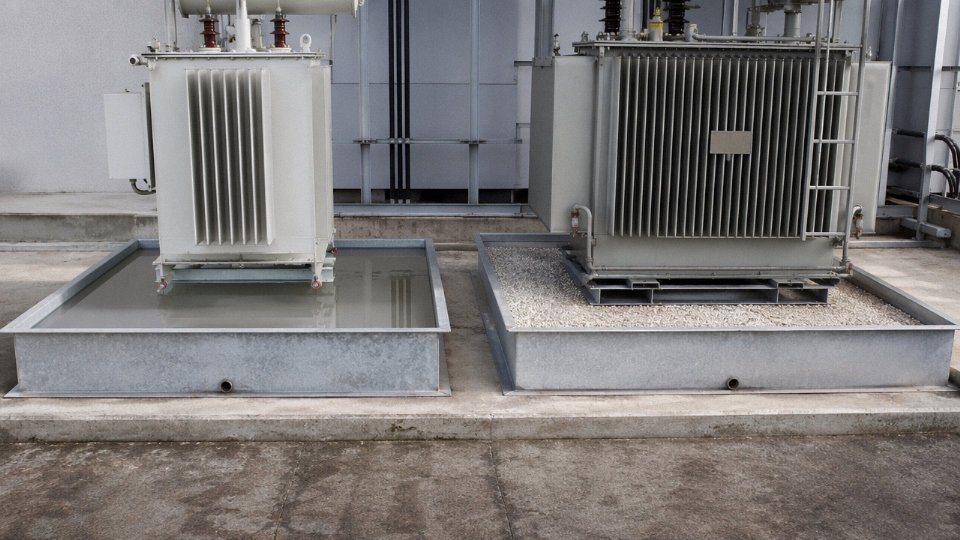
That said, silicone oil’s higher viscosity — roughly 50–100 cSt at operating temperature versus 8–12 cSt for mineral oil at the same temperature — slows surface spread after a spill but does not reduce the containment volume required under applicable regulations. Don’t let a facilities engineer talk you into undersizing the bund because “it won’t flow as far.”
Containment Design and Regulatory Obligations
IEC 60296 covers mineral insulating oils and references containment broadly; the harder obligations come from EPA 40 CFR Part 112 (SPCC rules) in the United States and the EU Water Framework Directive for European installations. Both frameworks require a containment sump sized to hold 110% of the largest single container volume, plus typically a rainfall allowance. Neither framework gives silicone oil a meaningful exemption from these sizing rules.
Disposal Cost: A Lifecycle Budget Item That Gets Underestimated
Used mineral oil is classified as hazardous waste in most jurisdictions unless it qualifies for re-refining. Disposal typically runs $0.50–$1.20 per liter depending on regional treatment infrastructure, PCB content, and whether re-refining is available locally. Silicone fluid waste is classified as non-hazardous special waste in most regions, but treatment capacity is thinner and less competitive — expect $0.80–$1.80 per liter, sometimes higher in areas without a dedicated silicone waste processor. The relative disposal cost gap narrows or reverses in locations where PCB-contaminated mineral oil drives costs up sharply.
For a 10,000-liter transformer, the end-of-life disposal difference can easily run $5,000–$10,000 or more before you account for any PCB remediation. Build this into the total cost of ownership model from day one.
Aging Mechanisms, Dissolved Gas Analysis Interpretation, and Condition Monitoring Protocols
Mineral oil and silicone oil don’t just differ in chemistry at room temperature — they age along completely different chemical pathways, and that distinction has serious consequences for how you interpret DGA results. Treating silicone oil with mineral-oil diagnostic frameworks is one of the more common and consequential mistakes in transformer maintenance, and it happens more often than most service engineers would admit.
How Mineral Oil Ages and What DGA Actually Measures
Naphthenic and paraffinic mineral oils degrade through a combination of thermal cracking and oxidative chain reactions. The fault gases this produces — H₂, CH₄, C₂H₆, C₂H₄, C₂H₂, CO, and CO₂ — form the entire basis of IEC 60599 and IEEE C57.104. The Rogers Ratio method, Doernenburg ratios, and the Duval Triangle were all built on decades of mineral oil field data. They work because mineral oil consistently generates predictable ratios of these gases depending on fault type and temperature. A high C₂H₂/H₂ ratio points toward arcing. Elevated C₂H₄ relative to C₂H₆ suggests a hot metal thermal fault in the 400–700°C range. The logic is well-established, extensively validated, and — critically — only valid for mineral oil.
Why Those Same Methods Fail with Silicone Oil
Silicone oil (polydimethylsiloxane) degrades differently. Thermal and electrical faults generate H₂ and CH₄ as the primary products; C₂H₄ and C₂H₂ remain very low even under conditions severe enough to cause significant physical damage. If you run a Duval Triangle on a silicone oil DGA result, the plot lands in zones that were calibrated to mineral oil gas ratios — you’ll likely misclassify the fault type, or worse, declare a healthy unit faulted (or vice versa). I’ve seen cases where a silicone-filled transformer was flagged for “high-energy arcing” by a diagnostic tool that had no silicone-oil mode, leading to an unnecessary and expensive de-energization.
The Duval Triangle and Rogers Ratio methods developed for mineral oil do not apply to silicone transformer oil DGA results.True
IEC 60599 Annex C explicitly states that DGA interpretation methods in the main body of the standard are developed for mineral oil. Silicone oil produces predominantly H₂ and CH₄ under fault conditions with minimal ethylene and acetylene, invalidating the gas ratio logic underlying Rogers, Doernenburg, and Duval Triangle methods.
The correct framework is IEC 60599 Annex C, which provides guidance specific to non-mineral insulating liquids. H₂ is the dominant fault indicator in silicone oil. CO and CO₂ ratios remain useful regardless of fluid type because they reflect cellulose insulation degradation, not the oil chemistry — that part of the interpretation carries over cleanly.
Oxidation Stability and What Testing Actually Shows
Oxidation testing protocols also diverge. Mineral oil is evaluated per IEC 61125, and uninhibited grades will show measurable sludge formation and acid number increase after roughly 164 hours at 120°C — sometimes dramatically so, depending on sulfur content and refining quality. Silicone oil, tested per ASTM D2112 or IEC 62535, shows negligible viscosity change and essentially no acid formation under the same conditions. This isn’t marketing language; it reflects the fundamental absence of oxidizable carbon-chain double bonds in PDMS. In practice, this means silicone-filled transformers in sealed or mildly breathing configurations accumulate acid-related paper degradation far more slowly — though the cellulose still ages thermally regardless of the fluid.
Water Content and Moisture Equilibrium Partitioning
Karl Fischer titration (IEC 60814) works for both fluids without modification. The problem is interpretation. For mineral oil, the Oommen curves and Norris diagrams let you back-calculate paper moisture content from oil water activity — these are embedded in most lab reporting tools. Those curves do not apply to silicone oil. Equilibrium moisture partitioning between PDMS and kraft paper is less well characterized in the open literature, and the partition coefficient differs enough that using mineral-oil Piper diagrams will give you incorrect estimates of paper moisture saturation. Use manufacturer-provided silicone-specific equilibrium data. If the OEM doesn’t have it, request it explicitly before commissioning.
Monitoring Frequency and Prioritization
For mineral oil units, IEEE C57.106 recommends annual DGA under normal service conditions, with increased frequency following any suspected fault event. Silicone oil monitoring is less standardized — no equivalent prescriptive schedule exists in IEC or IEEE documents as of current editions. Industry practice among utilities and industrial plant operators who actually run silicone-filled units tends toward DGA every 2–3 years for stable, low-load transformers, with the diagnostic emphasis shifting toward infrared thermography and online partial discharge monitoring. This isn’t because silicone oil is inherently more reliable; it’s because the DGA signal-to-noise ratio is lower, and thermal imaging often catches developing issues faster than waiting for dissolved gas levels to climb meaningfully. Annual oil sampling for moisture and dielectric strength still makes sense on units in humid or coastal environments, where moisture ingress risk justifies the modest lab cost.
Total Cost of Ownership: Initial Fill Cost, Maintenance Expense, Retrofit Economics, and 30-Year Lifecycle Analysis
The purchase price comparison is where most procurement conversations start — and, unfortunately, where many of them stop. Silicone transformer oil runs roughly $8–$20 per liter at 2023–2024 global industrial pricing, depending on viscosity grade, order volume, and whether you’re sourcing from a major chemical distributor or a specialty transformer fluid supplier. Mineral transformer oil sits at $0.80–$1.50 per liter for standard inhibited naphthenic grades. That’s a real gap, and it deserves honest accounting rather than hand-waving about “long-term benefits.”
Take a concrete sizing case: a 2,500 kVA pad-mount or substation distribution transformer typically holds somewhere between 1,000 and 1,400 liters of dielectric fluid — call it 1,200 liters as a working figure. At those unit prices, the initial fill cost premium for silicone over mineral oil lands between roughly $9,000 and $22,000 per transformer. On a fleet of 20 units, that’s $180,000–$440,000 in fluid cost alone before anything else enters the model. Anyone who tells you that premium is automatically justified hasn’t done the site-by-site analysis.
Civil Infrastructure Savings Can Dwarf the Fluid Premium
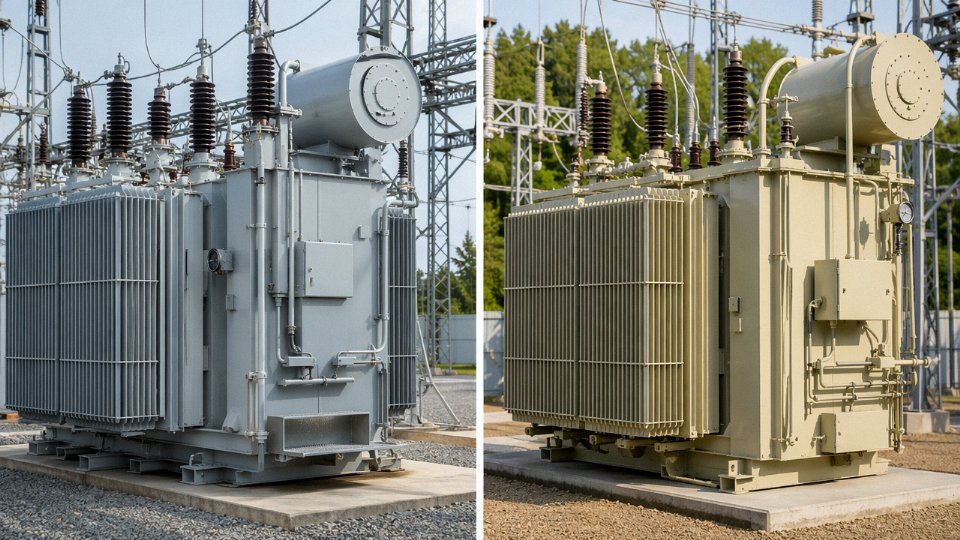
Here’s where the economics often flip, particularly on urban or indoor installations. A transformer filled with mineral oil in many jurisdictions — IEC 61936-1, NFPA 70B, and various national fire codes — requires a concrete bunded containment pit sized for 110% of fluid volume, automatic fire suppression, smoke detection, and sometimes a dedicated fire-rated vault. Depending on site complexity, ground conditions, and local contractor rates, that civil package costs somewhere between $50,000 and $250,000. The lower end applies to a straightforward outdoor substation on flat ground with simple bunding; the upper end reflects an urban basement installation or a transformer room inside an occupied building with sprinkler integration, blast walls, and restricted access requirements.
Silicone oil’s classification as a high-fire-point fluid (flash point above 300°C, compared to 140–170°C for mineral oil) often allows those civil requirements to be reduced or eliminated under the same codes. In practice, a hospital, data center, or commercial high-rise selecting silicone-filled transformers for their main distribution level may save the entire cost of the suppression system — which more than offsets a $15,000–$20,000 fluid premium on a 2,500 kVA unit. This is not theoretical. Structural engineers and M&E consultants who work on high-value building projects price this into their risk models routinely.
Silicone transformer oil's high flash point can eliminate the need for automatic fire suppression systems in many indoor transformer installations under IEC and NFPA codes.True
IEC 61936-1 and NFPA 70 both provide reduced civil and fire protection requirements for transformers filled with fluids having flash points above 300°C, which silicone oils meet. This is well-established in transformer installation engineering practice.
Maintenance Cost Over a 15–30 Year Service Life
Mineral oil degrades through oxidation — it forms acids, sludge, and varnish deposits that block radiator passages and attack cellulose insulation. Inhibited oils slow this down but don’t stop it. Routine condition monitoring on a mineral-oil transformer typically involves annual dissolved gas analysis, periodic acidity and dielectric strength testing, and every 8–12 years, an oil reclamation treatment or full oil change. That reclamation service alone runs $1,500–$4,000 per unit depending on transformer size and oil volume.
Silicone oil does not oxidize through the same mechanism. It doesn’t form acidic sludge, radiator blockage is not a failure mode, and there’s no requirement for inhibitor replenishment. Realistic maintenance savings — accounting for reduced testing frequency, no reclamation cycles, and lower filter media consumption — land in the range of $500–$2,000 per unit per year for a medium-voltage distribution transformer. Over 20 years, that’s $10,000–$40,000 per unit in avoided maintenance spend, though the actual number depends heavily on the plant’s existing DGA contract pricing and whether reclamation is done in-house or outsourced.
Retrofit Economics: When Does Switching Make Sense?
Converting an existing mineral-oil transformer to silicone requires a complete drain, flush, and filter press cleaning — sometimes multiple flush cycles to get residual mineral oil contamination below 1% by volume, which is the typical threshold before silicone fill. Insulation compatibility needs checking if the transformer uses older gasket materials; some nitrile compounds absorb silicone fluid and swell unpredictably. The full retrofit service, including labor, filter media, disposal of the old oil (which carries its own disposal cost, roughly $0.30–$0.80 per liter for non-PCB mineral oil), and recommissioning typically runs $3,000–$8,000 per unit.
That spend is hard to justify for a transformer that’s staying in an outdoor yard with no fire exposure risk. It makes straightforward economic sense when a transformer is being relocated to an indoor site, or when a facility’s insurance underwriter is repricing the policy based on dielectric fluid classification. Don’t retrofit for its own sake. Retrofit when the site conditions change.
Insurance and Liability: The Number That Often Gets Missed
This one is genuinely hard to model without site-specific data, but it’s not negligible. Property insurers and risk engineers for high-value occupancies — hospitals, data centers, financial trading floors — increasingly price the transformer fluid classification into their coverage terms. Over a 20-year net present value calculation, the premium savings from operating silicone-filled versus mineral-oil-filled transformers in a high-risk building classification can reach $15,000–$60,000 per transformer, depending on asset replacement value, occupancy class, and the insurer’s loss history. Some facilities have had their mineral-oil transformer insurance declined outright in specific zones.
Decision Framework: Where Does Silicone Oil Win on Total Cost?
| Site Condition | Civil Cost Risk | Transformer Capacity | Silicone TCO vs. Mineral Oil |
|---|---|---|---|
| Outdoor substation, low fire risk | Low | Any | Mineral oil usually cheaper over lifecycle |
| Urban outdoor, congested site | Medium | ≥1,000 kVA | Break-even or marginal silicone advantage |
| Indoor building, code-required suppression | High | ≥500 kVA | Silicone typically superior by $30,000–$150,000+ |
| Tunnel, basement, critical facility | Very high | Any | Silicone strongly preferred; mineral oil may be code-prohibited |
| Retrofit of existing unit, no site change | N/A | Any | Mineral oil — retrofit cost rarely recovered |
The honest summary: silicone oil is not economically superior in every application, and blanket fleet conversions driven by a single corporate policy are usually wasteful. The case for silicone closes fast, though, the moment civil infrastructure costs enter the model — which they do on almost every urban, indoor, or critical-facility installation. Run the numbers per site, not per fluid brand.
Application Selection Guide: Which Fluid Wins in Specific Installation Scenarios
Every scenario in transformer engineering has a cost-optimal answer, and it is rarely the same answer twice. The sections above have built the technical case; this one converts it into decisions you can defend in a design review or a procurement meeting.
Outdoor Utility Substation (Ground-Level, Remote from Occupied Buildings)
Mineral oil wins here, and there is no close contest. At more than roughly 1 km from the nearest occupied structure, the fire-risk calculus shifts decisively: standard earthen bunding or concrete containment sized for 110% of tank volume meets most utility codes, and the capital saved on fluid — silicone typically runs 8–15× the per-liter cost of mineral oil — funds meaningful additional assets. Mineral oil’s slightly superior viscosity-to-thermal-conductivity ratio under ONAN cooling is fully exploited outdoors, where ambient convection is unconstrained. The dielectric margin in a well-designed outdoor unit is more than adequate with mineral oil’s 10–15 kV/mm breakdown strength under IEC 60156. Keep maintenance intervals realistic — annual DGA sampling is the floor, not the ceiling — and a mineral oil outdoor transformer is a straightforward, low-drama asset.
Indoor Building Substation (Hospital, Data Center, Commercial Tower, Transit Station)
This is where the fluid decision carries the most consequence. Smoke toxicity, sprinkler interaction, and insurance requirements effectively rule out mineral oil in any occupied building without heroic containment measures. Silicone oil becomes competitive with dry-type cast resin units somewhere above 2,000–2,500 kVA, depending on voltage class; above that threshold, cast resin units get physically awkward and expensive, and silicone-filled transformers at the same rating are more compact, run cooler under overload, and in most jurisdictions qualify for the same reduced fire-clearance envelope as dry types. The flash point above 300°C is the deciding specification here.
Silicone oil-filled transformers qualify as 'less flammable' or 'fire-resistant' fluid transformers under IEC 61039 and most building codes, allowing installation in occupied buildings with reduced clearance versus mineral oil units.True
IEC 61039 classifies transformer insulating liquids by fire performance; silicone fluids meet the K-class criteria. Most national building and electrical codes derive indoor installation clearance requirements from this or equivalent fire-performance classifications.
Underground Vault or Tunnel Installation
Silicone oil is effectively mandatory in most jurisdictions with human occupancy below grade — and frankly, the reasoning is not subtle. A mineral oil fire in a confined vault produces toxic combustion products faster than ventilation can clear them, and no forced ventilation system I have seen specified actually mitigates that risk to an acceptable level for occupied tunnels. Metro and utility authorities in Europe and North America have codified this. Do not try to engineer around it with CO₂ suppression alone; suppression fails to prevent the smoke event that is the real life-safety hazard.
Offshore Platform and Marine Installation
Both fluids are used offshore, but the argument tilts toward silicone, particularly in arctic or sub-arctic environments. Silicone oil’s pour point near –60°C versus roughly –40°C for cold-climate-grade mineral oil is not an academic distinction on a North Sea platform in January. Mineral oil is permitted with automatic CO₂ or FM-200 suppression in enclosed equipment rooms, but the weight and complexity penalty of adequate suppression systems often makes silicone the more practical total-package choice once you price the full installation.
Traction Power (Railway, Metro Tunnel Sections)
EN 45545 leaves little room for interpretation in tunnel-section traction transformers: silicone or ester fluid, full stop. Mineral oil is acceptable only in open surface depots, and even there, some operators have moved away from it voluntarily after insurance reviews. Ester fluids are strong competitors here on biodegradability, though silicone holds an edge in extreme cold and long-term oxidative stability.
High-Altitude and Severe Cold Environments
The Tibetan Plateau, high-mountain grids in Central Asia, and Arctic installations all share one characteristic: winter temperatures where standard mineral oil becomes sluggish enough to impair ONAN circulation. Winter-grade mineral oils extend the range to around –40°C; silicone reaches –60°C with no additive package needed. At 4,500 m elevation on the Tibetan grid, that difference is not marginal — it determines whether the transformer cools adequately during a cold-weather overload.
Legacy Fleet Life Extension
Resist the temptation to retrofit every aging outdoor transformer to silicone just because the fluid change is technically feasible. For existing outdoor units in sound condition, in stable regulatory environments, mineral oil remains correct. Silicone conversion makes sense when an asset is being relocated to a fire-sensitive site, when the installation environment is reclassified by new building codes, or when an insurance requirement changes. The conversion process itself — flushing residual mineral oil below roughly 1–3% contamination level to preserve silicone’s dielectric performance — is neither cheap nor trivial, and should be weighed against simply replacing the unit.
| Installation Type | Preferred Fluid | Primary Driver |
|---|---|---|
| Outdoor remote substation | Mineral oil | Cost; ONAN thermal efficiency |
| Indoor occupied building, >2,500 kVA | Silicone oil | Fire class; code clearance |
| Underground vault, occupied | Silicone oil | Smoke toxicity; code mandate |
| Offshore / arctic marine | Silicone oil (preferred) | Pour point; fire safety |
| Railway tunnel traction | Silicone or ester | EN 45545 compliance |
| High altitude / severe cold | Silicone oil | Pour point (–60°C) |
| Legacy outdoor, no site change | Mineral oil | Economics; no regulatory trigger |
Frequently Asked Questions About Silicone Oil and Transformer Oil
Can you mix silicone oil with mineral transformer oil?
No — and this is one of the more consequential mistakes a field crew can make during a retrofit or emergency top-up. PDMS and petroleum hydrocarbon dielectrics are immiscible. Pour them together and you get an emulsion rather than a homogeneous fluid, which destroys the dielectric integrity you were counting on. Breakdown voltage of the contaminated mixture can drop well below acceptable IEC 60156 minimums — think 20–30 kV rather than the 70+ kV you’d expect from clean fluid, depending on contamination ratio and emulsion stability. Cooling is compromised at the same time, since the interfacial layer disrupts convective flow paths.
When converting a mineral-oil unit to silicone fill, a full drain-and-flush procedure is mandatory: drain bulk oil, flush with clean PDMS (at least one fill cycle, sometimes two for units with complex geometries), sample, verify contamination is below the transformer fluid supplier’s threshold, then fill to service level. Skipping the flush to save a day of downtime has caused transformer failures. The field conversion cost — flush fluid, labor, oil disposal — should factor into any retrofit economic calculation.
Mixing silicone oil and mineral transformer oil is safe if the volume ratio of one to the other is smallFalse
PDMS and mineral hydrocarbon dielectrics are chemically immiscible regardless of ratio. Even small contamination levels can cause emulsification, reducing dielectric breakdown strength and disrupting thermal convection. IEC 60836 requires that silicone transformer fluid be free of petroleum contamination; no safe mixing ratio exists.
Does silicone oil degrade the paper insulation in transformer windings?
No. PDMS is chemically inert under normal operating temperatures and does not attack Kraft paper, thermally upgraded Kraft, pressboard, or Nomex. Long-term aging studies at equivalent hot-spot temperatures show cellulose degradation rates comparable to — occasionally slightly slower than — mineral oil service, largely because silicone’s hydrophobic character can limit water activity near the solid insulation. That said, the DGA picture is different (methane is the primary gas from PDMS thermal stress, not ethylene or acetylene as you’d see with mineral oil faults), so don’t confuse “compatible with paper” with “same diagnostic signals as mineral oil.”
Why isn’t silicone oil used in all transformers if it performs better on fire safety?
Mostly cost. At 8–15× the per-liter price of commodity mineral oil — a range that shifts depending on PDMS polymer pricing, order volume, and regional supply logistics — silicone fill adds meaningful capital expense to units where fire risk simply isn’t the governing design concern. An outdoor rural distribution transformer sitting on a pole in open country does not need a >300 °C flash point. The fire-safety premium earns its keep in urban substations, building-integrated units, tunnels, data centers, hospitals — environments that have already been covered in the fire safety section of this article.
There are also two technical nuances worth being honest about. First, silicone’s thermal performance in ONAN (natural oil, natural air) cooling is measurably lower than mineral oil due to its higher viscosity at operating temperature; for a given tank and radiator geometry, you may run 3–8 °C hotter at the hot spot under rated load. Second, the DGA diagnostic framework for PDMS is less mature than for mineral oil — the gas ratios differ, fewer laboratories have calibrated reference ranges for silicone, and misinterpretation is a real operational risk for maintenance teams trained exclusively on mineral-oil IEC 60599 guidance.
Is transformer-grade silicone oil the same as the silicone used in cosmetics or hydraulic systems?
No. Transformer-grade PDMS is specifically manufactured to IEC 60836 specifications: controlled molecular weight distribution for stable viscosity across temperature, ultra-low ionic impurity content (conductivity and dissipation factor are tightly bounded), and certified dielectric performance tested to IEC 60156. Cosmetic-grade silicone fluids are optimized for skin feel and regulatory safety, not electrical insulation. Hydraulic-grade silicone may contain additives — anti-wear, anti-foam compounds — that contaminate the dielectric and can accelerate partial discharge. Using off-spec fluid because it looks similar and costs less is a straightforward path to warranty voidance and, eventually, a failed transformer.
How often should silicone oil be tested in service?
Industry practice for stable in-service units runs to DGA every 2–3 years, with a baseline sample taken at commissioning before the unit goes energized — skipping that baseline is something you regret later when you’re trying to interpret your first in-service result. For critical substation units, annual interfacial tension and dielectric breakdown testing per IEC 60836 is reasonable. If you’re seeing any unusual load history, through-faults, or prior moisture ingress events, tighten the interval regardless of the nominal schedule. Silicone ages slowly, but it does age, and the dissolved gas profile shifts gradually with cumulative thermal stress.
What happens to silicone oil at end of transformer life?
Used PDMS fluid should go to a licensed waste handler familiar with silicone fluids. The good news is that used silicone transformer oil typically does not require hazardous waste classification in most jurisdictions — check local regulations, but in the EU and most US states it processes as industrial waste rather than hazardous. Re-refining and recertification to IEC 60836 is commercially available and worth investigating for large-volume decommissioning projects; the recovered fluid value partially offsets disposal cost. Don’t assume the same disposal contractor who handles your mineral oil has the processing capability for PDMS — confirm before the decommissioning project starts.
Can silicone-filled transformers be serviced in the field?
Yes, but with more discipline than mineral-oil units. PDMS fluid is hydrophobic, which sounds like a benefit — and it is in normal sealed-tank service — but during open work it actively scavenges airborne moisture onto surfaces and winding insulation. Any field repair that opens the tank needs moisture-controlled conditions: dry air blanket or nitrogen purge over the open unit, limited exposure time, desiccant staging for the fluid. After winding work, hot-oil circulation per the OEM’s procedure is required before re-energization. Field crews trained only on mineral-oil practice sometimes underestimate this. The consequence of sloppy open-tank procedure is elevated water content in the fluid, reduced dielectric margin, and potentially accelerated paper aging — exactly what you were trying to avoid by specifying silicone in the first place.