Specifying the wrong synthetic fluid for a high-temperature actuator or a wide-temperature-range gearbox isn’t a theoretical mistake — it shows up as seized bearings, degraded seals, and unplanned downtime that typically runs two to five times the cost of simply using the right fluid from the start. Procurement teams often treat “synthetic oil” as a single category, which leads to substituting a PAO-based lubricant where silicone belongs, or the reverse, and neither failure mode is cheap.
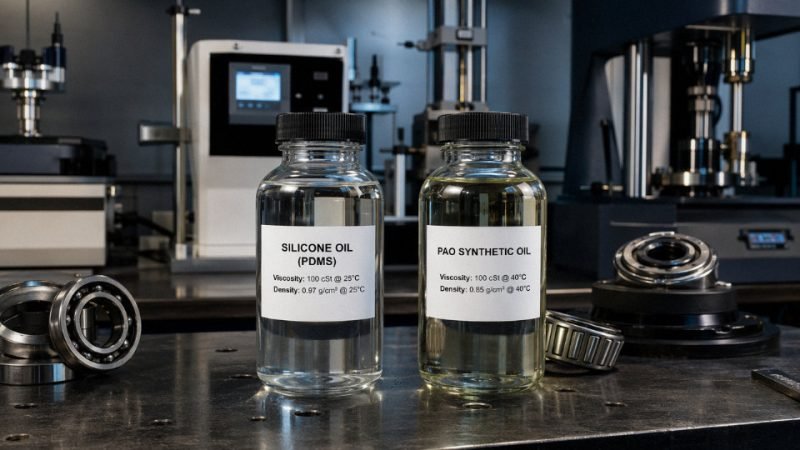
Silicone oil (primarily PDMS grades) outperforms conventional and PAO synthetics on temperature range — usable from roughly −60 °C to +250 °C versus PAO’s −54 °C to +175 °C — and delivers a viscosity index of 100–300, sometimes exceeding 400 in specialty grades. However, silicone oil fails badly under boundary lubrication: FZG gear test failure load stages of 4–6 compared to 10–12 for PAO mean it should never be used in loaded gear contacts without additives or a complete application redesign.
What makes this comparison genuinely tricky is that both fluid families are “synthetic,” both are used in demanding industrial and aerospace applications, and on a data sheet they can look superficially similar until you dig into the load-carrying numbers or check what happens to your elastomer seals. The differences that matter most are not always the ones that appear first in a supplier’s product bulletin.
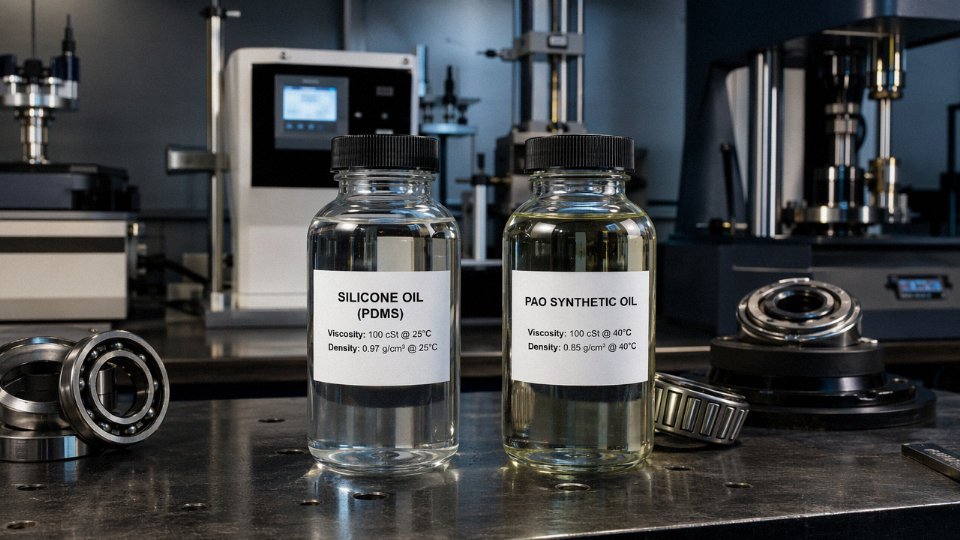
Molecular Architecture: How PDMS Chemistry Drives Silicone Oil’s Unique Behavior
The performance gap between silicone oil and carbon-backbone synthetics isn’t arbitrary — it’s baked into the atoms. Understanding that gap at the molecular level lets you predict behavior before you ever run a compatibility test or pull a viscosity sample.
The Si–O Backbone: Why Bond Geometry Changes Everything
Polydimethylsiloxane (PDMS) is built on a repeating Si–O–Si chain rather than the C–C or C–O linkages you find in PAO or ester synthetics. That distinction matters more than it might look on a data sheet.
The Si–O bond carries an energy of roughly 452 kJ/mol — significantly higher than a C–C bond at around 347 kJ/mol. That alone explains a lot of the thermal oxidative stability silicone oils are known for. But the geometry is equally important: the Si–O–Si bond angle sits around 143°, much wider than the roughly 109° of a tetrahedral C–C chain, and the silicon atom is larger, so there’s far less steric restriction on backbone rotation. The chain is genuinely floppy at low temperatures in a way that carbon backbones simply aren’t.
The practical result is a glass-transition temperature for standard PDMS that can fall below −120 °C, which is why silicone oils stay pourable and functional down to −60 °C in typical grades. Compare that to PAO, which uses branched isoparaffin C–C chains — excellent cold-flow by hydrocarbon standards, with pour points around −54 °C, but the chain stiffens progressively in a way silicone doesn’t. Ester synthetics achieve comparable cold-flow partly through their polar ester linkage geometry, but they carry a different set of trade-offs that we’ll get to.
Methyl and Phenyl Substituents: Tuning the Properties Deliberately
Standard PDMS has two methyl groups hanging off each silicon atom. Those methyl groups are low-polarity, tightly packed, and point outward from the chain — which is why silicone oil has such low surface tension (typically 19–21 mN/m depending on molecular weight) and why it naturally suppresses foam. In hydraulic and mixing applications where entrained air causes cavitation or erratic actuator response, this isn’t a trivial benefit.
Swap some or all of those methyls for phenyl groups — as in methylphenyl silicone or diphenyl silicone fluids — and the character changes noticeably. The bulkier, electron-rich phenyl ring increases the refractive index, reduces radiation degradation by dissipating energy through the aromatic system, and pushes the usable upper temperature ceiling from roughly 250 °C for standard PDMS up toward 280–300 °C for high-phenyl grades. This matters in aerospace seal lubrication, certain analytical instrument bearings, and nuclear-adjacent environments. The trade-off is that phenyl substitution tends to raise the pour point and reduce the already-modest load-carrying capacity slightly further.
Phenyl-substituted silicone oils offer better radiation resistance than standard PDMS.True
The aromatic phenyl ring absorbs ionizing radiation energy and dissipates it without chain scission at the rates seen in purely aliphatic silicones, which is why phenyl grades are specified in nuclear and high-radiation instrumentation applications.
How Polarity Dictates Compatibility and Additive Response
This is where the molecular story gets directly operational. PDMS is essentially nonpolar. PAO is similarly nonpolar (isoparaffin structure, VI typically 120–170, excellent compatibility with mineral-oil-tolerant seals and additives). Ester synthetics carry a polar carbonyl linkage — that polarity is exactly what gives them superior boundary lubrication performance and film strength, but it also makes them hygroscopic and susceptible to hydrolysis if water ingress isn’t controlled. PAG fluids go further: the polyether chain is water-miscible in some grades, which is useful for certain fire-resistant hydraulic applications but creates an entirely different sealing and contamination challenge.
Silicone oil’s nonpolarity means conventional antiwear and EP additive packages designed for hydrocarbon or ester bases largely don’t work with it. The additives simply don’t adsorb onto the tribological contact surface the way they do from a polar carrier fluid. This is the direct molecular explanation for why silicone oil performs so poorly in gear and boundary-lubrication applications — FZG failure load stages of 4–6, versus 10–12 for a properly formulated PAO — without it being a defect of the base fluid per se. It’s just not what the chemistry is suited for. Knowing that before specifying is the entire point.
Viscosity-Temperature Performance: Viscosity Index, Pour Points, and Low-Temperature Pumpability
Viscosity index — the number that tells you how much a fluid thins as temperature rises — is where silicone oil immediately separates itself from most carbon-backbone synthetics. A high VI means the fluid stays closer to its rated viscosity across a wide temperature swing, which matters enormously in systems that see cold morning startups and hot steady-state operation within the same shift.
Viscosity Index Compared Across Fluid Families
The table below gives working ranges rather than single-point specs, because actual VI shifts with molecular weight distribution, additive loading, and whether you’re looking at a neat base stock or a formulated product.
| Fluid Type | Typical VI Range | Key Dependency |
|---|---|---|
| PDMS silicone oil | 100–300+ (some specialty grades >400) | Increases with higher MW / phenyl substitution; grade-independent baseline is flat |
| PAO synthetic | 120–170 | Drops with lower viscosity grades (PAO 4 cSt sits near 120–125) |
| Synthetic ester | 120–175 | Influenced by ester architecture; polyol esters trend toward the upper end |
| PAG (polyalkylene glycol) | 150–260 | Water-soluble vs. oil-soluble PAG diverges significantly here |
The overlap between high-VI PAG grades and silicone oil is real, and it trips people up. Both might show a VI around 200 on the datasheet. The difference surfaces under shear: PAG VI tends to hold up better under sustained mechanical shear in gear contacts, whereas silicone oil’s VI figure, while impressive, comes partly from the inherent flat viscosity-temperature curve of the Si–O backbone rather than from viscosity modifier additives — which is actually a structural advantage, not a numbers game.
Silicone oil (PDMS) can achieve viscosity index values exceeding 400 in certain high-molecular-weight specialty grades, well above standard PAO synthetic base oils.True
High-MW PDMS and phenyl-substituted silicone grades are documented in fluid chemistry literature as achieving VI above 400, reflecting the exceptionally flat viscosity-temperature relationship of the Si–O backbone. Standard PAO base stocks top out around 120–170 VI.
Low-Temperature Pumpability and Cold Cranking
Here’s where silicone earns genuine respect in cold-climate applications. A 100 cSt PDMS grade typically shows a Brookfield low-temperature viscosity around 1,500–2,500 mPa·s at −40 °C, depending on the specific molecular weight cut. That’s pumpable. The pour point for silicone grades in that viscosity range is usually around −55 to −65 °C, though the exact value shifts with the presence of any phenyl groups, which raise pour point somewhat.
PAO 4 cSt reaches a pour point near −54 °C and handles cold cranking well — it’s the reason PAO became the default in synthetic engine oils and arctic-duty hydraulic fluids. But move up to PAO 10 or PAO 46 and pour points climb to −30 °C or higher. Silicone, by contrast, tends to maintain cold fluidity more consistently across viscosity grades. A 500 cSt silicone oil still pours at −50 °C in most cases; a 500 cSt mineral or even PAO-based hydraulic fluid does not come close.
For wind turbine gearboxes operating in northern climates — think sites where ambient temperatures routinely drop below −30 °C before the turbine spins up — cold-start pumpability is not a theoretical concern. It determines whether the gearbox gets adequate lubrication in the first 30–90 seconds after an overnight shutdown. Silicone’s flat low-temperature behavior has made it a serious candidate in those systems, even though its load-carrying limitations (discussed separately) require engineering workarounds.
High-Temperature Viscosity Retention
At the hot end, silicone holds its own differently. A 100 cSt PDMS grade typically retains roughly 18–25 cSt at 150 °C — the log-log viscosity-temperature relationship is nearly linear with a shallow slope, which is exactly what the high VI number predicts. In rolling element bearings running at elevated temperatures, this means the lubricant film is thinner than you’d have at ambient, but it degrades more gracefully than a lower-VI mineral oil would.
Synthetic esters, however, have a structural advantage here that often gets overlooked: they combine respectable VI (120–175) with significantly higher film strength under elastohydrodynamic conditions compared to silicone. Polar ester molecules adsorb onto metal surfaces and contribute to boundary film formation — something PDMS simply does not do well. In a deep-groove ball bearing running at 130–160 °C where film thickness is already marginal, a polyol ester formulation will typically outlast an equivalent silicone grade because of that surface chemistry, not because of VI.
The practical takeaway: for pure thermal stability across a wide temperature window with minimal viscosity swing, silicone oil is genuinely hard to beat. But for applications where high-temperature operation coincides with significant contact stress, synthetic esters or PAO with appropriate EP additive packages usually deliver better wear protection, even if their VI numbers look less impressive on paper.
Thermal Stability and Oxidation Resistance: Upper Temperature Limits Under Continuous Service
Thermal limits are where fluid selection stops being academic and starts costing you bearings, downtime, and in some cases an entire gearbox. The numbers matter here, but so does understanding what the fluid actually does when it degrades — because not all breakdown products are equally damaging.
What TGA Data Actually Tells You About Real-World Ceilings
Thermogravimetric analysis gives a clean, controlled picture of when a fluid starts losing mass through decomposition. PDMS silicone oil shows onset of significant decomposition at roughly 350 °C when tested in nitrogen — an inert atmosphere that isolates thermal cracking from oxidation chemistry. Expose the same fluid to air and that onset drops to around 300 °C, sometimes lower depending on methyl-to-phenyl substituent ratio and chain length. Phenyl-modified silicones push this boundary upward somewhat, which is why they dominate oven and high-temperature damper applications where continuous service temperatures sit in the 230–260 °C band.
PAO starts to show meaningful oxidative degradation somewhere in the 175–200 °C range, depending heavily on the antioxidant package. Unadditivated PAO degrades faster, obviously, but even well-inhibited formulations start generating polar oxidation products — ketones, carboxylic acids, sludge precursors — above 200 °C under continuous service. Synthetic esters handle heat somewhat better due to their inherently polar molecular structure; diesters and polyol esters typically hold up through 200–230 °C in service, with some aviation-grade formulations certified for short excursions above that. PFPE (perfluoropolyether) is the genuine high-temperature champion, stable well past 300 °C with minimal decomposition, but current pricing runs roughly 10–50× silicone depending on viscosity grade and supplier — a range that wide because specialty PFPE grades for semiconductor or aerospace use carry a completely different price tier than general-purpose fluids.
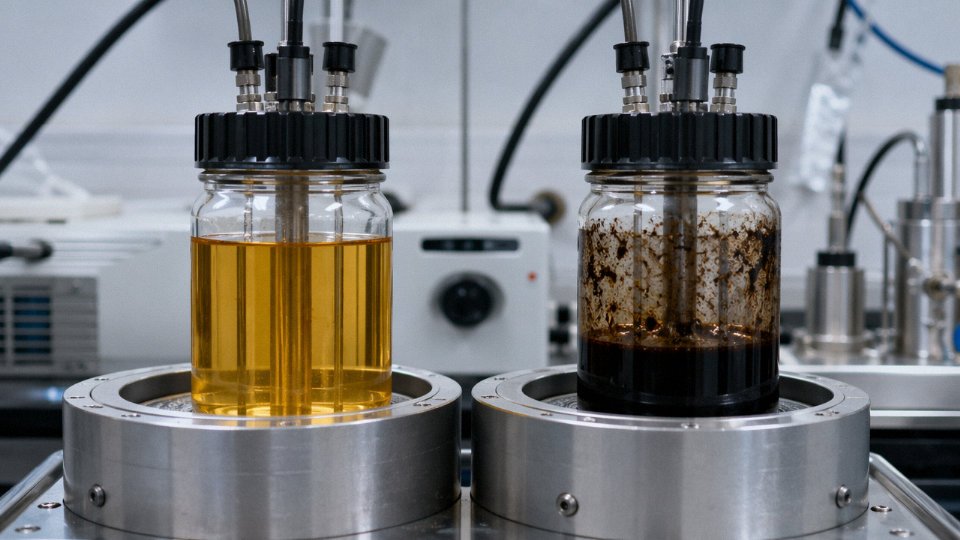
The practical selection logic follows almost directly from those ceilings. For continuous service below 175 °C, a properly additivated PAO is usually the right call — better load-carrying, better additive solubility, lower cost. From 175 °C up to about 250 °C, silicone oil becomes competitive on thermal grounds, especially where the load profile is light (more on that below). Above 250 °C in continuous air-exposed service, you’re looking at phenyl silicone or PFPE, and the cost-versus-requirement conversation becomes very application-specific.
The [Silica](https://siliconchemicals.com/silica/) Problem: Why Silicone Oil’s Oxidation Products Are Uniquely Dangerous
This is the detail that catches people off guard, and it’s operationally critical. When PAO oxidizes, it produces organic varnish and sludge — messy, insulating, problematic for heat transfer and valve response, but relatively soft. When silicone oil oxidizes at elevated temperatures in air, the Si–O backbone doesn’t just polymerize or crack; it produces silica (SiO₂) particulates. Hard, abrasive, sub-micron particles circulating through precision bearings.
Silicone oil oxidation above 200 °C in air produces hard SiO₂ particles that cause abrasive wear in precision bearings.True
The Si–O backbone of PDMS oxidizes to form silicon dioxide particulates rather than the soft organic deposits produced by carbon-backbone synthetics. This is documented in tribology literature and is the primary reason silicone oils are not recommended for recirculating lubrication systems operating in high-temperature air-exposed environments.
In practice, this means silicone oil in a sealed, low-temperature damper or a transformer is fine. Silicone oil in an open bath lubricating a precision spindle that occasionally sees 220 °C air exposure? That’s a bearing failure mode waiting to develop. I’ve seen applications where someone specified silicone “for the temperature range” without accounting for the oxidation environment, and the resulting SiO₂ contamination showed up in wear debris analysis months before anyone understood why bearing life had dropped by half.
Why Standard Oxidation Tests Don’t Rate Silicone Oil — And What That Gap Means
RBOT (ASTM D2272) and TOST (ASTM D943) are the industry workhorses for oxidation life comparison. A well-formulated PAO turbine oil with a modern antioxidant package typically delivers 2,000–4,000 minutes in RBOT testing; the range depends on antioxidant loading, base oil quality, and whether the formulation uses hindered phenolics, aminic antioxidants, or a synergistic blend. Synthetic ester-based turbine oils usually fall in the 1,500–3,000 minute range under TOST conditions.
Silicone oil essentially doesn’t appear in these test comparisons — and the reason is structural, not an oversight. Standard antioxidant additives (zinc dithiophosphates, hindered phenolics, amines) are designed for hydrocarbon or ester carrier fluids. They have very low solubility in PDMS. You can disperse some antioxidant species into silicone, but the effective concentration in solution is severely limited, and what doesn’t dissolve properly doesn’t protect uniformly. The result is that silicone oil’s oxidation resistance depends almost entirely on its base molecular stability rather than on an additive package — which is why its thermal ceiling and its oxidation ceiling are essentially the same thing, not two separately manageable variables the way they are with PAO.
That’s not necessarily a weakness if you’re selecting silicone for an application genuinely within its thermal window. It does mean you can’t compensate for a marginal temperature specification by throwing a better antioxidant package at the problem, the way you might with a PAO formulation pushing its upper limits.
Lubrication and Load-Carrying Capacity: Where Silicone Oil Falls Short in Tribological Performance
Silicone oil’s thermal and viscosity-temperature credentials are genuinely impressive, and in the right application nobody would argue otherwise. But put it under real contact stress — gears meshing, a cam follower bouncing, a bearing running boundary conditions during startup — and the picture changes fast. This is the section most silicone oil datasheets underplay.
FZG Gear Testing and the Boundary Lubrication Problem
The FZG gear test (ISO 14635-1) is blunt and informative: it stages load in increasing steps until a defined level of tooth damage occurs. Unformulated PDMS silicone oil typically fails at load stage 4–6. A PAO with a conventional EP additive package reaches 12–14; most synthetic gear oils land at 10–13, depending on additive treat rate and ester content.
That gap is not subtle. It reflects a fundamental chemistry problem. The Si–O backbone is almost entirely non-polar, and metal surfaces — steel in particular — are oxide-covered and moderately polar. There is essentially no affinity between PDMS and the asperity contact zone. At low speeds or under high load, where hydrodynamic film pressure collapses and the lubricant has to do real work at metal-to-metal contacts, silicone oil has almost nothing to offer. No chemisorbed film forms. No sacrificial layer develops. The asperities shear each other.
PAO, by contrast, still has some polar character at the chain terminations, and more critically it can dissolve sulfur-phosphorus EP chemistries readily. Those additives decompose under contact heat, deposit protective iron sulfide and phosphate layers, and save the surface. Silicone cannot dissolve most of those additives at useful concentrations — the solubility mismatch is severe enough that formulating an EP silicone lubricant is genuinely difficult, not just inconvenient. A few specialty greases use organosilicone carriers with carefully chosen solid EP additives (PTFE, MoS₂, zinc compounds), but these are workarounds, not solutions.
Four-Ball Wear Numbers Tell the Same Story
ASTM D4172 four-ball wear testing at 40 kg, 1,200 rpm, 75 °C gives wear scar diameters that most tribologists find a reasonable screening tool. Silicone oil typically produces a wear scar of 0.8–1.2 mm under those conditions. PAO with an AW additive package comes in at roughly 0.35–0.55 mm. Synthetic ester is similar, 0.40–0.60 mm, depending on ester type and whether any AW treat was included.
A wear scar twice the diameter corresponds to roughly four times the contact area — and wear volume scales even faster than that. In practical terms, this means silicone oil in a sliding contact that experiences any boundary regime will generate substantially more wear debris and surface damage per hour than a properly formulated PAO or ester would.
Silicone oil cannot dissolve conventional sulfur-phosphorus EP additives, making it nearly impossible to formulate as a heavy-duty gear lubricant without switching to solid-particle EP systems.True
PDMS has very low solubility for polar sulfur-phosphorus compounds. This is documented in tribology literature and is the primary reason silicone-based gear lubricants do not exist in standard industrial formats.
Creep Migration: The Quiet Failure Mode
Surface tension of PDMS sits around 21 mN/m. PAO runs about 29 mN/m. That 8-point gap sounds academic until you watch silicone oil migrate across a PCB toward a relay contact, or find it has crept along a shaft into an optical encoder housing.
Low surface energy means silicone spreads aggressively on most solid surfaces. It does not stay where you put it. In sealed, fully flooded systems — an immersion cooling bath, a hydraulic damper with no sensitive neighbors — this is irrelevant. But apply silicone oil near electrical contacts, near elastomer seals (many swell noticeably with silicone exposure), or near precision optics, and contamination is close to inevitable over time. PAG and synthetic ester oils are comparatively well-behaved in this regard; their higher surface tension and, in PAG’s case, water miscibility, mean they localize better.
| Application Context | Silicone Oil Risk Level | Preferred Alternative |
|---|---|---|
| Heavily loaded gears, > FZG stage 6 required | Disqualifying | PAO + EP, synthetic gear oil |
| Sliding cams, boundary lubrication regime | High | Ester or PAO with AW |
| Electrical relay or contact zone nearby | High | Dry film, PAG, or mineral |
| Optical or encoder assembly | High | Specified dry lubricant |
| Lightly loaded bearing, no sensitive adjacents | Low to acceptable | Silicone viable |
| Damper fluid, thermal transfer, no sliding | Negligible | Silicone often preferred |
The operational warning worth stating plainly: silicone oil migration damage in relay mechanisms or optical sensors is often misdiagnosed as electrical or component failure. If you’re seeing intermittent contact resistance or unexplained encoder errors in equipment that was lubricated with silicone anywhere nearby, check for silicone contamination before replacing parts.
Material Compatibility: Elastomer Swell, Seal Degradation, Paint, and Metal Interactions
Material compatibility is where silicone oil causes the most expensive surprises. A technician swaps in silicone fluid for a mineral oil because the temperature range looks right on a datasheet, and three months later the NBR shaft seals have swollen, distorted, and started leaking. The root cause never makes it back to the procurement decision. This section exists to prevent that.
Elastomer and Seal Compatibility
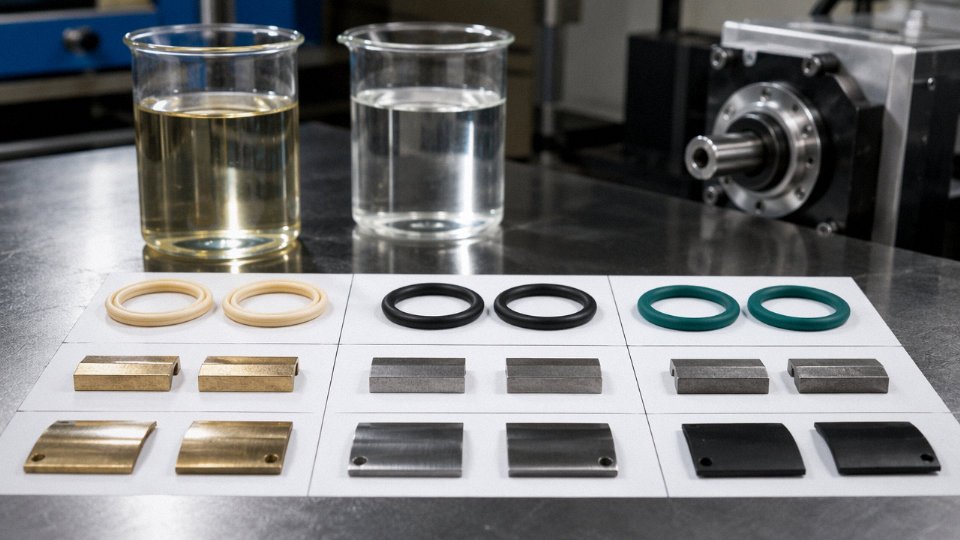
Silicone oil (PDMS) is compatible with fluorosilicone (FVMQ), PTFE, and EPR/EPDM seals — those work fine in most service conditions. The irony that catches people off guard: silicone oil causes severe swell in silicone rubber (VMQ) itself, often 15–40% volume increase depending on the fluid’s viscosity grade, the elastomer’s crosslink density, and service temperature. Higher temperatures accelerate uptake significantly. A 350 cSt PDMS fluid sitting against a VMQ o-ring at 150 °C will cause visibly distorted geometry within weeks. At room temperature the same combination might look acceptable for months before the seal starts extruding under pressure.
Natural rubber and most polyurethanes behave similarly — significant plasticization, dimensional change, and eventual loss of sealing force. If you’re specifying a system that uses standard urethane wiper seals on linear actuators, silicone oil is essentially disqualifying unless you reformulate the seal material first.
PAO tells a different story. Its carbon-backbone chemistry is largely inert toward the nitrile (NBR) and hydrogenated nitrile (HNBR) seals that dominate hydraulic and gearbox applications. Volume swell in NBR with typical PAO fluids usually runs 2–8%, which most seal designs tolerate without functional loss. That’s why PAO stepped in so smoothly as a drop-in upgrade path from mineral oil in so many hydraulic systems — the seal inventory didn’t need to change.
Silicone oil causes significant volume swell in silicone rubber (VMQ) seals, sometimes 15–40% depending on grade and temperatureTrue
PDMS fluid permeates the VMQ elastomer matrix readily because the chemical similarity reduces the thermodynamic penalty for absorption; crosslink density and temperature govern how severe the dimensional change becomes.
Polymer Housings and Coatings
This is an under-discussed failure mode. Silicone oil plasticizes polycarbonate — used in sight glasses, gearbox covers, and sensor housings — causing stress cracking and loss of optical clarity. Certain nylons (PA6 and PA66 in particular) absorb PDMS slowly and soften. Acrylic coatings on painted enclosures blush and delaminate on contact with silicone fluid, which creates a maintenance headache if you’re applying silicone oil as a general-purpose protectant anywhere near painted steel panels. In practice this sometimes goes unnoticed because the coating failure looks like peeling from moisture rather than fluid attack.
Synthetic esters deserve a specific warning: they hydrolyze when in contact with zinc alloys and reactive steel surfaces, especially above 80–90 °C and in the presence of moisture. The hydrolysis products are acidic, which accelerates corrosion on the very metal surfaces the fluid was supposed to protect, and it’s a self-reinforcing process. Mixed-metal housings — aluminum body, zinc die-cast fittings, steel shaft — are particularly vulnerable.
PAG fluids carry their own compatibility trap. Mix PAG with any non-PAG lubricant, including PAO or mineral oil, and you get emulsification or gel formation. A residual few percent of mineral oil left in a gearbox during a PAG conversion is enough to cause problems. Flush discipline matters enormously here.
Metal Interactions and Corrosion Protection
Silicone oil provides essentially no rust protection on ferrous surfaces. It fails ASTM D665-A (distilled water) without rust-inhibitor additives, and passing D665-B (synthetic seawater) requires careful formulation. This is often acceptable in sealed, dry environments — a precision instrument mechanism or a vacuum application — but it rules out silicone fluid anywhere with condensation exposure, coolant ingress risk, or outdoor duty cycles. Rust-inhibited PAO turbine oils, by contrast, are formulated specifically to pass both D665 variants and maintain that protection over long drain intervals.
Synthetic phosphate esters behave differently from most lubricants on ferrous metals: they form a thin passivation layer through adsorption onto iron oxide surfaces, which actually provides meaningful anodic protection. This is part of why phosphate ester hydraulic fluids became standard in aviation hydraulic systems — fire resistance was the driver, but the passivation behavior on steel actuator components was a genuine operational benefit rather than just a side effect. That protection comes with a cost, though: phosphate esters are aggressive toward most paints and are incompatible with zinc, magnesium, and cadmium-plated components common in older aerospace assemblies.
A compact compatibility summary is worth keeping near the fluid selection decision:
| Fluid Type | NBR/HNBR | VMQ (Silicone Rubber) | EPDM | Polycarbonate | Zinc Alloys | Rust Protection (D665) |
|---|---|---|---|---|---|---|
| Silicone (PDMS) | Poor–Fair | Poor (15–40% swell) | Good | Poor | Acceptable | Fails without additive |
| PAO | Good | Good | Fair | Good | Good | Good (inhibited grades) |
| Synthetic Ester | Good | Good | Good | Good | Poor (hydrolysis risk) | Moderate |
| PAG | Fair | Good | Good | Fair | Good | Good |
| Phosphate Ester | Poor | Good | Poor | Poor | Poor | Good (passivation) |
Ratings assume typical service temperatures and standard commercial grades; always verify against the specific elastomer compound and fluid formulation, not just the generic family.
Electrical and Dielectric Properties: Transformer Fluids, Switchgear, and Sensitive Electronics
Silicone oil’s dielectric characteristics are, in practice, the primary reason it commands a price premium in electrical applications — not the viscosity index, not the temperature range, but the combination of high breakdown voltage, extremely low dissipation factor, and near-indifference to moisture. Understanding where these properties matter, and where they don’t justify the cost, separates a well-specified fluid purchase from an expensive mistake.
Dielectric Breakdown Voltage and Fire Safety in Transformer Vaults
Measured by ASTM D877 (disk electrodes) or the more discriminating D1816 (VDE electrodes, 2.5 mm gap), fresh silicone transformer fluid typically achieves breakdown voltages above 35 kV — often in the 35–45 kV range depending on the specific PDMS grade and cleanliness of the sample. Biodegradable synthetic ester transformer fluids generally test higher, around 35–50 kV new, and that performance edge is real. PAO-based dielectric fluids land roughly in the 25–35 kV range, which is acceptable for many distribution-class applications but leaves a narrower safety margin in contaminated-service conditions.
Where silicone fluid pulls decisively ahead is fire behavior. Its fire point runs above 300 °C and flash point typically exceeds 300 °C as well, placing it in IEC 61100’s “K class” (high fire-point fluid, ≥300 °C fire point). For indoor transformer vaults in commercial buildings, tunnels, and underground substations, this classification can eliminate the expensive containment bunds, suppression systems, and ventilation requirements that mineral oil mandates. The capital cost savings on vault infrastructure alone can offset the fluid price difference over the transformer’s service life — and the insurance underwriter usually notices.
Volume Resistivity and Dissipation Factor: The Numbers That Matter for RF and High-Frequency Applications
Volume resistivity of silicone oil sits in the 1×10¹⁴ to 1×10¹⁵ Ω·cm range at 25 °C. PAO-based dielectric fluids are typically closer to 1×10¹³ Ω·cm — a one-to-two order-of-magnitude difference that sounds abstract until you’re specifying cooling fluid for a high-voltage capacitor bank or an RF power amplifier running at several hundred kilohertz.
Silicone oil dissipation factor (tan δ) is below 0.0001 at 25 °C/100 Hz, significantly lower than most synthetic ester dielectric fluids.True
Published fluid specifications from major silicone fluid producers (Dow, Wacker, Shin-Etsu) consistently show tan δ values below 0.0001 at 25 °C across standard test frequencies. Synthetic ester dielectric fluids typically fall in the 0.0002–0.001 range depending on formulation and contamination level, representing a meaningfully higher dielectric loss.
That dissipation factor difference is not academic. In high-frequency capacitor cooling and RF power amplifier thermal management, even small dielectric losses generate heat in the fluid itself, which feeds back into the thermal management problem you’re trying to solve. Silicone’s tan δ of under 0.0001 compares with 0.0002–0.001 for ester fluids — at high frequencies and high voltages, that gap translates directly into resistive heating in the coolant circuit. In most 50 Hz power transformer applications the difference is negligible; in a 500 kHz induction heating power supply or a broadcast transmitter’s output stage, it is not.
Moisture Absorption: The Tropical Climate Problem
This is the factor that gets underestimated most often in procurement specs written in a temperate-climate engineering office. Silicone oil absorbs roughly 50 ppm water by weight under typical atmospheric humidity. Synthetic esters can absorb anywhere from 1,000 to 5,000 ppm depending on fluid type and ambient conditions — sometimes more after extended service in a tropical environment with poor breather maintenance.
Why does this matter? Water contamination degrades dielectric strength sharply. An ester fluid that tested at 45 kV new may drop into the 20–25 kV range after absorbing significant moisture in a poorly maintained outdoor transformer at high humidity. Silicone fluid’s dielectric strength is far less sensitive to ambient moisture exposure because it simply doesn’t pick up much water. For outdoor distribution transformers in Southeast Asia, coastal industrial sites, or rainforest-adjacent installations, this characteristic alone has driven fluid specification decisions — not the headline breakdown voltage number on the fresh-fluid data sheet, but the in-service retention of that performance through a humid rainy season.
The practical caveat: silicone fluid’s low surface tension means it migrates aggressively and is notoriously difficult to contain if a seal weeps even slightly. Transformer designs intended for silicone service need gasket and seal specifications reviewed carefully — a point that sometimes gets skipped when a plant switches fluid type on an existing transformer frame.
Environmental Profile, Regulatory Compliance, and Disposal Considerations
Procurement teams often finalize a lubricant spec based on viscosity grade and price, then discover the environmental and regulatory paperwork six months later when an EHS audit lands on someone’s desk. With silicone oil versus synthetic alternatives, the compliance picture is genuinely complicated — and the differences matter operationally, not just on paper.
Biodegradability: What the OECD 301B Numbers Actually Tell You
The silicone family is not monolithic here, which is where most confusion starts. Low-molecular-weight cyclic siloxanes — D4, D5, and D6 — are a different story from the high-viscosity linear PDMS fluids used as lubricants and heat-transfer media. D4, D5, and D6 are classified as persistent, bioaccumulative, and toxic (PBT) substances under EU REACH and are on Canada’s Domestic Substances List with corresponding restrictions. If your silicone oil supplier cannot confirm that the product is a linear PDMS with number-average molecular weight well above 5,000 g/mol and contains no residual cyclic fractions, that matters for both import compliance and wastewater discharge permits.
Linear lubricating-grade PDMS scores typically below 20% in OECD 301B ready biodegradability testing. Non-biodegradable, full stop — but also genuinely low in acute aquatic toxicity, which is a meaningful distinction. It won’t biodegrade in a drainage ditch, but it doesn’t kill fish at concentrations realistic to a spill either. That combination puts it in a regulatory grey zone that varies by jurisdiction.
Synthetic esters tell a more straightforward story. Polyol esters and certain dibasic acid esters routinely hit 60–90% in OECD 301B, which meets the threshold for “readily biodegradable” classification. That status unlocks preferential treatment under environmental permits in Germany, Scandinavia, and several US state programs — practically, it can mean the difference between a standard spill kit and a full hazmat response protocol at a facility near a waterway. PAO falls in between: roughly 20–40% in OECD 301B, not readily biodegradable, but not the regulatory liability that cyclic siloxanes present.
Linear PDMS lubricating oils (MW >5,000 g/mol) score below 20% in OECD 301B biodegradability testing but show low acute aquatic toxicity, distinguishing them from the PBT-classified cyclic siloxanes D4, D5, and D6.True
OECD 301B data for high-MW linear PDMS consistently shows <20% biodegradation; the PBT classification specifically targets D4/D5/D6 cyclic fractions under EU REACH Annex XVII and Canada's DSL assessments, not lubricating-grade linear PDMS.
Food-Contact Registration and Sector-Specific Approvals
Silicone oil holds FDA 21 CFR 178.3570 status for use as a release and anti-foaming agent with incidental food contact, and NSF H1 registration is available for food-grade silicone lubricant formulations used in processing environments. PAO base stocks also qualify for NSF H1 registration, and several well-known food-machinery lubricant lines are PAO-based. Polyol ester formulations can also carry NSF H1.
Where it gets messy is potable water. Some ester chemistries — particularly certain phosphate esters and aromatic esters — run into restrictions under NSF 61 for contact with drinking water components. If your application touches water treatment equipment or beverage dispensing lines, verify the specific ester type in the formulation, not just the product category.
Disposal: The Cost Nobody Budgets For
This is where silicone oil carries a real and often underestimated penalty. Unlike PAO or mineral-derived synthetics, PDMS cannot be re-refined. The Si–O backbone doesn’t play well with conventional re-refining hydrotreatment processes. Spent silicone oil must be incinerated, and it requires temperatures above roughly 850 °C to fully combust the silicon chain. Below that threshold, you get fine amorphous silica ash — a process equipment fouling problem in the incinerator, and a reason some hazardous waste contractors charge a surcharge or refuse the stream outright. Budget accordingly: in my experience, disposal quotes for silicone oil run noticeably higher than for equivalent volumes of used PAO, and some regional contractors simply don’t have permitted capacity for it.
PAO and synthetic esters, by contrast, re-enter base stock programs through established used-oil collection and re-refining infrastructure. Depending on contamination level and collection logistics, re-refining can recover meaningful value — effective disposal cost reductions of roughly 30–60% compared to incineration, depending on regional recycler pricing and oil volume. For a plant running several thousand liters per year of hydraulic or gear oil, that gap is real money.
The practical takeaway for EHS and procurement: silicone oil’s low toxicity doesn’t translate into low regulatory burden or low disposal cost. If your facility is near sensitive waterways, operates under a strict environmental permit, or generates significant used-oil volume, the total compliance cost of silicone oil is higher than its purchase price suggests.
Total Cost of Ownership: Purchase Price, Service Life, Relubrication Intervals, and System Compatibility Costs
Purchase price is the number procurement managers see first, and it almost always misleads them.
Bulk Fluid Pricing in Context
Food-grade PDMS silicone oil runs roughly $8–$25/kg in 2024 bulk quantities, depending on viscosity grade and whether NSF H1 certification is required — the H1 premium alone can add 30–60% over non-food-contact grades. PAO base stocks (4–8 cSt) typically land at $3–$6/kg, and fully formulated PAO gear or hydraulic oils with additive packages sit around $6–$12/kg. Polyol ester aviation turbine oils occupy a higher tier at roughly $15–$40/kg depending on OEM approval requirements. PFPE fluids are in a different universe — $200–$1,500/kg — and are only justifiable in genuinely extreme environments like semiconductor process equipment or oxygen-service compressors.
Silicone oil sits mid-tier on raw price. The problem is formulation flexibility. PDMS doesn’t accept EP additives cleanly, doesn’t respond well to standard antiwear packages, and has limited solubility for conventional corrosion inhibitors. That means when an application needs anything beyond basic viscosity — oxidation protection in a gearbox, say, or rust inhibition in a humid environment — you’re often pushed toward a specialty silicone compound rather than a generic grade, and that specialty pricing can easily push past $30–$50/kg for phenyl-modified or amino-functional variants.
Drain Intervals and Actual Service Life
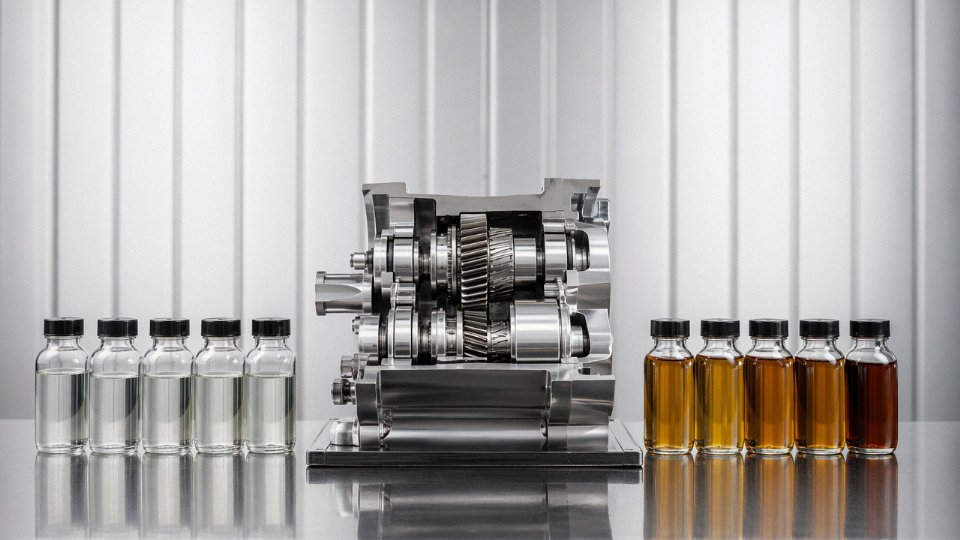
This is where silicone oil can look genuinely competitive — in the right application. In closed, sealed heat transfer systems with no oxygen ingress and no mechanical shear stress, PDMS heat transfer fluid routinely runs 3–7 years before replacement is justified. Diffusion pump oil in a clean vacuum system can have a similar story. No oxidation pathway, minimal degradation, stable viscosity.
Open bearing applications are a different matter. Above roughly 180 °C, PDMS undergoes slow oxidative crosslinking and produces silica (SiO₂) particles. Those particles are abrasive. In practice, bearing systems running above that threshold often need oil replacement at 1,500–2,500 hours — worse than a well-monitored PAO hydraulic circuit, which typically achieves 4,000–8,000 hours with basic condition monitoring (particle count, viscosity trending, acid number). Synthetic ester aviation oils are typically managed on-condition, commonly replaced around 3,000–5,000 hours depending on OEM requirements and cycle severity.
The honest takeaway: silicone’s long service life advantage is real but narrow. It applies mainly in sealed, thermally stable, low-shear systems.
Silicone oil always lasts longer than PAO in industrial lubrication applications.False
Silicone oil's service life advantage is specific to closed, low-shear systems with no oxidation pathway. In open bearing applications above 180 °C, silica particle formation from PDMS oxidation can force replacement at 2,000 hours or less — shorter than a monitored PAO circuit.
Hidden System Costs Nobody Budgets For
Silicone oil migrates. It volatilizes slightly, travels along surfaces, and in mixed-use machinery it will find adjacent electrical contacts. A thin PDMS film on a low-voltage switch contact — even a few micrograms — raises contact resistance enough to cause intermittent faults or outright failures. Replacing a relay or contactor runs $500–$5,000 per event once you account for parts, labor, and lost production time. Troubleshooting silicone contamination failures is notoriously slow because the root cause isn’t obvious on first inspection.
Seal incompatibility is the other budget killer. Use the wrong silicone grade against a silicone rubber seal (which silicone oil actually tends to swell less than petroleum products) and you might be fine — but put it against certain fluorosilicone or EPDM compounds and you’ll see degradation that forces seal replacement at $200–$2,000 per seal set in a mid-size industrial pump, not counting the unplanned downtime that accompanies a wet seal failure.
PAO, by contrast, has broad compatibility with most standard seal elastomers, metals, and coating systems. That compatibility reduces the probability of unplanned maintenance events substantially. A realistic estimate, based on comparative maintenance cost studies in process industries, is that correctly applied PAO cuts 5-year maintenance cost by roughly 15–25% versus silicone oil used in applications where PAO would have been the better fit. That range depends heavily on plant size, lubrication discipline, and how aggressively condition monitoring is used.
The right TCO framing isn’t “which fluid costs less per kilogram.” It’s: what does the system cost to run, over five years, including the failures that don’t get attributed to lubricant choice until the third time they happen?
Application-Specific Selection Guide: Matching Fluid Type to Operating Environment
The preceding sections established why silicone oil and synthetic lubricants differ — now the question is where each actually belongs. A structured selection approach based on real operating conditions prevents the costly mistakes of over-specifying an expensive fluid or, worse, running the wrong one until something fails.
Where Silicone Oil Is the Right Answer
Oven conveyor chains in food and industrial processing are the classic silicone territory. Continuous service temperatures of 150–250 °C, sometimes hitting brief excursions above that, disqualify most PAO-based products, which start forming deposits and oxidizing noticeably above roughly 160–175 °C depending on antioxidant loading. A silicone fluid running at 200 °C will still be fluid and relatively stable where a PAO would have carbonized into a varnish that binds the chain pins. The food-grade variants (typically D4/D5 or high-MW PDMS with NSF H1 status) satisfy incidental food contact requirements that most synthetic hydrocarbons cannot.
Electrical transformer cooling and switchgear is where silicone’s dielectric strength — typically 15–20 kV/mm breakdown voltage, higher than most ester synthetics — and fire resistance combine to justify the price premium. In installations where mineral oil is prohibited for fire safety reasons but PFPE is cost-prohibitive, silicone transformer fluids occupy a well-defined niche.
Instrument damping at extreme cold is another uncontested application. At −55 °C, most PAOs have Brookfield viscosities that make precision damping unpredictable; properly selected low-viscosity PDMS grades (5–20 cSt at 25 °C) remain pourable and mechanically consistent down to −60 °C. Gyroscope dampers, aerospace instrument clusters, and sensitive gauge mechanisms have used silicone for decades for exactly this reason.
Diffusion pumps essentially require silicone or PFPE — the fluid must survive direct thermal decomposition cycling and cannot contaminate the vacuum environment with reactive carbon species. This is a specialized but non-negotiable application.
Medical device lubrication requiring biocompatibility and chemical inertness — catheter lubricants, syringe plunger coatings, prosthetic joint assembly aids — is silicone territory by regulatory default as much as by chemistry.
One often-overlooked use: silicone oil as an anti-foaming additive at 50–200 ppm in PAO or hydraulic fluid systems. You are not lubricating with the silicone; you are using its extremely low surface tension to collapse foam. Overdosing causes its own problems (air entrainment, filter blinding), but at the right concentration it is highly effective and does not require changing the base fluid.
Where PAO or Synthetic Ester Is the Correct Choice
High-speed gear drives requiring FZG load stage performance above 8 are simply not suitable for neat silicone oil. The boundary lubrication weakness documented in the tribology section is not addressable with additives in any practical commercial formulation. Gear oils here should be PAO-based with sulphur-phosphorus EP additive packages, full stop.
Hydraulic systems with nitrile (NBR) or HNBR seals are a compatibility trap for silicone. As the material compatibility section covered, silicone fluid causes measurable swell and softening in NBR — the most common seal material in industrial hydraulics — which leads to extrusion failure under pressure cycling. PAO or ester-based hydraulic fluids are the standard choice, and switching away from them requires a full seal audit first.
Aviation turbine lubrication is governed by MIL-PRF-23699 and equivalent specifications, which are polyol ester products. Silicone oil cannot meet the film strength, additive response, or material compatibility requirements of turbine engine lubrication, and no amount of cost argument changes that.
Automotive drivetrain fluids depend on friction modifier chemistry (typically molybdenum compounds or specific amine-based additives) that are engineered for hydrocarbon base stocks. Silicone base oil disrupts friction modifier solubility and response in ways that produce inconsistent clutch and limited-slip differential behavior.
Silicone oil can replace PAO in most industrial gear lubrication applications with proper additive treatmentFalse
Silicone oil's FZG failure load stage of 4–6 versus PAO's 10–12 reflects a fundamental tribochemical limitation — silicone does not form effective boundary lubricating films on ferrous surfaces regardless of additive treatment, making it unsuitable for loaded gear contacts.
Hybrid Strategies and Upgrade Paths
Running silicone in damper or shock absorber cartridges while adjacent bearing housings use PAO is technically sound — provided barrier seal design physically isolates the two fluids. Cross-contamination is not hypothetical; a weeping seal on a silicone damper reservoir will migrate into bearing cavities and displace PAO film in exactly the areas where load-carrying matters most. The fix is a labyrinth or lip seal arrangement confirmed dry before commissioning, not periodic monitoring after the fact.
When silicone’s upper temperature limit (~250 °C continuous, ~300 °C for specialty phenyl-substituted grades) is insufficient and load-carrying is still secondary — vacuum system bearings above 250 °C, for instance — PFPE is the logical upgrade. The cost jump is significant (roughly 8–25× silicone pricing depending on grade and quantity), but in a 200 °C+ vacuum environment there are no practical alternatives.
PAG earns serious consideration in compressor applications where biodegradability and water washout resistance must coexist. PAG’s hygroscopic nature is a real liability in some environments, but in refrigeration compressors using HFC refrigerants or in marine-classified installations with strict environmental discharge rules, PAG’s combination of good film strength, biodegradability profile, and refrigerant miscibility covers ground that neither silicone nor PAO handles cleanly.
The core selection discipline: identify the hard constraints first (temperature ceiling, load stage requirement, seal materials, regulatory classification), then eliminate fluid families that fail any one of them. What remains is a short list. Price and availability decide among those.
Frequently Asked Questions About Silicone Oil Versus Synthetic Oils
Can silicone oil be mixed with PAO or synthetic ester oils?
No. Full stop. Silicone oil (PDMS) is immiscible with virtually all hydrocarbon-based synthetic fluids — PAO, ester, PIB — and blending them produces a two-phase system, not a homogeneous fluid. In practice, what you get at the bearing or gear mesh is inconsistent local viscosity, additive dropout as polar EP and anti-wear packages preferentially migrate to one phase, and accelerated wear as lubricant film integrity collapses unpredictably.
The contamination threshold is uncomfortably low. Even 1–2% silicone carryover into a PAO gear oil can completely destroy foam inhibitor performance — silicone physically stabilizes foam bubbles rather than breaking them, which is the opposite of what your defoamant additive is designed to do. A single greased fitting, a residual film on a transferred component, or a technician reusing a silicone-contaminated transfer pump can introduce enough silicone to cause this. Cross-contamination during equipment changeover is the most common source in mixed-fleet plants, and it’s worth adding silicone-oil-containing lubricants to your contamination control matrix the same way you’d flag incompatible hydraulic fluid families.
Trace silicone contamination at 1–2% in PAO gear oil can collapse foam inhibitor performanceTrue
Polydimethylsiloxane stabilizes foam bubbles through surface activity that counteracts hydrocarbon-based defoamant chemistry; this interaction is well-established in lubricant formulation literature and industrial contamination case reports
Is silicone oil safe for food-grade applications?
Yes, with qualifications that matter. Certain PDMS grades carry NSF H1 registration and comply with FDA 21 CFR 178.3570, meaning they are permitted for incidental food contact — lubricant that might touch food in small, unavoidable quantities during normal equipment operation. That is not the same as direct or intentional food contact, and it is definitely not edible.
The practical advice: always verify the specific grade against your equipment OEM’s approved lubricant list, confirm the allowable concentration limits with your food safety auditor, and don’t assume that “food-grade silicone” on the label is sufficient. Regulatory interpretations vary by region, and some processing scenarios (high-shear mixing, elevated temperatures near food surfaces) may push even H1-registered fluids outside their approved use envelope.
Why does silicone oil damage electrical relay contacts?
This one catches people off guard more than it should. Silicone oil has measurable vapor pressure even at room temperature, and that vapor migrates into any adjacent enclosure. When it reaches a low-voltage electrical contact that experiences arcing — even the mild arcing in a 24 V control relay — the silicone polymerizes on the contact surface, depositing a thin insulating film with resistivity exceeding 10¹² Ω·cm.
The insidious part is that this film resists normal contact wiping action. Unlike oxide films, it doesn’t wear away under the modest contact force of a relay armature. The result is intermittent contact resistance that climbs gradually until you get nuisance faults, then eventually permanent contact failure. This failure mode is well-documented in automotive and industrial control relay applications and is why responsible maintenance programs prohibit silicone-based lubricants anywhere near relay panels, switchgear enclosures, or terminal strips. If you’re lubricating a nearby door hinge or cable gland with a silicone spray, the vapor still gets in. Use a PTFE-dry or lithium-complex grease instead.
What viscosity grade of silicone oil is equivalent to ISO VG 46 PAO hydraulic fluid?
A 50 cSt silicone oil (measured at 25 °C, which is the conventional reference for silicone grades) comes close to the 46 cSt at 40 °C that defines ISO VG 46, but direct substitution is not straightforward. Silicone oil’s viscosity-temperature curve is much flatter than PAO — its viscosity index typically runs 100–300, and some grades exceed 400, versus roughly 120–170 for PAO. That means at cold startup (say −20 °C), the silicone will be significantly less viscous than an ISO VG 46 PAO, improving cold-start pumpability but potentially reducing film thickness on bearings during the critical first seconds. At high operating temperature, the silicone may sit marginally above the PAO equivalent.
Before making any substitution, you need to recalculate pump inlet suction pressure based on actual viscosity at minimum operating temperature, verify seal compatibility (this is rarely a trivial step — see the compatibility section earlier in this article), and confirm the system’s load-carrying requirements are within silicone’s more limited tribological envelope.
How does silicone oil perform in water-contaminated environments?
Silicone oil is strongly hydrophobic and doesn’t emulsify with water, which is genuinely useful. Water that enters a silicone-lubricated system sits as a distinct phase and can be removed by settling or centrifugation — a meaningful practical advantage over PAG, which is water-miscible and essentially becomes a different fluid once water dilutes it past a few percent.
The catch is rust protection. Silicone oil provides essentially no corrosion inhibition, and water present in a steel bearing housing will cause rust regardless of how clean the silicone phase looks. If your application involves condensation, wash-down exposure, or process water ingress, you need a compatible rust inhibitor that has been specifically tested in your silicone base fluid — not just assumed to work because it functions in mineral or PAO bases. In my experience, this is an easy detail to overlook during initial formulation or when transitioning from a mineral oil that had rust inhibitor built into the additive package.