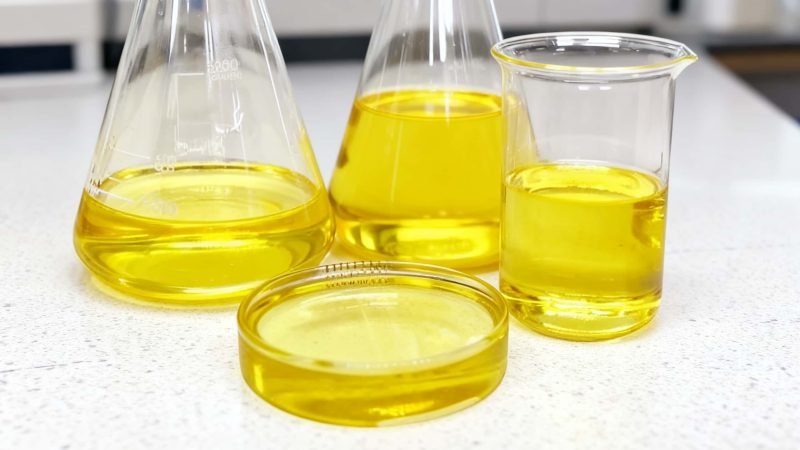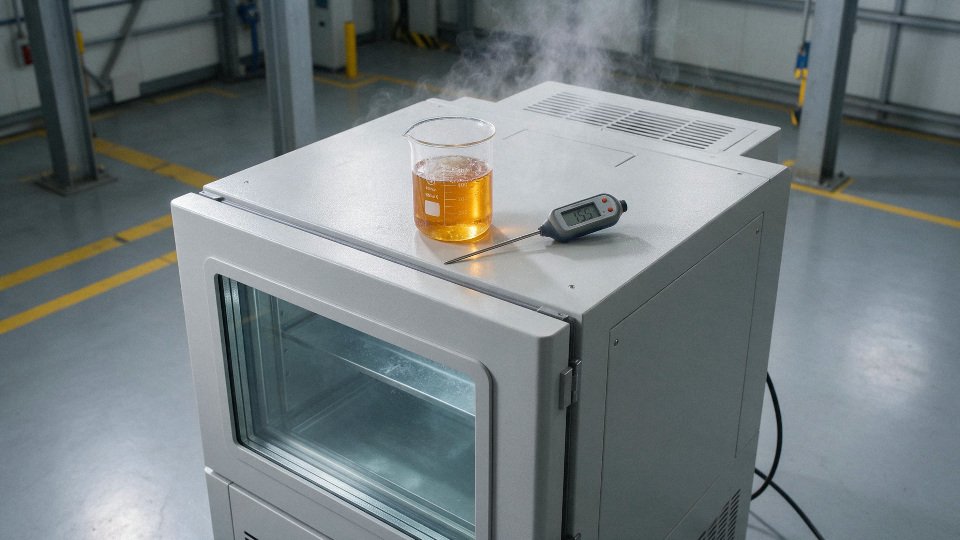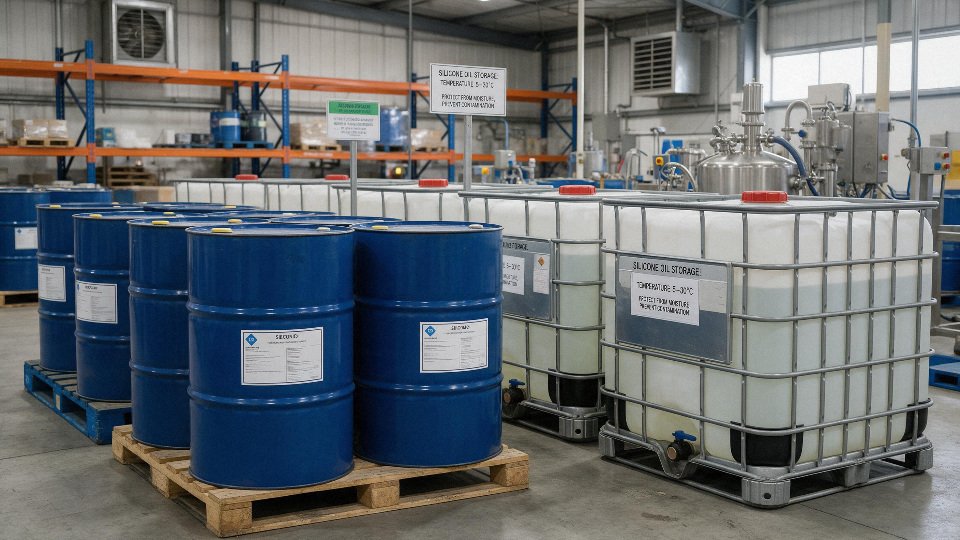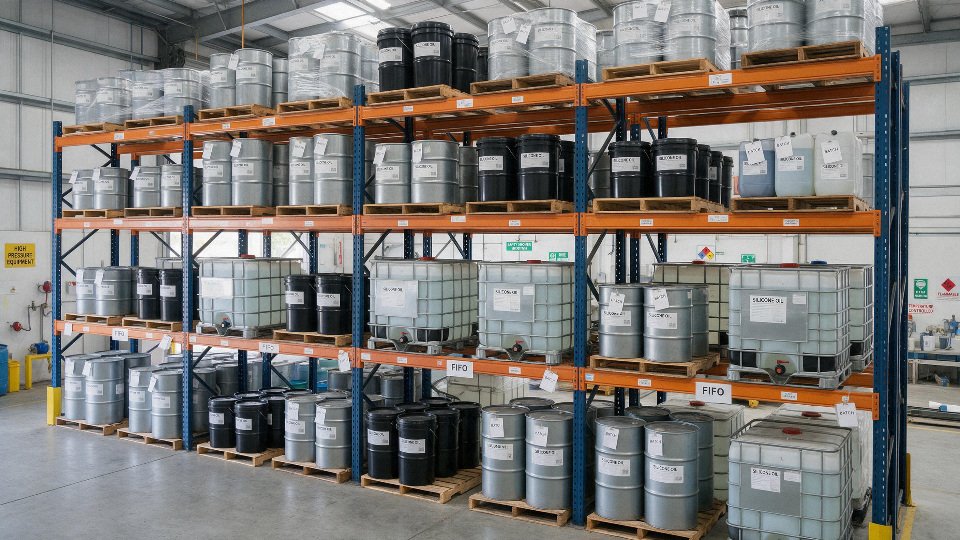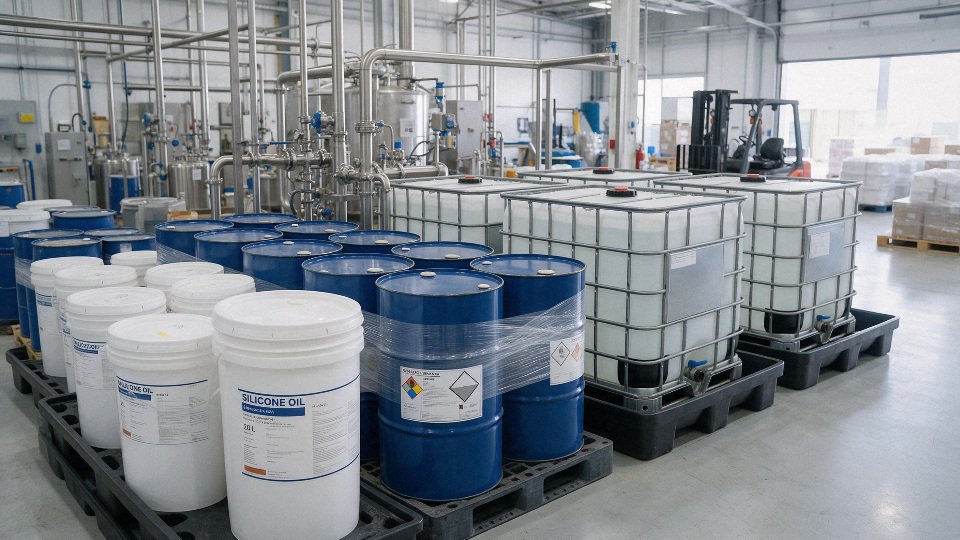
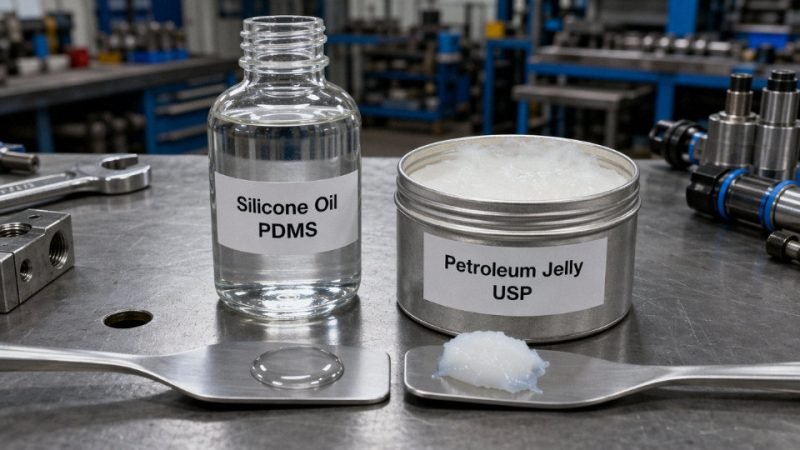
Pick the wrong lubricant for a food-grade conveyor seal, a high-cycle electrical connector, or a rubber gasket in a pneumatic manifold, and you will not get a polite warning — you will get a seized component, a failed audit, or a production line down at 2 a.m. on a Sunday. Swapping silicone oil for petroleum jelly, or vice versa, is one of those substitutions that looks harmless on paper and quietly ruins equipment over weeks or months, usually showing up as unexplained rubber swelling, oxidized contact surfaces, or a greasy film migrating somewhere it absolutely should not be. The cost of that kind of misapplication is rarely just the replacement part; it is unplanned downtime, a maintenance call-out, and sometimes a compliance incident.
Silicone oil (polydimethylsiloxane, PDMS) and petroleum jelly (petrolatum) are both semi-inert lubricants and protectants, but they differ fundamentally in thermal range, chemical compatibility, and regulatory status. Silicone oil remains functional from roughly -60°C to +200°C and is chemically inert to most elastomers, while petroleum jelly melts between 40–70°C, can degrade natural rubber, and suits lower-temperature, non-electrical applications. Choosing between them depends on substrate, temperature, and end-use environment — not convenience.
What makes this comparison genuinely interesting to engineers is that both materials have been around long enough that a lot of the “received wisdom” about them is partially wrong, or right only under specific conditions. Petroleum jelly still outsells silicone fluids by market value — petrolatum sat at roughly USD 3.8 billion globally in 2023 versus about USD 2.1 billion for silicone fluids — but silicone’s CAGR of around 5.8% through 2030 reflects where new design requirements are pushing procurement teams. The real question is not which product is better in general, but which one fails more quietly in your specific application.
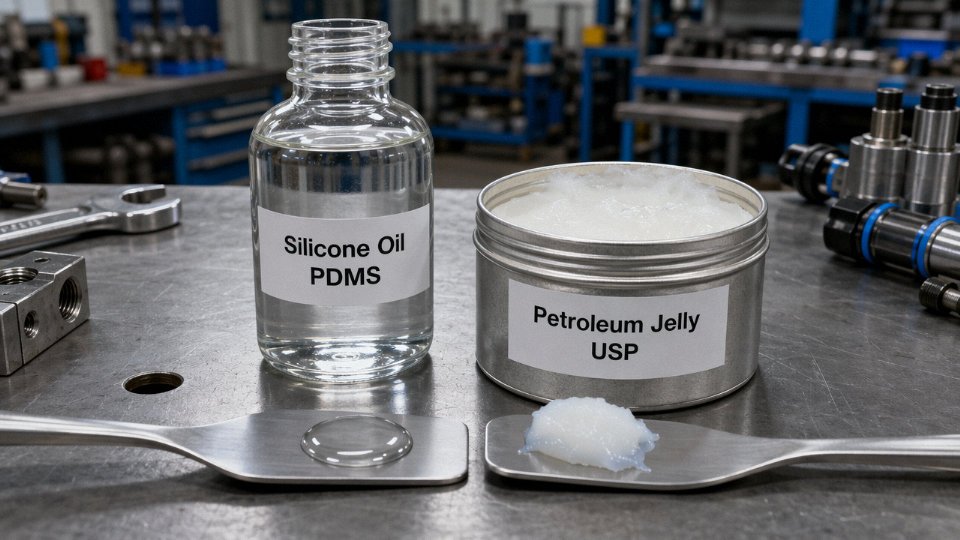
Chemical Identity and Manufacturing Pathway: PDMS Chains vs. Hydrocarbon Wax Blends
The performance gap between these two lubricants starts at the atomic level, and if you understand the bonding, the downstream behavior stops being surprising.
Silicone Oil: The Si–O Backbone and Why Chain Length Is Everything
Silicone oil — properly called polydimethylsiloxane, or PDMS — is built on an alternating silicon-oxygen spine: –[Si(CH₃)₂–O]ₙ–. The pendant groups hanging off each silicon are typically methyl (–CH₃) for standard grades or phenyl (–C₆H₅) for high-temperature and radiation-resistant variants. That backbone is not organic in the usual sense; it’s closer structurally to a silicate mineral than to a petroleum product, which is exactly why it behaves so differently under heat and oxidative stress.
Viscosity is almost entirely controlled by the degree of polymerization — that is, how many Si–O repeat units are in the chain. A short-chain PDMS fluid at n ≈ 2–4 gives you something around 0.65–1 cSt, thinner than water, useful for release agents and fine instrument lubrication. Push n into the thousands and you’re looking at 100,000–1,000,000 cSt — a thick, nearly gel-like fluid that barely pours at room temperature. The same chemistry, just longer chains. This tunability is genuinely unusual; petroleum products don’t give you anywhere near that range within a single molecular family.
Manufacturing starts with quartz sand (SiO₂) and chloromethane (CH₃Cl). The Müller-Rochow process reacts them over a copper catalyst at around 250–300°C to yield methylchlorosilanes, predominantly dimethyldichlorosilane. Hydrolysis and condensation of that intermediate builds the polymer chain. Chain length — and therefore viscosity grade — is controlled by adding monofunctional end-blockers (trimethylsiloxy groups) during polymerization. Major producers include Dow, Momentive, and Shin-Etsu, all of whom vertically integrate from chlorosilane synthesis through to finished fluid grades.
Petroleum Jelly: Wax Blend from the Bottom of the Barrel
Petrolatum is a fundamentally different animal. It’s not a single compound; it’s a semi-solid blend of straight-chain alkanes (primarily C₂₀–C₄₅ range), branched isoalkanes, and microcrystalline waxes, the composition varying with crude source and refining depth. It comes from vacuum distillation residues — the heavy fraction left after lighter cuts (diesel, lubricating base oils) are drawn off — followed by solvent dewaxing and, for pharmaceutical grades, extensive hydrotreatment or acid-clay percolation to strip out aromatic compounds, color bodies, and sulfur-containing impurities.
The melting range (40–70°C, depending on wax content and refining) reflects the blend nature: there’s no single melting point, just a softening zone. Microcrystalline waxes contribute more branching and higher melting fractions; higher-melting-point products like USP-grade white petrolatum have been more aggressively dewaxed and bleached. Sonneborn is the most recognized dedicated petrolatum refiner in North America; Savita Chemicals covers substantial volume in Asia; Unilever and a handful of other large consumer-goods companies refine their own supply for captive use.
Bond Energy: The Root Cause of the Thermal Gap
The Si–O–Si bond in PDMS has meaningfully higher bond dissociation energy than the C–C bonds in petroleum jelly, which directly explains silicone oil's superior thermal and oxidative stability.True
Si–O–Si bond energy is approximately 452 kJ/mol. C–C bonds in alkane chains are roughly 347 kJ/mol, and C–H bonds are around 414 kJ/mol. Higher bond energy means more energy is required to initiate oxidative chain scission or thermal degradation — this is a well-established principle in polymer chemistry, not a marketing claim.
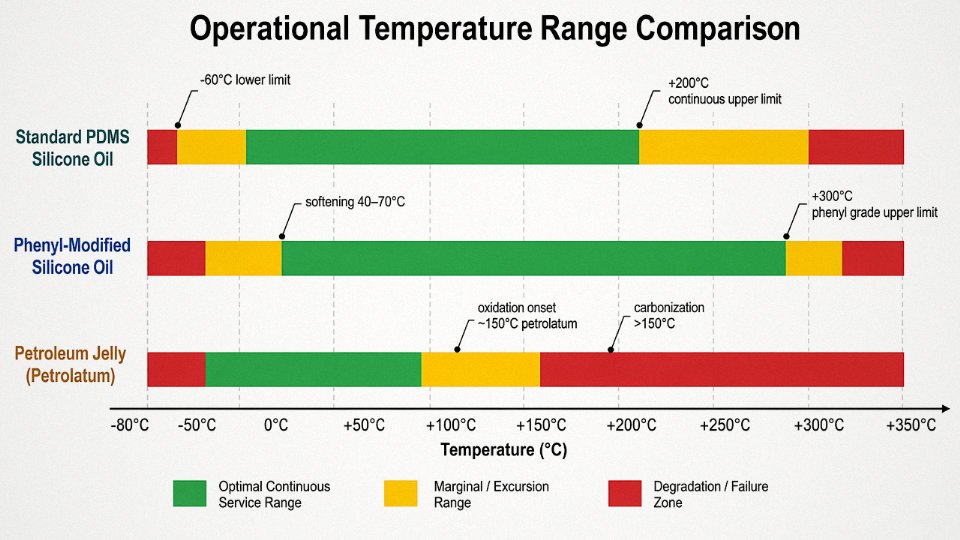
Standard-grade PDMS holds up usably from roughly -60°C to +200°C; high-temperature phenyl-modified grades push that to around +300°C before significant viscosity breakdown or oxidation sets in. Petroleum jelly softens above 40–50°C and begins oxidative degradation — darkening, acid number rise, volatility increase — somewhere in the 100–150°C range depending on how thoroughly the aromatic fraction was removed during refining. On a hot bearing housing or near a process heater, that difference is not academic.
Purity Grades: What the Certifications Actually Test
Both materials have pharmaceutical and food-contact grades, but the tests differ substantially. USP/NF white petrolatum certification covers color, consistency, melting range, and critically, the polynuclear aromatic (PNA) hydrocarbon content — the carcinogenic fraction that heavy hydrotreatment is supposed to eliminate. The USP test for PNAs involves UV absorbance; it’s a pass/fail screen, not a quantitative measurement of every compound.
Food-grade and medical-grade silicone fluids (typically certified to FDA 21 CFR 178.3570 for food contact or USP Class VI for implantable/injectable applications) are tested for heavy metals, volatile siloxanes (D4, D5 cyclic species), and extractable residues. The cyclic siloxane limits have tightened in recent years — particularly in the EU — because D4 and D5 have endocrine-disruption concerns at environmental exposure levels. That’s worth knowing if you’re specifying silicone in a food-processing or pharmaceutical application and your plant sells into European markets.
In practice, procurement managers often default to “USP grade” as a blanket quality signal for both products, but the underlying tests are testing for entirely different contaminants. Specify the actual regulatory standard and the application — not just the grade name.
Thermal and Oxidative Performance: Where Each Material Survives and Where It Fails
Temperature is where the gap between these two lubricants stops being theoretical and starts costing money.
Silicone Oil: A Genuinely Wide Window, With One Ugly Exception
Standard polydimethylsiloxane (PDMS) grades hold up from roughly -60°C to +200°C in continuous service — a span that covers most industrial oven seals, food-processing equipment, and outdoor electrical connectors in cold climates. Phenyl-modified silicone oils extend the upper limit to around +300°C and push the low-temperature pour point up to about -50°C (the phenyl groups disrupt chain packing, which is why viscosity stays manageable in cold). In practice, the upper limit isn’t one number; it depends on whether the oil is in a sealed housing or exposed to circulating air, the surface-area-to-volume ratio, and the presence of metal catalysts like copper or iron that accelerate oxidative degradation even in silicone.
The failure mode above ~350°C is worth knowing in detail. Decomposition produces formaldehyde and fine amorphous silica dust. In an enclosed space — a sealed gearbox vent, an oven with limited airflow — formaldehyde accumulates fast enough to be a real inhalation hazard, and the silica residue will abrade precision surfaces. This isn’t a scare story; it just means that “silicone is heat-stable” doesn’t mean “silicone is inert at any temperature,” and maintenance crews working in confined spaces after a thermal event need to treat residues accordingly.
Petroleum Jelly: Reliable at Room Temperature, Fragile Above It
Petrolatum softens somewhere in the 40–70°C band — the exact point depends on the refining grade and the wax fraction present, which varies meaningfully between industrial-grade and USP-grade products. At 80–100°C it flows, and above roughly 100°C, oxidative degradation starts accelerating. The hydrocarbon chains crack and form peroxides; above about 150°C you get carbonization — a dark, varnish-like residue that seizes sliding surfaces and blocks small clearances. Anyone who has pulled apart a fitting that used petroleum jelly in a moderately hot junction box has seen this: the original smooth white grease replaced by a brittle brownish crust that needs a scraper, not a rag.
Cold performance is the less-discussed weakness. Below about -10°C, petrolatum loses film strength and becomes brittle. For a static seal in an outdoor electrical cabinet in northern climates, this is a real failure path — the film fractures under any mechanical movement at start-up, leaving the substrate effectively unprotected until the assembly warms.
Petroleum jelly remains chemically stable at temperatures above 150°CFalse
Above approximately 150°C, petroleum jelly (petrolatum) begins to carbonize. The hydrocarbon chains undergo oxidative degradation, forming peroxide intermediates and eventually a hard, varnish-like carbonaceous residue that impairs lubrication and can block clearances in precision assemblies.
Flash Point and Fire-Risk Environments
Flash point matters in any application near open flame, arc flash zones, or high-wattage heating elements. Petroleum jelly open-cup flash point runs roughly 180–200°C depending on grade — usable in many industrial settings, but not comfortable near anything that regularly approaches that temperature. Silicone oil flash point is viscosity-dependent in a way that catches people off-guard: low-viscosity grades (below about 5 cSt) flash at around 130°C, making them actually less fire-safe than petrolatum in some scenarios. High-viscosity silicone oils (above roughly 1,000 cSt) push flash points above 320°C, which is why they appear in transformer cooling and high-heat bearing applications.
Side-by-Side Temperature Performance
| Material | Lower Use Limit | Softening / Pour Point | Upper Continuous Use | Upper Excursion Limit | Oxidation Onset |
|---|---|---|---|---|---|
| Standard PDMS silicone oil | -60°C | Below -50°C (most grades) | ~200°C | ~250°C (short exposure) | ~220–250°C |
| Phenyl-modified silicone oil | -50°C | Below -40°C | ~280–300°C | ~320°C | ~280°C |
| Petroleum jelly (petrolatum) | ~-10°C (film integrity) | 40–70°C (grade-dependent) | ~80°C (light load) | ~120°C (marginal) | ~100–110°C |
The Practical Cutoff
Any assembly that cycles above 120°C — oven door seals, autoclave fittings, engine bay connectors, heat-sealer jaws — should use silicone oil unless there’s a specific compatibility reason not to. Petroleum jelly is perfectly adequate at and below 80°C where the substrate is hydrocarbon-compatible and cost matters; it’s cheaper, easier to source in small quantities, and the USP-grade is already on-site in most plants for incidental use. Trying to stretch it above that threshold is a maintenance problem waiting to schedule itself.
Material Compatibility: What Each Lubricant Attacks, Softens, or Dissolves
This is where most misapplication damage happens. Not from choosing the wrong viscosity grade or the wrong temperature range — from grabbing a tub of petroleum jelly and smearing it on a rubber seal because it was sitting on the bench. The degradation is rarely immediate, which makes it worse: seals swell slowly over days or weeks, then leak, then fail, and by then the root cause is buried under other maintenance events.
Petroleum Jelly and Elastomers: The Hydrocarbon Absorption Problem
Petrolatum is a saturated hydrocarbon blend, and many elastomers are hydrocarbon-based networks. Put a hydrocarbon lubricant against a hydrocarbon polymer and you get a classic like-dissolves-like problem. Petroleum jelly will swell natural rubber (NR), EPDM, neoprene (polychloroprene), and nitrile (NBR) by penetrating the polymer matrix and disrupting crosslink density. The seal or gasket absorbs the oil fraction, expands, softens, and loses its designed compression set. In practice, NBR O-rings — which are everywhere in hydraulic fittings and pneumatic cylinders — can swell 10–30% in volume depending on the petrolatum grade and exposure duration, and at that point the interference fit is gone.
PTFE and hardened engineering thermoplastics like acetal or glass-filled nylon handle petrolatum well. Those aren’t solvent-susceptible in the same way. If your application is a PTFE-lined valve or a hard nylon cam follower, petroleum jelly is usually fine as an assembly lubricant.
Silicone Oil and Elastomers: Broadly Safe, With One Catch
PDMS-based silicone oils are compatible with NR, NBR, EPDM, neoprene, and most common thermoplastics. That broad compatibility is one of the main reasons food-processing and pharmaceutical equipment relies on silicone oil — it isn’t trying to dissolve your seals. However, there’s one edge case that regularly catches people off guard: silicone oil used in contact with silicone rubber itself. At high concentrations or with prolonged exposure, PDMS fluid can cause minor swelling in silicone elastomer seals. The effect is usually modest — maybe 2–5% volumetric swell depending on oil viscosity and crosslink density of the elastomer — but in precision hydraulic or pneumatic seals with tight tolerances, that margin matters.
Petroleum jelly is safe to use on all rubber seals and O-rings as a general assembly lubricantFalse
Petroleum jelly causes significant swelling and degradation in NBR, EPDM, natural rubber, and neoprene by penetrating the hydrocarbon polymer matrix. It is only compatible with PTFE and certain hardened engineering plastics. Using petrolatum on common O-ring materials is a well-documented cause of seal failure.
Metals: Generally Fine, With a Salt-Spray Caveat
Both lubricants are non-corrosive to steel, aluminum, and copper under dry or mild-humidity conditions. Petroleum jelly has a long history as a corrosion inhibitor for bare metal storage, and that reputation is mostly deserved — with one qualifier. Lower-grade petrolatum formulations can carry ionic impurities that accelerate galvanic corrosion in salt-spray or marine environments, particularly at dissimilar-metal junctions. If you’re lubricating a carbon steel–aluminum interface on outdoor equipment, the purity grade of your petrolatum actually matters. USP/BP pharmaceutical-grade petrolatum is refined enough that this isn’t a concern; the cheap industrial bulk material sometimes isn’t.
Paints, Adhesives, and Sealants: Both Create Problems, Different Ones
Petroleum jelly can migrate laterally into uncured adhesive bonds — it acts as a bond-line contaminant and will inhibit cure on many anaerobic, epoxy, and cyanoacrylate adhesive systems. In assembly operations where parts are lubricated for press-fitting and then bonded downstream, this causes latent adhesion failures that are maddening to trace.
Silicone oil is arguably worse in this regard because it transfers by contact contamination across an entire assembly area. Even trace amounts of PDMS on a bonding surface will prevent adhesion for virtually all non-silicone adhesives and coatings. Paint fisheye defects in automotive refinishing are frequently traced back to silicone oil contamination from shop lubricants. If you’re running a mixed assembly line where some stations use silicone-based lubricants and others require adhesive bonding or painting downstream, physical segregation and dedicated tooling aren’t optional.
Compatibility Quick Reference
| Substrate | Petroleum Jelly | Silicone Oil |
|---|---|---|
| Natural rubber (NR) | Incompatible | Excellent |
| EPDM | Incompatible | Excellent |
| Nitrile rubber (NBR) | Incompatible | Excellent |
| Neoprene | Poor | Acceptable |
| Silicone rubber | Acceptable | Acceptable (watch concentration) |
| PTFE | Excellent | Excellent |
| Polycarbonate | Acceptable | Excellent |
| Nylon (PA6/66) | Acceptable | Excellent |
| Steel | Excellent | Excellent |
| Copper | Excellent | Excellent |
| Cured paint/coating | Acceptable | Poor |
| Adhesive bond surfaces | Poor | Incompatible |
Ratings assume ambient temperature, normal exposure duration, and mid-grade commercial product. High-temperature conditions or extended immersion will shift some of these toward the unfavorable end.
Regulatory and Safety Classification Across Medical, Food, and Industrial Sectors
Getting the chemistry right matters less than you’d think if the regulatory classification derails your product approval or triggers a recall. Both materials carry approvals in multiple jurisdictions, but the approvals are narrow, grade-specific, and easy to misread.
Petroleum Jelly: Grade Determines Everything
USP-grade petrolatum is approved by the FDA as an over-the-counter skin protectant under 21 CFR 347, at concentrations of 30–100% in the finished formulation. That sounds broad. The catch is the word “USP-grade” — not all petrolatum sold in industrial quantities meets USP purity specifications, and using a technical-grade material in a consumer topical because it’s cheaper is the kind of shortcut that ends in a 483 observation letter.
The EU handles this through EC No 1223/2009, where White Petrolatum is listed as a permitted cosmetic ingredient. Non-refined and mildly refined grades, however, face Annex II restrictions because of polycyclic aromatic hydrocarbon contamination. PAHs — specifically the subset classified as CMR (carcinogenic, mutagenic, reprotoxic) substances under REACH — are present in crude petroleum fractions and survive inadequate refining. Fully refined white petrolatum, tested to show a DMSO extract absorbance below the threshold defined in the IP346 method, clears that restriction. Non-refined yellow petrolatum does not, and it cannot legally appear in cosmetic formulations sold in the EU regardless of concentration.
Non-refined petroleum jelly is prohibited in EU cosmetic products due to PAH contamination riskTrue
EC No 1223/2009 Annex II restrictions apply to non-fully-refined hydrocarbons of mineral origin; the restriction is based on PAH content verifiable through the IP346 test method. Fully refined white petrolatum that passes this test is permitted.
In practice, procurement managers buying petrolatum for dual-use products — say, a lip balm that ships to both US and EU markets — need a Certificate of Analysis that explicitly states the IP346 result and confirms USP compliance. A single-line “petrolatum” entry on an SDS tells you almost nothing useful.
Silicone Oil: Food and Medical Registration Are Not Interchangeable
Food-grade PDMS, including Dow Corning 200 Fluid and its equivalents, is listed under FDA 21 CFR 178.3570 as an adjuvant and release agent, with typical use limits in the range of 10 ppm in finished food. NSF H1 registration covers silicone fluids for incidental food contact in processing equipment — gaskets, conveyor components, mold-release applications. H1 is the right certification for a food plant; NSF 3H (direct food contact lubricants) is a different, stricter category. Confusing the two is a real audit finding.
The medical device context is where things get genuinely complicated. PDMS has been used for decades as a syringe barrel lubricant because it’s ISO 11135-compatible (surviving ethylene oxide sterilization cycles without degrading) and chemically inert. That’s well established. What’s less well understood at the plant-floor level is the FDA warning regarding silicone oil in pre-filled syringes, where sub-visible silicone droplets have been associated with protein aggregation in biologic drug products. The risk is specific to biologics — small-molecule injectables don’t aggregate the same way — but a device manufacturer supplying components for both markets needs to know which syringes go where. Specifying “silicone-lubricated barrels for biologic pre-fills” without reviewing the FDA guidance documentation is an avoidable compliance problem.
Workplace Safety and SDS Handling
Under GHS, silicone oil is generally non-hazardous — no pictograms, minimal PPE requirements at ambient temperature. Petroleum jelly sits in a less clean classification depending on grade and flash point; some grades are classified as combustible solids, others as combustible liquids, with flash points typically in the 170–230°C range depending on the specific formulation. Neither poses acute hazards at room temperature in normal handling. Heat both above their decomposition temperatures, though — roughly above 150°C for petroleum jelly and above 200–300°C for standard PDMS — and you get thermal decomposition products that require adequate ventilation. This matters in oven-seal applications and anywhere process temperatures run high. The SDS will tell you what you need, but pull the SDS for the specific grade you’re actually buying, not a generic one from a search engine.
Performance Benchmarks in Six Key Industrial Applications
The theoretical differences between PDMS and petrolatum only matter when they translate into measurable outcomes on actual equipment. Here is what the data looks like across the applications where specification decisions get made — and occasionally get made badly.
Electrical Insulation and Switchgear
Silicone oil’s dielectric strength typically runs 14–16 kV/mm; petroleum jelly sits closer to 10–12 kV/mm, depending on purity and moisture content. That gap is meaningful in medium-voltage switchgear and distribution transformers, where partial discharge at contaminated contact surfaces is the failure mode you’re trying to prevent. Silicone oil also holds its viscosity and dielectric properties across humidity swings that would cause petrolatum to weep or migrate, which matters in outdoor pad-mounted gear exposed to condensation cycles. For any transformer operating regularly above 100°C — and many do in summer loading conditions — petrolatum is simply the wrong fluid. It will oxidize, darken, and leave carbonaceous deposits on surfaces that need to stay clean.
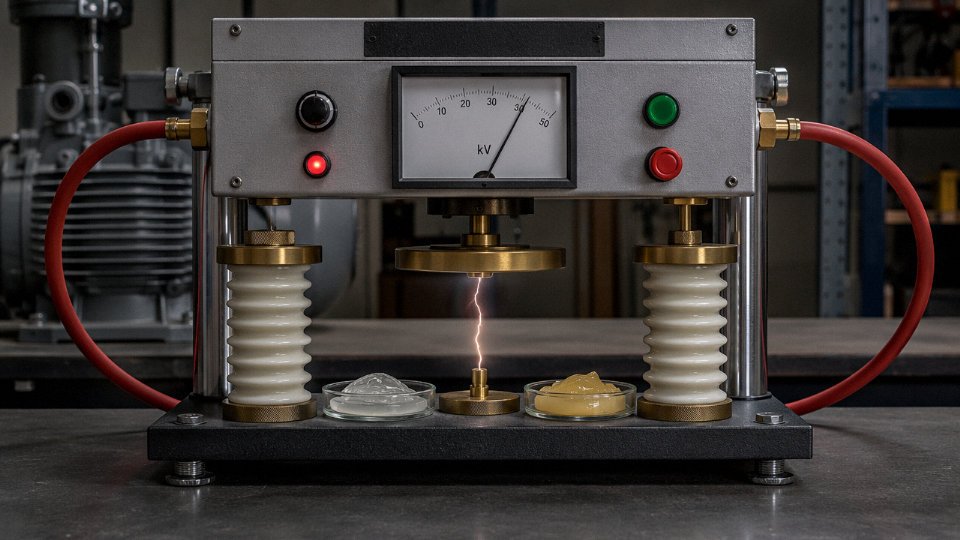
Silicone oil maintains dielectric strength above 14 kV/mm at operating temperatures up to 200°C, while petroleum jelly degrades significantly above 80°C.True
PDMS thermal stability allows retention of electrical insulating properties through its full service range; petrolatum's hydrocarbon structure begins softening and oxidizing well below 100°C, compromising dielectric integrity.
Rubber Mold Release in Compression Molding
Surface tension drives release behavior more than most molding engineers expect. Silicone oil spray sits around 20–21 mN/m; petroleum jelly is closer to 28 mN/m. Lower surface tension means the release agent wets the mold face more uniformly, which translates to cleaner part separation and less tearing on thin flash edges. In documented production comparisons for rubber O-ring and gasket compression molding, switching from petrolatum-based release to silicone spray reduced post-mold cleaning cycles by roughly 30–50% — the range depends on part geometry complexity and mold steel surface finish. Cycle time savings are real but secondary; the bigger win is usually scrap reduction on tight-tolerance sealing profiles.
Threaded Fastener Anti-Seize in High-Temperature Environments
Petroleum jelly is viable as a fastener lubricant only up to about 80°C ambient. Beyond that, it oxidizes and effectively transforms into a varnish that bonds the fastener rather than releasing it — exactly the failure mode you wanted to prevent. Silicone grease (essentially PDMS thickened with fumed silica or similar) handles up to roughly 260°C, which covers most boiler flange bolts, exhaust manifold studs, and heat exchanger covers. Above 500°C, neither product belongs on the fastener. That’s nickel-based or copper-based anti-seize territory, and no silicone product should be treated as a substitute there.
Cable and Wire Pulling Lubricant
Petroleum jelly is the traditional standard for electrical conduit pulls and remains ASTM D2513-compatible for gas distribution polyethylene pipe as well. It works. Lower-viscosity silicone oil grades do reduce pull tension by roughly 15–20% in comparative pull-force testing on long conduit runs with multiple bends, but they cost 3–5× more per unit volume. For most commercial electrical installation work, that cost differential is hard to justify unless the pull geometry is genuinely extreme or conductor damage from excess tension is a documented risk.
Pharmaceutical and Cosmetic Formulation
These two materials occupy separate niches that rarely compete directly. Petroleum jelly’s occlusive barrier reduces transepidermal water loss by approximately 98%, which is why it remains the reference standard in wound occlusion and emollient lip products. Silicone oil — specifically dimethicone grades — delivers a lighter, non-greasy skin feel that formulators want in serums, primers, and leave-on conditioners. Trying to substitute one for the other produces a noticeably inferior consumer experience in either direction.
Food Processing Conveyor and Seal Lubrication
This one is not a performance comparison — it is a compliance requirement. Where incidental food contact is possible, only NSF H1-registered lubricants are permitted, and silicone oil is the workhorse fluid in that category. Petroleum jelly is acceptable under NSF H2 classification for mechanical areas with no food contact risk, such as the underside of a conveyor frame or an external gearbox. Using H2 product in an H1 zone is a food safety audit failure waiting to happen, regardless of how the lubricant performs technically.
Cost Analysis and Total Cost of Ownership: Purchase Price Is Only Part of the Equation
Purchase price is the number that shows up on the requisition. It is rarely the number that matters most.
A 180 kg drum of USP white petrolatum runs somewhere between USD 150 and 300 depending on grade, supplier, and whether you are buying spot or on contract — roughly USD 0.85 to 1.65 per kg. A 190 kg drum of food-grade PDMS silicone oil at 350 cSt typically lands between USD 800 and 1,400, call it USD 4.20 to 7.40 per kg. On a unit-cost basis, silicone oil is four to five times more expensive. That ratio is real and nobody should pretend otherwise. The question is what you are actually buying for that premium.
Reapplication Frequency Changes the Math Quickly
In dynamic seal applications running above 80°C — oven conveyor seals, hot-fill valve stems, autoclave door gaskets — petroleum jelly softens, migrates, and oxidizes. Relubrication intervals in those environments often run every 2 to 4 weeks, sometimes tighter in continuous-duty equipment. Silicone oil, because of its low volatility and resistance to oxidative degradation in that temperature range, routinely extends intervals to 8 to 16 weeks in the same service, occasionally longer. The multiplier depends on the specific operating temperature, the surface finish of the mating parts, and whether the application is static or reciprocating.
Work through a simple example: 60 lubrication points on a pasteurizer line, each requiring 20 minutes of technician time and a line slowdown. If petrolatum demands a 3-week interval versus silicone oil at 10 weeks, the annual maintenance touch count drops from roughly 1,000 events to around 300. At a fully-loaded labor rate of USD 45 to 65 per hour plus the production impact of each slowdown, that gap can close a significant portion of the silicone oil price premium before you even consider substrate damage.
Substrate Damage Is Where the Exposure Gets Serious
Petroleum jelly applied to EPDM or nitrile O-rings in hydraulic systems causes measurable swell and hardness loss within weeks of service.True
Petroleum jelly is a hydrocarbon blend; EPDM and nitrile elastomers absorb hydrocarbons, causing volume swell of 10–40% and a reduction in Shore A hardness, both of which lead to seal leakage and eventual failure. This is well-documented in elastomer compatibility literature and standard references such as Parker O-Ring Handbook ORD 5700.
A single O-ring failure in a hydraulic manifold block — seal pull, fluid loss, potential contamination of downstream product, plus labor to disassemble and reassemble — realistically costs USD 500 to 5,000 depending on circuit pressure, manifold complexity, and whether a production batch gets scrapped. A facility running 200 hydraulic circuits with marginal or incorrect lubricant specification can experience a handful of these failures annually. The numbers accumulate fast. Conservative modeling puts potential savings from correct specification at USD 30,000 to over USD 50,000 per year in a mid-sized plant, and that estimate does not include any regulatory exposure from product contamination.
Disposal Costs Run in the Opposite Direction
This is where silicone oil loses some of its TCO advantage. Petroleum jelly waste is managed under EPA 40 CFR Part 279 as used oil — a relatively well-established, lower-cost disposal pathway, typically USD 0.30 to 0.50 per kg depending on your region and contracted hauler. Silicone oil waste is not classified as used oil under that framework and often requires incineration at a licensed facility, running USD 0.80 to 1.20 per kg or more. For high-volume applications where lubricant turnover is significant, disposal can add a non-trivial line item to the silicone side of the ledger.
Five-Year TCO Decision Framework
| Application Scenario | Material | Approx. Unit Cost (USD/kg) | Reapplication Interval | Risk-Adjusted Failure Cost | Disposal Cost (USD/kg) | Estimated 5-Year TCO per Point |
|---|---|---|---|---|---|---|
| Dynamic seal, >80°C, rubber substrate | PDMS silicone oil | 4.20–7.40 | 8–16 weeks | Low (compatible) | 0.80–1.20 | USD 180–320 |
| Dynamic seal, >80°C, rubber substrate | Petroleum jelly | 0.85–1.65 | 2–4 weeks | High (incompatible) | 0.30–0.50 | USD 600–1,400+ |
| Static metal-to-metal, ambient temp | Petroleum jelly | 0.85–1.65 | 12–24 weeks | Low (compatible) | 0.30–0.50 | USD 40–90 |
| Static metal-to-metal, ambient temp | PDMS silicone oil | 4.20–7.40 | 24–52 weeks | Low (compatible) | 0.80–1.20 | USD 80–160 |
| Food-contact conveyor, incidental contact | PDMS silicone oil (food-grade) | 5.00–8.00 | 4–12 weeks | Low (compliant) | 0.80–1.20 | USD 200–380 |
| Food-contact conveyor, incidental contact | Petroleum jelly (USP) | 0.85–1.65 | 1–3 weeks | Medium (regulatory scrutiny) | 0.30–0.50 | USD 220–480 |
The table above assumes average consumption of roughly 50–100 g per lubrication point per interval; actual figures scale with contact area, clearance, and operating speed. The failure cost column is the one that most procurement decisions underweight. In applications where the materials are genuinely compatible and operating conditions are mild, petroleum jelly remains the economical choice — and there is no reason to over-specify. But in elevated-temperature or rubber-contact service, the purchase price comparison is almost irrelevant once you account for what goes wrong when the wrong product is in the system.
Environmental and Sustainability Profile: Biodegradability, Carbon Footprint, and End-of-Life
Neither material is clean. That’s the honest starting point for any ESG screening conversation, and procurement teams that treat one as automatically “green” are likely to get pushback from EHS auditors who’ve read the actual test data.
Biodegradability: The Numbers Are More Complicated Than the Marketing
Petroleum jelly has an intuitive appeal here — it’s a hydrocarbon, it comes from the ground, surely it breaks down. In aerobic soil conditions it does biodegrade, typically over weeks to several months depending on soil microbiology, temperature, and film thickness. The problem is aquatic environments. Petrolatum is classified as a persistent hydrocarbon pollutant in water, and OECD 301B ready biodegradability tests typically return 20–40% degradation in 28 days — well below the 60% threshold required for “readily biodegradable” classification. That matters if your plant discharges to a waterway, uses washdown processes, or applies lubricant to components that will later be cleaned with water-soluble systems that route to effluent treatment.
Petroleum jelly passes the OECD 301B ready biodegradability testFalse
Petrolatum typically achieves only 20–40% degradation in 28 days under OECD 301B conditions, well below the 60% threshold required for 'readily biodegradable' classification. It is not classified as readily biodegradable.
Silicone oil (PDMS) degrades through a different mechanism: hydrolysis in soil and sediment slowly converts it to silanols, which then break down further to silica and CO₂. The endpoint products are environmentally benign, which is why PDMS is not classified as bioaccumulative. But “eventually benign” is doing a lot of work in that sentence. Persistence in sediments is well-documented, and the timeline for full mineralization can extend to years in low-pH, low-moisture environments. The bigger regulatory issue right now is cyclic siloxanes — D4 and D5 specifically — which face active REACH restrictions in the EU for wash-off product applications due to aquatic persistence and endocrine disruption concerns. Linear PDMS used as an industrial lubricant doesn’t fall under the same restrictions, but if your purchasing spec doesn’t explicitly call out linear vs. cyclic, you may be buying a blend that creates a compliance headache.
Carbon Footprint: Silicone Oil’s Manufacturing Penalty Is Real
Petroleum jelly production carries a carbon footprint in roughly the 1.2–1.8 kg CO₂e/kg range, depending heavily on refinery configuration, energy source mix, and how much of the upstream crude extraction is allocated to the petrolatum fraction. It’s a refinery co-product, which means some lifecycle methodologies assign it a relatively low burden.
Silicone oil sits at roughly 5–8 kg CO₂e/kg — three to five times higher — driven by the energy intensity of chlorosilane synthesis, the high processing temperatures required, and HCl handling infrastructure. That gap is significant enough that it should appear in any Scope 3 supplier emissions calculation.
The mitigating factor is service life. In applications where silicone oil lasts 6–12× longer than petroleum jelly before reapplication (cable insulation, oven door seals, long-interval maintenance points), a lifecycle analysis that accounts for avoided reapplication emissions can substantially close that gap. The math depends entirely on reapplication interval and quantity, so run your own numbers for your specific application rather than relying on supplier lifecycle claims.
Bio-Based Alternatives: Promising but Not Production-Ready
Plant-derived petrolatum substitutes — typically based on hydrogenated vegetable waxes or rice bran derivatives — are commercially available and show improved aquatic biodegradability profiles. Performance gaps remain in oxidative stability and low-temperature consistency. For most food-contact or cosmetic-adjacent industrial uses they’re viable; for high-temperature or chemically aggressive environments, they’re not there yet.
Bio-based silicone alternatives (silicones synthesized from bio-derived silicon feedstocks or hybrid organosilicone structures) are at roughly TRL 4–6 depending on the research group. They’re not commercially available at production scale as of 2024. Watch this space, but don’t spec it yet.
Frequently Asked Questions
Can I use petroleum jelly as a substitute for silicone oil on rubber seals?
No — and this is probably the most expensive mistake made on plant floors. Natural rubber (NR), nitrile (NBR), and EPDM seals will absorb the hydrocarbon fraction of petroleum jelly, swell, and lose their compressive sealing force. Depending on the seal geometry and operating temperature, you might see visible distortion within 48–72 hours and measurable loss of sealing pressure within a week or two. Dynamic seals — O-rings in reciprocating cylinders, lip seals on rotating shafts — fail faster than static face seals because the flexing accelerates hydrocarbon uptake.
The correct substitute is either silicone grease (thickened PDMS) or a low-viscosity silicone oil in the 50–350 cSt range depending on the seal speed and load. Fluorosilicone is the right call if you’re also dealing with fuel or solvent exposure.
Petroleum jelly causes rubber O-rings to swell and lose sealing forceTrue
Hydrocarbon-based petrolatum is absorbed into elastomers such as NR, NBR, and EPDM, causing volumetric swell that initially may feel like a tighter seal but progresses to loss of elasticity and sealing force. This is well-documented in elastomer compatibility literature and ASTM immersion test data.
Is silicone oil safe for skin and personal care use?
Yes, with the appropriate grade. Cosmetic-grade dimethicone (essentially low- to mid-viscosity PDMS, typically 5–350 cSt) is FDA-approved as a skin protectant under 21 CFR 347 and appears in countless lotions, hair serums, and primer formulations. It spreads easily, leaves a non-greasy slip, and doesn’t clog pores the way heavier occlusive agents do. USP white petrolatum is also skin-safe — it’s been in wound care for well over a century — but it’s considerably more occlusive and heavier-feeling on skin, which is sometimes exactly what’s wanted for barrier creams or dry-heel treatments.
The distinction that matters for formulators: petrolatum’s occlusive property is therapeutically useful for moisture retention; silicone oil’s breathable, low-surface-tension film is better for leave-on cosmetics where skin feel matters. Different tools.
Which is better for lubricating electrical connectors?
Silicone dielectric grease, clearly. It handles thermal cycling without hardening, maintains dielectric strength over time, and won’t attack the common plastic connector bodies made of nylon, polycarbonate, or PBT. Petroleum jelly oxidizes gradually — especially if the connector sees any heat — and the oxidation byproducts can increase contact resistance or leave a varnish-like residue that’s genuinely annoying to clean off during maintenance.
In practice, a small smear of silicone dielectric grease on automotive or industrial multi-pin connectors before reassembly is one of those maintenance habits that prevents a surprising number of intermittent-fault callbacks.
Does silicone oil contaminate welds or bonded joints?
This one is serious. Silicone oil on a metal surface migrates, spreads at extremely low concentrations, and is nearly impossible to remove by standard solvent wiping. Even trace contamination causes weld porosity and massively degrades adhesive bond strength — epoxy, polyurethane, acrylic, it doesn’t matter much. The silicone interferes with surface wetting and primer adhesion.
The operational rule is simple: never apply silicone oil upstream of any welding or bonding station in your process sequence. If you’re running a mixed assembly line where some stations bond and some stations lubricate, physically segregate the silicone and put it downstream. Cleaning protocols based on alkaline degreasers help, but they rarely get contamination down to the level adhesive manufacturers require.
What viscosity of silicone oil is equivalent to petroleum jelly as a lubricant?
Roughly 200–500 cSt PDMS at room temperature gives you comparable film thickness and spreadability to petroleum jelly. That’s a reasonable starting point for drop-in substitution testing. The critical difference is what happens as temperature rises: petroleum jelly softens sharply above roughly 40–50°C and can run or be displaced from a bearing surface, while 350 cSt silicone oil loses viscosity far more gradually and stays in place through a much wider range. At 150°C, the petroleum jelly is gone; the silicone oil is still doing its job.
So the viscosity equivalence holds at ambient, but the temperature-viscosity relationship diverges substantially — factor that in if the application sees any heat cycling.
Are there applications where petroleum jelly is clearly the better choice?
Yes, a few. For cost-sensitive, low-temperature, low-load applications — bicycle cables, threaded plumbing fittings on PTFE-tape-wrapped joints, or anti-galling on stainless fasteners that will be disassembled again — petroleum jelly is cheap, available everywhere, and does the job without any compatibility concerns about the metal substrates. Wound-care barrier formulations are another legitimate home for petrolatum; the occlusive film is precisely what prevents transepidermal water loss, and no silicone oil matches that mechanism. Petroleum jelly also has a longer shelf life in simple packaging and doesn’t require the grade-verification that food or medical silicone procurement demands. Where the application is simple, the temperature is moderate, and no elastomers or adhesives are nearby, petrolatum is often the sensible choice.
Selection Decision Framework and Quick-Reference Specification Guide
Most specification errors happen not because engineers lack knowledge but because the selection process skips a step. The five-step sequence below is deliberately sequential — each step can eliminate a candidate material before you spend time on the next.
Step-by-Step Decision Process
Step 1 — Substrate compatibility first, everything else second. Identify every material the lubricant will contact: seal elastomers, housing polymers, painted surfaces, gasket compounds. If any substrate is natural rubber, EPDM, neoprene, or an unfilled polyurethane, petroleum jelly is disqualified immediately regardless of cost or availability. Run a 72-hour coupon soak at operating temperature if you have any doubt; mass change above roughly 3–5% or visible swelling kills the candidate. Silicone oil is generally compatible with most engineering polymers, though it can slightly swell silicone rubber itself — worth checking if the seal compound is also silicone-based.
Step 2 — Temperature range. If continuous operating temperature exceeds about 80°C, petroleum jelly is off the table. Its petrolatum base begins to migrate and oxidize in that range, and you will see staining, gum deposits, and eventual dry friction. Standard-grade PDMS holds to roughly 200°C; high-temperature grades extend to around 280–300°C depending on formulation and whether oxidizing atmosphere is present. For cryogenic work below -30°C, low-viscosity silicone oil (50–200 cSt range, typically) stays fluid where petrolatum has long since solidified.
Step 3 — Regulatory environment. Food-contact lubrication, medical device assembly, and pharmaceutical packaging lines each carry specific requirements. NSF H1 certification is the minimum for incidental food contact; FDA 21 CFR 178.3570 covers the lubricant formulation side. Petroleum jelly has a legitimate path here for certain applications — USP-grade petrolatum appears in direct food-contact and personal care contexts — but silicone fluid has broader NSF H1 coverage across viscosity grades. Confirm which specific regulation applies before specifying either material; “food-grade” printed on a container is not the same as NSF H1 registration.
NSF H1 registration means a lubricant is safe for direct consumption in food products.False
NSF H1 covers lubricants with only incidental food contact — accidental, technologically unavoidable contact. It does not qualify a lubricant for intentional ingestion or direct food incorporation.
Step 4 — Reapplication access and interval. A sealed bearing in a difficult-to-reach location needs a lubricant that lasts. Silicone oil’s oxidative stability and low volatility give it substantially longer service life in enclosed or semi-enclosed spaces. Petroleum jelly in high-humidity or cycling-temperature environments can emulsify or wash out faster than predicted. If your maintenance interval is driven by access cost rather than lubricant condition, the higher unit cost of silicone fluid often pays back within the first or second avoided relubrication cycle.
Step 5 — Five-year TCO. Factor purchase price, application labor (frequency × crew time), any scrap or rework attributable to lubricant failure, and disposal cost. Silicone fluids typically run 4–8× the per-kilogram price of petroleum jelly depending on grade and volume, but in polymer-contact or high-temperature service, the failure cost from using petroleum jelly usually dominates the calculation inside 18 months.
Quick-Reference Specification Table
| Application | Recommended Material | Grade / Viscosity | Key Standard | Disqualifying Condition |
|---|---|---|---|---|
| Rubber O-ring assembly (EPDM, NBR) | Silicone oil | 350–1,000 cSt | ISO 6072 compatibility | Petroleum jelly — swells most rubbers |
| Food-conveyor chain lubrication | Silicone oil, NSF H1 | 150–500 cSt | NSF H1, 21 CFR 178.3570 | Unregistered lubricant |
| Threaded metal fastener anti-seize, ambient | Petroleum jelly | Standard USP grade | — | Temp >80°C or polymer contact |
| Electrical connector corrosion barrier | Silicone oil or silicone grease | 1,000–10,000 cSt | MIL-PRF-4343 or similar | Petroleum jelly — can track into contacts |
| Wound-care and lip-care formulation | Petroleum jelly | USP white petrolatum | USP monograph | Non-USP grade; silicone oil not approved this use |
| Oven door gasket lubrication (>150°C) | High-temp silicone fluid | 500–5,000 cSt | OEM spec | Standard-grade silicone above 200°C |
| Cleanroom actuator lubrication | Silicone oil, low outgassing | 50–200 cSt | ISO 14644 class req. | Any hydrocarbon lubricant |
| Plastic gear lubrication (acetal, nylon) | Silicone oil | 500–2,000 cSt | DIN 51517 (as reference) | Petroleum jelly — softens many thermoplastics |
| Medical device assembly (implant-adjacent) | Silicone oil, USP/medical grade | 350 cSt typical | ISO 10993, USP Class VI | Industrial-grade silicone or any petrolatum |
| General-purpose ambient metal-to-metal | Petroleum jelly | Industrial or USP | — | Elevated temp, polymer contact |
| Cryogenic valve stem lubrication (<-40°C) | Low-viscosity silicone oil | 10–50 cSt | ASTM B117 salt spray ref. | Petroleum jelly — solidifies |
| High-volume cosmetic fill (lip/skin care) | Petroleum jelly | Cosmetic or USP grade | EU Cosmetics Regulation | Silicone oil — not equivalent skin-feel or barrier |
When Each Material Belongs in the Spec
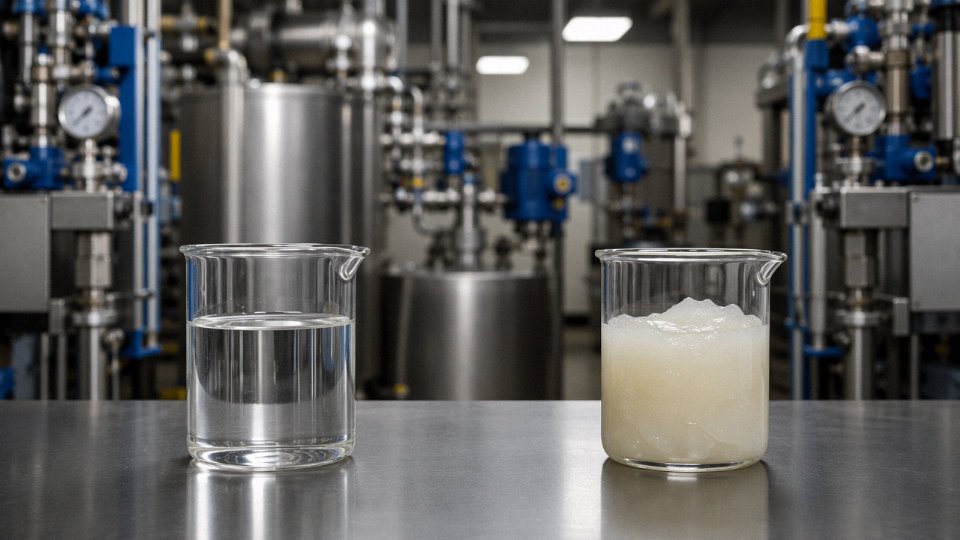
Petroleum jelly earns its place in ambient-temperature applications on metal or hydrocarbon-compatible substrates, high-volume personal care formulations, and non-critical mechanical lubrication where reapplication is easy and cost pressure is real. It is genuinely excellent at what it does. The problem is misapplication, not the material itself.
Silicone oil is the correct default for any elastomer or polymer contact, electrical insulation, food-contact service needing NSF H1, elevated temperature, cleanroom or medical environments, or anywhere long service intervals are valued. Pay the premium where it prevents failure. Don’t pay it where petroleum jelly will do the job.
Hybrid Stocking Strategy
Some maintenance operations carry both. Petroleum jelly handles ambient metal components, hardware assembly, and general corrosion protection. Silicone fluid covers every polymer-contact point and anything above 80°C. In practice this keeps lubricant spend reasonable while protecting the failure-critical points. The risk is label discipline on the floor — two containers that look similar, applied by different shifts. If that is a concern in your facility, color-code the dispensers, add substrate-specific cue cards at each PM station, and include the distinction in new technician onboarding.
Pre-Specification Checklist
Before sign-off, confirm each item:
- Coupon soak completed on all contact substrates at max operating temperature (72 hours minimum; document mass change and hardness)
- Temperature range verified against continuous operating data, not just design nominal
- Regulatory classification confirmed with the lubricant supplier’s compliance documentation, not just the product label
- NSF H1 or USP grade physically verified on the supplier’s current registration list (registrations lapse)
- Reapplication interval validated against PM schedule — not assumed
- 5-year TCO calculated with failure-mode cost included, not just purchase price
- Disposal pathway confirmed with EHS (silicone fluids are not universally accepted by waste oil recyclers)
- Substitute/emergency-supply source identified — single-source silicone grades can have lead times of 8–14 weeks depending on market conditions