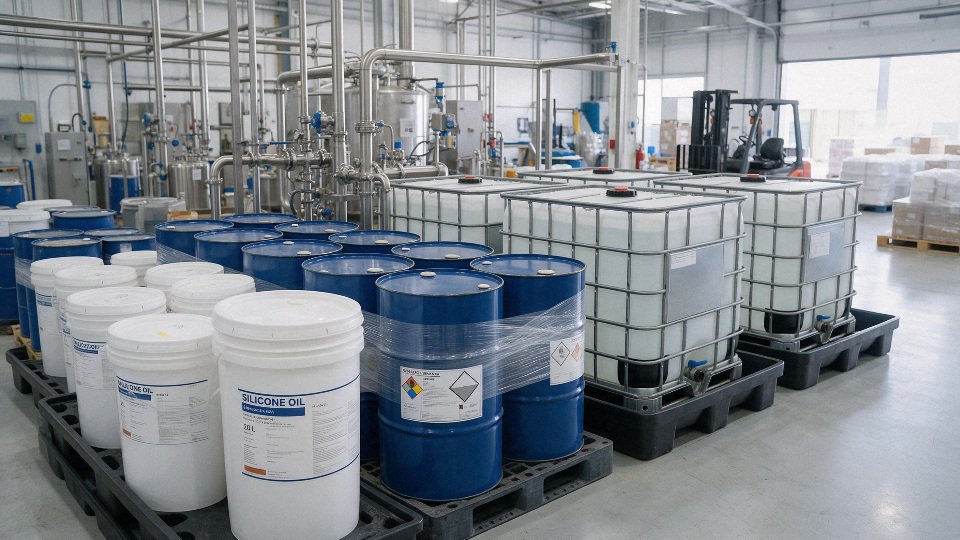
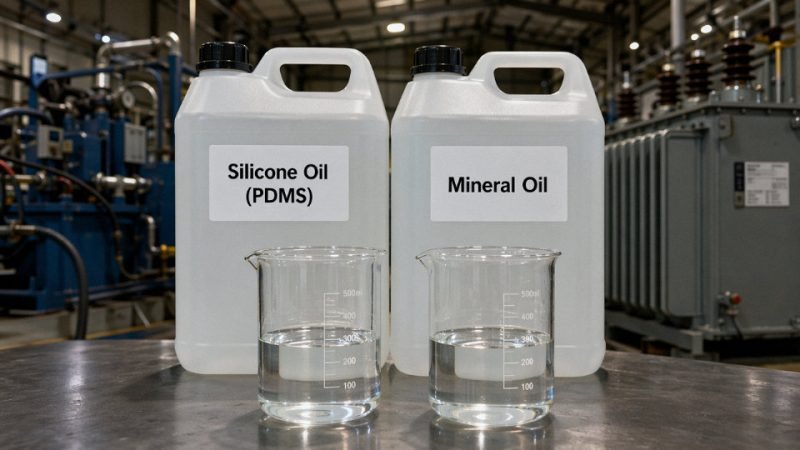
Picking the wrong dielectric or heat-transfer fluid for an application rarely announces itself with a dramatic failure — it tends to grind you down through seal degradation, viscosity drift at temperature extremes, and a slow accumulation of unplanned downtime that shows up as “mystery losses” on your OEE reports. A transformer fluid that turns sluggish at –30 °C, a bath heater that carbonizes its working fluid well before its rated cycle life, a damper system that goes stiff in a cold warehouse — these are the fingerprints of a mineral-oil specification carried over by habit into conditions it was never designed for. The cost is real: fluid replacement, collateral seal and gasket damage, and in worst cases, equipment pulled from service during peak production.
Silicone oil (PDMS) should replace mineral oil when operating temperatures exceed roughly 150 °C continuous or drop below –40 °C, when electrical applications require a slightly higher dielectric constant (~2.7–2.8 vs. ~2.2 for mineral), or when fluid stability over very wide thermal cycles matters more than upfront cost. Mineral oil remains the right default for moderate temperatures, standard hydraulic and lubrication duty, and cost-sensitive high-volume applications.
What makes this choice genuinely tricky is that the two fluids look similar on a basic data sheet — both are clear, oily liquids with overlapping viscosity grades — but their behavior diverges sharply once you push either one toward its limits. Viscosity index alone tells part of the story: silicone runs 200–400 versus mineral oil’s 95–120, which sounds like a spec-sheet abstraction until you watch a mineral-oil-filled actuator struggle through its range of motion on a January morning in an unheated facility. There are also the less obvious factors — density, surface tension, material compatibility — that tend to surface only after the fluid is already in the system.
Temperature Range Requirements: Where Mineral Oil Hits Its Ceiling and Silicone Takes Over
The operating envelope is usually the first thing that settles this debate — and it settles it fast.
Mineral Oil’s Practical Limits
Mineral oil is a competent fluid across a surprisingly wide range, which is exactly why it remains the default choice in so many plants. Pour point typically falls between –15 °C and –30 °C depending on refining depth and pour-point depressant additives; a deeply refined Group II or Group III base will sit closer to –30 °C, while a basic Group I mineral cuts off around –15 °C. Flash point runs from roughly 130 °C on light transformer oils up to about 180 °C on heavier gear and hydraulic grades.
The harder ceiling is oxidative degradation. Above about 100–120 °C in continuous service — and this depends heavily on the presence of copper, iron, or water as catalytic contaminants — mineral oil starts forming sludge and varnish at a rate that maintenance teams notice within a few thousand operating hours. At 120 °C continuous with copper contact (common in transformer windings or hydraulic valve bodies), expect usable service life to drop by 30–50% versus the same fluid running at 80 °C. That’s not a theoretical figure; it’s broadly consistent with what you see when you pull oil samples from heat-loaded hydraulic power units in steel mill or injection-molding applications.
Mineral oil begins accelerating oxidative degradation above approximately 100–120 °C continuous service temperatureTrue
Oxidation rate roughly doubles for every 10 °C rise above a fluid's stability threshold; combined with metal catalysts common in machinery, this compresses service intervals measurably at sustained temperatures above 100–120 °C.
Silicone Oil’s Operating Envelope
Polydimethylsiloxane (PDMS) fluids operate where mineral oil simply cannot. Pour points reach as low as –60 °C — genuinely useful for outdoor equipment in northern climates, high-altitude installations, or cold-soak aerospace and defense applications. Flash point for high-viscosity grades (say, 1000 cSt and above) exceeds 300 °C. Continuous service to 200 °C is well-established, and short-term excursions to around 250 °C are tolerable in well-designed systems, though at that level you’re burning off some of your margin and seal compatibility becomes the limiting factor rather than the fluid itself.
The cold-end performance is equally important and often underappreciated in procurement discussions. A mineral oil at –20 °C may technically be above its pour point but can be moving like cold syrup through narrow passages — starving a pump or a bearing on cold start before the system warms up. Silicone’s viscosity changes far less dramatically over temperature, which brings us to the viscosity index question.
What Viscosity Index Actually Means on the Shop Floor
Viscosity index (VI) quantifies how much a fluid thins as temperature rises. Mineral oils run VI 95–120 for conventional grades, up to roughly 150–160 for premium synthetics. Silicone oils post VI values of 200–400, depending on molecular weight and grade. In practice, a silicone fluid that’s 100 cSt at 25 °C might still be 20–30 cSt at 150 °C. A comparable mineral oil could be down to 5–8 cSt at that temperature — right at the edge of hydrodynamic film failure in a journal bearing or gear mesh.
Cold-start is the mirror problem. A mineral oil specified for a gearbox that sits at –25 °C overnight may generate enough viscous drag on startup to overstress a shaft seal or cause momentary bearing starvation. Silicone handles that scenario much more gracefully.
The Overlap Zone: 60 °C to 100 °C
This band is where the decision gets genuinely difficult, because both fluids are technically viable. Secondary criteria take over. Fire risk is the most common tiebreaker — a food plant, a foundry floor near open induction furnaces, or any application covered by insurance underwriters demanding a high-flash fluid will push you toward silicone regardless of temperature alone. Altitude matters too; equipment at high elevation runs hotter due to reduced convective cooling, which can push an application that looks comfortable at 80 °C on paper into actual 95–100 °C operation. Cyclic thermal shock — repeated rapid swings between, say, –10 °C and 90 °C in outdoor switchgear or vehicle-mounted hydraulics — tends to degrade mineral oil faster than steady-state temperature would predict, while silicone’s stable backbone chemistry handles cycling well.
If the application sits in this overlap zone and none of those secondary flags apply, mineral oil usually wins on cost. Silicone can run three to eight times the price per liter depending on grade and volume, and that gap is hard to justify when thermal conditions don’t demand it.
Material Compatibility Mapping: Seals, Plastics, Coatings, and Metals That Reject Silicone or Mineral Oil
Get this wrong and you’re pulling a gearbox or a transformer bushing assembly six months after a fluid change — not because the oil failed, but because the seal did. Compatibility mapping is usually the last step engineers check and the first thing that causes a callback.
Elastomers and Silicone Oil: The Swelling Problem
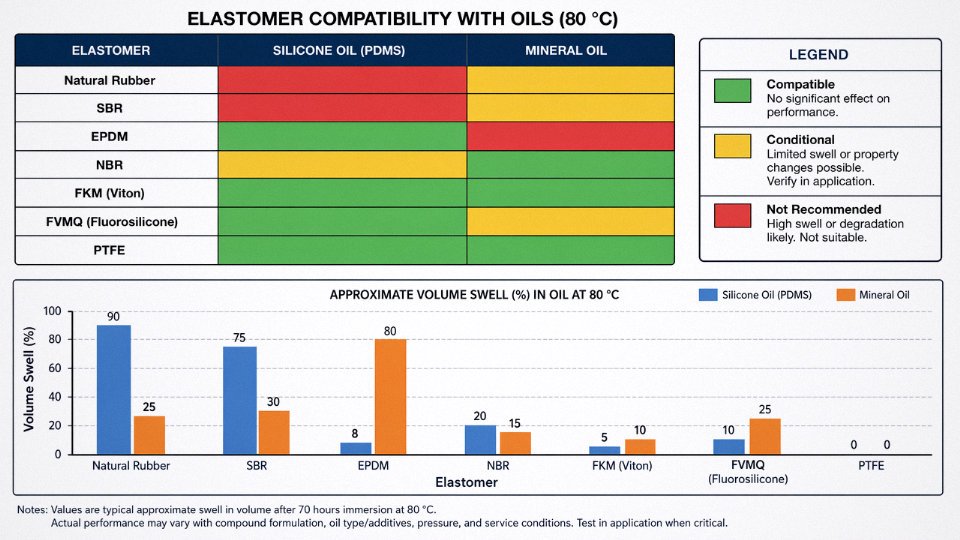
Natural rubber and SBR (styrene-butadiene rubber) both swell noticeably in PDMS-based silicone oils. In practice you can see 15–30% volume swell in natural rubber depending on oil viscosity grade and temperature; higher-viscosity silicones are slightly less aggressive, but not enough to rely on if you’re running above 80 °C. SBR behaves similarly. What catches maintenance teams off guard is EPDM — some compounded grades are listed as “silicone-compatible” by the elastomer supplier, but low-durometer EPDM with high oil-extension levels will still creep dimensionally over months. Always ask for the specific compound number, not just the polymer family.
If silicone oil is mandatory for the application, the practical answers are fluorosilicone (FVMQ) seals or PTFE-lined face seals. FVMQ gives you the thermal range you’re after with acceptable swell resistance; PTFE-lined is the belt-and-suspenders choice for static seals where you can tolerate the higher cost. Expect FVMQ seals to run roughly 2–4× the unit cost of standard EPDM or NBR, depending on size and whether you’re buying off-the-shelf or custom-molded.
Elastomers and Mineral Oil: Nitrile Is Fine, Until It Isn’t
NBR (nitrile rubber) is the workhorse for mineral oil service and it earns that reputation. Swell rates in standard Group I or II mineral oil are typically 3–8% at operating temperature, well within what a properly designed groove can tolerate. The issue comes when someone substitutes a high-aromatic mineral oil — some process oils, certain transformer insulating fluids, or re-refined stocks — because aromatic content drives NBR swell higher and accelerates hardness loss. If the aromatic content of your mineral oil exceeds roughly 15–20% by composition, push toward FKM (Viton) instead. FKM handles mineral oil across a wide temperature range, resists aromatic fractions better, and is the standard choice for hydraulic systems running fire-resistant or high-ester-content mineral blends.
One thing that trips up plant engineers: polysulfide sealant compounds used in some older gearbox housings and marine equipment. These are not particularly happy with mineral oil long-term — gradual softening and adhesion loss after 12–18 months of immersion exposure is common. If you’re resealing a housing that has polysulfide bead seals, this is a conversation to have before the oil goes in.
FKM (Viton) seals are universally compatible with both silicone and mineral oilsFalse
FKM is broadly compatible with mineral oils and many synthetic fluids, but it can swell or degrade in certain PDMS silicone oils, particularly at elevated temperatures. Always verify with the seal manufacturer's specific fluid compatibility data before assuming cross-fluid suitability.
Plastics, Coatings, and the Silicone Migration Issue
Silicone oil’s surface tension runs around 20 mN/m — low enough that it wicks into surface pores and microcracks that mineral oil would largely ignore. Polycarbonate housings are a real concern: PDMS migrates into the amorphous regions of polycarbonate over time, causing stress cracking and measurable dimensional shift in precision-molded parts. This shows up in optical encoder housings, junction boxes, and sensor covers. If you’re running silicone oil in a system with polycarbonate components nearby — even just splash exposure — switch to acrylic or glass-filled nylon for those parts, or accept periodic replacement intervals.
Mineral oil has its own coating problem. Aromatic fractions attack certain amine-cured epoxy coatings, which matters for epoxy-lined tanks and transformer tanks that haven’t been re-lined with an oil-resistant formulation. You’ll see blistering and delamination within a year in a worst case, especially if the coating was applied thin or over surface contamination. Phenolic-cured epoxies hold up considerably better.
Metals, Fasteners, and the Adhesive Bond Risk
Both silicone and mineral oil are broadly safe on carbon steel and aluminum alloys under normal service conditions — corrosion-wise, neither is particularly aggressive without water contamination. The practical difference is mechanical, not chemical. Silicone oil’s low surface tension means it travels. It will wick along a threaded fastener shank, undermine thread-locking compounds, and reach adhesive bond lines that were never intended to see any fluid. In practice, torque retention on fasteners exposed to silicone oil splash drops noticeably — 20–40% loss in prevailing torque on nylon-insert lock nuts after extended exposure is not unusual. Use thread-locking adhesives rated for silicone fluid exposure (most standard Loctite threadlockers are not), or switch to serrated-flange fasteners in those areas.
Painted surfaces adjacent to silicone oil systems get contaminated faster than anyone expects. Even vapor-phase PDMS migration — which happens at elevated temperatures — is enough to compromise subsequent paint adhesion if a component needs rework. Shops that run silicone lubricants anywhere near a paint line know this problem well.
| Material | Silicone Oil (PDMS) | Mineral Oil | Recommended Alternative |
|---|---|---|---|
| Natural rubber | Significant swell (15–30%) | Moderate swell | FVMQ or PTFE-lined |
| NBR | Moderate swell | Low swell (3–8%) | FKM for high-aromatic grades |
| EPDM (oil-extended) | Risk of creep/swell | Generally acceptable | Verify compound grade |
| Polycarbonate | Migration, stress cracking | Usually acceptable | Acrylic or glass-filled nylon |
| Amine-cured epoxy coating | Generally stable | Risk of blistering | Phenolic-cured epoxy |
| Thread-locking compounds | Undermined by wicking | Low risk | Serrated-flange fasteners or compatible sealant |
Lubrication Performance Under Load and Speed: Where Each Fluid Earns or Loses Points
Silicone oil’s thermal stability is real and well-documented, but thermal stability is not the same as lubrication performance. These two properties get conflated constantly, and the result is usually a seized bearing or a gearbox with accelerated pitting that nobody can explain until someone checks the maintenance log and finds “switched to silicone per engineering memo.”
Boundary and Mixed-Film Lubrication: Mineral Oil’s Structural Advantage
Under boundary and mixed-film conditions — which is where most loaded machinery actually spends a significant portion of its life during startup, slow-speed reversals, and shock loading — mineral oil has a genuine chemical advantage. Its natural polarity means it adsorbs onto metal surfaces and forms a thin protective layer even before any pressure-activated EP additive kicks in. That intrinsic polarity is something silicone (PDMS) simply does not have. Silicone is a non-polar fluid; it sits on the surface rather than bonding to it.
The additive receptivity gap makes this worse. ZDDP, sulfur-phosphorus EP additives, and most anti-wear chemistries were developed for hydrocarbon base stocks. They dissolve, disperse, and activate correctly in mineral oil. In silicone, many of these additives either fall out of solution, migrate to the interface unpredictably, or fail to activate under the right pressure-temperature window. In practice, a silicone-based gear oil with EP additives is a fundamentally harder formulation problem than the equivalent mineral oil product, and most commercially available silicone lubricants do not attempt it seriously.
Silicone oil provides equivalent anti-wear protection to mineral oil in boundary lubrication conditions when using standard EP additivesFalse
PDMS lacks the natural polarity and additive compatibility of hydrocarbon base stocks. Standard ZDDP and EP additives do not function reliably in silicone carriers, leaving boundary film strength significantly lower than in mineral oil under high-contact-stress conditions.
Where Silicone Oil Actually Works: Hydrodynamic and Low-Load Precision Mechanisms
Shift the regime to hydrodynamic or elastohydrodynamic lubrication — full fluid film, no metal-to-metal contact — and the picture changes. Here, viscosity and its stability across temperature matter more than chemical polarity. Silicone oil earns its place in dashpots, rotary dampers, optical instrument drives, lightly loaded instrument geartrains, and precision positioning mechanisms. The viscosity index of 200–400 (versus roughly 95–120 for a typical mineral oil, depending on refining quality and additive package) means the film thickness at –30 °C and at +150 °C stays in a far narrower band. For a camera focus mechanism or a surgical robot joint that operates across a wide ambient temperature range, that consistency is worth more than EP performance.
Shear Stability Under High RPM
Silicone polymers are inherently shear-stable. The PDMS backbone does not degrade mechanically the way long-chain viscosity modifier polymers do in mineral multi-grades. A 75W-90 gear oil running a high-speed pinion at 8,000–12,000 RPM can shear thin permanently over several thousand hours, dropping effective viscosity well below its nominal grade — sometimes by 15–25%, depending on the VI modifier chemistry and the shear severity of the gear geometry. Silicone does not have this problem. Its viscosity is essentially intrinsic to the base polymer, not propped up by additives that can be mechanically destroyed.
That said, shear stability alone does not make silicone suitable for that gearbox. The load-carrying deficit still disqualifies it.
The Practical Cut-Off: When Not to Specify Silicone
Heavily loaded helical or hypoid gear sets. Rolling element bearings running above moderate radial or thrust loads. Sliding guideways on machine tools where stick-slip and metal-to-metal contact are everyday realities. All of these demand the film strength, EP chemistry, and metal-wetting behavior that mineral oil — properly formulated — delivers and silicone fundamentally cannot match. Specifying silicone in these applications to gain temperature range is a bad trade. Usually the right answer is a synthetic hydrocarbon (PAO) or a polyalkylene glycol, both of which accept EP additives properly and extend the usable temperature window considerably compared to Group I or II mineral oil, without the film-strength penalty silicone carries at high contact stress.
Electrical and Dielectric Applications: Transformer Cooling, Capacitor Fill, and High-Voltage Insulation
Electrical engineers often treat fluid selection for transformers and switchgear as a procurement afterthought — spec the cheapest IEC-compliant fluid, move on. That works fine until you’re commissioning a 2 MVA dry-type replacement inside a hospital basement and someone in risk management reads the flash point data sheet.
Dielectric Strength: The Numbers Are Closer Than You’d Expect
Mineral transformer oil tested to IEC 60296 typically delivers dielectric breakdown strength in the range of 30–70 kV across a 2.5 mm gap, depending heavily on moisture content, particulate contamination, and how recently the oil was degassed. Fresh, clean oil at the upper end of that range; oil that’s been in service three years in a humid coastal climate without treatment, considerably lower.
Silicone transformer fluid qualified to IEC 61099 runs roughly 25–50 kV at the same gap geometry. On paper that looks like a step backward, and in pure dielectric-strength terms, it is — slightly. But the number that changes the entire risk calculus is flash point. Mineral oil flash points typically fall in the 135–160 °C range. Silicone fluid flash points exceed 300 °C, and many formulations are essentially non-flammable under realistic fault arc conditions. IEEE C57.12.00 classifies these as “less-flammable” insulating liquids, which directly affects building code requirements, fire suppression system design, and insurance underwriting. In practice, the marginal dielectric-strength deficit is acceptable to most utilities and facility engineers precisely because the fire performance gap is so large.
Silicone transformer fluids have a flash point above 300 °C and are classified as less-flammable insulating liquids under IEEE C57.12.00.True
IEC 61099-qualified silicone fluids (polydimethylsiloxane-based) consistently show flash points exceeding 300 °C in standardized testing, and IEEE C57.12.00 establishes the less-flammable classification threshold at 300 °C minimum flash point with specific fire point criteria.
Permittivity Mismatch and Field Grading Consequences
This is where electrical engineers need to slow down. Mineral oil sits around a relative permittivity (dielectric constant) of 2.2. Silicone fluid runs 2.7–2.8, depending on the molecular weight and temperature — higher permittivity means higher capacitance per unit volume.
For a straightforward distribution transformer, that difference is manageable. For cable terminations, bushings, and stress cone assemblies, it matters considerably more. Field grading in these components is designed assuming a specific permittivity for the surrounding insulating medium. Drop silicone fluid into a system whose stress-grading geometry was optimized around mineral oil, and you shift the electric field distribution in ways that may concentrate stress at interfaces you didn’t intend. The effect is worst at high voltage — anything above roughly 36 kV class is worth running through a field calculation before committing to a fluid swap. Capacitor fill applications are similarly affected; a capacitor bank designed around a mineral-oil fill will have its capacitance shifted measurably if you substitute silicone without recalculating.
When the Price Premium Is Actually Justified
Silicone dielectric fluid costs roughly 4–6× more per liter than standard mineral transformer oil, depending on viscosity grade, volume, and supplier. That premium is hard to justify in an outdoor rural substation with adequate separation distances and no occupancy risk. It’s much easier to justify — and often mandated — in three situations: indoor urban substations where containment bunding is impractical or undersized, transformers installed inside occupied buildings like hospitals, data centers, and high-rise commercial properties, and high-altitude installations where thinner air reduces convective cooling efficiency and simultaneously worsens arc extinction, making fire risk disproportionately elevated. A transformer cooling poorly and running hotter than nameplate is exactly the scenario where you want a fluid that won’t ignite if a winding insulation fault escalates.
DGA Baselines: Don’t Use Mineral Oil Tables for Silicone Systems
Dissolved gas analysis is standard maintenance practice for fluid-filled transformers, and most technicians have internalized the mineral oil fault gas signatures from IEC 60599 — the hydrogen/methane/ethylene ratios that indicate thermal faults, partial discharge, arcing. Silicone fluid degrades differently. Under thermal stress and electrical faults, PDMS-based fluids generate primarily methane and hydrogen, with relatively low levels of the heavier hydrocarbons like ethylene and ethane that dominate mineral oil fault patterns.
Running a silicone-filled transformer against mineral oil DGA baselines will produce false negatives on some fault types and false positives on others. A few facilities have decommissioned transformers prematurely because the DGA “looked alarming” under mineral oil interpretation — while the actual fault condition was mild. The corrective step is straightforward: obtain silicone-specific DGA baseline limits from IEC 60599 (which includes guidance for non-mineral fluids) and ensure your diagnostic lab is aware of the fill fluid before they issue an interpretation report. It sounds obvious. It gets missed more often than it should.
Environmental, Regulatory, and Disposal Constraints That Can Override Engineering Preferences
Engineering performance gets a fluid onto the shortlist. Regulations can take it straight back off.
This happens more often than plant managers expect, especially on projects near waterways, in EU-designated groundwater protection zones, or on US sites already subject to SPCC oversight. Getting the compliance picture late — after the system is designed around a specific fluid — means expensive retrofits to containment infrastructure, or worse, a spill incident that triggers enforcement because your absorbent materials were wrong for the fluid you were using.
Biodegradability and Regulatory Classification
Mineral oil is a petroleum product, and regulators treat it accordingly. In the US, any facility storing more than 1,320 gallons of petroleum oil in aggregate aboveground (or 42,000 gallons underground) falls under EPA SPCC requirements — detailed spill prevention plans, secondary containment, and inspector visits. In the EU, mineral oil sits under the Water Framework Directive as a priority hazardous substance in some formulations, and national transpositions vary enough that you genuinely need to check country-by-country. Most plant engineers know this and have the containment systems to match.
Silicone oil — specifically polydimethylsiloxane (PDMS) — looks cleaner on the acute toxicity side, and in many jurisdictions it is classified as non-hazardous. That’s accurate as far as it goes. The problem is persistence. PDMS breaks down slowly in soil and sediment, and certain cyclic siloxane degradation products (D4, D5) are flagged under REACH and the EU’s persistent, bioaccumulative, and toxic (PBT) substance framework. Some silicone fluid suppliers will quietly note this in the extended SDS if you read carefully. For a plant near a sensitive receptor — a river, a drinking water abstraction, a wetland buffer zone — using PDMS may technically be allowed today while regulatory tightening is already in motion.
PDMS-based silicone oil is fully environmentally benign because it has low acute toxicityFalse
While PDMS has low acute toxicity, it degrades slowly in soil and sediment. Cyclic siloxane breakdown products such as D4 and D5 are classified as substances of very high concern (SVHC) under EU REACH due to PBT properties, meaning persistence-based regulatory risk is real even where acute toxicity is low.
Spill Behavior and Containment Engineering
Silicone oil has surface tension in the range of roughly 20–21 mN/m, compared to about 28–32 mN/m for typical mineral oils. That 30–40% difference is not trivial during a spill. PDMS spreads faster across hard floors, penetrates concrete micro-cracks, and wicks into soil more aggressively. Standard clay-based absorbents — the grey granules on almost every plant floor — perform poorly with silicone fluids. Silica-based or polypropylene absorbents are more effective, and your spill response kits need to reflect the actual fluid in service. If you’re switching from mineral oil to silicone and your emergency spill locker still has clay granules, that’s an audit finding waiting to happen.
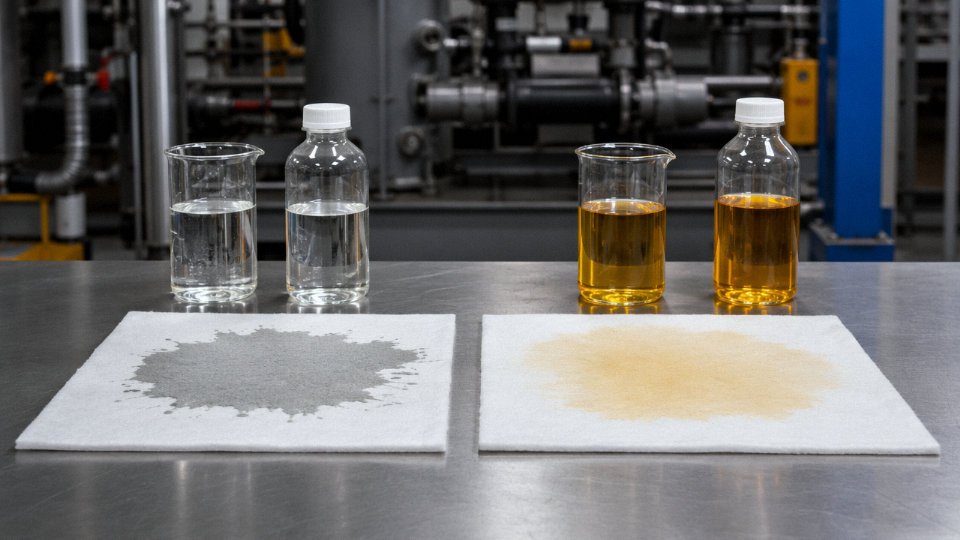
Secondary containment sizing isn’t automatically different — volume calculations don’t change — but bund liner compatibility does. PDMS will degrade certain painted concrete coatings over time, and a liner specified for petroleum service may not have been validated for silicone fluids. Check with the liner manufacturer before assuming it transfers.
Waste Disposal: The Hidden Cost Gap
Used mineral oil has an established re-refining industry in most regions. Collectors pay for it or collect it at low cost because there’s a recycled-base-oil market on the other end. Used silicone oil has no equivalent infrastructure. In practice, incineration at a licensed high-temperature facility is usually the only compliant route, and depending on your region and volume, disposal costs for spent silicone oil run roughly 3–6× higher per liter than equivalent mineral oil disposal — sometimes more for small quantities where you’re paying minimum-load charges.
For a hydraulic system with a 200-liter sump on a 3–5 year oil-change cycle, that gap is manageable. For a large transformer or an industrial heating bath running hundreds of liters, the lifetime disposal cost difference is worth putting in the total cost of ownership calculation before the purchase order goes out.
Near-Water Zones and Formal Regulatory Frameworks
Germany’s WHG (Wasserhaushaltsgesetz) water hazard class system is one of the more structured frameworks to understand. Mineral oils typically fall in WGK 2 (clearly hazardous to water), which triggers specific storage, containment, and inspection requirements. Many PDMS-based silicone fluids are rated WGK 1 (slightly hazardous) or occasionally WGK nwg (not hazardous to water), which reduces the containment obligation and can genuinely simplify installation in sensitive zones. If your plant is in a German groundwater protection area (Wasserschutzgebiet), that WGK rating difference can determine whether a fluid is permitted at all.
UK PPG26 (now replaced by the Environment Agency’s updated pollution prevention guidance) takes a similar risk-based approach, with particular scrutiny on stored volumes and proximity to surface water. US EPA SPCC thresholds apply regardless of fluid type — petroleum or non-petroleum — but the response plan requirements differ based on whether the fluid is classified as a petroleum product.
Ester-based fluids — both synthetic esters and natural esters — often rank better than either mineral oil or PDMS under these frameworks because they combine reasonable biodegradability with low aquatic toxicity. If your application is genuinely near a sensitive water body and the temperature envelope allows it, natural esters deserve a serious look before you default to silicone as the “safe” non-petroleum choice.
The regulatory picture changes fast enough that what was permissible on your last project may need re-checking on the next one, particularly for anything touching EU chemical regulation. Build the EHS review into fluid selection early, not after the equipment spec is locked.
Total Cost of Ownership Analysis: Upfront Price, Service Life, and System Redesign Costs Compared
The unit price gap between silicone and mineral oil is real and it’s large — roughly 4–8× depending on grade, volume, and whether you need food-grade certification. Industrial PDMS-based silicone oils typically run USD 8–18/kg in drum quantities; food-grade or medical-grade variants push toward USD 20–25/kg or beyond. Mineral oil sits at USD 1–4/kg for most industrial grades, less in bulk. Any procurement manager who stops the analysis there will almost certainly make the wrong call.
Service Life Changes the Labor and Downtime Equation Dramatically
At sustained operating temperatures around 120 °C — common in gearboxes adjacent to furnaces, hydraulic systems on injection molding platens, or cooling circuits near process heat — mineral oil oxidizes. Acid number climbs, varnish deposits form, and in practice you’re looking at an oil-change interval somewhere between 2,000 and 4,000 hours before the fluid is genuinely condemned. The range depends heavily on sump size relative to heat load, whether there’s any ingress of metal particles catalyzing oxidation, and how rigorously the plant actually monitors oil condition rather than just running calendar-based changes.
Silicone oil under the same 120 °C continuous exposure? Realistically 8,000–20,000 hours before meaningful degradation, and that upper bound assumes a reasonably clean system. The chemistry just doesn’t oxidize the same way.
Run the numbers on a typical mid-size plant: if an oil change on a gearbox takes 4–6 hours of labor including drain, flush, refill, and paperwork, and you’re doing it three or four times as often with mineral oil, the maintenance labor cost alone starts narrowing the price gap fast. Add in the lost production if that gearbox sits in a critical path. In some facilities, the labor and downtime cost of a single avoided oil change exceeds the entire annual price premium of the silicone fill.
Silicone oil's service life at elevated temperatures is typically 3–5× longer than mineral oil under equivalent thermal load.True
PDMS silicone oil has far greater oxidative and thermal stability than paraffinic or naphthenic mineral oils; published oxidation studies and OEM service data consistently show mineral oil acid number limits are reached at 2,000–4,000 hours at 120°C while silicone-based fluids remain serviceable well beyond 8,000 hours under the same conditions.
Hidden Switching Costs That Kill the Business Case If You Miss Them
Here’s where the TCO analysis gets uncomfortable. Switching an existing mineral-oil system to silicone isn’t a simple drain-and-fill. Residual mineral oil contaminating a silicone fill will degrade the silicone’s dielectric properties and can cause additive dropout — you need a proper flushing protocol, which typically means one or two intermediate flushes with a compatible solvent or low-viscosity carrier, adding cost and waste disposal obligations.
Seal replacement is the bigger hidden cost in many systems. NBR (nitrile) seals, which are standard on the overwhelming majority of industrial equipment, are not compatible with silicone oil for long-term exposure — swelling, softening, eventual leakage. FVMQ (fluorosilicone) seals that handle both silicone oils and reasonable temperature ranges cost roughly 2–3× their NBR equivalents, and on a complex hydraulic circuit with dozens of fittings that adds up quickly. On some older equipment with press-fit or bonded seals, replacement means partial disassembly that wasn’t budgeted.
Staff retraining is smaller but real. Silicone oil spills behave differently — extremely low surface tension means it migrates into places mineral oil wouldn’t reach, and it makes surfaces slippery at much lower contamination levels. Housekeeping procedures need updating.
Decision Matrix for Application Scoring
Use this table to score your application across the factors that actually drive the choice. Weight each factor for your specific context; a food-processing plant weights regulatory higher than a steel mill does.
| Factor | Weight Silicone Higher When… | Weight Mineral Oil Higher When… |
|---|---|---|
| Operating temperature | Continuous duty above 100–110 °C | Ambient to 90 °C range |
| Oil-change labor cost | High labor rate, hard access, critical path | Easy access, low-cost scheduled maintenance |
| Seal and gasket replacement budget | New build or planned overhaul underway | Legacy system, no teardown planned |
| Regulatory / food contact | Direct or incidental food contact required | Industrial-only, no food/pharma exposure |
| Dielectric requirement | High-voltage insulation or capacitor fill | No electrical function |
| Load and anti-wear need | Light to moderate load, speed-dominant | Heavy EP loads (consider neither; use PAO or gear oil) |
| Volume and weight sensitivity | Low-volume system, weight not critical | Weight-sensitive mobile or aerospace application |
No scoring system replaces a proper engineering review, but this structure forces the right questions before procurement commits to either fluid. The worst outcomes — usually a seized bearing or a leaking hydraulic cylinder six months after a fluid switch — come from treating oil selection as a commodity decision rather than a systems one.
Industry-Specific Application Guides: Food Processing, Medical Devices, Aerospace, and Heavy Industry
The criteria from the previous sections — temperature limits, compatibility, dielectric behavior, TCO — don’t always translate cleanly into a plant-floor decision. What follows is sector-by-sector guidance for the four industries where the silicone-versus-mineral-oil question comes up most often and where the wrong call has measurable consequences.
Food Processing and Pharmaceutical Manufacturing
This is probably the clearest-cut case for silicone oil. Above roughly 150 °C, mineral oil-based chain lubricants oxidize, carbonize, and produce visible smoke — all unacceptable in a baking or frying line environment. Oven conveyor chains running at 160–190 °C need something stable, and a silicone oil in the 350–1000 cSt range at 40 °C typically handles that service life with far less deposit buildup than any food-grade mineral oil.
The regulatory piece matters enormously here. Certain PDMS-based silicone oils are listed under FDA 21 CFR 178.3570 for incidental food-contact use; NSF H1 registration covers lubricants where incidental contact is possible. Not all silicone oils qualify — viscosity grade, additives, and the specific application all determine registration status. Procurement managers should request the exact NSF registration number from the supplier and verify it against the NSF White Book rather than accepting a data sheet claim at face value.
All silicone oils are automatically FDA-approved for food contactFalse
Only specific PDMS formulations meeting 21 CFR 178.3570 criteria and carrying valid NSF H1 registration qualify; additive packages and viscosity modifiers can disqualify an otherwise acceptable base fluid.
Autoclave environments are similar. Steam sterilization cycles at 134 °C with high humidity destroy most petroleum-based lubricants in a matter of weeks. Silicone greases and oils are standard in these settings, not because they’re exotic but because they simply don’t hydrolyze or wash out the way mineral-based products do.
Medical Devices and Laboratory Instruments
Silicone oil’s near-total chemical inertness makes it genuinely difficult to replace in certain precision instrument applications. Pipette mechanisms use small volumes of silicone oil — typically 5–50 cSt grades — as damping and sealing fluid because it won’t attack the polypropylene or polycarbonate bodies, won’t react with biological samples if there’s minor contamination, and stays consistent across the temperature swings a bench-top instrument sees.
Centrifuge damper systems and ophthalmic surgical equipment (vitreoretinal procedures use silicone oil directly as a vitreous tamponade) are contexts where biocompatibility isn’t a preference — it’s a mandatory product specification. No mineral oil equivalent exists for these applications. The density difference (silicone at roughly 0.96–0.97 g/cm³ versus mineral at 0.85–0.87 g/cm³) actually works in silicone’s favor in ophthalmic use, where buoyancy behavior inside the eye is a clinical parameter.
Aerospace and Defense
The terminology gets slippery here and it’s worth being precise. MIL-PRF-83282 — commonly described as a “fire-resistant hydraulic fluid” — is actually a synthetic hydrocarbon (polyalphaolefin base), not a silicone. It replaced MIL-H-5606 mineral oil in many airframe hydraulic systems for fire safety reasons but is chemically distinct from PDMS silicone fluids.
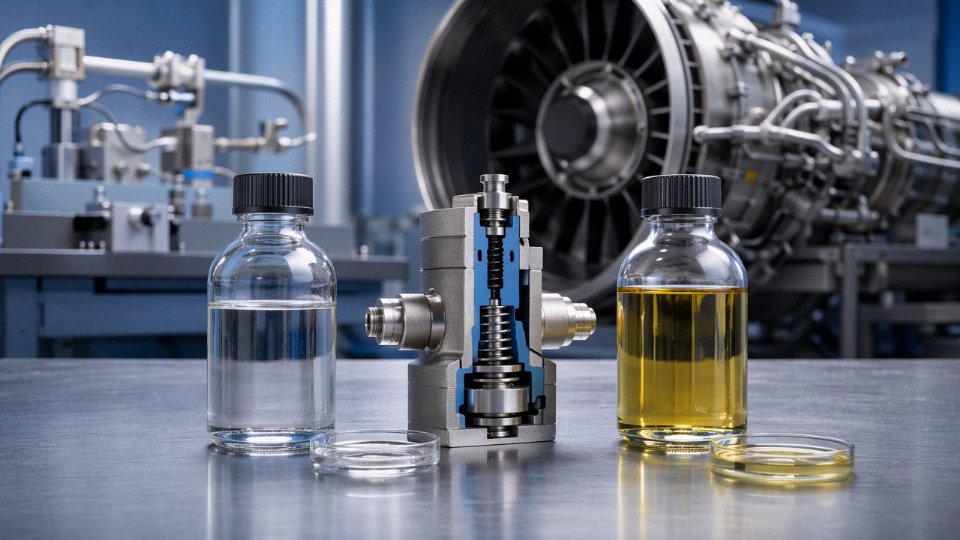
True silicone hydraulic and instrument fluids (MIL-PRF-6085 is the relevant spec for instrument and low-load applications) appear in radar antenna drive mechanisms, gyroscope dampers, satellite deployment actuators, and instrument panel shock absorbers. The driving requirements are cold-start performance at –54 °C — where mineral oils have long since thickened past utility — and low flammability in confined electronics bays. The trade-off is load-carrying capacity: silicone fluids under MIL-PRF-6085 are not designed for high-pressure, high-load hydraulic circuits, which is exactly why MIL-PRF-83282 (synthetic hydrocarbon) handles the main flight control systems while silicone handles the instruments.
Heavy Industry and Power Generation
Mineral oil dominates here, and for good reason. Turbine lube systems, large industrial gearboxes, and hydraulic circuits operating above 150–200 bar all depend on additive packages — zinc dialkyldithiophosphate (ZDDP), sulfurized EP additives, detergent inhibitors — that integrate well with refined mineral or group II hydrocarbon base stocks. Silicone’s poor solubility for most conventional additives is a genuine technical barrier, not a marketing distinction. You cannot simply add EP additives to a PDMS fluid and expect them to stay in solution or perform correctly under boundary lubrication conditions.
That said, there are narrow, well-defined niches. Arc furnace electrode positioning systems operate close enough to molten metal that a hydraulic fluid fire is a realistic risk; phosphate ester or water-glycol fluids are more common here, but silicone has been used in smaller systems where the temperature and fire-risk profile justifies the cost premium and the system has been designed around silicone’s lower bulk modulus. Near hot-strip rolling mills, similar logic applies to any hydraulic actuator that sits within spatter range of liquid steel.
In practice, the heavy-industry cases where silicone genuinely wins are the ones where the alternative is a fire — not where it’s marginally warmer than a standard mineral oil can handle.
Switching Protocols and Contamination Control: How to Convert a System from Mineral to Silicone Oil Safely
Cross-contamination is, in practice, the most common reason a silicone oil conversion fails in the field — not incorrect viscosity selection, not seal incompatibility, but residual mineral oil that nobody bothered to fully remove. The failure mode is deceptively quiet at first: some foaming, slightly erratic viscosity readings, maybe a sluggish pressure response. Then the antifoam package collapses and things get ugly fast.
Why Even Trace Contamination Is a Real Problem
Silicone oils — PDMS-based fluids specifically — are exceptionally sensitive to mineral oil contamination because the two fluid classes interact destructively at the additive level. At contamination levels as low as 1–2% mineral oil by volume, the antifoam agents formulated into the silicone fluid are effectively deactivated. The result is persistent foam under dynamic conditions, which in hydraulic or cooling systems translates directly to cavitation, inconsistent film formation, and thermal hotspots. Viscosity behavior also shifts in a non-linear way that doesn’t track neatly with simple blending rules — you cannot reliably predict the contaminated fluid’s performance from either base fluid’s datasheet.
The reverse conversion carries its own hazard. Residual silicone oil left in a system being refilled with mineral oil causes severe, stubborn foaming — silicone at even sub-1% concentrations is potent enough to interfere with the mineral oil’s additive chemistry, particularly rust inhibitors and EP additives. Some mineral oil formulators explicitly void their product warranty if silicone contamination is detected.
The Triple-Flush Procedure
A single drain-and-fill is never sufficient. A three-stage flush is the minimum for any system that held the previous fluid at operating temperature for more than a few hundred hours — longer service means deeper fluid absorption into seals, hoses, and any polymer-lined components.
Stage 1 — Bulk drain: Drain while the system is warm (not hot — aim for 40–60 °C on the fluid, which reduces viscosity enough to pull out settled contaminants without creating burn hazards). Tilt or rotate components where geometry allows pooling.
Stage 2 — Intermediate flush: For most hydraulic and gearbox systems, a low-viscosity paraffinic mineral oil (ISO VG 10 or 15) works well as the flush medium for mineral-to-silicone conversions; it cuts residual mineral oil effectively and is then itself easy to purge. For precision systems or medical-grade applications where any hydrocarbon carryover is unacceptable, isopropyl alcohol is the correct choice — but verify IPA compatibility with every elastomer in the circuit before doing this, because it will swell certain seal materials. Run the flush fluid through the full operating cycle, including any servo valves or heat exchanger passages. Drain again completely.
Stage 3 — Cleanliness verification: Before filling with silicone oil, pull a fluid sample from the lowest drain point and run a contamination check. Residual mineral oil content should be below 0.5% by volume — verify via FTIR or a simple refractive index check if a lab isn’t available on-site. Particulate cleanliness should meet ISO 4406 class 16/14/11 or better before the new fluid goes in.
A single drain-and-refill is adequate for converting a hydraulic system from mineral to silicone oilFalse
Residual mineral oil remains absorbed in seals, hoses, and machined cavities after a single drain. Even 1–2% carryover deactivates antifoam agents in silicone oil and causes foaming and viscosity instability under operating conditions. A triple-flush procedure with intermediate flush fluid and contamination verification is the correct minimum protocol.
Seal and Gasket Inspection Before First Fill
Don’t assume seals that survived mineral oil will survive silicone oil without attention. Replace any seal or O-ring that shows compression set, surface crazing, or dimensional change beyond 5% — these will leak under silicone oil, often within the first 50 operating hours. Nitrile (NBR) seals are the usual culprit; PTFE-encapsulated or silicone-compatible FKM seals are generally acceptable, but check the specific durometer grade against the fluid temperature range expected.
After first fill, re-torque all gland fittings and flanged connections at 50 hours and again at 250 hours. Thermal cycling during commissioning causes initial relaxation in seal hardware that a one-time torque check won’t catch. Monitor fluid temperature at the pump outlet and the reservoir return line for the first 500 operating hours — a temperature deviation of more than 8–10 °C from baseline usually indicates a flow restriction from foam or a failing seal bypassing fluid internally.
Documentation and Labeling
This part gets neglected and causes expensive audit failures. Label every reservoir, fill point, and sample port with the fluid type, viscosity grade, and the conversion date — not just a generic “silicone oil” tag, but the specific product and batch. For ISO 9001-registered facilities, the change log needs to capture the pre-conversion fluid type, flush procedure used, cleanliness verification result with test method, new fluid specification, and the technician sign-off. AS9100 environments require all of this plus traceability to the fluid batch certificate.
Attach an ISO 4406 cleanliness tag to the reservoir or record the result in the equipment’s maintenance history file. It becomes your baseline for trend monitoring — if cleanliness degrades from 16/14/11 to 19/17/14 over six months, you have a real data point to investigate rather than guessing at a contamination source.
Fluid identification labels should be color-coded if your plant runs both fluid types across multiple machines; a simple visual system prevents the wrong fluid going into the wrong reservoir during a rushed top-off, which is exactly the scenario that creates 2% contamination events.
Frequently Asked Questions About Silicone Oil vs. Mineral Oil Selection
Can you mix silicone oil and mineral oil for an emergency top-up?
No. Full stop. Even a 5–10% contamination of one fluid type into the other is enough to cause persistent foaming, and the foam doesn’t just look bad — it collapses hydrodynamic film thickness and starves bearings or gear contacts within minutes of startup. What happens chemically is that the two base fluids have fundamentally different surface tensions and solvency characteristics, so they don’t form a stable blend; they form a micro-emulsion that traps air and destabilizes whatever additive packages were already in the system. Any anti-wear, anti-oxidant, or EP additives formulated for mineral oil are essentially inert or actively counterproductive once silicone is present in meaningful quantity.
Seal damage is the other immediate risk. Many systems running mineral oil use NBR or neoprene seals that are already borderline-compatible with silicone fluid — a sudden composition shift can accelerate swell or shrinkage enough to cause a weeping leak within a few operating cycles.
In practice: if a system needs an emergency top-up and you don’t have the correct fluid on hand, the right answer is to reduce load, slow the machine, and source the correct fluid before the next shift. Topping up with the wrong fluid to “get through the day” typically creates a contamination remediation job that costs far more than the downtime you avoided.
Mixing silicone oil and mineral oil in any proportion is safe for short-term emergency useFalse
Even small proportions — as low as 5–10% — cause foaming, additive interference, and accelerated seal degradation; the two fluid types must never be mixed, regardless of the urgency of the situation.
Is silicone oil automatically the safer, greener option?
Not remotely. Silicone oil’s flash point runs roughly 300 °C or above for most PDMS grades, and acute dermal and inhalation toxicity is genuinely low — those are real advantages in confined-space or food-adjacent environments. But silicone oil is highly persistent in soil and aquatic environments. It doesn’t biodegrade meaningfully under standard OECD test conditions, and disposal through licensed hazardous-waste contractors typically costs two to four times what mineral oil disposal runs, depending on region and volume. In jurisdictions with strict environmental liability frameworks, a spill of silicone oil into a drainage channel can trigger a remediation obligation that dwarfs any operational savings.
Mineral oil, particularly the hydrotreated Group II and III grades, is now well-characterized from a regulatory standpoint and biodegrades faster under most environmental conditions. That doesn’t make mineral oil universally preferable, but it does mean the “silicone is safer” assumption needs to be challenged every time you’re operating near waterways, agricultural land, or in regions with active PFAS/persistent-chemical regulatory scrutiny.
Does silicone oil need different filtration hardware?
Yes, and this catches people off guard during conversions. Silicone oil’s low surface tension — typically 20–21 mN/m versus 28–32 mN/m for mineral oil — means it wets and penetrates standard cellulose filter media aggressively, causing fiber shedding into the fluid. Those fibers then circulate as contaminant particles and can jam servo valves or score precision bores. Glass-fiber elements or stainless-steel mesh elements rated for the correct particle-size cutoff are the standard fix. Beta ratios need to be re-verified for the new fluid, not assumed to carry over from the mineral oil installation — filter manufacturers’ published beta ratings are usually derived from ISO 16889 tests run with specific test fluids, and silicone oil’s viscosity-flow behavior through porous media differs enough to shift the actual separation efficiency by a meaningful margin.
Why does silicone oil contaminate painted and powder-coated surfaces nearby?
Silicone oil has measurable vapor pressure at elevated temperatures, and even at ambient conditions, fine mist from splash, venting, or purging can migrate several meters from the source. Once silicone deposits on a surface, it is nearly impossible to remove completely with standard industrial degreasers — it doesn’t dissolve well in most alkaline cleaners, and even solvent wiping tends to smear a thin molecular layer rather than remove it.
That thin layer is enough to cause fish-eye defects in any subsequent paint or powder coat application. Weld prep is affected too: silicone contamination of a joint surface prevents proper fusion and causes porosity that only shows up on post-weld inspection. Plants that run silicone-lubricated equipment in or near paint lines, fabrication bays, or repair workshops typically need dedicated mist extraction at the fluid’s venting points and strict procedural controls around maintenance activities involving open fluid handling.
What viscosity grade should replace mineral oil in a dashpot or rotary damper?
This is where silicone oil’s high viscosity index — typically 200–400 compared to 95–120 for mineral oil — actually creates a selection trap. Because silicone oil’s viscosity changes so little with temperature, a silicone grade with the same ISO VG number as your current mineral oil will behave stiffer at elevated operating temperatures and softer at cold start than the mineral oil did. For most damping applications, that means you need to start with a lower ISO VG grade for the silicone oil to match the dynamic viscosity at your primary operating temperature.
The practical method: pull the operating temperature range for the damper, look up both fluids on an ASTM D341 viscosity-temperature chart, and find the silicone grade whose viscosity curve intersects your target viscosity at the design operating temperature. Don’t rely on supplier cross-reference tables alone — they often match at 40 °C, which may be nowhere near the actual service condition. A rotary damper running in an outdoor mechanism at –20 °C to +70 °C will behave very differently from what a 40 °C cross-reference suggests.