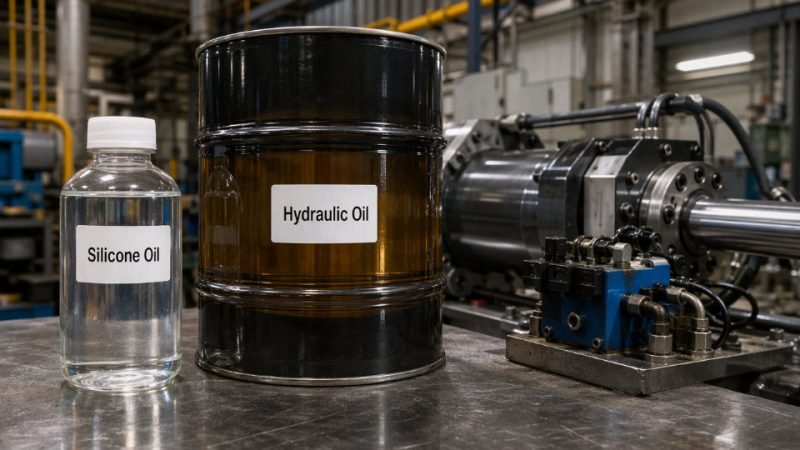
Swap silicone oil into a hydraulic circuit designed for mineral oil and you will not get a gentle performance degradation — you will get sluggish actuator response, seal swell or shrinkage depending on elastomer type, and in servo-controlled systems, positional errors that take days to diagnose because nobody checked fluid compressibility at commissioning. The maintenance cost is rarely the fluid itself; it is the downtime chasing symptoms that trace back to a fluid selection made in procurement because silicone oil looked chemically safe and temperature-stable on the datasheet.
Silicone oil and hydraulic oil are not interchangeable. Silicone oil spans roughly 0.65 cSt to 1,000,000 cSt viscosity and handles −60°C to +200°C continuous service, but its bulk modulus sits around 900 MPa — nearly half that of mineral hydraulic oil at 1,600–1,800 MPa — which slows servo-valve response measurably and makes it a poor default choice for high-precision hydraulic circuits despite its thermal advantages.
What makes this comparison genuinely difficult is that both fluids look similar in a drum, behave predictably in isolation, and only reveal their incompatibilities under load, at temperature, or when the wrong seal compound finally starts weeping after 400 hours. The viscosity ranges barely overlap in practical application, the thermal envelopes serve completely different industries, and the mechanical behavior under pressure is different enough to matter in ways that a standard fluid spec sheet will not flag. The details are worth getting right before the purchase order is signed.
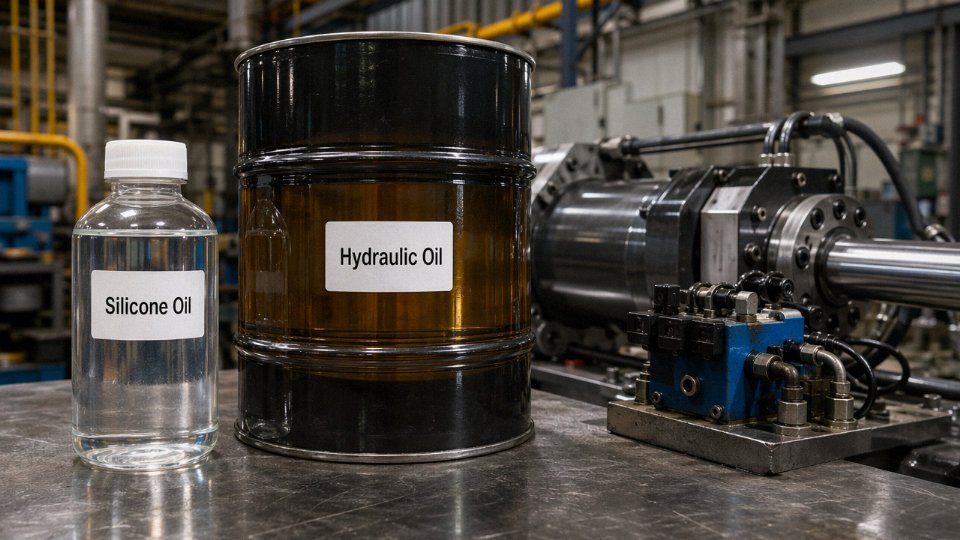
Molecular Architecture and Base-Fluid Chemistry That Drive Performance Differences
The single most expensive mistake in fluid selection is treating silicone oil and hydraulic oil as two points on the same viscosity spectrum. They are not. They are built from fundamentally different atomic structures, and those structures explain nearly every performance gap you’ll encounter downstream — in seal compatibility, bulk modulus, thermal range, and additive behavior.
The Si–O Backbone: Why Silicone Oil Behaves the Way It Does
Polydimethylsiloxane (PDMS), the workhorse silicone fluid, is built on a repeating silicon-oxygen backbone with methyl (or, in higher-temperature variants, phenyl) side groups hanging off each silicon atom. The Si–O bond energy sits around 452 kJ/mol — substantially higher than the C–C bonds (~347 kJ/mol) that form the backbone of mineral oils. That difference matters in two practical ways: the fluid resists oxidative chain-scission at elevated temperatures, and it doesn’t easily polymerize into varnish or sludge when thermal stress accumulates.
The methyl side groups are non-polar and loosely packed. Intermolecular forces between PDMS chains are weak — van der Waals interactions only, no hydrogen bonding, no dipole coupling. That’s the root cause of the famously flat viscosity-temperature curve. As temperature rises, there’s simply not much intermolecular structure to disrupt. A PDMS fluid at 100°C behaves almost like the same fluid at 25°C, comparatively speaking. Viscosity Index values of 150 to 400 are achievable without any additive intervention. Some phenyl-modified grades push even higher.
No VI improvers means no shear degradation. That’s a real operational advantage in systems running variable duty cycles or high-shear pump geometries.
Mineral and Synthetic Hydraulic Oils: Chemistry Held Together by Additives
Mineral base stocks — Group I through Group III — are refined fractions of crude oil, predominantly paraffinic and naphthenic hydrocarbons. Group I stocks (solvent-refined) carry VI in the 95–105 range and significant sulfur/aromatic content. Group II and III (hydrocracked, hydroisomerized) are cleaner, reaching VI around 110–130, but they’re still fundamentally C–C and C–H backbone materials, susceptible to oxidative degradation at sustained temperatures above roughly 80–90°C.
PAO (Group IV) and synthetic esters (Group V) are purpose-built molecules rather than refined fractions — better oxidative stability, broader temperature range — but they still can’t touch silicone’s thermal ceiling without their own additive support.
The additive package in a finished hydraulic oil is doing a lot of heavy lifting: anti-wear (AW) agents protect pump surfaces that the base stock would otherwise score, extreme-pressure (EP) additives carry shock loads, VI improvers (typically olefin copolymers or polymethacrylates) compensate for the base stock’s viscosity-temperature weakness, and anti-foam packages suppress air entrainment. The problem is that these additives consume themselves. VI improver polymers shear-degrade in high-pressure pump clearances over roughly 1,000–4,000 service hours depending on severity, and the oil’s actual in-service VI drifts downward — sometimes without triggering any obvious alarm until you’re chasing intermittent spool-valve stiction.
Mineral hydraulic oil VI improvers permanently shear-degrade over time in pump serviceTrue
Polymeric VI improvers are high-molecular-weight chains that break under mechanical shear in pump clearances and valve orifices; once degraded, viscosity index cannot recover and the fluid effectively thins more with temperature than its original spec suggests.
Polarity, Surface Energy, and a Trap People Walk Into
Silicone oil’s low surface tension — roughly 20–22 mN/m — is frequently misread as a benefit. In sealed systems with controlled interfaces, it sometimes is. In open reservoirs or systems with any air-entrainment path, it becomes a liability. That low surface tension means air bubbles coalesce slowly; foam is stable. Standard mineral-oil anti-foam additives don’t transfer to silicone systems. You need silicone-compatible defoamers, and even then, open-sump designs with silicone fluid are genuinely problematic in practice. Hydraulic oils formulated for industrial service typically land at 24–28 mN/m surface tension — high enough to let foam collapse reasonably fast under normal reservoir residence times.
Key Molecular Property Comparison
| Property | Silicone Oil (PDMS) | Mineral Hydraulic Oil (Group II/III) | Impact on Hydraulic Circuit Design |
|---|---|---|---|
| Backbone bond energy | ~452 kJ/mol (Si–O) | ~347 kJ/mol (C–C) | Silicone: pass for high-temp oxidation; mineral: marginal above 90°C |
| Viscosity Index (neat) | 150–400, no additives | 95–130, needs VI improvers | Silicone: stable over life; mineral: degrades in service |
| Surface tension | ~20–22 mN/m | ~24–28 mN/m (formulated) | Silicone: foam risk in open systems; mineral: acceptable |
| Dielectric constant | ~2.2–2.8 | ~2.0–2.4 | Silicone: marginally higher, relevant for EHC systems |
| Flash point (base chemistry) | >300°C (most grades) | 180–240°C (Group II/III) | Silicone: pass for fire-risk areas; mineral: requires assessment |
| Bulk modulus | ~900 MPa | ~1,600–1,800 MPa | Silicone: fail for servo/proportional valve response; mineral: pass |
| Additive dependency | Minimal | High (AW, EP, VI, anti-foam) | Silicone: lower maintenance variability; mineral: additive depletion must be tracked |
The bulk modulus gap is the one that surprises engineers who’ve done all their other homework. A fluid at ~900 MPa versus ~1,700 MPa compresses roughly twice as much under the same pressure pulse. In a servo-controlled axis running at 20 ms response targets, that compliance shows up as positional lag and reduced bandwidth — something you’ll see in the data before you understand why.
Viscosity, Compressibility, and Flow Behavior Across Operating Temperatures
Viscosity is where these two fluid families diverge most dramatically in practice — and where engineers make the most expensive sizing mistakes.
Viscosity-Temperature Behavior: The Curve That Changes Everything
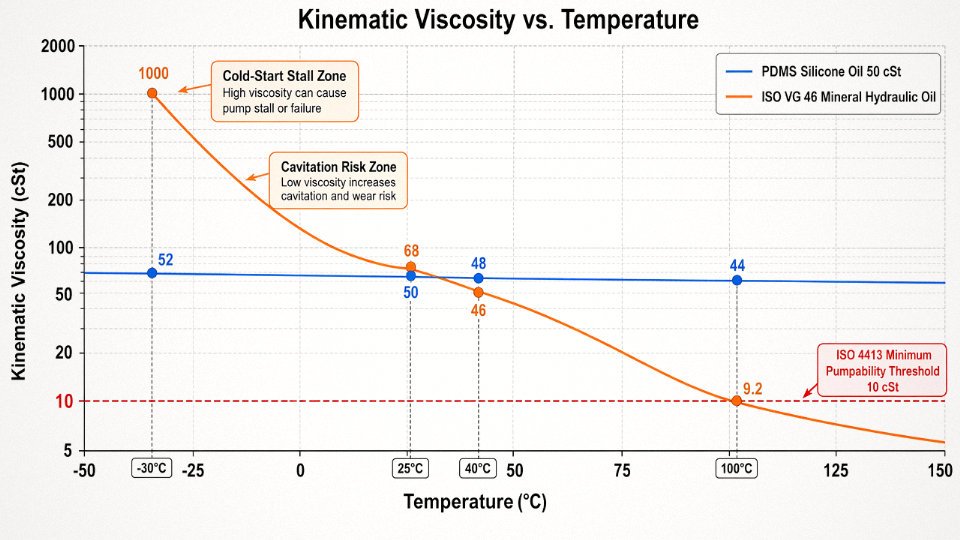
Take PDMS silicone oil at 50 cSt (measured at 25°C) and ISO VG 46 mineral hydraulic oil and plot them from −50°C up to +150°C. The gap is striking. At −30°C, a typical ISO VG 46 mineral oil climbs to somewhere in the range of 800–1,200 cSt depending on its base stock and additive package — roughly an 8× to 12× increase over its rated viscosity. PDMS 50 cSt, by contrast, sits around 80–120 cSt at the same temperature. That’s less than a 2× rise. The silicone oil’s viscosity-temperature coefficient (VTC) is inherently flat because the Si–O backbone has an exceptionally low intermolecular energy barrier to flow — something no VI improver additive can fully replicate in a mineral oil.
What that means on a pump curve: a system designed around ISO VG 46 at 40°C will be running severely over-viscous fluid at cold start. Expect cavitation, sluggish response, and potential pump starvation before the fluid warms up. In a heated machine shop this matters less. On an outdoor arctic valve actuator in January, it matters enormously.
Silicone oil viscosity rises less than 2× from 25°C to −30°C for typical PDMS grades in the 50–100 cSt range.True
PDMS fluids have a very low viscosity-temperature coefficient due to the flexible Si–O backbone. A 50 cSt PDMS grade typically reads 80–120 cSt at −30°C, well within a 2× increase, whereas mineral hydraulic oils with VI improvers still rise 6× to 12× over the same interval.
Cold-Start Pumpability and ISO 4413 Thresholds
ISO 4413 sets a minimum pump inlet viscosity of roughly 10 cSt for most gear and vane pump designs — some axial-piston units go down to 7 cSt. Silicone oil stays comfortably above that threshold below −50°C. Mineral hydraulic oil usually freezes out well before causing a low-viscosity problem; its failure mode at cold start is the opposite — it’s too thick, not too thin.
This is why aerospace ground-support equipment and arctic pipeline valve actuators standardized on silicone fluids decades ago. No block heater, no immersion element, no warm-up idle cycle. The system just works at −55°C ambient. That reliability has a real cost — silicone fluid is typically 4× to 8× the price per liter of mineral VG 46 — but the downtime cost of a failed cold start on a flight-line hydraulic test rig makes it a straightforward trade.
Bulk Modulus, Compressibility, and Servo Accuracy
Here’s where silicone oil causes real trouble in high-performance systems. Mineral hydraulic oil has a bulk modulus in the range of 1,600–1,800 MPa at typical operating pressures. Silicone oil comes in around 900 MPa — roughly half as stiff.
In a servo-hydraulic positioning system running at 200 bar, that compressibility difference translates directly into cylinder position error. A 500 mm stroke cylinder with 40 mm bore can accumulate 0.8–1.2 mm of position error from fluid compression alone when switching from mineral oil to silicone oil without retuning the servo valve’s response parameters. That’s not a theoretical concern — it shows up immediately in machine tool or press-brake positioning accuracy.
Switching from mineral hydraulic oil to silicone oil in a servo system can introduce cylinder position errors of around 1 mm at 200 bar without control loop retuning.True
The bulk modulus of silicone oil (~900 MPa) is approximately half that of mineral hydraulic oil (~1,650 MPa). This lower stiffness means more fluid volume is compressed per unit pressure, delaying actuator response and introducing position offset that servo controllers tuned for mineral oil will not automatically compensate.
Valve manufacturers typically recommend slowing actuation rates by 15–25% and resizing accumulators upward when converting a servo circuit to silicone fluid. Budget for that engineering rework before you specify the fluid swap.
Cavitation Risk Under Pressure Cycling
Lower bulk modulus also means dissolved air releases from silicone oil at lower pressure differentials. In a high-cycle circuit — think a press with 60+ strokes per minute — silicone oil will liberate air bubbles more readily during the return stroke. The result is cavitation erosion on pump faces and valve seats, often within 500–2,000 operating hours depending on cycling frequency and pressure swing magnitude. Mineral oil systems typically tolerate more aggressive cycling before showing the same damage.
Practical fix: increase accumulator pre-charge volume by roughly 30–50%, specify slower proportional valve ramp rates in the PLC, and install a vacuum degassing unit on the reservoir if the circuit runs continuously. Skipping these steps and just swapping the fluid is one of the more reliable ways to destroy a pump.
Shear Stability: Where Silicone Has a Clear Edge
PDMS polymer chains don’t shear-degrade at realistic hydraulic conditions. Even at shear rates approaching 10⁶ s⁻¹ — which you’d see in a tight gear pump clearance — the silicone viscosity holds. Mineral hydraulic oils formulated with viscosity-index improvers (typically OCP or PMA polymers added at 3–8% treat rate) are far more vulnerable. ASTM D2603 KRL tapered-roller testing consistently shows 15–30% viscosity loss after 100 hours in a gear pump circuit for VI-improved mineral oils. Some cheaper formulations lose that much in 40–60 hours.
The practical consequence: a mineral VG 46 oil blended to hit its viscosity grade with heavy VI improver loading may be behaving like a VG 32 or even VG 22 fluid after a few months of service in a high-shear circuit. Your oil analysis should be tracking kinematic viscosity at 40°C on every sample — if you’re not seeing that data, you’re flying blind on fluid condition.
Thermal Stability, Fire Resistance, and Oxidation Life in High-Temperature Circuits
The purchasing conversation in steel mill hydraulics or die-casting presses almost always starts with fire risk. That’s fair — a burst hose on a press with a 300°C die surface and a fluid that ignites at 220°C is a documented fatality scenario, not a hypothetical. So the thermal data matters, and it’s worth going through it carefully rather than relying on vendor datasheets that selectively quote best-case numbers.
Flash Point, Auto-Ignition, and What the Classifications Actually Mean
Silicone oil (polydimethylsiloxane fluids) typically shows an open-cup flash point above 300°C and auto-ignition temperatures above 450°C — the exact figures shift somewhat with molecular weight, so a 1,000 cSt grade will behave differently from a 50 cSt grade, but both sit well above the range that concerns fire marshals in hot-work environments. ISO VG 46 mineral hydraulic oil, by contrast, runs a flash point of roughly 210–230°C and auto-ignites around 320°C, which is close enough to die surface temperatures and furnace radiation levels to be genuinely problematic.
ISO 15029 sets out the fire-resistant hydraulic fluid classification framework. HF-D and HF-E categories (water-containing fluids) get used in some steel applications, but they bring their own penalty — reduced lubricity, corrosion risk, and maintenance overhead that many plant managers find worse than the fire risk they’re trying to solve. Silicone oil doesn’t slot neatly into ISO 15029 categories because those categories were written around water-glycol and phosphate ester fluids, but in practice, the auto-ignition data usually satisfies insurance underwriters and local fire codes without the corrosion headache of HF-D.
Silicone oil auto-ignition temperature exceeds 450°C, roughly 130°C higher than typical mineral hydraulic oil.True
PDMS-based silicone fluids consistently show auto-ignition above 450°C in standardized testing; ISO VG 46 mineral oil auto-ignition is typically cited at 300–340°C depending on refining grade and additive package.
Oxidation Life: Where Mineral Oil Quietly Loses Ground
Silicone oils are not petroleum products and have no hydrocarbon backbone to oxidize in the conventional sense. Below about 150°C continuous operating temperature, oxidation is negligible — you’re not fighting additive depletion or varnish formation in the same way. Mineral hydraulic oils with zinc-based AW (anti-wear) additive packages, which is most of the ISO VG 32–68 range you’ll find in industrial service, start meaningful additive depletion above roughly 80°C. ASTM D943 TOST data for zinc-dithiophosphate-doped mineral oils typically show viscosity drift exceeding 10% and acid number rising sharply after 2,000 hours at 90°C. In a system running a 85–90°C reservoir temperature — which is common in injection molding and die-casting circuits that lack properly sized heat exchangers — that means a drain interval of 2,000–3,000 hours is realistic, not conservative.
Fluid life extension additives help, but they don’t change the underlying chemistry. The zinc breaks down, the acid number climbs, and eventually you’re accelerating seal degradation and corroding brass servo-valve components. That’s how you get a $40 drum of oil that turns into a $4,000 servo-valve replacement every few years.
Degradation Products Are Not a Minor Footnote
When silicone oil is pushed above 200°C — either by a hot spot, inadequate flow, or a localized fault — pyrolysis generates cyclic siloxanes, primarily D4 and D5. Both are listed under REACH in the EU as substances of very high concern due to persistence and bioaccumulation potential. That’s a real compliance issue for any operation with fluid disposal obligations in Europe, and worth flagging early in a procurement decision rather than discovering it during an environmental audit.
Mineral oil thermal degradation tells a different story but not a cleaner one. Acidic by-products attack yellow metals — brass fittings, bronze bushings, copper heat exchanger tubes — and swell nitrile seals over time. The failure mode is gradual and insidious: slightly sticky servo spools, micro-pitting on pump port plates, seals that look fine until they don’t.
Fluid Life and the Real Cost of Drain Intervals
In closed, well-filtered silicone oil circuits with controlled contamination ingression — typical of clean-room equipment, aerospace ground support, or well-maintained laboratory systems — documented service lives of 10 to 15 years without full fluid replacement are credible. That’s not marketing copy; it reflects the chemical stability and the absence of oxidative degradation pathways. The caveat is that “closed and contamination-controlled” is doing a lot of work in that sentence. Silicone oil’s hydrophobic nature means it doesn’t absorb water like mineral oil does, which removes one common degradation pathway but also means particulate contamination isn’t diluted or settled out the same way. Filtration discipline matters.
Mobile equipment on mineral hydraulic oil — excavators, rough-terrain cranes, agricultural machinery — realistically drains every 2,000 to 4,000 hours depending on system temperature, filter maintenance, and whether the OEM’s recommendation is being followed or just posted on the wall. Stationary industrial equipment with good thermal control can stretch further, but anything running consistently above 80°C should be on condition-based monitoring rather than fixed intervals.
When the Thermal Advantage Doesn’t Justify the Premium
Here’s the practical cut: if your system runs below 70°C continuous, has a properly sized heat exchanger, and isn’t near a flame or radiant heat source, silicone oil’s thermal stability buys you nothing operationally. Silicone oil typically costs 8–20 times more per liter than an equivalent-viscosity ISO VG mineral oil, depending on grade and volume. Choosing it purely because it sounds safer, without a genuine thermal or fire exposure justification, is a procurement decision that will be hard to defend at budget review. Save it for the applications where the failure consequence is a fire, a compliance violation, or a 15-year no-drain service life that actually offsets the upfront cost.
Lubricity, Wear Protection, and Seal Compatibility in Hydraulic Circuits
The single most damaging misconception on the shop floor is that silicone oil, because it feels slippery and coats surfaces beautifully, must be a competent lubricant in any mechanical application. It isn’t. Silicone PDMS fluid does an excellent job reducing friction under light, sliding-contact conditions — which is exactly why it works in cosmetics, release agents, and damping applications. Hydraulic machinery, however, is a different world entirely.
Four-Ball Wear Test: What the Numbers Actually Show
Under ASTM D4172 four-ball conditions, unformulated silicone oil produces wear scar diameters in the range of 0.8–1.2 mm. The spread depends on viscosity grade and test load. A zinc-dialkyldithiophosphate (ZDDP) -treated VG 46 mineral hydraulic oil, tested under identical conditions, lands at 0.3–0.5 mm. That’s roughly 2–3× worse wear protection for silicone — not a marginal difference, a categorical one. ZDDP and other anti-wear additives work by forming sacrificial tribofilms on steel surfaces under pressure. Silicone’s chemically inert backbone, which gives it such admirable thermal stability, also prevents it from forming those films. Inertness is a double-edged property.
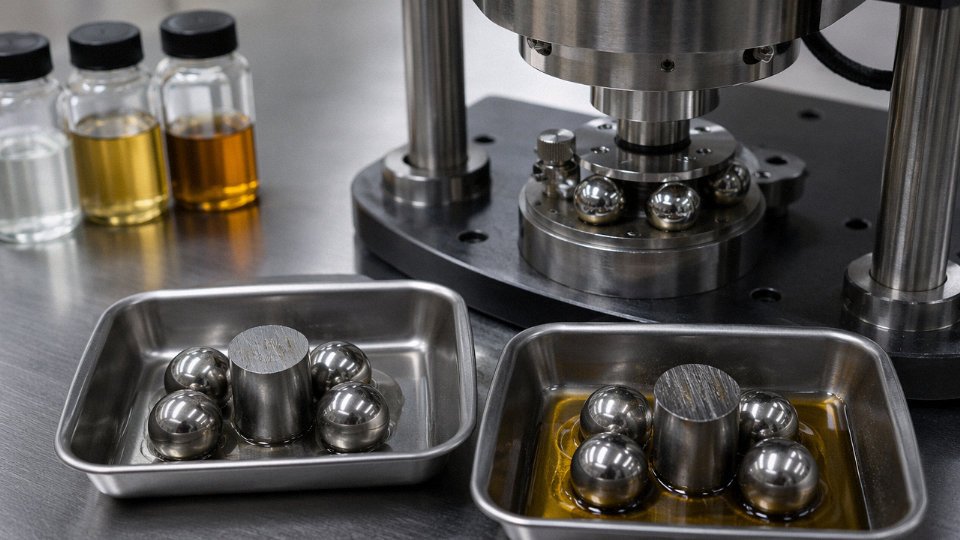
Silicone PDMS oil produces 2–3× larger wear scars than ZDDP-treated mineral hydraulic oil under ASTM D4172 four-ball test conditionsTrue
Published ASTM D4172 test data for unadditivized polydimethylsiloxane fluids consistently shows wear scar diameters of 0.8–1.2 mm compared to 0.3–0.5 mm for formulated VG 46 anti-wear hydraulic oil, reflecting the absence of tribofilm-forming additives in silicone.
EHD Film Thickness and What It Means for Gear Pumps
Elastohydrodynamic lubrication theory tells you the film thickness depends heavily on the fluid’s pressure-viscosity coefficient (α). Mineral hydraulic oils run α values of roughly 18–25 GPa⁻¹. Silicone oils sit at 5–8 GPa⁻¹ — the fluid simply doesn’t stiffen under high contact pressures the way mineral oil does. The practical result is EHD film thickness running 60–70% lower at identical load and speed, which matters enormously in gear pumps and roller bearings where that thin film is the only thing standing between metal surfaces.
In a gear pump running at 150 bar with VG 100 silicone, you’re operating near the edge of acceptable film thickness. Push that to 200 bar and you’re into metal-to-metal contact territory. Vane pumps are even more sensitive — reduced side-loading pressure and tighter running clearances mean silicone should only be used at derated pressures, typically 30–40% below the pump’s rated mineral-oil ceiling. Piston pumps above roughly 250 bar are simply not appropriate for silicone service. The piston shoe wears rapidly, and in my experience the damage becomes apparent within a few hundred operating hours rather than at planned overhaul intervals. Specify PAO or a fully formulated mineral hydraulic oil for any high-pressure piston circuit.
Seal Compatibility: Get This Wrong and You’re Buying Seals in Bulk
Silicone oil is remarkably kind to fluorosilicone (FVMQ) seals — volume swell under ASTM D471 immersion typically stays below 2%, which is effectively non-issues territory. That compatibility is real and worth acknowledging. The problem is that most existing hydraulic systems aren’t built with FVMQ seals. Standard nitrile (NBR) seals — the default in a huge proportion of industrial hydraulic cylinders — swell 15–40% in silicone oil within 500 hours of service. EPDM behaves similarly. At that level of swell, seals extrude, leak, and eventually fail in a way that looks mysteriously like a pressure spike rather than a seal problem.
Viton (FKM) lands in an intermediate zone: swell of roughly 3–8%, which is manageable in static applications but worth verifying against your specific seal compound and operating temperature before signing off. FKM formulation varies substantially between manufacturers, and a swell test on the actual seal batch is worth the two-week delay.
| Seal Material | Swell in Silicone Oil (500 hr) | Practical Verdict |
|---|---|---|
| FVMQ (fluorosilicone) | 280 bar | |
| Mobile hydraulics | ❌ Not recommended | ✅ Recommended | ✅ Recommended | OEM approvals, seal compatibility |
| Soft robotics / compliant actuators | ✅ Recommended | ❌ Not recommended | ⚠️ Acceptable | Temperature range, compliance tolerance |
| Servo-hydraulic precision presses | ❌ Not recommended | ✅ Recommended | ✅ Recommended | Bulk modulus, positional accuracy |
The pattern across all these applications is consistent: silicone oil wins on chemistry and temperature range, loses on compressibility and lubricity, and gets disqualified in mobile applications purely by approval-list absence. PAO hydraulic fluid is the closest thing to a universal answer for demanding industrial circuits, though it costs 2–4× mineral oil and requires confirming seal compatibility in aging equipment. Mineral oil remains dominant wherever OEM approvals and cost govern, which is most of the world’s installed hydraulic base.
Environmental, Safety, and Regulatory Compliance Considerations
Fluid selection doesn’t end at performance specs. Once you’ve confirmed a fluid works in your circuit, your EHS manager and legal team will ask a different set of questions — and the answers for silicone oil and mineral hydraulic oil diverge in ways that catch procurement teams off guard.
Ecotoxicity and Environmental Classification
PDMS-based silicone oils above 100 cSt have low acute aquatic toxicity. Daphnia magna LC50 sits above 1,000 mg/L, which clears the EU CLP classification threshold for aquatic hazard. That sounds reassuring until you check biodegradability: BOD5/COD ratios typically run below 0.6, meaning silicone oil does not readily break down in biological wastewater treatment systems. It tends to persist and accumulate in sediments rather than mineralizing.
The practical consequence is that PDMS does not qualify as an Environmentally Acceptable Lubricant under the EPA’s 2013 Vessel General Permit (VGP 2013), which matters directly if your equipment operates on or near navigable waterways — marine deck machinery, dockside cranes, riverine construction equipment. The VGP requires EAL fluids in all oil-to-sea interfaces unless technically infeasible. Silicone oil fails that test regardless of its low acute toxicity score.
Silicone oil (PDMS >100 cSt) qualifies as an Environmentally Acceptable Lubricant under EPA VGP 2013.False
PDMS has low acute aquatic toxicity (LC50 >1,000 mg/L for Daphnia magna) and clears CLP aquatic thresholds, but its poor biodegradability (BOD5/COD <0.6) means it fails the biodegradability criteria required for EAL classification under VGP 2013.
Mineral hydraulic oil carries its own classification burden. Under REACH it’s a petroleum substance, and naphthalenic mineral oils carry SVHC scrutiny due to polycyclic aromatic hydrocarbon content. If your supplier shifts base oil origin without notifying you — which happens more than anyone admits — you may inadvertently introduce a higher-PAH fraction. The regulatory response on the mineral oil side is ISO 15380 biodegradable hydraulic fluids: HETG (vegetable ester), HEES (synthetic ester), and HEPG (polyalkylene glycol) types, several of which carry EU Ecolabel certification. These are increasingly specified on forestry equipment, tunneling machinery, and anything operating inside water protection zones in Germany, Austria, and the Nordic countries.
Cyclic Siloxanes: The Regulatory Overhang on Silicone Fluids
This is the part of the silicone SDS that procurement managers often miss. PDMS base fluids themselves are currently unrestricted in industrial applications, but cyclic volatile methylsiloxanes — D4, D5, and D6 — are a different matter. D4 and D5 are already restricted in wash-off cosmetic products in the EU. ECHA published a restriction dossier in 2023 covering broader industrial uses, and while the final scope is still being determined, formulators of silicone oils should be documenting their cyclic siloxane content now. Any finished silicone fluid requires a compliant SDS under Regulation (EC) No 1907/2006; that’s straightforward, but the SDS is only as good as the supplier’s analytical data on residual cyclics from their polymerization process. Worth asking for explicitly.
Workplace Exposure and Mist Control
Neither fluid has a clean story on airborne exposure. Silicone oil mist lacks a formally established OEL in most jurisdictions, so in practice it’s treated as generic oil mist at 5 mg/m³ — the ACGIH TLV. Mineral hydraulic oil mist carries the same OSHA PEL of 5 mg/m³. On high-pressure systems with potential leak points, mist extraction is not optional for either fluid. A leaking hydraulic fitting at 200 bar will atomize fluid into a respirable aerosol fast enough to exceed that limit within meters of the source.
Spill Response: The Slip Hazard That Gets Underestimated
Mineral oil spills are managed under standard IBC containment regulations — bunding, absorbent granules, drain isolation. Most plants have a procedure for it.
Silicone oil spills on smooth concrete or epoxy-coated floors are genuinely more dangerous than mineral oil spills, and in my experience the hazard is routinely underestimated because silicone looks less alarming — it’s clear, odorless, and doesn’t stain. Dynamic friction coefficient on a smooth surface can drop below 0.2 once silicone oil is present. That’s comparable to wet ice. It’s documented as a cause of serious industrial falls, and unlike mineral oil it doesn’t absorb readily into standard clay-based absorbents. Use polypropylene pads or dedicated silicone-compatible absorbents, mark the area immediately, and do not let pedestrian traffic near the zone until the floor is mechanically cleaned and dried. The bunding and containment requirements are identical to mineral oil; the slip risk after a breach is higher.
Frequently Asked Questions About Silicone Oil vs Hydraulic Oil
Can I use silicone oil as a direct drop-in replacement for hydraulic oil?
No. Full stop. This is probably the single most dangerous misconception in fluid selection, and it surfaces regularly when procurement managers see silicone oil’s temperature specs and assume “better fluid, same system.”
The minimum conversion steps before filling with silicone oil: replace all NBR and EPDM seals (typically the majority of seals in any industrial hydraulic circuit) with FVMQ or PTFE-compatible components; verify pump type and pressure rating against EHD film requirements; recalibrate servo-valve response if the system is closed-loop, because the bulk modulus drop from roughly 1,600–1,800 MPa down to ~900 MPa will slow response times by somewhere in the 15–25% range depending on line volume and valve geometry; and flush the circuit completely — silicone and mineral oil are immiscible and even residual contamination causes problems. You’re not re-filling; you’re converting. Budget accordingly.
Will silicone oil damage my hydraulic pump?
Depends entirely on pump type and operating pressure. In gear pumps running below about 150 bar, silicone oil is generally acceptable — the sliding contact loads are modest and the fluid’s viscosity (properly selected) maintains adequate film thickness. Above 200 bar in axial piston pumps, the picture changes sharply. Axial piston designs rely on elastohydrodynamic film generation across slipper pads and the barrel/valve plate interface; silicone oil’s poor boundary lubrication characteristics, confirmed in four-ball wear tests (weld load typically 30–40% lower than equivalent-viscosity mineral oil) and FZG gear tests (failure load stage usually 2–4 grades lower), means accelerated wear under high contact stress. In practice, running a medium-duty axial piston pump on silicone oil at 250 bar is a maintenance event waiting to happen within a few thousand hours, not a long-term solution.
Is silicone oil better for cold-weather hydraulic systems?
Yes, with real caveats. Silicone oil maintains workable viscosity at temperatures where mineral hydraulic fluid either gels or requires a block heater — a PDMS-based fluid at 50,000 cSt (25°C) might still be in the 500–800 cSt range at −55°C, depending on formulation, which is actually operable in low-pressure circuits. For a −40°C cold-start scenario, a 100–200 cSt (25°C) silicone fluid usually gives you reasonable flow without cavitating a gear pump. For −55°C starts, you want to be talking to your fluid supplier about grades in the 50–100 cSt (25°C) range. The lower bulk modulus is still present regardless of temperature, so any servo or proportional valve control loop needs to be tuned for that — and lubricity at the pump is still a concern. Cold weather justifies silicone oil consideration; it doesn’t eliminate the engineering work.
Which is more fire-safe, silicone oil or hydraulic oil?
Silicone oil has a flash point above 300°C versus roughly 210–230°C for most mineral hydraulic oils, and its autoignition temperature is considerably higher. In practical terms, a silicone oil mist in a die-casting environment is meaningfully less likely to ignite from a hot surface or pinhole spray than mineral oil. That said — and this matters for compliance — silicone oil is not classified as fire-resistant hydraulic fluid under ISO 15029. That standard covers water-glycol and phosphate ester fluids. If your insurance policy, machine safety standard, or site permit requires a fire-resistant fluid by classification, silicone oil won’t satisfy the paperwork even if it performs better in a spray ignition test.
Silicone oil qualifies as a fire-resistant hydraulic fluid under ISO 15029False
ISO 15029 fire-resistant hydraulic fluid classifications cover water-glycol and phosphate ester fluid types. Silicone oil, despite its high flash point above 300°C, does not hold this classification and cannot be substituted in applications where ISO 15029 compliance is contractually or regulatorily required.
How do I know if my seals are compatible with silicone oil?
Run ASTM D471 immersion testing at your actual service temperature for 168 hours minimum. Volume swell above roughly 20% or tensile strength loss above 30% is a rejection criterion in most hydraulic seal applications. Quick reference:
| Seal Material | Silicone Oil Compatibility |
|---|---|
| FVMQ (fluorosilicone) | Preferred — low swell, stable |
| PTFE | Excellent — essentially inert |
| FKM (Viton) | Marginal — test before committing |
| NBR (nitrile) | Not compatible |
| EPDM | Not compatible |
NBR is the default seal material in most off-the-shelf hydraulic cylinders and valves. Assume it’s wrong until proven otherwise.
What is the shelf life of silicone oil versus hydraulic oil in storage?
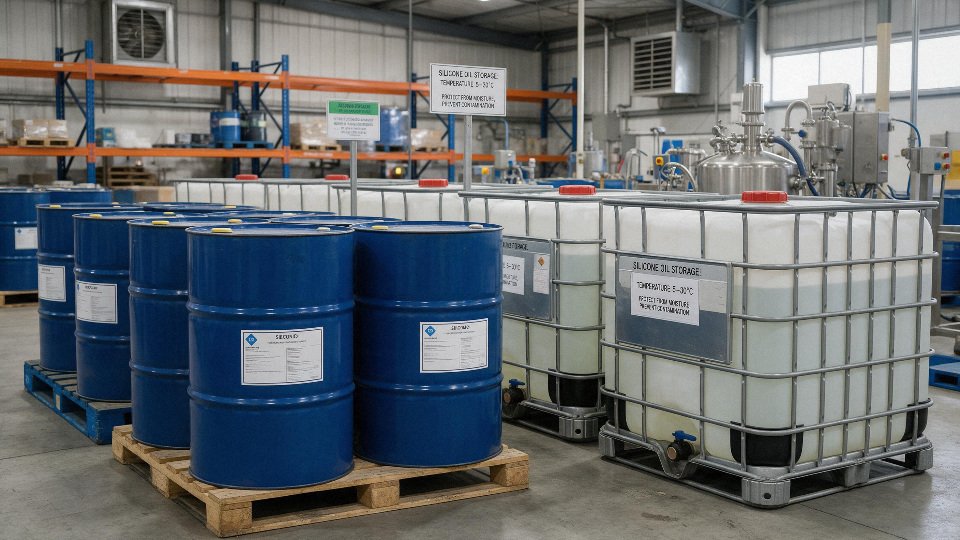
Silicone oil in a sealed, opaque container — HDPE or lined steel, away from UV — is stable for 10 years or more. There are no additive packages to precipitate, no antioxidants to deplete sitting on a shelf. Mineral hydraulic oil is a different story: the antiwear and antioxidant additives can precipitate or degrade within 3–5 years even in good storage conditions, and the timeline shortens if the drum breathes through temperature cycling (condensation introduces water). Store hydraulic oil horizontally if drums won’t be used within 18 months, and rotate stock.
Can silicone oil and hydraulic oil be mixed accidentally?
They are immiscible — they will not blend, they will phase-separate, and foam control additives in the mineral oil will be deactivated by even trace silicone contamination. Field experience suggests as little as 1% silicone in a mineral oil system is enough to collapse the foam inhibitor package and cause persistent aeration. If cross-contamination is suspected, the correct response is a complete flush with a dedicated flushing oil (compatible with the intended service fluid), followed by particle count verification per ISO 4406 and visual check for phase separation in a sample jar before returning the system to service. Skipping the particle count is how this kind of mistake gets repeated twice.