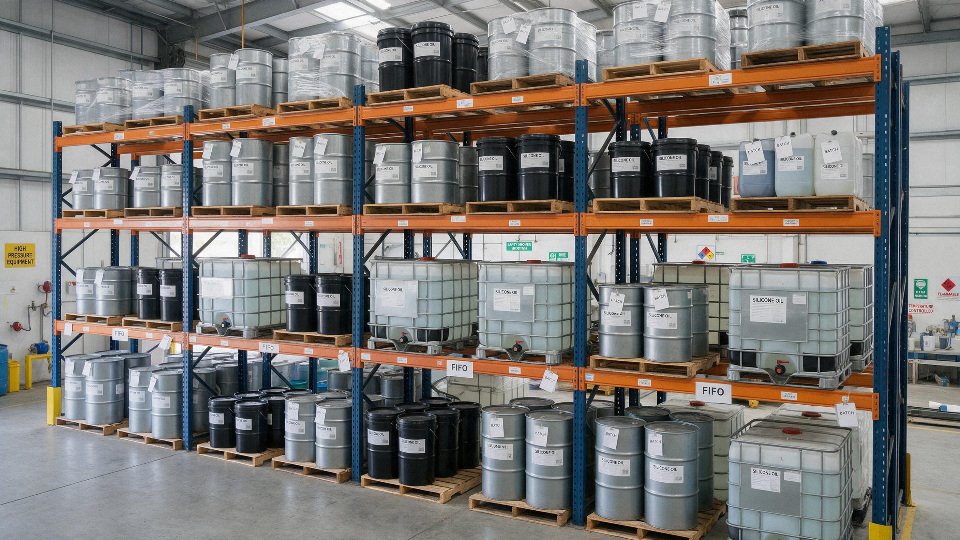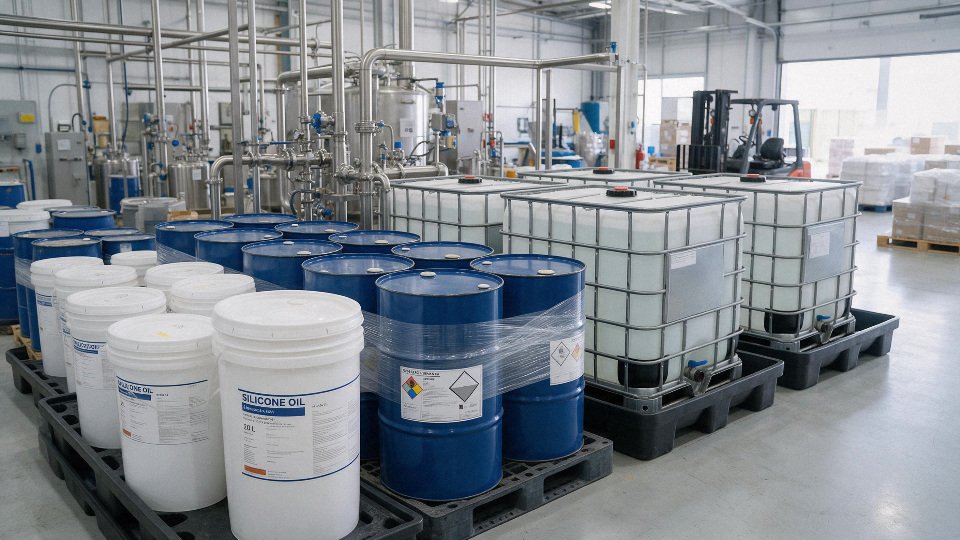

Silicone oil that drifts even a little off target stops behaving like the material your process was qualified around. Pumps meter differently, coat weights move, release performance shifts, deaeration changes, and the line starts compensating with temperature, pressure, or operator habit instead of control. That usually shows up as slower throughput, more rework, unstable downstream quality, and a procurement problem nobody wanted: paying for a nominal grade that now costs extra labor, scrap, and customer risk to make usable.
Manufacturers control silicone oil viscosity by controlling polymer chain length, molecular weight distribution, and dilution conditions, then confirming the result with temperature-defined viscosity testing, usually at 25 C and often compared across 25 C to 100 C. In commercial production, the practical target is not one magic number but a repeatable grade within an agreed batch tolerance, commonly around plus or minus 5 percent to plus or minus 10 percent depending on the viscosity range and application.
What matters is that the same viscosity number can come from very different manufacturing routes and very different production discipline. A low-viscosity fluid, a heavily diluted system, and a very high-viscosity gum each fail control in different ways, and the fix is not always in the reactor. Sometimes the real answer sits in heat history, stripping, blending sequence, test temperature control, or simply whether the buyer specified the application tightly enough for the supplier to hold the right window.

Molecular drivers of viscosity
At the simplest level, silicone oil gets thicker as the siloxane chains get longer, but buyers should not accept “molecular weight” as a complete explanation. For most commercial silicone fluids, final viscosity is set by a combination of average chain length, molecular weight distribution, end-group chemistry, residual low boilers, and whether the fluid remains truly linear and uniform rather than partly branched or micro-gelled. That is why two suppliers can both quote, say, 350 cSt at 25 C and still deliver noticeably different processing behavior.
Chain length and molecular weight: the first lever, not the only one
In standard polydimethylsiloxane-type fluids, increasing the degree of polymerization raises kinematic viscosity because longer chains entangle more and move less freely past one another. That part is basic polymer physics. On the plant floor, though, what matters is not just the target average chain length; it is how tightly the batch sits around that target.
A narrow molecular weight distribution usually gives more predictable viscosity control, cleaner batch-to-batch behavior, and fewer surprises in pumping, blending, or final application. A broad distribution can still hit the nominal viscosity spec, but it often does so with a different internal composition:
- More low-molecular-weight fraction can reduce flash point, increase volatility, and change wetting or spread
- More high-molecular-weight tail can increase stringiness, foam persistence, carryover on rolls, or residue on parts
- A wide distribution can mask instability, where the batch measures in-spec at release but shifts in storage or after stripping
Here is the mechanism buyers often miss: viscosity in polymeric fluids is not a simple arithmetic average property. A relatively small high-molecular-weight fraction can pull viscosity upward disproportionately, while a modest low-boiling fraction can drag it back down. The supplier may still land inside the agreed band, often something like ±5% to ±10% depending on grade, yet the fluid can behave differently during dosing, coating, or defoamer incorporation.
That becomes commercially relevant in three situations:
- Tight metering systems
Gear pumps, mass-flow dosing, and small-orifice applicators notice subtle differences in flow stability. - Surface-sensitive uses
Release coatings, textile finishing, and personal-care intermediates can show differences in leveling and hand feel. Heat-exposed service
If the “same viscosity” fluid contains more volatile fraction, it may thin, evaporate, or drift in service faster.
So yes, average molecular weight is the main lever. It stops being a sufficient buying criterion once the application is sensitive to volatility, residue, or flow consistency.
Cyclic-linear equilibrium in PDMS systems
For many polydimethylsiloxane fluids, especially those made through equilibration routes, final viscosity is tied to the balance between cyclic siloxanes and linear chains. This is not just a synthesis detail; it directly affects what the buyer receives.
In an equilibration process, cyclic siloxanes and linear siloxane chains interconvert in the presence of catalyst until the system approaches an equilibrium distribution. End-blockers, commonly trimethylsiloxy species in non-reactive fluids, limit how far chains can grow. By adjusting the ratio of cyclic feed to end-blocker, the producer steers the average chain length and therefore the viscosity grade.
That sounds tidy on paper. In practice, three things complicate it:
- Equilibrium does not guarantee a single clean molecular species; it produces a distribution
- Catalyst efficiency, water traces, temperature profile, and residence time all affect where the batch settles
- Post-reaction stripping determines how much residual cyclic content remains in the finished oil
The mechanism matters because residual cyclics act as internal diluents. They lower measured viscosity and can shift other properties at the same time, especially volatility and odor. If stripping is too aggressive, yield drops and cost rises; if it is too light, the batch may meet viscosity at release but carry too much volatile material for the end use. This is a classic manufacturing trade-off: tighter low-boiler removal improves product robustness, but it costs time, energy, vacuum capacity, and sometimes throughput.
Residual cyclic siloxanes can lower measured viscosity without indicating better polymerization control.True
Low-molecular-weight cyclics act as low-viscosity components in the fluid. A batch can read on target in cSt while still containing more volatile fraction than a buyer expects, so viscosity alone does not fully define composition quality.
End groups and functional groups change more than reactivity
Two silicone oils with similar backbone length can differ materially because the chain ends and side groups change intermolecular interactions.
Trimethylsiloxy end-blocked fluids
These are the standard non-reactive silicone oils in many industrial applications. Trimethylsiloxy end-blocking reduces further condensation tendency and keeps the fluid comparatively inert. Flow behavior is usually cleaner and more stable because the chain ends do not strongly hydrogen-bond or readily continue reacting under normal storage.
For buyers, this usually means:
– Better storage stability
– Lower risk of viscosity drift from post-reaction condensation
– More predictable release and lubrication behavior
Hydroxyl-terminated fluids
Hydroxyl ends increase polarity and allow hydrogen bonding. Even before any curing chemistry is considered, that can raise apparent cohesion and affect how the fluid wets, flows, and interacts with fillers or substrates. These materials can also continue condensing if moisture, catalyst residue, or heat is present.
That means a hydroxyl-terminated fluid with a given nominal viscosity may:
– Show stronger interaction with mineral fillers
– Drift upward in viscosity during storage if not stabilized properly
– Behave differently in thin-film application than a trimethylsiloxy-capped fluid of similar cSt
Alkoxy-terminated fluids
Alkoxy functionality introduces moisture-reactive behavior and can change polarity. These fluids are often selected for downstream curing systems rather than as simple inert oils. Their measured viscosity reflects both chain length and the specific terminal chemistry, and storage conditions matter more.
A procurement team should not substitute alkoxy-terminated and trimethylsiloxy end-blocked fluids based only on viscosity grade. On paper the numbers may align; in production the line may not.
Amino-modified, phenyl-modified, and other functional silicones
Amino modification tends to increase intermolecular attraction and substrate affinity. In textiles, polishes, or specialty additives, that can be useful. It can also change shear response, emulsion behavior, and compatibility with organic components.
Phenyl content often improves low-temperature behavior and can alter refractive index and thermal characteristics. Depending on substitution level and structure, it may also change how the fluid flows and solvates other materials.
Other modifications, including polyether, epoxy, fluoro, or long alkyl groups, affect viscosity through a mix of backbone mobility, side-group bulk, polarity, and compatibility. Once you move beyond plain PDMS, viscosity is no longer interpretable as “just chain length.”
Branching, slight crosslinking, and micro-gel: where trouble starts
A linear silicone fluid can tolerate some compositional variation. Once branching or slight crosslinking appears, viscosity can rise sharply and nonlinearly. Worse, the batch may become less uniform even if the reported single-point viscosity still looks acceptable.
This happens because branched structures occupy space differently and restrict chain mobility. A small amount of branching can increase resistance to flow more than a buyer would expect from average molecular weight alone. If localized condensation or side reactions create micro-gel particles, the fluid may show haze, filtration issues, unstable pumping, or poor leveling.
Typical warning signs include:
- Viscosity higher than expected relative to molecular targets
- Broad or unstable QC readings between repeated measurements
- Poor screen or filter passage
- Stringy discharge during filling
- Residue, specks, or fish-eyes in coating applications
The trade-off here is uncomfortable for manufacturers: pushing reaction conversion hard can improve yield or reduce low-molecular-weight content, but if catalyst control, dryness, or hold time slips, the process can move from clean chain extension into branching or pre-gel formation. Once that starts, rework options are limited. Blending down with lower-viscosity fluid may rescue the cSt number, but it does not remove gel particles or restore true compositional uniformity.
Volatile fractions and dissolved gases affect the number you measure
Measured viscosity is only as good as the sample condition. Residual monomers, cyclic siloxanes, other low-boiling fractions, and even dissolved gas can shift the result enough to matter near a release limit.
The main effects are straightforward:
- Low-boiling fractions reduce measured viscosity by acting as thinner components
- Residual volatiles can continue evaporating during storage, heating, or use, causing later viscosity drift
- Dissolved air or process gas can interfere with some measurement methods and sample consistency
- Temperature mismatch during testing can swamp small compositional differences, which is why viscosity grades are typically referenced at 25 C and often characterized up to 100 C for comparison
In practice, poor sample conditioning causes a lot of false arguments between supplier and buyer. A drum sampled cold in winter, then tested before thermal equilibration, can read “wrong” without the chemistry being wrong. The same goes for a batch pulled after aggressive recirculation with entrained air. If a fluid is close to the spec edge, these handling details matter.
Same nominal viscosity does not mean same behavior
This is the point technical buyers should keep in the front of the file: two silicone oils with the same nominal viscosity can differ in shear response, volatility, wetting, storage stability, and application feel because viscosity is a single measured outcome, not a full compositional fingerprint.
A 1000 cSt silicone fluid can arrive at that value by different internal routes:
- Narrow-distribution linear PDMS with low volatiles
- Broader-distribution fluid with more light ends and a heavier high-MW tail
- Functional silicone with stronger intermolecular interactions
- Slightly branched material blended to target viscosity
All may pass a simple viscosity check. They will not necessarily perform the same in a textile bath, release coating, defoamer concentrate, vacuum pump fluid, or cosmetic intermediate. The conclusion holds well for standard industrial buying: viscosity grade is necessary, but not sufficient. It stops holding only if the application is truly insensitive to anything beyond bulk flow at the test temperature, which is rarer than purchasing teams sometimes assume.
If a supplier claims unusually precise viscosity control, the right follow-up question is not just “what cSt can you hold?” Ask what chemistry platform they use, how they manage cyclic removal, what end-group structure they are supplying, and whether the product is a straightforward linear fluid or a modified silicone with different interaction behavior. That is where the useful truth usually sits.
Manufacturing control methods
A silicone oil plant does not “dial in” viscosity with one magic setting. It gets there by controlling a chain of variables that all push molecular weight distribution in one direction or another: feed purity, catalyst activity, reaction severity, end-capping efficiency, volatile removal, and finally blending discipline. If any one of those drifts, the batch may still look clear and clean but miss grade, especially in the middle-viscosity and high-viscosity ranges where small shifts in chain length show up quickly in cSt.
What matters on the factory side is not just reaching target viscosity once. The harder job is making batches land in the same agreed band, often something like ±5% to ±10% depending on grade, without creating avoidable rework, yield loss, or unstable inventory between adjacent grades.
Feedstock selection: where viscosity variation usually starts
Most viscosity problems begin before the reactor is charged. Silicone oil viscosity is highly sensitive to the balance between cyclic siloxanes, linear intermediates, end-cappers, catalysts, and any modifiers in the recipe. Incoming variability in any of those streams changes how far the equilibrium shifts and how broad the final molecular weight distribution becomes.
In practice, the feedstock checks that matter most are:
- Cyclic siloxane composition
- The ratio of different cyclics affects reactivity and redistribution behavior.
- Purity matters because non-target cyclics, residual acids, water, or unknown organics can alter catalyst response.
- A supplier may quote acceptable purity, but what matters in production is lot-to-lot consistency, not one COA from one drum.
- Linear intermediates or prepolymers
- If the process uses linear siloxane intermediates, their existing chain length distribution carries forward into the final batch.
- Broad or drifting intermediate quality makes tight final viscosity control harder, even when the downstream process is stable.
- End-cappers
- End-cappers are not just additives; they are one of the primary tools for limiting molecular growth.
- Purity, exact functionality, and water content all matter. If the end-capper is weak, contaminated, or underdosed, chains continue growing and viscosity creeps high.
- Catalysts
- Catalyst strength and cleanliness strongly affect how fast the system approaches equilibrium.
- A catalyst that is nominally the same chemistry but different in activity from supplier to supplier can shift the whole operating window.
- Modifiers and specialty components
- Functional modifiers, branching agents, or compatibility aids can change viscosity directly or alter the reaction path.
- These are usually where process transfer from lab to plant gets messy, because their effect is often nonlinear at production scale.
A common purchasing mistake is to treat all raw-material substitutions as commercial equivalents. They are not. A cheaper cyclic stream with slightly higher low-boiler or impurity content may save on invoice cost and then quietly show up as extra finishing load, wider blending corrections, and more off-spec hold tanks.
Equilibrium polymerization and redistribution: the main production lever
For many silicone oils, the core manufacturing step is an equilibrium polymerization or chain redistribution process. The plant is controlling not only average chain length but how broadly chains are distributed around that average. That is why operators watch several variables together rather than chasing one setpoint.
The practical levers are:
- Catalyst strength and dosage
- Higher catalyst activity usually accelerates equilibration.
- Too little catalyst can leave the batch under-converted or slow to stabilize.
- Too much can overshoot, promote side reactions, or create a batch that is hard to stop cleanly at the target grade.
- Temperature
- Higher temperature generally increases reaction rate and helps the system approach equilibrium faster.
- It can also increase volatilization, stress certain modifiers, or widen the consequences of poor heat removal.
- The preferred temperature range depends on catalyst system and product family, so this must be verified against the specific process rather than generalized.
- Residence time
- Time is not just “more is better.” Once near equilibrium, additional hold time may offer little gain and may even increase variability if side reactions start to matter.
- In batch plants, delayed sampling or shift-change holdovers can move viscosity enough to matter, especially on lower and medium grades.
- Agitation
- Agitation is often underestimated because the liquid looks uniform. It is still needed to distribute catalyst, equalize temperature, and expose the whole batch to the same reaction environment.
- Weak mixing in a viscous batch can create local hot spots or uneven catalyst contact, which broadens batch variability.
- Mass transfer and reactor condition
- Heat-transfer surface condition, baffle geometry, impeller condition, and fill level all affect how predictably the reactor runs.
- A fouled jacket or coated internal coil can shift the effective temperature profile enough to alter viscosity outcome from one campaign to the next.
Here the mechanism is straightforward: catalyst, temperature, and time govern how quickly siloxane chains break and reform toward equilibrium; mixing and heat transfer determine whether the whole mass sees the same conditions. If the reactor is not homogeneous, one part of the batch effectively “sees” a different process recipe than another.
The trade-off is speed versus controllability. Plants can often shorten cycle time by running hotter or with stronger catalyst, but the operating window narrows. That strategy may work on high-volume standard grades with disciplined raw materials and strong controls; it becomes risky on specialty grades, highly viscous products, or any campaign where modifier sensitivity is high.
Chain stopping and end-capping: how manufacturers prevent viscosity drift
Once the batch approaches the target molecular range, the process has to stop chain growth in a controlled way. This is where end-capping strategy earns its keep. The objective is not only to hit target viscosity at sampling, but to lock the fluid into a stable grade so it does not keep changing during finishing or storage.
Typical controls include:
- Stoichiometric control of end-capper addition
- Metering accuracy matters. Small ratio errors become larger viscosity errors at low and medium chain lengths.
- Plants that rely on manual additions for critical end-capping steps usually see more batch scatter than those using validated metering systems.
- Addition timing
- Early addition limits growth but can suppress the desired build.
- Late addition may allow viscosity overshoot that cannot be corrected without blending or rework.
- Post-addition hold
- The batch usually needs enough time and mixing for full distribution and reaction of the end-capper.
- Incomplete end-capping leaves residual reactive sites that can continue redistributing.
- Catalyst neutralization or deactivation
- Depending on the system, stopping the reaction may require neutralization, quench, adsorption, or another deactivation method.
- If this step is incomplete, viscosity can drift after the reactor, which is one of the more frustrating failure modes in production because the in-reactor sample may have looked fine.
The boundary here is simple: end-capping and quench logic work well only if the upstream reaction is already close to the intended distribution. They are not a cure-all for poor feed consistency or an unstable reactor.
Devolatilization and vacuum finishing: removing the low boilers that distort grade
Vacuum finishing is often the difference between a product that merely reaches nominal viscosity and one that stays there from batch to batch. Low boilers, residual cyclics, and other volatiles depress measured viscosity and can make a batch appear on-grade before finishing, then drift after proper stripping.
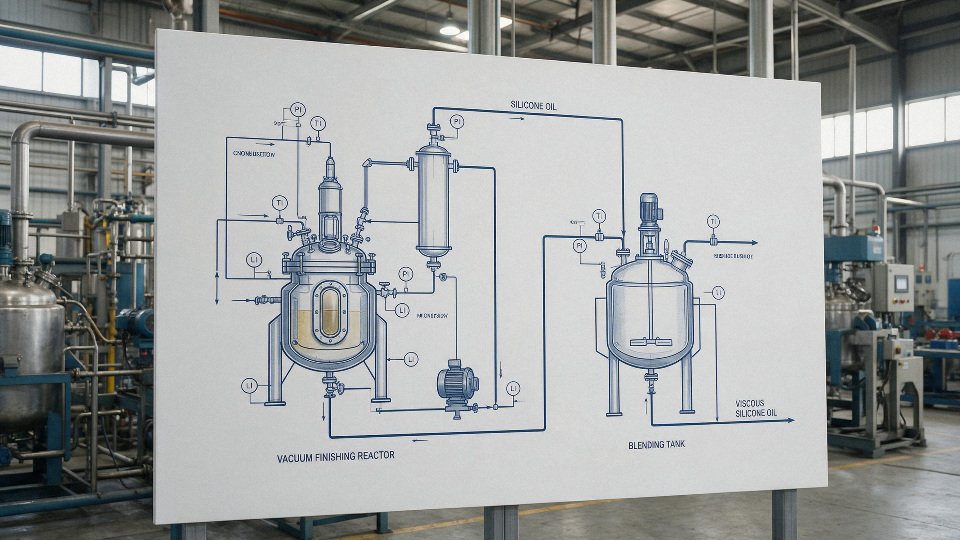
The main finishing methods are:
- Thermal stripping under vacuum
- Used to remove low-boiling siloxanes and residual volatile fractions.
- Vacuum level, temperature, and hold time interact. Stronger stripping removes more low boilers but can increase cycle time, energy use, and risk of overprocessing sensitive products.
- Thin-film or wiped-film style finishing in some plants
- Useful where efficient volatile removal is needed with controlled residence time.
- Equipment choice depends on viscosity range and throughput; this is not universal across all silicone oil plants.
- Gas sweep or assisted devolatilization in selected setups
- Sometimes used to improve volatile removal efficiency.
- Effectiveness depends heavily on equipment design and is not something to assume without plant-specific data.
The mechanism matters here: remove low-molecular-weight fractions and the remaining fluid shifts upward in average molecular weight and often narrows into a more stable apparent grade. A batch that is viscosity-correct before stripping but low in solids balance is usually not truly under control; it is unfinished.
The trade-off is yield versus grade tightness. Aggressive stripping improves consistency and reduces residual volatile content, but every plant has to watch product loss, utility cost, and throughput. The preferred point flips if the buyer places high weight on volatile limits and stable use performance rather than lowest possible manufacturing cost.
Blending to exact window: standard practice, but only with rules
Blending is a legitimate control method in silicone oil manufacturing. It is usually the last fine adjustment step, not the primary way a competent plant compensates for a bad process. Good plants build grades close by reaction and finishing, then use blending to land inside the agreed window reproducibly.
Common blending strategies include:
| Blending approach | Typical use | Main risk |
|---|---|---|
| Adjacent-grade blending | Fine correction when one batch lands slightly high or low | Inventory complexity and cumulative drift if overused |
| High-viscosity concentrate plus low-viscosity cut | Efficient for broad product portfolios | Poor homogeneity if mixing time is too short at high viscosity |
| Blend-back of retained off-spec material under controlled rules | Yield recovery | Quality dilution if traceability and compatibility are weak |
The practical requirements are not complicated, but they must be enforced:
- Use validated blending curves or prior plant data, not simple linear assumptions where nonlinearity is known.
- Control temperature during blending because apparent viscosity shifts with temperature.
- Mix long enough for full homogeneity, especially above moderate viscosity.
- Keep blend components traceable by lot.
- Set rules for maximum reblend frequency so inventory quality does not slowly drift.
Manufacturers can always correct any silicone oil viscosity deviation by blending.False
Blending is useful for fine adjustment, but large deviations may indicate wrong molecular distribution, excessive volatiles, contamination, or incomplete end-capping. Those issues are not always fixed by blending alone and can create downstream performance differences even if final viscosity appears acceptable.
Contamination, moisture, and cleanliness: the quiet causes of bad batches
Some of the ugliest viscosity problems come from basic housekeeping failures rather than chemistry mistakes. Moisture ingress, dirty transfer lines, residual catalyst from a prior campaign, rust fines, elastomer extractables, or partial gel from stagnant hold-up can all interfere with polymerization and finishing.
The checklist that usually prevents trouble is short:
- Dry raw materials and dry nitrogen where the process requires it.
- Verify reactor, line, and filter cleanliness between campaigns.
- Control dead legs and low-flow pockets where old material can sit.
- Inspect seals, hoses, and pump materials for compatibility.
- Watch for seasonal humidity effects if the plant is not tightly enclosed.
- Remove micro-gel or insoluble contamination before final packaging where the process design calls for filtration.
In my experience, plants often look first at catalyst or recipe when viscosity suddenly starts wandering. Fair enough. But if two or three batches in a row drift unpredictably, I would inspect moisture control, line clearance, and reactor cleanliness before rewriting the formulation. That is where a lot of “mysterious” viscosity variation actually comes from.
Process variables and tradeoffs
A silicone oil plant can usually hit a target viscosity by more than one route, but those routes do not behave the same in production or in the customer’s tank. The variables that matter most are reaction temperature, residence time, catalyst system, neutralization quality, and whether the product is made in batch or continuous mode; the tradeoff is that pushing any one of them for speed or cost tends to show up somewhere else as color, volatility, broader molecular distribution, residue risk, or poorer stability over time.
Reaction temperature is the first big lever because it affects both how fast siloxane chains redistribute and where the practical operating window sits. Higher temperature usually speeds equilibration, so the reactor turns faster and the same vessel makes more saleable volume per week. That sounds attractive to production, but heat also accelerates side pathways: color bodies build faster, low-boiling cyclics can shift, and some catalyst systems become harder to stop cleanly. On the floor, that often shows up as a grade that meets viscosity at discharge but needs extra stripping, extra polishing, or a tighter hold before release.
The mechanism is straightforward enough. As temperature rises, the redistribution reaction rate increases, so the system reaches a target average chain length more quickly. But the same thermal energy also increases the rate of unwanted reactions and can change the relative population of chain lengths and cyclic by-products, especially if feed dryness, catalyst dosage, or neutralization timing is not tight. A fast reactor is not automatically a stable process if the extra temperature also creates more material that has to be removed or quenched later.
A few practical temperature effects matter to buyers and process engineers:
- Chain redistribution speed: higher temperature reduces cycle time and can improve reactor utilization.
- Equilibrium behavior in practice: while the chemistry trends toward equilibrium, the usable product window depends on how fast the plant can stop the reaction and remove volatiles.
- Color development: hotter runs often darken faster, which matters for cosmetic, coating, and electronics-related applications where water-clear appearance is expected.
- Side-product formation: low boilers and other by-products can increase rework load and complicate final stabilization.
- Utility and hardware load: hotter operation may demand better condenser duty, tighter vent handling, and more stable temperature control than an older plant actually has.
Residence time is the second major variable, and this is where good plants separate themselves from merely adequate ones. Too short a hold can leave under-reacted material, which may not fully show up in a single viscosity check if the batch is still moving toward equilibrium. Too long a hold creates its own trouble: broader molecular distribution, avoidable thermal history, and in some systems a higher tendency toward gel particles or haze, especially if contamination or local hot spots are present.
In practice, residence time control is not just “leave it longer.” It depends on:
- Feed consistency
- Small shifts in cyclic content, end-blocker ratio, moisture, or trace acidity change how quickly the batch moves.
- A plant using mixed feed tanks without tight segregation will see more batch-to-batch correction.
- Mixing quality
- Poor agitation creates local zones with different catalyst concentration or temperature.
- That can produce a batch that samples well at one valve and still behaves unevenly in filtration or packaging.
- End-point definition
- Some manufacturers stop on a single viscosity reading.
- Better control usually combines viscosity trend, time-at-temperature, and sometimes volatile or residual-spec checks, depending on grade.
- Quench or neutralization timing
- If the reaction keeps drifting while the batch is cooling, the “true” final viscosity may not match the hot sample result.
Catalyst choice and neutralization strategy are where chemistry, maintenance, and product stability collide. A very active catalyst can shorten batch time and improve throughput, but it also raises the penalty for sloppy quench control. Residual catalyst left in the oil may continue to shift the molecular distribution during storage or elevated transport conditions. That is one reason the cheapest route to an in-spec viscosity at the plant gate is not always the cheapest route for the customer six weeks later.
Typical tradeoffs around catalyst systems look like this:
| Variable | What you gain | What you risk |
|---|---|---|
| More active catalyst | Shorter reaction time, better vessel productivity | Harder end-point control, greater residual-catalyst sensitivity |
| Lower catalyst dosage | Easier neutralization, less residue burden | Slower conversion, longer occupancy, more variable completion |
| Aggressive neutralization | Better reaction stop, improved storage stability | Salt formation, filtration load, possible corrosion if water handling is poor |
| Minimal neutralization | Lower immediate processing cost | Post-reaction drift, long-term instability, customer-side formulation problems |
Corrosion risk is not theoretical. Residual acidic or basic species, especially combined with moisture and heat, can attack certain transfer lines, pump seals, and storage hardware over time. Plants that have learned this the expensive way usually become very disciplined about neutralization completeness, wash or polish steps where applicable, and final residue checks. The conclusion here holds until you move into very specialized formulations where catalyst residue is intentionally managed for downstream reactivity; for standard silicone oil grades, residual activity is usually a liability, not an asset.
Batch and continuous production each have a place. Batch systems are more responsive when the grade slate changes often, when customers order many viscosity points, or when feedstock variability is a fact of life. They also make traceability easier at the lot level; if a single batch drifts, you quarantine one vessel, not half a campaign. Continuous systems generally win on statistical consistency once they are tuned, because residence time distribution, feed control, and thermal profile can be held steadier over long runs. The catch is responsiveness: a feed upset in continuous mode can affect a lot of material before lab data catches up, and grade changes require disciplined transition management.
Tight viscosity windows cost money, especially at the ends of the range. Very low-viscosity grades are sensitive to low-boiler balance and contamination; very high-viscosity grades are harder to mix, sample, devolatilize, and sometimes filter. That means more in-process checks, more finishing time, more careful temperature control, and often a higher chance of rework. A routine commercial tolerance band might be around ±5% to ±10% depending on grade, but the narrower the agreed window, the more the supplier must spend on hold time, analytical confirmation, line clearance, and sometimes segregated packaging.
The lowest-cost manufacturing route to a target viscosity is often not the most stable route over storage and downstream use.True
A process can meet initial viscosity at packaging yet leave residual catalyst, broader molecular distribution, or more volatile content that shifts behavior during storage, transport heat exposure, or customer formulation. Stability depends on more than the release number.
That last point matters more than many buyers expect. If the oil will sit in drums through a hot summer, be blended with solvents or additives, or feed a customer process with tight wetting or release performance, initial viscosity alone is not enough. You need to know how the supplier controls residual reactivity, volatile balance, and batch-to-batch spread under the conditions the product will actually see after it leaves the plant.
Measurement and quality assurance
A viscosity number is only as credible as the way the sample was conditioned, measured, and documented. For silicone oils, a supplier worth taking seriously should be able to show not just a result, but the test method, test temperature, instrument control, supporting release data, and the trail that links that number back to the batch and retained sample.
The practical issue is simple: silicone oils cover an unusually wide viscosity range, from low-cSt fluids that behave almost like light solvents to very high-viscosity materials that handle more like syrup or soft gum. One method does not suit the whole range, and a single viscosity value without temperature, method, and tolerance tells a buyer less than many people assume.
Which viscosity measurement methods are actually used?
For most standard silicone oil grades sold by kinematic viscosity, capillary methods remain the backbone because they measure a property buyers commonly specify and compare. Rotational methods are used where the fluid is too viscous, too slow-flowing, or otherwise impractical for capillary timing, or where process handling behavior matters as much as the nominal kinematic grade.
Capillary methods for kinematic viscosity
In routine silicone-oil QC, capillary viscometers are widely used for low-to-medium and, with the right setup, some higher viscosity grades. The principle is straightforward: measure the time required for a conditioned volume of liquid to pass between marks under gravity at a controlled temperature, then convert using the viscometer constant.
What matters on the plant floor is not the textbook principle but the execution:
- Method fit to grade
- Low and medium grades are usually the easiest to run by capillary method.
- As viscosity rises, flow time becomes long and operator handling gets less forgiving.
- Very high viscosity grades may require dilution methods, alternative setups, or a shift to rotational measurement, depending on the supplier’s validated procedure.
- Temperature setpoint
- Silicone oil viscosity is commonly reported at 25 C, and many suppliers also characterize behavior up to 100 C for process comparison.
- A result reported without the test temperature is incomplete.
- Flow timing discipline
- Meniscus reading, timing start/stop consistency, and bath stability all affect repeatability.
- For narrow-tolerance grades, small operator differences can push a result from pass to borderline.
Rotational methods where appropriate
Rotational viscometers are typically used when:
- The product is too viscous for practical capillary flow timing
- The buyer needs an apparent viscosity under defined shear conditions
- Processability in pumping, coating, metering, or filling is the main concern
These instruments measure resistance to spindle rotation in the liquid. That is useful, but buyers should read the number carefully because rotational viscosity depends on test conditions more explicitly than kinematic viscosity does.
A credible rotational viscosity report should state:
- Instrument type or method reference
- Spindle geometry
- Rotation speed
- Test temperature
- Sample conditioning
- Whether the value is a single-point apparent viscosity or part of a shear-rate profile
The trade-off is clear enough. Capillary methods are usually better for standardized comparison of Newtonian silicone oils; rotational methods are more practical for difficult high-viscosity materials and process simulation. That preference flips when the fluid shows handling issues at production scale that gravity-flow methods do not represent well.
Why do temperature control and sample handling matter so much?
A one-degree mistake will not ruin every test, but it can materially shift reported viscosity, especially when buyers are working to release limits such as plus or minus 5 percent to plus or minus 10 percent, depending on grade. In practice, many viscosity disputes trace back to sample condition rather than to chemistry.
The main handling controls are usually these:
- Thermal equilibration
- The sample must reach the test temperature fully, not just sit near the bath for a token few minutes.
- High-viscosity silicone oils need longer equilibration because the center of the sample lags.
- Degassing
- Entrained air from filling, pumping, or shipping can disturb flow timing and rotational readings.
- This is common after drum transfer, tote recirculation, or vigorous lab pouring.
- Moisture and contamination control
- Silicone fluids are generally robust, but open handling can still introduce moisture, dust, cleaning-solvent carryover, or traces from sampling valves.
- A dirty thief sampler or a wet glass bottle has spoiled many “supplier problem” investigations.
- Sample homogeneity
- If the product contains a broad molecular distribution or has seen cold storage, the sample may need gentle mixing before aliquoting.
- Overmixing can introduce bubbles; under-mixing can bias the test.
- Container effects
- Residues from previous products, liner extractables, or even a poor bottle cap can interfere with sensitive grades.
If the supplier cannot describe how samples are conditioned before test, the viscosity result is not fully auditable. That matters most in regulated applications, qualification lots, and any line where a few percent drift changes coating weight, release behavior, or dosing accuracy.
How do manufacturers keep viscosity data trustworthy?
Trustworthy data comes from layered control, not from owning an expensive instrument. A decent lab with disciplined verification will often outperform a better-equipped lab with loose habits.
The core controls usually include:
- Calibration and instrument verification
- Use of certified or traceable reference fluids across the expected measurement range
- Scheduled verification of viscometer constants, timing devices, bath temperature accuracy, and rotational torque response
- Defined acceptance criteria after maintenance or relocation
- Reference fluid checks in routine use
- Daily or shift-based checks help catch drift before batch release data is affected.
- This is especially useful in plants where ambient temperature swings or vibration can affect benches and baths.
- Inter-laboratory correlation
- Comparison between plant QC, central lab, and sometimes external lab results
- Side-by-side testing during method transfer, new instrument installation, or customer dispute investigation
- Method standardization
- Controlled SOPs for conditioning time, degassing approach, replicate count, and result rounding
- Clear rule for what to do when duplicate tests disagree
A single viscosity number without method and temperature is sufficient for procurement.False
For silicone oils, the reported value must be tied to a defined test method and temperature, and often to sample conditioning rules as well. Without that context, cross-supplier comparison is weak and dispute resolution becomes difficult.
The mechanism here is operational, not abstract. If reference checks drift and nobody catches it, off-target batches may be released or good batches may be held unnecessarily. One path creates customer variability; the other creates avoidable inventory and retest cost.
What other release tests support viscosity interpretation?
Viscosity rarely stands alone in a serious release decision. Supporting tests help confirm whether a viscosity shift reflects normal batch variation, residual volatile carryover, contamination, incomplete finishing, or a broader molecular-distribution issue.
Typical companion tests include:
- Volatile content
- Helps identify residual low-boiling components that can depress viscosity or affect use stability
- Moisture
- Relevant where hydrolysis sensitivity, packaging integrity, or downstream formulation behavior matters
- Acid or alkali residue
- Useful after catalyzed manufacture or neutralization steps; residue can signal incomplete finishing or risk to downstream systems
- Refractive index
- A quick identity and consistency check, often more useful than people give it credit for
- Density
- Supports material identity and can help detect composition drift
- Appearance
- Clarity, haze, visible particles, or phase issues often flag handling or finishing problems early
- Color
- Important for some end uses and helpful as an aging or contamination indicator
- Molecular distribution indicators
- Where available, these give deeper evidence that the viscosity target was reached by controlled polymer distribution rather than by a blunt correction step
A buyer should not assume every supplier runs every one of these on every batch. That depends on product family, application criticality, and internal control plan. For a performance-critical grade, though, viscosity release unsupported by any adjacent checks is thin QA.
How is batch consistency monitored over time?
Batch release tells you whether one lot passed. Statistical process control tells you whether the process is staying healthy. Good manufacturers use both.
Common controls include:
- Control charts for viscosity and key supporting properties
- Trend analysis by reactor, line, catalyst campaign, or raw material lot
- Alert limits tighter than final specification limits
- Retained samples for complaint review and aging comparison
- Root-cause review when drift, step changes, or wider scatter appear
This matters because a process can remain technically “in spec” while quietly moving toward the edge. A buyer qualifying a long-term source wants evidence of centering, not just occasional passing data. The main boundary here is volume and product complexity: a small custom campaign may not have deep SPC history, so retained samples, release records, and method discipline become even more important.
What should buyers expect in documents and change control?
On a certificate of analysis, buyers should expect at minimum:
- Product name and batch/lot number
- Tested viscosity result
- Test temperature
- Test method or internal method reference
- Specification range or agreed tolerance band
- Date of test or release
- Related release results where contractually relevant
On a technical data sheet, expect:
- Nominal viscosity grade
- Typical physical properties, with test temperatures clearly stated
- Usable viscosity range presentation where relevant, often anchored at 25 C and sometimes characterized up to 100 C
- Statement that typical values are not batch-specific release values
For change-control notification, viscosity-critical buyers should expect advance notice of changes that may affect viscosity consistency or interpretation, including:
- Raw material source changes
- Reaction route or finishing changes
- Method changes in viscosity measurement
- Packaging changes that may affect contamination or moisture pickup
- Plant transfer, equipment replacement, or major maintenance affecting process behavior
If a silicone oil is going into a regulated product, validated process, or customer-qualified formulation, ask early whether the supplier supports formal change notification and how much notice they can commit to in the supply agreement.
Common viscosity control failures
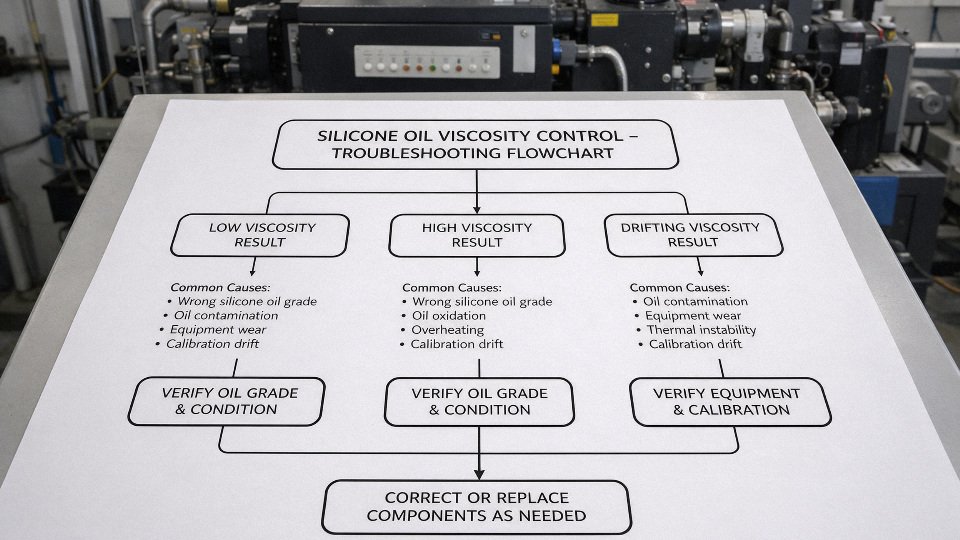
Most viscosity-control failures fall into five buckets: the batch is genuinely too thin, genuinely too thick, inconsistent from batch to batch, drifting after packaging, or only appears off because the test itself is wrong. On a plant floor, the expensive mistake is treating all five the same way; good manufacturers separate measurement error from process deviation before they touch the reactor recipe, stripping cycle, or blend plan.
A viscosity number can move for very different physical reasons. A low result may mean too many short-chain species are still present, while a high result may come from unintended chain extension or branching. The symptom is one number, but the correction path is not interchangeable.
Off-spec low viscosity: what usually caused it
Low viscosity is usually traced to too much low-molecular-weight material in the finished oil, not some mysterious “weak batch.” In practice, the common causes are excess low-boiling fractions left after stripping, incomplete equilibration, wrong blend ratio, or accidental dilution from a feedstock, transfer line, or reused tote that was not as clean as someone thought.
Typical root causes include:
- Excess low-boiling fractions
- Inadequate vacuum stripping
- Short residence time at stripping conditions
- Condenser or vacuum-system performance dropping off
- Foaming that limits effective devolatilization
Mechanism: low-boiling cyclics or short-chain siloxanes depress average molecular weight and pull kinematic viscosity down. This is one of the first things I would check if a batch is low but otherwise clear and normal-looking.
Incomplete equilibration
- Reaction stopped early to recover throughput
- Catalyst activity lower than expected
- Poor temperature uniformity in the reactor
If the target polymer distribution never fully develops, the batch can land below grade even though feed ratios looked correct on paper.
Incorrect blend ratio
- Metering error between high- and low-viscosity components
- Operator setpoint mistake
- Density assumption error in mass-to-volume conversion
This shows up a lot in plants that still do some manual correction blending. A small ratio error can move a low- or mid-viscosity grade noticeably; the same percentage error may matter less at very high viscosity, depending on the blend curve.
Feedstock dilution or contamination
- Residual solvent in a transfer vessel
- Wrong raw material connection
- Rework addition without proper accounting
A batch can be “chemically fine” and still test low because something lighter got into it.
Off-spec high viscosity: what pushes a batch upward
High viscosity usually means the material saw more effective polymer growth than intended, or it picked up structures that increase flow resistance beyond what a simple linear-chain target would predict. The usual suspects are over-reaction, moisture-triggered condensation, branching, localized overheating, or contamination that changes the reaction path.
Watch these failure modes:
- Over-reaction
- Excess catalyst
- Longer reaction time than planned
- Temperature overshoot
The mechanism is straightforward: more chain growth or redistribution toward higher average molecular weight increases viscosity.
Moisture-triggered condensation
- Wet nitrogen blanket
- Poorly dried feed or vessel
- Humid-weather exposure during charging
Some plants only see this seasonally, especially when drums are opened and left standing. A little water can be enough to shift side reactions and lift viscosity.
Branching or unintended structure formation
- Impure feed with multifunctional species
- Cross-contamination from functional silicone campaigns
- Side reactions under harsh conditions
Branching is a particularly nasty case because viscosity can rise disproportionately relative to what buyers expect from a nominal molecular-weight shift. The product may still look acceptable in a quick release test, yet process badly in the customer’s coating or release formulation.
Localized overheating
- Dead spots near heating surfaces
- Poor agitator performance
- High-viscosity zones with weak circulation
This is one of those problems that rarely shows up in a lab kettle the way it does in a full production reactor.
Batch inconsistency: same grade, different behavior
When batches drift around inside or near spec with no clean pattern, the problem is often process uniformity rather than a single gross error. You see this in plants where average quality is acceptable, but customers complain that one lot pumps differently or blends differently than the previous one.
Common sources:
- Variable raw material purity
- Different impurity profile lot to lot
- Supplier change without full revalidation
- Reactor dead zones
- Baffles, internals, or geometry leaving stagnant regions
- Poor agitation
- Wrong impeller for the viscosity range
- Agitator wear or speed-control issues
- Sampling error
- Top, middle, and bottom of vessel not equivalent
- Sample taken before full homogenization
- Inconsistent stripping efficiency
- Vacuum fluctuations
- Heat-transfer fouling
- Condenser loading changes
A practical diagnostic sequence is:
- Compare release data against raw material lot history.
- Check whether variability correlates with reactor, shift, or campaign sequence.
- Review agitation load, temperature mapping, and stripping logs.
- Re-sample the same batch from multiple points after confirmed homogenization.
- Verify whether viscosity variation tracks volatiles, acid/base residues, or only the reported viscosity number.
That last distinction matters. If viscosity is moving but volatiles and other support data are steady, look harder at sampling and test conditions before rewriting the process.
Viscosity drift during storage: not every shipped batch stays put
A batch that leaves the plant on spec can still drift in the warehouse or in transit. That is usually tied to residual catalyst, unstable functional groups, moisture ingress, oxidation, or package interaction.
Typical storage-related causes:
- Residual catalyst
- Incomplete neutralization or removal
- Catalyst carryover from upstream process
Residual active species can keep the chemistry moving after filling.
Unstable functional groups
- More relevant in modified silicone fluids than fully stable non-functional grades
- Side reactions continue slowly over time
- Moisture ingress
- Poor drum closure
- Damaged liners
- Repeated opening and resealing at the customer site
- Oxidation
- Air headspace
- Elevated storage temperature
- Long storage duration
- Packaging interaction
- Liner incompatibility
- Extractables from seals, gaskets, or reused containers
The boundary here is important: stable, standard silicone oils are often quite storage-tolerant under proper conditions, so significant drift should not be waved away as “normal aging” without evidence. If drift is alleged, compare retained samples, packaging type, storage temperature history, and opening history before assigning blame.
Misleading test results: the batch may be fine
A surprising number of viscosity disputes are test-condition disputes. Wrong test temperature, entrained air, poorly conditioned samples, or mismatched methods between supplier and customer can create a false nonconformance.
Check these first:
- Test temperature
- Viscosity is temperature-sensitive; even a small deviation from the specified test temperature can move the result enough to trigger a complaint
- Typical reporting is anchored at 25 C, but some comparisons are made across 25 C to 100 C for process-use context
- Entrained air
- Recent pumping, shaking, or high-shear transfer can trap bubbles
- Air lowers apparent sample density and can disturb viscometer behavior
- Unconditioned sample
- Sample not equilibrated to lab temperature
- Stratification after transport
- Testing too soon after opening
- Mismatched test method
- Different viscometer type
- Different shear conditions or calculation basis
- Different preconditioning procedure
A viscosity dispute should be treated as a measurement-verification problem first and a manufacturing failure second.True
That sequence prevents unnecessary rework, incorrect batch disposition, and false root-cause findings. Supplier and customer methods must be aligned before process correction decisions are made.
Troubleshooting logic: separate bad data from bad material
- Confirm the specification basis
- Grade
- Target viscosity
- Tolerance band
- Reference temperature
- Test method
- Retest the same retained sample under controlled conditions
- Condition to the specified temperature
- Remove bubbles if procedure allows
- Run replicate measurements
- Cross-check with supporting indicators
- Volatiles or low-boiler content
- Reaction history
- Blend records
- Storage age and packaging condition
- Only then assign a process cause
- Low with high volatiles suggests stripping or dilution
- High with abnormal reaction history points to over-reaction, moisture, or branching
- Random variation lot to lot pushes you toward mixing, sampling, or raw material consistency
If a plant skips that order and jumps straight to recipe changes, it often creates a second problem on top of the first. The cleanest factories I have seen are not the ones that never miss; they are the ones that can tell within a few hours whether the issue is the sample, the test, the batch, or the package.
Application-specific viscosity targets
A silicone oil grade that works in one plant can be a nuisance in another, even when the nominal viscosity looks close on paper. End-use selection usually starts with viscosity, but the grade that performs best is the one whose viscosity sits inside the process window while volatility, temperature response, compatibility, and handling behavior also stay acceptable.
The practical split is less about neat textbook buckets and more about what the fluid has to do on the line: spread, stay put, damp motion, survive heat, resist evaporation, or act as a reactive intermediate. That is why buyers in personal care, textile finishing, release systems, damping devices, and elastomer compounding often ask for very different viscosity bands from the same silicone family.
Low-viscosity grades: flow, wetting, and fast coverage
In broad industry practice, low-viscosity silicone oils are chosen where fast leveling and easy spreading matter more than film build. This is common in personal care carriers, textile treatment, mold release, and formulations that need to wet a large area quickly without leaving a heavy residual feel.
Typical decision drivers include:
- Rapid substrate wetting
- Easy blending into low-viscosity systems
- Fine atomization or sprayability, where relevant
- Light sensory profile on skin, fiber, or coated surfaces
- Minimal drag in wiping or application
That sounds straightforward, but the mechanism matters. Lower viscosity reduces internal resistance to flow, so the fluid moves across the surface faster and can penetrate fine texture more easily. On textiles, that can improve hand feel uniformity and pickup distribution. In release systems, it can help the fluid reach edges, corners, and part details before the mold cycles again.
The trade-off is that what spreads fastest also tends to migrate, thin out, or disappear fastest if volatility is not controlled. A buyer who only narrows the viscosity range may still get inconsistent end performance if the fluid contains more low-boiling fractions than expected. In personal care and some release applications, that secondary variable can matter as much as the cSt number. Two fluids with similar nominal viscosity may not leave the same residual film, odor profile, or evaporation pattern.
Check alongside viscosity:
- Volatile content
- Surface tension and wetting behavior, if critical
- Compatibility with fragrance, carrier oils, waxes, or textile auxiliaries
- Regulatory or ingredient-profile requirements for the target market
- Low-temperature pour behavior if the product is filled or stored in cold conditions
Medium-viscosity grades: where pumpability and film persistence must coexist
For lubricants, polishes, hydraulic damping, heat-transfer-related service, and general industrial processing, medium-viscosity grades often give the most usable compromise. They are mobile enough to transfer, meter, or circulate with ordinary plant equipment, but viscous enough to maintain a film instead of running off immediately.
Common use cases in this band include:
- Light to moderate lubrication
- Polish and protectant formulations
- Dashpot and motion-control damping
- Industrial baths or transfer loops where fluid mobility matters
- Carrier phases in process formulations
This is where the selection often becomes less intuitive. A buyer may assume “higher viscosity equals better protection,” but if the fluid has to pass through small metering valves, needle dispensers, or long narrow lines, a grade that is too heavy can create unstable dosing, longer cycle times, and more line heating. I have seen systems where the actual production loss was not material failure but operators thinning the process informally because the day shift could not get a cold line started.
The trade-off here is between persistence and operability:
- Higher within the range gives better stay-put behavior and often better cushioning or film life
- Lower within the range improves pumping, filling, mixing, and response at startup
That balance can flip with temperature. Since viscosity drops as temperature rises, a grade that handles well at 35 C may become sluggish at 10 C, while one chosen for winter filling may feel too thin in summer service. Typical viscosity-temperature comparisons are reported between 25 C and 100 C, but your actual decision should be based on the temperatures in storage, transfer, application, and end use, not just the test certificate.
High-viscosity grades: persistence, body, and controlled mobility
High-viscosity silicone oils are usually selected when the fluid must resist rapid movement. That is common in defoamer systems, antifoam compounds, dielectric applications requiring stable fluid presence, damping media, and specialty formulations where body and residence time are part of the function.
These grades are often preferred for:
- Foam control systems that need persistent action
- Damping devices needing slower motion response
- Compounds where the silicone phase must remain in place
- Coatings or additives that need a more durable lubricious layer
Here the mechanism is simple enough on the surface: a thicker fluid moves less readily, so it is less likely to drain away, splash off, or redistribute too quickly. In foam control, that can help the active phase remain available at the gas-liquid interface longer. In damping, it can create more controlled mechanical resistance.
But high viscosity can create its own processing headaches:
- Slow blending into host formulations
- Air entrapment during mixing
- Difficult drum or tote unloading in cool weather
- Greater sensitivity to shear history in transfer and filling
- Residue left in lines, pumps, and containers
For antifoam and defoamer buyers especially, viscosity alone is not enough. The grade’s compatibility with the host system and the formulation architecture often matter more than hitting an ultra-tight cSt target. A fluid that is too compatible may disperse too well and lose foam-breaking efficiency; one that is too incompatible may separate or cause surface defects.
Very high viscosity and gum-like materials: usually intermediates, not finished-use fluids
At the upper end, silicone materials become so viscous that they are handled more like process intermediates than like pumpable oils. These are used for elastomer manufacture, pressure-sensitive systems, and further modification into higher-value formulations.
Typical roles include:
- Base materials for silicone elastomers
- Components in pressure-sensitive or tack-modified systems
- Feedstock for further chemical modification
- Thickening or structure-building in specialty compounds
The practical implication is that standard fluid-handling assumptions stop holding. Transfer may require follower plates, heated systems, heavy-duty gear, ram, or extrusion-style equipment. Sampling becomes harder. Mixing time goes up sharply. The supplier’s control of volatiles, residual reactive species, and consistency from lot to lot can matter more than a narrow apparent viscosity window, because the customer often transforms the material in a later step.
The tightest possible viscosity specification is not always the best purchasing specification.True
If end-use performance is more sensitive to volatility, purity, compatibility, or viscosity-temperature behavior, tightening nominal viscosity alone can raise cost without improving process stability or product function.
What to check alongside viscosity before locking the grade
If the application is performance-critical, put these checks next to viscosity on the qualification sheet:
- Volatile content: affects odor, evaporation loss, deposit stability, and closed-system behavior
- Pour behavior at actual storage temperature: affects startup, drum discharge, and dosing consistency
- Shear handling: matters in pumps, mixers, and recirculation loops; verify with the actual equipment type
- Thermal stability: important for heat exposure, long dwell times, and repeated temperature cycling
- Compatibility: with solvents, polymers, surfactants, resins, fillers, and substrate surfaces
- Regulatory profile: especially in personal care, food-contact-adjacent, electronics, or export-sensitive applications
- Viscosity-temperature response: critical where the plant and the field environment are not close to 25 C
If your process fails mainly because of evaporation loss, cold-start pumping, haze, residue, or formulation instability, tightening viscosity from ±10% to ±5% may not move the result much. In that case, the better buying spec usually adds the property that is actually driving performance, then keeps viscosity within a commercially realistic release band.
Supplier evaluation criteria
A silicone oil supplier is worth shortlisting only if they can hold your target viscosity lot after lot at the grade and scale you actually buy, not just on a lab sample or a brochure line. In practice, the best predictor is not one single test result but the combination of upstream control, plant hardware, quality discipline, and how they handle deviations when a batch drifts.
Upstream control and vertical integration
If a supplier controls key siloxane intermediates, catalyst handling, and finishing in-house, viscosity consistency is usually better and cost swings are easier to manage. That does not guarantee a better product by itself, but it reduces the number of handoffs where molecular distribution, contamination, or documentation errors can creep in.
What to check:
- Siloxane intermediate sourcing
- Do they make core cyclics or linear intermediates themselves, or buy from the open market?
- If purchased, do they dual-source and qualify incoming lots against defined viscosity-related criteria?
- Ask how feedstock variation is screened before production, not just whether it is “inspected.”
- Catalyst system control
- Is catalyst selection standardized by product family and viscosity range?
- Are catalyst charge, quench, and removal steps documented tightly enough to prevent continued chain growth or side reactions after target viscosity is reached?
- Residual catalyst issues are easy to underestimate; they may not show up as an obvious defect on release day but can shift stability or create lot-to-lot drift.
- Finishing and post-reaction adjustment
- Can the supplier trim viscosity by controlled blending of validated base stocks, or do they rely on ad hoc correction?
- Is finishing done in dedicated or segregated equipment to avoid cross-contamination from high-viscosity, modified, or filled silicone systems?
The mechanism matters here: upstream variation changes the molecular weight distribution entering or leaving the reactor, which changes final kinematic viscosity and often broadens batch-to-batch spread. A trader can still supply acceptable material, especially for non-critical use, but once you need a narrow agreed tolerance band such as roughly ±5% rather than ±10%, upstream control starts to show up in your incoming results.
Manufacturing assets that actually affect viscosity consistency
A supplier’s asset list should match the grade you intend to buy. A plant set up for commodity mid-range fluids is not automatically good at ultra-low or very high viscosity grades.
Use this as a practical screening table:
| Asset or capability | Why it matters for viscosity control | What to ask |
|---|---|---|
| Reactor design and size range | Heat transfer, mixing uniformity, and residence-time control affect reaction completion and batch repeatability | Which reactor sizes make my grade, and is scale-up data available across those sizes? |
| Vacuum stripping capability | Removal of volatiles and low boilers changes measured viscosity and stability | What vacuum level and endpoint criteria are used, and how is over-stripping avoided? |
| Precision blending systems | Final adjustment depends on accurate ratio control and homogenization | Are blends metered by mass, and how is tank homogeneity verified before filling? |
| Contamination control | Trace carryover from other products can alter appearance, odor, or performance even if viscosity looks in range | Are lines dedicated, pigged, flushed, or campaign-managed? |
| Production scale fit | Too small can mean poor economics; too large can mean inflexible MOQs and fewer custom runs | Is my grade a routine production item or a special campaign? |
The trade-off is straightforward: large integrated plants often give better cost and lead-time stability, but smaller specialty lines can be better for custom trims, lower minimums, or unusual viscosity windows. The preferred choice flips if your annual demand is modest and your process is sensitive enough that one off-spec lot costs more than a slightly higher unit price.
Quality systems and deviation handling
A credible quality system is visible in records, not slogans. You want proof that the supplier can trace, investigate, and contain viscosity variation fast enough to protect your line.
Check for:
- Lot traceability
- Raw materials, reactor batch, finishing tank, packaging line, and shipment linkage
- Clear retention of manufacturing and test records
- Statistical control
- Trend data by grade, not just pass/fail COAs
- Evidence they monitor drift before batches go out of spec
- Retained samples
- Sufficient retention time and storage conditions
- Ability to re-test against a complaint lot months later
- Method validation and lab alignment
- Whether their viscosity method matches yours in temperature, instrument type, conditioning, and sampling practice
- A lot of disputes come from method mismatch, not bad product
- Deviation investigation response
- Ask for an example of how they handled a viscosity complaint: root cause, corrective action, and preventive action
- Speed matters, but depth matters more
A supplier with strong viscosity control should be able to discuss trend data, retained samples, and test-method alignment in specific terms rather than generic quality language.True
Those are standard indicators of a functioning industrial quality system and are directly relevant to investigating lot-to-lot viscosity variation.
Technical support and commercial reliability
Technical support is not just application advice. For procurement, it is the supplier’s ability to translate your process requirement into a manufacturable, testable grade and keep the paperwork and logistics clean enough that purchasing does not become the weak link.
Evaluate:
- Application guidance
- Can they explain which viscosity range is reasonable for your coating, release, lubrication, defoaming, or personal care process without overpromising?
- Custom adjustment capability
- Can they supply a trimmed viscosity target if your line is tuned tightly around pumpability, leveling, or dose accuracy?
- Data package quality
- COA clarity, SDS quality, typical properties format, change notification practice
- Laboratory alignment
- Will they compare methods with your lab when results disagree?
- Commercial execution
- Lead-time consistency
- MOQ flexibility
- Drum, pail, IBC, or bulk packaging options
- Export documentation quality
- Track record with international industrial shipments
Unit price alone is a poor buying metric if your team ends up reblending, slowing line speed, or quarantining borderline lots. A supplier that is slightly higher on price but materially better on viscosity consistency often wins on total cost once rejection risk, formulation adjustment labor, and production predictability are counted. This conclusion weakens only when the application is genuinely non-sensitive to viscosity drift and incoming correction is cheap and routine in your plant.

Frequently asked questions
Can manufacturers adjust silicone oil viscosity after polymerization, and when is blending acceptable versus a sign of weak process control?
Yes. Post-reaction adjustment is common and technically legitimate when it is controlled, documented, and limited to bringing a finished batch into a defined grade window. It becomes a warning sign when blending is being used repeatedly to rescue wide process drift, hide inconsistent molecular distribution, or substitute one nominal grade for another without clear disclosure.
In practice, buyers should separate two very different situations:
- Normal finishing control
- Blending adjacent in-spec lots to tighten a release target
- Cutting a higher-viscosity base with a lower-viscosity compatible grade designed for that product family
- Standardizing commercial inventory to a customer grade after reaction variability that is still within normal process capability
- Weak process control
- Large corrective dilution on a routine basis
- Frequent rework loops because polymerization overshoots or undershoots
- Batch history showing wide swings before final adjustment
- Finished lots that meet viscosity but drift on volatiles, appearance, or other secondary properties
The mechanism matters. A blend can hit the same reported cSt as a directly made batch, but not always with the same molecular-weight distribution or low-end fraction. That difference may show up in foam behavior, migration, volatility, or lubrication consistency. If your application is sensitive, ask whether the grade is typically made to target directly or standardized by blend after polymerization.
Why is viscosity specified at 25 C for many grades, and when should buyers request data at additional temperatures?
Twenty-five degrees Celsius is a practical reference point: it is close to standard lab conditions, widely used across supplier literature, and stable enough for grade-to-grade comparison. For purchasing and incoming inspection, that makes it a sensible anchor. It is not, by itself, enough for applications that run hot, cold, or across a broad seasonal range.
Request additional temperature data when any of these apply:
- The oil is pumped, metered, or sprayed outside normal room conditions
- Your process window is sensitive to flow, wetting, or film build
- The product sees outdoor storage or winter freight
- The oil is sold into downstream formulations that heat during mixing or cure
Typical characterization is often shown from 25 C to 100 C, but the useful range depends on the application. A drum that transfers cleanly at 25 C can behave very differently at 10 C in an unheated warehouse or at 80 C in a dosing skid.
How much batch-to-batch viscosity variation is normally acceptable for industrial silicone oils?
A common commercial release band is roughly plus or minus 5 percent to plus or minus 10 percent, depending on grade, test method, and how critical the end use is. Lower-viscosity products and tightly controlled specialty grades may be held closer; very high-viscosity materials or less demanding applications may accept a wider band.
Do not treat one number as universal. The acceptable range depends on:
- Grade viscosity level
- Test temperature control
- Instrument and method
- Application sensitivity
- Whether the value is a sales nominal, a release limit, or a customer-specific contract spec
All silicone oil grades should be controlled to the same viscosity tolerance.False
Tolerance capability and practical need vary with viscosity level, test sensitivity, and end-use risk. A sensible tolerance for one grade may be unrealistic or unnecessary for another.
Does higher viscosity always mean higher molecular weight and better performance?
Usually higher viscosity points toward higher average molecular weight within a comparable silicone chemistry, but “better” is application-dependent. Higher viscosity can improve film persistence, damping, and residence time, while hurting pumpability, heat transfer, dispensing speed, or low-temperature handling.
Cases where the simple rule breaks down:
- Different chemical modification on the polymer chain
- Different molecular-weight distribution at similar nominal viscosity
- Different volatile content or additive package
- Applications where spreading or penetration matters more than staying power
A maintenance team often learns this the hard way: the thicker oil stops sling-off, but now the metering pump cavitates in winter and the line rate drops.
Can storage time or shipping conditions change silicone oil viscosity before use?
Sometimes, yes, but not every viscosity shift is chemical degradation. Most silicone oils are storage-stable under proper conditions, yet apparent viscosity can move because of temperature history, contamination, moisture ingress in some systems, or mixing of settled trace impurities from the container.
Buyers should check:
- Temperature equilibration before testing; a cold sample will often read high
- Container integrity; damaged seals and dirty transfer fittings create more problems than freight time alone
- Clean sampling; a bit of grease, solvent, or water in a sample bottle can distort results
- Retest after homogenization if the product manual allows rolling or gentle mixing
If the oil is reactive, modified, or part of a formulated system rather than a simple silicone fluid, shelf-life effects need product-specific verification from the supplier documentation.
What sample size, test method, and acceptance criteria should buyers align before approving a supplier?
Set this before the first commercial lot, not after a dispute. Most viscosity arguments come from poor alignment on temperature, sampling, and pass/fail rules rather than from grossly bad product.
Use a written approval checklist:
- Define the exact grade and nominal viscosity
- Example format: target viscosity at 25 C, with stated tolerance
- Lock the test method
- Specify instrument type or agreed standard method
- Define test temperature and equilibration time
- State whether the result is kinematic viscosity, dynamic viscosity, or another basis
- Agree the sample source and size
- Retain sample from top, middle, or composite
- Supplier retain and buyer retain from the same lot
- Enough volume for duplicate testing and referee testing if needed
- Set acceptance criteria
- Numerical viscosity range
- Whether average of replicates or single result governs
- Rules for borderline or disputed results
- Define the approval stage
- Lab sample
- Pilot lot
- First production lot
- Ongoing batch release
Your viscosity verification checklist
A silicone oil purchase is ready to move only when four basics are locked down: target viscosity grade, test temperature, allowable tolerance, and whether your process cares about kinematic or dynamic viscosity. If any one of those is vague, you are not comparing like with like, and the wrong material can still arrive with a perfectly “acceptable” COA. For most industrial buying, that is where avoidable trial waste starts.
- Define the viscosity requirement in a way both labs and production can use
- State the target grade clearly, for example 100 cSt, 350 cSt, or 10,000 cSt.
- Specify the test temperature, usually 25 C unless your process standard says otherwise. Some users also want comparison data up to 100 C because heating shifts handling behavior fast.
- Set the allowable tolerance band. Routine commercial control is often agreed around plus or minus 5 percent to plus or minus 10 percent, but the workable band depends on grade and application sensitivity.
- Confirm whether you need kinematic viscosity, dynamic viscosity, or both. If the fluid is being pumped, metered, or used in a temperature-sensitive dosing system, this distinction matters.
- Check the adjacent properties that can still make the right viscosity behave wrong
- Volatile content
- Moisture
- Density
- Refractive index
- Functional group type, if you are buying a modified silicone rather than a straightforward dimethyl fluid
- Thermal stability under your actual heating profile
- Compatibility with your formulation, substrate, seals, hoses, and any inline filters
A buyer will sometimes focus so hard on viscosity that they miss the thing operators notice first: foaming in the mix tank, haze after blending, swelling of a gasket, or drift after a heated hold. That usually traces back to composition, not just nominal viscosity.
- Ask for documents that show control, not just marketing
- A recent certificate of analysis from a representative production lot
- The current technical data sheet
- The supplier’s sample retention policy and retention period
- A practical explanation of the in-process viscosity control method used during manufacture
You are not looking for proprietary reaction details. You are checking whether the supplier has a controlled process, or whether final viscosity is being corrected too loosely batch by batch.
- Run a plant-relevant trial before approval
- Verify incoming viscosity against the agreed method and temperature
- Test pumping through your actual line length, pump type, and transfer temperature
- Check metering repeatability, especially on gear pumps, needle valves, or small-dose systems
- Observe mixing time, air release, and compatibility in the full formulation
- Confirm end-use performance
- Recheck stability after storage and, if relevant, after heating or recirculation

The mechanism here is simple but often ignored: viscosity affects flow and dosing directly, while volatiles, moisture, and composition affect what happens during mixing, cure, storage, and heat exposure. A supplier can hit the headline cSt value and still miss your process window.
- Qualify the supplier as a repeat source, not a one-off sample source
- Batch-to-batch consistency history
- Change notification practice for raw materials, process adjustments, or specification shifts
- Packaging integrity, liner quality, drum cleanliness, and seal reliability
- Export documentation support
- Ability to supply custom grades or tighter controls if your process justifies them
Routine batch release often controls viscosity within an agreed tolerance band such as plus or minus 5 percent to plus or minus 10 percent, depending on grade.True
This is consistent with common industrial practice, but the exact tolerance must be confirmed with the supplier for the specific viscosity grade, test method, and commercial agreement.
If you are ready to screen a grade properly, send the application details that actually drive the recommendation: substrate material, contaminant type if cleaning or release is involved, approximate layer thickness where relevant, working area, required finish, target rate, and clear part photos or samples when those affect compatibility or performance. With that, SiliconChemicals can review the use conditions, recommend a matched viscosity grade, and arrange a sample and commercial proposal.