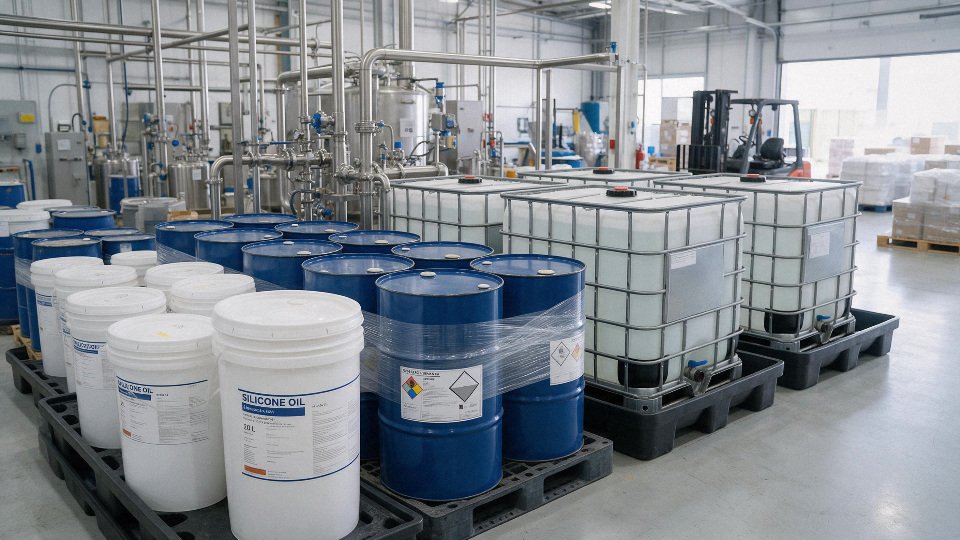

Silicone oil gets treated as a simple commodity right up until a batch fails incoming QC, a customer rejects a formulation, or a line starts behaving differently because the fluid that was supposed to be “the same” is off on viscosity, volatiles, moisture, or flash point. On the plant floor, that turns into unstable coating weight, poor release, seal swell questions, foam-control drift, or heat-transfer performance that does not match the last lot. The cost is rarely just the drum price; it shows up as rework, slower qualification, supplier disputes, extra lab time, and sometimes a production stop while purchasing and engineering figure out which standard actually applies.
Silicone oil is not governed by one universal standard; the applicable requirements depend on the product type, end use, customer specification, and the market where it will be sold. In practice, buyers usually need to align three layers at once: composition and grade definition, routine quality-control test methods, and any industry-specific regulatory or application standard tied to cosmetics, food contact, medical, electrical, or industrial use.
That is where a lot of confusion starts. A drum can meet a supplier’s internal release sheet and still miss what your application or customer audit expects, especially if nobody has separated general industrial QC items from sector-specific compliance requirements. The useful question is not “What is the silicone oil standard?” but “Which standards control this exact fluid, in this exact use, and which properties actually need to be verified lot by lot?”

Core standard categories
There is no single “silicone oil standard” that settles suitability on its own. In practice, buyers are dealing with a stack: test-method standards that define how the fluid is measured, regulatory frameworks that govern whether it can be sold or used in a market, sector rules tied to the end use, and then customer-specific specifications that often decide the order.
That distinction matters because two silicone oils can both be called polydimethylsiloxane, both pass a routine viscosity check, and still be very different procurement risks. One may be acceptable for a release-coating intermediate in an industrial line; the other may need tighter volatile control, impurity disclosure, lot traceability, and packaging rules before it can enter a medical, electronics, or personal-care supply chain.
Consensus standards bodies and test frameworks
The first layer is analytical: how the material is identified, measured, and compared from lot to lot. Common references include ISO, ASTM, DIN, EN, and GB methods, depending on where the material is produced, sold, or tested. These are usually not “approval standards” for the oil itself; they are the agreed methods used to generate comparable data for certificates of analysis, incoming inspection, dispute resolution, and qualification dossiers.
Routine release testing for silicone fluids often includes:
- Viscosity at a stated temperature, commonly 25°C for commercial grading
- Refractive index
- Density or specific gravity
- Moisture
- Acidity or acid value, where relevant to the chemistry
- Flash point
- Appearance, including clarity, haze, or visible particulate
For silicone oils, viscosity is the obvious headline parameter, but it is also where buyers get tripped up. A nominal 100 cSt fluid and another sold as 100 cSt may not behave identically in dosing, wetting, or carryover if they differ in molecular-weight distribution, volatile fraction, or temperature-viscosity profile. The test method, temperature, and acceptance band all matter. A broad industrial transfer fluid or defoamer base can tolerate one range; a precision damping, cosmetic, or dielectric application often cannot.
The mechanism is straightforward: as molecular-weight distribution broadens or low-boiling fractions rise, the same nominal viscosity can mask differences in evaporation loss, residue pattern, and process stability. That shows up later as weight loss in heated service, odor complaints, fogging on optics, or drift in coating add-on. This is why lab method references are not paperwork clutter; they are the bridge between a catalog grade and actual plant performance.
A practical point from procurement: do not accept a data sheet that lists properties without test references or at least internally controlled equivalent methods. If your incoming lab uses ASTM-based viscosity measurement and the supplier uses a non-equivalent house method, you can end up arguing over a “failure” that is really just method mismatch.
Regulatory regimes affecting market access
Market access sits on a different plane from quality control. A silicone oil can be technically excellent and still be blocked from import, sale, or use if its substance status, hazard communication, or residual profile does not fit the destination market.
The frameworks buyers most often need to screen against include:
- EU REACH
- UK REACH
- US TSCA
- GHS classification and Safety Data Sheet format
- EU CLP
- Country-specific chemical inventories in markets outside the EU and US
- Application-specific restrictions on certain cyclic siloxanes or residual substances
For organosilicon products, this is where the chemistry details start to matter. Linear PDMS fluids, phenyl-modified fluids, amino-functional materials, and blends may sit under different inventory or classification positions. Residual cyclics, unreacted intermediates, catalysts, or solvents can also change the compliance picture even when the main component is familiar.
One recurring issue is cyclic siloxanes. Restrictions are not uniform across all silicone oils or all jurisdictions, and they are not interchangeable with “all silicones are restricted.” The risk is usually tied to specific cyclic substances, concentration thresholds, use pattern, and market. If a buyer assumes that any silicone fluid is automatically acceptable because the base chemistry is common, they can get caught later in customs review, retail compliance screening, or downstream customer audits.
The conclusion here has a boundary: regulatory status cannot be generalized responsibly from chemistry name alone. It must be checked against the exact product identity, residual profile, intended use, and destination market using current supplier documentation and, where needed, legal or regulatory review.
ISO 9001 certification proves a silicone oil is compliant for food, cosmetic, medical, or electronics use.False
ISO 9001 shows a certified quality management system, not application-specific product compliance. Buyers still need the product's composition, regulatory declarations, test data, and any sector-specific approvals or restrictions.
Industry and sector standards
Once market access is cleared, end-use standards take over. This is usually where qualification becomes expensive, because the fluid is no longer judged only as a chemical; it is judged as part of a controlled application.
Personal care and cosmetic uses
For cosmetic or personal-care supply, buyers often need alignment with:
- Ingredient naming and composition disclosure frameworks
- Region-specific cosmetic regulations
- Impurity and residual limits relevant to the product form and market
- Support documents for formulation review and safety assessment
A cosmetic-grade expectation is not just “high purity.” In practice it often means tighter control of odor, color, volatiles, residual cyclic content where relevant, and documentation quality. A drum that is acceptable for industrial mold release may be rejected immediately by a personal-care buyer over trace odor or incomplete declaration language.
Food-contact and indirect additive uses
Silicone oil used around food processing, release, lubrication, or contact-adjacent applications needs careful legal review. The key questions are:
- Is the use direct, indirect, or purely incidental?
- Which country’s food-contact framework applies?
- What are the limits on composition, extractables, or migration?
- Is the fluid itself cleared, or only certain uses under certain conditions?
This area is easy to oversimplify and expensive to get wrong. A fluid can be sold into a food plant and still not be acceptable for all food-contact scenarios. Always verify against the current applicable regulation and supplier declaration for the specific use case.
Medical and pharmaceutical expectations
Medical and pharmaceutical use is stricter again. Depending on the application, buyers may ask for:
- Biocompatibility support data or pharmacopeia alignment where applicable
- Enhanced traceability and change control
- Tighter particulate, cleanliness, and packaging controls
- Audit rights, retained samples, and deviation reporting
The trade-off is cost and supply flexibility. As control requirements tighten, approved source options usually shrink, lead times can lengthen, and change management becomes slower. That is often justified for patient-facing or validated processes, but it is overkill for many industrial uses.
Electronics and high-cleanliness processing
Electronics buyers usually focus on contamination risk, outgassing, ionic cleanliness, residue behavior, and consistency. A silicone oil that performs well as a lubricant may still be wrong for electronics assembly if it migrates, fogs surfaces, or interferes with downstream adhesion, coating, or contact reliability.
Textile process requirements
Textile applications often care less about a formal universal “silicone oil standard” and more about process fit:
- Bath stability
- Compatibility with auxiliaries
- Foam behavior
- Yellowing tendency
- Hand feel, sewability, and rework behavior
- Wash durability or finish persistence
Here, bench and line trials matter more than broad category claims. Textile chemistry is messy; water quality, pH drift, shear history, and dryer profile can overturn a neat lab result fast.
Customer-specific standards
In many supply relationships, the customer specification is what actually controls the purchase. It often pulls from public standards, but it goes further into plant-level risk control.
Typical customer requirements include:
- OEM approvals or approved vendor lists
- Internal supplier manuals
- Impurity caps on volatiles, cyclics, ash, metals, chloride, or residual catalyst, where relevant
- Lot traceability back to production batch and raw material records
- Certificate of analysis format and retention
- Restricted substance lists
- Change notification periods
- Packaging validation, including liner compatibility, seal integrity, cleanliness, and labeling rules
This is where commercial reality shows up. A product that technically works may still lose the bid because the supplier cannot support 12-month retained samples, barcode traceability, or drum cleanliness expectations for an automated filling line. I have seen more qualification delays caused by packaging and paperwork gaps than by off-spec viscosity.
Management systems that support trust, but do not define the fluid
Management system certifications are useful, especially for supplier screening and audit reduction. Common references include:
- ISO 9001
- ISO 14001
- ISO 45001
- GMP-oriented systems, where relevant
- Customer or third-party audit programs
These matter because they reduce the odds of avoidable failure: poor change control, weak calibration discipline, unlabeled rework, inconsistent document release, sloppy complaint handling. On the plant floor, those are the failures that create mixed lots, mystery deviations, and expensive containment actions.
But the line buyers need to hold is simple: a certified management system supports confidence in how the supplier operates; it does not prove the silicone oil itself meets your application standard. Product fit still depends on the actual specification, regulatory declarations, analytical data, and, in many cases, an application-specific trial or qualification package.
Property test methods
A silicone oil is only “to spec” when its claims are tied to named test methods, controlled conditions, and agreed acceptance limits. In practice, buyers get into trouble when a data sheet says low volatility, stable viscosity, or good dielectric performance but does not say how those properties were measured, at what temperature, after what conditioning, and on which lot basis.
The point of test methods is not paperwork. They convert a broad product description into something a plant can receive, release, compare across suppliers, and investigate when a line starts foaming, a seal swells, or a fluid thickens in storage.
Identity and composition checks
For commodity dimethyl silicone fluids, identity work is usually simple: clear appearance, expected density and refractive index window, and an infrared spectrum consistent with the claimed siloxane structure. For modified silicones, especially amino-, epoxy-, phenyl-, or polyether-modified grades, functional group confirmation matters because a small compositional shift can change compatibility, wetting, cure interaction, or electrical behavior.
Typical identity and composition checks include:
- Appearance
- Colorless to slightly hazy, depending on grade and additive package
- Free from visible suspended matter, gel particles, or phase separation
- Checked visually under defined lighting and container conditions
- Infrared spectrum
- Used to confirm the siloxane backbone and major functional groups
- Particularly useful for screening wrong-product filling or cross-contamination
- Not usually enough on its own to quantify low-level impurities
- Functional group confirmation for modified silicones
- Amino, epoxy, hydroxyl, alkyl, aryl, or polyether groups may need specific analytical confirmation
- The relevant technique depends on the chemistry: IR, NMR, titration, or supplier-specific assay
- For reactive grades, functionality level often matters more than a simple pass/fail identity match
- Residual volatile profiling
- Important where low-volatile, high-purity, or emission-sensitive use is specified
- Commonly assessed by controlled heating loss, gas chromatography, or a product-specific volatile content method
- The acceptable limit depends heavily on grade; it is not responsible to state one universal number for all silicone oils
Two silicone oils with the same nominal viscosity can perform differently in service.True
Nominal viscosity captures only one point on the fluid's behavior. Molecular weight distribution, residual low boilers, trace catalyst residues, surface-active impurities, and additive package can shift volatility, foam behavior, dielectric performance, seal compatibility, and long-term stability.
That last point catches buyers all the time. A 100 cSt fluid from one source may evaporate faster, wet better, or foam less than another 100 cSt fluid because the low-molecular-weight tail and impurity profile are different. Nominal viscosity is a necessary receiving check, not a complete performance fingerprint.
Rheological properties
Viscosity is the headline property for most silicone oils, but the test details matter. Common commercial grades run from roughly 0.65 cSt up to 1,000,000 cSt at 25°C depending on chemistry and intended use, and the measurement approach changes across that range.
The main rheological checks are:
- Kinematic viscosity
- Often used for lower- and mid-viscosity fluids
- Measured at a defined temperature, commonly 25°C and sometimes 40°C depending on the market or application
- Sensitive to temperature drift; even a small lab temperature error can move a borderline lot out of range
- Dynamic viscosity
- Often preferred for higher-viscosity products or non-Newtonian modified systems
- Requires control of spindle geometry, shear rate, sample conditioning, and equilibration time
- Viscosity-temperature relationship
- Relevant where the oil sees cold startup, outdoor storage, or high process temperatures
- Some buyers ask for viscosity at multiple temperatures or for viscosity-temperature curves rather than a single-point value
Two lab habits drive repeatability more than people expect:
- Temperature control
- Silicone oils are less viscosity-sensitive than many hydrocarbons, but they are not immune
- A sample measured at 23°C and compared with a 25°C specification can create a false dispute, especially in low- and medium-viscosity grades
- Shear and handling history
- Most straight silicone fluids are close to Newtonian, but modified or filled systems may not be
- Aggressive stirring, entrained air, or incomplete equilibration after transfer can distort readings
- In a plant lab, I would rather wait ten extra minutes for temperature stabilization than release a lot on a rushed number
The trade-off is straightforward: tighter viscosity tolerances improve process consistency but raise the risk of supplier rework, lot segregation, and cost. That logic flips in applications such as precision coating, damping, or metered dispensing, where a broad viscosity band quickly turns into variable laydown, unstable pump behavior, or reject parts.
Physical constants
Physical constants are often treated as secondary checks, but they are useful for both incoming inspection and forensic troubleshooting.
Commonly specified properties include:
- Density or specific gravity
- Helps confirm identity and consistency
- Useful for mass-to-volume conversion in dosing systems and inventory control
- Refractive index
- A good supplementary identity indicator
- Can flag compositional drift or contamination when compared against the established product window
- Pour point
- Relevant for outdoor storage, winter shipping, and low-temperature service
- Especially important when drums sit in an unheated warehouse and the first shift wants to pump them at 6 a.m.
- Cloud point
- More relevant to certain modified silicones than to standard dimethyl fluids
- Indicates phase behavior changes, often critical for emulsification, release, or surfactant-like applications
- Surface tension
- Important in spreading, wetting, leveling, and defoaming applications
- A low surface tension fluid may wet a substrate well, but if compatibility is poor, you can still get fisheyes or dewetting patterns
Here the mechanism matters. Surface tension affects how the fluid spreads on a surface, but spreading in production is also shaped by contamination, substrate energy, temperature, and trace polar impurities. A buyer looking only at viscosity and ignoring surface behavior can end up with a fluid that pumps perfectly and performs poorly.

Safety-related properties
Flash point is commonly listed on data sheets, but it should not be treated as a complete fire-risk description. It is one property measured under specific conditions, and it is strongly influenced by volatile content and test method.
Safety-related checks may include:
- Flash point
- Usually specified for handling, transport classification support, and plant safety review
- Must be tied to the exact method; open-cup and closed-cup values are not interchangeable
- Fire point
- Less commonly specified, but useful in some high-temperature service reviews
- Autoignition considerations
- Usually relevant only in hot-surface or high-risk thermal environments
- Must be verified from current supplier documentation or direct testing when critical
- Volatility or evaporation loss
- Determined under defined time and temperature conditions
- Critical for release fluids, personal care intermediates, electronics, and high-temperature lubricating applications
A low flash point or high evaporation loss often points to residual low boilers. Those same low boilers can also shift odor, shrink volume in service, increase deposits, and change dielectric behavior. One test result can therefore explain several field complaints if the receiving lab and application engineer compare notes instead of working separately.
Chemical quality indicators
Chemical quality indicators are where many specification packages become application-specific. Routine quality release testing often covers viscosity, refractive index, density, moisture, acidity, flash point, and appearance, but some buyers need tighter impurity control.
Important indicators include:
- Acid value
- Can indicate hydrolysis, oxidation, poor finishing, or contamination
- Particularly relevant where corrosion risk, catalyst poisoning, or cure interference matters
- Moisture or water content
- Important for electrical, reactive, and high-temperature uses
- Water can enter through poor drum sealing, repeated headspace breathing, or sloppy sampling on humid days
- Ionic contamination
- Relevant for electronics, dielectric uses, and sensitive process environments
- Usually requires application-specific limits and methods rather than a generic commodity spec
- Halogen content
- May be restricted by customer requirement, end-use regulation, or internal material policy
- Needs method alignment because “halogen-free” language can mean different things in different sectors
- Residual catalyst or metal traces
- Important where long-term stability, cure behavior, electrical performance, or ash formation matters
- Typical methods depend on the metal and the required detection limit
The boundary here is simple: broad industrial service may tolerate standard impurity control, but electronics, medical, or tightly regulated applications usually need narrower windows and more sensitive analytical methods than a general-purpose silicone oil certificate provides.
Performance-linked tests by use case
A general silicone oil specification does not automatically predict application success. Where the end use is demanding, buyers should add performance-linked tests that mimic the service failure mode.
Examples include:
- Dielectric strength and related electrical tests
- Relevant for electrical insulating fluids
- Results depend on moisture, particles, dissolved gases, and test cell preparation, not just base chemistry
- Thermal stability and oxidation resistance
- Needed for heat transfer, high-temperature lubrication, or long-life fluid service
- Test conditions vary widely; ask what temperature, duration, atmosphere, and endpoint were used
- Defoaming efficiency and foam profile
- Important for process aids and antifoam-related uses
- Includes knockdown speed, persistence control, and re-foam tendency under actual process chemistry
- Lubricity
- Relevant for mold release, elastomer processing, textile, and specialty mechanical applications
- Usually requires a use-specific tribology method; there is no universal lubricity number that predicts every contact pair
- Spreadability and wetting
- Important in coatings, release, polishes, and surface treatment systems
- Compatibility
- With elastomers, plastics, coatings, solvents, and process additives
- One of the most common causes of field trouble, and not reliably predicted from a generic data sheet
Sampling, retention, and laboratory discipline
A good method is still weak if the sample is poor. Silicone oils are often stable, but sampling practice can still make or break the result.
Use a disciplined routine:
- Take representative lot samples
- Sample after confirming lot identity and container integrity
- For bulk tanks or ISO containers, account for stratification, dead legs, and transfer-line residues
- Condition containers and tools
- Use clean, dry sampling devices and compatible sample bottles
- Avoid reusing bottles that held surfactants, solvents, or catalysts unless they have been properly validated as clean
- Control sample temperature
- Bring the sample to the specified test temperature before measurement
- Do not compare a cold warehouse sample with a warm retained standard
- Maintain retains and shelf-life checks
- Keep retained samples under defined storage conditions
- For long-stored retains, note that headspace exchange, light exposure, and container seal quality can change some properties over time
- Reduce inter-laboratory variation
- Align on method version, equipment type, calibration routine, and calculation basis
- In supplier-customer disputes, compare blind split samples before arguing about chemistry
If a buyer is qualifying a new source, asking for lot COA data is not enough. The useful next step is to agree on which properties are identity checks, which are release controls, and which require application testing on the actual substrate and process conditions.
Application-specific requirements
A 350 cSt dimethyl silicone oil can be perfectly acceptable in one plant and completely unusable in another. Once silicone oil is tied to a specific end use, the governing requirements shift from “does the viscosity match?” to “does the product, documentation, impurity profile, and market status fit the application risk?” That is where many buying mistakes start: the fluid is technically sound, but the application file is too thin, the purity is wrong, or a downstream customer rejects it for a market-specific reason.
The practical consequence is simple. Buyers who screen only on viscosity, appearance, and price usually discover the missing requirement late, often after line trials, customer approval delays, or a blocked shipment. In most plants, the expensive part is not the oil; it is the lost time around reformulation, cleaning, retesting, and customer requalification.
Cosmetics and personal care
Cosmetic use is rarely judged by viscosity alone; it is judged by ingredient identity, market acceptability, sensory repeatability, and support documentation. A silicone fluid that works well as a carrier or gloss agent in a lab batch may still fail commercial adoption if its ingredient naming, residual volatile profile, or regulatory support does not fit the target market.
For formulators, the main checkpoints are usually:
- Ingredient naming and composition clarity
- The material needs to align with the naming system used in the target cosmetic market, often through INCI-style identification where applicable.
- Blends, modified silicones, and specialty fluids need clear composition disclosure at the level required for formulator compliance work.
- If the product contains cyclics, residual solvents, or functional additives, those details matter early.
- Purity and consistency expectations
- Cosmetic buyers typically expect tighter control of odor, color, haze, and trace impurities than a general industrial buyer.
- Batch-to-batch sensory consistency matters because consumers notice spreadability, slip, gloss, dry-down, and residue quickly.
- Low volatile content may be preferred or required depending on formulation intent and market position.
- Cyclic siloxane restrictions in some markets
- Certain cyclic siloxanes face restrictions or heightened scrutiny in parts of the world, especially for rinse-off or high-exposure uses.
- The point is not that all silicone oils are restricted; it is that the presence and residual level of particular cyclics can affect marketability.
- This must be checked against current regional rules and the supplier’s current declaration, not assumed from generic product family language.
- Documentation typically needed
- Technical data sheet
- Safety data sheet
- Composition or regulatory declaration suitable for cosmetic review
- Allergen, impurity, or restricted-substance statements where relevant
- Sometimes residual monomer or cyclic content information, depending on customer policy
The mechanism here is straightforward: trace volatility and impurity profile affect both compliance and sensory performance. A fluid with slightly different low-molecular-weight fractions can change evaporation rate, initial slip, and after-feel, while also changing how the product is reviewed by regulatory or brand teams. In practice, formulators often reject a material less because the main polymer is wrong than because the supporting impurity and declaration package is incomplete.
Food-related processing and indirect contact uses
For food-related service, the first question is whether the silicone oil is a direct food ingredient, a process aid, or an indirect-contact material. Those are not interchangeable categories, and the documentation burden changes sharply between them.
Common evaluation points include:
- Regulatory declarations for the intended use
- Buyers usually need a statement tied to the relevant jurisdiction and use mode.
- A generic “food grade” label is often too vague to support audit or customer review.
- The declaration should identify whether the material is suitable for incidental contact, processing equipment use, release use, or another specific function.
- Migration and contact risk
- Higher temperature, longer dwell time, aggressive food media, and repeated contact all increase the need to examine migration potential.
- Viscosity influences carryover and mobility, but it is not the only driver. Surface loading, application method, and cleaning regime matter just as much.
- If the fluid is used on conveyors, molds, seals, or filling equipment, the actual contact scenario has to be defined.
- Contamination control
- Production and packaging controls matter because food-sector customers may ask whether the product is segregated from non-acceptable additives or handled in a contamination-controlled line.
- Drum cleanliness, transfer hoses, and filling practice become part of the buying decision, especially in audited supply chains.
- Process aid versus direct ingredient
- A process aid used externally on equipment may be acceptable under one framework.
- A material intended for deliberate inclusion in food is a different regulatory matter entirely and should never be inferred from indirect-contact suitability.
This is a section where the main conclusion has a clear boundary: if the oil never approaches food, many of these declarations are irrelevant; once it can contact food or food-contact surfaces, they become central and application-specific.
Medical and pharmaceutical contexts
Medical and pharmaceutical use is where many industrial suppliers get screened out immediately. Standard industrial documentation is usually nowhere near enough for serious medical, device, or pharmaceutical evaluation.
The technical concerns often include:
- Biocompatibility
- The fluid itself, and sometimes the finished article containing it, may need evaluation under recognized biocompatibility frameworks depending on contact type and duration.
- A supplier cannot responsibly imply medical suitability from viscosity, purity appearance, or generic inertness claims.
- Extractables and leachables awareness
- In drug processing, device manufacture, or packaging-related use, stakeholders often want to understand what can migrate out of the silicone-containing system over time.
- The oil may be only one part of that picture, but its low-molecular-weight fraction and residual impurities can materially affect the risk assessment.
- High-purity expectations
- Tighter control of volatiles, residues, metals, particulate matter, and trace reactive species may be expected.
- Change control is also much more serious. A supplier process change that is routine in industrial markets can trigger qualification work in medical programs.
- Documentation beyond standard commercial files
- Detailed composition support within confidentiality limits
- Manufacturing and quality-system information
- Change notification practices
- Application-specific declarations
- Sometimes supporting toxicological or biological evaluation data, depending on the program
A silicone oil that is acceptable for cosmetics is automatically suitable for medical use if its purity is high enough.False
Medical and pharmaceutical suitability depends on intended contact, risk classification, biocompatibility expectations, extractables and leachables considerations, quality-system controls, and documentation depth. High purity alone does not establish medical suitability.
Electronics and electrical uses
In electronics, the fluid is often judged less by feel or general lubricity and more by what it does not contribute: ions, volatiles, corrosion drivers, conductive residues, or outgassing on sensitive parts. A silicone oil can have excellent thermal stability and still be wrong for a sealed sensor, optical assembly, or high-voltage component.
Key requirements typically include:
- Dielectric performance
- Insulating applications may require dielectric strength, dielectric constant, and dissipation factor data, or at least application-specific verification.
- Moisture pickup and contamination can degrade actual in-service performance even when the base fluid is sound.
- Low ionic contamination
- Trace ionic species can create trouble in high-reliability electronics, especially where spacing is tight or humidity cycles are harsh.
- This is often a cleanliness and process-control issue, not just a base chemistry issue.
- Outgassing control
- In sealed housings, optics, sensors, and vacuum-adjacent systems, low volatility and low outgassing become critical.
- A small amount of condensable volatile can fog a lens, contaminate a contact surface, or alter sensor response.
- Thermal stability and compatibility
- The oil must remain stable across the actual service temperature range.
- It also has to be compatible with plastics, elastomers, coatings, potting materials, and metal finishes in the assembly.
The trade-off here is common: lower volatility and higher molecular weight often improve outgassing behavior, but they can worsen low-temperature mobility or dispensing behavior. The preferred balance flips depending on whether the main risk is evaporation in a warm sealed unit or sluggish flow during cold-start operation.
Textiles, leather, and fiber finishing
For finishers, the product may be sold as neat oil or as an emulsion or formulated softener. The buying mistake here is assuming that the silicone backbone determines performance by itself. On the machine, emulsion stability, amino functionality level, and bath compatibility often decide whether the line runs cleanly.
What buyers usually need to check:
- If supplied as an emulsion
- Particle size stability
- Dilution stability
- Shear stability
- Electrolyte and pH tolerance
- Storage stability under seasonal temperature swings
- Amino functionality control
- Amino-modified silicones can improve softness and affinity, but too much or poorly controlled functionality can increase yellowing risk, shade shift, or build-up.
- This matters more on whites, pale shades, and heat-exposed cure conditions.
- Hand-feel reproducibility
- Softness, slickness, drape, and surface smoothness need to repeat lot to lot.
- Small formulation drift can show up immediately on customer panels, especially in apparel and upholstery work.
- Process bath compatibility
- Interaction with resins, catalysts, fluorochemicals, waxes, and dye auxiliaries must be checked.
- A finish that is stable in a beaker can break in a recirculating bath with hard water and carryover contamination.
Industrial lubricants, release agents, and defoamers
In general industrial service, silicone oil is often selected for broad operating range and chemical stability, but downstream contamination risk can dominate the decision. A release fluid or antifoam that solves one problem can create another if the process later needs painting, printing, bonding, or coating.
Critical checks include:
- Volatility limits
- Higher volatility can increase consumption, odor, residue transfer, and misting.
- In defoamer service, volatile fractions may affect persistence and carryover.
- Performance testing for the actual duty
- Antifoam efficiency should be checked in the real system or a representative lab simulation.
- Foam chemistry varies too much across detergents, fermentation, wastewater, metalworking fluids, and coatings to rely on generic claims.
- Substrate interaction
- Release performance depends on substrate energy, temperature, cure state, and cycle time.
- What works on one elastomer, composite, or molded resin may fail on another.
- Downstream contamination sensitivity
- Silicone transfer can cause fish-eyes, crater defects, poor paint wetting, and adhesion loss in later operations.
- Plants with coating lines usually need stricter control than plants using silicone only inside closed mechanical systems.
Thermal and mechanical systems
For heat transfer, damping, instrumentation, or mechanical fluid service, the key standards shift toward service stability rather than only purity or declaration language. Viscosity grade still matters, but so do oxidation resistance, evaporation loss, seal compatibility, and low-temperature behavior.
A practical screening list looks like this:
- Viscosity index and temperature-viscosity behavior
- The buyer needs to know how sharply viscosity changes across the service range.
- A fluid that is acceptable at 25°C may be too thin hot or too sluggish cold.
- Oxidation and evaporation behavior
- Elevated temperature and air exposure can increase viscosity drift, deposit formation, and fluid loss.
- The actual rate depends on temperature profile, residence time, headspace, and contamination with catalytic metals or process residues.
- Seal and materials compatibility
- Elastomer swelling, shrinkage, or loss of mechanical properties must be checked against the exact seal material.
- “Compatible with rubber” is not a useful engineering statement; FKM, NBR, EPDM, and silicone rubber behave differently.
- Low-temperature flow
- Cold-start torque, pumpability, and instrument response can all be limited by poor low-temperature mobility.
- This becomes more important in outdoor equipment, refrigerated areas, and plants with winter startup issues.
The issue buyers miss most often is not the fluid itself. It is the statement package behind it. The same silicone oil may perform beautifully in the process and still be commercially blocked because the supplier cannot provide the specific regulatory declaration, restricted-substance statement, impurity disclosure, change-control commitment, or market-aligned documentation that the customer’s application actually requires.
Regulatory and safety compliance
A silicone oil can meet the viscosity and purity target and still be unusable if its legal status, hazard communication, or documentation package is wrong for the destination market. In practice, market access usually turns on inventory listing, restricted-substance declarations, and whether the shipped lot can be traced back to the exact formulation and plant configuration the customer approved.
Chemical inventory status and market access
For international sales, one of the first checks is whether the substance is listed, exempt, or otherwise allowed under the chemical inventory system in the importing country or region. If that status is wrong, the product may be held at customs, require a local notifier or importer of record, or be blocked entirely until a new substance process is completed.
What matters is not just the commercial name “silicone oil,” but the actual chemical identity and how the market regulates that identity:
- Base substance listing
- Linear polydimethylsiloxane fluids are often treated differently from specialty modified silicones.
- Amino-, epoxy-, phenyl-, fluorinated-, or polyether-modified silicone oils may fall under separate identities with separate listing questions.
- Polymer exemption logic
- Some jurisdictions apply polymer exemptions; some do not, or apply them narrowly.
- A supplier saying “polymer, therefore exempt” is not enough. The exemption conditions and destination-country rules have to match.
- Impurity and residual content
- Even if the main polymer is listed, residual monomers, catalysts, solvents, or low-molecular-weight fractions can trigger extra obligations.
- This is where buyers get caught. The drum label looks familiar, but the import declaration hinges on components present above reporting thresholds.
- Plant and legal-entity continuity
- A product made at Plant A under one legal manufacturer may not be administratively identical to “the same” product made at Plant B, depending on registration structure and customer filings.
The mechanism here is straightforward: legal access is tied to substance identity, not marketing shorthand. A raw material substitution that slightly changes end-blocking chemistry may leave viscosity unchanged while shifting the reportable identity enough to require a new regulatory review. That is why regulated customers ask for composition boundaries, not just a broad product family name.
Hazard communication obligations
A good Safety Data Sheet is not a formality. It is the operating document that tells the warehouse, EHS team, transporter, and end user what hazards are assigned, what emergency actions are appropriate, and whether the information on the label, SDS, and transport documents agrees.
Minimum control points buyers should review:
- GHS classification basis
- Is the product classified as hazardous or not under the destination-country implementation of GHS?
- If not classified, does the SDS still address decomposition hazards, slip hazards, thermal breakdown products, and environmental handling?
- Label elements
- Product identifier
- Supplier details
- Signal word and hazard statements if classified
- Precautionary statements where required
- Batch or lot identification
- Transport status
- Many silicone oils are not regulated as dangerous goods for routine transport, but that is product-specific, not category-wide.
- Flash point, viscosity, packaging size, and contaminant content can affect the result. Verify against current mode rules for road, sea, and air rather than assuming one answer fits all shipments.
- Emergency information consistency
- The SDS first-aid, fire-fighting, accidental release, and storage sections should align with the transport declaration and local emergency contact arrangements.
- Mismatches are a red flag, especially on private-label or trader-supplied material.
All silicone oils are non-hazardous and unrestricted for transport.False
Many silicone oils are not classified as dangerous goods under normal transport rules, but that depends on the exact formulation, flash point, impurities, packaging configuration, and destination regulations. Hazard classification and transport status must be verified product by product.
Restricted substance management
Restricted-substance review is where commercial approvals are often won or lost. The buyer may not only care about legal bans; they may have their own restricted substance list driven by electronics, automotive, medical, food-contact, or brand-owner requirements.
Common review areas include:
- Residual solvents
- Especially relevant for modified fluids or specialty finishing grades
- Need declaration limits tied to the customer’s restricted substance thresholds
- Heavy metals
- Usually low concern in well-controlled silicone fluids, but declarations are still commonly required for lead, cadmium, mercury, hexavalent chromium, and sometimes total metal screens
- Halogens and corrosive residues
- Important in electronics and cable applications
- Chloride or other ionic contamination may matter more than total halogen in sensitive uses
- Cyclic siloxanes
- Low-molecular-weight cyclics such as D4, D5, and D6 receive specific regulatory attention in some markets and applications
- This is one area where the preferred product grade flips: a lower-cost fluid with higher volatile cyclic content may be acceptable in a closed industrial use, but not where emissions, personal care restrictions, or environmental persistence concerns are under scrutiny.
- SVHC and customer watch lists
- Even where a substance is not banned, customers may require declaration if present above threshold or if under active regulatory review
Routine quality release testing often covers viscosity, refractive index, density, moisture, acidity, flash point, and appearance. That is useful, but it does not by itself answer restricted-substance compliance. For that, you usually need formulation review, supplier declarations for critical raw materials, and targeted analytical testing where the risk justifies it.
Environmental and occupational considerations
Silicone oils are generally selected because they are stable and useful over a wide operating window, but those same traits can raise questions about persistence, emissions, and housekeeping. Regulators and plant EHS teams tend to focus on five practical issues:
- Volatile emissions
- Lower-viscosity and higher-volatile-content grades can contribute more to fugitive emissions during mixing, coating, heating, or open-tank use.
- Typical volatile content limits for many industrial silicone fluids are controlled in the low-percent or sub-percent range by product grade, but the acceptable limit depends on the application and local rules.
- Slip hazard from spills
- This is one of the most immediate plant-floor risks. A small leak at a tote valve or pump seal can make a concrete aisle dangerously slick long before anyone notices odor or vapor.
- Waste handling
- Disposal classification depends on contamination after use, not just virgin product status.
- Used silicone oil mixed with solvents, metal fines, or process residues may need a very different waste route.
- Thermal decomposition
- High-temperature use can generate breakdown products that require ventilation review and confirmation against the equipment manual and workplace controls.
- Worker exposure expectations
- Even where no specific occupational exposure limit applies to the finished silicone oil, mist control, ventilation, glove compatibility, and heated-process controls still matter.
The main boundary here is process temperature and openness. A stable, low-volatility fluid in a closed hydraulic or damping system presents a very different EHS profile from the same chemistry sprayed, atomized, or heated in an open line.
Packaging, transport, and contamination control
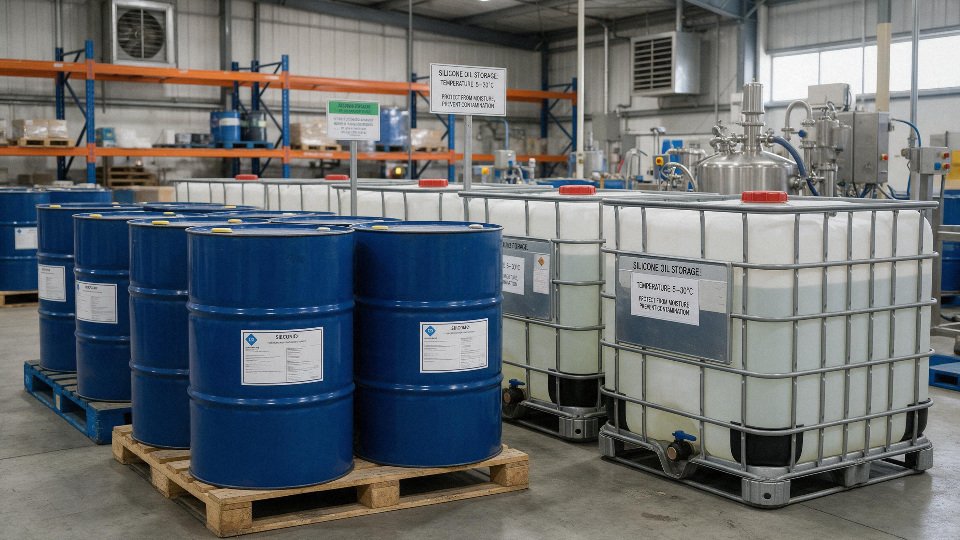
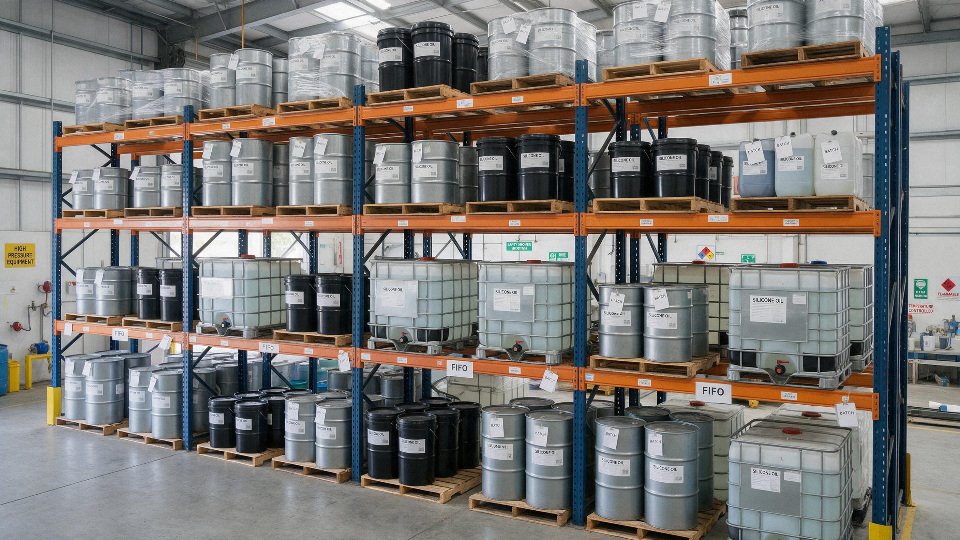
Packaging compliance is partly regulatory and partly quality preservation. The legal side covers correct marks, transport status, and closure integrity. The quality side is just as important because silicone oils pick up contamination easily during filling and transfer.
Check these points before approving a supplier:
- Container compatibility
- Drum lining, gasket material, IBC seal material, and valve compatibility should be confirmed for the specific fluid and storage period.
- A gasket that is fine for mineral oil is not automatically fine for every silicone formulation.
- Tamper evidence and closure control
- Especially for export drums and IBCs with multiple transshipment points
- Clean filling practice
- Dedicated or validated filling lines reduce the risk of cross-contamination from solvents, release agents, or other silicone grades
- Headspace and moisture control
- More important for hydrolysis-sensitive modified fluids than for standard dimethyl grades
- Lot identification through logistics
- Label, pallet, packing list, and shipping documents should all tie back to the same batch record
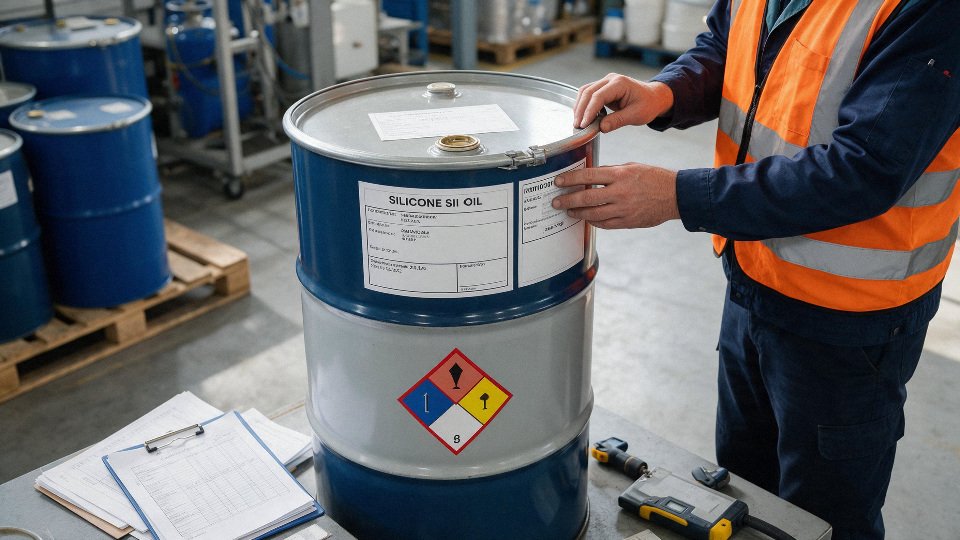
Change management and legal continuity
For customers with validated formulations or qualified production settings, uncontrolled change is often a bigger risk than one missed test value. Raw material substitutions, catalyst changes, process parameter shifts, plant transfers, and even packaging component changes can affect compliance, application performance, or customer requalification obligations.
A practical change-control expectation should include:
- Defined change categories and notification triggers
- Advance notice period for significant changes
- Updated SDS, TDS, and declaration letters where affected
- Reissued CoA format if test methods or limits changed
- Confirmation of whether regulatory status in any destination market is impacted
This is where procurement and engineering need to stay aligned. A supplier may view a plant transfer as commercially routine; the customer may see it as a new source requiring line trials, emissions review, and document resubmission.
Practical documentation set for international trade
For cross-border supply, the working document pack usually includes:
- Certificate of Analysis
- Lot-specific measured values against agreed release items
- Safety Data Sheet
- Destination-language and destination-format compliance where required
- Technical Data Sheet
- Typical properties, intended use boundaries, storage guidance
- Declaration letters
- Inventory status, restricted substances, SVHC status, halogen or heavy metal statements, cyclic siloxane statements where relevant
- Statement of origin
- Needed in some customs, tariff, or customer qualification contexts
- Lot traceability records
- Manufacturing date, batch number, plant of manufacture, and link to retained sample or batch record
If the application is regulated, validated, or export-sensitive, ask for the current document set before purchase order release, not after the container is on the water. That is usually the cheapest point to catch a compliance gap.
Supplier qualification criteria
A usable silicone oil supplier screen has to go past price, nominal viscosity, and a clean-looking TDS. The suppliers worth shortlisting are the ones that can show process control, lot traceability, release discipline, and enough application judgment to keep your plant out of requalification trouble when something changes upstream.
The reason this matters is simple: for silicone oil, many expensive failures are not obvious on the front-page datasheet. Two products can match viscosity at 25°C and still behave differently because of volatile carryover, moisture, acidity, contamination, or lot-to-lot variation that only shows up in foaming, coating defects, dielectric drift, seal compatibility, or customer audit findings.
Manufacturing capability review
A supplier with an integrated siloxane chain usually has better control over consistency, change risk, and root-cause response than a trader assembling supply from shifting sources. That does not automatically make every integrated producer better, but it usually means fewer unknowns in upstream intermediates, less dependency on spot-market substitutions, and a clearer path when you ask what changed between lots.
Procurement should check the following, not just ask for a plant photo and a capacity number:
- Integration depth
- Does the supplier control key upstream siloxane intermediates, or are they buying from multiple outside producers?
- If they are not fully integrated, how do they qualify and lock raw material sources?
- How often do they switch upstream suppliers, and what triggers a customer notification?
- Reaction and finishing control
- What process variables are held within defined limits: temperature profile, catalyst usage, residence time, end-blocking control, stripping conditions?
- What purification steps are available: filtration, devolatilization, vacuum stripping, drying, polishing?
- Can they explain how they control low boilers or residual volatiles for grades where that matters?
- Batch size flexibility
- Can they run both large commodity batches and smaller controlled campaigns without excessive cross-scheduling risk?
- What is the practical minimum batch size for a custom or tighter-spec grade?
- If your annual volume is modest, will you be tied to a large production slot with long lead times?
- Consistency of upstream sourcing
- Are critical raw materials dual-sourced, single-sourced, or internally produced?
- What incoming testing is done before release to production?
- How do they handle seasonal supply stress, power restrictions, or transport disruption?
Here the mechanism is commercial as much as chemical. Weak upstream control often shows up first as wider adjustment in finishing, then as more variable impurity profiles, then as downstream validation failures on your side. A plant blending cosmetic-looking conformity from inconsistent feedstocks may still hit nominal viscosity, but it tends to struggle once your process is sensitive to volatiles, moisture, dielectric behavior, or surface defects.
Quality system depth
Routine release testing is the minimum entry ticket, not proof of a strong quality system. Many suppliers can report viscosity, refractive index, density, moisture, acidity, flash point, and appearance; the useful question is how those results are generated, reviewed, retained, and connected to corrective action when something drifts.
Look for evidence in six areas:
- Release testing scope
- Which tests are performed on every lot, and which are periodic?
- Are methods tied to recognized standards or internal validated methods?
- Are acceptance limits grade-specific or copied broadly across products?
- Retained samples
- Is a retain kept for every shipped lot?
- How long is it stored, under what conditions, and in what package type?
- Can the retain support complaint investigation months later?
- Deviation handling
- What happens if one parameter is marginal, out of trend, or retested?
- Who can authorize concession shipment?
- Are deviations documented with containment and disposition, or handled informally?
- Calibration discipline
- How are viscometers, balances, moisture analyzers, flash-point equipment, and temperature sensors calibrated?
- What is outsourced versus handled internally?
- How is method drift detected?
- Complaint response
- What is the expected first response time for a quality complaint?
- Will they issue an 8D, CAPA, or equivalent investigation record?
- Can they distinguish packaging damage from process-related nonconformance?
- Corrective action effectiveness
- Do they verify that corrective actions actually prevented recurrence?
- Can they show anonymized examples?
- Are repeat issues tracked by cause category?
The trade-off here is practical. A supplier with a deeper QA structure may not be the cheapest and may move slower on urgent concessions, but that friction is often cheaper than line stoppage, customer returns, or a six-month revalidation because one shipment came in “technically in spec” but functionally unstable.
A lower purchase price can still produce a higher total landed cost if the supplier's analytical control and change management are weak.True
In silicone oil procurement, downstream costs often come from re-testing, qualification failures, coating or process instability, complaint handling, and emergency resourcing rather than the invoice price alone.
Documentation maturity
If a supplier cannot answer a customer questionnaire cleanly, they are usually not ready for regulated, export-heavy, or audit-sensitive business. Good documentation maturity shows up in completeness, version control, and response speed.
Review these documents as a package:
| Document type | What to check | Common weakness |
|---|---|---|
| Technical data sheet | Property definitions, test conditions, typical vs guaranteed values | Marketing language replacing measurable limits |
| Safety data sheet | Current format, hazard basis, transport relevance, revision date | Outdated regional content or generic hazard statements |
| Certificate of analysis | Lot-specific values, method references, authorized release | Template COAs with missing actual test data |
| Regulatory letters | Application-specific declarations, substance status, restricted content statements | Overbroad declarations not tied to product grade |
| Customer questionnaires | Consistency across quality, regulatory, and manufacturing answers | Contradictions between sales and QA replies |
A mature supplier also knows when not to overstate. If a declaration depends on market, end use, or threshold assumptions, they should say so plainly rather than issue a broad letter that creates liability for both sides.
Traceability and lot control
If traceability stops at the finished drum label, it is not traceability in any useful procurement sense. Buyers should be able to understand how a shipped lot links back to production date, reactor batch, key raw materials, packaging line, and release decision.
Ask for the logic behind:
- Batch numbering
- Does the code map to product, date, line, and production campaign?
- Can QA decode it without going back to one person’s notebook?
- Raw material linkage
- Can they identify which incoming lots fed the finished batch?
- Is this electronic, paper-based, or hybrid?
- Packaging line segregation
- How are different grades separated on filling lines?
- What flush, line-clearance, or label-verification controls are used?
- Recall readiness
- Have they tested mock recall speed?
- How quickly can they identify affected shipments and customers?
This conclusion stops holding if you are buying a low-risk, noncritical process aid with broad internal acceptance windows. In those cases, full audit-depth traceability may not justify the effort. For anything tied to customer approvals, electronics, medical-adjacent handling, or export declarations, it matters quickly.
Application support competence
Some suppliers know their product; fewer can map it to your process. The useful partner can interpret end-use requirements, flag over-specification, and keep you from buying a premium grade you do not need or a commodity grade that will fail quietly in service.
Test this by giving them a real application brief:
- Substrate or system material
- Contaminant or contact environment
- Approximate film or layer thickness
- Temperature range
- Required finish or functional target
- Process method and line speed
- Any customer or regulatory restrictions
Then see whether they:
– Ask clarifying questions
– Distinguish “typical value” from acceptance requirement
– Recommend one grade with a fallback option
– State what needs lab or plant validation before commitment
A weak supplier jumps straight to viscosity matching. A strong one asks what the oil is actually doing in the process.
Global supply reliability
Export capability is not just having a freight forwarder. It includes packaging integrity, document accuracy, lead-time stability, and communication that survives time zones and customs issues.
Check for:
- Export experience by region
- Have they shipped routinely into your destination market?
- Do they understand the document set your import team actually needs?
- Packaging options
- Drum, pail, IBC, isotank, or bulk capability as relevant
- Package compatibility for low- and high-viscosity grades
- Seal integrity and labeling discipline
- Lead-time stability
- Standard lead time versus actual recent performance
- Make-to-stock or make-to-order model
- Peak-season variation
- Change-control communication
- How much notice is given for raw material, process, specification, or packaging changes?
- Is there a formal PCN-style process?
- Multilingual commercial support
- Can sales, QA, and logistics answer clearly in the working language of the transaction?
- Miscommunication around COAs, labels, and customs codes causes more trouble than many buyers expect.
The overlooked cost driver is usually not the drum price. It is the supplier who ships on time until a raw material swap, changes an internal method without telling you, or cannot explain an impurity excursion when your customer rejects finished goods. That is where supplier qualification stops being paperwork and starts protecting throughput, validation status, and margin.
Certificates and technical documents
A silicone oil is only as compliant as the paperwork that ties the sold lot to a defined chemistry, test method, and release decision. For engineers and buyers, the core document set is usually a technical data sheet, a lot-specific certificate of analysis, a current safety data sheet, and a regulatory declaration package; anything less leaves too much room between “meets standard” and what actually arrived at the dock.
The practical point is simple: standards are verified through documents before they are confirmed by incoming inspection. If the documents are vague, out of date, or copied across unrelated grades, you will spend the difference later in delayed qualification, customs questions, production trials, or a dispute that no one can close cleanly.
Technical data sheet: what the product is supposed to be
A useful TDS does not just advertise viscosity. It should tell your team what fluid family it is, what the intended operating window looks like, and where the supplier is drawing the line between typical behavior and guaranteed release criteria.
Look for these elements:
- Product description
- Chemical type or family, such as dimethyl silicone fluid or modified silicone fluid
- Appearance and basic functional identity
- Viscosity grade reference temperature, usually 25°C
- Property data with clear labeling
- Typical values
- Specification limits, if published
- Units shown consistently
- Test methods or at least method references for key properties
- Recommended uses
- Lubrication, release, heat transfer, dielectric use, foam control, cosmetics intermediate, and so on
- Any application exclusions
- Known incompatibilities or limitations
- Oxidizing agents, certain elastomers, coating systems, high-shear emulsification sensitivity, paint contamination risk
- Storage and handling guidance
- Recommended storage temperature range
- Container closure expectations
- Moisture or contamination sensitivity where relevant
- Shelf-life statement, if one exists
The main trap here is confusing typical values with contractual limits. A TDS may show density, refractive index, moisture, flash point, or volatile content as representative numbers, but unless the supplier states the acceptance range, your quality team cannot treat those values as release criteria. In practice, that matters most when you are trying to qualify multiple sources or write a purchasing specification that can survive a supplier change.
Certificate of analysis: what this lot actually measured
The CoA is the document that should connect the delivered batch to measurable release data. If your process is sensitive to viscosity drift, trace acidity, moisture pickup, or volatile content, the CoA is where you catch it before the material reaches the tank farm or blending room.
A workable CoA should include:
- Product name and unambiguous grade
- Lot or batch number
- Manufacture date and, where applicable, retest or expiry date
- Lot-specific measured results
- Acceptance criteria for each reported property
- Test method references
- Units for every result
- Authorized release signature, stamp, or electronic approval
- Document date and revision status
The mechanism is straightforward: if a lot result is reported without the method, the number is weaker than it looks. Viscosity, for example, depends on temperature control and method setup; moisture can shift with sampling and handling; flash point depends on the test procedure used. Two suppliers can report similar numbers generated by different methods and still deliver noticeably different shop-floor behavior.
A CoA without lot-specific measured values is not a true certificate of analysis.True
If the document only repeats catalogue values or says 'conforms' without reporting actual measured lot data, it does not provide traceable evidence of release testing for that batch.
Safety data sheet: safe use and transport control
The SDS is not a sales attachment. It is the operating and compliance document your EHS team, warehouse, forwarder, and emergency responders will lean on.
Check that it covers:
- Hazard classification and labeling status
- Composition or component disclosure as required
- First aid measures
- Firefighting and spill response
- Handling and storage precautions
- Exposure controls and PPE guidance
- Stability and reactivity
- Transport information
- Disposal considerations
- Revision date and version control
If the SDS revision is old, or the transport section is generic and disconnected from the actual product form, assume you need clarification before shipment. Import delays often start there, not in the chemistry.
Regulatory declarations and quality evidence
For many industrial buyers, especially importers and multinationals, the supporting package matters almost as much as the fluid itself.
Common requests include:
- Chemical inventory status letters
- REACH, TSCA, or other market-specific inventory position, as applicable
- Restricted substance declarations
- RoHS, REACH SVHC communication, POPs, conflict minerals where requested by customer flow-down
- Sector-specific statements
- Food-contact support, cosmetic suitability, medical-use limitations, electronics-cleanliness statements, only where genuinely applicable
- Allergen, animal-origin, or contaminant statements
- Usually relevant for personal care, food-adjacent, or regulated downstream sectors
- Quality system evidence
- ISO 9001 certificate
- Audit summary or supplier questionnaire response
- Lab accreditation support if the supplier claims accredited testing
- GMP-aligned statement where the application genuinely requires it
The trade-off is familiar: broader declaration packages reduce qualification risk, but they also expose weak suppliers because unsupported claims are easy to spot once procurement asks for the backing file. A supplier that can make silicone oil is not automatically prepared to support regulated export business.
How to spot weak or unreliable documentation
Use this as a quick screen:
- Generic wording copied across multiple products with no chemistry-specific differences
- No test method references on key properties
- Typical values presented with no limits, then marketed as guaranteed performance
- Missing revision dates or obsolete certificate versions
- Units that shift between documents without explanation
- Claims that do not fit the product chemistry or intended use
- Regulatory statements that say “compliant” without naming the regulation or scope
- CoA values rounded so heavily that they look typed from a template rather than measured
A clean document package does not prove the product is right for your process, but weak documentation is often the first visible sign that the supplier’s quality system, regulatory control, or technical support is thinner than advertised. If the paperwork is shaky before approval, it rarely gets better after the first nonconformance.
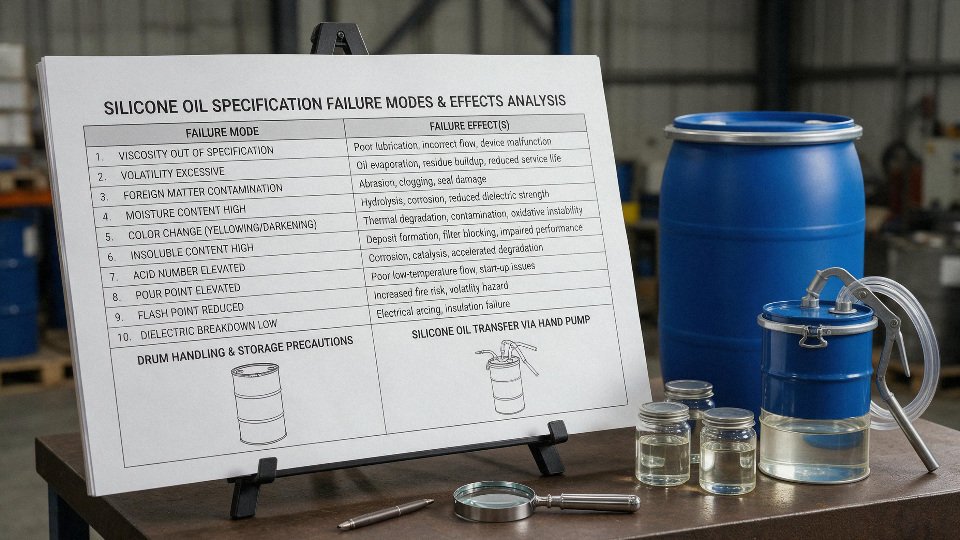
Frequent specification failures
Most silicone oil specification failures are not dramatic chemistry disasters. They are usually quieter: a viscosity shift that looks small on paper but throws off dosing, a volatile fraction that turns into odor or outgassing at temperature, a clean COA paired with the wrong revision or an unapproved process change. In practice, the costly failures are often the ones that pass basic incoming checks and only show up after the oil is inside the customer’s process.
That is why preventive control has to cover three points, not one:
- Source control: what the supplier actually makes, how tightly they hold the process, and whether they segregate grades properly.
- Handling control: repacking, storage, transfer, drum return, hose cleanliness, and exposure to heat or moisture.
- Use control: what happens once the fluid meets your substrate, additive package, seal material, or operating temperature.
Viscosity drift
Viscosity is usually the first number buyers lock onto, and it is one of the easiest ways a lot can go wrong.
Common causes include:
- Off-spec polymerization degree during manufacture
- Blending error between viscosity grades
- Thermal history, especially repeated heating or prolonged high-temperature storage
- Contamination during repacking, often from residual mineral oil, solvent, water, or previous product in a tote, pump, or flex hose
The mechanism matters. Silicone oil viscosity is strongly tied to molecular chain length and distribution; if the average chain length is low, the fluid comes in thin, and if high, it comes in heavy. A supplier can hit a nominal target on one batch and still show wider lot spread than your process can tolerate. That becomes a plant-floor problem in metering systems, spray application, release coatings, damping fills, and defoamer formulations, where flow behavior affects film weight, residence time, or bubble break.
A second failure path is more mundane: repacking. I have seen perfectly acceptable bulk material drift out of customer spec after moving through a shared gear pump and an unverified IBC line. The lab result then looks like a supplier issue, but the root cause is housekeeping.
Controls that actually help:
- Set an acceptance range at the application temperature reference, usually whatever your specification defines, commonly 25°C for datasheet comparison
- Require lot traceability from original manufacture through any repack step
- Verify whether the supplier uses dedicated or shared blending and filling equipment
- For critical uses, keep a retained sample and compare not just initial viscosity but post-heat or aging viscosity stability
The boundary here is simple: if your process is forgiving, a small viscosity deviation may not matter. If the oil is metered, atomized, or used as a formulation component at tight ratios, the same deviation can create scrap or rework quickly.
Excess volatiles
Low-boiling fractions are easy to underestimate because a drum can look clear and still be wrong for the job. Excess volatiles commonly show up as:
- Odor complaints
- Reduced flash point
- Weight loss during heating or curing
- Outgassing in enclosed assemblies
- Drift in process behavior in heat-sensitive applications
This is where “same chemistry” is not enough. Two dimethyl silicone fluids with similar nominal viscosity can behave very differently if one grade has tighter volatile control. In ovens, vacuum service, electronics assembly, or any application with confined headspace, that difference can become visible fast.
The trade-off is commercial as much as technical. Tighter volatile limits usually cost more because they require better stripping, fraction control, or grade segregation. Buyers who do not need heat stability should not overbuy. Buyers running elevated temperature, vacuum, optical, or odor-sensitive processes usually should.
Moisture and ionic contamination
Moisture is not always a problem for silicone oil by itself, but it can become one once the fluid enters a system.
Watch for these effects:
- Hydrolytic instability in moisture-sensitive formulations
- Dielectric performance loss in electrical uses
- Emulsion instability where the oil is later emulsified or compounded
- Interference with downstream chemistry, especially catalyst-sensitive systems
- Ionic residue issues where conductivity or corrosion risk matters
Water often enters after manufacture, not during it: poorly sealed drums, humid storage, unpurged headspace, wet transfer fittings, or condensation from temperature cycling. Ionic contamination is similar. A line flushed with plant water or a reused container can introduce enough residue to upset a sensitive process without making the oil visibly dirty.
Color, haze, gel particles, and insolubles
A silicone oil can meet viscosity and still fail on cleanliness or appearance.
Typical causes:
- Poor final filtration
- Oxidation from heat and air exposure
- Incompatible storage materials, liners, or seals
- Aged inventory
- Cross-contamination from another silicone, resin, or process fluid
For some uses, slight color is cosmetic only. For optical, personal care, electronics, and precision coating work, haze or fine gel is a genuine defect because it changes clarity, film uniformity, or surface behavior. Gel particles are especially troublesome because they may pass casual visual inspection in a drum sample but show up later as coating streaks, fish-eyes, or filter plugging.
Compatibility failures despite a similar datasheet
A common purchasing mistake is to assume that matching viscosity, density, and appearance means functional equivalence. It does not.
Frequent incompatibility points include:
- Elastomers and seals: swelling, shrinkage, softening, extraction
- Coatings and inks: cratering, adhesion loss, surface defects
- Substrates: poor wetting or migration
- Surfactant systems: phase separation or unstable emulsions
- Additive packages: catalyst poisoning, defoaming changes, or unexpected foam persistence
This is one of the harder failures to catch from paperwork alone. The oil can be fully within its own specification and still be wrong inside your formulation or assembly stack-up. For these cases, bench compatibility screening and a short process simulation beat any generic datasheet comparison.
Documentation nonconformance and “passes the lab, fails the line”
Documentation failures are procurement failures first and quality failures later. The usual patterns are:
- Wrong specification revision on the COA
- Incomplete lot genealogy or repack records
- Unsupported compliance declarations
- Unannounced raw material, process, or site change
- Missing retention sample policy or unclear shelf-life basis
A silicone oil lot can pass routine incoming tests and still be unsuitable for production if foam behavior, odor profile, or application stability are not controlled lot-to-lot.True
Routine release testing often covers viscosity, refractive index, density, moisture, acidity, flash point, and appearance, but those tests may not predict all use-specific behaviors. Where sensory profile, foam, or thermal application stability matter, the buyer usually needs an application-specific approval protocol rather than relying only on standard QC release data.
The less obvious failure mode is exactly that claim. Incoming lab work may confirm the usual release items, yet operators still complain that one lot foams longer, smells stronger in the oven, wets differently, or gives shorter bath life. That is not unusual in plants with heat, shear, surfactants, or sensitive downstream chemistry. If those behaviors matter, put them into the specification or approval process; otherwise they remain “uncontrolled properties,” and sooner or later one lot will remind you.
Frequently asked questions
Is there one universal standard for all silicone oils?
No. Silicone oil is a family, not a single product standard. What applies depends on the base chemistry, whether the fluid is straight PDMS or modified, the intended use, the market it enters, and the customer’s own specification stack.
A 100 cSt dimethyl silicone fluid used as a release aid, a heat-transfer medium, and a personal care ingredient may share some core property tests, but they do not sit under one universal approval framework. In practice, buyers get into trouble when they assume a generic “silicone oil standard” exists and stop checking application-specific requirements.
Does a viscosity grade alone define compliance?
Not even close. Viscosity is usually the first screening parameter, but it does not control volatile content, moisture, acidity, appearance, flash point, purity, or restricted-substance status.
Two fluids can both be sold as 350 cSt at 25°C and behave very differently in service. One may have tighter volatility control and better lot consistency; the other may drift in process because low-boiling fractions evaporate off, foam differently, or leave a different residue pattern. That matters in coating, defoaming, lubrication, and dielectric use. A viscosity grade identifies a window of flow behavior; it does not prove fitness, compliance, or interchangeability.
Which tests should appear on a certificate of analysis?
For routine industrial purchasing, the CoA should usually show the release tests that define the sold grade. Common items include:
- Viscosity at the stated reference temperature, often 25°C
- Appearance
- Density or specific gravity
- Refractive index
- Moisture or water content
- Acidity or acid value, where relevant
- Flash point, where part of the grade definition or safety review
- Sometimes volatile content, depending on grade and use
Not every product family uses the exact same panel. If the fluid is going into a sensitive application, ask whether the CoA values are lot-specific measured results or only typical values copied from the datasheet. Buyers miss that distinction all the time.
What documents are needed for export or import review?
That depends on country and use, but the usual review file includes:
- Safety Data Sheet
- Technical Data Sheet
- Certificate of Analysis
- Product specification
- Packing list and commercial invoice
- Transport classification information
- Statement of regulatory status for the destination market, where needed
- Origin or customs documents if required by the trade route
If your internal team is doing a formal approval, add change-notification expectations and a declaration on restricted substances where relevant. Customs and EHS are often looking at different things; treat them as separate checks.
Are cosmetic-grade and industrial-grade silicone oils interchangeable?
Usually no. A fluid sold into cosmetic or personal care channels may carry tighter controls on impurities, odor, appearance, residual cyclics, or documentation, while an industrial grade may be perfectly suitable mechanically but unsupported for that use.
The reverse can also fail commercially. A cosmetic-grade material may work in an industrial process, but the cost structure, packaging, and documentation burden may make no sense. You need the grade aligned to the end-use standard, not just the chemistry.
How do modified silicone oils change the standards picture?
They widen it. Once the silicone backbone is modified with polyether, alkyl, amino, epoxy, phenyl, or other functional groups, the applicable checks often shift beyond the base silicone-fluid tests.
Now you may care about:
– Active content
– Functional group level
– Compatibility with water, solvent, resin, or substrate
– pH stability or emulsion behavior
– Color, odor, or haze development
– Side-reaction risk in the customer’s process
A modified fluid can pass the standard release panel and still fail the application because the functional group changes wetting, migration, reactivity, or storage stability.
Does ISO 9001 mean the product is approved for my application?
No. ISO 9001 tells you the supplier runs a documented quality management system; it does not certify that a silicone oil meets your technical, regulatory, or end-use requirements.
That distinction matters in procurement. ISO 9001 can reduce process risk around traceability, document control, and corrective action, but it does not replace product qualification, incoming checks, or use-specific declarations.
ISO 9001 certification by itself does not prove a silicone oil is compliant for food, cosmetic, medical, or other regulated end uses.True
ISO 9001 covers the supplier's quality management system, not automatic approval of each product for every application or jurisdiction.
When should a buyer request additional impurity or restricted substance testing?
Request it when the consequence of contamination is expensive, regulated, or hard to detect in process. Typical triggers include:
- Personal care, food-contact-related, medical, or electronics-adjacent use
- Customer specifications naming restricted substances
- Export into markets with tighter chemical disclosure expectations
- High-temperature use where low boilers can cause fogging, odor, or residue
- Optical, coating, or release applications sensitive to trace contamination
- Supplier change, plant change, or unexplained lot-to-lot behavior
- Modified silicone oils where side-products or residual reactants matter
If you cannot tie the extra test to a use risk, skip it. If a failed batch would mean line stoppage, customer complaint, or blocked import clearance, the added lab cost is usually cheap insurance.
Your compliance verification checklist
If you want fewer surprises after PO placement, define compliance from the application backward, not from the datasheet forward. For silicone oil, the grade name is usually the easy part; the hard part is confirming which legal, technical, customer-specific, and documentation requirements actually govern the shipment you intend to buy, import, process, and release into production.
A workable checklist looks like this.
1) Start with end use before you name the product
A 100 cSt silicone oil can be acceptable in one plant and unusable in another, even when the basic fluid is the same chemistry. The decision flips on where it goes, what it touches, which country it enters, and what your customer forbids by contract.
Define these inputs first:
- Actual use in the process
- Lubricant, release aid, dielectric fluid, defoamer base, textile treatment, cosmetic ingredient, process aid, heat-transfer medium, or intermediate
- Continuous-contact use versus incidental contact
- Open process, closed loop, wipe-on, dip, spray, or metered addition
- Destination market
- Import country and final-use country if they differ
- Whether the product crosses multiple customs jurisdictions
- Whether the buyer needs language-specific or format-specific compliance documents
- Customer or industry restrictions
- Approved-substance lists
- Banned or restricted volatile fractions
- Odor, haze, residue, or extractables limits
- Automotive, electronics, medical, personal care, food-related, or other sector-specific expectations
- Exposure and contamination sensitivity
- Does the oil contact a substrate directly?
- Can low-molecular-weight fractions migrate, fog, bleed, or interfere with downstream coating, bonding, printing, or electrical performance?
- Is the line clean enough to detect a small moisture or particle excursion, or are you running a forgiving bulk process?
In practice, this is where many buying errors start. Procurement asks for “dimethyl silicone oil, 350 cSt,” but the line really needs a narrow volatility profile, low moisture, and a change-control agreement because the fluid sits upstream of a sensitive coating step.
2) Build a standards matrix instead of one mixed specification
Do not combine legal, performance, and supplier-preference items into one undifferentiated requirement list. That makes supplier comparison messy and invites arguments later about what was mandatory versus merely desirable.
Use a matrix with three columns:
| Requirement group | What belongs here | Typical decision use |
|---|---|---|
| Mandatory legal and market-entry compliance | SDS, labeling, transport classification where applicable, regional chemical inventory status, restricted-substance declarations, import documentation | Shipment can legally move, clear customs, and be used in the destination market |
| Application performance requirements | Chemistry type, viscosity at stated temperature, volatility limits, moisture, appearance, flash point where relevant, impurity caps, compatibility requirements | Product will actually perform in the process without scrap, residue, or instability |
| Preferred supplier qualifications | COA format, lot traceability, retention sample practice, response time for deviations, change notification period, packaging options, supply continuity | Supplier can support production reliably over time |
That separation matters commercially. A supplier may fully satisfy legal compliance and still be a poor fit because their batch-to-batch control is loose, their document package is incomplete, or their packaging creates handling contamination in your plant. On the other hand, a premium supplier with excellent systems is still the wrong choice if they cannot document the destination market status you need.
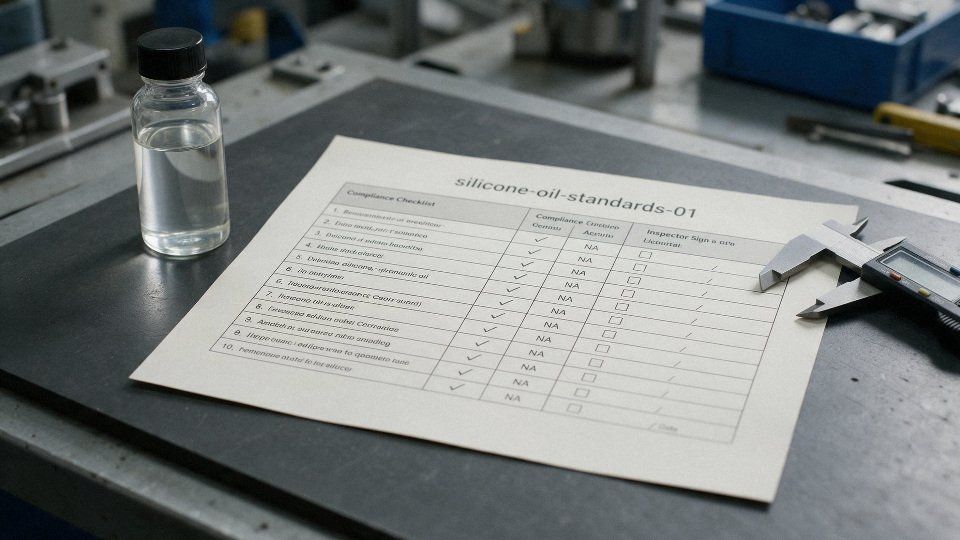
3) Lock the acceptance items that actually control fit
Some properties are nice to know. Others decide whether the batch can enter production. Write acceptance criteria in measurable form, tied to a test method or supplier release method, and tied to the delivery unit.
At minimum, decide these items before RFQ or sample approval:
- Chemistry type
- PDMS or another silicone fluid family
- Linear, modified, reactive, or specialty grade if relevant
- Any explicit exclusion of additives, fillers, catalysts, or residuals
- Viscosity window
- State the target and allowable range
- State the reference temperature, often 25°C
- Do not compare values measured at different temperatures as if they were equivalent
- Volatility
- Especially important for electronics, coatings, textile finishing, mold release, and enclosed systems
- Low-volatility grades usually reduce fogging, weight loss, and residue migration, but often cost more and may tighten supply options
- Moisture
- Critical where hydrolytic sensitivity, foaming, dielectric behavior, or downstream reaction stability matters
- Moisture pickup can occur after manufacture, so packaging and warehouse discipline matter almost as much as plant production
- Appearance
- Clear, free of haze, free of visible particles, or other stated standard
- This is not cosmetic if your process depends on optical clarity or clean wetting
- Impurity caps
- Acidity, ionic contamination, residual volatiles, metals, particulates, or other application-driven limits
- Do not invent broad impurity requirements if your process does not need them; test only what creates real risk
- Packaging
- Drum, pail, IBC, or bulk
- Liner type, seal integrity, cleanliness expectation, palletization, and labeling
- A good fluid packed badly still becomes a plant problem
- Required documents
- COA, SDS, TDS, declaration statements, change-control commitment, origin documents if needed for trade, and any customer-specific forms
The mechanism here is straightforward: the fluid leaves the supplier within spec, then handling introduces risk through headspace moisture, dirty transfer pumps, open drum time, or relabeling errors. That is why a technically correct specification without packaging and document controls is only half a specification.
4) Ask for lot-level evidence, not brochure language
Generic claims such as “high purity,” “stable quality,” or “complies with international standards” do not support release decisions. What you need is lot-linked evidence and a commitment about what happens if the supplier changes raw materials, process conditions, manufacturing site, or analytical method.
Request these items:
- Recent lot COAs
- Preferably several lots, not just one selected sample
- Check whether the reported values cluster tightly or simply fall inside a broad limit
- Test-method identification
- Internal method number or recognized external method where applicable
- Clarify whether the method is release-critical or informational only
- Change-control statement
- Notification period for formula, process, plant, packaging, or spec changes
- Requalification trigger for your approved status
- Traceability
- Batch coding structure
- Retention sample policy
- Complaint and CAPA handling route
- Shelf-life and storage conditions
- Supported by data or established company practice
- Not just a generic “store in a cool dry place” line
A silicone oil specification is complete once viscosity and basic compliance documents are confirmed.False
That is rarely enough for industrial sourcing. Volatility, moisture, impurities, packaging, lot evidence, and change control often decide whether the product remains acceptable in the actual process and across repeat orders.
5) Validate in the actual process, not only on paper
A paper-compliant silicone oil can still fail in service. The usual failure path is not dramatic chemistry; it is a mismatch between the fluid and the operating window: temperature cycling, substrate interaction, residue sensitivity, pump shear, or long dwell time on the part.
Run a fit-for-use check that reflects your line:
- Process temperature profile
- Ambient only, heated, cyclic heating, or sustained high-temperature exposure
- Volatility and residue behavior often change faster with temperature than buyers expect
- Substrate compatibility
- Metals, elastomers, plastics, coatings, textiles, paper, glass, electronic assemblies
- Swelling, poor adhesion, surface defects, or transfer contamination can appear only after contact time
- Contamination sensitivity
- Optical parts, paint lines, bonding operations, and electronic assemblies are much less forgiving than general mechanical applications
- Application method
- Spray, dip, wipe, metered feed, recirculation, or immersion
- The preferred grade can change with delivery method because misting, carryover, and fluid loss change the economics
- Line-side handling
- How the container is opened, dispensed, filtered, resealed, and identified
- In many plants, the transfer cart and pump are the weak link, not the supplied material
This section’s main conclusion stops holding if your use is heavily regulated by a sector-specific approval system that requires formal third-party qualification beyond routine industrial documentation. In that case, supplier self-declarations and internal COAs are only part of the path; the approval route itself becomes the gating item.
6) Shortlist suppliers that can support both quality and paperwork
Price gaps between silicone oil suppliers often look small until a shipment is held for missing declarations, a line trial slips because COAs arrive late, or a formulation change shows up without notice. For international industrial trade, document discipline is part of product quality.
Shortlist suppliers against both operational and commercial criteria:
- Consistent manufacturing and release control
- Clear, complete, lot-specific documentation
- Ability to support destination-market compliance questions
- Stable packaging quality and export readiness
- Defined change-notification practice
- Responsive technical contact who can answer application-specific questions
- Willingness to review customer specifications before order acceptance
If you are narrowing sources now, send the application, destination market, required documents, substrate material, contaminant or sensitivity concern, approximate operating temperature range, and target viscosity grade or working window. SiliconChemicals can review those inputs, recommend an appropriate silicone oil grade, and check the documentation package needed for your intended market and use.