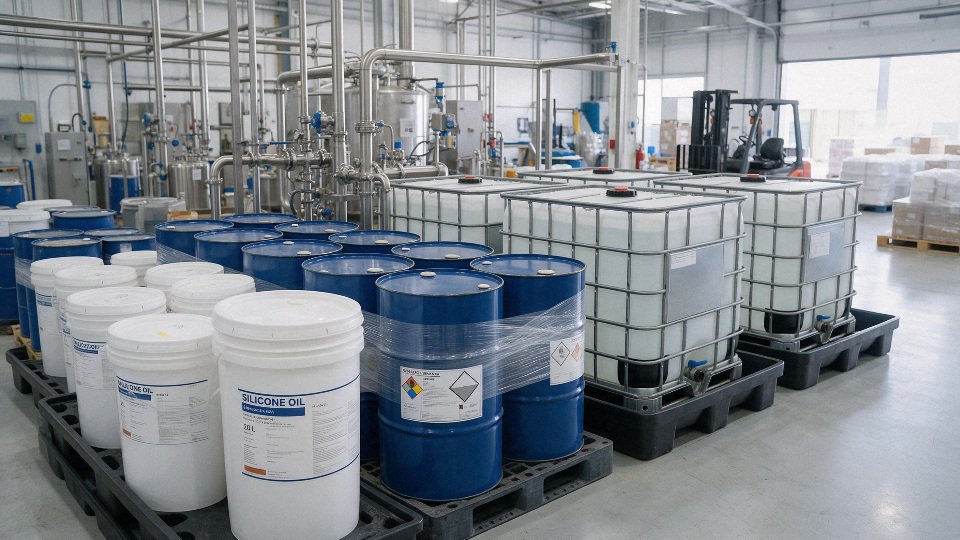

Procurement teams shipping silicone-oil-lubricated components into EU markets get caught off guard more often than they should. A compliance hold at customs, a last-minute request for substance declarations from a Tier-1 automotive customer, or a failed RoHS audit on a finished assembly — any of these can stall a product launch by weeks and trigger re-qualification costs that run well into five figures. The root confusion is almost always the same: engineers assume “silicone” means “safe,” but they haven’t actually traced what’s in the formulation beyond the base fluid.
Neat silicone oil — polydimethylsiloxane (PDMS, CAS 9006-65-9) — is not a restricted substance under RoHS Directive 2011/65/EU. None of the ten listed hazardous substances apply to pure PDMS, so a compliant base fluid will clear RoHS thresholds without special treatment. The compliance risk lives in the additive packages, stabilizers, and cross-linkers blended into commercial grades, not in the silicone oil molecule itself.
What makes this trickier in practice is that most industrial silicone oils — transformer-grade, heat-transfer, damping fluids — aren’t sold as pure PDMS. They arrive with viscosity modifiers, antioxidants, or metal-deactivator packages that the supplier may not fully disclose on a standard TDS. Understanding exactly where the line between “inherently compliant” and “needs verification” actually falls requires a closer look at how RoHS is applied at the homogeneous material level, and which additive categories are historically the ones that cause problems.

What RoHS Actually Restricts: The Ten Substances and Their Thresholds
The directive itself is more surgical than most engineers expect. RoHS 2011/65/EU doesn’t restrict classes of chemistry broadly — it names ten specific substances, sets concentration thresholds in homogeneous materials, and ties those restrictions to electrical and electronic equipment (EEE) placed on the EU market. Everything else is out of scope, which is why the question “is this silicone oil RoHS compliant?” requires you to work through the list methodically rather than rely on a supplier’s blanket declaration.
| Substance | Symbol / Abbreviation | Threshold (wt%) | Threshold (ppm) | Typical industrial source relevant to lubricants and fluids |
|---|---|---|---|---|
| Lead | Pb | 0.10 | 1,000 | Legacy heat stabilizers in PVC-jacketed cables; some older anti-wear additive packages |
| Mercury | Hg | 0.10 | 1,000 | Fluorescent lamp components; historically in some tilt-switch assemblies; rarely in fluid formulations |
| Cadmium | Cd | 0.01 | 100 | Plating on metal hardware; cadmium-based pigments; occasional stabilizer in older PVC compounds |
| Hexavalent chromium | Cr(VI) | 0.10 | 1,000 | Chromate corrosion inhibitors in coolants and some hydraulic fluid packages — a real risk in blended industrial fluids |
| Polybrominated biphenyls | PBB | 0.10 | 1,000 | Flame retardants in polymer housings; not typically added to oils, but contamination via recycled base stocks is theoretically possible |
| Polybrominated diphenyl ethers | PBDE | 0.10 | 1,000 | Same flame-retardant family as PBB; deca-BDE has appeared in polymer-extended lubricating oils in legacy formulations |
| Bis(2-ethylhexyl) phthalate | DEHP | 0.10 | 1,000 | Plasticizer in flexible polymer seal compounds and some carrier fluids; the phthalate most commonly found in lubricant additive packages |
| Butyl benzyl phthalate | BBP | 0.10 | 1,000 | PVC flooring adhesives and some specialty sealant carriers; lower risk in fluid formulations but not zero |
| Dibutyl phthalate | DBP | 0.10 | 1,000 | Ink carriers, adhesive formulations; occasionally used as a viscosity modifier in older lubricant blends |
| Diisobutyl phthalate | DIBP | 0.10 | 1,000 | Added to RoHS via Delegated Directive 2015/863; chemically similar to DBP; check formulation dates — pre-2019 SDS may not flag it |
Cadmium’s threshold sits at 100 ppm, ten times tighter than the others. That asymmetry trips up engineers who assume one limit applies across the board.
The Homogeneous Material Rule and Why It Changes Everything for Blended Oils
“Homogeneous material” is the phrase that actually does the compliance work here. The directive defines it as a material that cannot be mechanically disjointed into different materials — meaning you can’t spin-separate, filter, or physically strip the constituent phases apart. For a single-component PDMS fluid this is straightforward: there’s one material, and PDMS itself contains none of the ten restricted substances. But most industrial silicone oils above roughly 100 cSt aren’t sold as pure PDMS. They arrive blended with antioxidants, corrosion inhibitors, anti-foam agents, and viscosity-index improvers, and those additive packages can each constitute a distinct homogeneous material under the directive. Each one must be assessed independently against the thresholds. A fluid that is 99.5% compliant PDMS and 0.5% additive package with a chromate inhibitor is not RoHS compliant — the additive phase almost certainly breaches 1,000 ppm Cr(VI) on its own.
In practice, the chromate and phthalate entries in the table above are the live risk zones for silicone fluid procurement. Lead-based stabilizers and PBDEs are primarily historical — you’re more likely to encounter them in legacy stock than in anything formulated in the last decade — but DEHP and Cr(VI) inhibitors are still present in some heat-transfer fluid packages sold today, particularly from suppliers outside the EU where RoHS compliance was never the design constraint.
What RoHS Scope Actually Covers — and What It Doesn’t
The directive applies to EEE placed on the EU market, and that scope extends to substances within finished products — including process fluids that remain in the product after manufacture. A silicone oil used as a permanent dielectric coolant inside a sealed transformer module, or as a damping fluid in an electronic sensor assembly, is in scope. It becomes part of the article. A silicone mold release agent that is fully cleaned off the product before it ships is generally considered a manufacturing process aid and falls outside RoHS scope, though you’ll want that “fully removed” status documented rather than assumed, because customs and market surveillance authorities have asked for that evidence.
Silicone oils used only as manufacturing process aids that are completely removed before the product reaches the end customer are generally out of RoHS scope.True
RoHS 2011/65/EU restricts substances in homogeneous materials of finished EEE. A process fluid that does not remain in the final product is not part of the article placed on the market. However, 'completely removed' must be demonstrable — verbal assurance is not enough for a technical file.
One thing worth being explicit about: RoHS does not restrict cyclic siloxanes D4, D5, or D6, nor does it address silanol end-groups or SVHC substances under REACH. Those compounds are regulated under separate EU frameworks — REACH restriction entries and the EU POPs Regulation — and conflating them with RoHS is a common error that shows up in supplier questionnaires regularly. If a compliance team is asking you whether your silicone oil is “RoHS and REACH compliant” in the same breath, those are two separate assessments requiring separate documentation chains.
Polydimethylsiloxane Chemistry: Why the Base Polymer Passes RoHS by Default
At the molecular level, polydimethylsiloxane is disarmingly simple. The backbone is an alternating silicon-oxygen chain — Si-O-Si-O — with two methyl groups hanging off each silicon atom. That’s it. The repeating unit formula is (C₂H₆OSi)ₙ, and the full elemental inventory of a neat PDMS fluid is exactly four elements: silicon, oxygen, carbon, and hydrogen. Cross every one of those against the RoHS restricted substance list — lead, mercury, cadmium, hexavalent chromium, PBB, PBDE, DEHP, BBP, DBP, DIBP — and you get zero matches. Not one of those ten substances has any chemical relationship to a pure PDMS chain.
This is why a base-polymer RoHS compliance claim for silicone oil is technically defensible without extensive testing, provided the fluid really is pure base polymer. In practice, it almost never is — but we’ll get to that.
Catalyst Residues: Platinum and Tin Are Not the Enemy Here — But Know What You Have
Silicone polymerization and cure systems rely on catalysts, most commonly platinum-based hydrosilylation catalysts or organotin compounds, and occasionally organic peroxides. Trace levels of these can survive into finished fluids depending on the purification process — typically in the range of a few ppm to perhaps 20–30 ppm in less rigorously stripped grades, though premium electronic-grade fluids are often processed well below 5 ppm catalyst residual.
Here’s the practical relief: neither platinum nor tin appears on the RoHS restricted substance list. So even if your silicone fluid carries residual dibutyltin dilaurate from a condensation cure process, that tin compound does not trigger a RoHS threshold exceedance.
It does, however, potentially trigger REACH SVHC obligations depending on the specific organotin species and concentration. Dibutyltin compounds have been on the SVHC candidate list, and if your supplier is using tin-based catalysts, you want that disclosed in the Safety Data Sheet. This is a separate regulatory track from RoHS, but procurement managers often conflate the two — worth flagging internally when you’re building your compliance documentation package.
Phenyl-Modified Grades: Still Clean at the Polymer Level
Phenylmethylpolysiloxane — the phenyl-modified variant used in high-temperature applications, optical fluids, and certain damping applications — substitutes phenyl rings (C₆H₅) for some of the methyl groups on the silicon backbone. This increases molecular weight, raises refractive index, and extends the useful temperature range, sometimes to 250°C and above. From a RoHS standpoint, it changes nothing. You’ve added more carbon and hydrogen atoms, both of which are unrestricted. The base polymer remains elementally clean.
Where the Chemistry Gets Complicated: Greases, Gels, and Compounded Fluids
Pure silicone fluid and silicone grease are not the same product, and treating them as equivalent for compliance purposes is a real mistake that shows up in supplier audits.
Silicone greases incorporate thickeners — fumed silica is common and harmless, but lithium soap thickeners, PTFE, or metallic soap systems introduce ingredients that need their own assessment. Some specialty greases use zinc oxide or other inorganic fillers as thermal conductivity enhancers, and zinc compounds require checking against RoHS even if zinc itself isn’t restricted, because formulation impurities in lower-grade filler materials occasionally carry cadmium contamination at levels that can approach the 100 ppm threshold in the homogeneous material.
Silicone gels, particularly two-part systems, may retain crosslinker residues from platinum or peroxide cure systems, and any reactive diluents or adhesion promoters added to the formulation need independent evaluation.
The rule of thumb I’d apply: the further a product is from “neat PDMS fluid,” the longer your compliance checklist gets.
Analytical Methods That Actually Hold Up in Documentation
When you need to support a compliance claim in technical documentation — an IPC-1752A form, a customer declaration, or an internal materials review — there are three methods that carry weight.
X-ray fluorescence (XRF) screening is fast and inexpensive, typically used as a first-pass screen for heavy metals including lead, cadmium, mercury, and chromium. Handheld XRF devices give you a result in seconds on the production floor, though detection limits are usually around 10–50 ppm depending on the matrix and instrument, which means it won’t catch marginal cadmium contamination on its own.
ICP-OES (inductively coupled plasma optical emission spectrometry) is the method you use when XRF flags something or when you need verified low-level trace metal data. Detection limits drop to sub-ppm territory, and it’s the standard confirmatory method for restricted metals in homogeneous material testing.
GC-MS handles the organic restricted substances — the phthalates (DEHP, BBP, DBP, DIBP), PBBs, and PBDEs. These are irrelevant to the base PDMS polymer, but if your silicone fluid contains any ester-based plasticizer or flame retardant additive, GC-MS is the tool you need.
Pure PDMS contains no RoHS-restricted elements, making the base polymer inherently compliant with RoHS 2011/65/EU without any restricted substance thresholds applying.True
The empirical formula (C₂H₆OSi)ₙ contains only silicon, oxygen, carbon, and hydrogen — none of which are among the ten restricted substances defined in RoHS 2011/65/EU and its amendments. This is verifiable by elemental analysis (ICP-OES or XRF) of a purified PDMS fluid.
The base polymer argument is solid. The question is always whether what’s in the drum is actually just base polymer.
Where Compliance Risk Actually Lives: Additives, Stabilizers, and Contaminants in Commercial Silicone Oil Formulations
Pure PDMS passes RoHS by default — but nobody buys pure PDMS off a drum. Commercial silicone oil grades are formulations, and that distinction matters enormously when you’re completing a Declaration of Conformity for a product destined for the EU market.
Antioxidants and Thermal Stabilizers
This is the highest-risk category in high-temperature and transformer-grade oils, and it’s where older inventory can quietly burn you. Lead naphthenate and lead octoate were workhorses in legacy thermal stabilizer packages through the 1990s and into the early 2000s — effective, cheap, and now squarely prohibited under RoHS (lead threshold: 0.1 wt% in any homogeneous material). Modern formulations have largely moved to hindered phenol systems or amine-based antioxidants, which are RoHS-clean when properly sourced.
The operational warning here: if your facility has been drawing from the same 200 L drum stock for an extended period, or if you’re sourcing from a regional distributor with deep inventory, you cannot assume the current batch matches the current SDS. Reformulations don’t always propagate cleanly through the supply chain. Request the manufacture date and lot-specific test data, not just the current product sheet.
Flame Retardants in Dielectric Grades
Specialty dielectric silicone fluids sometimes carry flame-retardant additive packages, and historically those packages leaned on brominated compounds — PBB and PBDE families specifically, both restricted under RoHS with the same 0.1 wt% threshold. If a fluid is marketed as “flame-retardant grade” or “FR-rated,” that phrasing alone should trigger a verification step.
Compliant alternatives do exist and are widely used: alumina trihydrate (ATH), magnesium hydroxide, and certain phosphorus-based systems can deliver flame resistance without halogenated chemistry. Ask specifically which flame-retardant mechanism the product uses. A vague answer is a red flag worth acting on.
Pigments and Colorants
Most industrial silicone oils are colorless or pale yellow and carry no intentional pigment. But dyed identification grades exist — color-coded maintenance oils, visual leak-detection fluids — and the pigment choice matters. Lead chromate (yellow, orange) and mixed-phase chromate pigments are prohibited. Carbon black and most organic pigments are generally fine, but cadmium-based reds and oranges require explicit verification given the tighter 0.01 wt% threshold for cadmium.

Phthalate Plasticizers in Blended Products
Neat silicone oil has no structural reason to contain phthalates — PDMS doesn’t need a plasticizer. The risk appears in blended or extended fluids: silicone-mineral oil mixtures, polymer-thickened damping fluids, or compounded lubricants where the formulator borrowed from conventional lubricant chemistry. DEHP, DBP, BBP, and DIBP are all RoHS-restricted (each at 0.1 wt%), and they appear in some of these hybrid formulations because they were already qualified in the base lubricant recipe.
If a product is described as a “silicone blend,” “compounded silicone fluid,” or anything other than straight PDMS or PDMS with a defined additive package, phthalate screening is warranted.
Contamination from Packaging and Dispensing Equipment
This one gets missed more often than it should. Silicone oil is a good solvent for plasticizer migration. Flexible PVC tubing — the kind that shows up on drum pumps, fill lines, and transfer hoses in most plants — can leach phthalates directly into the fluid. The silicone oil itself may be fully compliant out of the supplier’s facility and arrive non-compliant at your incoming quality dock because of how it was handled internally.
The fix is straightforward: use HDPE, stainless steel, or PTFE-lined fittings for silicone oil transfer. Validate with incoming XRF or ICP screening if the fluid feeds into a regulated assembly line.
A supplier's RoHS declaration alone is sufficient evidence of compliance for silicone oil used in regulated products.False
A declaration of conformity is a starting document, not a complete verification. It must be backed by formulation-level SDS review, identification of all additive packages, and ideally third-party analytical data (XRF or ICP-MS) for substances of concern — particularly lead, cadmium, and any halogens from flame retardants or pigments.
What to Actually Require from Your Supplier
At minimum, procurement and quality teams should be pulling three documents for each commercial silicone oil grade used in a regulated product: a full formulation SDS that identifies additive chemistry (not just hazard classifications), a RoHS Declaration of Conformity that explicitly references Directive 2011/65/EU and its current amendment status, and third-party analytical test data — XRF screening is a reasonable first pass; ICP-MS gives you the elemental quantification you need if anything in the SDS is ambiguous or if the fluid is a blend. Supplier-generated test data is acceptable but carries less weight during an audit. Independent lab data is worth the modest cost, usually somewhere in the range of $150–$400 per sample depending on the test scope and turnaround requirement.
Reading a Silicone Oil RoHS Declaration: What a Valid Compliance Document Must Contain
A supplier handing you a one-page letter with “RoHS Compliant” printed at the top is not giving you a compliance document. It’s giving you a marketing gesture. The difference matters — especially if your product is placed on the EU market and you need to defend that technical file five years from now during a customs challenge or a customer audit.
What a Credible Declaration Must Actually Say
The directive citation should read 2011/65/EU — and ideally reference the most recent delegated amendment that brought the four phthalates (DEHP, BBP, DBP, DIBP) into scope. A document that cites only 2002/95/EC is telling you, inadvertently or not, that it was either written before 2019 or simply copied from an older template. Either way, it hasn’t been reviewed against the current ten-substance list, which is a hard red flag for any silicone oil that contains plasticizer-adjacent additives or processing aids.
Every credible declaration must list all ten restricted substances by name — not “heavy metals and phthalates” as a catch-all phrase — and state explicitly that each substance falls below its threshold in every homogeneous material. That phrasing matters. “Below threshold in the product” is weaker than “below threshold in every homogeneous material,” because RoHS concentration limits apply at the homogeneous material level, not the finished product level. A supplier conflating these two is either careless or hoping you won’t notice.
The signatory line needs a name, job title, and a statement of authority to bind the company. Unsigned declarations, or ones signed by a sales coordinator with no stated authority, are worth almost nothing in a dispute.
‘RoHS Compatible’ Is Not a Compliance Statement
Watch for softening language. “RoHS compatible,” “RoHS ready,” “designed to meet RoHS requirements” — none of these confirm conformance. They suggest the product could comply under certain conditions, which is a very different thing. In practice, this language often appears on technical data sheets for specialty blended fluids where the formulator hasn’t actually run full analytical testing on the additive package. It’s not necessarily bad faith; sometimes it’s just that the product was developed for a non-EU market and the compliance paperwork never caught up.
If the declaration lacks third-party test data specifically for phthalates, that’s a gap worth pushing on, particularly for transformer-grade or heat-transfer silicone oils in the 50–500 cSt range where ester-based co-additives sometimes appear.
DoC, Declaration of Compliance, and FMD — They Are Not Interchangeable
The Declaration of Conformity (DoC) is the legally required EU document. It’s what the responsible party signs when placing EEE on the EU market. A Declaration of Compliance — sometimes called a supplier declaration — is what your silicone oil vendor provides to you; it’s not itself a regulatory document but it feeds into yours.
A Full Material Disclosure (FMD) goes further. It lists all substances present above a specified reporting threshold — typically 0.1 wt% — across the full formulation. FMDs aren’t legally required, but they’re genuinely useful because they let your compliance team audit the formulation rather than just trust a pass/fail assertion. For complex blended fluids, an FMD can surface proprietary additive families that wouldn’t otherwise appear in a standard declaration.
A Declaration of Compliance from your silicone oil supplier is sufficient on its own to satisfy EU RoHS requirements for your finished product.False
The supplier's Declaration of Compliance is input evidence only. The OEM or importer placing the EEE on the EU market must issue their own Declaration of Conformity under 2011/65/EU and retain supporting technical documentation — including the supplier's declaration — for ten years after the last unit is sold.
IPC-1752A and IEC 62474: Structured Data Your BOM System Can Actually Use
If you’re working with EMS providers or running any kind of automated compliance verification against a bill of materials, IPC-1752A Class D declarations and IEC 62474 database submissions are significantly more useful than PDF letters. They’re machine-readable, structured to the homogeneous material level, and can be ingested directly into tools like BOMcheck or Assent Compliance without manual re-entry. Class D specifically requires substance data at the homogeneous material level with full coverage of all RoHS substances — it’s the format that holds up under scrutiny.
The Ten-Year Technical File Obligation
If silicone oil is a constituent material of an EEE product you’re selling into the EU, you are required to retain evidence of its RoHS status in your technical documentation file for ten years after the last unit ships. That means keeping the dated supplier declaration, any associated test reports, and — if you changed suppliers mid-production run — documentation covering each supplier’s material. A single letter from your current supplier doesn’t cover batches sourced from a previous one.
RoHS Exemptions That May Apply to Silicone Oil Applications in Electronics
The exemption framework inside RoHS 2 is genuinely confusing, even for engineers who’ve been filing compliance documentation for years. The short version: exemptions are application-specific and time-limited, not blanket material clearances. They live in two annexes. Annex III covers general application-based exemptions across most EEE categories. Annex IV is narrower — it applies exclusively to medical devices (Category 8) and monitoring and control instruments (Category 9). Neither annex exempts a material outright; they exempt a specific use of a specific substance in a specific product context.
Exemptions also expire. The European Commission issues renewal decisions on a rolling basis, and a supplier’s compliance file that was accurate in 2021 may be referencing a lapsed exemption today. That’s not a hypothetical — it happens in practice, especially with smaller component suppliers who update their documentation infrequently.
Why Exemption 7(a) Is Worth Understanding, Even Though It Doesn’t Apply Here
Exemption 7(a) — lead in high-melting-point solders (lead alloys containing 85% or more lead by weight) — has nothing to do with silicone oil. It’s worth mentioning precisely because it illustrates the logic of the whole system. The exemption doesn’t say “lead is acceptable.” It says lead in that form, in that application, is permitted because a technically and economically feasible substitute hasn’t been qualified. That application-specificity is the mental model you need when evaluating any exemption claim a supplier drops into a datasheet.
Where Exemptions Become Relevant in Silicone Oil Applications
Silicone oil itself doesn’t need an exemption — PDMS base chemistry contains none of the ten restricted substances, so there’s nothing to exempt. The complication arises when silicone oil is a functional component inside a larger assembly that does contain restricted substances, and the equipment manufacturer needs to build a complete system-level compliance file.
Consider a tilt sensor used in industrial control equipment: silicone oil provides the damping fluid, but the sensor housing might incorporate lead-containing piezoelectric ceramics, or the calibration assembly might reference mercury-containing electrodes. These components fall under Category 9 (monitoring and control instruments) in the RoHS scope definitions, and they’re fully in scope — no automatic exclusion just because the equipment is “industrial.” The silicone oil supplier may be asked to contribute a material-level RoHS declaration to support the OEM’s Annex IV exemption claim for the piezo element or the electrode.

Category 11 (“all other EEE not covered by Categories 1–10”) is the catch-all, and silicone-oil-filled hydraulic dampers used in industrial electronics assemblies typically land here. If the damper assembly contains any lead, cadmium, or hexavalent chromium — in a seal coating, a plated surface, or a solder joint — the manufacturer needs a valid, current exemption or must demonstrate RoHS conformity through reformulation.
Checking Current Exemption Status
Don’t rely on a supplier’s PDF. Exemption status changes, and the only authoritative sources are EUR-Lex (the official EU law database, where consolidated RoHS amendments are published) and the ECEEE RoHS exemption tracker, which logs renewal requests, commission decisions, and expiry dates in a searchable format. Roughly speaking, most active Annex IV exemptions run on four-to-seven-year renewal cycles, though the actual duration depends on the specific exemption and when it was last reviewed.
Silicone oil itself currently requires no RoHS exemption because PDMS and its standard processing aids contain none of the ten restricted substances.True
PDMS (CAS 9006-65-9) is a silicon-oxygen backbone polymer with methyl side groups; it contains no lead, mercury, cadmium, hexavalent chromium, PBBs, PBDEs, DEHP, BBP, DBP, or DIBP at any processing stage. Compliance risk in commercial formulations comes from additive packages, not the base polymer.
In practice, the engineer responsible for the system-level technical file needs to treat silicone oil as a clean input while actively tracking the exemption status of every other restricted substance co-located in the assembly. Those exemptions expire. Building a reminder into your document control calendar — quarterly at minimum, honestly — is the kind of maintenance habit that prevents a scramble when a renewal lapses and a key customer requests an updated DoC.
Silicone Oil RoHS Compliance Across Major Global Markets: EU, UK, China RoHS, and Beyond
If you’re manufacturing one product and selling it into five markets, you don’t get to pick one standard and call it done. The same silicone-oil-lubricated assembly destined for Frankfurt, Shenzhen, Mumbai, and a California distributor needs to satisfy four overlapping — but not identical — regulatory frameworks. Understanding where they agree and where they diverge saves you from either over-engineering your compliance paperwork or, worse, getting a shipment held at customs because your declaration cited the wrong statutory instrument.
UK RoHS: Mostly a Mirror, But Watch the Marking Language
Post-Brexit, the UK transposed EU RoHS 2 directly into national law as SI 2012/3032 (as amended through the Product Safety and Metrology etc. (Amendment etc.) (EU Exit) Regulations). In practice the substance list, the thresholds, and the four phthalates added in 2019 all carried over unchanged. A compliance declaration already written for the EU market is almost always technically valid for the UK — the underlying chemistry is the same.
What trips people up is administrative, not chemical. UKCA marking requires that your Declaration of Conformity references the UK statutory instrument, not Directive 2011/65/EU. Suppliers sending a declaration that reads “compliant with RoHS Directive 2011/65/EU” to a UK-bound product line are technically issuing a document that doesn’t satisfy the UK importer’s legal obligation, even if the silicone oil itself would pass both regimes without question. A simple dual-reference declaration — citing both the EU directive and SI 2012/3032 — handles both markets with one document, and most competent suppliers will provide this if you ask explicitly.
China RoHS: Same Six Substances, Different Paperwork Architecture
China RoHS (primarily GB/T 26572-2011 for concentration limits and SJ/T 11364-2014 for marking) covers the original six EU RoHS 1 substances: lead, mercury, cadmium, hexavalent chromium, PBB, and PBDE. The thresholds mirror the EU’s. For silicone oil used in electronic products, the base PDMS presents zero concern, and a well-documented EU-compliant formulation will meet the concentration requirements without modification.
The structural difference is disclosure. China RoHS requires a hazardous substance table — sometimes called an EFUP table — either on the product itself or in the accompanying documentation, showing whether each restricted substance is present above threshold in each homogeneous material. This isn’t optional for products on the regulated catalog. Practically speaking, if your silicone oil supplier can provide a substance disclosure table broken down by material type, you can incorporate that directly into your finished product declaration. Many don’t provide this without prompting, so build it into your supplier qualification questionnaire from day one.
The four phthalates are not currently restricted under China RoHS as of this writing, though they appear in Phase 2 catalog discussions. If your product line has any longevity — or if you’re qualifying a new supplier now and don’t want to redo the paperwork in two years — get phthalate data on your silicone oil now anyway.
India, Japan, and US State-Level Frameworks
India’s E-Waste Management Rules 2022 effectively adopt the EU’s ten-substance list for electrical and electronic equipment. Compliance documentation prepared to EU RoHS 2 standard transfers directly. In practice, the enforcement infrastructure in India is still maturing, but the legal requirement exists, and multinational manufacturers operating under ISO 14001 or similar systems should be documenting compliance regardless.
Japan’s J-MOSS (JIS C 0950) operates on a disclosure rather than restriction model for many applications. If your silicone oil is a sub-component inside a product that falls under a J-MOSS covered category, the obligation lands on the finished product manufacturer to declare the substance content — not on the silicone oil supplier directly. You need the material data from your supplier; they don’t need to produce a J-MOSS certificate for the oil itself.
California Proposition 65 overlaps with RoHS substances — lead, cadmium, and DEHP all appear on the Prop 65 list — but the framework is entirely different. RoHS works on concentration in a homogeneous material; Prop 65 works on exposure, specifically whether a product causes exposure above a safe harbor threshold. A product can be RoHS-compliant and still trigger a Prop 65 warning obligation, depending on how the substance can migrate or off-gas in use. For silicone oil specifically, DEHP isn’t a native component of PDMS, but if an additive package contains any phthalate plasticizer, your US legal team needs to look at this separately from the EU compliance file.
A supplier RoHS declaration that meets EU 2011/65/EU automatically satisfies UK, China, and US Prop 65 requirements without modificationFalse
Each jurisdiction has distinct documentation requirements, marking obligations, and in some cases different substance scopes. EU compliance is a strong starting point but does not substitute for jurisdiction-specific declarations.
The Practical Answer: One Harmonized Full Material Disclosure
Rather than managing four supplier questionnaire formats and chasing jurisdiction-specific certificates every time a product revision triggers a re-evaluation, the most operationally efficient approach is to require a Full Material Disclosure (FMD) for each silicone oil grade you use. An FMD lists all ten RoHS substances, reports measured or verified concentrations, and — if the supplier is doing it properly — also covers Prop 65 reportable substances and provides the substance-by-material breakdown China RoHS needs for the EFUP table.
One document. Most major market requirements satisfied. When a new jurisdiction adds a substance or lowers a threshold, you update from the FMD rather than hunting through a stack of market-specific certificates. In my experience, most large silicone oil producers can provide this; smaller specialty blenders sometimes can’t, and that gap in documentation capability is itself a supplier qualification signal worth taking seriously.
Step-by-Step Compliance Verification Protocol for Silicone Oil in Electronic Assemblies
Documenting RoHS compliance for silicone oil is not a one-form exercise. Done properly, it’s a layered process that touches procurement, incoming quality, process engineering, and records management. The steps below are sequenced so each one feeds the next — skip one and you’ll likely have a gap that shows up during a customer audit at the worst possible time.
Step 1 — Define Whether the Oil Is Actually In Scope
This is the question most teams skip, and it’s the most consequential one. If the silicone oil is a permanent constituent of the finished electrical or electronic equipment — a transformer dielectric fluid sealed inside a component, a conformal dampening fluid in a sensor — it’s in scope as a homogeneous material and every threshold in Annex II applies. If it’s purely a process fluid that is fully removed and residue-verified before shipment (a mold-release lubricant, a temporary anti-static carrier), you may have a defensible out-of-scope argument.
The determination cannot be verbal. It needs to live in the technical file with a clear rationale: the application, the removal method, and, critically, evidence that removal is effective. An XRF or wipe-test result showing non-detectable residual is far stronger than a process description alone.
Step 2 — Collect the Right Supplier Documents
A supplier’s generic “RoHS compliant” stamp is nearly useless. What you need is a Full Material Disclosure (FMD), a Safety Data Sheet current enough to reflect the actual production formulation, and a RoHS Declaration of Conformity that explicitly cites 2011/65/EU as amended by 2015/863/EU and covers all ten restricted substances — not just the original six. If the declaration only lists the pre-2019 six, it predates the phthalate additions and is incomplete for current compliance purposes.
Ask for any third-party analytical certificates. Not every supplier offers them, but the better silicone oil manufacturers — the ones supplying into automotive or medical electronics — usually have IEC 62321-series test reports available. If the supplier can’t or won’t provide these, that itself is a data point worth documenting.
Step 3 — Incoming Material Testing
Supplier documentation tells you what the formulation is supposed to contain. Analytical testing tells you what the specific lot actually contains.
XRF screening per IEC 62321-3-1 covers lead, mercury, cadmium, and hexavalent chromium efficiently — turnaround is fast and cost per sample is low enough to justify routine lot checks. For phthalates (DEHP, BBP, DBP, DIBP), XRF won’t cut it; you need GC-MS or LC-MS/MS per IEC 62321-8, which runs slower and costs more, so a risk-stratified frequency makes sense: more frequent testing on oils with complex additive packages or sourced through distributors rather than direct from the compounder.
Set a re-qualification cadence. Annually is the common minimum; drop it to six months if the supplier has changed their formulation or if your volume justifies the lab spend.
Step 4 — Check Packaging and Dispensing Equipment
This one bites teams that have done everything else correctly. PVC tubing plasticized with DEHP, older syringe barrels, certain drum liners — these can leach phthalates into the oil during storage or dispensing. The oil that passed incoming testing can fail by the time it hits the assembly line.
Run a process blank: oil held in actual dispensing equipment under realistic time and temperature conditions, then tested against the 0.1 wt% phthalate threshold. If you’re using silicone tubing or HDPE dispensing hardware throughout, you’re usually fine, but verify rather than assume.
Step 5 — Enter Data in a Machine-Readable BOM Compliance Format
Compliance data stored only in PDF folders is functionally invisible during a customer audit or automated data exchange. Enter the silicone oil part number, supplier, lot qualification date, applicable standard, and compliance status into your compliance database using IPC-1752A or IEC 62474 formats. Both are structured to be machine-readable, which matters when your customers’ procurement systems are querying your declarations automatically.
Step 6 — Monitor the Regulatory Pipeline
RoHS Annex II is not static. Medium-chain chlorinated paraffins (MCCPs) and certain PFAS compounds are under active assessment as candidate restricted substances. Some specialty silicone formulations — particularly those designed for extreme-temperature or dielectric applications — use fluorinated or chlorinated additives that could be directly affected.
Subscribe to EU Official Journal amendment alerts and track the European Chemicals Agency (ECHA) restriction dossiers. A quarterly review is usually enough; the legislative process moves slowly, but the lead time from candidate listing to formal restriction can be shorter than a product development cycle.
RoHS Article 7(7) requires manufacturers to retain technical documentation for a minimum of ten years from the date of placing the product on the market.True
Article 7(7) of Directive 2011/65/EU explicitly states this ten-year retention requirement for manufacturers. Importers and distributors have separate but related obligations under Articles 9 and 10.
Step 7 — Retain the Right Records for the Right Duration
Keep every compliance document — declarations, test certificates, FMDs, process blank results, technical file scope determinations — for a minimum of ten years per RoHS Article 7(7). In practice, tie retention to the product last-shipped date, not the document creation date, because audits often arrive years after production ends. A shared, backed-up document management system with indexed lot numbers will save significant time if a customer or notified body ever requests evidence on a specific production batch.
Silicone Oil Versus Alternative Dielectric and Damping Fluids: Comparative RoHS Risk Profile
Design engineers rarely choose a functional fluid purely on compliance grounds — viscosity, thermal stability, and cost drive most decisions. But when a product needs to clear RoHS for EU market access, the fluid choice can quietly become the hardest line item to defend. Silicone oil looks expensive until you price in the documentation burden of the alternatives.
Mineral Oil: Clean on Paper, Complicated in Practice
Modern naphthenic transformer mineral oils are generally RoHS-compliant at the base level. No restricted metals, no halogens in the base fluid. The problem is legacy equipment and processing history. Older transformers — anything filled before the mid-1990s and in some regions before 2000 — have a real chance of containing PCB-contaminated mineral oil, either from deliberate blending or cross-contamination during filling operations. That alone disqualifies the fluid under multiple frameworks simultaneously.
Even in freshly manufactured naphthenic grades, trace DEHP (di(2-ethylhexyl) phthalate) can migrate in from flexible processing hoses and gaskets during blending and packaging. DEHP sits on the RoHS restricted list with a 0.1 wt% threshold in homogeneous materials. Most reputable mineral oil suppliers will confirm DEHP levels well below that threshold, but “below the threshold” is not the same as “not present,” and your documentation has to reflect the difference. In practice, mineral oil is manageable — it just requires more document chasing than silicone oil does.
PCB-Based Fluids: Already Out of Compliance, Full Stop
PCB-based dielectric fluids (Aroclor series) are still legally in use in some older electrical equipment in certain regionsTrue
While new PCB-containing equipment has been banned under the Stockholm Convention, legacy equipment containing PCBs remains in service in some jurisdictions where decommissioning schedules have not yet been enforced. However, such equipment is non-compliant with the EU POP Regulation and cannot be placed on the EU market.
Polychlorinated biphenyls are restricted under the Stockholm Convention, the EU POP Regulation, and effectively every comparable national framework. Any equipment that still contains PCB dielectric fluid is non-compliant with multiple regulatory instruments at once — RoHS, REACH, and POP Regulation all apply depending on how the product is classified. Silicone oil is the standard retrofit fill for PCB-contaminated transformer decommissioning for exactly this reason. The switch is not optional; it is the compliance remediation path.
PFPE Fluids: Clean Today, Uncertain Tomorrow
Perfluoropolyether fluids are not currently restricted under RoHS, and their base chemistry is inert enough that additive packages tend to be minimal. In terms of immediate compliance documentation, PFPE is straightforward. The longer-term picture is less comfortable. PFPE compounds fall within the broad PFAS chemical family, and the ECHA 2023 universal PFAS restriction proposal — if adopted in anything close to its current scope — would create significant compliance exposure for PFPE-containing products. Engineers specifying PFPE for new designs should be treating that regulatory trajectory as a material risk, not a footnote.
PAO Synthetics and Bio-Based Fluids
Polyalphaolefin lubricants sit in roughly the same RoHS risk tier as silicone oil at the base polymer level. Both are clean. Both carry additive package risk — particularly metal-based antioxidants and, in some PAO grades, phthalate-family pour-point depressants. The compliance verification workflow for PAO is essentially identical to silicone oil: interrogate the additive package, not the base fluid.
Vegetable-based and castor oil dielectric fluids are bio-sourced and RoHS-compliant at the base level, but oxidation stability additives can introduce manganese or copper compounds at trace levels. Not automatically a problem, but worth confirming.

Comparative Risk Summary
| Fluid Type | Base Polymer RoHS Risk | Additive Package Risk | REACH SVHC Exposure | Long-Term Regulatory Trajectory |
|---|---|---|---|---|
| Silicone oil (PDMS) | Low | Low–Medium | Low | Stable |
| Naphthenic mineral oil | Low | Medium (DEHP path) | Medium | Stable with caveats |
| PCB-based fluid | High — non-compliant | High | High | Banned |
| PFPE fluid | Low | Low | Low–Medium | Deteriorating (PFAS pressure) |
| PAO synthetic | Low | Medium | Medium | Stable |
| Vegetable/castor oil | Low | Low–Medium | Low | Stable |
The takeaway for material selection is straightforward: silicone oil is the only fluid in this group that scores low across all four dimensions when properly specified with a clean additive package. PFPE matches it today but carries regulatory uncertainty that silicone oil simply does not. For a new design targeting a 10-plus year product life, that long-term trajectory column matters more than most engineers weight it at the BOM stage.
Frequently Asked Questions About Silicone Oil RoHS Compliance
Is pure PDMS silicone oil RoHS compliant?
Yes — unambiguously, for the base polymer. Polydimethylsiloxane contains only silicon, oxygen, carbon, and hydrogen. None of those elements appear anywhere on the RoHS restricted substance list, and no amount of reformulation or blending changes that elemental fact about the backbone. The practical caveat is that “pure PDMS” is not what most buyers actually receive. Commercial silicone oils at 50–500 cSt industrial grades routinely contain thermal stabilizers, antioxidants, and processing aids, and those additives are where the real compliance work lives. So: neat PDMS, compliant by elemental composition; commercial formulation, verify individually.
Pure PDMS silicone oil (CAS 9006-65-9) contains no RoHS-restricted elements by chemical structure.True
PDMS consists exclusively of silicon, oxygen, carbon, and hydrogen — none of which are among the 10 substances restricted under RoHS Directive 2011/65/EU as amended.
Does silicone oil need a formal RoHS Declaration of Conformity?
Strictly speaking, the obligation to issue a DoC sits with the EEE manufacturer placing finished product on the market — not the fluid supplier. But that legal technicality offers cold comfort when a customer audit lands on your desk. Best practice is to require your silicone oil supplier to provide a written compliance declaration explicitly referencing Directive 2011/65/EU and its amendments (the 2015 four-phthalate additions especially). That document should state which substances were assessed, by what method, and at what threshold. Without it, you’re defending your product compliance with your own assertion alone, which is a weak position in a product liability dispute.
Can silicone oil contain phthalates?
Pure silicone oils have no functional need for phthalate plasticizers — PDMS doesn’t require them, full stop. The risk vectors are subtler. Blended functional fluids occasionally use phthalate-containing co-solvents or carrier fluids, though this is uncommon in reputable industrial grades. More frequently overlooked: PVC dispensing hoses, tubing, and bulk storage liners can leach DEHP or DBP into the fluid during storage or filling, particularly at elevated temperatures. If your silicone oil sits in a PVC-lined drum or gets pumped through flexible PVC tubing, request phthalate-specific XRF or GC-MS test data from the fluid lot, not just a blanket declaration.
Are cyclic siloxanes D4, D5, and D6 a RoHS concern?
No — this is a common mix-up worth being precise about. D4, D5, and D6 are regulated under REACH as SVHCs and D4/D5 are now subject to EU POP Regulation restrictions, but none of them appear on the RoHS restricted substance list. They are a separate compliance track entirely. If your product is exported to certain markets, the REACH and POP obligations still apply regardless of RoHS status, so they need parallel tracking. Don’t let a clean RoHS declaration distract you from the SVHC obligation.
Does silicone oil used as a process fluid — not staying in the product — fall under RoHS?
Process fluids that are completely removed before the finished EEE is placed on the market generally fall outside RoHS scope. The burden is on the manufacturer to prove complete removal, not just assert it. Residue testing on finished assemblies, documented rinse validation, or thermal evaporation confirmation — depending on your process — should be on file. Any residual film remaining in the shipped product is in scope. In practice, conformal coating and potting operations sometimes leave trace fluid in joint gaps; that’s the scenario worth auditing.
How frequently should silicone oil be retested?
Annual re-qualification is the reasonable baseline for established, stable supply chains. Trigger additional testing whenever you receive a supplier notification of raw material source change, processing site relocation, or formulation revision — even a minor one. Supply chain changes have introduced unexpected tin-based stabilizers into previously clean batches; it’s happened often enough to treat supplier change notices as automatic re-test triggers rather than optional review items.
Is silicone grease also RoHS compliant?
The PDMS base oil in silicone grease is clean, as discussed. The thickener system is where you need to look. Fumed silica thickeners are generally fine. PTFE thickeners are fine. Lithium soap thickeners require checking for incidental heavy metal contamination depending on the soap source and production process. Metal oxide fillers — zinc oxide, for instance, used for thermal conductivity — need explicit threshold verification against the RoHS cadmium and hexavalent chromium limits if the oxide source isn’t well characterized. Most silicone greases from established industrial suppliers carry valid RoHS declarations, but “carries a declaration” and “declaration has been reviewed” are two different things.
Building a Defensible Silicone Oil Compliance Position: Documentation, Audit Trails, and Supplier Management
Getting to “compliant” once is relatively straightforward. Staying compliant across multiple product lines, across supplier changes you didn’t ask for, and across evolving regulations is the harder problem — and it’s where most compliance failures actually happen.
Approved Vendor List Qualification That Holds Up Under Audit
Your silicone oil AVL needs teeth. Every listed supplier must provide three documents as a baseline: a current RoHS Declaration of Conformity, a Safety Data Sheet dated to the same formulation revision, and third-party analytical test data no older than 24 months. That 24-month ceiling matters because suppliers do reformulate — sometimes quietly — and a DoC from four years ago reflects a product that may no longer exist in the same form.
Any supplier who cannot produce all three documents goes on hold. Full stop. It doesn’t matter if you’ve been buying from them for a decade. Historical use is not evidence of current compliance, and a notified body or OEM customer audit will not accept it as such.
In practice, building this qualification package takes longer than most procurement teams expect, especially for smaller specialty suppliers who treat RoHS documentation as an afterthought. Build in 8–12 weeks for initial supplier qualification when you’re onboarding a new grade.

The Change Notification Agreement: Your Most Important Contract Clause
Require a written change notification clause with a minimum 90-day lead time before any formulation change, raw material source change, or manufacturing site change takes effect. This single contractual requirement does more work than almost any other compliance control you can implement.
Why 90 days? You need time to request updated documentation, re-run incoming screening if warranted, and work through any internal change management process before the new material hits your line. A supplier who changes their stabilizer package and ships you the reformulated product without notice has just made your compliance position unknowable — and if that change introduced a restricted substance, you may not find out until a customer audit or market surveillance action.
Not every supplier will accept 90 days without pushback. Some will negotiate to 60. That’s a judgment call, but anything shorter than 60 days leaves you operationally exposed.
Internal Escalation Thresholds and BOM-Level Traceability
Set your internal action threshold at roughly half the regulatory limit. If incoming phthalate screening returns above ~50 ppm, trigger a hold and investigation before you’re anywhere near the 0.1 wt% threshold. Early detection keeps the problem contained; waiting until you’re at 900 ppm means you’re one retest away from a nonconformance.
Map every silicone oil grade to the specific assemblies in your BOM system. This sounds obvious, but plenty of plants still manage this in spreadsheets that are six months out of date. If a compliance issue surfaces with one grade — say, a supplier’s Lot X from a particular batch — you need to determine affected product scope in hours, not days. Customer containment requests and regulatory reporting windows don’t leave much slack.
Customer-Facing Documentation and Dual-Framework Coverage
Large OEM customers and Tier 1 automotive buyers routinely request both a RoHS DoC and a REACH SVHC declaration for the same fluid, sometimes in the same email. Prepare a combined document template that addresses both frameworks simultaneously. It reduces response time from days to hours and signals to customers that your supply chain management is actually functional rather than reactive.
A combined RoHS and REACH SVHC declaration for silicone oil is legally acceptable as a customer-facing compliance document provided it clearly identifies the product, applicable regulation versions, and responsible signatory.True
Neither RoHS 2011/65/EU nor REACH Regulation (EC) 1907/2006 prohibits combined compliance declarations; the legal requirement is accuracy and traceability of content, not document format.
Monitoring the Regulatory Horizon
The European Commission is actively evaluating additional substances for RoHS restriction, including certain PFAS categories. Specialty silicone formulations using fluorinated substituents — fluorosilicone oils used in aerospace sealing and fuel-resistant damping applications — sit in a watch zone here. Pure PDMS is not affected, but if your application uses a fluorinated silicone variant, track PFAS regulatory developments through the ECHA substance evaluation pipeline. Ignorance of a pending restriction is not a compliance defense.
Pure PDMS silicone oil is, genuinely, one of the most RoHS-compatible functional fluids in industrial electronics. The base chemistry is clean. But compliance is not an intrinsic property of the material — it’s a property of your supplier relationship, your documentation discipline, and your monitoring practices. Those things require ongoing management, not a one-time declaration filed and forgotten.