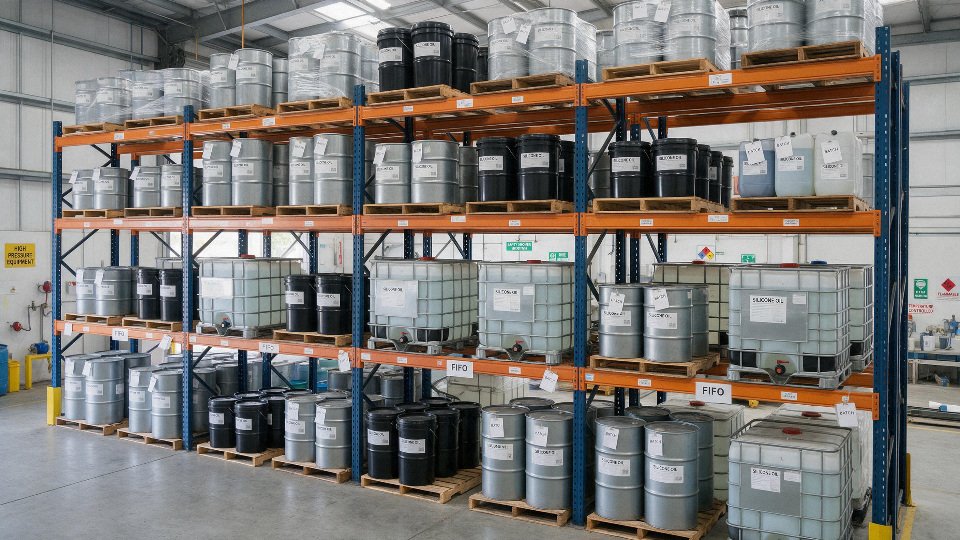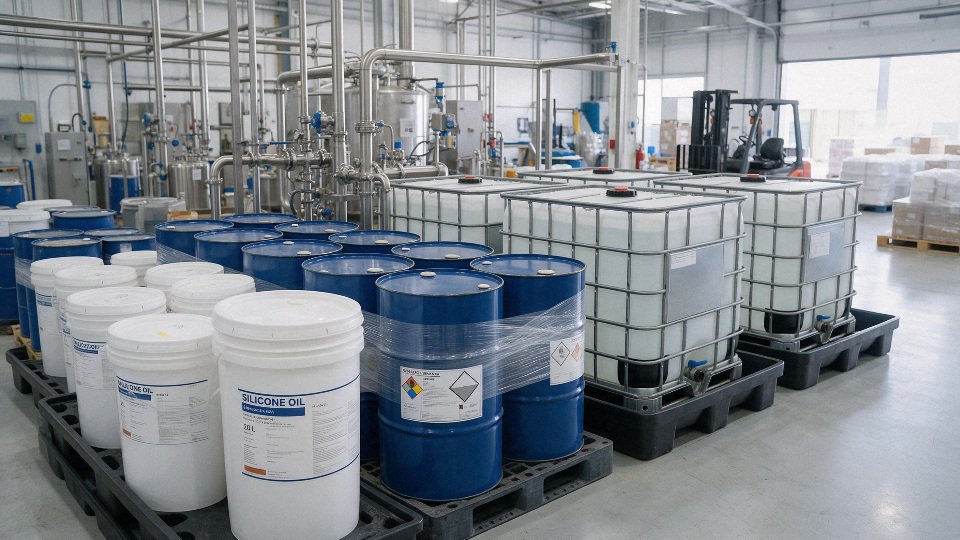
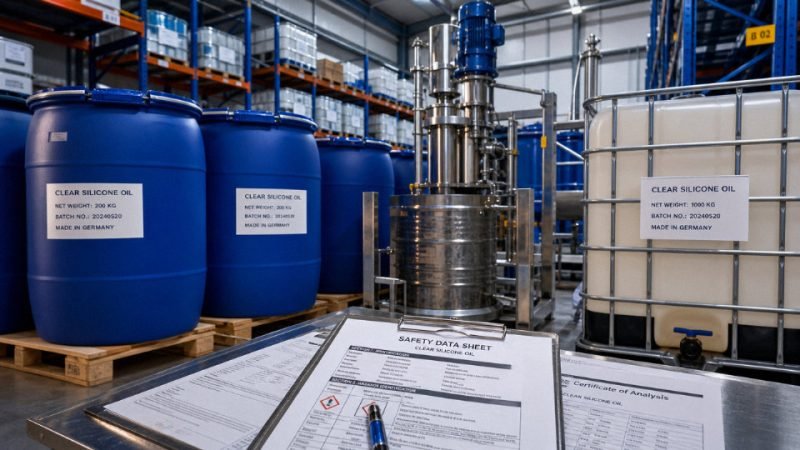
Sourcing silicone oil for a product line that ships into the EU sounds straightforward until your compliance team flags a REACH query from a customer and nobody on the floor can answer it with confidence. That delay — even a week of back-and-forth with your supplier — can stall a product launch, trigger a hold on a shipment, or quietly expose your company to Article 33 liability if the substance in question is on the SVHC candidate list. The financial hit is rarely the fine itself; it’s the scramble, the rework, the customer relationship you spend six months rebuilding.
Most standard silicone oils — particularly linear polydimethylsiloxane (PDMS) grades — are not currently classified as SVHCs under REACH and do not appear on the candidate list. However, cyclic siloxane impurities, specifically D4 and D5, are listed as substances of very high concern due to PBT and vPvB properties, and their presence above 0.1% w/w in an article triggers mandatory disclosure obligations under REACH Article 33 within 45 days of a customer request.
What makes this genuinely tricky isn’t the regulation itself — it’s that “silicone oil” is a family of chemistries, not a single substance, and the compliance answer changes depending on grade, purity, application, and whether your product is classified as a mixture or an article under REACH definitions. Those distinctions matter more than most procurement managers realize until they’re already in a nonconformance conversation.
Silicone Oil Chemistry Taxonomy: Linear, Cyclic, and Functional Variants Under REACH Scrutiny
The single most common mistake procurement teams make is treating “silicone oil” as a monolithic chemical category. It isn’t. REACH obligations attach to specific chemical identities — structure, CAS number, EC number — not to trade names or viscosity grades. Getting this taxonomy right is the operational foundation for everything else.
Linear PDMS: The Dominant Commercial Grade
Polydimethylsiloxane (PDMS) linear chains make up the vast majority of silicone oil sold globally by volume. The backbone is a repeating –Si(CH₃)₂–O– unit, terminated with trimethylsiloxy groups. The broad-composition CAS number most suppliers reference is 63148-62-9, though lower-oligomer fractions sometimes carry their own discrete CAS numbers — 107-46-0 for hexamethyldisiloxane (MM), for instance, which behaves quite differently in volatility and regulatory profile from a 100 cSt fluid.
Linear PDMS as a whole is not currently listed on the SVHC Candidate List. It has REACH registrations in place under multiple tonnage bands, and for most industrial applications — transformer cooling, release agents, hydraulic dampening — it sits in a relatively stable regulatory position. That said, “relatively stable” is not the same as “permanently safe from scrutiny.” The European Chemicals Agency has been broadening PBT assessments, and very high molecular weight PDMS fractions generate their own questions around environmental persistence that haven’t been fully resolved.
Cyclic Siloxanes: Where the REACH Risk Is Concentrated
This is where procurement teams need to pay close attention. D4 (octamethylcyclotetrasiloxane, CAS 556-67-2, EC 209-136-7) and D5 (decamethylcyclopentasiloxane, CAS 541-02-6, EC 208-764-9) are both on the SVHC Candidate List on grounds of vPvB (very persistent, very bioaccumulative) properties. D4 carries an additional PBT classification. Since January 2020, both are restricted under REACH Annex XVII at concentrations above 0.1% w/w in wash-off cosmetic products — rinse-off personal care formulations being the primary target — but the regulatory trajectory matters for industrial buyers too, because D5 in particular appears as a trace component or processing residual in some technical silicone fluids.
D6 (dodecamethylcyclohexasiloxane, CAS 540-97-6) is under ongoing review. Treat it as a near-term compliance risk rather than a resolved one.
D3 (hexamethylcyclotrisiloxane, CAS 541-05-9) is lower-volume and less discussed, but it is not off the regulatory radar either.
Functional Silicone Oils: Each One Has Its Own Registration Profile
Amino-functional silicones (e.g., CAS 106842-44-8 for some aminopropyl-terminated variants) are widely used in textile softeners and hair care. Epoxy-functional silicones, phenyl-modified silicones (which improve thermal stability and refractive index), and hydrogen-terminated fluids each have distinct chemical identities and correspondingly distinct REACH registration histories. Some phenyl-modified grades are registered; others, especially narrow-volume specialty fluids, may rely on only-representative (OR) arrangements or may have gaps. Always request the full SDS and verify the registration number in the ECHA database directly — don’t accept a supplier’s verbal assurance.
Viscosity Grade Is Not a Compliance Proxy
A 1,000 cSt fluid and a 1 cSt fluid can be the same chemical (linear PDMS) or completely different substances. Viscosity is a physical property of the polymer chain length distribution; it tells you nothing about the presence of cyclic oligomers, functional groups, or low-molecular-weight volatile fractions that carry separate CAS numbers. This is a point worth emphasizing to anyone sourcing silicone oils purely on technical data sheets.
The UVCB Complication
Some commercial silicone fluids are UVCB substances — unknown or variable composition, complex reaction products, or biological materials — which means composition boundaries are inherently less precise. Blended silicone oils or partially-reacted systems can straddle classification thresholds. In practice, this makes the SDS your primary compliance document, not the product name. If the SDS lists cyclic oligomers without quantifying them, that is a gap worth resolving with the supplier before you sign a supply agreement.
| Silicone Oil Type | CAS Number | REACH Registration Status | SVHC Listed? | Restriction Status |
|---|---|---|---|---|
| Linear PDMS (broad) | 63148-62-9 | Registered (multiple registrants) | No | None current |
| Hexamethyldisiloxane (MM) | 107-46-0 | Registered | No | None current |
| D4 (cyclic tetramer) | 556-67-2 | Registered | Yes (vPvB, PBT) | Restricted >0.1% in wash-off cosmetics (Jan 2020) |
| D5 (cyclic pentamer) | 541-02-6 | Registered | Yes (vPvB) | Restricted >0.1% in wash-off cosmetics (Jan 2020) |
| D6 (cyclic hexamer) | 540-97-6 | Registered | Under review | Under review |
| Amino-functional silicone | 106842-44-8 (example) | Varies by grade/supplier | No (current) | None current |
| Phenyl-modified silicone | Multiple CAS | Varies; some gaps in low-volume grades | No (current) | None current |
| Hydrogen-terminated PDMS | 70900-21-9 (example) | Registered (select grades) | No | None current |
Viscosity grade alone determines REACH compliance status for silicone oilsFalse
REACH obligations are tied to chemical identity — CAS number, molecular structure, and composition — not physical properties like viscosity. A 10 cSt and a 1,000,000 cSt fluid can share the same CAS number and regulatory status, while two fluids of identical viscosity from different chemical families carry entirely different compliance profiles.
REACH Registration Requirements for Silicone Oil Manufacturers and Importers Above 1 Tonne Per Year
If you’re manufacturing or importing silicone oil into the EU at any meaningful volume, REACH Title II registration isn’t optional paperwork — it determines whether your substance can legally remain on the market. The practical starting point is tonnage, and the obligations escalate faster than most procurement teams expect.
Pre-Registration Status and SIEF Consortia for PDMS Grades
High-volume linear polydimethylsiloxane (PDMS) grades — the workhorses used in everything from textile finishing to hydraulic fluids — have full ECHA registration dossiers in place, submitted through Substance Information Exchange Forums (SIEFs) operated by industry consortia. For most standard viscosity grades of linear PDMS, this means the heavy scientific lifting has technically been done. The SIEF consortia (typically coordinated through bodies like the Silicones Europe consortium) pooled data years ago to meet the 2010 and 2013 registration deadlines.
What that does not mean is that you can ignore registration entirely. Any importer bringing linear PDMS into the EU above 1 tonne per year must either join the relevant SIEF and access the shared dossier — paying a letter-of-access fee, which typically runs somewhere between EUR 5,000 and EUR 30,000 depending on tonnage band and data set size — or demonstrate an equivalent registration pathway. Skipping this step and simply selling under a downstream user exemption when you’re actually importing at scale is a gap that ECHA enforcement is increasingly closing.
Tonnage Band Obligations: What Each Threshold Actually Demands
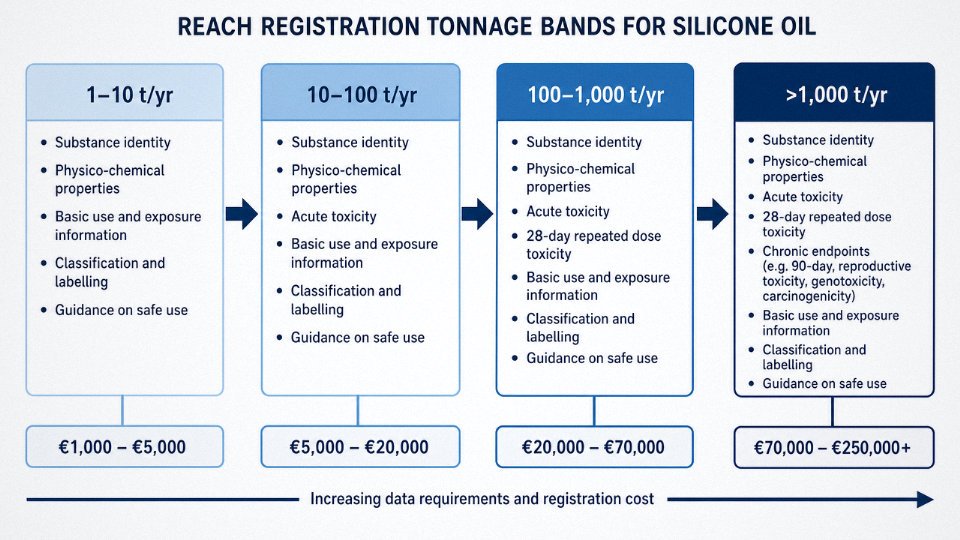
The data requirements under REACH Annexes VII through X are tiered, and the jumps between bands are significant in both cost and testing scope.
| Tonnage Band | Core Data Requirements | Typical Cost Range |
|---|---|---|
| 1–10 t/yr | Physico-chemical properties, basic acute toxicity, Annex VII ecotox endpoints | EUR 5,000–25,000 |
| 10–100 t/yr | Extended tox profile, 28-day repeated dose, Daphnia reproduction, fish early-life stage | EUR 20,000–80,000 |
| 100–1,000 t/yr | Full sub-chronic tox, reproductive/developmental screening, sediment/soil fate | EUR 50,000–200,000 |
| >1,000 t/yr | Chronic endpoints, full environmental fate battery, possible two-generation reproductive | EUR 150,000–400,000+ |
Cost ranges depend heavily on whether existing read-across data from structurally similar siloxanes can be justified — a competent registrant who builds a solid read-across case from established PDMS data can sit toward the lower end. A registrant starting from scratch for a novel functional silicone with an unusual substituent group should budget toward the top, and then some.
The Only Representative Mechanism for Non-EU Manufacturers
Non-EU silicone oil producers exporting into Europe have a clean structural option under Article 8: appoint an Only Representative (OR), a natural or legal person established in the EU who takes on the registration obligations in place of the importer. In practice this shifts the compliance burden — the OR must hold the complete substance dossier, maintain all downstream user records, and be the point of contact for ECHA queries. The OR arrangement doesn’t reduce the scientific data requirements by a single endpoint, but it does consolidate responsibility in one place.
Documentation the OR must hold includes: the full registration dossier or letter of access, downstream user volume data sufficient to confirm tonnage band, and a formal appointment agreement. Gaps in any of these have come up in ECHA’s recent completeness checks.
Where Dossiers Are Actually Failing Inspection
ECHA's dossier completeness checks on silicone oil registrations have become more rigorous since 2021True
ECHA published updated compliance check priorities and sector-specific campaigns from 2021 onward, with industrial lubricants and silicone substances appearing in enforcement focus areas due to historically variable dossier quality
The most common gaps found in silicone oil dossiers since 2021 are not in the basic physico-chemical data — those sections are usually fine. The problems concentrate in worker exposure scenarios within Chemical Safety Reports, particularly for high-viscosity grades used in enclosed industrial processes where exposure assumptions are optimistic, and in environmental fate data for cyclic impurities that may be present at low but non-trivial concentrations in commercial PDMS grades. Sediment adsorption data and long-term aquatic fate are routinely flagged as insufficient. If your supplier’s Safety Data Sheet is vague about cyclic siloxane impurity levels, that’s worth a direct question before assuming the registration covers your use case fully.
SVHC Status of Cyclic Siloxanes D4, D5, and D6: Candidate List, Authorization, and Restriction History
The regulatory trajectory of D4, D5, and D6 under REACH is not a single event — it’s a layered sequence of scientific assessments, listing decisions, and targeted restrictions that unfolded over several years and still isn’t finished. Getting the timeline straight matters because each step carries a different legal obligation, and conflating them is one of the most common errors compliance teams make.
How D4, D5, and D6 Landed on the SVHC Candidate List
ECHA added D4 (octamethylcyclotetrasiloxane) and D5 (decamethylcyclopentasiloxane) to the SVHC Candidate List in January 2018, on dual grounds: persistent, bioaccumulative, and toxic (PBT) and very persistent, very bioaccumulative (vPvB). The scientific basis came from ECHA’s Risk Assessment Committee (RAC) opinions, which drew on evidence showing that both substances accumulate in aquatic sediment organisms and resist environmental degradation at rates well beyond REACH threshold criteria. D6 (dodecamethylcyclohexasiloxane) was added in the same 2018 listing round, but solely on vPvB grounds — no acute toxicity endpoint was required, because vPvB classification under REACH Annex XIII doesn’t demand one. That distinction occasionally trips up formulators who assume D6 is “less serious” than D4 or D5. It isn’t, from a listing-obligation standpoint.
D4, D5, and D6 were all added to the REACH SVHC Candidate List in 2018 based on PBT or vPvB properties identified in ECHA RAC scientific opinions.True
ECHA's official Candidate List records confirm the January 2018 addition of D4 and D5 (PBT/vPvB) and D6 (vPvB), consistent with ECHA RAC evaluation documentation published at the time.
The Annex XVII Restriction: Narrower Than It Looks
Commission Regulation (EU) 2018/35, which amended REACH Annex XVII, restricted D4 and D5 specifically in wash-off personal care products — rinse-off cosmetics, essentially — at concentrations at or above 0.1% w/w. This came into force in January 2020. The restriction is deliberately narrow. It does not cover leave-on cosmetics, industrial lubricants, hydraulic fluids, release agents, or the vast majority of industrial silicone oil applications. D6 is not included in this restriction, though ECHA has indicated it remains under review. For a procurement manager sourcing silicone fluid for a metalworking coolant or a mold release compound, this Annex XVII entry is effectively irrelevant — but you still carry the Article 33 communication obligation regardless.
SVHC Listing vs. Annex XIV Authorization: Not the Same Thing
This is worth being blunt about. As of 2024, none of the cyclic siloxanes — D4, D5, or D6 — have been placed on REACH Annex XIV (the Authorization List). Annex XIV requires a specific granted authorization before a substance can be used or placed on the market for a given use. That’s a significantly more restrictive regime than SVHC listing. ECHA has flagged cyclic siloxanes as candidates for Annex XIV prioritization, which means the possibility of mandatory authorization is live, but it hasn’t happened yet. Industrial users should monitor ECHA’s Substances of Potential Concern pipeline; history suggests prioritization and formal authorization recommendations can take three to six years from SVHC listing, sometimes longer, depending on exposure data and lobbying dynamics.
Article 33 Communication Duties in Practice
Once a substance is on the Candidate List, Article 33 of REACH activates a disclosure duty for articles containing that substance above 0.1% w/w. Any supplier of an article — a gasket, a coated component, a molded part — must communicate SVHC presence to business customers within 45 days of request, and to consumers upon request with no specified timeframe caveat in practice most businesses respond immediately to avoid liability exposure.
For bulk silicone oils sold as substances rather than articles, the relevant obligation runs through the Safety Data Sheet under Article 31, not Article 33. The distinction matters for how your compliance team structures documentation workflows.
In industrial lubricant formulations, D4 and D5 typically appear as process impurities — byproducts of polydimethylsiloxane synthesis that weren’t fully stripped during distillation. Concentrations usually fall in the 50–500 ppm range, depending on the supplier’s purification process and the viscosity grade (lower viscosity grades tend to retain more cyclic impurities). That keeps most industrial silicone oils well below the 0.1% w/w trigger. The problem arises when the SDS simply states “no SVHC above threshold” without actual measured data behind it. If a downstream customer or regulator asks for substantiation and the supplier can’t produce GC-MS or equivalent analytical backup, that’s a compliance gap — not a paperwork gap. Get the analytical certificate, not just the declaration.
How to Read a Silicone Oil Safety Data Sheet for REACH Compliance Signals
An SDS is a legal document, not a marketing brochure — but in practice, suppliers vary enormously in how much useful REACH information they actually put in one. Some are thorough. Many are not. Knowing which sections to interrogate, and what specific language to look for, means you can make a preliminary compliance call in under ten minutes without waiting for your legal team.
Section 1: Confirm You Have the Right Substance
Start here, always. Trade names like “200 Fluid,” “AK fluid,” or “Silicone Fluid 350” tell you almost nothing about chemical identity. A 200 Fluid from one supplier might be a trimethylsiloxy-terminated PDMS with a viscosity of 50 cSt; from another, nominally the same product could contain a blend with measurable cyclic siloxane fractions that push it into different regulatory territory.
Cross-reference the CAS number in Section 1 against what your purchase order actually specifies. For linear PDMS, you’re typically looking at CAS 63148-62-9 (polydimethylsiloxane) or related entries. If the SDS lists a CAS number for D4 (556-67-2) or D5 (541-02-6) as the primary substance — or buries them in Section 3 — that immediately changes the compliance picture. The EC number matters too, especially for ECHA dossier lookups.
Section 2: No Hazard Pictograms Is Not a Compliance Statement
High-molecular-weight PDMS, particularly above roughly 1,000 cSt, is genuinely low-hazard — no GHS pictograms, minimal environmental classification. That’s accurate and expected. The mistake is reading “no hazard symbols” as “no REACH concerns.” SVHC status is a regulatory designation, not a toxicological one in the traditional sense. D4 and D5 are listed as substances of very high concern due to PBT and vPvB properties, not acute toxicity. An SDS for a low-viscosity silicone oil containing D5 impurities might have a clean hazard section and still carry real compliance obligations.
Section 15: This Is the Section That Actually Tells You Something
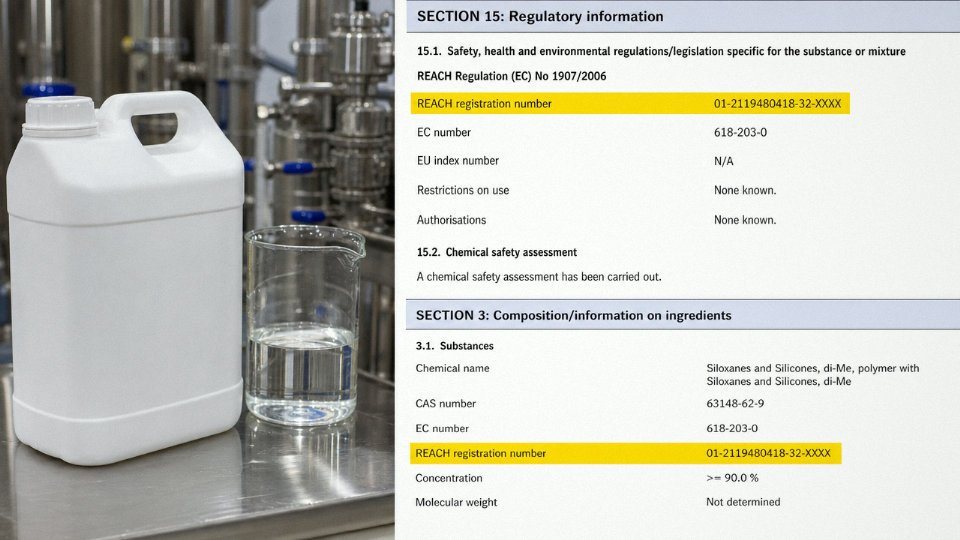
Section 15 — Regulatory Information — is where suppliers are supposed to declare REACH status explicitly. Here’s what you need to see:
A valid REACH registration number, formatted as 01-XXXXXXXXXX-XX-XXXX. If the substance is manufactured or imported above 1 tonne per year and no registration number appears, that’s a problem. Either the substance isn’t registered (a potential market access issue for EU import) or the SDS is incomplete.
An explicit SVHC statement. Something like “This substance/mixture does not contain SVHC above 0.1% w/w” is what you want. Generic language — “complies with all applicable regulations” — is legally meaningless and, in my experience, usually signals that whoever prepared the SDS didn’t dig into the substance-level detail.
An Annex XVII restriction check. For any silicone oil marketed into wash-off cosmetic formulations, Section 15 should reference the D4/D5 restriction under Annex XVII Entry 70, in force since January 2020. If your product is a wash-off application and this entry isn’t mentioned, the SDS revision is probably stale or was prepared for a different end-use.
Section 3: Demand Numbers, Not Generalities
For blended or mixture products, Section 3 should list every component above 0.1% w/w with its CAS number and concentration range. Cyclic siloxane impurities — D4 and D5 are common process byproducts in PDMS manufacture — sometimes appear here at levels that look small but still cross the 0.1% SVHC threshold in articles.
If Section 3 lists cyclic siloxanes without quantified ranges, or omits them entirely while the product is a low-viscosity grade (where cyclic content tends to be higher), request a full disclosure letter or a certificate of analysis with GC-based cyclic siloxane quantification. Suppliers who push back on this request for products going into EU-regulated applications are worth reconsidering.
A silicone oil SDS with no GHS hazard pictograms confirms REACH complianceFalse
GHS hazard classification and REACH SVHC/registration status are separate frameworks. High-MW PDMS can have no hazard pictograms and still require REACH registration or carry SVHC obligations if cyclic siloxane content exceeds 0.1% w/w.
Red Flags Worth Printing Out and Keeping at Your Desk
A revision date before 2020 is an immediate flag — the D4/D5 Annex XVII restriction on wash-off cosmetics came into force in January 2020, and any SDS that predates it hasn’t been reviewed against current obligations. Missing REACH registration numbers for substances your supplier claims to manufacture or import above 1 tonne per year. Composition sections that list “siloxanes and silicones” as a catch-all without CAS-level breakdown. And that phrase again: “complies with all applicable regulations” — without specifics, it’s worth nothing in an audit.
Run through these four sections systematically, and you’ll catch the majority of compliance gaps before a product reaches your formulation line or your EU customs broker.
Downstream User Obligations: Formulating with Silicone Oil Inside and Outside Identified Uses
Most compliance conversations about silicone oil stop at registration and SVHC status. That’s a mistake. For anyone actually incorporating silicone oil into a finished product — a lubricant grease, a release agent, a textile softener, a skincare emulsion — the downstream user obligations under REACH Title V are where the real operational exposure sits.
What “Identified Uses” and Exposure Scenarios Actually Mean on the Shop Floor
When a silicone oil supplier registers their substance with ECHA, they document a set of Identified Uses (IUs) — specific applications the substance is intended for, each accompanied by an Exposure Scenario (ES) that describes safe conditions of use: concentrations, process temperatures, ventilation requirements, personal protective equipment, and so on. These ESs get attached to the extended Safety Data Sheet (eSDS) as annexes, often running to dozens of pages for a widely-used substance like polydimethylsiloxane.
Here’s the operational reality: those ESs are written to cover the supplier’s commercial customer base at the time of registration, and they are never exhaustive. A supplier selling into automotive, textiles, and personal care markets will document those routes. If your plant is using that same fluid as a mold release agent in a food-processing line — injecting it between a baking mold and dough at 180–220 °C, say — that specific use may simply not appear anywhere in the eSDS annex.
That gap is not a paperwork inconvenience. Under REACH Article 37, if your application is not covered by the supplier’s ES, you have two choices: contact the supplier and formally request they add your use to their chemical safety report and eSDS, or prepare your own Chemical Safety Report and document your own risk assessment. Neither option is fast. Requesting an ES update from a large supplier can take anywhere from a few months to well over a year, depending on how responsive their regulatory affairs team is and whether they consider your volume commercially significant enough to bother with.
The Article 38 Notification Requirement
If you decide not to wait for the supplier and proceed with a use outside any identified ES, REACH Article 38 requires you to notify ECHA within 12 months of first use. There are narrow volume exemptions — typically below roughly 1 tonne per year, though the precise threshold depends on substance-specific conditions — but most industrial formulation operations will not qualify. Failing to notify, and failing to maintain a documented chemical safety assessment for that use, leaves your company exposed during any regulatory inspection or product liability claim.
The practical decision logic runs like this:
| Situation | Required Action | Document |
|---|---|---|
| Your use matches supplier ES | Retain eSDS, confirm operating conditions comply | ES annex on file, internal sign-off |
| Your use is close but not explicitly listed | Request ES update from supplier in writing | Supplier correspondence, timeline |
| Supplier declines or is too slow | Prepare own Chemical Safety Report (Art. 37(4)) | CSR, risk assessment, ECHA notification |
| Use outside all known ESs, volume >1 t/yr | Notify ECHA under Art. 38, prepare own CSR | ECHA notification reference, full CSR |
Sector Overlays: REACH Is Necessary but Not Sufficient
This is where formulators in certain sectors consistently get caught out. REACH compliance on its own does not clear silicone oil for every application.
In cosmetics, the EU Cosmetics Regulation (EC) No 1223/2009 governs what goes on or in a person’s skin independently of REACH. D4 and D5 restrictions under REACH Annex XVII for wash-off products (effective January 2020, at above 0.1% w/w) overlap with cosmetics regulation obligations, but the two regimes run in parallel — you must satisfy both. A rinse-off conditioner formulated with a silicone blend needs to be assessed under both frameworks separately.
Food contact is similarly layered. Silicone oil used as a mold release agent, conveyor lubricant, or anti-foaming agent in food processing falls under Regulation (EU) 10/2011 on plastic materials and articles in contact with food, and potentially under specific migration limits that have nothing to do with your REACH eSDS. The fact that your supplier registered the substance and your use appears in their ES does not mean you have clearance under food contact law.
REACH downstream user compliance is automatically satisfied if the substance is registered by the supplierFalse
Registration by the supplier covers their obligations as manufacturer or importer. Downstream users carry independent obligations under REACH Title V, including verifying that their specific use is covered by an Exposure Scenario and notifying ECHA if it is not.
In practice, a procurement or EHS team reviewing a new silicone oil application should be running three checks simultaneously: does the eSDS ES cover our use and conditions; does any sector-specific regulation (cosmetics, food contact, medical device, etc.) impose additional restrictions; and if D4, D5, or D6 content is non-trivial, are the relevant Annex XVII restrictions triggered. Treating REACH as a standalone checklist is how companies end up compliant on paper and exposed in practice.
Silicone Oil in Specific Industrial Sectors: Compliance Risk Profiles for Lubricants, Textiles, Electronics, and Personal Care
Regulatory pressure on silicone oils is not uniform. Where you sit in the supply chain and what sector you operate in shapes your actual exposure to REACH enforcement action almost entirely. A plant engineer specifying a 1000 cSt PDMS dielectric fluid faces a very different compliance picture than a personal care formulator using a low-viscosity cyclic-containing emollient. Understanding that distinction is more useful than any general reassurance that “silicone oils are broadly REACH compliant” — which is technically defensible but operationally useless.
Lubricants and Hydraulic Fluids
Linear polydimethylsiloxane at viscosities above roughly 100 cSt is, in practice, the low-risk end of the spectrum. ECHA dossiers for high-molecular-weight PDMS are well-established, hazard profiles are mature, and the substance has decades of industrial use without triggering PBT or vPvB classification. Procurement teams buying straight PDMS lubricants from established suppliers should find SDS Section 15 clean — but they should still check it, because blended formulations are where things get complicated.
The risk escalates when low-viscosity silicone blends enter enclosed systems — gearboxes, compressors, hydraulic actuators — where worker inhalation exposure becomes realistic. Some blends incorporate cyclic siloxane fractions for viscosity modification or lubricity, and if D4 or D5 is present above 0.1% w/w, that triggers SVHC communication obligations regardless of the application. Industrial hygiene and REACH obligations are separate concerns, but in enclosed-system lubrication they tend to arrive at your desk simultaneously.
Textile and Fiber Processing
Textile silicone softeners and spin-finish oils are a genuinely messy area. Functional silicone oils — amino-modified, epoxy-modified, polyether-grafted — are widely used in these formulations, and the REACH profile of each modification needs individual assessment rather than blanket reliance on a base PDMS registration. D5 in rinse-off textile processing liquors is under active EU regulatory scrutiny, driven by concerns about aquatic compartment contamination through wastewater streams. If your mill discharges to a municipal system rather than a closed-loop process, that scrutiny becomes operationally relevant fast.
D5 is restricted in rinse-off cosmetic products under REACH Annex XVII at concentrations above 0.1%True
The restriction on D5 (decamethylcyclopentasiloxane) in wash-off cosmetic products at ≥0.1% w/w has applied since January 2020 under REACH Annex XVII. This applies to cosmetics specifically; textile processing is under separate but ongoing regulatory review.
Electronics and Semiconductor Manufacturing
High-purity silicone oils used as dielectric immersion fluids or thermal interface media are typically compliant. The chemistry here — tightly controlled linear PDMS with very low cyclic impurity content — is exactly what good manufacturers control for anyway, and most high-purity grades carry appropriate REACH registrations. The risk in this sector is less about the substance classification itself and more about classification of the use. If your process generates vapor or aerosol — certain wave-soldering or vapor-phase reflow operations can — the environmental release pathway needs to be documented in your Chemical Safety Report or covered by the supplier’s Extended SDS. An oversight here surfaces during ISO 14001 audits or customer supply-chain due diligence, not necessarily in routine procurement.

Personal Care and Cosmetics
This is the highest-risk sector under REACH, full stop. The D4 and D5 restrictions in wash-off products are enforced and have been since early 2020. Leave-on products are not currently restricted under Annex XVII, but ECHA’s Scientific Committee on Consumer Safety is conducting ongoing risk evaluations that could change that within the current regulatory cycle. Formulators using any cyclic siloxane fraction — even as a processing aid that “flashes off” during manufacturing — need to confirm actual residual concentration in the finished article, not just assume the process claim holds up analytically.
Food Contact and Pharmaceutical Applications
Silicone oils in food contact or pharmaceutical settings often carry dual approval — FDA 21 CFR § 175–178 positive lists, EU Regulation 10/2011 for food contact materials — and compliance teams sometimes treat that sector-specific approval as a substitute for REACH obligations. It isn’t. Registration, SDS requirements, and SVHC communication obligations under REACH apply independently of any positive-list status. A silicone release agent that is perfectly legitimate under 21 CFR still requires a compliant REACH SDS from your supplier, and if your annual import volume crosses the 1-tonne registration threshold, that obligation falls on you as importer if there’s no EU-registered Only Representative in the chain. Both compliance frameworks run in parallel. Managing only one of them is a procurement gap that auditors find quickly.
Building a REACH-Compliant Silicone Oil Supply Chain: Supplier Qualification, Documentation, and Audit Protocols
Getting the chemistry right and understanding the regulatory status of D4 or D5 is only half the job. The other half — the part that actually protects you during a customs inspection or a customer audit — is having a defensible paper trail and a supplier qualification process that doesn’t fall apart the moment someone asks a hard question.
Supplier Qualification: What to Actually Verify
Start with the REACH registration number. Every substance supplied into the EU above 1 tonne per year must be registered, and the registration number (format: 01-XXXXXXXXXX-CC-XXXX) should appear in SDS Section 1. If it’s missing, that’s not a paperwork oversight — it’s a flag that the substance may not be legally placed on the EU market at all.
Check the SDS revision date. In practice, anything older than three years should trigger a formal re-request, because REACH obligations and SVHC candidate list entries change on a roughly six-month cycle, and suppliers are legally required to update SDSs when relevant new information emerges. A 2019-dated SDS for a linear PDMS product isn’t automatically wrong, but it predates several candidate list updates and almost certainly has a stale Section 15.
Request a dedicated SVHC declaration letter — separate from the SDS. The SDS will tell you what’s listed; the declaration letter should state explicitly whether the article or substance contains any candidate list SVHC above 0.1% w/w, signed and dated by someone with actual authority. Generic “we comply with all applicable regulations” language in a letter is commercially useless and legally worthless.
If you’re sourcing from a non-EU manufacturer — Chinese, US, or Korean producers being the most common in silicone oil supply chains — confirm that an Only Representative (OR) has been appointed under REACH Article 8. Get the OR’s name, ECHA registration confirmation, and contact details. Without a properly appointed OR, your company may carry importer obligations you haven’t budgeted for.
Contract Language That Actually Holds Up
Procurement teams routinely underestimate how much work a well-drafted supply contract does during an audit. At minimum, your silicone oil supply agreements should include: a REACH compliance warranty clause stating the material is registered for all supplied uses; an obligation on the supplier to notify you within 30 days if the regulatory status of any component substance changes (new SVHC listing, restriction entry, authorisation requirement); and an explicit right to audit the supplier’s compliance documentation, not just request it.
That last clause matters more than people think. A supplier who accepts an audit right is making a different kind of commitment than one who will only send PDFs on request.
Document Retention: Ten Years Is the Floor
REACH requires business-to-business communication records — including SDSs, SVHC notifications, and exposure scenario correspondence — to be retained for at least 10 years.True
REACH Article 36 requires all information used to fulfil obligations under the regulation to be kept for at least 10 years after the substance was last supplied or used.
Ten years sounds like a long time until you’re defending a product liability claim for a coating applied seven years ago. Build retention into your document management system with version control — not a shared drive folder where files get overwritten.
Internal Monitoring Triggers
Subscribe to the ECHA SVHC candidate list update notifications directly through ECHA’s website. Updates come roughly every six months, sometimes with little commercial warning. Map each CAS number in your silicone oil portfolio against an automated alert — D4 is CAS 556-67-2, D5 is CAS 541-02-6, D6 is CAS 540-97-6, but functional siloxanes and reactive silicones each carry their own CAS numbers that need individual tracking. A procurement manager who only watches for “silicone” as a keyword will miss entries made under the specific chemical name.
What Audits Actually Find
In a typical mid-size European chemical distributor audit, roughly 30–40% of silicone oil SDSs reviewed have at least one Section 15 deficiency. Outdated SVHC statements are the most common finding — a supplier updated their formulation or a substance hit the candidate list, and the SDS simply wasn’t refreshed. The second most common issue is missing or incomplete extended Safety Data Sheet (eSDS) annexes for products supplied to industrial users, where exposure scenarios are legally required but absent.
When supplier declarations are genuinely insufficient — a new supplier relationship, a disputed impurity claim, or a customer requiring analytical proof — third-party testing is the practical fallback. GC-MS analysis for D4 and D5 impurity quantification at an accredited EU laboratory typically runs EUR 300–800 per sample, depending on matrix complexity and turnaround time. XRF screening is faster and cheaper but only suitable as a first-pass screen for certain matrices. Build one or two accredited lab relationships before you need them urgently.
Frequently Asked Questions About Silicone Oil and REACH Compliance

Q: Is polydimethylsiloxane (PDMS) silicone oil on the REACH SVHC candidate list?
No. Standard linear PDMS — the workhorse fluid used across lubrication, release coatings, and heat transfer — is not on the SVHC candidate list as of 2024. The substances drawing regulatory attention are the cyclic siloxanes: D4 (CAS 556-67-2), D5 (CAS 541-02-6), and D6 (CAS 540-97-6), all listed due to PBT or vPvB concerns. The practical problem for buyers is that low-viscosity PDMS grades can contain residual cyclics from the manufacturing process. So “PDMS” on a product label is not a blanket clearance. Always verify the specific CAS number and ask your supplier for a statement of cyclic siloxane content — particularly if you’re sourcing fluids below roughly 100 cSt, where residual D4/D5 levels tend to be higher.
Linear PDMS (polydimethylsiloxane) is not listed on the REACH SVHC candidate list as of 2024.True
ECHA's SVHC candidate list targets cyclic siloxanes D4, D5, and D6 for PBT/vPvB properties. Linear PDMS has not been identified as a substance of very high concern under the criteria of REACH Article 57.
Q: Do I need a REACH registration number from my silicone oil supplier?
Yes, if that supplier is placing the substance on the EU market above 1 tonne per year. The registration number — formatted as 01-XXXXXXXXXX-XX-XXXX — should appear in Section 15 of the SDS. Its absence is a red flag, not a minor paperwork gap. In practice, if a supplier cannot produce a current SDS with a valid registration number and you’re buying in commercial volumes, you are potentially holding unregistered substance and could face customs issues or downstream liability. For imports from outside the EU, either the non-EU manufacturer has appointed an Only Representative (OR), or your own company carries the registration obligation as importer. Either way, someone has to hold that number before the material crosses the EU border at scale.
Q: Can I use silicone oil in wash-off cosmetics in the EU?
Linear PDMS is not currently restricted for wash-off cosmetic applications. D4 and D5, however, have been restricted under REACH Annex XVII since January 2020 — they cannot be used at concentrations at or above 0.1% w/w in rinse-off personal care products. That threshold is low enough that trace cyclic content in a nominally PDMS-based emollient or carrier fluid can push a finished formula into non-compliance. Formulators working in personal care should specify low-cyclic or cyclic-free PDMS grades and get written confirmation of residual cyclic content from the raw material supplier, not just rely on the SDS.
Q: What is the 0.1% threshold under REACH Article 33?
If any article — not just a chemical substance or mixture, but a finished article like a sealed bearing or a coated textile — contains an SVHC above 0.1% by weight of that article, the supplier has to proactively communicate that to business customers. Consumers can request the same information, and the supplier must respond within 45 days. The calculation is per article, not per batch or shipment, which creates some complexity when you have composite assemblies. A silicone-lubricated gasket incorporated into a larger component, for instance, may or may not breach the threshold depending on the mass ratio.
Q: How often does ECHA update the SVHC candidate list?
Roughly twice per year, typically in June and January, though the exact timing shifts. Given the list has grown past 240 substances as of 2024 and the pace of additions has been fairly consistent, compliance teams relying on annual manual checks are almost certainly operating with stale information at some point. Automated regulatory intelligence feeds — several commercial platforms offer SVHC monitoring — are worth the subscription cost for any procurement team managing a significant formulated product portfolio.
Q: Is silicone oil the same as silicone fluid for REACH purposes?
Functionally, yes. The commercial distinction between “silicone oil” and “silicone fluid” is a marketing and rheology convention, not a regulatory one. REACH cares about chemical identity: CAS number, EC number, molecular structure. A product sold as “silicone fluid 350” and another sold as “silicone oil 350 cSt” may be identical substances. If they share the same CAS number, they carry the same REACH obligations regardless of what the label says. Don’t let trade names drive your compliance classification — always go back to the SDS Section 1 and Section 3 identifiers.
Q: Are silicone oil imports from China and other non-EU countries subject to REACH?
Fully. REACH applies to any substance entering the EU market, regardless of origin. A Chinese silicone oil manufacturer exporting to EU buyers above 1 tonne per year either appoints an Only Representative registered with ECHA — in which case EU importers can rely on that OR’s registration — or each EU importer must hold their own registration. In practice, large Chinese silicone manufacturers supplying European markets have mostly established OR arrangements, but smaller or less experienced exporters sometimes have not. Ask for the OR’s name and REACH registration number before you finalize a supply agreement, not after the first container arrives at Rotterdam.