A lot of buyers treat silicone oil as a simple fluid until viscosity drifts lot to lot, volatiles show up in odor-sensitive applications, or a release coating starts behaving differently on the line. That usually traces back to how the oil was made and finished: hydrolysis control, equilibration chemistry, end-blocking, stripping, and filtration all leave fingerprints on performance. Miss those details in sourcing or process review, and the cost lands later as rework, unstable batching, customer complaints, or paying for a tighter grade than the application actually needs.
Silicone oil is typically made by hydrolyzing chlorosilanes or related silane intermediates to form siloxane species, then equilibrating those siloxanes under acid or base catalysis to reach the target polymer chain length, followed by end-blocking, neutralization, stripping of residual cyclics and low boilers, and final filtration. The exact route depends on the required viscosity, volatility, purity, and whether the product is a straight PDMS fluid or a modified silicone oil.
That sounds straightforward on paper, but the manufacturing route is where commercial grades separate from problem grades. A 10 cSt fluid, a 1,000 cSt fluid, and a very high viscosity silicone oil may share the same chemistry family while demanding quite different control over catalyst choice, residence time, and devolatilization, and that is where procurement, plant operation, and end-use performance start to connect.
Core raw materials
Silicone oil performance is set upstream, not just in the reactor. The practical raw-material stack starts with silicon metal and methyl chloride, moves through chlorosilane intermediates such as dimethyldichlorosilane and trimethylchlorosilane, and ends with a smaller but critical set of hydrolysis aids, catalysts, neutralizers, and end-blockers that decide viscosity, volatility, color, and storage stability.
At plant level, these inputs do not contribute equally. Dimethyldichlorosilane is usually the main economic and structural feedstock for standard polydimethylsiloxane oils, while end-blockers, catalyst package, and impurity control often decide whether the batch is merely on-spec or actually usable in a demanding application.
Main upstream feedstocks
The starting chain is well known in organosilicon production:
- Silicon metal
- Reacts with methyl chloride in the direct synthesis step
- Purity matters, especially metallic impurities that can carry through the chlorosilane train or upset catalyst behavior
- Iron contamination is watched closely in practice because it can contribute to color, residue, and downstream instability
- Methyl chloride
- Main methylating raw material for producing methylchlorosilanes
- Supply continuity and dryness matter; water ingress here creates avoidable corrosion and side-product problems upstream
- Direct synthesis catalysts
- Typically copper-based catalytic systems, often with promoters
- Their job is not just conversion; they also influence product distribution among chlorosilane fractions
- That distribution matters commercially because a plant set up to maximize the desired dimethyl fraction has a different cost position from one relying on purchased mixed chlorosilanes
- Chlorosilane fractions
- Dimethyldichlorosilane (DMDCS): the principal precursor for standard linear silicone oil
- Trimethylchlorosilane (TMCS): a common end-blocking source used to cap chain ends and limit polymer growth
- Other methylchlorosilanes may appear depending on product slate and plant integration
The mechanism is straightforward but commercially important: DMDCS hydrolyzes to silanol-bearing intermediates that condense into siloxane chains. TMCS or another trimethylsilyl source terminates reactive ends, so the ratio between difunctional units and end-blockers helps determine average chain length and therefore viscosity. Push too little end-blocker and the product drifts upward in viscosity; push too much and you buy lower viscosity than the customer ordered, along with more low-boiling fractions to strip out.
Hydrolysis and finishing auxiliaries
These materials look secondary on a purchasing spreadsheet, but they often decide operability.
- Water
- Used in chlorosilane hydrolysis
- Quality and addition control matter because hydrolysis is exothermic and sensitive to local concentration
- Moisture variation can shift emulsion behavior, HCl release profile, and phase separation quality
- Alcohols
- Used in some routes to moderate reactivity, assist handling, or form alkoxy intermediates
- Choice depends on process design; not every silicone oil line uses them
- Neutralizing agents and acid scavengers
- Remove or consume residual HCl and acidic species after hydrolysis or equilibration
- Commonly selected to reduce corrosion, suppress post-reaction instability, and improve color
- Overuse creates its own cleanup burden through salts or haze
- Process solvents
- Used where needed for heat transfer, viscosity control, washing, or stripping efficiency
- Not universal; many standard grades are made with limited or no solvent in final form
- Solvent selection has a trade-off: easier handling and devolatilization versus extra recovery load, VOC management, and contamination risk
The section’s main conclusion stops holding when the plant is making highly specialized, low-volume modified fluids; in those cases, the modifier cost can outweigh the base chlorosilane economics by a wide margin.
End-blockers and molecular weight control
For straight PDMS oils, chain termination is one of the most sensitive levers in the recipe.
Common end-blocking sources include:
- Trimethylchlorosilane
- Hexamethyldisiloxane, where the route uses it
- Other trimethylsilyl-bearing intermediates
Their purpose is to cap silanol or reactive siloxane chain ends. That does three things at once:
- Limits continued condensation
- Helps set target viscosity
- Improves storage stability by reducing residual reactivity
In practice, end-blocker control is tied to stripping strategy. A customer buying a 100 cSt fluid and a customer buying a 100,000 cSt fluid are not just buying different chain lengths; they are buying different tolerance to low-boiling carryover, residual cyclics, and viscosity drift.
Catalysts for equilibration or condensation
Catalyst choice is where chemistry, maintenance, and finished-goods appearance start pulling against each other.
- Acidic catalysts
- Common in siloxane equilibration systems
- Can give efficient rearrangement and viscosity build or adjustment
- If not properly neutralized or removed, they can worsen color, promote corrosion, and shorten storage stability
- Basic catalysts
- Also used for equilibration or condensation depending on route
- Effective for molecular weight adjustment, but can leave residues that continue reacting if cleanup is poor
- Sensitive applications often require tighter control of residual catalyst
What changes physically is the rate and selectivity of siloxane bond cleavage and redistribution. That affects molecular weight distribution, not just average viscosity. A broad distribution may still hit the nominal cSt target at 25°C, yet behave differently in volatility, pour behavior, foam response, or customer processing. That is why two oils with the same headline viscosity are not always interchangeable on a coating line or release formulation.
Specialty modifiers for functional silicone oils
Modified silicone oils are built by introducing other siloxane units or side groups, typically through tailored intermediates rather than simple post-blending.
Relevant modifier families include:
- Phenyl-containing siloxane units
- Used for better low-temperature behavior, refractive properties, or thermal performance in some applications
- Hydrogen-containing siloxane units
- Provide Si-H functionality for further reaction
- Require tighter handling because residual reactivity matters
- Amino-functional units
- Used where substantivity, lubrication, or adhesion effects are wanted
- More sensitive to color and residual chloride issues
- Epoxy-functional units
- Chosen for reactivity with organic systems and surface treatment chemistry
- Polyether-modified units
- Used to improve compatibility, wetting, or defoaming behavior depending on structure
These modifiers introduce a trade-off. You gain function, but usually sacrifice some combination of hydrolytic stability, color robustness, process simplicity, or cost position.
Purity and procurement issues that matter in practice
A few impurity classes repeatedly cause trouble:
- Iron and other metals: color, residue, catalyst interference
- Chloride content: corrosion risk, instability, odor, customer rejection in sensitive formulations
- Moisture variation: hydrolysis inconsistency, gel particles, handling problems
- Low-boiling siloxanes: flash-off, odor, VOC-related complaints, viscosity drift after use
- Catalyst residues: continued reaction, discoloration, poor storage stability
Integrated producers with direct chlorosilane access usually have better cost control and supply stability than traders or simple toll blenders.True
This is a typical structural advantage in organosilicon supply chains because upstream integration reduces dependence on purchased intermediates, improves control over chlorosilane fraction balance, and usually shortens response time during supply disruptions. It does not guarantee better quality by itself, which still depends on process control and purification discipline.
For buyers, that procurement point is not academic. If supply tightens, the producer controlling its own chlorosilane stream can usually manage formulation continuity, lead times, and cost swings better than a blender buying intermediates on the spot market.
Main process route
Standard silicone oil is not made in one neat reactor pass. Industrial product quality comes from a chain of reactive and separation steps: organochlorosilane synthesis, chlorosilane fractionation, controlled hydrolysis and condensation, equilibration to the target chain length, then cleanup, stripping, polishing, blending, and clean packaging. If any one of those stages is poorly controlled, the plant can still make “silicone fluid,” but not a stable, saleable grade with predictable viscosity, volatility, and storage behavior.
Finished silicone oil comes directly from a single polymerization of one pure monomer.False
Commercial silicone oil is typically produced through multiple integrated stages. Even when dimethyldichlorosilane is the key precursor, industrial manufacture still requires chlorosilane synthesis, purification, hydrolysis/condensation, equilibration with end-blocking control, catalyst removal, devolatilization, and finishing steps to meet specification.
Direct synthesis: making the chlorosilane feedstock
The route usually starts upstream with the direct synthesis, often called the Müller-Rochow process. Methyl chloride reacts with silicon metal in the presence of a catalyst system, commonly copper-based, to produce a crude mixture of methylchlorosilanes rather than one single compound. For silicone oil manufacture, the fraction that matters most is dimethyldichlorosilane, because it is the main building block for linear polydimethylsiloxane structures.
In practice, this is already a selectivity problem, not just a conversion problem. The reactor does not politely make only the desired di-functional monomer. It also generates methyltrichlorosilane, trimethylchlorosilane, and other organochlorosilane fractions in varying amounts depending on:
- Silicon metal quality and particle characteristics
- Catalyst composition and promoter package
- Reactor temperature profile
- Methyl chloride purity
- Contact time and gas-solid hydrodynamics
- Fouling condition and age of the bed
That selectivity matters commercially. Dimethyldichlorosilane supports linear chain growth; trimethylchlorosilane acts more like a chain stopper downstream; methyltrichlorosilane introduces tri-functionality, which pushes the system toward branching or resin-like structures if it carries through unchecked. A plant can tolerate some compositional spread, but only if the downstream fractionation and formulation strategy are built around it.
Fractionation: separating the chlorosilanes that define structure
Before hydrolysis, the crude chlorosilane stream is distilled into controlled fractions. This is one of those stages buyers rarely ask about, but it has a direct line to product consistency. Downstream polymer architecture depends on monomer composition, so the distillation train is not just a purification step; it is a structural control step.
Typical target fractions include:
- Dimethyldichlorosilane
- Methyltrichlorosilane
- Trimethylchlorosilane
- Heavier and lighter chlorosilane cuts
- Recycleable off-spec fractions, depending on plant design
The separation is demanding because these compounds are moisture-sensitive, corrosive, and close enough in boiling behavior that column performance, reflux control, and materials of construction all matter. In a decent plant, operators watch not only overhead and bottoms temperatures but also pressure stability, condenser performance, and contamination drift between cuts. A small fractionation upset can show up later as a viscosity shift, haze issue, or excessive volatile cyclics in the finished oil.
The mechanism is straightforward: monomer functionality controls how siloxane networks can form. More di-functional species favor linear chains. More mono-functional species cap chains and lower achievable molecular weight. More tri-functional species increase branching risk. The trade-off is that tighter fractionation improves downstream predictability but raises energy use, capital cost, and operational sensitivity. For commodity grades, plants may accept broader internal cuts if the equilibration and blending system can absorb the variation. That stops working when the customer needs tight viscosity tolerance or low-volatility grades.
Hydrolysis: converting chlorosilanes into silanols and siloxanes
Once the right chlorosilane fractions are available, hydrolysis converts Si-Cl bonds into silanol-bearing intermediates, which then condense to siloxane bonds. Water is the reagent, hydrochloric acid is the unavoidable byproduct, and the product stream is not yet a finished oil. It is usually a mixture of low molecular weight linear and cyclic siloxanes, along with acid, water, and depending on the setup, some emulsified or phase-separated material that needs further handling.
A simplified process view looks like this:
- Meter chlorosilane feed into water, or water into chlorosilane, depending on the process design
- Control the exotherm through temperature management and addition rate
- Allow silanol formation and initial condensation
- Separate acid-rich aqueous phase from the organosilicon phase
- Wash or otherwise condition the crude hydrolysate for the next stage
The order and intensity of mixing matter more than many non-specialists realize. Hydrolysis is fast and exothermic. Poor local mixing creates hot spots, and hot spots create side reactions, broad molecular weight distribution, and in bad cases gel particles. Those gels do not politely disappear later; they become filtration load, haze, or customer complaints about insolubles.
Typical batch temperatures through hydrolysis and later equilibration often run somewhere from about 20°C to 180°C, depending on the route and catalyst. There is no single “correct” plant-wide number. The hydrolysis window depends heavily on feed composition, reactor design, heat-removal capacity, and whether the process is batch, semi-batch, or continuous.
Initial condensation and phase management: where operators earn their pay
A lot of quality is won or lost here. The hydrolysis product system contains reactive species, acid, water, heat release, and rapidly changing phase behavior. Engineers control addition rate, agitation, temperature, and acid handling to keep the system from drifting into gel formation, corrosion problems, or an unhelpfully broad molecular weight spread.
The practical control points usually include:
- Addition rate: Too fast and the local concentration spikes; too slow and throughput suffers
- Agitation intensity: Enough to disperse phases and remove heat, not so violent that emulsions become hard to break
- Temperature profile: Needed to balance hydrolysis rate, condensation rate, and side-reaction risk
- Materials of construction: Acidic chloride service can be unforgiving; lining choice and gasket selection are not trivial
- Acid removal path: HCl handling affects corrosion, environmental controls, and downstream washing demand
- Phase separation time: Rushing decantation often carries acid or water into the next stage
One familiar plant-floor issue is emulsified interface hold-up. On paper, you decant aqueous acid and move on. In practice, a dirty vessel, a changed agitator speed, or a shift in feed impurities can leave a stubborn rag layer that drags acid into the siloxane phase. Then the next reactor behaves differently, catalyst demand changes, and somebody starts blaming the lab. Usually the chemistry is innocent; the phase split was poor.
Equilibration or polymerization: setting the target viscosity
The crude hydrolysis product does not yet have the final chain length needed for a commercial silicone oil grade. The next major step is equilibration, sometimes loosely called polymerization, where cyclic siloxanes and linear species rearrange under acid or base catalysis to reach the target average molecular weight and viscosity. End-blockers are usually introduced to define terminal groups and stop the chain from running longer than intended.
For standard dimethyl silicone oils, the process objective is usually to control three things together:
- Target viscosity at 25°C
- Volatile content remaining after finishing
- Terminal structure and long-term storage stability
End-blockers such as trimethylsiloxy-forming species are central here. They cap chain ends and set the average chain length for a given equilibrium condition. If the end-blocker ratio is off, viscosity misses can be dramatic, especially in lower and mid-range grades. Since silicone oil viscosity can range from about 0.65 cSt to more than 1,000,000 cSt at 25°C, the process window for a 10 cSt fluid and a 100,000 cSt fluid is obviously not the same, even if both are based on similar siloxane chemistry.
The mechanism is worth stating plainly: catalyst promotes siloxane bond cleavage and re-formation, allowing cyclics and linears to redistribute toward an equilibrium chain-length distribution. End-blockers limit how long those linears can become. Temperature, catalyst type, catalyst level, residence time, and starting composition all affect where that equilibrium lands and how fast it is reached.
The trade-off is familiar. Stronger catalysis or higher temperature can reduce batch time and improve throughput, but it can also make control touchier, increase color formation or side reactions, and raise the cleanup burden. For high-viscosity products, heat transfer and mixing become limiting. Once the fluid gets thick, what looked fine in a pilot kettle can become a torque problem in production.
Neutralization and catalyst removal
Residual catalyst cannot be left in the product and ignored. Acid or base residues continue to promote rearrangement or degradation during storage, especially if traces of moisture remain. That is how a product that passed release testing can drift later in viscosity, odor, or appearance.
Typical cleanup methods include:
- Neutralization with a suitable quenching agent
- Water washing where the process allows it
- Adsorbent treatment for catalyst residues or ionic impurities
- Settling and phase separation
- Fine filtration after neutralization solids form
The exact chemistry depends on the catalyst system, and this is a place where broad generalizations get risky. The supplier’s process route matters. What does hold across plants is the principle: unfinished catalyst removal is one of the quiet causes of shelf-life problems.
Stripping and devolatilization
After polymer build, the fluid is usually stripped under heat and vacuum to remove low-boiling cyclics, moisture, dissolved gases, and any solvent traces carried from upstream operations. This stage drives final volatility, flash point behavior, odor, and in some uses the tendency to smoke or lose weight in service.
Residual cyclic siloxanes after stripping for standard grades are often below roughly 0.1% to 1.0%, depending on the specification. That range should not be treated as universal. It depends on viscosity grade, product purpose, customer limit, stripping equipment capability, vacuum depth, temperature, and residence time.
In production, stripping performance is shaped by:
- Vacuum stability, not just nominal vacuum level
- Film thickness or surface area in the devolatilizer
- Product temperature, balanced against thermal history
- Entrained moisture and dissolved gas load from prior steps
- Viscosity of the fluid being stripped
Low-viscosity grades generally surrender volatiles more easily. High-viscosity grades can be stubborn, and aggressive stripping then starts to compete with throughput and thermal exposure limits. That is the boundary of the usual “just strip harder” advice: once viscosity is high enough, mass transfer becomes the bottleneck.
Filtration, polishing, and standardization
Once the fluid is chemically complete and devolatilized, finishing work still remains. Fine filtration removes particulates, gel specks, neutralization salts, and adsorbent carryover. Some grades may also receive carbon treatment or adsorbent polishing to improve appearance, reduce haze, or remove trace color and odor bodies.
Then comes standardization by blending. Even a well-run plant sees lot-to-lot variation from upstream monomer composition, hydrolysis behavior, catalyst response, and stripping history. Blending is how manufacturers tighten viscosity tolerance and present a consistent commercial grade rather than a collection of narrowly passing batches.
Typical release checks around this stage often include:
- Viscosity
- Volatile content
- Moisture
- Appearance and haze
- Color
- Acid or alkali residue indicators, depending on process
- Density or refractive index, if relevant to the grade
Packaging: protecting the fluid already paid for
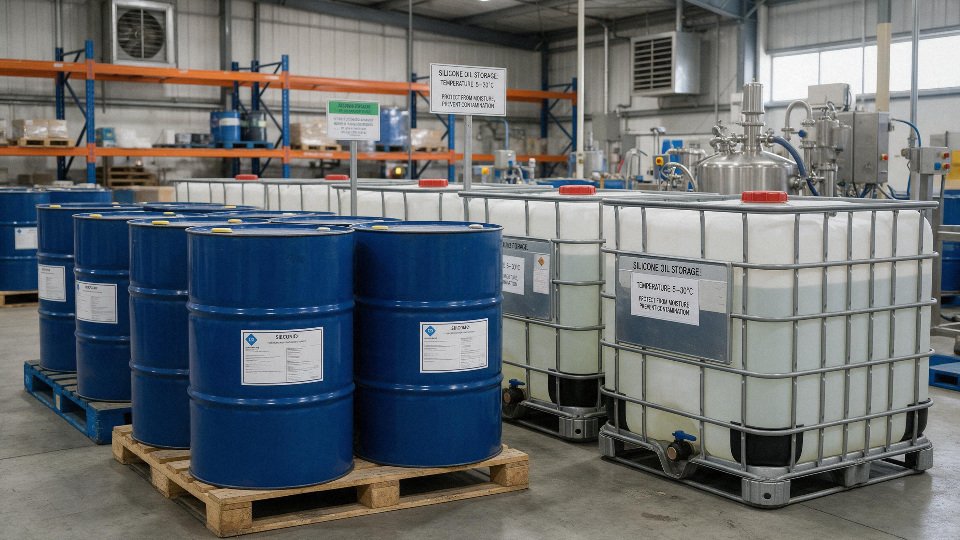
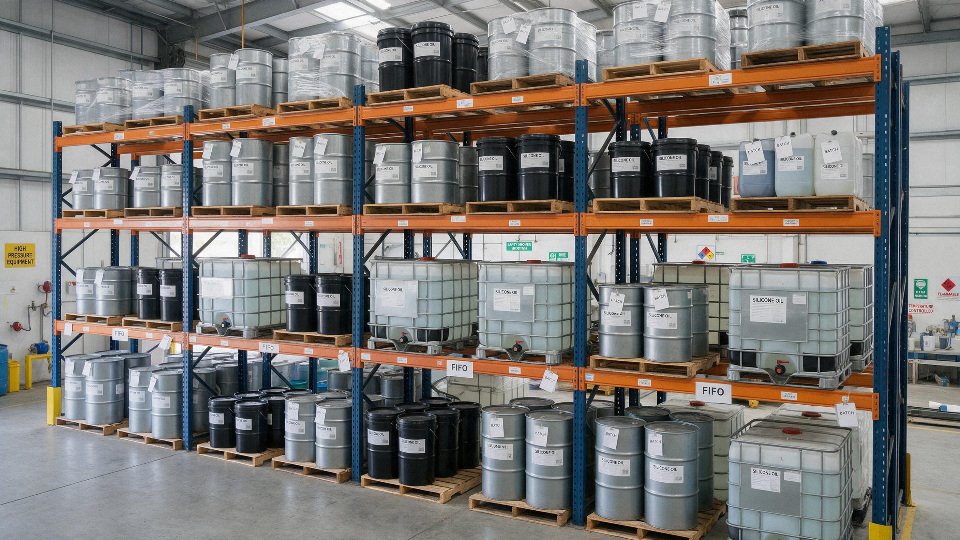
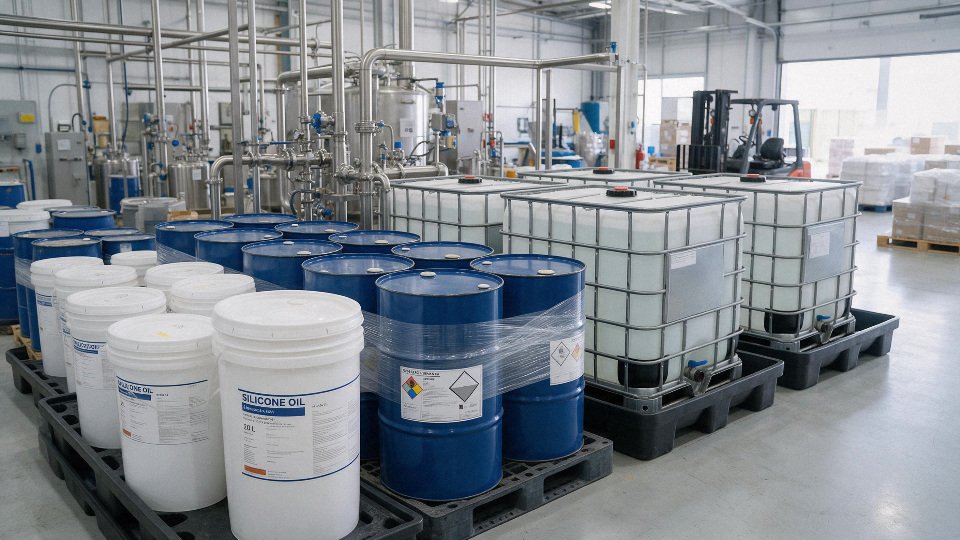
Packaging is less glamorous than synthesis, but it is where avoidable contamination often enters. Finished silicone oil is commonly packed in clean drums, IBCs, tank trucks, or isotanks, with moisture-aware handling and transfer practices.
Good packaging control usually means:
- Clean, dry containers and transfer lines
- Compatibility of seals, hoses, and pump materials
- Minimizing airborne dust or water ingress during filling
- Lot traceability back to production and blend records
- Headspace and sealing practices suited to storage duration and shipping mode
A nice-looking fluid can still arrive off-spec if it picked up moisture, rust fines, or the wrong tote residue. Anyone who has chased a haze complaint back to a reused transfer hose tends not to dismiss packaging discipline after that.
Viscosity and structure control
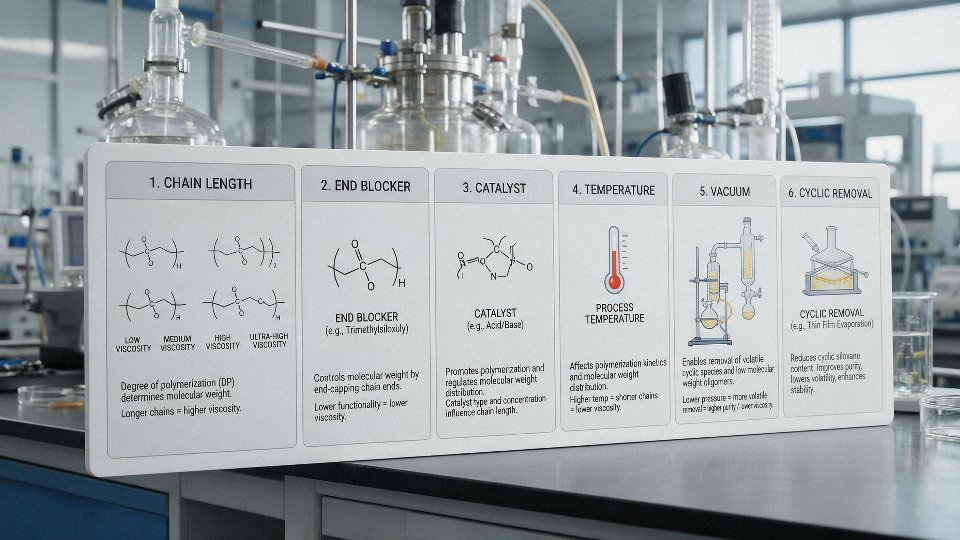
Silicone oil viscosity is controlled less by a single “thickness” setting than by the molecular architecture the plant builds and then preserves through stripping and finishing. In practice, the target grade comes from four linked variables: average chain length, chain-end chemistry, molecular weight distribution, and how much low-boiling cyclic material remains after equilibration and devolatilization.
For standard dimethyl silicone fluids, kinematic viscosity rises mainly with degree of polymerization. Longer linear siloxane chains generally mean higher molecular weight and higher viscosity at 25°C, but buyers should not assume a one-to-one relationship across all grades because the width of the molecular weight distribution matters too. Two batches can hit the same nominal cSt and still behave differently in foaming, evaporation loss, pour characteristics, or seal compatibility if one contains more short chains and residual cyclics.
The chain ends are not a side detail. They are one of the main production levers. End blockers, typically low-functionality siloxane species used to terminate chain growth, set the average chain length during equilibration. A higher end-blocker dosage creates more chain ends per unit mass, which pulls the average polymer shorter and pushes viscosity down. Reduce the dosage, and average chain length climbs.
That sounds simple until you get into low-viscosity material. In very low cSt grades, small shifts in end-blocker charge, feed purity, or catalyst exposure can move the product materially because the absolute chain length is already short. A minor stoichiometric drift that would be almost invisible in a medium-viscosity fluid can push a 1 cSt or 2 cSt product off grade, or force extra stripping that then affects yield. Anyone who has run these fluids knows this is where operator discipline shows up fast: weighing accuracy, line hold-up, and even whether the previous batch left residue in the transfer spool all start to matter.
How molecular architecture translates into viscosity behavior
Several structural features work together:
- Average degree of polymerization
- The primary driver of viscosity in linear silicone fluids.
- Higher average chain length increases intermolecular entanglement and resistance to flow.
- Molecular weight distribution
- A narrow distribution usually gives more predictable viscosity and volatility.
- A broad distribution can still meet nominal viscosity while carrying excess light ends or heavy fractions.
- Chain-end identity
- Trimethylsiloxy end-stopped fluids behave differently from hydroxyl-terminated or functionalized systems.
- End groups influence reactivity, storage stability, moisture sensitivity, and downstream cure or compatibility.
- Residual cyclic siloxanes
- Low-boiling cyclics can depress measured viscosity and raise volatility.
- They also affect odor, flash behavior, and some customer regulatory screens, depending on market and use.
- Functional comonomer content
- Phenyl, Si-H, amino, epoxy, or polyether segments change more than viscosity; they alter polarity, refractive behavior, reactivity, compatibility, and thermal profile.
A viscosity certificate alone is not enough to judge process control. If the plant hits cSt by stopping at the right number but leaves cyclics, catalyst residue, or broad distribution unchecked, the fluid may pass incoming inspection and still disappoint in use.
Process levers inside equilibration
Catalyst choice and catalyst level control how quickly the siloxane system approaches equilibrium and how much side reaction comes along for the ride. Acidic or basic equilibration systems can both be used in industry, but their practical behavior differs enough that the downstream workup strategy has to match. Stronger catalytic activity shortens residence time and helps throughput, yet it also raises the risk of over-equilibration, back-biting, and cyclic reformation if temperature and hold time are not kept in line.
Back-biting is the mechanism worth watching here. A linear chain can intramolecularly rearrange and split out cyclic siloxanes under catalytic conditions, especially when the system is hot and held too long. That means the same catalyst package that helps build the target fluid can also start eroding it back toward lighter cyclic species. Operators often see this as a moving target: viscosity may approach setpoint, then volatile content refuses to come down cleanly because the system is still generating cyclics while you are trying to remove them.
Residence time is therefore not just “enough to finish the batch.” It is an economic and quality balancing point:
- Too short:
- incomplete equilibration
- wider batch-to-batch variation
- off-target viscosity
- unstable devolatilization behavior
- Too long:
- more back-biting
- higher cyclic content
- more color risk in sensitive functional grades
- unnecessary utility use and lower reactor availability
The preferred setting flips with grade. Medium general-purpose fluids usually tolerate a broader operating window. Low-viscosity grades and some functional fluids do not.
Temperature and vacuum: where devolatilization is won or lost
Hydrolysis and equilibration stages often run somewhere from about 20°C to 180°C, depending on route and catalyst, but the important point is not the headline range. It is the profile. Temperature affects reaction rate, viscosity in the kettle, vapor pressure of cyclics, and side-reaction tendency all at once. Vacuum affects how efficiently those cyclics leave the bulk fluid instead of recondensing somewhere in the system.
For low-viscosity silicone oils, devolatilization is often harder than people expect. The fluid itself is already close in character to the species you are trying to remove, so separation is less forgiving than it is in a heavy fluid where the volatility gap is wider. Residual cyclic siloxanes after stripping for standard grades are often below roughly 0.1% to 1.0%, depending on specification, but there is no responsible universal number beyond that without knowing product grade, plant design, and test method.
Common plant-floor failure points include:
- vacuum leaks at mechanical seals, sight glasses, or instrument taps
- poor condenser balance that lets valuable product leave with volatiles
- shallow mixing in high-viscosity zones, which traps light ends
- aggressive heating that darkens the batch or promotes further rearrangement
- inadequate final hold under vacuum after neutralization or catalyst kill
A staged vacuum pull usually works better than simply dropping to the deepest vacuum available as fast as possible. Sudden flashing can foam the batch, foul internals, and create carryover. On older equipment, especially with modest disengagement space, a slower pressure ramp saves more product than it costs in cycle time.
Different viscosity bands need different production logic
Low-viscosity fluids
These are the most sensitive to raw-material ratio error and residual cyclic management.
Typical priorities are:
- very accurate end-blocker dosing
- tighter control of catalyst exposure
- efficient but gentle stripping
- low contamination from previous batches
- tighter analytical release on volatile content
A plant can make a low-cSt fluid that reads correctly on viscosity while still failing customer expectations on evaporation loss or odor. That is common enough to be worth saying plainly.
Medium general-purpose fluids
This is usually the most forgiving part of the range and where many commodity grades are produced efficiently. Standard stirred reactors with competent temperature control and vacuum stripping can handle these products well, provided the feed purity and catalyst neutralization are consistent.
The trade-off here is usually throughput versus polish. If the grade is going into a low-sensitivity release agent or mechanical lubricant blend, the buyer may accept a broader spec window. If it is headed into personal care, electronics, or a coating system with tight appearance requirements, color, trace acidity, and volatile profile become more important.
Very high-viscosity grades
As viscosity climbs, heat transfer and mixing become the limiting factors. The chemistry may be straightforward, but the reactor no longer behaves like a thin-fluid kettle. Dead zones, wall build-up, and poor devolatilization become practical constraints.
Plants often need some combination of:
- higher-torque agitation
- anchor or helical ribbon mixing rather than simple turbine flow
- slower heating ramps
- larger vapor disengagement allowance
- longer finishing times
- in some cases, alternate concentration or post-build strategies rather than trying to do everything in one standard vessel
The boundary here is equipment. A process that works well for mid-range silicone oil does not automatically scale to very high viscosity just by extending batch time. At some point, the reactor geometry and agitation package become the bottleneck, not the chemistry.
Structure control in specialty silicone oils
Specialty fluids add another layer because viscosity is no longer the only structural target.
- Phenyl-modified silicone oils
- Used where low-temperature behavior, refractive properties, or thermal stability need adjustment.
- Phenyl content changes compatibility and often shifts viscosity behavior relative to purely dimethyl systems.
- Color control matters more here because overheating or catalyst mismanagement shows up quickly.
- Hydrogen-containing silicone oils
- Si-H functionality is reactive and must be protected from side reactions and moisture-related issues.
- Residual catalyst, trace acidity, or contamination can hurt storage stability and downstream hydrosilylation performance.
- Amino-functional silicone oils
- Nitrogen functionality improves substantivity and surface affinity, especially in textile or care-related uses.
- These fluids are more sensitive to color, odor, and compatibility drift; overprocessing can hurt appearance and shelf behavior.
- Epoxy-functional silicone oils
- Built for reactive compatibility in coatings, additives, or adhesion-related systems.
- Functional group preservation matters as much as target viscosity, so catalyst kill and finishing conditions need tighter discipline.
- Polyether-modified silicone oils
- Used to tune wetting, defoaming, emulsification, or slip.
- Here, phase behavior and compatibility often matter more than headline viscosity; poor structure control can produce haze, separation, or unstable application performance.
Tighter viscosity control always means a better silicone oil.False
A batch can meet a narrow viscosity target yet still be weak on volatile content, acid number, color, residual catalyst, or storage stability. Fitness depends on the whole specification package and the end use, not cSt alone.
That is the counter-intuitive part buyers sometimes miss during sourcing. If a supplier chases ultra-tight viscosity alone, they can make decisions in catalyst hold, stripping, or finishing that damage the broader product profile. The better manufacturing target is a balanced window: viscosity, volatile content, end-group integrity, color, acidity or residual catalyst, and storage stability all aligned with the actual application.
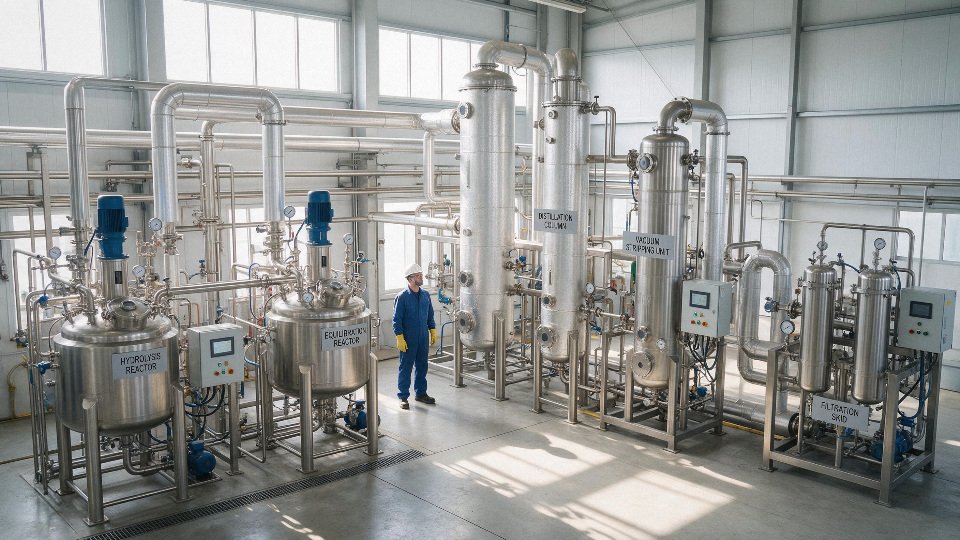
Plant equipment and controls
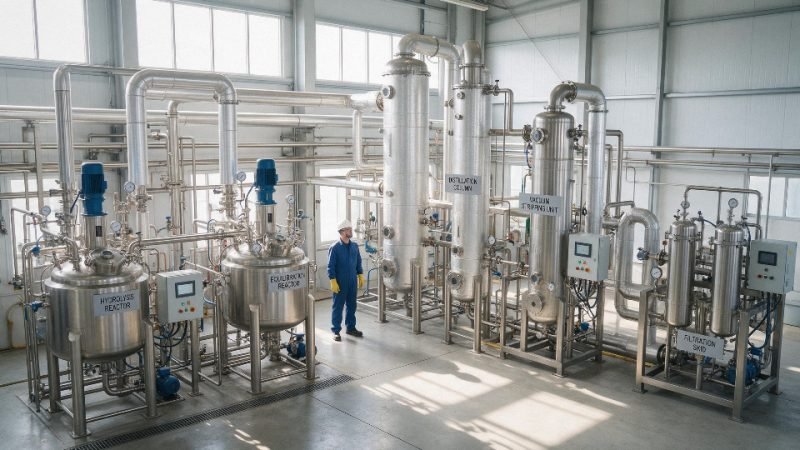
Reliable silicone oil production depends less on having a reactor and more on having the right chain of equipment around it: corrosion-tolerant feed handling, clean fractionation, controlled hydrolysis, strong vacuum finishing, and instrumentation that catches drift before it becomes an off-spec batch. The practical dividing line between a true manufacturer and a blender is usually upstream distillation, downstream devolatilization, and the ability to handle chlorosilanes and acid gas safely at plant scale.
Core equipment across the process train
A standard industrial setup typically includes these unit operations:
- Direct synthesis reactors
These are used where the producer makes chlorosilanes from silicon and organohalide feedstocks rather than buying them in. Reactor design varies by route and catalyst system, but solids handling, heat removal, and gas distribution matter immediately because selectivity upstream affects every downstream purification load. - Chlorosilane distillation columns
Fractionation is one of the hardest parts to fake. Close-boiling organochlorosilane cuts require well-designed columns, stable reflux control, dry systems, and disciplined contamination management. If the column train is weak, the hydrolysis stage inherits composition variability, and that shows up later as inconsistent viscosity build, higher cyclics, or unstable end-group balance. Hydrolysis vessels
Hydrolysis often runs in the rough range of 20°C to 180°C depending on route, feed sequence, and how aggressively the plant is trying to manage reaction rate and phase behavior. These vessels need controlled addition, acid-resistant internals, vapor handling, and enough disengagement space to cope with gas evolution and phase separation without carrying acid mist downstream.Equilibration reactors
After hydrolysis and crude separation, the siloxane mixture is redistributed in reactor systems designed for catalyst dosing, temperature control, and residence time consistency. Agitation quality matters more than many buyers realize. Once viscosity rises, poor circulation creates local overreaction and broad molecular-weight distribution.Neutralization and washing tanks
These are not glamorous, but they decide whether catalyst residues, chloride, and salts leave the process cleanly or remain as long-term stability problems. Tank geometry should allow phase disengagement, solids removal, and repeatable wash efficiency.Thin-film evaporators, wiped-film units, or vacuum stripping systems
This is where serious processors remove residual cyclic siloxanes and other low boilers. For standard grades, residual cyclics after stripping are often brought below roughly 0.1% to 1.0%, depending on product specification and how deep the vacuum system can pull under load.Filters and polishing systems
Cartridge, bag, or pressure-leaf filtration may be used depending on solids load. Fine filtration is especially important after neutralization and before final packaging, because trace particulates can create customer complaints that look like chemistry problems but are really housekeeping failures.Storage and transfer tanks
Dedicated dry storage for chlorosilanes, segregated intermediate tanks, and clean finished-goods tanks are basic requirements. Nitrogen blanketing is common where moisture pickup or oxidation is a risk.
Materials of construction: where plants get into trouble
For chlorosilane and HCl service, ordinary carbon steel is rarely the cheap option it appears to be once corrosion products, leaks, and contamination are counted. Plants usually rely on:
- Corrosion-resistant alloys in critical wetted parts, depending on exact chloride, temperature, and moisture conditions
- Glass-lined or fluoropolymer-lined equipment for selected acidic or highly corrosive stages
- Dry transfer systems with sealed pumps, inert gas blanketing, desiccated vent handling, and moisture exclusion
- Non-return protection and vent scrubbing to prevent wet-air ingress into chlorosilane systems
The limitation is straightforward: material choice cannot be generalized safely across all silicone plants. Chloride concentration, water activity, temperature, cleaning regime, and upset frequency all change corrosion behavior, so final selection has to be verified against current supplier data and plant-specific corrosion experience.
Heat, agitation, and mass transfer
Hydrolysis is where laboratory chemistry often falls apart in scale-up. The reaction is exothermic, phase behavior shifts during addition, and acid generation changes both corrosion risk and separation behavior. A vessel that looks adequate on paper can become a foam generator or a hot-spot problem if feed is added too fast or mixing dies off near the wall.
Two mechanisms matter most:
- Heat removal controls side reactions and operability.
If the local temperature spikes during hydrolysis, you do not just get a warmer batch. You can shift the distribution of intermediates, increase volatilization load, and make downstream stripping harder. Mixing quality controls molecular consistency in equilibration.
In higher-viscosity systems, impeller choice, power input, and baffle design determine whether catalyst and chain-stopper are distributed evenly. Bad mixing broadens product variability lot to lot.
The trade-off is familiar on the plant floor: stronger agitation and faster heat transfer improve control, but they increase capital cost, shaft-seal demands, and sometimes air entrainment risk. The preferred design flips once viscosity gets high enough that conventional stirred-tank assumptions stop holding and film-type finishing equipment becomes the safer path.
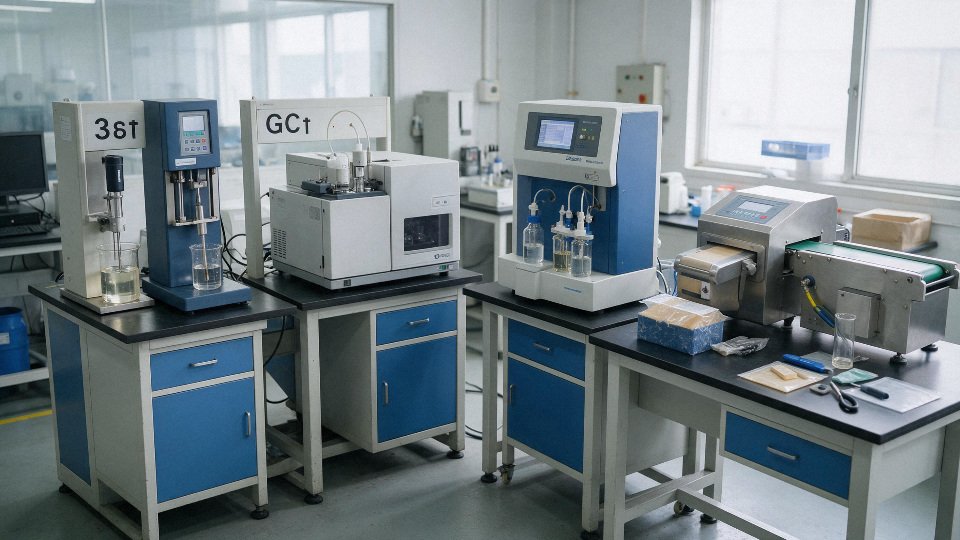
Instrumentation, analytics, and automation
A reliable silicone oil line is usually controlled with a mix of inline instrumentation and lab release tests:
- Temperature and pressure on all reactive and vacuum stages
- Vacuum level and condenser performance on stripping systems
- Acidity or neutralization endpoint
- Chloride monitoring, especially after washing and before finishing
- Viscosity at 25°C, because that is still the commercial language most customers buy in
- Refractive index as a fast consistency check for certain grades
- Gas chromatography for cyclics, residual low boilers, and composition tracking
- Moisture monitoring in sensitive feed and transfer systems
Automation should cover more than recipe timing. Serious plants use batch control and historian systems for:
- Raw material lot capture
- Charge confirmation and interlocks
- Deviation logging
- Alarm/event history
- Lot genealogy from chlorosilane input to packed drum or IBC
That traceability matters when a customer reports haze, odor, or unexpected volatility three weeks later and purchasing wants a precise containment decision rather than a warehouse-wide hold.
The bottlenecks buyers should read between the lines
When a supplier says they “produce silicone oil,” ask what they actually own. The capability gaps that matter most are:
- Upstream chlorosilane distillation
- Deep vacuum stripping or thin-film devolatilization
- Acid gas and hazardous vent treatment
- Moisture-controlled bulk handling
- Analytical control for cyclics and residual chloride
Every silicone oil supplier is a true manufacturer with full upstream and downstream process capability.False
Many companies formulate, blend, or toll-finish silicone fluids from purchased intermediates. Full manufacturing capability typically requires chlorosilane handling, distillation, reactive processing, and finishing systems that simple blenders do not operate.
Quality assurance checkpoints
A silicone oil batch is only as good as the test regime behind it. For standard fluids, release usually hinges on a small set of physical and chemical checks that catch most commercial failures; for specialty grades, that is not enough, because a batch can pass viscosity and still fail in the customer’s line through residual volatiles, wrong functional content, trace acidity, or packaging contamination.
Routine release testing normally includes the basics below, with limits set by grade rather than by one universal industry number:
- Viscosity at 25°C
This is the first gate because customers often buy by viscosity band. It reflects molecular weight distribution and, in practice, is also a quick screen for poor equilibration, over-stripping, or unintended dilution. - Appearance and clarity
Visual haze, suspended matter, or phase separation can indicate incomplete filtration, moisture pickup, salt carryover, or compatibility issues in modified grades. - Color
Often checked by Pt-Co, Gardner, or supplier-specific visual standard depending on grade. Color drift may point to thermal history, catalyst side reactions, oxidation, or contamination from upstream equipment. - Refractive index and density
These are simple but useful identity checks. They help confirm composition consistency and can flag the wrong blend ratio, abnormal cyclic content, or substitution with another fluid grade. - Volatile matter
Usually measured by a controlled heating loss method or inferred from composition data. This matters because low-boiling siloxanes change odor, flash point, dielectric behavior, and evaporative loss in service. - Flash point
Particularly relevant for industrial fluids sold into heat-transfer, release, lubrication, or dielectric applications. Flash point is strongly affected by residual low boilers; if stripping is inconsistent, this number moves before the customer notices anything else. - Acid value and moisture
Both are small numbers with outsized consequences. Residual acidity can continue to attack packaging, destabilize emulsions, or corrode sensitive systems; moisture can cloud the fluid, alter electrical properties, and aggravate hydrolytic instability in some specialty products.
That basic panel catches obvious off-spec material. It does not fully answer what is actually in the fluid.
Composition analysis: what release tests miss if you stop at the basics
For commodity dimethyl silicone oil, composition work is often done by GC or GC-MS for cyclic siloxanes and low-boiling linear fractions, especially when a buyer specifies residual volatiles after stripping. Typical residual cyclic siloxanes in standard grades are often below roughly 0.1% to 1.0%, but the acceptable limit depends on the grade, the downstream market, and the supplier’s stated specification.
Other composition checks commonly used are:
- Residual chlorides
Measured by suitable wet chemistry or instrumental methods after sample preparation. This is a serious control point when the route starts from organochlorosilanes. Hidden chloride carryover can show up later as corrosion, catalyst poisoning, or instability in formulated products. - Catalyst residues
Acid or base equilibration catalysts must be neutralized and removed to the required level. If not, the fluid can keep reacting in the drum, especially in warm storage, which shifts viscosity over time. - Functional group content in specialty grades
Amino, epoxy, phenyl, vinyl, hydroxyl, polyether, or other modified silicone oils need functionality verification by methods such as titration, FTIR, NMR where appropriate, or supplier-specific validated methods. A functional silicone can be “on-viscosity” and still be unusable if the active group level is wrong.
The mechanism matters here. Residual catalyst or chloride does not always change the release appearance, but it can keep driving slow post-reaction. That means the batch leaves the plant looking fine, then drifts in viscosity, color, odor, or compatibility after a few weeks in a hot warehouse. In plants without disciplined neutralization and residue checks, this is where expensive customer complaints start.
In-process controls are not the same as final release
A good QA system does not wait until packaging to find out the batch failed.
In-process controls typically include:
- Hydrolysis and phase-separation checks to confirm complete reaction and efficient removal of aqueous salts or acid-containing phases.
- Equilibration monitoring through viscosity trend, temperature profile, reaction time, and sometimes intermediate composition sampling.
- Neutralization endpoint control so catalyst is actually quenched, not just diluted.
- Stripping endpoint verification by vacuum, pot temperature, distillate rate, and volatile analysis.
- Filtration and transfer checks to catch haze, particulates, or line contamination before filling.
Final release tests answer whether the shipped batch meets specification. In-process controls answer whether the process is still under control before value is added downstream. That distinction matters commercially: once a high-viscosity or specialty-functional batch is filled into clean drums or IBCs, rework becomes slower, more expensive, and sometimes impossible without degrading the product.
Application-specific tests depend on where the fluid is going
A buyer using silicone oil in a defoamer, dielectric fluid, textile finish, release system, or personal care intermediate should expect targeted testing beyond the generic panel.
Common application-specific checks include:
- Dielectric properties for electrical grades: dielectric strength, volume resistivity, dissipation factor
- Thermal stability or heat-aging for high-temperature service
- Lubricity or friction behavior where the oil is used in mechanical contact
- Surface tension and spreading for wetting, release, and surface-treatment applications
- Compatibility testing with elastomers, plastics, solvents, or formulation components
- Foam control performance in defined media and shear conditions for antifoam use
- Textile handle, softness, hydrophilicity, or yellowing tendency for textile auxiliaries
- Sensory, volatility, residue, and formulation compatibility checks for personal care-related grades where relevant
There is a trade-off here. The broader the application test package, the better the supplier can predict downstream behavior, but each extra test adds cost and time. For general-purpose industrial grades, a full end-use simulation is rarely practical on every batch. For specialty grades going into sensitive formulations, skipping that work is false economy.
Packaging and traceability are part of quality assurance
Clean product can still arrive dirty. QA should cover:
- Packaging cleanliness before filling, especially for small packs and high-purity grades
- Seal integrity and closure torque
- Correct liner, gasket, and container material compatibility
- Label and batch traceability
- Storage conditions, including temperature control where cold-flow behavior, moisture pickup, or prolonged heat exposure could change the product
One buyer point gets missed all the time: a certificate of analysis is only a snapshot. It is far more meaningful when the supplier can link that data to retained samples, calibrated instruments, batch records, and documented corrective action if a trend drifts.
A certificate of analysis alone is weaker than a traceable quality system with retained samples and calibration records.True
A COA shows reported results for one batch. It does not by itself prove method validity, instrument status, sample retention, investigation discipline, or the supplier’s ability to resolve a later complaint with traceable evidence.
Safety and environmental management
In chlorosilane-based silicone oil production, the hardest part is not making fluid that meets viscosity; it is controlling a process train that combines flammable gas service, water-reactive intermediates, acid generation, vacuum systems, and several waste streams that can turn expensive or dangerous fast if the plant gets sloppy. Most serious incidents in this sector start at interfaces: unloading, transfer, venting, maintenance opening, or off-spec residue handling rather than in the main reactor during steady-state production.
Major process hazards that drive plant design
A silicone oil plant upstream of equilibration usually has several distinct hazard classes operating side by side:
- Flammable methyl chloride
- Used in upstream organochlorosilane manufacture
- Low ignition energy and easy to leak through valves, seals, and compressor systems
- Demands classified electrical areas, gas detection, tight flange management, and disciplined purge practice
- Reactive chlorosilanes
- Hydrolyze rapidly with moisture
- Release HCl and heat on contact with atmospheric water or wet equipment internals
- Small drips can create dense acid fumes around pumps, sample points, and unloading hoses
- Hydrochloric acid generation
- Inherent to chlorosilane hydrolysis
- Corrosion risk rises quickly where acid concentration, temperature, and condensation combine
- Trouble spots are vent headers, knockouts, scrubber inlets, and any dead leg that cycles between wet and dry service
- Vacuum operation
- Common in stripping and devolatilization
- Brings air-inleak risk, oxygen ingress, and solvent or siloxane vapor loading on vacuum systems
- If operators chase vacuum with a leaking gasket instead of fixing the leak, you can move from quality loss to flammable mixture risk
- Hot oil and heated reactors
- Typical process stages may run anywhere from roughly 20°C up to 180°C depending on route and catalyst
- Burns, thermal degradation, seal failure, and localized overheating matter more than people expect, especially during low-flow circulation or fouled jacket service
- Combustible dust in silicon handling
- More relevant in upstream direct-process operations than in finished-fluid blending
- Fine silicon dust can ignite and dust collection design has to reflect particle size, moisture condition, duct velocity, and isolation requirements
The mechanism is straightforward: one upset often propagates into another. A wet transfer line does not just contaminate product; it can trigger chlorosilane hydrolysis, generate HCl, overpressure a vent system, and load the scrubber beyond its design margin.
Why moisture exclusion and vent treatment are non-negotiable
Dry handling is not a quality preference. It is a core safety control.
Chlorosilane storage and transfer systems are usually kept under dry inert gas, with controlled loading procedures, dried lines, and strict verification after maintenance. A little atmospheric humidity entering through an open manway, a bad hose cap, or wet instrument air is enough to start hydrolysis at the wrong point in the system.
That is why plants pay attention to details operators never forget after one bad shift:
- nitrogen blanketing quality
- dew point control on purge gas
- dry-break couplings where practical
- line draining before opening
- gasket material compatibility
- proof that cleaned equipment is actually dry before return to service
Vent treatment follows the same logic. You do not discharge mixed chlorosilane and acid-forming vapors directly and hope the downstream stack system sorts it out. Vent headers normally need staged handling: condensation where recoverable material is present, scrubbing for acid gases, then polishing if organics remain.
Byproducts, emissions, and how plants actually control them
Typical streams that need deliberate management include:
- Hydrochloric acid
- Generated in hydrolysis
- May be recovered as commercial acid if concentration and contamination are controlled
- Otherwise neutralization and disposal economics get worse quickly
- Chlorinated residues and heavy ends
- Often corrosive, reactive, or difficult to rework
- Need segregated collection and waste classification based on actual composition, not assumptions
- Low-boiling siloxanes
- Removed during stripping and finishing
- Standard grades often target residual cyclic siloxanes below roughly 0.1% to 1.0%, depending on specification
- Those removed volatiles usually go first to condensation recovery; carbon polishing may follow for residual vapor
- Wastewater
- Can contain acidity, salts, suspended solids, emulsified silicone, and trace organics
- Treatment performance depends heavily on source segregation; once high-silicone streams are mixed indiscriminately into general wastewater, separation gets harder and costs rise
- Off-gases
- May contain HCl, organics, inert gas, and traces of low boilers
- Usually require combined systems rather than a single device
Common abatement tools include:
- acid absorption and recovery systems
- caustic or water scrubbers designed for actual gas composition
- condensers and knock-out pots ahead of scrubbers
- activated carbon for low residual organic loading
- compliant hazardous waste handling for residues, spent carbon, and contaminated maintenance debris
The trade-off is operating cost versus recovery value. Deep condensation and acid recovery can save material and reduce waste, but only if the stream is reasonably concentrated and stable. On dilute, highly variable vents, simpler scrubbing and compliant disposal may be the more reliable answer.
Worker protection and product stewardship
Good plants keep operators out of contact rather than asking PPE to solve a bad design.
Controls typically include:
- closed charging and transfer systems
- local exhaust at sampling, drum filling, and maintenance break points
- chemical-resistant gloves, face protection, and acid-resistant clothing where splash risk exists
- emergency showers and eyewash units near handling areas
- defined quench or neutralization procedures for small reactive releases, verified against the actual chemistry involved
- training on line opening, purge verification, confined space conditions, and residue behavior during maintenance
Destination market matters more than it did a few years ago. Industrial buyers increasingly ask not only for viscosity and volatiles, but also for cyclic siloxane management, residual content, intended-use restrictions, and conformity to the regulations that apply where the product will be sold. That scrutiny is strongest for personal care and other consumer-facing uses, but even industrial customers now expect documented product stewardship rather than a generic statement of compliance.
All silicone oil grades are regulated the same way in every export market.False
Regulatory treatment depends on product composition, residual cyclic content, application, and destination country or region. Compliance has to be checked against the current market-specific requirements and the supplier's actual product data.
Common production challenges
Most silicone oil production problems do not start with the nominal viscosity grade. They start with trace chloride, residual catalyst, volatile carryover, thermal abuse, or poor endpoint control, and those small upstream misses show up later as odor, haze, corrosion complaints, unstable performance, or batch-to-batch inconsistency that customers often misdiagnose as “bad silicone oil.”
A plant can make a fluid that lands on viscosity and still fails in use. That is the uncomfortable part of this business: a 100 cSt oil with the wrong impurity profile can perform worse than a properly made 50 cSt or 350 cSt grade in the same customer line, especially in release, defoaming, cosmetics-adjacent uses, textile finishing, or any closed system where odor and volatility matter.
High chloride or acid residue
Residual chloride and acidic species are among the most expensive “small” defects because they travel downstream quietly. In practice, they come from incomplete hydrolysis washing, poor phase separation, weak neutralization, inadequate stripping, or contamination from upstream chlorosilane handling.
Typical consequences include:
- Corrosion risk in customer equipment, storage tanks, pumps, and dosing systems
- Odor or sharp acidic note, especially noticeable in warm filling or enclosed processing
- Instability during storage, with gradual property drift
- Poor compatibility with additives, emulsifiers, or functional modifiers
- Problems in personal care, textile, coating, or release applications where trace ionic residue matters
The mechanism is straightforward. Residual HCl or hydrolyzable chloride can keep reacting at low levels after the batch is “finished,” especially if moisture gets in during storage or drum filling. That shifts pH, attacks metal surfaces, and can interfere with downstream formulations. A plant may not see the problem in a short final QC hold, but the customer sees it two weeks later in a blend tank with carbon steel internals and a humid utility room.
Robust producers usually control this through:
- Tight hydrolysis and wash-stage separation
- Confirmed neutralization, not assumed neutralization
- Monitoring chloride or acid value at more than one point, not only final release
- Clean transfer lines and dry storage
- Verification after stripping, because concentration changes can reveal residual contamination
Excess volatile cyclics
If cyclic siloxanes are not stripped hard enough, the product may look acceptable in the reactor and still fail commercially. Standard grades often target residual cyclics below roughly 0.1% to 1.0%, but the right number depends on the product specification, end use, and customer regulatory exposure.
What shows up in the field:
- Lower flash point than expected
- Weight loss during heating, drying, or application
- More odor than the customer can tolerate
- Drift in coating or defoaming performance as light ends evaporate first
- Regulatory concern in applications sensitive to volatile siloxane content
The trade-off is cost and throughput. Deeper stripping usually means longer residence time, more vacuum duty, tighter condenser performance, and sometimes more yield loss. Plants under schedule pressure are tempted to stop early if viscosity is already on target. That saves hours in the kettle and can create months of argument later.
Finished silicone oil viscosity alone is a reliable indicator that volatile cyclic content is under control.False
A batch can meet viscosity and still retain excess low-boiling cyclics. Volatile content needs its own control and verification, typically by stripping conditions and analytical testing appropriate to the product specification.
Broad molecular weight distribution
Broad distribution is one of the harder issues to explain to buyers because a single viscosity result can hide it. The usual causes are poor equilibration control, uneven catalyst activity, weak temperature uniformity, bad end-capping balance, or stopping the reaction before the chain population stabilizes.
It tends to appear as:
- Viscosity drift during storage or after customer heating
- Non-uniform lubricity or feel
- Variable defoaming behavior from lot to lot
- Inconsistent spreading, film thickness, or migration
A wider distribution means too many short chains and long chains at the same nominal average. The short fraction drives volatility and migration; the long fraction can thicken, haze, or destabilize performance. The preferred control strategy flips if you are making very high-viscosity gum-like fluids or highly tailored functional oils, because aggressive redistribution can damage the intended architecture. For standard dimethyl silicone oils, though, narrow and reproducible distribution is usually what customers actually pay for.
Color, haze, particulates, and gel
When silicone oil leaves the plant darker than expected, slightly hazy, or with visible specks under bright light, the problem is rarely cosmetic only.
Common causes include:
- Catalyst degradation products
- Oxidation from air ingress or hot hold time
- Poor filtration or overloaded filter media
- Metal fines, gasket debris, rust, or line contamination
- Excessive thermal history in rework or prolonged stripping
- Side reactions involving functional monomers
For gel particles or crosslinked bits, the causes are more serious:
- Uncontrolled reaction of amino, epoxy, hydroxyl, hydrogen, or other functional units
- Overreaction from local hot spots
- Contamination with water, alkali, acids, or reactive metal salts
- Dirty rework practices
A few gel particles may seem minor in bulk storage. They are not minor in a customer’s coating head, textile padder, fine filter, or aerosol valve.
Batch-to-batch variation
Most recurring customer complaints come from variation, not absolute failure. Feedstock drift, weak endpoint definition, poor blending discipline, and inadequate in-process analytics are the usual drivers.
A capable manufacturer watches at least these control points closely:
- Feedstock identity and purity before charging
- Water balance and separation efficiency during hydrolysis
- Reaction temperature profile, not just peak temperature
- Catalyst charge accuracy and deactivation timing
- Volatile removal endpoint
- Filtration condition and final blend homogeneity
The useful lesson for buyers is this: many “chemistry problems” are really process-history problems. If a silicone oil keeps causing odor, haze, corrosion risk, or unstable application behavior, do not start by changing viscosity grade. Start by asking about residual chloride, volatile content, filtration practice, thermal history, and batch consistency controls.
Supplier evaluation criteria
A silicone oil supplier is worth shortlisting only if they can show process control, traceability, and export competence that match your application risk. For long-term supply, the strongest predictor is not the lowest drum price but whether the manufacturer can explain how it makes, stabilizes, tests, and supports the exact fluid you need when conditions change.
Upstream integration: where process control really starts
If a producer is integrated into upstream organosilicon production, they usually have better control over intermediate quality, supply continuity, and cost stability than a blender relying heavily on merchant siloxanes. That does not automatically make every integrated supplier better, but it changes what can be controlled in-house versus what is being accepted from the market.
Check these points:
- Feedstock position
- Do they produce key chlorosilanes, cyclic siloxanes, or silicone intermediates internally?
- Or are they mostly buying D4, DMC, end blockers, and modified intermediates from outside suppliers?
- Impact on lot consistency
- Internal control over intermediate purity often helps with:
- color stability
- odor
- residual cyclic control
- metal or catalyst residue management
- batch-to-batch viscosity consistency
- Internal control over intermediate purity often helps with:
- Commercial exposure
- Merchant-dependent suppliers are more exposed to:
- raw material shortages
- sudden lead-time shifts
- formulation substitutions
- quality drift between intermediate sources
- Merchant-dependent suppliers are more exposed to:
- What to ask directly
- Which critical intermediates are produced in-house?
- Which are purchased?
- Under what conditions do they switch intermediate sources?
- How is equivalence verified after a source change?
The trade-off is straightforward. A non-integrated specialist can still be excellent, especially in niche modification, compounding, or emulsion work, but they need a disciplined incoming quality system and documented source-approval process. If they cannot describe that clearly, the risk usually lands on the customer later as requalification work, not on the supplier.
Product scope: can they support the fluid you need now and later?
A supplier that only offers a narrow dimethyl fluid catalog may be fine for straightforward release, lubrication, or dielectric uses. If your application may move into reactivity, compatibility tuning, textile handle, coating slip, defoaming, or emulsion delivery, you need broader formulation capability from the start.
Review whether the supplier covers these materially distinct product groups:
- Standard dimethyl silicone fluids
- broad viscosity range, often from very low viscosity fluids up to high-viscosity polydimethylsiloxanes
- Reactive silicone oils
- hydroxyl-terminated
- vinyl-functional
- hydrogen-containing
- amino, epoxy, or other reactive variants where applicable
- Modified silicone fluids
- polyether-modified
- alkyl-modified
- aryl-modified
- other compatibility or surface-property adjustments
- Silicone emulsions
- nonionic, cationic, anionic, or custom systems depending on end use
- Customization
- viscosity targeting
- solids adjustment
- volatility reduction
- appearance or color limits
- application-specific blending
This matters because many buying errors start with a generic product name. “Silicone oil” can describe fluids that behave very differently on substrate wetting, foam control, thermal loss, cure interaction, migration, or compatibility with plastics and elastomers. Engineering support has to sit behind the catalog.
Process capability evidence: ask for proof, not just a data sheet
A serious producer should be able to discuss what viscosity range it actually manufactures, not just what it lists. Typical silicone oil markets cover about 0.65 cSt to above 1,000,000 cSt at 25°C, but no single plant handles that whole span equally well, and high-viscosity consistency is usually where weak process control shows up first.
Ask for evidence on:
- Viscosity coverage and control
- standard production range
- practical tolerance by viscosity band
- how they control high-viscosity lots differently from low-viscosity lots
- Low-volatility grades
- capability to strip residual cyclics
- typical residual cyclic siloxane range after stripping for standard grades
- whether they can support tighter customer limits and how that affects cost and lead time
- Color and appearance
- water-clear versus slight haze acceptance
- Gardner or APHA color control, if relevant
- what process variables most affect color drift
- Impurity management
- catalyst residues
- acidity or alkalinity carryover
- moisture
- odor-causing light ends
- insoluble matter or gel particles
- Lot consistency
- certificate of analysis trend data across multiple lots
- retained production history for repeat grades
- action limits versus release limits
The mechanism behind this is practical, not academic. Poor stripping leaves more volatile cyclic content, which can affect odor, weight loss, flash behavior, downstream emissions, and in some applications surface defects. Loose equilibration or end-blocking control can shift viscosity and terminal functionality, which then changes wetting, migration, cure response, or defoaming behavior in the customer’s process. A supplier that can explain these paths usually understands its own plant.
A broad catalog alone proves strong manufacturing capability.False
Catalog breadth helps, but buyers should verify which grades are routinely produced at scale, which are custom-made, and which depend on outsourced intermediates or toll processing.
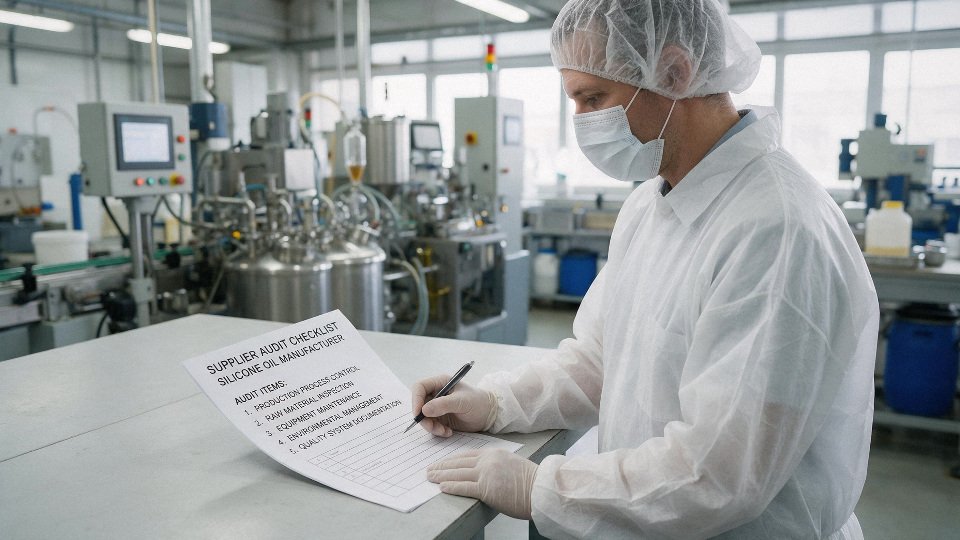
Quality systems and complaint handling: this is where weak suppliers get exposed
A certificate on the wall is not enough. What matters is whether the quality system helps you reconstruct a lot history, isolate a deviation fast, and prevent repeat problems.
Check for:
- Certifications and system maturity
- ISO 9001 at minimum for most industrial supply chains
- any sector-specific systems only if relevant to your market
- Traceability depth
- batch number linkage to raw materials, reactor records, test data, filling line, and shipping date
- Retained sample policy
- retention period
- retention conditions
- whether both bulk and packed samples are kept
- Change management
- formal notification for raw material source changes, process changes, test-method changes, or packaging changes
- Complaint response
- who leads technical investigation
- expected turnaround time
- whether they issue 8D, CAPA, or equivalent structured reports
In practice, if a supplier cannot produce retained-sample logic and traceability details during qualification, complaint handling will be slow and defensive later. That usually costs far more than a small unit-price saving.
Regulatory and export support
For export business, documentation quality is part of product quality. A technically acceptable fluid can still become a procurement problem if shipping documents, declaration support, or destination-market paperwork are handled badly.
Ask about:
- Safety data sheet quality and revision control
- technical data sheets and specification sheets
- certificate of analysis format
- statement support for regulatory or restricted-substance inquiries, where applicable
- packing, labeling, and transport documentation
- export experience by destination region
- familiarity with customer approval packages and vendor onboarding requirements
This area has a hard boundary: destination-market compliance cannot be assumed from the product family alone. The buyer still needs to verify current local requirements, intended use restrictions, and customer-specific declarations against the latest regulations and supplier documents.
Operational resilience and engineering communication
A supplier with nominal capacity but poor maintenance discipline is not resilient. Ask what installed capacity means in practice, how many lines can make your grade, how shutdowns are planned, what their normal lead times are by package size, and whether they offer drums, pails, IBCs, ISO tanks, or other formats you actually use.
Also check:
- raw material stocking strategy
- backup utilities
- filtration and filling controls
- container cleanliness standards
- on-time delivery history
- peak-season performance
One non-obvious criterion deserves more weight than buyers often give it: engineering communication quality is often a better predictor of project success than headline price. Silicone oils are frequently selected inside a performance window, not by commodity name alone. If the supplier’s technical team asks about substrate, process temperature, shear, volatility limits, cure chemistry, or downstream dilution method before quoting, that is usually a good sign. If they quote immediately from a generic list and dodge application details, expect more trial-and-error, more change orders, and more avoidable downtime.
Frequently asked questions
Is silicone oil made from petroleum or from silicon-based feedstocks?
Silicone oil is not a petroleum oil in the usual sense. Its backbone is silicon-oxygen based, but industrial production still depends on upstream raw materials that come partly from quartz-derived silicon and partly from petrochemical methyl sources such as methanol or related hydrocarbons.
In plant terms, the chain usually starts with metallurgical silicon, chlorination chemistry, and organochlorosilanes, not with refining crude oil into base oil as you would for mineral lubricants. That matters because buyers sometimes assume silicone oil should behave like hydrocarbon oil in oxidation, volatility, or seal compatibility. It often does not.
Silicone oil is simply a refined petroleum oil with a silicone additive.False
Standard silicone oils are organosilicon polymers, typically based on siloxane chains, not petroleum base oils blended with silicone.
What is the difference between silicone oil, siloxane, and silicone fluid?
In most industrial purchasing conversations, “silicone oil” and “silicone fluid” are used almost interchangeably for pumpable liquid silicone materials. “Siloxane” is the broader chemical term: it can refer to the Si-O-Si structural unit, small cyclics, short-chain intermediates, or finished polymeric fluids.
The confusion usually shows up on specifications and customs documents. A drum labeled silicone fluid may be a standard polydimethylsiloxane fluid, a phenyl-modified fluid, or a functional copolymer. A document mentioning siloxane content may be talking about residual cyclics, not the whole product. If the application is sensitive, ask for:
– Chemical type or family
– Viscosity at 25°C
– Functional modification, if any
– Residual volatile or cyclic content
– Intended use limitations
Why do some silicone oils have different viscosities if they come from similar raw materials?
The raw materials can be similar while the molecular architecture is not. Viscosity mainly changes with polymer chain length, molecular weight distribution, end-blocking, and how much low-boiling cyclic material remains after equilibration and stripping.
Two suppliers may both start from dimethyl siloxane intermediates and still produce very different fluids. A low-viscosity grade may be close to water-thin, around the lower end of roughly 0.65 cSt, while heavy grades can exceed 1,000,000 cSt at 25°C. In practice, the split comes from process control: catalyst choice, equilibration time, temperature, vacuum stripping efficiency, and how tightly the batch is cut. If the process leaves excess light fractions, the fluid may test on target at release but drift in flash point, volatility, or foaming in service.
Can silicone oil be custom-made for thermal transfer, lubrication, defoaming, textile, or release applications?
Yes, within the chemistry and processing limits of the manufacturer. Customization is common, but it usually means tailoring viscosity, volatility, functional groups, compatibility, or emulsion behavior rather than inventing a completely new chemistry from scratch.
Typical customization paths include:
– Thermal transfer: tighter volatility control, oxidation resistance focus, often lower residue tendency
– Lubrication: viscosity tuning, shear behavior, material compatibility checks
– Defoaming: rapid spreading behavior, often with specific carriers or compound design
– Textile: amino, epoxy, or other functional modification depending on handle and durability targets
– Release: balanced surface activity and transfer control
The limit is that one fluid rarely does all jobs well. A formulation optimized for fast defoaming may not be the best for high-temperature heat transfer or long-term dielectric use.
What impurities matter most when buying industrial silicone oil?
The most important impurities depend on the end use, but a few come up repeatedly in failure analysis:
– Residual cyclic siloxanes and other volatiles
– Moisture
– Residual catalyst or acid/alkali traces
– Insolubles, gel particles, or haze
– Ionic contamination, when electrical performance matters
– Residual odor-causing low boilers, for consumer-adjacent uses
For standard grades, residual cyclics after stripping are often below about 0.1% to 1.0%, depending on specification. That range is not universal; buyers should ask what method was used and whether the number is a routine release item or only type-test data.
How should silicone oil be stored and transported to protect quality?
Keep it clean, dry, and sealed. Most quality complaints in distribution are not chemistry failures from the reactor; they come from moisture pickup, dirty transfer lines, mixed containers, or packaging that sat half-open beside a hot process line.
Basic handling practice:
– Use clean steel or compatible lined containers confirmed for the grade
– Keep drums, IBCs, or tanks tightly closed
– Avoid cross-contamination from pumps and hoses previously used for surfactants, mineral oils, or solvents
– Protect from excessive heat where viscosity drift, pressure buildup, or packaging deformation could occur
– Follow the supplier’s storage temperature guidance and re-test aged stock if the hold time is long
What documents should an international buyer request before ordering?
- Product data sheet with viscosity and key physical properties
- Safety data sheet for the destination market
- Certificate of analysis for the lot or shipment
- Technical specification or agreed quality standard
- Packaging specification and net weight details
- Country of origin and HS code confirmation
- Regulatory or compliance statements relevant to the market and application
- Statement on residual volatiles or restricted substances, if your application requires it
- Sample retention and complaint-handling procedure, if supply continuity matters
Verify your process-fit supplier
A silicone oil supplier is a fit only if its process controls line up with your application window, not just if it can quote the target viscosity. For buying decisions, the practical check is whether the supplier can repeatedly deliver the right fluid family, volatility level, functional chemistry, packaging format, and documentation set without shifting quality once your volume ramps.
Start by fixing your own requirement set. Buyers often ask for “100 cSt silicone oil” when the actual process need is narrower: low foam carryover, tight odor limit, release performance on a hot line, or compatibility with a specific elastomer, coating, or cosmetic base. That changes the supplier short list immediately.
Define the product fit before you compare suppliers
Use a short internal specification sheet that covers:
- Product family
- Standard dimethyl silicone fluid
- Hydroxy-terminated fluid
- Amino-, epoxy-, phenyl-, or other modified silicone fluid
- Food-contact, cosmetic, electronics, textile, or industrial process grade as applicable
- Viscosity window
- Set a target and an acceptable range at 25°C
- State whether startup temperature, winter pumping, or high-shear use matters
- Remember that a broad acceptable range may lower cost, but it can also widen downstream performance drift
- Volatility or residual cyclic limit
- This matters in defoamers, personal care, mold release, and closed-space processing
- Typical residual cyclic siloxanes after stripping may be below roughly 0.1% to 1.0%, but the acceptable limit depends on your use and market requirements
- Functional group and end-group needs
- Functionalized oils can solve adhesion, softness, reactivity, or compatibility problems
- They also narrow the processing window and usually increase sensitivity to storage and contamination
- Compliance profile
- REACH, food-contact statements, cosmetic declarations, SDS quality, lot traceability, and any customer-specific restricted substance requirements
Use a supplier verification checklist that reflects plant reality
Ask for specifics, not brochure language:
- Raw material integration or sourcing stability for key siloxane intermediates
- Stated manufacturing route for the product family you need
- In-process and final QC items, with test methods
- Impurity controls: moisture, acidity/alkalinity, residual volatiles, insolubles, color, odor where relevant
- Packaging choices: pails, drums, IBCs, bulk; liner type; nitrogen blanketing if needed
- Export documentation quality and responsiveness
- Change-control procedure for raw materials, process conditions, or test methods
A supplier that controls upstream organosilicon intermediates usually has better leverage over consistency, lead time, and cost than a trader-only source.True
This is a common industrial purchasing pattern, though the degree of advantage still depends on the supplier's actual plant discipline, inventory policy, and quality system.
Request evidence that can survive a technical review
Do not stop at “product meets industry standard.” Ask for:
- Recent certificate of analysis examples
- Typical, not just specification-limit, test ranges
- Batch-to-batch consistency data over several lots
- Recommended storage conditions and shelf-life basis
- Application notes tied to uses similar to yours
- A retained-sample or complaint-handling procedure
The mechanism here is simple: tighter control of equilibration, stripping, and finishing shows up as narrower viscosity spread, lower volatile variation, and fewer surprises in odor, foam, or thermal behavior. The trade-off is that suppliers with stronger control systems are not always the cheapest at first quote, but they often cost less once line rejects, reformulation time, and emergency freight are counted.
Confirm commercial fit before you sign volume business
- Run a sample in your actual formulation or line condition.
- Approve through pilot or first-production trial, not bench testing alone.
- Confirm normal lead time, minimum order quantity, and replenishment flexibility.
- Agree in writing on change notification expectations.
- Check whether the supplier can support investigation if your process shifts after scale-up.
A supplier can look technically sound on paper and still fail on execution if lead times slip during peak season or if packaging arrives inconsistent from lot to lot. That is usually where annual contracts go wrong.

If you are qualifying a supplier now, send the application basics up front: substrate or formulation system, contaminant or process exposure if relevant, approximate layer thickness or addition level, working area or batch size, required finish or performance target, target consumption rate, and clear product or process photos or a sample reference. SiliconChemicals supports global industrial buyers with integrated organosilicon supply from China, technical communication around silicone fluid selection, and cost-competitive manufacturing; with the right inputs, the next step can be a matched product recommendation, sample review, or quotation.