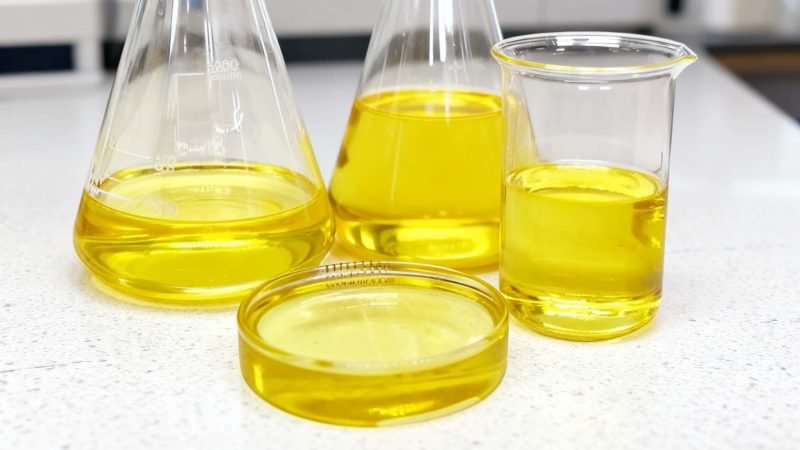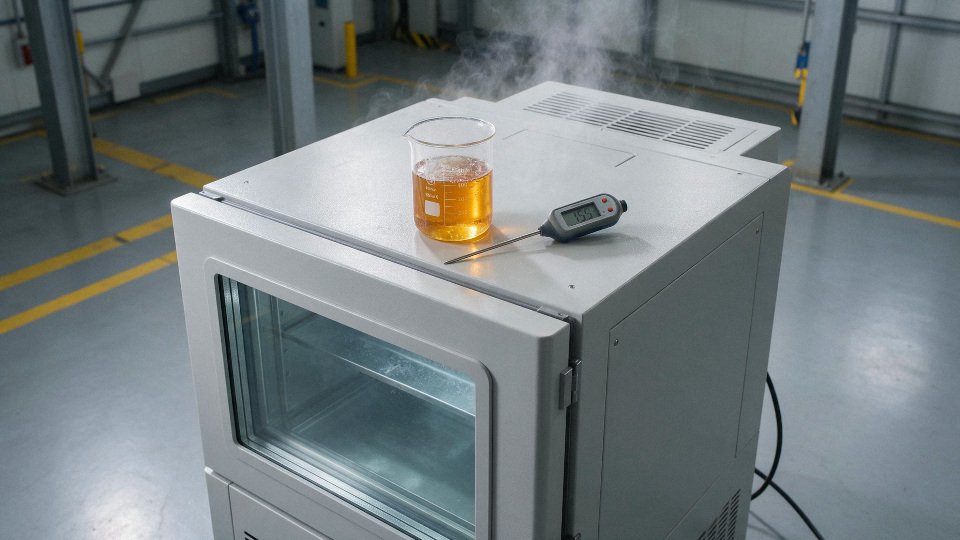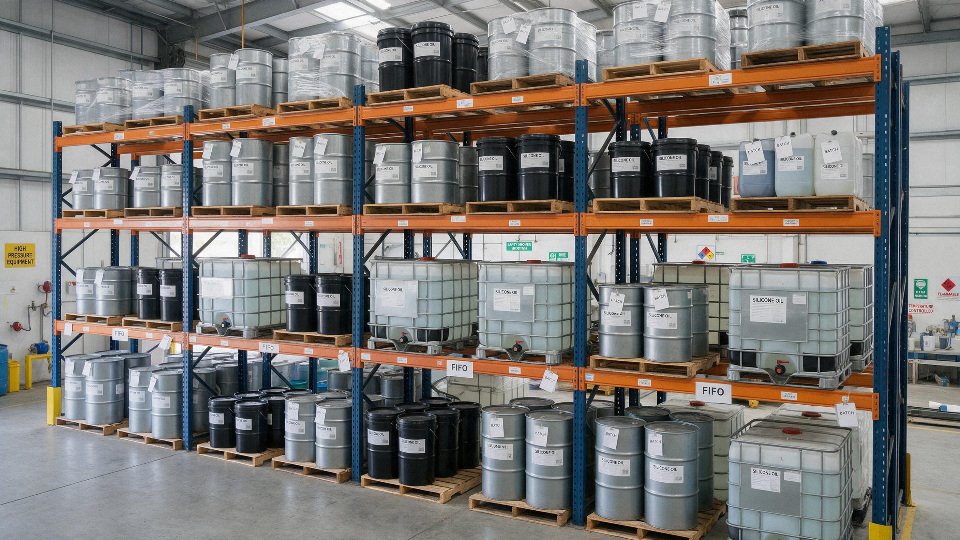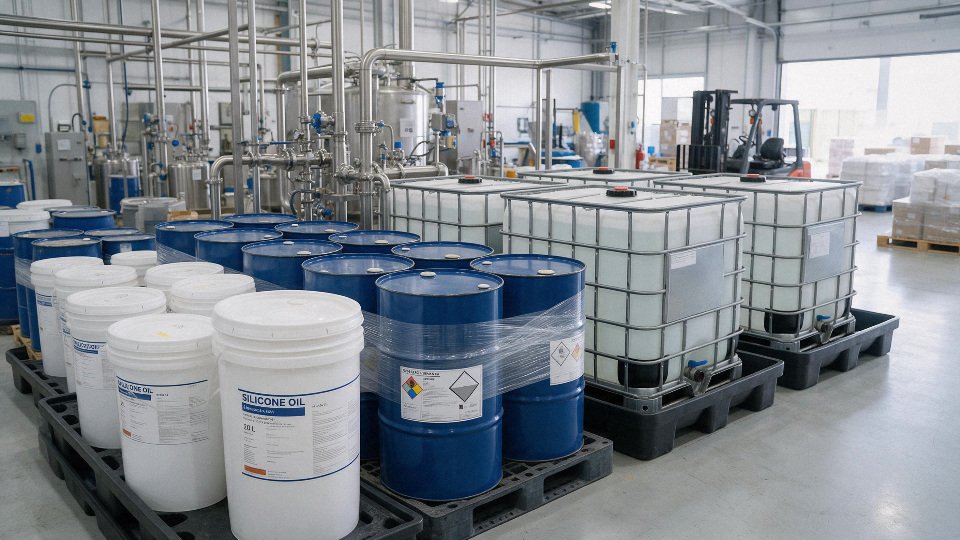
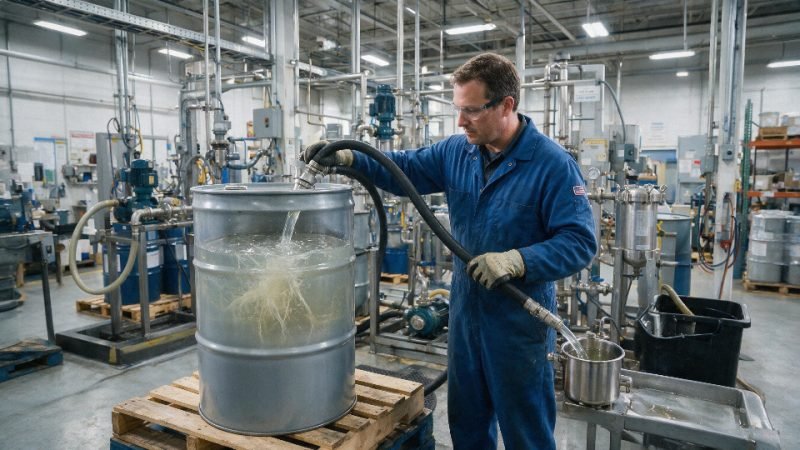
A drum of silicone oil that pumped cleanly last quarter can come back stringy, hazy, or unexpectedly thick, and that is where plants get into trouble. The immediate hit is unstable dosing, poor wet-out, fouled filters, and arguments between production and purchasing about whether the material is “off spec” or the process drifted. Left alone, it turns into scrap, line stoppage, rework, and the expensive mistake of buying the wrong replacement fluid when the real issue was heat history, contamination, or choosing a reactive grade without treating it like one.
Silicone oil does not all behave the same way. Most standard trimethylsilyl-endblocked PDMS fluids do not readily polymerize under normal storage and use, but certain reactive silicone oils can crosslink or continue reacting when exposed to heat, moisture, catalysts, oxygen, or incompatible contaminants. Whether polymerization is a risk depends on end groups, formulation, process conditions, and time.
That distinction matters because silicone’s reputation for thermal stability is only half the story. The Si-O backbone is strong, roughly 440 to 460 kJ/mol, and many grades run comfortably from about -50 C to 200 C, but in practice the trouble usually starts at the chain ends, with residual functionality, or with whatever the fluid picked up from the plant environment. That is why one silicone oil stays usable for years while another gains viscosity in a week on the same site.
Silicone oil chemistry
Most silicone oils are already polymeric siloxane fluids, but whether they stay as stable lubricating liquids or keep reacting depends on backbone structure, side groups, end groups, and whatever catalyst or moisture the formulation sees later. If you want to predict “will it polymerize?” the first check is not viscosity alone; it is the combination of chain architecture and functional groups.
At the backbone level, silicone oil is built around repeating Si-O-Si linkages rather than a carbon-carbon chain. That matters because the siloxane bond is unusually robust, with a representative bond energy often cited around 440 to 460 kJ/mol, and the bond angle and bond length give the chain a lot of flexibility. In practice, that combination is why many PDMS-based fluids stay mobile across a wide temperature window and keep low glass-transition behavior that hydrocarbon oils do not match easily.
A high-viscosity silicone oil is often already a polymeric material rather than a simple low-molecular-weight 'oil'.True
Commercial PDMS fluids span from very low viscosity oligomeric fluids to extremely high-viscosity polymeric fluids. Viscosity usually rises with average chain length and molecular weight, not just with purity or concentration.
The side groups attached to silicon then decide much of the fluid’s behavior:
- Methyl
- The standard for dimethyl silicone oil.
- Gives low surface tension, good lubricity, broad temperature usability, and relatively low reactivity when end-blocked.
- Usually the baseline industrial fluid unless there is a specific reason to move away from it.
- Phenyl
- Improves low-temperature flexibility in some grades and often helps with thermal or oxidative performance, depending on formulation.
- Also changes refractive index and solvent compatibility.
- Used where plain dimethyl fluid starts running out of room on temperature or electrical-property requirements.
- Amino
- Adds polarity and adhesion-related behavior.
- Common in textile softeners, release systems, and surface-treatment fluids.
- The trade-off is that amino functionality can make the fluid more interactive with substrates, emulsifiers, and contaminants, so storage and compatibility become less forgiving.
- Epoxy
- Introduces reactive sites useful in coatings, additives, and coupling-type applications.
- Usually selected when the silicone phase needs to bond into another resin system rather than remain an inert lubricant.
- Vinyl
- Often used as a reactive site for addition-curing systems, especially with Si-H functionality present elsewhere in the formulation.
- By itself, vinyl does not guarantee cure; catalyst package and stoichiometry still control whether anything happens.
- Hydrido (Si-H)
- Found in hydrogen silicone fluids.
- Reacts in hydrosilylation systems with vinyl-functional silicones under the right catalyst.
- Also vulnerable to side reactions with moisture or incompatible impurities in some systems, which is why drum cleanliness and transfer-line history matter more than buyers sometimes expect.
- Polyether
- Used to improve wettability, dispersibility, or emulsification behavior.
- Helpful in defoamers, agricultural adjuvants, and surface-modifying fluids.
- Usually sacrifices some pure-silicone inertness and hydrolytic simplicity for application performance.
- Hydroxyl
- Typically means silanol-terminated material.
- Much more likely to participate in condensation or further network formation than trimethylsilyl-endblocked fluid.
- This is the grade that gets mistaken for “ordinary silicone oil” in purchasing specs and then surprises people in storage or cure behavior.
Architecture: linear, cyclic, branched, resin-containing
Not all silicone oils are simple straight-chain PDMS.
| Architecture | What it is | Typical behavior | Why buyers should care |
|---|---|---|---|
| Linear fluid | Repeating siloxane chain, usually end-capped | Predictable viscosity, common lubricant/base fluid | Usually the easiest grade to specify and replace |
| Cyclic siloxane | Ring-shaped oligomers | Low viscosity, volatile relative to higher-MW fluids | Can affect emissions, equilibrium behavior, and formulation drift |
| Branched fluid | Siloxane chain with branch points | Changes flow, film behavior, and compatibility | Not a drop-in replacement for linear fluids |
| MQ-type resin-containing system | Resinous siloxane units blended or reacted with fluid | Higher body, film formation, tack/release control | Often behaves more like a formulation component than a simple oil |
Linear fluids are the usual plant-floor material: pumpable, meterable, and comparatively stable if end-blocked. Cyclics are different. Under catalytic conditions, especially with acids or bases, cyclic siloxanes and low-molecular-weight oligomers can open, rearrange, and equilibrate with linear chains. That is one reason a fluid that looked stable on a bench can drift in viscosity or volatile content in a formulated system.
Branched and resin-containing systems shift the conversation from “oil” to “structure-building intermediate.” Once MQ resin or similar resinous fractions are in the mix, film hardness, release, transfer, and compatibility with organic resins move to the front of the selection process. A buyer treating these as commodity fluids usually ends up with line trials that do not reproduce.
Why viscosity is not a purity test
For trimethylsilyl-endblocked PDMS, commercial viscosity can range from about 0.65 cSt to more than 1,000,000 cSt at 25 C. That span is mainly a molecular architecture and chain-length story. Short chains flow like light fluids; long chains become heavy, stringy, sometimes almost gum-like, even though both may be chemically “silicone oil.”
The mechanism is straightforward: as average chain length rises, chain entanglement rises, internal mobility drops, and resistance to flow increases. Purity still matters, especially for volatiles, catalyst residues, haze, or ionic contamination, but a higher-viscosity silicone oil is usually not “cleaner” or “more concentrated”; it is often just a higher-molecular-weight siloxane fluid.
That conclusion stops holding when fillers, emulsification, solvent dilution, or resin modification are involved. Once you are looking at an emulsion, a blend, or a reactive package, viscosity no longer maps cleanly to chain length.
Commercial families you will actually see on quotations
Common silicone-fluid families include:
- Dimethyl silicone oil
- Standard nonreactive PDMS fluid, usually trimethylsilyl end-blocked.
- Used for lubrication, heat transfer, damping, release, and dielectric applications depending on grade.
- Methyl phenyl silicone oil
- Chosen for temperature extension or property shifts that dimethyl grades cannot deliver alone.
- Hydrogen silicone fluid
- Carries Si-H functionality for reactivity, often as a crosslinker or water-repellent treatment component.
- Vinyl silicone fluid
- Reactive fluid used in addition-cure systems and specialty formulations.
- Hydroxy silicone oil
- Silanol-terminated fluid, important in condensation systems and further polymer build.
- Amino-modified fluid
- More substrate-active, common in softening and finish applications.
- Silicone emulsions
- Waterborne delivery systems containing one of the above fluid types plus surfactant package.
- Good for safer handling or easier dilution, but emulsion stability, freeze-thaw behavior, and microbial control become practical procurement issues.
End groups decide whether the fluid stays a fluid
Trimethylsiloxy end-blocking is the usual route to chemical stability in silicone oils. It caps the chain ends so the fluid behaves as an inert material under many service conditions, which is what buyers generally want in lubricants, dielectric fluids, and damping applications.
Silanol or alkoxy end groups are different. They provide entry points for condensation, especially with moisture and a suitable catalyst, so the fluid can build molecular weight or form a network over time. That is useful in sealants, release coatings, and reactive intermediates, but it is exactly the wrong chemistry if the plant expects a long-shelf-life, noncuring maintenance fluid.
In practice, this is where many specification errors happen: the purchasing line says “silicone oil, 1000 cSt,” but says nothing about end groups. If the application is sensitive, ask for the chain type, end-blocking, volatile level, and whether the material contains reactive functionality or residual catalyst. That usually avoids the expensive kind of learning.
When polymerization occurs
Silicone oil does undergo further reaction, but only under specific chemical conditions: reactive end groups or side groups, a compatible crosslinker, and usually a catalyst, moisture source, or elevated temperature. Plain trimethylsilyl-endblocked PDMS fluid is generally too stable to “just polymerize” in a drum, so when viscosity rises unexpectedly, contamination or a different fluid chemistry is often the real cause.
The practical split is this: some systems are designed to build molecular weight in a controlled way during curing or manufacture, while others only drift because something reactive got into the fluid. On the plant floor, those two situations can look similar at first glance. The troubleshooting path is different.
Condensation pathways: where moisture and end groups matter
Hydroxyl-terminated silicone fluids are the classic case where further polymerization or network formation is chemically plausible. A silanol end group, Si-OH, can condense with another silanol or with a moisture-reactive silane or siloxane crosslinker to form a new Si-O-Si linkage. Water is either consumed, generated, or required somewhere in that loop depending on the system.
The main condensation routes you will actually see are:
- Silanol with silanol
- Two Si-OH groups condense to form Si-O-Si and water
- Typically slow on its own at ambient conditions
- Often accelerated by tin compounds, titanium catalysts, strong acids, strong bases, or certain metal salts
- Silanol with alkoxy silane
- Crosslinker hydrolyzes first with moisture, then reacts with silanol
- Releases alcohol as a by-product
- Cure rate depends heavily on ambient humidity, catalyst package, and how well moisture can diffuse into the bulk
- Silanol with acetoxy silane
- Moisture-triggered hydrolysis and condensation
- Releases acetic acid
- Fast and robust in many sealant-type systems, but corrosivity around sensitive metals must be checked
- Silanol with oxime silane
- Moisture-cure route common in neutral-cure systems
- Releases oxime-type by-products
- Less aggressive toward some substrates than acetoxy systems, but cure speed and storage stability still depend on formulation balance
- Silanol with other moisture-reactive crosslinkers
- Includes mixed alkoxy, amide, amine, or specialty functional silanes
- Used when adhesion, by-product profile, or cure speed has to be tuned
- Needs formulation-specific verification; you cannot generalize one crosslinker’s behavior to all
What matters operationally is the mechanism. Moisture first hydrolyzes the reactive silane, creating silanol functionality that then condenses into siloxane bonds. That means the same storage condition can behave two different ways: a sealed dry tote may stay usable, while a half-open pail in humid summer air starts skinning, thickening, or gelling around the lid and pump standpipe.
A common buyer mistake is to treat “silicone oil” as one commodity line item and miss whether the fluid is trimethyl-endblocked or hydroxyl-terminated. That one detail changes the storage risk completely. If your process uses drum pumps, nitrogen blanketing, or partial container returns, the termination chemistry belongs on the receiving checklist, not just the viscosity.
The trade-off with condensation systems is straightforward:
- Gain
- Simple cure chemistry
- Good substrate tolerance in many applications
- Broad industrial familiarity and relatively forgiving processing
- Sacrifice
- Sensitivity to moisture history
- By-product release during cure
- Greater risk of storage drift if packaging control is poor or catalysts are introduced unintentionally
That conclusion stops holding if the fluid is fully endblocked and non-reactive; then moisture exposure alone usually does not create meaningful polymerization.
Addition cure: controlled crosslinking, not spontaneous self-growth
Vinyl-functional silicone fluids can react with Si-H containing fluids through hydrosilylation in the presence of platinum catalysts. In most industrial formulations, this is not “self-polymerization” in the loose sense buyers use. It is a deliberately designed addition-cure network-forming reaction with defined stoichiometry and inhibitor control.
The practical ingredients are:
- Vinyl-functional PDMS or silicone resin/fluid
- Hydride-functional siloxane crosslinker or chain extender
- Platinum catalyst
- Often an inhibitor to slow reaction until heat or time overcomes the inhibition
No water is required, and there is no small-molecule by-product in the ideal reaction. That is one reason addition-cure systems are preferred where low shrinkage, low volatiles, or enclosed-part curing matter.
The mechanism also explains why the reaction can feel “sudden” in production. A formulation may be stable in separate Part A and Part B containers, then gel quickly after mixing because platinum is now in contact with both vinyl and Si-H at the intended ratio. If the same transfer hose, static mixer, or day tank carries residues from a previous run, the next batch may begin crosslinking long before the operator expects it.
In practice, the key variables are:
- Vinyl to Si-H ratio
- Controls crosslink density and residual functionality
- Catalyst level and catalyst dispersion
- Affects cure speed and consistency through the bulk
- Inhibitor package
- Extends pot life, but too much can create undercure
- Temperature
- Usually accelerates cure sharply
- Catalyst poisons
- Sulfur, phosphorus, nitrogen compounds, certain amines, organotin residues, and some metal contaminants can inhibit or distort cure
The trade-off flips depending on what the plant needs. Addition cure gives cleaner chemistry and predictable cure when contamination is controlled. Condensation cure is often less expensive and more tolerant of some field conditions, but it brings moisture dependence and by-products with it.
A vinyl silicone fluid will not usually polymerize in storage unless it also encounters Si-H functionality and an active platinum catalyst system.True
Vinyl groups alone are not enough for normal addition-cure crosslinking. The hydride component and catalyst package are both required, and many commercial systems are intentionally split into separate parts for that reason.
Ring-opening and equilibration of cyclic siloxanes
If cyclic siloxanes such as D4, D5, or related low-molecular-weight siloxanes are present, acid or base catalysis can drive ring-opening polymerization or equilibration. This is a manufacturing pathway first and a contamination hazard second.
In production, this chemistry is useful. Cyclics are polymerized or equilibrated into target molecular-weight fluids, then endblocked and stripped to control volatility and viscosity. In storage or downstream use, the same chemistry is unwelcome because it changes viscosity and molecular-weight distribution without anyone intending it.
Watch for these trigger conditions:
- Strong acid contamination
- Residual acidic cleaner
- Acidic process additive
- Corrosion products in unusual systems
- Strong base contamination
- Caustic wash carryover
- Amine-rich contamination in some mixed-use equipment
- Alkaline residues from maintenance cleaning
- Insufficient endblocking
- Leaves chains more able to redistribute
- Makes the fluid more sensitive to catalytic rearrangement
The mechanism is not just chain growth. Under equilibration, siloxane bonds break and reform, so some chains get longer while some species become cyclic again. The result may be a viscosity shift, broadened molecular-weight distribution, or a higher volatile fraction, not simply neat monotonic polymerization.
That distinction matters if a buyer is comparing COA viscosity against field performance. A fluid can still test “close enough” on one property while having a very different distribution because catalyst contamination has rearranged the system.
Peroxide and radical routes
Peroxide curing is relevant to silicone gum, solid elastomer processing, and a few specialty systems, but much less relevant to routine storage of ordinary silicone oil. It becomes important when the fluid is part of a compounded cure package, exposed to radical initiators, or heated in a way that activates peroxide decomposition.
Typical cases include:
- Silicone rubber formulations where peroxide generates radicals that create crosslinks
- Specialty coatings or release systems with radical-sensitive components
- High-temperature operations where residual initiator survives farther into the process than expected
For plain PDMS oil in a clean, closed container, this is not the mechanism I would suspect first. In a shared plant with elastomer mixing, old lines, or reused vessels, I would not dismiss it outright.
Heat-driven side reactions and the “it thickened by itself” problem
Above the normal service window, especially with air exposure or reactive residues present, silicone fluids can change by several competing routes:
- Oxidation
- Can increase acidity, create volatile fragments, and shift color or odor
- Chain scission
- Lowers molecular weight and viscosity at first
- Scission followed by recombination or condensation
- Can later increase viscosity or create gel particles
- Condensation of residual silanols
- More likely in hydroxyl-functional fluids
- Catalyst-accelerated rearrangement
- Can move the fluid away from its original viscosity grade
A useful plant-floor caution: apparent spontaneous polymerization often turns out to be a contamination problem from adjacent equipment. Trace amines from a previous batch, acidic wash residue in a tote line, metal salts from corroded fittings, moisture entering through a bad drum bung seal, or residual platinum from a shared mixer can all trigger drift.
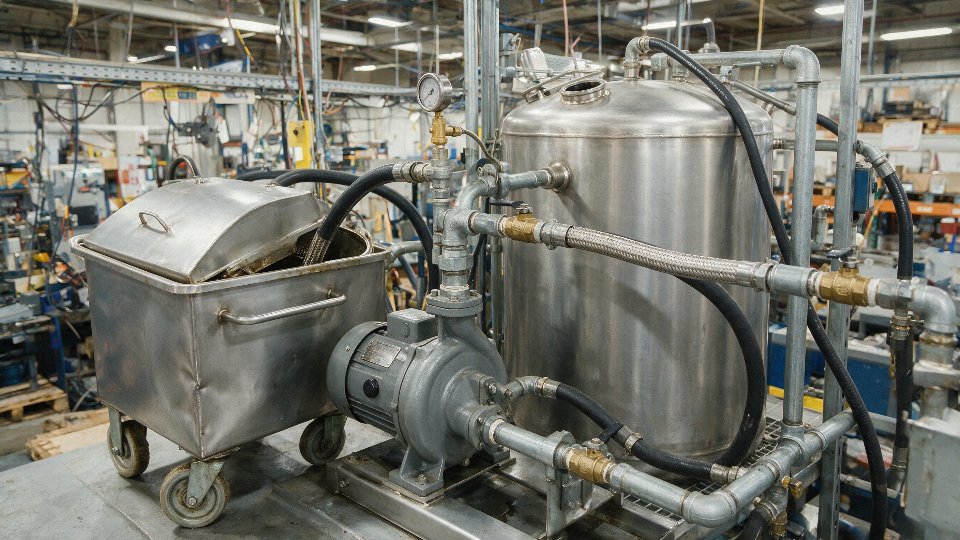
The mechanism is indirect but costly. A few ppm of the wrong contaminant can change cure kinetics or equilibration rate, which changes viscosity, pumpability, and final product behavior; then procurement sees a “bad batch” claim, while operations sees plugged filters and maintenance sees gel on level probes. In my experience, stainless hardware helps but does not solve poor segregation. The real control points are dedicated transfer paths, validated cleaning chemistry, moisture management, and knowing exactly which silicone functionality is in the drum before it goes near a day tank.
Why most oils stay stable
For standard silicone oils, the short answer is structural: most commercial fluids are deliberately made so they have very little left that can keep reacting. A trimethylsilyl-endblocked PDMS fluid is usually stable in storage and in many service conditions because the chain ends are capped, the Si-O backbone is relatively resilient, and the product has been finished to remove the residual chemistry that would otherwise let viscosity drift upward.
The practical reason buyers often describe silicone oil as “non-polymerizing” is that they are usually talking about linear, trimethylsilyl-endblocked polydimethylsiloxane fluids. Those methyl-capped ends matter. If the chain terminates in silanol groups, you still have a route for condensation or chain extension under the right conditions, especially if moisture, acid, base, or metal salts get involved. Once those ends are blocked with trimethylsilyl groups, that route is largely shut down because there is no active silanol left to condense with a neighboring chain.
That sounds like a small molecular detail, but on the plant floor it is the difference between a fluid that sits in a tote for months with very little change and one that slowly creeps up in viscosity, skins over in a vented tank, or surprises you after a warm summer in a warehouse. In purchasing terms, end-blocking is not a cosmetic specification. It is one of the core design choices that separates a stable silicone fluid from a reactive intermediate.
Most standard silicone oils do not keep polymerizing in the drum under normal storage conditions.True
That is generally true for properly manufactured, trimethylsilyl-endblocked PDMS fluids with low residual catalyst and low silanol content. It stops being true if the product is intentionally reactive, poorly neutralized, contaminated, or exposed to conditions that introduce catalytic surfaces, moisture, or curing agents.
The siloxane backbone itself is another big part of the stability story. Si-O bond energy is often cited around 440 to 460 kJ/mol, which helps explain why many silicone fluids tolerate heat better than a lot of conventional organic oils. In service, that usually shows up as slower hardening, less sludge formation, and a wider usable temperature window. Typical grades are often used somewhere around -50 C to 200 C, with specialty phenyl or reactive chemistries extending beyond that, but no one should treat that as a universal guarantee. Oxidation rate, residence time, air exposure, and the exact metal surfaces in the system all change the picture.
There is a trade-off here that gets missed in brochure language. The backbone is robust, but silicone fluids are not invincible under hot air, high shear, and contamination. At elevated temperature in the presence of oxygen, especially with thin films on hot metal, you can still see oxidative degradation, volatile loss, or deposits. If trace catalysts are present, the fluid may not “burn” in the way a mineral oil does, but it can still shift in viscosity or generate low-molecular-weight fragments. In a sealed transformer or damping assembly, stability may be excellent. In an open heat-transfer loop with poor vent design and a bit of metal soap contamination, the same fluid can age much faster.
Why they stay fluid so consistently is also tied to intermolecular behavior. PDMS molecules have relatively low intermolecular forces compared with many hydrocarbon or polar fluids. That is one reason silicone oils keep a broad liquid range, maintain flow at low temperature, and show fairly predictable viscosity behavior across a useful operating window. It is also why they turn up in several very different duties:
- Lubrication and release where low surface interaction and stable flow are useful
- Damping and dashpot service where viscosity consistency matters more than extreme film strength
- Heat transfer where thermal stability and pumpability matter
- Dielectric service where electrical insulation and fluid stability are both part of the buying decision
Still, “viscosity changed” does not automatically mean “polymerization happened.” In practice, I would check simpler causes first:
- Temperature shift
- Silicone oil viscosity is strongly temperature-dependent.
- A fluid sampled cold on a winter receiving dock can look “thicker” than the same batch tested after equilibrating in the lab.
- Loss of light fractions
- Lower-viscosity grades can change if volatile fractions evaporate during open handling, hot service, or repeated tank breathing.
- What operators describe as “it got heavier” is often concentration by volatilization, not chain growth.
- Contamination
- Water, dust, fines from pumps, residual solvent, process chemicals, or incompatible additives can all skew apparent viscosity.
- A little filler carryover from a blending line can change the feel of the fluid dramatically without any true molecular increase.
- Entrained air or poor sampling
- Aerated fluid from a recirculating line often reads inconsistently.
- Sampling from the top of a dirty tote is not the same as sampling after proper mixing and conditioning.
This is where manufacturing discipline shows up in the delivered product. A stable commercial silicone oil is not just “made” and shipped. It is usually the result of several finishing controls that reduce the chance of post-production drift:
- Neutralization of residual acidic or basic species after polymer manufacture
- Stripping of cyclics and other low boilers to tighten volatility behavior
- Control of residual silanol content so the fluid is less prone to further condensation
- Filtration to remove gels, particulates, and catalyst-bearing fines
- Clean, dry packaging to prevent moisture pickup and cross-contamination during filling and transport
If any of those are sloppy, the buyer may see the problem later as haze, odor, viscosity drift, or odd behavior after blending. I have seen fluids that were chemically fine leave the reactor, then get compromised by dirty transfer hoses, reused drums, or a filling station that handled reactive silicone the shift before. Packaging cleanliness sounds mundane until you are explaining a blocked dispensing valve to maintenance.
The boundary on all of this is simple: stability is application-specific, not absolute. A silicone oil that is stable for a year in a sealed drum may become much less stable once you mix in fillers, pigments, metal powders, peroxide systems, tin catalysts, amines, or ambient process moisture. Contact with certain metal surfaces, especially at heat, can also change the aging path. So the usual statement that silicone oil “does not polymerize” holds well for standard finished fluids in clean storage and appropriate service, but it stops holding once the fluid becomes part of a formulated system or sees a catalytic environment that the original product was never designed to tolerate.
Apparent polymerization signs
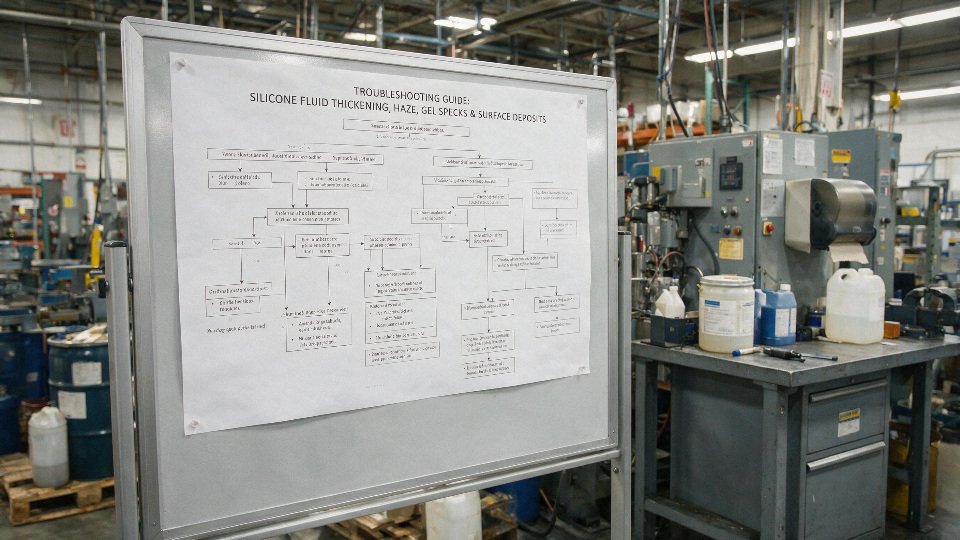
What operators call “the silicone oil polymerized” is often a mixed bag: sometimes there is a real molecular-weight increase or surface crosslinking, but just as often the bulk fluid is only behaving differently because of temperature, contamination, volatilization, water pickup, or incompatibility with another component. If you do not separate bulk-fluid change from surface deposit formation and physical thickening, you can scrap good material, blame the wrong supplier, and still not fix the line.
The symptoms below matter, but none of them proves polymerization by itself.
What you can actually observe
- Viscosity increase
- The most common complaint.
- Can come from chain extension or crosslinking, but also from simple cooling, solvent loss, partial evaporation of low-boiling diluent, or filler interaction.
- In practice, a drum sampled at 12 C in winter can look “aged” compared with the same lot tested at 25 C.
- Haze or loss of clarity
- Often points to phase instability, moisture contamination, additive incompatibility, or suspended microgel.
- True reaction can cause haze, but so can a small amount of water in a fluid that was otherwise clear when packed.
- Gel specks
- These are important because they often indicate localized reaction rather than uniform bulk polymerization.
- Common sources include catalyst hot spots, contamination at transfer points, partially cured residue shedding from hoses, or old heel material in a tote outlet.
- Stringiness or filaments when pulling a spatula or dip rod
- Suggests some network formation or a broad molecular-weight distribution.
- It can also show up when fillers swell, when a reactive additive starts to structure, or when solvent balance shifts.
- Skin formation at the surface
- Frequently mistaken for whole-batch polymerization.
- Surface exposure to moisture, oxygen, metal salts, or heat can cure a thin layer while the bulk underneath remains usable.
- Poor flow and reduced leveling
- Seen in coating, release, and lubricant applications.
- Sometimes this is viscosity rise; sometimes it is contamination with incompatible surfactant, resin, or packaging extractables that change surface tension instead.
- Nozzle fouling
- Usually a process clue more than a chemistry conclusion.
- If fouling is limited to the nozzle, static mixer, needle tip, or heated block, look hard at localized heat history, catalyst carryover, and dead-leg residence time.
- Phase separation
- A strong sign that incompatibility may be involved.
- True PDMS chain growth alone does not usually create a neat top-and-bottom split unless another component is present and the solubility balance has moved.
- Cured deposits on hot surfaces
- Very common around heaters, manifolds, pump seals, and vented zones.
- These deposits can make the whole operation look like the fluid “went solid,” even when the tank sample still tests close to spec.
What looks like polymerization but often is not
A rising viscosity number is only meaningful if the sample handling is controlled. Silicone fluids span a very wide viscosity range, and the apparent change can be exaggerated by test temperature, shear history, air entrainment, and contamination from the sample container. I have seen a clean 350 cSt fluid “fail” because it was compared against a room-temperature certificate after being measured cold on a bench viscometer with poor equilibration.
The physical causes that most often create a false polymerization diagnosis are:
- Low-temperature thickening
- Especially relevant for higher-viscosity grades or formulations containing waxy or resinous additives.
- The mechanism is simple: lower temperature reduces chain mobility and raises viscosity sharply, even without any new bonds forming.
- Emulsion instability
- If the product is an emulsion, not a neat fluid, breaking can create lumps, creaming, or apparent gel.
- That is a colloid stability problem, not polymerization of the silicone phase.
- Solvent loss or volatile loss
- In open pans, vented tanks, and warm recirculation loops, loss of low-boiling components can shift a fluid from free-flowing to syrupy.
- The process operator experiences “thickening,” but the polymer itself may be unchanged.
- Filler swelling or structuring
- Silica, treated minerals, and some rheology modifiers can build a network through hydrogen bonding or surface interaction.
- This can produce stringiness and poor flow with little or no actual PDMS chain growth.
- Water ingress
- Depending on the system, water can cause haze, hydrolysis, emulsion break, or catalyst activation/deactivation.
- The result may resemble polymerization while the primary issue is moisture management.
Why surface cure misleads people
A thin cured layer on steel, aluminum, brass, heated glass, or elastomer seals can give the impression that the whole batch polymerized. Often the mechanism is local: catalytic residue on a fitting, basic or acidic contamination on a contact surface, or heat concentration at the wall drives crosslinking where residence time is longest. The bulk fluid moving through the center may stay largely unchanged.
That distinction matters commercially. If deposits are confined to pump heads, nozzles, static mixers, or heat-transfer contact points, your fix is more likely in equipment cleaning, metallurgy, seal chemistry, dead-zone reduction, or catalyst segregation than in changing the base silicone oil.
Gel specks or cured skin automatically prove the entire silicone oil batch polymerized.False
Localized crosslinking at surfaces, in dead legs, or around contamination points is common. Bulk-fluid testing is needed before concluding that the whole lot underwent molecular-weight increase.
How to confirm what changed
Use more than one test. A single viscosity result is directionally useful, not dispositive.
- Viscosity trend testing
- Compare retained sample, incoming sample, and in-process sample at the same temperature, same method, same equilibration time.
- Best first screen for change over time.
- FTIR
- Useful for tracking consumption or change in reactive groups such as silanol or vinyl, if those groups are expected in the system.
- Also helps identify contamination from foreign organics.
- GPC/SEC
- The clearest way to see whether molecular-weight distribution shifted upward.
- This is the right tool when you need to distinguish true chain extension from a simple loss of volatiles.
- NMR
- Valuable for end-group identification and confirming whether reactive end groups are still present.
- Usually a lab tool rather than a plant-floor routine check.
- Volatile content
- Essential when thickening may actually be concentration change from evaporation.
- Pair this with viscosity; the combination is often more informative than either alone.
- Acid-base contamination checks
- Fast and practical when unexplained instability appears after transfer, repacking, or contact with a cleaning residue.
- Trace acidic or alkaline contamination can trigger or distort reactions in reactive grades.
- Gel fraction measurement
- Important when partial crosslinking is suspected.
- It shows whether an insoluble network has formed, which a straight viscosity test can miss.
Practical troubleshooting sequence
- Take representative samples correctly
- Pull from bulk, outlet, and problem point if possible.
- Use clean, inert containers; do not sample a suspected silicone issue into a dirty PE bottle and then debate the result for a week.
- Record visual and handling observations
- Clarity, color, haze, specks, skin, stringiness, odor, separation, deposit location.
- Note sample temperature immediately.
- Check process history
- Tank temperature, line heat tracing, residence time, shutdown duration, recirculation, recent maintenance, cleaning chemistry, packaging change, and whether the line sat over a weekend.
- Compare against retained reference
- Same lot if available.
- If only a certificate exists, that helps less than people think.
- Screen for contamination exposure
- Acids, bases, metal catalysts, peroxide residues, amines, tin compounds, platinum carryover, moisture, and foreign additives.
- Also check transfer hoses, pump lubricants, gasket materials, and old heel material.
- Measure viscosity and volatile content under controlled conditions
- This quickly separates many physical thickening cases from chemical change.
- Run confirmatory analysis
- FTIR first for many plants; GPC, NMR, or gel fraction if the case is material enough to justify outside lab work.
- Do a controlled bench reactivity test
- Hold a clean sample at defined temperature, with and without suspected contaminant or catalyst exposure.
- If only the contaminated split changes, you have your direction.
One point that gets missed in supply disputes: the silicone oil is often blamed because it is the obvious common ingredient, but the trigger is elsewhere. Additive incompatibility, liner extractables, drum coating residues, poorly selected seals, or a repackaging step can create haze, thickening, and gels that look like intrinsic instability. Before rejecting the fluid, verify what else touched it.
Industrial implications
The practical consequence is simple: a silicone fluid that stays chemically quiet behaves like a stable lubricant, dielectric, or process aid, while a reactive or degrading silicone fluid can shift viscosity, generate deposits, lose consistency, or cure where you did not want it to. In purchasing and plant operation, that difference matters more than the generic label “silicone oil,” because two products with similar starting viscosity can behave very differently once heat, moisture, catalysts, air, or substrate chemistry enter the picture.
For most buyers, the first mistake is treating silicone oil as a single commodity. It is not. A trimethylsilyl-endblocked PDMS fluid in the lower-viscosity range can be selected mainly on viscosity, volatility, temperature window, and cleanliness; a hydroxy-, alkoxy-, amino-, epoxy-, vinyl-, or hydrogen-functional fluid is being bought partly for what it will react with later. If that distinction is missed, the commercial result is usually ugly: inconsistent line performance, shorter bath life, off-spec cure, blocked filters, or customer complaints that show up weeks after shipment.
Lubricants and damping fluids
In damping, instrument filling, dashpots, fan clutches, and specialty lubrication, unintended viscosity growth is usually a performance problem long before anyone proves “true polymerization.” The equipment only sees that the fluid got thicker, less mobile at low temperature, harder to meter, and less predictable over time.
A few consequences show up fast on the plant floor:
- Torque and damping consistency drift
- Damping force rises with viscosity, but not always linearly across the whole motion profile.
- Small viscosity changes can be tolerable in a door closer; they are much less tolerable in precision instruments, automotive controls, or test equipment.
- Operators often describe this as “the unit feels sticky” or “returns slowly in the morning.”
- Low-temperature motion gets worse first
- Silicone fluids are often chosen because they remain usable roughly from about -50 C to 200 C by grade, but contamination or chemical change narrows the practical window.
- If viscosity creeps upward, the penalty is amplified at the cold end. A unit that still moves acceptably at 25 C can become sluggish or nonresponsive in winter shipment, cold storage, or outdoor service.
- Metering accuracy falls off
- Gear pumps, piston fillers, and timed dispense systems depend on repeatable flow behavior.
- As viscosity rises, slip changes, fill times drift, and air entrapment tends to increase.
- In practice, maintenance may chase the symptom by changing pump speed or dispense time, which hides the root cause until the next batch or season.
- Service life shortens
- Thicker fluid can increase drag, raise local temperature, and hold contaminants.
- If the change is driven by degradation products or contamination rather than clean chain extension, wear and seal attack may follow.
The mechanism is usually indirect: heat, trace catalyst, moisture, incompatible additives, or oxidation products alter molecular structure or create higher-molecular-weight fractions; that raises viscosity, and the higher viscosity then shifts torque, startup behavior, and fill performance. The trade-off is that a higher-viscosity silicone may be exactly what gives the desired damping feel on day one, but it leaves less room for upward drift. Where ambient temperature swings are wide, that margin matters more than the nominal catalog viscosity.
Heat transfer and dielectric uses
For heat transfer and electrical insulation, the issue is often degradation rather than classic polymerization. You may not get a cured gel, but you can still get enough viscosity drift, volatile formation, or deposit build-up to hurt performance.
A few failure paths are common:
| Use | Operational symptom | Likely consequence |
|---|---|---|
| Heat transfer loops | Darkening, odor, residue on hot surfaces | Lower heat-transfer coefficient, fouling, unstable temperature control |
| Expansion tanks or reservoirs | Gas bubbles, pressure fluctuation, foaming | Pump cavitation, oxidation acceleration, reduced thermal stability |
| Transformers, capacitors, specialty dielectric systems | Dielectric loss drift, gas formation, contamination | Lower insulation reliability, harder fault diagnosis |
| Heated baths with poor venting | Light ends or breakdown gases accumulate | Fire-risk assessment changes, vent system load increases |
Deposits are a quiet efficiency killer. Once a thin film forms on a heater sheath, plate surface, or narrow passage, thermal resistance rises, metal skin temperature climbs, and degradation speeds up at exactly the worst spot. Then the loop looks like it “mysteriously aged” everywhere, when in fact one overheated zone started the problem. The section’s main conclusion stops holding if the system is already operating near the fluid’s thermal limit or has localized hot spots well above bulk temperature; in that case, even a normally stable silicone fluid may degrade quickly.
For dielectric duty, current equipment-specific limits must be verified against the fluid supplier’s data, the electrical design, and the latest equipment documentation. It is not safe to generalize one silicone fluid’s dielectric behavior across the whole category.
Surface applications: where some reactivity is useful
In textile finishing, release coatings, personal care, defoaming, and surface treatment, a little controlled reactivity can be an advantage rather than a liability. The buyer is not only purchasing flow and feel; they are purchasing whether the silicone stays mobile, deposits physically, or bonds to the substrate.
That distinction affects application results:
- Textiles
- Reactive amino or other functional silicones are often chosen for softness with better wash durability.
- Too inert, and the hand feel may wash out quickly.
- Too reactive, and bath stability or shade reproducibility can suffer.
- Release and paper treatment
- Anchoring to paper, film, or a primer layer often requires reactive groups that cure into a release network.
- If cure is incomplete, release force drifts and transfer can increase.
- Personal care
- Highly inert fluids are valued for slip, spreadability, and sensory profile.
- Reactive chemistry is generally less relevant in the package, but compatibility with emulsifiers, actives, and packaging still matters.
- Defoaming
- Purely inert silicone can knock down foam quickly, but persistence depends on formulation balance, carrier compatibility, and droplet behavior.
- In some systems, modified silicones improve spreading or substrate affinity.
- Surface treatment
- Hydrophobicity and durability improve when the silicone can orient and, in some chemistries, graft or condense onto the surface.
- Glass, mineral, and hydroxyl-bearing surfaces especially reward the right functionality.
A soft hand, durable hydrophobe, and clean release usually do not come from the exact same silicone structure. That is the trade-off buyers need to keep in view.
Coatings, sealants, RTV, paper release, and silicone-modified resins
Here, reactive silicone fluids are often selected on purpose. The fluid is not merely a liquid ingredient; it is a network former, crosslinkable intermediate, or grafting component.
Typical intentional uses include:
- RTV and sealant systems
- Hydroxy-, alkoxy-, acetoxy-, oxime-, or other reactive siloxanes are used so the system cures after application.
- Moisture sensitivity is part of the design, which means storage control is not optional.
- Paper release coatings
- Vinyl-functional polymers with crosslinkers and catalysts are chosen to cure into a release layer.
- Pot life, catalyst level, coating weight, and oven profile all interact.
- Silicone-modified resins and coatings
- Reactive silicone segments improve weatherability, slip, water repellency, or flexibility by grafting into an organic resin network.
- The gain is property enhancement; the sacrifice can be more formulation sensitivity and narrower processing latitude.
- Electronics and protective coatings
- Cure profile, by-product release, and substrate adhesion must be matched to the assembly process.
- A fluid bought only on cSt can easily be the wrong chemistry.
Two silicone oils with similar viscosity can have completely different curing or storage behavior.True
Viscosity mainly reflects molecular size and structure at a given temperature, not whether the chain ends or side groups are reactive. Endblocking and functionality determine whether the fluid remains inert or can chain-extend, condense, crosslink, or graft under use conditions.
Process manufacturing and procurement controls
In manufacturing, the chemistry shows up as housekeeping and uptime issues before it shows up as a lab theory problem.
Pay attention to these controls:
- Pumpability
- High-viscosity grades may need jacketed lines, follower-plate systems, larger suction piping, or slower pump speeds.
- If viscosity drifts upward in storage, the first complaint is often poor drum emptying or cavitation.
- Filtration
- Fine filtration can remove gels or contaminants, but it will not fix a fluid that is continuing to react.
- Filter differential pressure trending is often an early warning.
- Storage tanks and drums
- Keep water out, especially for moisture-sensitive reactive grades.
- Dead legs, dirty manways, reused IBCs, and poorly sealed nitrogen blankets cause a lot of avoidable trouble.
- Catalyst segregation
- For two-part or catalyzed systems, mix ratio discipline matters.
- A drum heel with concentrated catalyst contamination can ruin the next batch.
- Equipment materials
- Stainless steel and glass-lined equipment are commonly suitable, but actual compatibility still depends on formulation, catalyst, temperature, and residence time.
- Elastomer seals need checking case by case; swelling or extraction behavior varies by seal material and by the silicone formulation.
- Receiving and purchasing
- Do not buy by viscosity alone.
- Ask for functional group type, endblocking, volatile content where relevant, inhibitor or catalyst presence, recommended storage conditions, and whether the product is intended as an inert fluid or reactive intermediate.
If you are sourcing for a line that depends on stable flow, damping, insulation, or bath life, the first procurement question is not “What cSt do we need?” but “Do we need a chemically inert fluid or a reactive silicone that must change after application?” Get that wrong, and the rest of the specification is just damage control.
Selection criteria
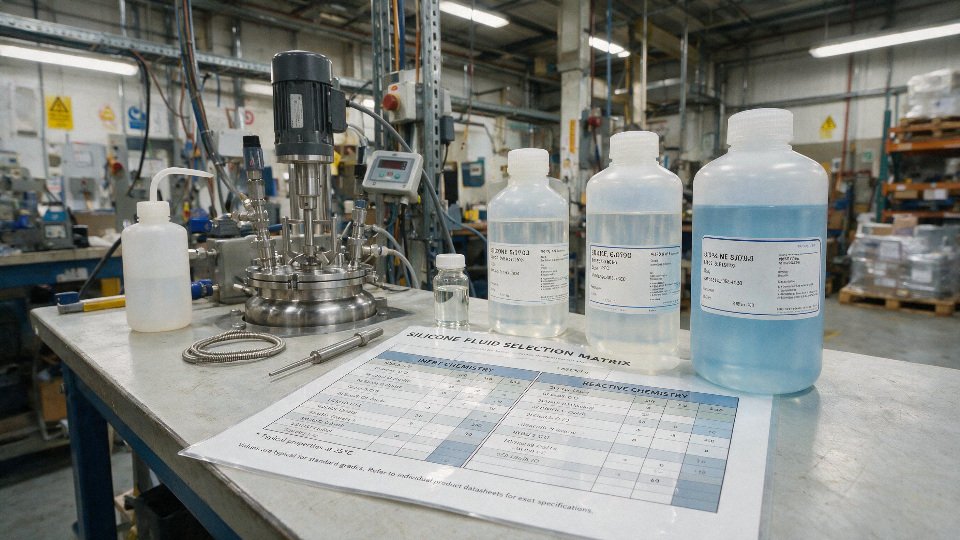
The right choice starts with a blunt split: buy an inert silicone oil when you need lubrication, heat transfer, dielectric behavior, slip, or foam control without further reaction; buy a reactive silicone fluid only when bond formation, cure, anchorage, or network build is part of the job. Most bad purchases happen in the gray zone, where a buyer specifies viscosity and misses the end-group chemistry that actually determines whether the fluid stays a fluid.
A 350 cSt trimethylsilyl-endblocked PDMS and a 350 cSt hydroxy-terminated PDMS can look similar on a basic data sheet and behave very differently once they meet moisture, tin catalyst, amines, metal salts, or heat. On the plant floor, that difference shows up as drum-to-drum drift, mixer torque rising halfway through a batch, unexpected haze, weak release performance, or a sealant that skins too fast in July and too slow in January.
Match chemistry to function
If the application need is broad stability, standard dimethyl silicone fluid is usually the default. Trimethylsilyl-endblocked PDMS covers a very wide viscosity range, roughly 0.65 cSt to above 1,000,000 cSt at 25 C depending on molecular weight, and it is commonly selected because the Si-O backbone is robust while the capped chain ends stay comparatively unreactive in storage and service.
Phenyl-modified fluids earn their place when the temperature window or optical behavior pushes beyond what plain dimethyl grades handle comfortably. In practice, buyers often move to phenyl-containing systems for improved low-temperature fluidity, better thermal stability in certain duty cycles, or refractive-index tuning. That said, the preferred choice flips if cost pressure is tight and the application never sees the temperature extremes or optical constraints that justify the premium.
For substrate affinity, amino- and epoxy-functional silicones are not interchangeable.
- Amino-functional fluids
- Used where adhesion, softening, lubricity, or fiber and textile affinity matter
- Often effective on polar substrates
- Can interact strongly with pigments, acidic species, and some packaging materials
- May yellow under some thermal histories or formulation conditions
- Epoxy-functional fluids
- Chosen where reactivity with suitable curing systems or surface anchorage is needed
- Often preferred when lower color and more controlled reactivity are required
- Can be less forgiving if the rest of the formulation is not matched properly
For curing systems, the split is straightforward:
- Hydroxy- or alkoxy-functional systems
- Used in condensation-curing formulations
- Sensitive to moisture level, catalyst type, and by-product management
- Common where ambient cure is acceptable and line speed is moderate
- Vinyl + Si-H systems
- Used in addition-cure chemistry
- Favored when you need fast, controlled cure with minimal by-product release
- Sensitive to catalyst poisons, especially sulfur, nitrogen species, organotin carryover, and some metal contaminants
The mechanism matters here. End groups control whether chains remain discrete or join into longer chains or networks. Once you introduce reactive ends, every trace contaminant in the surrounding formulation stops being a background issue and becomes part of the cure profile.
Evaluate the specifications that actually predict behavior
Viscosity matters, but it is not enough for selection or purchasing approval. For inert versus reactive service, these specifications often decide whether the material behaves on your line:
- End-group type
- The first thing to confirm
- Distinguishes capped inert fluids from silanol, alkoxy, vinyl, amino, epoxy, or Si-H reactive grades
- Active content
- Especially important in modified fluids and emulsifiable systems
- Low active content can make a price look attractive while increasing usage rate and freight per unit of function
- Volatile fraction
- High cyclic or low-boiler content can shift odor, flash behavior, shrinkage, and coating defects
- In closed systems it can also distort viscosity after heat exposure
- Moisture level
- Critical for condensation systems and relevant to storage stability
- Even small water pickup in a humid warehouse can shorten shelf life
- Acidity or alkalinity
- Residual acid or base can accelerate unwanted condensation or destabilize emulsions
- This is one of those quiet variables buyers ignore until a batch starts gelling in transfer totes
- Residual catalyst
- Useful when intentionally present
- Expensive when unintentionally carried into a downstream formulation that was supposed to stay stable
- Flash point
- Necessary for EHS review, transport classification, and heated-process risk assessment
- Must be verified from current supplier documentation, not assumed from chemistry family alone
- Refractive index
- Relevant in optical, cosmetic, and specialty coating uses
- Often a quick confirmation of composition drift in phenyl-containing products
- Color
- Not cosmetic only
- A color shift can indicate contamination, thermal history, oxidation, or side reactions
A lower-priced silicone fluid can raise total operating cost if residual silanol, cyclics, or catalyst contamination shifts a high-value downstream process.True
That is consistent with normal formulation economics. The fluid cost difference may be small relative to scrap, rework, line downtime, customer rejects, or shortened bath life caused by instability or cure drift. The exact cost impact is application-specific and needs plant data.
Check the formulation environment before you release a PO
A silicone fluid that is stable in a sealed drum may behave very differently after it sees your actual formulation train.
- Fillers and pigments
- Silica, calcium carbonate, titanium dioxide, carbon black, and treated mineral fillers can adsorb active species or introduce moisture and surface acidity
- The same silicone can cure slower, faster, or unevenly depending on filler treatment
- Metal catalysts and metal contact surfaces
- Platinum-cure systems can be inhibited by trace contaminants
- Iron, copper, and mixed-metal contact hardware can sometimes promote side effects, especially in recycled kettles with poor cleaning discipline
- Moisture
- Ambient humidity, wet solvent, damp filler, and headspace condensation all matter
- Summer conditions in a non-conditioned warehouse can change behavior enough to show up in pot life
- Solvents and surfactants
- These can alter compatibility, dispersion, hydrolysis rate, and foam behavior
- Some surfactants quietly destabilize what looked fine in bench trials
- Heat history
- A fluid preheated repeatedly in a day tank is not the same as fresh material from the drum
- Viscosity drift and volatile loss can both move the process window
The main conclusion here stops holding if your process is not chemically quiet. In a simple lubricant or dielectric fill, inert dimethyl grades are usually selected on viscosity and purity. In a compounded adhesive, release coating, textile finish, or sealant, surrounding ingredients can dominate the outcome as much as the silicone itself.
Fit the fluid to the process, not just the formula
Selection should survive actual production constraints:
- Mixing energy
- High-viscosity or filler-loaded systems may need stronger dispersion equipment than the pilot lab used
- Degassing
- Entrained air changes appearance, cure, and dielectric performance
- Pot life
- Reactive systems need a usable working window at the line, not just acceptable lab gel time
- Shelf life
- Warehouse temperature and container closure quality matter
- Required cure speed
- Fast cure improves throughput but can reduce rework time and increase scrap during changeovers
- By-product release
- Condensation systems may release alcohols or other small molecules that affect odor, corrosion risk, and enclosed-space handling
- Post-cure needs
- Some applications need an elevated-temperature post-cure to finish reaction, drive off volatiles, or stabilize properties
Set supplier and procurement filters that prevent expensive surprises
For a production-grade purchase, I would not approve on price and nominal viscosity alone. At minimum, procurement and technical teams should verify:
- Batch consistency
- Lot-to-lot viscosity, active functionality, and color control
- Technical data transparency
- Clear identification of end groups, test methods, and typical versus guaranteed values
- Application testing support
- Not hand-waving; actual screening against your substrate, cure package, and process conditions
- Export packaging
- Drum, pail, IBC, liner, seal integrity, and labeling suitable for your transport route and storage method
- Customization capability
- Ability to tune viscosity window, functionality level, or molecular structure when a standard grade lands close but not cleanly inside your process window
If the downstream product is high value, the cheapest fluid is often the most expensive one in the plant. A few hundred dollars saved on a batch can disappear fast if residual silanol pushes viscosity upward in storage, cyclics create volatilization issues in cure, or trace catalyst contamination shortens pot life on a line that bills downtime by the minute.
Storage and handling controls
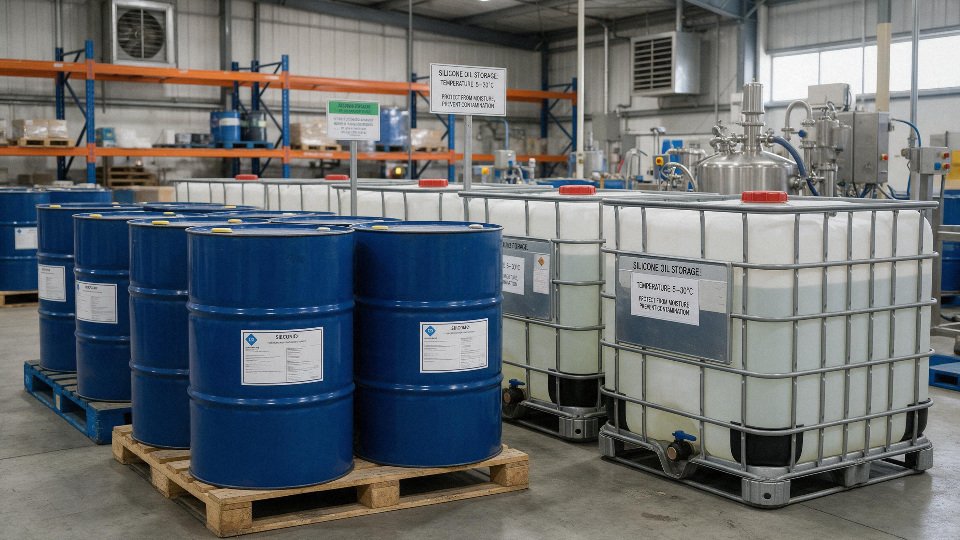
For most silicone oils, good storage discipline is enough to prevent unwanted viscosity drift, gel specks, or false “polymerization” complaints. Keep standard non-reactive grades sealed, dry, and out of heat; treat reactive grades much more like moisture-sensitive intermediates, with tighter segregation from catalysts, acids, alkalis, and wet air.
The first split is product type. Trimethylsilyl-endblocked PDMS fluids are usually quite storage-stable if the container stays closed and reasonably clean. Reactive fluids, hydroxy-functional grades, alkoxy-functional grades, amino-modified systems, and catalyst-containing packages are less forgiving; a little moisture, a little carryover from the wrong hose, or a warm warehouse corner can move viscosity or trigger premature reaction.
Storage conditions by product type
- Keep containers tightly sealed
- Prevents moisture pickup, dust ingress, and volatile contamination.
- Matters most for reactive grades and low-viscosity fluids with more headspace exchange.
- Store in a dry area
- Moisture is a direct reactant for some systems and an indirect problem for others because it brings corrosion, rust fines, and dirty bung surfaces.
- In practice, “dry” means more than keeping drums under a roof. Watch washdown zones, dock doors in monsoon season, and condensation on metal packaging during temperature swings.
- Hold at moderate temperature
- As a working rule, avoid prolonged exposure to elevated warehouse temperatures unless the supplier’s data says otherwise.
- Heat accelerates side reactions, raises permeation rates through seals, and can change inhibitor performance in reactive systems.
- Protect from direct sunlight
- Sun on dark drums or IBCs can push the actual liquid temperature far above ambient.
- UV is usually less important than the temperature rise itself, but outdoor storage still creates unnecessary variability.
- Segregate reactive grades
- Store away from:
- Tin, platinum, or other cure catalysts
- Acids and alkaline cleaners
- Water-bearing raw materials
- Peroxide initiators or oxidizing chemicals where relevant
- A common plant-floor mistake is putting “all silicones together.” That is fine for some inert fluids and absolutely wrong for a mixed inventory of reactive materials.
Handling controls in plant use
Contamination usually enters during transfer, not during storage. A clean incoming drum can be spoiled by a shared tote pump that last saw caustic cleaner, amine additive, or a catalyst-containing blend.
- Use dedicated transfer lines where possible
- Best for reactive grades, high-purity applications, and low-level additive systems.
- If full dedication is not economical, define a validated cleaning and line-clearance procedure.
- Use clean pumps and hoses
- Hoses should be capped when not in service.
- Avoid absorbent or difficult-to-clean hose materials for multi-product service.
- Consider dry nitrogen blanketing
- Justified for moisture-sensitive reactive fluids, long-term bulk storage, or frequent partial drawdown from tanks.
- Usually unnecessary for fully inert, sealed small-package PDMS fluids unless the environment is unusually humid or the product specification is tight.
- Be cautious with contact materials
- Stainless steel is usually the safer default.
- Avoid copper and contaminated mild steel where catalytic effects, corrosion products, or metal fines may affect stability. The exact sensitivity depends on formulation; if the grade is reactive, verify against supplier guidance rather than assuming all silicone fluids behave the same.
Packaging and container selection
- Prefer packaging with reliable internal compatibility
- Lined steel drums are common.
- For IBCs, verify gasket, valve, and liner compatibility with the specific silicone grade and any functional groups.
- Check closure quality
- Moisture barrier performance often fails at the bung, cap seal, or valve, not the main package wall.
- Do not reuse containers casually
- Reused drums and IBCs are a frequent source of cross-contamination from surfactants, water, oils, cleaners, or trace catalysts.
- If reuse is unavoidable, require documented cleaning, drying, and release inspection.
Sampling, requalification, and lot control
- Retain a sample from each received lot
- Keep it sealed and labeled for later comparison if a stability question appears.
- Run periodic checks
- Viscosity
- Appearance and clarity
- Odor if relevant
- Moisture for reactive grades
- In some plants, a simple side-by-side pour and haze check catches trouble before a full lab workup.
- Apply first-in, first-out inventory control
- Especially important where multiple viscosity grades or reactive variants look similar on the rack.
A viscosity shift by itself does not prove silicone oil has polymerized.True
Viscosity can change from contamination, solvent loss, moisture reaction in functional grades, temperature history, or mixing with the wrong product. Compare against retained samples and test the actual cause before calling it polymerization.
What to do if instability is suspected
- Isolate the lot immediately.
- Stop blending it into production or topping off bulk tanks.
- Compare the suspect material with the retained sample for viscosity, appearance, and, where relevant, moisture.
- Run a small bench compatibility test with the intended formulation before any release decision.
- Check the handling path: container, pump, hose, filter, tote, tank, and recent cleaning records.
- Verify root cause before disposition.
The reason to be strict here is simple: once questionable material is blended into a larger batch, the diagnosis gets slower and the scrap bill gets bigger. If the fluid is part of a cure system, one contaminated tote can turn into line stoppage, off-spec cure, and a week of finger-pointing over whether the problem started with storage, transfer, or the formulation itself.
Frequently asked questions
Can dimethyl silicone oil cure by itself at room temperature?
Standard dimethyl silicone oil usually does not. A fully end-blocked PDMS fluid can sit at room conditions for long periods with little change unless it contains reactive end groups, a crosslinker, a catalyst, or contamination that effectively creates one of those conditions.
If a buyer says an oil “cured on the shelf,” I would first suspect misidentification, catalyst carryover, moisture-sensitive functional groups, or packaging contamination before assuming ordinary dimethyl fluid became curable by itself.
Does heating silicone oil always make it polymerize?
No. Heating lowers viscosity and can accelerate oxidation, volatilization of light ends, or degradation in the wrong environment, but it does not automatically create polymerization in a stable silicone oil.
The practical split is this:
- Inert, end-blocked PDMS: heating alone often just changes flow behavior temporarily
- Reactive fluids: heat can accelerate condensation, hydrosilylation, or chain extension if the chemistry is already present
- Contaminated systems: heat can make a marginally stable batch fail faster by speeding catalyst-driven side reactions
Above normal service conditions, especially with air, metal contact, or reactive fillers, you need the actual formulation and exposure history to predict what happens.
What is the difference between silicone oil and silicone resin?
Silicone oil is mainly a fluid polymer with mostly linear chains; silicone resin is a much more highly branched or networked silicone structure. That structural difference is why oils flow and resins form harder, more durable films or solids.
In procurement terms, confusing the two leads to bad quoting and bad trials. A resin may share siloxane chemistry with an oil, but it behaves like a coating or binder system, not a simple lubricant or heat-transfer fluid.
Can moisture thicken all silicone fluids or only reactive grades?
Mostly reactive grades. Moisture is a thickening risk for hydroxyl-terminated, alkoxy-functional, acetoxy-functional, or otherwise condensation-reactive fluids; a fully end-blocked dimethyl silicone oil is far less sensitive under normal storage.
Moisture can still cause indirect problems in supposedly stable systems by:
- hydrolyzing additives
- destabilizing an emulsion
- activating residual catalysts
- reacting with fillers or impurities that then shift viscosity
How can I tell whether a fluid is hydroxyl-terminated or fully end-blocked?
You usually cannot confirm that from viscosity alone. Ask for the technical data sheet and, for critical purchases, a certificate or test data covering end-group functionality.
Useful indicators include:
- OH value or silanol content
- FTIR evidence of silanol or other reactive groups
- NMR for higher-confidence structural confirmation
- Moisture-reactivity behavior in a controlled lab check
- Supplier product naming, though this is only a clue, not proof
If the application is cure-sensitive, get this verified before the drum reaches the line.
Is a viscosity increase after storage always a quality failure?
No. A small increase can come from temperature history, loss of volatiles, emulsion instability, or normal batch drift within agreed limits. It becomes a quality failure when it moves outside specification or changes the application outcome.
A higher viscosity after storage always means the silicone oil has polymerized.False
Viscosity can rise for several reasons besides polymerization, including cold storage effects, light-end loss, emulsion water loss, or contamination. The cause has to be diagnosed, not assumed.
Can silicone oil gel because of metal contamination?
Yes, especially if the fluid is reactive or contains catalyst-sensitive functionality. Tin compounds, platinum residues, amines, strong acids or bases, and certain metal salts can shift a stable-looking system into thickening or gelation.
On a plant floor, the contamination source is often mundane:
- reused transfer pails
- wrong pump seals or hose history
- unlined steel containers
- dirty mix tanks
- trace carryover from a previous batch
Which tests should a supplier provide for reactive silicone fluids?
- Viscosity at stated temperature, usually 25 C
- Functional group content or equivalent value
- Moisture content where relevant
- Volatile content
- Specific gravity
- Appearance and clarity
- Recommended storage life and storage conditions
- Cure profile or reactivity window, if the product is sold as reactive
- Catalyst compatibility or inhibition notes, if applicable
For tighter process control, ask about gel time, residual catalyst, ionic contamination, and lot-to-lot variation limits.
Are silicone emulsions more likely to show false signs of polymerization than neat fluids?
Yes. Emulsions can look “polymerized” when the actual problem is water loss, freeze-thaw damage, pH drift, surfactant breakdown, or microbial contamination. A neat fluid gives a cleaner read on actual chemical thickening.
Can a stable silicone oil be intentionally converted into a curable system?
Yes, but usually not by wishing it into reactivity. In practice you either start with a reactive silicone fluid, blend in functional components and a curing package, or chemically modify the base fluid under controlled conditions.
Whether that is commercially sensible depends on scale and risk. For most buyers, it is cheaper and safer to buy the right reactive grade than to retrofit cure chemistry around a fluid that was designed to stay inert.
Your next material check
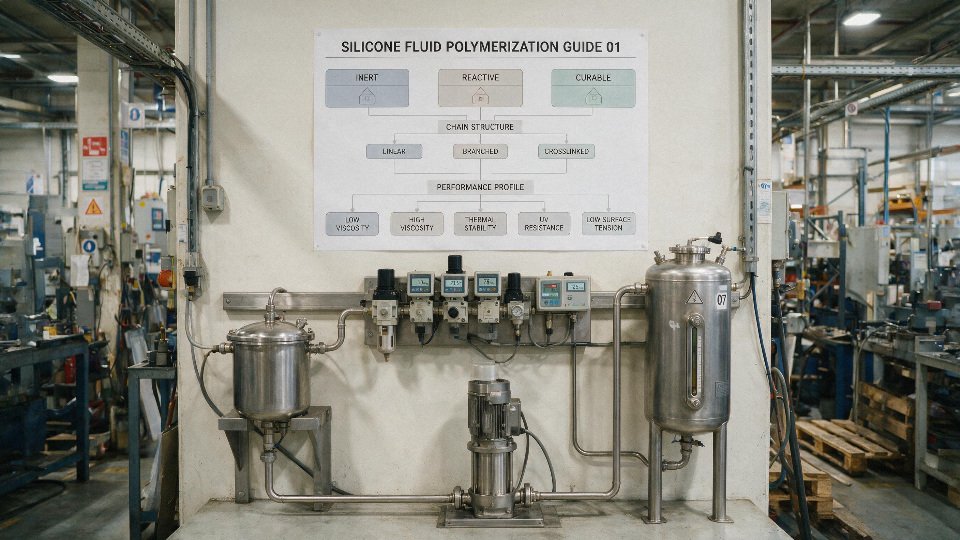
Most buying mistakes here come from treating all silicone oils as one family. For selection and plant handling, you need to sort the material into one of three buckets: an inert service fluid, a conditionally reactive intermediate, or a designed cure system. If that classification is wrong, the downstream problem is usually not academic chemistry; it shows up as pot-life loss, viscosity drift, fish-eyes, gel particles, poor release, or blocked lines.
Three-way decision path
- Inert service fluid
- Typically trimethylsilyl-endblocked PDMS or another fully end-capped fluid intended to stay a fluid in storage and use
- Best fit for lubrication, heat transfer, damping, antifoam carriers, release, dielectric service, and similar non-curing roles
- Main concern is not polymerization but contamination, volatility, viscosity shift, or compatibility with seals, elastomers, coatings, and process residues
- Conditionally reactive intermediate
- Fluid has functional end groups or side groups that can chain-extend, condense, add, or crosslink under the right trigger
- Trigger may be moisture, heat, catalyst, metal contamination, pH excursion, or blending with another component
- Common buying error: purchasing this grade because the viscosity “looks right” while missing the reactivity package
- Designed cure system
- Material is meant to cure on purpose, either as a one-component moisture system or a multi-part catalyzed system
- Selection hinges on working time, cure profile, substrate interaction, byproducts or volatiles, and final network properties
- Here, storage and plant segregation are part of process control, not just warehouse housekeeping
Documents and data to verify before purchase or release
- Product type and intended use class
- End-group chemistry or functionality description
- Known catalyst sensitivity, including sensitivity to amines, tin, platinum, alkali, acids, or metal salts where relevant
- Moisture limits or water sensitivity
- Viscosity target and acceptable tolerance at the stated temperature, usually 25 C unless specified otherwise
- Volatile content and test basis
- Recommended storage conditions, shelf life, and packaging constraints
- Any inhibitor package, stabilizer, or cure-window note
- Current technical data sheet and safety data sheet
- Lot-specific certificate of analysis if the application is tight on viscosity, volatiles, or reactivity window
A silicone fluid can be chemically stable in bulk storage yet still fail in a plant because of trace contamination introduced by pumps, hoses, or mix tanks.True
That is standard process behavior for many reactive organosilicon systems. The fluid may be stable as supplied, but catalyst carryover, moisture ingress, alkaline wash residue, or incompatible elastomer extractables can shift viscosity or trigger cure.
Minimum validation before you commit the material
- Run a compatibility trial
- Check contact with seals, hose liners, pump materials, filters, coatings, and any residual process chemicals
- In practice, old transfer hoses and drums with mixed service history cause more trouble than the reactor does
- Run an accelerated aging or pot-life test
- Hold at the highest credible storage or process temperature and watch viscosity, appearance, and gel formation over time
- The useful result is trend, not a generic pass or fail number
- Test on the actual substrate where relevant
- Especially for release, wetting, coating, defoaming, textile, paper, electronics, and mold-contact use
- Surface energy, residual moisture, and trace additives can flip performance
- Review contamination risk in the actual line
- Audit pumps, dead legs, venting, dryers, nitrogen blanketing, drum-opening practice, and cleaning chemistry
- A fluid that behaves well in a beaker can still misbehave in a humid mezzanine tank with intermittent use
When to ask for customization
Ask the supplier about adjustment when the standard grade is close but not quite safe enough:
- Tighter viscosity control for dosing, coating weight, or damping consistency
- Lower volatiles for odor, fogging, electrical, or thermal applications
- Different end-blocking to suppress or enable further reaction
- Modified functionality for a targeted cure speed, compatibility profile, or network density
- Application-specific packaging for moisture control, clean transfer, smaller batch consumption, or reduced headspace exposure
If you are qualifying a current fluid or trying to replace one, send SiliconChemicals the basics that actually determine the recommendation: substrate material, contaminant or contact chemistry if relevant, approximate layer thickness or use level, working area or batch size, required finish or functional result, target production rate, process temperature range, and your current fluid specification with clear part or process photos where useful. With that, SiliconChemicals can review the application and recommend the right silicone fluid or reactive organosilicon intermediate, or advise where tighter viscosity control, lower volatiles, different end-blocking, modified functionality, or packaging changes are worth the extra discipline.