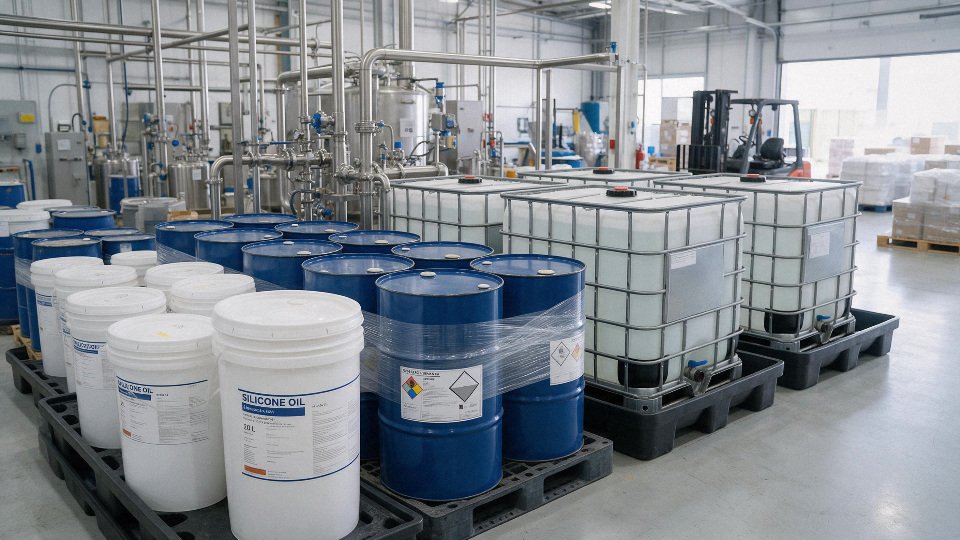

A drum of silicone oil that has picked up water rarely announces itself politely. It shows up as erratic viscosity readings, haze, micro-foaming, unstable dielectric behavior, poor coating laydown, or a process that was steady last month and now needs operator babysitting. On a plant floor, that turns into rejected batches, line slowdowns, extra drying steps, and arguments over whether the problem came from storage, filling, or the raw material itself. The useful question is not whether silicone oil behaves like a sponge, because it does not; it is how much moisture it can actually hold, under what conditions, and when that small amount is enough to matter.
Silicone oil does absorb only a small amount of moisture, but it is not truly moisture-proof. Typical polydimethylsiloxane fluids dissolve roughly 50-200 ppm water at 25 degrees Celsius, depending on viscosity and molecular structure, and many industrial shipments are accepted at below about 100-300 ppm by Karl Fischer, grade permitting.
That small number is exactly why the subject gets mishandled. Engineers hear “hydrophobic” and assume water is irrelevant; buyers hear “low moisture” and assume all grades behave the same in storage and use. In practice, the trouble sits in the gap between low equilibrium solubility and what happens in drums, tanks, transfer lines, heated systems, and formulations that contain other ingredients.
Why silicone oil resists water
Silicone oil resists water mainly because common dimethyl silicone fluids present a methyl-rich, low-polarity molecular surface that gives water very little incentive to mix with the liquid. That resistance is real, but it is not absolute: many PDMS-based fluids still hold small amounts of dissolved water, often at low ppm levels, without looking wet or cloudy.
The starting point is the chemistry of the base fluid. Most standard silicone oils used in industry are polydimethylsiloxane, or PDMS. The polymer backbone is built from alternating silicon and oxygen atoms, but the groups facing outward along the chain are usually methyl groups. Those methyl groups matter more to day-to-day moisture behavior than the backbone does, because they dominate the fluid’s external interaction with other materials.
Water is a strongly polar liquid with extensive hydrogen bonding. PDMS, by contrast, presents a surface that is largely methyl-covered and low in polarity. In practical terms, water does not “see” many favorable interaction sites. There are few places for strong hydrogen-bond-type interactions, so the energetic gain from mixing is limited. That is the core reason silicone oil is usually described as hydrophobic.
A lot of buyers stop there, and that is where confusion starts. Hydrophobic is not the same as incapable of containing water. It means the fluid has a low affinity for water relative to more polar liquids.
What the molecule is doing at the interface
At an oil-water interface, the fluid’s methyl groups tend to orient in a way that keeps the contact energetically easy for the silicone phase and unfavorable for water penetration. PDMS also has characteristically low surface tension, which is one reason silicone oils wet many solid surfaces so well. That low surface tension sometimes gets misread as “water cannot stay in it.” Not so.
Low surface tension helps silicone oil spread over metal, glass, elastomers, and coated parts. It does not, by itself, prove zero water solubility. Solubility comes from the total balance of intermolecular interactions and entropy, not one single property. You can have a fluid that spreads beautifully, sheds bulk water, and still carries a small dissolved moisture load.
That distinction shows up on the plant floor all the time. A drum of silicone oil can look perfectly bright and clear, with no free water at the bottom, and still return measurable Karl Fischer moisture. For many industrial silicone fluid shipments, moisture acceptance is often somewhere below roughly 100 to 300 ppm, depending on the grade and the intended use. That is entirely consistent with a hydrophobic fluid.
If silicone oil and water visibly separate, the silicone oil is moisture-free.False
Visible separation only shows that bulk water is not fully miscible with the fluid. A hydrophobic silicone oil can still contain dissolved water at low ppm levels below the threshold for haze, cloudiness, or droplet formation.
Why complete water exclusion is unrealistic
Even in strongly hydrophobic fluids, complete exclusion of water is thermodynamically unrealistic once the fluid has been manufactured, transferred, stored, or used in air. There is almost always some opportunity for equilibrium with ambient humidity, process water, wet containers, or residual moisture on parts and piping.
Typical water solubility reported for PDMS silicone oils at 25°C is about 50 to 200 ppm, depending on viscosity and structure. That range should not be treated as a single universal spec. Viscosity grade, molecular weight distribution, end groups, temperature history, and impurity profile all move the number around. But it is enough to make one practical point clear: silicone oil usually takes up little water, not zero water.
The mechanism is simple. A tiny fraction of water molecules can still disperse into the fluid because absolute molecular exclusion is not how liquids behave in service. Given enough time and contact, some water enters until the chemical potential balance says “enough.” If the water content stays below the solubility limit, the fluid can remain visually clear. Once that limit is exceeded, you start seeing haze, suspended droplets, or a separate phase.
The conclusion stops holding cleanly when you are no longer dealing with neat PDMS fluid. Modified silicone fluids, contaminated process baths, filled compounds, or heavily aged fluids can behave very differently from textbook dimethyl silicone oil.
How silicone oil compares with other industrial fluids
In practical engineering terms, silicone oil usually sits on the low-moisture-affinity side of the fluid spectrum, but not always at the absolute extreme for every formulation.
| Fluid type | Typical moisture behavior | Practical implication |
|---|---|---|
| Dimethyl silicone oil (PDMS) | Low water affinity; limited dissolved water possible; immiscible with bulk water | Usually sheds free water well, but can still test positive for ppm moisture |
| Mineral oil | Also generally low water affinity; behavior depends on refining, additives, contamination | Similar shop-floor expectations in many cases, though additive packages can change water handling |
| Polyalkylene glycol (PAG) fluids | Often much higher water affinity; some grades are deliberately water compatible | Moisture pickup can be much faster and more consequential for viscosity, corrosion, or lubrication performance |
| Ester fluids | Usually more moisture sensitive than PDMS or mineral oil; hydrolysis risk may matter | Water control is often tighter because chemistry and service life can shift faster |
| Glycol ethers | Typically more polar and more water compatible | Better solvency in some applications, but much more likely to absorb or retain moisture |
Two trade-offs matter here.
- If you want a fluid that strongly resists bulk water mixing, silicone oil is often a good candidate.
- If you need a fluid to dissolve polar contaminants or carry water uniformly, that same hydrophobicity becomes a limitation.
That is why silicone oil works well in many release, dielectric, damping, and heat-transfer roles across roughly -50 to 200°C, application-dependent, but may be a poor fit where water tolerance or moisture scavenging is part of the process objective.
Mineral oil is the comparison many buyers ask for first. In practice, both mineral oils and dimethyl silicone oils are commonly treated as water-immiscible fluids. The difference is not “one repels water, the other does not.” The difference often shows up in details: additive response, low-temperature behavior, dielectric stability, oxidation profile, air release, seal compatibility, and how the specific formulation handles trace contamination. You cannot generalize one supplier’s inhibited mineral oil against all PDMS fluids or the reverse.
What changes the apparent water behavior in service
Base chemistry sets the tendency, but plant conditions often decide the result. I have seen users blame silicone oil for “absorbing moisture” when the actual issue was upstream contamination through a vented tank, a steam-cleaned transfer line, or reused totes that never dried internally.
The main variables that can shift observed moisture behavior are:
- End groups
- Trimethyl-terminated fluids often behave differently from hydroxyl-terminated fluids.
- More polar end groups can increase interaction with water.
- Additives and modifiers
- Surfactant-like additives, coupling agents, or performance modifiers can change water compatibility.
- Even small additive packages can affect haze point and emulsion tendency.
- Residual catalysts or byproducts
- Incompletely removed catalyst residues or low-molecular-weight fractions can alter moisture response and stability.
- Fillers or suspended solids
- In compounds or filled systems, solids can carry adsorbed moisture and make the fluid appear more water-sensitive than the base oil really is.
- Process contamination
- Cleaning residues, glycol carryover, salts, or fine particulates can create persistent cloudiness or emulsified water.
- Temperature
- Solubility and phase behavior can shift with temperature, so a fluid may look clear warm and haze on cooldown.
The practical mistake is to judge moisture status by appearance alone. A clear sample tells you there is no obvious excess free water; it does not tell you the dissolved water content, and it tells you almost nothing about whether additives or contamination have changed the fluid’s moisture behavior. If moisture matters to the process, the next check is analytical, not visual.
When water enters silicone oil
Silicone oil usually does not pull moisture out of air the way hygroscopic fluids do, but that does not keep water out of a plant system. In practice, most water contamination comes from ingress paths, temperature-driven condensation, or process-side leaks, not from the fluid suddenly becoming “water-loving.”
A lot of troubleshooting goes sideways because people ask the wrong question. The useful question is not “Can silicone oil absorb moisture?” but “Where is water getting introduced, and is it dissolved, dispersed, or sitting free in the low points?” Those are different failure modes, and they point to different fixes.
Atmospheric ingress during storage and handling
The most common source is simple breathing and exposure during routine storage.
- Partially filled drums and totes
- Every temperature change expands and contracts the headspace.
- As the container cools, it pulls outside air in through the bung, vent, or imperfect seal.
- If that air is humid enough, some water can condense on the container wall or enter the fluid over repeated cycles.
- Repeated opening during use
- Opening a drum for sampling, dip-tube transfer, or topping off a day tank sounds harmless.
- In a humid shop, especially near washdown areas or curing ovens with wet exhaust nearby, each opening gives moisture another chance to enter.
- The risk climbs when containers stay open during shift change or sit with funnels left in the bung.
- Poor seals and damaged closures
- A flattened gasket, cross-threaded cap, missing desiccant breather, or a bung wrapped in tape instead of properly seated is enough.
- In my experience, this is common on drums that have been “temporarily” reopened five or six times over a month.
- Humid warehouse conditions
- Indoor storage is not automatically dry storage.
- Warehouses with large roller doors, no humidity control, and warm daytime air can run damp for long periods.
- Coastal sites and monsoon-season conditions are where this shows up most often.
The mechanism is straightforward: humid air enters the headspace, the temperature drops, and water either condenses or transfers gradually into the oil. The total amount per cycle may be small, but repeated breathing can push the fluid out of a typical moisture acceptance range over time, especially in lightly used containers.
Condensation from temperature swings
A hydrophobic fluid still loses the argument when cold steel meets warm humid air.
- Day-night temperature cycling
- Outdoor tanks, IBCs, and drums see shell temperature swings every 24 hours.
- The headspace “breathes,” and the inside wall can fall below the dew point overnight.
- Water forms on the wall and runs down into the product.
- Cold starts
- Idle systems started after a shutdown often have cold reservoir walls, piping, and pump casings.
- If warm humid air enters during startup or maintenance opening, condensation can form before the oil reaches operating temperature.
- Outdoor storage
- Sun on one side, cool ambient at night, rain-cooled metal, then morning humidity: that is a reliable condensation recipe.
- Drums stored under a tarp are not necessarily protected. A poorly ventilated cover can trap moisture and make the shell sweat harder.
- Transfer from cold storage into warm air
- Bringing cold-packed drums or pails into a warm humid room often causes immediate sweating on the outside.
- If the container is opened before it equalizes, you can get internal condensation as well.
This is where the practical distinction matters: the oil is not strongly absorbing bulk water from air, but condensation can introduce liquid water directly, which is a much faster contamination path. The conclusion that “silicone oil is hydrophobic, so storage climate does not matter” stops holding once container or system surfaces regularly cross the ambient dew point.
Process-side intrusion
If moisture appears suddenly rather than gradually, suspect the process.
| Intrusion route | Typical plant-floor cause | What it often looks like |
|---|---|---|
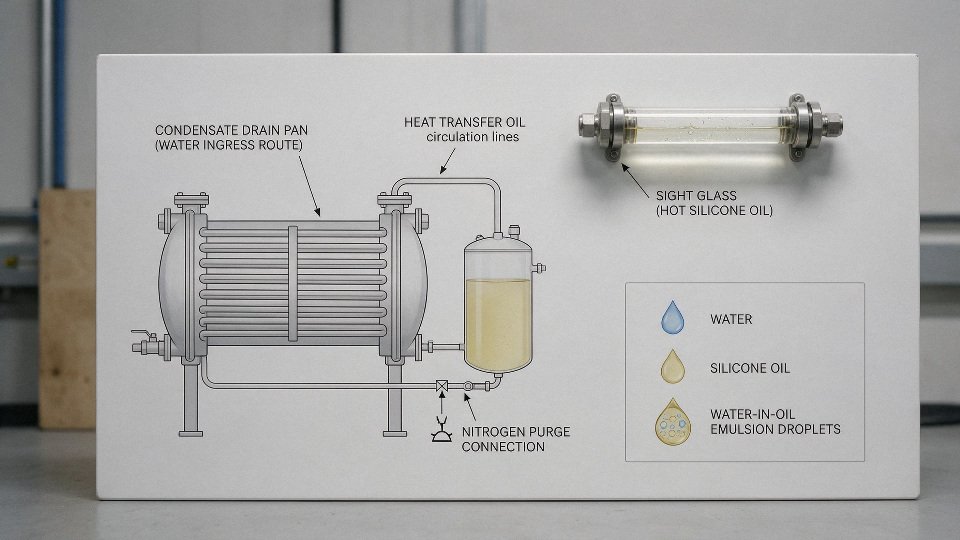
| Heat exchanger leak | Pinhole or gasket failure between water and oil sides | Fast moisture rise, haze, pressure anomaly |
| Pump or agitator seal issue | Seal water or wash liquid migrating inward | Local contamination near equipment, repeated top-ups |
| Washdown exposure | Open vents, bad covers, splash entry | Intermittent contamination after sanitation |
| Steam cleaning | Condensing steam entering vented or open equipment | Sharp moisture increase after maintenance |
| Water-jacket failure | Jacket breach into oil circuit | Persistent water carryover, hard-to-stabilize system |
| Shared line cross-contamination | Incomplete line clearing between products | Batch-to-batch inconsistency, unexpected haze |
A leaking heat exchanger is a classic example. Even a tiny leak can beat the system’s natural ability to let water settle or be removed, because the water enters continuously under pressure differential. The same logic applies to pump seals with barrier or flush water nearby: the leak may be small enough to ignore mechanically, but chemically it keeps feeding moisture into the loop.
A hydrophobic silicone oil can still accumulate operationally significant water if the system introduces small amounts continuously.True
Hydrophobicity limits affinity, not exposure. If ingress is continuous and separation or removal is slow, dissolved, dispersed, or free water can build up to levels that affect performance or shipment acceptance.
The trade-off here is that tightly integrated systems improve production efficiency but create more hidden leak interfaces. A simple drum-to-point-of-use setup has fewer moisture entry points; a recirculating thermal or process loop has many more.
Manufacturing and packaging residues
Sometimes the water came with the fluid path before the product ever reached service.
- Insufficient drying after cleaning
- Mix tanks, transfer lines, filters, and filling heads cleaned with water-based solutions must be fully dried before product contact.
- “Looks dry” is not enough when dead legs, filter housings, and low pockets are involved.
- Wet or poorly stored containers
- Reconditioned drums, improperly dried pails, or containers stored open before filling can carry residual moisture.
- Drum liners can also be a problem if damaged, wrinkled into a sump area, or trapping water between layers.
- Residual aqueous processing aids
- Depending on grade and process, traces from upstream aqueous washing or finishing steps may remain if separation and drying are incomplete.
- You cannot generalize this across all silicone oils; it depends on the manufacturing route and the supplier’s finishing controls.
- Packaging-area humidity and handling discipline
- Filling in a damp area, leaving containers uncapped between filling and sealing, or using wet transfer tools can all show up later as “mysterious” moisture.
This is why incoming inspection matters. Many industrial shipments are accepted against a Karl Fischer moisture limit, often below roughly 100–300 ppm depending on grade, but that does not tell you where the water entered unless sampling is tied to packaging date, container condition, and chain of custody.
Moisture generated during service
Some systems create their own contamination opportunity.
- Contact with wet substrates
- Silicone oil used as a processing, release, or lubricating medium can pick up water from freshly washed parts, green ceramics, damp textiles, or uncured surfaces carrying residual moisture.
- Condensation in electrical equipment
- In transformers, damping devices, or other enclosed equipment, thermal cycling can create internal condensation even if the fill fluid itself is not hygroscopic.
- Breather condition and enclosure sealing matter as much as fluid choice.
- Recirculating systems over long periods
- Reservoir vents, maintenance openings, and low-level air entrainment give ambient moisture repeated access.
- Over months, small ingress can outrun passive separation, especially if the system keeps the water finely dispersed.
That last point catches people off guard. A fluid can be hydrophobic and still end up wet in operation if the system keeps introducing small amounts faster than they can settle, vent, coalesce, or be removed. If you are seeing persistent haze, unexplained dielectric drift, foaming changes, or moisture test creep, do not argue with the chemistry in the abstract; trace the ingress path like any other contamination source.
Forms of water contamination
A silicone oil sample can hold water in at least five materially different forms, and treating them as the same problem is how plants misread both test data and risk. Dissolved water at ppm level is usually a chemistry-control issue; droplets, emulsions, and free water are handling and phase-separation issues; surface films sit in between and often explain why a “dry” system keeps failing incoming checks.
That distinction matters because the same total water content can behave very differently in service. A fluid with modest dissolved moisture may still look clear and run normally, while a drum with a thin free-water layer at the bottom can cause a sudden dielectric failure, erratic lubrication behavior, or a cloudy first batch after transfer. The lab number alone does not tell the whole story unless you know the water state at the moment of sampling.
Dissolved water at ppm levels
This is the least visible form and, in many plants, the one people underestimate because there is nothing to see. For common dimethyl silicone oils, water solubility at 25 degrees Celsius is typically on the order of about 50 to 200 ppm, depending on viscosity and fluid structure. That is low compared with many polar fluids, but it is not zero.
In practice, dissolved water usually shows up only through analytical testing such as Karl Fischer titration or an equivalent moisture method validated for the specific silicone matrix. Many industrial shipments are accepted somewhere below roughly 100 to 300 ppm, but that is grade-specific and should not be treated as a universal pass/fail limit.
What makes dissolved water tricky is that it can move with temperature and exposure history:
- Warmer fluid can temporarily hold more moisture before visible separation appears.
- A drum opened on a humid day may pick up a small amount without any haze.
- A previously wet system can release trace moisture back into fresh silicone oil over several transfer cycles.
The operational effect depends on the application. In electrical uses, even low ppm moisture can matter because dielectric strength is often more sensitive than operators expect. In heat-transfer or release applications, the same ppm level may be tolerated with little obvious day-to-day effect. The boundary here is simple: once water exceeds true solubility under local conditions, you are no longer dealing only with dissolved moisture; another water form is present whether the sample catches it or not.
Entrained droplets from mixing or turbulent circulation
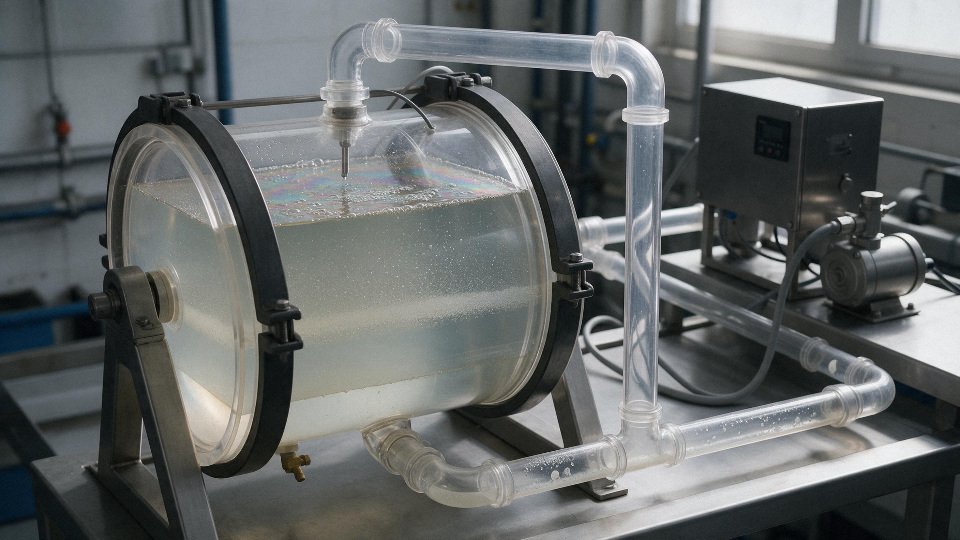
If the oil has been pumped hard, recirculated through a restrictive valve, splashed into a tote, or churned with air ingress, water can exist as finely dispersed droplets. This is not a stable emulsion in the strict sense; it is often a temporary mechanical dispersion that may clear if the fluid is left still long enough.
Typical shop-floor clues:
- Slight haze or milkiness that improves after settling
- Different moisture readings from top, middle, and bottom samples
- A sample drawn right after pump shutdown testing wetter than one drawn the next morning
- Short-term foaming or inconsistent level-glass appearance
The mechanism is straightforward. Shear and turbulence break larger water pockets into small droplets, and small droplets settle much more slowly than a single bottom layer. If the sample point is near a return line, elbow, or pump suction, you can pull a non-representative sample and think the whole tank is contaminated to that same degree.
That matters commercially as much as technically. Good fluid gets rejected, or a buyer claims “high moisture” when the issue is poor sampling discipline. Before condemning a batch, check residence time, agitation history, and where the sample came from. I have seen operators sample a recirculating tote five minutes after forklift movement and then wonder why the result doubled.
Stable emulsified water
A stable emulsion is a different problem altogether. Here, water does not separate readily because something in the system is reducing interfacial separation and helping droplets stay suspended.
Common stabilizers include:
- Surfactant residues from upstream processing or cleaning agents
- Fine solids, fillers, or wear debris
- Oxidation or degradation products
- Process chemicals carried over from adjacent operations
- Certain additives or mixed-fluid contamination
Once an emulsion is established, settling that would normally fix entrained water may do very little. The fluid can stay persistently cloudy or opalescent, and even heating may not fully break it without changing other properties or creating safety concerns. This is where operators often waste time: they wait for separation that is not going to happen on its own.
The trade-off in diagnosis is that emulsion looks obvious, but the root cause is not. Removing water without removing the stabilizing contaminant may only give temporary improvement. If the oil picked up detergent from a washdown-related transfer setup, for example, you may dry it and still recreate the emulsion the next cycle.
Free water phase in drums, tanks, and low points
Once water intrusion is large enough, or the oil has sat long enough after a severe contamination event, water can collect as a separate phase. In silicone oil service this is most often found:
- At the bottom of drums and intermediate bulk containers
- In tank sumps and dead legs
- In low points of piping
- Behind poorly drained valve pockets
- After outdoor storage with breathing condensation or seal failure
This is the highest-risk form for sudden process upset because one drain, one tilt, or one pump startup can send a slug of water downstream. The bulk fluid above may look clean. The first few liters out of a bottom outlet tell a different story.
Surface moisture and interface films
Not all contamination is in the bulk fluid. Water can remain as a thin film on vessel walls, drum lids, transfer hoses, sight glasses, and package interiors. Condensation is the usual culprit, especially with temperature swings between warehouse and production floor.
This form is easy to miss because the silicone oil itself may still appear bright and clear. Then transfer starts, the wall film washes into the product, and moisture readings jump batch to batch for no obvious reason.
Watch these locations closely:
- Drum headspace and underside of lids
- Unused transfer hoses capped outdoors
- Tank manways after steam or water cleaning
- Glass sample bottles not properly dried
- Fill nozzles and quick-connects with trapped rinse water
If silicone oil looks clear, there is no meaningful water contamination risk.False
Clear appearance rules out only some forms of dispersed water. Dissolved moisture, wall films, and small free-water pockets in low points can all exist without obvious haze in the bulk sample.
Why the distinction changes test results and operating risk
Different water states change what the operator sees, what the lab reports, and what corrective action works.
| Water form | What you usually see | What it can distort | Typical corrective path |
|---|---|---|---|
| Dissolved water | Clear fluid | Karl Fischer result, dielectric performance | Dry handling, controlled dehydration if justified |
| Entrained droplets | Temporary haze | Sampling repeatability, short-term viscosity perception, pump behavior | Settling, calmer transfer, better sampling point |
| Stable emulsion | Persistent cloudiness | Heat transfer, filtration, apparent viscosity, consistency | Identify contaminant, break emulsion, often reprocess or replace |
| Free water | Bottom layer or slugs | Dielectric strength, corrosion risk in associated hardware, severe process upset | Drain low points, isolate source, inspect storage and seals |
| Surface film | Clean-looking bulk but recurring moisture issue | Batch-to-batch variability, false troubleshooting paths | Dry containers, hoses, fittings, and sample hardware |
A final practical point: water itself usually does not corrode silicone oil, but it can absolutely promote corrosion in associated carbon steel hardware, instrument pockets, and package interiors if oxygen, salts, process residues, or dissimilar metals are involved. So the fluid may survive while the system around it starts rusting, shedding fines, and creating the next contamination problem.
Performance effects by application
The same moisture reading can be irrelevant in one silicone oil service and a reject condition in another. What matters is not the ppm number by itself, but what failure mode that water can trigger in that specific duty: electrical breakdown, flash boiling, coating defects, hydrolysis, microbial risk, or simply cosmetic inconsistency.
A drum testing at 120 ppm water might run for years in a loosely loaded damping application and still be a bad idea for a high-voltage insulating system or a moisture-sensitive functional fluid. That is why buyers get into trouble when they apply one acceptance limit across all silicone oils and all end uses. The governing question is always: where in the process does water become active, and what does it disturb first?
Dielectric and transformer-related uses
In dielectric service, even modest moisture contamination deserves attention because the first penalty is usually not visible. Water can reduce dielectric strength, raise the likelihood of partial discharge at local weak points, and complicate insulation diagnostics because the oil result may reflect not only the fluid itself but also wet paper, wet solids, poor drum handling, or condenser breathing issues elsewhere in the system.
A few practical points matter here:
- Dissolved water is not the whole story. A low Karl Fischer result does not automatically clear the system if free water has settled elsewhere or if solid insulation has already taken up moisture.
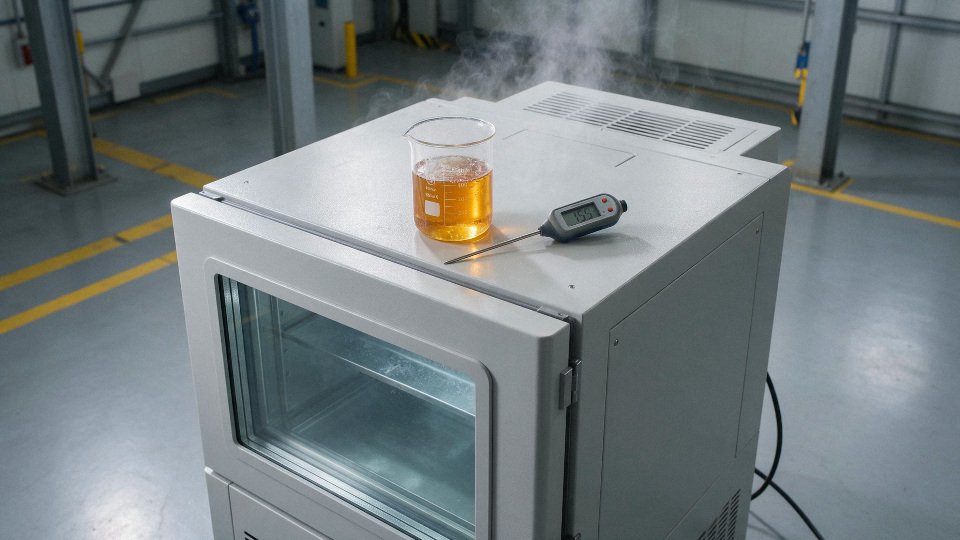
- Temperature changes can mislead maintenance teams. Warm oil can hold more dissolved moisture than cold oil. A system that looks stable at operating temperature may show haze, droplets, or abnormal electrical behavior after shutdown and cooling.
- Partial discharge risk is local, not averaged. One wet spot, a trapped bubble, or a water-rich interface can matter more than the bulk moisture number.
Mechanistically, water affects electrical performance through several paths:
- It changes the conductivity and dielectric loss behavior of the insulating fluid.
- It promotes bubble formation when local heating occurs at electrical stress points.
- It can transfer into porous insulation materials, degrading the wider insulation system rather than only the oil phase.
That last point is where maintenance interpretation often goes wrong. Technicians sometimes sample only the fluid, get a number that looks acceptable for a shipment standard, and assume the transformer or capacitor system is healthy. In service, the oil is only one part of the insulation package. If cellulose, spacers, bushings, or internal surfaces are wet, the fluid moisture result can be only a partial indicator.
The trade-off is straightforward: a very dry fluid costs more to produce, store, and handle correctly, but the cost of being casual with moisture in dielectric duty is usually much higher than the treatment cost. This conclusion weakens only in low-voltage, low-stress applications where the oil is not serving as the primary insulation medium and the system design is tolerant of some moisture variation. For actual acceptance limits, the user has to verify against the equipment design, voltage class, maintenance standard, and current supplier documentation rather than using a generic silicone-oil number.
Heat transfer fluids
For heat transfer service, water is often tolerated right up until the day it causes a startup event. The practical risk is not usually that silicone oil suddenly “absorbs” a lot of moisture; it is that a small amount of water reaches a hot zone, flashes violently, and creates pressure surges, erratic temperature control, pump noise, or temporary loss of circulation.
The mechanism is brutally simple. Silicone oil may be operating comfortably across a wide temperature window, but water still keeps its own boiling behavior. If water enters during storage, maintenance, washdown, or from a leaking exchanger, it can remain dispersed or settle in low points. On startup, the cold system may seem normal. As the heater wall, control vessel, or hot leg temperature rises, that water can vaporize long before the bulk oil is fully stabilized.
Watch for these common symptoms:
- Pressure spikes during warmup
- Pump cavitation or a gravel-like noise at the pump suction
- Sudden level changes in expansion tanks
- Temperature overshoot or unstable control-loop response
- Steam-like vent discharge or misting from vents and breathers
- Intermittent flow loss that clears once the system is hot
Where the water sits matters. A little moisture in a well-mixed, low-temperature circulating loop may produce no obvious trouble. The same amount trapped in a dead leg, low pocket, or pump casing can create repeated startup headaches. In plants with outdoor piping, seasonal condensation makes this worse. I have seen systems run quietly all summer and start hammering in the first cold wet spell because breathing and condensation changed.
Trade-off: operators sometimes try to “boil it out” in place. That can work for trace moisture in a suitable system with proper venting and controlled heat-up, but it is not a universal fix. If there is enough water to create unstable flow, foaming, or repeated pressure excursions, aggressive heat-up can make the event worse before it makes it better. The preferred approach flips when you have a confirmed ingress source such as an exchanger leak; then drying the charge without fixing the source just buys a short calm period.
Lubrication and damping uses
In lubrication and damping duties, low moisture levels are often less catastrophic than in dielectric or heat transfer service, but they can still show up as performance drift. The usual complaints are inconsistent film behavior, higher foam tendency in agitated systems, noise changes in damping devices, and slow corrosion problems on adjacent metal surfaces that are not fully protected by the silicone phase.
Typical effects include:
- Slightly less consistent lubricating feel or torque response in precision mechanisms
- Foam persistence where the fluid is churned or recirculated
- Noise changes in dashpots, dampers, or instrument-filled components
- Spot corrosion on steel components at water collection points
- Rust staining near seals, vents, or partially filled housings
- Variable cold-start behavior if water separates during storage
Silicone oil itself is generally not an aggressive corrosion driver, but trapped water against steel, cast iron, or plated surfaces is another story. The fluid can act as a transport medium while the actual corrosion occurs at the metal-water interface. In small actuators and dampers, that often shows up first as noise or stick-slip rather than as obvious rust.
Seal compatibility is a little messy in practice. Water does not usually make silicone oil attack an elastomer outright, but it can alter interfacial behavior, carry contaminants to the seal lip, and expose weaknesses in elastomers that were only marginally compatible to begin with. If someone says “the silicone oil ruined the seal,” I usually want to know whether the issue was actually water, cleaning residue, or a bad NBR selection in a system that should have been using FKM or another verified material.
Textile, release, and surface-treatment uses
In coating, release, textile, and surface-treatment work, moisture becomes a quality problem long before it becomes a fluid-property problem. The silicone may remain chemically usable, but water can disrupt wetting, destabilize emulsified or blended systems, and show up on the line as fish-eyes, craters, poor laydown, or uneven hand feel.
The practical consequences are familiar to anyone running a coating head or mixing tank:
- Patchy wetting on low-energy substrates
- Coating weight variation across the web or part
- Fish-eyes and crater defects
- Poor leveling after application
- Adhesion loss on inks, adhesives, or overcoats
- Inconsistent release force or slip performance
Here the mechanism is interfacial. Water changes surface tension relationships, can form microdomains in blends, and may interfere with how the silicone phase spreads over the substrate. On a clean stainless test plate, the batch may look acceptable. On an actual line with trace surfactant residue, warmer ambient humidity, and a substrate that has seen corona or flame treatment, those same moisture effects can amplify and become visible defects.
The trade-off is that some processes are already water-based or intentionally use emulsified silicone systems; in those cases, water is part of the formulation architecture, not contamination by definition. But that does not make uncontrolled water harmless. The boundary is simple: if the process depends on phase stability and precise wetting behavior, unplanned moisture variation can still shift performance even when the system nominally contains water by design.
Cosmetic and personal care grades
In personal care use, moisture usually matters less because the silicone fluid “absorbs” water and more because formulations are multi-phase systems. A neat dimethyl silicone fluid can remain stable on its own, but once it is put into a cream, serum, primer, antiperspirant, or hair product, water affects emulsion stability, preservative strategy, viscosity profile, and sensory repeatability.
Three issues come up repeatedly:
- Formulation stability
- Water balance affects emulsion structure, droplet size, and separation tendency.
- Trace moisture shifts may matter more in anhydrous-looking systems than buyers expect if powders, waxes, or actives are moisture-sensitive.
- Microbial control
- Silicone itself is not a nutrient source in the usual sense, but any water-containing cosmetic system still needs an appropriate preservation approach.
- The microbial question belongs to the full formulation, not to the silicone fluid alone.
- Sensory consistency
- Spread, break, afterfeel, and volatility perception can change if water alters the emulsion or suspension structure.
- Consumers often describe this as “draggy,” “patchy,” or “not the same batch,” even when the silicone raw material still meets its own spec.
A hydrophobic silicone fluid does not remove the need for microbial control in a water-containing cosmetic formulation.True
Microbial risk is governed by the presence of an aqueous phase, nutrients, preservation system, packaging, and manufacturing hygiene. The hydrophobic character of the silicone component does not protect the full formula by itself.
Silicone process intermediates and specialty modified fluids
This is where moisture tolerance often drops sharply. Standard dimethyl silicone oils are usually fairly forgiving. Functional silicones, alkoxy-modified fluids, amino silicones, epoxy silicones, silane-containing intermediates, and catalyst-bearing systems can be much less forgiving because water is not just a contaminant there; it can become a reactant.
Potential moisture-driven effects include:
- Hydrolysis of reactive groups
- Condensation side reactions
- Viscosity drift during storage
- Gel particles or haze formation
- Reduced shelf life
- Catalyst deactivation or altered cure behavior
- Off-spec reactivity in downstream compounding or finishing
The mechanism depends on chemistry. Alkoxy or silane-functional materials may hydrolyze and then condense, slowly changing molecular structure. Catalyst systems can lose activity if water poisons the active species or shifts the reaction pathway. Amino- or epoxy-modified fluids may not fail the same way, but they can still show storage instability or downstream variability if moisture changes how they interact with other formulation components.
This is the section where broad statements stop being safe. A moisture level that is routine for a commodity dimethyl fluid may be completely unacceptable for a reactive intermediate. Buyers need the exact fluid type, functional group, storage condition, package size, expected shelf life, and downstream process before setting acceptance criteria. If the application is moisture-sensitive, ask for the grade-specific moisture limit and the test method, and verify whether the supplier’s shipment standard aligns with your reaction sensitivity rather than assuming one plant-wide number will cover it.
Measuring moisture correctly
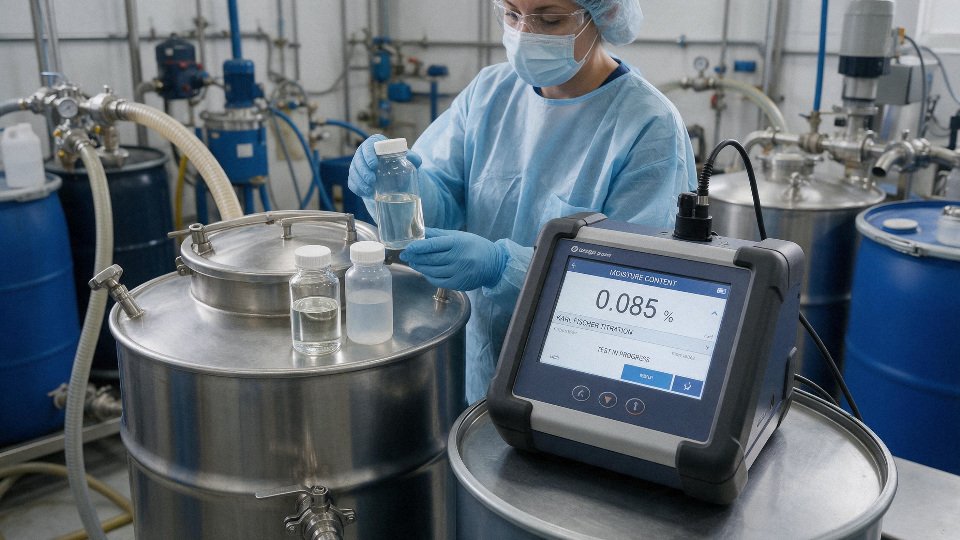
For low-level water in silicone oil, Karl Fischer is the method that usually gives you a defensible number; a visual check does not. If you need to know whether a fluid is at 80 ppm, 180 ppm, or 600 ppm, you are already outside the range where “looks clear” tells you anything useful. Typical industrial shipment limits for many silicone fluids are often somewhere below 100–300 ppm, but that only matters if the grade and application actually call for it.
Karl Fischer works because it measures water chemically rather than inferring it from appearance or a side effect. In practice, that matters with silicone oil because the fluid can hold a small amount of dissolved water without turning cloudy, and free water can hide in the wrong part of the container. A clean-looking top sample from a drum can be perfectly clear while the bottom still contains separated water.
Karl Fischer: the main quantitative method
For silicone oils, Karl Fischer titration is the first method I would ask for when the decision is release, reject, dry, or investigate. Coulometric Karl Fischer is commonly used for very low water levels; volumetric is used where water content is higher. The right choice depends on expected moisture level, sample size, and the method the lab has actually validated on that fluid.
Why it is preferred:
- It measures water directly, rather than using haze, dielectric change, or a heating crackle as a proxy.
- It has enough sensitivity for the low ppm range where many silicone oil acceptance decisions are made.
- It gives a number that can be trended over time for in-service condition monitoring.
- It is much easier to compare lot to lot, supplier to supplier, or before and after drying.
That said, Karl Fischer is not “push button and forget it.” The sample introduction method matters. Low-viscosity dimethyl fluids are usually straightforward. Higher-viscosity silicone oils, modified silicone fluids, or systems containing fillers, catalysts, surfactants, or emulsified contamination can distort recovery if the lab uses a generic setup.
A clear silicone oil sample confirms low moisture.False
Clarity only tells you there is no obvious haze or dispersed free water in that specific portion. Dissolved water can still be present at decision-relevant levels, and settled water may be absent from the sample if the draw point was too high.
Direct tests versus screening indicators
A lot of plants still rely on fast checks. That is fine as a first screen, but not as final release data.
Use this distinction:
| Method | What it tells you | Useful for | Main limitation |
|---|---|---|---|
| Karl Fischer titration | Quantitative water content | Incoming QC, troubleshooting, trend monitoring | Needs method suitability for the fluid matrix |
| Visual clarity / haze | Presence of visible dispersed water or contamination | Fast field screen | Misses dissolved water and stratification |
| Crackle test on hot plate | Gross free water that flashes on heating | Rough maintenance check | Not sensitive for low ppm moisture; operator-dependent |
| Viscosity shift | Possible contamination or degradation | Broad condition screen | Water is only one of many causes |
| Dielectric change | Possible contamination affecting electrical behavior | Transformer/insulating service screening | Not specific to moisture alone |
The mechanism behind the false confidence is simple. Dissolved water changes chemistry long before it creates visible droplets. Haze appears only once water exceeds solubility or forms a dispersed phase; by then the fluid is already past the point where many precision or electrical applications would have accepted it. The preferred choice flips a bit in rough utility service: if the question is “is there gross water ingress from a failed cooler,” a crackle test or a clear jar settle test may be enough to trigger maintenance before the lab result comes back.
Sampling practice decides whether the number means anything
Bad sampling is the most common reason a moisture result misleads people. The lab can run a perfectly good Karl Fischer method on a non-representative sample and hand you a precise answer to the wrong question.
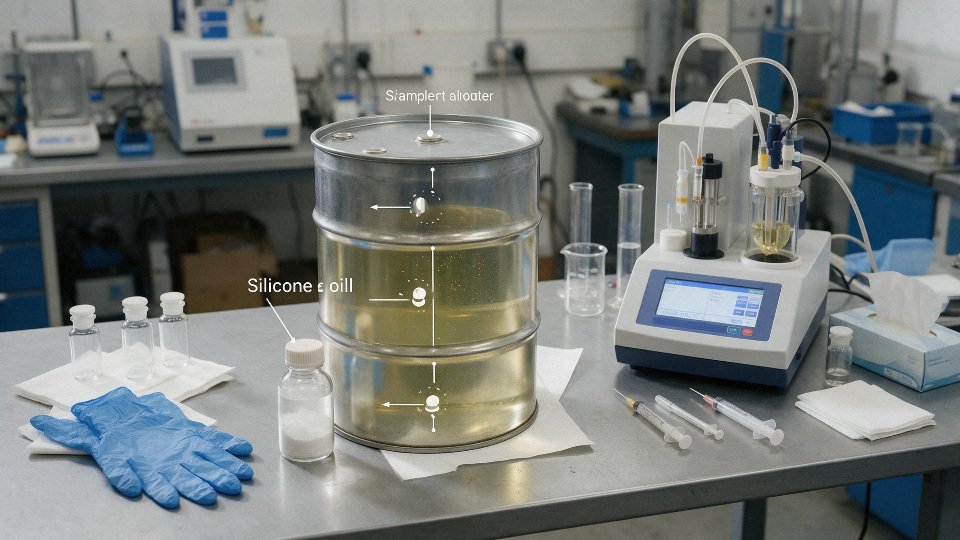
Use a disciplined sampling routine:
- Define the sample point
- Drum top, mid-depth, bottom valve, circulating loop, day tank, or machine sump all represent different conditions.
- For suspected stratification, pull top, middle, and bottom samples separately.
- Use dry, compatible containers
- Clean glass bottles with tight caps are typical.
- Containers must be dry before use; a bottle rinsed with tap water and “air dried” ruins low-ppm work.
- Minimize ambient pickup
- Cap immediately after filling.
- Do not leave a bottle open on a humid bench while labels are being printed.
- In wet summer conditions, I have seen careless handling add enough moisture to confuse a borderline acceptance call.
- Decide whether to sample after mixing or after settling
- If the question is total contamination in a working tank, sample after adequate circulation or mixing.
- If the question is whether free water has separated, allow settling and sample by level.
- Record temperature and condition
- Warm, recently agitated oil can temporarily hold dispersed water that later settles.
- A sample taken right after pump recirculation may not match what the bottom drain will show an hour later.
The common mistake is worth stating plainly: one clear top sample from a drum does not prove the batch is dry. Free water settles, and silicone oil does not magically homogenize it unless you give it energy to disperse.
Matrix effects and method validation
High-viscosity fluids and complex formulations need extra care. Thick silicone oils may not release water cleanly if the sample is simply dropped into reagent without suitable dispersion, heating, or oven-transfer setup. Filled compounds or additive packages can slow extraction, trap water in phases, or introduce side reactions that bias the result high or low. Emulsified samples are another headache; if the water is unevenly distributed, duplicate tests can scatter badly unless the sample is homogenized in a controlled way first.
What to verify with the lab or supplier:
- Whether the Karl Fischer procedure has been validated on that product family
- Sample size and introduction technique
- Repeatability on duplicate or triplicate runs
- Recovery on spiked samples, if interference is suspected
- Whether oven Karl Fischer is more suitable than direct injection for that matrix
The boundary here is straightforward: a published “water by Karl Fischer” result is only as trustworthy as the method’s suitability for that specific silicone fluid and contamination state.
Interpreting the number without overreacting
A moisture number is not pass/fail by itself. It has to be read against the actual specification, the application, and whether you are looking at incoming material or used fluid in service.
Keep those decisions separate:
- Incoming inspection
- Compare against the agreed product specification or certificate limits for that grade.
- Many industrial silicone fluid shipments are accepted below roughly 100–300 ppm, grade-specific, but that is not universal.
- In-service monitoring
- Trend the same system over time rather than using a single generic threshold.
- A rise from 70 ppm to 180 ppm may matter even if both numbers look “low” in isolation, because the change points to ingress or a process upset.
- Application sensitivity
- Electrical, optical, vacuum, or moisture-sensitive processing uses often need tighter control.
- Heat-transfer or general lubrication service may tolerate more, provided there is no free water and no related degradation.
A procurement team usually wants one universal acceptance number. I understand why, but it rarely holds across all silicone fluids and uses. The right approach is narrower: define the grade, test method, sampling point, and action level together. If a result is close to the limit, the next sensible step is usually resampling with better control, not an argument over whether a clear bottle “looks fine.”
Storage and handling controls
Most moisture problems in silicone oil are preventable with ordinary discipline, not exotic hardware. If the fluid arrives dry and stays in sealed, temperature-stable, dry transfer conditions, water pickup usually remains low; if drums breathe outdoors, lines are wet after washdown, or operators leave containers open between draws, contamination risk climbs fast even though the oil itself is not strongly hygroscopic.
The practical point is simple: silicone oil does not have to “absorb” much water to create trouble. A few avoidable handling mistakes can introduce enough free or dispersed water to trip Karl Fischer limits, haze the fluid, or create process instability, especially in long-stored inventory and partially used containers.
Choose packaging and closures that actually stay dry in service
The best package is the one that stays sealed, survives your logistics route, and is easy for operators to reseal correctly. A pristine product packed well at the supplier can still become a wet product if the closure is left loose on a warm drum that cools overnight and pulls humid air back in.
Use these packaging controls:
- Prefer fully sealed drums or totes for standard industrial storage
- Tight-head drums generally control environmental exchange better than repeatedly opened wide-mouth containers.
- For intermediate bulk containers, verify valve integrity and top-cap sealing; a tote with a damaged vent or sloppy valve cap is a moisture pathway, not just a housekeeping issue.
- Use compatible lined packaging where the grade and route justify it
- Liners are not universal good practice; they must be chemically compatible with the silicone fluid and mechanically stable over storage time.
- They matter more when contamination from package walls, previous service history, or returnable containers is a concern.
- Consider nitrogen blanketing for moisture-sensitive grades or long hold times
- This is not mandatory for every dimethyl silicone oil shipment. It becomes more useful when the acceptance limit is tight, the container will be opened multiple times, or the plant is hot by day and cool by night.
- The mechanism is straightforward: a dry inert headspace reduces humid air exchange and cuts condensation risk at the liquid surface and container roof.
- Minimize headspace in long storage
- A half-empty drum is much harder to keep dry than a full one.
- If partial containers must be held, transfer the remainder into a smaller clean, dry, sealed container rather than storing a large vapor space for months.
Leaving partially used silicone oil drums with large headspace increases moisture contamination risk even when the oil itself is hydrophobic.True
Hydrophobicity limits water solubility, but repeated breathing through headspace during temperature cycling can introduce humid air and condensation, which may later appear as dissolved, dispersed, or free water.
Control warehouse conditions before the product reaches the line
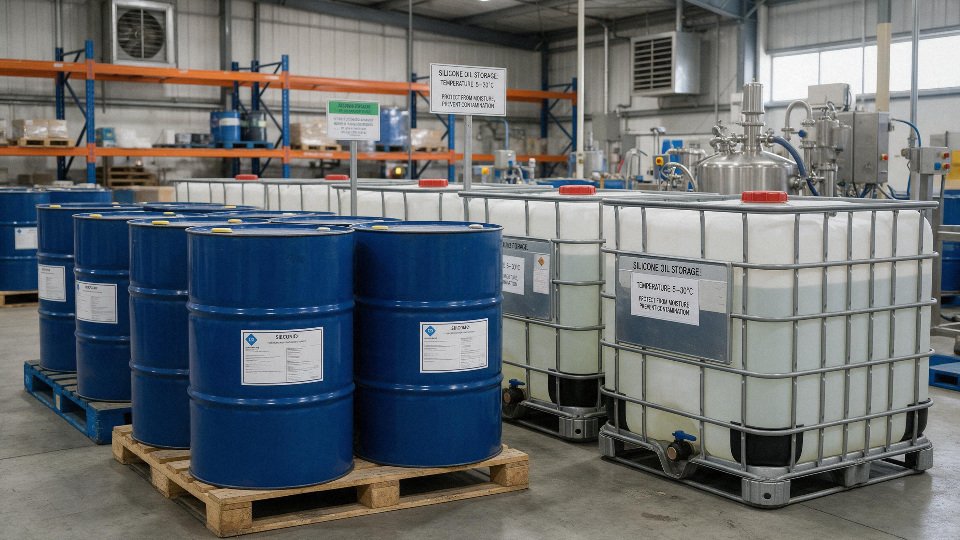
Indoor storage under stable conditions is usually enough; outdoor exposure is where small packaging weaknesses become recurring contamination events. A drum stored on a yard edge through rain, sun, and cold nights may still look acceptable from a distance, but the closure area often tells a different story.
Focus on these basics:
- Keep containers under cover
- No direct rain, no standing water around bungs, no sun-baked lids followed by cool evening air.
- Outdoor temporary staging is where many plants lose control, especially during receiving backlog.
- Avoid large temperature swings
- Temperature cycling drives container breathing and condensation.
- The effect is worse in partially filled containers because the air volume expands and contracts more meaningfully relative to the liquid volume.
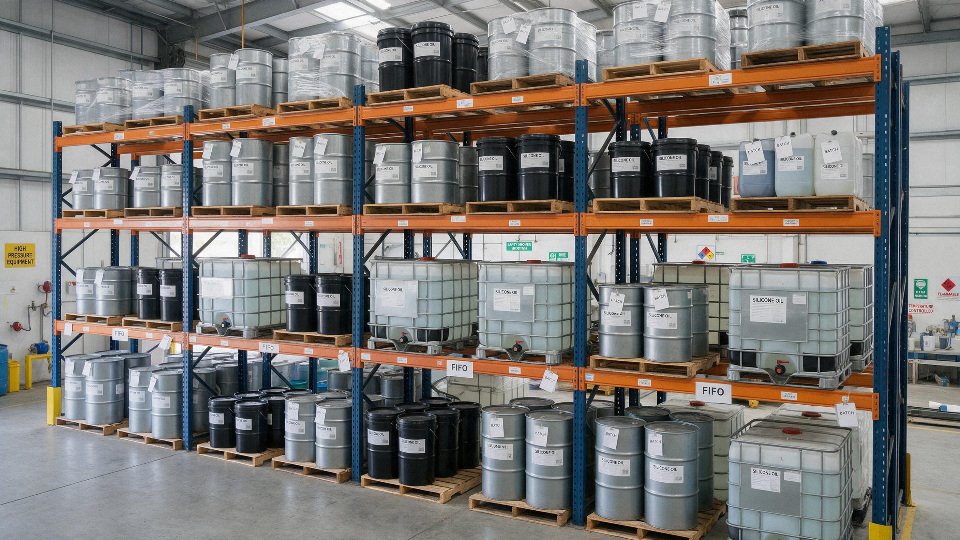
- Use FIFO inventory discipline
- Older, repeatedly handled stock is statistically more exposed, even if no one can point to one bad event.
- Date received, date opened, and remaining quantity matter. In practice, “old but still looks clear” is not a moisture-control method.
- Store drums correctly
- Keep them upright if closure integrity is best maintained that way, unless supplier instructions specify otherwise.
- Protect closures from dust and washdown spray. A clean drum top helps, because water and dirt around the bung are often carried inward during opening.
The trade-off here is operational convenience versus contamination control. Plants like to stage material close to the point of use, but line-side storage near exterior doors, roof leaks, steam lines, or washdown zones often defeats the benefit of sealed packaging.
Adopt dry transfer practice every time material moves
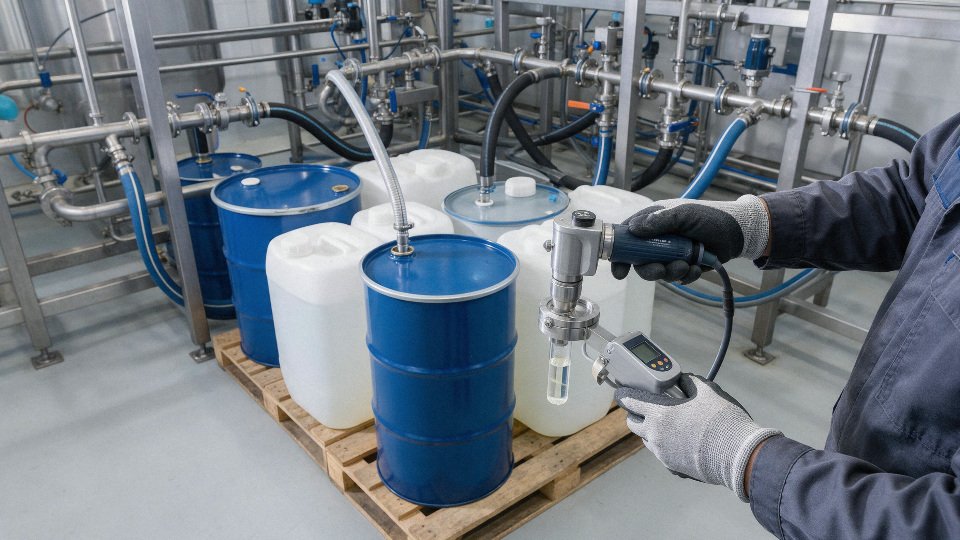
Most avoidable water ingress happens during transfer, not during untouched storage. A dry product can be contaminated in one shift by a wet hose, a pump that was cleaned and not dried, or an operator who leaves the drum open while setting up fittings.
Use a dry transfer checklist:
- Dedicate hoses and pumps where possible
- Shared transfer equipment is a common contamination route, especially if it has also seen water-based cleaners or aqueous products.
- Even a few low spots in a flexible hose can hold residual water.
- Dry lines before use
- Blow out, drain, or otherwise verify dryness using your approved procedure.
- Do not assume yesterday’s cleaning left the line dry by morning, especially in humid plants.
- Use closed transfer systems
- Camlocks, dry-break fittings, and closed suction arrangements reduce both environmental exposure and operator error.
- Open pouring from pails or cut-top drums should be the exception, not standard practice.
- Open containers only when ready to transfer
- Break the seal, connect, draw product, reseal immediately.
- Leaving a drum open while fetching tools is one of those small habits that keeps showing up behind failed moisture checks.
- Reseal immediately after partial use
- Tight closure torque matters. Hand-tight is not always sealed.
Prevent contamination from cleaning and maintenance
If your plant does regular washdown or steam cleaning, this is where the main conclusion above starts to weaken. Good packaging and indoor storage help, but they do not protect against water introduced directly through process equipment, maintenance activity, or utility leaks.
Pay attention to these plant-floor details:
- Verify equipment dryness after washdown
- Tank tops, manways, vent filters, pump housings, and transfer carts can hold trapped water.
- Low points and dead legs deserve specific inspection, not a quick visual glance.
- Isolate steam sources
- Leaking steam tracing, open condensate issues, and poorly controlled warm-up procedures can introduce moisture indirectly through condensation.
- The problem is often seasonal; winter startup and monsoon-season humidity expose weak practices fast.
- Inspect vent and seal arrangements
- A damaged gasket or missing cap can let wash water or humid air into otherwise closed equipment.
- On mobile transfer skids, check the fittings people step on or drag across wet floors. They are usually the first to fail.
Train operators on what to look for and when to quarantine
A good procedure on paper does not stop water ingress if operators are not told what failure looks like. Training should be concrete and visual, not generic.
Cover these points:
- Recognize condensation and free-water signs
- Cloudiness, droplets under a lid, bead-like water at the container bottom, and hazy samples after temperature change all justify attention.
- Set quarantine triggers
- Damaged seal, wet drum top at opening, unknown storage history, evidence of outdoor exposure, or visible phase separation should trigger hold-and-test.
- Document traceability
- Record lot number, receipt date, open date, storage location, and any unusual exposure such as rain event, washdown splash, or line-cleaning incident.
Procurement controls start before the truck arrives
Supplier packaging integrity, fill condition, and route exposure can materially change moisture risk before your team touches the product. That is not a theoretical purchasing concern; it affects incoming inspection workload, rejection rates, and whether your operators are fighting a problem they did not create.
Ask suppliers and logistics teams about:
- seal type and tamper evidence
- whether the product is filled under dry conditions or inerted where appropriate
- package type for export, containerized, or long-transit shipments
- expected storage and transit temperature swings
- whether partial loads, port dwell time, or weather exposure are common on the route
If your moisture acceptance is tight, include those requirements on the purchase specification rather than arguing after receipt. For grades commonly accepted below roughly 100-300 ppm by Karl Fischer, the difference between a disciplined supply chain and a casual one is often visible in incoming variation long before it becomes visible in the oil.
Removing water from silicone oil
Sometimes yes, often no: water can be removed from silicone oil economically if the contamination is still physical separation rather than a chemistry problem. Once you have a stable emulsion, reactive contamination, or a moisture limit that is tighter than the process can reliably verify after rework, replacement is usually the safer and cheaper decision even if the raw fluid itself is expensive.
The first question is not “What drying equipment do we have?” but “What form is the water in?” Free water at the bottom of a drum behaves very differently from 150 ppm dissolved moisture in a warm circulating bath, and both are much easier than a silicone fluid that has picked up surfactant, cleaner residue, or process carryover. I have seen plants waste a shift pumping fluid through bag filters that could never remove dissolved water in the first place.
Settling and decanting: useful for free water, not a cure-all
If the silicone oil chemistry is still intact and the water has separated cleanly, settling and decanting is the cheapest first move. This works best when there is a visible water phase, the oil is reasonably low to medium viscosity, and the tank can sit undisturbed long enough for the interface to sharpen.
A practical sequence looks like this:
- Transfer the contaminated oil to a clean, dry settling vessel with a bottom drain.
- Let the vessel stand without agitation.
- If the oil is very viscous, warm it moderately to reduce viscosity and speed phase separation.
- Drain the bottom water slowly until the interface approaches the outlet.
- Pull a mid-level sample, not a top skim, and test moisture again.
The mechanism is simple gravity separation: larger water droplets fall because of density difference, and lower viscosity silicone oils let that happen faster. Temperature helps mainly by reducing oil viscosity, which improves droplet settling. The trade-off is that heat can also keep a small amount of water dissolved, so the best settling temperature is usually warm enough to improve mobility, not so hot that you disguise residual moisture.
This method stops being effective when:
– the water is finely dispersed
– surfactants or soap residues stabilize droplets
– the fluid is very high viscosity
– the application requires low residual moisture, not just removal of visible water
Vacuum dehydration and thin-film drying: the practical route for dissolved water
For dissolved water and light entrainment, vacuum dehydration is the normal industrial remedy. Lowering pressure reduces the boiling point of water; spreading the fluid as a thin film or increasing surface area helps water escape before the silicone oil has a long hot residence time.
Two controls matter more than operators sometimes expect:
- Temperature
- High enough to release dissolved moisture and cut viscosity
- Low enough to avoid damaging additives, modified side groups, or application-specific properties
- Residence time
- Long enough for mass transfer under vacuum
- Not so long that throughput collapses or thermal history becomes excessive
Common dimethyl silicone oils often tolerate broad operating temperatures, but treatment conditions still have to be verified against the actual grade and supplier guidance. A plain PDMS heat-transfer fluid is one thing; a modified silicone with functional groups is another. The section’s main conclusion stops holding once the fluid is hydrolysis-sensitive or chemically altered by contamination, because then “drying” may remove water without restoring performance.
Thin-film or wiped-film style drying becomes attractive when:
– moisture is mostly dissolved rather than free
– viscosity makes bulk vacuum tanks slow
– throughput matters
– repeated batch drying is tying up labor and tanks
Standard particulate filters remove dissolved water from silicone oil.False
Standard particulate filters capture solids, not molecularly dissolved water. They may reduce water only indirectly if they include coalescing or demulsifying media and the water already exists as removable droplets.
Filtration, centrifuges, and coalescers: where each one actually fits
Standard filters are often oversold inside plants. A 5 µm or 1 µm cartridge may clean up dirt and maybe some gel, but it will not remove dissolved water. If the problem is haze from dispersed droplets, then the conversation changes.
Use these tools for the right condition:
| Method | Best for | Main limitation |
|---|---|---|
| Standard particulate filtration | Solids contamination only | No removal of dissolved water |
| Coalescer | Fine dispersed water droplets | Performance drops with very stable emulsions, high viscosity, surfactants |
| Centrifuge | Dispersed water where density difference can be exploited | Less effective on very fine or stabilized emulsions |
| Vacuum dryer / thin-film dryer | Dissolved moisture and light entrainment | Needs control of heat, vacuum, and validation |
Coalescers work by forcing small droplets to merge into larger ones that can then separate. That mechanism depends heavily on droplet size distribution and interfacial chemistry. If detergent residue, process additives, or reaction by-products are stabilizing the interface, a coalescer that works nicely on one batch may do almost nothing on the next. Centrifuges help where gravity is too slow, especially with viscous oils, but they also lose ground when droplets are extremely fine or the emulsion is chemically stabilized.
When replacement is the better engineering choice
Replacement is often justified sooner than people want to admit in these cases:
- Stable emulsions that do not break with settling, vacuum, or mechanical separation
- Modified silicone fluids that may have hydrolyzed or shifted in performance
- Contamination by surfactants, cleaners, salts, process chemicals, or reaction residues
- Applications with tight moisture acceptance where post-treatment proof matters as much as treatment itself
- Systems where hidden residual water can trigger scrap, electrical failure, foaming, or corrosion downstream
The commercial decision is not just fluid cost. Include:
– cost of downtime while reworking
– test cost and sampling delay
– labor and utility use
– yield loss if the treatment only partly succeeds
– risk of putting marginal fluid back into a critical process
In practice, reconditioning makes sense when contamination is recent, the fluid grade is robust, the water is still physically removable, and you can verify the result with the right moisture test on a representative sample. If the oil has become an unstable process variable instead of a dependable material, replacement usually costs less than the second failure.
Frequently asked questions
Does silicone oil absorb humidity from air during storage?
Not much under normal plant storage. Dimethyl silicone oils are not truly hygroscopic, so they do not pull in atmospheric moisture the way glycols, brake fluids, or some solvents do, but they can still pick up small amounts of dissolved water over time if containers breathe, are opened repeatedly, or cycle through day-night temperature swings.
In practice, the bigger risk is not slow vapor uptake through still air. It is condensation and poor handling:
– Partly used drums with a loose bung
– IBCs stored outdoors under sun and cool nights
– Warm fluid transferred into a cooler tank headspace
– Nitrogen-blanketed tanks losing blanket pressure through a bad regulator or fitting
A sealed original container stored indoors usually stays within grade if it was dry when packed. An often-opened day tank is a different story.
Can silicone oil and water mix under agitation?
Yes, temporarily, and sometimes stubbornly enough to confuse operators. Silicone oil and water are immiscible in equilibrium, but pumps, recirculation loops, inline mixers, high-shear filling, or even a return line splashing into a small reservoir can create a dispersion of fine water droplets that makes the oil look uniformly hazy or milky.
What matters is the shear history and what else is in the fluid:
– Plain dimethyl silicone oil usually separates again if left still long enough
– Lower viscosity fluids often separate faster because the droplets settle or coalesce more easily
– Modified silicone fluids, surfactant residues, process additives, or contamination from cleaners can stabilize the dispersion and keep it cloudy much longer
If the sample clears after standing, that points to dispersed free water rather than purely dissolved moisture.
Is cloudy silicone oil always a moisture problem?
No. Cloudiness is a warning sign, not a diagnosis. Water is a common cause, but not the only one.
Other causes worth checking:
– Entrained air after pumping or filling
– Incompatibility with another oil, additive, or elastomer extractable
– Fine particulate contamination
– Waxy or resinous material dropping out at low temperature
– Oxidation or degradation products in hard service
A simple first screen is to compare appearance under three conditions:
1. Freshly agitated
2. After standing undisturbed
3. After warming moderately within the product’s safe handling range
If haze disappears with settling, suspect free water or air. If it disappears with mild warming, temperature-related solubility or phase behavior may be involved. If it stays unchanged, send it for moisture plus contamination checks instead of assuming water.
How much water is too much for silicone oil?
There is no single universal limit. For many industrial dimethyl silicone fluid shipments, Karl Fischer acceptance is often somewhere below about 100-300 ppm, but the right limit depends on application sensitivity, not on a generic category rule.
Typical decision bands:
– Tens of ppm to low hundreds of ppm: often acceptable for many general industrial uses if the grade allows it
– Around or above the solubility range at ambient conditions: risk of free water, haze, phase separation, and inconsistent process behavior increases
– Any visible water or persistent milkiness: usually unacceptable for precision processing, electrical, coating, release, or cosmetic-sensitive uses
The preferred limit flips lower when the fluid goes into vacuum service, fine coating, dielectric use, or moisture-sensitive formulations. Buyers should set the limit from end-use risk, not just from what is easy to test.
Can heating alone dry contaminated silicone oil?
Sometimes, but only for light contamination and only if the water is truly removable as vapor. Heating a silicone oil drum or tank without venting, vacuum, dry gas sweep, or enough residence time often just redistributes the problem.
Heating helps by increasing water diffusion and vapor pressure, but three limits show up quickly:
– Dissolved moisture may come off slowly in bulk tanks
– Dispersed water can re-condense on cooler tank surfaces or headspace
– Stabilized emulsions usually do not clean up well with heat alone
If there is visible free water, heat by itself is rarely the most reliable correction. Settling, vacuum dehydration, dry gas stripping, filtration for solids, or full replacement may be needed depending on contamination level and product value.
Does higher viscosity silicone oil hold less water?
Usually yes for standard dimethyl silicone oils, but not by a simple linear rule you should write into a spec sheet without data. Typical water solubility at 25 degrees Celsius is often in roughly the 50-200 ppm range, and viscosity and molecular structure both affect where a specific product sits inside that band.
The practical catch is this: higher viscosity fluid may dissolve somewhat less water, yet it can hold dispersed droplets in suspension longer because the fluid drains and separates more slowly. So a thick fluid can look wetter operationally even if its true dissolved-water capacity is lower.
Are modified silicone fluids more moisture-sensitive than dimethyl types?
Often yes, especially if the modification increases polarity. Polyether-modified, hydroxyl-functional, amino-functional, or other specialty silicone fluids can show more interaction with water than plain dimethyl types, though the extent varies widely by chemistry.
All silicone oils resist water equally well.False
Plain dimethyl silicone oils are usually the most water-resistant common type, but modified silicone fluids can show materially different water affinity, emulsion behavior, and moisture tolerance depending on functional groups and formulation.
This is one place where category assumptions cause purchasing mistakes. If the fluid is modified, ask for product-specific moisture behavior and compatibility data rather than borrowing limits from a dimethyl fluid you used elsewhere.
How should buyers specify moisture limits on purchase orders?
Use a testable requirement tied to the actual grade and application. A vague note such as “low moisture required” creates arguments at receiving inspection.
A workable PO or technical agreement should state:
– Product name and exact grade
– Moisture test method, usually Karl Fischer if suitable for the product
– Maximum allowable moisture value in ppm or wt%
– Sampling condition if relevant: as packed, before transfer, or from retained sample
– Appearance requirement if free water or haze is unacceptable
– Any tighter limit for critical service such as dielectric, vacuum, or formulation use
– Packaging and closure expectations if storage integrity matters
If the application is sensitive, send the supplier the substrate or system context and ask them to confirm a realistic shipment limit instead of copying a number from another industry. A sensible spec is one both sides can measure the same way.
Your next moisture check
If moisture matters, it matters for a reason tied to the job the fluid is doing. A silicone oil that is perfectly acceptable in a low-risk process intermediate can still be the wrong fluid for a dielectric system, a tight-tolerance formulation, or a heat-transfer loop where even small water carryover shows up as foaming, instability, or electrical trouble. Do not judge “wet” or “dry” in the abstract; judge it against the application, the fluid chemistry, and the form of the water present.
Start with the question that actually controls the decision:
- What is the oil doing?
- Dielectric use: usually the least forgiving. Dissolved moisture, free water, and condensation risk all matter because electrical performance can shift before the drum looks obviously contaminated.
- Heat transfer: small dissolved water may be manageable in some systems, but free water is a different story. It can flash at hot spots, drive noise, pressure fluctuation, or oxidation side effects elsewhere in the loop.
- Lubrication: tolerance depends on load, temperature, speed, and whether the silicone fluid is neat or part of a compounded lubricant. Water can change film behavior, promote corrosion in adjacent metal parts, or upset consistency in grease systems.
- Formulation use: often controlled by compatibility and reproducibility more than by one universal ppm limit. A little water can change cure response, dispersion quality, or surface result, especially in moisture-sensitive downstream chemistries.
- Process intermediate: the practical limit may be set by the next unit operation, not by the fluid itself.
Then verify the exact fluid type. This is where buyers and plant teams sometimes lose time by treating all silicone oils as interchangeable.
- Standard dimethyl silicone oils usually show low water affinity, with typical water solubility at 25 degrees Celsius around 50-200 ppm, depending on viscosity and structure.
- Hydroxy-terminated fluids can behave differently because terminal functionality changes how the fluid interacts with moisture and with the rest of the formulation.
- Phenyl-modified fluids may shift low-temperature or dielectric behavior, but moisture response still needs grade-specific confirmation.
- Amino-modified fluids are even less suitable for blanket assumptions; functional groups can change handling and compatibility around water.
- Emulsions are a separate case entirely. Water is part of the product system, so “moisture contamination” means something different than it does in a neat silicone fluid.
Before you act, check three pieces of evidence together:
- Recent moisture test result
- Prefer a method and acceptance basis that match the grade.
- Many industrial silicone fluid shipments are accepted somewhere below 100-300 ppm by Karl Fischer, but that is grade-specific, not universal.
- Visual condition
- Look at the top, middle, and drain point if available.
- Haze, droplets, phase separation, or bottom water change the decision fast.
- Exposure route
- Open bung left loose, repeated warm-cold cycling, washdown splash, damaged liner, wet transfer hose, condenser leak, outdoor storage, partial drums sitting half-empty through winter.
That leads to four practical actions:
| Condition found | Typical decision |
|---|---|
| Test result within grade expectation, clear appearance, no credible ingress path | Accept as-is |
| Fluid still usable but handling risk is obvious | Improve storage and transfer controls |
| Water appears removable and application risk is moderate | Recondition and retest |
| Free water, repeated ingress, unstable appearance, or high-risk application | Reject and replace |
The preferred choice flips once the cost of uncertainty is higher than the cost of replacement. That is common in electrical service, sensitive formulations, and systems where a batch failure costs far more than the fluid.
For new sourcing, ask the supplier for:
– Technical data sheet
– Typical moisture specification or stated test method
– Packaging format and closure details
– Recommended storage and handling guidance
All silicone fluids can be evaluated with the same moisture limit.False
Moisture acceptance depends on the application, the fluid chemistry, the contamination form, and the buyer's process risk. A single universal ppm limit is not technically reliable.
If you are checking a current problem or qualifying a new grade, send SiliconChemicals the fluid type or grade, viscosity, application, moisture concern, and any recent test result or clear photos of the container or fluid condition. With that, the team can recommend a suitable silicone fluid and a practical moisture-control plan grounded in the grade you are actually using, not a generic rule of thumb.