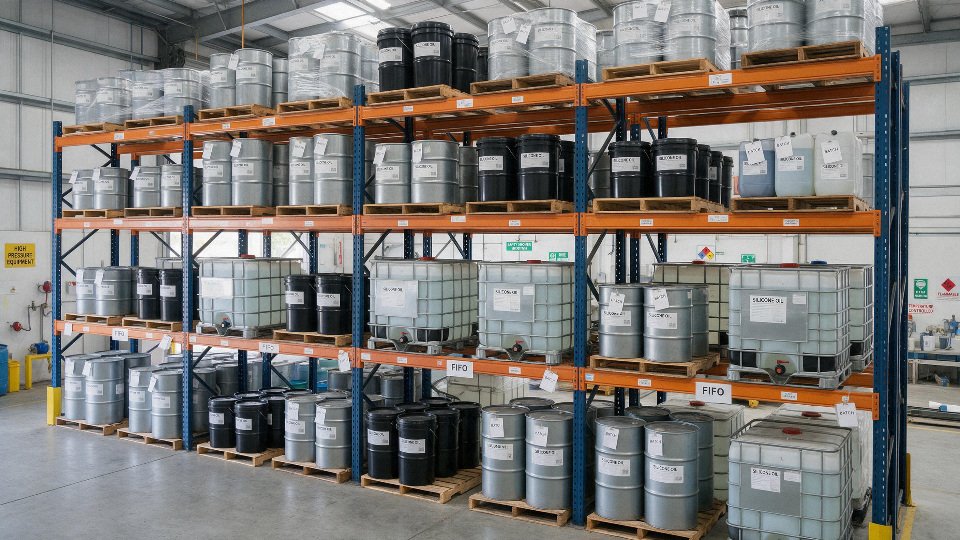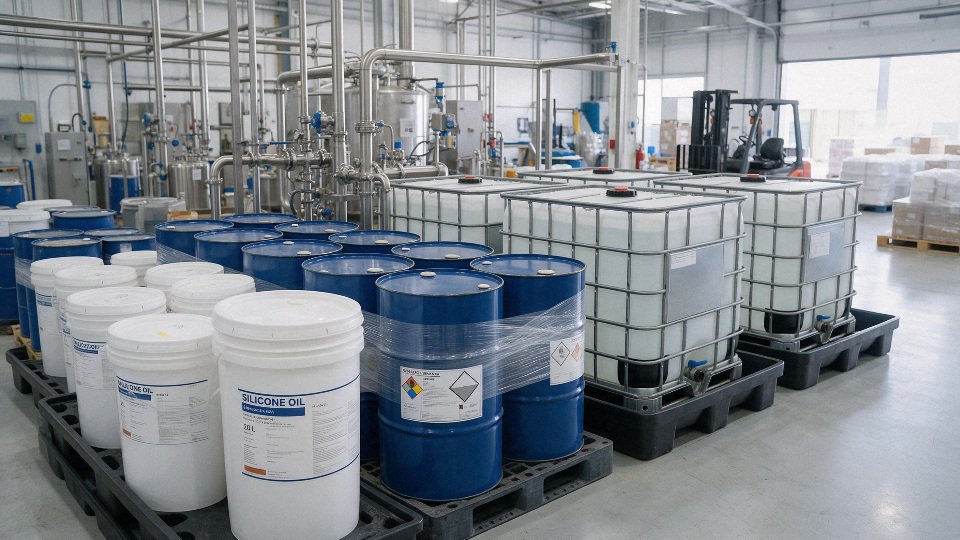
Specify “food-grade silicone oil” on a purchase order without a viscosity call-out and you will likely receive something technically compliant but completely wrong for your application — too thin for a chain lubricant, too thick to pump through a narrow metering line, or simply an industrial-grade fluid that sailed past your incoming inspection under the wrong label. The consequences range from accelerated wear and unplanned downtime to a failed regulatory audit, and in food or pharma environments that last one can shut a line for days while you trace the contamination path.
Silicone oil grades are defined by three overlapping properties: viscosity (spanning roughly 0.65 cSt to 2,500,000 cSt at 25°C depending on polymer chain length), purity level (industrial, food-grade, medical-grade, or electronic-grade, each with stricter heavy-metal and volatile-content thresholds), and thermal range (standard PDMS holds from about -60°C to +200°C; high-purity grades can handle short excursions to +300°C). Choosing the wrong grade on any one of those axes creates real operational problems.
What makes this genuinely tricky is that two drums labeled “PDMS 350 cSt” from different suppliers can behave identically in a rheometer and very differently on your production floor — because viscosity grade is only the first filter, not the whole story. Purity specs, volatility curves, and additive packages quietly separate a $4/kg industrial fluid from a $40/kg medical-grade one, and the gap between them matters enormously depending on what touches the oil downstream.
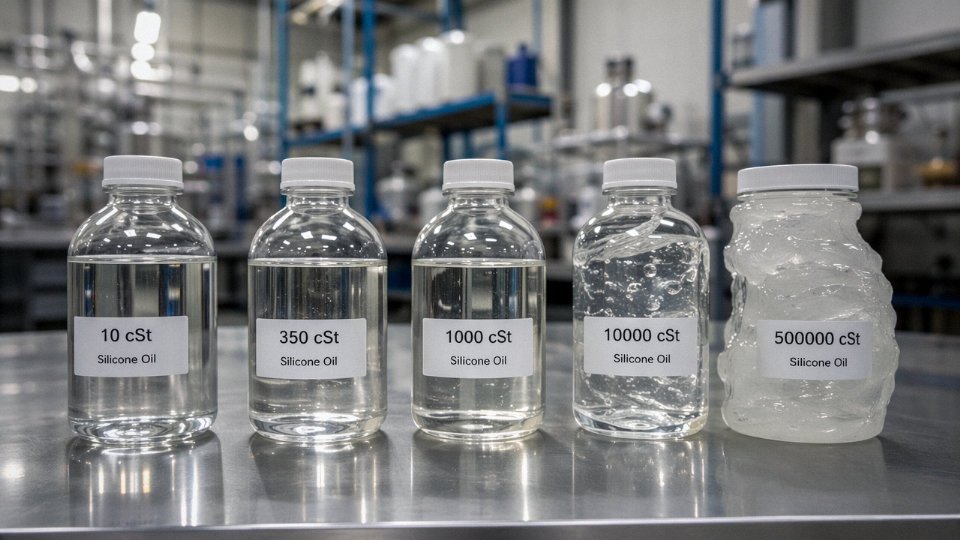
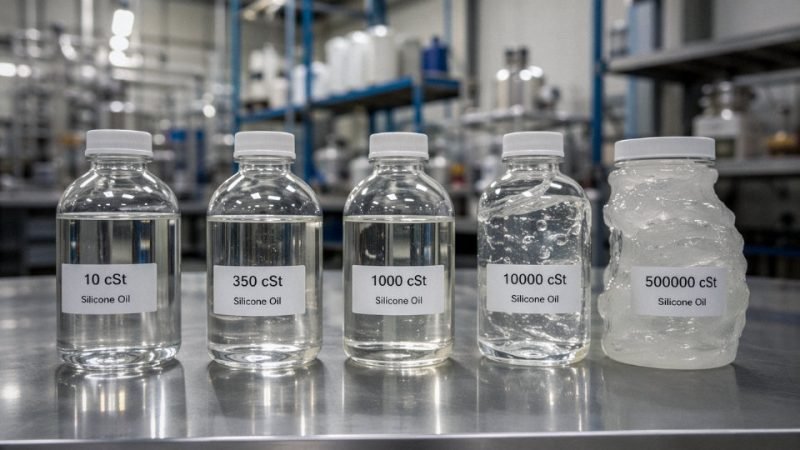
Viscosity Grades: From Ultra-Thin Fluids to Heavy Damping Oils
Viscosity is the primary axis on which silicone oil grades are classified, and getting it wrong isn’t a minor inconvenience — it’s how you end up with a release coating that migrates into a food product, or a damper fluid that cavitates at -30°C because someone specced the wrong tier.
Kinematic viscosity is measured per ASTM D445 or the essentially equivalent ISO 3104, both of which time a fluid flowing through a calibrated glass capillary at a controlled temperature (25°C for most silicone oil datasheets, though 40°C is also common in industrial lubrication contexts). The result comes out in centistokes (cSt), which equals mm²/s. Dynamic viscosity in millipascal-seconds (mPa·s, numerically equivalent to centipoise) is just kinematic viscosity multiplied by density — and since polydimethylsiloxane (PDMS) density sits in a fairly tight band around 0.93–0.98 g/cm³ across most grades, the two numbers are close enough that procurement documents sometimes mix them up. Worth checking which convention a supplier’s TDS is using before you place an order.
Viscosity Sub-Classes and Where Each One Actually Gets Used
The usable range for industrial PDMS runs from roughly 0.65 cSt up to 2,500,000 cSt at 25°C — an extraordinary span that no single mineral oil family can match.
| Viscosity Band | Typical Range | Representative Applications |
|---|---|---|
| Ultra-low | 0.65 – 5 cSt | Carrier fluids, surface spreading agents, aerosol release sprays |
| Low | 10 – 100 cSt | Antifoam agents, personal care emollients, mold release coatings, hydraulic fluids in light-duty systems |
| Medium | 200 – 1,000 cSt | Dielectric fluids, textile softeners, heat-transfer fluids, laboratory bath fluids |
| High | 5,000 – 60,000 cSt | Shock absorbers, hydraulic dampers, rotary shaft seals, transformer coolants |
| Ultra-high | 100,000 – 2,500,000 cSt | Vibration isolation mounts, prosthetic joint lubrication, high-load bearing grease bases |
Application boundaries are blurry in practice. A 350 cSt fluid is often perfectly acceptable in a role where the spec sheet calls for 500 cSt, provided the operating temperature range, seal compatibility, and shear conditions are confirmed. Nobody should be treating this table as a hard cutoff.
The Flat Viscosity-Temperature Curve — and Why It Matters More Than Most People Think
Mineral oils thin out dramatically when heated. A typical ISO VG 46 turbine oil might carry a viscosity index (VI) around 95–110. PDMS silicone oils routinely exceed VI 400, with some high-purity grades measured above VI 600.
What this means on the plant floor: a 1,000 cSt silicone bath fluid heating from 20°C to 150°C stays roughly functional throughout that range without reformulation. A mineral oil equivalent would need a completely different grade or a heavy VI improver package. In seasonal climates — say, an outdoor damper assembly that sees -20°C winters and +55°C summer ambient — silicone’s flat V-T curve is often the deciding factor rather than an added benefit.
PDMS silicone oils maintain a substantially flatter viscosity-temperature relationship than conventional mineral oils, with viscosity index values commonly exceeding 400.True
This is well-documented in supplier technical data and confirmed by ASTM D2270 VI calculations applied to published PDMS viscosity-temperature data. The flat V-T behavior results from the flexible Si-O-Si backbone and methyl group rotation, which is less temperature-sensitive than carbon-chain interactions in hydrocarbon oils.
Low-Viscosity Grades: Carriers, Antifoams, and Release Applications
Below roughly 50 cSt, silicone oils spread fast and evaporate slowly — behavior that makes them useful as carrier vehicles in personal care formulations and as the active component in antifoam compounds. A 10 cSt grade can be emulsified into a water-based antifoam with relatively straightforward processing; a 5 cSt grade spreads across a mold face quickly enough that cycle times aren’t penalized. The tradeoff is that low-molecular-weight PDMS carries a higher tendency to migrate, which matters enormously in food-contact and pharmaceutical contexts where regulatory limits on extractables are tight.
High-Viscosity Grades: Damping, Insulation, and Prosthetics
Above 10,000 cSt, you’re dealing with a fluid that behaves almost gel-like at room temperature. These grades are used in rotary dampers, where the energy dissipation rate is directly tuned by viscosity selection — engineers designing a soft-close hinge mechanism or a camera pan head will typically iterate through several viscosity tiers (say, 30,000 cSt versus 60,000 cSt) based on measured torque curves at minimum expected operating temperature.
Shear stability deserves attention here. High-molecular-weight PDMS — which underpins the ultra-high viscosity grades — degrades in viscosity under sustained mechanical shear more noticeably than low-MW grades do. In a circulating pump system handling 500,000 cSt fluid, you can expect measurable viscosity drop over months of operation; how much depends on pump type, shear rate, and temperature. Gear pumps are particularly hard on high-MW PDMS. This isn’t a catastrophic failure mode, but it does mean that maintenance intervals should include periodic viscosity checks rather than relying on time-based fluid replacement alone.
Chemical Structure Variants: PDMS, Phenyl, Fluorosilicone, and Amino-Functional Grades
Viscosity gets most of the attention in grade selection conversations, and understandably so — it’s the number on the data sheet everyone reaches for first. But viscosity tells you almost nothing about how an oil will behave in contact with jet fuel, under gamma radiation, or when you need it to bond chemically to a polyester fiber. That’s structure. And the siloxane backbone is unusually tolerant of deliberate chemical modification, which is why the grade families below exist as genuinely distinct materials rather than variations on a theme.
PDMS: The Baseline Everything Else Is Measured Against
Polydimethylsiloxane is the default — two methyl groups per silicon atom, repeating Si–O–Si backbone, available in viscosities from under 1 cSt to several million cSt. It’s the commodity grade. Pricing on bulk PDMS (say, 100–1000 cSt) typically runs somewhere in the range of $3–8/kg depending on volume, origin, and whether you’re buying from a distributor or direct; everything else in this section costs more, sometimes dramatically so. Thermal stability sits between roughly -60°C and +200°C for standard grades, which covers the majority of industrial applications without much drama. If a plant is asking “what silicone oil should we start with,” the answer is almost always a PDMS grade until there’s a specific reason to move away from it.
Phenyl-Modified Grades: Low-Temperature and Radiation Environments
Substituting some methyl groups with phenyl groups — yielding what’s commercially called PMPS or phenylmethyl polysiloxane — disrupts the crystalline packing of the backbone enough to push usable low-temperature performance down to around -73°C, give or take depending on phenyl content. The refractive index climbs to the 1.46–1.53 range (versus roughly 1.40 for standard PDMS), which matters for optical coupling fluids and immersion applications. More critically for aerospace and nuclear sectors: phenyl substitution significantly improves resistance to ionizing radiation. Standard PDMS degrades — crosslinks, embrittles, generates low-molecular-weight volatile fragments — at cumulative doses that phenyl grades handle with much less property change. If you’re specifying a lubricant or damping fluid for equipment that sees significant radiation exposure, this is not a minor footnote. It’s the reason to specify the grade explicitly, not leave it to a distributor to interpret “silicone oil.”
Phenyl-modified silicone oils show substantially higher radiation resistance than standard PDMS due to the energy-absorbing properties of the aromatic ring system.True
The phenyl ring absorbs and dissipates radiation energy through resonance mechanisms, reducing backbone scission and crosslinking damage — a well-documented property used in nuclear and space applications.
Fluorosilicone Oils: Chemical Resistance at a Price
Trifluoropropyl side chains give fluorosilicone oils a resistance profile that standard PDMS simply cannot match: hydrocarbon fuels, aromatic solvents, chlorinated compounds. In practice, these oils turn up in aerospace fuel system lubrication and chemical plant seal applications where exposure to aggressive media is routine rather than accidental. The trade-off is real and worth stating plainly. Fluorosilicone grades typically cost 4–10× the equivalent PDMS viscosity grade, and the available viscosity range is narrower — roughly 20–10,000 cSt covers most commercial products, not the extreme ends you can get with PDMS. Don’t reach for fluorosilicone because it sounds more robust; use it when hydrocarbon or solvent exposure is confirmed in the application.
Amino-Functional Grades: Textile and Personal Care Chemistry
Primary and secondary amine groups grafted onto the siloxane side chains give these oils the ability to form covalent or strong electrostatic bonds to textile fibers — cellulosics, polyamides, polyesters. That’s why amino-functional silicone oils dominate fabric softener concentrates and hair conditioning formulations. The amine groups create substantivity, the property that makes the silicone stay on the fiber through rinsing rather than washing off. Viscosity in these applications tends to run relatively low (50–500 cSt range is common for emulsifiable grades), and the amine content — typically expressed as the amine equivalent weight — is the specification that textile chemists actually argue over, not the silicone backbone length alone.
Reactive Functional Grades: Not Lubricants, Building Blocks
Epoxy-functional and carbinol (hydroxyl-terminated) silicone oils are reactive intermediates. You won’t find them in a drip-feed lubricator. They’re used as modifiers and crosslinker components in electronics encapsulants and adhesives, contributing silicone’s flexibility and moisture resistance to otherwise organic resin systems. Similarly, hydrogen-terminated and vinyl-terminated PDMS grades are the two-part reactive system behind platinum-catalyzed addition-cure silicone elastomers. The vinyl-to-hydride ratio controls crosslink density, and therefore the modulus and elongation of the cured part. Buying these grades without understanding the catalyst system and inhibitor chemistry attached to them is a reliable way to produce an elastomer that either never cures or cures too brittle to be useful.
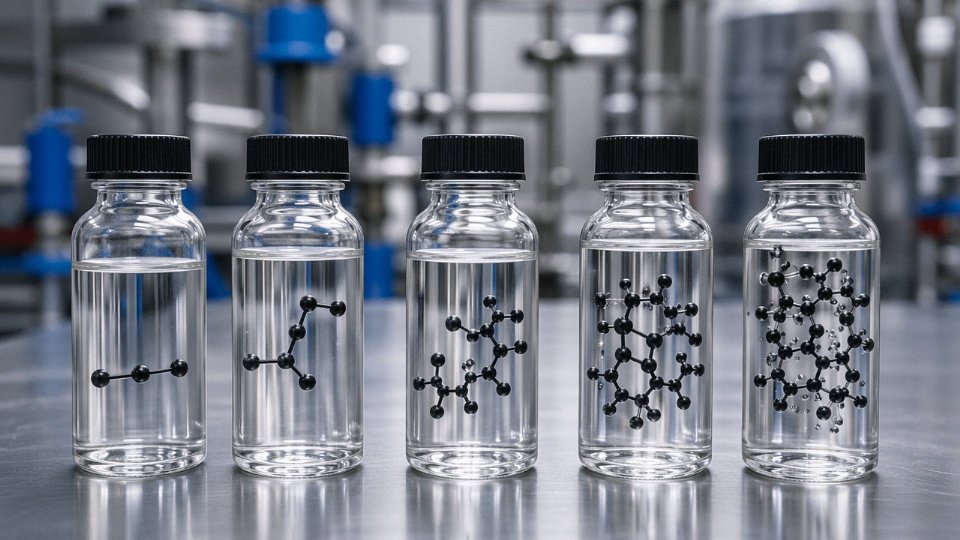
Grade Comparison at a Glance
| Chemical Variant | Useful Temp Range | Chemical Resistance | Refractive Index | Relative Cost vs. PDMS | Primary Sector |
|---|---|---|---|---|---|
| PDMS (standard) | -60°C to +200°C | Moderate (not solvents/fuels) | ~1.40 | 1× (baseline) | General industrial, food, pharma |
| Phenyl-modified (PMPS) | -73°C to +250°C | Moderate | 1.46–1.53 | 3–6× | Aerospace, nuclear, optics |
| Fluorosilicone | -60°C to +200°C | High (fuels, solvents) | ~1.38 | 4–10× | Aerospace, chemical processing |
| Amino-functional | -50°C to +150°C | Low-moderate | ~1.40 | 2–4× | Textiles, personal care |
| Epoxy/carbinol-functional | Depends on cure system | Moderate | Varies | 3–5× | Electronics encapsulants, adhesives |
| Vinyl/H-terminated | Depends on cure system | Moderate | ~1.40 | 2–4× | Addition-cure elastomers, coatings |
Cost multipliers depend heavily on order volume, phenyl or fluorine content, and whether the grade carries any regulatory certification (food-contact, medical, aerospace). A small-volume purchase of a certified phenyl grade from a Western producer can run considerably higher than the table suggests.
Purity and Regulatory Grades: USP, Food-Grade, Medical, and Electronic-Grade Classifications
Viscosity and chemical structure get most of the attention in technical datasheets, but for a significant slice of industrial and medical applications, those properties are almost secondary. The grade that actually matters is the compliance grade — and the gap between an industrial-grade fluid and a USP-grade fluid at the same viscosity can be the difference between a regulatory approval and a product recall.
USP-Grade Dimethicone: More Than a Purity Label
The United States Pharmacopeia monograph for dimethicone sets specific, auditable limits that go well beyond a simple purity percentage. Viscosity must fall within ±10% of the stated nominal grade — so a 1000 cSt USP dimethicone must measure between 900 and 1100 cSt by the prescribed method. Heavy metals are capped below 10 ppm total, residue on ignition must stay under 0.1%, and the refractive index and specific gravity have defined acceptable ranges as well.
In practice, USP-grade silicone oil shows up in three main contexts: as a lubricant for hypodermic needle cannulas and prefilled syringe barrels, as a vitreous substitute in retinal detachment surgery (where the 1000 cSt and 5000 cSt viscosity grades are both used, depending on surgeon preference and tamponade duration), and as a release agent or lubricant in oral solid dosage manufacturing equipment. Each of those applications has its own downstream regulatory scrutiny, and the USP monograph compliance is the baseline that makes all of them possible.
USP-grade dimethicone requires residue-on-ignition below 0.1% and heavy metals below 10 ppm under the USP monograph.True
These limits are explicitly stated in the USP monograph for Dimethicone and are verified by standard compendial test methods during batch release.
Food-Grade Under FDA 21 CFR 178.3570
Food-grade silicone oil is specifically authorized as a defoamer in food processing under 21 CFR 178.3570, with use limited to concentrations at or below 10 ppm in the finished food. That concentration ceiling matters operationally — a plant running continuous foam-knockdown in a fermentation vessel needs to document dosing rates with enough precision to demonstrate compliance, which usually means calibrated peristaltic injection rather than manual addition.
Beyond concentration limits, food-grade silicone oil must pass extractables and leachables testing when used in contact applications such as food-processing equipment gaskets or conveyor lubricants. The chemistry may be identical to industrial PDMS, but the testing documentation and supplier quality system requirements are not. Buying an industrial-grade fluid and calling it food-grade because the SDS looks similar is a compliance failure waiting to happen during an FDA audit.
Kosher and Halal certifications add a documentation layer, not a chemical one. The underlying fluid is the same, but certifying bodies require full chain-of-custody records — raw material sourcing, processing equipment cleaning validation, and in some cases dedicated production lines to prevent cross-contamination with non-compliant materials. The premium is mostly administrative cost.
Electronic-Grade: The Cleanroom Tier
Semiconductor-grade silicone oil operates under demands that make USP look relatively relaxed. Ionic contamination limits are typically below 1 ppb for metals like sodium, potassium, and iron — because even trace ionic species can destroy gate oxide integrity on a wafer. Particle counts must generally be below 10 particles per mL at 0.5 µm and above. These fluids are used in chemical mechanical planarization slurry formulation, wafer-handling equipment, and certain photolithography stage components.
Sourcing this tier requires cleanroom-packaged containers, lot-specific particle count certificates, and in most cases a direct qualification audit of the supplier’s production facility. A standard industrial distributor almost certainly cannot supply this grade regardless of what a datasheet claims.
ISO 10993 vs. USP: Not the Same Thing
A common misconception — even among experienced procurement teams — is that USP compliance covers medical device biocompatibility. It does not. ISO 10993 biocompatibility testing is a separate, device-context-specific battery that includes cytotoxicity (typically an MEM elution or direct contact assay), sensitization studies (usually a Guinea pig maximization or LLNA), and for implantable devices, implantation studies at relevant anatomical sites. A silicone oil that passes the USP dimethicone monograph is not automatically ISO 10993-compliant; it needs to be tested in the specific formulation and contact scenario of the finished device.
This distinction has real consequences. Regulatory agencies reviewing a Class III implantable device submission expect full ISO 10993 biocompatibility data on every fluid and material in the device, not a reference to USP monograph compliance. Missing that data is a common cause of FDA 510(k) deficiency letters and CE mark delays.
The Documentation Chain That Auditors Actually Check
Every compliance tier requires a specific documentation package. A Certificate of Analysis alone is rarely sufficient above food-grade. The standard expectation by grade tier runs roughly as follows:
| Grade | Minimum documentation expected |
|---|---|
| Industrial | SDS, basic CoA with viscosity and specific gravity |
| Food-grade | CoA with full 21 CFR 178.3570 compliance statement, extractables data if contact application |
| USP dimethicone | CoA against full USP monograph, lot traceability, supplier Drug Master File (DMF) or equivalent |
| Medical device (ISO 10993) | CoA, biocompatibility test reports for specific device context, RCL from supplier |
| Electronic-grade | CoA with ionic analysis and particle count by lot, cleanroom packaging certification |
The Regulatory Compliance Letter is the piece most procurement teams underestimate. Suppliers of USP and medical-grade fluids maintain DMF filings with the FDA; when a device manufacturer references that DMF in their submission, they need an RCL from the supplier authorizing that reference. Without it, the FDA has no way to access the supporting data, and the submission stalls.
Grade Substitution Risk: When It Goes Wrong
There is a well-documented category of regulatory enforcement actions involving the substitution of industrial-grade silicone oil into Class III implantable devices — pacemaker lead lubrication being one historically cited context. The failure mode is not always a dramatic adverse event; sometimes it surfaces only during an FDA inspection when the quality system cannot produce compliant material specifications and biocompatibility data. Consequences have included warning letters, mandatory product corrections, and in more serious cases, consent decrees affecting the entire manufacturing facility.
The procurement lesson is blunt: a $15-per-kilogram price difference between industrial and USP-grade silicone oil is not a meaningful saving when the cost of a Class III device recall starts in the millions. Buy the correct grade, verify the documentation, and qualify the supplier’s quality system before you need the fluid on a production line.
Thermal and Dielectric Grades for Electrical and High-Temperature Applications
Power electronics engineers and transformer OEMs often come to silicone fluids from a mineral oil background, and the first question is always cost. Fair enough — dielectric-grade silicone fluid runs roughly 4–8× the price of a comparable mineral transformer oil. But the comparison breaks down quickly once you look at the operating conditions that actually matter.
Dielectric Performance and the IEC 60836 Framework
Dielectric-grade silicone fluids are characterized by three numbers that procurement specs tend to quote loosely but should not: dielectric strength in the range of 15–35 kV/mm (the actual value depends heavily on moisture content and particle loading — a contaminated sample can drop well below 15 kV/mm), volume resistivity above 1×10¹⁴ Ω·cm at 25°C, and dissipation factor below 1×10⁻⁴ at 100 Hz. IEC 60836 is the governing standard for silicone fluids used in transformers and switchgear; if a supplier cannot provide a certificate of conformance to IEC 60836, treat that as a red flag regardless of what the data sheet says.
Dielectric-grade silicone fluid maintains a dissipation factor below 1×10⁻⁴ at 100 Hz when clean and dryTrue
This is consistent with IEC 60836 requirements and published data from major fluid suppliers; however, moisture ingress or particulate contamination degrades this figure significantly, so in-service testing matters as much as the initial specification.
The fire-risk argument for silicone over mineral oil is real, not marketing. Flash point above 300°C versus roughly 140°C for standard mineral transformer oil is a meaningful difference — especially in indoor substations or any installation where a fire event has severe consequences. That said, silicone fluid has lower thermal conductivity than mineral oil (roughly 0.15–0.16 W/(m·K) for PDMS versus 0.13 W/(m·K) for mineral oil — closer than many engineers expect), so you cannot simply swap fluids in an existing transformer design and assume the thermal management is unchanged. The cooling circuit geometry usually needs review.
ASTM D4652 covers the physical and electrical properties of silicone fluids for electrical use and is the standard most North American procurement engineers reference alongside IEC 60836. MIL-PRF-27617 applies to silicone fluids for military and aerospace electrical equipment — a narrower spec with tighter viscosity-grade designations and more demanding documentation requirements.
High-Temperature Heat Transfer Grades
Standard PDMS fluids start oxidizing meaningfully above 200°C in open systems. For continuous-service heat transfer loops running at 250–300°C — common in chemical processing, semiconductor tool heating circuits, and precision mold temperature control — you need either a phenyl-modified silicone or a PDMS formulation with an antioxidant additive package specifically designed for elevated temperatures. Suppliers typically rate these fluids for 8,000–15,000 hours of continuous service at 250°C, though actual fluid life depends on whether the system is sealed, how much oxygen ingress occurs, and whether the fluid ever sees excursions above the rated temperature. A single thermal runaway event that pushes a 250°C-rated fluid to 320°C for even a short period can accelerate degradation dramatically — the oxidation kinetics roughly double with every 10°C above the threshold.
Thermally Conductive Filled Grades
Unfilled silicone oil conducts heat poorly — useful for electrical isolation, problematic when you need to move heat. Filled grades incorporating boron nitride, aluminum oxide (alumina), or zinc oxide particles achieve thermal conductivity in the range of 0.5–3.0 W/(m·K), depending on filler loading, particle size distribution, and the specific filler chemistry. Boron nitride-filled grades tend to sit at the higher end of that range and maintain better electrical resistivity than alumina-filled alternatives, which matters for power module cooling where the fluid may contact live surfaces.
The practical split between a flowable filled oil and a thixotropic thermal compound comes down to the joint geometry. If the gap is tight and consistent — under roughly 100–200 µm — a grease-consistency compound gives better contact. If the gap varies, the assembly involves blind joints, or you need the fluid to circulate, the lower-viscosity oil grade is more forgiving. Getting this wrong shows up as elevated junction temperatures rather than immediate failure, which makes it easy to miss until a device reliability problem surfaces months later.
Cosmetic and Personal Care Grades: Cyclomethicone, Dimethicone, and Emollient Silicones
The personal care industry runs on a parallel classification system that has almost nothing to do with the viscosity codes a process engineer would recognize. Instead of “1000 cSt PDMS,” a cosmetic formulator specifies “Dimethicone 350” or “Cyclopentasiloxane,” using INCI (International Nomenclature of Cosmetic Ingredients) names that embed performance intent as much as chemistry. If you’re sourcing for both industrial and cosmetic applications — or auditing a supplier who serves both markets — the translation between these worlds is genuinely non-obvious.
Dimethicone Grades and the INCI Viscosity Descriptor
Dimethicone is linear PDMS, full stop. The number appended to the INCI name — Dimethicone 5, Dimethicone 20, Dimethicone 350, Dimethicone 1000 — corresponds directly to the fluid’s viscosity in centistokes at 25°C. So Dimethicone 350 is the same material as what an industrial buyer would call 350 cSt polydimethylsiloxane, provided it meets cosmetic-grade purity requirements. The distinction lies not in the polymer architecture but in the testing documentation: a cosmetic-grade Dimethicone 350 needs a full safety dossier, heavy-metal certificates typically below 1 ppm, and lot-traceable CoAs. The same viscosity fluid sold into a hydraulic damper application carries none of that paperwork burden.
In formulation practice, Dimethicone grades below roughly 50 cSt feel light and spread fast — they’re used in leave-on serums and foundations where skin drag is unacceptable. Grades in the 200–1000 cSt range form the backbone of conditioners and skin creams, balancing spreadability against the occlusive, protective feel that gives premium products their sensory signature. Above about 5000 cSt, dimethicone becomes noticeably heavy and is generally reserved for targeted barrier applications or blended down with lighter fluids.
Cyclomethicone: D4, D5, D6, and the Regulatory Disruption
Cyclic siloxanes — octamethylcyclotetrasiloxane (D4), decamethylcyclopentasiloxane (D5), and dodecamethylcyclohexasiloxane (D6) — were, for about two decades, the dominant volatile carriers in hair care. Their viscosities run well below 10 cSt and they evaporate cleanly from skin and hair, leaving behind whatever actives or non-volatile silicones were co-formulated with them. That “dry” sensory finish was hard to replicate.
D4 and D5 are restricted in wash-off cosmetic products in the EU above 0.1% concentration since January 2020 under REACH.True
EU REACH Regulation (EC) No 1907/2006, Annex XVII entries 70 and 71, restrict D4 and D5 in wash-off cosmetics above 0.1% w/w; this restriction came into force on 31 January 2020 following ECHA assessment of bioaccumulation concerns.
The practical consequence for formulators was significant reformulation cost and a scramble toward D6 (not yet restricted at the same threshold) and toward non-cyclic volatile alternatives like isododecane or lower-viscosity linear dimethicone blends. D6 restriction review has been ongoing — procurement teams should monitor ECHA updates rather than assuming D6 is a permanent safe harbor.
Caprylyl Methicone and Phenyl Trimethicone
These two grades sit at the premium end of cosmetic silicone purchasing and are worth distinguishing. Caprylyl methicone is a hybrid molecule — a silicone backbone with a C8 organic side chain — that gives it a spreading coefficient closer to an emollient ester than a pure silicone. It distributes over skin unusually evenly, which is why it turns up in high-SPF sunscreens and light-texture foundations where uniform film formation matters.
Phenyl trimethicone carries phenyl groups on the siloxane chain, which raises the refractive index noticeably — typically into the 1.46–1.46 range versus around 1.40 for standard PDMS. That optical effect translates directly to the “glass hair” shine seen in premium styling serums. It also has a higher thermal stability threshold than plain dimethicone, making it genuinely useful as a heat-protectant carrier in flat-iron and blow-dry products rather than just a marketing claim.
Amodimethicone: Where Industrial and Cosmetic Amino Silicones Diverge
Amino-functional silicones used in hair conditioning — sold under the INCI name Amodimethicone — are related to, but not interchangeable with, the amino silicone oils used in textile finishing or release coatings. The cosmetic version is engineered for a specific molecular weight distribution that controls deposition selectivity: it preferentially adsorbs onto the damaged, negatively charged sites on weathered hair fiber rather than coating the whole shaft uniformly. That selectivity matters because over-deposition creates the greasy, weighed-down feel that makes consumers switch brands.
Industrial amino silicone oils, by contrast, are typically optimized for bath exhaustion onto fiber under elevated temperature and pH conditions that would never apply to a rinse-off conditioner. pH adjustment and microemulsification are also handled differently — cosmetic amodimethicone is almost always supplied as a pre-made cationic microemulsion at roughly 20–35% active content, ready to blend into an aqueous conditioner base. Buying a bulk industrial amino silicone and expecting to reformulate it into a cosmetic system is a project, not a substitution.
Volatile Versus Non-Volatile: The Formulator’s First Cut
Before reaching for any specific grade, cosmetic formulators make a binary call: does the silicone need to leave the skin, or stay on it? Volatile silicones — D5 where regulations allow, certain linear low-viscosity dimethicones around 1–5 cSt — evaporate within minutes, carrying pigments or UV filters into an even film and then disappearing. The skin feel is dry and non-greasy. Non-volatile grades (anything above roughly 10 cSt that isn’t cyclic) remain on skin, providing lubricity, moisture barrier function, or gloss.
In antiperspirant sticks, this distinction is almost the entire formulation strategy: a high proportion of volatile silicone keeps the initial application dry while the active aluminum salt does its job. In a tinted moisturizer, a blend of volatile carrier and non-volatile Dimethicone 200 controls both ease of spreading and the final skin feel after dry-down. Getting the ratio wrong doesn’t ruin the product chemically — it just makes it feel wrong, and in personal care, sensory failure is product failure.
Regulatory Compliance Across Markets
FDA 21 CFR 700-series regulations cover cosmetic ingredients broadly but do not pre-approve individual silicone grades the way the EU’s Cosmetics Regulation (EC) No 1223/2009 does through its Annex and positive/negative list system. In practice, dimethicone at standard use levels (up to roughly 24% in leave-on products by some industry convention) has a long safe-use history in both markets. EWG Skin Deep scores for dimethicone are generally low-hazard, which matters increasingly for brands targeting clean-beauty positioning — though EWG ratings carry no regulatory force and procurement decisions shouldn’t rest on them alone.
The tightening picture around cyclic siloxanes, combined with California’s ongoing Safer Consumer Products evaluations, means any procurement team buying cosmetic silicone grades at volume needs supplier agreements that include advance notice of regulatory status changes. A supplier who can’t provide that is a supply-chain risk regardless of price.
Industrial and Specialty Grades: Antifoam, Release Agent, Hydraulic, and Damping Fluid Applications
Application-defined grades are where procurement gets genuinely confusing. Two products can share nearly identical base PDMS chemistry, pass the same viscosity test, and still perform completely differently in service — because the grade isn’t just about the polymer. It’s about formulation, carrier system, particle size, and the specific failure mode the product is engineered to prevent.
Antifoam Grades
Antifoam silicone oils are almost always low-viscosity PDMS, typically in the 10–100 cSt range at 25°C, but the viscosity number alone tells you almost nothing useful. What actually matters is the active ingredient concentration (commonly 10–60% in emulsion form, depending on the application dilution protocol), the hydrophobic silica loading that drives foam-cell rupture, and the HLB (hydrophilic-lipophilic balance) value of the emulsifier package.
Food-process antifoams — the kind used in sugar refining, edible oil processing, or starch hydrolysis — must meet FDA 21 CFR 173.340 or equivalent, carry food-grade documentation, and use only approved emulsifiers. Industrial fermentation antifoams for, say, citric acid or amino acid production operate under different constraints: the silica loading can be heavier, dosing rates are higher, and the more important specification is whether the antifoam survives the sterilization cycle (typically 121°C steam) without breaking down or causing downstream filter fouling. Confusing these two grades in a food plant is a regulatory problem; confusing them in a fermentation tank is usually just a process efficiency problem — but it’s still a problem.
Release Agent Grades
Release agent grades are typically medium-viscosity PDMS, 200–1,000 cSt, applied in either a solvent carrier or a water-based emulsion. The viscosity window is chosen to deliver a thin, uniform film without pooling — too low and you get uneven coverage, too high and the oil migrates unevenly under mold pressure.
Under production conditions, mold temperatures often reach 180–250°C, which rules out any release agent that hasn’t been validated for thermal oxidation stability in that range. High-purity PDMS grades hold up well; anything with an incompletely reacted functional group will leave a residue that transfers to the part surface. That matters enormously when the molded part goes on to painting, bonding, or overmolding — silicone contamination as thin as a few nanometers is enough to cause paint adhesion failure. Some release agent suppliers now offer “paintable” grades specifically formulated with surface-active additives that orient away from the substrate rather than toward it.
Hydraulic and Damping Grades
Ultra-high-viscosity grades — 30,000 cSt up to 1,000,000 cSt or beyond — are specified almost entirely by their dynamic viscosity at the actual operating temperature, not at 25°C. A rotary damper in a consumer appliance hinge operates at ambient conditions; a speed governor in an industrial valve actuator might see 80–120°C continuously. The viscosity-temperature coefficient of silicone is much flatter than mineral oil, which is usually the primary reason for choosing it, but you still need to confirm the actual viscosity at temperature before specifying.
Silicone damping oils maintain a more stable viscosity-temperature relationship than mineral-based hydraulic oils across a -40°C to +150°C range.True
PDMS viscosity index is typically 300–400 compared to 95–100 for conventional mineral hydraulic oil, making silicone oils significantly more stable across wide temperature swings.
Recoil mechanisms and ballistic dampers are a specialized niche here — grade selection in those applications involves dynamic shear stability testing that standard industrial datasheets don’t cover.
Compressor and Vacuum Pump Grades
These grades are defined less by viscosity than by chemical resistance and vapor pressure. In semiconductor fab dry pumps handling reactive gases like Cl₂ or HF, even trace contamination of the pump oil can cause corrosion cascades. The relevant benchmark is ASTM D2155 for oxidation stability, combined with low vapor pressure, typically below 10⁻³ Pa at operating temperature. A pump charged with standard lubricating-grade silicone oil instead of the specified vacuum-pump-grade can introduce backstreaming contamination that ruins a wafer batch worth far more than the oil ever cost.
Optical Coupling and Ultrasonic Grades
Low-viscosity grades, usually 0.65–5 cSt, serve a completely different purpose in ultrasonic non-destructive testing: minimizing acoustic impedance mismatch at the transducer-to-workpiece interface. The viscosity here controls how well the fluid fills surface roughness without attenuating the signal. Refractive index matching grades for fiber optic splicing add a second specification layer — the fluid must hit a very narrow RI window, often ±0.001 around the target, regardless of viscosity.
Textile and Leather Finishing Grades
These are almost always emulsified, and the grade differentiation that actually matters in practice is emulsion particle size and ionic character. Cationic emulsions bond to negatively charged natural fibers like cotton and wool; anionic emulsions are more compatible with synthetic fiber processing lines; nonionic grades give the broadest compatibility but usually deliver less durable softness. Particle size affects penetration depth — finer emulsions (sub-200 nm) penetrate the fiber bundle, coarser ones coat the surface. Specifying “silicone oil” to a finishing goods supplier without specifying ionic character and particle size will routinely get you the wrong product.
How to Select the Right Grade: A Decision Framework for Engineers and Formulators
Getting the grade right before you write the purchase order saves considerably more than the cost difference between a standard and a premium fluid. Wrong selections show up as bearing seizure at operating temperature, a failed FDA audit, a foam-collapse event mid-batch, or a transformer that runs 15–20°C hotter than designed. The framework below walks through selection in the order that eliminates the most candidates fastest.
Step 1 — Define the Primary Function First
Start here, not at viscosity. Lubrication, heat transfer, dielectric insulation, surface modification, defoaming, and chemical-inertness applications all pull from overlapping viscosity ranges but from fundamentally different grade families. A 100 cSt PDMS used as a mold release behaves nothing like a 100 cSt food-grade fluid used in a dough-divider gearbox — the base chemistry may look similar on a datasheet, but the additive package, purity level, and regulatory status are completely different. Narrowing by function first cuts your candidate list from potentially several hundred commercial grades down to a manageable tier of ten to thirty.
Step 2 — Set the Temperature Window Honestly
This is where a lot of specs go wrong. Engineers often write the normal operating temperature and forget about startup transients, CIP steam cycles, or a heater malfunction scenario. For continuous service above roughly 180–200°C, standard PDMS is marginal and you will see progressive oxidative thickening and deposit formation. Above 200°C you need either a high-stability PDMS with antioxidant packages or a phenyl-modified grade — phenyl content raises the oxidative ceiling into the 250–300°C range depending on phenyl substitution level. Fluorosilicone holds better in fuel-contact environments but its thermal ceiling is not dramatically higher than standard PDMS; don’t over-specify it for temperature alone. State both the continuous-use temperature and the worst-case excursion temperature on your internal spec sheet. They are often not the same number.
Step 3 — Lock Down Regulatory Constraints Before Pricing Anything
Purity and compliance grades impose a hard floor on your selection regardless of what the cost comparison looks like. Food contact requires NSF H1 or equivalent; pharmaceutical processing equipment requires USP or EP compliance with full lot traceability; semiconductor fabrication demands low-ionic-contamination electronic grades where sodium and chloride content matters more than viscosity. Trying to substitute a lower-tier fluid to save 20–35% on unit cost in any regulated application is not a procurement decision — it is a liability decision. Audit findings and batch rejections cost orders of magnitude more than the fluid cost differential.
Step 4 — Specify Viscosity With the Application Mechanism in Mind
For hydrodynamic lubrication, map to ISO VG equivalents. For damping applications, viscosity must be matched to operating frequency — too low and you lose damping force, too high and you generate excess heat; a dashpot running at 5–10 Hz typically wants something in the 5,000–60,000 cSt range, but the exact target depends on gap geometry and stroke. For release applications, spreading coefficient matters as much as viscosity: a 50–200 cSt grade spreads readily on most substrates; very high-viscosity release fluids can actually trap flash and cause cosmetic defects in molded parts.
Step 5 — Check Chemical Compatibility Systematically
Don’t assume silicone inertness extends to every elastomer in your system. Nitrile rubber swells meaningfully in prolonged contact with PDMS fluids — swell rates of 5–15% by volume are common depending on nitrile content and temperature, which can compress seal interference fits to zero. EPDM is generally more compatible. Functional grades such as amino-silicones introduce reactivity that standard PDMS lacks; they will bond to certain substrates and can discolor or degrade some polymers. Pull the elastomer compatibility chart from the fluid supplier and cross-reference it against every seal and gasket material in the assembly.
Step 6 — Calculate Total Cost of Ownership, Not Unit Price
Premium electronic or medical-grade fluids can run 3–8× the unit cost of industrial-grade PDMS at equivalent viscosity. That differential looks large until you price a single contamination event, a recall, or an unplanned shutdown. Fluid replacement frequency matters too — a high-stability phenyl grade in a hot application might last 18–36 months where standard PDMS would need changing every 6–9 months, which shifts the math considerably once you factor in labor and downtime. One more item that rarely appears in procurement comparisons: disposal. Silicone oils are not readily biodegradable and are classified as persistent substances in many jurisdictions; disposal typically runs $0.30–$1.20 per liter depending on regional regulations and local waste contractor rates, and that cost scales with volume and changeout frequency.

| Application Category | Recommended Grade Family | Typical Viscosity Range | Key Standard / Specification | Supplier Tier Note |
|---|---|---|---|---|
| Precision instrument lubrication | Standard or high-purity PDMS | 10–1,000 cSt | ISO VG equivalent | Tier 1 for traceable lot docs |
| Food-contact machinery | Food-grade PDMS | 100–1,000 cSt | NSF H1, FDA 21 CFR 178.3570 | Certified supplier required |
| High-temperature heat transfer (>200°C) | Phenyl silicone or stabilized PDMS | 50–500 cSt | Supplier thermal stability data | Phenyl grades: limited sources |
| Transformer / power electronics cooling | Dielectric-grade PDMS | 50–200 cSt | IEC 60836 | Verify dielectric strength lot-to-lot |
| Pharmaceutical processing equipment | USP/EP-compliant PDMS | 350–1,000 cSt typical | USP, EP monographs | Full CoA and traceability mandatory |
| Injection mold release | Release-agent PDMS | 50–350 cSt | Internal spec + substrate test | Tier 2 acceptable with qualification |
| Aqueous foam control | Antifoam-grade compound | Not specified by cSt alone | Application performance test | Compound, not neat oil |
| Semiconductor fab / optics | Electronic-grade PDMS | 5–500 cSt | Low-ionic, particle count spec | Tier 1 only; lot certification |
| Damping / vibration control | High-viscosity PDMS | 5,000–300,000 cSt | Frequency-matched by design calc | Viscosity stability over temp critical |
Standard PDMS silicone oil is thermally stable for continuous use up to approximately 200°C, with degradation accelerating above this threshold under oxidative conditions.True
This aligns with published thermal stability data from major PDMS producers and is consistent with oxidative degradation mechanisms documented in peer-reviewed silicone chemistry literature. High-purity or phenyl-modified grades extend this ceiling but standard PDMS does not.
One practical note: in my experience, the step most often skipped is Step 5. Engineers nail viscosity and temperature, source a compliant grade, then discover six months into production that their Parker or Freudenberg nitrile shaft seals are weeping because nobody ran the compatibility check. That failure mode is entirely avoidable and entirely common.
Frequently Asked Questions About Silicone Oil Grades
What is the difference between food-grade and medical-grade silicone oil?
They are not interchangeable, and mixing up the documentation requirements will cause a regulatory rejection, not just a quality flag. Food-grade silicone oil meets FDA 21 CFR 178.3570, which permits incidental food contact at defined concentration limits — think release agents on baking equipment or lubricants on conveyor chains in a food plant. The purity bar is real but relatively straightforward: you need a compliant formulation and a supplier declaration.
Medical-grade is a different category entirely. It must additionally satisfy the USP dimethicone monograph (identity, viscosity limits, heavy metals, and related substances) and pass ISO 10993 biocompatibility testing covering cytotoxicity, sensitization, and — depending on contact duration — systemic toxicity. Heavy-metal content typically needs to sit below 1 ppm, and full batch traceability with a certificate of conformance is non-negotiable for device manufacturers. In practice, a medical-grade supplier will hand you a Device Master File reference or equivalent documentation package. A food-grade supplier will not, and should not be expected to.
Food-grade and medical-grade silicone oil share the same purity standardFalse
Medical-grade silicone oil must meet USP dimethicone monograph requirements and ISO 10993 biocompatibility testing, representing a significantly higher purity and documentation standard than FDA 21 CFR 178.3570 food-grade qualification.
Can I substitute a higher-viscosity grade to reduce evaporation loss?
Rarely without consequences. The instinct makes sense — a 1,000 cSt oil will evaporate far more slowly than a 10 cSt grade — but viscosity touches almost every functional parameter downstream. Heat transfer coefficient drops as viscosity rises, which matters immediately in any transformer cooling or temperature-controlled bath application. In metered lubrication systems, a thicker oil will either partially block narrow orifices or deliver an excess film weight per cycle, both of which cause their own problems. Shear behavior under dynamic load also shifts. My general rule: if you’re tempted to bump viscosity grade to solve a volatility problem, first ask whether a mid-chain-length PDMS grade closer to 100–350 cSt closes the gap without forcing a full revalidation. If the system was validated at a specific grade, treat a viscosity change as a design change, not a drop-in swap.
Is silicone oil the same as silicone grease?
No. Silicone grease is a silicone oil — usually somewhere in the 60,000 to 300,000 cSt range — that has been thickened with fumed silica, PTFE powder, or occasionally a mineral filler to produce a semi-solid that won’t migrate or flow at operating temperature. The base oil grade still determines temperature range and chemical resistance, so specifying “silicone grease” without knowing the base oil viscosity and thickener type is genuinely underspecifying the product. A low-viscosity base will give you a softer grease with better low-temperature pumpability; a high-viscosity base gives a stiffer product with less tendency to bleed under static load. Some maintenance teams treat any white grease as equivalent. That causes failures.
Are D4 and D5 cyclomethicone grades still available for industrial use?
Yes, with caveats. The EU REACH restrictions on D4 and D5 are specifically targeted at wash-off cosmetic products above 0.1% concentration — rinse-off shampoos, shower gels, and similar. Industrial applications including D5 as a dry-cleaning solvent carrier or as a diluent in specialty coatings are currently still permissible under REACH, though the regulatory review process for these uses is ongoing. Procurement teams sourcing D5 for industrial applications should request current SDS documentation that explicitly addresses SVHC status and should build a supplier communication cadence around regulatory updates — this is a live situation.
How do I identify the grade of an unmarked silicone oil sample?
Start with kinematic viscosity by ASTM D445. That alone narrows the field considerably. Follow with refractive index measurement, which will clearly distinguish a phenyl-modified grade (higher refractive index than standard PDMS) from straight dimethylsiloxane. FTIR spectroscopy then identifies functional side groups — amino, epoxy, or fluorinated modifications all show characteristic absorption bands that PDMS alone does not. For purity-tier assessment, ICP-MS or ICP-OES gives you metallic impurity concentration, which is how you distinguish an electronic-grade or medical-grade material from a standard industrial product. This sequence usually takes a few days in a competent analytical lab and costs roughly $300–$800 depending on how many tests you run and whether you need certified results.
What viscosity silicone oil is used in retractable pens and rotary dampers?
Typically 30,000 to 100,000 cSt PDMS, though the specific target depends on the damping torque spec and the operating temperature range of the device. A pen mechanism running at room temperature only is tolerant of a fairly wide viscosity window. A precision rotary damper in an automotive or aerospace assembly may be specified to ±5% viscosity tolerance with a defined viscosity-temperature curve, which often means a custom-blended or narrow-cut grade sourced from a specialty supplier. These are not catalog items you find in a standard industrial distributor’s stock.
Does silicone oil degrade over time, and do different grades degrade differently?
Yes, and the rate varies significantly by grade and environment. Standard PDMS degrades primarily through thermal oxidation above its rated temperature ceiling and through hydrolysis at extreme pH — strongly acidic or strongly alkaline conditions attack the Si–O backbone. UV exposure is a secondary pathway but relevant in outdoor or near-UV process environments. Phenyl-modified grades outperform PDMS above roughly 200°C because the phenyl group sterically shields the backbone; this is one of the main reasons to pay the premium for phenyl grades in high-temperature applications. Functional grades carrying reactive side groups — amino, epoxy, hydroxyl — are inherently more susceptible to hydrolysis than unfunctionalized PDMS.
Monitoring in service is straightforward: kinematic viscosity trend and acid number measurement on periodic samples will catch degradation before it causes a functional failure. A viscosity shift of more than 10–15% from the original specification, or an acid number rising above roughly 0.05 mg KOH/g, is a practical flag to schedule an oil change or investigate the process condition driving the change.
Sourcing, Storage, and Quality Verification of Silicone Oil Grades
Selecting the right grade on paper is only half the job. What actually runs through your equipment — or ends up in a medical device or food-contact application — depends entirely on procurement discipline, storage practice, and incoming inspection. This is where a lot of facilities fall down.
Primary Global Producers and Their Grade Systems
The five producers that dominate industrial supply are Dow (DOWSIL series, formerly Dow Corning), Shin-Etsu Chemical (KF series), Momentive (Xiameter and Silplus lines), Wacker Chemie (AK series), and Elkem Silicones. Each publishes its own viscosity designations — Wacker’s AK 1000 and Shin-Etsu’s KF-96-1000cs both target 1,000 cSt nominal, but their internal test protocols, additive packages, and batch-to-batch tolerance windows differ slightly. Cross-referencing to ISO 1628 or ASTM D445 equivalents is straightforward for standard PDMS grades, but for functional grades — phenyl-modified, amino, or high-purity electronic — you cannot assume equivalence without comparing datasheets side by side and, if stakes are high, running your own viscometry.
In practice, multi-source procurement strategies are common in automotive and electronics supply chains, but qualifying a second supplier as a true drop-in takes time. A change notification agreement with your primary supplier — requiring advance notice before they alter synthesis routes or raw material sources — is standard under IATF 16949 and worth negotiating into every long-term supply contract.
Adulteration and Substitution Risks
Mineral oil and white oil substitution is a real problem, particularly in spot-buy procurement from trading companies rather than authorized distributors. Both fluids can visually resemble low-to-mid viscosity PDMS. The cost difference is significant enough that the incentive exists.
FTIR spectroscopy can reliably distinguish PDMS from mineral oil or white oil adulteration at goods receipt.True
PDMS produces characteristic Si-O-Si absorption bands near 1,000–1,100 cm⁻¹ and Si-CH₃ bands near 1,260 cm⁻¹ that are absent in hydrocarbon oils, making FTIR a definitive and rapid screening tool for adulteration detection.
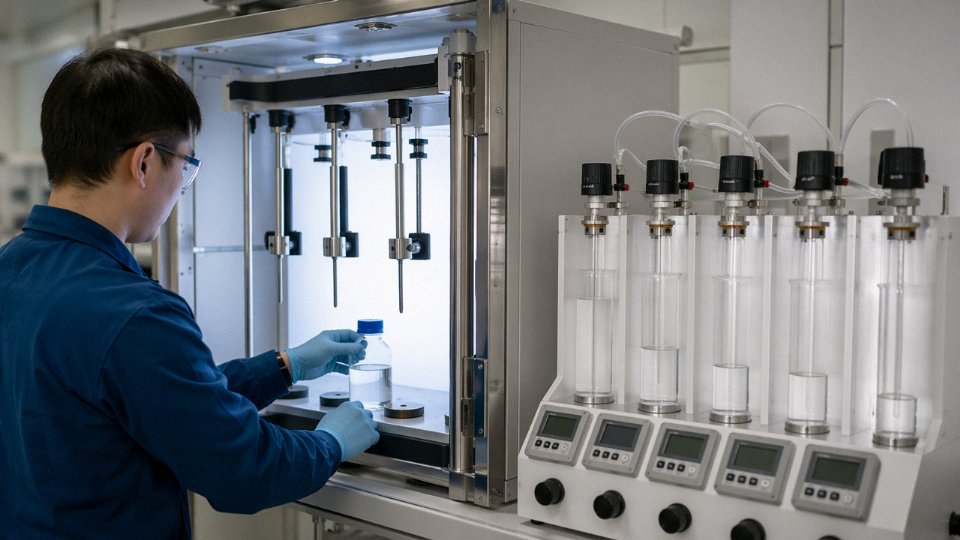
A basic goods-receipt screen should include kinematic viscosity (ASTM D445), refractive index (ASTM D1218), and a flash point check (ASTM D93). PDMS grades are non-flammable at typical viscosities — a flash point below roughly 300°C on a high-viscosity grade should raise immediate questions. For electronic-grade material, add ionic conductivity measurement; even trace contamination can compromise dielectric performance in transformer or power-module applications. Karl Fischer water content testing (ASTM E1064) matters for any moisture-sensitive process, and color (ASTM D1209) is a fast indicator of thermal degradation or contamination in returned or repackaged stock.
Storage: What the Datasheet Doesn’t Always Emphasize
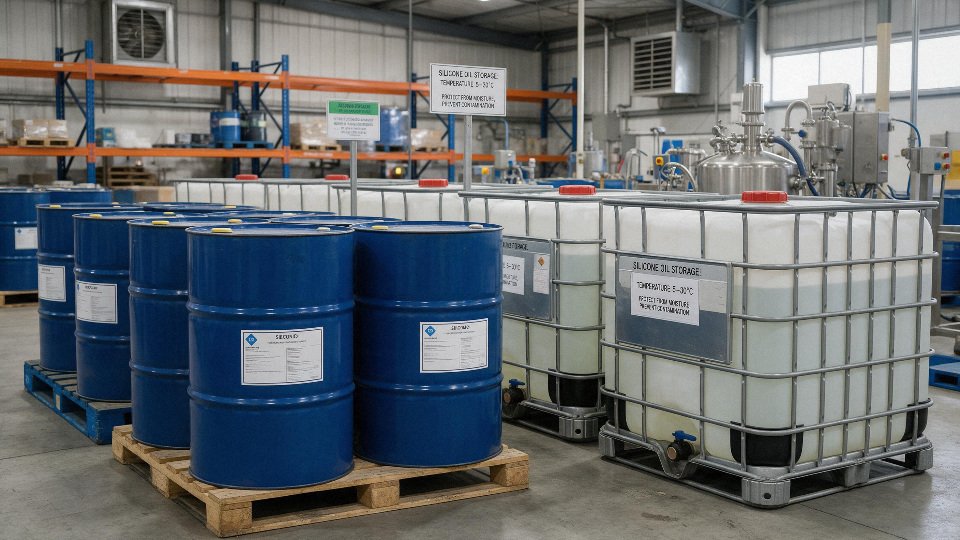
Standard PDMS grades are generally stable for around 24 months in sealed containers stored below 30°C, away from strong acids, strong bases, and oxidizing agents. Seasonally, warehouses in humid climates can push containers toward condensation cycles — not a catastrophic problem for bulk PDMS, but worth managing if you’re storing high-purity or low-viscosity grades.
Functional grades are a different story. Amino-functional and epoxy-functional silicone oils typically carry 12-month shelf lives because the reactive side groups can undergo slow cross-linking or hydrolysis during storage. Using a drum past its labeled shelf life in a release-agent or coating application can result in inconsistent film formation, adhesion failures, or contamination of the substrate — consequences that often don’t show up until downstream processing.
Container material deserves more attention than most procurement specs give it. HDPE and stainless steel are the standard choices. Certain low-viscosity grades — below roughly 5 cSt — can permeate through some polymer liners and thin-walled plastic drums over extended storage, which creates both product loss and the risk of contaminating whatever the drum is sitting on. Carbon steel drums are usable for standard PDMS but introduce rust risk in humid conditions; they’re generally not appropriate for electronic or medical grades where ionic contamination tolerance is tight.
Traceability Under ISO 9001 and IATF 16949
Lot-controlled Certificate of Analysis retention is the baseline requirement. For automotive supply chains operating under IATF 16949, and for medical device supply chains under ISO 13485, that means retaining CoAs for the duration of the product’s service life — which can extend well beyond the oil’s own shelf life. Supplier qualification audits, including process capability data and periodic site assessments, are not optional extras; they’re the mechanism that catches silent reformulations before they cause a field problem. A supplier who changes their stripping or distillation process without notification can deliver a product with the same nominal viscosity but a different trace-metal profile or a shifted volatility curve — and your incoming viscosity check won’t catch it.
The change notification agreement is the single most underused procurement tool in chemical supply chains. Get it in writing.