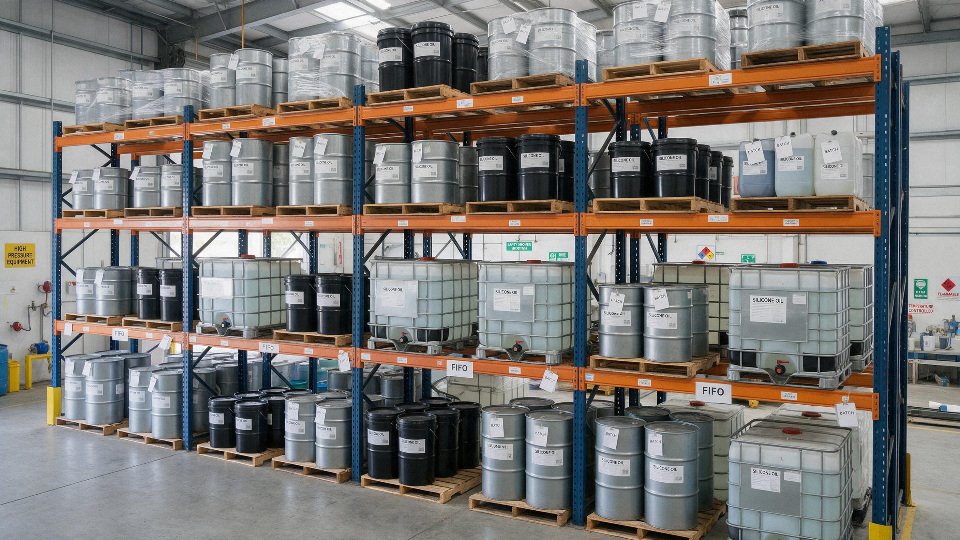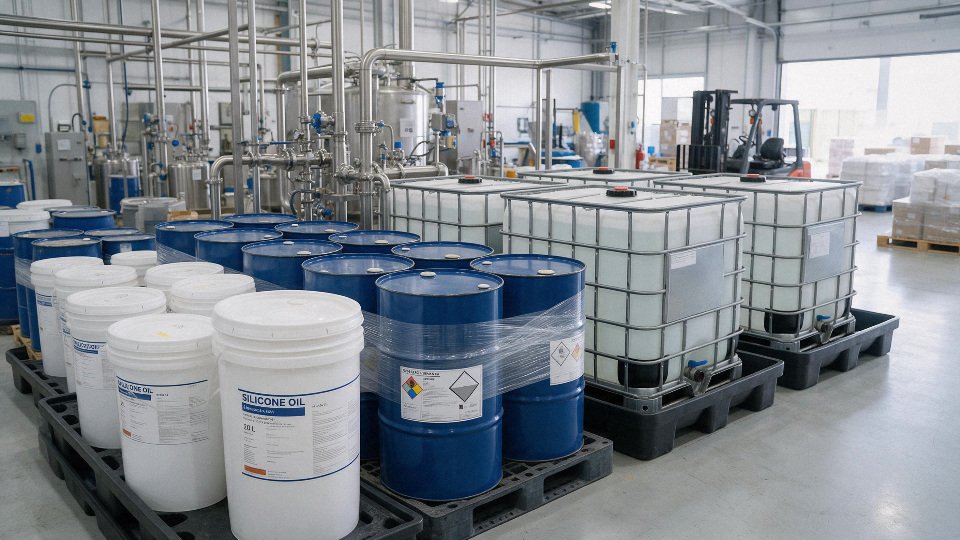
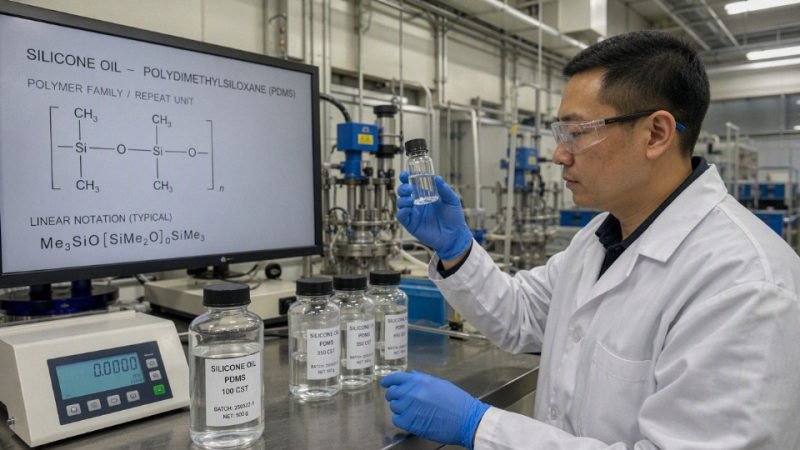
You can lose a lot of time and make a bad buy from one deceptively simple question: “What is the chemical formula of silicone oil?” If purchasing treats it like a single fixed substance, the wrong grade gets quoted, tested, and approved, then shows up with the wrong viscosity, volatility, or temperature behavior for the job. That usually turns into requalification work, line-side troubleshooting, scrap risk, and a more expensive correction than the original drum price difference ever looked.
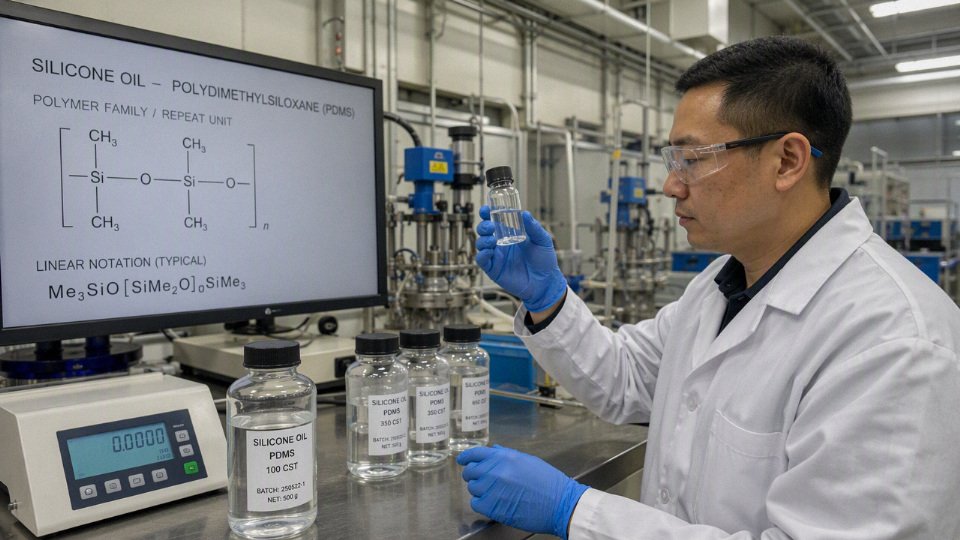
The usual chemical formula of standard silicone oil is written as [Si(CH3)2O]n, the repeat unit of polydimethylsiloxane, or PDMS. The key point is that silicone oil is not one small molecule but a polymer family, so the “n” changes with chain length, which is why commercial grades span very different viscosities and performance ranges.
That short formula answers the chemistry, but not the buying decision. In practice, the repeat unit stays the same while molecular weight, end groups, branching, and modification change how the fluid behaves on your parts, in your pumps, and across your operating temperature window. The useful question is less “what is the formula?” and more “which silicone oil structure is actually being offered, and what does that mean in service?”
Structural formula and notation
Silicone oil is usually written as a repeat-unit polymer, not a single fixed molecule, because what buyers call “silicone oil” is most often a distribution of siloxane chain lengths with defined end groups and, sometimes, deliberate functional modification. For standard dimethyl silicone oil, the practical structural shorthand is the linear end-capped form Me3SiO[SiMe2O]nSiMe3, and that notation tells you far more than a trade name or a catalog label.
Start with the repeat unit most engineers see first:
[Si(CH3)2O]n
That compact expression carries the core chemistry.
- Si is silicon
- O is oxygen
- (CH3)2 means two methyl groups bonded to each silicon
- n means the siloxane unit repeats many times along the chain
What matters structurally is that the backbone is Si-O-Si-O, not the carbon-carbon or carbon-hydrogen framework you see in mineral oils or many synthetic organic fluids. That difference is not just academic. It is one reason silicone oils keep workable viscosity over a broad temperature window, stay relatively inert toward many substrates, and show the slip, release, and dielectric behavior plant people expect from PDMS-type fluids.
If you sketch one segment, each silicon is typically bonded to:
- Two methyl groups
- Two oxygen linkages within the chain, except at the chain ends
That gives the chain a flexible, somewhat open structure compared with tighter carbon-chain organics. In practice, that flexibility feeds into low glass-transition behavior and the broad service ranges often associated with dimethyl silicone oils. The boundary is simple, though: once you move into very high temperatures, strong oxidizing environments, catalytic contamination, or open systems where volatility matters, the neat textbook advantages start to narrow and you have to look at the exact grade and end groups.
What the shorthand actually means
In silicone chemistry, Me is standard shorthand for a methyl group, CH3. So instead of writing a long structural formula repeatedly, suppliers and formulators often use:
Me3SiO[SiMe2O]nSiMe3
Read that from left to right:
- Me3SiO- is one trimethylsiloxy end group
- [SiMe2O]n is the repeating dimethylsiloxane chain
- -SiMe3 at the far end completes the second end cap through oxygen in the full chain structure
You will also see equivalent ways of writing the same idea, such as:
- MDnM notation in siloxane shorthand
- Trimethylsiloxy-terminated polydimethylsiloxane
- PDMS, dimethyl terminated
That shorthand matters in procurement because two products can both be called “silicone oil” while differing in chain termination, residual cyclic content, functional groups, or molecular-weight distribution. On paper they look close. On the line they can wet differently, foam differently, cure differently in downstream silicone systems, or extract differently into elastomers and plastics.
Why the value of n matters
The n in [Si(CH3)2O]n is variable because silicone oil is a polymer family, not a single discrete molecule. As n increases, the average chain length increases, molecular weight rises, and viscosity usually rises with it.
That is the practical path:
- Higher degree of polymerization
- Higher average molecular weight
- Greater chain entanglement and internal friction
- Higher viscosity at a given temperature
For standard PDMS fluids, that is why you can buy grades ranging from water-thin fluids to very heavy oils and gum-like materials. The benchmark viscosity span often cited for dimethyl silicone oils is about 0.65 cSt to above 1,000,000 cSt at 25 C, but that entire range is not one chemistry behaving identically. Low-viscosity materials are much more sensitive to volatility and cyclic content; very high-viscosity grades raise pumping, metering, and line-cleaning issues. Anyone who has tried to move a high-viscosity silicone through a small gear pump in winter knows the formula on the drum is only the start of the discussion.
A common purchasing mistake is assuming viscosity alone defines equivalence. It does not. Two oils at the same nominal cSt can differ in:
- Molecular-weight distribution
- End-group chemistry
- Residual cyclic siloxane level
- Trace catalyst or ionic residues
- Functional modification content
Those differences can shift antifoam behavior, paper release, dielectric performance, or compatibility with adhesives and coatings.
Linear silicone oils versus cyclic siloxanes
Not every silicone fluid in a process stream is purely linear. Linear silicone oils are the main commercial form for many industrial uses, but cyclic siloxanes are structurally distinct compounds where the siloxane units form rings rather than chains.
Typical cyclic examples include:
- D3: hexamethylcyclotrisiloxane
- D4: octamethylcyclotetrasiloxane
- D5: decamethylcyclopentasiloxane
These are not just shorter versions of PDMS. They are different molecular architectures with different volatility, solvency, and regulatory attention in some markets.
Why they matter in a silicone oil discussion:
- They may appear as intermediates in production
- They may remain at trace residual levels after polymerization and stripping
- They may be present at controlled levels in formulations where volatility or spreading is desired
- They can affect odor, evaporation loss, flash behavior, and compliance review
The trade-off is straightforward. Lower cyclic content usually improves consistency for many technical fluid applications, but achieving very low residual levels can add processing cost and may not matter for every use case. If the oil is going into a closed mechanical system, one specification set makes sense; if it is for personal care, food-contact-adjacent processing aids, or a regulated export market, the acceptable residual profile may be much tighter. That is where a generic “silicone oil” label stops being useful.
Common modified silicone oil structures
Once you leave plain dimethyl silicone oil, the formula notation changes because one or more methyl groups or chain ends are replaced with functional groups. These are still siloxane-based materials, but they are no longer fully described by [Si(CH3)2O]n alone.
Methyl phenyl silicone oils
Some methyl groups are replaced by phenyl groups. You may see repeat units represented conceptually as mixtures of:
- [SiMe2O]
- [SiMePhO]
- sometimes [SiPh2O]
These fluids are often chosen where lower-temperature flexibility, refractive-index adjustment, or better high-temperature oxidative behavior is needed relative to straight dimethyl grades. The trade-off is cost and, in some systems, different compatibility with substrates or elastomers.
Amino-modified silicone oils
These carry aminoalkyl-functional siloxane units, often represented generically rather than with one universal formula because side-chain architecture varies. Typical notation may look like a PDMS backbone with a small fraction of amino-functional units inserted.
They are used where the oil needs substantivity or surface interaction, such as textile softening or certain conditioning applications. The mechanism is chemical affinity: the amino functionality interacts more strongly with polar surfaces than plain PDMS does. That same feature can create yellowing, bath instability, or recoatability issues if the grade is mismatched.
Epoxy-modified silicone oils
These include epoxy-functional side groups attached through organic spacers. They are used where silicone slip or flexibility must coexist with some reactivity toward resin or crosslinking systems. You have to verify compatibility with the intended curing chemistry; “epoxy silicone” is not one fixed structure.
Polyether-modified silicone oils
These combine siloxane segments with polyether side chains. They are often used as surfactants, wetting agents, or defoamers with tuned water compatibility. Unlike plain dimethyl silicone oil, they may be partially dispersible or soluble depending on EO/PO ratio and architecture. That flips the handling profile completely in some plants.
Fluoro-modified silicone oils
These incorporate fluorinated groups for lower surface energy or improved resistance in specific chemical environments. They are specialty materials, usually justified only when standard PDMS or organic fluorofluids miss the mark.
Hydroxyl-terminated silicone oils
These are commonly written as:
HO[SiMe2O]nH
or described as silanol-terminated PDMS.
Here the chain ends are hydroxyl-functional rather than trimethylsiloxy-capped. That makes the fluid chemically more active in condensation or crosslinking systems. It also changes storage behavior and moisture sensitivity, so it should not be treated as a drop-in replacement for dimethyl-terminated oil of similar viscosity.
CAS numbers and trade names are not enough
A CAS number can identify a chemical category, and a trade name can identify a supplier’s product line, but neither one replaces structural understanding when you are checking technical equivalence.
Two silicone oils with similar viscosity and the same broad product label can still behave differently in production because end groups, residual cyclics, and functional modification change performance.True
This follows established polymer and formulation behavior. Viscosity is only one property; chain architecture and composition affect volatility, surface interaction, compatibility, and reactivity. Exact equivalence requires product data and, in many cases, plant or lab testing.
For engineering and procurement work, the minimum comparison set usually includes:
- Backbone type: dimethyl, methyl phenyl, modified siloxane, copolymer
- End groups: trimethylsiloxy, hydroxyl, vinyl, amino, epoxy, other
- Nominal viscosity and test temperature
- Molecular-weight distribution, if relevant
- Residual cyclic siloxane limits, if relevant
- Density range, if dosing is by volume
- Application-specific purity or reactivity limits
If a supplier only gives a trade name and a viscosity grade, you do not yet know enough to call it equivalent. In practice, that gap shows up later as foam carryover, cure inhibition, poor wet-out, seal swell, or an oil that behaves fine in summer and turns into a transfer problem once the warehouse drops 10 degrees.
Why formula varies by grade
For standard dimethyl silicone oils, the “formula” usually changes on paper faster than it changes in chemistry. Most viscosity grades are still the same basic PDMS backbone, but with different chain length distributions, different end groups, and, in specialty grades, deliberate structural modifications that change how the fluid behaves in processing and in service.
That distinction matters in procurement and plant use. A buyer may see two products both described as silicone oil, both built around siloxane chains, and assume they are interchangeable. In practice, one may be a stable heat-transfer or lubricating fluid, another a reactive intermediate for sealants, and another a modified spreader or defoamer that will either solve a line problem or create one.
Viscosity grade usually means chain length, not a different base fluid
For plain dimethyl silicone oil, viscosity is driven mainly by average molecular weight and molecular weight distribution. The repeat unit stays the familiar dimethylsiloxane structure, but the value of n changes; longer chains tangle more, move less freely, and raise viscosity, especially once you get out of the very low-cSt range.
A few practical points matter here:
- Low-viscosity grades are typically shorter-chain fluids.
- They flow easily
- They often show higher volatility
- They can evaporate or migrate faster at elevated temperature
- They are easier to emulsify in some systems, though formulation details still dominate
- Higher-viscosity grades are typically longer-chain fluids.
- They have lower volatility
- They give thicker lubricating films
- They can be harder to pump, meter, or disperse
- They may create carryover or residue issues if the process really needed a lighter fluid
- Distribution matters, not just average viscosity
- Two fluids with the same nominal cSt can behave differently if one has a broader molecular weight distribution
- Broader distribution can affect shear response, low-boiler content, odor, and consistency from batch to batch
- In some coating and release applications, that difference shows up as uneven spreading or cure disturbance
The mechanism is straightforward: chain length affects internal friction, and low-molecular-weight fractions affect volatility and surface behavior. That is why a 100 cSt fluid is not “chemically different” from a 350 cSt fluid in the same basic PDMS family, but it is not operationally equivalent either.
This logic stops holding once the product is no longer a simple dimethyl silicone oil. Once functional groups or comonomers are introduced, the same viscosity can come from a very different architecture with very different compatibility and reactivity.
End groups change reactivity and downstream use
The chain ends are a small fraction of the molecule by mass, but they often decide whether the fluid is inert, reactive, easy to store, or ready to crosslink. That is one reason the formula by grade needs more than just the repeat unit.
Common end-group types include:
- Trimethylsiloxy-terminated
- Often used for relatively non-reactive, storage-stable silicone fluids
- Lower tendency to condense or build molecular weight during storage
- Common where the fluid is expected to act as a lubricant, dielectric fluid, release component, or process aid rather than a reactive intermediate
- Hydroxyl-terminated
- Usually more reactive
- Can participate in condensation reactions
- Common as intermediates for RTV systems, silicone rubber manufacture, and some modification chemistries
- More sensitive to moisture-related processing effects and contamination in downstream use
- Reactive-functional end groups
- Examples may include amino, epoxy, vinyl, hydride, polyether, or other functional terminations depending on product family
- Used when the silicone oil must bond, cure, anchor to a substrate, or compatibilize with another chemistry
- Common in textile finishing, release systems, additives for coatings, and some electronics materials
The trade-off is familiar on the shop floor: inert end-capped fluids are easier to store and simpler to use, but they do less chemically. Reactive grades can deliver adhesion, cure participation, or substrate affinity, but they are less forgiving. A drum left open on a humid day, a transfer line with residue from another chemistry, or a poorly cleaned tote can turn into viscosity drift or partial pre-reaction.
A silicone oil with the same siloxane backbone but different end groups can require a different storage, handling, and qualification protocol.True
End groups affect moisture sensitivity, curing behavior, volatility profile, and compatibility with downstream chemistries, so qualification by viscosity alone is not technically sufficient.
Copolymer or graft modification changes both notation and performance
Once you move beyond straight dimethyl silicone fluid, the shorthand formula gets less tidy. Manufacturers may represent the product as a copolymer, a grafted structure, or a functionalized siloxane with approximate repeat-unit ratios rather than one neat repeating unit.
This is where many buyers get caught. The siloxane backbone may still be present, but the side groups or comonomers can shift the fluid’s behavior sharply.
Common modification routes and what they change
| Modification type | Typical performance shift | Common application logic |
|---|---|---|
| Phenyl-modified siloxane | Better low-temperature flexibility or different thermal/optical behavior, depending on structure | Specialty lubrication, heat stability, electronics, optical uses |
| Polyether-modified silicone | Higher surface activity, better water dispersibility, improved wetting/spreading | Textile finishing, agricultural adjuvants, coatings, personal care |
| Amino-modified silicone | Increased substrate affinity, softness, lubrication on fibers, possible yellowing risk in some systems | Textile softeners, fiber treatment, surface conditioning |
| Reactive silicone with vinyl or hydride functionality | Enables addition cure or crosslinking | Release coatings, silicone elastomer systems, electronics encapsulation |
| [Silica](https://siliconchemicals.com/silica/)-containing or structured antifoam systems | Stronger foam knockdown, but often narrower compatibility window | Defoaming in process liquids, coatings, wastewater, fermentation support systems |
The mechanism is usually one of three things:
- changing surface energy
- changing compatibility with polar or nonpolar media
- introducing sites that react or anchor under process conditions
That is why two products both sold broadly as silicone oil can behave opposite ways in the same tank. One may spread instantly on a waterborne surface; another may bead up. One may suppress foam in a circulating bath; another may stabilize it if the emulsifier package is wrong. One may lubricate an elastomer seal; another may swell it or extract additives, depending on the polymer system.
Purification level matters, especially in sensitive applications
Residual cyclics, low boilers, and trace volatiles often do not change the broad family description, but they can change whether a grade is fit for the job. This is especially relevant in personal care, electronics, regulated applications, vacuum service, or any process sensitive to fogging, odor, extractables, or outgassing.
Watch these variables:
- Residual cyclic siloxanes
- Can affect volatility, regulatory acceptability, and odor profile
- May matter in personal care and other controlled markets
- Limits are product- and market-specific, so they need supplier confirmation
- Low-boiling fractions
- Influence flash-off, evaporation loss, and fogging
- Can create weight-loss issues in heated processes
- Often show up first as inconsistent finish or contamination around vents and covers
- Purity and trace contamination
- Matter in electronics, optical parts, and sensitive coating lines
- Ionic residue, catalyst traces, or particulates can disqualify an otherwise suitable fluid
- Verification needs actual supplier data and, in many plants, an application test
A cheap fluid that needs rework, extra ventilation cleaning, or customer complaint handling is rarely cheap by the second quarter. In my experience, this is one of the places where technical purchasing earns its keep: not by buying the highest-spec grade automatically, but by matching purity level to the actual risk of the process.
Composition-property relationships
A silicone oil’s working behavior is set less by the name on the drum than by three structural levers: siloxane chain length, molecular weight distribution, and side-group chemistry. If you want to predict viscosity, heat tolerance, dielectric suitability, wetting, release, or compatibility, the useful question is not “Is it silicone oil?” but “Which siloxane structure, how broad a distribution, and what substitution package?”
That matters on the plant floor because two fluids sold as “silicone oil” can behave very differently in metering pumps, on a hot roll, inside a capacitor housing, or on a release-coated web. Buyers often get caught by category thinking here. The chemistry is broad enough that the same family covers light damping fluids, heat-transfer media, defoamers, textile auxiliaries, transformer-type insulating liquids in some cases, and highly modified wetting agents.
Chain length, molecular weight distribution, and what they do to flow
For standard dimethyl silicone oils, increasing chain length generally raises viscosity because longer chains entangle more and resist flow. The common PDMS benchmark, based on the repeat unit [Si(CH3)2O]n, is sold in grades from roughly 0.65 cSt up past 1,000,000 cSt at 25 C, but that headline number is only part of the selection picture.
What usually changes with chain length and distribution:
- Viscosity at room temperature
- Low molecular weight grades flow almost like a light solvent or thin mineral oil.
- Mid-range grades meter cleanly through gear pumps and simple dosing systems.
- Very high viscosity grades can require follower-plate pumps, heat tracing, or drum unloaders.
- Viscosity-temperature behavior
- Silicone fluids usually hold a more stable viscosity across temperature swings than many hydrocarbon oils.
- In practice, this is why they stay serviceable in cold starts and still retain body at elevated temperature.
- Exact behavior still depends on grade and modification; do not assume every silicone fluid has the same viscosity index.
- Pour behavior and low-temperature mobility
- PDMS is known for remaining fluid at temperatures where many mineral oils are already sluggish.
- That comes from the flexible Si-O backbone and weak intermolecular packing.
- Phenyl-modified or specially designed low-temperature grades may improve cold performance further in some applications, but not universally.
- Shear response
- Most silicone oils behave close to Newtonian in many ordinary service conditions, especially lower to medium viscosity grades.
- Once molecular weight rises far enough, apparent handling can become less forgiving: stringiness at dispensing, slower leveling, more residue on transfer surfaces.
- That is not the same thing as classic shear-thinning in every case, so if your process involves high-shear mixing, atomization, or narrow clearances, test the actual grade.
- Processing ease
- Thin grades are easier to filter, degas, and meter accurately.
- Heavy grades stay in place better and can improve damping or residence on vertical surfaces, but they are slower to blend and harder to clean out of lines.
The trade-off is simple enough: longer chains buy body, film persistence, and often lower volatility, but they cost you handling ease and can complicate dosing accuracy, startup, and cleanup. That preference flips in high-speed coating or precise micro-dosing lines, where a lower viscosity fluid may run cleaner even if you need more frequent replenishment.
Why the Si-O backbone behaves differently from hydrocarbon oils
The siloxane backbone is the reason silicone oils do not track one-for-one with mineral or PAO oils. The Si-O bond geometry gives the chain unusual flexibility, while the backbone itself is relatively robust thermally. That combination is behind the familiar package of wide operating temperature range, good low-temperature fluidity, and stable rheology over temperature.
Typical standard dimethyl silicone oils are often used across roughly -50 C to 200 C, but that figure is only a benchmark. Actual service limit depends on several things:
- exposure time at temperature
- oxygen availability
- surface area of the fluid exposed to air
- presence of metal catalysts or process contaminants
- volatility of the specific grade
- whether the system is sealed, vented, or intermittently heated
A silicone oil's maximum service temperature can be stated as a single universal number.False
Thermal life depends strongly on time, oxygen exposure, contamination, fluid volatility, and system design. A short excursion and continuous service are not the same engineering condition.
Oxidation behavior is where buyers often overread marketing language. In a clean, mostly closed system, a suitable silicone fluid may hold up very well. In an open hot bath with air entrainment, trace iron fines, and periodic overheating at the heater wall, the same chemistry can age much faster. In practice, once oxidation starts showing up as increased acidity, viscosity drift, deposits, or volatiles, the maintenance problem is no longer purely chemical; it becomes a heat-transfer, fouling, and housekeeping problem.
Compared with many hydrocarbon oils, silicone fluids also tend to leave different deposit patterns under thermal stress. They may resist carbonaceous sludge in some conditions, but under the wrong contamination package they can still form gels, varnish-like residues, or silica-related decomposition products. That boundary matters. If your equipment has hot spots, catalytic metal contact, or intermittent dry heating, do not select on brochure temperature alone.
Side-group chemistry changes the job the fluid can do
Substituents on the siloxane chain can shift performance more than many buyers expect. “Silicone oil” is not one structure with one property profile.
| Substitution type | Property direction usually affected | Typical selection reason | Common caution |
|---|---|---|---|
| Methyl | Low surface tension, broad utility, good flexibility | General-purpose PDMS fluids, release, lubrication, dielectric uses | Limited solvency for some soils and polymers |
| Phenyl | Higher refractive index, often improved low-temperature or radiation-related performance in specific designs | Optical, specialty thermal, or electrical formulations | Cost is usually higher; not a blanket upgrade |
| Fluoro | Lower flammability tendency in some systems, altered chemical resistance and lubricity | Specialized chemical or aerospace-related environments | Compatibility and cost need checking case by case |
| Amino | Better interaction with some substrates, conditioning, slip, softening | Textile, personal care, selected surface treatment systems | Can interfere with paint or adhesion; can yellow in some conditions |
| Epoxy | More reactive substrate interaction in formulated systems | Coatings, additives, coupling-oriented formulations | Stability and cure interaction depend on system chemistry |
| Polyether | Strongly changed wetting, spreading, and emulsifiability | Wetting agents, defoamers, agricultural or coating additives | Water sensitivity and foam behavior can move either way depending on design |
A few practical links matter most in industrial buying:
- Phenyl substitution
- Often raises refractive index, which is useful where optical matching matters.
- Can improve solvency toward certain organic materials compared with straight dimethyl types.
- Some phenyl-containing fluids also perform well at lower temperatures or in radiation-related environments, but the exact behavior is formulation-specific.
- Fluoro substitution
- Usually targeted where standard PDMS is too weak on chemical resistance or where specialty lubricity is needed.
- These are not commodity replacements; qualification work is usually worth doing.
- Amino and epoxy functionality
- Increase interaction with substrates.
- Useful when you want softness, anchorage, or a more persistent surface effect rather than pure inert slip.
- The penalty can be compatibility trouble with downstream painting, printing, or adhesive bonding.
- Polyether modification
- This is a big one for wetting and antifoam systems.
- It can transform a water-insoluble silicone fluid into a self-dispersing or water-compatible additive.
- The same modification that improves spreading can also change foam control, hydrolytic behavior, and substrate selectivity.
Low surface tension helps release, but spreading and defoaming are not automatic
Silicone oils usually have low surface tension, which is why they are widely used where release, slip, leveling, or surface migration are useful. That is the general rule. It is not a guarantee that any silicone fluid will spread well on any substrate or act as an effective defoamer in any liquid system.
Mechanistically, low surface tension helps a fluid cover surfaces and reduce adhesion forces at the interface. But practical performance depends on more than that:
- fluid viscosity
- side-group polarity
- whether the system is solventborne, waterborne, or 100% solids
- contamination on the substrate
- dosage level
- mixing intensity
- compatibility with the surrounding formulation
A common plant-floor mistake is assuming a neat dimethyl silicone oil will fix foam because “silicone kills foam.” Some grades do, in some systems. Others simply sit there, create fish-eyes, or separate badly. Effective antifoam behavior usually depends on controlled incompatibility, particle package, carrier choice, and droplet distribution, not on the word silicone by itself.
Dielectric behavior: useful, but only when purity is controlled
Many silicone fluids have attractive dielectric characteristics, which is why certain grades are used in electrical and electronic environments. Their combination of thermal stability, hydrophobicity, and electrical insulation can be valuable in transformers, damping devices, heat-transfer loops near electrical assemblies, or specialty encapsulation-related systems.
What has to be controlled:
- Purity
- Ionic contamination, moisture, catalyst residues, and particulates can undermine dielectric performance.
- This is one area where a “technically similar” industrial lubricant grade may not be an acceptable substitute.
- Volatile content
- Low molecular weight fractions can affect evaporation loss, pressure build-up in sealed spaces, and long-term consistency.
- Compatibility with insulation materials
- Paper, varnish, elastomers, potting compounds, and plastics do not all respond the same way.
- Swelling, extraction, or stress cracking can show up only after time at temperature.
- Application-specific testing
- Dielectric strength, dissipation factor, volume resistivity, and aging behavior need current supplier data and, for critical equipment, system-level validation.
The section’s main conclusion stops holding once the fluid is heavily modified for surfactant behavior or reactive surface interaction. At that point, broad assumptions about dielectric performance, inertness, or low volatility become unsafe shortcuts.
Compatibility limits buyers overlook
The failures here are usually expensive because they appear late, after a fluid is already approved.
Watch these points:
- Gas permeability
- Silicones are relatively permeable to gases compared with many organic polymers and oils.
- Fine for some damping or lubrication duties; a problem for vacuum-adjacent service, gas-sensitive packages, or barrier-dependent designs.
- Elastomer swelling
- Some rubbers tolerate silicone oils well; others swell, soften, or lose properties.
- NBR, EPDM, FKM, silicone rubber, and specialty seals all need case-by-case review because formulation differences matter.
- Paintability and adhesion
- Even trace silicone contamination can crater coatings or disrupt printing and bonding.
- If the fluid is used upstream of painting, laminating, or adhesive assembly, housekeeping and migration risk have to be discussed before purchase.
- Solvency limits
- Standard PDMS is not a strong solvent for many deposits.
- Buyers sometimes expect it to clean, lubricate, and release all at once. Usually that is asking too much of one fluid.
- Contamination sensitivity at high temperature
- Metal fines, acid traces, alkaline cleaners left in the system, or mixed-oil contamination can shorten life sharply.
- On paper the fluid is stable; in a dirty loop, the chemistry gets blamed for a maintenance discipline problem.
For an application review, the useful inputs are the substrate set, temperature profile, oxygen exposure, seal materials, electrical cleanliness requirement, and whether the fluid can migrate onto paint or bond surfaces. Without those details, property claims stay generic, and generic is where expensive mistakes start.
Industrial grade families
The commercial answer is that “silicone oil” is not one buying category but a family of fluid chemistries built on siloxane backbones and sold into very different process windows. If you are sourcing for a plant, the useful split is not just by formula notation; it is by whether the fluid is inert or reactive, how it behaves in water or solvent, what it leaves behind on the surface, and what documentation burden comes with the grade.
A drum labeled silicone oil can be a straightforward dimethyl PDMS, a reactive hydroxyl-terminated intermediate, a phenyl-modified specialty fluid, or a heavily application-tuned surfactant system. That matters because the wrong family usually does not fail in a dramatic laboratory way first; it shows up as coating defects, cure drift, yellowing, seal contamination, poor recoatability, or procurement trouble when the customer asks for extractables, residual cyclics, or food-contact paperwork you did not ask for up front.
Standard dimethyl silicone oils
These are the general-purpose PDMS fluids most buyers mean when they say silicone oil. Chemically, they are usually linear dimethylsiloxane fluids built around the repeat unit [Si(CH3)2O]n, offered from very low viscosity grades, around 0.65 cSt, up to very high viscosities well past 1,000,000 cSt at 25 C.
In plant terms, this family covers several very different jobs:
- Lubrication for plastics, elastomers, light mechanisms, and rubber processing
- Heat-transfer or thermal-bath service in selected systems
- Release and anti-stick treatment
- Polishing, gloss, and feel modification
- Household and personal care intermediates where the grade and regulatory position allow
The mechanism behind their broad use is straightforward: the Si-O backbone gives flexibility and thermal stability, while the methyl groups keep surface energy low and chemical reactivity limited. As molecular weight rises, viscosity rises sharply, volatility drops, and film persistence increases. That is useful for release and lubrication, but it also makes cleanup harder and can create paint or adhesive contamination if the fluid migrates into nearby operations. Any plant that runs silicone release and downstream printing in the same airspace learns this the expensive way.
Typical density for standard dimethyl grades is about 0.93-0.98 g/cm3 at 25 C, depending on molecular weight and structure. Many standard grades are used roughly from -50 C to 200 C, but that is not a universal design limit. Volatility, oxidation stability, residence time, open-air exposure, and contamination all shift the practical ceiling, so a heat-transfer loop or dielectric application should always be checked against supplier data and the actual system design.
Hydroxyl silicone oils
Hydroxyl silicone oils are usually linear siloxane fluids terminated with silanol groups. The buying difference is simple: these are not just lubricating fluids, they are reactive intermediates.
Common use classes include:
- RTV silicone systems
- Sealants and caulks
- Elastomer and gum intermediates
- Crosslinkable release coatings
- Paper-release and specialty coating formulations
What changes operationally is end-group chemistry. The hydroxyl end groups can condense or react within crosslinking systems, so viscosity alone is not enough for selection. You need at least:
- Hydroxyl content or equivalent reactive functionality
- Viscosity at the stated temperature
- Residual volatiles
- Compatibility with the chosen crosslinker, catalyst, and filler package
This is where procurement mistakes happen. Two hydroxyl fluids can sit near the same viscosity and behave very differently in cure speed, storage stability, and final network properties because silanol level and molecular weight distribution are not the same. In sealant plants, that shows up as skin-over time drift, hardness variation, or package stability problems in warm weather.
Methyl phenyl silicone oils
Methyl phenyl silicone oils replace part of the methyl substitution with phenyl groups. That modification usually improves low-temperature behavior in some grades and can improve resistance in thermal or radiation-intensive service, which is why these fluids appear in specialty dielectric, damping, optical, and aerospace-adjacent applications.
The trade-off is cost and, often, narrower sourcing options. You buy phenyl modification when standard dimethyl fluid stops holding its properties where you need them, not because the word “specialty” sounds safer. In practice, the preferred choice flips when one of these conditions is true:
- Very low-temperature fluidity must be preserved beyond the comfortable range of standard dimethyl grades
- Optical or refractive behavior matters
- Thermal-radiation exposure or specialty dielectric stability justifies the premium
Because manufacturer formulations differ, performance claims in optical or electrical service should be verified against the exact grade rather than assumed across the whole phenyl-modified category.
Amino silicone oils
Amino silicone oils are workhorse surface-treatment materials, especially in textiles and fiber finishing. They are also used in conditioning systems, softeners, and selected surface-modification packages where durable slip and hand feel matter.
The critical buying variable is not just “amino modified” but:
- Amino value or nitrogen functionality level
- Backbone viscosity or molecular size
- Emulsion particle size and stability if supplied as an emulsion
- Ionic character and compatibility with the rest of the bath
- Yellowing tendency under heat or storage
Higher amino functionality usually improves substantivity to fibers and boosts softness, smoothness, and lubricity. The penalty can be yellowing, bath instability, or poor shade reproducibility, especially on white or pastel goods. In textile finishing, emulsion design matters almost as much as the polymer itself. A good amino oil in a poor emulsion can produce roller deposits, uneven pickup, or silicone spots that operators blame on the padder when the chemistry is the real issue.
Polyether-modified silicone oils
Polyether-modified silicone oils sit at the boundary between silicone fluid and surfactant technology. They are selected when plain PDMS is too water-repellent or too incompatible with the system.
Typical applications include:
- Wetting and spreading additives
- Coating and ink leveling
- Defoaming and controlled foam knockdown
- Agrochemical adjuvants
- Water-dispersible surface treatments
The mechanism is the built-in polarity from the polyether segment. That improves water dispersibility and substrate wetting, but it also changes foam behavior, compatibility, and hydrolytic sensitivity. You gain easier formulation into aqueous systems and better dynamic wetting; you often give up some pure silicone slip, water resistance, or defoaming persistence. The boundary here is important: a polyether-modified silicone that performs well as a wetter can be a poor choice where you need durable release or highly persistent lubrication.

Epoxy, alkyl, aralkyl, and fluoro-modified silicone oils
These are niche families, but they matter in the jobs where standard grades miss the target.
- Epoxy-modified silicone oils are used where reactive anchoring, coating modification, or crosslink participation is needed.
- Alkyl-modified silicone oils are often chosen to improve organic compatibility, lubricity, or feel in hydrocarbon-rich systems.
- Aralkyl-modified grades can help tune compatibility and thermal behavior in specialty formulations.
- Fluoro-modified silicone oils are selected for difficult chemical environments, low surface-energy release, or specialty lubrication where resistance to fuels, solvents, or aggressive media matters more than cost.
These are not broad commodity fluids. Selection usually depends on the exact substrate, bath chemistry, and exposure conditions, and bench testing is worth the time because performance can turn on one compatibility issue rather than on bulk properties like viscosity.
Medical, food-contact, electronics, and ultra-pure grades
A regulated or sensitive application changes the buying process more than it changes the base formula description. The fluid may still be dimethyl or modified siloxane chemistry, but the commercial grade must be controlled for residuals, extractables, impurities, lot consistency, and documentation.
Buyers in these sectors usually need to review some combination of:
- Regulatory status for the intended market and use
- Residual cyclic content or other volatile profile
- Extractables and non-volatile residue controls
- Bioburden, cleanliness, or particulate expectations where relevant
- Metal-ion or ionic impurity limits for electronics-related use
- Batch traceability, change-control commitment, and supporting declarations
A standard industrial silicone oil cannot be treated as automatically suitable for food-contact, medical, or electronics use just because the base chemistry is PDMS.True
Application-sensitive grades require supplier-specific controls on purity, residuals, documentation, and often change management. Those requirements are commercial and regulatory, not captured by the repeat-unit formula alone.
That is where formula language stops being enough. Once the application is regulated, high-purity, or contamination-sensitive, the right question is no longer “What is the chemical formula?” but “What is the exact commercial grade, impurity profile, and documentation package for this use?”
Specification and testing points
A usable silicone oil specification is not “PDMS, 100 cSt” and little else. For purchasing, qualification, and incoming inspection, the spec has to tie chemical identity, purity, and use-specific performance together; otherwise two drums with the same nominal viscosity can behave very differently in sealing, defoaming, dielectric, release, or thermal service.
The practical reason is simple: viscosity mostly tracks chain length, but plant performance often depends on what is sitting at the chain ends, what low-boiling fractions are still present, and what was blended in to make the fluid wet, react, or release. That is where a lot of bad buys happen. A fluid can look water-clear and hit the viscosity target, then still fail because hydroxyl end groups react where trimethylsiloxy end groups would stay inert, or because cyclic residuals drive odor, fogging, or volatility problems at temperature.
Core identity items to lock down first
If the product description is vague, fix that before comparing prices.
- Chemical name
- Dimethyl silicone oil
- Hydroxy-terminated polydimethylsiloxane
- Vinyl-terminated PDMS
- Amino-modified silicone fluid
- Polyether-modified silicone
- Phenyl-containing silicone fluid
- Structural type
- Linear siloxane fluid
- Modified copolymer or grafted structure
- Blend, if it is not a single defined fluid family
- End group description
- Trimethylsiloxy-terminated
- Hydroxy-terminated
- Vinyl-terminated
- Methoxy or other reactive alkoxy termination, where relevant
- CAS reference where applicable
- Useful for standard material identification and customs or regulatory paperwork
- Not enough by itself for qualification, because one CAS can still cover a broad molecular-weight range or commercially different grades
- Residual cyclic content or cyclic-bearing character
- Whether the product is predominantly linear
- Whether it contains residual low-molecular cyclics from manufacture
- Whether cyclic limits are controlled for the target market or application
A supplier quote that only says “silicone oil” is not quote-ready for any technical buying process. At minimum, the identity line should let your team distinguish inert fluid from reactive intermediate.
Physical property items that belong on the working spec
For standard dimethyl silicone oils, viscosity can range from about 0.65 cSt to above 1,000,000 cSt at 25 C, so the number matters, but only with the test temperature attached. Density for common dimethyl grades is often around 0.93-0.98 g/cm3 at 25 C depending on molecular weight and structure; if the density is materially outside expectation, it can point to different composition, modification, or contamination.
Use a table format internally so engineering, QC, and procurement are checking the same sheet.
| Property | Why it matters | What must be stated |
|---|---|---|
| Viscosity | Pumping, coating weight, damping, lubrication behavior | Value, method, and temperature |
| Density | Fill volume, mass balance, blend control | Value and temperature |
| Refractive index | Quick identity check, useful for modified grades | Value and temperature |
| Flash point | Handling and heated-process risk review | Method and minimum value |
| Pour point | Low-temperature handling and startup | Method and limit |
| Volatility or weight loss | Fogging, mass loss, residue stability | Test condition, time, temperature |
| Appearance | Gross contamination or phase instability | Clear/hazy, color, visible particles |
One mechanism worth watching: low-boiling fractions tend to depress flash point and increase evaporative loss, which then changes viscosity in service, increases deposits on nearby surfaces, and can upset a process that looked stable during a short line trial. That matters a lot more in heated molds, textile dryers, and vacuum-adjacent equipment than it does in a room-temperature release wipe.
Chemical quality items that separate acceptable from troublesome
These are the checks buyers skip when they are under schedule pressure.
- Moisture
- Critical for hydrolysis-sensitive systems, electrical uses, and moisture-reactive downstream chemistry
- Acid or alkali content
- Residual catalyst or neutralization carryover can accelerate corrosion, destabilize formulations, or shift cure behavior
- Hydroxyl value
- Especially important for hydroxy-terminated fluids and reactive formulations
- Often the difference between a useful intermediate and an inert processing fluid
- Functionality level
- Amino content, vinyl content, epoxy content, polyether content, or other defined functional loading where applicable
- Cyclic residuals
- Relevant for volatility, odor, fogging, some compliance discussions, and thermal loss behavior
- Impurity profile relevant to use
- Metal ions for electrical applications
- Particulate cleanliness for precision coating
- Residual solvent or non-silicone diluent where blends are possible
The trade-off is straightforward: tighter impurity and cyclic control usually costs more, and sometimes materially more. The preferred choice flips if the application is low-temperature, noncritical, and tolerant of some loss; in dielectric service, heated release, personal-contact formulations, or tightly controlled coating lines, cheap material often becomes expensive through scrap, odor complaints, or unstable process windows.
Application-specific performance tests
Do not ask every supplier for every test. Ask for the tests that match the failure mode you care about.
- Dielectric strength / volume resistivity
- For transformer, electronic, and insulation-related use
- Must be tied to a defined test method and conditioning state
- Thermal aging
- Weight loss, viscosity drift, color change, or residue after exposure
- Especially relevant if service is anywhere near the upper end of the typical range, roughly up to 200 C for many standard grades, but actual suitability depends on oxidation stability and application design
- Foam control efficiency
- Knockdown speed and persistence in the actual foaming medium
- A defoamer that works in one surfactant package may fail in another
- Spreading coefficient / wetting behavior
- Important for coating, leveling, agricultural adjuvant, and surface-treatment uses
- Lubricity / friction behavior
- Needed for elastomer assembly, textile lubrication, or plastic-on-metal contact
- Release force
- For release coatings or mold-release-related uses
- Should be tested against the actual substrate and cure conditions
- Compatibility testing
- With elastomers, plastics, sealants, coatings, additives, and the process fluid already on site
Approving a silicone oil by viscosity alone is usually not enough for industrial qualification.True
Viscosity mainly indicates molecular-weight range. End groups, residual cyclics, moisture, catalyst traces, and functional modification can change reactivity, volatility, compatibility, dielectric behavior, and release or defoaming performance even when viscosity is similar.
Documentation package procurement should require
- COA for each lot
- Actual test results, not just nominal values
- TDS
- Typical values, intended use, and handling guidance
- SDS
- Current revision, aligned with destination country requirements
- Regional compliance status
- REACH, and any other market-specific declarations your product line requires
- Lot traceability
- Batch number linkage from production to shipment
- Change-control expectation
- Written notice period for raw material, process, test-method, or specification changes
- Packaging integrity requirements
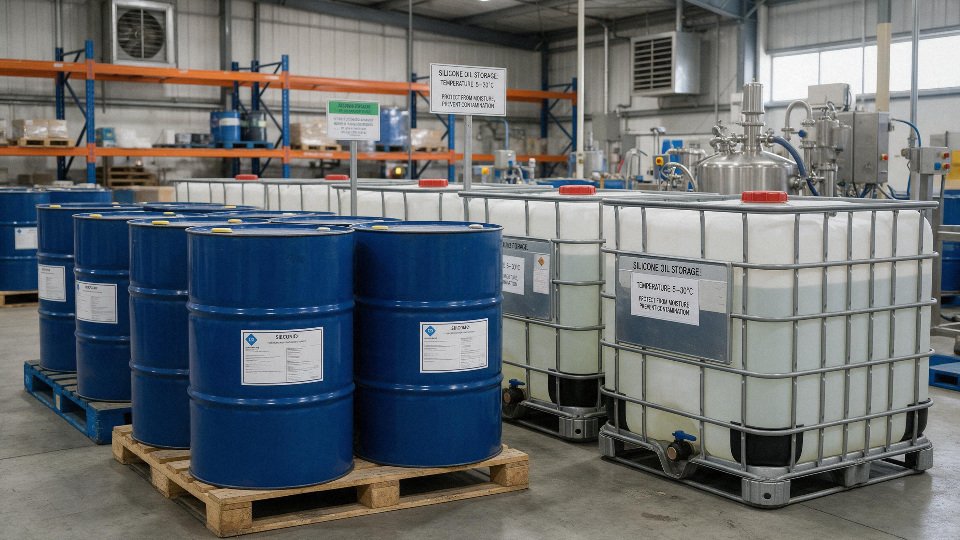
- Drum or IBC type, liner compatibility, seal condition, tamper evidence, cleanliness standard, and storage recommendation
The common buying mistake is approving by viscosity alone and assuming everything else is interchangeable. That shortcut only holds for the most forgiving applications; once the fluid has to insulate, wet, release, resist heat loss, or coexist with a sensitive formulation, you need end-group identity, cyclic control, impurity limits, and at least one use-specific performance test tied to your actual process.
Frequent formula misunderstandings
Most buying mistakes around silicone oil start with one false assumption: that the name on the drum tells you a single, fixed chemistry. It usually does not. In practice, silicone oil is often a polymer family, a viscosity-defined grade, or a modified fluid class, and those are not the same thing from a specification, compliance, or performance standpoint.
Misunderstanding one: silicone oil has one exact molecular formula
Silicone oil usually does not behave like acetone, toluene, or a monomer silane where one molecular formula identifies one substance cleanly. Standard dimethyl silicone oil is commonly a distribution of chain lengths built around the siloxane repeat unit, so the useful chemical description is structural, not a single fixed molecular formula.
What matters on the plant side is that chain-length distribution drives the properties you actually buy:
- Viscosity rises mainly with molecular weight and chain entanglement
- Volatility tends to fall as average chain length increases
- Pour behavior and pumpability shift with both molecular weight and temperature
- Residue and carryover can change if the low-molecular fraction is high
That last point gets missed in procurement. Two suppliers may both describe a product as dimethyl silicone oil, but one may have a broader molecular-weight distribution or higher low-end volatile fraction. On paper, the formula language looks similar. In operation, one grade may fog more on heated rolls, lose mass faster in an open bath, or show a different odor profile during startup.
A silicone oil grade can be chemically described correctly even when it does not have one exact molecular formula.True
Many commercial silicone oils are polymer distributions, so repeat-unit notation and end-group description are more accurate than a single small-molecule formula.
Misunderstanding two: PDMS, dimethicone, dimethyl silicone oil, and silicone fluid always mean the same thing
They overlap, but treating them as perfect synonyms is risky. In industrial sales talk, people often use these terms loosely; in formulation documents, customs paperwork, SDS review, or regulated end uses, the distinction can matter.
A practical way to read the terms:
- PDMS usually refers to polydimethylsiloxane as the core polymer chemistry
- Dimethyl silicone oil usually points to a linear PDMS-type fluid grade
- Silicone fluid is broader and may include modified silicones, blends, or specialty variants
- Dimethicone is often used in personal care and regulated product contexts, where naming conventions may follow specific ingredient systems rather than general industrial shorthand
The commercial trap is simple: a buyer asks for “PDMS 100 cSt,” a supplier offers “silicone fluid 100 cSt,” and everyone assumes equivalence. That can hold for some applications, but not all. If the end use involves coatings, cosmetics, release systems, food-contact review, emissions screening, or export documentation, you need the actual chemical type, not just a familiar market name.
Misunderstanding three: higher viscosity means higher purity, better thermal life, and better lubrication
Sometimes it helps. Often it does not. Higher viscosity generally means higher average molecular weight, but that is not a direct proxy for purity, oxidation resistance, or lubricating performance across different contacts and speeds.
Three common errors show up here:
- Purity assumption
A 1,000 cSt fluid is not automatically “cleaner” than a 100 cSt fluid. Residual catalysts, cyclics, moisture, or particulates depend on manufacturing and finishing, not just viscosity. - Thermal-life assumption
Higher viscosity often reduces volatility, which can improve retention at elevated temperature. But thermal life also depends on oxidation stability, residence time, air exposure, metal contamination, and whether the system is open or sealed. In a vented heated process, the lower-volatility grade may last longer; in a shear-sensitive metering system, it may simply run hotter and create handling problems. - Lubrication assumption
Silicone oils have useful lubricity in some elastomer, plastic, and light-duty contacts, but they are not universal replacements for hydrocarbon, ester, or PFPE lubricants. The preferred choice flips when the contact pressure, material compatibility, boundary-film demand, or contamination sensitivity changes. A thicker silicone oil can actually increase drag, attract dust, or feed less reliably through small applicators.
In practice, the right viscosity is tied to the application method and temperature window first, then checked against volatility, film persistence, and compatibility.
Misunderstanding four: cyclic siloxanes and linear silicone oils are basically the same
They are related chemistries, but not the same materials and not interchangeable from a processing or compliance standpoint. Cyclic siloxanes are lower-molecular ring structures; standard silicone oils are usually linear polymers or oligomer-rich fluids. Residual cyclic content inside a linear oil can matter more than buyers expect.
Why it matters:
- Emissions and fogging: lower-molecular cyclics are more likely to volatilize
- Odor during heating: not always severe, but often more noticeable when volatile content is high
- Process stability: volatile fractions can shift bath composition over time
- Compliance review: some end markets and regions scrutinize certain cyclic siloxanes more closely than standard linear PDMS
- Flash-off and deposition behavior: low-end fractions can affect coating uniformity or residue patterns on hot tooling
This is one of those cases where a generic COA line is not enough. If emissions, enclosed-space exposure, cosmetic use, or heat aging matter, ask for the residual cyclic profile or at least the supplier’s test method and control basis. Without that, “same viscosity” does not mean “same process behavior.”
Misunderstanding five: modified silicone oils are drop-in replacements for standard PDMS
Usually not. A modified silicone oil may still be sold under the broad label of silicone oil, but once you introduce phenyl, amino, polyether, fluoro, epoxy, or other functional groups, you have changed more than the name.
The mechanism is straightforward: modification changes intermolecular behavior and interface behavior, which then changes application performance through several paths:
- Compatibility with water, solvents, resins, plastics, or elastomers
- Surface activity and wetting on low- or high-energy substrates
- Reactivity or anchoring in coatings and release films
- Foam behavior, migration, and transfer
- Electrical and thermal behavior in specialty systems
The trade-off is rarely one-way. A polyether-modified silicone may improve spreading or emulsifiability, but give up some water resistance or alter foam behavior. A phenyl-modified fluid may improve low-temperature or optical performance in certain uses, but cost more and behave differently against seals or process residues. The rule that standard PDMS is a safe reference stops holding once the application depends on formulation compatibility rather than just bulk fluid properties.
If a supplier proposes a modified silicone against a standard dimethyl grade, treat it as a requalification item, not a simple substitution. At minimum, compare substrate interaction, bath stability, residue after heat exposure, and any downstream effect on painting, bonding, printing, or sealing.
Frequently asked questions
What is the exact chemical formula of silicone oil?
There usually is no single exact small-molecule formula for “silicone oil” in the way there is for acetone or water. For the most common grade, dimethyl silicone oil, the chemistry is typically expressed as the repeating siloxane structure [Si(CH3)2O]n, with actual product identity also depending on chain length and end groups.
In procurement terms, asking only for the “formula” is not enough to lock down the material. Two suppliers can both quote PDMS chemistry, but one may supply a low-viscosity, more volatile fluid and the other a much higher molecular weight grade with different handling, loss rate, and compatibility behavior.
Is silicone oil the same as polydimethylsiloxane?
Often yes, but not always. In many industrial conversations, “silicone oil” means polydimethylsiloxane, or PDMS, yet the commercial category also includes phenyl-modified, amino-modified, polyether-modified, hydroxyl-terminated, and other silicone fluids that are not plain PDMS.
This matters when a buyer copies a legacy line item that just says “silicone oil.” If the application is a release agent, dielectric fluid, defoamer base, fiber lubricant, or cosmetic intermediate, the modified structure may be doing the actual work. Treat “silicone oil” as a family name; treat “PDMS” as one important member of that family.
Why is silicone oil written with n in the formula?
The “n” indicates a polymer, not a fixed molecule. It means the siloxane repeat unit appears many times in a chain, and the number of repeats varies with molecular weight and viscosity grade.
That notation is not academic shorthand; it connects directly to buying and use conditions:
- Lower n usually means:
- lower viscosity
- higher volatility
- easier pumping and dosing
- greater evaporative loss at temperature
- Higher n usually means:
- higher viscosity
- lower volatility
- more drag in transfer lines and metering systems
- more residue persistence on the substrate
The point where this shorthand stops being enough is when end-group chemistry or copolymer modification drives performance more than chain length does. Then you need the full product description, not just the repeat unit.
What is the difference between silicone oil and cyclic siloxane?
Silicone oil usually refers to predominantly linear or slightly modified siloxane fluids. Cyclic siloxanes are ring-shaped molecules such as D4, D5, or D6, and they behave differently in volatility, regulation, and process handling.
A quick comparison helps:
| Material type | Basic structure | Typical behavior | Procurement concern |
|---|---|---|---|
| Linear silicone oil | Chain polymer, often PDMS-based | Broad viscosity range, lower vapor pressure as MW rises | Must specify viscosity, end groups, volatiles |
| Cyclic siloxane | Ring oligomer | More volatile, lower viscosity, different regulatory attention in some markets | Need residual cyclic content data and market-specific compliance review |
In practice, cyclics may be present as residual low boilers in linear silicone oil. That is one reason two fluids with the same nominal viscosity can smell different, lose mass differently in heated service, or behave differently in enclosed processes.
Does viscosity change the chemical formula?
Not the basic repeat unit, if you are still talking about the same chemistry family. What changes is mainly chain length, molecular weight distribution, and sometimes end-group contribution.
For standard dimethyl silicone oils, a 10 cSt fluid and a 1,000 cSt fluid are both commonly described by the same repeat-unit formula, [Si(CH3)2O]n, but the higher-viscosity product generally has a larger average n. Once you move into modified silicone fluids, viscosity may change for two reasons at once: chain length and comonomer structure. That is why a viscosity number alone never proves chemical equivalence.
How do hydroxyl silicone oil and trimethylsiloxy-terminated oil differ?
The practical difference is at the chain ends. Hydroxyl silicone oil carries reactive terminal -OH groups, while trimethylsiloxy-terminated oil is end-capped with relatively non-reactive trimethylsiloxy groups.
That difference shows up quickly on the plant floor:
- Hydroxyl silicone oil is usually chosen when the fluid must:
- participate in further reaction
- moisture-cure or condensation-cure into a network
- bond into sealant, RTV, or intermediate polymer systems
- Trimethylsiloxy-terminated oil is usually chosen when the fluid must remain:
- more storage-stable
- less reactive in the package
- closer to a finished lubricant, release, or dielectric fluid
If a line is sensitive to viscosity drift during storage, or if drums sit through humid summers, the terminal chemistry deserves more attention than buyers often give it.
Which formula is used for dimethicone on technical documents?
Dimethicone is generally documented as polydimethylsiloxane, commonly written as [Si(CH3)2O]n or described in words as a dimethyl polysiloxane. Some documents also show terminal groups explicitly, but many SDSs and TDSs stay at the repeat-unit level because the material is polymeric and distributed in chain length.
Do not assume cosmetic naming, technical naming, and customs naming will line up perfectly on every document. For qualification, match at least these items across files:
- INCI or trade name, if relevant
- chemical description
- viscosity grade at stated temperature
- end-group description, if disclosed
- CAS reference where applicable
- supplier internal grade code
Can two silicone oils with the same basic repeat unit perform differently?
Yes, often enough to cause qualification failures if you buy only on the generic formula. Two fluids built on the same siloxane repeat unit can differ in molecular weight distribution, end groups, residual cyclics, trace catalyst residues, moisture level, volatility, and cleanliness.
That difference creates a very ordinary but expensive trap: a fluid passes bench appearance checks, then starts causing foam persistence, poor wetting, dielectric drift, or deposit formation in heated equipment. The repeat unit tells you the family. It does not fully tell you how that drum will behave in your process.
Two silicone oils with the same PDMS repeat unit can still require separate process qualification.True
Polymer chain length distribution, terminal groups, volatile fraction, and impurity profile can materially change application performance even when the nominal repeat unit is the same.
What information should I request from a silicone oil supplier before qualification?
Ask for enough data to connect chemistry to your process, not just enough to populate a purchasing system.
Start with the core product definition:
- chemical family and product type
- nominal viscosity and test temperature
- end-group type, if relevant
- appearance, density, and volatile content
- residual cyclic siloxane information, if your market or process cares about it
- recommended service temperature range, with application limits clearly stated
Then request qualification-critical support data:
- certificate of analysis format and lot consistency controls
- typical molecular weight or distribution indicators, if available
- moisture, acidity, hydroxyl value, or refractive index where relevant to use
- compatibility guidance with your substrate, elastomers, seals, and additives
- storage conditions, shelf life, and packaging options
- SDS, TDS, and regulatory declarations needed for your market
Finally, give the supplier enough application detail to get a useful answer back:
- substrate material
- contaminant or process contact
- approximate coating or fluid film thickness
- working temperature range
- required finish, lubricity, dielectric, or release target
- target throughput or dosing method
- photos, samples, or failure history if the application is already running
Your grade verification checklist
If the chemistry is wrong, no viscosity number will save the purchase. The right silicone oil grade is verified by matching the required siloxane structure, end groups, and performance limits to the actual duty, then forcing that claim through documents and a plant-relevant trial before release to production.
- Confirm the chemistry you actually need
- Standard PDMS: the default choice for lubrication, heat transfer, dielectric uses, release, damping, and general water-repellent formulations where a non-reactive dimethyl siloxane backbone is what matters.
- Hydroxyl-terminated PDMS: used where downstream reaction, condensation, crosslinking, or adhesion promotion depends on terminal silanol groups. Buyers often miss this and receive a trimethyl-end-capped fluid that looks similar on paper but will not react in the formulation.
- Phenyl-modified silicone oil: selected when low-temperature behavior, refractive index, or some thermal-oxidative performance requirements push beyond standard dimethyl grades. The trade-off is usually cost and, in some systems, different compatibility.
- Amino-modified silicone oil: mainly for softening, surface conditioning, and applications where cationic or reactive amino functionality changes substrate interaction. This is not a drop-in substitute for plain PDMS; it can shift emulsion behavior, yellowing tendency, and bath stability.
- Polyether-modified silicone oil: used where wetting, spreading, defoaming balance, or water dispersibility is needed. The preferred choice flips here if the process demands strong hydrolytic stability or broad solvent resistance, because the organic side chain starts to matter as much as the siloxane backbone.
- Other specialty types: epoxy-, vinyl-, fluoro-, alkyl-, or custom-modified siloxanes should be specified by function, not by the loose label “silicone oil.”
- Match structure to the use case
- Define the viscosity range at 25 C and whether the process is sensitive to shear, dosing temperature, or seasonal viscosity drift.
- Specify end groups if cure, anchorage, emulsification, or further reaction is involved.
- Set a volatility or weight-loss limit if the fluid will see heat, vacuum, open surfaces, or long residence time. A high-viscosity fluid is not automatically low-volatility if the molecular distribution is broad.
- State the needed purity level: water, acidity/alkalinity, low-boiling content, haze, gel, or particulates can matter more than nominal chemistry in coating, electronics, textile, or cosmetic-adjacent processes.
- Check compatibility with substrate, elastomers, seals, additives, and packaging. In practice, the wrong drum lining or a nitrile seal that swells can create a “quality problem” that is really a materials mismatch.
- Identify any regulatory or customer declaration requirement early. If food-contact, electronics, VOC-sensitive, or export compliance matters, put that into the RFQ, not after first shipment.
- Request the minimum supplier evidence set
- Structural description of the product family and modification type
- Latest TDS
- Batch COA
- Current SDS
- Applicable compliance declarations
- Sample retention policy
- Batch traceability method from production lot to shipment
A COA alone is not enough to verify silicone oil grade suitability.True
A COA confirms that a batch met listed release items, but it does not prove end-group identity, application compatibility, long-term stability, or fitness in the buyer's process unless those points are explicitly tested and documented.
- Run a fit-for-purpose validation plan
- Bench compatibility test with your actual substrate, resin, solvent, elastomer, or bath chemistry
- Short process trial at line temperature, line speed, and dosing conditions
- Aging or performance test matched to failure mode: evaporation, oxidation, dielectric drift, slip loss, foam behavior, softness retention, or release consistency
- Side-by-side comparison against the incumbent material under real conditions, including reject rate, cleaning frequency, consumption rate, and any maintenance effect

If you already know the required structure but need a competitive, stable global supply source, send SiliconChemicals the application basics: substrate material, contaminant or formulation system, approximate layer thickness or add-on level, working area, required finish, target rate, and clear part photos or representative samples where relevant. With that, SiliconChemicals can review the application, recommend a suitable grade, arrange samples, and provide a quotation.