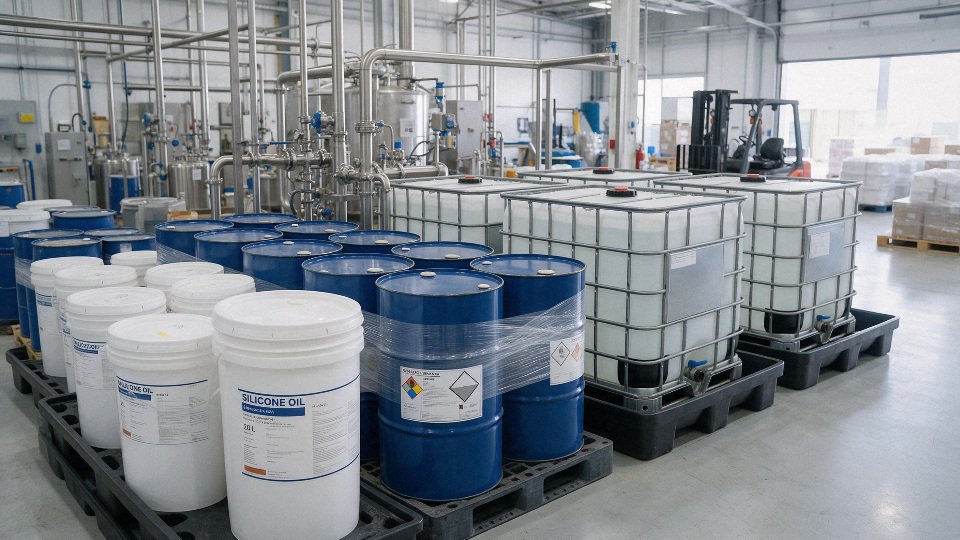
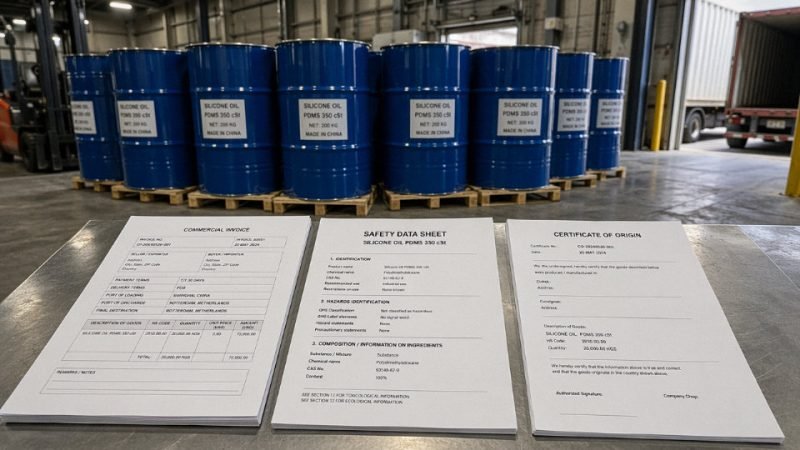
Missing a single certificate at the port of loading does not just delay the shipment — it stalls your customer’s production line, triggers demurrage charges that stack up fast, and occasionally forces a costly re-export or destruction of the consignment. Silicone oil, classified under HS 3910.00, touches more regulatory frameworks than most exporters expect: hazardous-materials rules, destination-country chemical registration schemes, trade-agreement duty conditions, and in some markets, end-use controls. Get the paperwork wrong on the first shipment and you are looking at 15–30 additional business days to remedy it, assuming the errors are even catchable before the goods are already sitting in a foreign bonded warehouse.
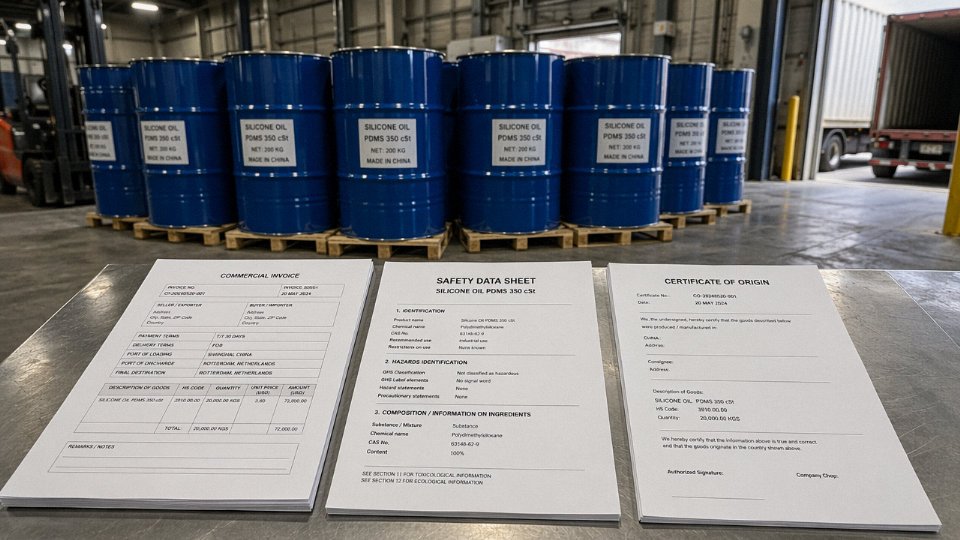
Exporting silicone oil (PDMS, HS 3910.00) requires a coordinated document package that typically includes a commercial invoice, packing list, certificate of analysis, Safety Data Sheet aligned to the destination country’s format, a certificate of origin for duty purposes, and — depending on the market — REACH pre-registration or full dossier for EU volumes above one tonne per year, an MSDS acknowledgment from the consignee, and any applicable end-use or hazardous-goods declarations. Preparing these in parallel, not sequentially, is what keeps first-time export lead times under 30 business days.
What makes this genuinely tricky is that the document set is not static — it shifts with destination, annual volume, customer type, and sometimes the specific grade of silicone oil you are shipping. A 100 cSt transformer-grade fluid going to a European distributor carries a completely different compliance burden than the same drum going to a contract manufacturer in Southeast Asia. The sections below break it down by document category, flag the decisions that cost exporters money when they guess wrong, and give you enough detail to brief a freight forwarder or compliance consultant without starting from zero.
Classifying Your Silicone Oil Correctly: HS Codes, CAS Numbers, and Grade Declarations
Get the classification wrong and everything downstream unravels — the SDS format, the tariff rate, the licensing requirements, even which port authority has jurisdiction. Classification is not paperwork formality. It is the load-bearing wall of your entire export package.
Primary HS Code and Where It Breaks Down
Standard polydimethylsiloxane (PDMS) in its neat, unblended form falls under HS 3910.00 — polysiloxanes in primary forms. Export duty rates against this code range from 0% to roughly 6.5% depending on destination and whether a bilateral or regional trade agreement applies. The EU, for instance, applies a different rate than, say, Vietnam or Brazil, and those rates shift again if your product ships under a preferential origin certificate.
The classification gets messier the moment you add anything to the base fluid. A silicone oil blended with a phosphate-ester or a synthetic hydrocarbon to produce a compressor lubricant blend can migrate to Chapter 34 (lubricating preparations), which carries different tariff treatment and, in some countries, additional import licensing requirements. A silicone-based release agent formulated with surfactants and a carrier solvent may land in Chapter 38 (miscellaneous chemical products). Customs officers in destination countries make these calls independently, and they do not always agree with the exporter’s classification. Inconsistent declarations between the export entry and the import entry are a reliable way to generate a customs hold, a penalty assessment, or both.
Matching CAS Numbers Precisely
Three CAS numbers come up constantly in silicone oil shipments, and they are not interchangeable on documentation:
- 63148-62-9 — PDMS, general polymer mixture, the most common declaration for standard industrial-grade [silicone oils](https://siliconchemicals.com/silicone-oil/) across the viscosity spectrum
- 9016-00-6 — specifically associated with lower-viscosity, well-defined PDMS grades; some importers and regulatory databases treat this separately from 63148-62-9
- 107-51-7 — octamethyltrisiloxane (MDM), a discrete small molecule, not a polymer mixture; this appears in very low-viscosity specialty fluids and in cosmetic ingredient declarations
Listing the wrong CAS on your SDS, commercial invoice, or REACH notification is not a minor clerical error. Several EU border inspections have been triggered precisely because the CAS on the shipping document did not match the CAS in the pre-registered substance database. If your product contains more than one silicone species — which blended grades often do — list all relevant CAS numbers. Do not pick one and hope the others go unnoticed.
CAS 63148-62-9 and 9016-00-6 refer to chemically identical substances and can be used interchangeably on export documentsFalse
While both describe PDMS, they represent different substance identifications used in different regulatory contexts. Substituting one for the other can cause mismatches against pre-registration records in REACH databases and trigger compliance flags at EU import.
Viscosity Grade Declarations and Their Knock-On Effects
Viscosity, expressed in centistokes (cSt), is not just a product spec — it has direct regulatory consequences. Many destination country importers require explicit viscosity declaration on the commercial invoice and packing list, and this is not arbitrary. Under IATA Dangerous Goods Regulations (IATA DGR), whether a silicone oil qualifies as non-hazardous for air freight depends partly on viscosity and flash point together. High-viscosity grades (typically above 20–50 cSt, depending on flash point) generally clear the non-hazardous threshold more cleanly than very low-viscosity fractions, which can behave more like volatile solvents in a cargo fire scenario. Get this wrong on an air shipment and you are looking at a rejected booking, cargo pulled from the aircraft, and a forwarder relationship under strain.
Food-Contact and Medical Grade: Declare It Explicitly
Food-contact silicone oils (commonly produced to USP, FDA 21 CFR, or EU 10/2011 standards) and medical-grade fluids require explicit grade statements on both the commercial invoice and the packing list. This is not optional language. An FDA-regulated importer in the US receiving a shipment where the invoice simply reads “silicone oil, 350 cSt” without a grade declaration will often trigger enhanced examination — and if the shipment is destined for a food processing or pharmaceutical application, the importer’s own compliance team may refuse acceptance pending clarification.
In practice, the declaration should read something like: “Silicone oil, PDMS, 350 cSt, food-contact grade, compliant with FDA 21 CFR 178.3570” — not just the chemical description.
Binding Tariff Rulings: Lock In Before You Ship
Before your first shipment to a new destination market, apply for a binding tariff ruling (BTR) from your country’s customs authority. This is a formal written decision that locks your HS classification in place. It takes time — usually several weeks, occasionally longer for novel formulations — but it protects you from retroactive duty assessments if a customs officer at the destination port disagrees with your classification later. Some exporters skip this step to save time on the first shipment and spend the next six months fighting a reclassification dispute. The lead time cost of getting a BTR is real; the cost of not having one when a dispute arises is typically much higher.
| Product Form | Likely HS Chapter | Key Risk if Misclassified |
|---|---|---|
| Neat PDMS fluid, unblended | 3910.00 | Baseline; minimal reclassification risk |
| Silicone-hydrocarbon lubricant blend | 34 | Higher tariff, possible import license trigger |
| Silicone release agent with surfactants | 38 | Different duty rate, licensing in some markets |
| Cosmetic-grade silicone fluid (MDM, cyclics) | 33 | Cosmetics-specific import controls apply |
Core Export Documents Every Silicone Oil Shipment Must Carry
Get any one of these wrong and you’re looking at a customs hold, a returned shipment, or — worst case — a rejected import that the buyer charges back to you. The document set below applies regardless of destination. Country-specific overlays (REACH, TSCA, pesticide-adjacent uses) come on top of this baseline.
Commercial Invoice
This is the document customs officers read first, and it needs to be specific enough that no officer has to guess what’s in the drum. State the full IUPAC or common chemical name (polydimethylsiloxane, not “silicone fluid”), the CAS number (most grades fall under 63148-62-9 or the relevant oligomer CAS), the HS code (3910.00 for PDMS-based fluids), the viscosity grade in cSt, and net and gross weights per unit and per shipment total. Incoterms clause and country of origin are not optional extras — they’re what customs uses to calculate applicable duty rates, which can swing from 0% under a preferential agreement all the way to 6.5% at MFN rates depending on where the shipment lands.
Vague descriptions like “silicone product” or “chemical oil” get flagged almost every time. In practice, even “silicone oil” without viscosity and CAS gets queried at major ports. It takes about ten minutes to fill in the extra fields; a customs query takes days.
Packing List
The packing list has to reconcile exactly — drum count, net fill weight per drum, tare weight, total gross weight, lot or batch numbers if applicable — with both the invoice and the physical markings on each drum or IBC. Discrepancies between declared net weight and actual tare weight are one of the most common triggers for holds, especially at ports running X-ray or random weigh-checks. If you’re shipping 200 kg net in a drum with a 25 kg tare and you’ve declared 225 kg net, expect problems.
Bill of Lading or Airway Bill
The carrier issues this, but you influence what goes on it. Low-viscosity silicone oils (below roughly 10 cSt) may carry a UN number under dangerous goods regulations depending on flash point; higher-viscosity grades are generally not restricted. Either way, get the carrier to note the classification explicitly. For non-hazardous grades, explicitly request a “not restricted as per IMDG/IATA” notation — some carriers omit this by default, and its absence can trigger a DG documentation request at the receiving port.
Certificate of Origin
Nearly every importing country needs this for tariff preference claims. For China-origin silicone oil shipping into ASEAN markets, Form E under the ACFTA agreement is the relevant instrument and needs to be certified by the local Chamber of Commerce before the shipment leaves — you can’t backdate it. Form E can meaningfully reduce import duty in receiving ASEAN countries, so skipping it because it’s inconvenient is leaving money on the table, usually the buyer’s money, which means it becomes your commercial problem.
Form E under ACFTA must be certified by the exporting country's Chamber of Commerce prior to shipment departure and cannot be issued retrospectively for preferential tariff claims.True
ACFTA rules of origin protocols require pre-shipment or at-shipment certification; retrospective CoO issuance is not recognized for preferential duty treatment under this agreement.
Safety Data Sheet
The SDS must follow the 16-section GHS format. It must be in the official language of the destination country — an English-only SDS will not satisfy French, German, Japanese, or Chinese customs requirements. Most regulatory agencies also apply an informal freshness rule: SDSs older than three years get scrutinized or rejected outright. If your formulation or classification hasn’t changed, a dated review with a new revision date from your EHS team is usually sufficient, but check destination-country requirements individually.
Certificate of Analysis
Buyers in the EU, US, and Japan routinely insist on a CoA from a third-party accredited laboratory rather than an in-house document. What goes on it depends on the grade and application, but at minimum expect: kinematic viscosity (cSt at 25°C), refractive index, flash point, specific gravity, and purity. Specialty grades — cosmetic-grade PDMS, food-contact grades compliant with FDA 21 CFR 178.3570, medical-grade material — need additional parameters and often lot-specific testing. Budget lead time accordingly; a third-party lab turnaround is typically 5–10 business days and should be running in parallel with other document preparation, not after.
Preparing all six of these documents in parallel, rather than sequentially, is what gets a first-time shipment out in 15–30 business days rather than 45. Sequential document preparation is the single most common scheduling mistake on a debut export.
Destination-Specific Chemical Registration and Notification Requirements
Getting classification right is only the beginning. The harder work is making sure your silicone oil can actually clear customs at the other end — and that usually means your buyer, or their regulatory agent, has completed country-specific registrations before the vessel departs. Miss this step and you’re looking at port holds, demurrage, or in the worst case, goods being returned or destroyed at the importer’s cost.

European Union — REACH and the Cyclic Siloxane Problem
PDMS itself falls under HS 3910.00 and has existing REACH registrations held by major producers, but the real complication is impurity content. D4 (octamethylcyclotetrasiloxane) is classified as a Substance of Very High Concern under REACH, and if your product contains D4 at or above 0.1% w/w, that concentration must be declared on the Safety Data Sheet and communicated down the supply chain under Article 33 obligations. D5 and D6 face their own use restrictions in wash-off cosmetic applications, which matters if your customer is in personal care.
The EU importer must hold a valid REACH registration for PDMS in the appropriate tonnage band, or have appointed an Only Representative before the goods arrive. If you’re a non-EU manufacturer selling directly, an OR arrangement is the standard route — the OR registers in their own name and holds the dossier. Full registration costs run roughly USD 50,000–250,000 depending on tonnage band and how much existing data can be leveraged; a first-time registrant at the 100–1,000 tonne/year band should budget toward the upper end of that range. Confirm the OR is appointed and active before you book the shipment. I’ve seen deals where the OR paperwork was still “in progress” when the container arrived in Rotterdam — that’s an expensive lesson.
D4 (octamethylcyclotetrasiloxane) is classified as a Substance of Very High Concern (SVHC) under REACHTrue
D4 was added to the REACH SVHC candidate list by ECHA due to its PBT (persistent, bioaccumulative, and toxic) properties, and concentration declarations above 0.1% w/w are legally required in articles and mixtures supplied within the EU.
United States — TSCA Inventory Status Is Not Automatic
Most commercial silicone oil grades are listed on the TSCA Chemical Substance Inventory, which means they’re exempt from pre-manufacture notification. The catch is “most.” Specialty-functionalized grades — amino-modified, epoxy-modified, phenyl-modified PDMS variants — may not be on the active inventory. Your first step before any US shipment of a non-standard grade is a CAS-number-level inventory search through EPA’s Chemical Data Reporting system. If the substance isn’t listed as active, your US importer faces a PMN filing, which adds months to the timeline. TSCA Section 13 export notification is a separate obligation that applies if the substance is regulated under Sections 5, 6, or 7 — less common for standard PDMS, but worth verifying with your compliance counsel if you’re exporting anything unusual.
China — IECSC Listing Verification Before Order Confirmation
China’s MEE Order No. 12 on new chemical substance notification catches exporters off guard more often than any other regime, in my experience. If your specific grade or formulation isn’t listed on the IECSC (Inventory of Existing Chemical Substances in China), your Chinese importer needs to complete a new substance notification before customs clearance. Standard linear PDMS is generally listed, but blended or functional grades may not be. Verify the IECSC status at the time of order confirmation, not after production. New substance notifications under Order No. 12 take several months at minimum and require toxicological data your customer may not have.
South Korea — K-REACH Letter of Access
Korean importers bringing in more than 1 tonne per year of a given substance are required to register it under K-REACH. In practice, most Korean importers will ask you — the foreign manufacturer — for a Letter of Access to an existing registration dossier, rather than generating their own data. If you supply to multiple Korean customers, coordinate LoA arrangements carefully; the terms and confidentiality protections vary between dossier holders.
Japan — Layered Inventory Rules
PDMS is generally covered under Japan’s Chemical Substances Control Law (CSCL) existing chemical inventory, so new substance notification is typically not required for standard grades. But the documentation requirement is real: you must supply a chemical composition declaration confirming the substance identity and any relevant impurities. Food-contact grades face an additional layer — compliance with Japan’s Food Sanitation Act specifications is mandatory, and your SDS and product spec sheet need to reference that compliance explicitly if the product is sold for food-processing applications.
Southeast Asia — Fast-Moving Regimes, Patchy Enforcement
Vietnam, Indonesia, and Thailand are worth treating seriously even though enforcement is less consistent than in the EU or Korea.
Vietnam’s Circular 32/2017 requires a hazardous chemical declaration for substances meeting hazard classification thresholds. Indonesia’s Government Regulation 74/2001 places certain B3 (bahan berbahaya dan beracun — hazardous and toxic material) classifications on viscosity grades above specific concentration thresholds; your Indonesian importer will need a B3 import permit if the product falls within scope. Thailand’s Hazardous Substance Act categorizes chemicals into four types, and industrial-grade silicone oils typically require Type 3 registration with the relevant controlling authority.
These regimes are still maturing. What was acceptable documentation two years ago may not satisfy current requirements — build in a check with your local freight forwarder or a regional regulatory consultant on every new lane you open. Typical documentary lead time for a first-time shipment across all these compliance steps runs 15–30 business days when certificate preparation, SDS localization, and compliance filings are genuinely run in parallel. Serial processing easily doubles that.
Dangerous Goods Classification, GHS Labeling, and Transport Compliance Documents
The classification question trips up a surprising number of experienced chemical exporters, usually because they assume silicone oil is inherently benign and skip the formal determination step. That assumption is mostly correct for standard PDMS grades — but “mostly” is not a defensible position when a carrier’s dangerous goods inspector is standing at your loading dock.
When PDMS Is Not a Dangerous Good — and Why You Still Need Paperwork
Most commercial PDMS fluids, particularly the 50 cSt and higher viscosity grades that dominate industrial and personal-care markets, carry flash points well above 93°C (200°F). Under GHS, the IMDG Code, and IATA DGR, that puts them outside Class 3 Flammable Liquid classification. So far, so good.
The problem is that “not regulated as dangerous goods” is not self-evident to a freight forwarder, a port authority, or a customs officer looking at a drum labeled “silicone fluid.” You are legally required to document the non-hazardous determination in writing. This typically takes the form of a Shipper’s Declaration for Non-Dangerous Goods or a Hazmat Certification of Non-Regulation — the exact title varies by carrier and routing, but the content is the same: the chemical identity, flash point data (referenced to a specific test method, usually ASTM D93 or D92), and a declarant signature from someone with authority at your facility. Some carriers, particularly air freight handlers, have their own proprietary forms. Check before you tender the booking.
Low-Viscosity Fluids: Where It Gets Real
Below roughly 5 cSt — typically trimethylsiloxy-terminated fluids used in release coatings, hydraulic damping fluids, and some specialty lubricants — flash points can drop below 60°C, sometimes significantly below. At that point you’re looking at a Class 3 Flammable Liquid, UN 1993 (Flammable Liquid, N.O.S.), Packing Group III.
This classification change cascades through your entire document set. You now need a properly completed IMDG or IATA Dangerous Goods Declaration, signed by a certified DG shipper. Your packaging must be UN-certified — drums stamped with the relevant UN performance code (e.g., 1A1 or 1A2 for steel drums), and you need documentation that those specific drums passed drop, stack, and leakage testing for the product density and fill volume you’re actually using. Don’t assume the drum supplier’s generic test certificate covers your fill; check the specific gravity range on the cert. Emergency Response Guide documentation — ERG page or the relevant EMS schedule under IMDG — travels with the shipment.
In practice, a shipper who switches from a 100 cSt product to a 2 cSt fluid and doesn’t update their DG classification process will generate a non-compliance finding sooner or later. Carriers can refuse the load, or worse, accept it and then raise a discrepancy claim when the paperwork is audited mid-voyage.
Standard PDMS silicone oils with flash points above 93°C require no dangerous goods declaration for transport.False
Even non-regulated materials require a written Shipper's Declaration of Non-Dangerous Goods. Failing to provide this documentation can result in carrier refusal or customs holds, regardless of the product's actual hazard profile.
GHS Labeling on Drums and IBCs
GHS label compliance is where I’ve seen the most real-money mistakes. The physical label on every drum or IBC must carry all six core elements: pictogram(s) — or the appropriate “no pictogram” layout for non-hazardous goods — signal word, hazard statements, precautionary statements, supplier identification with a reachable contact, and a product identifier that matches the SDS. That part most exporters get right.
What they miss is language. A container of 200 L drums heading to France needs French-language labels. Turkey requires Turkish. South Korea mandates Korean under its K-REACH and chemical labeling regulations. Shipping English-only labels to these markets isn’t a technicality — it can result in detention, relabeling costs at destination (typically USD 8–25 per drum, depending on the port agent), or outright rejection.
Operationally, the cleanest approach for exporters serving multiple markets is to pre-print destination-specific label sets and use a documented label control procedure. It adds maybe half a day of admin per order, but it avoids a scenario where your consignee is standing at a bonded warehouse paying demurrage while a translator re-labels 800 drums.
Bulk Tanker Shipments: The Extra Layer
Bulk silicone oil by ISO tanker or dedicated chemical tanker adds a distinct document layer that drum shippers never encounter. You’ll need a Tank Certificate confirming the vessel’s tank is approved for the product, a P&I Club letter covering the cargo, and a MARPOL Annex II Pollution Category Declaration. Silicone oils generally fall under Category Y — harmful to the marine environment but not Category X. Confirm the specific classification for your product with your SDS author before the vessel is nominated; the P&I Club will ask.
SDS Transmission: Physical and Electronic
The SDS must travel physically inside the container — one copy per consignment minimum, accessible without unloading the cargo if possible. But carriers, particularly container lines, increasingly require electronic pre-arrival SDS submission through platforms like CargoSphere or IICL’s cargo data systems. Some lines have their own portals. Failure to submit electronically doesn’t necessarily stop the vessel, but it can delay release at destination and generates internal compliance flags that tend to make your subsequent bookings with that carrier slower to process.
The SDS itself needs to match the product — not a generic “silicone oil” sheet, but a document specific to the viscosity grade, CAS number, and additive package you’re actually shipping. An SDS for 350 cSt PDMS does not adequately describe a 2 cSt trimethylsilyl-terminated fluid. Auditors and regulatory officers know what to look for.
Grade-Specific Regulatory Certificates: Food, Medical, Cosmetic, and Electrical Applications
Standard export paperwork gets you to the port. Getting the product through customs and accepted by the end buyer is a different problem entirely — and for specialty silicone oil grades, the gap between those two outcomes is filled with application-specific certificates that most freight forwarders won’t think to ask about.
Food-Contact Grade
For US market entry, the key document is either an FDA Food Contact Notification (FCN) acknowledgment letter or a written compliance statement referencing 21 CFR 172.210 (direct food additive, anti-foaming use) or 21 CFR 178.3570 (release agents and lubricants with incidental food contact). The compliance statement must cite the specific PDMS viscosity grade and the intended food-contact application — a generic “FDA compliant” letter gets rejected by serious food-industry buyers almost immediately. If the oil is formulated (blended with anything), all components need to be separately justified under the CFR citations.
EU food-contact compliance follows a different logic. You need a Declaration of Compliance (DoC) prepared in accordance with Regulation (EU) No 10/2011 on plastic materials in food contact, which must reference supporting migration test data — typically overall migration (OM) and specific migration (SM) results from an accredited laboratory. Migration tests run roughly 2–6 weeks depending on the test conditions (food simulant selection depends on the intended food type). Get this started early; it’s the most common bottleneck I’ve seen on food-grade shipments into Germany and the Netherlands.
Medical and Pharmaceutical Grade
This is where documentation requirements become genuinely demanding. USP, EP, or JP pharmacopoeia conformance certificates must come from a GMP-certified manufacturing site — not from a trader, not from a re-packager. The certificate of analysis alone isn’t sufficient. Pharma buyers and hospital-supply procurement managers will require a Certificate of GMP Compliance issued by the relevant national drug authority (NMPA for Chinese manufacturers, EMA-recognized authorities for EU sites) or a full third-party GMP audit report dated within the last 12–24 months.

Some buyers in Japan and South Korea also want a Drug Master File (DMF) reference number on file with their local authority before they’ll accept the shipment. Sorting that out after a purchase order has been placed is a painful experience. Get the DMF reference confirmed during qualification, not during order execution.
A GMP certificate from the manufacturer's national drug authority is sufficient proof of pharmaceutical-grade compliance for most regulated markets.False
While a national GMP certificate is necessary, most regulated buyers — particularly in the EU, Japan, and the US — also require a current audit report or site master file, and in some cases a locally filed DMF reference. The national certificate alone rarely satisfies full buyer qualification requirements.
Cosmetic Grade
EU and US cosmetics importers increasingly require an INCI conformance letter confirming that the silicone oil ingredient name (e.g., Dimethicone, Cyclopentasiloxane) matches the INCI dictionary designation, along with a Certificate of Conformity to ISO 22716, which covers Good Manufacturing Practice for cosmetics. The ISO 22716 certificate should cover the manufacturing and filling site, not just a corporate entity. A subtler requirement that’s caught several exporters off-guard: some larger cosmetics brands now ask for a Nagoya Protocol compliance declaration if any naturally derived processing aids were used during synthesis, even if the final product is fully synthetic. It’s worth checking with your legal team whether your process triggers that obligation.
Electrical Insulating Grade
Transformer and switchgear manufacturers typically require proof of conformance to IEC 60296 (mineral and synthetic insulating oils) or IEC 60836 (silicone insulating liquids specifically). These must be supported by a dielectric strength test report and, increasingly, a dissolved gas analysis (DGA) baseline certificate issued by an accredited electrical testing laboratory. The DGA baseline matters because transformer maintenance teams use it as the reference state for future in-service monitoring. Shipping without it creates a warranty argument waiting to happen.
Lubrication and Industrial Process Grade
If the oil will contact food-processing machinery — even incidentally — NSF H1 certification is the non-negotiable entry requirement for most food and beverage plant procurement teams. Beyond that, ISO 6743-4 grade classification documentation (which defines the lubricant type and viscosity grade within a standardized framework) significantly smooths technical acceptance by European industrial buyers, particularly in Germany and Scandinavia, where maintenance engineers want to see that classification before approving a new lubricant into their SAP system.
Export Licensing, Dual-Use Screening, and Sanctions Compliance Documentation
Most silicone oil exporters spend their energy on SDS preparation and HS code classification, then get blindsided by export control and sanctions screening requirements they didn’t know applied to them. This is the area where penalties aren’t measured in delayed shipments — they’re measured in fines, license revocations, and in serious cases, criminal liability for the responsible individual.
Dual-Use Classification and ECCN Review
Standard polydimethylsiloxane (PDMS) in general industrial grades does not appear on the Wassenaar Arrangement Dual-Use List, and for most bulk shipments — transformer oils, release agents, cosmetic intermediates — an ECCN review will confirm classification as EAR99, meaning no specific US export license is required for most destinations. Don’t skip the review on that assumption, though. Cyclic siloxanes, highly purified grades used in semiconductor CMP processes, or any silicone fluid supplied with documentation suggesting defense, aerospace, or optics end-use may require closer scrutiny under US Export Administration Regulations (EAR). If your product is being sold to a buyer who packages or processes it for those sectors, the burden of that review sits with you as the exporter, not just the buyer.
For China-origin exports, the situation has tightened considerably since the Export Control Law took effect in late 2020. MOFCOM administers the dual-use licensing regime, and while most commodity-grade silicone oils clear without a specific license, specialty functional fluids — particularly high-purity grades with declared applications in electronics or energy — can fall into categories requiring pre-shipment license application. Lead time for those approvals runs roughly 20–45 business days in practice, sometimes longer if the destination is flagged for enhanced review. Build that into your production planning, not your shipping schedule.
Sanctions Screening: Who You’re Actually Screening
Screening the buyer’s company name once against a single list is not compliance. It’s a checkbox that won’t hold up in a regulatory audit. Every shipment requires screening of the buyer, the declared end-user (who may be different), the ship-to party, the freight forwarder, the nominated bank or financial intermediary, and any intermediate trading entity in the chain. Lists to run: OFAC SDN and Consolidated Sanctions List, the EU Consolidated Financial Sanctions List, UN Security Council consolidated lists, and any country-specific lists relevant to your jurisdiction — the UK OFSI list if you’re routing through British entities, for instance.
The documentation requirement here is specific: you need a timestamped screening record that logs the database version used, the date of the search, the name variants searched, and a clear pass/negative finding. That record gets filed with the shipment package and retained for a minimum of five years. In practice, most compliance teams use a screening platform (several integrate directly with ERP systems) rather than manual portal searches, but even automated tools require a human review step when a potential match is flagged — a “false positive” finding still needs to be documented and resolved before the shipment moves.
Sanctions screening must cover the end-user and financial intermediaries, not just the named buyer on the commercial invoice.True
OFAC guidance and EU sanctions regulations explicitly extend liability to transactions where a prohibited party is involved anywhere in the chain, including as a beneficial owner or payment intermediary, even if the direct counterparty appears clean.
License Numbers, EEI Filings, and End-Use Certificates
If your ECCN review results in a required export license, the license number is not optional boilerplate — it must appear on the commercial invoice and on the Electronic Export Information (EEI) filing submitted through the Automated Export System (AES) for US-origin shipments. An EEI without the correct license citation is grounds for Customs and Border Protection to hold or seize the shipment at the port of export. Germany, Japan, and increasingly the US are also requesting End-Use Certificates (EUCs) or End-User Statements (EUS) for bulk chemical exports where diversion risk is plausible. These are signed declarations from the ultimate buyer specifying the intended application and confirming the product will not be re-exported or redirected to prohibited uses or territories.
Getting a signed EUC back from an overseas buyer can take a week or two if they’re unfamiliar with the format, so request it early — ideally before order confirmation, not after production is complete.
Quality, Environmental, and Sustainability Certificates That Buyers Now Demand
The regulatory documents get you through customs. These certificates get you onto the approved vendor list — and increasingly, the absence of even one of them kills a bid before price is ever discussed.
ISO 9001: The Baseline That Is No Longer Optional
A current ISO 9001 certificate covering the silicone oil manufacturing or blending scope is now table-stakes for Tier-1 chemical distributors and OEM buyers across Europe, North America, and Japan. “Current” matters here — the certificate must be within its three-year certification cycle and, critically, the listed scope must explicitly reference the relevant production activity. A certificate scoped to “general chemical manufacturing” when the buyer is procuring transformer-grade PDMS will raise questions from a diligent procurement manager and may require supplementary documentation.
In practice, buyers will check the issuing certification body against accreditation databases like IAF MLA signatories. A certificate from an unaccredited body — something that does happen with smaller suppliers in certain regions — gets flagged immediately.
ISO 14001 and Supplier Sustainability Programs
European automotive, electronics, and personal care companies have systematically embedded ISO 14001 into their supplier qualification criteria, and the trend is accelerating. A mid-size cosmetics group running a supplier audit program will typically score environmental management systems as a pass/fail gate, not a weighted criterion. No certificate, no further evaluation — regardless of price.
The certificate should again list a scope that matches what you’re actually supplying. Renewal is every three years, with surveillance audits annually. If your facility is mid-cycle and the certificate is approaching its expiry or a surveillance audit is overdue, flag it proactively. Buyers who discover a lapsed surveillance audit during due diligence will interpret the gap as a quality signal, not an administrative oversight.
SVHC Declaration for D4, D5, and D6
This one has real legal teeth. Under REACH Article 33, if your silicone oil contains D4 (octamethylcyclotetrasiloxane), D5 (decamethylcyclopentasiloxane), or D6 (dodecamethylcyclohexasiloxane) above 0.1% w/w, you are legally obligated to declare this to the recipient in writing. Both parties must retain the declaration. Standard PDMS fluids are generally low in cyclics, but process-dependent residuals do vary between manufacturers and viscosity grades — particularly at lower viscosities like 5 or 10 cSt where lighter fractions are less thoroughly stripped.
Failure to provide an SVHC declaration when D4, D5, or D6 exceeds 0.1% w/w in a product supplied to the EU constitutes a breach of REACH Article 33, regardless of whether the buyer requests it.True
REACH Article 33 places an active legal obligation on suppliers to proactively communicate SVHC presence above 0.1% w/w; the obligation is not conditional on a buyer request.
Get the declaration in writing, dated, and linked to the specific batch or product grade. A generic letter covering “all silicone oil products” is not adequate and will not satisfy a rigorous REACH audit.
Product Carbon Footprint Documentation
The EU Corporate Sustainability Reporting Directive (CSRD), Germany’s Lieferkettensorgfaltspflichtengesetz (LkSG), and France’s Devoir de Vigilance are pushing carbon footprint disclosure down into chemical supply chains faster than most mid-size silicone producers anticipated. Buyers subject to these frameworks are now requesting Product Carbon Footprint (PCF) figures calculated per ISO 14067 or the GHG Protocol Product Standard, covering at minimum cradle-to-gate boundaries.
A PCF calculation for a silicone oil product typically requires energy consumption data at the production facility, upstream emissions factors for chlorosilane or siloxane feedstocks, and transport assumptions to the point of delivery. Expect the calculation effort to run several weeks if done properly — and expect buyers to ask whether the figure has been third-party verified. Unverified self-declarations are increasingly viewed skeptically by European procurement teams.
Conflict Minerals and Supply Chain Transparency
Silicone oil raw materials trace back to quartz-derived silicon, which is not listed under Dodd-Frank Section 1502 or EU Regulation 2017/821 as a conflict mineral. So technically, no conflict minerals declaration is required. That said, electronics sector buyers operating comprehensive responsible sourcing programs sometimes request a supply-chain transparency statement as part of a broader minerals policy that goes beyond the statutory list. A short, factual letter confirming the silicon feedstock origin and supply chain structure usually satisfies this — it does not require a full CMRT submission, but having the raw material traceability data ready saves back-and-forth.
Halal and Kosher Certification
For food-grade and pharmaceutical-grade silicone oil moving into Middle Eastern markets, Southeast Asia, or certain North American distributors serving those communities, Halal and Kosher certification is a commercial prerequisite, not a nice-to-have. These certificates are issued by accredited religious authorities — JAKIM in Malaysia, MUI in Indonesia, various bodies in the Gulf, and OU or Star-K for Kosher — and must be renewed annually. The certification audit typically requires access to ingredient sourcing records, cleaning and segregation procedures for shared production lines, and evidence that no haram substances contact the product or process equipment.
The renewal cycle catches people out. A certificate that lapses between order placement and shipment can hold up an entire consignment at destination — I’ve seen this cause a two-week delay on a food-additive silicone shipment where the buyer’s incoming QC simply would not accept the goods without a valid certificate in hand.
Step-by-Step Documentary Workflow: From Purchase Order to Port Clearance
Getting the documents right is less about bureaucratic box-ticking and more about sequencing — doing things in the wrong order, or in series when they should run in parallel, is how a 20-day clearance turns into a 45-day detention and a furious buyer. The workflow below reflects what actually works on a first-time or infrequent silicone oil export, not the theoretical ideal.

Step 1 — Pre-Shipment Classification Review (Days 1–3)
Before anything else moves, pull the purchase order and confirm the HS code (almost always 3910.00 for PDMS-based silicone oils, though blended or functional-grade products can migrate to other headings), the correct CAS number, the flash point from your internal TDS, and the declared grade. Cross-check all four against each other — a mismatch between what the CoA says and what the invoice declares is a red flag that customs inspectors are specifically trained to catch. If the PO specifies food-contact or medical grade, flag it now, because the downstream certificate requirements are substantially heavier. This is also the moment to run a quick SVHC screen and verify no controlled-substance trigger applies in the destination country. Catching a registration gap on Day 2 is painful. Catching it on Day 19 at the port is catastrophic.
Step 2 — Registration and Licensing Check (Days 1–7, Running in Parallel)
This step runs concurrently with Step 1, not after it. Verify that your current registration covers the specific grade and the annual volume you’re shipping to that market. For EU destinations, confirm your REACH status covers the tonnage band — the gap between the 1 tonne/year threshold and the next band can mean the difference between a notification and a full dossier costing USD 50,000–250,000 depending on tonnage. For South Korea (K-REACH) or China (MEE/IECSC), the inquiry alone can take two to three weeks just to confirm standing. If a new filing is genuinely required, initiate it the same day — registration lead times of 60–180 days are normal, and no amount of freight forwarder pressure will compress a regulator’s review clock.
Step 3 — Lab Testing and CoA Generation (Days 5–12)
Submit production batch samples to an accredited lab as soon as the batch is confirmed, not after packing. Request a CoA that covers every parameter the buyer specified — viscosity at multiple temperatures, refractive index, volatile content, metal impurities if relevant — not just your standard internal release spec. For food or medical grades, include the applicable pharmacopoeia tests (USP, EP, or JP depending on destination) or food-law compliance data explicitly. Turnaround at a reputable external lab is typically 5–8 business days for standard parameters; specialty tests can add 3–5 days. Build that into your timeline now, not when the freight booking is already confirmed.
Step 4 — SDS Preparation and Language Localization (Days 3–10)
GHS-compliant SDS authoring is not a cut-and-paste job, even for a relatively benign material like silicone oil. Different revision levels of GHS are enforced in different markets — Japan uses GHS Rev 7, the EU uses CLP (which diverges from GHS in meaningful ways), and several Southeast Asian markets are still transitioning. If your destination requires a local-language SDS, engage a specialist authoring service with verified in-country regulatory knowledge; a generic translation service that doesn’t understand hazard classification will produce a document that fails inspection. Allow 5–7 business days for localization and review.
Step 5 — Commercial Documents Preparation (Days 10–15)
Draft the commercial invoice, packing list, and certificate of origin in parallel with the SDS work. For preferential tariff treatment — which matters given export duty rates that can range from 0% to roughly 6.5% depending on trade agreements in force — submit the CoO application to your Chamber of Commerce or designated issuing authority early. Issuance typically takes 3–5 business days, but some authorities are slower in peak periods. In practice, a lot of exporters leave this too late and end up paying MFN duty on a shipment that qualified for preferential treatment.
Step 6 — Dangerous Goods Assessment and Transport Documents (Days 12–16)
Complete a formal DG determination worksheet for every shipment, even repeat ones — viscosity grade or additive composition changes can occasionally shift classification. Standard PDMS silicone oils are generally non-regulated under IMDG and IATA, but cyclic siloxanes in some specialty grades complicate that. If the shipment is non-DG, prepare a signed Non-DG Declaration with enough technical detail to satisfy the carrier. If it is DG, prepare the Multimodal Dangerous Goods Form, confirm UN-certified packaging compliance, and arrange for an IMDG/IATA-compliant DG declaration from a certified person — not just whoever happens to be in the shipping office that day.
Standard PDMS silicone oils are generally not classified as dangerous goods under IMDG or IATA regulations.True
Pure polydimethylsiloxane (PDMS) has a high flash point (typically above 300°C for higher-viscosity grades) and low acute toxicity, placing it outside IMDG and IATA dangerous goods classifications under normal transport conditions. Specialty grades with reactive functional groups or low-boiling-point cyclic siloxane content may require individual assessment.
Step 7 — Final Document Review and Submission to Freight Forwarder (Days 15–20)
Run a cross-document consistency audit before anything goes to the freight forwarder. Invoice description, HS code, net weight, and gross weight must match exactly across the commercial invoice, packing list, bill of lading draft, CoA, and SDS. A one-kilogram discrepancy between the packing list and the BL has triggered holds at ports that took a week to resolve — and in some jurisdictions triggered a formal misdeclaration investigation. Use a signed pre-shipment checklist with your export compliance officer’s name on it. This is also your last practical opportunity to catch a missing document.
Step 8 — Customs Filing and Cargo Release (Days 18–30)
For US-origin shipments, monitor AES/EEI filing confirmation and watch the ITN number. For exports from other origins, confirm customs entry acceptance and track any queries. The 24-hour rule applies here: unresolved customs queries accumulate demurrage charges fast, especially at congested container ports where free-time allowances can be as short as three days. Designate someone — internally or through your freight forwarder — who has authority to respond to customs queries immediately, not by committee. Retain the full document package for a minimum of five years; most jurisdictions require this, and some (notably the EU and US) can request audit documentation well beyond the standard limitation period for certain regulatory filings.
The total elapsed time for a well-run first shipment typically falls in the 15–30 business day range when all parallel tracks are managed actively. Compress the parallel work, and you can hit the lower end. Let steps queue up sequentially, and the upper end — or beyond — becomes likely.
Frequently Asked Questions About Silicone Oil Export Documentation
Is silicone oil classified as a hazardous material for international shipping?
Most standard PDMS grades are not. Any silicone oil with a flash point above 93°C falls outside the Class 3 Flammable Liquid threshold under both IMDG and IATA DGR, and the vast majority of commercial viscosity grades — 100 cSt, 350 cSt, 1000 cSt and above — comfortably clear that threshold. That said, you still need a written non-hazardous determination in the shipment file. Carriers and freight forwarders will ask for it, and if a customs officer pulls the container, “we assumed it was fine” is not a defensible position.
The exception that catches people off guard is low-viscosity PDMS below roughly 5 cSt. Those grades can have flash points well below 60°C and will classify as a Class 3 Flammable Liquid, triggering full DG documentation — UN number, proper shipping name, packing group, DG declaration, and compliant packaging markings. If your product range includes both standard and low-viscosity grades on the same order, verify each grade individually. Do not apply one determination to the whole shipment.
What is the correct HS code for silicone oil exports?
The primary classification is 3910.00 — polysiloxanes in primary forms. For a straight PDMS shipment, that is usually straightforward. Where it gets complicated is formulated or blended products: a silicone release agent compounded with a carrier solvent may land in Chapter 38, and a silicone-based personal care fluid could fall under Chapter 34 depending on its composition and the importing country’s tariff schedule. Export duty rates under 3910.00 range from 0% to around 6.5% depending on the destination and any applicable trade agreements — the same product can carry meaningfully different landed costs depending on which FTA your buyer is operating under.
HS code 3910.00 applies to polysiloxanes in primary forms and is the standard classification for undiluted PDMS silicone oil exportsTrue
Confirmed by the WCO Harmonized System nomenclature and standard customs tariff schedules; formulated or blended products require individual classification review
Get a binding tariff ruling from your national customs authority before the first shipment. Not an informal opinion — a formal ruling. That ruling protects you on subsequent shipments and gives your buyer confidence.
Do I need a REACH registration to export silicone oil to the EU?
The registration obligation sits with the EU importer, not you. But that does not mean you can ignore REACH entirely. Your importer cannot register without your full technical support: substance identity, composition data, impurity profile, tonnage information, and SVHC screening results. If you cannot supply that, their dossier stalls — and so does the commercial relationship.
One practical option, especially for exporters shipping above the 1 tonne/year threshold and dealing with multiple EU buyers, is appointing an Only Representative. The OR assumes the importer’s regulatory obligations and holds the registration on your behalf. Full dossier costs for PDMS typically run USD 50,000–250,000 depending on tonnage band, and the preparation timeline can stretch 12–18 months for a new registration. Plan accordingly.
How long is a Certificate of Analysis valid for silicone oil?
There is no single regulatory answer. In practice, most industrial buyers accept a CoA issued within 12 months of shipment date. For pharmaceutical-grade material, the CoA must correspond to the exact production batch — not a reference lot, not a representative sample — and is tied directly to the shelf life declared in the product specification. Some buyers in sensitive applications will also request re-testing if the CoA is older than six months, particularly for high-purity electronic grades where trace metal content matters.
Can I use one SDS for all destination countries?
No. GHS has been adopted at different revision levels across markets: the EU currently applies GHS Rev. 7, while a number of importing countries still operate under Rev. 3 or Rev. 4. Classification criteria, label elements, and exposure limit formats differ between revisions in ways that can make a document technically non-compliant even if the hazard profile is identical. Beyond revision level, the SDS must be in the official language of the destination country. A single English-language document will not satisfy customs or downstream regulatory requirements in most non-English-speaking markets. Budget for localized SDS versions early — translation and regulatory review by a local specialist takes time, and you cannot substitute one for the other at the port gate.
What records do I need to keep after shipment?
Retain everything — commercial invoice, packing list, bill of lading, CoA, SDS, certificate of origin, customs filing confirmation, and any licenses or permits — for a minimum of five years. US EAR requires five years from the export date. EU customs law sets a three-year minimum, though five years is the safer standard if you are dealing with any dual-use screening. China’s Export Control Law requires five years. In practice, keep the full file together; do not split documents across systems in a way that makes reconstruction difficult during an audit.
Does silicone oil require an export license from China?
Standard commercial PDMS grades are not listed on China’s dual-use export control catalog and do not require a license. Every shipment still requires a standard customs declaration filed with accurate CAS number and HS code — that is baseline compliance, not optional. Where the question becomes less clear-cut is with high-purity electronic grades or specialty dielectric fluids. Those should be reviewed against the current MOFCOM dual-use catalog before each shipment cycle, because the catalog is updated and a grade that was unrestricted last year may not be this year. When in doubt, request a written classification opinion from a licensed customs broker before booking the cargo.
Building a Reusable Documentation System to Cut Lead Times on Repeat Orders
Getting the documents right on a first shipment is hard. Doing it again six weeks later shouldn’t be — but for most exporters it nearly is, because the files are scattered across email threads, shared drives with inconsistent naming, and someone’s desktop who’s since left the company. That’s the real cause of those 15–30 business day lead times. The regulatory complexity is genuine, but a lot of the delay is just disorganization.
Create a Document Master File for Every Grade–Market Combination
Build one controlled folder — call it a Document Master File, or DMF — for each silicone oil grade and each destination market you serve regularly. At minimum it should contain: the approved HS code ruling (keep the written ruling from customs if you have one, not just your internal classification), current registration certificates for that market (REACH, K-REACH, whatever applies), the SDS in every language required by that destination, your standard CoO template already formatted for any applicable preferential trade agreement, and at least one approved CoA format that the buyer’s QC team has already accepted.
That last point matters more than people expect. A CoA that’s technically complete but formatted differently from what the importer’s receiving team is used to will get questioned at their end, which bounces back to you as a delay. Boring, preventable, surprisingly common.
Review and update each DMF at least once a year — and immediately whenever a hazard reclassification, volume threshold, or regulatory amendment touches that product or market. Annual is the floor, not the standard.
Run a Document Expiry Calendar, Not a Memory System
Paper-based or spreadsheet-based expiry tracking breaks down fast once you’re managing more than two or three markets. Build a live calendar — even a well-structured shared spreadsheet beats nothing — that tracks ISO certificate surveillance audits (typically annual) and triennial recertifications, REACH and K-REACH periodic updates that get triggered when your export volumes cross tonnage thresholds, SDS revision cycles (every three years at minimum, or immediately on new hazard data), and preferential CoO eligibility windows under any active free trade agreements you’re using to reduce your buyer’s import duty.

Missing a K-REACH update because nobody flagged the volume trigger isn’t a paperwork inconvenience — it’s a shipment hold at Busan that costs you the customer relationship.
Automate Where You Actually Can
An Export Compliance Management System, or a properly configured GTS module in SAP or Oracle GTM, will handle HS code assignment from item master data, run automated sanctions screening against updated denied-party lists, and generate draft export documents directly from the sales order. The setup investment is real — configuration and testing for a mid-size chemical exporter typically runs several months and a non-trivial internal IT effort — but the per-shipment labor saving and error reduction justify it once you’re above roughly 40–60 export transactions a year, give or take depending on your product complexity.
SAP GTS and Oracle GTM can automate HS code assignment and sanctions screening for chemical exports when correctly configured with current trade content subscriptions.True
Both platforms support automated classification and restricted-party screening as documented features, though accuracy depends on the quality of item master data and subscription to current regulatory content libraries.
Brief Your Brokers — And Keep Briefing Them
Establish a pre-approved network of freight forwarders and customs brokers in your top destination markets. “Pre-approved” means you’ve verified their licenses, run a basic due diligence check, and signed a formal customs power of attorney before any shipment moves — not scrambled to find someone after a booking is placed.
Brief them annually. Not a forwarded email. An actual call or short meeting covering your product grades, the distinctions between food-grade, medical-grade, and industrial PDMS, any regulatory changes in the past year, and any new markets you’re entering. A broker who understands that your 350 cSt electrical-grade oil has a different documentation profile than your 1000 cSt industrial grade will resolve a customs query in two or three hours. One who doesn’t may hold your container for a week while they figure it out at your expense.
Audit Internally Before Someone Else Does
Run a semi-annual internal compliance audit against a standardized checklist — ideally one that mirrors the document requirements covered in this article and in your ECMS. Document what you find, even when the findings are unflattering, and document the corrective actions taken. Enterprise buyers conducting supplier audits will ask for this evidence. Regulators treat documented self-correction far more favorably than they treat gaps discovered from the outside.
Don’t Skip the Internal Training Problem
Sales representatives, logistics coordinators, and customer service staff all touch the export documentation chain, usually without fully understanding how their decisions affect it. A sales rep who quotes a food-grade silicone oil but enters the order as industrial grade because the price difference seems like a rounding error will generate a document mismatch — wrong CoA format, wrong SDS language tier, wrong regulatory certificate attached — that can unravel weeks of preparation when the container reaches the port. Short, grade-specific training sessions for customer-facing and logistics staff, run annually and whenever a new grade or market launches, are cheap compared to what a single mis-documented shipment costs in demurrage, rework, and customer credibility.