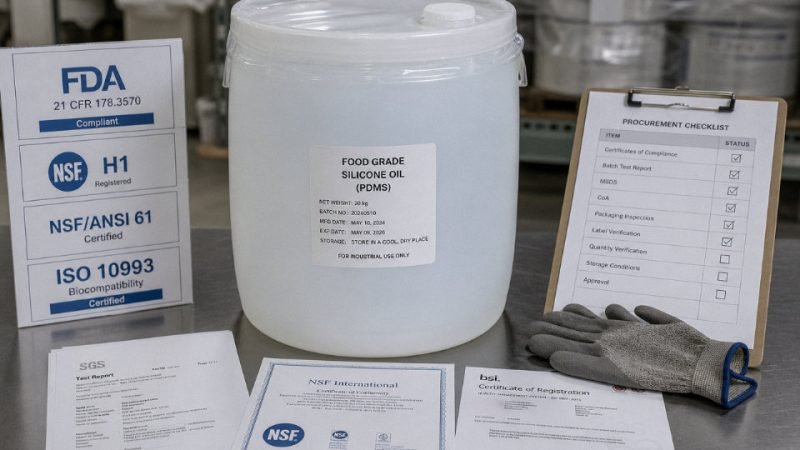
Specify the wrong grade of silicone oil — use an industrial lubricant where a food-contact fluid is required, or source an uncertified fluid for a drinking-water valve assembly — and the consequences land fast: a failed audit, a product recall hold, or a rejected shipment sitting on a dock while you pay demurrage. Procurement teams often treat “silicone oil” as a single SKU, when the certification landscape actually splits the product into several legally distinct categories. Getting that wrong costs more than the price difference between grades.
Silicone oil certifications include FDA 21 CFR 178.3570 for food-contact defoaming applications, NSF/ANSI 61 for drinking-water system components, ISO 10993 for medical device biocompatibility, and various regional equivalents such as EU 10/2011 and REACH compliance. The correct certification depends on the specific application, contact medium, and jurisdiction — no single mark covers all uses.
What makes this genuinely tricky is that the same base fluid — polydimethylsiloxane — can appear in a drum labeled four different ways depending on which testing protocol the manufacturer ran and which regulatory dossier they filed. The chemistry barely changes. The paperwork changes enormously. And the downstream liability for using the wrong one sits entirely with the buyer.
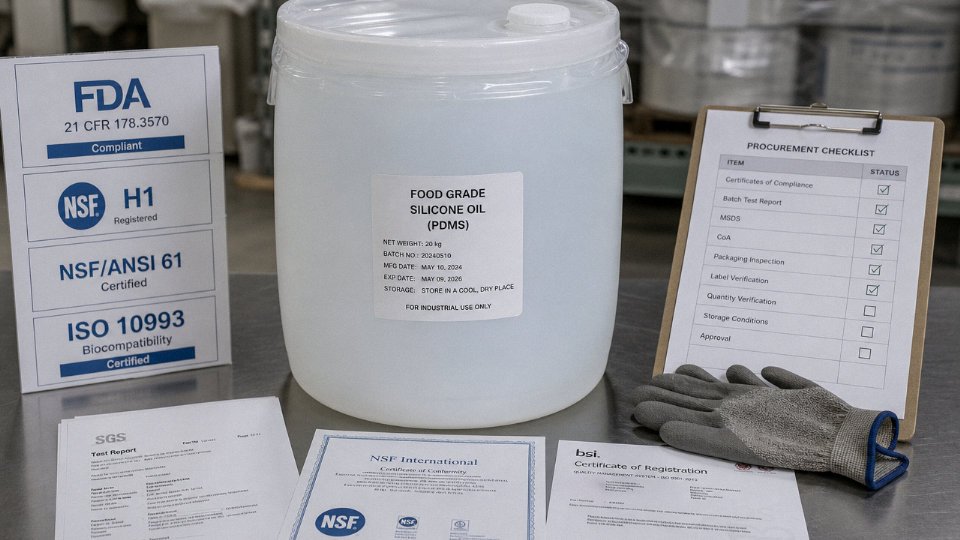
FDA Regulations Governing Silicone Oil in Food Contact and Food Processing
The regulatory entry point for most food-industry engineers is 21 CFR 178.3570, which covers polydimethylsiloxane (PDMS) as a defoaming agent in food processing. The rule is narrow and specific: PDMS is permitted only in the processing of food, not as a direct additive, and the concentration in the finished food must not exceed 10 ppm. That ceiling applies to the finished food itself, not to the concentration in the process stream — a distinction that trips up procurement teams more often than it should. If you’re dosing a fermenter or a sugar-crystallization vessel, the dilution math matters enormously, and you need migration or residue data to demonstrate that 10 ppm is not exceeded in the final product. The regulation also lists specific food categories explicitly: beet sugar and cane sugar processing, rendering of fats and oils, and various fermentation and distillation applications, among others. Using PDMS as a defoamer in a product category not listed is not a minor procedural issue — it puts you outside the regulation entirely.
Indirect Food-Additive Regulations: 21 CFR 175–177
Beyond the defoamer context, silicone oils appear in food contact through a different regulatory door: 21 CFR parts 175 through 177, which govern indirect food additives — coatings, adhesives, and components of food-contact articles. Silicone-coated baking parchment, silicone-lubricated conveyor belts, and mold-release films all fall here. These regulations specify which silicone types are permitted, at what cross-link density or viscosity range, and for which food types and conditions of use. Temperature conditions matter a great deal: a silicone release coating approved for dry bakery contact at 200°C may not be authorized for fatty or aqueous foods at the same temperature. Procurement managers sourcing conveyor lubricants or pan-release sprays should be verifying which specific sub-part — 175.300, 177.2600, or another — actually covers their use case, not just accepting a supplier’s general claim of “FDA-compliant silicone.”
GRAS Self-Affirmation and Letters of No Objection
Manufacturers introducing a silicone-based product without a specific CFR listing have two main pathways. The first is GRAS self-affirmation, where the manufacturer convenes a panel of qualified experts, assembles a dossier of compositional data, migration studies (typically conducted under worst-case extraction conditions — time, temperature, contact area), and a full toxicological evaluation, and concludes that the ingredient is Generally Recognized As Safe. The burden of documentation is substantial: migration studies alone can take three to six months depending on the analytical lab backlog and the complexity of the food simulants required. The second pathway is submitting a GRAS notification to FDA and receiving a Letter of No Objection (LNO). FDA doesn’t formally “approve” GRAS status, but an LNO provides meaningful defensibility during an audit or a customer due-diligence review.
Supplier Certificate ≠ End-Product Compliance
This is where a lot of food manufacturers get into trouble. A silicone oil supplier can legitimately certify that their raw material meets 21 CFR 178.3570 in terms of identity and purity. That certificate says nothing about how the material is used downstream.
A supplier's FDA compliance certificate for silicone oil raw material automatically makes the end food-contact product compliantFalse
FDA compliance of a raw material covers only that material's specifications. The finished article or food-contact application must independently satisfy the applicable CFR use conditions, concentration limits, and any required migration testing. End-product compliance is the manufacturer's — not the supplier's — responsibility.
If a food processor buys a certified PDMS fluid and applies it at twice the intended dose rate, or in an unlisted food category, the supplier certificate is irrelevant.
Audit Readiness and Record-Keeping
FDA inspectors auditing a food facility that uses silicone-based release agents or defoamers will typically request lot-specific certificates of conformance, usage logs showing application rates, and evidence that the processor has mapped each silicone product to a specific CFR provision. In practice, many facilities keep a “food-contact substance binder” — a folder, physical or electronic, containing the CFR citations, supplier SDS and CoA documents, and internal SOPs for dosing and application. Seasonal production swings can complicate this: a brewery scaling up fermentation volume in the fall may increase defoamer consumption significantly, and without updated dosing calculations, staying under the 10 ppm finished-product ceiling requires deliberate verification, not assumption.
NSF International Certifications: NSF/ANSI 51, 61, and H1 Lubricant Registration
NSF International runs three distinct certification streams that apply to silicone oil, and buyers routinely mix them up — sometimes with real consequences for product recalls or regulatory audits. Each stream addresses a different exposure pathway, uses different test methods, and imposes different ongoing compliance burdens on the supplier. Getting the wrong one on your spec sheet is not a paperwork problem; it can void your facility’s HACCP plan or trigger a USDA audit finding.
NSF/ANSI 51: Silicone in Food Equipment Materials
NSF/ANSI 51 covers materials that contact food during processing — seals, gaskets, O-rings, hose liners, and similar components. For silicone fluids or silicone-based compounds used in those components, the certification process involves extraction testing: cured or compounded silicone samples are immersed in food-simulant solvents (water, acidic solution, and often a fatty simulant) under controlled time-temperature conditions, and the extractate is analyzed for total extractable mass as well as specific restricted substances.
There’s also a sensory evaluation — literally a taste and odor panel conducted on the extraction fluids. This catches plasticizers and processing aids that pass chemical thresholds but still impart off-flavors to food. In my experience, silicone fluids themselves rarely fail the sensory step, but compounded silicone products with cure-system residues sometimes do. Suppliers that pass receive a certified-mark authorization and a listing in the NSF White Book database, which procurement teams should verify before issuing a purchase order — supplier claims alone are not sufficient.
NSF/ANSI 61: Drinking Water System Components
NSF/ANSI 61 is the standard you need when silicone fluid contacts potable water — pump lubricants in water treatment, valve seat compounds, or metering equipment. The methodology is a controlled leaching protocol: test specimens are exposed to aggressive water conditions, and the resulting leachate is analyzed against health-effects thresholds derived from EPA toxicological reference values.
NSF/ANSI 61 certification requires that silicone fluids used in drinking-water equipment leach no more than 10% of the health-effects threshold for each regulated contaminantTrue
NSF/ANSI 61 uses a single-concentration allowable contaminant level based on 10% of the health-based threshold (the Tolerable Daily Intake or similar), providing a safety margin before the health threshold is reached. This is documented in the NSF/ANSI 61 standard methodology.
Waterworks engineers and municipal specifiers use the NSF Blue Book listing as a direct procurement gate — if the product isn’t listed, it generally can’t be installed in a regulated public water system regardless of what the data sheet claims. PDMS-based fluids at food or technical grades are the grades most commonly submitted for 61 evaluation; phenyl-modified or chlorinated silicones rarely qualify.
NSF H1, H2, and 3H: Lubricant Registration
This is where procurement teams cause the most errors. H1 covers lubricants with incidental food contact — splash lubrication on a conveyor drive, for example, where a small amount may contact food but is not intended to. H2 covers lubricants used in areas with no food contact possibility at all. 3H covers direct food-contact release agents, which is a separate category most silicone oils don’t occupy.
For H1 registration, NSF reviews the complete formulation — every ingredient against an approved-substances list. There’s no physical testing of finished product in the same sense as 51 or 61; it’s primarily a formulation toxicology review. Registration typically takes roughly 8–16 weeks depending on formulation complexity and whether any novel ingredients require individual clearance. Costs run in the range of $1,500–$4,000 per product, give or take, depending on the registrar’s fee schedule and how clean the formulation is.
A lapsed H1 registration matters more than suppliers usually admit. If your lubricant supplier’s listing expires and you’re audited by SQF or BRCGS before they renew, the lubricant is technically unregistered at that moment — which can generate a non-conformance against your food safety plan. Annual surveillance audits require suppliers to notify NSF of any formulation changes; undisclosed changes can result in listing suspension.
| Certification | Scope | Primary Test Method | Renewal / Audit Cycle | Typical Silicone Grades |
|---|---|---|---|---|
| NSF/ANSI 51 | Food equipment materials (contact surfaces) | Extraction testing + sensory evaluation | Annual surveillance audit | Food-grade PDMS, silicone elastomer compounds |
| NSF/ANSI 61 | Drinking water system components | Leaching vs. health-effects threshold (10% limit) | Annual surveillance audit | PDMS fluids, technical-grade silicone |
| NSF H1 | Incidental food-contact lubricants | Formulation toxicology review (no finished-product testing) | Annual audit + change notification | Compounded PDMS lubricants, silicone greases |
One practical note: holding H1 registration does not automatically satisfy NSF/ANSI 51 requirements for a silicone component used in food-zone equipment. They cover different exposure scenarios and are evaluated under different frameworks. A silicone O-ring lubricant might need both, depending on how it’s used. Specify which certification applies to which use case in your material specification — vague vendor certifications have a way of hiding gaps until an auditor finds them.
Medical and Pharmaceutical Certifications: USP, ISO 10993, and EP Standards
Medical-grade silicone oil sits in a regulatory category that frankly catches a lot of procurement teams off guard. The testing burden is substantially heavier than food-contact compliance, and the documentation trail has to survive an FDA auditor or a Notified Body reviewer — not just an internal QA sign-off.
USP Class VI Testing: What It Actually Requires
USP Class VI is the most stringent of the three USP plastics classifications, and it’s the baseline expectation for any silicone oil contacting drug product, a syringe barrel, or tissue inside the body. Three in-vivo tests define it: systemic injection (extractables injected into mice, observed 72 hours), intracutaneous reactivity (rabbit model, local tissue response scored against a saline control), and implantation (14- or 90-day rabbit muscle implant depending on intended use).
For syringe barrel lubrication — where a thin PDMS film contacts injectable drug product directly — passing USP Class VI is essentially the floor, not the ceiling. Manufacturers supplying prefillable syringe producers typically carry extraction study data at multiple temperatures and solvents, because a Class VI pass at room temperature with saline doesn’t automatically cover a protein-based biologic stored at 2–8 °C for 18 months. Buyers should ask specifically for extraction data matched to their fill product chemistry.

ISO 10993: Building the Biological Evaluation File
ISO 10993 is a series, not a single test, and the part that matters most depends on device category. Part 10993-1 governs the risk-based approach — it’s the framework document that tells you which downstream tests are required given the device’s contact type, duration, and tissue exposure. Part 10993-5 covers cytotoxicity, usually the first screen run and relatively quick. Parts 10993-10 (sensitization and skin irritation) and 10993-11 (systemic toxicity, including subacute and subchronic endpoints) tend to generate the longest timelines; animal studies under 10993-11 can run 90 days or more depending on implant duration classification.
A compliant biological evaluation file for a silicone oil used in, say, a long-term implantable device will realistically pull from five to seven sub-tests across the series. The manufacturer — or their contract testing lab — assembles this into a biological evaluation report that maps each endpoint to the risk framework in 10993-1. In practice, a well-organized 10993 package is what separates a silicone oil supplier that can actually support a 510(k) submission from one that hands you a spec sheet and a Certificate of Analysis.
ISO 10993 biocompatibility testing for medical-grade silicone oil typically requires 5–7 individual sub-testsTrue
ISO 10993-1 risk-based framework specifies testing endpoints based on contact nature and duration; a permanent-contact implant-category material commonly requires cytotoxicity (10993-5), sensitization (10993-10), systemic toxicity (10993-11), genotoxicity (10993-3), and implantation (10993-6) at minimum, reaching or exceeding five tests.
European Pharmacopoeia Dimethicone Monograph
The Ph. Eur. monograph for dimethicone (silicone oil) specifies identity, viscosity grade, refractive index, acidity/alkalinity, and limits for volatile matter and heavy metals. This is the excipient-grade standard, and it draws a real commercial line. Industrial silicone fluids — even optically clear, high-purity grades — are not Ph. Eur. grade unless manufactured under pharmaceutical excipient GMP and tested against monograph specifications batch by batch. Procurement teams occasionally try to substitute industrial grades on cost; the viscosity may match, but the volatile siloxane profile and heavy-metal limits almost certainly won’t, and any pharmaceutical customer worth keeping will catch it in incoming QC.
510(k), PMA, and the Role of Master Files
When silicone oil is a constituent material of a medical device, FDA expects the 510(k) or PMA submission to address it explicitly. Suppliers supporting device manufacturers typically maintain a Type III Device Master File (MAF) or a Drug Master File (DMF) with FDA — these let the device company reference the file in their submission without the supplier disclosing proprietary formulation details. Operationally, confirm that the MAF or DMF is currently active and that the supplier has authorized your company as a reference holder before you design it into your device. Authorization lapses and outdated files have delayed submissions.
GMP Requirements: ICH Q7 and 21 CFR Part 820
For pharmaceutical excipient supply, ICH Q7 defines the API GMP framework that silicone oil manufacturers are expected to follow. For device components, 21 CFR Part 820 (the Quality System Regulation, now largely aligned to ISO 13485) applies. A supplier audit checklist for either pathway should cover change-control procedures, batch traceability to raw material lots, and validation of any sterilization or filtration steps applied before shipping. In my experience, the change-control piece is where smaller silicone producers struggle most — a process change that improves yield can inadvertently alter the extractable profile, and if the customer isn’t notified, you find out during a product stability study rather than a supplier audit.
Intraocular Tamponade Silicone Oils: The Highest Burden
Intraocular tamponade oils occupy a specific, demanding niche. Used to maintain retinal apposition after vitrectomy, these are long-contact, intraocular materials — the regulatory bar is correspondingly high. The two viscosity grades in clinical use run roughly 1,000 cSt and 5,000 cSt; the higher-viscosity grade is harder to emulsify but more difficult to remove surgically, so the clinical trade-off is real and documented in ophthalmology literature.
In the EU, these products are Class III medical devices under MDR 2017/745, which requires a Notified Body review including clinical evaluation under Article 61. The clinical evaluation can’t rely solely on pre-MDR literature anymore — post-market clinical follow-up data and an updated clinical evaluation report are ongoing obligations, not one-time submissions. CE marking under the old MDD is no longer valid for new market entries, and legacy devices have faced deadline pressure under the MDR transition. Manufacturers supplying the EU market should verify their Notified Body’s EUDAMED registration and confirm that the clinical evaluation file has been updated to MDR standard, not just relabeled.
Cosmetics and Personal Care Compliance: EU Cosmetics Regulation, ISO 22716 GMP, and COSMOS
The compliance path for silicone oils in personal care is genuinely different from food or medical routes — more fragmented, more driven by regional ingredient lists, and increasingly shaped by environmental pressure on cyclic siloxanes. If you’re a formulation chemist or regulatory affairs manager sourcing dimethicone, phenyl trimethicone, or any cyclic variant, you need to track at least four separate frameworks simultaneously. That’s not an exaggeration.
EU Cosmetics Regulation (EC) No 1223/2009 and REACH Restrictions on Cyclic Siloxanes
The EU framework operates on a positive/negative list structure. Ingredients are either restricted (Annex III), prohibited (Annex II), or — for most cosmetic ingredients including standard dimethicone grades — simply not listed at all, which means they’re permitted provided your Safety Assessment supports their use. Dimethicone (INCI: Dimethicone) and related linear PDMS variants sit in that unlisted-but-permitted space for most applications, and in practice they’ve had a clean regulatory history.
Cyclic siloxanes are a different story. D4 (octamethylcyclotetrasiloxane) and D5 (decamethylcyclopentasiloxane) are now restricted under REACH Annex XVII — rinse-off cosmetic products may not contain either substance at or above 0.1% w/w. The restriction came into force in January 2020. D6 (dodecamethylcyclohexasiloxane) followed with its own SVHC evaluation. If your fragrance or conditioning base uses a carrier that contains D4 or D5 as an impurity or processing residue — even incidentally — you need supplier-level documentation confirming levels below that threshold, not just a declaration.
Every finished cosmetic product placed on the EU market requires a Cosmetic Product Safety Report (CPSR), prepared or signed off by a qualified safety assessor. For silicone-heavy formulations (think leave-on hair serums or high-viscosity barrier creams where dimethicone might run 5–15% of the formula), the CPSR needs to address dermal absorption data, cumulative exposure across product categories, and any available environmental endpoints for the specific silicone grade. Generic “dimethicone is safe” statements won’t satisfy a competent authority audit.
U.S. MoCRA 2022: What Changed for Silicone Oil Suppliers and Formulators
The Modernization of Cosmetics Regulation Act, signed in late 2022, significantly expanded FDA’s authority over cosmetics for the first time in decades. Facilities that manufacture or process cosmetic products — including, arguably, silicone oil manufacturers who do any compounding or blending for cosmetic use — must register with FDA biennially. Products must be listed, with ingredient declarations. Safety substantiation must be maintained on file and produced on request.
For silicone oil suppliers, the practical implication is that supplying a cosmetic-grade dimethicone now comes with a documentation expectation that didn’t exist before. Formulators should be asking their suppliers whether the manufacturing site is registered and whether product-specific safety data is available in a format compatible with MoCRA substantiation requirements. Most large silicone producers are ahead of this; smaller specialty compounders may not be.
ISO 22716:2007 GMP: What Auditors Actually Look For
ISO 22716 is the internationally recognized GMP standard for cosmetics. When a silicone oil manufacturer claims cosmetic-GMP compliance, auditors are looking at a handful of things that tend to separate genuine compliance from paper compliance: dedicated or thoroughly validated-clean equipment (silicone contamination of a subsequent batch is surprisingly hard to detect and can affect emulsion stability), batch traceability through Certificate of Analysis documents that reference specific lot numbers, viscosity ranges, purity specifications, and test methods, and change-control records for raw material sources. A CoA that lists only viscosity and appearance, with no reference to cyclic siloxane content or heavy metals, is inadequate for EU cosmetic use today.
COSMOS: Why Most Silicone Oils Don’t Qualify
COSMOS-standard prohibits synthetic silicone oils entirely. Dimethicone, cyclomethicone, phenyl trimethicone — all out. The standard’s feedstock and processing criteria require petrochemical-origin synthetic polymers to be excluded, and silicones as a class fall there. Some formulators are exploring bio-derived silicone alternatives based on bio-sourced silicon precursors, but commercial availability is limited and certification pathways are still being established case by case with COSMOS certification bodies. For a natural beauty brand, this is a genuine formulation constraint, not a paperwork problem. Replacing dimethicone’s slip, film-forming, and water-repellency profile with COSMOS-compliant alternatives (certain plant waxes, bio-based esters) usually requires significant stability and sensory testing.
D4 and D5 cyclic siloxanes are restricted to below 0.1% w/w in rinse-off cosmetics under EU REACH Annex XVII as of January 2020True
Regulation (EC) No 1907/2006 Annex XVII, Entry 70, restricts both octamethylcyclotetrasiloxane (D4) and decamethylcyclopentasiloxane (D5) in wash-off consumer products at concentrations at or above 0.1% by weight, with the restriction applying from 31 January 2020.
China NMPA Registration: Declaring Silicone Oil for Import
China’s NMPA (National Medical Products Administration) framework treats cosmetics under a tiered system — ordinary cosmetics versus special-use cosmetics — and silicone oils appear in the Cosmetic Ingredient Dictionary (IECIC). Standard dimethicone grades listed in the IECIC can be declared straightforwardly on the ingredient list. Novel silicone variants — new molecular weight distributions, functionalized silicones, or blends not individually listed — require a New Cosmetic Ingredient (NCI) notification, which involves safety data, manufacturing information, and a Chinese-language safety assessment. Processing time runs roughly 6–18 months depending on the ingredient risk tier and documentation quality. For market entry, testing documentation must include safety assessment data conducted or verified by a NMPA-accepted institution, and imported finished products require in-country responsible person registration. Underestimating this timeline has delayed more than a few product launches.
Electrical and Industrial Certifications: IEC, UL, and Transformer Fluid Standards
Silicone fluids have been used as transformer insulating liquids since the 1970s, and the certification landscape around them is more layered than most procurement specs acknowledge. If you’re sourcing silicone dielectric fluid for a substation, a high-voltage test transformer, or a large industrial enclosure cooler, you’re dealing with at least three overlapping standards frameworks simultaneously — and the consequences of getting it wrong range from voided insurance coverage to catastrophic dielectric failure.
IEC 60836 and the Key Performance Parameters
IEC 60836 is the primary international specification for unused silicone insulating liquids in electrotechnical service. It defines acceptance limits for dielectric breakdown voltage (typically ≥30 kV under IEC 60156 test conditions, though grade-dependent), kinematic viscosity, flash point (generally ≥300 °C for the standard grades, which is part of why utilities like these fluids), pour point, water content, and oxidation stability. The oxidation stability requirement matters in practice because silicone fluids in sealed transformers can still accumulate trace moisture from breathing cycles, and a fluid that degrades under oxidative stress produces gels and particulate that contaminate windings.
Supplier conformance to IEC 60836 is supposed to be verified by third-party testing labs — accredited under ISO/IEC 17025 — not just manufacturer self-declaration. In reality, I’ve seen procurement packages where the “certificate” is nothing more than a supplier’s in-house CoA stamped with the IEC number. That’s not the same thing. If you’re buying for utility-grade or critical industrial service, ask specifically for the accredited lab report, not just the spec sheet.
ASTM D4652 and How It Sits Alongside IEC 60836
ASTM D4652 covers much of the same ground as IEC 60836 but uses ASTM test methods — D877 and D1816 for dielectric strength, D445 for viscosity, and so on. U.S. utilities and transformer OEMs frequently cite both standards in purchase specifications because their testing infrastructure is built around ASTM methods while the equipment may be certified to IEC. The two standards are broadly compatible but not identical; flash point limits and viscosity grade definitions can differ slightly depending on the revision year. When writing a procurement spec, it’s worth explicitly referencing both and indicating which test method governs in case of dispute.
UL Listings for Silicone Fluid in Electrical Equipment
UL 508A governs industrial control panels, and silicone fluids used for component cooling or insulation within listed enclosures need to come from suppliers with a UL yellow-card listing for the fluid itself — not just for the finished enclosure. The yellow-card listing process requires the fluid manufacturer to submit samples, undergo UL’s own testing, and then maintain the listing through periodic follow-up inspections and testing. Listings can lapse if the fluid formulation changes or if the manufacturer misses a follow-up cycle. Before specifying a fluid, verify the listing is current at UL’s Product iQ database; a listing that expired 18 months ago does nothing for your panel certification.
K-Class Fire Resistance Under IEC 61039
This is the classification that most directly affects substation design decisions. IEC 61039 categorizes less-flammable transformer fluids, and silicone insulating liquids qualify as K-class — meaning they have a fire point above 300 °C and pass specific flame propagation tests. K-class classification isn’t automatic from IEC 60836 conformance; it requires separate testing per IEC 61039 protocols.
K-class silicone transformer fluid eliminates fire risk in indoor substationsFalse
K-class classification means the fluid is less-flammable under IEC 61039 criteria, not non-flammable. Indoor substation designs still require containment bunding, fire detection, and ventilation; K-class status reduces, not removes, insurance and regulatory requirements in most jurisdictions.
Why does this matter for procurement? Insurance underwriters for indoor or urban substations in Europe, parts of Asia, and increasingly in North America apply meaningfully lower premium rates and relaxed containment requirements for K-class fluids versus conventional mineral oil. Some local fire codes in densely built areas mandate K-class or better for new installations. The classification also affects required bund volume calculations — mineral oil installations typically require 110% containment of total fluid volume; K-class requirements vary by jurisdiction but are often reduced.
REACH and RoHS Compliance Declarations
Polydimethylsiloxane itself is not currently on the SVHC candidate list, but a complete REACH declaration for a silicone insulating fluid needs to cover the full formulation — including any stabilizers, antioxidants, or corrosion inhibitors the manufacturer has added. A credible supplier REACH declaration will identify all constituents above 0.1% w/w, confirm SVHC screening against the current candidate list (updated twice yearly by ECHA), and include the declaration date so you can verify it’s current. Declarations more than 12–18 months old are worth re-requesting, especially given how frequently ECHA adds substances.
RoHS compliance for silicone fluids in electrical equipment follows EU Directive 2011/65/EU and its 2015 recast. Pure PDMS-based fluids generally pass RoHS screening without difficulty, but again the additive package is where problems sometimes appear. Require a substance-level RoHS declaration, not just a checkbox statement on a letterhead.
In practice, the cleanest procurement approach for utility or critical industrial use is to require IEC 60836 compliance with accredited lab data, current UL yellow-card listing where applicable, separate IEC 61039 K-class certification if fire classification matters for the installation, and a dated REACH/RoHS declaration covering the complete formulation — all as contractual deliverables, not optional supporting documents.
Environmental and Sustainability Certifications: REACH, GHS/SDS Requirements, and Eco-Labels
Environmental compliance for silicone oil has gotten considerably more complicated over the last decade — and the trajectory is toward tighter scrutiny, not less. EHS managers who treated silicone fluids as inert and unregulated are now dealing with SVHC listings, SDS revisions, and customer sustainability questionnaires that require actual test data, not marketing language.
REACH Registration and SVHC Obligations
Under EC 1907/2006, any manufacturer or importer bringing silicone oil into the EU above 1 tonne per year must submit a registration dossier to ECHA. For PDMS grades — the workhorses of industrial and food-grade silicone fluid — this means physicochemical data, toxicological summaries, and environmental fate information. The dossier workload depends heavily on tonnage band: the 1–10 t/year band carries a lighter data burden than the 100+ t/year band, which triggers a full chemical safety report including exposure scenarios.
The more operationally urgent issue is cyclic siloxanes. D4 (octamethylcyclotetrasiloxane) and D5 (decamethylcyclopentasiloxane) are both listed as Substances of Very High Concern under REACH due to PBT and vPvB properties. D4 was restricted in wash-off personal care products from 2020; D5 followed with a concentration limit of 0.1% by weight in rinse-off products. For industrial silicone fluids, the direct restriction picture is different — D4 and D5 in process lubricants or heat transfer fluids aren’t banned outright — but any product containing them above 0.1% in an article triggers SVHC communication obligations down the supply chain. Procurement teams at automotive or electronics OEMs are increasingly pushing this requirement upstream, which means your silicone fluid supplier needs to be able to answer it formally, not informally.
The industry response has been real. Several major silicone producers have reformulated toward linear PDMS chains or higher-molecular-weight cyclic fractions that don’t carry the same regulatory burden. Whether the alternatives are functionally equivalent depends entirely on the application — viscosity-temperature behavior and vapor pressure differ enough that a drop-in swap isn’t always a drop-in swap.
D4 and D5 siloxanes are restricted in rinse-off cosmetic products in the EU at concentrations above 0.1% by weightTrue
EU REACH Annex XVII Entry 70 restricts D4 and D5 in wash-off/rinse-off cosmetic products at ≥0.1% w/w, effective since January 2020 for D4 and February 2020 for D5.
GHS Classification and SDS Accuracy
Most PDMS-based silicone oils classify as non-hazardous or minimally hazardous under GHS — typically no hazard pictograms, with Section 2 of the SDS showing “not classified” for most endpoints. That said, Section 2 still needs to be accurate for the specific viscosity grade. Low-viscosity silicone oils (below roughly 5 cSt) can present aspiration hazard (GHS Category 1, H304) because thin fluids wick into the lung easily. Mid-to-high viscosity grades — 50 cSt and above — generally don’t meet the aspiration hazard criteria.
Regional implementation differences matter in practice. EU CLP alignment and OSHA HazCom 2012 are both GHS-derived but diverge in cut-off values, mixture rules, and SDS formatting requirements. A single global SDS that’s been lazily harmonized sometimes fails CLP Section 2 formatting or omits the OSHA-required 16-section structure properly. Auditors catch this.
Biodegradability Data and OECD Test Methods
OECD 301 (ready biodegradability) and OECD 306 (seawater biodegradability) are the standard test frameworks used for silicone oils. PDMS is persistent — it doesn’t biodegrade readily under OECD 301 conditions, typically achieving well under 20% degradation over 28 days regardless of molecular weight. That persistence is why D4 and D5 attracted PBT scrutiny in the first place.
High-molecular-weight PDMS behaves differently in environmental fate terms: it adsorbs strongly to soil and sediment, which limits aquatic bioavailability but doesn’t make it biodegradable. This distinction matters when responding to customer sustainability questionnaires — “low aquatic toxicity” and “biodegradable” are not the same claim, and conflating them creates liability.
Blauer Engel and B2B Eco-Label Positioning
The Blue Angel scheme (RAL UZ) is the most credible eco-label in German and broader European B2B markets. Silicone-based release agents and some process lubricants can potentially qualify under relevant product categories, but the pathway requires lifecycle assessment data, emissions testing, and ongoing certification audits — not a one-time submission. The marketing value is real in segments like food packaging machinery or building products where procurement scorecards weight environmental certification. For bulk industrial silicone fluid sold purely on performance, the ROI on Blue Angel certification is genuinely debatable and depends heavily on your customer base.
ISO Quality Management and Industry-Specific Manufacturing Certifications
Regulatory product certifications like FDA 21 CFR 178.3570 or USP Class VI tell you what a silicone oil is allowed to do. Facility-level quality certifications tell you whether the manufacturer can reliably produce it that way, batch after batch. For industrial buyers doing supplier qualification, that distinction matters a great deal — especially when a single out-of-spec drum of silicone damper fluid can trigger an automotive line shutdown.
ISO 9001:2015: Reading the Certificate Scope Before You Trust It
Almost every silicone oil producer of any size holds ISO 9001:2015 certification, but the certificate is only as useful as its scope statement. A manufacturer might be certified for “production and sale of specialty silicone fluids for industrial lubrication” while their pharmaceutical-grade PDMS line sits outside that scope entirely — manufactured in a different building, under a different QMS, or not certified at all.
When you receive a certificate, look at three things: the scope description, the site address (multi-site certificates list each facility), and the certification body’s accreditation mark (UKAS, DAkkS, A2LA, and similar bodies carry more weight than obscure regional registrars). Surveillance audits typically run annually, with full recertification every three years. A certificate dated more than 14–15 months ago with no surveillance confirmation should prompt a direct question to the supplier.
In practice, ISO 9001 at a silicone oil plant governs incoming raw material inspection (cyclic siloxane purity, catalyst residues), in-process viscosity control, filling and packaging traceability, and customer complaint handling. It does not guarantee a specific product specification — that comes from the product datasheet and purchase agreement.
IATF 16949: Automotive Applications and the PPAP Requirement
Silicone fluids appear in automotive manufacturing in several places: rotary damper assemblies, door-check mechanisms, engine gasket lubricants applied during assembly, and airbag deployment system components. Any of these supplied into a Tier 1 or direct OEM relationship will almost certainly require IATF 16949 certification from the silicone oil supplier, because the automotive customer’s own IATF scope extends upstream.
The operational implication is PPAP — Production Part Approval Process. For a silicone fluid, a Level 3 PPAP submission typically includes process flow diagrams, a control plan covering viscosity, refractive index, and volatile content, MSA (measurement system analysis) for critical parameters, and initial process capability data (Cpk targets are usually ≥ 1.33 for viscosity, though the customer may specify tighter). If your silicone oil supplier has never delivered a PPAP package, qualifying them into an automotive supply chain will take considerably longer than you expect — budget 4–6 months minimum, not weeks.
Integrated Systems: ISO 14001 and ISO 45001 Alongside 9001
Serious silicone fluid manufacturers — particularly those running high-temperature polymerization and distillation processes with flammable solvents and siloxane vapors — tend to run ISO 14001:2015 (environmental management) and ISO 45001:2018 (occupational health and safety) as an integrated management system alongside 9001. Integrated audits are more efficient and signal organizational maturity. From a procurement standpoint, a supplier holding all three under a single integrated certificate is usually easier to audit and faster to respond to corrective action requests.
What this looks like in practice: shared document control, combined internal audit schedules, a single management review covering quality, environmental, and safety KPIs. Ask the supplier for their last management review output — a real one, not a summary brochure.
AS9100: Traceability Requirements for Aerospace Silicone Fluids
Silicone oils appear in aerospace in niche but critical roles: gyroscope damping fluids, certain hydraulic system applications, and as formulation components in aircraft sealants and lubricants. AS9100 Rev D (the current revision) layers aerospace-specific requirements onto ISO 9001, and the traceability demands are substantially higher.
AS9100 certification requires silicone oil manufacturers to maintain lot-level traceability linking finished product to raw material certificates of conformance, with records retained for a minimum period defined by customer contract, often 10 years or more.True
AS9100 Rev D clause 8.5.2 mandates configuration management and traceability controls; aerospace customers routinely specify 10-year or life-of-program record retention in their purchase order terms, which flows down to chemical suppliers.
First article inspection (FAI) under AS9100 requires documented evidence that the production process — not just the product — meets requirements. For a silicone fluid, that means the FAI package covers the specific reactor lot size, catalyst system, and stripping conditions, not just a certificate of analysis on the finished drum. Nonconforming material control is also stricter: suspect product must be physically segregated and dispositioned through a formal MRB (Material Review Board) process, with objective evidence retained.
Halal and Kosher Certification: Where Formulation Details Become Critical
This one catches formulators off guard more often than it should. Pure polydimethylsiloxane synthesized from inorganic precursors is generally not the problem — the issues arise from processing aids, emulsifiers, antifoam additives, or blending components that may contain animal-derived ingredients or alcohol.
Recognized Halal certifying bodies vary by target market. For Gulf Cooperation Council countries, ESMA (UAE) and SASO (Saudi Arabia) recognize specific international bodies; Malaysia’s JAKIM and Indonesia’s MUI are the primary references for Southeast Asian markets. For Kosher certification, OU (Orthodox Union) and Kof-K are widely accepted in North American and Israeli markets.
The audit for a silicone oil plant covers raw material sourcing documentation, production line segregation from non-Halal/non-Kosher products, cleaning validation between production runs, and annual facility inspection. Common rejection causes: undisclosed use of fatty acid-based processing aids in the polymerization step, or emulsified silicone products containing polysorbates derived from non-compliant tallow sources. If you are formulating an emulsified silicone product for Middle Eastern food or personal care markets, verify every co-ingredient against the certifying body’s approved ingredient database before submitting — a single undisclosed additive can void the entire application.
How to Read a Silicone Oil Certificate of Analysis and Verify Authentic Certification
A supplier hands you a glossy PDF with an official-looking header, a specification table, and a compliance statement referencing FDA 21 CFR 178.3570. Looks fine. In practice, that document may be three years old, cover a product family rather than your actual lot, and reference a lab that lost its accreditation eighteen months ago. Procurement teams get burned by exactly this kind of thing more often than most quality managers would admit.
Anatomy of a Legitimate CoA
Every credible Certificate of Analysis for silicone oil — whether food-grade PDMS, electrical-grade fluid, or medical-grade — should carry at minimum: a unique batch or lot number traceable to a specific production run, the manufacturing date and the test date (these are not the same thing, and a gap of more than 60–90 days between production and testing deserves a question), explicit test method citations (ASTM D445 for viscosity, ASTM D92 for flash point, ISO 6353 or internal methods where applicable), the actual measured result alongside the specification limit, and the name and signature of an authorized quality representative. The lab accreditation number — typically an ISO/IEC 17025 accreditation from A2LA, UKAS, DAkkS, or an equivalent national body — should appear on any third-party test report referenced.
If the CoA lists only pass/fail without the actual measured value, that’s worth pushing back on. A viscosity listed as “meets specification” tells you nothing about whether the fluid is at the edge of tolerance.

Cross-Verifying Against Official Databases
Never rely solely on what the supplier sends. NSF-certified products — including silicone fluids registered under H1, NSF/ANSI 61, or NSF/ANSI 51 — are listed in the NSF Blue Book at info.nsf.org, searchable by product name, manufacturer, and registration number. If the registration number on the supplier’s document doesn’t appear there, or appears under a different product scope, that’s a real problem. Check the listing’s effective date and expiry too; NSF registrations require annual renewal.
For FDA compliance claims, there’s no single FDA “approval database” for food-contact substances — FDA doesn’t certify individual products, it establishes regulatory frameworks. So a supplier claiming “FDA approved” for a silicone fluid is either misstating the regulatory picture or being sloppy with language. What you’re verifying is conformance to 21 CFR 178.3570, and the burden is on the supplier to show third-party analytical data demonstrating the fluid meets purity and composition requirements consistent with that regulation.
NSF H1 registration guarantees a silicone lubricant is safe for direct food contact in unlimited quantitiesFalse
NSF H1 registration means the lubricant formulation has been reviewed and is acceptable for incidental food contact — it does not eliminate usage-rate limits or override application-specific regulatory requirements such as FDA 21 CFR constraints on concentration.
Document Types and When Each Is Sufficient
These four documents are not interchangeable: a Certificate of Analysis contains actual measured test data for a specific lot. A Certificate of Conformance is a supplier’s written declaration that the lot meets specification — useful for low-risk incoming inspection but not a substitute for test data on safety-critical applications. A Test Report is the full raw output from a laboratory, often more detailed than a CoA and necessary when you’re doing independent verification. A Regulatory Compliance Declaration states that a product meets a named regulation or standard, but typically contains no test data whatsoever — adequate for initial supplier qualification screening, insufficient for medical or food-contact sign-off.
For food-processing and medical applications, you want the CoA and the underlying test report from an ISO 17025-accredited laboratory. A conformance declaration alone won’t satisfy an FDA audit or a medical device technical file.
Supplier Qualification and Certification Tracking
During an audit, request the lab’s current ISO 17025 scope of accreditation certificate alongside any third-party test reports. Verify the scope covers the specific test methods cited — a lab accredited for polymer testing isn’t automatically accredited for electrical-fluid dielectric-strength measurement.
Set up expiry tracking in your QMS. NSF registrations typically renew annually; ISO 17025 accreditations have defined surveillance cycles, usually 12–18 months between assessments depending on the accreditation body. A simple spreadsheet with supplier name, certification type, certificate number, issue date, and expiry date, reviewed quarterly, prevents the common failure mode of catching an expired certification only when a customer audit triggers a document request. Most ERP systems can flag this automatically if someone bothers to configure it — and in my experience, that configuration gets skipped far too often.
Frequently Asked Questions About Silicone Oil Certifications
Is food-grade silicone oil the same as medical-grade?
No, and confusing the two is one of the more costly documentation mistakes I see in cross-industry procurement. Food-grade silicone oil is typically compliant with FDA 21 CFR 178.3570 — which governs defoaming agents at up to 10 ppm in food processing — or NSF H1, which covers incidental lubricant contact. Medical-grade carries an entirely different burden: ISO 10993 biocompatibility testing (usually 5–7 sub-tests covering cytotoxicity, sensitization, systemic toxicity, and depending on the application, implantation and hemocompatibility), plus USP Class VI testing for many device applications, plus pharmacopoeial purity specifications under USP or EP monographs.
A food-grade CoA documents batch viscosity, purity, and regulatory-use status. It says nothing about extractables, leachables, or cytotoxic potential. Submit one to a medical device notified body as evidence of biocompatibility and you will be told to start over. The testing philosophy is fundamentally different: food compliance asks “is the residual level safe?” while medical compliance asks “does this material cause a biological response in or near human tissue?”
A food-grade CoA for silicone oil is sufficient documentation for a Class II medical device application.False
Medical device applications require ISO 10993 biocompatibility data, USP Class VI or equivalent pharmacopoeial testing, and in many cases extractables/leachables profiling — none of which is covered by FDA 21 CFR 178.3570 food-contact compliance documentation.
Can a single silicone oil grade carry multiple certifications simultaneously?
Yes, and multi-certified PDMS grades do exist — you can find NSF H1 + FDA 21 CFR 178.3570-compliant grades from several major silicone producers. Some pharmaceutical-grade fluids layer USP and EP compliance on top of that. What this actually requires is careful raw material selection (no additives that would fail any of the overlapping test regimes), dedicated manufacturing on clean lines, and separate documentation packages for each certification stream.
The practical limitation is that certification scope doesn’t merge. An NSF H1 registration covers lubricant use in food-equipment; FDA 21 CFR 178.3570 covers defoaming at defined concentrations; ISO 10993 covers a specific tested article in a specific contact scenario. Holding all three doesn’t mean the fluid is approved for every possible use — it means it passed specific tests for specific applications. Read the scope statement on each certificate carefully.
How long does NSF H1 registration or FDA compliance status take, and what does it cost?
NSF H1 registration for a new silicone formulation typically runs 3–9 months from initial application to listing, depending on how complete the ingredient disclosure is and whether any components trigger additional toxicological review. Straightforward neat PDMS grades tend to sit at the shorter end; formulations with additives, emulsifiers, or novel processing aids can stretch toward the longer end or beyond.
Cost ranges are harder to pin down because they depend on formulation complexity, how much toxicological data already exists for your ingredients, and your internal regulatory team’s capacity. Roughly speaking, expect NSF H1 registration to run somewhere between $3,000 and $12,000 in direct fees, not counting internal labor or any raw-material testing gaps you need to close. FDA 21 CFR 178.3570 compliance is a self-determination process rather than a third-party registration — there’s no application fee, but the work involves confirming ingredient compliance and maintaining a defensible regulatory file, which costs real engineering time.
What happens when a supplier changes their manufacturing process or raw material source?
This is where buyers get caught out. Under NSF H1, any formulation change — new raw material supplier, altered additive level, production-site transfer — requires notification to NSF and may trigger re-evaluation. The registered formulation is what’s certified, not the product name. If your silicone oil supplier shifts their siloxane monomer source and doesn’t tell you, your NSF H1 paperwork is technically void even though the product looks and tests the same.
Build change-control notification clauses into your supply agreements. Ask specifically: does a site transfer require re-registration? (Usually yes for NSF H1.) Does a raw material supplier change require NSF notification? (Yes, if the ingredient is listed in the registered formula.) ISO 9001-certified suppliers have formal change-control procedures that at least create a paper trail — which is one practical reason facility-level certifications matter to procurement beyond the abstract quality-management argument.
Are bio-based silicone oils held to different certification standards?
Mostly no, with a few specific exceptions worth knowing. COSMOS-standard organic certification explicitly prohibits silicones, including bio-derived PDMS, so a bio-based silicone oil cannot carry COSMOS certification regardless of feedstock origin. The USDA BioPreferred program can certify bio-based content for federal procurement purposes, but that designation says nothing about food safety or medical suitability — it’s a sourcing classification, not a performance or safety certification.
REACH registration applies to all PDMS placed on the EU market above 1 tonne per year, regardless of whether the silicon precursors came from bio-based or fossil-based routes. The molecule is what gets registered, not the feedstock.
Which certifications are mandatory versus recommended for EU market entry in 2024 and beyond?
REACH registration is mandatory for manufacturers and importers above threshold volumes. GHS-compliant SDS documentation is mandatory. For cyclic siloxanes specifically — D4, D5, D6 — EU REACH restrictions have been tightening since 2020, with wash-off cosmetic applications already restricted; watch for industrial and other-use restrictions that were still under ECHA review as of 2024. Linear PDMS used in industrial applications isn’t currently restricted the same way, but the regulatory momentum is worth tracking.
NSF, FDA, and ISO certifications are not legally required for EU market entry unless your end-use application (food contact, medical device, drinking water) triggers sector-specific legislation like EU 10/2011 for food contact materials or the EU MDR for devices.
How do Chinese GB standards compare to FDA and EU regulations for food-contact silicone oil?
GB 9685 is China’s framework standard for food contact material additives, and it works differently from FDA 21 CFR or EU 10/2011 in one important way: it uses a positive list approach with specific migration limits, and silicone compounds must appear on that list to be legally used. Not every PDMS grade or formulation additive permitted under FDA rules appears on the GB 9685 positive list. If you’re exporting food-processing equipment or packaging into China, or sourcing silicone oil through Chinese supply chains for export back to FDA-regulated markets, you need to verify compliance against both systems independently — they don’t cross-recognize each other, and assuming FDA-compliant means GB-compliant has caused customs holds and product rejections in practice.
Building a Certification Compliance Roadmap for Silicone Oil Procurement and Product Development
Getting certified silicone oil into a product is not the hard part. Keeping track of which certification covers which grade, for which market, at which stage of the supply chain — that is where specification failures actually happen. Most costly compliance errors trace back to a single, surprisingly common mistake: assuming a raw-material certification automatically covers the finished formulation. It does not, and regulators in every major market treat the distinction seriously.
Start With End-Use, Not With the Supplier Datasheet
The only sensible starting point is the application. A quick decision-tree walk: Is the silicone oil contacting food? Map to FDA 21 CFR 178.3570 and NSF/ANSI 51 or H1 depending on contact type. Drinking water equipment? NSF/ANSI 61, non-negotiable. Medical device or ophthalmic use? USP and ISO 10993 sub-test battery. Cosmetic formulation sold in the EU? Regulation (EC) No 1223/2009 ingredient listing plus ISO 22716 GMP at the manufacturing site. Electrical transformer fluid? IEC 60836 plus any applicable UL listing.
Mandatory certifications define the floor. Voluntary ones — COSMOS organic, specific eco-labels, extended biocompatibility panels beyond the ISO 10993 minimum — are competitive differentiators or customer-driven requirements. Build the tree on paper first before touching any procurement documents. It takes a few hours; skipping it costs months.
The Certification Matrix: A Living Document, Not a One-Time Checklist
Practically every QA team I have seen treats certification records as a filing task. Wrong approach. Structure it as a matrix in your product specification: rows represent silicone oil grades (e.g., 350 cSt food-grade PDMS, 1000 cSt medical-grade, low-viscosity electrical insulating fluid), columns represent certification categories (FDA, NSF, USP, REACH, ISO 9001 facility cert, etc.), and each cell carries the certificate number, the issuing body, and the expiry date. Assign ownership to one person on the quality team to audit it quarterly — certificates lapse, NSF listings get updated, and suppliers occasionally let registrations quietly expire between your annual supplier reviews.

Navigating Regulatory Divergence Across Markets
A silicone oil compliant for EU cosmetics does not automatically satisfy Japan’s MHLW quasi-drug ingredient requirements, and a U.S. FDA-compliant food-processing lubricant may need additional GB standards documentation for Chinese food-safety audits. Gulf Cooperation Council markets increasingly reference both EU and U.S. frameworks but add their own conformity marks depending on the product category.
The practical strategy: identify your primary market first and build full compliance there. Then run a gap analysis against secondary markets — usually 20–30% additional documentation work rather than full retesting, though this depends heavily on the application and the specific standard divergence. Engaging a regulatory affairs consultant with actual multi-jurisdiction silicone experience (not a generalist chemical consultant) pays for itself quickly when you are filing in three or more markets simultaneously.
Supplier Certification Versus Independent Testing: Know Which You Need
For many industrial applications, relying on your silicone oil supplier’s NSF listing or ISO 9001 certificate is entirely sufficient — you reference the listing number in your specification, verify it is current on the NSF white pages, and move on. Where that breaks down is when you are blending, diluting, or compounding the silicone oil into a finished product. The moment you alter the formulation, the supplier’s raw-material certification no longer covers your product. You own the compliance obligation.
A supplier's NSF H1 registration for a silicone oil base fluid does not automatically certify a lubricant blend containing that fluid.True
NSF H1 registration is issued to a specific formulation at a defined composition. Blending or compounding changes the formulation identity; the finished product requires its own NSF H1 registration, not just the base fluid's listing.
Emerging Tools Worth Watching
Digital product passports under the EU Green Deal are moving from pilot to regulatory reality for several chemical categories, and silicone fluids used in consumer-facing products will likely fall in scope within the next regulatory cycle. Blockchain-based certification ledgers are already used by a handful of specialty chemical suppliers to give buyers immutable audit trails — useful for high-value pharmaceutical or medical-device supply chains where certificate fraud is a real, documented risk. AI-assisted regulatory monitoring tools can flag changes to standards (a revised ISO test method, an updated REACH restriction entry) faster than any manual subscription service. Worth trialing even for mid-size procurement teams.
Five Certifications to Verify Before Any Regulated Purchase
Regardless of application, these five cover the majority of compliance risk: FDA 21 CFR 178.3570 or equivalent food-contact authorization, NSF listing (H1, 51, or 61 as appropriate), USP compliance statement for any pharmaceutical or medical use, current REACH registration and up-to-date SDS under GHS, and the supplier’s ISO 9001 or 9001-derivative facility certification. Miss one, and you are usually not looking at a fine — you are looking at a product recall, a batch rejection, or a failed customer audit. The single most common error, repeated across industries, is treating the raw-material CoA as a finished-product compliance document. It never is.