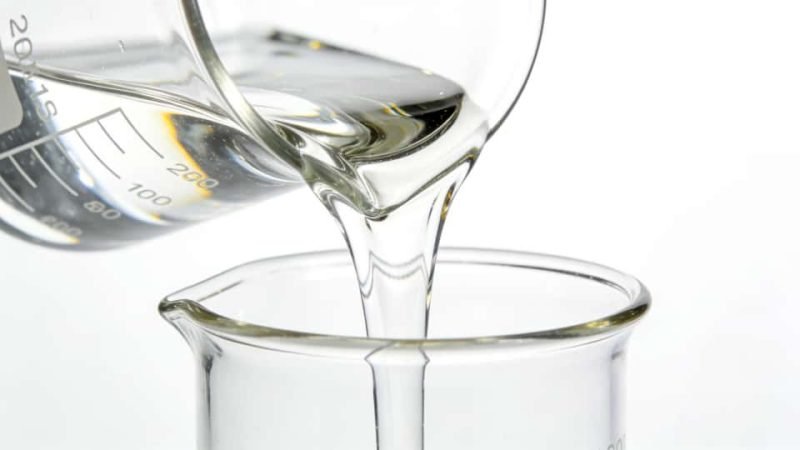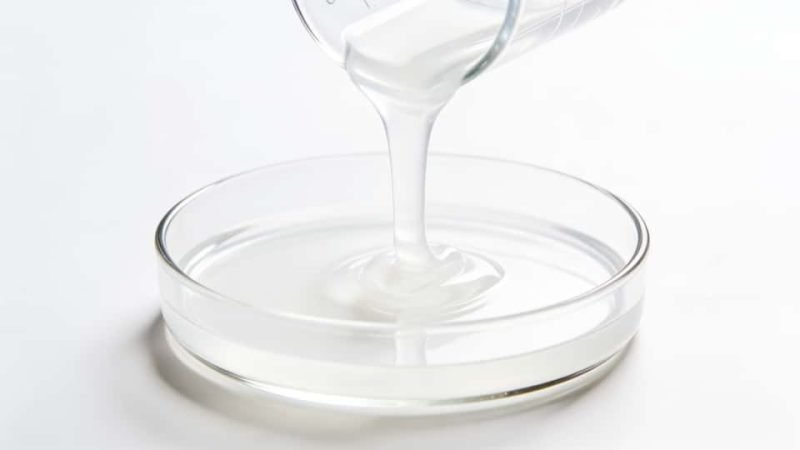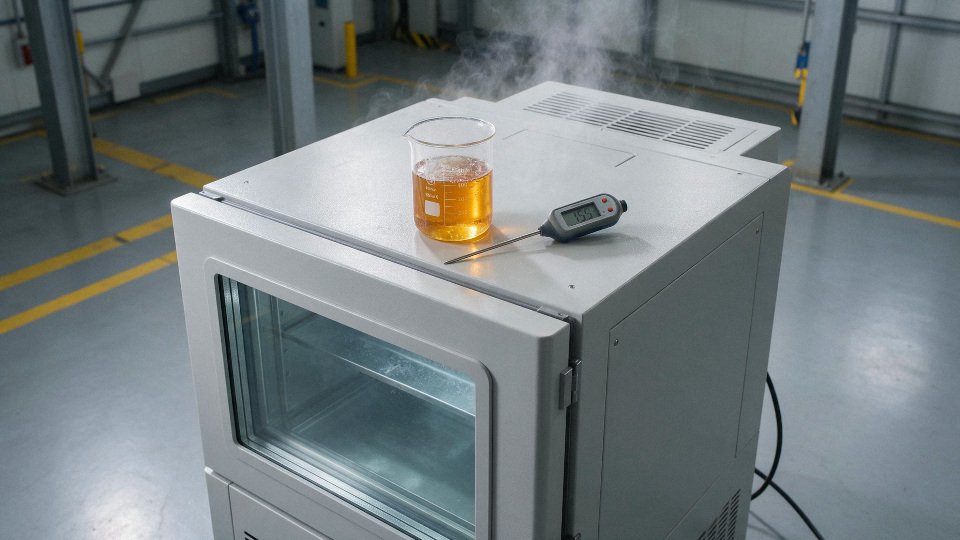
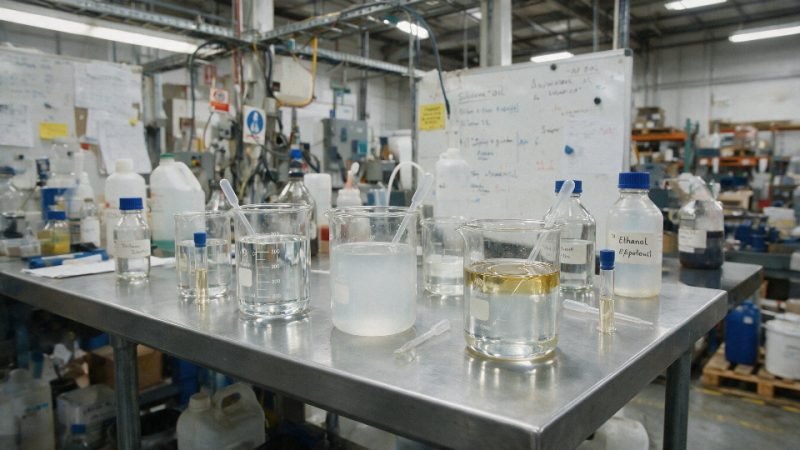
You can lose half a day on a tank mix that looks fine in the beaker and splits by the time it reaches the line. With silicone oil and alcohol, that usually shows up as haze, floating slicks, unstable wetting, or a finish that drifts shift to shift; then procurement gets pulled into rush solvent buys, rework, and arguments over whether the fault sits with the fluid, the solvent grade, or the mixing sequence. The practical fix is not to ask whether “silicone oil” is soluble in “alcohol” as a category, but to match the specific silicone chemistry, viscosity, alcohol type, water content, and target concentration before anyone commits to production.
Standard dimethyl silicone oil is usually negligible to very limited in solubility in ethanol or isopropanol at room temperature unless a compatibilizer is used. Modified silicone fluids can behave very differently, and some low-viscosity grades can form clear or semi-clear alcohol solutions from roughly 1% up to 50%, depending on functional groups, solvent purity, and temperature.
That gap between “silicone oil” on the label and what actually happens in alcohol is where most selection mistakes start. Two drums can look interchangeable on a purchase order and behave nothing alike in a blend room, so the useful question is not just yes or no, but which silicone structure, in which alcohol, at what ratio, under what storage and line conditions.
Silicone oil families
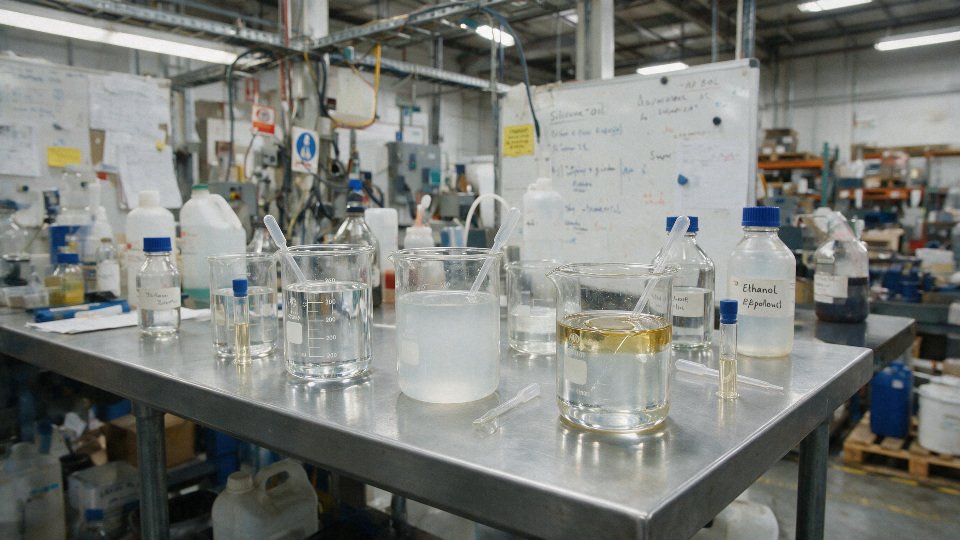
If two drums are both labeled “silicone oil,” one may sit cleanly in an alcohol blend while the other throws haze, strings, or a hard phase break within minutes. The difference is usually not the alcohol first; it is the silicone family, the functional groups on the siloxane chain, and whether you are dealing with a neat fluid, a modified fluid, or a formulated product.
The practical mistake I see most often is treating silicone oil as a single material class. On a purchasing sheet that may be good enough. On the plant floor, it is not. A dimethyl fluid for release or lubrication behaves very differently from an amino silicone used in textile softening, and both behave differently again from a polyether-modified wetting agent designed to go into polar systems.
Conventional dimethyl silicone oil
Dimethyl silicone oil, usually polydimethylsiloxane or closely related trimethylsiloxy-terminated fluid, is the baseline reference for this whole question. It is chemically stable, strongly hydrophobic, low in surface tension, and in typical ethanol or isopropanol systems at room temperature it shows negligible to very limited true solubility without some compatibilizing help.
That combination of properties is why dimethyl fluid is so useful in defoaming, lubrication, mold release, dielectric service, and water-repellent applications. The methyl groups shield the siloxane backbone from polar interaction, so alcohol molecules do not “grab” the fluid effectively enough to produce a stable single phase in most practical mixing ratios.
What operators often notice instead is apparent short-term mixability:
- A low-viscosity dimethyl fluid can disperse temporarily under agitation
- Warm solvent can reduce haze for a while
- Small additions into a multicomponent formula may look clear at first
- A drum sample may pass a quick beaker check and still separate overnight
That is not a minor distinction. Temporary dispersion is not the same thing as thermodynamic solubility, and the cost of getting that wrong is usually rework, line stoppage, or a finish that drifts batch to batch.
Phenyl-modified silicone oils
Phenyl-modified silicone oils replace some methyl groups with phenyl groups. That change usually raises refractive index and can improve low-temperature flow characteristics in certain formulations, which is why these fluids show up in optical, cosmetic, and specialty lubricating applications.
Phenyl substitution also changes solvent compatibility, but not in the simplistic way people sometimes expect. Better compatibility with some organic media does not mean “alcohol soluble.” In practice, phenyl content may broaden the compatibility window with selected solvent blends, especially where less-polar co-solvents are present, yet straight ethanol or IPA still may not hold the fluid in a clear, stable solution across useful concentration ranges.
The trade-off here is straightforward:
- You gain optical and formulation flexibility in some systems
- You may improve compatibility with certain hydrocarbons or aromatic-rich blends
- You do not automatically gain robust single-phase behavior in polar alcohol media
That last point matters in procurement because a supplier may correctly state “improved solvent compatibility,” but that claim is too broad to approve an alcohol-based process without a blend test.
Amino-functional silicone oils
Amino-functional silicone oils are common in textile finishing, hair-care conditioning, and specialty surface-treatment work because the amino groups increase substantivity to fibers, keratin, and some mineral surfaces. They often deposit better than plain dimethyl fluids and can deliver softer hand, lubricity, or conditioning at lower use levels.
Those amino groups also increase polarity, so formulators sometimes assume they will dissolve well in alcohol. Sometimes they behave better in formulated alcohol-containing systems, especially when neutralized, emulsified, or combined with surfactants or other modifiers. That still does not guarantee full alcohol solubility as a neat fluid.
Amino silicones are a good example of why mechanism matters. The functional group can improve interaction with a polar medium, but it also introduces variables that affect stability:
- Amine content and type
- Degree of substitution along the siloxane chain
- Molecular weight
- Whether the amine is free, neutralized, or salt-formed
- Presence of water, acid, or nonionic surfactants
In practice, a textile plant may get a stable alcohol-water concentrate from one amino silicone package and complete phase separation from another that looks similar on paper. The boundary here is important: once the product is sold as an emulsion concentrate or pre-neutralized formulation, you are no longer judging the neat silicone family alone.
Polyether-modified silicone oils
Polyether-modified silicone oils are usually the most relevant family when alcohol compatibility is the actual buying criterion. By grafting polyether chains onto the siloxane backbone, the material becomes more polar and can behave as self-dispersing, water-dispersible, or in some cases alcohol-soluble depending on chain design and formulation conditions.
This is the family behind many wetting agents, leveling additives, agricultural adjuvants, and specialty coatings additives. The polyether segment gives the alcohol or water phase something to interact with; the siloxane segment still brings low surface tension and spreading.
That gives you a useful but not unlimited design window:
| Silicone family | Typical behavior in alcohol systems | Main commercial use logic |
|---|---|---|
| Dimethyl | Usually insoluble or only temporarily dispersible | Lubrication, release, defoaming, dielectric |
| Phenyl-modified | Compatibility may improve in some solvent blends; not inherently alcohol-soluble | Optical, low-temperature, specialty fluids |
| Amino-functional | Better affinity in formulated systems; neat-fluid solubility still variable | Textile, personal care, surface treatment |
| Polyether-modified | Most likely to form clear or semi-clear alcohol blends | Wetting, leveling, dispersing, adjuvant service |
Typical low-viscosity modified fluids can form clear or semi-clear alcohol solutions from roughly 1% up to much higher levels, sometimes into the tens of percent, but that range depends heavily on:
- Polyether type and length
- EO/PO balance where relevant
- Alcohol type and purity
- Temperature
- Water content
- Presence of other resins, salts, or actives
Polyether-modified silicone oils are generally the most suitable silicone oil class for alcohol-compatible formulations.True
This aligns with established formulation practice because polyether chains increase polarity and improve interaction with alcohol media. The exact compatibility range still depends on structure, solvent purity, and blend conditions, so product-specific testing is still required.
The trade-off is not trivial. As polyether content rises, alcohol compatibility and wetting often improve, but you may sacrifice some slip, water repellency, foam profile, hydrolytic stability, or surface feel compared with a simpler dimethyl fluid. In a coating or cleaner, that may be fine. In a release or dielectric application, it may be the wrong direction entirely.
Hydroxyl-, epoxy-, alkyl-, and other specialty modified siloxanes
This group is broad, and broad claims are where people get into trouble.
Common specialty types include:
- Hydroxyl-functional siloxanes: often used as reactive intermediates, in condensation systems, or where further curing is expected
- Epoxy-functional siloxanes: selected for adhesion promotion, coating modification, and reactive systems
- Long-alkyl-modified siloxanes: used where organic compatibility, slip, or specific surface effects are needed
- Other reactive or polar variants: carboxyl, mercapto, fluoro, and custom grafted structures for narrow uses
Polar or reactive groups can widen compatibility with certain solvents, including some alcohol-containing systems, but they also change downstream behavior. A fluid that looks compatible in the mixing tank may later react, self-condense, lose pot life, or interfere with cure if moisture, catalyst, or resin chemistry is not controlled. Anyone buying these grades for coatings, sealants, or primers should verify both blend stability and the cured-film result; one without the other is not enough.
Viscosity, molecular weight, and product form
Lower-viscosity fluids often look more mixable because they break into finer droplets under shear and haze less at first glance. That visual effect fools a lot of people. Chemical functionality usually dominates true solubility; viscosity mainly affects how fast separation shows up and how convincing the temporary dispersion looks.
Before judging alcohol solubility, identify exactly which product form you have:
- Neat silicone fluid
- Silicone blend with organic solvent
- Emulsion
- Microemulsion
- Surfactant-containing concentrate
- Reactive intermediate
A microemulsion or formulated concentrate may be perfectly usable in an alcohol-rich process even when the underlying silicone polymer itself is not alcohol-soluble as a neat material. That distinction belongs on the PO, the COA review, and the lab screening sheet, not just in the supplier’s marketing copy.
Why alcohol rejects silicone
Standard dimethyl silicone oil is usually not thermodynamically comfortable in ethanol or isopropanol, because the solvent and the polymer do not offer each other the right kinds of intermolecular attraction. In plant terms, that is why a blend can look mixed under agitation, turn hazy after standing, or split cleanly into layers by the next shift even though nothing was “wrong” with the drum.
The short version is polarity mismatch, but that phrase hides the actual mechanism. Lower alcohols are polar protic solvents. They spend a lot of their energy budget in hydrogen-bonded networks with themselves and with water if any is present. Standard silicone oils, especially dimethyl types, have a very different surface character: a flexible siloxane backbone internally, but methyl groups presented externally, which makes the fluid low in surface tension and relatively poor at engaging with polar, hydrogen-bonding solvents.
Polarity mismatch is real, but it is not the whole story
“Like dissolves like” points you in the right direction, but it is too crude for troubleshooting an actual formulation. Two liquids can both be described loosely as “organic” and still reject each other because the attractive forces are distributed differently.
A more useful way to think about it is by the three main components behind solubility behavior:
- Dispersion interactions: weak, general van der Waals attraction present in almost all molecules
- Polar interactions: attraction from permanent dipoles
- Hydrogen bonding: stronger, more specific interaction where donor and acceptor sites matter
Lower alcohols such as ethanol and isopropanol bring all three, but the polar and hydrogen-bonding portions are doing a lot of work. Dimethyl silicone oil relies much more on dispersion-type interactions and has limited ability to participate in hydrogen-bonding. So even if the total solubility parameter does not look impossibly far apart on paper, the internal balance is wrong.
That distinction matters in formulation work. I have seen buyers look at one “overall” parameter value and assume a blend should be fine. Then the pilot kettle gives a bright, clear mix at 45 °C, everyone relaxes, and two days later the tote has a haze line halfway down. The problem was not poor mixing; it was that the alcohol-rich phase and silicone-rich phase had no strong thermodynamic reason to stay together once the temporary help from heat and shear disappeared.
Why dimethyl silicone oil in particular has weak attraction to alcohol
The siloxane backbone, Si–O–Si, is flexible and unusual compared with a hydrocarbon chain. That flexibility lowers viscosity for a given molecular size and gives silicones some of their useful wetting and lubricity behavior. But in dimethyl silicone oil, the chain is sheathed mainly by methyl groups. Those methyl groups dominate what neighboring molecules “see.”
That external methyl-rich surface does two things that work against alcohol compatibility:
- It limits polar interaction with the solvent
- Ethanol and isopropanol can stabilize dissolved species when they can orient around polar sites.
- Dimethyl silicone oils offer very few effective sites for that kind of stabilization.
- It does not compensate for breaking the alcohol’s own structure
- To dissolve a silicone chain, the alcohol has to give up some alcohol-alcohol hydrogen bonding.
- If the new alcohol-silicone interactions are not strong enough to repay that energy cost, dissolution is unfavorable.
That is the core reason alcohol “rejects” standard silicone oil. The solvent would rather stay associated with itself than reorganize around a dimethylsiloxane chain.
Clear appearance right after mixing does not prove true solubility.True
A silicone-alcohol blend can appear clear for minutes or hours because of temporary dispersion, elevated temperature, or incomplete phase growth. Storage observation is needed to distinguish true solution behavior from metastable mixing.
Solubility parameter mismatch: where the simple rule stops being enough
Solubility parameter language is useful if you treat it as screening, not as a guarantee. A mismatch in total cohesive energy density often predicts trouble, but the practical failure point usually comes from the hydrogen-bonding and polar components, not the total value alone.
Here is the mechanism in plain terms:
- Alcohol molecules are strongly self-associated through hydrogen bonding.
- Dimethyl silicone molecules are flexible and mobile, but chemically “quiet” toward that network.
- Mixing requires the solvent to open space and reorganize.
- If the silicone does not return enough favorable interaction energy, the free-energy balance stays negative for dissolution.
That is why the old shop-floor rule that “silicone likes hydrocarbons better than alcohols” is often directionally right. Hydrocarbon-type solvents do not ask the silicone to pay the same hydrogen-bonding penalty.
The boundary on that rule is important, though: once the silicone carries functional groups with real polarity, behavior can change sharply. You cannot generalize from a straight PDMS fluid to every silicone fluid in a purchasing catalog.
Why modified silicone fluids can behave very differently
Add polyether groups, certain alkoxy functionality, or other polar side chains, and the balance shifts. Those groups create new interaction points with alcohol molecules. In effect, they give the alcohol a reason to keep the silicone chain in solution.
The mechanism is straightforward:
- Polar side groups increase alcohol affinity
- They provide dipole interaction and, in some cases, hydrogen-bond acceptance.
- The modified chain becomes amphiphilic
- Part of the molecule still behaves silicone-like, but the side group talks to the solvent.
- The solvated side groups can drag the rest of the chain into a stable or semi-stable mixed state
This is why some low-viscosity modified silicone fluids can form clear or semi-clear alcohol solutions over a broad practical range, roughly from low single-digit percentages up to much higher loadings, depending on:
– Functional group type and level
– Molecular weight and viscosity
– Alcohol type
– Solvent purity
– Temperature
The trade-off is that you usually give up something to gain compatibility. A strongly alcohol-compatible modified silicone may have different slip, foam, release, migration, or water-sensitivity behavior than a standard dimethyl fluid. In other words, the “best dissolving” product is not automatically the best performing one on the substrate.
Water in technical-grade alcohol is a common spoiler
A small amount of water can materially change what you see, especially in borderline systems. That catches people all the time because the alcohol drum is labeled correctly, but the actual water content varies by grade, by storage condition, and sometimes by how often the container has been opened.
Water matters because it strengthens the polar, hydrogen-bonded character of the solvent phase. For many silicone-organic blends, that pushes the medium even farther away from what the silicone chain can tolerate. The result can be:
- Faster haze formation
- Earlier cloud point
- Layer separation that did not appear in drier solvent
- False pass/fail results between lab batches
In practice, this is one reason two labs can report different compatibility results on “the same” formula. One used fresh high-purity IPA from a sealed container. The other used alcohol that had picked up moisture from repeated shop-floor handling. The visual difference can be dramatic.
If alcohol purity is not tightly controlled, screening data are not very trustworthy. For anything commercially important, log the solvent grade and actual water content if available, or at least keep the source and container handling consistent through the trial series.
Heat can help mixing, but not necessarily storage stability
Heating often improves apparent compatibility because viscosity drops, diffusion speeds up, and some mixtures move closer to a one-phase region temporarily. That can be useful in processing, but it is also where people fool themselves.
What commonly happens:
- The silicone and alcohol are mixed warm.
- The batch turns clear or nearly clear.
- Filling goes smoothly, so the system is assumed stable.
- Material cools in storage or shipment.
- Haze, stratification, or viscosity drift appears later.
The key point is that processing temperature and storage temperature are different design conditions. If the product will sit at 20 to 30 °C in a warehouse, or worse, cycle between day and night temperatures in transport, that is where compatibility has to hold.
A practical screening approach is to check blends at several ratios, then observe:
– Initial clarity
– Time to haze or phase split
– Change after 24 to 72 hours
– Behavior after a heat-cool cycle
– Behavior at the lowest expected storage temperature
Clear is not the same as soluble
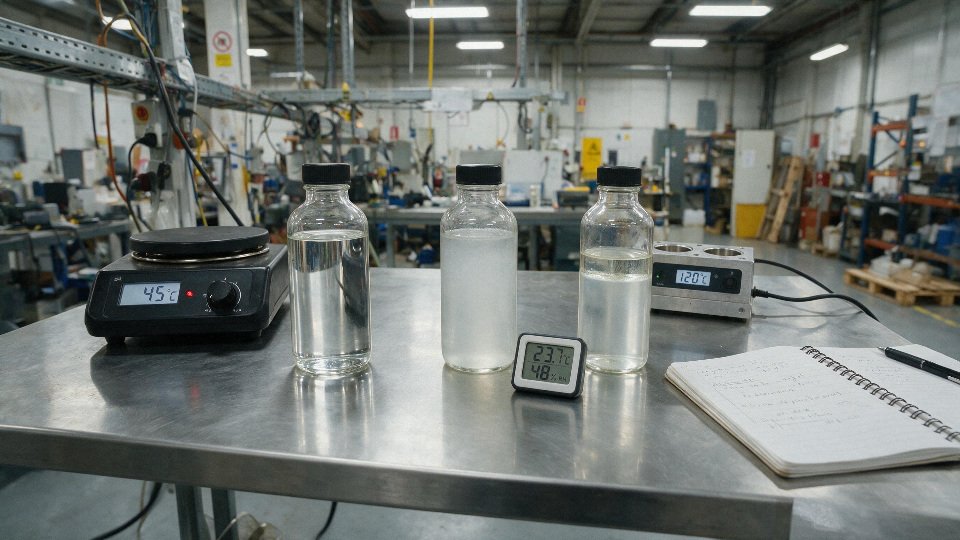
This is the most important distinction in day-to-day formulation work: thermodynamic solubility, kinetic stability, and visual clarity are not the same thing.
A blend may be:
- Thermodynamically soluble
- One true phase at the tested composition and temperature
- Metastable but clear
- Looks fine now, but phase separation is only delayed
- Dispersed
- Very small droplets scatter little light at first, then grow and turn hazy
- Visually hazy but functionally usable
- In some process aids, slight haze is acceptable if performance is stable; in coatings or cosmetics, usually not
The failure path is often kinetic first, then visual, then functional. Small silicone-rich domains form, coalesce slowly, and only later become visible. By the time the operator sees a top layer or ring on the drum wall, the blend has usually been unstable for some time.
That is why a proper compatibility screen should not stop at “looks clear after mixing.” The 1:9, 3:7, 5:5, and 7:3 oil-to-alcohol checks over 24 to 72 hours are simple but useful because they expose systems that only pretend to be compatible in the first hour. If a product is headed for long storage, cold shipment, or variable solvent quality, extend the observation window and test with the actual commercial alcohol grade rather than lab-grade solvent.
Alcohol compatibility matrix
For standard dimethyl silicone oil, the short answer is simple: methanol, ethanol, and isopropanol are usually poor screening solvents, while less polar alcohols such as n-butanol may show somewhat better compatibility but still do not make a conventional silicone fluid broadly “alcohol-soluble.” The decision flips once you move into modified silicone fluids, because the functional group on the molecule often matters more than the alcohol name on the drum.
What buyers and formulators usually need is not a textbook polarity ranking but a practical screen: which alcohol is worth testing first, which one is likely to give a false positive on initial appearance, and which one creates unnecessary plant headaches even if the bench sample looks acceptable.
How the common industrial alcohols behave
| Alcohol type | Standard dimethyl silicone oil | Modified silicone fluids | Main practical notes |
|---|---|---|---|
| Methanol | Insoluble to negligibly compatible | Sometimes partially compatible, but often still poor | Highest polarity of the common low-MW alcohols; toxic handling profile; often not preferred for production formulations |
| Ethanol | Usually insoluble | Formulation-dependent; some modified grades can form clear or semi-clear systems | Very common in coatings, cleaners, personal care; water content strongly affects behavior |
| Isopropanol (IPA) | Usually insoluble | Formulation-dependent; sometimes preferred over ethanol for process reasons | Drying/handling balance is often the reason to choose it, not dramatically better solvency |
| n-Butanol | Partially compatible in some cases, still limited for many PDMS fluids | Often better than lower alcohols for selected siloxanes | Slower evaporation, stronger odor, VOC and process trade-offs |
| Higher alcohols / specialty alcohols | Variable, sometimes improved compatibility | Can support niche systems | Need to check resin package, drying target, and regulatory fit |
| Benzyl alcohol | Not a general solvent for standard silicone oil | May help certain modified silicone systems as co-solvent or plasticizing solvent | High boiling, specialty use, can improve incorporation but change dry time and residue profile |
| Industrial alcohol blends | Unpredictable without testing | Unpredictable without testing | Denaturants and moisture can shift phase behavior sharply |
That table is useful as a first pass, but it hides the main trap: an alcohol can improve the appearance of the blend at mixing and still give you a bad product 24 hours later.
Methanol: usually the worst practical choice for standard silicone oil
Methanol is often the poorest of the common alcohols for conventional silicone oils because its high polarity is a poor match for the low-polarity siloxane backbone. On the bench, that usually shows up as immediate clouding, stringy separation, or a temporary dispersion that breaks into two layers after standing.
There is also a commercial point here. Even if methanol gives a useful lab signal for a specific modified silicone, many plants will avoid building a production formula around it because of toxicity controls, exposure restrictions, shipping concerns, and customer acceptance. In practice, a solvent that procurement can source cheaply is not necessarily a solvent that EHS or the customer spec will tolerate.
Mechanistically, methanol can selectively interact with the polar modifier on a modified silicone while leaving the siloxane-rich portion under-solvated. That is why you sometimes see an odd result: the mixture goes clearer during agitation, then turns hazy or separates after a few hours as the polymer chains reorganize. Initial clarity in methanol is not reliable evidence of true single-phase stability.
Ethanol: common, useful to screen, but very sensitive to water and silicone type
Ethanol is the alcohol most buyers ask about because it sits in so many commercial systems: surface cleaners, textile auxiliaries, cosmetic bases, release aid carriers, and coating packages. For unmodified dimethyl silicone oil at room temperature, compatibility is typically negligible to very limited. For selected modified silicone fluids, especially lower-viscosity grades, clear or semi-clear solutions can sometimes be built anywhere from low single-digit percentages up to much higher levels, but only under the right formulation conditions.
The biggest variable is water. Ethanol that is nominally “industrial grade” can carry enough moisture to shift a blend from clear to hazy, or from stable to phase-separated. That happens because water increases the effective polarity of the alcohol phase and can collapse whatever narrow compatibility window the modifier created. Plants see this in winter and monsoon seasons more than they expect, especially when drums breathe or solvent is transferred through lines that are not kept dry.
A second variable is solvent purity beyond water alone. Denaturants or residual ketones can improve or worsen the look of the blend depending on the silicone chemistry. If you are screening ethanol systems seriously, use a controlled grade and record the water level. Otherwise two lab batches can disagree for reasons that have nothing to do with the silicone itself.
Anhydrous ethanol can make a modified silicone appear fully compatible, while a wetter ethanol grade from the same supplier can destabilize it.True
This is consistent with standard solvent-polymer compatibility behavior. For alcohol-sensitive silicone formulations, moisture can materially shift haze, phase separation time, and long-term stability. The exact threshold depends on the silicone structure and cannot be generalized without testing.
Isopropanol: chosen as often for process behavior as for solvency
Isopropanol is common on the plant floor because it is familiar, fast enough to dry, and generally easier to live with than some heavier alcohols. For standard silicone oil, though, it is often no better than ethanol in any meaningful sense. If a buyer expects IPA to “solve” a PDMS incompatibility, that usually ends in a cloudy sample jar.
Where IPA earns its place is in formulation balance. It can give a different evaporation profile, different wetting behavior on the substrate, and sometimes better handling in wipe-on or spray applications. Those process benefits can matter even if its solvency for the silicone is only marginally changed. A cleaner that flashes too fast with ethanol may streak; one built around IPA may lay down more evenly. That is not the same thing as saying the silicone is more soluble.
The trade-off is that slower evaporation relative to methanol or some ethanol blends can help application uniformity but may extend tack time or leave more opportunity for phase migration before the film sets. If the silicone is only conditionally compatible, that extra open time can actually worsen appearance on the part.
n-Butanol and higher alcohols: sometimes better compatibility, never a free upgrade
As alcohol chain length increases, polarity drops, and some silicone systems become easier to incorporate. n-Butanol is the common example. It may show better partial compatibility with certain siloxanes than ethanol or IPA, and for some modified silicone fluids it can act as a useful bridge solvent.
That gain comes with obvious shop-floor penalties:
- Slower drying
- Stronger residual odor
- Higher solvent hold-up in porous or textured substrates
- Different VOC and labeling implications depending on market
- Higher process cost in some regions
- More difficult cleanup if operators are set up for fast-evaporating alcohols
The preferred choice flips if the line needs rapid flash-off, low odor, or a residue-sensitive finish. In those cases, slightly better solubility in n-butanol may not help the total process. You get a clearer bulk blend but a slower, less forgiving operation.
Benzyl alcohol and specialty alcohols: niche tools, not default options
Benzyl alcohol and certain specialty alcohols can help specific modified silicones where co-solvency, plasticization, or slower film formation is useful. They are not general replacements for ethanol or IPA. Their value is usually in a narrow formulation problem: getting a modified silicone to stay incorporated with another resin, improving leveling, or softening the solvency gap between the silicone fraction and the rest of the package.
The limitation is straightforward. High-boiling specialty alcohols can improve incorporation while hurting dry time, residual feel, odor, or extractables. That makes them more suitable for carefully designed coatings or treatment systems than for general-purpose cleaners or fast-cycle processing.
Industrial alcohol blends: the most common source of false assumptions
Denatured alcohols, mixed alcohol cuts, and water-containing grades are where compatibility work often goes off track. One denatured ethanol may contain components that temporarily improve clarity; another may push the same silicone straight out of solution. Plant teams sometimes say “it worked in alcohol last year” when the actual variable was a change in denaturant package or moisture pickup in storage.
Use a simple screening matrix instead of guessing:
- Test at 1:9, 3:7, 5:5, and 7:3 silicone-to-alcohol ratios.
- Record immediate appearance: clear, semi-clear, hazy, or separated.
- Recheck after 24, 48, and 72 hours.
- Note viscosity drift, not just phase split.
- Repeat with the actual production solvent grade, not just reagent-grade lab alcohol.
- If the system is near the boundary, repeat at expected plant temperature range.
The useful way to read alcohol compatibility is by class, not by hope. Standard dimethyl silicone oils are usually insoluble in the common low-molecular-weight alcohols; modified silicone fluids may be partially compatible, conditionally soluble with a co-solvent, or genuinely formulation-dependent. If a blend only stays clear when freshly mixed, or only with one unusually dry solvent lot, you do not yet have a robust process solvent—you have a narrow lab condition that still needs proving.
Formulation pathways
You usually have four workable routes when a standard silicone oil will not stay compatible with alcohol: switch to a silicone designed for polar media, add a bridging co-solvent, move to an emulsion approach, or force compatibility with surfactants and process control. The right route depends less on the word “silicone” and more on what the finished system must actually do on the part: remain crystal clear, deposit a lubricating film, knock down foam, improve wetting, or leave almost nothing behind.
A lot of formulation trouble starts when buyers ask for “silicone soluble in IPA” as if that were one product category. In practice, the choice is driven by end-use boundaries. A wipe-down fluid for optical parts, a sprayable release aid, and an alcohol-based leveling additive for coatings can all need completely different chemistry.
Modified silicone fluids for alcohol-rich systems
If you need a clear or semi-clear alcohol solution, the cleanest path is usually a modified silicone fluid rather than trying to force ordinary dimethyl silicone oil into a solvent it does not like. Polyether-modified silicones are the most common answer because the polyether segment gives the molecule enough affinity for polar media to dissolve or self-disperse in ethanol, isopropanol, or mixed alcohol systems.
What changes physically is straightforward: the silicone backbone still delivers low surface tension, slip, and spreading, but the polyether or other polar functionality interacts with the alcohol phase strongly enough to reduce phase separation. That is why some low-viscosity modified fluids can stay clear over a meaningful concentration range while a conventional PDMS fluid clouds almost immediately. The exact workable range can vary widely, roughly from very low treat levels up to much higher blend ratios, and it depends on:
- Functional group type and level
- Silicone molecular weight and viscosity
- Alcohol choice
- Solvent purity and water content
- Temperature
- Whether other formulation components compete for solubility
The trade-off is not subtle. As you increase polar modification, you usually gain compatibility and wetting, but you may give up some of the classic silicone traits:
- Lower slip than a comparable non-modified silicone
- Reduced hydrophobicity after deposition
- Greater foam tendency in some systems
- More sensitivity to electrolytes or resin interactions
- Higher chance of recoating or adhesion issues on some substrates
That last point matters on paint lines and converting lines. A modified silicone that behaves beautifully in the drum can still create fisheye, printability loss, or bond failure if too much migrates to the surface. On paper, film, coated metal, and cured elastomers, I would not trust a compatibility win unless the downstream adhesion test also passes.
Co-solvents that bridge the polarity gap
When direct alcohol compatibility is close but not good enough, a co-solvent can widen the operating window. Hydrocarbons, esters, glycol ethers, and ketones are typical bridging solvents where the regulatory profile, flash point, VOC rules, and customer specification allow them.
Their job is to reduce the polarity mismatch between the alcohol phase and the silicone phase. In simple terms, they give the silicone something it can sit in while still staying miscible enough with the alcohol-rich bulk liquid. This often turns a two-layer failure into a usable single phase or at least a more stable blend.
Typical co-solvent families and what they tend to do:
| Co-solvent family | What it helps with | Common downside |
|---|---|---|
| Aliphatic or aromatic hydrocarbons | Stronger silicone solvency | Often poor fit for alcohol-heavy, low-odor, or stricter VOC systems |
| Esters | Good balance in some coating and cleaner formulations | Can affect dry time, odor, and substrate sensitivity |
| Glycol ethers | Strong bridging effect in many mixed-polarity systems | Slower evaporation, worker exposure review needed |
| Ketones | Fast solvency, often useful in short-dry systems | Flammability, aggressive toward some plastics or coatings |
The mechanism is only half the story; the evaporation curve matters just as much. If the alcohol flashes off first and leaves behind a concentrated silicone/co-solvent residue, you may see craters, oiling out, or non-uniform deposition. In practice, a blend that looks perfect in a beaker can fail on a warm line running at speed because the solvent balance shifts during atomization or wipe application.
This route stops being the preferred choice when the product must be food-contact sensitive, ultra-low residue, very low odor, or tightly constrained on VOC and flammability. Then you are usually pushed back toward a purpose-built modified silicone or an emulsion route.
Emulsions for water-alcohol systems
If optical clarity is not the priority, emulsification is often more forgiving than chasing true solubility. Silicone emulsions, microemulsions, and nanoemulsions let you deliver lubricity, release, gloss, anti-blocking, or surface modification through a dispersed silicone phase instead of a molecular solution.
Use this route when the functional target is deposition on the surface, not a perfectly clear package. Common cases include:
- Textile finishing
- Mold release maintenance sprays
- Water-alcohol wipe formulations
- Surface care products
- Some metalworking and handling aids
There are practical differences among emulsion types:
- Conventional emulsions are usually easier to make and cheaper, but may be milky and less stable under solvent stress.
- Microemulsions can give smaller particle size and better transparency, but they often require tighter surfactant balance.
- Nanoemulsions may improve deposition uniformity and feel, though the process and stabilizer package become more sensitive.
The trade-off here is residue package complexity. You are no longer only depositing silicone; you are also bringing emulsifiers and sometimes protective colloids along for the ride. That can change gloss, foam, rinse behavior, and contamination risk on surfaces that will later be painted, printed, bonded, or plasma treated.
Surfactants and coupling agents: useful, but easy to overdo
Surfactants and coupling agents can rescue a borderline system, especially at low silicone dosage. They improve wetting, reduce interfacial tension, and help maintain dispersion or temporary clarity. Silane-type coupling agents may also help anchor the deposited layer to certain inorganic substrates, depending on the chemistry and cure conditions.
Use them carefully because they solve one problem by creating others:
- Foam can increase sharply, especially with dynamic mixing or spray application
- Defoaming performance can collapse if the surfactant package is too effective at stabilizing air
- Residue can become more noticeable after drying
- Hydrophobicity may drop because the surface is no longer silicone-dominant
- Recoatability, printability, or adhesive bond strength may suffer
- Cured surface contamination becomes harder to diagnose because the failure is now a mixed organic film, not just silicone
Heavy surfactant loading is one of the most common formulation mistakes in alcohol-silicone systems. It can make a lab sample look stable for a day and still leave the user with foam, weak water repellency, or a surface that the next process step will not tolerate.
If enough surfactant is added, any silicone oil can be made suitable for alcohol-based systems without side effects.False
Surfactants can improve apparent compatibility or dispersion, but they often change foam behavior, residue, surface energy, and downstream adhesion. Suitability still depends on the application, dose, and what the treated surface must do next.
Process controls that decide whether the batch stays stable
A surprising number of “chemistry failures” are really process failures. Alcohol purity, water content, addition order, shear level, and temperature all affect whether a blend stays uniform or drifts into haze and separation over 24 to 72 hours.
For screening work, a simple staged blend check is worth doing before anyone scales a drum:
- Prepare oil-to-alcohol blends at 1:9, 3:7, 5:5, and 7:3.
- Record immediate appearance: clear, slight haze, cloudy, or two-phase.
- Recheck after 1 hour, 24 hours, and 72 hours.
- Note phase separation time, top/bottom layer ratio, and viscosity drift.
- Repeat with expected plant water content if the alcohol supply is not absolute grade.
A few shop-floor points matter more than people expect:
- Adding alcohol too fast into a concentrated silicone-rich phase can create localized shock incompatibility.
- High shear may temporarily improve appearance but does not guarantee true stability.
- Small water pickup from open tanks, humid air, or reused lines can shift a borderline system into haze.
- Cold blending can trigger temporary cloudiness; warming may clear it, but verify that the effect is reversible.
- Residual detergent in an IBC or transfer hose can completely distort the test.
Balancing the performance package
The best formulation is rarely the one with the maximum silicone compatibility. It is the one that delivers the right operating balance:
- Slip and lubricity
- Leveling and wetting
- Defoaming or foam control
- Spreadability on the target substrate
- Volatility and dry-time profile
- Tactile feel
- Deposit efficiency at the actual application rate
A wipe fluid, for example, may tolerate slight haze if it lays down a uniform low-friction film and dries clean. A coating additive cannot. A spray lubricant may need stronger deposition and can accept some residue package; an electronics cleaner usually cannot.
If you are screening options, send the actual substrate material, contaminant or use condition, approximate application rate, alcohol type and purity, required appearance, and any downstream painting, bonding, or printing step. That is usually enough to narrow the route before lab work starts.
Application-specific implications
Alcohol compatibility matters only insofar as it changes what reaches the surface, what stays in package, and what defects show up at line speed. A silicone that is “insoluble” on paper can still work well if the job is slip, deposition, or release; it becomes a problem when the application demands a clear, stable, low-residue single phase from drum to nozzle to substrate.
That is why buyers get into trouble when they ask only, “Will it dissolve in ethanol?” The better question is narrower: clear solution or stable microdispersion, at what alcohol ratio, for how long, through which pump, and with what finish requirement after drying.
Coatings and inks
In alcohol-borne and alcohol-reduced coatings, silicone is usually there for one of four jobs:
- leveling
- crater control
- slip and anti-blocking
- surface feel or release
Those jobs do not all want the same compatibility window. A fully incompatible silicone can seed defects instead of curing them. A too-compatible silicone can flatten the surface tension gradient so much that intercoat adhesion, printability, or recoat behavior starts to drift.
The mechanism is straightforward. Silicone additives work by migrating rapidly to the air-film interface and lowering local surface tension. If the additive is poorly matched to the resin-alcohol package, it may separate too early, form droplets, or create local concentration spikes. On a panel or printed web, that shows up as:
- fisheyes
- Benard-cell-type flow marks
- haze in clear systems
- floating or poor pigment orientation
- variable gloss
- craters that appear worse after a “fix” additive was introduced
A common plant-floor mistake is screening a silicone only in the solvent blend, not in the full letdown with resin, defoamer, pigment wetting package, and amine or acid neutralization state. In practice, a modified low-viscosity silicone that looks clear in ethanol can still turn a coating cloudy once resin solids and neutralizers are present. The reverse also happens: a silicone that is hazy in neat alcohol may perform acceptably in the actual binder system because the resin acts as a compatibilizing medium.
The trade-off is familiar to anyone who has tuned a gravure or flexo ink: stronger slip and crater resistance often come with a narrower defect-free dosage window. Start low, especially in clear topcoats and overprint varnishes, and watch the dried film, not just the blend in the beaker.
Personal care and cosmetics
For alcohol-rich sprays, serums, and hair products, the first split is simple: do you need optical clarity in the package, or do you need silicone deposition on skin or hair after the alcohol flashes off? Those are different formulation targets, and they often point to different silicone structures.
Clear hair serums, pump sprays, and fine fragrance-adjacent systems usually need a silicone that can remain solubilized or near-solubilized in the alcohol-water-fragrance package over shelf life and temperature swings. Here, low-viscosity modified silicones are often selected because standard dimethyl silicone oils are usually poor candidates for stable, clear alcohol systems without help.
Sensory products complicate the picture. A formulator may actually want partial incompatibility so the silicone deposits efficiently during drying and leaves combability, gloss, or a conditioned after-feel. Too much compatibility can leave less material on the substrate; too little can give haze, nozzle fouling, or visible separation in the bottle.
A clear alcohol-silicone cosmetic formula is not automatically the best sensory formula.True
Clarity and deposition are different targets. In many alcohol-rich systems, some controlled phase behavior during application can improve silicone laydown, while excessive incompatibility creates package instability or spray defects.
Watch the packaging hardware as well:
- fine-mist actuators are less forgiving of unstable dispersions
- dip tubes can separate product if density mismatch is high
- cold-weather storage can push a marginally clear system into haze or layering
Textile finishing
Textile finishing is where buyers often overvalue neat-solvent clarity and undervalue bath behavior on the machine. Amino-modified and hydrophilic silicones are commonly used in alcohol-assisted systems because they can improve wetting, hand feel, sewability, and substrate coverage, especially on difficult synthetic blends.
What matters on the line is:
- bath stability over the shift
- pickup consistency across fabric width
- hand feel after drying and curing
- yellowing risk, especially on whites and pale shades
- deposit on rollers, pads, and guide surfaces
Amino silicones can deliver a soft, full hand, but the boundary is important: on heat-sensitive shades or white goods, the yellowing risk can outweigh the softness gain. Solvent package, catalyst residue, drying temperature, and fabric chemistry all influence that outcome. A hydrophilic or more carefully modified silicone may be the safer route when rewettability and color cleanliness matter more than maximum softness.
Alcohol can help reduce viscosity and improve application uniformity, but if the silicone is only marginally compatible, the bath may drift during recirculation. That is when operators start seeing uneven hand, edge-to-center variation, or oily build on machine parts by the end of the run. A 24 to 72 hour compatibility check is useful in the lab; for textile work, a heated, agitated short-run simulation is often more revealing.
Industrial cleaners and release systems
Here the same silicone can be either contamination or value, depending on the plant.
Silicone is usually a contamination risk in:
- paint shop pretreatment and cleaning
- metal finishing before coating or bonding
- electronics cleaning
- oxygen-service or high-purity maintenance contexts where residue control is strict
Even a small carryover can wreck downstream wettability. If the process after cleaning involves painting, adhesive bonding, plating, or printing, standard silicone oils are often a poor choice in alcohol cleaners because trace residual film can create expensive reject modes that are hard to diagnose.
Silicone can be beneficial in:
- light-duty release systems
- lubricant wipes
- assembly aids
- maintenance fluids where boundary lubricity or nonstick behavior is desired
In those cases, perfect alcohol solubility may not be necessary. A controlled dispersion can leave a thin transfer film after the alcohol evaporates, which is exactly the mechanism the user wants.
Agricultural adjuvants and specialty process fluids
Organomodified silicones are often chosen in mixed solvent systems because spreading, wetting, and surface coverage matter more than simple solvent clarity. In agricultural adjuvants, the target may be rapid wetting on waxy leaf surfaces, retention under spray conditions, or compatibility with the active ingredient package.
The catch is that solvent optimization is doing several jobs at once:
- stabilizing the silicone
- protecting active ingredient compatibility
- controlling evaporation rate
- managing cold-storage behavior
- keeping viscosity in a sprayable range
A solvent package that looks fine in a bench blend can fail once salts, actives, or hard water enter the picture. That is why these systems are usually screened as full formulations, not as silicone-plus-alcohol only.
Electronics, precision cleaning, and maintenance fluids
For precision cleaning, standard silicone oils are usually on the wrong side of the risk-reward balance. The issue is not just poor alcohol compatibility. It is residue sensitivity.
If the cleaning target is optical parts, connectors, PCB assemblies, sensor housings, or components that will later be coated, bonded, or soldered, residual silicone can cause:
- contact problems
- coating dewetting
- adhesive failure
- difficult-to-remove smears
- false cleanliness confidence because the part looks clean but is not surface-active clean
That does not mean every silicone-modified fluid is disqualified. Some specialty systems are designed for very specific maintenance or protection functions. But for precision alcohol cleaning, the burden of proof is high and should come from residue testing, surface energy checks, and downstream process validation, not assumption.
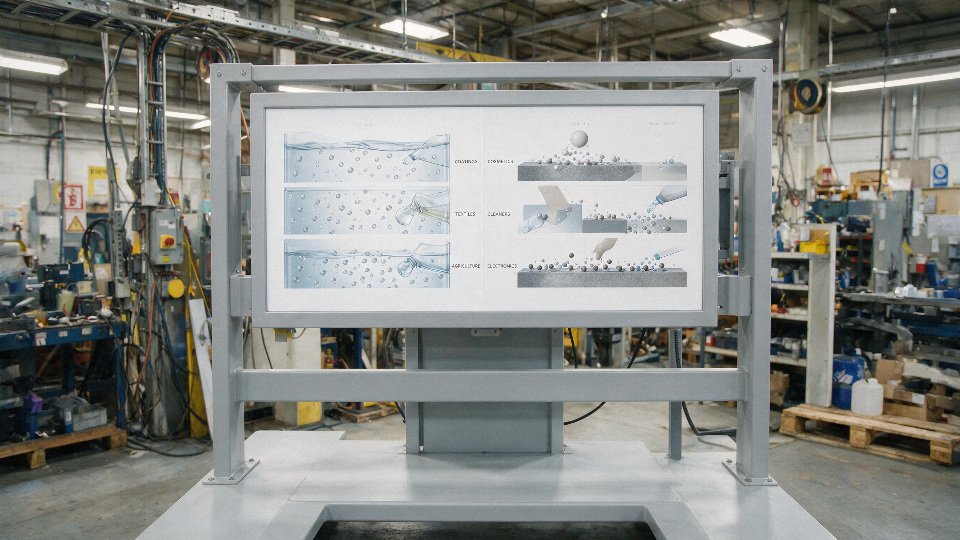
The misunderstood point is this: insolubility is not automatically a formulation failure. If the application benefits from controlled deposition, boundary lubrication, or release-film formation after the alcohol leaves, partial compatibility may be the better design window. It stops being acceptable when package stability, optical clarity, precision cleanliness, or defect-free surface appearance is the actual requirement.
Testing and failure signs
A silicone fluid that looks acceptable in a supplier vial can still fail once it sees your actual alcohol grade, water content, additive package, and plant temperature swing. For buying and scale-up decisions, compatibility is not a brochure claim; it is a formulation-specific test question that has to be answered with your exact blend and your actual application conditions.
A supplier certificate by itself is enough to confirm silicone oil compatibility in an alcohol-based formulation.False
Certificates can confirm identity, typical properties, and sometimes a supplier's internal compatibility observations, but they do not prove stability or performance in a customer's specific alcohol grade, additive package, process sequence, substrate, or storage condition.
Bench screening method
Start with a small, disciplined screening set. You are not trying to prove perfection on day one; you are trying to eliminate obvious failures fast and identify the blends worth deeper work.
- Use the actual alcohol grade
- Test with the same solvent family planned for production: ethanol, IPA, or blended alcohol.
- Match water content as closely as possible. A few percent water can flip a system from clear to hazy, especially with modified silicones.
- If the process solvent is denatured alcohol, test the denatured grade, not neat lab alcohol.
- Prepare ratio series
- Use the screening sequence already proven useful in practice:
- 1:9 oil-to-alcohol
- 3:7
- 5:5
- 7:3
- If the intended use level is very low, add one leaner point such as the actual use concentration in the finished formula.
- Use the screening sequence already proven useful in practice:
- Control mixing order
- Add silicone into alcohol first for one set.
- Add alcohol into silicone for a second set if the system is borderline.
- Some modified fluids tolerate one order much better than the other because local concentration spikes can trigger temporary association, haze, or microgel formation.
- Standardize agitation
- Use moderate shear first: magnetic stirrer, overhead stirrer, or capped bottle inversion at a repeatable rate.
- Avoid violent mixing as the only test. High shear can force a temporary fine dispersion that looks stable for an hour and then falls apart.
- Record mixing time. Ten minutes of controlled stirring is usually enough for a screening pass.
- Set observation windows
- Check immediately after mixing.
- Recheck after 30 minutes, 2 hours, 24 hours, and 72 hours.
- For elevated temperature screening, hold a duplicate set warm, often around 40 to 50°C if the formulation will see warm storage or heated process conditions. Then cool back to room temperature and inspect again.
- If the product may ship in winter or enter an unheated warehouse, add a low-temperature hold and watch for delayed clouding on cooling.
The mechanism matters here. A borderline-compatible silicone can look clear while warm because thermal motion helps keep it molecularly mixed or very finely associated. Once cooled, the interaction parameter gets worse, the system crosses its cloud point, and phase separation starts. That is exactly the kind of failure that shows up after a truck ride or a weekend shutdown, not necessarily during the first lab stir.
What to look for visually
Visual inspection is still the fastest filter, but do it systematically rather than by a quick glance through the bottle.
- Clear solution
- Best case, though not proof of long-term stability.
- Haze
- Often the first sign of incomplete compatibility or moisture sensitivity.
- Opalescence
- Usually indicates submicron dispersed domains rather than true solution.
- Oil ring at the meniscus or bottle wall
- Common with poor wetting of the container and early silicone separation.
- Layering
- Obvious fail for most single-phase applications.
- Sediment
- More relevant when other additives are present; silicone incompatibility can drag down waxes, resins, or matting agents.
- Stringiness or elastic threads
- Warning sign for associative thickening, partial gelation, or contamination.
- Delayed cloud point on cooling
- A frequent trap. The blend leaves the mixer clear, then turns milky overnight in a cooler room.
Quantitative checks that catch borderline failures
If a blend is even slightly important commercially, move beyond visual judgment.
| Check | What it tells you | Typical value of the test |
|---|---|---|
| Turbidity | Degree of haze or phase instability | Good for comparing candidate fluids or alcohol grades |
| Particle size, if dispersed | Whether you have a true solution or a fine dispersion | Useful when appearance is semi-clear but performance is inconsistent |
| Viscosity drift over 24 to 72 hours | Association, microgel growth, or structural breakdown | Catches systems that thicken or thin after standing |
| Density | Batch consistency and gross phase change | Helpful as a secondary QC check |
| Conductivity, where relevant | Water pickup or contamination in polar systems | More useful in controlled formulations than in simple screening |
| Centrifuge test | Accelerated separation tendency | Good for ranking unstable candidates quickly |
| Accelerated storage | Heat-aging or temperature-cycle stability | Closer to logistics reality than a single room-temperature snapshot |
The trade-off is straightforward: the more modified and alcohol-compatible the silicone, the better your chance of making a clear blend, but often with a narrower process window or different downstream behavior. A fluid optimized for alcohol solubility may not give the same slip, foam control, or release profile as a standard dimethyl silicone. This is where cheap screening saves expensive rework.
Functional checks by end use
A stable-looking bottle can still be a bad formulation. Test the function on the actual substrate or at least a representative panel.
- Slip and hand feel
- Apply and dry at use level. Some alcohol-compatible silicones lose the lubricious feel buyers expect from a higher-MW dimethyl fluid.
- Wetting
- Check spread on low-energy and high-energy surfaces. Good alcohol compatibility does not automatically mean good substrate wetting.
- Foam and defoam behavior
- In some systems, a silicone that stays dissolved too well stops acting as an effective defoamer.
- Recoating and printability
- Excess surface migration can hurt adhesion, ink laydown, or overprint.
- Anti-crater action
- Evaluate on the real coating package. A borderline-compatible additive may cure surface defects in one resin and create them in another.
- Residue after drying
- Dry a known coat weight and inspect for spots, drag marks, or uneven silicone deposition.
- Performance under dilution
- Many failures appear only when the concentrate is cut down on the line with fresh alcohol.
In practice, this is where projects flip. A buyer may choose the clearest lab sample, then find that after dilution into the production tank it loses crater control or leaves patchy slip. The chemistry that helps solubility can also change where the silicone ends up during drying.
Packaging and logistics checks
Plant-floor failures are often blamed on chemistry when the trigger was storage or handling.
- Freeze-thaw resilience
- Run at least a few cycles if the product may ship through cold regions.
- Drum-to-drum consistency
- Check more than one batch, especially early in sourcing.
- Moisture pickup
- Alcohol systems pull in water surprisingly fast if drums are left open during transfer.
- Container sensitivity
- Test with the intended package where practical. Some systems pick up contamination from liners, reused drums, or transfer hoses.
- Metal or plastic contamination
- Small amounts of processing residue, plasticizer, rust fines, or previous-product carryover can trigger haze or gel.
The main boundary on all of this is simple: a clean two-component lab test is useful, but it stops being predictive once your production formula adds resins, surfactants, pigments, salts, or a different dilution sequence. At that point, repeat the screening with the full formulation, the actual alcohol grade, and the target substrate. That is usually where the hidden incompatibility shows itself.
Purchasing specification points
If the purchase spec only says “silicone oil for alcohol system,” expect delays, re-qualification work, or a fluid that looks fine in the COA and fails in the tank. Procurement needs to lock down chemistry class, physical data, alcohol-specific compatibility limits, supply form, and compliance status before asking for price.
A workable buying document usually covers seven points.
- Name the silicone class precisely
- Specify whether you need:
- Dimethyl silicone fluid
- Amino-modified silicone
- Polyether-modified silicone
- Phenyl-modified silicone
- Alkyl-modified or other specialty functional silicone
- Do not use “silicone oil” as the product name unless you truly mean any silicone fluid is acceptable, which is rarely the case in alcohol-containing formulations.
- If performance depends on one function, say so directly: for example, slip and leveling, defoaming, wetting, gloss, hand feel, release, or phase-stable dilution in ethanol or IPA.
- Specify whether you need:
The mechanism matters here. Functional groups change polarity, and polarity is what decides whether the silicone will stay clear, go hazy, or split after a day on the shelf. A buyer who writes “amino silicone acceptable” may still get three chemically different products with very different behavior in 95% ethanol.
- Request the technical data that actually predicts fit
- Ask for:
- Kinematic viscosity at the stated test temperature
- Active content
- Volatility or low-boiling fraction, if relevant to drying or odor
- Functional group content or equivalent specification method
- Refractive index
- Cloud point, where applicable
- Supplier’s recommended solvent compatibility list
- Ask for the test methods, not just the values. One supplier’s “active content” may be solids by oven loss; another may define it by formulation recipe.
- Ask for:
Viscosity affects dosing, pumpability, and the speed of haze development during storage. Cloud point and solvent compatibility matter because some modified silicones stay clear at 25 °C in the lab, then turn cloudy in an unheated warehouse or during winter freight. In practice, that is where a lot of complaints start.
- Require alcohol-specific compatibility data
- Ask the supplier to state compatibility by:
- Alcohol type: methanol, ethanol, IPA, n-propanol, butanol, or blend
- Concentration range in each alcohol
- Water tolerance
- Temperature window
- Observation period after mixing, preferably at least 24 to 72 hours
- Reject vague wording such as:
- “Soluble in organic solvents”
- “Good compatibility with alcohol”
- “Dispersible in polar media”
- Ask the supplier to state compatibility by:
This is the commercial trade-off: tighter compatibility data takes more work from the supplier, but it cuts your scale-up risk sharply. Generic solvent language may be enough for a release fluid sold neat; it is not enough for a clear coating, hair product, cleaner, or wipe fluid that sits in inventory for months. The conclusion stops holding if your own formulation contains surfactants, resins, salts, or fragrances that materially change the solvent balance; then supplier data is only a first screen, not a release standard.
A generic statement such as 'soluble in organic solvents' is not a reliable purchasing criterion for alcohol-based use.True
Alcohol compatibility depends on silicone structure, alcohol type, water content, and temperature. Broad solvent claims do not define those boundaries well enough for formulation control.
- Confirm the supply form
- State whether the offered product is:
- Neat fluid
- Solvent solution
- Emulsion
- Formulated blend
- Require the supplier to identify:
- Carrier solvent
- Dilution ratio
- Nonvolatile content
- Any surfactant package, if present
- State whether the offered product is:
This affects receiving, storage, and line-side use more than buyers sometimes expect. A neat fluid may need heated transfer or slow addition. A solvent blend may trigger different labeling, VOC accounting, and transport handling. An emulsion may solve one compatibility problem and create another if your alcohol level is high enough to break it.
- Review quality consistency items
- Include limits or reporting requirements for:
- Batch-to-batch variation
- Residual cyclics, if relevant to your market or internal policy
- Moisture level
- Color
- Odor
- Storage stability and retest period
- Include limits or reporting requirements for:
Moisture is easy to overlook and often expensive to ignore. In alcohol systems, water can be the difference between clear and cloudy, especially with narrow-formulation products. If appearance matters, ask for retained sample policy and complaint investigation procedure, not just a standard COA.
- Cover compliance early
- Check whether you need:
- REACH status
- RoHS declaration
- VOC-related information
- Cosmetic-use documentation
- Food-contact relevance, if applicable
- Transport classification for solvent-containing grades
- Verify current supplier documents against the destination market. Do not rely on an old declaration forwarded in a sales email.
- Check whether you need:
- Assess supplier capability beyond unit price
- Ask about:
- Application support for alcohol systems
- Custom modification capability
- Pilot sample turnaround time
- Documentation quality
- Ability to support repeat global supply from a stable manufacturing base
- Ask about:
A cheap drum is not cheap if your team spends six weeks chasing missing data, reformulating around haze, or qualifying a second source because the first supplier cannot scale. For alcohol-sensitive silicone grades, the stronger supplier is usually the one that can discuss compatibility limits plainly, send a representative screening sample set, and support the same product quality once volumes move from kilos to containers.
Frequently asked questions
Is silicone oil soluble in ethanol?
Usually not if you mean standard dimethyl silicone oil. At room temperature, typical PDMS silicone oil shows negligible to very limited solubility in ethanol unless the silicone has been chemically modified or a compatibilizer package is doing the work.
Is silicone oil soluble in isopropyl alcohol?
Sometimes slightly better than in ethanol, but standard dimethyl silicone oil still does not reliably form a stable clear solution in IPA. In practice, IPA may give a temporarily clearer blend with some low-viscosity or modified fluids, but you still need to check phase separation over 24 to 72 hours rather than judging by first appearance.
Can heating make silicone oil dissolve in alcohol permanently?
Not by itself in most cases. Heating can reduce viscosity, improve mixing, and sometimes create a short-term clear phase, but once the blend cools, many silicone/alcohol systems haze or split because the underlying polarity mismatch has not changed.
Heating a silicone oil and alcohol blend until it turns clear proves the system is permanently soluble.False
Heat can create temporary clarity by lowering viscosity and improving mixing, but it does not necessarily create thermodynamic compatibility. Cooling and storage tests are still required.
Which silicone oils are most compatible with alcohol-based formulas?
Modified silicone fluids are the first place to look, especially products carrying polyether, hydroxyl, amino, or other polar functionality designed for solvent compatibility. The usable range can vary widely, roughly from low single-digit percentages up to much higher loadings in favorable systems, and it depends on the exact functional group, molecular weight, alcohol purity, and whether water is present.
Does lower viscosity silicone oil dissolve better in alcohol?
Lower viscosity often improves apparent mixing, but it does not guarantee true solubility. A 5 cSt dimethyl silicone oil can look easier to blend than a 350 cSt grade simply because it disperses faster and separates more slowly, yet both may still fail a clear-spray requirement. Chemistry matters more than viscosity once the blend sits on the shelf.
Can surfactants make silicone oil alcohol-soluble?
They can make the system usable, but not always truly soluble. A surfactant or compatibilizer may produce a microemulsion, fine dispersion, or clear-looking concentrate, which can be good enough for cleaners, wipes, or temporary wetting systems. The trade-off is that surfactants can affect foam, residue, surface slip, and coating defects, so they solve one problem while sometimes creating another.
What is the difference between soluble, dispersible, and emulsifiable silicone?
Use these terms carefully in a purchase spec:
- Soluble: forms a single-phase system with no visible separation under defined conditions
- Dispersible: breaks into fine droplets or particles, but remains a multiphase system
- Emulsifiable: can be stabilized in another phase, usually with surfactants or built-in emulsifying groups
- Clear on mixing: not enough by itself; a blend can start clear and still separate later
That distinction matters because a clear personal-care spray, a defoamer concentrate, and a metalworking additive do not need the same kind of compatibility.
How does water in alcohol affect compatibility?
A little water can help some modified silicones and hurt others. With standard dimethyl silicone oil, added water usually makes compatibility with lower alcohols worse, pushing the system toward haze or faster separation. With certain functional silicones, a controlled water level may improve balance, but that is formulation-specific and needs testing with the actual solvent grade.
Can I use standard dimethyl silicone oil in a clear alcohol spray?
Usually no, not if “clear” and shelf-stable are hard requirements. You may get a momentary clear mix right after agitation, especially at low silicone levels, but standard PDMS is a poor candidate for a transparent ethanol or IPA spray without modification or a properly designed compatibilizer system.
**What lab test should I run before scale-up?****
Start with a simple staged blend screen and make it harder than the plant will. A practical first pass is:
- Prepare 1:9, 3:7, 5:5, and 7:3 silicone-to-alcohol blends
- Test with the actual alcohol grade, including expected water content
- Observe initial clarity, haze, and mixing behavior
- Recheck after 24, 48, and 72 hours for separation or viscosity drift
- Run the same test at the lowest and highest expected storage temperatures
- If the product will be sprayed, atomize a sample and inspect residue, nozzle behavior, and post-spray haze
Your compatibility verification step
Start from the performance target, not from the fluid you already have on the shelf. If you need a clear alcohol solution, stable alcohol-water package, or repeatable surface effect, the correct next action usually becomes obvious once you define what the silicone must do before and after drying. Standard dimethyl silicone oil is often the wrong starting point for lower-alcohol systems; trying to force it in with agitation and wishful thinking usually costs more than switching chemistry early.
A practical decision path looks like this:
- If you need a clear one-phase alcohol solution
- Move first to polyether-modified or other alcohol-compatible organomodified silicones.
- Screen in the actual alcohol system, not a substitute. Ethanol denatured with another solvent can behave differently from pure ethanol, and IPA with a few percent water can shift clarity fast.
- Do not approve on fresh appearance alone. Check clarity, haze, and phase separation after 24, 48, and 72 hours at the expected storage temperature.
- If you need a stable alcohol-water system
- Assume compatibility gets harder as water rises, unless the silicone was designed for that mixed-polarity system.
- Favor application-specific modified silicones over standard dimethyl grades.
- Watch for delayed failure: slight blue haze on day one, viscosity drift on day two, then top-layer separation in a drum after a weekend. That is a common plant-floor pattern.
- If you need a surface-active additive
- Define the job clearly: wetting, slip, mar resistance, leveling, foam control, release, or feel.
- A silicone that dissolves perfectly may still perform poorly if the functional group package is wrong. Solubility is only the entry ticket.
- In practice, this is where buyers get trapped by “clear in alcohol” claims that say nothing about crater control, recoatability, or substrate response.
- If you need a deposited silicone effect after drying
- Full solution clarity may not be necessary.
- A controlled dispersion, emulsion route, or co-solvent package can be more economical than chasing total alcohol solubility.
- The preferred choice flips here: if the final dried film matters more than package appearance, deposition behavior and defect risk matter more than perfect bottle clarity.
When should you stop trying standard dimethyl silicone oil? Usually when the formulation requires any of the following:
– Transparent lower-alcohol concentrate
– Alcohol-water stability
– Tight storage appearance limits
– Consistent low-dose surface activity
– Predictable performance across seasonal temperature swings
At that point, repeated lab tweaking with a non-compatible base fluid becomes false economy. You spend time on mixing order, shear, and solvent balance, then still inherit separation risk in transport or warehouse storage. A better route is either:
– modified silicone selection, or
– solvent-package redesign if the silicone function is otherwise correct.
Before purchase approval, the minimum sample-screening data should include:
– Alcohol type and grade
– Measured or specified water content
– Target silicone loading range
– Storage and use temperature range
– Required package appearance: clear, semi-clear, or acceptable haze
– Required end performance: wetting, slip, release, defoaming, gloss, feel, or deposit uniformity
– Blend results at 1:9, 3:7, 5:5, and 7:3 oil-to-alcohol ratios, with observations over 24 to 72 hours
A clear bench blend proves production stability.False
Bench clarity is useful but not sufficient. Production-scale shear, solvent purity variation, water pickup, drum storage temperature, and fill age can all change phase stability.
If you are at the point of comparing standard silicone, modified silicone, co-solvent route, or a custom approach, send SiliconChemicals the actual application package: substrate material, contaminant or surface objective, approximate layer thickness if relevant, working area, required finish, target addition rate, and clear part photos or retained samples where possible. With that, the team can review the formulation path, match candidate organosilicon materials, and support sample selection from its organosilicon manufacturing and supply base in China.