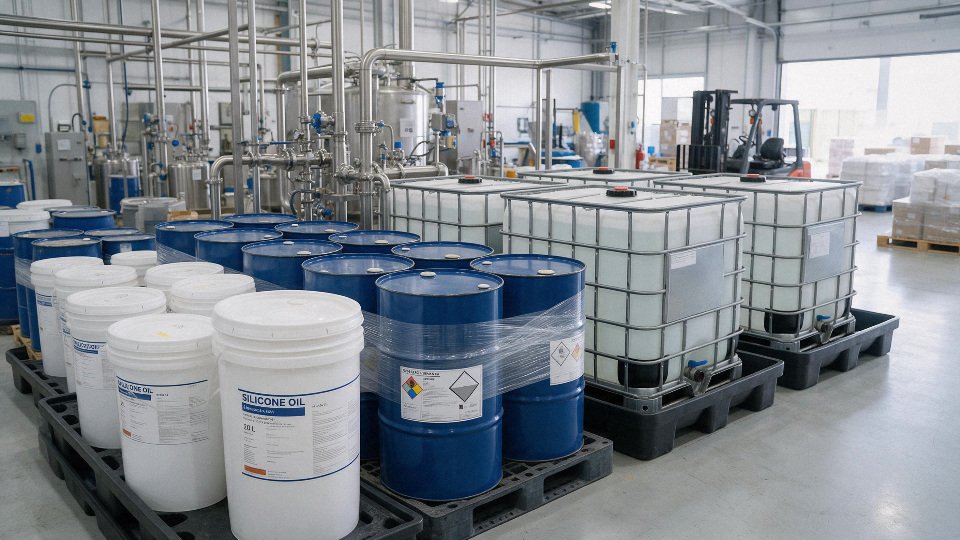
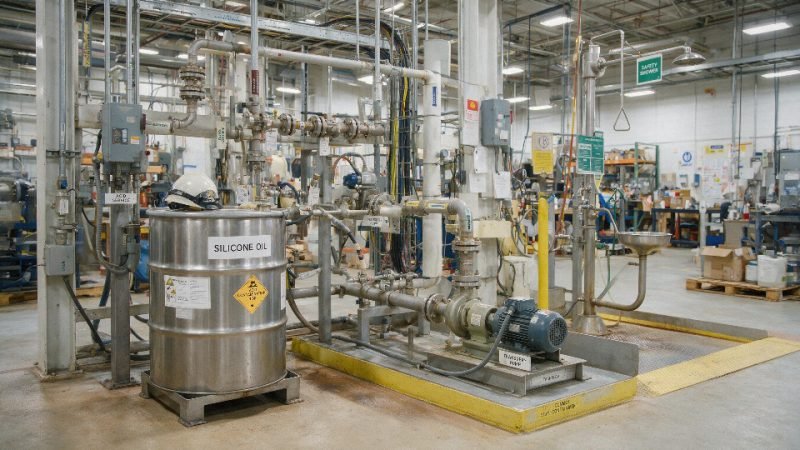
A drum of silicone oil that sits next to acid service sooner or later raises the same uncomfortable question: if traces of hydrochloric, sulfuric, or another strong acid get into the fluid, are you looking at a harmless contamination event or the start of viscosity drift, seal trouble, deposits, and an unplanned cleanout? On a plant floor, that uncertainty quickly turns into downtime risk, rejected product, maintenance labor, and procurement arguments over whether the fluid failed, the process upset caused it, or the original grade was wrong for the exposure. The practical answer is not to treat “silicone oil” as one chemically uniform thing, but to look at acid strength, water presence, temperature, residence time, and the exact silicone formulation before you decide whether the fluid can stay in service.
Silicone oil is usually resistant to many acidic environments, but it is not universally nonreactive. Standard dimethyl silicone fluids often tolerate incidental contact far better than many organic oils, yet strong acids, elevated temperature, water, and catalytic impurities can still drive siloxane bond cleavage, viscosity change, or by-product formation, so compatibility has to be judged by conditions, not by the name alone.
That distinction matters because the failure mode is often indirect. A fluid can look fine after a brief splash or low-ppm carryover, then start shifting only after hot, wet, recirculating exposure in a vent-poor system or a process with repeated acid washback. The useful question is less “does acid react with silicone oil?” than “under which combinations of acid, temperature, moisture, and time does the reaction become operationally relevant?”
Silicone oil chemistry basics
Silicone oil is not just “an oil with better heat resistance.” It is a siloxane polymer fluid built on Si-O-Si linkages rather than the C-C and C-H framework that dominates mineral or synthetic hydrocarbon oils, and that difference is exactly why acids affect it differently. In plain terms, the siloxane backbone gives silicone oils unusual thermal stability and low-temperature mobility, but under the wrong acidic, wet, and hot conditions that same backbone can undergo catalyzed rearrangement or cleavage instead of the oxidation and sludge formation buyers may expect from hydrocarbon oils.
At the molecular level, most silicone fluids are polysiloxanes: repeating units where each silicon atom is bonded to oxygen atoms in the chain and to organic side groups, most often methyl groups. The most familiar example is polydimethylsiloxane, or PDMS, where the repeat unit is effectively based on -[Si(CH3)2-O]-. Those methyl groups shield the backbone, lower intermolecular attraction, and help explain why silicone oils stay fluid across a wide temperature range, often around -50 to 200 C for standard dimethyl grades if the formulation is appropriate.
That backbone matters for two reasons that seem contradictory until you have seen enough service failures.
- The Si-O bond is strong and contributes to heat resistance.
- The Si-O-Si linkage is also chemically polar and can participate in acid- or base-catalyzed reactions.
- So silicone oils are often thermally robust, yet not automatically inert in every acidic environment.
A hydrocarbon oil under acid contamination often fails through oxidation, additive depletion, corrosion byproducts, varnish, or carbonaceous sludge. A silicone oil can show different behavior: chain rearrangement, depolymerization, viscosity drift, gel formation, phase instability, or changes driven by reactive end groups and contaminants rather than by the bulk fluid alone. That distinction matters in plant troubleshooting. What looks like “the oil failed” may actually be an emulsion package collapsing, residual silanol groups condensing, or a trace catalyst getting activated by low pH and moisture.
Backbone and side groups: what the base polymer is doing
The siloxane chain is unusually flexible because bond angles and rotational freedom differ from carbon-chain oils. That is one reason silicone fluids keep lubricity and flow characteristics over wide temperatures. It also means they usually have lower surface tension and different wetting behavior than hydrocarbon oils, which can be an advantage in release, defoaming, textile treatment, and dielectric service.
But the same chemistry creates a boundary. If you combine acid, water, and enough temperature or residence time, the siloxane network can start to equilibrate rather than remain unchanged. In practice, the risk rises with stronger acids, higher acid concentration, longer exposure, and more chemically active silicone structures. A sealed, dry system with trace acidic carryover behaves very differently from a hot, wet, recirculating process stream with periodic acid wash contamination.
Major silicone oil families and why their acid behavior differs
Not all silicone oils deserve to be treated as one compatibility class. Buyers sometimes ask for “silicone oil” as if viscosity grade is the only variable. It rarely is.
Dimethyl silicone oil
This is the standard PDMS family and the starting point for many compatibility discussions. It is usually the most chemically straightforward: methyl side groups, relatively low polarity, and often decent stability when properly end-capped and kept away from severe acidic or basic conditions.
Where it works well:
– General heat transfer and damping applications within grade limits
– Release and lubrication uses with intermittent mild contamination
– Systems where low reactivity is more important than specialty surface effects
Where it gets into trouble:
– Wet acidic service at elevated temperature
– Contact with strong mineral acids at meaningful concentration
– Formulations carrying reactive end groups or unstable additives
Methyl phenyl silicone oil
Phenyl substitution is used to improve low-temperature properties, radiation behavior in some cases, and certain thermal or oxidative characteristics. Acid response is not reducible to “better” or “worse” across the board; the exact substitution level and formulation matter.
In practice:
– It may outperform straight dimethyl fluids in some thermal applications.
– It is still a siloxane fluid, so acidic hydrolysis or rearrangement concerns do not disappear.
– Compatibility still has to be checked against the actual acid, water content, and service temperature.
Amino-modified silicone oil
Amino-functional fluids are useful because they bond or anchor better to some substrates, especially in textile and surface-treatment applications. That same amino functionality makes them much more condition-sensitive in acidic systems.
Typical issues:
– Protonation of amino groups in acidic media
– Emulsion instability
– Viscosity changes or deposit formation
– Performance drift even if the backbone itself has not fully degraded
These are often the products that confuse operators, because the fluid may “react” in use through formulation collapse or surface-behavior changes before obvious backbone breakdown is visible.
Epoxy-modified silicone oil
Epoxy-functional silicones are chosen for adhesion, reactivity, and specialty coatings behavior. In acidic environments, epoxy groups can open or participate in side reactions, depending on water, catalyst presence, and residence time.
That means:
– Acid sensitivity may come from the functional group, not just the siloxane chain.
– Storage stability and process stability are separate questions.
– A fluid that is fine in a closed drum may still drift in an acid-exposed line or bath.
Polyether-modified silicone oil
These are widely used where emulsification, wetting, or defoaming behavior is needed. They are often the least reliable family to judge by “silicone oil” assumptions because the polyether segment changes polarity, water affinity, and phase behavior.
Common failure paths in acidic service:
– Hydrolytic instability in the non-silicone segment
– Emulsion break
– Loss of defoaming or spreading performance
– Haze, separation, or viscosity shift
If a plant reports that a “silicone oil failed in acid,” it is often a polyether-modified product or an emulsion, not a neat trimethylsilyl-capped PDMS fluid.
Terminal groups often decide the outcome
End groups are not a small detail. They are frequently the difference between acceptable service life and a drum return.
- Trimethylsilyl-capped fluids are usually more stable because the chain ends are blocked and less available for condensation or further reaction.
- Hydroxyl-terminated fluids carry silanol end groups, which are much more reactive in wet acidic systems.
- Reactive silanol-containing grades may be intentionally supplied for downstream curing, bonding, or crosslinking; those grades are poor candidates for casual exposure to acidic contamination unless the supplier explicitly confirms suitability.
Mechanistically, silanol ends can condense to form longer chains or networks, especially when catalyzed, which can push viscosity upward or create gel-like material. Under other conditions, acid-catalyzed equilibration can shorten chains and create more low molecular weight fractions. So the same broad family can show either thickening or thinning depending on the exact chemistry and exposure history. That is why a single “acid resistance” ranking is usually too crude to be useful.
Why apparent compatibility often comes from the formulation, not the base oil alone
On the plant floor, fluids are almost never a pure textbook polymer. Apparent acid compatibility can be skewed by other ingredients or residues:
- Additives for lubrication, wetting, antifoam, or process performance
- Residual catalysts from manufacture
- Low molecular weight cyclics or short-chain siloxanes
- Emulsifiers in water-dispersible systems
- Solvents used for application or viscosity adjustment
- Fillers or dispersed solids in specialty products
Each of those can move the result. Residual acidic or basic catalyst can accelerate change. Emulsifiers can fail first and make the whole product look “chemically attacked.” Solvents can concentrate or transport acid into places the neat fluid would not reach as easily. Low molecular weight species can volatilize, extract, or react faster than the main polymer and create misleading lab results.
A higher-viscosity silicone oil is automatically more acid resistant than a lower-viscosity grade.False
Viscosity mainly reflects molecular weight or formulation, not universal chemical durability. Acid stability depends more on end-capping, functional groups, water content, acid type and concentration, temperature, exposure time, and additives or emulsifiers present.
A thick PDMS fluid can still fail faster than a lower-viscosity, well-capped fluid if the thicker product carries hydroxyl ends, reactive modification, or unstable auxiliaries. I have seen buyers assume 1,000 cSt must be safer than 100 cSt, then find the opposite once the product was actually exposed to hot acidic wash carryover. The preferred choice flips when service conditions are dominated by contamination chemistry rather than by simple volatility or fluid retention.
So viscosity still matters, just for different reasons:
– Higher viscosity may reduce migration or misting.
– It may change dwell time on a surface.
– It may affect pumpability, mixing, and cleanout.
– It does not, by itself, establish acid resistance.
If you are screening silicone oils for acidic service, start with the polymer family, side-group functionality, and terminal chemistry before you look at cSt. Then check whether the product is neat fluid, compound, emulsion, or solvent blend, because that often explains the gap between supplier brochure language and what happens in a line running hot, wet, and slightly dirty.
How acids affect silicone oil
Most acids do not make silicone oil “react” in the dramatic, obvious way buyers often picture. What usually happens first is slower acid-catalyzed rearrangement or degradation: viscosity drift, rising volatility, cyclic formation, haze, odor change, or eventually gel particles and deposits. Whether that drift is negligible or process-ending depends mainly on acid strength, oxidizing character, water, temperature, dwell time, and what else is in the system besides the base silicone fluid.
The plant-floor trap is that a drum or sump can look perfectly quiet while the chemistry is already moving. Silicone oil and an aqueous acid phase often sit as two layers, so operators assume “no mixing, no problem.” In practice, the damage can start at the interface, then spread as low-molecular fragments dissolve back into the oil or volatilize out of it.
Acid-catalyzed siloxane bond cleavage and equilibration
The central mechanism is acid-catalyzed attack on the siloxane backbone, the Si–O–Si link that gives silicone fluids their flexibility and temperature stability. Under acidic conditions, especially with water present, that linkage can be protonated and made more susceptible to cleavage. You do not need a runaway event for this to matter; in many systems the first sign is simply that the fluid no longer holds its original viscosity profile.
What happens next depends on the operating environment:
- Hydrolytic cleavage
- Water and acid together can split siloxane bonds, generating silanol-terminated species.
- Heat usually accelerates this.
- Longer residence time pushes the effect from trace change into measurable property drift.
- Equilibration or redistribution
- Once cleavage starts, the system may not just break down linearly.
- Siloxane chains can rearrange, forming a different molecular weight distribution.
- That often means a broader viscosity spread and less predictable volatility.
- Back-condensation
- Silanol groups formed during cleavage can react again.
- Depending on conditions, this can either rebuild chains, form branched structures, or contribute to gel-like material.
This is why a simple “acid causes breakdown” description is incomplete. In silicone fluids, acid often promotes a moving equilibrium between cleavage and reformation, and the property change you care about on the plant side is the net result of that shuffle.
A useful way to think about it is this: if the system favors chain scission and volatilization, the fluid gets thinner and lighter ends increase; if the system favors condensation or branching, it may thicken or even form insoluble material. The same acid contamination can push either direction depending on water content, end groups, temperature history, and additives.
Why viscosity sometimes drops instead of showing obvious damage
A common expectation is that chemical attack should produce sludge, charring, or visible decomposition. With many silicone oils, the earlier and more common outcome is less dramatic: the fluid gets thinner. That is because acid-catalyzed cleavage often shifts the molecular weight distribution downward before you see discoloration or solids.
In practical terms, this can show up as:
- Lower kinematic viscosity at the same test temperature
- Higher evaporation loss or more light volatiles in vent streams
- Increased odor during heating
- Greater carryover, misting, or seal leakage because the fluid is no longer behaving like the original grade
- Drift in damping, release, dielectric, or heat-transfer performance
The mechanism matters commercially. A buyer may look at a viscosity grade, say 100 cSt versus 350 cSt, and assume the thicker fluid is automatically safer against acid. That is not a reliable rule. The supplied viscosity range for silicone oils can run from roughly 5 to 1,000,000 cSt, but acid sensitivity in practice is influenced more by formulation, end groups, temperature, water, and contamination history than by viscosity alone. A high-viscosity fluid can still depolymerize if the catalytic conditions are right.
There is also a boundary here: this conclusion weakens when you are dealing with heavily modified silicone systems rather than relatively simple dimethyl silicone fluids. Once you add reactive organic modifiers, fillers, emulsifiers, or specialty end-blocking, the failure mode can flip.
Why some acid-exposed silicone oils thicken, haze, or gel
Not every acid contamination event gives viscosity loss. Some fluids show the opposite trend: gradual thickening, stringiness, haze, or eventually gel particles. In my experience this is where plants get caught, because the fluid may still be in service while filters start loading up and operators blame dust or oxidized product elsewhere in the line.
Several paths can produce that result:
- Condensation of silanol groups
- If acid and moisture first create silanol functionality, those groups can later condense.
- Instead of forming only neat linear chains, the system may generate branching or localized network structures.
- That can increase apparent viscosity or create microgels.
- Reaction of modifiers or functional side groups
- Amino, epoxy, polyether, alkyl, aryl, or other specialty modifications can introduce their own acid sensitivities.
- The base siloxane may not be the only thing reacting.
- Sometimes the modifier degrades first and changes compatibility, making the fluid turn cloudy or separate.
- Additive interaction
- Defoamers, surfactants, stabilizers, pigments, catalysts, or residual processing aids can react under acidic conditions.
- The result may be insoluble fines, color bodies, or tacky deposits rather than clean molecular redistribution.
- Localized overexposure
- A stagnant dead leg, sight glass pocket, transfer hose low point, or pump seal cavity can see much higher acid contact than the bulk tank.
- Material formed there can seed the rest of the system with gel specks or sludge.
This is one reason incoming-failure analysis should not stop at bulk viscosity. You want to check whether the sample is uniform, whether there is phase haze, whether insolubles are present, and whether any upper or lower layer behaves differently after settling. A drum can pass a quick viscosity check and still be chemically compromised.
Non-oxidizing acids versus strongly oxidizing acids
There is a practical difference between acids that mainly catalyze siloxane rearrangement and acids that can oxidize the organic substituents attached to silicon. Non-oxidizing mineral acids may drive cleavage, equilibration, and condensation pathways without immediately attacking every organic group in the molecule. Strongly oxidizing acids are a different risk class.
With strongly oxidizing acids, possible effects become more severe:
- Attack on methyl or other organic substituents
- Formation of darker degradation products
- More pronounced odor and fume issues
- Carbonaceous residues or silica-like inorganic remnants after deeper degradation
- Faster loss of functional performance, not just viscosity drift
That distinction matters in procurement and root-cause work. If a fluid exposed to acid shows mild viscosity change over long service, catalytic rearrangement is a reasonable first hypothesis. If it shows aggressive discoloration, corrosive off-odor, rapid solids formation, or broad material attack in the same zone, you may be dealing with an oxidizing environment or a mixed contaminant package rather than simple acid carryover alone.
If silicone oil and acid form separate layers, the silicone oil is safe unless mechanically mixed.False
Immiscibility reduces bulk contact but does not prevent interfacial degradation. Over time, acid, water, and catalytic residues at the interface can still change viscosity, generate silanols or cyclics, and create degradation products that migrate into the oil phase.
Phase behavior: immiscible does not mean inert
Many operators trust their eyes too much here. Acid-water mixtures and silicone oil often separate cleanly, and from a housekeeping standpoint that looks reassuring. Chemically, the interface can still be active for weeks or months, especially in warm tanks, recirculating loops, and systems with intermittent agitation.
The failure path usually looks like this:
- Acid and silicone oil contact at a limited interface.
- Acid-catalyzed cleavage starts at that boundary, often helped by water.
- Lower molecular weight fragments form.
- Some fragments remain in the oil phase, changing volatility and viscosity.
- Agitation, pumping, or thermal cycling renews the interface and keeps the process going.
The slower this happens, the easier it is to miss. A long-life closed system is actually vulnerable because low contamination can accumulate effect over time. Plants often monitor strong mineral acid contamination anywhere from below 10 ppm up to several thousand ppm depending on how sensitive the system is. In a short batch process, a few ppm may not move the needle. In a sealed fluid circuit expected to run for months, that same level can be enough to shift fluid properties measurably if the chemistry and temperature are unfavorable.
Hidden catalysts: metals, clays, residues, and dirty hardware
Acid alone is not always the whole story. On used equipment, catalytic surfaces and residues can turn a borderline contamination issue into a chronic one.
Watch for these contributors:
- Dissolved metal ions
- Iron, copper, aluminum, and other metals from corrosion or wear can alter degradation pathways.
- They may accelerate side reactions or increase color formation.
- Acidic clays and adsorbents
- Some process aids, filtration media, bleaching clays, or absorbent residues carry acidic sites.
- Even after the obvious bulk acid is gone, the surface can keep catalyzing change.
- Residual cleaning chemicals
- Poorly rinsed descalers, pickling residues, passivation chemicals, or acid-based cleaners are common culprits.
- Flexible hoses and pump internals are repeat offenders because they are easy to overlook.
- Contaminated vessel surfaces
- A reactor wall, tote, valve cavity, or heat exchanger that previously held acidic material may keep exposing fresh silicone fluid charge after charge.
- This is why “the new drum was bad” is often the wrong diagnosis.
- Packing, seals, and elastomer breakdown products
- Degraded non-metallic components can carry acidic or catalytic fragments into the fluid.
- The result may be trace but persistent contamination.
This is where the commercial problem shows up: replacing fluid without fixing the source just buys another short run to failure. If the acid source is hardware-related, the second fill often degrades faster because residual contaminants were never fully removed.
What changes first in service
The earliest field indicators are usually subtle. Violent reaction is not the normal pattern; creeping property drift is.
Typical first signs include:
- Viscosity moving out of expected range
- Flashing off more light ends during heating
- Foaming or defoaming behavior changing
- Haze, slight color shift, or fine suspended matter
- Filter differential pressure rising
- More odor around vents, reservoirs, or heated zones
- Release, lubrication, damping, or dielectric performance becoming inconsistent
If you only test after a failure, you miss the progression. For critical service, trend a fresh retained sample against used-fluid checks rather than relying on one absolute number.
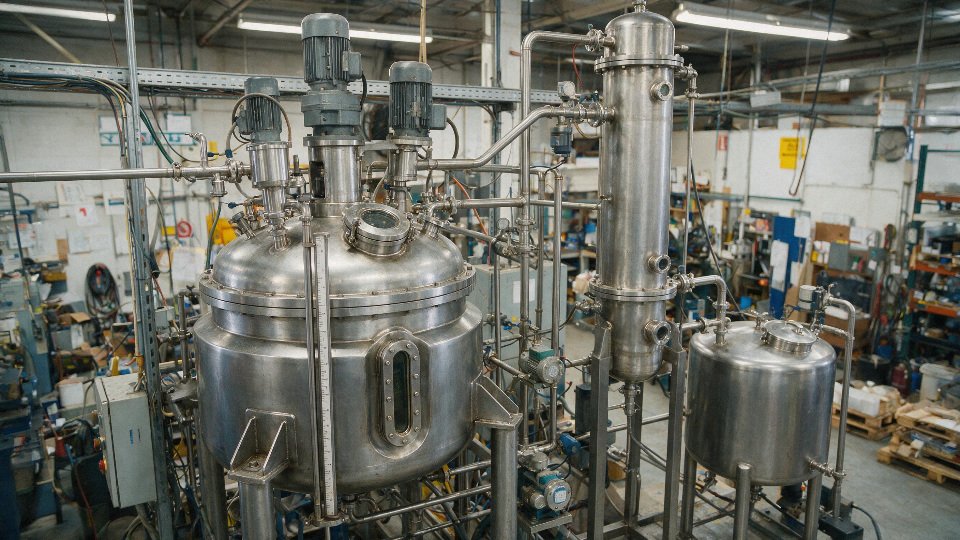
The practical decision is not whether silicone oil is “acid resistant” in the abstract. It is whether your specific fluid, contamination route, and service temperature let small catalytic damage stay small. If the system is closed and long-life, even very low acid carryover deserves attention, and the right next step is usually to test the used fluid against a retained control while checking water, contamination source, and any acidic surfaces upstream.
Acid types and risk levels
There is no single “acid-resistant” rating that usefully covers silicone oil. Risk rises fastest with acid strength, oxidizing character, concentration, temperature, water availability, and contact time; it also jumps when the silicone is not a neat, fully capped fluid but an emulsion, microemulsion, or formulated product with reactive additives. In practice, weak organic acids at room temperature may cause little short-term change, while hot concentrated mineral acids, acid fumes, or mixed acid systems can push the fluid into viscosity drift, gel formation, phase instability, or outright breakdown.
A useful way to rank exposure is by asking two plant-floor questions first:
- Is the silicone present as a neat bulk fluid, or as a water-containing formulation with lots of interface area?
- Is the acid a mild contaminant in a cool system, or an active process chemical that is concentrated, hot, oxidizing, fuming, or continuously replenished?
That distinction matters because the failure path is not just “acid touches oil.” Water, surfactants, metal salts, and heat can open up pathways for siloxane bond cleavage or rearrangement. A drum of dry, capped dimethyl silicone fluid in a warehouse can tolerate incidental exposure that would destabilize the same chemistry immediately in an acidic emulsion loop.
Weak organic acids
Weak organic acids are usually the lowest-risk category for neat silicone oils, but “low risk” is not the same as “no effect.” Acetic acid is the one buyers ask about most often because it shows up in sealants, process residues, cleaning formulations, and some packaging environments.
For fully capped silicone oils at ambient conditions, limited exposure to weak acids such as acetic acid, citric acid, or dilute carboxylic acid residues often produces little immediate visible change. That is especially true when the fluid is dry, the acid level is low, and the contact time is short. You may not see any shift in appearance, odor, or handling over a normal shift or even over a few days.
The boundary shows up when one or more of these conditions change:
- Elevated temperature
- Continuous exposure instead of incidental contact
- Water present
- Large interfacial area from emulsification or agitation
- Reactive end groups or unstable additives in the formulation
Under hot, wet exposure, even weak acids can contribute to slow viscosity drift or emulsion instability. In practice, this often shows up first as process inconsistency rather than dramatic failure: a release coating that feels slightly different, a defoamer that loses efficiency, or an emulsion that starts separating earlier in storage. The mechanism is straightforward: water and acid together make chain rearrangement or hydrolytic attack more accessible, and once surfactants are involved, the contact area between phases becomes enormous.
Diluted mineral acids
Diluted mineral acids sit in the middle of the risk ladder. A mildly acidic aqueous system is generally less aggressive than hot concentrated acid, but it can still cause problems because it usually brings water into the contact zone.
Common examples include:
- Hydrochloric acid at low concentration in cleaning or pickling carryover
- Sulfuric acid traces in process condensate or battery-area contamination
- Phosphoric acid residues from metal treatment or cleaning chemistry
- Nitric acid at low concentration in rinse or passivation carryover
At low concentration and moderate temperature, neat silicone oils may tolerate incidental contamination better than many buyers expect. But the practical question is not whether the fluid survives one splash test. It is whether repeated acidic ingress changes the fluid enough to affect service life, seals, filters, foam behavior, or product quality.
Hydrochloric acid deserves special caution because even when the liquid concentration is modest, HCl is volatile enough that fumes and acidic condensation can create localized attack points in storage or around vented systems. Sulfuric acid is less volatile, but as concentration rises it becomes much more dehydrating and generally more severe. Phosphoric acid is often perceived as “milder,” which can be directionally true at comparable dilute conditions, yet that should not be turned into a blanket compatibility claim. Nitric acid brings a different concern because oxidizing behavior starts to matter, not just acidity.
Dilute acid is always safe for silicone oil if pH stays above 4.False
Bulk pH alone is not a reliable compatibility criterion. Local concentration, temperature, water content, residence time, and whether the silicone is neat or emulsified often matter more than a nominal pH reading.
Concentrated non-oxidizing mineral acids
Once mineral acids become concentrated, especially under heat, the practical risk moves sharply upward. Hydrochloric acid and sulfuric acid are the usual examples here, though their behavior is not identical.
Concentrated hydrochloric acid can drive faster acid-catalyzed degradation than a dilute aqueous acid because the acid activity is higher and contamination events are less forgiving. If the system is also hot, agitated, or contains catalytic metal residues, the fluid can move from “stable enough” to “unacceptable drift” quickly. Hydrochloric acid fumes make handling harder as well; drums, tote headspaces, and poorly ventilated fill areas can become exposure points even if no one intends direct mixing.
Concentrated sulfuric acid is often worse from an overall damage standpoint because it combines strong acidity with dehydration effects. Hot concentrated sulfuric acid is not a condition under which a silicone oil user should assume serviceability without targeted testing. It can darken organic contaminants, attack additives, and create complex degradation behavior that does not look like a simple viscosity loss.
This is where a lot of procurement errors happen. Someone asks for a compatibility table, sees “good” or “fair,” and applies it across all concentrations. That is not how acid service works. A fluid that survives trace carryover may fail badly in a reactor vent seal, scrubber-associated line, or heated transfer point with recurring concentrated exposure.
Oxidizing acids
Oxidizing acids are a separate high-risk category, and nitric acid is the practical example most readers will encounter. Mixed acid environments push risk higher again.
Nitric acid cannot be treated as just another mineral acid because oxidation can attack not only the siloxane system but also stabilizers, modifiers, organic contaminants, packaging components, and elastomers in the same assembly. A clean compatibility check on the oil alone may miss the actual failure route. You may end up with discoloration, gas generation, sludge, seal damage, or contamination from adjacent materials before the silicone itself shows its final breakdown mode.
Mixed acid environments deserve more respect than they usually get in purchasing discussions, including combinations such as:
- Nitric plus sulfuric residues
- Hydrochloric acid with oxidizing cleaners
- Acid plus peroxide or other oxidant carryover
- Acidic waste streams with dissolved metal salts
The trade-off is simple: if you are selecting for broad process tolerance, silicone oils can be excellent in many thermal and inert environments, but they stop being a forgiving choice when strong acid and oxidation are both present, especially at elevated temperature. At that point, lab screening under representative exposure is usually cheaper than one line upset.
Lewis acids
Lewis acids are easy to overlook because the exposure may not be labeled as “acid contamination” on the production sheet. Metal chlorides, aluminum-based species, boron compounds, tin catalysts, and similar materials can behave as strong catalytic promoters in silicone systems.
The risk here is often disproportionate to concentration. A relatively small amount of catalytic contaminant can accelerate chain scission, rearrangement, or unwanted condensation, particularly if the fluid contains reactive end groups or sits hot for long residence times. This is one reason a silicone fluid that looks fine in virgin form may behave unpredictably after passing through a contaminated line, reused tote, or mixer previously used for catalyst-bearing chemistry.
If your plant handles chlorinated metal salts, acid chloride chemistry, catalyst residues, or reclaimed process vessels, you should treat Lewis acid exposure as a separate compatibility question, not a footnote under “general acid.”
Acid-generating contaminants and gas-phase exposure
Some of the worst surprises come from systems where no liquid acid is intentionally added. Acid can be generated in service or introduced through off-gassing, decomposition, or packaging conditions.
Common sources include:
- HCl released from chlorinated materials during heating or degradation
- Acidic off-gassing from nearby chemical storage
- Residual acidic cleaners left in tanks, hoses, or pumps
- Decomposition products in overheated process streams
- Moisture plus acid-forming contaminants in closed containers
Gas-phase exposure matters because headspace condensation can create highly localized acidic films. A drum stored near an HCl-handling area may show problems at the bung, liner, or upper wall before the bulk liquid shows an obvious issue. In practice, these are the complaints that get misdiagnosed as “bad batch” or “transport damage” when the actual cause is storage environment.
Why emulsions and microemulsions are much more vulnerable
Silicone emulsions, microemulsions, and surfactant-stabilized systems are often the point where a nominally manageable acid exposure becomes unacceptable. The reason is not mysterious: they contain water, they create very high interface area, and their stability depends on surfactant balance and droplet behavior.
That changes the whole risk picture:
- Acid has easier access to the silicone-water interface
- Hydrolytic pathways become more available
- Surfactants themselves may lose effectiveness or decompose
- Electrolytes and pH shifts can collapse emulsion stability
- Small changes show up fast as creaming, separation, or viscosity change
A neat silicone oil may tolerate trace acidic contamination with little immediate visible impact. The corresponding microemulsion can separate, haze, or lose performance from the same event. If the product is an emulsion, buyers should ask for acid-stability data on that formulation, not on the base silicone fluid category.
For any service involving hydrochloric acid, sulfuric acid, nitric acid, phosphoric acid, mixed acids, or acidic fumes, the practical ranking should always be tied to actual concentration, temperature, water content, and form of the silicone system. Once exposure becomes hot, wet, concentrated, oxidizing, or catalytic, generic compatibility language stops being useful and application-specific testing becomes the safer purchasing path.
Failure modes in service
Acid-related silicone oil failure rarely announces itself as a neat “chemical reaction.” On the plant floor it shows up as drift: a damper that no longer controls smoothly, a heat-transfer loop that starts losing level, a coating bath that suddenly foams, or finished parts that develop fisheyes after weeks of stable production. If you only test the oil for viscosity and stop there, you can miss the actual failure path and replace the wrong component.
Viscosity drop: chain scission and loss of functional performance
The most common high-consequence failure is a viscosity decrease from acid-catalyzed chain scission. In practical terms, the siloxane chains are being cut into shorter segments, and the fluid loses body. That matters less because the number on the certificate changed, and more because film thickness, damping force, leakage tendency, and control stability all move with it.
You tend to see this in:
- Heat-transfer systems
- Lower viscosity can increase leakage past marginal seals and threaded fittings
- Pump behavior may change, especially in systems already close to NPSH limits
- Volatility can rise at the same time, so operators notice both level loss and a different odor
- Damping and motion-control devices
- Force response drifts
- Equipment overshoots or becomes less repeatable
- Seasonal troubleshooting gets confusing because hot-weather thinning masks the chemistry for a while
- Lubrication or release-film applications
- Boundary film weakens
- Metal-to-metal contact risk rises in lightly loaded mechanisms
- Release consistency becomes patchy rather than failing completely
The mechanism is straightforward enough: shorter polymer chains lower viscosity, but the operating consequence depends on where the fluid was carrying load or controlling motion. In a closed loop, a 20% viscosity shift may be tolerable; in a precision dashpot or metering head, much less can push the process out of control.
The trade-off in diagnosis is that a viscosity drop can also come from simple mischarge, solvent ingress, or thermal history. Acid involvement becomes more likely when the viscosity loss is paired with one or more of these:
- Rising acid number in the contaminated system fluid
- Increasing volatile fraction
- Seal complaints without obvious mechanical wear
- Changes accelerating with temperature and residence time
Viscosity increase, haze, gel, or skin: not all failures go in the same direction
Aged silicone fluid does not always get thinner. Under some conditions, especially in mixed systems with water, reactive contaminants, unstable additives, or air-exposed interfaces, you can get condensation-type reactions, localized crosslinking, or phase instability that makes the material look thicker, hazy, or partly gelled.
Typical symptoms include:
- Bulk viscosity increase
- Slower pumpability
- Poorer leveling in coatings or finishes
- Metering deviations in dosing equipment
- Haze or cloudiness
- Fine insoluble material
- Water-related instability
- Early warning before visible gel forms
- Gel particles or stringy residue
- Plugged filters
- Dirty spray nozzles
- Deposits in static mixers and small-bore tubing
- Surface skin formation in containers or open baths
- Often strongest at the air-liquid interface
- Commonly misread as simple oxidation or dirt ingress
- Can seed contamination into the whole batch when mixed back in
This is where buyers sometimes overgeneralize from viscosity grade. In practice, acid sensitivity here is influenced far more by formulation package, end groups, moisture exposure, and contaminants than by whether the base fluid is 100 cSt or 1,000 cSt.
A change in silicone oil viscosity alone does not identify the acid-related failure mechanism.True
Acid contamination can drive chain scission and lower viscosity, but condensation, interfacial reactions, additive instability, or phase separation can increase apparent viscosity or create haze and gel. Root cause needs correlated evidence, not a single property result.
Volatiles, odor shift, and evaporation loss
When depolymerization produces lower-molecular-weight siloxanes, the plant usually notices it before the lab issues a report. Operators report a sharper odor, vents show more carryover, and makeup consumption creeps upward. In open or warm systems, that can look like “the silicone is burning off,” when the more accurate explanation is that acid exposure has shifted part of the fluid into a more volatile distribution.
Watch for:
- Faster mass loss at the same operating temperature
- Condensate or oily residue appearing in vent lines
- Increased misting around breathers or imperfect covers
- Flashier handling behavior in coating kitchens or blend tanks
The boundary here is important: evaporation loss is strongly temperature-dependent even without acid contamination. To separate normal thermal loss from degradation, you need a before-and-after volatile profile or at least trend data tied to operating temperature, contamination level, and residence time.
Formulated-product instability: foam, emulsion break, and performance drift
In textile finishes, coating additives, process aids, and emulsified silicone products, acid contamination often shows up first as formulation instability rather than obvious polymer damage. The silicone may still be present, but not in the form or distribution the process needs.
Common plant-floor patterns:
- Unexpected foaming
- Changed interfacial behavior
- Surfactant package upset
- Air entrainment that suddenly stops being released
- Defoamer failure
- The product is in the tank, but no longer migrates or spreads correctly
- Operators overdose to compensate, which can create surface defects downstream
- Emulsion instability
- Creaming, separation, or viscosity collapse
- Shortened bath life
- Different pickup on the line from morning to afternoon
A useful rule: when a silicone-containing formulation starts alternating between overactive and inactive behavior, look at pH excursion, acid carryover, and local contamination points before blaming the drum supplier.
Corrosion and seal problems: often misattributed
Silicone oil gets blamed for corrosion surprisingly often. In most cases, the direct driver is the acid contaminant, trapped water, or incompatible seal material, not the silicone fluid by itself. The distinction matters because replacing the fluid without removing the contamination source just resets the clock.
Use this check sequence:
- Map where damage appears
- Uniform metal attack suggests chemical contamination in the system
- Localized damage near dead legs, vents, or water pockets points to concentration effects
- Inspect seal failure mode
- Swelling, hardening, cracking, or extrusion each suggest different compatibility paths
- Verify elastomer grade; “Viton” on a maintenance note is often not enough
- Compare metal surfaces and fluid condition
- Clean fluid with corroded hardware often means acid/water attack upstream
- Dirty, gelled, or odorous fluid supports a broader chemistry problem
- Test the contaminant, not just the oil
- Acid identity, water content, and exposure temperature usually tell you more than base-fluid viscosity alone
Downstream product defects
Where silicone oil is part of a process rather than a closed machine fill, acid-related degradation can surface as customer-visible defects:
- Surface craters or fisheyes in coatings and inks
- Poor release from molds, liners, or treated webs
- Inconsistent wetting or slip
- Reduced dielectric performance in electrical applications
- Off-spec refractive index, haze, or rheology in specialty formulations
The mechanism is usually one of three things:
- The silicone’s molecular weight distribution has shifted
- Insoluble byproducts or gels are now acting as defect seeds
- The formulation no longer migrates, spreads, or anchors as intended
That last point is where the commercial damage shows up. A system can keep running while quality quietly deteriorates, and by the time maintenance gets involved the batch records already show scrap, customer complaints, or extra labor from line cleaning. If the symptoms are intermittent, sample both fresh and in-service material and include the contamination source, not just the failed product, or the lab result will be technically correct and operationally useless.
Testing and verification methods
A generic “resistant to acids” statement is not enough to buy against. The only reliable answer is a test matrix that matches your actual acid, contamination level, temperature profile, water content, and dwell time, then judges the oil against the property that matters in service. In practice, a silicone fluid that looks fine in a bottle test can still fail in a pump seal circuit, release line, mold-release operation, or heat-transfer loop because the acceptance limit is application-specific, not chemistry-specific.
Start with a structured matrix before you send anything to the lab. If the inputs are vague, the output will be vague too.
- Define the acid clearly
- Exact chemical identity, not just “acidic cleaner” or “pickling residue”
- Mineral acid, organic acid, mixed acid, or formulated bath
- Whether oxidizers, chlorides, fluorides, inhibitors, surfactants, or solvent carriers are present
- Set the concentration range
- Use the realistic contamination band, not one guessed number
- For process carryover, that may mean below 10 ppm, tens to hundreds of ppm, or a worst-case upset at much higher levels
- If concentration fluctuates, test at nominal and upset conditions
- Match temperature to service
- Constant temperature if the system is steady
- Thermal cycling if startup, cleaning, or batch discharge creates spikes
- Include hot spots if the oil sees heater skins, bearings, or localized recirculation stagnation
- Control water content
- Dry acid and wet acid can behave very differently
- Measure initial moisture in both the acid source and the silicone oil
- If condensation is possible in storage or operation, include that condition
- Set residence time honestly
- Seconds in a release application is not the same as weeks in a circulating system
- Include both normal contact time and foreseeable hold times during shutdown or weekend stagnation
- Include agitation and shear
- Static bottle tests are useful, but they can miss emulsion behavior, interfacial attack, and air entrainment effects
- If the system is pumped, mixed, or sprayed, reproduce that as closely as practical
- Specify container and contact materials
- Glass, stainless, carbon steel, lined steel, HDPE, fluoropolymer-lined components, elastomers
- Catalytic metals from rust, weld scale, or poor cleaning can change the result more than viscosity grade does
A simple way to keep this under control is a compact test table.
| Variable | Minimum set | Why it matters |
|---|---|---|
| Acid identity | Exact formulation or SDS-backed composition | Different acids drive different degradation paths |
| Concentration | Normal, high-normal, upset | Reaction rate and physical contamination effects are dose-dependent |
| Temperature | Ambient, normal service, credible peak | Heat can accelerate siloxane cleavage or create non-representative side reactions |
| Water content | Dry and wet condition where relevant | Water often shifts acid activity and hydrolytic behavior |
| Residence time | Expected exposure and extended hold | Slow changes may only show after storage or shutdown |
| Agitation | Static and mixed if applicable | Interfacial area changes contamination and phase behavior |
| Contact materials | Actual tank/line materials | Metals and residues can catalyze degradation |
Once samples are aging, the core measurements should be practical and repeatable. Most plants can do some of these in-house and send the rest out.
- Viscosity: usually the first screen. It catches chain scission or structure build, but by itself it does not tell you which happened.
- Acid number: useful for tracking contamination and changes in acidic species, though interpretation depends on the original formulation.
- Appearance: haze, gel particles, sediment, skin formation, or persistent emulsion all matter.
- Color: not a standalone failure criterion, but a useful trend marker.
- Odor: crude, yes, but sudden sharp or burnt notes often correlate with volatile formation or contamination.
- Phase separation: especially important where acid-water mixtures can sit under the oil and create localized attack.
- Density: small shifts can support other findings, particularly in contaminated systems.
- Flash point: relevant if volatile breakdown products or solvent-borne acid contamination are possible.
- Volatile content: weight loss or distillation-based changes can show low molecular weight generation.
When the risk or commercial consequence is high, move past bottle observations.
- FTIR: good for spotting silanol formation or broad structural change. It is a strong screening tool, though not every subtle degradation pattern will resolve cleanly.
- GC or GC-MS: useful for cyclics, low boilers, and other volatiles. If a fluid starts generating more light species, this method usually shows it before plant operators do.
- GPC: the best choice when you need to prove molecular weight shift, either downward from depolymerization or upward from condensation/crosslinking.
- Karl Fischer: essential if water is part of the suspected mechanism rather than just background noise.
- ICP: worth doing when drums, tanks, pumps, or transfer lines may be contributing iron, aluminum, tin, or other catalytic metals.
High-temperature screening always gives a conservative answer for acid resistance.False
It only gives a useful conservative answer if the failure mechanism at elevated temperature is the same one expected in service. Push the temperature too far and you can create unrealistic volatilization, oxidation, container interactions, or condensation reactions that would not occur at the actual operating condition.
That point matters. Accelerated aging is helpful, but it is easy to overcook it. A test at a much higher temperature than the process can flip the mechanism: instead of measuring slow acid contamination under service conditions, you may be measuring thermal decomposition, excessive moisture loss, or reaction with the test vessel. Acceleration is valid only when the stress shortens time without changing the chemistry that dominates in service. If your application runs at 60 to 80 C with intermittent acid carryover, jumping straight to 180 C may produce a failure mode that looks dramatic and tells you very little.
Packaging and storage deserve their own check because plenty of “reaction” complaints start there.
- Verify drum, tote, and cap liner compatibility
- Check for moisture ingress through poor seals or repeated drum opening
- Confirm that tanks and transfer lines are free of residual cleaning acids
- Inspect for headspace contamination from acidic vapors stored nearby
- Review whether reused containers had prior service with water-based cleaners, pickling chemicals, or acidic additives
A plant-floor example: a silicone oil may pass a controlled acid-spike test in clean glassware, then fail after a month in a mild-steel day tank because trace water, acidic vapor ingress, and rust contamination work together. That is not unusual. The mechanism is not just “acid versus silicone oil”; it is acid plus water plus metal plus time.
Pass-fail criteria have to be tied to function, not just lab movement.
- In a heat-transfer or damping application, a modest viscosity shift may be acceptable if volatility and safety properties stay within limits.
- In a metering, release, or textile finish application, that same viscosity shift can wreck coating weight, spray pattern, wet-out, or release consistency.
- In closed-loop equipment, tiny increases in volatiles or acidity may matter because they affect seals, vents, or odor complaints before the bulk fluid appears degraded.
If you are qualifying a grade for a critical use, ask the lab to write acceptance criteria before the test starts. That usually means defining allowable change bands for viscosity, volatiles, appearance, and any application-specific metric, then deciding whether failure is immediate, trend-based, or conditional on further analysis.
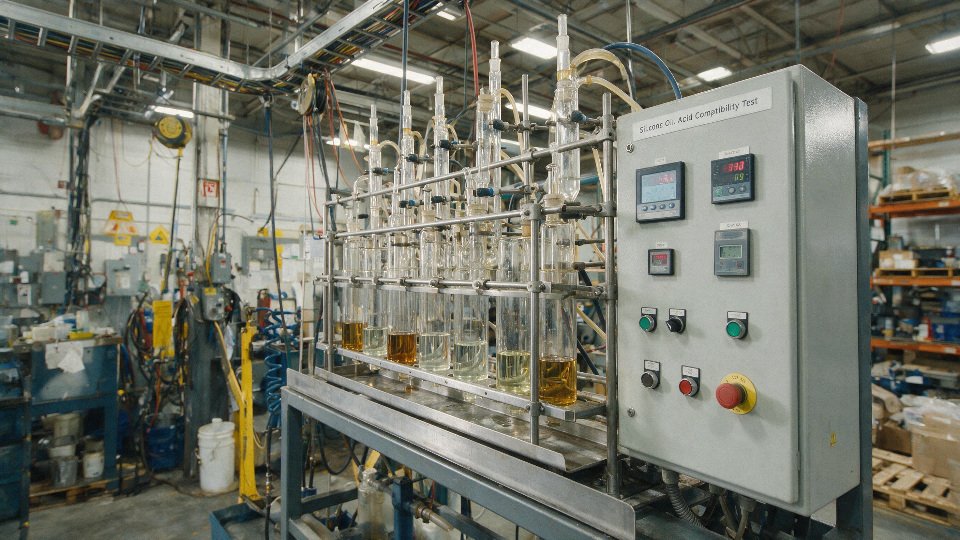
Application-specific compatibility
Silicone oil can be perfectly serviceable around acids in one plant and a problem in the next because the decision is usually driven less by “acid present or not” than by where the acid sits in the process, how long it stays there, and whether heat, water, or functional additives are involved. Standard dimethyl silicone fluids often tolerate incidental acidic exposure better than many buyers expect, while amino-, epoxy-, or other modified silicone systems usually need much tighter control.
Heat transfer and high-temperature bath fluids
For hot baths and closed-loop thermal systems, the practical risk is usually not a dramatic acid attack event but a slow combination of trace acidic contamination plus thermal aging, which can show up first as drift in viscosity, volatility, deposits, or vent losses. If the fluid is a standard dimethyl silicone heat-transfer grade and the system is kept dry, clean, and properly vented, low-level contamination may be manageable; once water ingress, hot spots, or oxidized residues join the picture, the margin shrinks fast.
A few plant-floor points matter here:
- Trace acids often enter indirectly
- Carryover from cleaned equipment
- Corrosion byproducts from upstream loops
- Process leaks from acidified side streams
- Residual pickling or descaling chemicals after maintenance
- The mechanism is cumulative
- Acid alone may only weakly affect a stable silicone fluid at moderate temperature
- High temperature accelerates chain scission or rearrangement pathways
- Water can help acidic species contact vulnerable sites
- Result: lower molecular weight fractions, more vapor loss, sometimes varnish or gel if secondary reactions develop
- Venting practice changes the outcome
- Poor vent design can trap volatile decomposition products
- Over-venting can strip light fractions and make the fluid look “aged” even when the root issue is contamination plus evaporation
- In older systems, I would inspect the vent knockout pot and expansion tank before blaming the base fluid
- Viscosity retention is the buying metric that matters
- Not just initial cSt
- You want stability under the actual thermal profile, dwell time, and contamination risk of the system
The trade-off is straightforward: a more specialized, higher-stability fluid can buy operating margin, but if the system keeps ingesting acidic wash residues or moisture, the premium fluid just fails more expensively. This guidance stops holding if you have repeated direct contact with concentrated mineral acids; then the question is no longer routine contamination tolerance but process segregation or a different fluid strategy entirely.
Textile, leather, and fiber finishing
In finishing lines, acid exposure is common enough that silicone selection should be tied to the wet-process sequence, not treated as a standalone chemical purchase. Amino silicone softeners are often the first place compatibility problems show up, because the same functional groups that improve hand feel and affinity can make the emulsion more sensitive to low pH conditions.
What usually needs checking:
- Acidic dye bath carryover
- Fabric or yarn can bring residual acidity into the finishing bath
- Inline pH may look acceptable while local carryover zones destabilize the emulsion
- Softener emulsion stability
- Particle size can shift under acidic conditions
- Emulsion break, oil spots, uneven pickup, roller fouling, and shade change are common symptoms
- This is especially relevant on high-speed padding and low-liquor systems
- Amino silicone sensitivity
- Protonation under acidic conditions can alter deposition behavior
- In practice, some systems lose softness efficiency; others become tacky or uneven rather than simply “reacting”
- pH control on the line
- Measure in the working bath, not just the make-up tank
- Check after all auxiliaries are added
- Recheck after recirculation and shift change; finishing chemistry drifts more than people admit
Where acidic operation is unavoidable, buyers often move toward silicone systems specifically designed for wider emulsion stability or reduce the functionality level to gain process robustness. That can sacrifice some premium hand feel or slip, so the preferred choice flips when appearance consistency and rework cost matter more than peak softness.
Personal care and cosmetic intermediates
Mild cosmetic pH is not the same thing as acid processing. Most skin-care and hair-care formulations sit in a range that standard cosmetic silicone fluids and many silicone elastomer or emulsion systems can handle, provided the emulsifier package is compatible and the formulation is clean. Trouble starts when formulators generalize from consumer-product pH to manufacturing exposures involving acid neutralization, low-pH actives, or aggressive fragrance systems.
Key distinctions:
- Mild finished-product pH
- Often acceptable for dimethicone-type fluids and many standard cosmetic silicones
- Stability still depends on surfactant system, salt load, and storage temperature
- Strong acid during processing
- Acid peels, concentrated actives, low-pH intermediates, or cleaning residues are a different case
- Hold time and temperature matter more than nominal pH alone
- Emulsifier and fragrance interactions
- Some failures blamed on “silicone instability” are really emulsion-package problems
- Fragrance oils, solubilizers, and preservatives can shift interfacial balance and expose the silicone phase to harsher conditions
- Purity and sensory consequences
- Even slight degradation can change feel, volatility, clarity, or odor
- In personal care, that is often enough to reject the batch before any major chemical breakdown is proven
A silicone fluid that is stable in a mildly acidic skin-care formula is not automatically suitable for strong acid processing conditions.True
Finished-product pH, exposure time, temperature, water content, and the presence of emulsifiers or functional silicone groups all change compatibility. The same silicone may perform well in a lotion and poorly in an acid-intensive intermediate or cleaning step.
Defoaming and process aids in chemical plants
In acid process streams, silicone-based defoamers can work very well, but the success or failure is often interfacial, not just chemical. A defoamer may survive the acid yet still fail because the carrier fluid, hydrophobe, or dilution medium is wrong for the liquor.
The checks I would insist on are:
- What phase sees the acid
- Bulk aqueous phase
- Foam lamella only
- Intermittent slug contact
- Separate acid wash stage
- What the defoamer is built from
- Silicone fluid only
- Compound with silica or wax
- Emulsion system with surfactants
- Hydrocarbon or ester carrier
- What “stable” means for the plant
- No viscosity drift in storage
- No separation in tote or drum
- No short-life knockdown failure in the reactor
- No residue on downstream filtration or coating steps
Batch-to-batch stability matters here because chemical plants do not forgive inconsistency. A slight shift in acid number, water content, or emulsifier balance can turn a previously good antifoam into a separator or foulant.
Release agents, mold care, and lubricants
Acid risk in release and lubrication service is often indirect: cleaned molds, etched metal, or freshly treated surfaces carry residues that contact the silicone film before the process normalizes. If the metal surface is still chemically active or improperly neutralized, the silicone system may lose wetting, form patchy films, or degrade faster at the interface than drum testing would suggest.
Watch for these situations:
- Acid-cleaned molds put back into service too quickly
- Residual passivation or pickling chemistry in vents, corners, and ejector areas
- Functional silicone modifiers chosen for release performance but less tolerant of low-pH residues
- Mixed-metal assemblies where localized corrosion products complicate the surface chemistry
This is one of those cases where surface preparation discipline beats fluid substitution. A more robust release grade can help, but it will not compensate for poorly rinsed tooling.
Electronic, dielectric, and specialty fluids
For electronics and dielectric uses, the compatibility bar is much tighter because small amounts of degradation byproducts or ionic contamination may be unacceptable even when the fluid still looks normal and flows normally. In these applications, “no obvious reaction” is not a useful acceptance criterion.
What buyers usually need to verify:
- Purity of the incoming fluid
- Acid or ionic contamination limits after processing
- Effect on dielectric properties, insulation performance, or sensitive assemblies
- Packaging cleanliness and transfer method
- Long-term stability under heat and humidity, not just bench exposure
In practice, this is where broad category claims about silicone oil tolerance break down. The same dimethyl silicone fluid that is acceptable in a textile auxiliary or heat bath may be disqualified in electronics because the allowable residue, conductivity shift, or decomposition trace is far lower.
Storage and handling controls
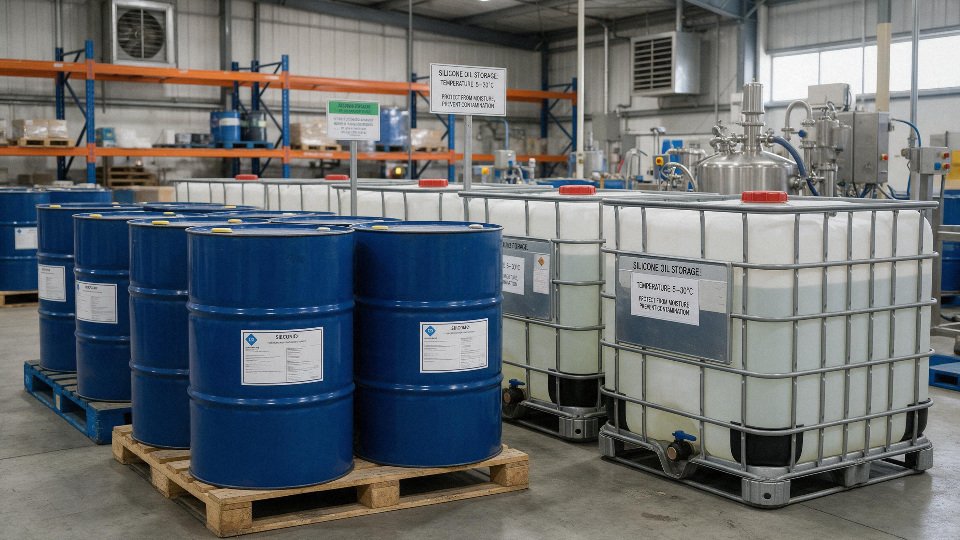
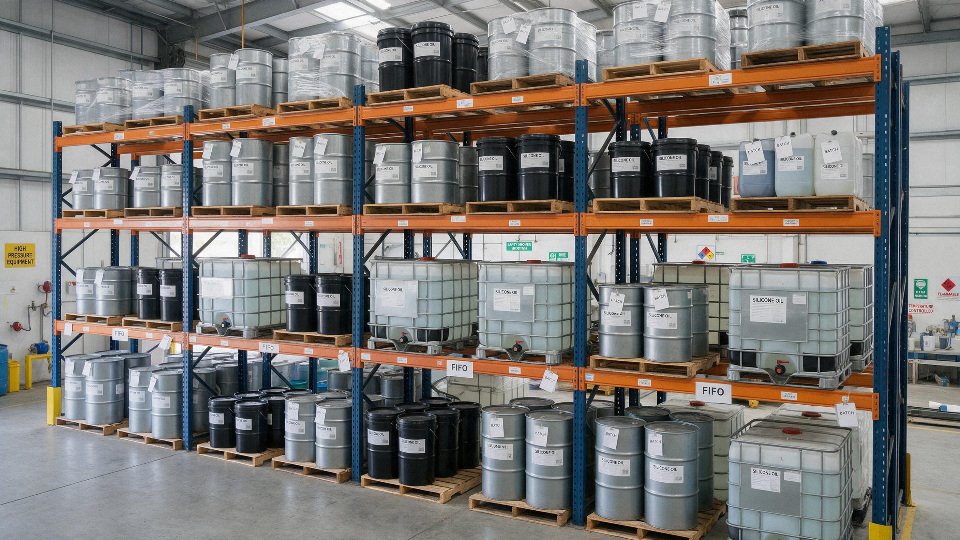
Most acid-related silicone oil failures start in drums, transfer lines, tote repacks, or blending tanks, not in the final application. If you keep silicone oil physically separated from acids, moisture, and dirty transfer hardware, you remove the main conditions that let a minor contamination event turn into a chemistry problem.
Segregation has to cover more than obvious bulk acid contact. In practice, trouble often comes from shared pump carts, a hose that was last used on an acidic cleaner, a tote stored near pickling chemicals, or acid vapor drifting into a poorly sealed day tank.
- Store silicone oils away from:
- Mineral acids and acid blends
- Acidic wash and passivation solutions
- Acid-catalyzed resin or coating raw materials
- Areas with acid mist, fume, or condensate risk
- Separate during:
- Drum and IBC storage
- Transfer to process tanks
- Repacking into smaller containers
- Sample drawing
- Waste handling and empty-container staging
- Mark dedicated equipment clearly:
- Pumps
- Hoses
- Camlocks and gaskets
- Dip tubes
- Funnels
- Portable filter carts
A common plant-floor mistake is assuming a quick solvent flush is enough after acidic service. It often is not. Residual cleaner in a dead leg, low spot, pump seal cavity, or hose liner can be all it takes, especially in a warm line that sits over a weekend.
Control water ingress, not just acid contact
Wet acid contamination is usually more aggressive than dry contact alone because water helps the acid interact with the siloxane system and can accelerate rearrangement or chain scission pathways. The practical effect is that a trace of acidity that seems harmless in a dry, sealed drum may become much more damaging in a vented tank that breathes humid air or in a system with rinse-water carryover.
Focus on the ordinary entry points:
- Keep drums, pails, and IBCs closed except during active use.
- Use desiccant breathers or dry inert blanketing where the application justifies it.
- Do not leave transfer lines wet after water-based cleaning.
- Drain low points fully before introducing silicone oil.
- Check tank vents, manways, and outdoor storage covers before rainy or humid seasons.
- In heated storage, watch for condensation cycles during cool-down.
The boundary here is simple: if your process is intentionally aqueous or already acidified, storage discipline alone will not protect the fluid; you need compatibility testing on the actual formulation.
Use dedicated, verifiably clean handling equipment
Cleanliness has to be chemical, not just visual. A stainless tank that looks spotless can still hold acidic residues from CIP chemistry, passivation chemicals, or previous product. The same goes for hoses with absorbed residues in the liner.
For critical service, set a release checklist before first fill:
- Confirm previous contents of the tank, pump, hose, and filter housing.
- Review the last cleaning chemistry used, including neutralizers.
- Verify rinse completion by conductivity, pH, or documented procedure as appropriate.
- Inspect dead legs, drain points, and seal pots.
- Record the equipment ID against the silicone oil lot.
If you cannot document what was in the line before, treat it as non-dedicated and requalify it before use.
Choose packaging that does not create its own contamination route
New, sealed packaging is usually safer than reused containers unless the reuse program is tightly controlled. The risk is not only residual acid; some liners, closures, or reconditioned containers can introduce extractables or hold retained wash chemistry that does not show up until storage time and heat exposure accumulate.
Prefer:
- Original supplier drums, pails, or IBCs with known lining systems
- Closures and seals compatible with silicone fluids and the storage environment
- Containers with documented cleaning history if reuse is unavoidable
- Packaging kept under cover, off wet floors, and away from corrosive chemical zones
Reused containers are acceptable for silicone oil if they are visibly clean and dry.False
Visual cleanliness is not enough. Residual acidic cleaners, previous contents, absorbed contaminants, or liner degradation can remain and may only show up after storage or heating. For sensitive applications, container history and cleaning verification matter.
Manage temperature and residence time
A moderate contamination level that causes no obvious issue at ambient temperature can become much more harmful after days or weeks in a warm holding tank. Temperature increases reaction rate, lowers viscosity, improves contaminant mobility, and gives acid more time to act throughout the fluid volume rather than only at a local interface.
Watch these conditions closely:
- Heated day tanks
- Warm recirculation loops
- Long blending holds before filling
- Summer warehouse storage
- Containers left near ovens, steam lines, or roof heat gain
Typical dimethyl silicone fluids are often stored and used across a broad service range, roughly from about -50 to 200 C depending on grade, but that does not mean acid-contaminated fluid is safe anywhere inside that range. Once acid and moisture are present, higher temperature usually shortens the time to viscosity drift, haze, odor change, or downstream performance loss.
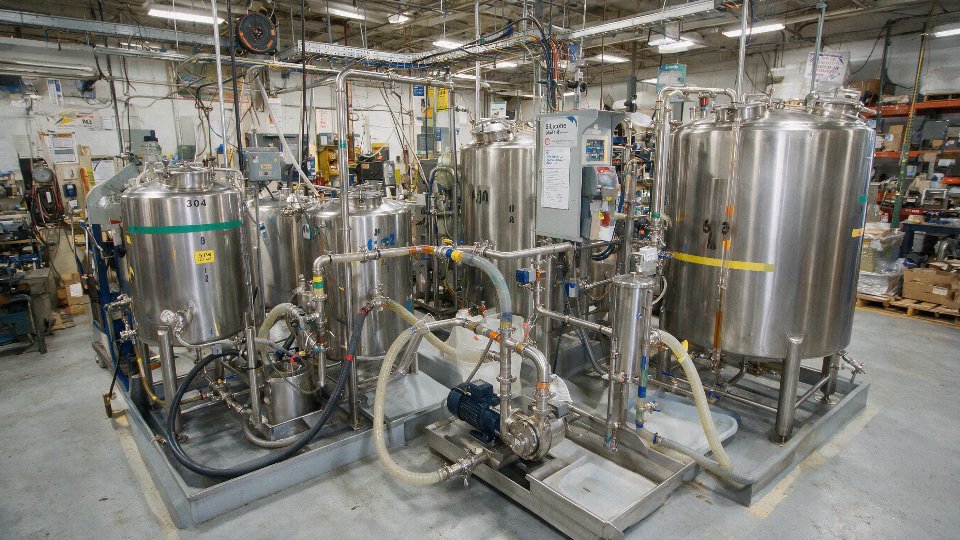
Put traceability and incoming checks where the risk justifies them
Some acid-related failures appear only after long residence time, thermal exposure, or customer use. That is why incoming inspection and lot traceability matter most in applications where the oil becomes a formulation component, a heat-transfer medium, a release coating ingredient, or a precision process fluid.
For higher-risk or higher-consequence use, control at least:
- Supplier and manufacturing lot
- Packaging type and fill date
- Receipt condition
- Retained sample
- Basic incoming checks such as appearance, viscosity, moisture, and acid-related screening if relevant to the process
- Where each lot was used internally and shipped externally
If a later complaint shows delayed viscosity shift or gel formation, this traceability is what lets you separate a chemistry issue from a handling issue. Without it, plants tend to blame the fluid first and spend weeks chasing the wrong root cause.
Frequently asked questions
Does silicone oil react immediately with acid?
Not always. Clean dimethyl silicone fluids often tolerate brief contact with weakly acidic conditions, especially at low temperature and low water content, but strong acids, heat, and long residence time can push the system from “contaminated but usable” into active degradation surprisingly fast.
In practice, “immediately” depends on:
– Acid strength and type: strong mineral acids are usually the first concern
– Concentration: a few ppm in a sealed system is a different problem from a process upset at hundreds or thousands of ppm
– Water present: hydrolytic pathways usually accelerate when water is available
– Temperature: reaction risk rises sharply as temperature climbs
– Silicone chemistry: end groups and modifications matter more than many buyers expect
Which acids are most dangerous to silicone oil?
Strong mineral acids are generally the highest-risk category. Sulfuric acid, hydrochloric acid, and similar strongly acidic contaminants can catalyze siloxane bond cleavage or rearrangement, particularly when moisture and heat are present.
Organic acids are often less aggressive, but that does not make them automatically safe. The preferred choice flips when exposure is long, the formulation is water-rich, or the silicone carries acid-sensitive functional groups. A mild acid in a cosmetic emulsion for months can be more damaging than a short accidental splash in a dry industrial system.
Is silicone oil stable in low-pH formulations?
Sometimes, but low pH alone is not a universal pass/fail criterion. Some silicone-containing formulations remain serviceable at acidic pH because the acid is buffered, water activity is controlled, contact time is limited, and the silicone grade was selected for that chemistry.
What needs checking:
– Final pH under actual use, not just concentrate pH
– Water phase behavior in emulsions or dispersions
– Storage temperature and expected shelf life
– Whether the silicone is plain dimethyl, amino-modified, polyether-modified, or another specialty type
Does viscosity grade change acid resistance?
Not in any simple, reliable way. A 1000 cSt fluid is not automatically more acid resistant than a 100 cSt fluid just because it is thicker.
Higher-viscosity silicone oil is always more resistant to acid attack.False
Viscosity alone does not determine acid stability. Formulation, end groups, catalysts, water, temperature, and exposure time usually dominate the outcome.
Are amino or polyether modified silicones more sensitive?
Often yes. Functional modifications that make a silicone more useful in coatings, textile finishing, personal care, or wetting applications can also create more chemical sensitivity than a straightforward dimethyl fluid.
Watch these cases closely:
– Amino-modified silicones: can interact unfavorably in acidic systems and may show performance drift, instability, or appearance change
– Polyether-modified silicones: often more sensitive in water-rich and chemically complex formulations
– Emulsified systems: surfactant package and pH adjustment chemistry can matter as much as the silicone itself
Can acid-damaged silicone oil be recovered?
Usually not to original performance once meaningful chemical degradation has occurred. Filtration may remove particulates or separated sludge, but it will not rebuild a depolymerized or chemically altered silicone backbone.
Recovery is sometimes limited to:
– Removing free acid contamination before major degradation progresses
– Stripping volatile byproducts in some controlled systems
– Downgrading the material for a less critical use, if quality risk is acceptable
If viscosity has shifted, odor changed, gel specks appeared, or volatile content increased, replacement is usually the cleaner commercial decision.
How should I test my exact process conditions?
- Use the actual silicone grade, not a “similar” generic fluid
- Test against the actual acid or full formulation
- Match temperature, dwell time, shear, water content, and container material
- Check before/after:
- viscosity
- appearance and haze
- acid number or residual acidity, where relevant
- volatile content
- phase stability
- functional performance in the end use
- Run both short-term stress and aged hold testing
A simple bench jar test is useful for screening, but it stops being enough when the plant runs hot, recirculates fluid, or has long storage periods.
What product information should a supplier provide?
Ask for the documents and answers that let you judge fit, not just a generic “acid resistant” statement:
– Product identity and chemical type
– Viscosity grade and normal specification range
– Functional modification details, if any
– Typical service temperature guidance
– Known compatibility limits with strong acids, water, and heat
– Recommended storage conditions and packaging
– Test methods used for key properties
– Whether application-specific screening or sample evaluation is available
For any serious acid-contact application, the supplier should also tell you what they do not know yet without your process data. That is usually a good sign, not a weak one.
Verify your operating window
Start with this rule: if the acid exposure is clearly defined and intermittent, many silicone oil applications can be screened quickly; if the exposure route is vague, wet, hot, or persistent, you should treat the system as unverified until tested on the exact grade. Most expensive mistakes here come from buying “silicone oil” as a generic fluid name when the actual risk sits in end groups, additives, and trace process conditions nobody wrote into the PO.
1. Confirm the exact silicone oil you are actually evaluating
Before you decide anything, pin down the product beyond “dimethyl silicone oil.”
- Base chemistry
- Dimethyl silicone fluid
- Phenyl-modified silicone fluid
- Amino-, epoxy-, or other functional silicone
- Blend versus neat silicone oil
- End groups
- Trimethylsiloxy-terminated
- Hydroxy-terminated
- Other reactive end groups if present
- Additive package
- Antifoam package
- Emulsifier or dispersant
- Stabilizer
- Fillers or performance modifiers in compounded products
- Viscosity grade
- Roughly 5 cSt to very high viscosity grades is a normal market span
- Do not use viscosity alone as a proxy for acid stability
Mechanism matters here. Hydroxy-terminated or otherwise reactive fluids can behave very differently from fully capped fluids under acidic, wet, and warm conditions because the end groups change how easily chain scission, redistribution, or condensation pathways get started. In practice, I have seen buyers compare a low-cost “equivalent” drum by viscosity only, then find that volatility, gel tendency, or residue behavior shifts because the formulation is not chemically equivalent.
2. Define the real acid exposure window, not the nominal one
A compatibility decision is only as good as the exposure definition. Gather the actual operating envelope:
- Acid identity
- Mineral acid, organic acid, mixed acid, acid cleaning residue, acidic catalyst, acidic off-gas condensate
- Concentration or contamination level
- From trace contamination below 10 ppm up to much higher upset levels, depending on the system
- Batch spike, steady background level, or occasional carryover
- Water content
- Dry system, humid environment, aqueous phase contact, washdown residue, condensate
- Temperature
- Normal operating temperature
- Peak excursions during startup, CIP, upset, or hot hold
- Local hot spots near seals, heat exchangers, or recirculation pumps
- Contact time
- Seconds in transfer
- Hours in process
- Weeks or months in storage or standby equipment
- Contamination route
- Process ingress
- Cleaning chemical carryover
- Leaking heat exchanger
- Incorrect tote, hose, or transfer line
- Operator handling error
The trade-off is simple but easy to miss: broad operating flexibility usually means paying for a more stable chemistry or tightening contamination control upstream. If your acid contact is rare and low-level, screening may be enough. If it is wet, hot, and recurrent, the cheaper fluid often becomes the expensive choice through shorter service life, foam instability, residue, off-spec product, or seal maintenance.
3. Classify the application before you spend more time
Use a three-band decision screen:
| Classification | Typical condition | Practical action |
|---|---|---|
| Likely acceptable | Trace or accidental acid exposure, controlled temperature, limited water, short contact time, non-reactive silicone grade | Proceed with document review and a confirmatory bench test if the duty is critical |
| Conditional on testing | Repeated low-to-moderate acid contact, uncertain moisture, temperature cycling, functionalized fluid, quality-sensitive product | Run compatibility testing on the exact grade and retain a control sample |
| High risk | Strong acid, aqueous contact, elevated temperature, long residence time, repeated contamination, prior degradation history | Do not release to production without reformulation, process isolation, or a different material choice |
This screen stops being reliable once the process has multiple unknowns at once, especially acid plus water plus heat. That is where lab screening and retained-sample comparison stop being optional.
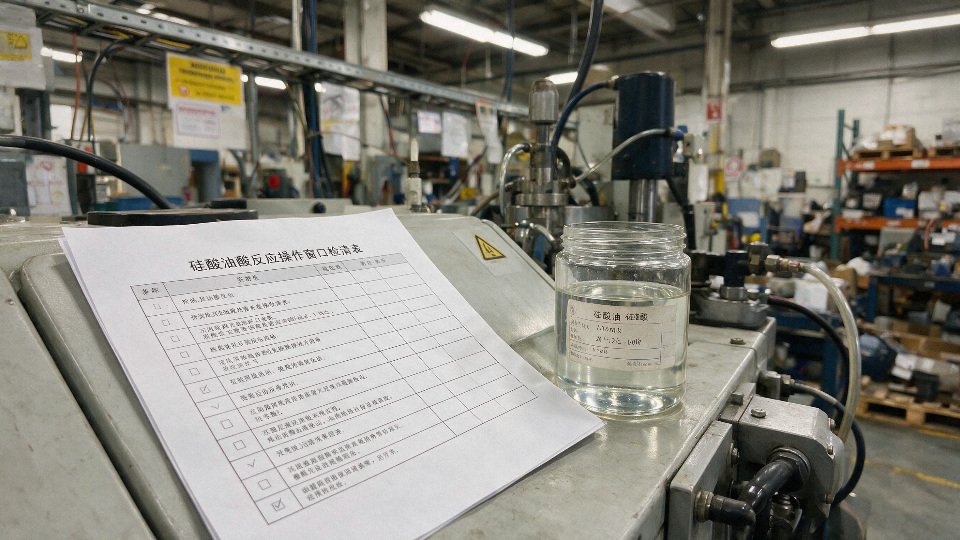
4. Prepare a technical brief your supplier can actually use
If you want a useful recommendation, send a concise technical brief with:
- Application and function of the silicone oil
- Substrate or process media involved
- Acid type and expected concentration range
- Water content or humidity exposure
- Temperature range and peak duration
- Residence time or replacement interval
- Target properties
- Viscosity
- Surface performance
- Volatility
- Dielectric behavior if relevant
- Foam control if relevant
- Required finish or product quality criteria
- Regulatory or customer compliance requirements
- Failure history
- Thickening
- thinning
- odor
- haze
- gel
- deposits
- seal issues
- Clear photos, SDS, process notes, and if possible retained used samples
A generic compatibility answer is enough to approve silicone oil for acidic service.False
Acid response depends on the exact silicone chemistry, contaminants, moisture, temperature, and exposure time. A responsible approval needs grade-specific review and, where the process is consequential, testing under representative conditions.
5. Ask for the right next step
For a low-consequence application, a document-based compatibility review may be enough to decide whether to proceed or screen a small sample. For anything quality-critical or failure-prone, ask for:
- Grade selection against your process window
- Application review based on your technical brief
- Controlled compatibility testing on the candidate grade
- Retained-sample comparison between unused and exposed fluid
- If needed, a custom-modified silicone or higher-stability grade matched to the duty
If you are at the point of choosing, not just reading, contact SiliconChemicals with the exact silicone grade or target viscosity, acid identity, estimated contamination level, water content, temperature peaks, contact time, application purpose, required properties, and clear part or sample photos where relevant. SiliconChemicals can support grade selection, application review, and controlled compatibility testing before you commit to full-scale use.