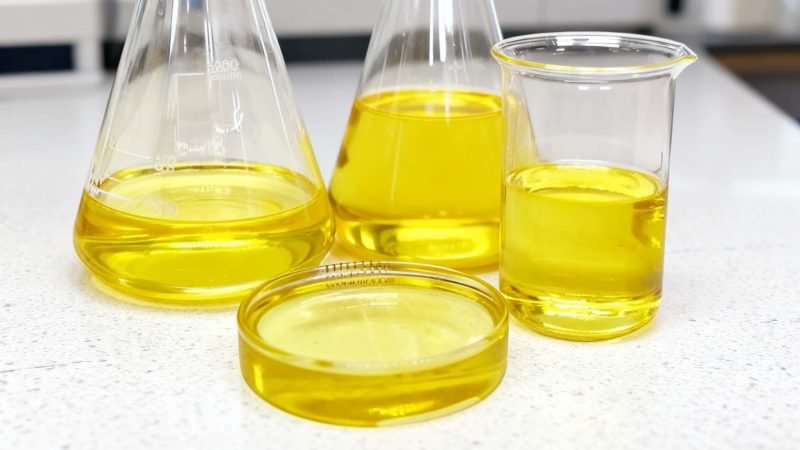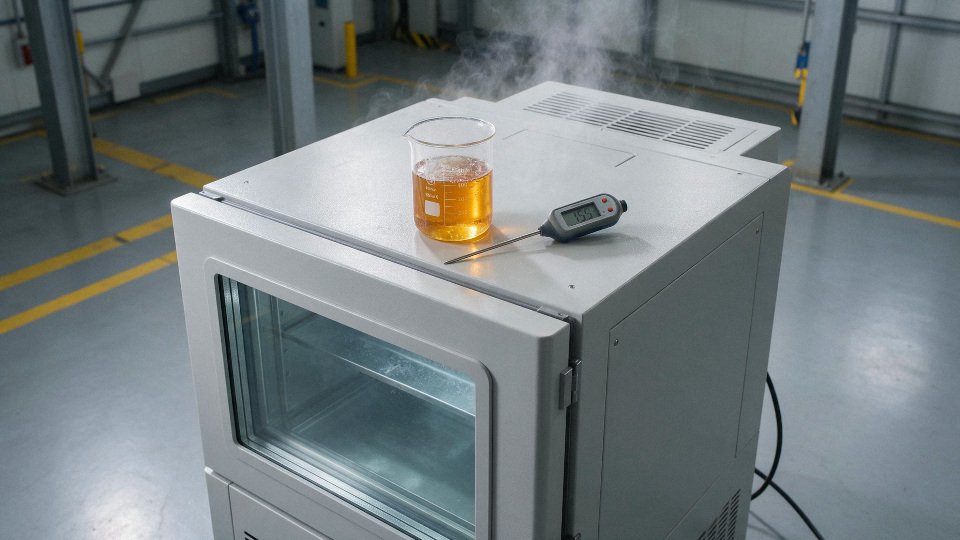
A lot of cleaning and formulation mistakes start with one bad assumption: treating “silicone oil” as if it were a single, predictable material in acetone. On the plant floor, that shows up as haze in a wash tank, residue left on parts, phase separation in a beaker that looked fine for the first minute, or a purchasing spec that says “acetone compatible” without naming the oil grade. The cost is rarely just a solvent drum; it lands as rework, scrap, lost line time, and the wrong buying decision on solvent volume, ventilation load, and waste handling.
Silicone oil is not reliably or universally soluble in acetone, and the answer depends mainly on the silicone oil’s chemistry, viscosity, and the test conditions. For typical room-temperature screening at 20 to 25 °C, using low-water-content acetone and mix ratios around 1:1 to 1:20 by volume, some low-viscosity or modified silicone fluids may appear partly compatible, but many standard polydimethylsiloxane oils show limited solubility, haze, or separation and should be verified by a simple bench test before any process or purchasing decision.
The part that catches people is that two fluids both labeled “silicone oil” can behave very differently in the same acetone drum, and even the same oil can look acceptable at one dilution and fail at another. That is why the useful question is not just “soluble or not,” but which silicone oil, at what viscosity, at what ratio, with how much water in the acetone, and for what actual job: cleaning, dilution, analysis, or formulation.
Compatibility mechanisms
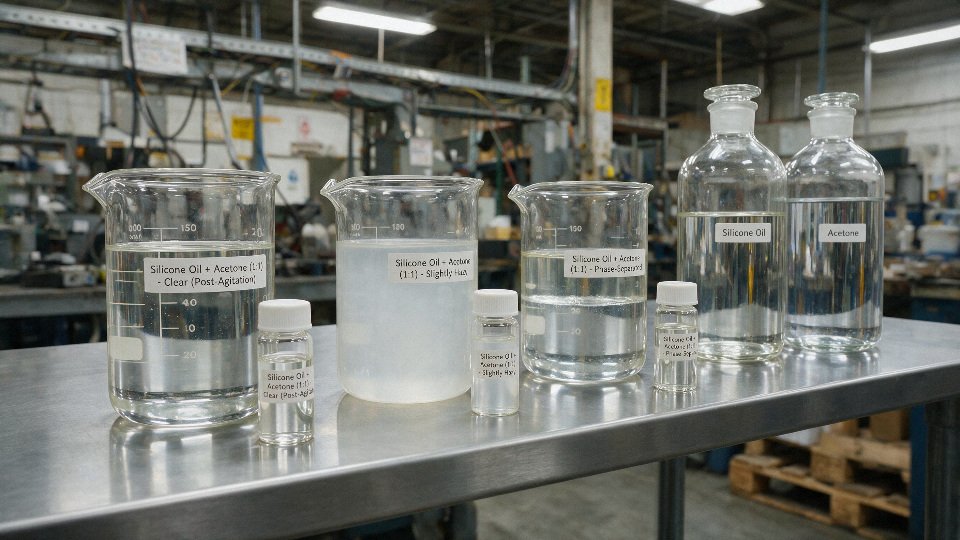
For standard dimethyl silicone oil and acetone, the governing mechanism is usually a mismatch in molecular interactions, not a simple handling issue. They may look temporarily mixed after shaking, especially at low viscosity or high acetone dilution, but acetone’s polarity profile does not strongly favor stable molecular dissolution of typical PDMS-based fluids.
At the chemistry level, most standard silicone oils are built on a siloxane backbone, the repeating Si–O–Si chain, with organic groups attached to the silicon atoms. In the common case, those side groups are methyl groups, so the fluid is essentially a dimethyl silicone fluid. That structure matters because it gives silicone oil a combination that confuses buyers who are used to hydrocarbons: a very flexible backbone, low glass transition behavior, low surface tension, and relatively weak intermolecular attraction compared with many conventional organic liquids.
That weak self-association is one reason silicone oils spread easily and stay fluid over a wide temperature range. It does not automatically mean they dissolve well in every solvent. A fluid can have low internal cohesion and still be a poor match for a specific solvent if the solvent cannot replace those interactions efficiently enough. In plant terms, “thin and slippery” is not the same as “easy to solvent-cut.”
Acetone sits on the other side of that mismatch. It is a polar aprotic solvent with a strong carbonyl group, so its molecules interact well with many resins, some oils, and a long list of organics that can accept its polarity profile. It does not donate hydrogen bonds, but it has a meaningful dipole and tends to favor solutes with compatible polar interaction components. Standard dimethyl silicone fluids are not strongly polar in that sense. They are often described as nonpolar to weakly polar in practical solvent-selection work, and that is close enough for purchasing and lab screening decisions.
The usual shorthand is “like dissolves like,” which is useful but incomplete. A better way to think about it is balance across dispersion forces, polar forces, and, where relevant, hydrogen-bonding character. Acetone brings a noticeable polar contribution. PDMS-type silicone oil is dominated more by dispersion interactions and by the unusual flexibility of the siloxane chain than by strong dipolar attraction. If those interaction profiles are too far apart, the free energy penalty of mixing stays too high, and what you get is partial compatibility, haze, temporary clarity, or clean phase separation rather than true solution behavior.
That is where buyers often get misled by one beaker test or one vendor statement.
If a silicone oil and acetone mixture turns clear after shaking, the silicone oil is definitely soluble in acetone.False
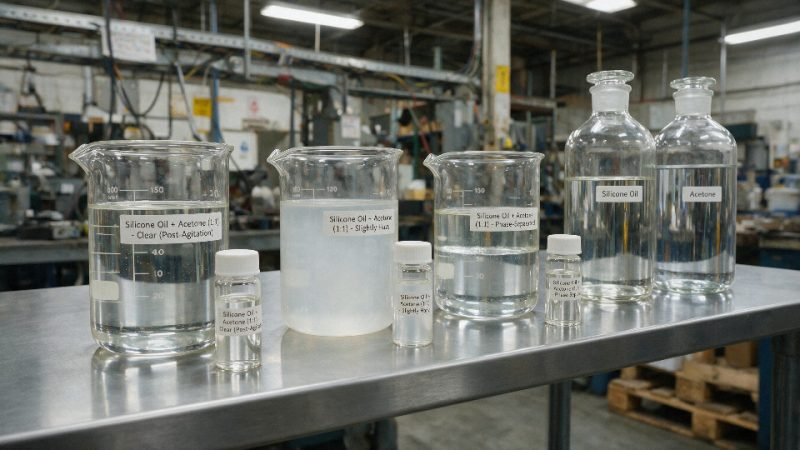
Immediate visual clarity can be a transient dispersion effect. Low-viscosity silicone droplets can become very fine under agitation, and the mixture may look clear or only slightly hazy for a few minutes before phase separation develops. A proper judgment needs time-based observation under controlled conditions.
Why molecular weight and viscosity change what you see
Lower molecular weight silicone fluids usually show greater apparent compatibility with acetone than high-viscosity grades, but “apparent” is doing important work in that sentence. Shorter chains have lower entanglement, lower viscosity, and a smaller mixing penalty per molecule, so they can disperse more finely and sometimes remain visually uniform longer. In a quick room-temperature screening, a 10 cSt fluid can behave very differently from a 1000 cSt fluid even when both are fundamentally dimethyl silicone oils.
The mechanism is partly thermodynamic and partly practical:
- Shorter chains are easier for the solvent to penetrate and distribute.
- Lower viscosity allows faster breakup during mixing, creating finer droplets and slower visible separation.
- Higher molecular weight fluids have more chain entanglement and usually a stronger tendency to pull back into a silicone-rich phase.
- Observation bias gets worse as viscosity rises; a thick fluid may look “insoluble” quickly because it never disperses well, while a thin fluid may look “soluble” when it is only forming a temporary single-looking phase.
In practice, this is why screening tests are often run across a range such as 10 cSt to 1000 cSt at 20 to 25 °C, with low-water acetone and a 5 to 30 minute observation window. If you only test one ratio and one viscosity, you can easily draw the wrong conclusion. A 1:20 silicone oil-to-acetone blend may stay visually uniform much longer than a 1:1 blend, not because the chemistry has changed, but because the dispersed phase volume is lower and the droplets are slower to find each other and coalesce.
The trade-off is straightforward. Lower-viscosity fluids are easier to screen and may appear more compatible, but that does not mean a high-viscosity production grade will behave the same way in a drum mix, tank wash, or line flush. Once chain length rises enough, the quick-clarity shortcut stops being reliable.
Why modified silicone oils can behave differently
Functional modification can move silicone fluids much closer to acetone compatibility, sometimes enough to make vendor claims sound contradictory unless you know the chemistry. The side groups attached to the siloxane chain change solvent affinity more than many non-specialists expect.
Three broad cases matter most:
Phenyl-modified silicone fluids
Phenyl groups increase polarizability and often improve compatibility with aromatic solvents and some organic systems relative to straight dimethyl fluids. They do not guarantee good acetone solubility, but they can shift behavior toward better mutual affinity than a methyl-only silicone oil. The degree of phenyl substitution matters; without that detail, a blanket claim is not very useful.
Polyether-modified silicones
These are often much more compatible with polar media because the polyether segment introduces stronger polar interactions. In coatings, wetting, and surfactant-type applications, that can dramatically change how the fluid behaves in ketones, alcohol blends, or water-containing systems. This is one of the clearest cases where someone says “silicone oil dissolves in acetone” and someone else says “it does not,” and both may be talking about different products.
Reactive or specialty-functional fluids
Amino-, epoxy-, hydroxyl-, alkoxy-, or other reactive modifications can shift compatibility in either direction depending on functionality level, molecular architecture, and whether the product is neat, stabilized, or partly formulated. These are not safe to generalize from family name alone. You need the actual product type, active content, and often the supplier’s solvent compatibility sheet or a bench test.
The boundary here is simple: conclusions drawn for standard dimethyl silicone oil stop holding once modification becomes substantial enough to dominate the interaction profile. At that point, the product is no longer behaving like a plain silicone fluid in solvent selection.
Why clear does not always mean dissolved
A common plant-floor mistake is to judge compatibility in the first 30 seconds after agitation. That is fine for a rough reject screen, but it is not enough to confirm molecular solubility. Silicone oil and acetone can form a temporary, fine dispersion that looks clear or nearly clear, especially in a clean glass vial with a low-viscosity fluid and a high acetone ratio.
What happens next depends on droplet size, density difference, interfacial tension, viscosity, and whether any formulation extras are acting like weak compatibilizers. Delayed separation is common. You may see:
- an initially clear blend that turns opalescent after a few minutes
- a faint top or bottom layer after 10 to 30 minutes
- a “stringy” or lens-like phase after standing
- wall wetting that makes the sample look more uniform than it really is
If the decision matters commercially, the test should be time-based and documented. Check immediately after mixing, then after 5 minutes, 15 minutes, and 30 minutes at minimum. If the product will be used in a cool warehouse or winter production area, repeat at the expected lower temperature; borderline systems often separate faster when temperature drops.
Formulation extras can distort the result
Pure-component logic is a good starting point, but production materials are not always pure silicone oil plus pure acetone. Small formulation components can change what the operator sees in a jar test, sometimes enough to cause a bad purchasing decision.
Watch for these distorting factors:
- Residual cyclic siloxanes or low oligomers
These can improve apparent short-term compatibility because they are lower molecular weight and often easier to disperse. - Stabilizers or inhibitors
Usually present at low levels, but in marginal systems even small amounts can alter clarity or separation behavior. Fragrance oils, hydrocarbons, or co-solvents
Common in consumer, release, polish, or maintenance formulations. These can act as bridges between phases and make a blend look more acetone-compatible than the base silicone actually is.Fillers or silica
Instead of true dissolution, you may get a structured suspension. It can look stable because the network slows separation, not because the silicone is molecularly dissolved.Surfactants or emulsifier residues
These can create persistent microdispersions. Anyone who has cleaned an old tote or reused a lab beaker has seen this once or twice.
That last point is not trivial. In practice, a dirty sample bottle, a trace of detergent, or a reused stirring rod can completely change a borderline compatibility test. If a vendor claim and your screening result disagree, first rule out contamination and unidentified formulation components before assuming the chemistry itself is wrong.
Silicone oil grade differences
The short answer only holds if you know which silicone fluid you actually have. “Silicone oil” on a drum label is too broad to predict acetone behavior, because a straight PDMS fluid, a phenyl-modified fluid, a polyether silicone, and a silicone emulsion can give visibly different results under the same bench test.
In purchasing and troubleshooting, this is where people get tripped up. A plant tech runs a quick beaker test, sees partial mixing or haze, and someone declares that “silicone oil is soluble” or “not soluble.” That conclusion may be wrong simply because the product is not a neat, standard dimethyl silicone fluid. The chemistry package matters as much as the silicone backbone.
Standard PDMS fluids across viscosity bands
For most buyers, “silicone oil” means polydimethylsiloxane, or PDMS. This is the baseline family behind many heat-transfer fluids, lubricants, release fluids, dielectric fluids, and process aids.
Across the common screening range of roughly 10 cSt to 1000 cSt, the practical expectation is usually the same: neat PDMS is often poorly compatible with acetone compared with hydrocarbons or some chlorinated solvents. What changes with viscosity is not just whether the system ultimately dissolves, but how the test looks while it is happening.
- Low-viscosity PDMS, around 10 to 50 cSt
- Disperses more easily when shaken or stirred
- Can give a misleading temporary uniform appearance
- Often separates more slowly, so a 5-minute observation may overstate compatibility
- Mid-range PDMS, around 100 to 350 cSt
- Usually shows the phase behavior more clearly
- If incompatibility is present, haze, droplets, or layer separation often become obvious within the normal 5 to 30 minute screening window
- High-viscosity PDMS, around 500 to 1000 cSt and above
- Mixes slowly even when the chemistry is reasonably favorable
- Traps bubbles and forms strings or globules that look like “gel” to inexperienced operators
- Needs more disciplined test handling, because poor dispersion can be mistaken for insolubility
The mechanism is simple enough on the floor: as viscosity rises, diffusion slows and mechanical mixing energy has a bigger effect on what you think you are seeing. A hand-shaken vial test at 1000 cSt tells you as much about shear history as it does about chemistry. That is why viscosity comparisons only mean something if temperature, acetone dryness, ratio, and mixing method are held reasonably constant.
The trade-off is that low-viscosity PDMS gives cleaner screening results faster, but it is not a stand-in for a 1000 cSt process fluid. If the plant uses a heavier grade for carryover control or film persistence, test that actual grade. The shortcut stops being reliable once molecular weight and flow behavior move far enough from the product you screened.
Phenyl-modified silicone oils
Phenyl substitution often shifts silicone fluids toward better compatibility with aromatic and some organic solvent systems, and it can change how they behave in acetone as well. It does not guarantee full solubility, but it can move a fluid from clear non-mixing behavior to partial compatibility or broader dilution tolerance.
Why? Replacing some methyl groups with phenyl groups changes the fluid’s intermolecular interactions and polarizability. In plain terms, the liquid becomes less “purely dimethyl-like” and can interact differently with organic solvents. In practice, even modest phenyl content can alter cloud point, clarity, and the acetone-to-silicone ratio at which phase separation appears.
This is one of those cases where generic naming causes expensive confusion. A thermal-stable phenyl silicone and a standard PDMS can both be sold loosely as silicone oil, yet their solvent response can diverge enough to matter in coating dilution, residue cleaning, or analytical sample prep. The flip side is cost and use-case fit: phenyl-modified fluids are chosen for thermal or low-temperature performance, refractive index, or solvent response, not because they are a drop-in substitute for standard PDMS everywhere.
Polyether-modified silicones
If your product is polyether-modified, the headline answer may change materially. Polyether silicones often have much greater affinity for polar organic systems than standard PDMS, so acetone interaction can be far stronger than a buyer would expect from “silicone oil” as a generic category.
These materials are widely used as surfactants, wetting agents, flow and leveling additives, agricultural adjuvants, and foam-control components. The polyether segment introduces polarity, and that can pull the fluid toward better compatibility with solvents that would reject neat dimethyl silicone.
A few practical consequences matter:
- A polyether silicone may form a clear or nearly clear mixture with acetone where PDMS would separate.
- Water contamination can change the picture fast, because many polyether-modified systems are sensitive to the water balance of the solvent package.
- The same product may behave differently at a 1:1 test ratio than at 1:10 or 1:20, especially if it is functioning more like a surfactant than a simple oil.
This is also where batch handling history starts to matter. A tote left open in a humid blending room can absorb enough moisture indirectly through the solvent side of the test to change appearance. On paper the chemistry is the same; on the bench the result looks different.
Functional silicone fluids used in specialty systems
Amino-, epoxy-, hydroxyl-, and alkyl-functional silicone fluids sit in the gray zone between base fluids and reactive formulation ingredients. Their behavior in acetone depends not only on the silicone backbone but on functional group level, molecular architecture, and whether the product is intended as a neat fluid, resin intermediate, textile softener component, or release coating ingredient.
Common patterns are:
- Amino-functional silicones
- Used in textiles, personal care, and soft-touch finishes
- Can show stronger interaction with polar systems than plain PDMS
- May also create haze or instability depending on neutralization state and formulation history
- Epoxy-functional silicones
- Common in coatings, adhesion promotion, and reactive systems
- Solvent compatibility can be formulation-specific rather than category-wide
- Storage age matters if partial reaction or contamination has changed the product
- Hydroxyl-functional silicones
- Often used as intermediates or for further reaction
- Can behave very differently from fully end-blocked PDMS
- Moisture, catalyst residues, or condensation history can complicate test interpretation
- Alkyl-modified silicones
- Chosen to tune slip, compatibility, or hydrophobic balance
- Response in acetone depends heavily on alkyl type and substitution level
A functional silicone fluid cannot be classified for acetone solubility based on viscosity alone.True
Viscosity affects mixing speed and appearance, but functional groups often shift solvent affinity more strongly than a change from, say, 50 cSt to 350 cSt within the same backbone family.
Silicone emulsions are a different question
A silicone emulsion is not a neat oil. It is a dispersed system of silicone droplets in water, usually stabilized by surfactants, sometimes with emulsifiers, preservatives, defoamers, and pH control agents in the package.
If you add acetone to a silicone emulsion, you are not asking whether silicone oil dissolves in acetone. You are asking whether the emulsion remains stable when a water-miscible organic solvent disrupts the surfactant balance and continuous phase.
That distinction matters on the plant floor because the observed outcomes can include:
- breaking or coagulation
- rapid viscosity drop
- phase inversion
- localized gelling
- a temporary smooth appearance followed by separation
A buyer looking at a textile softener emulsion or release emulsion should not use neat-oil solubility logic. The right check is emulsion stability in the intended solvent package, at the intended addition order, under the plant’s actual water quality and shear conditions.
Blends, antifoams, and compounded products
Many commercial “silicone oils” are not single-component fluids at all. Antifoams, release concentrates, compound lubricants, and process additives often contain carriers, silica, organic oils, surfactants, or performance additives that dominate the acetone test result.
In practice, these are the problem products. A silicone antifoam in hydrocarbon carrier may appear to “mix” with acetone because the carrier disperses first. A compounded release fluid may throw haze because of silica or wax, not because the silicone fraction itself is insoluble. If the product contains 5 to 20% active silicone and the rest is carrier and package, the observed behavior belongs to the formulation, not to silicone chemistry in isolation.

Why the data sheet matters more than the generic label
The useful question is not “Is silicone oil soluble in acetone?” but “What exact silicone product is this, and is it neat or formulated?” Product data sheets, technical data sheets, and where needed SDS documents should be checked for:
- chemical description, not just trade name
- viscosity grade
- functional modification
- active content
- solvent or carrier identity
- emulsion versus neat fluid status
- recommended dilution media
- storage and handling notes that may affect testing
If the sheet only says silicone oil, that is not enough for a buying decision or a process correction. Ask for the exact chemistry class and, if the application is sensitive, confirm with a controlled bench test at 20 to 25 °C using low-water acetone and the actual product ratio you plan to use. That extra hour up front is cheaper than finding out after a whole blend tank turns milky.
Acetone test variables
A silicone oil can look “soluble” in one acetone test and plainly incompatible in another, simply because the test setup changed. If you do not lock down acetone grade, water content, ratio, agitation, temperature, and observation time, a jar test can tell you more about the test method than about the fluid.
The mistake I see most often is treating acetone as a single fixed material. On paper it is one solvent; on the plant floor, technical-grade acetone from a drum that has been opened for two humid shifts is not behaving like fresh low-water lab solvent.
Acetone purity and water content
Water is usually the first hidden variable to check. Acetone is fully miscible with water, and once it picks up moisture from storage, transfer, or an unsealed wash bottle, the solvent environment changes enough to shift what you see with silicone fluids.
A few practical points matter:
- Low-water acetone gives the most reproducible screening result for comparing one silicone oil against another.
- Technical-grade acetone may contain water and trace impurities that do not show up in a casual bench test but can affect haze, phase separation, or residue.
- Acetone stored in:
- half-empty drums
- vented day tanks
- frequently opened lab bottles
- humid production areas
will usually drift away from the “fresh solvent” condition.
Mechanistically, water changes both polarity balance and interfacial behavior. That can do two different things depending on the silicone fluid and the test ratio: it may push the system toward faster visible separation, or it may create a temporary haze or micro-dispersion that someone misreads as partial solubility. Either way, the result is not comparable to a dry-acetone screen.
A silicone oil judged acceptable in acetone using fresh low-water solvent may fail the same visual test with moisture-contaminated acetone.True
Water uptake changes the effective solvent environment and can alter clarity, dispersion stability, and phase behavior. The magnitude depends on silicone oil chemistry and test ratio, so the result must be verified under controlled solvent conditions.
If the decision affects cleaning validation, rework, extraction, or incoming material approval, specify the solvent condition in writing. “Acetone” is not enough.
Temperature changes what you think you are seeing
At 20 to 25 °C, which is a common screening range, even small temperature shifts can change visual behavior. Warmer conditions lower silicone oil viscosity, improve diffusion, and make mixing look better in the first few minutes. That is useful if your process really runs warm; it is misleading if the production line, warehouse, or cleaning station runs colder.
What usually changes with temperature:
- Silicone oil viscosity drops, sometimes sharply for higher-viscosity grades
- Mass transfer improves, so the mix clears or disperses faster
- Temporary homogeneity lasts longer before separation becomes obvious
- Settling or layer formation may be delayed enough to fool a short observation
The trade-off is straightforward. Testing warm can reveal whether acetone helps mobilize or thin a contaminant during actual cleaning. It can also overstate compatibility if your acceptance criterion is true single-phase behavior at ambient conditions. That conclusion stops holding if the process temperature is controlled and consistently above room temperature; in that case, the warm test may be the relevant one.
Ratio matters: trace contamination is not bulk dilution
A lot of confusion comes from comparing unlike ratios. A silicone residue being rinsed off a metal part is one problem. Trying to dilute silicone oil into acetone as a bulk blend is a different problem entirely.
Use separate test ranges for separate questions:
- Trace contamination or residue pickup: very low silicone oil loading in acetone
- Cleaning or extraction screening: intermediate ratios, often around the common 1:1 to 1:20 silicone oil-to-acetone by volume range, depending on the purpose
- Bulk dilution attempt: high silicone oil loading, where phase behavior becomes much less forgiving
In practice, a fluid may appear manageable when only a thin film is present on a part, yet split quickly when you try to make a concentrated working mixture. That is not a contradiction. It reflects where the system crosses from “acetone can carry some of it” to “the solvent is overloaded.”
For procurement and process signoff, the ratio should match the job:
- residue removal
- line flush
- lab extraction
- reclaim attempt
- rework thinning
If the supplier statement does not state ratio, it is incomplete for decision-making.
Agitation intensity and time
High shear can make a bad combination look acceptable for a short window. A vortex mixer, ultrasonic bath, paint shaker, or aggressive hand shaking can create a fine temporary dispersion that passes a quick visual check and then separates once the sample sits.
Watch for these common traps:
- Judging compatibility immediately after vigorous shaking
- Comparing one sample hand-shaken for 5 seconds against another mixed for 2 minutes
- Using different containers that change vortex formation
- Calling a milky dispersion a solution
The mechanism is simple enough: shear breaks one phase into small droplets, increasing the time needed for coalescence and visible separation. That says something about dispersion stability, not necessarily about molecular-level solubility.
In a plant setting, this matters because pumps, recirculation loops, and spray nozzles can keep a system looking uniform long enough to get through a shift, then leave separated waste drums, residue bands, or inconsistent cleaning by the next day.
Observation window and what each time point tells you
Do not rely on a single glance. Immediate appearance, 5-minute stability, 30-minute separation, and 24-hour phase behavior answer different questions.
A useful sequence is:
- Immediate appearance
- Clear
- Slight haze
- Milky dispersion
- Visible two-phase split
- After 5 minutes
- Has haze increased or decreased?
- Is there a top or bottom layer starting to form?
- Are droplets clinging to the wall?
- After 30 minutes
- Is phase separation now obvious?
- Is there sediment, floating oil, or a rag layer?
- After 24 hours
- Does the system fully separate?
- Is there persistent haze?
- Is residue left on the glass after decanting?
A sample that looks promising at 2 minutes may be useless for storage, waste handling, or consistent metering. On the other hand, for a wipe-cleaning process where contact time is under a minute, the 24-hour result may be less relevant than short-term pickup performance. The test has to match the duty.
Container cleanliness and cross-contamination
Dirty glassware ruins solvent screening faster than people admit. Residual surfactants, previous solvent films, detergent traces from washing, or leftover release agent from a prior test can shift interfacial behavior enough to create false clarity or false haze.
Common contamination sources:
- Lab glass washed with detergent and not fully rinsed
- Reused sample bottles from alcohol, hydrocarbon, or surfactant service
- Pipettes or syringes carrying over previous materials
- Finger oils on rims and caps
- PTFE-lined caps that saw another chemical before reuse
Surfactant contamination is especially troublesome because a tiny amount can stabilize an emulsion and make an incompatible system appear “mixed” for far longer than it should.
Define acceptance criteria before you test
The test is only useful if “pass” means something operationally specific. Different plants use the same jar test to answer completely different questions, then argue over the result.
Set the criterion first:
- Clear solution required: for blending, metering, or analytical preparation
- Haze acceptable below a defined threshold: for noncritical cleaning or short-contact use
- Low residue after evaporation required: for surface prep or electronics-adjacent work
- Extraction efficiency required: for contamination analysis or strip-and-measure work
- Rework suitability required: for salvage operations where perfect clarity is not necessary
That last point matters. A mixture that is not a true solution may still be good enough to soften, mobilize, or carry away a thin silicone film during rework. But if you need a stable one-phase liquid in a tote, drum, or feed tank, the acceptance bar is much higher.
Practical process implications
Acetone is useful in silicone-related work, but mostly as a limited-purpose solvent, not a universal fix. It can help with light uncured residues, thin transfer films, and some mixed process soils; it often underperforms on established silicone oil layers, higher-viscosity fluids, and contamination embedded in textured surfaces, wipes, felts, rollers, or porous substrates.
The practical mistake is easy to spot on a plant floor: somebody sees silicone smear soften during wiping, the rag comes back dirty, and the line assumes the surface is clean. In a lot of cases, the acetone has only mobilized part of the contamination, spread the rest into a thinner film, and then flashed off fast enough to leave a visually clean but functionally contaminated surface.
Cleaning and degreasing
For light contamination, acetone can work as a first-pass cleaner. For bulk silicone oil or aged residue, it is usually unreliable on its own, especially once viscosity climbs or the residue has had time to wet into surface texture, paper cores, elastomer rolls, fabric belts, or oxidized metal.
Why the difference matters:
- Thin uncured traces are easier to disturb because the silicone layer is small and often mixed with other low-molecular-weight species, process dust, oils, or additives.
- Thicker silicone films need true dissolution or strong displacement to leave the surface, not just temporary softening.
- Higher-viscosity residues resist transfer. You can smear them around with a wipe and still leave enough behind to cause defects.
- Mixed soils behave differently from neat silicone oil. A release agent contaminated with wax, mineral oil, surfactant, or filler may respond to acetone in a way that the pure silicone fluid would not.
Mechanism matters here. If acetone only partially interacts with the residue, it lowers apparent film strength during wiping without creating a stable single phase. The wipe then shears and redistributes the contamination instead of lifting it cleanly. On smooth stainless, you may get away with it. On bead-blasted aluminum, cast housings, painted guards, or rough conveyor components, the same method often leaves enough silicone in surface valleys to keep causing fisheyes or adhesion loss.
In practice, cleaning success depends on more than solvent choice:
- Residue age
- Fresh contamination is usually easier.
- Heat-aged films and repeatedly deposited mist are harder to remove.
- Film thickness
- A fingerprint-scale transfer film behaves very differently from a pump leak or dripped lubricant.
- Substrate texture and porosity
- Polished metal is forgiving.
- Textured polymer, paper, fabric, wood, and rough coatings hold silicone tenaciously.
- Cleaning method
- Static wiping is the weakest method.
- Flooding, immersion, agitation, heated compatible cleaner systems, or multi-stage wash/rinse/dry setups generally outperform hand wiping.
- Verification
- Visual cleanliness is not enough for adhesion-critical work.
- Water-break tests, dyne measurement where relevant, contact-angle trends, witness panel bonding, or coating defect checks tell you more than a clean-looking part.
A common trade-off shows up in maintenance departments: acetone is cheap, available, and evaporates fast, so downtime looks low. The cost comes back later as repaint rejects, seal failures, or repeated cleaning labor because the contamination was reduced, not removed. That conclusion stops holding if the contamination is genuinely light, fresh, and on a noncritical surface where a trace residual film has no process consequence.
Formulation and dilution
If the silicone fluid and acetone are not truly compatible under your formulation conditions, using acetone as a diluent can create a bath that looks acceptable at charge-up and fails during use. The usual symptoms are haze, delayed phase separation, viscosity drift, uneven wetting, poor leveling, edge pullback, or variable add-on weight from the same tank.
This is where people get trapped by a short beaker test. A mixture may appear clear for five or ten minutes at room temperature and then split after standing, after water pickup from air, or after contact with the rest of the formulation package. Pigments, resins, surfactants, fillers, and trace salts can all shift the balance.
Typical plant-floor failure modes include:
- Uneven coating laydown
- The first parts look acceptable.
- Later parts show craters, skips, or different gloss because the silicone-rich fraction has separated.
- Poor leveling
- The solvent flashes before the system can level.
- A nonuniform silicone distribution exaggerates orange peel, streaking, or drawdown marks.
- Bath instability
- Recirculation keeps the mixture looking uniform temporarily.
- Dead legs, day tanks, and quiet corners in tote-based feed systems reveal the separation problem.
- Dose inconsistency
- Metering a partially separated bath means the line is not feeding what the formulation sheet assumes it is feeding.
A clear acetone-silicone blend at room temperature is enough to approve acetone as a production diluent.False
Short-term clarity only shows that the tested sample looked homogeneous under those exact conditions. Production suitability still depends on silicone chemistry, concentration, viscosity, water content, residence time, temperature swing, and the effect of all other formulation components.
If the process is sensitive to coating uniformity, slip, release, defoaming, or surface energy, compatibility screening should include the full formulation, not just silicone oil plus acetone in a glass jar.
Analytical sample preparation
Acetone can bias lab results if it extracts only part of a silicone-containing system. That is a serious problem when QC, failure analysis, or incoming inspection is trying to answer “how much silicone is present?” or “is silicone contamination the cause?”
Partial extraction creates two kinds of error:
- False low results
- The acetone removes mobile fractions but leaves higher-molecular-weight or less compatible silicone behind.
- The test then underreports total silicone content.
- Misleading composition
- The extracted fraction may not represent the whole system.
- You end up analyzing what acetone preferred to pick up, not what was actually on the part or in the deposit.
This shows up often with:
- defoamer-containing aqueous systems
- cured or partially cured sealant residues
- release coatings
- silicone-contaminated powders or fillers
- multilayer deposits from mixed lubricants and process dust
For analytical work, the solvent choice has to match the question. If the question is “what fraction is acetone-extractable?” then acetone is fine. If the question is total recoverable silicone, method development has to prove recovery on that exact matrix. Otherwise the data can look clean and still lead engineering in the wrong direction.
Surface preparation before bonding, painting, or printing
For adhesion-critical surfaces, acetone wiping is often a screening step, not a release-to-production cleaning method. Silicone contamination can persist after wiping and still be enough to cause fisheyes, ink repellency, label lift, bondline weakness, or erratic paint wetting.
The counter-intuitive part is that a fast-evaporating solvent can create a strong false-clean signal:
- the surface looks dry quickly
- visible smears disappear
- odor drops off fast
- the operator assumes the contaminant is gone
But if the wipe loaded up early, or the cloth pressure was low, or the part geometry trapped contamination in corners and fastener heads, the silicone may just be spread thinner. Thin silicone films are exactly the kind that trigger downstream defects while remaining nearly invisible.
A practical check sequence is usually better than repeated blind wiping:
- Remove gross residue mechanically if present.
- Clean using a validated method with fresh wipes or controlled wash chemistry.
- Avoid reusing contaminated cloths that simply transfer residue.
- Run a quick adhesion or coating witness sample before restarting the full lot.
Maintenance and contamination control
Lines handling sealants, release agents, defoamers, or silicone lubricants need segregation discipline more than heroic cleanup. Once silicone gets into shared tools, benches, gloves, pump carts, or maintenance rags, the contamination source can become intermittent and hard to trace.
The usual weak points are familiar:
- shared spray bottles
- unlabelled wipes and cloth bins
- air lines near silicone spray use
- maintenance technicians moving between silicone and paint/adhesive areas
- reused containers and funnels
- drip pans under metering pumps
Acetone has a place in cleanup kits, but not as the entire contamination-control strategy. If recurring silicone defects are showing up, audit the pathway, not just the solvent cabinet.
Safety and EHS considerations
Acetone’s main safety issue is not mystery chemistry; it is ordinary flammable-solvent discipline that plants get casual about because acetone is common. Fast evaporation raises vapor load quickly, especially during wipe cleaning, open-pan washing, or indoor maintenance on warm equipment.
At minimum, operations need to control:
- Ignition sources
- Hot surfaces, non-rated switches, static, grinders, and nearby welding
- Ventilation
- Local exhaust or confirmed general ventilation, not just an open door and hope
- Wipe handling
- Solvent-wet rags in proper closed containers, because they keep evaporating after the job
- Waste segregation
- Silicone-containing solvent waste may need to stay separate from other streams depending on site disposal rules and recycler requirements
- Worker exposure
- Gloves, eye protection, and procedure discipline matter because repeated hand wiping is where shortcuts happen
Repeated wiping also creates a housekeeping problem: every pass can move silicone from the part to the glove, from the glove to the bench, and from the bench to the next batch. On paper, the area was cleaned. On the line, the contamination footprint just got bigger.
Alternative solvent options
Acetone is often the wrong tool for silicone oil, especially for standard dimethyl silicone fluids where you need true dissolution rather than a quick wipe-down. In most plants, the better choice comes from matching solvent polarity and cleaning method to the oil chemistry, the surface you are cleaning, and whether the job is dilution, line flushing, residue removal, or final cosmetic cleaning.
A common purchasing mistake is to ask for “the strongest solvent” and assume that solves the problem. Silicone contamination does not respond that way. The useful decision starts with two questions:
- Are you trying to dissolve bulk silicone fluid, or just loosen a thin film so it can be removed mechanically?
- Is your priority cleaning performance, drying speed, substrate safety, regulatory acceptance, or waste cost?
Those priorities shift the answer fast.
Hydrocarbon solvents
For many dimethyl silicone oils, less polar hydrocarbon solvents show better affinity than acetone. That is not a lab curiosity; it follows the chemistry. Standard PDMS-type fluids are relatively non-polar at the chain level, so aliphatic and similar low-polarity solvent systems often wet and solvate them more effectively than a highly polar, fast-evaporating ketone.
Typical hydrocarbon options include:
- Isoparaffinic solvents
- Often used for parts cleaning, wipe solvents, and maintenance flushing
- Usually lower odor than broad-cut mineral spirits
- Evaporation rate varies widely by grade
- Mineral spirits / dearomatized hydrocarbons
- Common, commercially practical, and easy to source
- Often effective for dissolving medium-viscosity silicone oils
- Can leave an oily feel if the cut is heavy or the rinse is poor
- Naphtha-type solvents
- Faster drying than heavier hydrocarbons
- Useful when throughput matters
- Higher flammability and stronger exposure controls may be needed
The mechanism matters here: as hydrocarbon solvency improves against the silicone oil, viscosity drops during cleaning, which helps the fluid detach from dead legs, pump housings, threaded fittings, and gasket grooves. Once viscosity falls, circulation or wiping becomes much more effective. That is why a “moderate” solvent paired with flow and dwell time often outperforms a more aggressive but poorly matched solvent.
The trade-off is plain enough on the plant floor:
- Better silicone affinity
- Slower evaporation than acetone
- Often more residue risk unless followed by a second rinse
- Higher fire load in some cases
- Variable compatibility with elastomers, paints, and certain plastics
Hydrocarbons stop being the obvious answer when you need very fast drying, low VOC impact, or cleaning on oxygen-sensitive coated surfaces where residue is unacceptable.
Aromatic and specialty solvents
Aromatic solvents and some specialty cleaning fluids can be very effective on stubborn silicone residues, especially aged films, compounded grease-like deposits, or silicone mixed with oils, waxes, and process dirt. In practice, these are often considered when aliphatics are too slow or incomplete.
Common examples include:
- Aromatic hydrocarbons
- Stronger solvency than many aliphatics
- Useful for heavy deposits and formulated silicone residues
- Often restricted or less desirable due to odor, exposure, and regulatory burden
- Specialty formulated cleaners
- Often blends designed for silicone release-agent removal, maintenance cleaning, or coating-line cleanup
- May include wetting agents, controlled evaporation components, or residue-breaking additives
- Performance is highly product-specific and should not be generalized from one brand to another
A more aggressive solvent is always the better cleaner for silicone oil.False
Cleaning efficiency depends on solvency match, dwell time, wetting, residue lift, substrate compatibility, and how the contaminant is removed after softening. A stronger solvent can flash off too fast, attack the part, or redeposit soil.
The caution here is not academic. Aromatics and specialty cleaners can solve the contamination problem and create a safety or compliance problem in the same shift. Verify current SDS data, local VOC rules, waste codes, and equipment manual restrictions before switching. Some buyers approve the solvent on cleaning performance, then discover late that the waste stream cost doubled.
Oxygenated solvents other than acetone
Other oxygenated solvents can be worth screening, but many are still inadequate for standard silicone oils if used alone. Alcohols, esters, glycol ethers, and ketones each behave differently, and none should be assumed effective across all silicone fluids.
You would typically screen these when:
- Acetone dries too fast
- Hydrocarbons are not acceptable for safety, odor, or residue reasons
- The silicone fluid is modified rather than standard dimethyl type
- The cleaning target is a thin film on a substrate, not bulk oil in equipment
A few practical notes:
- Alcohols
- Often useful for final wipe or mixed contamination
- Frequently weak on bulk dimethyl silicone oil
- Esters
- Can improve wetting and residue lift in some systems
- Need compatibility checks on coatings and plastics
- Glycol ethers
- Sometimes useful in formulated cleaners because they slow evaporation and improve wetting
- Worker exposure and rinse requirements need review
The boundary here is important: if you are cleaning a high-viscosity, unmodified silicone oil from pumps, tanks, or transfer lines, oxygenated solvents alone often disappoint unless the residue is very thin.
Blended solvent systems
In industrial cleaning and formulation, blends are often the practical answer because one solvent rarely gives you everything. A good blend can combine:
- Primary solvency for the silicone fluid
- Wetting to penetrate films and crevices
- Evaporation control so the cleaner stays on the job long enough
- Residue removal so loosened contamination does not simply smear around
- Rinse behavior suited to the next process step
A typical shop-floor pattern is:
- Use a slower solvent or blend to dissolve and mobilize the silicone residue.
- Agitate, circulate, or wipe while the contaminant is still fluid.
- Follow with a faster, cleaner-rinsing solvent if the surface must be dry and low-residue.
That sequence is often cheaper than trying to force one premium solvent to do all three stages. It also reduces rework on painted parts, adhesive bonding surfaces, and inspection-critical components.
Aqueous alkaline and surfactant-assisted cleaning
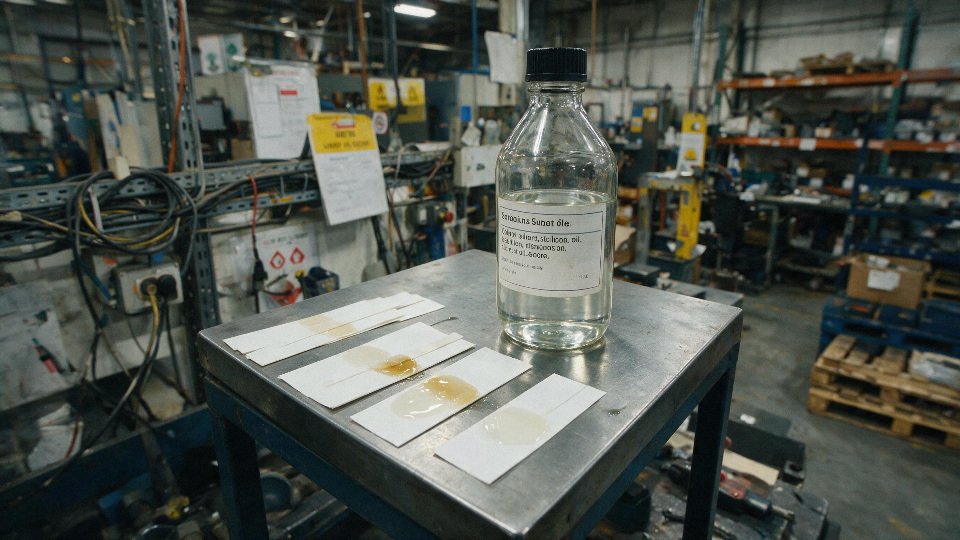
When pure solvent cleaning is insufficient, water-based systems deserve serious consideration. They do not usually “dissolve” silicone oil the way a matched organic solvent can, but they can remove it effectively by emulsifying, lifting, and carrying it away from the surface.
This approach is often the better choice for:
- Parts washers
- Large working areas where solvent use is expensive or hazardous
- Equipment with complex geometry
- Pre-treatment before a final solvent rinse
- Plants trying to reduce flammability and VOC exposure
Useful aqueous approaches include:
- Alkaline cleaners
- Help break associated soils and improve removal from metal surfaces
- Need careful compatibility review for aluminum, zinc, and sensitive finishes
- Surfactant-assisted cleaners
- Improve wetting on low-energy contaminated surfaces
- Often better than plain alkaline solutions for thin silicone films
- Heated wash systems
- Lower oil viscosity and speed detergent action
- Can also make emulsified waste harder to separate later
The trade-off flips here. You often gain safer handling and lower solvent emissions, but you may sacrifice drying time, add rinse-water management, and create a more complex wastewater stream. If the line cannot tolerate flash rust, trapped moisture, or wash chemistry carryover, a water-based route needs a complete process check, not just a beaker test.
Mechanical and thermal assistance methods
A weakly effective solvent can become acceptable with the right physical help; a good solvent can fail if the cleaning method is lazy. In practice, silicone removal improves sharply when you add one or more of these:
- Wiping
- Best for thin surface films and fresh spills
- Use clean cloth rotation; dirty wipes just redistribute silicone
- Ultrasonics
- Useful on small parts and complex geometry
- Performance depends on bath chemistry, frequency, and part fixturing
- Heat
- Reduces silicone viscosity and improves flow-out
- Must stay within equipment, solvent, and substrate limits
- Circulation cleaning
- Critical for tanks, pumps, hoses, and dosing systems
- Flow velocity matters; dead zones stay dirty
- Extended dwell time
- Often the cheapest variable to improve before changing chemistry
- Only helps if evaporation is controlled and the solvent remains active
In my experience, maintenance teams often change solvent before they fix access, flow path, or soak time. That is backwards. A line with poor circulation and no drain points can make a good cleaner look bad.
Selection criteria that actually decide the purchase
Once performance is narrowed down, the buying decision usually comes down to a compact set of trade-offs:
| Criterion | What improves | What usually gets worse |
|---|---|---|
| Stronger silicone solvency | Cleaning speed, lower labor | Safety constraints, substrate risk, cost |
| Faster evaporation | Throughput, dry-to-handle time | Contact time, streaking, fire risk |
| Lower polarity | Affinity for many dimethyl silicone oils | Final residue risk, slower drying |
| Water-based cleaning | VOC and flammability profile | Drying burden, wastewater complexity |
| Specialty blends | Balanced performance | Unit price, supplier dependence |
The best alternative to acetone is usually not a single “stronger” solvent but a matched cleaning system: chemistry plus contact time plus removal method. To choose responsibly, you still need to verify the specific silicone fluid type, contamination thickness, substrate sensitivity, and downstream cleanliness requirement with bench testing under plant-relevant conditions.
Verification methods
A quick jar test is useful, but it is not enough to approve a solvent for production. If the decision affects cleaning quality, downstream adhesion, or equipment materials, you need a staged verification sequence: bench screening, residue confirmation on actual substrates, materials compatibility checks, then a pilot run under plant conditions. That sequence catches the failures that a clear-looking beaker misses.
Bench solubility screening protocol
Start simple, but keep it controlled so the result means something.
- Define the materials
- Record the silicone oil type if known: straight PDMS, modified silicone, emulsion break residue, grease base fluid, or formulation blend.
- Record nominal viscosity. A practical screening range is often 10 cSt to 1000 cSt, but the chemistry matters more than viscosity alone.
- Use fresh, low-water acetone. Wet acetone can shift appearance and phase behavior, especially with formulated residues.
- Set the test conditions
- Run at 20 to 25 °C unless your process runs materially hotter or colder.
- Use at least three volume ratios, not one:
- 1:1
- 1:5
- 1:20
- Those ratios are typical for room-temperature screening and usually tell you whether you are looking at full miscibility, partial compatibility, or simple dilution haze.
- Mix consistently
- Add solvent to a clear glass vial with a cap.
- Introduce the silicone oil by pipette or syringe so the amount is known.
- Agitate for a fixed time, such as:
- 10 hand inversions for a quick screen
- 30 to 60 seconds on a vortex mixer or shaker for a tighter comparison
- Do not compare one hand-shaken sample with another that was mechanically mixed. That happens all the time on plant benches and it creates false disagreements.
- Observe over time
- Check immediately, then at 5, 15, and 30 minutes.
- Grade what you see:
- Clear, single phase
- Slight opalescence
- Persistent haze
- Two liquid layers
- Gel, stringing, or precipitated material
- Photograph against a printed line grid if you want a simple visual record.
A useful detail in practice: some silicone residues appear to “dissolve” right after shaking, then split once air bubbles clear and the sample sits. If phase separation starts within that 30-minute window, I would not call that stable dilution for production use.
A clear bench mixture does not by itself prove cleaning effectiveness.True
A solvent can temporarily disperse or dilute silicone oil without removing the residue from the actual substrate or without meeting downstream surface cleanliness requirements.
Residue-removal evaluation on representative substrates
If your actual problem is cleaning, test cleaning, not just liquid mixing.
Use coupons or real scrap parts made from the substrates that matter:
- Stainless steel or carbon steel
- Aluminum
- Glass
- Engineering plastics
- Elastomers
- Painted or coated surfaces
- Printed labels or marked parts
Then run a controlled comparison.
- Prepare the contamination
- Apply a known amount of silicone oil or use actual process residue.
- If possible, age some coupons for several hours or overnight. Fresh fluid is easier to remove than cured or dirt-loaded residue.
- Apply the cleaning method
- Wipe, soak, spray, ultrasonic, or recirculated wash, matching your intended process.
- Fix contact time and mechanical action. Solvent performance often depends as much on agitation and replenishment as on chemistry.
- Include a no-clean control and, if possible, one alternative solvent benchmark.
- Dry and inspect
- Let volatile solvent flash off under the same conditions each time.
- Look for:
- Oily smear
- Rainbow film
- Haze
- Beading differences
- Dirt redeposition at edges or low points
The mechanism matters here: acetone evaporates fast, which helps throughput but can leave you with redistributed silicone if the fluid was only loosened, not fully lifted and carried away. That trade-off flips when you have strong spray impingement or frequent bath refresh; then the fast evaporation is less of a problem.
How to confirm whether silicone residue remains
Visual inspection is a start. It is not the final answer if adhesion, coating, printing, or bonding comes next.
Use one or more of these checks:
- Gravimetric
- Weigh clean coupon, contaminated coupon, and cleaned coupon.
- Best for heavier residues and controlled coupons.
- Weak for very thin films unless you have a stable balance setup.
- Optical inspection
- Bright light, low-angle light, or microscope.
- Good for streaks, haze, droplets, and nonuniform cleaning.
- Contact angle or surface wetting
- Very useful when the next process is coating or bonding.
- Residual silicone usually raises water contact angle and lowers wettability.
- The absolute acceptance value depends on your downstream process, so set that with production trials rather than generic targets.
- FTIR or surface analytical checks
- Useful when failure cost is high or the film is very thin.
- Can confirm silicone-related residue more specifically than a visual check.
- Needs proper sampling method and interpretation; not every site has this in-house.
- Surface energy tests
- Dyne solutions or equivalent quick checks can help on some substrates.
- Best used as screening, not as sole release criteria.
Compatibility testing with equipment and contact materials
A solvent that removes silicone well can still create a maintenance problem.
Check every material that will contact the solvent or contaminated solvent stream:
- Seals and O-rings
- Hoses
- Pump internals
- Tank linings
- Sight glasses
- Labels and ink markings
- Machine paint and guarding windows
- Adhesives used in fixtures or sensors
Run soak or exposure tests at realistic temperature and time. Check for:
- Swelling
- Hardening or softening
- Cracking
- Extractables or discoloration
- Label lift
- Coating dulling or blistering
This is where plant experience saves money. A hose liner may survive neat acetone for a short transfer, then fail early in recirculation service because contamination, heat, and repeated dry-wet cycling change the exposure. Verify against the current material compatibility data from the hose, seal, and equipment suppliers rather than relying on generic solvent charts.
Pilot-scale validation and pass/fail criteria
Before release, run the solvent in the way production will actually use it:
- Batch soak or wipe station
- Closed wash tank
- Spray loop
- Recirculated system
- Multi-part cleaning sequence
Track these variables:
- Cleaning time to acceptable result
- Solvent evaporation loss
- Contamination loading over time
- Need for filtration or bath change
- Residue carryover to rinse or downstream steps
- Operator handling and ventilation burden
Ask the silicone supplier for:
– Product family or composition type
– Nominal viscosity
– Flash point
– Recommended solvent classes
– Known incompatibilities or caution notes
Set pass/fail criteria to match the job, not the chemistry in isolation:
- Dilution use: no phase split or unacceptable haze over the required hold time
- Cleaning use: target residue removal within the allowed cycle time
- Visual quality use: no visible haze, streaking, or marks on the finished surface
- Adhesion-sensitive use: downstream bond, print, or coat performance must pass after cleaning
If your use case is critical, send the exact silicone fluid, contaminant state, substrate, and target finish into a controlled application review. That usually resolves the gray area faster than arguing over a jar test that was never set up to answer the production question.
Procurement and specification factors
A workable purchase spec starts by narrowing the chemistry, not by asking for “silicone oil” and hoping the supplier interprets your process correctly. If acetone contact matters anywhere downstream, the buying document needs to define the fluid family, physical window, product form, and the exact compatibility question under stated conditions; otherwise you usually end up paying for screening by production trial.
The first commercial mistake is category drift. “Silicone oil” can mean a straight polydimethylsiloxane fluid, a phenyl-modified fluid, an amino-functional material, a polyether-modified silicone, an antifoam compound, or even an emulsion sold into a water-based process. Those do not behave the same way in acetone, and they certainly do not clean, dilute, wet, or deposit the same way on parts.
What to put in the RFQ or purchase specification
- Name the silicone fluid family
- State whether you need PDMS, methyl phenyl silicone fluid, amino silicone, epoxy silicone, polyether-modified silicone, fluorosilicone, or another defined chemistry.
- If you only know the application, describe that too: release, lubrication, antifoam, cosmetic slip, fiber finish, dielectric use, or intermediate for formulation.
- If the incumbent product is being replaced, provide the current grade name, supplier, and the problem you are trying to solve. Replacement by viscosity alone is where a lot of bad buys start.
- Set the physical property window
- Viscosity is the obvious one, but not the only one. Give the acceptable range, not just a nominal value.
- Include any limits that affect solvent behavior or process stability:
- Functional groups or degree of modification
- Volatility or low-boiler content
- Flash point, if relevant to handling
- Appearance and color limits
- Target solids, if the product is not a neat fluid
- In practice, a 100 cSt straight fluid and a modified 100 cSt material can behave very differently in mixing, cleaning, and residue formation.
- State the solvent exposure in the actual process
- Specify whether acetone is used for:
- Dilution
- Equipment flushing
- Surface cleaning
- Extraction
- Analytical preparation
- Rework or residue removal
- Give the expected conditions:
- Approximate silicone-to-acetone ratio
- Temperature range
- Contact time
- Water content sensitivity
- Whether the system is static, stirred, sprayed, or recirculated
- A generic supplier statement like “insoluble in acetone” is not enough for procurement. What you need is guidance tied to conditions: haze, phase split, swelling, precipitation, extraction level, or cleanability under your test method.
- Specify whether acetone is used for:
Product form matters as much as base chemistry
Ask the supplier to confirm whether the offered material is a neat fluid, emulsion, blend, antifoam, or modified polymer. Buyers get caught here all the time because the sales name sounds similar while the product form changes everything.
- Neat fluids are the cleanest place to discuss intrinsic fluid-solvent compatibility.
- Emulsions bring surfactants, water, and emulsion stability into the picture; acetone can destabilize them even when the underlying silicone phase would otherwise disperse differently.
- Blends and compounds may contain hydrocarbon carriers, silica, process aids, or package additives that change phase behavior and cleaning performance.
- Antifoams are especially easy to misread because the active silicone may be only one part of the delivered product.
That difference is not academic. The mechanism is straightforward: once surfactants, fillers, or co-carriers are added, the solvent is no longer interacting with one silicone fluid only; it is interacting with an engineered package, and the first failure may be emulsion break, gel formation, or residue carryover rather than a neat two-phase split.
Buy consistency, not just a nominal specification
Two lots can both meet a broad viscosity target and still behave differently in acetone service. Ask what the supplier controls, and how tightly.
Relevant consistency points include:
- Molecular weight distribution
- Broader distributions can shift flow, spreadability, and extractability even when the reported viscosity looks on target.
- Residual cyclic content
- This can affect volatility, odor, regulatory position, and sometimes apparent solvent response.
- Additive package control
- Stabilizers, catalysts, inhibitors, surfactants, fillers, or trace processing aids can change cleaning outcomes and residue levels.
- Lot-to-lot COA structure
- Check whether the certificate reports only a few headline properties or includes the parameters that actually matter in your use case.
If the process is sensitive to residue, extraction, or cleaning validation, viscosity alone is not a sufficient buying control. The conclusion stops holding only when the application is genuinely tolerant, such as a noncritical bulk lubricant use where minor compositional variation has no practical effect.
Commercial filters that prevent expensive trial-and-error
Before approving a source, review the non-chemical buying factors that usually decide whether the project runs smoothly:
| Procurement item | Why it matters in practice |
|---|---|
| Packaging format | Drum, pail, tote, or smaller packs affect contamination risk, line-side handling, and partial-use shelf exposure |
| Shelf life and storage conditions | Some modified silicones and formulated products are less forgiving than straight fluids |
| Lot traceability | Necessary for complaint isolation, validation records, and regulated export customers |
| Export and documentation support | SDS, TDS, origin paperwork, and destination-specific declarations can delay shipments if not ready |
| Sample-to-production continuity | A good sample is not enough if the production grade shifts raw material source or additive package |
| Technical response time | If compatibility questions come up during trials, slow feedback can stall line qualification |
Integrated organosilicon producers can sometimes reduce sourcing risk because they are better positioned to align base polymer chemistry, lot consistency, and application screening.True
This is generally credible as an industry practice, not a universal guarantee. It depends on the supplier's actual manufacturing scope, QC system, and technical service capability, which the buyer still needs to verify.
Supplier capability is a practical risk filter, not a marketing slogan. A producer with genuine organosilicon manufacturing depth is often better equipped to discuss grade matching, provide lot-level consistency context, and run targeted compatibility screens under defined conditions. That does not mean every integrated supplier is the right one; it means procurement has a better chance of getting answers tied to chemistry instead of generic catalog language.
Frequently asked questions
Is silicone oil soluble in acetone at room temperature?
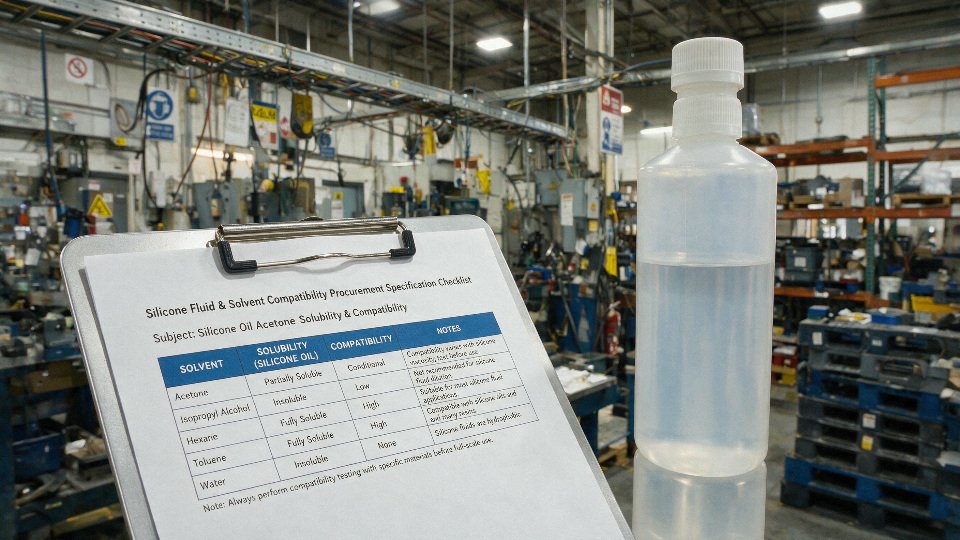
Usually not in the full, formulation-grade sense people want. At roughly 20 to 25 °C, many standard dimethyl silicone oils show only limited compatibility with acetone, and whether they appear to mix can depend heavily on viscosity, mix ratio, water content, and how long you watch the sample.
If you are checking a typical screening ratio, 1:1 to 1:20 silicone oil-to-acetone by volume is common, but the visual result can change across that range. A thin fluid may give a temporarily clear or slightly hazy blend, while a higher-viscosity grade may show cloudiness, stringing, or phase separation quickly.
Standard silicone oil is broadly soluble in acetone under normal room-temperature conditions.False
For many common dimethyl silicone oils, acetone is at best a limited-compatibility solvent. Apparent mixing in a quick jar test does not reliably prove stable solubility.
Why did my silicone oil look dissolved at first but separate later?
That is a very common false positive. Initial shaking can create a temporary dispersion or micro-emulsion-like appearance, especially with low-viscosity fluids, trace surfactants, or a warm sample, but once the shear stops the system relaxes and the two phases sort themselves out.
Check these usual causes:
- You created fine droplets, not a true solution.
- The observation window was too short. Five minutes can look acceptable; thirty minutes may not.
- The acetone picked up water from air or containers. That often pushes the system toward haze or separation.
- The sample temperature changed. A warm bottle from the shop floor can behave differently than a conditioned lab sample.
- The silicone oil contains additives or modification chemistry that shifts the first visual impression.
A shop-floor warning: if you are using this result to approve a cleaning or dilution step, let the mixture sit, then inspect again after agitation stops. A clear sample right after shaking is not enough.
Does lower viscosity silicone oil mix better with acetone?
Often it appears to, but that does not automatically mean true long-term solubility. Lower-viscosity silicone oils, say in the 10 cSt range, disperse faster and can look more compatible than 350 cSt or 1000 cSt grades because they break into smaller droplets more easily and resist phase separation for longer.
The limit is chemistry. If the base silicone structure is still a standard dimethyl type, lower viscosity may improve handling and apparent mixing but not fundamentally turn acetone into a strong solvent for it.
Can acetone remove silicone oil from metal or glass surfaces?
Sometimes, but not reliably enough to treat as a universal silicone cleaner. On smooth metal or glass with a very thin, fresh silicone film, acetone plus wiping may remove part of the residue, especially if the contamination is light and not heat-aged.
It works less well when any of these apply:
- Thicker silicone layers
- Higher-viscosity oils
- Aged, baked, or oxidized deposits
- Surface texture, pores, or machining marks that trap oil
- Repeated contamination where oil has spread into joints, threads, or seal grooves
In practice, acetone often smears and redistributes silicone unless the wiping method is disciplined and the cloth is changed frequently.
Will acetone damage silicone rubber or seals during cleaning?
It can, and you should not assume seal compatibility from the fact that the seal is “silicone.” Short incidental contact may be tolerated in some assemblies, but swelling, extraction of additives, hardness change, and bond-line damage are all possible depending on the rubber compound, cure system, filler package, and dwell time.
Verify against:
- The seal supplier’s chemical-resistance data
- Current equipment manual
- A short immersion or wipe test on the actual elastomer grade
This matters most on pumps, spray guns, meter-mix equipment, and portable wash stations where operators leave solvent sitting in dead legs longer than planned.
Which solvents usually work better than acetone for standard dimethyl silicone oils?
For many standard dimethyl silicone oils, non-polar or moderately non-polar hydrocarbon-type solvents usually perform better than acetone. Exact solvent choice depends on plant safety rules, VOC constraints, flash point targets, residue tolerance, and whether the goal is dilution, flushing, or full cleaning.
Commonly considered classes include:
- Aliphatic hydrocarbons
- Isoparaffinic solvents
- Aromatic solvents where permitted
- Selected specialty silicone-compatible cleaning blends
The preferred choice flips if your process is driven more by evaporation speed or mixed contaminant removal than by silicone solvency alone.
How does water in acetone affect the test result?
Water usually makes the result worse and less repeatable. Wet acetone changes polarity enough to reduce compatibility with many silicone fluids, and it can turn a borderline-clear mixture cloudy very quickly.
Use low-water-content acetone, dry glassware, and closed containers. If two labs get different answers, moisture pickup is one of the first things I would check.
Are modified silicone oils more compatible with acetone?
Sometimes yes. Polyether-modified, functionalized, or otherwise modified silicone fluids can show much better acetone compatibility than standard dimethyl silicone oils because the modification changes polarity and intermolecular interaction.
But this is product-specific territory. One modified fluid may be fully blendable; another may only tolerate a narrow ratio range before haze appears.
Can acetone be used to dilute silicone oil for coating or spraying?
Only if your exact silicone fluid stays stable in the intended ratio and for the full working time of the process. A temporary blend that separates in the day tank, changes spray pattern, or shifts deposit uniformity is not a usable diluent system.
Before approving it, check:
- Clarity and stability over the actual use period
- Viscosity drift after mixing
- Spray pattern or coating uniformity
- Substrate wetting and defect formation
- Drying behavior and residue
- Equipment seal compatibility
What is the fastest way to verify whether a specific silicone fluid is compatible?
Run a controlled bench test with the actual fluid and the actual acetone grade you plan to use. Mix at a practical ratio, usually somewhere within the 1:1 to 1:20 screening range, observe at 20 to 25 °C, and check immediately, after 5 minutes, and again out to 30 minutes.
For a useful fast screen:
- Record silicone oil type and viscosity
- Confirm acetone water condition
- Test at least two mix ratios
- Observe clarity, haze, separation, and residue
- Repeat after gentle inversion, not only hard shaking
- If the use case is cleaning, test on the actual contaminated part surface
- If the use case is formulation, include a short hold test before scale-up
If the result is even slightly ambiguous, do not force a production decision from a jar test alone. That is the point where a small application review or sample trial saves a much larger cleaning, coating, or quality problem later.
Your next compatibility check
For most buyers and process engineers, the safe operating conclusion is simple: do not treat a standard silicone oil as acetone-soluble unless you have verified that exact product, at your ratio, temperature, and contact time. A quick clear-looking mix in a beaker can still fail in production once viscosity, water pickup, residue thickness, or substrate geometry changes.
Your next step depends less on the word “solubility” and more on what you are trying to get done.
- If the job is cleaning silicone residue
- Start with a bench wipe or immersion test on the actual residue, not neat bulk oil alone.
- Check whether acetone is:
- dissolving the silicone,
- only thinning and redistributing it,
- or lifting low-molecular-weight fractions while leaving a film behind.
- If you still see smearing, rainbow film, or poor water-break results after evaporation, move quickly to an alternative solvent route rather than forcing acetone into the process. In practice, operators often misread “it wiped easier” as “it dissolved,” and that is how contamination gets carried downstream into coating or bonding.
- If the job is formulating a blend
- Run a controlled compatibility screen first, typically at the intended use ratio and a few off-ratio points.
- Observe:
- initial clarity,
- haze after 5 to 30 minutes,
- phase separation,
- viscosity drift,
- residue after solvent loss.
- If the blend must stay stable beyond a short handling window, a casual room-temperature mix check is not enough. Go to pilot validation if the blend will be stored, pumped, or metered.
- If the job is extracting silicone for analysis
- Define the analytical target before choosing the solvent.
- Verify:
- extraction efficiency,
- selectivity against the substrate or matrix,
- evaporation behavior,
- and whether acetone biases the result by extracting only part of the silicone population.
- If recovery has to support quality claims, customer disputes, or regulated documentation, bench screening should be followed by a repeatable validated method.
- If the job is selecting a modified silicone grade
- Do not start from viscosity alone.
- Ask whether the supplier can recommend a silicone chemistry designed for better compatibility with polar systems, if that is the actual requirement.
- The preferred choice flips here: if acetone compatibility is central to the application, it is often more efficient to change silicone grade than to keep fighting the wrong solvent.
Before you contact a supplier, gather the minimum technical data:
- Silicone chemistry or product type
- Viscosity grade
- Process and test temperature
- Acetone grade and approximate water content
- Silicone-to-acetone ratio
- Substrate or surface involved
- Contact time and agitation method
- What “pass” means in your process:
- visual clarity,
- no phase split,
- cleaning speed,
- residue limit,
- analytical recovery,
- downstream adhesion or coating acceptance
Use a bench test when you are screening feasibility, comparing a few candidate fluids, or checking a cleaning concept on a manageable sample. Escalate to pilot validation when the result affects storage stability, line cleaning cycle time, metering behavior, EHS controls, finish quality, or customer-facing specifications. Skip straight to an alternative solvent or modified silicone fluid when acetone already shows phase separation, persistent residue, substrate attack, or unstable results across small changes in ratio or temperature.
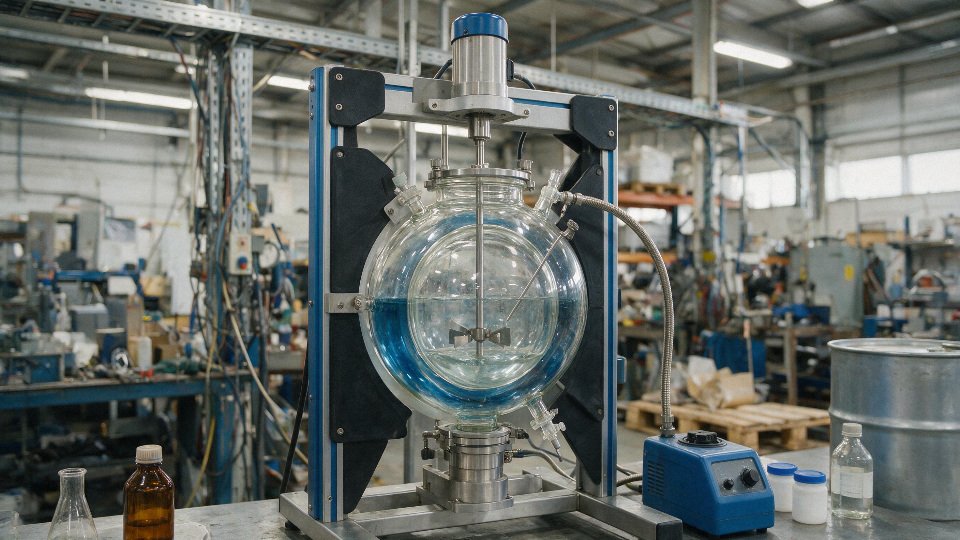
If you want SiliconChemicals to review the application, send the actual use details: substrate material, contaminant or silicone type, approximate layer thickness or residue condition, working area or batch size, required finish, target processing rate, and clear part photos or representative samples where possible. From there, SiliconChemicals can support a compatibility review, recommend sample grades, or help narrow the silicone fluid selection for a product-specific verification plan.