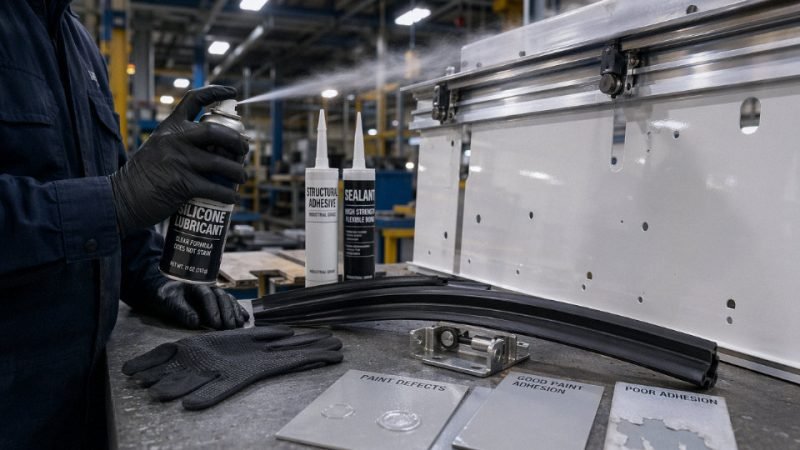
Silicone lubricant solves squeaks, sticky rubber, and light sliding jobs so neatly that people start treating it like a harmless shop-floor cure-all. That is where trouble starts. A fine mist on a bench can migrate to parts headed for painting, bonding, printing, or coating, then the plant sees fisheyes, weak adhesive joints, rework, line stops, and a scrap meeting nobody wanted. The better answer is not “never use silicone.” It is knowing exactly where it belongs, where it does not, and how to control it like a real contamination risk.
The main downsides of silicone lubricant are hard-to-remove residue, contamination of paint and adhesive processes, poor load-carrying performance in some metal-to-metal contacts, and compatibility surprises with seals, plastics, carriers, or thickeners. It works well in the right spot, but one casual spray can create hours of cleanup.
Part of the confusion comes from the label. A light-duty silicone spray may use oil around 100 to 1,000 cSt, while silicone greases and damping compounds can run from roughly 1,000 to 100,000 cSt. Many products tolerate about -40°C to 200°C in continuous service, give or take, but the real limit depends on the thickener, solvent carrier, additives, and the material it touches. That gap between the brochure and the plant floor is where the downsides usually hide.
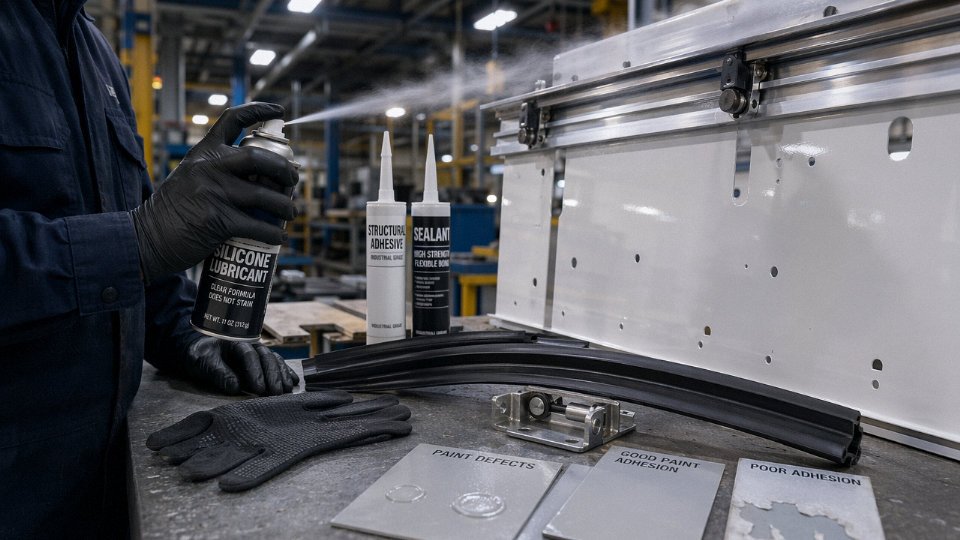
Silicone residue can ruin painting, bonding, printing, coating, and sealing operations
Silicone lubricant is harmless only until the next process needs a clean surface. That is where it becomes expensive.
Most silicone oils used in sprays, greases, and release-type products have very low surface energy. In plain shop terms, paint, ink, adhesive, sealant, or coating does not want to wet over them. Instead of forming a continuous film, the liquid pulls away. You see fish eyes in wet paint, craters in powder or liquid coating, dewetting on printed films, bare spots under conformal coating, weak adhesive bonds, or small sealing voids that only show up after leak testing.
The material underneath can be metal, plastic, glass, composite, wood, or a previously painted panel. Silicone does not care. A few square inches of residue on a steel enclosure before powder coating can turn into a rack of rejected parts. A fingerprint carrying silicone oil onto a bonded plastic housing can reduce bond strength enough that the failure appears days later, after the product has moved past inspection.
Silicone residue can interfere with paint, adhesive, coating, and ink performance at contamination levels that are too low to see by eye.True
Silicone oils change surface wetting behavior at very low film thicknesses. Operators may see a clean-looking part, while coating or adhesive still pulls back during application or loses adhesion during cure or service.
The contamination does not stay where it was sprayed
The common mistake is thinking, “We only used it on that guide rail,” or “It was sprayed on the hinge, not the painted surface.” In a factory, silicone travels.
Aerosol drift is the obvious path. A light-duty silicone spray, often based on silicone oil in the rough 100 to 1,000 cSt range, can hang in the air longer than people expect, especially near booth entrances, open doors, exhaust imbalance, or fans someone added during summer. Greases and damping compounds may use much higher viscosity silicone oils, roughly 1,000 to 100,000 cSt depending on the formulation, but even those can transfer by touch, rag, or fixture contact.
The less obvious paths are usually the ones that burn the most time:
- gloves used on lubricated slides, then used to load parts for bonding
- wiping cloths stored near maintenance chemicals
- benches where sprayed parts were staged “just for a minute”
- shared Allen keys, clamps, vacuum cups, and hand tools
- compressed air nozzles that have seen oily plant air or contaminated hose ends
- cardboard dividers, tote bins, and foam pads that keep re-touching clean parts
- maintenance carts parked inside a finishing department
I have seen people chase a paint defect for a week while the real source was a can of silicone spray sitting on a mechanic’s cart twenty feet from the prep area. Not malicious. Just normal plant behavior.
High-risk areas deserve stricter rules
Some departments should treat silicone spray almost like a banned contaminant, not a convenience lubricant. Paint shops and body repair facilities are the obvious examples because fish eyes are visible, ugly, and hard to rework cleanly. Powder coating lines are also vulnerable; craters and poor edge coverage can mean strip-and-recoat, which eats labor, energy, media, and schedule.
Electronics coating areas have their own version of the problem. Conformal coating that pulls away from connector edges, solder mask, component bodies, or masking boundaries can leave moisture paths. Printing plants can see ink crawl, poor dot formation, skipped areas, or laminate adhesion trouble. Adhesive assembly cells are risky because the defect may not be cosmetic. It may be structural. Gasket application stations can get bead breaks, poor wet-out, or local leaks after cure. Clean assembly lines, especially those feeding optics, medical devices, painted appliances, or automotive trim, need the same discipline.
The bad part is that silicone contamination is often visually invisible. A water-break test may catch some surface issues, dyne pens may help on plastics and films, and contact angle testing can support investigation, but none of these are magic if the contamination is patchy. FTIR or lab surface analysis can confirm suspicions, yet by then the line has already lost parts and time.
Practical controls that actually hold up on the floor
A policy that says “be careful with silicone” is not enough. People need physical separation and clear substitutes.
Create silicone-free zones around finishing, printing, bonding, sealing, and coating operations. Keep them simple and marked. No silicone aerosol cans, no unknown mold-release sprays, no shared maintenance lubricants, no mystery wipes. Use labeled tool sets and dedicated carts for these areas. If a tool leaves the zone for general maintenance, assume it needs cleaning before it comes back.
Control aerosols. That means no spraying near open product, no spraying into the air “to free up” a sticky mechanism, and no using compressed air to blast a lubricated assembly unless you want a fine contamination cloud. For mechanisms near finishing areas, choose non-silicone lubricants or dry-film products that have been checked against the coating or adhesive system. In release applications, ask for a silicone-free release agent and test it on the actual substrate, not only on a supplier’s brochure panel.
Surface preparation should be verified, not trusted. Solvent wiping helps only when the solvent, wipe material, and technique are right; a dirty rag can spread silicone into a thinner, more uniform film. Alkaline wash, abrasion, plasma, corona, or flame treatment may be needed depending on the substrate and process. Painted repair work has its own rules, but the logic is the same: remove the contaminant, do not smear it around.
The right control prevents defects before they enter the booth or bonding fixture. The wrong control finds them after cure, after inspection, or after a field leak. That is the difference between a small maintenance inconvenience and a production-quality problem with real money attached.
It migrates, creeps, and oversprays into places where lubrication is not wanted
Silicone lubricant is hard to keep in one neat little target area. That is not a lab curiosity; it is a maintenance and quality-control problem. The same low surface tension that helps silicone wet rubber, plastic, and metal also helps it crawl along seams, shafts, threads, cable jackets, molded housings, and capillary gaps that nobody meant to lubricate.
With light-duty silicone sprays, the oil fraction is often in the rough range of 100 to 1,000 cSt, depending on the product and solvent package. That is thin enough to move. A shaft bushing gets a quick spray, then a faint film tracks along the shaft toward an encoder disc. A door seal is treated, then the lubricant creeps onto adjacent painted trim or onto a label area. A threaded adjuster gets “freed up,” and a few cycles later the residue is sitting on a locknut face where friction was part of the holding method.
Greases and damping compounds are usually much thicker, often somewhere from 1,000 to 100,000 cSt depending on base oil, thickener, and filler system, but they are not magically stationary either. Under pressure, vibration, heat, or repeated wipe contact, they can still bleed oil or transfer film. I have seen this most often around rubber seals, plastic slides, and cable-entry points where a maintenance tech applied what looked like a harmless dab. Two weeks later the nearby area had a shine to it and dust stuck to every edge.
A silicone spray only lubricates the part you aimed at.False
Aerosol droplets, carrier solvent flow, capillary creep, and hand transfer can move silicone residue well beyond the original application point, especially on smooth plastic, rubber, and painted surfaces.
Aerosol overspray is worse than it looks
Aerosol silicone is convenient, which is exactly why it causes trouble. The visible wet spot is not the whole application. Fine droplets hang in the air, drift with fan wash or compressed-air leaks, and settle on floors, workpieces, braking surfaces, belts, pulleys, sensors, lenses, barcode labels, cartons, and the tools sitting on the bench.
The operator may think the spray was controlled because the part looks right. Then the next shift finds a drive belt slipping under load, a photoeye reading poorly through a faint film, or labels peeling at the corners after packaging. The root cause gets misread as a belt tension issue, bad adhesive, weak print quality, or “dirty parts.” Sometimes it is just silicone where it never belonged.
A typical small failure goes like this: a stuck plastic guide on a packaging machine gets hit with silicone spray during a short stop. The guide moves freely again. Good. But a light mist lands on the nearby timing belt and on the operator’s gloves. Over the next hour, the belt starts to slip during acceleration, and several cases index short. The mechanic tightens the belt, which loads the bearings harder. Now a five-minute lubrication shortcut has become scrap, extra adjustment, and a bearing life penalty.
It defeats parts that rely on friction
Not every moving part wants a lower coefficient of friction. A surprising number of components are designed around controlled drag, grip, or breakaway torque.
Silicone migration can interfere with:
| Component or area | What goes wrong | Usual plant-floor symptom |
|---|---|---|
| Clutches and brake faces | Friction drops or becomes inconsistent | Chatter, slip, longer stopping distance |
| Drive belts and pulleys | Belt traction falls, dust sticks to residue | Indexing errors, squeal, heat, retensioning |
| Rollers and feed wheels | Product grip becomes uneven | Skewed sheets, missed picks, double feeds |
| Friction hinges and detents | Holding torque falls | Covers, guards, or displays drift out of position |
| Torque-limited fasteners | Clamp behavior changes if faces are contaminated | Loose assemblies or false torque readings |
| Gripping pads and vacuum cups | Surface grip changes, residue attracts fines | Dropped parts, inconsistent pick-and-place |
The ugly part is inconsistency. A clean belt and a lightly contaminated belt may both pass a quick jog test. Under real load, with heat, dust, and speed changes, the contaminated one starts losing margin. That is how nuisance downtime is born.
Residue transfer keeps the problem alive
Silicone residue does not need a visible wet patch to move. It transfers by hands, gloves, rags, reusable totes, foam packaging, bench mats, and tool handles. A mechanic sprays one fixture, wipes the excess with a shop towel, then uses the same towel near a sensor bracket or assembly nest. Now the original application is finished, the can is back in the cabinet, and the contamination route is still active.
Packaging is a common blind spot. Parts may leave the lubrication area clean enough by eye, then rub against a bag, tray, or divider that picked up silicone from a previous batch. The next parts inherit a faint film. If the plant is chasing intermittent adhesion, printing, inspection, or feeding defects, this kind of transfer is maddening because the source no longer sits next to the defect.
Operational warning: do not use compressed air to “dry off” a silicone-sprayed part near production hardware. You may just atomize the residue and distribute it more evenly.
How to keep silicone where it belongs
The best mitigation is boring: control the application. Use a needle oiler, swab, brush, felt tip, or measured wipe instead of an aerosol whenever access allows. If the lubricant must stay put, consider a grease form rather than a low-viscosity spray, but check that the grease will not bleed oil at the actual service temperature. Many silicone lubricants operate somewhere around -40°C to 200°C in continuous service, but the useful limit depends on the thickener, carrier solvent, additive package, surface, load, and cleaning exposure.
Mask nearby belts, sensors, brake faces, labels, and packaging contact areas before applying. Put the lubricant on the applicator, not directly into the machine, when practical. Use the minimum amount that gives the needed motion or sealing effect. Then verify. A clean white wipe, contact-angle check, dyne pen, tape test, or trial run with real product may reveal transfer that eyesight misses.
A simple shop rule works well: if the surrounding components depend on grip, sensing, printing, bonding, torque, or clean packaging contact, treat silicone spray as a controlled chemical, not a general-purpose convenience can.
It is often a poor choice for high-load metal-to-metal lubrication
Silicone lubricant gets misused because it feels slippery on fingers and makes a dry hinge quiet for a while. That does not make it a good bearing lubricant.
In plant maintenance, the difference shows up under load. A light silicone spray may use silicone oil in the 100 to 1,000 cSt range, depending on the product and carrier solvent. Silicone greases and damping compounds can be much thicker, often somewhere around 1,000 to 100,000 cSt, depending on base oil blend and thickener. Viscosity alone is not load capacity, though. A thick product can still have poor boundary protection if it lacks the right anti-wear and extreme-pressure chemistry.
Film strength is the weak point in many metal contacts
Many general-purpose silicone oils have modest film strength compared with lubricants built for loaded metal surfaces: properly formulated mineral oils, synthetic hydrocarbons, ester-based lubricants, lithium complex greases, molybdenum disulfide pastes, or extreme-pressure greases.
That matters most when motion is slow, intermittent, or heavily loaded. In those conditions, the parts are not floating nicely on a full hydrodynamic oil film. They are in boundary lubrication, where microscopic high spots on the metal surfaces try to weld, tear, and smear against each other. This is where additives earn their keep: sulfur-phosphorus EP packages, zinc anti-wear chemistry, solid lubricants like MoS2, tackifiers for chains, or base oils selected for polar attraction to metal.
A plain silicone lubricant usually does not bring that toolbox.
A silicone lubricant that works well on an O-ring is automatically suitable for a loaded steel bearing.False
O-ring lubrication, sealing, and damping are very different from bearing and gear lubrication. Loaded metal-to-metal contacts need verified wear, load, and sometimes extreme-pressure performance, not just slipperiness or water resistance.
What failure looks like on the floor
The first sign is often not a dramatic seizure. It is a machine that starts sounding different.
Under load, silicone lubricant can squeeze out of the contact zone, especially in point or line contacts. Once the film thins out, the surface asperities carry more of the load. Then the usual damage chain starts: inadequate boundary film, scuffing, galling, fretting, heat buildup, and accelerated wear. On splines or keyed couplings, I have seen the symptom show up as reddish-brown fretting debris before anyone calls it a lubrication problem. On a sliding bushing, it may just look like blackened grease and a shaft that now measures a few hundredths under where it should be.
Shock load makes it worse. A slow oscillating arm, a cam follower, a lightly greased press guide, or a stop-start conveyor component can punish the lubricant harder than a smooth rotating shaft at the same average load. The contact pressure spikes. The lubricant has no time to rebuild a film. Noise follows, then heat, then clearance.
Once clearance opens up, the machine starts eating itself.
Where silicone is usually not the first choice
There are exceptions, but I would be cautious using silicone lubricant as the default in these services:
| Application | Why silicone often disappoints | Better direction to check |
|---|---|---|
| Loaded rolling bearings | Needs verified wear protection, oxidation stability, and grease life | Bearing grease matched to speed, load, temperature, and seal type |
| Gear teeth | Sliding and rolling contact with high local pressure | Gear oil or EP grease with proper viscosity and additives |
| Chains | Needs penetration, tack, and wear control at pins and bushings | Chain oil, waxy chain lubricant, or high-temperature chain fluid |
| Splines and metal bushings | Fretting, shock load, boundary wear | MoS2 paste, EP grease, or specified assembly lubricant |
| Sliding ways | Stick-slip control and load support matter | Way oil or guideway grease |
| Press-fit assemblies | Lubricant changes insertion force and retention behavior | Approved assembly compound or dry fit, based on engineering spec |
| Threaded fasteners needing torque control | Friction scatter can change clamp load | Specified anti-seize, thread lubricant, or clean/dry condition |
Threaded fasteners deserve a special warning. If a mechanic sprays silicone on bolts “so they go in nice,” torque readings can become misleading. Clamp load depends heavily on thread and under-head friction. The wrong lubricant can over-tension a fastener at the same torque setting, or create inconsistent clamp across a flange. That turns into leaks, stripped threads, broken bolts, or a joint that relaxes after a few thermal cycles.
Silicone grease has good uses, just not every use
Some silicone greases are excellent products. I use them without hesitation on many elastomer seals, valve stems, dielectric connections, plastic-compatible damping points, and O-rings where mineral oil would swell the rubber. Many handle roughly -40°C to 200°C in continuous service, give or take, but that limit depends on the thickener, carrier solvent, base oil viscosity, and additives. A valve grease surviving temperature and water exposure does not prove it belongs on gear teeth.
That is the trap: good specialty lubricant, bad universal lubricant.
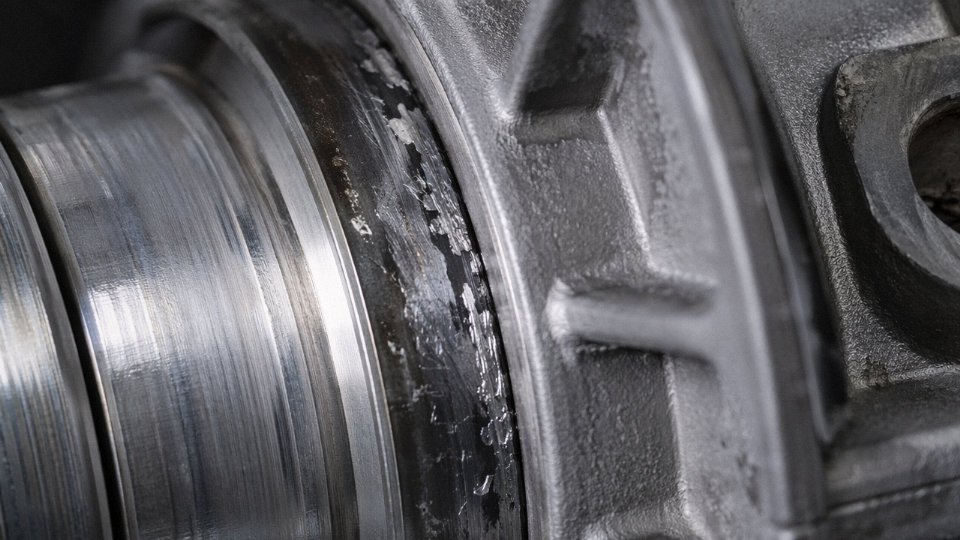
Before using silicone in load-bearing service, read the datasheet like a maintenance engineer, not like a buyer comparing can sizes. Look for base oil viscosity, thickener type, dropping point, four-ball wear data, weld load or load rating if provided, corrosion protection, elastomer and plastic compatibility, and actual manufacturer application guidance. If the sheet only says “waterproof,” “non-staining,” and “safe on rubber,” treat that as missing information for metal-to-metal load service.
For critical equipment, ask the lubricant supplier a blunt question: “What bearing, gear, or sliding contact load is this approved for?” If they answer with general slipperiness, keep it away from the asset.
It can attract dust, trap grit, and turn into an abrasive maintenance problem
A clean silicone spray on a bench sample can look harmless. Out on a line, next to paper dust, flour, sawdust, textile lint, road grit, or cement powder, the same lubricant can become a dirt magnet.
There is a big practical difference between a very thin, nearly dry-feel silicone film and a wet silicone oil or silicone grease. Light-duty silicone sprays often use oils somewhere around 100 to 1,000 cSt, depending on the product and carrier solvent. Greases and damping compounds can be far heavier, often in the 1,000 to 100,000 cSt range, depending on thickener and formulation. The thin film may leave only a faint slickness. The wet residue stays tacky enough to hold whatever lands on it: dust, fibers, sand, metal fines, food powder, paper dust, rubber crumbs, and airborne debris from nearby processes.
That is where the maintenance problem starts.
Wet silicone lubricant residue can collect airborne dust and loose particles, and those trapped particles can increase wear on exposed sliding or rolling surfaces.True
The lubricant itself is not usually the abrasive. The captured contamination is. Once dust, grit, or fines are held in the film, the contact behaves more like a lapping compound than a clean lubricated joint.
The abrasive paste problem is usually slow, then expensive
On exposed sliding tracks, drawer slides, cable guides, hinge pins, rubber seals, roller shafts, and light linkages, dirt-loaded silicone can make a gray or black paste. You see it on garage door tracks, conveyor guide rails, packaging machine adjustments, and outdoor equipment pivots. At first it feels smooth because the silicone is still doing some lubrication. Then the grit starts cutting.
The wrong lubricant in the wrong place does not always fail dramatically. More often it causes lazy failures: a slide that needs extra force, a gate that no longer returns cleanly, a roller that starts tracking off-center, a rubber seal that begins dragging, a sensor flag that hesitates. Maintenance tightens something, wipes the obvious dirt, sprays more lubricant, and the cycle repeats.
I have seen this most often where mechanics use an aerosol can because it is fast and familiar. A few seconds saves a work order today. Two months later, the machine has black paste in every exposed slot.
Dusty and fiber-heavy plants are unforgiving
Some areas punish wet films harder than others:
| Environment | Typical contamination | What usually goes wrong |
|---|---|---|
| Sawmills and woodworking shops | Fine sawdust, resin dust, sanding powder | Slides and guides pack up; lubricant turns gummy with wood fines |
| Packaging lines | Paper dust, film scrap, carton fibers | Adjustment screws, rails, and rollers collect lint halos |
| Print rooms | Paper dust, ink mist, coating overspray | Shiny residue transfers to sheets, belts, and guards |
| Cement plants and farms | Mineral dust, soil, sand | Exposed pins and linkages wear quickly once grit is held in the film |
| Textile machinery | Lint, thread fibers, fuzz | Build-up wraps around shafts, guides, and small rollers |
| Food-adjacent equipment | Sugar, starch, flour, seasoning powder | Sticky deposits form near open product zones and are hard to clean without proper washdown |
Outdoor equipment has its own version of the same issue. Wind-blown sand on a silicone-wet hinge or latch is not lubrication for long. It is a grinding paste with good adhesion.
Housekeeping tells you when the lubricant is migrating dirt
There are visible clues if people know what to look for. Slick smears on guards. Shiny patches on plastic parts. Dust halos around pivot points. Dark rings near roller ends. Footprints that spread from a sprayed area onto a walkway. A drawer slide that looks wet even after wiping. Silicone residue can be stubborn because water alone does not remove it well, and in many plants the first cleaning pass is just a damp rag.
Floors are a separate warning. Overspray or drip from silicone products can create slick spots that do not look as obvious as oil puddles. A light film on smooth concrete, painted steel platforms, gym equipment frames, or maintenance ladders is enough to cause a slip complaint. The plant may blame poor housekeeping, but the root cause is often uncontrolled aerosol use.
Better choices depend on the exposure
If the area is dusty, open, and lightly loaded, a dry PTFE film is often cleaner than wet silicone. It still needs compatibility checks, especially around coating, printing, and bonding work, but it usually holds less dust once the carrier flashes off. For selected dry mechanisms, graphite can work, though I would be careful near electrical cabinets, light-colored products, and food zones. Wax-based lubricants are useful on some slides, table surfaces, guides, and woodworking equipment because they leave a more controllable film and tend not to creep as aggressively.
For rotating parts, sealed bearings beat clever lubrication habits. For exposed rods and guides, bellows, wipers, shields, or simple covers are often cheaper than repeated cleaning. If grease is required, use a non-migrating grease placed exactly where the load is, not a broad spray that coats everything nearby.
A practical rule from the floor: if you can see dust sticking to yesterday’s lubricant, you are no longer looking at lubrication only. You are looking at a contamination system. Clean it, shield it, reduce the film, or change the product before the wear shows up as scrap, jams, extra motor load, or another weekend repair.
Material compatibility is broad, but not guaranteed for every plastic, rubber, seal, or coating
Silicone lubricant gets recommended for plastics and rubber so often that people start treating it as chemically harmless. That is too casual for a production floor. The base silicone oil may be mild, but the product in the can or tube is not just “silicone.” It may include carrier solvent, propellant, thickener, tackifier, anti-wear additive, corrosion inhibitor, fragrance, dye, or a small amount of another oil to change feel and spread.
That mix matters.
A light-duty spray might use silicone oil in the roughly 100 to 1,000 cSt range, usually cut with a fast-evaporating carrier so it sprays evenly. A silicone grease or damping compound may sit closer to 1,000 to 100,000 cSt, depending on whether it is meant for O-rings, slow sliding parts, or motion damping. Those two products can behave very differently on the same rubber lip seal.
Silicone lubricant is automatically safe for all plastics and elastomers.False
Compatibility depends on the silicone base oil, solvent or propellant, thickener, additives, plastic or elastomer grade, filler system, stress level, exposure time, and temperature. A product that is harmless on one EPDM compound or polycarbonate grade can still damage another.
The risk is usually not dramatic failure on day one
The annoying failures are slower and harder to trace. A rubber seal swells a few percent, then drags in the groove. A plastic latch loses its snap because the lubricant reduced friction where friction was part of the design. A clear cover develops haze around molded-in stress. A foam gasket softens, takes a set, and no longer seals after a few heat cycles.
I have seen maintenance teams blame “bad rubber” when the real change was a new aerosol on the bench.
Possible compatibility problems include:
- Swelling or dimensional growth in elastomers, especially where seals run in tight grooves
- Softening, tackiness, or loss of compression recovery in foam seals and appliance gaskets
- Stress cracking in loaded plastics such as polycarbonate or acrylic
- Surface haze on clear plastics, sometimes after solvent exposure rather than the silicone oil itself
- Staining on painted plastics, light-colored rubber, and porous trim materials
- Reduced coefficient of friction on grips, rollers, belts, pads, and clutches where traction is required
- Loss of adhesive performance on tapes, labels, potting compounds, or later repair bonding
That last point catches people. A lubricant can be chemically compatible and still functionally incompatible. If a rubber feed roller needs grip, making it slick is not a harmless improvement.
Aerosol products deserve extra suspicion
The silicone oil may be compatible, while the aerosol package is not. Many spray products use hydrocarbon solvents, alcohols, ketones in some formulations, or liquefied gas propellants. The label may highlight “safe for rubber” in large print, while the solvent flashes off fast enough that it is rarely noticed during a quick wipe test.
Polycarbonate, acrylic, ABS blends, painted plastic housings, and some soft-touch coatings can be sensitive to solvent attack, especially under molded-in stress or screw-clamp stress. A clear machine guard might look fine immediately after spraying. Two shifts later, a spiderweb crack appears around a fastener boss. That is not mysterious if the part was already stressed and the carrier solvent found the weak spot.
Temperature pushes the problem along. Many silicone lubricants advertise broad service limits, often somewhere around -40°C to 200°C for continuous service, but the real limit depends on the thickener, solvent residue, additives, and the material being contacted. Heat can accelerate swelling, extract plasticizer, soften coatings, or drive migration into porous rubber. Cold can hide the issue until the next warm washdown or summer shutdown.

Parts I would not treat casually
Some materials deserve a test before anyone sprays them in anger:
| Part or material | Why caution is needed |
|---|---|
| EPDM seals | Often used with water, steam, and brake-type fluids; compatibility varies by compound and filler package |
| Natural rubber | Can soften, swell, or lose mechanical properties depending on formulation |
| Silicone rubber components | Silicone-on-silicone contact can cause swelling or surface changes in some cases |
| Polycarbonate and acrylic | Susceptible to stress cracking or haze from certain carriers and solvents |
| Painted plastics and soft-touch coatings | Staining, gloss change, or coating lift may not appear immediately |
| Foam seals | Can absorb lubricant, collapse, or lose compression recovery |
| Appliance gaskets | May lose grip, stain adjacent surfaces, or attract soils in service |
| Medical or food-contact parts | Material approval and residue control matter; shop sprays are usually not acceptable by default |
| Safety-critical seals | Brake, fuel, pneumatic safety, hydraulic, gas, and lifting equipment seals need OEM-approved lubricant only |
For safety-critical seals, do not improvise. A tube of “silicone grease” on a maintenance cart is not a material approval.
A practical compatibility test is cheap compared with a field failure
A decent shop test does not need a lab on the first pass, but it does need discipline. Cut a sample from the same material lot if possible, not a random scrap that “looks similar.” Apply the actual lubricant, at the expected amount, and expose it for the expected time and temperature. If the part sees washdown, UV, detergent, heat soak, or compression, include that in the test.
Basic checks that catch many problems:
- Weigh the sample before and after exposure if swelling or absorption matters
- Measure key dimensions with calipers, especially seal cross-sections and groove-fit features
- Check hardness with the right durometer scale for rubber or foam
- Look for haze, gloss change, staining, cracks, tackiness, and edge lift
- Run the functional test, not just the visual check: seal leak rate, roller grip, latch force, insertion force, torque, or slide resistance
- Confirm against OEM guidance, resin supplier notes, elastomer compound data, or the lubricant manufacturer’s compatibility chart
A short example: if a plant wants to lubricate a squeaking plastic hinge on a packaging guard, testing only the hinge motion is not enough. Check the transparent panel for haze near fasteners, confirm the latch still holds, and make sure the lubricant cannot migrate to labels, belts, or printed film. Right choice: quiet hinge and no downstream issue. Wrong choice: cracked guard, slipping belt, unreadable code, and a maintenance ticket that looks unrelated at first glance.
Electrical, electronic, and sensor applications need tighter controls than many users expect
Silicone grease has a legitimate place in electrical maintenance. The trouble starts when people treat every clear, slippery, water-resistant product as “good for electrics.” That shortcut causes a lot of nuisance faults.
Dielectric silicone grease is intentionally insulating. That is the point. It is commonly used to exclude moisture from spark plug boots, battery terminals, trailer connectors, outdoor plug shells, certain automotive connectors, and industrial terminal housings where the connector design provides enough wiping force or metal-to-metal pressure to maintain the electrical path. The grease sits around the interface and blocks water and oxygen. It is not a conductive contact restorer. It is not the same thing as a contact cleaner. It is not a cure for a weak crimp, a tired spring contact, or a plated terminal that has already been fretted half to death.
In practice, I want the connector manufacturer’s bulletin or the equipment manual to say the compound is acceptable. “Silicone safe” on a spray can is too vague for control cabinets, sensors, and low-voltage signal circuits.
Overapplication turns a moisture barrier into a fault source
A thin film in the right connector can be harmless. A gob of grease packed into a low-force signal connector is a different animal.
Low-current electronics often rely on small normal force, thin plating, and tiny wiping motion. If silicone grease gets between those surfaces and the contact force is not enough to displace it, contact resistance can climb or become unstable. The symptom is usually ugly: intermittent faults, not a clean open circuit. A machine may run for hours, then stop on a sensor fault during vibration, washdown, or a temperature swing. Maintenance swaps the sensor, the fault disappears for two shifts, then returns. That kind of problem eats labor.
Common failure points include:
- Membrane switches and small pushbuttons where grease migrates onto contact domes
- Relay sockets and plug-in control modules with low wiping force
- Encoder, servo feedback, and fieldbus connectors where one unstable pin causes strange diagnostics
- Ribbon connectors, board headers, and small M-series connectors that were never meant to be packed with lubricant
- Dusty junction boxes where grease captures fines and turns a clean connector into a dirt trap
The dust issue is underrated. A silicone film inside a connector can hold carbon brush dust, fiber lint, packaging powder, grain dust, or metal fines from a nearby grinding cell. Dry dust can often be blown out. Greasy dust stays put.
Dielectric silicone grease is meant to conduct electricity through a connector.False
Dielectric grease is insulating. It can be used around or within specified connectors for moisture exclusion when contact force and connector design maintain metal-to-metal contact, but it should not be treated as a conductive contact treatment.
Sensors and optical devices are less forgiving than terminals
Silicone residue on a sensor face can be enough to shift readings without looking dirty. That is the uncomfortable part.
Camera lenses, barcode scanners, optical encoders, photoeyes, laser distance sensors, and light curtains all depend on clean optical paths. A faint silicone smear can scatter light, soften contrast, or collect dust at the exact spot the device uses for measurement. The maintenance note may say “clean lens,” but if someone used the wrong wipe or an aerosol lubricant nearby, ordinary cleaning may just spread the film.
Air and gas sensors deserve the same caution. Oxygen sensors, mass airflow sensors, pressure sensor ports, and some chemical detection elements can respond badly to contamination films or vapor from sprays. Automotive shops see this with intake work; industrial plants see the equivalent around combustion controls, compressed air monitoring, and process instrumentation. A silicone aerosol used to free a sticking latch near an instrument panel can travel farther than the person holding the can expects.
A typical scenario: a packaging line has intermittent no-read events on a barcode scanner after a weekend maintenance round. The scanner window looks acceptable under shop lighting. At production speed, reject rates climb. The root cause is not the scanner firmware; it is a fine lubricant film on the window holding paper dust. Wrong product, wrong location, expensive symptom.
High voltage adds another layer of uncertainty
Silicone compounds are used in some high-voltage insulation systems, but that does not mean any silicone spray belongs near high-voltage gear. Product chemistry matters: base oil viscosity, thickener, solvent carrier, additives, cure residues, and contamination already on the surface.
Many silicone lubricants tolerate broad temperatures, often roughly -40°C to 200°C for continuous service, depending heavily on thickener, carrier solvent, and additives. Electrical stress is a separate question. A surface film can change tracking behavior, hold airborne debris, or make it harder to inspect whether a mark is harmless dirt, carbonized tracking, or old lubricant. In high-voltage panels, motor terminals, corona-prone areas, and ignition systems, that uncertainty is not helpful.
If arcing has already occurred, do not spray silicone over the evidence and call it sealed. Clean, inspect, find the cause, and use the insulation compound specified for that voltage class and environment.
Practical controls that prevent most problems
For electrical and electronic work, I use a simple rule: if the product is not approved for that connector, sensor, or enclosure, keep it away.
| Application | Better practice | Avoid |
|---|---|---|
| Weather-exposed power connectors | Connector-approved dielectric grease, applied sparingly | Filling the cavity until pins hydraulic-lock |
| Low-level signal contacts | Manufacturer-approved contact treatment, or clean and dry assembly | General silicone spray |
| Optical sensors and scanners | Mask or remove before lubrication work nearby | Aerosol use in the same enclosure |
| Relays and switches | Replace worn parts, use specified cleaner only | Grease on moving electrical contacts |
| High-voltage insulation | Rated insulating compound per procedure | Unknown silicone film over dirty surfaces |
Use swabs, small brushes, or metered dispensers instead of aerosols near electronics. If aerosol use cannot be avoided, shield sensor faces and open connectors first, then allow solvent carriers to flash off before energizing equipment. Keep optical windows covered during nearby lubrication work. Label the product, lot if relevant, and location in the maintenance record. That sounds fussy until the first intermittent sensor fault takes down a line for half a shift.
The best electrical use of silicone grease is controlled, specified, and boring. The bad use is casual spraying near devices that measure tiny currents, tiny light changes, or tiny airflows. That is where a lubricant becomes a diagnostic headache.
Health, safety, fire, and slip hazards depend on the full product, not just the silicone oil
A lot of people talk about silicone lubricant as “safe,” and in a narrow sense they may be thinking of the silicone oil itself. Many common silicone oils have low volatility and relatively low acute toxicity compared with harsher industrial solvents. That does not make the can, tube, spray mist, or job setup safe by default.
In plant use, the risk usually sits in the complete formulation: carrier solvent, propellant, thickener, additives, spray pattern, ventilation, and where the excess lands. A light-duty silicone spray may use silicone oil in the roughly 100 to 1,000 cSt range, but the aerosol product around it can behave very differently from a non-aerosol silicone grease in the 1,000 to 100,000 cSt range. The safety data sheet is the starting point, not the label on the front of the can.
Pure silicone oil and aerosol silicone lubricant should not be treated as the same safety risk.True
The silicone base fluid may be relatively low in volatility, while aerosol versions can include flammable propellants, volatile solvents, and inhalable mist hazards that change the workplace risk profile.
Aerosol carriers and solvents change the exposure picture
The phrase “silicone spray” hides a lot. Some cans are mostly propellant and solvent by weight, depending on the product. That solvent may flash off quickly, which is convenient for maintenance, but it also creates vapor exposure and fire concerns. In a small room, pit, machine enclosure, lift station, or poorly ventilated packaging area, a few seconds of spraying can hang in the air longer than the mechanic expects.
Respiratory irritation is usually the first sign people notice: throat scratch, cough, light headache, or that sharp solvent smell that sits behind the nose. Mist is another issue. Fine aerosol can be inhaled before the droplets ever reach the chain, hinge, rubber seal, or slide rail. This is one reason I dislike casual “spray and walk away” habits around operators. If the line is running and someone is leaning into a guard opening, the spray does not politely stay on the part.
Skin and eye exposure should be handled like any other chemical maintenance task. Gloves suited to the solvent, safety glasses or goggles where splash or rebound is possible, and decent ventilation are basic controls. Not glamorous. Just normal discipline.
Slip hazards are one of the most underestimated downsides
Silicone overspray on a floor can be nasty. Not dramatic-looking, not oily in the way a hydraulic leak announces itself, and sometimes almost invisible under LED lighting. Then a fitter steps onto it while carrying a motor, or an operator turns on a painted platform tread, and the plant suddenly has an injury investigation.
The bad spots are predictable:
- Floors beside conveyors, baggers, presses, doors, and maintenance benches
- Steps, ladders, mezzanine stairs, and lift platforms
- Forklift pedals, brake pedals, foot switches, and machine tread plates
- Handles, handrails, tool grips, and access doors
- Smooth concrete, epoxy floors, stainless platforms, and painted machine bases
Even a thin silicone film can reduce traction enough to matter. If abrasive dust or water joins the party, it gets worse. I have seen maintenance teams wipe the machine face and forget the floor below it. That is the wrong order. The floor is where the claim happens.
Clean overspray immediately using the cleaning method approved for that site and surface. Do not assume a dry rag fixes it. Silicone can smear into a wider, thinner film. Some plants need detergent cleaning, solvent wiping, absorbent pads, or a dedicated housekeeping procedure, depending on the floor coating and contamination rules.
Fire risk is usually from the package, not the silicone film
Many silicone lubricants can handle a broad service-temperature window, often around -40°C to 200°C for the lubricant film, depending on the thickener, carrier solvent, and additives. That does not mean it is safe to spray onto a hot bearing housing, heater band, energized cabinet, or weld fixture.
Aerosol silicone sprays may contain flammable propellants or solvents. The ignition risk depends on the specific formulation, vapor concentration, ventilation, spray volume, and nearby ignition sources. Hot surfaces, welding bays, grinding sparks, open flames, ovens, shrink tunnels, battery rooms, and electrical panels deserve caution. Confined spaces are worse because vapor can accumulate instead of dispersing.
A common bad habit is using silicone spray to “free up” something near a live machine panel because the straw nozzle reaches the spot. That can create two problems at once: flammable vapor around electrical equipment and insulating residue where it does not belong. Use the right lockout, the right product, and the right application method. Shortcuts here are cheap until they are not.
Practical controls that actually work
The safest silicone lubricant job is usually the one with less spray. Use a non-aerosol oil, grease, wipe-on applicator, needle bottle, brush, or pre-lubricated component where it gives the same result. Less airborne product means less inhalation risk, less floor contamination, and less chance of hitting a hot surface or someone’s safety glasses.
A workable shop-floor rule set looks like this:
| Control point | Better practice |
|---|---|
| Product selection | Read the safety data sheet for solvent, propellant, flash point, exposure limits, and storage rules |
| Application | Spray away from people, ignition sources, sensors, panels, belts, and walking surfaces |
| Ventilation | Use local exhaust or open-air application where the safety data sheet calls for it |
| Personal protection | Match gloves and eye protection to the full formulation, not just “silicone” |
| Housekeeping | Clean overspray right away, especially on floors, steps, pedals, and handholds |
| Storage | Keep aerosols out of hot areas and follow site limits for flammable storage cabinets |
In practice, the safety downside of silicone lubricant is rarely that the base silicone oil is unusually toxic. The bigger problem is treating every silicone product like the same harmless slippery stuff. On a real floor, the can contents, spray mist, ignition sources, and the patch of invisible film under someone’s boot are what decide the risk.
Cleanup, rework, and verification are harder than with many conventional lubricants
Silicone lubricant is easy to apply and annoyingly hard to prove gone. That is the lifecycle cost many maintenance teams underestimate.
The problem starts with the same properties that make silicone useful: low surface energy, water resistance, spreadability, and chemical stability. A light-duty spray may use silicone oil in roughly the 100 to 1,000 cSt range, while greases and damping compounds can be much thicker, often somewhere from 1,000 to 100,000 cSt depending on the formulation. Thin oils creep into seams. Thick greases stay in corners, gasket lands, screw threads, embossed textures, and porous cast surfaces. Neither behavior is friendly when the next operation is bonding, painting, printing, potting, labeling, or sealing.
Silicone also has a habit of hiding. It can sit in molded plastic texture, wick along elastomer surfaces, or remain under the lip of a rubber seal after the visible smear has been wiped away. On machined aluminum, it may survive in small scratches and around fastener holes. On painted or powder-coated parts, it can lodge in orange peel texture. A part may look clean under normal plant lighting and still fail a dyne test or produce fisheyes in a coating booth.
A surface can look clean after silicone lubricant is wiped off and still be unsuitable for adhesive bonding or painting.True
Silicone residue can remain at low levels, especially in pores, seams, scratches, and textured surfaces. These residues reduce surface energy and can cause coating, ink, adhesive, or sealant defects before they are visible to the eye.
Soap, water, and a rag are often not enough
Ordinary detergent cleaning works well for many shop soils: coolant mist, hand oil, light grease, dust. Silicone is different. It resists water by design, so a quick wash may remove dirt sitting on top of the film without removing the film itself.
Wiping can make the situation worse. I have seen this happen with well-meaning operators using the same blue shop towel across a bench full of parts. The first wipe picks up silicone. The second wipe spreads a thinner, harder-to-see layer over a larger area. If the solvent flashes off too quickly, the silicone is simply redistributed. If the cloth is reused, the cloth becomes the contamination source.
Solvent choice matters, but there is no magic universal answer. Isopropyl alcohol may help with some soils but can be weak against heavier silicone residues. Heptane, mineral spirits, or specialty silicone removers may work better on certain oils, depending on the base oil, thickener, additives, and the surface being cleaned. Acetone or aggressive blends may cut faster, but they can attack plastics, soften coatings, lift labels, haze clear parts, or swell rubber. That is not cleanup. That is a second failure mode.
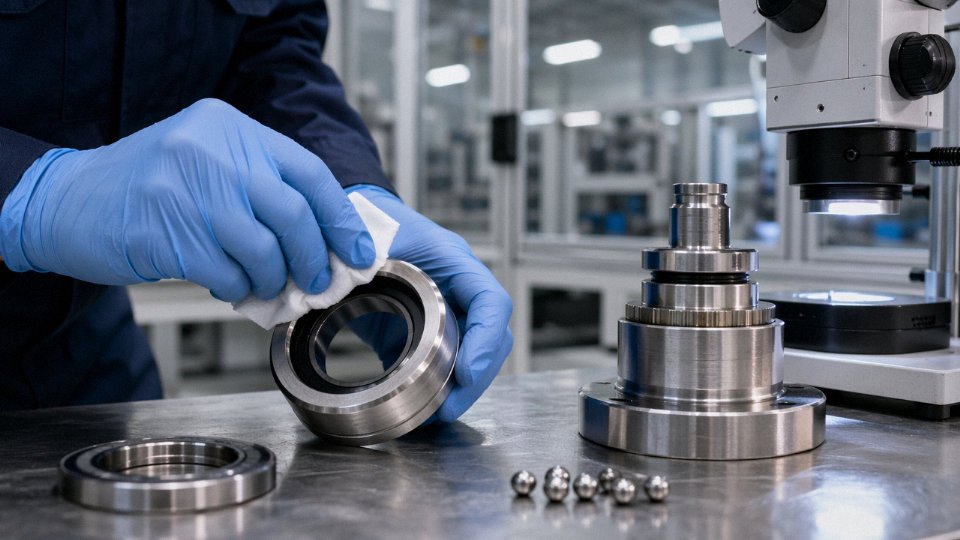
A practical cleaning method usually needs controlled wiping: clean lint-free cloths, one-direction strokes, frequent cloth changes, wet wipe followed by dry wipe, and no dipping dirty rags back into clean solvent. Sounds basic. It is also where many rework jobs fail.
Rework can turn into a process trial
Once silicone has reached a quality-critical surface, rework often becomes a small process development project. Repeated solvent cleaning may be needed. Alkaline washing can help in some production lines, especially with heat, spray pressure, and proper rinsing, but compatibility must be checked. Abrasion can remove contaminated surface layers, yet it changes dimensions, gloss, texture, and coating thickness. On precision shafts, optical covers, printed panels, molded housings, and sealing faces, that may be unacceptable.
For high-value parts, shops may escalate to plasma treatment, corona treatment, or flame treatment to raise surface energy before bonding or coating. Those methods can work, but they are not forgiveness machines. If silicone keeps bleeding out of a seam or elastomer edge, the treated surface can degrade again. Process windows are also part-specific: material grade, surface age, humidity, treatment speed, and storage time all matter.
Verification is where the cost becomes visible. A quick visual inspection is rarely enough. Dyne pens can be useful as a screening tool, though they are operator-sensitive and have shelf-life limits. Contact-angle checks give better data, but they need clean technique and a defined acceptance range. Some plants run tape tests, bead tests, coating drawdowns, primer trials, or sacrificial bond coupons before releasing reworked lots. None of that is free. It ties up people, parts, fixtures, and floor space.
Prevention beats heroic cleaning
The cheapest silicone cleanup is the one you never need to do. Treat silicone lubricants as controlled materials, not casual maintenance sprays.
A workable shop rule is simple: no silicone product near surfaces that will later be painted, bonded, printed, coated, sealed, or overmolded unless process engineering approves it. Put that in maintenance standards, not just tribal knowledge. Label containers clearly. Keep silicone sprays and greases in a separate cabinet from general-purpose lubricants. Record where they are used, especially on fixtures, conveyors, clamps, assembly aids, air cylinders, door seals, and packaging contact areas.
This is not bureaucracy for its own sake. If a line starts producing paint craters or adhesive skips, the first question should not be, “Did anyone spray something around here last week?” The answer will usually be a shrug. A usage log, even a simple one, can cut hours or days from troubleshooting.
A typical decision check looks like this:
| Situation | Better control |
|---|---|
| Lubricating a part that will never be finished or bonded | Silicone may be acceptable if compatible and documented |
| Lubricating fixtures near painted or adhesive-bonded parts | Use a non-silicone alternative unless approved by process engineering |
| Freeing a stuck mechanism during emergency maintenance | Contain overspray, tag the area, and notify quality before restart |
| Cleaning suspected silicone contamination | Validate with surface-energy or coating trials, not visual inspection alone |
Silicone lubricants are not bad tools. They are bad surprises. Once they get into the wrong part of the process, the cost is rarely the price of the can; it is rework labor, delayed shipments, scrap risk, and the uncomfortable meeting after a defect escapes.
Choosing alternatives: match the lubricant to the failure mode instead of using silicone by habit
The better question is not “What can I spray on this?” It is “What failure am I trying to stop?” Squeak, wear, corrosion, sticking, water entry, galling, electrical fretting, and assembly damage are different problems. Silicone solves some of them neatly, especially light sliding on compatible rubber or plastic. It causes trouble when it gets used as the plant’s universal quieting spray.
A sensible substitute depends on base materials, load, speed, temperature, water exposure, cleanup needs, finishing or bonding risk, electrical behavior, food-contact rules, and how much contamination the area can tolerate. That sounds like paperwork until a painter rejects a batch, or a packaging line starts collecting dust on every guide rail.
Pick the lubricant by duty, not by habit
For light pivots, hinges, slides, and general machine oil points, a mineral oil or synthetic hydrocarbon oil is often easier to manage than silicone. Mineral oil is cheap, familiar, and removable with normal degreasing methods. Synthetic hydrocarbon oils usually handle wider temperature swings and oxidation better, depending on viscosity and additive package. Neither is magic; both can stain, drip, and attract dirt if overused.
Loaded bearings, pins, bushings, and cams usually need a grease with real load-carrying chemistry. Lithium complex grease is common because it is available, affordable, and serviceable in many plants. Calcium sulfonate grease is worth a look where water washout, corrosion, and shock loading are recurring headaches. The right grease depends on bearing speed, operating temperature, seal design, purge practice, and whether the old grease is compatible. Mixing greases blindly is a maintenance classic. Not a good one.
For dusty tracks, sliding doors, labeler rails, textile guides, sawmill equipment, and powder-handling areas, a PTFE dry film or wax lubricant may beat any wet lubricant. Dry films reduce tacky dirt buildup, though they wear off and need controlled reapplication. Graphite can work in hot or dry sliding service, but it is messy and electrically conductive. Molybdenum disulfide paste is useful for high-pressure sliding and assembly work, especially slow, loaded motion, but it is not something I want migrating near clean packaging, paint, or electronics.
Chains need chain lubricant, not whatever aerosol is closest. A proper chain oil has tackifiers, penetration behavior, and film strength suited to pins and rollers. Too thin and it flings away. Too sticky and it becomes grinding paste. Conveyor speed, washdown, oven exposure, and drip tolerance all matter.
Common alternatives and where they fit
| Alternative | Good fit | Watch-outs |
|---|---|---|
| Mineral oil | Light-duty pivots, simple oil points, temporary lubrication | Low film strength, dirt pickup, possible staining |
| Synthetic hydrocarbon oil | Higher stability oils, wider temperature service | Check seals, viscosity, and additive compatibility |
| Lithium or calcium sulfonate grease | Bearings, pins, bushings, wet or loaded service | Grease compatibility, purge intervals, over-greasing heat |
| PTFE dry film | Dusty slides, light guides, clean-ish mechanisms | Limited load capacity, surface prep matters |
| Graphite | Dry or hot sliding, some locks and threaded parts | Black residue, conductivity, contamination risk |
| Molybdenum disulfide paste | High-load assembly, slow sliding, anti-scuff service | Dirty, hard to remove, not for clean zones |
| Wax lubricant | Woodworking, packaging guides, light sliding | Heat sensitivity, buildup |
| Anti-seize compound | Bolts, studs, threaded assemblies exposed to heat or corrosion | Not a bearing grease; affects torque-tension relationship |
| Penetrating oil | Freeing stuck parts before disassembly | Short-term only; poor lasting lubrication |
| Specialty contact lubricant | Specified electrical connectors and switches | Must match connector material and electrical spec |
Do not improvise around brakes, connectors, seals, or food areas
Brake work needs brake-specific products. Rubber brake components, caliper slides, pad backs, and ABS-related hardware are not places for general-purpose silicone spray or random grease. Use the lubricant called out by the brake component supplier, and keep friction surfaces clean. A tiny mistake there has a bigger consequence than a squeaky hinge.
Electrical connectors are similar. An approved dielectric grease can be right for sealing a specified connector family, especially in wet or corrosive service. A random silicone aerosol inside a sensor plug may change contact behavior, trap debris, or interfere with diagnostic work. Connector specifications, OEM service bulletins, and site electrical standards should outrank personal preference.
Food and beverage plants need their own discipline. If incidental food contact is possible, look for NSF H1 registration and confirm the product fits the actual use point. H1 is not permission to fog the whole line. In practice, auditors care about storage, labeling, application control, and whether maintenance can prove the right product went in the right place.
A lubricant that works mechanically can still be the wrong choice if it violates finishing, food-contact, electrical, or contamination-control requirements.True
Lubrication performance is only one acceptance criterion. Many failures come from residue transfer, incompatible additives, missing approvals, or uncontrolled application rather than lack of lubricity.
A practical selection workflow
Start with the motion: rolling bearing, sliding guide, chain, thread, seal, latch, connector, or temporary assembly aid. Then name the failure mode. Wear? Corrosion? Squeak? Galling? Water ingress? Fretting? If the answer is vague, the lubricant choice will be vague too.
Check the materials next: steel, aluminum, brass, EPDM, nitrile, silicone rubber, polyurethane, polycarbonate, acetal, painted surfaces, plated contacts. Then check temperature. Many silicone lubricants sit roughly in the minus 40°C to 200°C continuous service band, but that depends heavily on thickener, carrier solvent, and additives; competing products have the same kind of fine print.
Now look downstream. Will the part be painted, bonded, printed, sealed, inspected optically, welded, packed into food equipment, or handled with gloves that touch clean parts? If yes, contamination risk may decide the lubricant before load calculations do.
Test a small sample. Not on the customer’s shipment. Run a wipe test, a bond test, a short heat cycle, or a dust exposure check if that is the real risk. Document the exact product name, grade, viscosity or NLGI grade where relevant, approval status, and application point. Train users on quantity. Most lubricant problems I have chased were not caused by one drop in the right spot; they were caused by six times too much in the wrong one.
Frequently asked questions about silicone lubricant downsides
Is silicone lubricant bad?
No. Silicone lubricant is not inherently bad. It is bad when it is used as a default spray for every squeak, slide, hinge, seal, and connector in the building.
The trouble starts in applications where contamination, load capacity, cleanability, adhesion, or controlled friction matters. A light-duty silicone spray might use silicone oil in roughly the 100 to 1,000 cSt range, depending on the product and carrier solvent. That is fine for some plastic guides, weather seals, light sliding parts, and moisture protection. It is not the same thing as an extreme-pressure grease for a loaded cam, chain, bearing, or metal slide.
The right use reduces sticking and moisture problems. The wrong use can create scrap, slipping belts, coating defects, or a maintenance mess that gets carried around on gloves and rags.
Does silicone lubricant damage rubber or plastic?
Often it does not, which is why people reach for it around rubber seals and plastic trim. But “often compatible” is not the same as “safe on every polymer.”
The base silicone oil may be mild, while the aerosol solvent, propellant, thickener, corrosion inhibitor, or tackifier may not be. Some plastics can craze or stress-crack. Some elastomers can swell, soften, or lose grip. Coated parts may stain. Printed markings can smear. The result depends on the polymer grade, filler package, age of the part, surface stress, and exposure time.
In a plant, I would test the exact lubricant on scrap or a hidden area before approving it near polycarbonate guards, soft thermoplastic elastomers, rubber drive parts, painted plastics, or seals that must hold a tight tolerance.
Can silicone spray be used on brakes, belts, or clutches?
Generally, keep silicone spray away from brakes, belts, clutches, friction rollers, drive pulleys, and any surface that relies on friction to work.
Silicone lowers friction. That is the point. On the wrong surface, that means belt slip, poor stopping, clutch chatter, tracking problems, or inconsistent feed. A tiny overspray cloud can travel farther than the person holding the can expects. I have seen maintenance teams fix one squeaky guard hinge and then chase intermittent belt slip on the same machine later. Not always silicone, but it is exactly the kind of failure pattern silicone can create.
For friction surfaces, use the manufacturer’s approved cleaner or dressing, if one is allowed at all. Many braking and clutch surfaces should be clean and dry, not “lightly lubricated.”
Why is silicone banned in some paint shops?
Because silicone residue can cause fish eyes, craters, poor wet-out, weak bonding, and coating defects at levels low enough that the surface may look clean to the eye.
Silicone lubricant can cause paint, adhesive, coating, and ink defects at contamination levels that are difficult to detect visually.True
Silicone residues can lower local surface energy and interfere with wetting. A part may pass a casual visual check yet still crater, fisheye, or bond poorly during finishing.
Paint shops ban silicone for practical reasons, not superstition. It transfers on hands, air hoses, carts, tools, repair benches, masking materials, and compressed-air blow guns. Once it is in a finishing area, removal is slow and verification is not simple. A normal solvent wipe may spread the residue instead of removing it.
This is why body shops, powder coat lines, printing areas, adhesive bonding cells, and sealant operations often treat silicone aerosol as a controlled or prohibited material.
Is silicone lubricant safe for electrical connectors?
Dielectric silicone grease can be useful on electrical connectors when the connector design or service manual calls for it. It can help exclude moisture, reduce corrosion, and protect rubber boots or seals. Common service temperatures for many silicone lubricants run around -40°C to 200°C, but the real limit depends on the thickener, carrier, additives, and connector material.
It is not a general-purpose contact cleaner. It is not a conductivity booster. Too much grease can block contact seating, trap debris, interfere with low-force terminals, or migrate onto nearby sensor surfaces. For switches, potentiometers, low-current signal contacts, and optical or gas sensors, use the specified contact lubricant or cleaner. A tube of dielectric grease in the wrong hands can create a very clean-looking intermittent fault.
How do you remove silicone lubricant?
Removal usually takes a combination of the right solvent, mechanical action, clean wipes, and verification. One wipe with a shop rag rarely does it.
The method depends on the substrate. Metal parts may tolerate stronger degreasers, heptane-type cleaners, or approved solvent blends. Plastics, rubber, coatings, and printed parts may not. In practice, cleaning often means flooding or wetting the surface, wiping in one direction with clean lint-free material, changing wipes often, and repeating. Abrasion, alkaline cleaning, plasma treatment, or surface sanding may be needed before bonding or coating, but those can change dimensions or damage finishes.
Operational warning: do not use the same contaminated rag, glove, or Scotch-Brite pad across multiple parts. That just moves the problem around.
What is better than silicone lubricant?
The better lubricant depends on the failure mode, not the habit of the mechanic.
| Application problem | Better candidate in many cases | Why it may be better |
|---|---|---|
| High-load metal sliding or pivots | EP lithium, calcium sulfonate, or synthetic grease | Better load carrying and wear protection |
| Dusty slides or packaging guides | Dry PTFE, dry film, or no-lube material change | Less grit pickup than wet oil |
| Electrical switches or low-current contacts | Specified contact lubricant | Designed for contact resistance and plastics |
| Chains, cams, bearings | Chain oil or bearing grease matched to speed and load | Stays in the contact zone better |
| Dry locks or selected sliding hardware | Graphite or wax-type products | Dry feel, less oily residue |
Silicone still has a place. I like it for certain rubber seals, light plastic sliding, moisture exclusion, and controlled assembly work where downstream contamination is not a risk. I do not like it as an open aerosol near paint, bonding, belts, brakes, sensors, or dusty production lines. That is where a cheap spray can becomes an expensive root-cause meeting.
Final selection rule: avoid silicone when contamination costs more than lubrication helps
Silicone lubricant is not a bad product. It is a bad default.
That is the rule I use on plant floors and in maintenance reviews. If the job needs water resistance, low chemical reactivity, low-temperature flexibility, or gentle lubrication on selected elastomers, silicone can be the right answer. A light spray in the 100 to 1,000 cSt range may free up a plastic slide or protect a rubber seal. A heavier silicone grease or damping compound, often somewhere from 1,000 to 100,000 cSt depending on formulation, can behave very well in a sealed mechanism that sees moisture and modest load. Many products tolerate roughly -40°C to 200°C continuous service, give or take, but the real limit depends on the thickener, carrier solvent, additives, and the part being lubricated.
The trouble starts when that same long-lasting film escapes the joint. Silicone does not care about your process boundary. It can move by overspray, gloves, rags, compressed air, shared tools, carts, fingers, and parts bins. The film may help the hinge and wreck the paint line two workstations later.
That tradeoff decides the purchase.
Red flags that should stop an automatic approval
I would avoid silicone, or at least force a formal review, if any of these conditions are present:
| Red flag | Why it matters in practice |
|---|---|
| Painting, powder coating, printing, adhesive bonding, potting, labeling, or sealing nearby | Silicone residue can cause craters, fisheyes, weak bonds, ink defects, and coating rejection at levels operators may not see before the defect appears. |
| Dust, wood flour, textile lint, cardboard fibers, abrasive powder, or outdoor grit | The lubricant film can become a dirt binder. What started as smooth motion becomes a polishing compound with bad intentions. |
| High-load metal-to-metal contact | Silicone oil usually lacks the boundary additives needed for shock load, high Hertz contact, sliding wear, and gear or bearing duty. |
| Braking, clutching, gripping, belt drive, roller feed, or vacuum pick surfaces | A tiny amount of migration can reduce friction where friction is the function. This is a safety and scrap issue, not just a housekeeping issue. |
| Sensitive electronics, optical sensors, cameras, encoders, laser scanners, or metrology equipment | Films, vapors, and transferred residue can insulate contacts, collect dirt, distort optical readings, or create strange intermittent faults. |
| Cleanrooms or controlled contamination areas | Silicone can be hard to verify and harder to remove. If the site has particle and surface contamination controls, do not sneak in a consumer spray can. |
| Food-contact or food-adjacent uncertainty | “Looks clean” is not a compliance basis. Confirm the exact approval, intended contact type, and application method. |
| Difficult rework conditions | If the part cannot be cleaned, baked, abraded, stripped, or scrapped economically, do not apply a persistent lubricant casually. |
A typical maintenance mistake is simple: a technician uses silicone spray to quiet a squeak on a conveyor guide near a labeler. It works for the squeak. Then labels start lifting at the corners, or ink adhesion gets patchy, or cartons begin slipping on a transfer belt. Nobody links the failures right away because the spray event was “minor.” By the time quality traces it, the line has burned labor, labels, product, and credibility.
That is how cheap lubricant becomes expensive.
Treat lubricant choice as an engineering control
Procurement teams sometimes treat lubricants like janitorial supplies: same supplier, same cart, lowest friction in the buying process. That is risky in manufacturing. A lubricant is a process chemical. It has failure modes, contamination paths, storage controls, and approval requirements.
For maintenance and repair work, the question should not be “Will silicone make this move?” It usually will, at least briefly. The better question is: “What else can this film touch, and what happens if it does?”
For factory owners, this is where standardization pays. Approved lubricant lists are not bureaucracy for its own sake. They prevent a weekend repair from poisoning a Monday production run. I have seen better results when plants tag lubricants by use case: chain oil, food-grade grease, dielectric compound, pneumatic tool oil, mold release, assembly aid, anti-seize, and “restricted use only.” Silicone products often belong in that last group unless the plant has no finishing, bonding, sensor, or friction-sensitive exposure. Few plants are that cleanly separated.
Final pre-use checklist
Before silicone is approved, run through this short check. Not in theory. On the actual equipment.
- Verify material compatibility with the specific plastic, rubber, seal, coating, or finish. Check the product data, then test if the part is critical.
- Confirm the load, speed, and temperature range. Do not use a water-resistant film as a substitute for an EP grease or bearing lubricant.
- Map contamination pathways: overspray, runoff, hand transfer, shared tools, compressed air, washdown, drainage, and downstream handling.
- Review the safety data sheet for the full product, especially aerosols, solvents, propellants, ventilation needs, and floor slip hazards.
- Test on a small area or non-production part. For bonding or painting areas, include the downstream process in the test, not just the lubrication point.
- Document the approval: product name, application point, amount, method, responsible owner, and prohibited nearby uses.
Silicone lubricant should be rejected when its likely contamination cost is higher than the value of the lubrication it provides.True
This is the practical engineering decision rule. Silicone can perform well in the joint, but its persistence and migration can create coating, bonding, friction, sensor, cleanup, and rework costs outside that joint.
Use silicone deliberately, sparingly, and only where its long-lasting film is an advantage. If that film becomes a contamination liability, choose another lubricant or redesign the lubrication point.