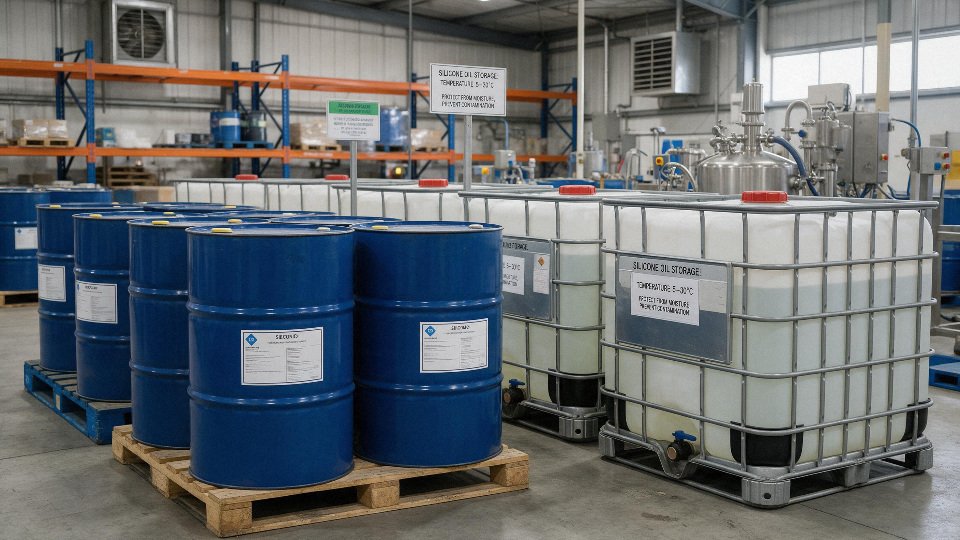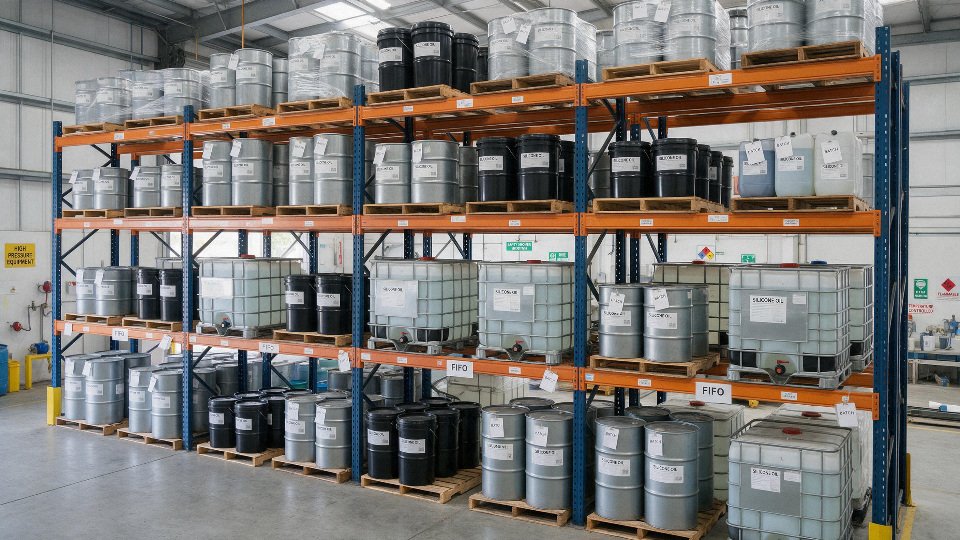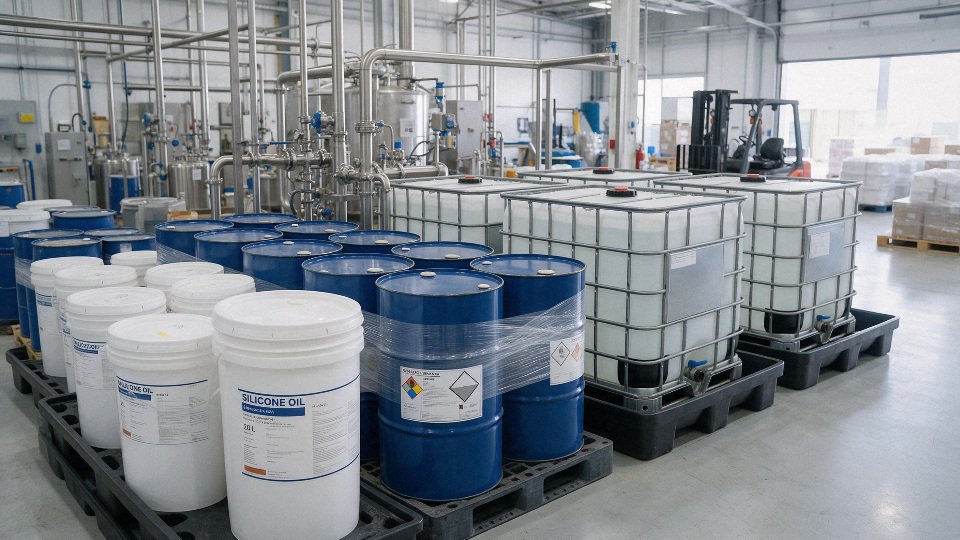
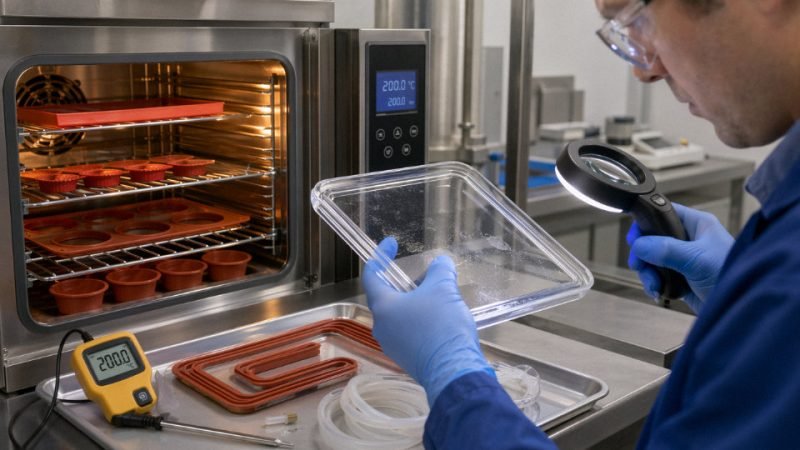
A silicone part that smells oily, fogs a cover, or leaves residue after a hot cycle is not just a comfort issue. On a line, that can mean rejected food-contact parts, tainted batches, nuisance smoke calls, or operators quietly lowering oven setpoints to avoid complaints. Then procurement gets pulled into credits, retesting, expedited replacements, and the ugly question: was the material wrong, or was it never cured and verified for the heat duty? The practical answer starts with temperature rating, cure quality, and extractables data, not with marketing words like “food grade.”
Food-grade silicone normally does not release toxic fumes at proper baking temperatures, roughly up to 230 degrees Celsius, or 260 degrees Celsius for some rated products. Risk rises with poor curing, fillers, oils, overheating, or long exposure near the limit. Ask for migration and volatile data, especially D4, D5, and D6.
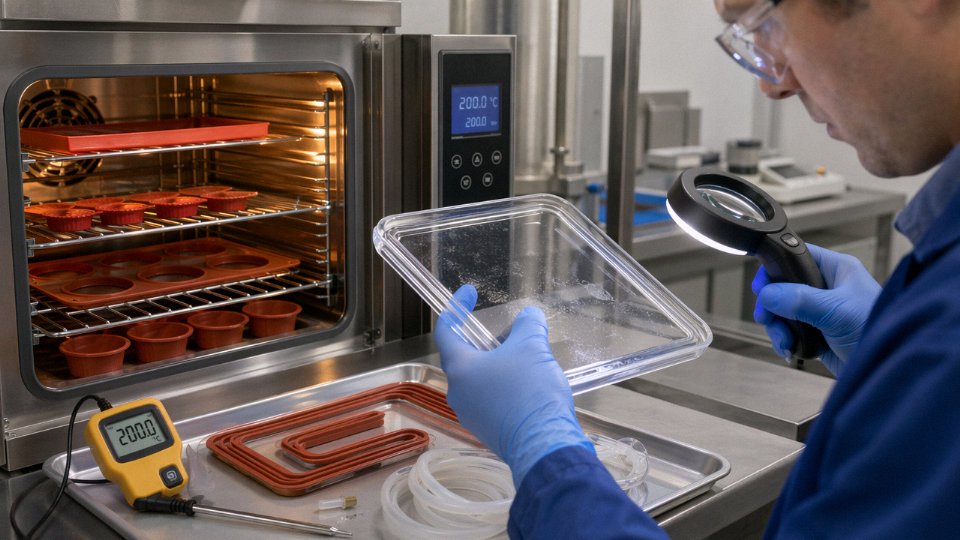
The part most buyers miss is that silicone is not one material. A cheap molded mat, a platinum-cured medical tube, and a peroxide-cured high-consistency rubber gasket can behave very differently after an hour in a hot oven. Post-curing at roughly 150 degrees Celsius to 250 degrees Celsius for several hours is often used to drive off volatile residues, but whether that happened, and whether anyone tested the finished part under realistic use conditions, is where the real answer lives.
How silicone behaves under heat: polymer structure, stability, and failure points
Why silicone tolerates heat better than many plastics
Silicone rubber is not just “soft plastic.” In most bakeware, gaskets, tubing, and molded industrial parts, it is a crosslinked polysiloxane network. The backbone is built mainly from silicon-oxygen bonds, with organic side groups attached to the silicon atoms. That silicon-oxygen backbone is the reason silicone holds up better under heat than many carbon-chain polymers used in packaging, seals, and consumer goods.
Compare that with polyethylene, polypropylene, nylon, or many thermoplastic elastomers. Those materials can be very good in the right service, and I have seen polypropylene tanks and nylon wear pads run for years without drama. But their carbon-based chains tend to soften, creep, oxidize, or lose mechanical properties at lower temperatures than properly cured silicone rubber. Silicone usually keeps flexibility across a wider temperature window.
Still, silicone is not magic.
A food-grade silicone mat rated to about 230 degrees Celsius is not the same thing as a high-temperature industrial silicone compound formulated for hot-air duct seals or oven door gaskets. Fillers, peroxide versus platinum cure chemistry, pigment package, wall thickness, post-curing, and exposure to oil, detergent, steam, or oxygen all change the answer. In procurement terms, “silicone” on a data sheet is a starting point, not a specification.
Silicone is heat-resistant because its silicon-oxygen backbone is generally more thermally stable than the carbon-carbon backbone found in many common plastics.True
This is broadly correct, but actual service life still depends on compound formulation, cure system, fillers, temperature, oxygen exposure, and mechanical load.
Softening, swelling, volatilizing, oxidizing, and decomposing are not the same event
A lot of confusion starts because people treat any smell, shine, surface bloom, or texture change as “toxins being released.” Sometimes that concern is justified. Sometimes it is the wrong diagnosis.
Softening means the part loses stiffness at temperature. Crosslinked silicone does not melt like polyethylene film, but it can lose strength and feel more rubbery under load. A thin silicone spatula edge may flex badly in a hot pan even though the polymer has not decomposed.
Swelling is different. Silicone can absorb oils, fuels, some solvents, and process chemicals. A gasket in hot cooking oil, citrus oil, or a factory line using aggressive cleaners may grow, soften, or distort. That is not the same as thermal breakdown, though heat makes swelling worse.
Volatilizing means low-molecular-weight compounds leave the rubber. In silicone, testing often looks for cyclic siloxanes such as D4, D5, and D6, along with overall migration under simulated use conditions. These residues are influenced by the cure process and post-curing. High-consistency silicone rubber is often post-cured at roughly 150 degrees Celsius to 250 degrees Celsius for several hours to reduce volatile residues. The exact recipe depends on part thickness, cure chemistry, airflow, and the regulatory target.
Oxidizing is surface reaction with oxygen at heat. You may see hardening, chalking, color shift, or loss of elasticity over time.
Decomposing is the severe case. That is where the polymer network breaks down enough to generate smoke, irritating fumes, silica-like ash or residue, and smaller chemical fragments.
Practical temperature bands
At room temperature storage, silicone is normally stable if it is kept away from incompatible chemicals, ultraviolet abuse, and deformation under heavy load. A silicone gasket jammed under a clamp for two years may take compression set without ever seeing heat.
At boiling and steaming temperatures, around 100 degrees Celsius, most properly made silicone parts are comfortable. Steam service is a little harsher than people expect, especially in plants where cleaning cycles repeat daily and the gasket is also under compression. The part may not fail from temperature alone; it fails from heat, pressure, detergent, and maintenance habits working together.
Baking service is where consumer questions usually land. Typical silicone bakeware is used around 175 degrees Celsius to 230 degrees Celsius, with some products rated up to about 260 degrees Celsius. Those ratings depend on the compound, test method, exposure time, and whether the part is empty, loaded with food, touching metal, or close to a heating element. A dark, empty silicone mold sitting on a hot tray can see harsher surface conditions than the oven dial suggests.
High-temperature industrial service is a different conversation. Silicone seals, sleeves, and pads may run near the upper end of their rated range for long periods, but life shortens as temperature rises. A seal that lasts a year at a moderate oven temperature might last weeks or months near its top rating, especially with airflow, ozone, tension, or abrasion. Maintenance teams know this pattern: the part looks fine during installation, then turns brittle on the shutdown you really needed to be short.
Above rated limits, the decomposition-risk zone begins. There is no single cliff edge because formulation and atmosphere matter, but sustained overheating or direct contact with flame, exposed heating elements, or very hot metal can push silicone into real degradation.
What severe overheating can produce
Under severe high-temperature exposure, silicone can release volatile siloxane fragments, including cyclic siloxanes such as D4, D5, and D6. Under certain oxidative high-temperature conditions, formaldehyde can also be produced. You may also get smoke, acrid or irritating fumes, and a silica-like residue as the organic groups burn away and the inorganic portion remains.
That is not normal baking behavior for a good part used within its rating. It is a failure condition.
The plant-floor rule is simple: if silicone darkens, cracks, powders, smokes, becomes sticky, or gives off a persistent harsh odor, remove it from service. Do not wash it, sniff it, and put it back because production is behind schedule. Wrong call: one degraded gasket sheds particles, leaks product, contaminates a batch, or forces an unplanned teardown. Right call: quarantine the part, check the heat source and exposure history, and replace it with a compound actually rated for the duty.
What can migrate from heated silicone: volatile siloxanes, residues, fillers, and additives
The main concern with heated silicone is not that the silicone polymer suddenly turns into a toxic gas at normal oven temperatures. The more practical question is what small compounds are left in the rubber, loosely held in it, or formed in small amounts after repeated heat exposure.
In testing reports, the names that come up most often are low-molecular-weight siloxanes, especially D4, D5, and D6. These are small cyclic silicone molecules, not the long rubbery network that gives a spatula or baking mat its shape. They can be residual material from silicone production, remnants from processing, or minor volatile compounds associated with heat aging. Labs may measure them in extractables or volatiles testing because they are mobile enough to leave the material under the right conditions.
That does not automatically mean a dangerous exposure. It means the product has something measurable that needs context: how much, under what food-contact condition, at what temperature, and for how long.
If a laboratory detects D4, D5, or D6 from heated silicone, the product is automatically unsafe.False
Detection only proves presence above the method's reporting limit. Safety depends on migration level, exposure route, duration, toxicological reference values, and the intended use of the silicone article.
Low-molecular-weight siloxanes are usually the first thing to check
D4, D5, and D6 have different volatility and toxicology profiles, so a decent compliance review should not just say “siloxanes present” and leave it there. For food-contact parts, extractables and volatile testing often looks at these compounds along with overall migration under simulated use conditions.
In practice, the highest readings tend to come from parts that were not well post-cured, parts made from low-grade compound, or thick sections where volatiles are trapped. A thin baking mat can off-gas faster during manufacturing than a chunky molded gasket or a deep cupcake mold. Geometry matters. So does air circulation during post-cure.
For high-consistency silicone rubber, post-curing is commonly done somewhere around 150 degrees Celsius to 250 degrees Celsius for several hours. The exact schedule depends on compound type, wall thickness, catalyst package, oven airflow, and the specification being targeted. I have seen factories treat post-cure like a box-ticking oven step, then wonder why the first shipment smells sharper than the sample lot. Load the oven too densely, skip airflow checks, or shorten the hold time, and residues stay in the part.
Odor can come from more than silicone itself
A silicone product is rarely just pure silicone polymer. The formulation may include reinforcing silica, pigments, processing aids, curing chemistry, and sometimes release agents from molding. If the compound is peroxide-cured, peroxide decomposition byproducts can remain unless the part is properly post-cured. Platinum-cured silicone often has a cleaner profile, which is why it is widely preferred in medical, baby-care, and higher-grade food-contact uses.
That said, peroxide-cured does not mean unsafe. A properly compounded and post-cured peroxide-grade silicone can pass food-contact requirements. The trouble starts when buyers treat “silicone” as one uniform material and never ask how it was cured, what post-cure was used, or whether the supplier has current migration data for the actual color and thickness being purchased.
Pigments deserve attention too. A red mold, a black spatula, and a translucent lid are not identical risk cases. Color masterbatches can bring their own extractables. Non-silicone fillers may lower cost, change stiffness, and sometimes increase ash content. In bad material, you may also see plasticizer contamination or blended plastics sold under the loose banner of “silicone.” That is where heat behavior can become unpredictable.
A quick plant-floor warning: if a “silicone” part hardens, cracks, smokes, or develops a burnt plastic smell at temperatures where real silicone bakeware should be comfortable, stop treating it as silicone until proven otherwise.
Fatty foods are the tougher test
Water is not the most aggressive food simulant for many silicone-related extractables. Low-molecular-weight siloxanes and many processing residues are hydrophobic, so oily and fatty foods can pull out more than water-based foods. Butter, pastry dough, cheese, meat drippings, and nut oils are more relevant to a baking mat than plain water sitting at room temperature.
That is why fat-contact testing matters for molds, liners, spatulas, and oven mats. A product used for steaming vegetables faces a different extraction challenge than one used under salmon or croissants at about 180 degrees Celsius to 220 degrees Celsius. Time matters as much as temperature. Repeated cycles can also change the early migration pattern; the first few heat cycles may release more volatile residue than later use, assuming the material is genuine silicone and not degrading.
Detectable, odorous, and hazardous are not the same thing
This is where procurement teams and factory owners need clean language. Food-contact migration limits are designed around how much of a substance can transfer into food under defined test conditions. Toxicological thresholds evaluate dose and biological effect. Workplace exposure limits apply to air inhalation in occupational settings and may not translate neatly to a muffin tray or a molded seal. Odor detection thresholds are something else entirely; humans can smell some compounds at very low levels, sometimes below levels of toxicological concern.
So, a smell is a quality warning, not a finished risk assessment.
The right response is not panic, and it is not blind acceptance. Ask for migration testing matched to use: temperature range, food type, duration, color, and thickness. Typical consumer silicone bakeware is sold for about -40 degrees Celsius to 230 degrees Celsius, with some products rated to 260 degrees Celsius, but that rating only means something if the material formulation and test evidence support it.
Cheap “silicone” can distort the whole safety discussion
The worst products in this category are often not failed silicone. They are questionable blends marketed as silicone. Excess mineral filler can make a mat feel firm while lowering cost. Plastic blends may pass a casual pinch test and still behave poorly near oven temperatures. Heavy filler loading can also mask poor rubber quality until the product sees oil, heat, and repeated flexing.
A practical receiving check is simple: review the supplier’s food-contact declaration, ask for overall and specific migration results, confirm whether the grade is platinum-cured or peroxide-cured, and verify the temperature rating against real use. If the product is unusually cheap, has a strong persistent odor after washing and heating, or leaves oily residue on packaging, do not put it into production or customer use without testing. One rejected batch is cheaper than complaints, scrap, or a recall discussion nobody wants to have on a Friday afternoon.
Safe temperature limits for silicone bakeware, mats, gaskets, tubing, and cookware
Most decent food-grade silicone kitchen products are sold with an upper working range around 220 degrees Celsius to 230 degrees Celsius. Some better grades, often platinum-cured or post-cured more thoroughly, are rated around 250 degrees Celsius to 260 degrees Celsius. Those numbers are not magic material limits. They depend on the silicone compound, curing system, filler package, pigment, wall thickness, time at temperature, and whether the part is sitting in clean hot air or touching oil, sugar, steam, detergent, or a hot metal surface.
That last part matters more than people think.
A baking mat in a 220 degrees Celsius oven is not seeing the same service as a silicone gasket clamped in a heated process line at 180 degrees Celsius with vacuum on one side and cleaning chemicals on the other. Same family of material, very different risk profile.
Practical temperature ranges by use case
| Application | Typical silicone exposure | Practical guidance |
|---|---|---|
| Freezer storage | About -40 degrees Celsius and above for many consumer products | Usually low risk for silicone. Watch for cracking in cheap blends or stiff parts bent while frozen. |
| Dishwasher cycles | Often 50 degrees Celsius to 75 degrees Celsius water, with hotter drying zones in some machines | Generally within range, but alkaline detergents and repeated drying can age low-grade parts. |
| Boiling water | Around 100 degrees Celsius at sea level | Normally safe for food-grade silicone if the part is intended for boiling or sterilizing. |
| Pressure cooking | Roughly 110 degrees Celsius to 125 degrees Celsius, depending on pressure | Acceptable for rated seals and accessories. Unrated lids, plugs, or baby parts are not automatic candidates. |
| Microwave reheating | Food and steam may exceed 100 degrees Celsius locally; dry edges can get hotter | Safe only if the product is microwave-rated and not run dry against overheated food or fat. |
| Conventional baking | Commonly 160 degrees Celsius to 230 degrees Celsius | Stay within the label rating. Avoid broilers and direct contact with oven walls or elements. |
| Air fryers and toaster ovens | Setpoints may be 180 degrees Celsius to 230 degrees Celsius, but local radiant hot spots can run higher | Use caution. Small cavities and exposed elements punish thin mats and overhanging molds. |
| Industrial heated lines | Anywhere from warm service to 200 degrees Celsius-plus, depending on process | Use compound data sheets: continuous rating, peak rating, media compatibility, pressure, vacuum, and compression set. |
A silicone product rated to 230 degrees Celsius is automatically safe anywhere inside an oven set to 230 degrees Celsius.False
The oven air setpoint is not always the surface temperature of the silicone. Radiant heat from coils, contact with hot dry metal, sugar or oil films, and cycling overshoot can push the silicone surface above its rated condition.
Geometry changes the real exposure
Thin silicone baking mats heat fast. That is good for even baking, but it also means the mat surface follows hot pan conditions closely. If the mat is on a dark steel tray near a lower element, the silicone may see sharper thermal peaks than the oven display suggests.
Thick molds behave differently. A muffin mold or loaf pan has more thermal mass, so the core of the part warms slower, but edges and corners still take the beating. Pigmented molds can absorb radiant heat differently too. Black, red, and dark blue parts often run hotter at the surface than translucent or pale parts under the same lamp or element. Not always, but enough that I would not ignore it.
Baby bottle nipples and pacifier parts are a separate case. They are thin, highly extracted by saliva, steam, fats, and repeated sterilizing, and they are flexed constantly. The safe question is not only “Will it survive 100 degrees Celsius?” It is also “Was it made and tested for repeated mouth contact after heating?”
Tubing, oven seals, and molded gaskets bring plant-floor problems into the discussion. A tube carrying hot syrup, steam condensate, oil, or solvent is being heated from the inside and chemically extracted at the same time. A gasket under compression near a heated vessel may look fine from the outside while compression set quietly ruins sealing force. Then the operator tightens the clamp one more turn. That works until it does not.
Direct heat is where ratings get abused
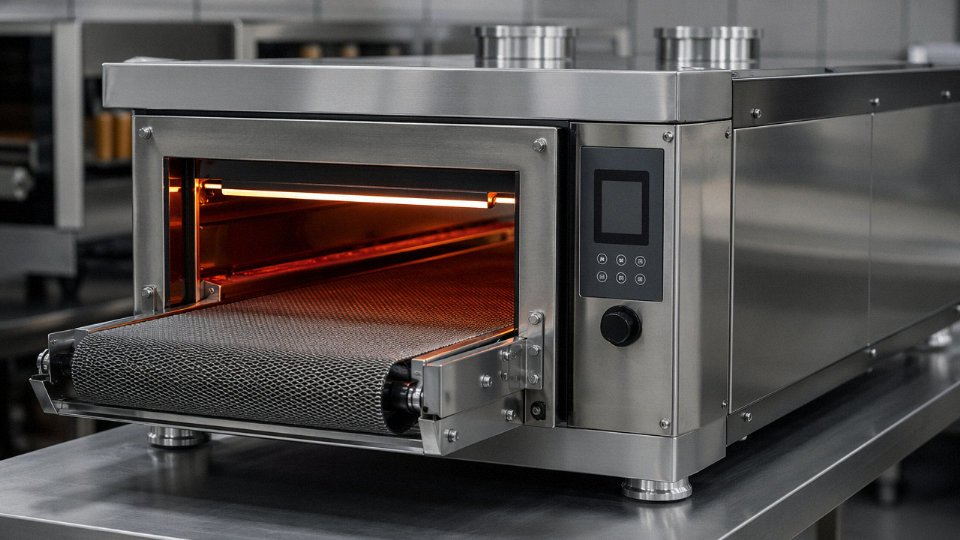
A stated air-temperature rating does not mean the silicone can touch anything at that temperature indefinitely. Direct contact with a heating element, open flame, broiler coil, hot dry skillet, pizza stone, or bare oven wall can exceed the rated surface condition in seconds. High-powered infrared heat is especially rough because it heats surfaces before the surrounding air catches up.
I have seen silicone oven seals scorched not because the oven was too hot on paper, but because the door was misaligned and one section sat in a leakage jet near the element. Same kind of failure shows up in factories: a silicone hose routed too close to a heat tunnel, a gasket overhanging into radiant heat, a mat trimmed so it curls upward toward a heater bank. Small installation errors become thermal exposure problems.
Air fryers and toaster ovens deserve their bad reputation here. The cavity is small, the heating element is close, airflow is aggressive, and the thermostat cycles. A basket set to 200 degrees Celsius can still create local hot spots above that at the silicone surface, especially on raised edges, corners, or parts sitting dry with little food mass to absorb heat. If a mat smells strongly, discolors, becomes sticky, chalky, cracked, or oily after those cycles, retire it. Do not keep “testing” it with food.
Use the rating that matches the job
For kitchen use, read the manufacturer’s temperature label and assume it applies to normal use: hot air, food contact, reasonable cycle time, no flame, no broiler, no dry pan abuse. If the product only says “heat resistant” without a temperature, I treat it as decorative until proven otherwise.
For industrial seals, tubing, sheets, and molded parts, generic silicone temperature charts are not enough. Ask for the compound grade, curing method, post-cure status, continuous-use rating, short-term peak rating, and compatibility with the actual media. Pressure, vacuum, cleaning chemistry, oils, fats, steam, and compression all change the answer.
A simple rule from the maintenance side: if losing the part stops production, contaminates product, or creates a safety exposure, buy the specified grade and document it. The cheap substitution usually looks clever only until the first unplanned shutdown.
How manufacturing quality determines whether heated silicone smells, smokes, or leaches
Two products can both be sold as “silicone” and behave nothing alike on a hot tray, in a steam line, or under a compression clamp. The difference is usually not the silicone polymer name on the sales sheet. It is the cure package, filler loading, post-cure discipline, contamination control, and whether procurement bought from a traceable compounder or from the cheapest listing with nice photos.
I have seen good silicone parts come out of a first heat cycle with barely any odor. I have also seen soft, brightly colored parts haze an oven window and smell like a tire shop. Same material family. Very different manufacturing quality.
Curing system and post-curing are where many problems start
Silicone rubber is not just poured into a mold and magically finished. It must be crosslinked. In plant terms, curing ties the polymer chains into an elastic network so the part holds shape, rebounds, and survives heat without turning gummy.
Common systems include peroxide-cured silicone and platinum-cured addition silicone. Peroxide systems are robust and widely used, but they can leave decomposition byproducts if the process is rushed or the formulation is not suited to the end use. Platinum-cured silicone can be cleaner for medical and food-contact applications, but it is more sensitive to catalyst poisoning from sulfur, amines, certain oils, and dirty handling. Neither system is automatically good or bad. Execution matters.
Crosslink density is the quiet variable buyers rarely ask about. Too low, and the part may feel soft but creep, swell, or release more low-molecular-weight material during heat exposure. Too high, and it can become brittle, tear at corners, or lose sealing force after compression. The right balance depends on the job: a baking mat, a gasket under clamp load, and a peristaltic pump tube do not need the same rubber behavior.
Post-curing is the step that separates a decent industrial part from a shortcut part. High-consistency silicone rubber is often post-cured at roughly 150 degrees Celsius to 250 degrees Celsius for several hours, depending on thickness, compound, air circulation, and end-use requirements. That hot-air bake drives off residual volatiles and leftover cure byproducts. Thick sections need longer than thin sheet. Packed ovens need more time than open racks. Anyone who has run post-cure ovens knows the smell on the first hour can be sharp; that is exactly why you do not want the customer’s oven doing the cleanup.
A strong chemical odor during the first heating of silicone is often a sign of residual volatiles or curing byproducts, not proof that the silicone polymer itself is decomposing.True
Well-made silicone is thermally stable within its rated range, but poor post-curing can leave low-molecular-weight siloxanes or peroxide byproducts that volatilize during first use. Actual decomposition is more likely when temperature limits are exceeded or the product is exposed to flame, aggressive chemicals, or incompatible oils.
Fillers can improve silicone, or cheapen it
Silica is the main reinforcing filler used in quality silicone rubber. It improves tear strength, tensile behavior, and shape retention. Treated fumed silica or precipitated silica costs money and must be mixed properly. Poor dispersion shows up as weak spots, rough surfaces, and inconsistent stretch.
Calcium carbonate and other mineral extenders are a different story. Used carefully, they can adjust cost, hardness, density, or processing. Overused, they make the product heavier, less elastic, and less tolerant of repeated heat cycling. A mat that feels unusually stiff for its thickness, cracks at a fold, or leaves a chalky edge after trimming may be carrying too much non-reinforcing filler. In a gasket, that becomes compression set and leaks. In bakeware, it can mean warping, odor, and early surface breakdown.
The practical warning: heavy does not always mean durable. Sometimes heavy just means filled.
Pigments, black compounds, and bright colors deserve scrutiny
Color is not just decoration. Pigments and masterbatches must be rated for the cure chemistry, the service temperature, and food-contact use if the product touches food. Bright red, orange, green, and blue silicone products can be perfectly safe when properly specified. They can also be where poor documentation hides.
Black silicone is another common trap. Carbon black grades vary widely. Some are suitable for rubber and high-temperature service; others are not appropriate for food-contact products. In procurement, I want to see the food-contact declaration, temperature rating, and material traceability, not just “FDA grade” printed on a carton. That phrase gets abused.
Unknown imports with no compound data, no batch lot, and no named manufacturer are risky, especially in bright colors or soft-touch products. If the supplier cannot say what pigment system was used, they probably cannot control migration either.
Contamination is a boring cause with expensive consequences
Bad silicone behavior is not always from the recipe. It can come from the shop.
Shared molds may carry traces of release agents, oils, previous compounds, or pigment residue. Recycled material streams can introduce unknown additives or partly cured scrap. Improper storage lets parts absorb dust, machine oil mist, cardboard odors, or plasticizer vapors from nearby materials. I have seen clean rubber ruined by being stored beside solvent-wiped tooling and open lubricant pails. No lab mystery there. Just poor housekeeping.
Release agents are a common nuisance. A little overspray helps demolding. Too much leaves an oily surface that transfers to food equipment, attracts dust, or smokes on first heating. If a silicone sheet feels greasy out of the package, do not assume that is normal.
Procurement red flags that usually predict trouble
| Red flag | What it can mean in practice | Likely consequence |
|---|---|---|
| No stated temperature rating | Product was not validated for the claimed use | Odor, softening, warping, or early failure |
| No food-contact declaration | No controlled migration basis | Rejection during audit or customer complaint |
| Strong chemical smell before use | Residual volatiles, poor post-cure, contamination | Smoke or odor during first heating |
| Uneven color or streaks | Poor pigment dispersion or mixed scrap | Weak spots, inconsistent migration behavior |
| Oily or dusty surface | Release agent excess, poor storage, dirty handling | Transfer, smoke, hygiene issues |
| Unusually low price | High filler loading, skipped post-cure, weak QA | Short life and hard-to-trace failures |
| Vague claims like “premium silicone” | Marketing instead of specification | No accountability when parts fail |
| No traceable manufacturer or lot | Broken supply chain control | Impossible root-cause analysis |
The right buying question is not “Is it silicone?” Ask what grade, what cure system, what post-cure, what temperature rating, what food-contact standard, and what batch traceability. A reliable supplier can answer without acting offended. A weak one sends another brochure.
Food-grade, medical-grade, and industrial-grade silicone: what labels actually prove
A silicone part is not safer just because the label sounds cleaner. “Food-grade,” “medical-grade,” and “industrial-grade” describe different qualification paths, not a simple good-better-best ladder. I have seen good industrial gasket material outperform cheap “food silicone” in a hot air cabinet, and I have also seen beautifully molded high-temperature rubber rejected because nobody could prove it was suitable for contact with oily food.
The certificate matters. The use case matters more.
Food-grade silicone means tested food contact, not unlimited use
Food-grade silicone should mean the compound was formulated and tested for food contact under stated conditions. That usually includes limits on overall migration, extractable residues, and sometimes specific low-molecular-weight siloxanes such as D4, D5, and D6, depending on the market and test plan.
It does not mean the item is automatically safe for every oven setting, every cleaning chemical, every fat-rich food, or every contact time.
A baking mat used at about 180 degrees Celsius for biscuits is one duty. A silicone liner pressed against oily meat at 230 degrees Celsius for hours is another. A gasket in a sauce-filling machine exposed to hot tomato paste, steam cleaning, and caustic washdown is another again. Same base polymer family, different risk profile.
For consumer bakeware, the common stated operating range is roughly -40 degrees Celsius to 230 degrees Celsius, with some products rated up to about 260 degrees Celsius. That number depends on the compound, geometry, filler package, cure state, and whether the temperature is continuous or short peak exposure. Thin mats sitting on a dark tray can see local hot spots. Ovens lie, too; a tired thermostat or top element can overshoot enough to matter.
Food-grade silicone is safe at any temperature as long as it does not melt.False
Food-contact approval is tied to specified test conditions such as temperature, time, food simulant, and intended use. Silicone can remain physically intact while still releasing higher levels of volatiles or extractables under harsher conditions.
Medical-grade silicone is not a free pass for food or factory heat
Medical-grade silicone usually points to tighter controls: biocompatibility testing, cleaner processing, traceability, and controls around residues that could irritate tissue or interfere with implantation or fluid contact. In serious medical supply chains, buyers will ask about ISO 10993 testing, USP Class VI, lot traceability, change control, and cleanroom handling where relevant.
That is a different question from, “Can I bake on it?” or “Will it survive saturated steam every shift while clamped in a sanitary valve?”
Medical-grade material may be excellent. It may also be optimized for softness, skin contact, tubing flexibility, or implant performance rather than dry-heat aging, compression set, tear strength, or food-fat extraction at oven temperature. I would not approve a medical silicone sheet for a bakery belt just because the word “medical” appeared on a data sheet. I would ask for food-contact migration data, temperature rating, cleaning compatibility, and whether the supplier allows that use.
In procurement, this is where people get trapped by prestige language. A medical label can raise confidence in process discipline, but it does not replace application-specific approval.
Industrial-grade silicone can be tough, clean-looking, and still not food-contact compliant
Industrial silicone is a broad bucket. It covers seals, hoses, extrusions, sponge sheets, electrical insulation, oven door gaskets, vibration pads, masking plugs, and molded components. Some industrial grades are built for heat resistance, compression recovery, flame behavior, weathering, or dielectric strength. They may run for years in a cabinet or enclosure.
That does not make them food-grade.
An industrial sheet might contain pigments, peroxide cure by-products, processing aids, reinforcing fillers, or additives that are acceptable for a machine guard seal but not tested for repeated contact with food. In practice, this is common with red oxide-colored silicone sheet sold by the roll. It may be perfectly sensible for a hot air duct flange. Put the same material under a chocolate depositor, and the documentation gap becomes your audit problem.
Wrong grade in the wrong place usually does not fail dramatically on day one. It creates nuisance odors, failed migration paperwork, customer complaints, or a maintenance scramble after a hygiene audit. That is still downtime.
Compliance language worth recognizing
For United States food-contact work, suppliers may reference FDA requirements under 21 CFR for rubber articles or food-contact substances. In Europe, you may see references to the European food-contact framework, including general material safety requirements and migration testing expectations. German LFGB testing is often used as a tougher market-facing benchmark, especially for consumer kitchenware, because it commonly includes sensory checks along with migration work.
None of these acronyms should be treated as decoration. Ask what was tested.
Useful documentation may include:
- Material identity and formulation family, at least enough to confirm it is silicone rubber and not a silicone-coated unknown substrate
- Overall migration results under the intended food simulants
- Specific extractables or volatile testing where relevant, including D4, D5, D6, or other low-molecular-weight siloxanes
- Post-curing conditions, often roughly 150 degrees Celsius to 250 degrees Celsius for several hours for high-consistency silicone rubber, depending on part thickness and compound
- Maximum recommended continuous and peak service temperatures
- Cleaning, sterilization, or dishwasher compatibility, if that is part of real use
- Lot traceability and change notification, especially for factory parts
A certificate that says “complies with food-grade standard” without test conditions is weak. It may still be legitimate, but it is not enough for a production line or a private-label product launch.
Match the paperwork to the actual job
The buying question should be blunt: does the evidence match my temperature, food type, time, cleaning method, repeat-use cycle, and contact area?
A small silicone spatula touching batter for two minutes is not the same exposure as a large baking mat in contact with oil for an hour. A gasket in a dairy filler that sees hot water, alkaline cleaner, acid rinse, and steam has a different burden again. Surface area matters. So does whether the part is new, post-cured, worn, cut, swollen, or abraded by operators with Scotch-Brite pads.
Be wary of soft claims such as “non-toxic,” “eco-friendly,” “BPA-free,” or “premium silicone.” BPA-free is nearly meaningless for silicone because BPA is not the normal concern in the first place. Those phrases do not tell you the cure system, post-cure status, filler package, migration results, or approved contact conditions.
A practical rule I use: if the supplier cannot connect the grade claim to a test report or declaration for your actual duty, treat it as unqualified material. Maybe it is fine. Maybe not. But guessing with heated food-contact parts is a poor procurement habit.
Kitchen and household use: how to reduce exposure when heating silicone
Most household risk control with silicone is boring: buy a decent product, keep it inside its rated temperature, clean it before first use, and throw it out when it starts acting wrong. That sounds simple, but many failures I see in kitchens and small food operations come from treating every soft, rubbery item as if it has the same formulation and heat history. It does not.
Start with traceability. For bakeware, baking mats, microwave covers, baby bottle nipples, pacifiers, and pressure cooker seals, buy from brands or suppliers that state a temperature limit and provide some kind of food-contact compliance statement. In the U.S. that may reference FDA food-contact requirements. In Europe, look for EU food-contact migration compliance. The wording matters less than the supplier being willing to put a limit and intended use in writing. “Food-grade silicone” printed on a marketplace listing, with no manufacturer, no temperature range, and no care instructions, is not much of a control.
Typical consumer silicone bakeware is often rated around -40 degrees Celsius to 230 degrees Celsius, with some products marked up to about 260 degrees Celsius. That upper number depends on formulation, fillers, post-curing, product thickness, and how the test was run. It is not permission to touch a broiler element.
A silicone item marked as food-grade is automatically safe for any oven temperature.False
Food-contact status and heat rating are separate issues. A product may be suitable for food contact at normal temperatures but still degrade, smell, discolor, or release more volatiles if overheated.
First use: wash it, then heat it carefully if allowed
New silicone should be washed thoroughly before food contact. Use hot water, dish soap, and a non-abrasive sponge. For baking mats and molds, I like a second rinse because detergent trapped in surface texture can smell like a material problem later.
If the manufacturer allows oven use, a short first heat cycle in a ventilated kitchen is sensible, especially for bakeware, muffin molds, loaf pans, and baking mats. Put the clean, dry item in an oven below its rated limit, usually somewhere in the normal baking range rather than at the maximum rating, and run it for a short cycle. Open a window or use the hood fan. A faint new-material odor may clear. A strong chemical odor, visible smoke, oily film, or odor that keeps coming back after washing is a rejection sign, not something to “burn off” repeatedly.
Do not do this with pacifiers, bottle nipples, ice cube trays, or items whose instructions only allow boiling, steam sterilizing, refrigeration, or microwave warming. Follow the use sheet. Baby products are small, thin, and used by a sensitive group; improvising is poor risk control.
Heat practices that prevent most problems
Stay below the marked temperature. If there is no marked temperature, do not use the item for high-heat cooking. Keep silicone away from broilers, gas flames, toaster oven elements, exposed electric coils, and the metal sidewalls of small ovens. Toaster ovens are a common offender because the element-to-product distance is short and the thermostat reading does not tell you the local radiant heat at the mat edge.
Flexible molds should sit on a metal tray before filling. This is partly about spill prevention, but it also avoids stretching and twisting hot silicone when it is loaded with batter or fat. A floppy muffin mold full of hot oil-rich batter is a burn incident waiting for a tired hand.
Avoid long high-heat contact with very fatty foods in cheap or undocumented silicone. Fats are better extraction media than water for many low-molecular-weight residues. In plain language: bacon grease, cheese oil, nut butters, and oily marinades can pull out odor-causing residues more aggressively than steaming vegetables or making ice cubes. A good, properly cured silicone baking mat should handle normal baking use. A no-name thin mat that smells after every oily roast is telling you something.
Item-by-item household guidance
Spatulas should not be parked in a hot pan or leaned against the rim of a wok. Stir, scrape, remove. Check the working edge; once it gets tacky, nicked, or darkened from heat, replace it. If the spatula is silicone over a plastic core, the core may limit temperature before the silicone does.
Baking mats are useful but should not be cut on, folded sharply, or used under a broiler. Deep knife scratches trap oil and residue. If a mat transfers taste to cookies or gives off the same odor every time it heats, it has reached the end of its useful kitchen life.
Muffin molds and cake pans need support on a tray. Dark staining is not automatically dangerous, but burned corners, sticky surfaces, cracking, or deformation are discard conditions.
Ice cube trays are low-temperature items unless labeled otherwise. Do not assume they are oven-safe because they are silicone. Freezer-grade convenience products are not always formulated or tested for baking.
Baby pacifiers and bottle nipples should be cleaned and sterilized only within the maker’s method: boiling for the stated time, steam sterilizer, or dishwasher if allowed. Replace them when they become cloudy, sticky, swollen, cracked, bitten through, or retain odor. A baby nipple that feels gummy after repeated sterilizing is not “extra soft”; it is degraded.
Microwave covers should vent steam and avoid direct contact with fatty foods. Microwaves heat unevenly, and splattered oil can locally run hotter than the food mass. If the cover warps or keeps a rancid smell after washing, replace it.
Pressure cooker seals are safety parts, not just kitchen accessories. Use the seal specified for the cooker model, inspect it for flattening, cracks, swelling, or permanent odor, and replace it on the schedule suggested by the cooker manufacturer or sooner if sealing becomes unreliable. A bad seal wastes energy at best. At worst, it interferes with pressure control.
Discard silicone when you see persistent odor after cleaning and allowed heating, sticky or oily surfaces, white powdering, cracking, deformation, burn marks, or transfer of color or taste to food. In a plant I would call that failed incoming or failed in-service inspection. At home, the same logic applies: if the material is changing and contacting food, do not negotiate with it.
Industrial risk controls for heated silicone components in production systems
In a plant, heated silicone is rarely just “a rubber part near heat.” It is usually a sealing surface, a sanitary contact part, an electrical barrier, or a flexible boundary that keeps product, steam, oil, vacuum, or hot air where it belongs. That changes the risk picture.
Common heated applications include oven door gaskets, hot-air duct seals, food and beverage transfer tubing, pharmaceutical hoses, autoclave seals, heat press membranes, silicone-covered rollers, electrical insulation boots, flexible heater leads, and molded seals inside process skids. Most run quietly for months. The bad ones announce themselves with odor, surface tack, cracking, powdery residue, nuisance smoke, or unexplained product taint after a hot wash cycle.
Heat is only one stress; the combination is what damages silicone
A silicone gasket sitting relaxed in dry air at 180 degrees Celsius is one case. The same gasket compressed hard in a door frame, hit with caustic foam, then steamed, cooled, and flexed twice per shift is another animal.
Compression can drive permanent set. Once the seal stops recovering, operators crank the latches tighter, which buys a little time and then tears the gasket at the corners. Dynamic flexing on hoses and membranes opens small cracks, especially near clamps and ferrules. Vacuum can pull volatiles out of marginally cured compounds and can collapse thin-wall tubing if the wall and durometer were chosen from a catalog rather than from the real duty cycle.
Steam is harsh in a different way than dry heat. Repeated autoclave or clean-in-place exposure can embrittle some silicone grades, particularly if the part also sees alkaline cleaners, peracetic acid, or oil contamination. Oils and solvents can swell silicone depending on chemistry; aromatic and chlorinated solvents are usually a warning flag. In heat press work, a membrane may fail from cyclic stretching before it “overheats” in the simple temperature-rating sense.
A silicone part that is safe at a listed temperature in dry air may still fail or release more extractables under steam, vacuum, chemical cleaning, compression, or repeated flexing.True
Published temperature ratings are usually based on controlled conditions. Industrial service combines thermal, mechanical, and chemical stresses, which can increase aging, extractables, odor, and seal failure risk.
Write the specification around the service, not the catalog name
The purchasing line “silicone hose, food grade, 200 degrees Celsius” is not a specification. It is a complaint waiting to happen.
A workable specification should define the media in contact with the silicone, maximum continuous temperature, peak temperature, dwell time, pressure or vacuum, bend radius, compression load if known, cleaning method, exposure frequency, regulatory requirement, and replacement interval. For heated food, beverage, and pharmaceutical contact, ask what migration or extractables testing applies to the intended use. Testing often looks at low-molecular-weight siloxanes such as D4, D5, and D6, along with overall migration under simulated use conditions.
Typical high-consistency silicone rubber may be post-cured at roughly 150 degrees Celsius to 250 degrees Celsius for several hours to reduce volatile residues, depending on formulation, part geometry, and regulatory target. Thick molded parts need different treatment than thin tubing. Pigments and fillers matter. So does whether peroxide cure residues are present.
A compact decision filter helps procurement and engineering stay aligned:
| Service condition | What to specify or verify | Plant-floor consequence if missed |
|---|---|---|
| Hot dry air seal | Continuous and peak temperature, compression set data | Door leaks, heat loss, nuisance odor |
| Sanitary tubing | Media, cleaning chemistry, extractables, lot traceability | Product hold, flavor transfer, failed audit |
| Autoclave seal | Steam cycles, pressure, replacement interval | Seal blow-by, wet loads, downtime |
| Heat press membrane | Flex life, tear resistance, surface finish | Scrap parts, membrane rupture mid-cycle |
| Electrical insulation near heat | Temperature class, dielectric properties after aging | Ground fault, brittle boots, unsafe repair work |
Supplier qualification should be boring and traceable
Good suppliers do not just send a glossy sheet and a reassurance email. At minimum, ask for the material data sheet, certificate of analysis or conformity, food-contact or pharmaceutical declaration where relevant, extractables or migration data tied to use conditions, batch traceability, and confirmation of post-cure where the application needs it. For critical parts, get a change-control agreement. If the compound, cure system, pigment, supplier site, or post-cure cycle changes, you want to know before the part is in your filler, oven, press, or autoclave.
I have seen plants approve a hose based on the right logo on the layline, then buy a “similar” hose through a cheaper distributor during a stockout. Same color. Different odor after hot caustic. The cost saving disappeared in one product hold.
Control worker exposure during startup and overheating events
Silicone should not be treated as harmless just because it is common. During first heat-up, after maintenance, or after an overheating event, use local exhaust ventilation where practical. Oven rooms, curing presses, and hot-air systems benefit from capture near the source, not a fan blowing fumes across the operator’s face. Thermal interlocks should stop runaway heater zones before seals char. Preventive maintenance should include gasket condition, hose routing, clamp damage, brittle insulation, and hot spots near duct joints.
Make odor and smoke reporting normal, not embarrassing. Operators often detect a change before instruments do. A sweet, acrid, or burnt rubber smell after a recipe change deserves a look, especially if product-contact silicone is involved.
Have a burnt-silicone response procedure before you need it
A written response should cover shutdown authority, ventilation, area isolation, product hold criteria, maintenance lockout, inspection, and component replacement. Do not scrape a burnt gasket, wipe it with solvent, and restart because orders are late. Remove the damaged part, check mating surfaces and temperature controls, identify the cause, and document the lot and supplier.
Root cause may be simple: failed thermocouple, blocked duct, wrong gasket material, over-tightened clamp, cleaner concentration drift, or a substitute part installed on night shift. The right response prevents repeat failure. The wrong one turns a small seal problem into scrap, audit exposure, worker complaints, and a weekend teardown.
How to test or screen silicone products before high-heat use
A decent screening process starts before anything goes into an oven, autoclave, dryer, or hot process line. Do not begin with the “flame test” videos people pass around online. They are crude, unsafe, and easy to misread. Start with paperwork, then visual inspection, then a controlled heat trial, then lab testing if the risk justifies it.
Start with documents, then use your hands and nose
For a household item, check the molded markings or packaging for the rated temperature. Typical consumer silicone bakeware is commonly sold for about -40 degrees Celsius to 230 degrees Celsius, with some products claiming up to 260 degrees Celsius. That upper number depends on formulation, wall thickness, fillers, post-curing, and whether the part is used in clean air or in contact with fats, sugars, detergents, or acidic foods.
For procurement or engineering use, ask for the actual technical data sheet, food-contact declaration if relevant, regulatory statement, batch number, and any test report tied to the grade being supplied. A generic “food grade silicone” line in a catalog is not the same as a migration report for that specific compound and color.
Then inspect the part like a receiving inspector would:
- Surface should be smooth and consistent, unless texture is intentional.
- No greasy film, powdery bloom, sticky patches, or wet-looking edges.
- Color should be uniform, especially around corners, gates, seams, and cut edges.
- Flexibility should feel consistent across the part. Hard spots can indicate poor mixing, overcure, contamination, or filler variation.
- Odor should be mild or absent after washing with warm water and a neutral detergent.
A faint rubbery or “new silicone” smell is not automatically a failure. A sharp solvent-like, burnt, sour, or perfume-like odor that stays after washing deserves caution. In a plant, I would quarantine that lot until QA or the supplier explains it.
Bend, pinch, and stretch checks are only screening tools
The common bend or pinch test is simple: fold or pinch the silicone and look for whitening, cracking, or chalky behavior. Stretching can show whether a thin part tears easily or exposes uneven filler. These checks can catch obvious junk.
They cannot prove food safety.
Highly filled silicone may whiten under strain and still be legitimate for some industrial service. Pigments can mask filler content. Some poor compounds feel soft and “premium” because of plasticizing residues or under-post-cure volatiles. A black gasket loaded with carbon black will not behave like a translucent baking mat, and neither home test tells you whether D4, D5, D6, or other low-molecular-weight siloxanes are present at a meaningful level.
Use these checks the way you would use a flashlight during equipment walkdown. Helpful, but not a certificate.
A bend or pinch test can confirm that a silicone product is food grade.False
It may reveal poor filler dispersion, cracking, or low-quality construction, but it cannot measure migration, volatile siloxanes, pigments, catalysts, or compliance with food-contact limits.
Run a controlled first-use heat observation
Before high-heat use, especially with bakeware, mats, tubing, seals, or custom molded parts, do a first heat cycle within the stated rating. Keep it boring and controlled.
Wash the part first. Dry it fully. Heat it in a ventilated area, preferably without food product on the first run. Stay below the published limit; for consumer bakeware that often means somewhere around 180 degrees Celsius to 220 degrees Celsius for a trial, depending on the intended use and the label rating. Industrial parts should be trialed against the actual process temperature, contact media, compression, and dwell time, not just free-air oven temperature.
Watch for:
- visible smoke or haze
- oily droplets, film, or residue on nearby metal or glass
- persistent odor that does not fade after the first cycle
- softening, sagging, blistering, cracking, or surface tack
- color transfer to cloth, paper, product, or tooling
Stop if any of those show up. Do not “burn it off and see.” That habit causes trouble in factories: contaminated product, complaints, rejected lots, and sometimes a long cleaning job on trays, belts, sensors, or ductwork.
Laboratory testing options for higher-risk use
Formal testing is where the guesswork drops. The right test depends on exposure: food contact, skin contact, pharmaceutical contact, hot air, steam, oil, powder, solvent, or repeated compression in a heated assembly.
Common lab routes include:
| Test type | What it helps answer | Typical use case |
|---|---|---|
| Overall migration testing | Total material migrating into a food simulant under defined time and temperature | Bakeware, utensils, food-contact seals |
| Specific migration testing | Whether named substances exceed limits | Targeted compliance or supplier qualification |
| VOC analysis | Volatile compounds released during heating | Odor complaints, hot enclosures, consumer products |
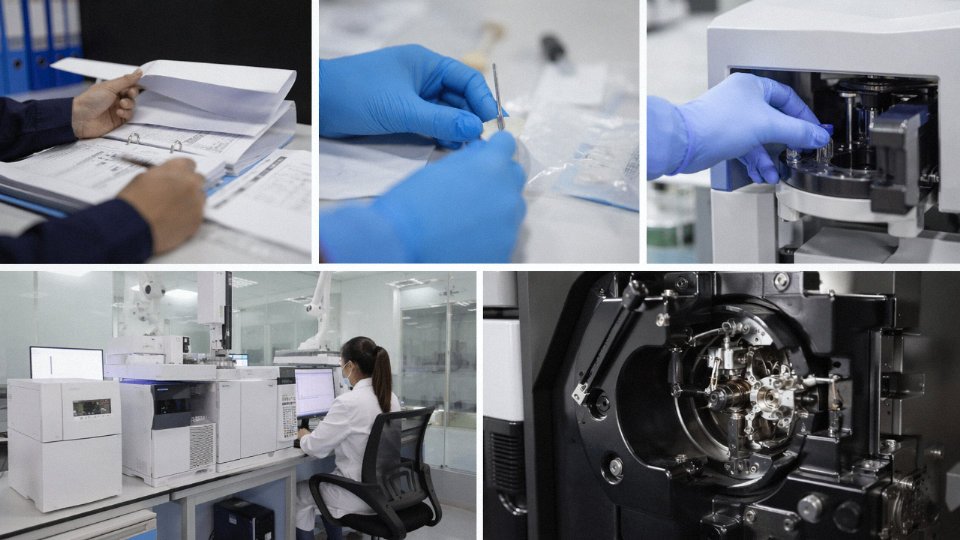
| Gas chromatography and mass spectrometry | Identification and approximate quantification of low-molecular-weight species such as D4, D5, and D6 | Extractables, volatiles, root-cause work |
| Thermogravimetric analysis | Weight loss as temperature rises | Comparing compounds, checking volatile load or filler level |
| Extractables studies | What comes out under aggressive solvents or simulated service | Medical, pharmaceutical, high-purity production |
High-consistency silicone rubber is often post-cured at roughly 150 degrees Celsius to 250 degrees Celsius for several hours to reduce volatile residues. The exact cycle depends on the compound, peroxide or platinum cure system, part thickness, and customer specification. If a supplier skips or shortens post-cure, the difference may show up as odor, fogging, or migration.
When testing is worth the money
Lab work is not cheap, and not every oven mitt needs a full extractables study. Spend the money when the downside is bigger than the invoice.
Formal testing is usually justified for repeated commercial food contact, infant products, medical or pharmaceutical use, export compliance, high-temperature industrial service, or unresolved odor complaints. I would also test when switching suppliers on a critical gasket, hose, membrane, roller covering, or food-contact conveyor component. A low-price substitute that saves a few cents per part can cost far more if it causes scrap, downtime, or a customer hold.
Regulated manufacturers should retain batch samples, certificates, drawings, purchase specifications, and supplier declarations. Keep the actual lot code tied to production records. If a complaint appears three months later, traceability turns a messy argument into a controlled investigation.
Frequently asked questions about heating silicone safely
Is silicone safer than plastic when heated?
Usually, yes, if the silicone is properly compounded, post-cured, and used within its rating. Silicone generally handles heat better than many common plastics used in kitchens and light industrial parts. A polypropylene lid may start to soften well below typical oven temperatures, while consumer silicone bakeware is commonly rated from about -40 degrees Celsius to 230 degrees Celsius, with some products rated to around 260 degrees Celsius. That rating depends on the formulation, thickness, filler package, and how the part was cured.
That does not make every silicone part automatically safe. A clean, certified food-contact silicone mat from a traceable supplier is a different animal from a bargain-bin “silicone” utensil with unknown fillers and no migration data. Procurement should treat silicone like any other engineered material: check the intended temperature, contact medium, cleaning chemicals, and certificate scope.
Silicone is always safer than plastic at high temperature.False
Silicone is often more heat-stable than many plastics, but safety depends on formulation, curing quality, certification, and actual use temperature.
Does silicone release toxins in the oven?
Rated food-grade silicone used correctly should not release harmful levels of substances during normal baking. That means staying within the supplier’s temperature limit, avoiding direct flame or broiler elements, and not using the part after it is burned or degraded.
In practice, oven problems usually come from misuse or poor quality: a mat sitting too close to a top element, a pan left dry during a high-heat cycle, or a low-grade product that was not post-cured well. Good high-consistency silicone rubber is often post-cured at roughly 150 degrees Celsius to 250 degrees Celsius for several hours to reduce volatile residues. If that step was skipped or shortened, the first few heating cycles may smell worse and show higher volatiles.
A faint warm smell on first use is not the same as visible smoke.
Can silicone go in a microwave, air fryer, dishwasher, boiling water, or pressure cooker?
It depends on the product rating and the equipment geometry. The appliance matters less than the actual surface temperature and exposure condition.
| Use condition | Usually acceptable? | Watch-outs from the field |
|---|---|---|
| Microwave | Often yes | Avoid parts with metal inserts, printed decoration of unknown chemistry, or trapped grease that can overheat locally. |
| Air fryer | Sometimes | Air fryers can create hot spots near the element. A “230 degrees Celsius” rating may not protect a thin mat touching a basket wall near radiant heat. |
| Dishwasher | Often yes | Detergent, rinse aid, and repeated drying cycles can age cheap silicone. Odor pickup from fats is common. |
| Boiling water | Often yes | Plain boiling water is mild for silicone, but oils, acids, and cleaning chemicals change the exposure. |
| Pressure cooker | Conditional | Steam temperature rises with pressure, typically around 115 degrees Celsius to 121 degrees Celsius in many kitchen units, depending on design. Check gasket and accessory ratings. |
For factory use, do not copy kitchen assumptions. Steam-in-place, caustic wash, silicone tubing near a heat jacket, or a gasket clamped under compression for months is a different duty cycle.
Is a new silicone smell dangerous?
A mild first-use odor can happen, especially with lower-cost bakeware or thick molded parts. It may come from low-molecular-weight siloxanes such as D4, D5, and D6, peroxide cure byproducts, processing aids, or absorbed packaging odors. Many suppliers recommend washing and running an empty heat cycle before food contact; I have seen that simple step solve plenty of nuisance odor complaints.
Strong chemical smell, smoke, oily residue, or an odor that keeps returning after several wash-and-heat cycles is different. Do not normalize it. In a plant, that is a quarantine-and-review item, not a “let production decide” item. For household use, replace it or ask the supplier for food-contact migration documentation.
Should scratched, sticky, discolored, or burned silicone be replaced?
Scratches alone are not always a safety failure, but they can trap grease, detergent, flour dust, biofilm, or cleaning residue. Sticky silicone is more concerning. Tackiness can mean surface degradation, plasticizer-like contamination from another material, or absorbed oils that will not wash out.
Replace silicone if you see:
- Cracking, tearing, or permanent deformation at a sealing edge
- Sticky or gummy surface after normal washing
- Burn marks, ash-like areas, or brittle spots
- Persistent rancid, chemical, or smoky odor
- Discoloration with surface roughness, not just harmless staining
In production, bad silicone parts usually fail twice: first as a quality risk, then as downtime. A swollen gasket sheds fragments, a roller marks product, a hose imparts odor, and suddenly maintenance is arguing with quality over who owns the scrap.
Are black silicone, colored silicone, or cheap silicone unsafe?
Color alone does not decide safety. Black silicone may use carbon black or other pigments. Red, blue, gray, and translucent grades may be perfectly suitable if the pigment system is approved for the intended contact and temperature. The real question is whether the finished article was tested, not whether it looks “clean.”
Cheap silicone is not automatically unsafe either, but the risk is higher because corners are often cut where buyers cannot see them: filler loading, cure control, post-curing time, pigment quality, or documentation. Ask for the actual food-contact standard, test conditions, and temperature range. A vague “FDA material” claim on a sales page is not the same as migration testing on the finished part.
Can silicone be recycled, incinerated, or disposed of safely?
Silicone recycling options are limited compared with metals or common thermoplastics. Most curbside programs will not accept it, and many molded silicone products end up in general waste unless a specialty recycler or take-back route exists. Availability depends heavily on the local waste program and whether the silicone is clean, sorted, and free from metal inserts or adhesive backing.
Incineration should be left to permitted facilities. Do not burn silicone in an open fire or shop barrel; incomplete combustion and mixed waste contamination are not worth the risk. For factories, disposal should sit in the material review from day one, especially for high-volume trim scrap, worn gaskets, release liners, and rejected molded parts. A low unit price can look less attractive when the waste stream has nowhere clean to go.
Decision guide: when heated silicone is acceptable and when to replace it
The short plant-floor answer is this: silicone does not automatically become toxic just because it gets hot. Good silicone, properly compounded and cured, used below its rated temperature, is a stable engineering material. The trouble starts when the product is poorly cured, poorly documented, contaminated, mechanically damaged, or pushed past the duty it was designed for.
That is true in a home oven, and it is just as true on a packaging line, a pharmaceutical skid, a bakery tunnel oven, or a heated transfer system.
Treat silicone like you would treat a gasket, hose, belt, tray, or electrical insulation. It has a specification. It has limits. It ages.
Heated silicone is always unsafe because it releases toxins.False
Properly manufactured silicone used within its rated temperature range is generally stable. Risk rises with low-quality materials, poor post-curing, overheating, contamination, and physical degradation.
Use it: low-risk conditions
Heated silicone is usually acceptable when all of the following are true:
| Condition | What you want to see |
|---|---|
| Grade is documented | Food-contact, medical, or application-grade certification that matches the use |
| Temperature is controlled | Normal operation stays comfortably below the product rating, not sitting at the edge |
| Surface is intact | No cracking, swelling, powdering, stickiness, cuts, or hard spots |
| Odor is absent or disappears after proper cleaning and initial heat cycle | No persistent chemical, burnt, or solvent-like smell |
| Media compatibility is known | The silicone is suitable for the food, oil, chemical, steam, detergent, or process fluid it touches |
| Use pattern is reasonable | Not abused by direct flame, dry scorching, sharp tools, aggressive solvents, or compression beyond design |
For household bakeware, that usually means a reputable silicone product rated around -40 °C to 230 °C, sometimes up to about 260 °C, used in a normal oven rather than under a broiler or on a stovetop. The exact safe range depends on the manufacturer’s formulation, filler package, cure system, wall thickness, and whether the part is reinforced.
For industrial parts, “looks like silicone” is not a specification. I want a data sheet, a drawing or purchase spec, material traceability where practical, and a service temperature range that matches the real process, including cleaning cycles. CIP caustic, steam bursts, oil exposure, and weekend heat soak can be harder on a seal than the normal production recipe.
Use caution: acceptable only with controls
This is the gray zone. Not an automatic reject, but not a blind yes either.
Be cautious with unknown brands, missing documentation, repeated high-temperature use, high-fat food contact, parts running close to their maximum rating, or silicone that has a faint odor after heating. Fats and oils can extract residues more aggressively than water-based foods, and long heat exposure can reveal poor post-curing that a quick room-temperature inspection misses.
A typical example: a bakery buys low-cost silicone mats for high-throughput cookie production. They work fine for a few weeks, then operators notice a sweet chemical odor when the line ramps up after lunch. The mat surface still looks acceptable. In practice, I would quarantine a few pieces, check oven setpoint versus actual belt temperature with a calibrated probe or thermal label, review the supplier documentation, and run a controlled heat-and-smell comparison against a known approved mat. Do not let purchasing solve that one by ordering the same part again because it is cheaper.
In a factory, the cost of caution is small compared with chasing tainted product complaints, unexplained scrap, or a seal failure during a sanitation cycle. In a kitchen, the cost is usually just replacing a questionable utensil or mat.
Do not use it: replace immediately
Remove heated silicone from service if you see smoke, burning, bubbling, deformation, cracking, chalky powder, sticky surface, or permanent hardening. A strong chemical odor is also a stop sign, especially if it persists after washing and one or two controlled heat cycles.
Direct flame exposure is another hard no. Silicone can tolerate heat, but it is not a flame shield for cookware unless the specific product was designed and rated for that duty. A spatula touching a hot pan briefly is one thing. A silicone mold sitting on a gas burner grate is abuse.
For industrial users, also reject silicone that has no rating for the intended service. No temperature rating, no media compatibility, no food-contact or process-contact statement where required, no batch identity for a critical application: that is not a bargain, it is an uncontrolled material substitution. I have seen small seal substitutions cause sticking valves, product discoloration, vacuum leaks, and one miserable weekend of cleaning baked-on residue from heated tooling. The part was cheap. The downtime was not.
Practical replacement checklist
Before heating silicone, run through this quick check:
- Verify the grade. Food-contact for food, medical-grade for validated medical use, and proper industrial-grade for process equipment.
- Verify the temperature rating. Use the actual contact temperature, not just the oven, air, jacket, or controller setpoint.
- Clean before use. Wash off mold release, dust, packaging residue, and shop contamination.
- Avoid overheating. No broiler, flame, dry scorching, or uncontrolled heat soak unless the product is rated for it.
- Monitor condition. Look, smell, and feel. Operators notice changes before spreadsheets do.
- Replace questionable products. If the odor, surface, shape, or documentation makes you uneasy, retire it.
Good silicone earns its place by specification and condition, not by the word “silicone” on the label. That mindset keeps exposure low at home and prevents avoidable scrap, downtime, and quality arguments in production.