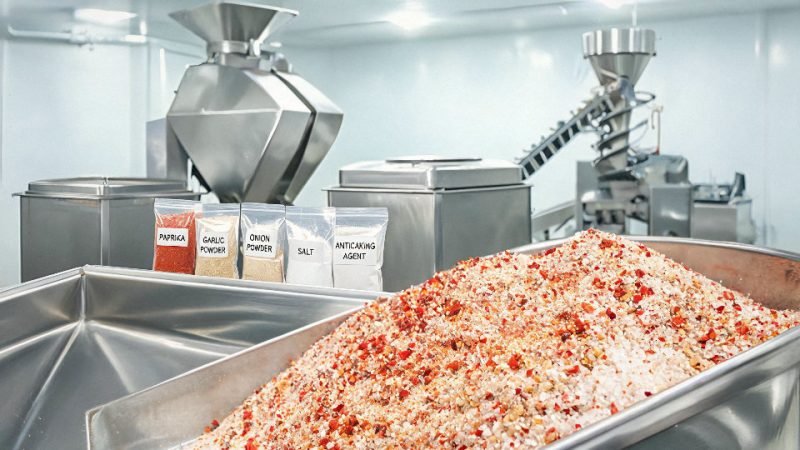
A seasoning blend that cakes in the tote, hangs up in a V-blender discharge, or feeds unevenly through an auger filler is not just a quality nuisance. It turns into short pouches, overweight giveaways, rework screens, operator “bin thumping,” and customer complaints after a humid week in storage. The money leaks out through downtime, scrap, freight claims, and extra labor. Used correctly, food-grade amorphous silicon dioxide is one of the practical tools that keeps dry seasoning flowing without turning the formulation into a chemistry experiment.
Silicon dioxide is generally considered safe in seasonings when it is approved for the food, sourced as food-grade amorphous material, and used within allowed limits, commonly up to about 2% by weight. In dry seasoning plants, typical use is roughly 0.5% to 2.0%, depending on humidity, particle size, and flow needs.
The real question is not only “is it safe?” but “which grade, at what level, under which plant conditions?” A barbecue rub packed in a coastal summer behaves differently from a dry soup base packed in an air-conditioned room. Particle form matters too: food-grade amorphous silicon dioxide in seasonings is typically micron-scale agglomerates, not intentionally engineered nanoparticles. That distinction is where a lot of confusion starts.
What silicon dioxide is in seasoning labels and what it is not
Silicon dioxide is the chemical compound SiO2: one silicon atom bonded with two oxygen atoms. That same formula shows up all over the natural world. Quartz, sand, many clays, diatomaceous earth, rice hull ash, and some plant-derived foods contain forms of SiO2. The formula alone, though, does not tell you the physical form, purity, particle structure, or risk profile.
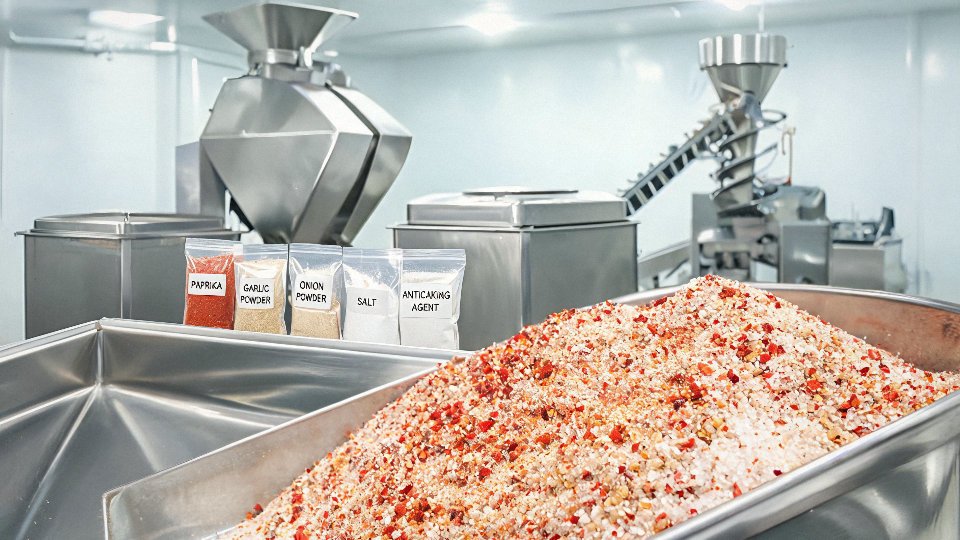
That distinction matters. A purchasing spec that says “silicon dioxide” for a taco seasoning blend is not asking for sand, crushed glass, or quarry dust. In food seasoning work, the ingredient is normally food-grade amorphous silicon dioxide used as an anticaking and flow aid. It is selected because powdered blends are miserable without help: salt pulls moisture, onion powder bridges in hoppers, paprika can smear and pack, and fine spice blends will sometimes rat-hole over an auger until an operator hits the bin with a rubber mallet. Nobody enjoys that shift.
The food additive form is usually synthetic amorphous [silica](https://siliconchemicals.com/silica/)
Most silicon dioxide used in dry seasoning blends is synthetic amorphous silica, made under controlled food additive specifications. “Synthetic” here does not mean suspicious; it means the supplier controls purity, surface area, moisture, bulk density, and particle behavior instead of relying on variable mined material.
In practical terms, food-grade amorphous silica is a fine, fluffy powder made of micron-scale agglomerates. It is not typically an intentionally engineered nanoparticle product in ordinary dry seasoning use. The primary structures may be very small, but what processors handle and blend are usually agglomerated particles that behave as a powder ingredient. The actual particle-size profile depends on the grade, manufacturing route, handling history, and how aggressively it is dispersed during testing.
A common use level in powdered seasonings is roughly 0.5% to 2.0% by weight. The low end may work in a dry, free-flowing salt-and-spice blend packed in a moisture-barrier pouch. The high end is more common when humidity is ugly, the blend contains hygroscopic powders, or the filling equipment needs consistent flow through small hoppers and volumetric cups. Many food additive rules set a ceiling around 2% by weight where silicon dioxide is permitted as an anticaking agent, but the legal limit depends on the country, food category, and exact regulation being applied.
Amorphous silicon dioxide is not crystalline silica dust
The word “silica” causes confusion because industrial hygiene people use it in a different, very serious context. Crystalline silica, especially respirable quartz dust generated from cutting, grinding, mining, or blasting stone and concrete, is an occupational inhalation hazard. Long-term inhalation can cause severe lung disease. Anyone who has worked around baghouses, pneumatic conveying, or dry mineral unloading knows dust exposure is not a theoretical issue.
Food-grade amorphous silicon dioxide in seasonings is evaluated for oral consumption, not for breathing as a workplace aerosol. Those are different exposure routes. Eating a permitted anticaking agent in a seasoning blend is not the same as inhaling respirable crystalline silica on a construction site or in a poorly controlled mineral plant.
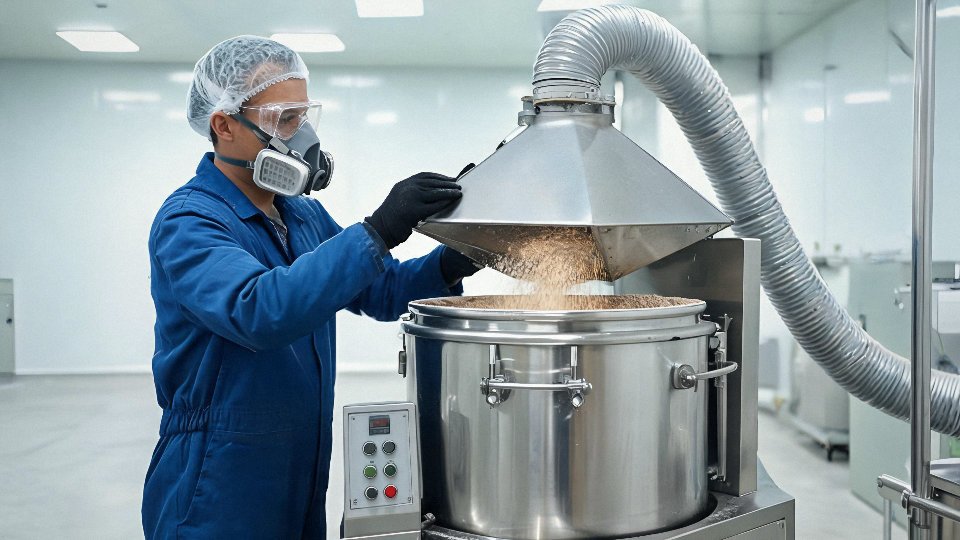
That said, a dry powder room should still control nuisance dust. Operators should not be breathing clouds of any fine powder, whether it is garlic powder, starch, or amorphous silica. Use decent local exhaust, keep scooping practices sane, close bags after use, and do not let a mixer charging station turn into a fog machine. Food safety approval does not cancel basic industrial hygiene.
Silicon dioxide on a seasoning label means the product contains sand or glass.False
Food additive silicon dioxide used in seasonings is typically purified amorphous silica made to food specifications. Sand, glass, and quartz may share the SiO2 formula, but they differ in structure, purity, particle form, and intended use.
“Silicon” does not mean silicone, silicon metal, or random industrial dust
Label language does not help much. Consumers see “silicon” and may think of silicone bakeware, sealants, computer chips, or metallic silicon used in manufacturing. Those are different materials.
Silicon dioxide is an oxide compound. Silicone is a family of polymers containing silicon, oxygen, carbon, and other groups, used in gaskets, tubing, release coatings, lubricants, and sealants. Silicon metal is an elemental material used in metallurgy and electronics. Industrial silica dust can refer to mined or processed mineral dust, including crystalline forms that raise inhalation concerns.
A seasoning label is not using those meanings. In the ingredient statement, you may see names such as “silicon dioxide,” “silica,” “amorphous silica,” “synthetic amorphous silica,” or simply “anticaking agent,” depending on the jurisdiction and label format. Procurement teams should still avoid vague specifications. A sensible purchase line says food-grade silicon dioxide or food-grade synthetic amorphous silica, references the applicable food additive standard, and asks for a current specification sheet, allergen statement if needed, heavy metals limits, and certificate of analysis. Cheap mystery powder is not a savings plan; it is a recall conversation waiting to happen.
It is added for powder handling, not nutrition or flavor
Silicon dioxide is not there to enrich the diet. It is not a preservative in the way sorbate or benzoate is. It does not make seasoning taste brighter, look redder, or kill microbes.
Its job is physical. Tiny amounts coat or separate particles, reduce caking, improve flow, and help a blend dose more consistently. In a plant, that can mean fewer plugged filler nozzles, less weight variation, fewer rejected pouches, and less rework from lumpy material. In a home kitchen, it may mean the seasoning shakes out instead of forming a brick after a humid summer.
Use too little and the blend may bridge in the hopper or clump in distribution. Use too much and you can create dustier handling, dull mouthfeel in some fine blends, or a label and compliance problem. The right level sits inside the legal limit and matches the product’s moisture pickup, particle size mix, packaging, shelf life, and filling equipment. That is the real identity of silicon dioxide in seasonings: a tightly specified powder-handling aid, not sand, not glass, not silicone, and not the same hazard profile as crystalline silica dust.
Why seasoning makers add silicon dioxide to dry blends
Seasoning looks simple in a kitchen jar. In a factory, it behaves like a moody bulk solid.
A dry blend may contain salt, sugar, yeast extract, hydrolyzed vegetable protein, cheese powder, onion powder, garlic powder, chili powder, starch carriers, maltodextrin, spray-dried flavors, and color-bearing spices. Several of those ingredients are hygroscopic, meaning they pull moisture from the air. Salt is the obvious one, but yeast extract and hydrolyzed proteins can be worse in practice because they get tacky at the surface. Cheese powders often carry fat and dairy solids that smear slightly under pressure. Onion and garlic powders can bridge in a hopper after one humid night. Chili powders vary a lot by grind, oil content, and fiber load.
That is why anticaking agents exist. Not to “hide” bad ingredients. To keep powder acting like powder.
What silicon dioxide does in the blend
Food-grade silicon dioxide used in seasonings is usually added at roughly 0.5% to 2.0% by weight, depending on humidity, seasoning composition, particle size, and how demanding the filling line is. Many food additive rules allow silicon dioxide up to 2% by weight where permitted, though the exact legal position depends on the country, food category, and label standard.
Its job is physical. Silicon dioxide has a high surface area, so a small amount can bind or hold trace surface moisture before that moisture turns particles sticky. It also sits between fine particles and reduces direct contact. Less contact means less interparticle adhesion, less clumping, and better flow through equipment.
Think of a high-salt barbecue seasoning with garlic, onion, sugar, paprika, and hydrolyzed protein. Without an anticaking agent, it may pass the first trial after blending, then cake after sitting in a tote for two shifts near a washdown area. The blend is still “dry” by ordinary language, but the surface moisture is enough to cause rat-holing in the hopper or clumps in a jar. Operators know this pattern: the first few cases run fine, then the filler starts hunting.
Silicon dioxide in powdered seasonings is mainly used to control moisture-related clumping and improve powder flow, not to change flavor.True
At typical use levels around 0.5% to 2.0% by weight, its function is physical anticaking and flow improvement. Formulators still need to verify flavor impact because overuse can make a blend dusty or slightly chalky.
Flow problems become production problems fast
Poor powder flow does not stay inside the blender. It shows up everywhere downstream.
In a hopper, sticky seasoning can bridge across the outlet, leaving an empty cavity underneath while material sits above it. In an auger filler, inconsistent bulk density causes light and heavy fills. Sachet machines hate lumps; a pea-sized clump can drag a seal, foul a jaw, or leave a weak corner seal that leaks in distribution. Spice jar filling has its own headache: a blend that flows poorly may mound at the neck, then collapse after capping, making the jar look underfilled even when the weight is correct.
Checkweighers catch some of this, but not for free. Rejects increase. Operators tap hoppers with rubber mallets. Someone slows the line from, say, 80 to 50 bottles per minute just to keep weights inside tolerance. Rework piles up, and now the plant has open seasoning exposed to the same humidity that caused the problem in the first place.
A small amount of silicon dioxide often costs less than the labor, giveaway, rejects, and sanitation time created by a sticky blend. That is the procurement reality. The cheapest formula on paper may be the expensive one on Friday afternoon.
Consumer use matters too
Free-flowing seasoning is not only a factory convenience. A consumer expects a shaker to shake, not produce one hard plug followed by a salty avalanche. Clumps also cause uneven distribution. One bite gets too much salt and garlic; another gets almost none. For soup bases, snack seasonings, rubs, and instant noodle seasoning packets, that unevenness can be the difference between “normal product” and a complaint.
Moist climates make this more visible. A seasoning jar opened daily in a coastal kitchen, a food truck, or a restaurant prep area can pick up moisture quickly. Once caking starts, people poke the jar with a knife or store it near a hot line, which usually makes things worse.
Why not just use a cheaper anticaking option?
Some alternatives work in certain blends: starches, tricalcium phosphate, calcium silicate, magnesium carbonate, or coarser carrier particles. The right choice depends on label rules, flavor impact, allergen or dietary positioning, cost, and moisture load. Lower-cost carriers can help bulk handling, but they may not control tackiness well in high-salt, high-protein, or high-humidity applications. Starch can also bring its own moisture behavior. Calcium-based agents may affect appearance or mouthfeel in delicate blends.
| Blend condition | What usually happens without enough anticaking control | Practical risk |
|---|---|---|
| High salt plus garlic or onion powder | Surface stickiness and hopper bridging | Line stops, operator intervention |
| Cheese or savory protein powders | Smearing, dense clumps under storage pressure | Poor dosing, rework |
| Fine chili or spice blends | Dust plus uneven flow, depending on oil and grind | Weight variation, dirty filler area |
| Tropical or rainy-season packing | Moisture pickup during staging and filling | Caking before shipment |
The dose still needs discipline
More silicon dioxide is not automatically better. Overuse can make a seasoning dusty, dull the flavor release slightly, create a dry or chalky mouthfeel, and add unnecessary additive load. It can also make housekeeping worse around fillers; fine airborne dust finds photoeyes, load cells, and cabinet filters faster than people expect.
A competent manufacturer should run the lowest effective level, not simply default to the maximum allowed. In practice that means checking flow after storage, not just right after blending. Test the blend after a few days in realistic humidity, through the actual hopper and filler, with the real jar or sachet speed. Lab scoops lie sometimes. Production equipment tells the truth.
How food-grade silicon dioxide is regulated in seasonings
Food regulators do not approve silicon dioxide for seasonings because it “sounds natural” or because the industry finds it convenient. The usual approval logic is more structured than that. Authorities look at the additive’s identity, purity, manufacturing route, toxicology data, estimated dietary exposure, and intended technical function. In plain plant language: what exactly is the powder, how clean is it, how much can people realistically eat, and does it actually do the job claimed on the label?
For seasonings, the job is normally anticaking. That matters because additives are not supposed to be used as silent fillers. If a dry barbecue rub, soup base, spice blend, or snack seasoning needs a flow aid to keep it from bridging in a hopper or setting up like a brick in a pouch, silicon dioxide may be allowed. If someone is using it to cheapen a blend or hide poor drying control, that is a different conversation.
Permitted use is usually tied to function and level
Many food additive systems permit silicon dioxide as an anticaking agent either under good manufacturing practice or at a specified maximum level. A common ceiling in relevant dry foods is up to about 2% by weight where the additive is permitted, though the exact rule depends on the country, food category, and wording of the regulation.
In real seasoning production, normal use is often lower, roughly 0.5% to 2.0% by weight. The low end may work in a dry, coarse garlic-and-herb blend packed quickly into moisture-barrier film. The high end may be needed for fine powders with salt, sugar, hydrolyzed vegetable protein, cheese powder, or hygroscopic flavors running through a humid packing room in August. Particle size distribution, mixer shear, packaging dwell time, and warehouse humidity all change the answer. Anyone who gives one magic percentage without seeing the product is guessing.
If silicon dioxide is listed on a seasoning label, it is automatically safe at any level.False
Approval depends on the food category, the food-grade specification, purity limits, intended anticaking function, and the permitted use level or good manufacturing practice requirement in the market where the product is sold.
Local rules still have to be checked
There is no single global seasoning rule that covers every market cleanly. A formula legal in one country can need adjustment in another because additive lists, food category names, maximum use levels, and label declaration rules do not line up perfectly.
For export work, procurement and regulatory teams should verify four items before the first commercial batch:
| Checkpoint | What to verify | Plant-floor consequence if missed |
|---|---|---|
| Additive permission | Silicon dioxide or its local additive number is allowed in that seasoning category | Finished goods can be blocked or relabeled |
| Maximum level | The formula stays below the permitted limit, often around 2% where a numeric cap applies | Rework, scrap, or detained inventory |
| Label wording | The ingredient name and function match local requirements | Label nonconformance, even if the formula is safe |
| Supplier grade | Material is certified for food additive use | Serious compliance failure, not just a paperwork issue |
I have seen teams treat this as a “same as last project” task. That is how trouble starts. A seasoning for retail meat rubs, a compound seasoning for instant noodles, and a dusting powder for fried snacks may sit in different regulatory buckets depending on the jurisdiction.
Food-grade specifications are not optional paperwork
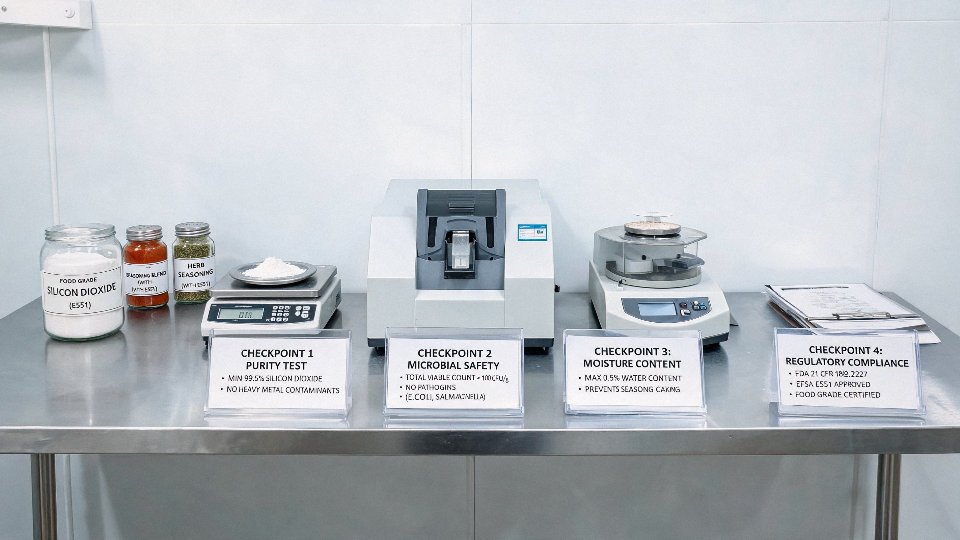
Food-grade silicon dioxide should meet recognized purity specifications. Those specifications usually cover identity, assay-related characteristics, loss on drying, soluble ion impurities, heavy metals, and limits for contaminants such as lead, arsenic, mercury, or cadmium, depending on the standard used. The numbers vary by specification and market, so buyers should not rely on a supplier’s brochure line that says “high purity silica.”
Loss on drying deserves more respect than it gets. A high or drifting value can signal moisture pickup, poor storage, or inconsistent handling. In a seasoning plant, that may show up as blend variability, dustier discharge, poor flow through a checkweigher feed pan, or caking in the corner of a tote. Soluble salts and pH-related properties can also matter, especially in seasoning systems with acidulants, dairy powders, or sensitive flavors.
Procurement should qualify the grade, not just the price
A legally compliant seasoning should use food-grade silicon dioxide only. Not industrial silica. Not construction-grade fillers. Not a cosmetic-grade material unless the supplier can document that the exact grade also meets food additive requirements for the target market. “Looks the same” is not a control plan.
For industrial buyers, the basic document pack should include:
- Current product specification with food-grade designation
- Certificate of analysis for each lot, not only an annual typical sheet
- Food additive compliance statement naming the applicable regulation or standard
- Heavy metal and contaminant testing data, with test method references
- Allergen statement and cross-contact information
- GMO, vegan, halal, kosher, or other market-specific declarations if required by the customer
- Safety data sheet, mainly for handling and dust control in the plant
- Change notification commitment, especially for source, process, or specification changes
One practical warning: do not approve a new silicon dioxide source only through the purchasing system. Run it in the actual blend. Some grades behave differently in a ribbon blender versus a paddle mixer, and fine powders can change dust loading at the bag dump station. The legal review keeps the product sellable. The plant trial keeps it runnable. Both matter.
What toxicology evidence says about eating small amounts of amorphous silicon dioxide
Toxicology starts with a distinction that gets lost in internet arguments: hazard is not the same as risk. A material can be hazardous under one route, at one dose, or in one physical form, while presenting low risk under normal food-use conditions. That is not wordplay. It is how plant chemicals, cleaning agents, processing aids, allergens, and even salt are judged in real factories.
For seasonings, the relevant question is not “Can silica dust be harmful somewhere?” The better question is: “What happens when a consumer eats a small amount of food-grade amorphous silicon dioxide dispersed in a dry seasoning at permitted use levels?”
That answer is much less dramatic.
Oral exposure is not the same as lung exposure
Food-grade amorphous silicon dioxide used in dry blends has low oral bioavailability. In plain terms, most of it is not absorbed into the body in meaningful amounts. It moves through the gastrointestinal tract and is eliminated, with limited uptake compared with nutrients, soluble salts, or many small organic compounds.
That matters because the scary silica stories usually come from inhalation, not eating. Fine airborne dust can reach the respiratory tract. In occupational settings, repeated inhalation exposure to certain silica-containing dusts is controlled for good reason. A bag-dump station with poor extraction, a torn dust sock, or an operator shaking out empty bags into open air can create a visible cloud. That is a plant-floor exposure problem.
It is not the same as eating a few grams of taco seasoning on dinner.
In a seasoning plant, I would still expect local exhaust ventilation, dust-tight transfer points where practical, housekeeping that uses vacuum systems rather than compressed-air blowdown, and respiratory protection when the job hazard analysis calls for it. Those controls protect workers from airborne nuisance dust and process dust exposure. They do not mean the ingredient becomes unsafe as eaten in finished food.
Food-grade amorphous silicon dioxide in seasonings should be evaluated mainly by ingestion exposure, not by occupational dust inhalation scenarios.True
The consumer exposure route is oral intake from a finished food. Workplace inhalation of dry powder can require controls, but it is a different route, dose pattern, and risk question.
Dose context: the actual intake is small
Typical use in powdered seasonings is roughly 0.5% to 2.0% by weight, depending on humidity, salt crystal size, spice oil content, packaging, and how free-flowing the blend must be for filling equipment. Many food additive rules cap use around 2% where silicon dioxide is permitted as an anticaking agent, though the exact allowance depends on jurisdiction and food category.
A normal serving of seasoning is usually only a few grams. If a 3 g seasoning portion contains silicon dioxide at 0.5% to 2.0%, the amount consumed is about 15 mg to 60 mg. That range shifts with the recipe and serving size. A soup base packet, snack coating, or high-salt rub may not behave like a tabletop sprinkle blend.
From a factory perspective, the difference between 0.7% and 1.8% can be very real. Too little anticaking agent and the blend bridges in the hopper, clumps in the auger, or gives inconsistent fill weights after a humid weekend. Too much and you may be outside the approved formulation, paying for unnecessary additive, or changing mouthfeel. Good formulation work lands at the lowest level that keeps the product running and stable.
What the safety assessments generally show
Safety reviews of food-grade amorphous silicon dioxide have not identified a safety concern for normal dietary use within permitted limits. That conclusion rests on several connected points: low absorption after ingestion, lack of concerning systemic exposure at normal food levels, and the long history of controlled use in dry foods.
This does not mean “anything called silica is fine.” The evaluated material is high-purity, food-grade amorphous silicon dioxide with controlled specifications. Impurities matter. Physical form matters. Particle size distribution matters. Food-grade products used in seasonings are typically micron-scale agglomerates, not intentionally engineered nanoparticles designed for novel behavior.
Material quality is part of the safety case
Procurement should not treat silicon dioxide like a generic white powder bought only on price. A proper supplier file should include food-grade status, specification limits, allergen and contamination statements where relevant, heavy metal limits, particle size information, and change-control expectations. I have seen plants get into trouble not because the ingredient was inherently exotic, but because a purchasing substitution happened faster than technical review.
A compact way to think about it:
| Question | Good control | Weak control |
|---|---|---|
| Is it food-grade amorphous silicon dioxide? | Supplier documentation matches the approved specification | Vague “silica” description with no food additive basis |
| Is the use level justified? | Formulation trial supports flow at the lowest workable dose | Habitual 2% addition because “that is what we always used” |
| Are workers protected from dust? | Enclosed handling, extraction, sensible housekeeping | Open dumping, air blowdown, visible dust clouds |
| Are particle characteristics tracked? | Specification includes relevant physical data and change notification | Supplier can change grade without technical approval |
One caveat belongs here. Analytical methods and guidance around nano-scale fractions in food additives have continued to evolve. Manufacturers should monitor current regulatory and scientific guidance, especially if supplier processes change or if the material is marketed with unusual particle-size claims. That is not a reason to panic over ordinary seasoning use. It is a reason to keep specifications current and avoid lazy substitutions.
When silicon dioxide in seasonings may deserve extra attention
For most healthy adults, the silicon dioxide in a normal sprinkle of taco seasoning, barbecue rub, soup base, or instant noodle seasoning is not the ingredient I would lose sleep over. In typical dry blends, it is used at low levels, often somewhere around 0.5% to 2.0% by weight depending on humidity, powder fineness, packaging, and how freely the blend needs to run through fillers or sachet machines.
That said, “safe for the general population” is not the same as “irrelevant for every person in every use case.” A plant manager thinks in exceptions: the wet corner of the warehouse, the operator who opens bags all shift, the customer on a renal diet, the toddler eating adult snack seasoning by the spoonful. Those edge cases deserve a calmer, more practical look.
Medically restricted diets need label discipline
Silicon dioxide itself does not add meaningful sodium, sugar, calories, fat, or common allergenic proteins. It is not a hidden source of gluten, milk, soy, egg, peanut, or tree nut protein.
The seasoning blend around it is another story.
People on medically restricted diets should read the full ingredient statement, not just scan for silicon dioxide. Low-sodium diets can be affected by salt, monosodium glutamate, disodium inosinate, disodium guanylate, yeast extract, hydrolyzed proteins, or sodium-containing carriers. Diabetic meal plans may care about dextrose, maltodextrin, sugar, or starch carriers. Gluten-sensitive users need to watch for wheat-based carriers, soy sauce powder, malt vinegar powder, and shared-line statements where applicable.
In practice, the anticaking agent is often one of the least nutritionally active ingredients in the bag. The “small print” carriers and flavor bases are usually where diet restrictions get tripped.
Gastrointestinal sensitivity is usually about the blend, not the silica
Silicon dioxide is not considered a common food allergen, and it is chemically inert under normal digestive conditions. Still, people sometimes blame the last unfamiliar word on a label when their stomach reacts.
Highly seasoned foods can be rough on sensitive users for several reasons:
- Chili powders and capsaicin can aggravate reflux or irritable bowel symptoms.
- Garlic and onion powders are high-FODMAP ingredients for some people.
- Gluten-containing carriers can matter for celiac disease or gluten sensitivity.
- Flavor enhancers, yeast extracts, and protein hydrolysates bother a small number of consumers.
- Acidulants, smoke flavors, and high salt levels can make symptoms worse in a heavy dose.
A useful troubleshooting method is to compare two products with similar silicon dioxide labeling but different spice bases. If one causes symptoms and the other does not, the issue is probably not the anticaking agent. It may be the chili load, garlic level, carrier system, or serving size.
Silicon dioxide in seasonings is a common allergen like milk, soy, or wheat.False
Food-grade amorphous silicon dioxide does not contain the allergenic proteins associated with major food allergens. Reactions blamed on seasoning blends are more often linked to spices, carriers, gluten-containing ingredients, or high salt and flavor enhancer levels.
Infants, toddlers, and supervised diets are a separate category
Adult seasoning blends are not designed as infant foods. That matters even when every additive in the blend is legally permitted.
Infants and toddlers have smaller body weights, immature eating patterns, and less need for salty, spicy, concentrated flavor systems. A pinch used in family cooking is different from giving a child heavily seasoned chips, instant noodles, or snack dust as a frequent food. The bigger concerns are usually sodium, chili heat, choking texture, and overall diet quality, not the small amount of silicon dioxide.
For people on medically supervised diets, such as renal diets, tube-feeding support, severe allergy management, inflammatory bowel disease flare plans, or post-surgical diets, the same rule applies: use foods and seasonings cleared by the clinician or dietitian. Do not assume a “natural spice blend” is automatically simpler or safer than a labeled commercial one. I have seen natural blends with undeclared carriers cause more trouble than a conventional product with a clean specification sheet.
Supplement overlap can add up, but seasonings are usually a minor source
Some consumers take several powdered supplements each day: protein blends, greens powders, electrolyte mixes, collagen, fiber powders, pre-workouts, and capsules filled with powdered actives. Many of those products may also use silicon dioxide as a flow aid or anticaking agent.
Seasoning exposure alone is typically small because the serving size is small. A few grams of seasoning containing roughly 0.5% to 2.0% silicon dioxide contributes only a modest amount. The picture changes if someone is taking many powders daily, especially products used by the scoop rather than the pinch.
That does not automatically mean danger. It does mean the person should look at total product use, serving sizes, and whether the products are from reputable suppliers with food or supplement-grade documentation. If a clinician has advised minimizing excipients, bring the actual labels, not a handwritten list.
Workers face a different risk than consumers
Eating a small amount of food-grade amorphous silicon dioxide in a seasoning is not the same exposure as breathing dust in a blending room.
Operators dumping bags, charging ribbon blenders, cleaning dust collectors, or reworking dusty premixes can inhale airborne powder. That dust may include silicon dioxide, salt, chili, garlic, onion, starch, smoke flavor, and other irritants. Anyone who has stood near a spice blender during a poor bag dump knows the cough cloud is real.
Plants should follow the safety data sheets, local occupational exposure requirements, and their own industrial hygiene program. Practical controls usually include:
- Local exhaust at bag dump stations and blender charging points
- Closed transfer where feasible
- Dust collection that is actually maintained, not just installed for the audit
- Fit-tested respiratory protection where required
- Eye protection and gloves for irritating spice systems
- Housekeeping methods that do not blow dust into the air with compressed air
The consumer safety question is ingestion. The worker safety question includes inhalation, repeated exposure, and dust concentration. Different route, different risk profile.
Red flags when buying seasonings or ingredients
Procurement people should be more suspicious of the supply chain than of a normal food-grade anticaking agent. The paperwork matters.
| Red flag | Why it matters | Better action |
|---|---|---|
| Unlabeled bulk powder in plain bags | No traceability, no additive status, no allergen control | Reject or quarantine until documents are verified |
| Missing manufacturer or lot information | Recall and complaint handling become impossible | Require lot coding and supplier identification |
| Very cheap “silica” offered without food-grade documentation | Could be industrial material, wrong particle profile, or contaminated | Ask for food-grade specification, certificate of analysis, and regulatory statement |
| No allergen or carrier declaration for a seasoning blend | Hidden wheat, soy, dairy, or sulfites may be present | Require full formulation disclosure under NDA if needed |
| Supplier cannot explain intended food use | Sales channel may not understand food additive rules | Use qualified food ingredient distributors |
A good supplier can provide a specification sheet, allergen statement, certificate of analysis, and confirmation that the silicon dioxide is food-grade amorphous material intended for dry food use. If the answer is vague, walk away. Cheap powder gets expensive fast when it causes a hold, a recall review, or a customer complaint that no one can trace.
How to read a seasoning label and judge whether silicon dioxide use is reasonable
On most seasoning labels, silicon dioxide shows up near the end of the ingredient list. That is usually expected. Anticaking agents are normally used at low inclusion rates, often around 0.5% to 2.0% by weight in dry seasoning blends, depending on humidity exposure, salt crystal size, spice oil content, powder fineness, and how freely the blend must run through fillers, sachet machines, or shaker caps.
A retail jar used at home does not need the same flow behavior as a high-speed pouch line filling 80 to 150 small sachets per minute. That difference matters. In a plant, one sticky garlic-salt blend can bridge in a hopper, starve an auger, throw off fill weights, and create a rework pile before anyone on the floor realizes the root cause is moisture pickup from a tote left open after lunch.
Seeing silicon dioxide on the label does not automatically mean the seasoning is cheap, unsafe, or badly made. Sometimes it means the manufacturer has controlled powder flow instead of letting the product cake in the jar or jam during packing.
Start with the whole formula, not one ingredient
A sensible label check looks at the full product, not just the anticaking agent. For a consumer, the bigger dietary question may be sodium. Some blends deliver several hundred milligrams of sodium per small serving, and serving sizes can be unrealistically small compared with how people actually season food. Added sugars, maltodextrin, artificial colors, hydrolyzed protein, yeast extract, smoke flavor, dairy powders, sesame, mustard, celery, wheat, soy, and shellfish-derived flavor bases may matter more for a particular household than silicon dioxide at a low percentage.
For procurement teams, the formula tells a different story. A long ingredient deck with hygroscopic components such as onion powder, brown sugar, tomato powder, cheese powder, or fine chili powder will behave differently from a coarse salt-and-herb blend. If the supplier claims “no anticaking agent” but the product contains fine powders and ships through a humid lane in summer, ask what is doing the moisture control. There is usually something: another mineral flow aid, starch, rice flour, a carrier system, desiccant packaging, foil laminate, nitrogen flushing, tighter warehouse controls, or simply a shorter shelf life.
Silicon dioxide listed near the end of a seasoning label usually indicates low-level anticaking use, not that the product is mostly silica.True
Ingredient lists are generally ordered by weight, and food-grade silicon dioxide is commonly used at low percentages for powder flow and caking control.
Clean-label does not mean no anticaking strategy
Many “clean-label” seasonings avoid silicon dioxide because the brand position demands a shorter or more familiar ingredient list. That is a marketing and formulation choice, not automatically a safety upgrade. Alternatives can include calcium silicate, tricalcium phosphate, potato starch, corn starch, rice flour, or coarser salt and spice granulation. Some work well. Some dull flavor release or change the look of the blend. Starches may add a slightly dusty mouthfeel in dry rubs. Rice flour can be useful, but it is still a functional ingredient added to manage moisture and flow.
Packaging can also carry the load. A good induction seal, low-moisture jar, foil pouch, tight cap liner, and decent case storage may reduce the need for anticaking agents. In practice, I trust that strategy more when the pack size is small and the turnover is quick. A 500 g club-size shaker sitting beside a steamy stove for six months is a different animal.
Practical reading guide
| What you see on the label or specification | Reasonable interpretation | What to check next |
|---|---|---|
| Silicon dioxide near the end of the ingredient list | Likely low-level flow aid | Confirm level if buying industrially |
| No silicon dioxide, but starch or rice flour present | Alternative anticaking or carrier system | Check taste, allergen status, and moisture behavior |
| Very fine powder blend with no flow aid listed | Possible clumping risk unless packaging is strong | Ask about shelf-life testing and humidity controls |
| Silicon dioxide used near a permitted ceiling | May still be lawful, but should be justified | Request technical rationale and compliance documents |
| Label hides behind vague terms | Weak transparency | Ask for full additive declaration and country-specific status |
If you prefer additive-minimized seasonings
Choose smaller jars, not oversized containers. Buy blends with coarser particles where they fit the cooking use: cracked pepper blends, coarse herb salts, steak rubs, and flake-style chili mixes tend to tolerate moisture better than very fine powders. Keep the lid shut, avoid shaking directly over steam, and do not store the jar above a kettle or fryer. That sounds basic, but I have seen more seasoning ruined by steam and wet spoons than by any formulation mistake.
Accept the trade-off. A blend without silicon dioxide may clump, especially in humid kitchens or coastal regions. Clumping is not automatically spoilage, but hard caking can make dosing uneven. For a consumer, that means one spoonful tastes flat and the next is too salty. For a foodservice kitchen, it can mean inconsistent batch flavor.
What industrial buyers should ask before approving a supplier
Procurement should not stop at “contains silicon dioxide” or “does not contain silicon dioxide.” Ask for the declared additive level or a practical use range. Confirm that the grade is food-grade amorphous silicon dioxide, suitable for dry blend use, with typical micron-scale agglomerates rather than a material sold for industrial silica applications. Check the permitted food category in the country of sale, not just the country of manufacture. Export programs need cleaner paperwork than domestic spot buys: specification sheet, allergen statement, certificate of analysis, food additive compliance statement, and sometimes a declaration covering nanoparticle status or non-nano intent.
Reasonable use has four legs: minimum effective quantity, correct food-grade material, accurate labeling, and a formulation that is not using silicon dioxide to cover up poor moisture control, stale raw spices, leaky packaging, or sloppy warehouse practice. If the blend cakes because bags are stored open near a washdown area, adding more flow aid is not engineering. It is hiding a process problem, and it usually comes back as complaints, scrap, or line stoppages.
Manufacturing controls that keep silicon dioxide use safe and effective
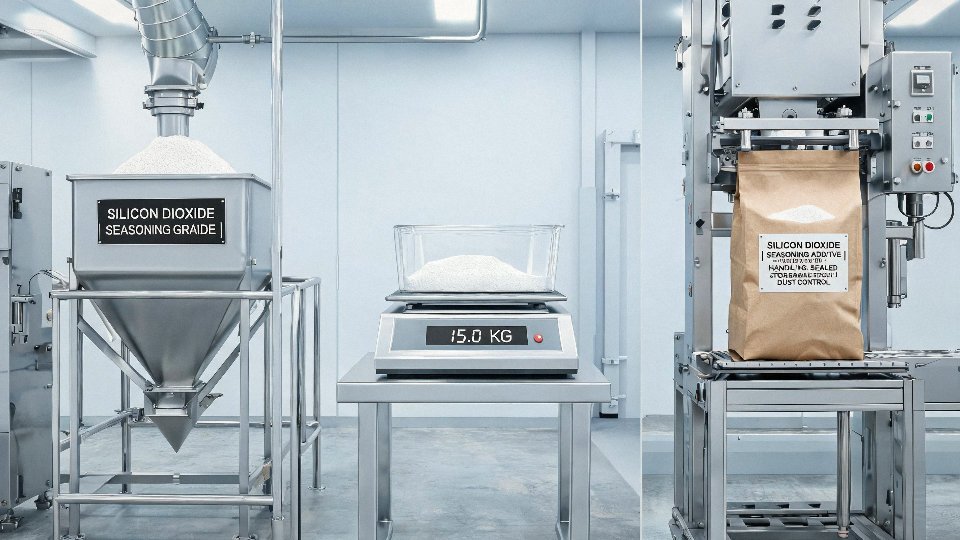
Food-grade silicon dioxide is not a “dump it in and hope” ingredient. In a decent seasoning plant, it is treated like any other controlled food additive: qualified before purchase, checked at receiving, weighed under control, and verified through finished-product testing. The safety question is not only toxicology. It is also whether the factory can prove the right material went into the right batch at the right level.
Start with incoming material control
Procurement should buy silicon dioxide only from approved suppliers with a current food-grade specification, allergen and contaminant statements where applicable, and a certificate of analysis for each lot. The certificate should be reviewed against the plant’s purchasing spec, not just filed because the truck is waiting.
A practical receiving check usually covers:
| Control point | What good practice looks like | What can go wrong |
|---|---|---|
| Food-grade status | Specification clearly states permitted food use | Industrial or technical grade material enters food inventory |
| Lot traceability | Supplier lot, internal lot, receipt date, and usage batches linked | Recall scope becomes guesswork |
| Identity check | Label, item code, supplier, and sometimes rapid identity testing | Wrong white powder gets staged for batching |
| Specification review | Particle size, purity, loss on drying, heavy metals limits, and additive compliance reviewed | Flow behavior changes or legal limits are missed |
Typical food-grade amorphous silicon dioxide used in dry blends is supplied as micron-scale agglomerates, not intentionally engineered nanoparticles. If a supplier changes particle specification, even within the same trade name, the plant should treat that as a real change. Flow, dusting, bulk density, and label compliance can all move.
Batching controls are where many problems actually start
Most powdered seasonings use silicon dioxide somewhere around 0.5% to 2.0% by weight, depending on humidity, salt crystal size, sugar content, spice oil load, powder fineness, and the flow requirement at filling. Many food additive rules allow up to 2% where the use is permitted, but “legal maximum” is not the same as “best operating point.”
Scales need calibration, and not just the main floor scale used for salt. Small-addition scales matter. A 20 kg minor-ingredient weighment error in a two-ton batch may not sound dramatic until the seasoning either cakes in the bag or exceeds the permitted additive level.
The addition sequence also matters. In practice, silicon dioxide is often pre-blended with salt, maltodextrin, or another carrier before entering the main ribbon blender or paddle mixer. That reduces hotspots. Dumping a small bag of silicon dioxide straight onto an oil-wet spice base is asking for clumps, poor dispersion, and inconsistent anticaking performance from one tote to the next.
In a controlled seasoning process, the safe use of silicon dioxide depends as much on dosing accuracy and dispersion as on the ingredient’s toxicology profile.True
Food-grade amorphous silicon dioxide has a well-established permitted use in many dry foods, but plants still need calibrated batching, legal-limit checks, and mixing controls to prevent overuse or uneven distribution.
Powder handling must control dust, not just mess
Silicon dioxide is light, fine, and irritating as an airborne dust even when the ingestion risk is low at permitted food-use levels. A good system uses enclosed transfer where practical, local exhaust at bag-dump stations, dust collectors sized for the actual loading, and low-drop-height conveying into mixers or bins.
A sloppy dumping station tells on itself: white dust on rafters, operators tapping bags against the hopper lip, filters blinded every Friday, and maintenance sweeping instead of vacuuming. That is not just untidy. It increases inhalation exposure, contaminates adjacent ingredients, and can create cross-contact complaints when seasoning lines change from garlic-heavy blends to cleaner label mixes.
Worker protection should start with the safety data sheet, then move into site-specific exposure assessment. Do not assume “food ingredient” means “no dust concern.” Respirator selection, if needed, should follow measured or reasonably assessed exposure, the task duration, and the plant’s respiratory protection program. Housekeeping should favor industrial vacuums or wet methods where suitable, not compressed air.
Combustible dust review belongs here too. Silicon dioxide itself is not the usual fuel of concern, but the total seasoning blend may include sugar, starch, onion powder, cheese powder, chili, or dehydrated vegetable fines. The blend, not the single additive, drives the dust hazard.
Finished-product testing proves the system is working
Finished seasoning should be tested against how it actually behaves in production and distribution. Flowability, angle of repose, bulk density, moisture content, water activity, sieve distribution, and fill-weight consistency all tell part of the story. No single test catches everything.
Caking challenge tests are especially useful. A simple version places packed seasoning at elevated humidity and temperature for a defined period, then checks lumping, pourability, and break force. The exact condition depends on the market: a dry inland warehouse is not the same as a coastal distributor in summer. I have seen blends pass a lab bench flow test and still bridge in a filler hopper after one damp weekend.
Packaging and change control close the loop
Silicon dioxide cannot rescue poor packaging. Moisture-barrier film or laminate selection, seal integrity, desiccants where appropriate, nitrogen flushing for oxidation-sensitive blends, and humidity-controlled packing rooms all affect whether the anticaking system survives the supply chain.
Change control should trigger a quality and regulatory review whenever the formula changes, a supplier changes, an export market is added, or the silicon dioxide particle specification shifts. The same applies when marketing wants a lower-additive claim. Reduce the anticaking agent without validating flow and shelf life, and the cost may show up later as rework, short-weight complaints, plugged fillers, or hardened seasoning blocks in retail packs.
Alternatives to silicon dioxide and how they compare in real seasoning systems
Replacing silicon dioxide is rarely a straight swap. On a bench sample, several anticaking agents can look acceptable for a week. In a warehouse through a humid summer, on a 14-head scale feeding a fine garlic-chili blend, the differences show up fast: bridging in the hopper, dusty seals, weight variation, smeared oil on augers, or consumer complaints about a clumped shaker.
The usual alternatives include calcium silicate, magnesium carbonate, tricalcium phosphate, starches, rice flour, cellulose, sodium aluminosilicate where permitted, and non-additive controls such as better grinding, agglomeration, humidity control, packaging changes, smaller packs, or moisture scavengers. None is “cleaner” by default. Each moves the risk and cost somewhere else.
How common alternatives behave in seasoning blends
| Alternative | Where it can work well | Practical tradeoffs |
|---|---|---|
| Calcium silicate | High-moisture-risk powders, salt-heavy blends, humid distribution | Good moisture pickup, but mineral labeling may still concern some buyers; regulatory acceptance depends on market and food category |
| Magnesium carbonate | Some spice and salt systems needing flow improvement | Can affect pH-sensitive flavors and may leave a slight mineral impression at higher use levels |
| Tricalcium phosphate | Dry mixes, powdered seasonings, products where calcium phosphate labeling is acceptable | Often needs careful validation; performance depends heavily on particle size and blend oil load |
| Starches | “Kitchen-friendly” labels, mild blends, some organic-style products if the source fits the standard | Usually higher use levels; may add carbohydrates, possible allergen or gluten questions depending on source and controls |
| Rice flour | Simple label positioning, dry rubs, low-oil blends | Can dull color, dilute flavor, and create microbial control questions if supplier controls are weak |
| Cellulose | Fiber-based label approach, some dry blends needing bulk flow support | Texture and mouthfeel can shift; does not always handle surface oil as well as mineral anticaking agents |
| Sodium aluminosilicate | Strong flow performance in some markets and applications | Regulatory permission and consumer perception around “aluminum” can be difficult |
| Packaging and process controls | Premium products, short shelf life, controlled distribution | No additive declaration, but higher packaging cost and tighter plant discipline are needed |
Silicon dioxide is commonly used around 0.5% to 2.0% by weight in powdered seasonings, depending on humidity, particle size, oil content, and the flow requirement at filling. Many permitted-use frameworks also land around an upper ceiling of 2% by weight for anticaking use where allowed. That low effective range is one reason it keeps surviving reformulation projects.
Starch and flour systems are not automatically simpler
Starch, rice flour, and similar carriers look friendly on a label. Procurement teams like that, especially for retail brands trying to avoid chemical-sounding names. In the plant, though, they often need more material to do the same job. A mineral anticaking agent may work below 2%; a starch-based system may need several percent, sometimes more, depending on moisture, spice oil, salt level, and grind profile.
That extra material is not free. It can flatten flavor, lighten a dark spice blend, change bulk density, and slow filling because the powder behaves differently under vibration. If the seasoning is sold by volume in a jar, that density shift matters. If it is sold by weight in sachets, the filler may need new settings and more checkweigher rejects during startup.
There are also food safety and specification issues. Wheat-derived ingredients bring gluten and allergen control into the discussion. Corn or potato starch may be fine technically but conflict with certain market claims. Rice flour can be useful, but it needs supplier discipline around microbial load, moisture, and foreign material. I have seen “simple” flour-based fixes create more incoming QC work than the original anticaking problem.
Mineral alternatives can perform, but they carry their own baggage
Calcium silicate, tricalcium phosphate, magnesium carbonate, and sodium aluminosilicate can all be valid tools. Some absorb moisture well. Some improve flow without much flavor impact when used carefully. The catch is that each has its own permitted categories, maximum levels, purity specifications, and labeling rules depending on the market.
Consumer perception is uneven too. “Calcium” may sound acceptable in one product line. “Aluminosilicate” may trigger questions in another, even when the ingredient is legally permitted and technically appropriate. A regulatory approval does not guarantee a smooth conversation with a retailer’s quality team.
A seasoning without silicon dioxide is not automatically safer than one using food-grade silicon dioxide within permitted levels.True
Safety depends on the full formulation, use level, regulatory status, contamination controls, shelf life, and how the product behaves during storage and use.
Non-additive controls help, but they are not magic
You can reduce caking without adding an anticaking agent. Coarser grinding lowers surface area and usually improves flow, though it may change taste release and visual appearance. Agglomeration can make powders run better through filling equipment, but it adds process cost and may not suit every spice blend. Humidity-controlled blending helps a lot; keeping a room around a stable low relative humidity can prevent many headaches, but utilities and air handling need to be sized properly. A door left open during rainy season can undo a beautiful specification.
Packaging is another lever. Better moisture barriers, induction seals, desiccant canisters, smaller pack sizes, and faster inventory turns all reduce caking risk. The tradeoff is cost, plastic or laminate selection, line speed, and sustainability targets. For foodservice tubs opened twenty times a day in a steamy kitchen, packaging alone may not save the product.
The right choice depends on the seasoning matrix, target market, shelf life, climate, filling equipment, and label strategy. A dry salt-and-herb blend for local turnover is a different problem from an oily barbecue seasoning shipped through tropical ports and stored for twelve months.
That is why silicon dioxide often remains attractive. Food-grade amorphous silicon dioxide is effective at low use levels, usually based on micron-scale agglomerates rather than intentionally engineered nanoparticles, and has a long safety and regulatory history for permitted food uses. It is not the only answer. It is just often the least troublesome one after the full system is costed, tested, and run on real equipment.
Frequently asked questions about silicon dioxide in seasonings
Is silicon dioxide safe to eat in seasoning?
Yes, food-grade amorphous silicon dioxide is generally considered safe when used within permitted food additive limits. In powdered seasonings, a typical use level is roughly 0.5% to 2.0% by weight, depending on humidity, salt level, particle size, packaging style, and how freely the blend needs to run through fillers or shakers.
That last part matters. A taco seasoning packed in a small sachet, a barbecue rub in a wide-mouth jar, and a fine soup base running through an auger filler do not behave the same way. The safety question is not “does the ingredient exist?” It is whether the correct grade is used, whether the dosage is controlled, and whether the finished product complies with the applicable food additive rule.
Is silicon dioxide the same as sand?
Chemically, both contain SiO2. Practically, no, they are not the same material in a food plant.
Ordinary sand is a naturally occurring mineral mixture. It may contain quartz, clay, metal traces, organic contamination, or whatever the local geology and handling gave it. Food-grade amorphous silicon dioxide is a purified, manufactured additive with specifications for identity, purity, moisture, heavy metals, and microbiological suitability. It is also amorphous rather than crystalline.
That distinction is not just academic. Procurement should never buy “silica” from an industrial catalog and assume it is suitable for a seasoning line. The purchase order should call out food-grade amorphous silicon dioxide, the relevant regulatory status, allergen statement, certificate of analysis, and lot traceability.
Is silicon dioxide a carcinogen?
The main cancer concern people read about is inhaled crystalline silica dust in occupational settings: mining, stone cutting, foundry work, abrasive blasting, concrete grinding. That is a lung exposure problem involving respirable crystalline particles over repeated or heavy exposure.
Normal ingestion of food-grade amorphous silicon dioxide in seasonings is a different exposure route and a different material. It is not the same as breathing quartz dust eight hours a day.
Silicon dioxide in seasoning carries the same cancer risk as respirable crystalline silica dust.False
The established occupational concern is mainly linked to inhaling fine crystalline silica dust. Food-grade amorphous silicon dioxide in seasonings is a controlled food additive used at low levels and consumed by ingestion, not chronic workplace inhalation.
One plant-floor caution: powdered silicon dioxide can still be dusty during dumping or blending. Worker dust control is a handling issue, even when the ingredient is food-grade.
Why is silicon dioxide in my spice mix?
It keeps dry blends from turning into bricks. Seasonings pick up moisture from air, salt can bridge, sugar can cake, and fine spices can pack tightly after vibration during freight. Silicon dioxide helps absorb surface moisture and reduces particle-to-particle sticking.
On the line, that means steadier flow through hoppers, fewer filler weight swings, less operator poking with a scoop handle, and fewer rejected packs for low or high weight. At home, it means the shaker still works after sitting near a steamy stove. Not glamorous. Useful.
Should I avoid seasonings with silicon dioxide?
Most consumers do not need to avoid it. If the product uses food-grade amorphous silicon dioxide within permitted limits, it is a normal anticaking choice.
Some buyers still prefer additive-minimized foods. That is a preference, not automatically a safety upgrade. A no-anticaking blend may clump, require a larger jar opening, need desiccant packaging, or have a shorter practical shelf life after opening. In procurement terms, ask what problem the replacement creates: higher scrap, more customer complaints, caked inventory in humid warehouses, or slower filling speeds.
A simple rule: if the label is clear, the supplier is reputable, and the use level is within the normal range, silicon dioxide alone is rarely the red flag.
Can silicon dioxide cause allergies?
Silicon dioxide is not one of the common food allergens and is not normally treated as an allergenic ingredient. True allergy to it would be unusual.
If someone reacts after eating a seasoning, look first at the more likely causes: mustard, sesame, celery, milk powder, soy sauce powder, wheat-based carriers, yeast extract, sulfites, chili, or high garlic and onion levels. Cross-contact in spice handling is also real. Shared mills and ribbon blenders can be messy unless the sanitation program is disciplined.
For sensitive consumers, the supplier’s allergen statement is more useful than guessing based on the anticaking agent.
How much silicon dioxide is in a serving?
Usually very little. If a dry seasoning contains 0.5% to 2.0% silicon dioxide, then a 1 g sprinkle contains about 5 mg to 20 mg. A heavier 5 g serving would contain about 25 mg to 100 mg. The actual amount depends on the formula, the declared serving size, and whether the product is a fine powder, coarse rub, soup base, or high-salt blend.
Those numbers are not lab results for a specific brand. They are practical estimates from typical use levels. A manufacturer should have the real batch formula and addition records.
Is silicon dioxide allowed in organic seasonings?
It depends on the organic standard, the certifier, the country or region, and the exact product category. Some organic programs restrict synthetic anticaking agents tightly. Others may allow certain processing aids or additives under specific conditions.
Do not assume. For an organic spice mix, procurement should check the current organic regulation, the certifier’s interpretation, and the supplier documentation before launch. I have seen projects lose weeks because someone approved a technically fine ingredient that the organic certifier would not accept for that label claim. That is an avoidable paperwork failure, not a formulation breakthrough.
Bottom line for consumers, food brands, and seasoning plants
For normal eating, silicon dioxide in seasonings is not a red-flag ingredient when three conditions are met: it is food-grade amorphous silicon dioxide, it is declared properly on the label, and it is used within the food additive limits that apply in the selling market. In many dry seasoning systems, the practical use level sits around 0.5% to 2.0% by weight, depending on humidity exposure, salt crystal size, spice oil content, powder fineness, and how well the pack has to pour after warehousing. That upper end also lines up with a common regulatory ceiling of up to 2% where silicon dioxide is permitted as an anticaking agent.
That does not make it a free-for-all. It means the risk is managed by material specification, dosage control, label control, and ordinary food safety discipline.
Food-grade amorphous silicon dioxide in seasonings is the same hazard as inhaled crystalline silica dust.False
The major occupational hazard is breathing respirable crystalline silica, such as quartz dust, into the lungs. Seasonings use food-grade amorphous silicon dioxide at low levels, typically swallowed with food, so the exposure route and material form are different.
For consumers: look at the whole seasoning, not one additive
If you are choosing between two taco mixes, barbecue rubs, ramen seasoning packets, or spice blends, silicon dioxide is rarely the nutritional item that should drive the decision. Sodium often matters more. So do allergens, added sugars, serving size creep, and how often the product is used.
A seasoning that contains 1% silicon dioxide but delivers a heavy sodium load per realistic serving is usually a bigger dietary concern than a low-sodium blend with a small amount of anticaking agent. The label can be technically honest and still understate how people use the product. Nobody in a real kitchen measures every shake perfectly.
Reasonable consumer checks:
| What to check | Why it matters |
|---|---|
| Ingredient name and labeling | Confirms the additive is declared rather than hidden behind vague wording |
| Sodium per serving | Often the dominant health concern in seasoning blends |
| Allergen statements | More relevant for sensitive users than silicon dioxide in most cases |
| Serving size | A tiny declared serving may not match actual use |
| Clumping or hard packs | Can signal moisture abuse, poor packaging, or age, not necessarily a safety issue by itself |
If a product is properly labeled, from a credible supplier, and used as seasoning rather than eaten by the spoonful, silicon dioxide is not something most consumers need to build their diet around.
For food brands: minimum effective use, documented every time
Brand owners should treat silicon dioxide like any other functional additive: useful, controlled, and documented. The right target is the minimum effective level, not the maximum allowed level. In practice, that often means running small plant or pilot trials across the worst moisture conditions the product will see. A blend that flows beautifully in a dry lab may bridge in a hopper after two weeks in a coastal warehouse in August.
Procurement should ask for the actual specification, not just a sales sheet. At minimum, keep supplier approvals, food-grade statements, additive compliance documentation for each market, allergen and contaminant statements, certificate of analysis records, and batch traceability. If you sell across regions, verify permission and labeling rules market by market. “Allowed in one country” is not a global compliance strategy.
I have seen brands push anticaking agents down too far to satisfy a clean-label request, then pay for it later with customer complaints, torn sachets, bad dosing, and rework. The additive was not the expensive part. The failed powder flow was.
For plant engineers: control the powder, not just the formula
On the floor, silicon dioxide is a fine, low-bulk-density powder that can behave badly if handled casually. Food-grade amorphous material is typically supplied as micron-scale agglomerates, not intentionally engineered nanoparticles, but it still creates nuisance dust during tipping, bag dumping, and dry blending. Use local extraction where needed, keep transfer points tight, and do not let operators beat bags into a cloud because the dust collector is overdue for filter maintenance.
Process controls that matter:
- Weighing accuracy, especially when dosing near the low end of the functional range
- Blend uniformity, since overconcentration can affect mouthfeel while underdosing causes caking
- Room humidity and ingredient temperature before mixing
- Packaging film barrier, seal integrity, and headspace moisture control
- Finished powder tests such as angle of repose, sieve flow, caking checks, or simple timed discharge tests from the actual filler hopper
The right outcome is boring: the powder flows, the label is correct, the additive stays within limit, operators are not breathing dust, and the consumer gets the same product in month six that passed sensory in week one.
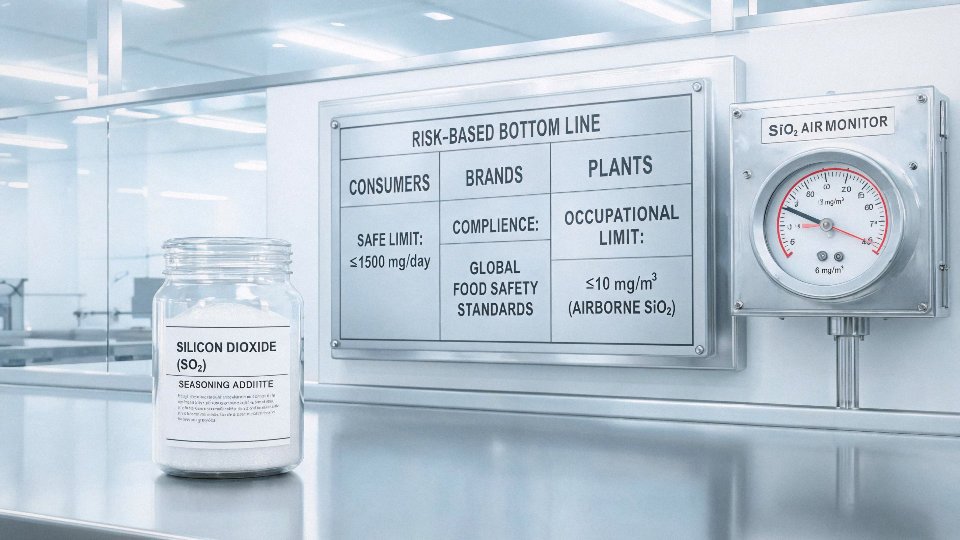
The practical answer is straightforward. Silicon dioxide is not a seasoning ingredient most people need to worry about under normal use. It still deserves professional control, because food safety is not built on reassurance; it is built on specifications, verified suppliers, compliant formulas, controlled blending, sound packaging, and plants that respect powder handling.