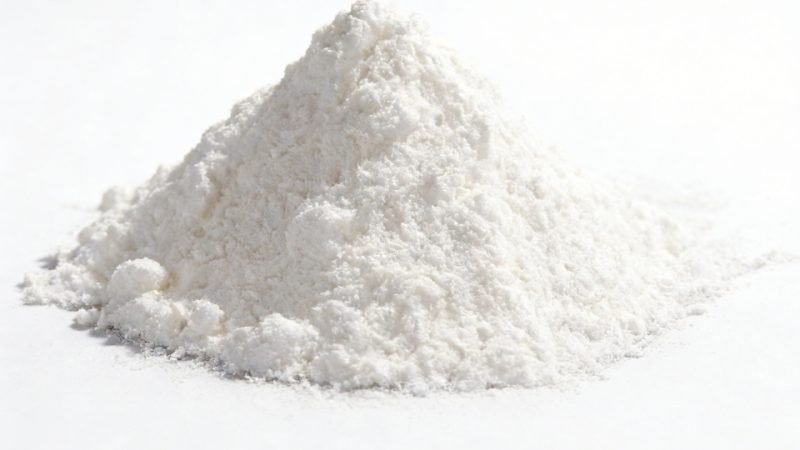
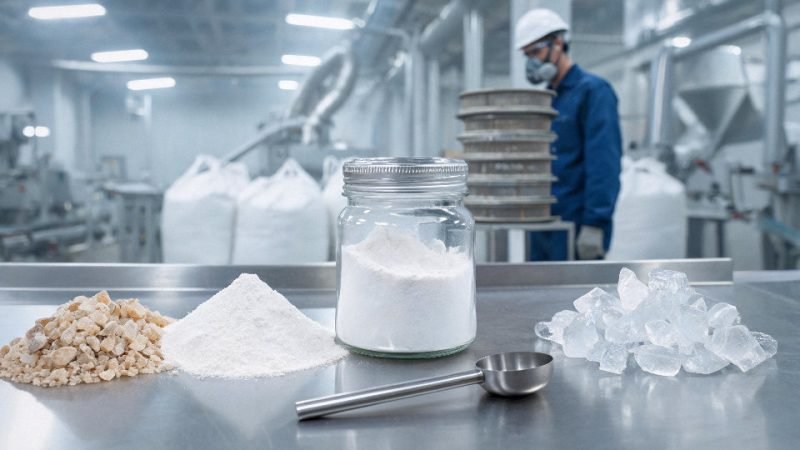
Call it “sand” on a purchase order and you can buy yourself a problem: a filter bed that blinds early, a foundry sand with the wrong grain shape, a glass batch carrying too much iron, or a filler that abrades screws faster than expected. The operational hit shows up as downtime, rejects, dust complaints, or a process engineer chasing a variable that should have been locked in at sourcing. The financial hit follows close behind. The fix is not fancy wording; it is specifying the form of SiO2, purity range, particle size distribution, moisture, trace metals, and whether crystalline silica exposure controls apply.
Silicon dioxide is not just sand; sand is often mostly silicon dioxide in the mineral form quartz. Natural quartz sand typically contains about 95% to 99.9% SiO2, depending on deposit and processing, while fused silica and electronic-grade SiO2 demand ppm-to-ppb impurity control and tighter physical specifications.
Same formula, very different material behavior. On a plant floor, quartz sand, fused silica, precipitated silica, silica flour, and semiconductor oxide do not substitute cleanly for one another just because the SDS lists SiO2. One may be a bulk commodity moved by pneumatic trailer; another may need clean packaging, leach testing, and contamination discipline that feels closer to pharma than aggregates. Even the safety conversation changes, since respirable crystalline silica limits are commonly around 0.05 mg/m3 as an 8-hour time-weighted average in regulated workplaces.
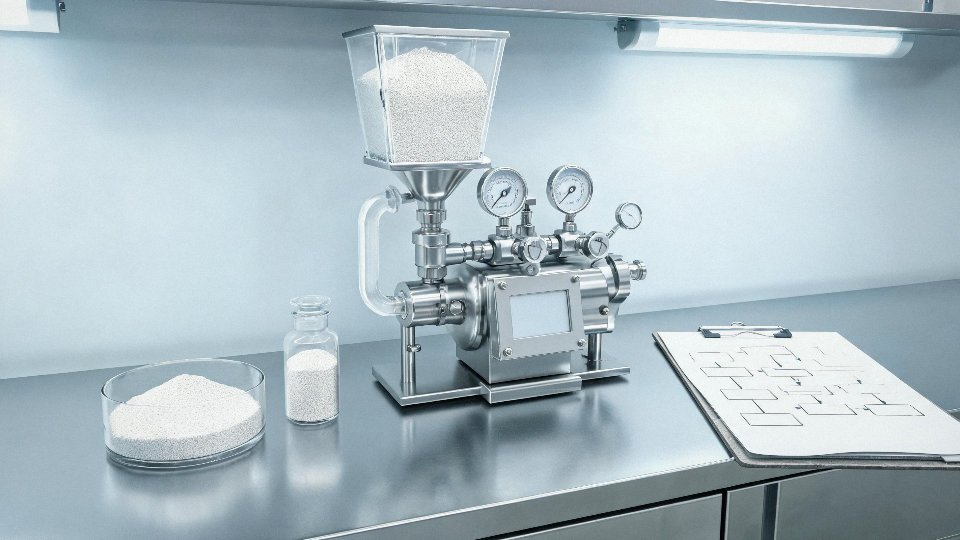
 materials shown beside bulk silica sand handling equipment.](https://siliconchemicals.com/wp-content/uploads/2026/07/silicon-dioxide-sand-01-hero-1.jpg)
What silicon dioxide actually is at the molecular and mineral level
Silicon dioxide is a chemical compound made from silicon and oxygen in a 1:2 atomic ratio, written as SiO2. That formula is simple. The material behind it is not.
At the atomic level, silica is built around a strong oxide network. A silicon atom sits at the center of a tetrahedral arrangement, bonded to oxygen atoms around it. In many silica structures, each oxygen bridges between silicon atoms, so the material becomes a continuous three-dimensional framework rather than a pile of separate little molecules. That framework is why silica can be hard, chemically resistant, thermally stable, and abrasive enough to eat pump seals, elbows, and screw conveyor flights if the handling system is poorly selected.
Same formula, different structures
The phrase “SiO2” only tells you the chemistry. It does not tell you whether the material is beach sand, ground quartz, fused silica, silica gel, fumed silica, or a high-purity oxide layer used in electronics.
Crystalline silica has atoms arranged in repeating patterns. Quartz is the common one most plants and mines deal with. Cristobalite and tridymite are also crystalline forms, usually associated with higher-temperature histories, certain refractories, fired ceramics, and some mineral transformations. From an occupational hygiene standpoint, crystalline silica is the form that gets the most attention. Regulated exposure limits are often around 0.05 mg/m3 as an 8-hour time-weighted average, depending on jurisdiction and the exact rule being applied. That is not a theoretical concern if you are dumping bags into a mixer with a tired dust collector and a missing gasket on the access door.
Amorphous silica has no long-range crystal order, although it still has local Si-O bonding. Fused silica, silica gel, and fumed silica all fall under this broad label, but they behave very differently in production. Fused silica can be a dense, low-expansion glassy material. Silica gel is porous and moisture-hungry, used for adsorption and drying. Fumed silica is extremely fine, fluffy, high surface area material that can bridge in hoppers, coat everything nearby, and make operators hate Mondays if the feeder is not designed for low bulk density powder.
Silicon dioxide always behaves like ordinary sand because it has the same chemical formula.False
SiO2 can be crystalline or amorphous, coarse or nanoscale, dry or moisture-loaded, low-purity or ultra-high-purity. Those differences can change flow behavior, reactivity, dust risk, optical performance, and process yield.
Why the physical form changes the job
A natural quartz sand might contain roughly 95% to 99.9% SiO2 by mass. The range depends on the deposit, washing, magnetic separation, flotation, acid leaching, and how hard the supplier is willing to beneficiate the material. For concrete or foundry work, that may be plenty. For glass, ceramics, coatings, or electronics-related use, the same number can be nearly meaningless unless the trace chemistry is controlled.
High-purity fused silica and semiconductor-grade silicon dioxide may have impurities measured in parts per million or even parts per billion. That level of control is not purchased by asking for “white silica.” It comes from controlled feedstock, thermal history, processing equipment that does not shed contamination, and testing methods that can actually see low-level metals.
Particle size changes behavior fast. Coarse quartz sand drains and conveys like a granular mineral. Fine silica flour can become airborne, pack tightly, blind filters, and change slurry viscosity. Fumed silica, with very high surface area, can thicken resins at low loading and create handling headaches because the powder is light, cohesive, and electrostatically annoying. I have seen maintenance teams blame a screw feeder when the real issue was a powder substitution that cut median particle size and doubled the fines fraction. The feeder did not suddenly become stupid; the material changed.
Moisture is another quiet troublemaker. A few tenths of a percent may not matter in some dry blending operations, while a few percent can cause caking, poor dosing, steam pops in thermal processes, or false weight readings in batch systems. Seasonal humidity matters too. A grade that runs cleanly in February may bridge in August if the silo venting and dryer discipline are marginal.
What engineers and buyers should specify
A serious silica specification rarely stops at “percent SiO2.” That is only the first line.
| Specification item | Why it matters in the plant |
|---|---|
| Particle size distribution | Controls flow, dusting, packing density, surface finish, filtration, and reaction rate |
| Iron content, often reported as Fe2O3 | Affects glass color, ceramics whiteness, electronics contamination risk, and some catalyst or coating uses |
| Alumina content, often reported as Al2O3 | Can influence melting behavior, refractory performance, and product chemistry |
| Loss on ignition | Indicates moisture, organics, carbonates, or volatile residues, depending on source and treatment |
| pH | Matters in coatings, polymers, slurries, adhesives, and surface-treated grades |
| Surface area | Drives adsorption, thickening, reactivity, and binder demand |
| Morphology | Angular, rounded, porous, fibrous, or agglomerated particles behave differently in mixing and conveying |
| Moisture | Affects weighing, storage, caking, flow, and thermal processing |
A typical procurement mistake is approving a lower-cost “equivalent” silica because the SiO2 percentage looks close. The trial batch then shows higher viscosity, darker fired color, faster nozzle wear, or filter press cycle times that stretch by 20% to 40%, depending on the particle size shift and impurity load. The invoice saving disappears into scrap, overtime, and a supervisor asking why the line is down again.
The practical rule is blunt: chemical formula identifies the compound; structure and specification determine whether it will run in your process.
When sand is mostly silicon dioxide, and when it is not
Sand is not a chemical name. It is a size class.
In most geologic and engineering use, sand means loose mineral or rock grains roughly 0.0625 mm to 2 mm in diameter. Finer material is silt or clay. Coarser material moves into granules and gravel. That definition matters because a bag marked “sand” tells you almost nothing about chemistry until someone has tested it. It could be mostly quartz. It could be shell fragments. It could be basaltic volcanic grains, feldspar, magnetite, garnet, or a mixed pit-run material with enough clay to make a concrete finisher swear at it by lunch.
All sand is silicon dioxide.False
Sand is a particle-size category, not a composition. Many sands are rich in quartz SiO2, but carbonate, volcanic, feldspathic, heavy mineral, and mixed construction sands may contain little quartz or behave nothing like industrial silica sand.
Many pale, inland or river-derived sands are silica-rich because quartz is stubborn. It is hard, chemically durable, and survives repeated weathering, washing, transport, and re-deposition better than many common rock-forming minerals. Feldspar breaks down into clays. Iron-bearing minerals stain, dissolve, or concentrate in small heavy fractions. Softer fragments get rounded down or destroyed. After enough geologic sorting, quartz tends to remain.
That is why a clean continental dune or mature river sand may contain about 95% to 99.9% SiO2 by mass, depending on the original deposit, the amount of washing and classification, and whether magnetic separation, attrition scrubbing, flotation, or acid leaching has been used. The upper end is not “ordinary beach sand.” It is selected industrial feedstock.
Carbonate sand is a different animal. In many tropical marine settings, the grains are broken coral, shell, algae, or other biogenic carbonate material, mostly calcium carbonate or mixed carbonate minerals. It may look clean and white, but put it into a high-temperature glass batch expecting quartz behavior and you have just changed the chemistry. Carbonates decompose and release CO2. They also flux the melt differently. Right material, right use. Wrong assumption, wrong furnace balance.
Volcanic sand can be dark, angular, and rich in basaltic glass, pyroxene, olivine, iron oxides, and other mafic minerals. Feldspathic sand still carries a meaningful feldspar fraction, often from less weathered granite or arkosic deposits. Heavy mineral sand may contain ilmenite, rutile, zircon, monazite, garnet, magnetite, or similar dense minerals. Some of those are valuable ores; some are contaminants in a silica specification. Mixed construction sand is often whatever the quarry can produce within grading and cleanliness limits. It may be perfectly good for bedding pipe or making mortar, but nobody should confuse it with furnace-grade silica.
For natural silica sand, the nuisance list is familiar: feldspar, clay, iron oxides, mica, organic matter, carbonates, and heavy minerals. Clay is a common troublemaker because a small amount can coat grains, raise water demand in mortar, blind a filter bed, or reduce permeability in a foundry mold. Iron oxides are another. A trace that looks like a faint tan stain on a stockpile can matter in clear glass, where low iron is not a cosmetic preference but a melt-color requirement. Mica can cause flaky particle behavior. Carbonates can fizz under acid and upset high-temperature reactions. Organic matter may burn out, smell, foam, or leave voids depending on the process.
Two sands can look nearly identical in a loader bucket and behave differently in production. I have seen this kind of mistake start with a purchasing substitution that looked harmless on the screen: same nominal mesh size, similar color, cheaper freight. Then the foundry sees lower green strength or higher burn-on. Or a filtration bed plugs early because the fines and clay coating were not controlled. In sports turf, a slightly different angularity and fines content can change drainage and compaction; it shows up after rain, not during the supplier presentation. In construction mortar, grain shape and fines shift workability and shrinkage. In glass, the penalty can be worse: higher energy demand, seed defects, color drift, accelerated refractory wear, or a batch house that needs constant adjustment.
A practical benchmark: high-quality industrial silica sand is not just “high SiO2.” It is usually selected and processed to hit a tight chemistry range, controlled grain-size distribution, low iron, limited refractory contaminants, and predictable thermal behavior. The required SiO2 and iron limits depend heavily on the end use. Container glass can tolerate more impurity than high-end optical or specialty glass. Foundry sand cares about grain shape, AFS grain fineness, acid demand, thermal expansion, and binder compatibility. Filtration sand needs effective size, uniformity coefficient, hardness, and low soluble contaminants. Semiconductor-grade silicon dioxide and high-purity fused silica sit in another universe, with impurities measured in parts per million or parts per billion, depending on grade and analytical method.
Procurement warning: do not approve a sand by name or appearance. Ask for chemistry, sieve analysis, moisture range, loss on ignition, clay content or turbidity, iron level, and the test method behind each number. Then trial it under plant conditions. A lab certificate is useful; a full shift at normal feed rate tells the truth.
How industrial silica is mined, washed, classified, and upgraded
Industrial silica does not become a reliable plant input just because a deposit looks white and gritty. The useful product is made by geology, then corrected by process control. Sometimes the feed is loose silica sand from an open pit. Sometimes it is crushed quartzite, vein quartz, or a high-purity quartz body that has to be drilled, blasted, sorted, and milled with much tighter contamination control. Those are different operations, with different cost structures and different failure modes.
A decent natural quartz sand may run roughly 95% to 99.9% SiO2 by mass, depending on the deposit and how much beneficiation has already been done. That range is wide for a reason. One sand may carry clay coatings, feldspar, heavy minerals, shell fragments, or iron staining. Another may be clean enough for container glass after washing and sizing. A high-purity quartz operation is a different animal; there the buyer may care about aluminum, lithium, sodium, titanium, or boron at parts-per-million levels, and for semiconductor-related silicon dioxide the discussion can move into parts-per-billion territory.
Natural quartz sand is the same thing as high-purity industrial silicon dioxide.False
Natural quartz sand can be silica-rich, often about 95% to 99.9% SiO2 by mass depending on geology and beneficiation, but high-purity fused silica and semiconductor-grade silicon dioxide are controlled for trace impurities at ppm or ppb levels.
From bank run material to controlled feedstock
A typical silica sand flow sheet starts with excavation and primary screening. The loader operator, scalping screen, and stockpile discipline matter more than some laboratory people expect. If the pit floor gets muddy after rain, the plant sees it two hours later as higher slimes, darker wash water, and a classifier that refuses to settle cleanly.
Oversize is removed first by screens. That may mean roots, gravel, ironstone nodules, or coarse quartz pieces, depending on the deposit. Attrition scrubbing follows in many plants. This is not gentle rinsing; it is grain-on-grain rubbing in a slurry to strip clay films, iron staining, and soft coatings from the quartz surface. Washing and desliming then pull out clay and very fine material. Hydrocyclones, hydrosizers, or classifiers split the sand by settling behavior, which is a practical proxy for size and density. Operators watch density, pressure, apex condition, and overflow clarity. A worn cyclone liner can quietly shift the cut point and put fines where the customer does not want them.
Spiral separators may be used to reject heavier minerals. Magnetic separation targets iron-bearing contaminants such as magnetite, ilmenite, and some stained grains, with the result depending on liberation size and magnetic susceptibility. For lower-iron glass grades, flotation may be used to remove feldspar, mica, or iron-titanium minerals. Reagent control is touchy; water chemistry, pH, temperature, and residual clays all change the result. Bad flotation is expensive twice: lost yield and off-spec product.
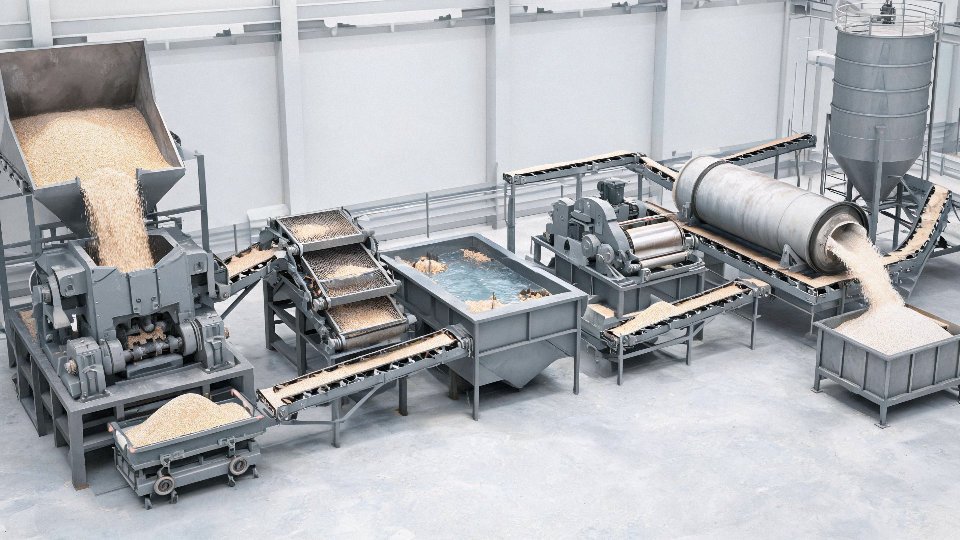
After wet processing, the sand is dewatered, dried, screened again if needed, and sent to bulk silos, bags, supersacks, or pneumatic tankers. Drying is not just about making it look dry. Moisture affects conveying, batching accuracy, foundry binder demand, silo hang-up, and freight cost. A sand sold at 0.2% moisture versus 4% moisture behaves differently in a bin, especially in winter or in a coastal plant where everything sweats overnight.
Size distribution is not a clerical specification
Particle size control is where many purchasing mistakes show up. Glass sand often needs a tight distribution with limited fines and limited coarse grains, because melting behavior and batch segregation depend on it. Foundry sand is selected for permeability, surface area, binder demand, and casting finish; too many fines can choke gas flow, while too coarse a sand prints through or weakens the mold.
Frac sand is judged differently again: crush resistance, roundness, sphericity, turbidity, acid solubility, and narrow mesh cuts such as 20/40, 30/50, or 40/70, depending on the reservoir design. Filter sand wants hydraulic performance and low breakdown. Fillers and silica flour grades may be milled to fine powders, where brightness, oil absorption, top cut, and respirable dust become central concerns.
This is why “silica sand” on a purchase order is not enough. A baghouse vendor, a glass furnace engineer, and a resin-coated sand supplier may all use silica, but they are not buying the same material.
Lot control, paperwork, and the uncomfortable parts
Serious buyers qualify deposits, not just suppliers. They ask for certificates of analysis, particle size reports, retained samples, moisture data, and evidence that the process can stay inside limits over months, not one lucky shipment. In practice, I like to see lot numbering that ties back to production date, dryer line, silo, and test results. If a customer calls about a color shift, foaming melt, casting defect, or blocked pneumatic line, traceability decides whether the problem is solved in a day or argued about for three weeks.
Dust control deserves direct attention. Crystalline silica exposure limits in regulated workplaces are commonly around 0.05 mg/m3 as an 8-hour time-weighted average, depending on jurisdiction and measurement method. Dry screening, milling, bagging, truck loading, and cleanup with compressed air are usual trouble spots. A plant can have good product chemistry and still be a poor supplier if its dust management is casual.
The environmental side is no longer background noise. Silica beneficiation can use a lot of water, especially where attrition scrubbing, classification, and flotation are involved. Tailings ponds, slimes handling, groundwater controls, truck traffic, rail distance, noise, and final reclamation all affect the real cost of supply. Land disturbance is visible to neighbors. Dust on a county road is visible too.
The best silica suppliers tend to be boring in the right way: qualified reserves, steady wash plant control, clean stockpile management, documented testing, and no surprises in the railcar or bulk tanker. That boring consistency is exactly what most factories are paying for.
Why glass, ceramics, foundries, construction, and electronics all need different silica grades
Silicon dioxide may carry one chemical formula, SiO2, but a buyer who treats every silica source as interchangeable will eventually pay for it. Sometimes the penalty is cloudy glass. Sometimes it is casting scrap, poor glaze fit, weak concrete, a plugged frac blender, or a furnace campaign that does not behave like the last one.
The specification is never just “percent SiO2.” It is SiO2 plus impurity chemistry, particle size, grain shape, mineral form, moisture, loss on ignition, fines, and how the material behaves under heat, pressure, binder chemistry, or optical inspection.
A silica sand that works well for concrete may be completely unsuitable for clear glass or semiconductor quartzware, even if all three are mostly SiO2.True
Concrete sand is usually specified around grading, durability, cleanliness, and aggregate performance. Clear glass and electronics require much tighter control of iron, alkalis, refractory minerals, trace metals, and melting or high-temperature behavior.
Glassmaking wants chemistry and melting behavior under control
Glass plants usually want high SiO2, low iron, stable particle sizing, and low refractory contaminants. The iron limit depends heavily on the product. Container glass can tolerate more iron than clear float glass, while solar glass and optical glass push the limit much harder. A sand running around 95% SiO2 might be useful in some construction markets, but glass sand is commonly much higher, often in the high-90% range, with beneficiation used to reduce iron-bearing minerals, heavy minerals, clay, and organics.
Grain size matters because melting is a production issue, not just a lab number. Too coarse, and grains can survive too long in the melt. Too fine, and dust losses, batch segregation, and carryover increase. A glass furnace operator does not want surprises in chromite, zircon, alumina-rich grains, or other refractory bits that can show up later as stones and cords in finished glass.
A typical headache: a quarry ships sand that still meets the broad SiO2 number, but the iron distribution shifts after mining moves into a different bench. The plant sees a slight color drift first, then batch corrections, then arguments over whose lab method is right. That is why good glass procurement looks at trend data, not one certificate.
Foundries care about heat, flow, and binder behavior
Foundry silica sand is judged on how it behaves in a mold or core, not just how clean it looks. Thermal expansion is a big one. Quartz expands sharply through its phase change region, and if the sand system, binder, and casting geometry are not managed, that movement can contribute to veining, scabbing, and dimensional problems.
Grain shape affects permeability and strength. Rounded grains usually give better flow and lower binder demand; angular grains may lock together better but can need more resin or clay to hit the same mold properties. Fines are another quiet troublemaker. A little helps surface finish in some systems, too much chokes permeability and drives gas defects.
Foundries also watch refractoriness, acid demand value, clay content, and compatibility with phenolic urethane, furan, sodium silicate, green sand clay systems, or whatever the floor is actually running. In practice, the sand that gives beautiful results on an aluminum job may be marginal on heavy iron castings. Heat load changes everything.
Ceramics use silica as both structure and movement control
In ceramics, silica can be a body component, a glaze ingredient, and a thermal expansion adjuster. The mineral form matters. Quartz, cristobalite, amorphous silica, and fused silica do not behave the same during firing and cooling.
Body formulations use silica to influence shrinkage, fired strength, vitrification, and thermal expansion. In glazes, silica is a glass former, but its particle size and reactivity affect melt development. Too much poorly controlled quartz in a body can leave residual expansion behavior that shows up as dunting or glaze fit trouble. Too little, and the fired body may not match the expansion target.
Ceramic engineers learn quickly that “same chemistry” does not mean “same firing curve.” Mill residue, particle distribution, and mineral conversion during firing can be the difference between a stable tile and a batch that pings as it cools on the kiln car.
Construction uses large volumes, with wider chemistry tolerance
Construction is the broadest and least romantic silica market, but it consumes a lot. Silica-rich sand goes into concrete, mortar, asphalt mixes, engineered stone, roofing granules, grouts, tile adhesives, jointing compounds, and mineral fillers. Here, the required purity is often lower than glass or electronics. The critical issues are usually grading, cleanliness, durability, moisture, alkali-silica reactivity risk, particle shape, and consistency from truck to truck.
Concrete sand can include other durable minerals and still perform well. That is normal. The wrong fines content, weak particles, salt contamination in coastal material, or reactive silica forms can be far more damaging than a slightly lower SiO2 percentage. A ready-mix plant manager will care less about a glamorous purity number and more about water demand, slump control, pumpability, and whether cylinders are breaking where they should.
Engineered stone and fillers sit in a more controlled middle ground. Color, particle size, resin demand, and dust management become commercial issues as much as technical ones.
Hydraulic fracturing sand is specified like a mechanical component
Frac sand has its own language: mesh size, crush resistance, roundness, sphericity, turbidity, acid solubility, cluster distribution, and fines generation. A 20/40 sand and a 40/70 sand are not interchangeable just because both are quartz-rich. Mesh size affects conductivity and placement. Crush resistance determines whether grains survive closure stress without producing fines that block flow paths.
Rounder, more spherical grains generally pack and conduct better. High turbidity suggests clays or surface contaminants that can interfere with fluid systems. Acid solubility screens out carbonates and other minerals that may not belong in the job.
Operational warning: wet or inconsistent sand at the transload site can slow a frac spread fast. Belts slip, hoppers bridge, density readings wander, and suddenly a cheap sand decision is costing far more in standby time than it saved on the purchase order.
Electronics and optics are a different purity universe
Electronics, optics, and high-end quartzware are where silicon dioxide stops looking like sand in any practical sense. Fused silica, high-purity quartz, and thermally grown silicon dioxide films demand extremely low metal contamination, often measured in parts per million or parts per billion depending on the use. Sodium, potassium, lithium, iron, titanium, aluminum, and transition metals can be serious defects, not harmless background chemistry.
Fused silica for optical use needs clarity, low bubble and inclusion content, controlled hydroxyl content, and high thermal stability. Semiconductor thermal oxide is grown or deposited under controlled process conditions because film thickness, interface quality, dielectric behavior, and contamination levels matter at a scale that bulk sand specifications cannot touch.
A simple procurement view looks like this:
| Application | What usually drives the grade | What goes wrong with the wrong silica |
|---|---|---|
| Glass | Low iron, consistent sizing, low refractory minerals, predictable melting | Color drift, stones, cords, furnace instability |
| Foundry | Grain shape, expansion, permeability, binder compatibility, fines | Gas defects, veining, poor shakeout, scrap castings |
| Ceramics | Mineral form, particle size, firing behavior, expansion control | Cracking, glaze mismatch, warpage |
| Construction | Grading, durability, cleanliness, moisture, reactivity | Strength loss, high water demand, ASR risk, placement issues |
| Frac sand | Mesh, crush strength, roundness, turbidity, acid solubility | Fines, lost conductivity, pumping delays |
| Electronics and optics | Trace metals, hydroxyl content, inclusions, optical and thermal behavior | Device defects, haze, contamination, premature failure |
The engineered forms of silicon dioxide that do not look like sand at all
Walk through a plant that buys “silica” and you may not see a grain of sand anywhere. You may see clear tubes in a cleanroom furnace, fluffy white powder that bridges in a hopper, wet slurry in plastic totes, bead-like desiccant in drums, or a film on a silicon wafer thinner than a fingerprint oil smear. Chemically, these materials can all be silicon dioxide. Operationally, they behave like different animals.
Fused silica and fused quartz
Fused silica and fused quartz are glassy, non-crystalline forms of SiO2. The usual distinction is feedstock and purity route: fused quartz is commonly made by melting high-purity crystalline quartz, while synthetic fused silica may be made from vapor-phase chemical precursors. In purchasing conversations, do not rely on the name alone. Ask for impurity limits, hydroxyl content, bubble class, striae, transmission range, and thermal history.
This material shows up in optics, UV lamp envelopes, semiconductor furnace tubes, photomask substrates, laboratory ware, and high-temperature fixtures. Its value is not that it is “just pure.” It has low thermal expansion, good thermal shock resistance, and useful optical transmission depending on grade. High-purity fused silica and semiconductor-grade silicon dioxide can have impurities controlled in the parts-per-million or even parts-per-billion range, depending on process route and the element being specified.
A typical mistake is treating fused silica like ordinary glass in handling. It may tolerate heat well, then fail from a tiny edge chip caused by a bad rack, a dropped quartz boat, or a technician using steel tools where polymer or clean ceramic tools should have been used. The scrap is not cheap.
Fumed silica
Fumed silica is an ultrafine amorphous silica made by flame hydrolysis, usually sold as a very low-bulk-density white powder. It is not sand ground fine. In practice, it behaves more like smoke that has been convinced to live in a bag.
Its job is often rheology control. In coatings, adhesives, sealants, elastomers, composites, greases, and potting compounds, it can thicken, prevent sag, improve anti-settling behavior, reinforce polymers, and tune flow under shear. A sealant that holds a vertical bead in summer may owe that behavior to a few percent fumed silica, give or take, depending on resin chemistry, surface treatment, mixing energy, and moisture exposure.
The operational warning is dust handling. Fumed silica can flood, bridge, cling electrostatically, and blind filters. Operators hate it for good reason. Use proper bag dump stations, local exhaust, conductive equipment where needed, and realistic housekeeping rules. If respirable crystalline silica exposure limits around 0.05 mg/m3 as an 8-hour time-weighted average are the regulatory reference for crystalline materials, do not assume amorphous powders are harmless. Different hazard basis, still a dust problem.
Precipitated silica
Precipitated silica is also amorphous, but it is made by wet chemical reaction, commonly from silicate solution and acid, then filtered, washed, dried, and milled or granulated. It has controlled surface area, pore structure, oil absorption, pH, and particle morphology.
Its largest high-volume use is in rubber, especially tires, where it helps tune rolling resistance, wet traction, and wear when paired with the right coupling chemistry. It also goes into rubber goods, toothpaste abrasives and thickeners, animal feed carriers, food processing aids where grades meet applicable standards, and general industrial fillers.
Procurement should not buy this material by price per ton alone. Two precipitated silicas with similar assay can disperse differently, absorb plasticizer differently, or shift cure behavior. In a rubber mixing room, that means higher mixer torque, longer dump times, poor dispersion, or inconsistent hardness. The compounder will notice before accounting does.
Silica gel
Silica gel is porous amorphous silica, usually recognized as beads or granules used for moisture adsorption. The “gel” name confuses people; the shipped product is normally solid and dry. It is used in desiccant packs, transformer breathers, compressed air drying, chromatography, humidity-buffered packaging, and selective adsorption duties.
Performance depends on pore size distribution, bead strength, moisture capacity, regeneration temperature, dusting, and whether indicator chemistry is used. Cheap gel that crumbles in vibration can contaminate a cabinet or block a small instrument vent. In warehouses near coastal climates, I have seen desiccant consumption double compared with a dry inland site, simply because every opened drum and unsealed carton became part of the humidity load.
Colloidal silica
Colloidal silica is nanoscale amorphous silica dispersed in water or another liquid. It is used in chemical mechanical polishing, investment casting slurries, paper and textile treatment, coatings, catalyst binders, refractory binders, and precision surface finishing.
The key controls are particle size, solids content, pH, ionic stability, sodium level, and shelf handling. Freeze a tote, contaminate it with polyvalent ions, or store it past its stable window, and a nice polishing slurry can turn into gelled waste. For wafer polishing or tight-tolerance metal finishing, that is not a minor nuisance; agglomerates can scratch parts and push rework rates up fast.
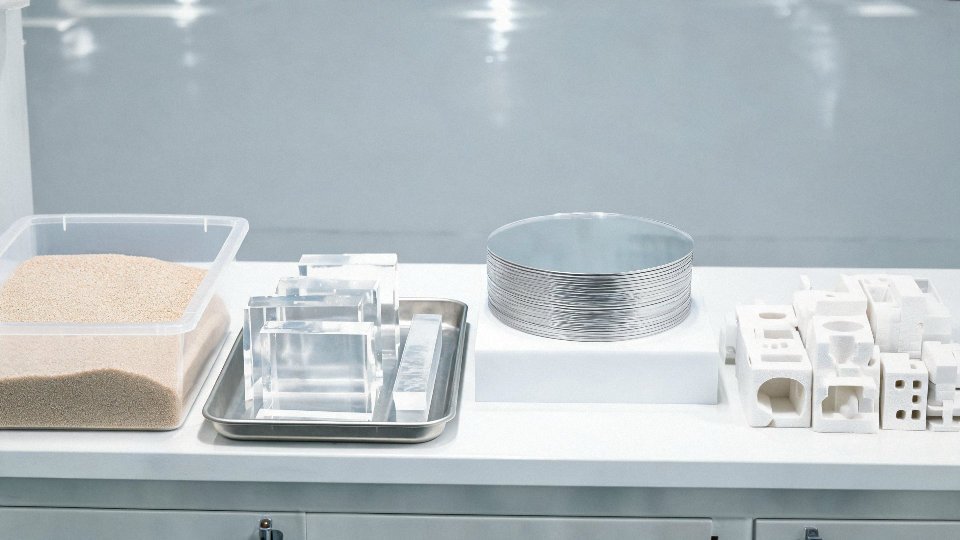
Thin-film silicon dioxide
Thin-film silicon dioxide is not bought as a sand product at all. It is grown or deposited directly onto surfaces, especially silicon wafers, by thermal oxidation, chemical vapor deposition, plasma-enhanced deposition, or related processes. In microelectronics, sensors, MEMS, and photovoltaic manufacturing, it serves as an insulator, passivation layer, mask, barrier, gate dielectric in older device structures, or surface-conditioning layer.
Here the purchasing unit is not a truckload or drum. It is process capability: film thickness uniformity, defect density, interface quality, mobile ion contamination, dielectric strength, and compatibility with the next etch, implant, metallization, or bonding step. A few nanometers too thin in the wrong area can create leakage. Too much hydrogen, sodium, or particles can kill yield quietly, lot by lot.
Silicon dioxide is always sand if the chemical formula is SiO2.False
Sand can be rich in SiO2, but engineered silicon dioxide also exists as fused glass, powders, gels, colloids, and thin films with properties defined by structure, purity, surface chemistry, and process history.
How to read a silica specification without making a costly substitution error
A silica data sheet can look deceptively simple. SiO2: 99.2%. Particle size: 40 to 70 mesh. Moisture: 0.2%. That may be enough for a rough purchase order, but it is not enough to protect a furnace, a filter bed, a resin reactor, or a wafer-cleaning process.
The first trap is treating chemical purity, mineralogy, and functional performance as the same thing. They are not. Chemical purity tells you the oxide chemistry by mass. Mineralogy tells you what phases are present, such as quartz, cristobalite, tridymite, feldspar, clay, mica, or amorphous silica. Functional performance is what the material actually does in your equipment: melts cleanly, drains at the right rate, resists crushing, disperses in a slurry, scratches a surface, or sheds dust into the operator’s breathing zone.
I have seen purchasing teams approve a “99% silica” substitute because the headline number matched the incumbent. The plant then chased haze, blinding screens, or higher baghouse loading for weeks. Same formula on paper. Different material in the process.
Read the oxide chemistry as a risk map, not just a purity number
SiO2 percentage is the starting point, not the finish line. Natural quartz sands often run roughly 95% to 99.9% SiO2 by mass, depending on the deposit and how much washing, attrition scrubbing, magnetic separation, or flotation has been done. High-purity fused silica and electronics-grade silicon dioxide sit in a different world, where some impurities are controlled in parts per million or even parts per billion.
Common oxide fields deserve a hard look:
| Specification field | Why engineers and buyers should care |
|---|---|
| SiO2 | Main chemistry, but not proof of suitability by itself. |
| Fe2O3 | Causes color, iron staining, magnetic contamination risk, and defects in clear glass or white ceramics. |
| Al2O3 | Often linked to feldspar or clay. Can change melting behavior and refractory chemistry. |
| TiO2 | A color and optical issue in some glass and ceramic bodies. |
| CaO and MgO | Carbonates or mineral carryover. Can affect fluxing, pH, and high-temperature behavior. |
| Na2O and K2O | Alkalis. Helpful in some glass batches, damaging in certain refractories and high-temperature insulation systems. |
| Loss on ignition | Moisture, organics, carbonates, or bound water. Depends on test temperature and method, so compare like with like. |
| Moisture | A handling and dosing issue. Wet sand bridges in bins, throws off batch weight, and changes pneumatic conveying behavior. |
| pH and conductivity | Quick indicators of soluble contamination, treatment residues, or salts. |
| Soluble salts | Trouble for chemical processing, coatings, electronics cleaning, and any process sensitive to chlorides, sulfates, or sodium ions. |
Two silica materials with the same SiO2 percentage can perform very differently in production.True
The SiO2 value does not define mineral phase, particle shape, soluble ions, surface chemistry, moisture behavior, or particle size distribution, all of which can control plant performance.
Particle data decides whether the material will flow, filter, melt, or abrade
Mesh size is the old shop-floor language. It is still useful, especially for foundry sand, filtration media, blasting grades, and bulk handling screens. But mesh alone hides the distribution. Ask for D10, D50, and D90 values from laser diffraction or sieve analysis, and make sure the test method is stated. A “200 mesh” product from one supplier may carry a fines tail that behaves nothing like another.
D10 tells you where the fine end sits. D50 is the median particle size. D90 shows the coarse end. Fines content matters because fines make dust, blind filters, increase slurry viscosity, and create segregation in dry blends. In a filter vessel, too many clay fines can turn a clean backwash schedule into a daily maintenance argument.
Shape matters too. Aspect ratio, angularity, and sphericity affect packing, permeability, and wear. Rounded silica sand may flow nicely and reduce pressure drop in some filtration uses. Angular grains can lock better in resin-bonded systems but abrade elbows, rotary valves, and screw conveyors faster. Surface area and pore volume show up in precipitated silica, fumed silica, gels, and treated powders; they influence oil absorption, thickening, reactivity, and drying load. Bulk density affects truck payload, silo capacity, feeder calibration, and whether your existing vibrator will actually move the material on a damp Monday morning.
Watch the contamination that matches your failure mode
Every process has a different villain. In clear glass, iron is usually the obvious one; low Fe2O3 can be worth paying for because a green tint or seed defect is not cheap to melt out. In refractories, alkalis such as Na2O and K2O can lower service life by fluxing the structure at temperature. In filtration, clay and ultrafines increase turbidity and pressure drop. In chemical processing, organic residues from mining aids or surface treatments can poison reactions, discolor product, or cause foaming. In electronics, trace metal ions are not a paperwork nuisance. Sodium, potassium, iron, copper, and other mobile contaminants can become yield loss.
A practical warning: do not accept “washed” as a technical specification. Washed with what water? To what conductivity? Was it dried in a gas-fired dryer with possible carryover? Was it stored under cover, or did the front-end loader pick up half the yard after a storm? These are not academic questions if your process is sensitive.
A sane qualification workflow
The best procurement route is slower at the start and cheaper over the year.
- Define the actual process requirement. Not “silica sand,” but melt color limit, permeability range, thermal expansion behavior, resin demand, soluble ion ceiling, or filter run length.
- Request a representative sample. A hand scoop from a clean bag is not the same as a composite from normal production.
- Run lab tests against your critical parameters. Include chemistry, mineralogy if needed, particle size distribution, moisture, pH, conductivity, and any in-house performance test that has caught failures before.
- Complete a pilot or controlled plant trial. Track yield, energy draw, pressure drop, scrap, emissions load, wear points, and operator exposure.
- Check health and safety classification. Respirable crystalline silica limits in regulated workplaces are commonly around 0.05 mg/m3 as an 8-hour time-weighted average, depending on jurisdiction and task. Cutting, dumping, drying, and conveying can change exposure sharply.
- Approve supplier lots with agreed control limits, certificate format, change notification rules, and a retention-sample practice.
Replacing one SiO2 source with another based only on the chemical formula is how plants buy defects in bulk. The wrong substitution can raise downtime, increase scrap, chew up equipment, change emissions, expose workers to a different dust risk, or put the site out of regulatory compliance. A low unit price rarely survives that math.
Health, safety, and regulatory realities: silica dust is not the same risk as intact sand
A pallet of bagged silica sand sitting in a warehouse is not the same hazard as a cloud of dust coming off a dry grinder, shot-blast cabinet, core knockout station, or concrete saw. That distinction gets missed in purchasing meetings and, just as often, on the shop floor.
The main occupational health concern is respirable crystalline silica: particles small enough to get past the upper airway and lodge deep in the lungs. The mere presence of SiO2 in a rock, grain of sand, ceramic part, glass bottle, or finished casting mold does not automatically mean workers are being overexposed. The risk rises when the material is made airborne in the respirable size range.
A bag of silica sand and a polished glass panel can both contain SiO2, but they do not present the same inhalation hazard during normal handling.True
The regulated occupational concern is primarily respirable crystalline silica generated as airborne fine dust; intact articles or wetted bulk material usually release far less respirable dust unless cut, abraded, crushed, blasted, or otherwise disturbed.
Where the dust actually comes from
Respirable particles are not the visible grains you can easily brush off a bench. They are the fine fraction, often invisible in normal lighting, that hangs in the air after cutting, grinding, crushing, drilling, milling, dry screening, pneumatic conveying, bag dumping, abrasive blasting, or rough housekeeping. In practice, the worst exposure is not always at the biggest machine. I have seen more dust at a manual sack tip station with a tired flexible connector than near a fully enclosed mill with a decent baghouse.
Typical high-risk tasks include:
| Operation | Why exposure can rise | Practical warning |
|---|---|---|
| Dry cutting or grinding concrete, brick, tile, or stone | Fresh fracture creates fine crystalline silica dust | A shop vacuum without HEPA filtration can simply redistribute the problem |
| Foundry shakeout, sand reclamation, and blasting | Sand grains break down and fines accumulate | Enclosures leak when doors, seals, and duct balance are neglected |
| Bag dumping of silica flour or fine mineral powders | Fine powder becomes airborne at the operator’s breathing zone | Forklift-damaged bags and rushed dumping make it worse |
| Drilling or milling quartz-containing materials | Local high-energy contact generates respirable fines | A mist system is not useful if the nozzle is aimed wrong |
Health effects and exposure limits
Overexposure to respirable crystalline silica is associated with silicosis, chronic obstructive pulmonary disease, kidney disease, and increased lung cancer risk in regulated workplace contexts. The risk depends on airborne concentration, duration, particle size distribution, crystalline form, work practices, and how many years the worker has been doing the job. A short dusty task repeated every shift for ten years is not a minor issue.
Many regulated workplaces use occupational exposure limits around 0.05 mg/m3 as an 8-hour time-weighted average for respirable crystalline silica, although exact rules, action levels, sampling methods, and medical surveillance triggers vary by jurisdiction. That number is small. You cannot judge compliance by whether the air “looks dusty.” By the time dust is obvious under warehouse lights, exposure may already be well above a limit, especially near the operator’s face.
Crystalline silica is not the same as amorphous silica
Quartz, cristobalite, and tridymite are crystalline forms of silica, and they carry specific respiratory hazard classifications. Amorphous silica, such as fused silica, precipitated silica, silica gel, or fumed silica, is classified differently in many systems because it lacks the same crystal structure.
That does not mean amorphous powder is harmless. Fine powders can overload ventilation, irritate airways, contaminate bearings and controls, create housekeeping problems, and fall under general particulate exposure limits. Some products also contain trace crystalline silica depending on feedstock and thermal history. Read the safety data sheet and certificate of analysis instead of assuming “non-crystalline” means “no industrial hygiene work needed.”
Controls that actually work on a plant floor
The control sequence should start before PPE. Substitution is worth checking first: can a lower-silica abrasive, pre-cut component, pelletized feed, slurry form, or coarser grade do the same job without creating respirable fines? Sometimes yes. Sometimes the process requirement blocks it.
After that, engineering controls do the heavy lifting:
- Use wet cutting, wet drilling, or misting where it does not damage the process or create slip and electrical hazards.
- Put local exhaust ventilation at the dust generation point, not three feet away because the bracket was easier to weld there.
- Enclose transfers, conveyors, mixers, and bag dump stations; flexible skirts and gaskets need inspection, not just installation.
- Use dust collectors with appropriate filtration and pulse-cleaning; check differential pressure trends and dust disposal practices.
- Clean with HEPA-rated industrial vacuums or wet methods. Dry sweeping is a bad habit that turns settled contamination back into exposure.
Respirators still have a place, especially during maintenance, filter changes, refractory tear-out, confined work, and non-routine tasks. They need proper selection, fit testing, cartridge or filter change schedules, and training. Handing out disposable masks from a supervisor’s desk is not a respiratory protection program.
Documentation is part of the control system
Good compliance is boring paperwork backed by real measurements. Keep current safety data sheets, labels, exposure assessments, air sampling records, maintenance logs for ventilation and dust collectors, training records, and medical surveillance documentation where required. Waste handling also matters; dust collector fines, spent blasting media, and vacuum contents may need controlled disposal depending on composition and local rules.
Procurement has a role here. A cheaper silica flour with a higher fine fraction, poor packaging, or vague SDS can create costs that never show up on the purchase order: sampling, respirators, cleanup labor, rejected product, and downtime after a regulator or insurer walks the line. The right material specification should cover performance and exposure reality, not just SiO2 percentage.
Environmental and quality implications across the silica supply chain
Silica choice is not only a chemistry decision. It decides how much ground gets disturbed, how many trucks hit local roads, how much water the plant recirculates, and how much quality risk your production team inherits six months later when the deposit face changes.
A good quartz sand deposit may run roughly 95% to 99.9% SiO2 by mass, depending on geology and beneficiation. That range looks narrow on a sales sheet. On the plant floor it is not narrow at all. The remaining fraction can mean iron staining in glass, alkali drift in ceramics, thermal expansion trouble in foundry molds, or a rejected electronics lot after a long qualification run.
Mining and processing are visible long before the silica reaches your plant
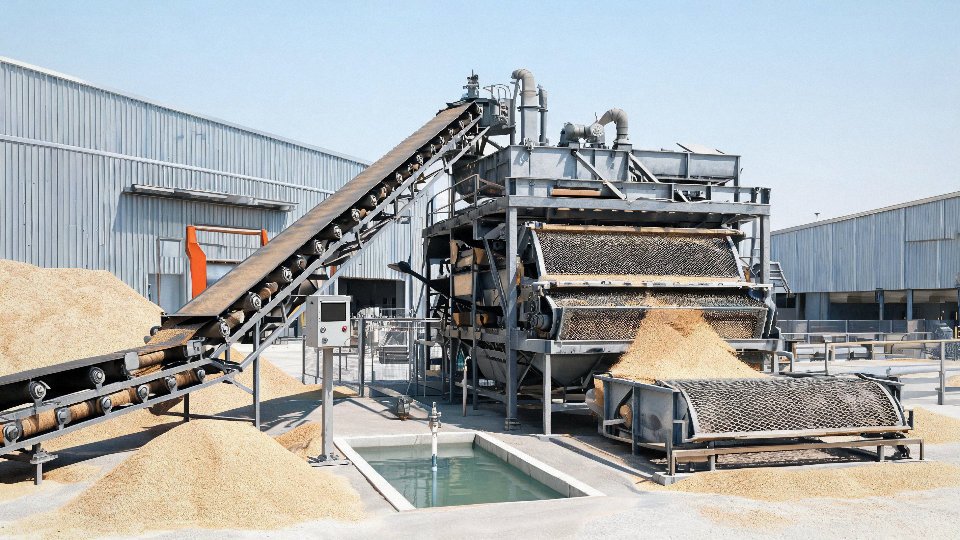
Silica sand mining has the usual surface-mining footprint: land clearing, overburden handling, haul roads, screens, pumps, stockpiles, settling ponds, and outbound traffic. The environmental load depends heavily on deposit depth, clay content, local water rules, and whether the operation is dry screened or wet washed.
Wet processing improves consistency, but it brings water management. A well-run wash plant may recycle a large share of its process water, often somewhere in the 70% to 95% range depending on fines loading, pond design, filtration equipment, and rainfall. High-clay deposits are messier. They generate more tailings, slower settling ponds, more dredging, and more opportunities for turbid water to become a permit problem.
Dust is another practical issue. Not the same as a bag of intact sand sitting quietly, but crushing, drying, conveying, and truck loading can release fine particulate. Plants handle this with covered conveyors, baghouses, water sprays, enclosed transfer points, paved haul roads, and wheel wash stations. If those systems are treated as “nice to have,” the neighborhood will usually notice before corporate does. Noise from dryers, loaders, backup alarms, and night trucking has a similar habit of becoming a community issue.
Reclamation is where serious suppliers separate themselves. Ask what happens after a pit cell is exhausted: backfilling, grading, topsoil replacement, water-body creation, native planting, erosion control, and monitoring. A supplier with a real reclamation plan is not automatically low risk, but one without a credible plan is a procurement warning sign.
Higher purity usually shifts the burden from mining to energy and qualification
Washed industrial sand is still relatively simple compared with fused silica, synthetic silica, or semiconductor-grade silicon dioxide. Fused silica requires melting high-purity quartz at very high temperature, above roughly 1,700 °C, then controlling bubbles, inclusions, hydroxyl content, particle size, or shape depending on the product. The energy bill depends on furnace type, batch size, yield loss, electricity mix, and how tightly the product is specified.
Synthetic silica moves the burden into chemical processing: feedstock production, reaction control, filtration, drying, calcination in some routes, packaging cleanliness, and wastewater treatment. Semiconductor-grade materials are another step again. Impurity targets may be measured in parts per million or parts per billion, and the quality system around the material can matter as much as the assay itself. Clean handling, trace-metal control, lot genealogy, and change notification become part of the product.
The lowest-environmental-impact silica option is always the highest-purity grade because it performs better.False
Higher purity can reduce scrap in demanding processes, but it often requires more processing energy, tighter packaging, longer transport, and lower yield. For low-demand uses, over-specified silica can increase cost and environmental burden without improving the finished product.
A practical lifecycle comparison
| Silica source | Environmental and logistics profile | Quality risk profile | Where it usually makes sense |
|---|---|---|---|
| Local aggregate sand | Short haul, low processing, variable mineralogy; may have lower transport emissions but higher product variability | High if substituted into glass, ceramics, foundry, or chemical service without testing | Concrete, fill, drainage, non-critical construction uses |
| Washed industrial silica sand | Moderate processing water and energy; truck or rail logistics matter a lot | Manageable with sieve, chemistry, moisture, and contamination controls | Glass, foundry, filtration, ceramics, sports turf, industrial fillers |
| Imported high-purity quartz | Long supply chain, container or bulk shipping, concentrated sources; high embodied logistics cost | Low impurity risk after qualification, but high supply disruption risk | Fused silica, crucibles, specialty glass, electronics-related uses |
| Synthetic silica | Chemical and energy intensive; packaging and cleanliness add burden | Very controlled if supplier quality system is strong | Polymers, coatings, catalysts, food and pharma grades where approved, precision applications |
That table is not a purchasing rule. It is a starting point for asking better questions.
Circularity can help, but only when contamination is controlled
Recycled glass cullet is one of the best silica-loop examples. In glass plants, cullet can reduce melting energy, often meaningfully, with the exact savings tied to furnace design, cullet percentage, color sorting, and contamination level. The catch is quality. Ceramics, metals, organics, and wrong-color glass can turn a good sustainability idea into stones, cords, or rejects.
Foundry sand reclamation can also pay. Mechanical attrition, thermal reclamation, or wet scrubbing can return sand to the molding loop and cut disposal volume. In practice, binder system, metal type, loss-on-ignition limits, grain rounding, and core-room discipline decide whether reclamation is a win or just another maintenance headache. I have seen reclaimed sand work beautifully, and I have seen it quietly raise scrap because nobody owned the daily test data.
Construction reuse is lower glamour but high volume: crushed concrete, reused fill, and controlled backfill can displace virgin aggregate. Process-water recycling at sand plants is similar. Not exciting. Very useful.
Supply risk is a quality issue, not just a purchasing issue
Silica supply can fail for ordinary reasons: a deposit face runs into more iron-bearing minerals, a dryer struggles with winter moisture, railcars are short, river levels affect barge movement, a permit renewal drags on, or a local road authority restricts truck traffic. Seasonal moisture variation alone can upset batching, freight cost, silo flow, and dryer load. Anyone who has fought wet sand bridging above a weigh belt knows this is not theoretical.
High-purity quartz has a narrower global supply base than common sand. That creates exposure to geopolitics, export controls, shipping disruption, and long customer qualification timelines. A second source may take months, sometimes longer, if the application needs furnace trials, optical testing, leach testing, or customer approval.
The engineering answer is not to buy the purest silica everywhere. Right-size the specification. Use premium silica where impurities, particle shape, thermal behavior, or trace metals truly affect yield or safety. For low-demand applications, specify the property that matters: gradation, moisture, chloride, color, loss on ignition, acid solubility, or dust content. Over-specifying ppm-level purity for a job that only needs stable particle size ties your plant to expensive supply, longer lead times, and a bigger environmental footprint with no operating gain.
Frequently asked questions about silicon dioxide and sand
Is silicon dioxide the same as sand?
No. Some sand is mostly silicon dioxide, but silicon dioxide is the wider material category.
A clean quartz sand used for glass or foundry work might contain roughly 95% to 99.9% SiO2 by mass, depending on the deposit, washing, attrition scrubbing, magnetic separation, and how aggressively it has been beneficiated. That does not make all silicon dioxide “sand.” Fused silica tubing, colloidal silica slurry, fumed silica powder, thermal oxide on a silicon wafer, and precipitated silica in rubber are all SiO2-based materials, but none behave like a shovel of sand from a stockpile.
Silicon dioxide is the same thing as sand.False
Silica-rich sand is one common natural source of SiO2, but silicon dioxide also exists as engineered powders, glasses, gels, coatings, and thin films with very different purity, structure, particle size, and performance.
Is all beach sand silica?
No, and this is a common source of bad assumptions.
Beach sand can be quartz-rich, especially where the local geology supplies durable quartz grains and wave action has removed softer minerals. In other locations it may contain shell fragments, coral debris, volcanic minerals, feldspar, magnetite, mica, heavy minerals, or a shifting mixture of all of them. A pale tropical beach can be mostly calcium carbonate from shells and coral. A dark beach near volcanic terrain may have basaltic minerals and iron-rich particles. River-fed beaches often change after storms because the sediment source changes.
For procurement, “beach sand” is not a specification. It is a location description. I have seen people try to use local sand for trial batches because it was cheap and available; sometimes the first issue is not chemistry, but moisture swings, organics, salt contamination, or a particle size curve that packs badly and changes water demand.
Is silicon dioxide natural or synthetic?
Both.
Natural forms include quartz, cristobalite, tridymite, chalcedony, diatomaceous silica, and silica contained in many rocks and sediments. Industrial users often start with quartz sand or quartz rock, then wash, size, dry, mill, float, magnetically separate, or acid-leach it to reach the grade they need.
Synthetic or engineered forms are made for tighter performance. Fumed silica is produced as an extremely fine powder and is used for rheology control and reinforcement. Precipitated silica is common in rubber, toothpaste, and carriers. Fused silica is made by melting high-purity silica to form a glassy, non-crystalline material with low thermal expansion. Colloidal silica is a stable dispersion of tiny silica particles, useful in polishing and binders. Semiconductor oxide films may be grown or deposited at thicknesses controlled in nanometers.
Same formula. Very different plant behavior.
Is silicon dioxide safe?
It depends on the form, exposure route, dose, particle size, crystallinity, and controls. A sealed quartz window in an instrument is not the same hazard as dry respirable crystalline silica dust from cutting, blasting, dumping, or pneumatic conveying.
The hard line on the plant floor is dust generation. Regulated workplace limits for respirable crystalline silica are commonly around 0.05 mg/m3 as an 8-hour time-weighted average, though the exact legal requirement depends on the country and standard. That is a tiny airborne concentration. You do not manage it with wishful sweeping and a paper mask left on a toolbox.
Practical controls usually include wet cutting, enclosed transfer points, local exhaust ventilation, baghouse maintenance, sealed conveying where justified, housekeeping by vacuum rather than compressed air, fit-tested respirators for defined tasks, and exposure monitoring. The material safety data sheet is only the start. Watch the task. A bulk bag discharge station with a tired dust sock can turn a “low-risk” material into a recurring exposure problem.
Why is SiO2 used in food, toothpaste, rubber, and electronics?
Because different SiO2 forms do different jobs.
In powdered food ingredients, certain silica grades act as anticaking agents by absorbing surface moisture and improving flow. In toothpaste, hydrated silica can provide controlled abrasion and thickening; too aggressive and it wears enamel, too soft and it does not clean well. In rubber, precipitated silica reinforces compounds and can improve rolling resistance in tires, but it needs the right coupling chemistry and mixing discipline. Dump it into a Banbury mixer like cheap filler and the batch will tell on you.
Electronics use silicon dioxide for insulation, passivation, dielectric layers, optical transmission, and precision polishing. The impurity expectations there can be brutal: high-purity fused silica and semiconductor-grade silicon dioxide may be controlled at parts-per-million or even parts-per-billion levels, depending on the application and contaminant. Sodium, iron, aluminum, and trace metals that are irrelevant in concrete can be unacceptable in wafer processing or optical components.
Can I use ordinary sand instead of industrial silica?
Sometimes, but do not assume it.
The substitution depends on purity, grain size distribution, particle shape, mineralogy, moisture, soluble salts, clay content, organics, iron staining, heavy minerals, and how sensitive the process is. A concrete mix may tolerate a local aggregate after testing for grading, deleterious materials, and alkali-silica reaction risk. A glass furnace, resin-coated foundry sand system, ceramic body, filter bed, or electronics process usually has much less patience.
A typical failure goes like this: someone approves “similar silica sand” based only on SiO2 percentage. The new source has a different fines content and higher moisture. Pneumatic conveying starts plugging, binder demand changes, casting defects increase, or furnace energy consumption creeps up because the batch does not melt the same way. The invoice looked better. The operating cost did not.
For any real substitution, ask for recent certificates of analysis, sieve data, moisture range, mineralogy if relevant, loss on ignition, iron and alkali levels where they matter, packaging condition, and lot-to-lot history. Then run a controlled plant trial. Not a heroic full-day changeover on a Monday morning. A controlled trial.
Final engineering takeaway: silicon dioxide is a chemistry, sand is only one possible form
The practical answer is this: silicon dioxide is not just sand. Sand is one common natural carrier of SiO2, and in many deposits it is a very good one. A clean quartz sand may run roughly 95% to 99.9% SiO2 by mass, depending on the geology, washing, magnetic separation, acid leaching, and classification work done before shipment. That still does not make it interchangeable with fused silica, precipitated silica, cristobalite, silica flour, colloidal silica, fumed silica, or semiconductor oxide.
Same formula. Different material behavior.
That distinction is not academic. It is the difference between a glass furnace running stable color and viscosity, a foundry core breaking correctly after shakeout, a resin system thickening as expected, or an electronics process being contaminated by a trace metal level that the sand supplier would consider irrelevant.
The three variables that decide whether a silica material will work
For engineering and purchasing decisions, I reduce the question to three checks: composition, structure, and specification.
| Variable | What to verify | Why it matters on the floor |
|---|---|---|
| Composition | SiO2 content, iron, alumina, alkalis, heavy metals, moisture, loss on ignition | Drives color, melt behavior, electrical properties, contamination risk, refractory life |
| Structure | Quartz, cristobalite, amorphous silica, fused silica, hydrated forms | Changes thermal expansion, reactivity, dust hazard classification, hardness, and process response |
| Specification | Particle size distribution, surface area, shape, pH, purity class, packaging, safety data | Controls flow, mixing, filtration, curing, abrasion, dosing accuracy, and worker exposure |
A procurement shortcut usually starts with someone saying, “It is all SiO2.” I have seen that sentence cost money.
A coarse washed silica sand for construction or filtration may be perfectly acceptable at a modest impurity level. Put that same mindset into optical glass, investment casting slurry, silicone rubber reinforcement, or wafer processing and the result can be scrap, rework, or a long troubleshooting week that starts with production blaming maintenance and ends with purchasing calling the supplier.
High-purity fused silica and semiconductor-grade silicon dioxide can push impurities down into parts per million or even parts per billion, depending on grade and analytical method. Ordinary sand is not designed for that world. It may be chemically close in a bulk assay and still fail completely in the application.
A simple approval rule that prevents bad substitutions
Never approve a silica material solely because the formula says SiO2.
Before substitution, check four things at minimum:
- Physical form: sand, powder, flour, granule, fused lump, colloid, fumed material, gel, or engineered particle. Handling and performance change fast here.
- Impurity profile: not just total purity, but the specific contaminants your process hates. Iron is a common one in glass and ceramics. Alkalis can be just as troublesome elsewhere.
- Particle characteristics: size distribution, fines content, angularity, surface area, agglomeration tendency, and moisture pickup. A bag that looks dry can still throw off a batch if the plant stores it next to a wash line in August.
- Safety classification: especially whether respirable crystalline silica can be generated. Regulated workplace limits are often around 0.05 mg/m3 as an 8-hour time-weighted average, depending on jurisdiction. Bulk grains sitting in a pile are not the same exposure as dry powder discharged from a torn supersack into a hopper.
A material can be mostly SiO2 and still be the wrong silica for an industrial process.True
Industrial performance depends on mineral structure, impurity profile, particle size, surface chemistry, moisture, and safety classification, not only the chemical formula.
What the right choice buys you
The correct silica grade is not always the most expensive one. It is the one matched to the process window.
For a foundry, that might mean a sand with the right grain fineness number, low clay, controlled thermal behavior, and consistent delivery moisture. For a glass plant, it may mean iron kept within a tight band so color control does not wander. For a polymer compounder, surface area and treatment can matter more than headline purity. In a high-purity electronics or optics setting, trace contamination and amorphous structure may dominate the whole decision.
Get it right and you gain yield, durability, stable energy use, cleaner housekeeping, fewer blocked feeders, better product consistency, and fewer awkward supplier meetings. Get it wrong and the consequences are familiar: off-spec batches, dust complaints, plugged filters, accelerated wear, furnace corrections, rejected lots, and sometimes a safety audit that finds the exposure control plan was written for the wrong material.
So the final engineering answer stays simple, but not simplistic: in casual speech, silica may mean sand. In engineering practice, silicon dioxide is a family of materials with very different performance limits. Sand is one member of that family, not the family itself.