A dry organic mix that bridges in a hopper, cakes in a tote, or refuses to feed through a small auger is not a paperwork problem; it becomes short fills, rework, line stops, and irritated customers. The cost shows up as slow packing speeds, extra labor with rubber mallets, rejected lots, and sometimes a reformulation scramble. Silicon dioxide may be part of the answer, but only if the organic rule, the function, and the commercially available alternatives line up.
Yes, silicon dioxide can be used in organic food in limited cases. Under USDA Organic rules, it is listed at 7 CFR 205.605(b), allowed as a defoamer, and for other uses only when organic rice hulls are not commercially available. In the EU, it is E551 but still controlled by organic production rules.
That narrow wording is where many teams get caught. Conventional plants often treat silicon dioxide as a routine anticaking tool at roughly 0.5% to 2% by weight in powders, depending on particle size, humidity, fat content, and packaging time. Organic production is less forgiving. The practical question is not just “does it work?” but “can we prove why we used it?”
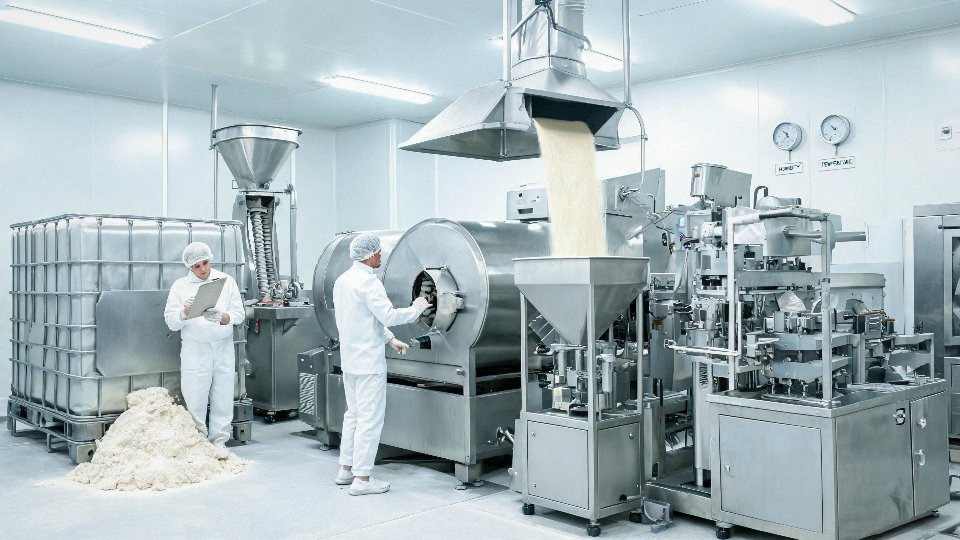
Define silicon dioxide in food manufacturing terms, not just chemistry terms
Silicon dioxide is the compound SiO2: silicon and oxygen bonded in a very stable mineral structure. That chemistry description is accurate, but it is not enough for a plant engineer, a QA manager, or a buyer writing a spec. In food manufacturing, silicon dioxide usually means a purified, food-grade additive or processing aid supplied with controlled particle size, purity limits, microbiological expectations, and documentation suited for edible products.
That is not the same thing as scooping up sand.
Sand is mostly silica in many places, and glass is made from silica-rich raw materials, but food-grade silicon dioxide is manufactured, purified, classified, and sold under food additive or food chemical specifications. Industrial silica used for rubber, coatings, abrasives, foundry work, or construction may have the wrong impurity profile, the wrong particle behavior, or simply no food compliance package. Procurement should not treat “silica” as a generic commodity line. Ask for the exact grade, regulatory status, allergen statement if relevant, country-of-origin paperwork, and whether the supplier supports organic documentation if the finished product needs it.
Food-grade silicon dioxide is not equivalent to sand, glass powder, or general industrial silica just because they share the SiO2 formula.True
The formula may be the same, but food-grade material is controlled for intended food use, purity, documentation, particle characteristics, and applicable additive specifications.
Common forms seen around food plants
The food industry does not use one single physical form in every application. You will see names such as amorphous silicon dioxide, hydrated silica, silica gel, and colloidal silicon dioxide. The language can get messy because suppliers, regulations, and formulation teams do not always use identical naming habits.
Amorphous silicon dioxide is the broad form many food people mean when discussing anticaking or flow improvement. It is not crystalline quartz, and that distinction matters for occupational exposure discussions and supplier selection. Hydrated silica contains associated water in its structure and may be selected for absorbency and surface behavior. Silica gel is familiar as a desiccant, though direct food-use applications depend heavily on the grade and the regulation. Colloidal silicon dioxide is a very fine, high-surface-area material often used where a small amount has a noticeable effect on powder behavior.
Do not over-specify blindly. A spice blender, a supplement capsule line, and a powdered beverage plant may all say they need “silicon dioxide,” but their real problems are different. One needs lower caking after summer storage. One needs tighter capsule fill weights. One needs a flavor oil carried into a dry base without turning the ribbon blender into a paste mixer.
What it does in real products
In dry foods, silicon dioxide is most often used as an anticaking agent or free-flow agent. Typical use levels in powdered foods, seasoning blends, dry mixes, and supplement powders often sit around 0.5% to 2% by weight, give or take. The right number depends on humidity exposure, salt or sugar content, oil load, particle size distribution, packaging barrier, shelf life target, and the regulation that applies to the product. A coastal plant filling paper sachets in August will not behave like a dry inland plant filling foil laminate pouches in January.
It can also act as a carrier. For example, a flavor, color, vitamin premix, or processing component may need a dry support so operators can dose it accurately instead of handling a sticky liquid or paste. As an absorbent, it can pick up surface moisture or oil and keep a blend from smearing along augers and hopper walls. In certain permitted uses, silicon dioxide may function as a defoaming aid or processing aid, though that depends on jurisdiction and product category. In the European Union, for instance, silicon dioxide is identified as E551, but organic use is controlled by organic production rules and additive permissions, not by conventional additive approval alone.
The plant-floor reason is simple: powders are not always well-behaved.
Salt pulls moisture. Onion powder cakes. Paprika carries oil. Cheese powders can smear. Fine botanical powders bridge over hopper outlets, then suddenly collapse and flood the filler. A seasoning blend that looked acceptable in the lab can segregate after vibration during transport, leaving the first cartons weak and the last cartons too salty. Sachet fillers hate that. So do customers who open a dry soup mix and find one hard brick instead of a pourable powder.
Right material, right dose, right mixing order: smoother flow, more consistent dosing, fewer line stoppages. Wrong grade or lazy formulation: dusting, label trouble, poor dispersion, plugged screens, or a customer complaint file full of “clumped,” “hard,” and “would not pour.”
Where the engineering judgment comes in
Silicon dioxide is not magic powder. If the plant has a leaking roof over the minor-ingredient room, operators leave fiber drums open overnight, or the packaging film has poor moisture barrier properties, no anticaking agent will rescue the system forever. I have seen crews blame the ingredient when the real issue was a worn hopper vibrator, a compressed-air line blowing humid air into a filler, or a maintenance habit of washing equipment too late in the day and restarting before everything was truly dry.
For procurement, the practical spec should tie the ingredient to the process need: food-grade status, intended function, particle form, documentation, regulatory suitability, and any organic-program requirement. For engineering, trial it under ugly conditions, not just in a clean beaker. Run it through the actual hopper, auger, checkweigher, and sachet machine after the blend has sat for a realistic hold time.
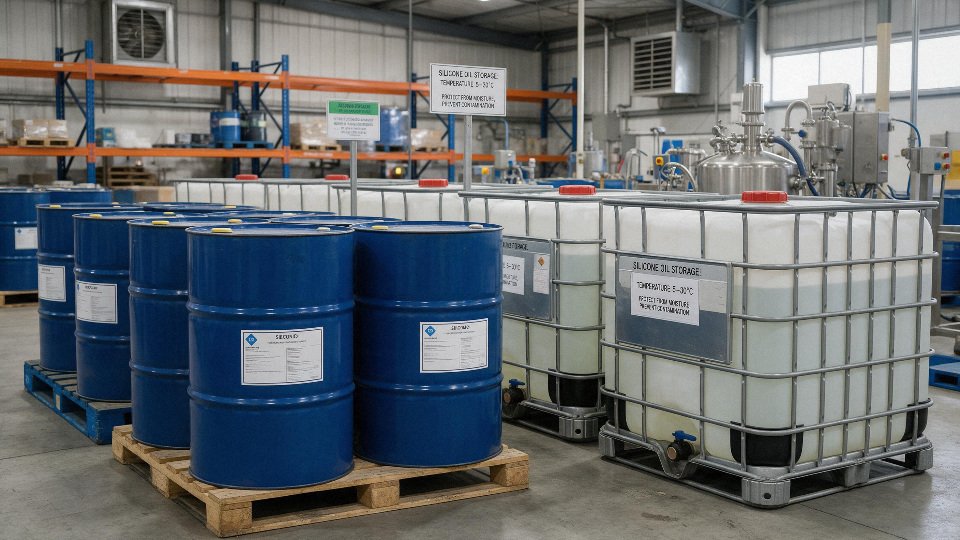
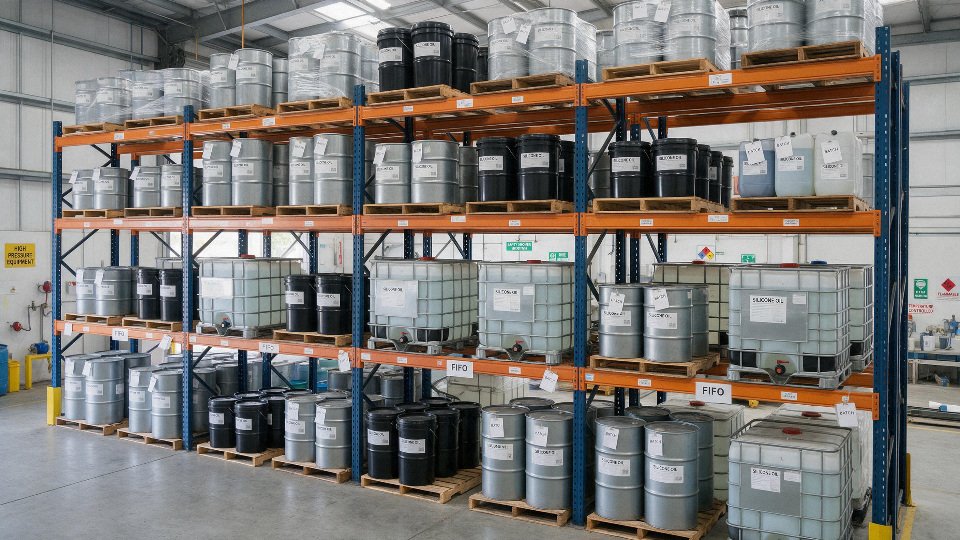
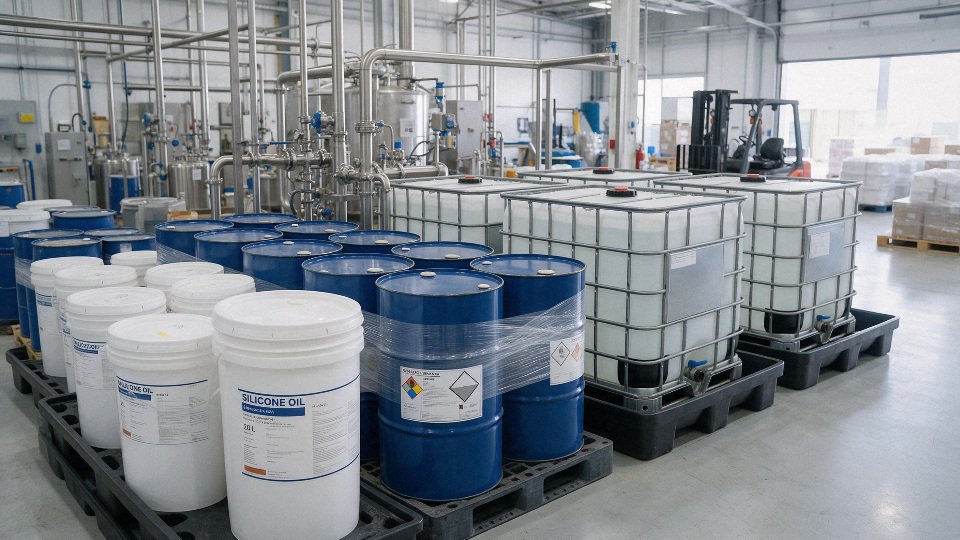
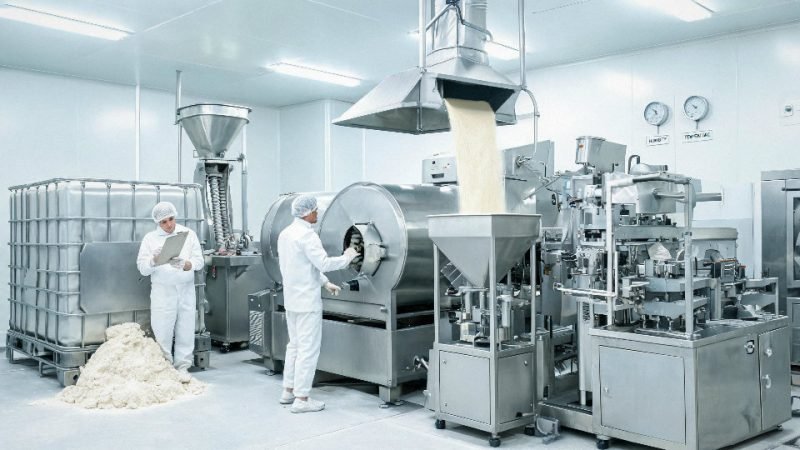
Caption: Flowability comparison of a dry seasoning blend with and without a small percentage of food-grade silicon dioxide.
Alt text: Two dry ingredient streams moving through stainless steel hoppers, one flowing smoothly and one forming clumps because of moisture.
Map the organic regulatory decision: allowed ingredient, restricted use, or prohibited shortcut
Organic compliance is not a simple food-safety screen. A material can be safe for conventional food and still fail an organic review. Certifiers look at four practical questions: what job is the material doing, is that job permitted under the organic standard, is there a less synthetic or organic alternative, and can the processor prove the answer with records rather than a buyer’s email and good intentions.
That is where silicon dioxide gets tricky. In a dry blending room, it may look like a harmless flow aid. In an organic file, it becomes a controlled non-organic substance.
Start with the function, not the material name
The first mistake I see is starting with “silicon dioxide is approved for food use.” That is too broad. The compliance question is narrower: approved for which function, in which product, under which organic program?
A plant using silicon dioxide to knock foam down during processing is in a different position from a spice packer adding it to keep garlic powder flowing through a multihead weigher in August humidity. Same compound. Different regulatory path.
In the United States, the key reference is the USDA National Organic Program, usually called NOP, and its National List of Allowed and Prohibited Substances. Silicon dioxide appears at 7 CFR 205.605(b), which covers certain synthetic nonagricultural substances allowed in processed organic products. The listing matters because organic processors cannot just borrow the conventional food additive rulebook and call it done.
In U.S. organic processing, silicon dioxide is not a blanket-approved anticaking agent for every organic dry product.True
Under 7 CFR 205.605(b), silicon dioxide is listed with a specific allowance as a defoamer, and other uses are limited to cases where organic rice hulls are not commercially available.
The U.S. rule in plain plant language
For U.S. organic products, silicon dioxide is clearly allowed when used as a defoamer under the National List condition. For other functions, such as anticaking or improving powder flow, the rule points you toward organic rice hulls first. Silicon dioxide can only be used for those other purposes when organic rice hulls are not commercially available.
“Commercially available” does not mean “I found rice hulls annoying” or “silicon dioxide is cheaper.” Certifiers usually expect a real evaluation: can organic rice hulls be bought in the needed quantity, quality, particle size, food-grade status, functional performance, and delivery timing? If the product is a fine instant beverage powder, coarse hull material may fail on mouthfeel or sediment. If the line runs high-speed sachets, a substitute that bridges in the hopper every 40 minutes is not functionally equivalent. Document that. Do not rely on memory after the inspection notice arrives.
Use level also belongs in the file. Conventional dry blends often run silicon dioxide somewhere around 0.5% to 2% by weight, depending on powder particle size, fat content, humidity exposure, packaging, and how aggressive the filling equipment is. Organic use should still be the minimum effective amount, not “what we always used on the non-organic SKU.”
Exporters cannot assume one organic answer travels worldwide
The European Union identifies silicon dioxide as food additive E551, but conventional additive approval is not the same as organic permission. EU organic rules control which additives may be used in organic foods and under what conditions. The United Kingdom has its own retained and amended organic framework. Canada, Japan, Korea, and other markets have their own lists, annotations, and certifier practices.
For procurement, this creates a boring but expensive trap. A premix supplier may say, “This is organic-compliant,” while meaning U.S. NOP only. If the finished pouch ships to the EU or the UK, that statement may not be enough. Ask for the destination-market basis in writing. I prefer a supplier declaration that names the standard, the function, the use level range, and any restriction tied to alternatives. Vague letters are weak inspection evidence.
Three possible compliance outcomes
| Outcome | What it looks like in practice | What to keep in the organic file |
|---|---|---|
| Clearly allowed | Silicon dioxide used as a defoamer where the applicable organic standard permits that function | Formula, process step, supplier specification, certifier approval, batch records |
| Conditionally allowed | Used as anticaking or flow aid only after organic rice hulls are shown not commercially available or not technically suitable | Alternative search, supplier quotes, trial notes, quality results, justification, approved formulation |
| Not acceptable | Used for convenience, cost reduction, or standardization without meeting the organic restriction | Reformulation record, rejected material notice, corrected label review |
The “wrong” path is rarely dramatic on day one. Product ships, invoices clear, nobody complains. Then an audit asks why silicon dioxide is in an organic seasoning blend when organic rice hulls were available. Now the brand is dealing with hold notices, relabeling, possible loss of organic claim, and a tense call with the co-packer. That is avoidable paperwork pain.
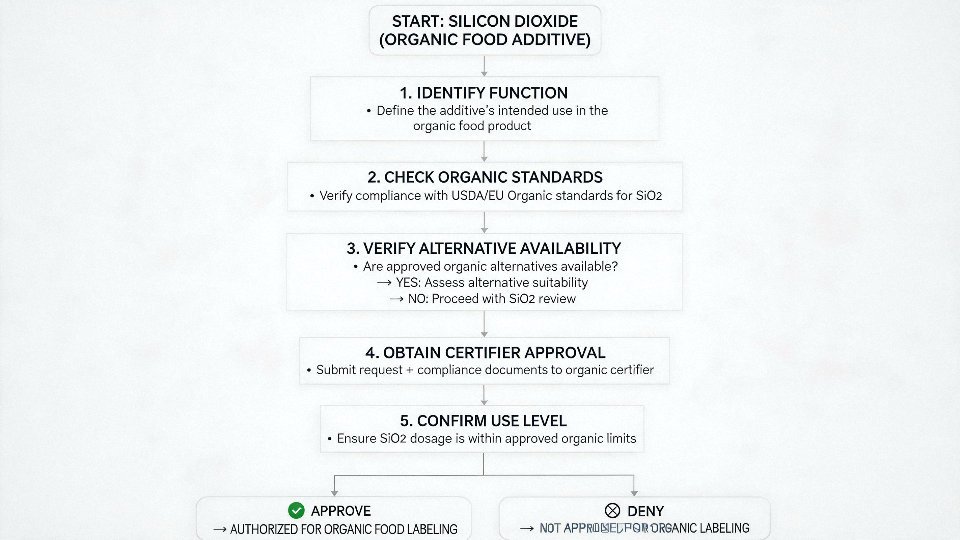
A workable decision path
Use a simple gate review before the first production run:
- Identify function: defoamer, anticaking agent, carrier, flow aid, or something else.
- Check organic standard: U.S. NOP, EU, UK, Canada, or the actual destination market.
- Verify alternative availability: especially organic rice hulls for U.S. non-defoamer uses.
- Obtain certifier approval: before purchase orders and printed packaging, not after.
- Document use level: target range, maximum, and reason it is needed.
- Approve label: confirm ingredient statement, organic claim, and market-specific requirements.
That sequence is not elegant, but it works. On a real floor, it prevents the classic gap between R&D, purchasing, and compliance: R&D solves a powder-flow problem, purchasing buys the cheapest approved-looking grade, and regulatory finds the restriction after labels are printed.
Compare organic rules across major markets before exporting a product
A formula that passes organic review in one country should be treated as “approved for that certificate,” not “approved worldwide.” That distinction saves a lot of rework. I have seen export launches stall over one minor flow agent because the team checked food additive legality, but not organic additive permission in the destination market.
Conventional approval is only the first gate. Silicon dioxide may be legal as a food additive in a standard seasoning, drink powder, capsule fill, or dry mix, yet still be restricted under organic rules. Organic standards look at the technical function, the product category, whether an organic alternative exists, and sometimes whether the substance affects the organic percentage calculation.
If silicon dioxide is legal in conventional food, it is automatically allowed in organic food.False
Organic programs apply separate positive lists, restrictions, and certifier review. Conventional food additive approval does not override organic production rules.
Practical comparison by market
| Market | organic authority | name or code for silicon dioxide | typical permission status | documentation needed | risk level |
|---|---|---|---|---|---|
| United States | USDA National Organic Program | Silicon dioxide; listed under 7 CFR 205.605(b) | Restricted. Listed for defoamer use, and for other uses only when organic rice hulls are not commercially available | Full formula, supplier spec, function statement, organic rice hull availability justification if used for flow or anticaking, certifier approval record | Medium to high, especially for powders |
| European Union | EU organic rules under Regulation (EU) 2018/848 and related permitted input lists | E551, silicon dioxide | Case-specific. Conventional E-number approval is not enough; organic additive permission and food category matter | E-number spec, product category, additive function, recipe percentage, organic certificate chain, importer or control body review | High for multi-ingredient processed foods |
| United Kingdom | UK organic rules, broadly derived from retained EU-style framework, with UK control bodies | E551, silicon dioxide | Similar practical review to EU, but do not assume identical acceptance after rule updates or control body interpretation | UK importer confirmation, control body correspondence, ingredient spec, label draft, certificate of inspection where applicable | Medium to high |
| Canada | Canadian Organic Regime, Permitted Substances Lists | Silicon dioxide, sometimes reviewed by function rather than code alone | Restricted depending on product and use. Check the current PSL and certifier interpretation | CAN/CGSB reference check, formula, processing aid vs ingredient position, supplier declaration, non-organic ingredient justification | Medium |
| Codex-style markets | National rules based partly on Codex organic guidelines | Silicon dioxide or INS/E551 | Not uniform. Codex influence does not mean automatic approval; local positive lists still govern | Local agent review, translated but English-controlled spec pack, additive purpose statement, organic content calculation | Medium to high, depending on local enforcement |
The United States is unusually explicit on the rice hull point. If a U.S. organic dry blend uses silicon dioxide as an anticaking agent, the file normally needs more than “food grade, suitable for organic.” A buyer or certifier may ask: did you try organic rice hulls, did they fail technically, or were they simply more expensive? Cost alone is a weak argument. If rice hulls cause flavor carryover, dark specks in a white powder, allergen cross-contact concerns from the mill, or poor flow through a small auger filler, document the trial. A short plant trial report beats a long email chain.
In the EU and UK, the trap is the E-number mindset. E551 tells the regulatory identity, not the organic permission. The same additive can be treated differently depending on whether it sits in a seasoning, a tablet-style supplement, a bakery premix, or a dairy-containing powder. The technical function also matters. Anticaking agent, carrier, defoamer, processing aid, and nutrient premix carrier are not interchangeable labels. Pick the wrong function on the spec sheet and the review can go sideways.
Canada is usually workable, but it is not a rubber stamp for U.S. formulas. The Canadian Organic Regime relies on its Permitted Substances Lists, and certifiers tend to ask direct questions about why a non-organic substance is present. For a small exporter, the painful part is not the rule itself; it is the timing. If the importer asks for documents after the first production run is packed, the plant may be sitting on pallets with a label claim that cannot ship.
Equivalency helps paperwork, not always formulation
Organic equivalency arrangements can reduce duplicate certification work, but they do not make every ingredient decision disappear. They often apply with conditions, shipment documentation, label rules, and product-scope limits. Multi-ingredient processed foods get the closest look because a certifier has to understand every non-organic minor ingredient, every processing aid, and the final organic percentage.
A spice blend with 0.5% to 2% silicon dioxide by weight may run beautifully through a pouch machine; whether that range is acceptable depends on the destination rule, the food category, the function claimed, and any maximum level or good manufacturing practice limit. Use only what the process needs. Excess anticaking agent can dull color, leave dusty residue in the filler, and invite exactly the kind of reviewer question nobody wants two days before vessel cutoff.
Build a pre-export compliance package before quoting delivery
For export products, I would not release a purchase order or print labels until the compliance pack is complete. Keep it boring and complete:
- Current formulation with percentages, including sub-ingredients in premixes and flavors.
- Ingredient specification for silicon dioxide, including food-grade status, particle type if relevant, and additive code such as E551 or INS reference where used.
- Additive function statement written for the real process: anticaking, flow aid, defoamer, carrier, or processing aid.
- Supplier certificate and non-GMO, allergen, heavy metal, and contaminant declarations where the destination buyer requires them.
- Non-organic ingredient justification, especially in the U.S. if the use competes with organic rice hulls.
- Organic content calculation showing whether the substance is excluded, included, or counted against the organic percentage under that market’s rules.
- Certifier or control body correspondence, saved as a controlled record rather than buried in a salesperson’s inbox.
The right sequence is dull: verify market rule, confirm certifier interpretation, run the plant trial, then approve the label. The wrong sequence is faster for about three weeks. Then it turns into relabeling, blocked inventory, reformulation, or an awkward call with a distributor who already promised organic status to their customer.
Evaluate why brands use silicon dioxide instead of organic rice hulls or other flow aids
Silicon dioxide is rarely chosen because a formulator loves additives. It is chosen because powder behaves badly at scale.
In a lab jar, an organic seasoning blend may look free-flowing for two days. On a plant floor, the same blend can bridge in a hopper, rat-hole above an auger, smear oil onto a ribbon blender wall, and fill 8% light during a humid afternoon shift. That is where silicon dioxide earns its place: low dose, strong surface moisture control, little taste impact, and predictable behavior in feeders and high-speed fillers.
Typical use as an anticaking or flow aid sits around 0.5% to 2% by weight in powdered foods, dry mixes, seasoning blends, and supplement powders. The actual level depends on the oil load, salt and sugar type, particle size distribution, packaging barrier, and the shelf-life target. A dry drink mix going into foil laminate may need less help than a garlic-and-cheese seasoning packed in a thin film pouch for warm distribution.
Organic rice hulls are usually the first alternative a U.S. organic certifier expects a manufacturer to evaluate before relying on silicon dioxide for non-defoamer uses.True
Under the USDA Organic National List logic, silicon dioxide is listed at 7 CFR 205.605(b); for uses other than defoaming, it is tied to the condition that organic rice hulls are not commercially available.
Why silicon dioxide performs so consistently
Silicon dioxide has a very high surface area compared with many agricultural carriers. It can bind surface moisture and oil films without contributing much flavor, color, or bulk. That matters in products where the label says “lemon pepper” or “vanilla protein powder,” not “rice hull.”
It also behaves consistently from lot to lot when bought from a qualified food-grade supplier. The particle size, bulk density, and moisture level are usually tighter than crop-derived materials. That sounds like a purchasing detail until a filler starts throwing weights out of tolerance. A 16-lane stick-pack machine or rotary auger filler does not forgive fluffy, variable powder. If the flow aid changes bulk density too much, operators start chasing settings all shift.
A typical scenario: a spice blend with salt, dehydrated onion, paprika oleoresin, and a small oil-based flavor runs fine in winter. In July, the same blend clumps in a supersack and feeds unevenly. Silicon dioxide at a modest level may stabilize it. Organic rice hulls might help too, but if the hull powder has a coarser cut or a toasted note, the sensory and fill-weight results can move the wrong way.
How the alternatives compare in real formulations
Organic rice hulls are the first place many teams look, especially for USDA organic products. They are agricultural, familiar to certifiers, and usually more label-friendly than a mineral-sounding additive. But they are not a drop-in replacement in every formula. They may need a higher use rate, they can add fiber-like texture, and some grades bring a faint cereal or toasted character. In a chili seasoning, nobody may notice. In a pale vanilla powder, people may.
Rice concentrate can work where a finer, more neutral rice-based carrier is needed, though performance varies by supplier and process. Starches help with moisture and bulk but can dull flavor release or thicken unexpectedly in instant beverages. Cellulose can improve flow and reduce caking, but organic acceptance depends on the exact material and rule set. Calcium silicate and magnesium carbonate are strong mineral flow aids in conventional powders; in organic, they require a careful regulatory check rather than a casual substitution.
Process controls deserve more respect than they get. Lowering room humidity, shortening open-bin dwell time, using dehumidified air at the filler, cooling product before packing, or upgrading to better moisture-barrier packaging can reduce the need for any additive. The catch is cost and discipline. A desiccant wheel, sealed transfer points, and foil laminate are not free. Neither is scrap from caked product returned by a distributor.
Practical comparison table for formulation and purchasing teams
| Flow aid or control method | Organic compatibility | Typical use rate | Flavor impact | Moisture control | Cost | Labeling perception | Best-fit applications |
|---|---|---|---|---|---|---|---|
| Silicon dioxide | Restricted in USDA organic; permitted only under specific National List conditions and certifier approval | About 0.5% to 2%, depending on formula | Usually neutral | Strong for surface moisture and oil films | Usually moderate | Can look “chemical” to some consumers | Seasonings, dry mixes, supplement powders, high-speed filling lines |
| Organic rice hulls | Often the first USDA organic alternative to evaluate if certified organic and suitable | Roughly 1% to 5%, depending on grind and caking pressure | Low to mild cereal note | Moderate | Low to moderate, but crop and grade dependent | Generally better | Spice blends, savory mixes, products tolerant of fiber-like carriers |
| Rice concentrate | Potentially organic-compatible if certified and accepted by certifier | Roughly 1% to 4% | Usually mild | Moderate | Moderate | Usually acceptable | Light-colored powders, blends needing a rice-based carrier |
| Organic starches | Compatible when certified organic and suitable for the product | Roughly 1% to 4% | Can mute flavor or change mouthfeel | Mild to moderate | Low to moderate | Familiar | Baking mixes, dry blends where starch is already expected |
| Cellulose | Depends on source, processing, and organic rule set | About 0.5% to 3% | Usually low | Moderate | Moderate | Mixed; some buyers dislike it | Fiber systems, tablets, some dry mixes |
| Calcium silicate | Check specific organic permissions by market and certifier | About 0.5% to 2% | Usually low | Strong | Moderate | Mineral additive perception | Salt-heavy powders, conventional or specially permitted formulas |
| Magnesium carbonate | Check specific organic permissions by market and certifier | About 0.5% to 2% | Slight mineral risk at higher levels | Moderate to strong | Moderate | Mineral additive perception | Powdered ingredients with high humidity exposure |
| Humidity control and better packaging | Fully compatible as a process approach | No formulation dose | None | Can be strong if well managed | Capital and operating cost vary widely | Best perception | Premium organic products, long shelf-life, humid plants or export lanes |
The commercial availability test is not a paper exercise
For USDA organic work, “organic rice hulls are not commercially available” should be treated like a file you may have to defend. A buyer saying “I could not find any” is weak evidence.
A solid file usually includes supplier search records, dates, names, specifications requested, minimum order quantities, quoted lead times, and price ranges. Keep the trial data too: flow through the hopper, angle of repose if you measure it, fill-weight variation, caking after accelerated storage, sensory comments, and photos of lumps or oiling-off. If organic rice hulls fail because they require 4% and ruin flavor, document that. If they work but lead time is sixteen weeks and your product launches in four, that may or may not satisfy a certifier; ask before production, not after labels are printed.
The right choice is not always the cleanest-looking ingredient statement. It is the option that meets the organic rule, keeps the powder moving, survives distribution, and does not create a hidden cost in downtime, rework, overweight giveaway, or customer complaints. In practice, the best plants test both: a regulatory-compliant organic alternative and the tighter-performing mineral option, then let the certifier, sensory panel, and filling line tell the truth.
Assess safety, toxicology, and consumer health concerns without exaggeration
The safety discussion around silicon dioxide gets messy because one name is used for materials that behave very differently in the body and in the workplace. Food-grade silicon dioxide used as an anticaking or flow agent is typically amorphous silica. That is not the same risk profile as respirable crystalline silica dust from cutting concrete, mining, sandblasting, or handling certain mineral fillers. Crystalline silica, especially fine airborne quartz or cristobalite, is the material tied to silicosis and serious occupational lung disease.
That distinction matters. A consumer swallowing a small amount of food-grade amorphous silicon dioxide in a dry soup mix is not experiencing the same exposure as a maintenance worker breathing fine dust from a bag dump station.
Food-grade amorphous silicon dioxide and respirable crystalline silica should not be treated as the same hazard in risk assessment.True
They differ in physical form, exposure route, particle behavior, and toxicological concern. Food additive assessments focus mainly on ingestion, while crystalline silica occupational limits address inhalation of respirable dust.
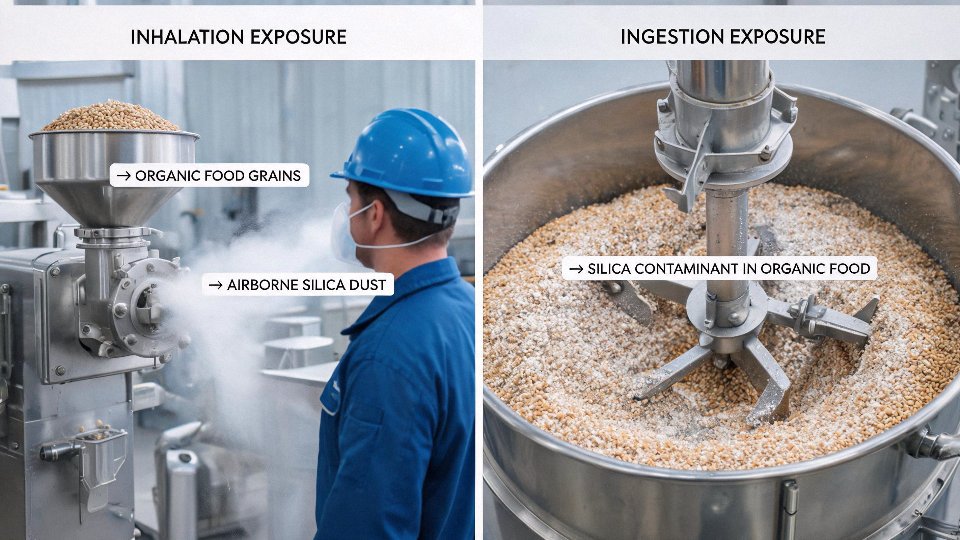
Ingestion risk is not the same as inhalation hazard
For food use, the main exposure route is ingestion. Food-grade silicon dioxide has a long use history, is poorly absorbed in the gastrointestinal tract, and is accepted by major food safety authorities when it meets specifications and is used within the relevant regulations. In practical terms, that means the risk assessment is built around material purity, particle characteristics, dietary exposure, and intended use level.
Plant-floor risk is different. Operators may handle 10 kg bags, fiber drums, or super sacks of very light powder. Tip one of those too fast into a ribbon blender or supplement premix hopper and you will see the dust cloud immediately. The material may be food-grade and still be a nuisance or respiratory exposure concern in the room.
A consumer dose might be a fraction of a gram across a serving, depending on formulation. A worker can be near airborne powder repeatedly during batching, rework, spill cleanup, filter changes, or poorly sealed conveying. Same ingredient name. Different risk.
What the safety consensus really says
The professional consensus is not “silicon dioxide is automatically harmless.” That is lazy language. A better statement is this: food-grade amorphous silicon dioxide has been evaluated by food safety bodies, has low systemic absorption, and is permitted in many food applications when it complies with additive rules, organic rules where relevant, and food-grade specifications.
Typical use as a flow aid in powdered foods, seasoning blends, dry mixes, and supplement powders often falls around 0.5% to 2% by weight, give or take. The actual level depends on particle size of the host powder, fat content, humidity exposure, packaging barrier, filling equipment, and how long the product must flow after warehousing. Organic status does not make the toxicology disappear, but it does restrict why and how the material may be used.
For organic products in the United States, the National Organic Program listing and use limitation still need to be checked. In the European Union, silicon dioxide is E551, but conventional additive approval alone does not settle organic acceptability. Safety and organic compliance are related conversations, not the same conversation.
Real concerns worth handling cleanly
There are a few issues that deserve calm, specific review.
Nanoparticle questions come up often. Some silicon dioxide products contain a distribution of particle sizes, and regulators have examined whether nanoscale fractions change absorption or biological behavior. Procurement should not accept vague certificates that say only “silicon dioxide, food grade.” Ask for a current specification sheet, regulatory status, heavy metal limits, loss on drying, assay basis, and any particle size or surface treatment information relevant to the grade.
Cumulative exposure is another fair question. A person may consume silicon dioxide from seasoning, powdered drink mixes, tablet supplements, instant soups, and other dry foods in the same week. The practical control is not panic; it is using the lowest effective level and avoiding formula creep. I have seen powders where the flow issue was really poor humidity control or a bad screen selection, then someone tried to “fix” it by adding more flow agent. That is not good engineering.
Sensitive consumers may still object for personal reasons. Some brands choose alternatives because their customer base reads labels aggressively. That is a market decision, not necessarily a toxicology decision.
Supplement mega-dosing deserves its own caution. A capsule or scoop product taken several times a day can produce a different exposure pattern from a pinch of dry seasoning. For supplements, review total daily intake assumptions, serving size abuse, and the combined excipient load across multiple products.
Do not confuse consumer safety with worker protection
Even if the finished food is safe for consumers, the plant still needs dust control. Local exhaust ventilation at bag dump stations, enclosed transfer where practical, dust-tight seals on blenders, and sensible housekeeping are not optional niceties. Dry sweeping is a bad habit; it re-suspends dust. Use HEPA-filtered vacuum systems or wet methods where compatible with sanitation and allergen controls.
PPE depends on exposure assessment, but respirators may be needed during charging, spill response, or maintenance. Gloves and eye protection are usually driven by nuisance dust and sanitation practice rather than systemic toxicity. If the plant handles other mineral powders, do not assume all white powders carry the same exposure limit. Check the safety data sheet and, where needed, run industrial hygiene sampling.
Sources a serious file should cite
For a defensible technical file, cite the United States Food and Drug Administration, European Food Safety Authority, the Joint FAO/WHO Expert Committee on Food Additives, USDA National Organic Program materials, and peer-reviewed toxicology reviews on amorphous silica and food additive exposure. Keep those references with the ingredient approval, supplier specification, organic compliance review, and hazard analysis.
That paper trail matters when a customer, certifier, retailer, or auditor asks the blunt question: “Why is this in an organic food, and how do you know it is safe?”
Read the label correctly: what silicon dioxide means on an organic package
On a retail label, silicon dioxide usually shows up in a plain ingredient statement, not in the organic seal itself. You might see it after a powdered spice, in a dry soup mix, in a drink powder, or inside a supplement blend where fine particles would otherwise bridge in the filler, clump in the jar, or dose unevenly through a sachet machine.
A typical callout might read:
Organic garlic powder ingredients: organic garlic, silicon dioxide to prevent caking.
That wording tells you two useful things. First, the garlic is the main agricultural ingredient and is identified as organic. Second, silicon dioxide is being used for a technical job: keeping the powder free-flowing. In many dry products, the level is low, often somewhere around 0.5% to 2% by weight when used as an anticaking or flow agent, depending on the particle size of the powder, moisture pickup, packaging format, humidity in the plant, and how long the product is expected to sit in distribution. Low level does not always mean “not declared.” If the substance has a technical function in the finished food, it commonly belongs in the ingredient statement under the applicable labeling rules.
That is where people misread labels. They see one non-organic-sounding term and assume the entire product is fake organic. Not necessarily.
The presence of silicon dioxide on an organic food label does not automatically mean the product is not organic.True
Silicon dioxide can be permitted in certain organic processed foods under defined organic rules, but the certifier should have reviewed the formula, purpose of use, and any required commercial availability justification.
The name may change by market
In the United States, a label may say silicon dioxide. Some labels or technical documents may use silica, though that term is broader and less precise for food labeling unless accepted by the jurisdiction. In European-style labeling, the same additive may be identified as E551. Exporters learn this the hard way: a formula sheet, retail label, and organic certificate may all describe the same material in different language.
For a quality team, this is not cosmetic. Match the supplier specification, additive declaration, organic approval record, and finished label. If the purchase spec says “food-grade silicon dioxide,” the formula system says “silica,” and the EU artwork says “E551,” someone should confirm they are referring to the same approved material and use. I have seen label reviews get held up for less, especially when a private-label customer’s compliance group is checking every additive against its own restricted-substance list.
Organic does not mean every component is organic
An organic processed product can contain different categories of materials. There are organic agricultural ingredients, such as organic garlic, organic cocoa, or organic oat flour. There may be non-organic agricultural ingredients allowed under specific limits and conditions. There may also be permitted non-agricultural substances used for a defined purpose.
Silicon dioxide falls into that last kind of discussion. It is not an organic crop. It is not being presented as “organic silicon dioxide.” The real question is whether the organic regulation and certifier allow it for that product and that function. Under the USDA organic framework, silicon dioxide is listed on the National List at 7 CFR 205.605(b), with specific restrictions, including defoamer use and other uses only when organic rice hulls are not commercially available. That last phrase matters on the factory side. It can mean supplier searches, documentation, trial records, or a certifier question before approval.
A consumer label will not show all of that back-office work. The organic certificate and product approval file should.
What the ingredient line can and cannot tell you
The ingredient line can tell you silicon dioxide is present and usually gives a hint about its function if the label says “to prevent caking” or similar wording. It cannot tell you by itself whether the certifier accepted the exact use, whether organic rice hulls were evaluated, or whether the level is 0.3% or 1.5%. Those details live in formulation records, supplier documents, organic system plans, and certifier correspondence.
For consumers, the practical reading is simple:
| Label situation | What it usually means | Sensible next step |
|---|---|---|
| “Organic garlic, silicon dioxide to prevent caking” | Silicon dioxide is being used as a functional anticaking agent | Accept it if limited flow aids fit your preference; avoid if you want no such additives |
| “Contains E551” on an organic product | Same additive naming style common in some markets | Check the certifier or brand FAQ if organic compliance matters to you |
| “100% organic” with silicon dioxide listed | Potentially questionable, depending on the rule set and label category | Ask the brand or certifier for clarification |
| “Made with organic ingredients” plus silicon dioxide | May be allowed depending on formula and category rules | Read the full ingredient list, not just the front panel |
Preference is still allowed
Some buyers want the cleanest possible label and will reject silicon dioxide even when it is legal. That is a valid market choice. Others accept a small amount because the alternative is a spice that cakes into a brick, a drink mix that does not dose correctly, or a seasoning line that stops every half hour while operators beat material through a hopper. In humid regions, especially during summer receiving and repack, this is not theoretical. Fine garlic, onion, cheese powders, and mineral blends can turn ugly fast.
The wrong choice has consequences either way. Use an additive without proper organic review and you risk a label nonconformance, product hold, or customer rejection. Refuse every flow aid without testing and you may buy yourself short fills, poor blend uniformity, scrap, and complaints from consumers who cannot shake the powder out of the jar.
A good label reader does not panic at the word silicon dioxide. They ask the right question: was it declared honestly, used for a real technical reason, and accepted under the organic rules that apply to that product and market?
Build a certifier-ready justification file for silicon dioxide use
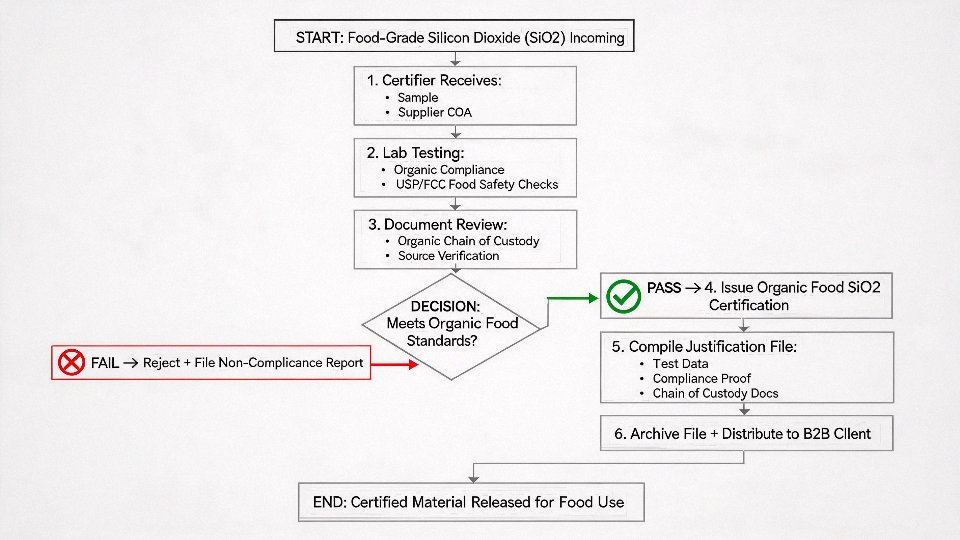
A certifier does not want a sales story about “better flow.” They want to see why silicon dioxide is in the organic formula, what job it performs, why the allowed alternative did not work or was not commercially available, and whether the use level is held to the minimum needed.
Build that file before the first production order, not after the label is printed.
Core documents to keep in the file
For each silicon dioxide source, keep a controlled documentation packet tied to the supplier name, item code, and revision date. In practice, the delay usually starts when purchasing swaps a material because the approved supplier is out of stock and nobody tells quality until the pre-shipment review.
At minimum, the packet should include:
- Complete finished-product formula, with silicon dioxide shown by exact weight percentage and batch quantity
- Ingredient specification for silicon dioxide, including grade, particle type if listed, purity limits, and intended food use
- Food-grade statement from the supplier, not just a generic mineral description
- Allergen statement, including facility cross-contact language where available
- Non-GMO statement if the customer, certifier, or export market requires it
- Certificate of analysis for each lot, or at least each received shipment depending on the plant’s quality system
- Supplier certification or approval record, including organic-handling relevance where applicable
- Safety data sheet, mainly for handling, dust control, storage, and worker protection
- Written intended technical function, such as anticaking, flow aid, defoaming, or dispersion support
That last item sounds simple, but it matters. “Processing aid” and “ingredient” are not casual words in an organic review. If silicon dioxide remains in the finished dry blend at roughly 0.5% to 2% by weight, depending on powder properties, packaging format, humidity exposure, and dosing equipment, call it what it is and document the permitted function.
A certifier may ask why silicon dioxide was used even when the formula level is small.True
Under organic certification, acceptability depends on the allowed use, necessity, alternatives, commercial availability, and label treatment. A low use level alone does not make the ingredient acceptable.
Prove the technical need with plant evidence
A clean justification file has trial records, not opinions.
Run a short no-flow-aid trial if it is safe and practical. Record what fails: caking in the hopper, auger surging, missed fill weights, poor dispersion in the blend, hard lumps after humidity exposure, or rejected bags due to dusty, uneven dosing. Keep the records boring and factual. A tablet blend that shifts from acceptable fill control to frequent overweights and underweights is evidence. So is a seasoning mix that bridges in a 45-degree cone hopper after two hours in summer air.
Useful records include:
- Batch trial sheets with date, batch size, mixer type, and blend time
- Filling accuracy data, such as checkweigher records or manual weight checks
- Sieve or lump-screen findings after storage
- Photos of bridging, caking, or poor discharge, with location and time noted
- Waste logs showing rework, scrap, or line stops
- Shelf-life or abuse-storage results, especially under humid conditions
Do not overdo the lab polish. A practical trial done on the actual filler often carries more weight than a perfect bench test that never saw the packaging line.
Document the alternative review
For products certified under USDA organic rules, silicon dioxide is listed at 7 CFR 205.605(b) with use as a defoamer, and for other uses only when organic rice hulls are not commercially available. That means the file should show that organic rice hulls were seriously reviewed, not dismissed because “we always use silica.”
Keep evidence of:
- Organic rice hull supplier searches, including dates, contact names or emails, and item codes reviewed
- Sample requests and whether samples were received
- Trial results against the same formula, equipment, and packaging target
- Performance comparison: flow, dusting, taste, color, texture, dispersion, fill control, shelf stability
- Commercial availability notes, including lead time, minimum order quantity, price volatility, and supplier capacity
- Written rejection rationale if rice hulls or other alternatives fail
A fair rejection is specific. “Caused visible specking in vanilla powder,” “increased dust at the pouch filler,” or “failed 30-day humidity hold with hard caking” is useful. “Not as good” is weak.
Record the minimum effective use level
Certifiers and technical reviewers are much more comfortable when the use level was bracketed. Test, for example, no flow aid, a low level, a mid-range level, and the proposed production level. The actual range depends on particle size, fat content, hygroscopic ingredients, packaging moisture barrier, and filler design. A fine mineral premix behaves differently from a coarse dry soup blend.
The file should show that the chosen level is no higher than needed. If 0.7% fixes hopper bridging and 1.5% gives no measurable gain, use the lower level unless there is a documented shelf-life reason. That decision saves cost too. Silicon dioxide is not usually the most expensive line item, but excess additive use can create label friction, customer objections, and sometimes texture complaints.
Talk to the certifier before launch
Send the justification package to the certifier before commercial production, especially if labels, retailer approvals, or export certificates are involved. A rejected ingredient after launch is painful: packaging scrap, reformulation, delayed purchase orders, relabeling, customer re-approval, and sometimes held inventory.
I have seen teams lose more money on printed film than they would have spent doing two extra pilot trials.
Proposed audit checklist
| Document | Owner | Update frequency | Certifier relevance | Common failure mode |
|---|---|---|---|---|
| Finished formula with exact use level | R&D or quality | Every formula change | Shows presence, percentage, and technical role | Formula in ERP does not match label or batch sheet |
| Silicon dioxide specification | Quality | Supplier revision or annual review | Confirms grade and identity | Generic spec lacks food-grade language |
| Food-grade statement | Procurement or quality | Annual, or each supplier change | Supports suitability for food use | Statement covers company, not the exact item code |
| Allergen statement | Quality | Annual | Supports risk review and customer files | Facility cross-contact language missing |
| Non-GMO statement, if required | Regulatory or quality | Annual | Needed for some customers and markets | Assumed unnecessary, then requested during shipment release |
| Certificate of analysis | Receiving quality | Each lot or shipment | Confirms lot traceability and compliance checks | COA filed without matching lot number |
| Supplier approval record | Procurement and quality | Annual, plus supplier change | Shows controlled sourcing | Buyer uses alternate distributor without approval |
| Safety data sheet | EHS or quality | Current revision review | Supports handling and dust controls | Old SDS kept after supplier change |
| Technical necessity trial records | R&D, production, quality | At development and major process change | Proves need for the additive | Trial notes say “flows better” with no data |
| Alternative review for organic rice hulls | Regulatory, R&D, procurement | Before approval, then when market availability changes | Supports restricted-use justification | No supplier search, or rejection reason is only cost |
| Minimum effective level study | R&D or process engineering | At development and reformulation | Shows use is not excessive | Only one level tested, chosen by habit |
| Certifier correspondence | Regulatory | Before launch and after changes | Creates approval trail | Verbal approval remembered, but not documented |
Frequently asked questions about silicon dioxide in organic food
Is silicon dioxide natural or synthetic?
Both answers can be misleading if they are used casually. Silicon dioxide is a naturally occurring compound in the earth’s crust, in plants, and in many mineral materials. The food additive used in powders, tablets, seasonings, and dry mixes is usually manufactured to a controlled food-grade specification, often as amorphous silicon dioxide.
Organic rules do not judge it only by the everyday question, “Is this natural?” They classify substances under the applicable organic standard, permitted-use list, and stated technical function. In the United States, for example, silicon dioxide appears on the National List at 7 CFR 205.605(b), with specific restrictions. That regulatory classification matters more in an audit than a marketing team’s description.
A buyer should ask a sharper question: “Is this grade, use level, and function allowed for this organic product in this market?” That is the question your certifier will care about.
Is silicon dioxide the same as sand?
Chemically, both can involve SiO2. Practically, no, they are not the same material for food manufacturing.
Construction sand is a bulk mineral material with variable particle size, mineral contaminants, surface chemistry, and no food additive specification. Food-grade silicon dioxide is produced, processed, tested, and sold against food additive requirements. It is typically amorphous, not crystalline quartz sand, and it is used because very fine particles can reduce caking and improve powder flow.
That distinction is not academic. A seasoning blend that bridges in a hopper, hangs up in a sachet filler, or forms hard lumps after a humid summer shipment may need a flow aid. The plant is not dumping beach sand into the mixer. It is using a controlled additive at a low inclusion rate, commonly somewhere around 0.5% to 2% by weight in conventional powdered products, depending on particle size, oil load, salt content, humidity exposure, and the flow problem being solved. Organic use may be narrower than that, so the permitted level and function still need approval.
Food-grade silicon dioxide and construction sand are interchangeable because both may contain SiO2.False
Food-grade silicon dioxide is manufactured and specified for food use, while construction sand is not controlled as a food additive and is not suitable for food processing.
Is silicon dioxide vegan, gluten-free, or allergen-free?
Silicon dioxide itself is mineral-derived or synthetically manufactured from mineral feedstocks, so it is typically considered vegan. It does not inherently contain gluten, milk, egg, soy, peanut, tree nut, fish, shellfish, or sesame proteins.
Still, do not approve it from a website description. Get the supplier statement.
For a plant QA file, I would normally want the specification sheet, allergen statement, gluten statement if the brand makes a gluten-free claim, vegan or animal-origin declaration where relevant, country-of-origin information, and a non-GMO position if the finished product needs it. Cross-contact risk is usually low for pure silicon dioxide, but repackers and distributors can complicate things. A tote that looks clean on paper may have passed through a shared warehouse with weak lot control. I have seen smaller suppliers handle documentation well, and large suppliers handle it badly. Verify the actual lot and source.
Does silicon dioxide make an organic food unhealthy?
Usually, its presence is a processing-function issue, not a nutrition issue. Silicon dioxide is used to keep powders flowing, reduce clumping, help dose accuracy, or prevent a dry blend from turning into a brick before the customer opens it.
That does not mean every consumer will like seeing it on a label. Some shoppers want organic food with fewer additives, even permitted ones. That is a reasonable preference. From a formulation and safety standpoint, though, the presence of silicon dioxide at permitted food-use levels does not automatically make a product unhealthy.
The better question is what problem it is solving. If a garlic powder, mineral supplement, or drink mix cakes badly without it, the wrong choice can create real waste: rejected pouches, underfilled stick packs, plugged augers, uneven dosing, customer complaints, and rework. If the product flows acceptably without it, leaving it out may be the cleaner label decision.
Can a product be certified organic if it contains E551?
Possibly, but never assume it.
E551 is the European additive number for silicon dioxide. Conventional food additive approval is not the same thing as organic approval. In organic products, acceptance depends on the market, product category, technical function, applicable organic regulation, and certifier interpretation.
A product certified for one market may need reformulation for another. For example, a dry seasoning approved by one certifier for one country might face questions elsewhere if silicon dioxide is being used as a general anticaking agent rather than under a narrower permitted condition. Export labels also create confusion because “silicon dioxide” and “E551” may refer to the same additive but are handled differently by local labeling practice.
Before printing film, send the exact formula, function statement, additive grade, and supplier documents to the certifier or organic control body. Printing first and asking later is how pallets get stuck in quarantine or relabeled by hand. Nobody enjoys that job.
What should brands use instead of silicon dioxide?
There is no universal substitute. The right answer depends on the powder, the packaging line, the climate, and the shelf-life target.
Common options include:
| Option | Where it can work | Watch-outs |
|---|---|---|
| Organic rice hulls | Seasonings, dry blends, some supplement powders | May need higher use levels; can affect texture, bulk density, or specking |
| Starch-based flow aids | Some bakery mixes and powdered foods | Can add carbohydrate, affect labeling, and may not handle oily powders well |
| Formula redesign | Products with excess oil, hygroscopic salts, or fine powders | Takes trial work; may change taste, dose weight, or cost |
| Lower-moisture raw materials | Spice blends, drink mixes, dry premixes | Supplier variability and seasonal moisture swings still need control |
| Humidity-controlled packing | High-value powders and sensitive blends | Requires equipment discipline; doors left open in July can undo the plan |
In practice, the cheapest fix on paper is not always the cheapest in the plant. If removing silicon dioxide slows a pouch line from steady running to constant hopper poking, the labor and giveaway can eat the label benefit fast. Test the alternative under ugly conditions: end-of-shift dust load, humid room air, real storage time, and the actual filler, not just a lab jar on a bench.
Make the final call: practical guidance for consumers, formulators, and organic brands
Silicon dioxide is one of those ingredients that looks suspicious on a label because the name sounds industrial. In a plant, though, it is usually doing a simple job: keeping powders from turning into bricks, sticking in hoppers, bridging over augers, or dosing badly into pouches and jars. The organic question is not “natural or chemical?” That framing causes more confusion than clarity. The real question is whether the use is allowed for that product, in that market, at that level, with that certifier’s approval and the right documentation behind it.
Consumers: read the label, then decide how strict you want to be
If you see silicon dioxide on an organic food label, do not jump straight to “fraud.” It may be present as a permitted processing aid or additive under the applicable organic rule, often for flow control or anticaking. In the United States, the National List treatment is restrictive, not open-ended: silicon dioxide appears under 7 CFR 205.605(b), including use as a defoamer, and other uses are tied to the commercial availability of organic rice hulls.
That said, consumers are allowed to have a tighter personal standard than the regulation. Some buyers are comfortable with a small amount of anticaking agent in an organic seasoning blend because they would rather have the product pour cleanly after two humid weeks in the pantry. Others prefer products with no added flow agents, even if the powder clumps. Both positions are reasonable.
A practical label read is simple:
- Identify the ingredient name: “silicon dioxide,” “silica,” or in some markets “E551.”
- Look at the product type. Dry mixes, spice blends, powdered drink bases, and supplement powders are more likely to need flow help than whole foods.
- Consider function before judgment. If the product is a fine hygroscopic powder, caking is not a theoretical problem; it is what happens in real warehouses, especially in summer.
Formulators: test alternatives first, then document the technical need
For product developers, silicon dioxide should not be the first reflex in an organic formula. Start with organic-compatible alternatives such as organic rice hull powder where it performs adequately, and test them under the conditions the product will actually see: warm warehouse storage, vibration during shipping, partial container opening, high-humidity filling rooms, and long dwell time in a feeder.
Lab beaker flow tells you very little. Run it through the filler.
Typical use levels for silicon dioxide in powdered foods, seasoning blends, dry mixes, and supplement powders often sit around 0.5% to 2% by weight, depending on particle size, fat content, salt level, moisture pickup, packaging barrier, and whether the powder is being spooned, augered, or gravity-fed. The correct number is not the highest level that works. It is the lowest level that gives stable flow, acceptable sensory impact, and compliant labeling.
Wrong call: skip trials, add a flow aid late, and hope certification accepts it. That can lead to relabeling, blocked production release, or finished goods sitting in quarantine while sales is already asking for pallets.
Right call: compare alternatives, record the data, get certifier input before scale-up, and keep the justification tied to the actual technical failure being solved.
Silicon dioxide can be used in some organic foods, but it is not an automatically permitted additive for every organic product or market.True
Organic rules control use by substance listing, function, product category, certifier interpretation, and market. Conventional food additive approval alone is not enough.
Procurement: buy it like a controlled food ingredient, not a commodity powder
Procurement teams should treat silicon dioxide as a qualified food-grade material with traceability, not as a generic white powder available from the lowest bidder. Ask for the full specification, food-grade statement, allergen position, heavy metals limits, particle size range, loss on drying, country of origin, manufacturing site, lot traceability, and change-notification terms. If the product is organic-certified finished goods, the supplier file needs to support that reality.
A cheap substitution can hurt twice. First, the new material may behave differently in the blender or filler because surface area and particle structure vary by grade. Second, the certifier may not accept the documentation, especially if the supplier cannot support intended food use or provide clear traceability.
In practice, I like procurement and quality to agree on “no silent alternates” for these materials. If purchasing changes supplier, grade, plant of origin, or broker, quality and regulatory should review before the first truckload arrives.
Quality and regulatory: keep a living approval matrix
A market-by-market matrix prevents ugly surprises. One column for the United States, one for the European Union, one for Canada, one for any private organic standard or retailer requirement if applicable. List the approved function, maximum internal use level, labeling name, certifier status, product categories, and supporting documents.
Review that matrix before changing:
- supplier or grade
- use level
- product category
- manufacturing site
- label claim
- export destination
- alternative flow aid availability
The European Union, for example, identifies silicon dioxide as E551 in the food additive system, but organic use is controlled through organic production rules and additive permissions, not simply by conventional E-number approval. That distinction matters during export review.
Brand managers: be clear without overpromising
If the product contains silicon dioxide, avoid vague “no additives” or overly broad clean-label language. It creates trust risk. A better approach is plain English: the ingredient helps keep the powder free-flowing, reduces clumping, and lets the consumer measure or pour the product properly.
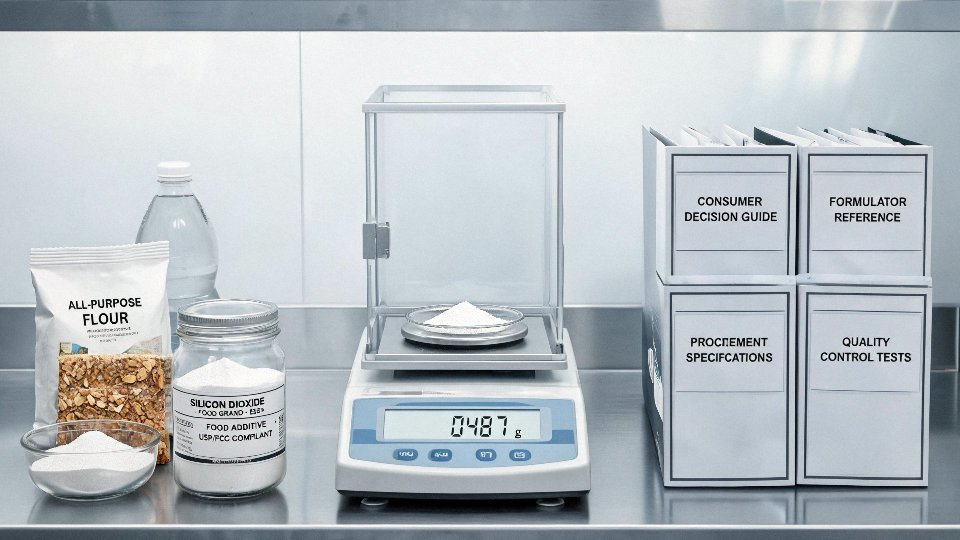
The final call is nuanced but manageable: silicon dioxide can be used in some organic foods, under controlled conditions. It is a technical ingredient with restrictions, documentation needs, and market-specific review. It is not an unrestricted organic default.