
Silane coupling agent procurement looks routine until it isn’t. A single qualification-approved grade — an amino-functional silane for a fiber-reinforced composite line, say, or a methacryloxy type locked into an adhesive formulation — can halt production the moment its availability slips. Lead times that run 4–12 weeks under normal conditions have stretched past 20 weeks during port congestion events and feedstock shortages, and because silane coupling agents are often a minor line item by cost, procurement teams rarely treat them with the same supply-chain discipline applied to bulk resins or metals. The result is outsized downtime risk from a molecule that represents a fraction of total raw material spend.
To assess and mitigate silane coupling agent supply chain risks, procurement and engineering teams should map single-source dependencies by functional chemistry, qualify at least two geographically distinct suppliers per critical grade, hold 8–16 weeks of safety stock calibrated to formulation-switch lead time, and monitor upstream trichlorosilane and chloromethane feedstock markets — because those inputs drive both availability and price volatility more than the silane market itself.
What makes this category genuinely difficult to manage is the concentration of global production capacity. Roughly 60–70% of silane coupling agent output sits within Chinese industrial clusters in Hubei, Jiangsu, and Zhejiang, which means a regional environmental inspection, a logistics disruption, or a feedstock allocation decision can simultaneously affect multiple suppliers a buyer assumed were independent. Understanding how that structural concentration translates into specific operational vulnerabilities — and what practical countermeasures actually hold up under pressure — is where the real risk management work begins.

Mapping the Silane Coupling Agent Supply Chain from Silicon Metal to Finished Grade
Before you can score supplier risk, you need an accurate map of where value — and fragility — actually accumulates. Most procurement teams work from a single-tier view: they see the coupling agent manufacturer and stop there. That is roughly equivalent to managing automotive supply risk while ignoring steel mills. The real exposure sits two and three tiers upstream, in facilities most end-users have never visited and most ERP systems have never recorded.
Tier 4: Quartz Ore and Metallurgical-Grade Silicon Metal
Everything starts with high-purity quartz ore, reduced in submerged arc furnaces to produce metallurgical-grade silicon (MG-Si, typically 98–99% purity). The dominant production geography is concentrated: Yunnan, Xinjiang, and Sichuan provinces account for the majority of Chinese output, with Norway (Elkem and similar smelters) and Brazil (Minas Gerais region) providing the principal non-Chinese supply. Chinese MG-Si production benefits from historically cheap hydropower in Yunnan and Sichuan, but that advantage is also a vulnerability — drought years reduce hydro availability, forcing curtailments that ripple forward within six to ten weeks. Xinjiang capacity adds a separate political-trade exposure that some European and North American formulators are actively working to route around.
MG-Si pricing swings considerably with energy costs and environmental inspection cycles. Expect spot price ranges of roughly USD 1,200–2,200 per metric ton depending on energy tariffs, seasonal hydro output, and regional production quotas — all of which compress or expand margin at every downstream tier.
Tier 3: Trichlorosilane and Tetrachlorosilane Synthesis
MG-Si reacts with anhydrous hydrogen chloride at 300–350°C to yield a mixture of chlorosilanes, predominantly trichlorosilane (HSiCl₃, TCS) alongside tetrachlorosilane (SiCl₄). This is where supply chain fragility is most sharply concentrated. An estimated five facilities in China’s Hubei and Jiangsu provinces supply roughly 55% of global merchant-market TCS volume. That number should give any senior procurement engineer pause.
A single provincial environmental inspection shutdown affecting two or three major Hubei chlorosilane plants can tighten global TCS merchant supply within four to six weeks, with price and availability effects measurable at the finished coupling agent level.True
TCS is a hazardous, pressure-liquefied intermediate with limited long-haul storage viability; merchant inventories are lean, typically two to four weeks of forward cover at formulators, meaning production curtailments propagate quickly rather than being absorbed by buffer stock.
TCS is not a commodity you warehouse freely. It is corrosive, moisture-sensitive, and regulated under pressure-vessel transport rules in most jurisdictions. Formulators typically hold two to four weeks of forward cover, which means any upstream curtailment — whether from environmental enforcement, energy-rationing policy, or a safety incident — becomes visible at the coupling agent level within a single month.
Tier 2: Organosilane Intermediates and Functional Group Incorporation
TCS and SiCl₄ feed synthesis routes that graft functional organic groups onto the silicon backbone. Vinyl, amino, epoxy (glycidoxy), methacryloxy, and mercapto silanes each follow somewhat different reaction pathways and draw on different organic co-reagents — allyl chloride for vinyl types, acrylonitrile-derived intermediates for amino variants, glycidyl ethers for epoxy grades. This matters strategically: 3-aminopropyltriethoxysilane (APTES, CAS 919-30-2) and 3-glycidoxypropyltrimethoxysilane (GPTMS, CAS 2530-83-8) are not interchangeable chemically, but they also do not compete for identical chlorosilane precursor pools. A formulation program that uses both amino and epoxy functional grades gains partial upstream diversification essentially for free — the two product lines are partially insulated from the same batch of supply shocks.
This is why CAS number specificity belongs in your risk mapping exercise, not just your quality documentation. Two products both described commercially as “silane coupling agents” may have meaningfully different upstream exposure profiles.
Tier 1: Finished Coupling Agent Blending, Stabilization, and Packaging
The final manufacturing step involves controlled hydrolysis management, stabilizer addition (to suppress premature silanol condensation during storage), solvent blending where required, and packaging in moisture-barrier containers ranging from 25 kg drums to IBC totes. This tier adds relatively modest technical risk compared to Tiers 3 and 2, but it introduces quality consistency risk — particularly in lot-to-lot silanol content, residual chloride levels, and color specification. A supplier operating with inconsistent Tier 2 intermediate quality will produce finished grades with variable hydrolysis behavior, which surfaces as adhesion failures or coating defects at your plant rather than at theirs.
The practical implication: when you conduct supplier qualification, trace capability questions back through Tier 2 at minimum. A Tier 1 blender without visibility into their intermediate supplier’s process controls is a risk you are carrying invisibly.
Structured Supplier Risk Scoring: Criteria, Weightings, and Red-Flag Thresholds
Qualifying a silane coupling agent supplier on price and lead time alone is how procurement teams end up air-freighting emergency stock of aminopropyltriethoxy silane at four times the contract rate while a production line sits idle. A structured, weighted scorecard forces you to surface fragility before it becomes a shutdown event.
The Six-Dimension Weighted Scorecard
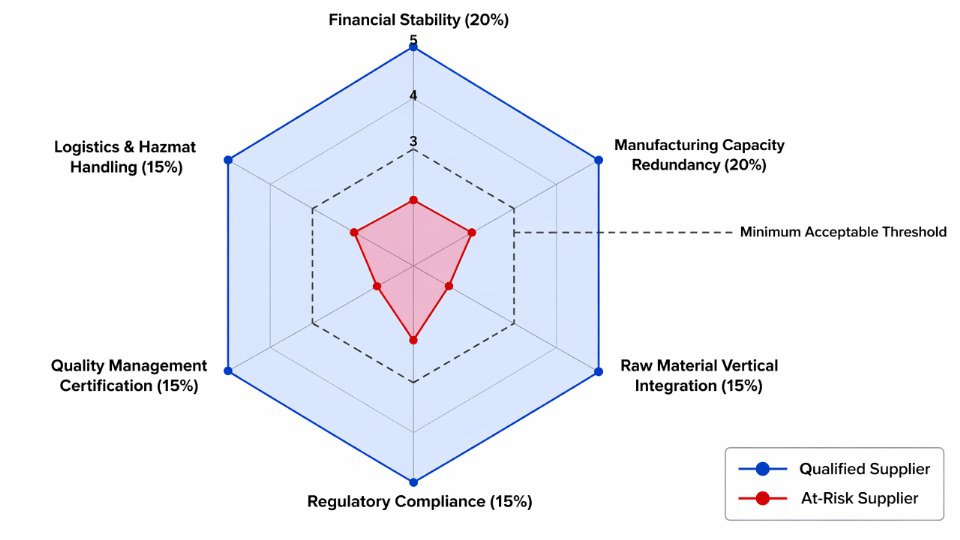
Score each dimension 1 through 5, multiply by its weight, and sum to a composite out of 5.00. A supplier scoring below 3.0 composite warrants a corrective action plan before any volume commitment. Below 2.5, walk away unless you have no alternative — and if you have no alternative, that itself is a supply chain risk you need to document.
| Dimension | Weight | Score 1 (Poor) | Score 5 (Strong) |
|---|---|---|---|
| Financial stability | 20% | No audited statements, high debt-to-equity | Audited 2+ years, investment-grade equivalent |
| Manufacturing capacity redundancy | 20% | Single reactor train, one site | Multiple reactor trains across ≥2 sites |
| Raw material vertical integration | 15% | 100% spot-purchased silicon metal and HCl | Captive or long-term contracted silicon metal supply |
| Regulatory compliance — REACH, GHS, GB | 15% | Active enforcement notices, gaps in SDS | Full REACH registration, current GB 13690 compliance, no MEE notices past 24 months |
| Quality management certification depth | 15% | ISO 9001 lapsed or not held | ISO 9001 + IATF 16949 + ISO 14001, all current |
| Logistics — hazmat handling and export licensing | 15% | No UN hazmat certification, no export license history | IMDG/ADR trained staff, active export licenses, documented cold-chain or inhibitor protocols |
Financial stability deserves the full 20% weighting because a small specialty silane producer carrying significant short-term debt can halt production mid-contract when a silicon metal price spike compresses margins to zero. Request two full fiscal years of audited statements — not management accounts, audited statements. If a supplier refuses, treat that refusal as a score of 1, regardless of what their sales representative tells you about confidentiality.
A silane coupling agent manufacturer with a single production site and no backup reactor train cannot guarantee supply continuity during planned maintenance or unexpected equipment failure.True
Chlorosilane-based synthesis requires reactor downtime for cleaning, inspection, and catalyst replacement. Without a parallel reactor train or a second plant, any unplanned outage directly translates to a supply gap with no internal buffer.
Hard Red-Flag Disqualifiers
Composite score arithmetic cannot override these. Any one of the following disqualifies a supplier from Tier 1 status regardless of how well they score elsewhere.
Single-site production with no backup reactor train is an unconditional disqualifier for any silane grade where your production cannot tolerate a 6–10 week gap. Outstanding EPA or Ministry of Ecology and Environment enforcement notices within the past 24 months indicate active regulatory exposure that can result in forced production suspension — often without advance notice to customers. Inability to provide batch-level certificates of analysis showing GC purity ≥98.5% and refractive index traceable to NIST or a recognized national metrology equivalent disqualifies a supplier on quality grounds; batch CoAs are not optional documentation in any regulated downstream application from automotive adhesives to pharmaceutical packaging. No audited financial statements for the prior two fiscal years disqualifies on commercial risk grounds.
On-Site Audit Protocol for Tier 1 Qualification
Budget two full days. Day one covers process safety: chlorosilane storage and transfer procedures, pressure relief valve inspection records, spill containment integrity, and personal protective equipment protocols for HCl exposure. Distillation column maintenance logs should show scheduled packing inspections and pressure differential trending — a column running above design differential pressure is approaching a capacity or purity problem. Day two covers quality system depth and environmental compliance: review the environmental discharge permits against actual effluent monitoring records, not just the permit documents.
Pull samples from at least three distinct production batches — not the same batch rereleased under three lot numbers, which is a real pattern. Send those samples to SGS, Intertek, or Bureau Veritas for independent third-party verification of purity, hydrolysis index, and functional group content. Repeat this audit annually for any supplier classified as critical to your formulation or process chemistry. The cost of one annual audit, typically in the range of USD 3,000–8,000 depending on site location and scope, is negligible against the cost of a single qualification failure traced to an unverified supplier.
Geopolitical, Regulatory, and Trade-Policy Risks Specific to Silane Procurement
Most procurement teams spend their energy scoring suppliers on lead time and price. The macro layer — energy policy, chemical regulation, tariff schedules — gets reviewed once a year if at all. That is exactly backwards for silane coupling agents, where a single regulatory event or a government energy directive can move spot prices 40–60% inside a single quarter and strand a production line with no legal substitution path.
China’s Energy Rationing and What It Actually Did to Silane Prices
Silicon metal smelting is among the most electricity-intensive industrial processes in China, consuming roughly 10,000–13,000 kWh per tonne of product depending on furnace efficiency and raw material grade. When Beijing imposed provincial power-consumption caps in 2021 under the dual-carbon policy framework, Yunnan, Sichuan, and Inner Mongolia — the three provinces that together supply the bulk of China’s silicon metal — curtailed smelter output simultaneously. Chlorosilane synthesis downstream tightened within weeks.
Vinyl trimethoxysilane (VTMS), a high-volume coupling agent used in wire-and-cable crosslinking and polyethylene modification, saw spot offers climb 40–60% during Q4 2021 relative to the prior six-month average. The spread between contract and spot was wide enough to wipe out a full year of cost-reduction gains for buyers without fixed-price agreements.
Buyers who weathered this best shared two practices. They maintained a minimum 90-day safety stock of their critical silane grades — physically held, not just on paper as supplier-managed inventory. And they had pre-negotiated price-cap clauses, typically structured as a ceiling tied to a published silicon metal index with a contractual trigger requiring renegotiation rather than automatic pass-through. Buyers relying on purely spot or short-term purchase orders absorbed the full spike. The operational lesson is straightforward: energy policy risk in China is not a rare black-swan scenario. It is a recurring structural feature of the organosilicon supply chain that should be treated as a base-case planning assumption.
REACH Registration: The Compliance Trap That Causes Customs Seizures
Any silane coupling agent exported into the EU above one tonne per year must have an active REACH registration dossier submitted by a manufacturer or importer established in the EU, or via an Only Representative arrangement. Several high-volume silanes are already registered — APTES (3-aminopropyltriethoxysilane), GPTMS (3-glycidoxypropyltrimethoxysilane), and VTMS appear in the ECHA registered substances database — but registration belongs to specific legal entities, not to a molecule category.
A Chinese manufacturer holding an ISO 9001 certificate automatically satisfies EU REACH registration requirements for silane export.False
REACH registration is substance-specific and registrant-specific under EU Regulation 1907/2006. ISO 9001 is a quality management system standard with no bearing on REACH compliance status. Buyers must verify the manufacturer's ECHA registration number directly through the ECHA database.
If your current Chinese supplier is not the registered entity and has no valid Only Representative in the EU, your shipment can be detained at the port of entry. Verifying the ECHA registration number before committing to any European procurement decision is not bureaucratic box-ticking — it is the difference between a clean shipment and a seized container with demurrage costs accumulating daily.
US Section 301 Tariffs and the Third-Country Blending Question
Specialty silane coupling agents imported from China under HTS Chapter 38 currently face Section 301 tariffs of 25%. On a USD 5–8 per kg specialty grade, that adds USD 1.25–2.00 per kg before any other landed-cost factors. At typical industrial volumes of 20–50 tonnes per year for a mid-sized compounder, the annual tariff burden reaches USD 25,000–100,000 depending on volume and grade — enough to justify a formal trade structure review.
Some buyers have explored sourcing silane intermediates from China and completing final blending or formulation in Vietnam or Malaysia to claim non-Chinese origin. This approach is legitimate only when substantial transformation has genuinely occurred — meaning the processing in the third country must change the HTS classification at the four-digit level and represent a meaningful value-added step, not merely repackaging or dilution. US Customs and Border Protection has specifically targeted chemical processing operations in Southeast Asia for origin fraud scrutiny since 2022. Any tariff-engineering strategy must be reviewed by a licensed customs attorney and documented with verifiable process records before implementation. The financial downside of a CBP finding of transshipment — back duties, penalties, and potential import restrictions — exceeds the tariff savings by a wide margin.
The practical mitigation for most buyers is less exotic: qualify a secondary supplier in a non-tariff-exposed jurisdiction, model the total landed cost honestly including duty and logistics, and use that figure as the true baseline when evaluating Chinese-origin pricing against alternatives.
Quality Consistency Risks: Analytical Verification Methods and Incoming Inspection Protocols
Silane coupling agents fail quietly. By the time a composite delamination or adhesive bond failure traces back to an off-spec incoming lot, you’ve already run production, consumed substrate material, and potentially shipped to a customer. The inspection work has to happen before that silane enters your process — not after.
The Five Parameters Worth Testing on Every Lot
GC purity is the primary identity and concentration check. For electronic encapsulant and automotive structural adhesive applications, the practical threshold is ≥98.5% by area normalization. Anything below that bracket needs a disposition hold, not a concession. What that figure actually catches is dilution and incomplete reaction product — you’ll see peaks from residual methanol, ethanol, or homologous silanes that shouldn’t be present at detectable levels. Run it on a capillary column with FID detection; DB-1 or equivalent nonpolar phase resolves most functional silane families cleanly.
Refractive index at 20°C is fast, cheap, and catches bulk substitution before you burn GC column time on a suspect lot. APTES (3-aminopropyltriethoxysilane) has a target nD20 of 1.4200 ± 0.0010; epoxy-functional grades like GPS sit closer to 1.4260 ± 0.0015. The tolerance window is narrow enough that a mislabeled drum or a significant blend substitution shifts the reading outside spec within minutes of opening the container. Keep a calibrated Abbe refractometer at goods receipt — this is a 90-second screen, not a lab exercise.
Moisture content by Karl Fischer titration matters most for amino, mercapto, and methacryloxy grades where hydrolysis is irreversible. Target <100 ppm water for moisture-sensitive grades. Values between 100–300 ppm usually indicate compromised packaging seal or warehouse humidity exposure. Above 300 ppm, partial oligomerization has likely begun and GC purity will confirm it — you’ll see a characteristic high-boiling tail and reduced monomer peak area. This is not a recoverable situation; the material’s coupling efficiency is degraded and no drying step restores the original structure.
Color by APHA scale is non-negotiable for optical bonding adhesives and clear coatings. Target APHA 200 ppm on arrival, pull it for full GC before releasing to stores.
Halide contamination from incomplete chlorosilane conversion is detectable only by ion chromatography. Cl⁻ above 50 ppm causes substrate corrosion in electronics applications and inhibits platinum catalysts in silicone cure systems — the effect is silent until cure failure appears downstream. Run IC on new supplier qualifications and whenever a supplier notifies of a process change.
A Statistically Valid Sampling Plan That Scales With Supplier Maturity
Apply ANSI/ASQ Z1.4 Level II AQL 1.0 for visual and packaging inspection — container integrity, label accuracy, fill level, and evidence of heat exposure. For chemical identity testing, tighten to AQL 0.65, which at typical silane lot sizes (20–200 drums) drives sample sizes that catch systematic contamination without being operationally unworkable.
For new suppliers during the first six months: test 100% of lots for GC purity. This isn’t bureaucratic caution — it’s the only way to establish a real baseline for that supplier’s process capability. After three consecutive conforming lots, transition to skip-lot testing with documented trigger criteria for returning to 100% testing (any OOS result, supplier notification of raw material change, or gap in shipments exceeding 90 days). Record the transition date and the qualifying lot numbers in the supplier qualification record. If a skip-lot sample fails, immediately revert to 100% testing and initiate a supplier corrective action request.
Karl Fischer titration moisture content measurement is a reliable leading indicator of hydrolysis-induced oligomerization in silane coupling agents before GC purity degradation becomes severe.True
Water ingress drives hydrolysis of alkoxy groups; the moisture elevation precedes significant oligomer accumulation, giving a practical early-warning window during incoming inspection before the lot is consumed.
The transition criteria matter as much as the initial testing frequency. A supplier qualification record that documents only the approval date but not the testing reduction rationale gives you nothing to work with during a supplier audit or an internal failure investigation.
Logistics Risk Management: Hazardous Goods Compliance, Lead Time Buffers, and Multi-Modal Redundancy
Logistics is the dimension of silane procurement risk that gets the least engineering attention — right up until a container sits in port detention for two weeks because the SDS listed the wrong UN number. At that point, whatever buffer stock you had is gone, and production is negotiating with the scheduling team about what to build next.
Hazmat Classification and Documentation — Where Most Holds Actually Start
Most common silane coupling agents fall into one of two UN classifications: UN 3253 (corrosive liquid, n.o.s.) for amino-functional and some epoxy-functional grades with pH extremes or corrosive hydrolysis products, and UN 1993 (flammable liquid, n.o.s.) for methacryloxy- and vinyl-functional grades with flash points typically in the 23–60 °C range. Under IMDG (sea), ADR (European road), and IATA (air), each classification triggers specific packaging requirements — UN-certified IBCs or closed-head steel drums with UN-rated closures, secondary containment, and segregation rules that vary by co-freight.
The documentation burden is real and unforgiving. A compliant shipment needs an accurate SDS aligned to the destination country’s regulatory format (GHS revision matters — the EU is on GHS Rev. 9, the US still references Rev. 3 for HazCom 2012), a properly completed dangerous goods declaration signed by a certified DG shipper, and packing certificates for the specific UN-rated containers used. Incorrect classification — misidentifying a corrosive as a non-hazardous industrial chemical, or listing the wrong packing group — is the leading documented cause of customs holds and port detention for specialty silanes. Delays from this failure mode run 5–20 days depending on the port authority and whether a physical inspection is triggered.
Incorrect UN classification on shipping documentation is the leading cause of customs holds for silane coupling agent shipments, not volume constraints or tariff disputes.True
Customs authorities at major chemical import ports including Rotterdam, Hamburg, and Los Angeles flag silane shipments primarily for documentation non-compliance — wrong UN number, missing DG declaration, or packing group mismatch — rather than capacity issues. This is consistent with freight forwarder incident data and IMDG enforcement patterns at EU ports.
For air freight specifically, the threshold tightens further. IATA Dangerous Goods Regulations cap quantities per package for many silane grades and require explicit airline acceptance — not all carriers accept UN 1993 in quantity, and approval must be confirmed before booking, not after.
Building a Realistic Lead-Time Risk Model
Baseline sea freight from Shanghai or Ningbo to Rotterdam runs 28–32 days under normal vessel schedules. That number is only the ocean leg. Add 3–5 days for inland trucking and port-side loading in China, 2–3 days for customs clearance at destination, and you are already at 33–40 days before the material reaches your warehouse. Layer on seasonal factors: Chinese New Year (late January through mid-February) and Golden Week (first week of October) each create booking surges and factory shutdowns that routinely add 8–12 days to effective lead time. Then add a disruption scenario buffer. The 2021 Yantian port congestion event pushed lead times for South China origin shipments past 60 days for several weeks; comparable events at Ningbo and Shanghai have occurred within the past four years.
Running those ranges together — baseline transit plus clearance plus seasonal buffer plus a single major congestion event — produces a risk-adjusted order cycle of 73–79 days. That implies a minimum safety stock target of 90 days for any silane grade that is production-critical and has no qualified domestic substitute.
Multi-Modal and Multi-Vendor Logistics Architecture
A single sea-freight lane with a spot-rate strategy is a single point of failure. The structure that actually protects production looks like this:
| Lane | Use Case | Volume Commitment | Cost Basis | Pre-Conditions Required |
|---|---|---|---|---|
| Primary sea freight (long-term rate agreement) | Routine replenishment | ~80% of annual volume | Market rate minus 5–12% for volume commitment | Annual volume forecast, quarterly review clause |
| Air freight via DG-certified forwarder | Emergency replenishment only | No commitment; pre-approved only | 8–12x sea freight cost | Airline DG acceptance confirmed in advance; packing pre-certified |
| Regional distributor buffer stock | Short-term shortfall cover | 30-day consumption equivalent | Negotiated call-off pricing, typically 10–18% above direct price | Distributor holds correct storage temperature and segregation |
The air freight option deserves a direct operational warning: the cost premium of 8–12x sea freight is only defensible when a production stoppage is imminent and no other option covers the timeline. Pre-approving the lane — forwarder selected, DG certification verified, airline acceptance confirmed for your specific grades — is the step most procurement teams skip. When the emergency actually arrives, scrambling for a qualified forwarder costs you the 48–72 hours that made air freight worth considering.
The regional distributor buffer arrangement works best when the agreement specifies grade, drum condition requirements, maximum storage age, and a tested call-off lead time of 48–72 hours. A distributor holding 30 days of your consumption with a vague “available on request” commitment is not a risk mitigation — it is a false comfort.
Contract Architecture and Commercial Risk Mitigation: Price Mechanisms, Force Majeure, and Dual-Sourcing Frameworks
Once you have scored your suppliers and mapped your exposure, the next failure point is almost always the contract itself. Most silane procurement agreements in circulation are either fixed-price annual deals — which collapse the moment chlorosilane feedstock spikes — or simple spot arrangements with no continuity guarantee whatsoever. Neither protects you adequately. What follows is a practical framework for converting identified risks into contractually bounded exposures.
Hybrid Pricing: Indexing That Shares Risk Rather Than Transferring It
Fixed annual prices feel safe during budget season and become liabilities within months. When trichlorosilane and methyltrichlorosilane spot prices moved sharply in both 2021 and 2022, suppliers holding fixed-price contracts either absorbed losses and quietly deprioritized those customers or simply invoked force majeure. Buyers on the other side found themselves without supply and without leverage.
A workable alternative: structure pricing as 60% indexed to the Shanghai chlorosilane spot index (published monthly by ICIS or CCM, depending on your data subscription) and 40% fixed for the 12-month contract term. The fixed component gives your finance team predictability; the indexed component keeps the supplier commercially whole when feedstock costs shift. Critically, cap the quarterly price movement at ±15% regardless of index direction. This ceiling prevents windfall extraction during a shortage and prevents artificial losses during an oversupply period — both of which destabilize the relationship.
The Shanghai chlorosilane spot index is published on a regular monthly schedule by ICIS and CCM and is a recognized commercial benchmark for silane feedstock pricing in China.True
Both ICIS and CCM (China Chemicals & Markets) publish chlorosilane price assessments as part of their Asia organosilicon market coverage, and these indices are used as pricing references in commercial silane supply contracts.
For specialty grades — aminosilanes, methacryloxy silanes, epoxy-functional silanes — add a secondary index adjustment tied to the relevant intermediate (e.g., allyl chloride for some epoxy grades) to avoid a structural mismatch between your pricing formula and the supplier’s actual cost stack.
Force Majeure Clauses That Actually Work for Silane Procurement
Generic “acts of God” language is operationally useless in a chemical supply contract. Silane supply disruptions have specific, predictable triggers, and your clause should name them: government-mandated production curtailments (including environmental inspection shutdowns, which have occurred repeatedly across Hubei and Jiangsu silane clusters), chlorosilane feedstock curtailments at the upstream silicone monomer level, and port or logistics embargoes affecting hazardous goods classification ADR/IMDG shipments.
Require written notification within 48 hours of any event affecting more than 20% of your contracted monthly volume. That threshold matters — it forces early disclosure rather than the slow-motion supply degradation that typically precedes a formal force majeure declaration by six to eight weeks. Mandate pro-rata allocation across all the supplier’s contract customers during any constrained period. Preferential allocation to spot buyers — who are paying premium prices precisely because they have no contract — is a real and common practice that your contract must explicitly prohibit.
Build in a 90-day cure period before you are contractually released to activate alternative sourcing without penalty. This protects both parties: the supplier retains the account if they recover; you retain the right to leave if they cannot.
Dual-Sourcing: Structure, Volume Split, and the Safety Stock Requirement
A dual-sourcing policy only functions if it is structured with enough specificity to survive procurement budget pressure. Designate a primary supplier receiving 65–70% of annual volume and a qualified secondary supplier receiving 30–35%. Annual performance reviews should compare three measurable variables: on-time delivery rate (target ≥98%), lot acceptance rate (target ≥99.5%), and technical support responsiveness measured as time-to-first-substantive-response on quality queries (target ≤24 hours).
The secondary supplier arrangement has one non-negotiable requirement: that supplier must maintain dedicated safety stock equivalent to 45 days of your consumption at all times, verified by quarterly warehouse confirmation. Without this, your secondary source is theoretical during an actual shortage — precisely when every other buyer is also calling them.
A common operational error is treating the secondary supplier as a pure emergency option and placing no routine orders with them for months. When a disruption hits, that supplier has no recent production run calibrated to your specification, no current QC baseline for your lot acceptance criteria, and no logistical familiarity with your hazardous goods documentation requirements. Routine 30–35% volume placement keeps them genuinely qualified, not just nominally approved.
Building Internal Organizational Resilience: Cross-Functional Risk Ownership and Digital Monitoring Tools
Every risk assessment framework documented in a procurement manual eventually fails if no one owns it between crises. The contracts, dual-sourcing agreements, and inspection protocols covered in earlier sections of this article only hold value when a living organizational structure maintains them, monitors leading indicators, and escalates early enough to act rather than react. For silane coupling agents specifically — where lead times can stretch past 20 weeks during disruptions and a single functional grade may feed multiple production lines simultaneously — the margin for slow internal response is essentially zero.
The Cross-Functional Supply Chain Risk Council
Silane procurement risk does not fit cleanly inside any single department. A supply interruption simultaneously triggers a sourcing problem, a technical qualification question, a quality disposition decision, a freight rerouting challenge, and a currency exposure event. Handling that in sequential department handoffs guarantees you lose two to three weeks before the response is even coherent.
The practical answer is a standing cross-functional Supply Chain Risk Council structured around five permanent roles. The senior procurement manager holds primary risk ownership — they track supplier relationships, contract status, and market pricing. A process or formulation chemist sits beside them, because any emergency switch to an alternative silane grade or supplier requires immediate technical assessment of purity thresholds, functional group specifications, and compatibility with existing formulations; procurement cannot make that call alone. The quality assurance lead owns incoming inspection authority and maintains the approved supplier list, which becomes critical during any emergency qualification. A logistics manager monitors inbound freight, manages hazardous goods compliance status, and owns the inventory position in real time. A finance representative handles FX exposure on foreign-currency denominated contracts and coordinates any hedging adjustments when supply risk triggers accelerated purchasing.
In steady state, this council meets monthly — roughly 60 to 90 minutes — to review supplier SRI scores, consume market intelligence, and confirm safety stock levels are tracking against policy. The moment any silane grade enters Amber or Red status on your Supply Risk Index, the cadence shifts immediately to weekly standing calls, with the full council expected to attend. That shift in rhythm is not bureaucratic; it is the mechanism that keeps parallel workstreams — supplier negotiation, alternative qualification, customer communication — synchronized rather than running out of phase with each other.
Four Digital Tools That Give You Earlier Signals
Waiting for a supplier to notify you of a production problem is the worst possible monitoring strategy. By the time that email arrives, lead times have already moved against you.
Chemical market intelligence platforms — ICIS, CCM Online, or SCI99 for China-originated feedstocks — publish chlorosilane spot pricing and production news that typically precede upstream squeeze events by four to eight weeks. A sharp upward move in methyl trichlorosilane pricing, for example, is a reliable early signal that Hubei cluster capacity is tightening. Tracking those price series as a leading indicator costs a fraction of what one missed delivery event costs in line downtime.
Supplier financial health monitoring through services such as Dun and Bradstreet or Creditsafe provides early solvency signals — deteriorating payment behavior, credit score changes, or legal filings — that rarely appear in any supplier’s voluntary communication until the situation is serious. For specialty silane producers operating in a capital-intensive sector, financial stress and quality consistency problems tend to arrive together.
Port congestion dashboards (MarineTraffic, SeaIntel) translate global port dwell-time data directly into expected inbound lead time corrections. If Shanghai or Ningbo container throughput is running 20 to 30% above baseline, your nominal 6-week ocean transit assumption needs immediate adjustment.
Regulatory alert services — ECHA CHEM Monitor for EU-bound shipments, EPA ChemView for US imports — catch classification changes or import restriction updates before they become customs delays. Silane coupling agents containing amino or epoxy functional groups have seen incremental registration updates under REACH in recent years; a procurement team that misses a compliance change discovers it at the port.
Tiered Escalation Keyed to a Supply Risk Index
The SRI scoring system described elsewhere in this article becomes actionable only when it drives defined responses rather than just a number in a spreadsheet.
| SRI Band | Status | Required Actions |
|---|---|---|
| 1–3 | Green | Routine monthly monitoring; standard reorder cycle; no safety stock adjustment |
| 4–6 | Amber | Accelerate next PO by 30 days; activate secondary supplier quote process; increase safety stock target to 120 days of consumption |
| 7–10 | Red | Issue emergency PO to secondary supplier immediately; convene full council within 24 hours; prepare customer communication templates if downstream delivery commitments are at risk |
The 120-day safety stock trigger at Amber is not an arbitrary number. It reflects the realistic worst-case scenario of a 20-plus week specialty silane lead time combined with a 4-week emergency qualification buffer for the secondary supplier. Running below that threshold when early warning signals are already elevated is how plants end up rationing product across production lines.
Cross-functional governance structures with defined escalation protocols meaningfully reduce supply disruption response time compared to ad-hoc departmental handling.True
Operations and supply chain management research consistently shows that pre-assigned role ownership and standing communication cadences reduce coordination latency during disruptions. For chemical procurement specifically, parallel workstreams in sourcing, technical qualification, and logistics cannot be sequentially managed without significant time loss.
The organizational layer is the one most frequently skipped during normal market conditions because it generates overhead with no visible return until something breaks. The return materializes entirely in the crisis — and by then, the companies that built the structure are managing the disruption while their competitors are still figuring out who to call.
Frequently Asked Questions About Silane Coupling Agent Supply Chain Risk

How many suppliers should we qualify for a single silane coupling agent grade?
For any grade consuming more than 5 tonnes per year, qualify a minimum of two independent suppliers — and “independent” means separate production facilities, not two trading companies drawing from the same plant. For grades above 50 tonnes per year, or for any grade used in safety-critical applications such as automotive structural sealing or aerospace composite manufacturing, qualify three suppliers and formally certify all three under your incoming inspection protocol. That last point matters more than most procurement teams realize. Holding three approved suppliers on paper but only ever testing material from one means the other two are theoretical backups, not real ones. Genuine interchangeability requires comparative batch testing, a signed quality agreement with each party, and at least one purchase order placed with each alternative annually to keep the relationship commercially alive.
What is a realistic safety stock level for silane coupling agents sourced from China?
For buyers in Europe or North America, a 90-day safety stock covers the baseline sea-freight transit cycle — typically 25–35 days port to port depending on destination — plus a meaningful disruption buffer. Some buyers in price-sensitive sectors compress this to 60 days. The 2021 supply tightness across specialty organosilicon materials showed clearly that sub-60-day positions left production schedulers with no room to maneuver when lead times stretched past 20 weeks on functional grades like aminopropyltriethoxysilane and methacryloxypropyltrimethoxysilane.
The incremental working capital cost of holding 90 versus 60 days of silane stock is almost always recovered by a single avoided production stoppage.True
A production line stoppage in a compounding or coating operation typically costs USD 15,000–80,000 per day depending on line throughput and product value. The carrying cost of an additional 30 days of silane inventory at typical usage volumes is a fraction of that figure, making the 90-day position financially defensible in most scenarios.
Can we substitute one silane coupling agent with another if our primary grade becomes unavailable?
Within certain functional families, substitution is technically feasible. Switching between a trimethoxysilane and a triethoxysilane variant of the same amino-functional silane, for instance, is often viable — the methoxy variant hydrolyzes faster, which can affect open time in adhesive applications. But “often viable” is not the same as “drop-in.” Any substitution requires formal revalidation: adhesion testing against your actual substrate, compatibility screening with your polymer matrix and any co-additives, and — for regulated end-use applications — potential re-qualification with downstream customers or relevant regulatory bodies. The practical answer is to build a pre-approved substitution list before a disruption occurs, developed jointly with your formulation chemist and signed off by quality. A substitution list assembled during a crisis, under production pressure, is how you get field failures.
How do I verify that a Chinese silane supplier’s quality claims are credible?
Request batch-specific CoAs with GC chromatograms attached, not summary tables with rounded assay figures. Cross-check refractive index and specific gravity values against published reference data — sources such as Gelest or major reagent supplier catalogs provide reliable baseline values for most commercial silane grades. Commission independent third-party analysis of the first three shipments through SGS, Intertek, or Bureau Veritas; the cost per sample run is modest against the risk of processing off-spec material. Conduct or commission a process audit — virtual audits are now widely accepted and cover reactor configuration, distillation train design, QC instrumentation, and batch traceability systems. Reputable manufacturers support customer audits as routine business practice, not exceptional requests.
What REACH and regulatory steps are needed before importing silanes from China into the EU?
Confirm the substance is registered in ECHA’s database under the correct CAS number and that your Chinese supplier is backed by an Only Representative with an active registration covering your annual import volume and the correct tonnage band. Verify SDS compliance with EU Regulation 2015/830. Check whether the substance appears on the SVHC Candidate List or Annex XIV — several organosilicon intermediates have drawn regulatory scrutiny in recent revision cycles — since either status imposes authorization requirements that can halt a product line faster than any logistics disruption.
How should we handle silane coupling agent price volatility in long-term supply contracts?
Avoid purely fixed annual pricing. It concentrates market risk entirely on one party and produces adversarial renegotiation when feedstock costs shift. The hybrid indexing structure covered earlier in this article — approximately 60% linked to a transparent chlorosilane or methanol index, 40% fixed — with a capped quarterly adjustment mechanism, distributes exposure more fairly and keeps the commercial relationship functional through volatile periods. Pairing this with volume commitment tiers, where the buyer commits to a minimum annual volume in exchange for price stability guarantees, aligns incentives durably. Suppliers prioritize customers who provide planning visibility. That priority becomes directly operational when allocation decisions are made during a tight market.