If your PDMS silicone oil supply varies from lot to lot, the trouble usually starts upstream in how the polymer was built, not in the drum label. Small shifts in hydrolysis control, cyclic redistribution, end-capping, stripping, or filtration show up later as viscosity drift, extra volatiles, odor, foaming, or instability in your formulation. On a plant balance sheet that turns into rework, slower line speeds, rejected batches, and awkward procurement conversations when a “like-for-like” replacement does not actually run like the last one.
PDMS silicone oil is typically produced by converting chlorosilanes or related silane intermediates into siloxane units through controlled hydrolysis, then building or redistributing the polymer chain to the required viscosity, end-capping it, and removing low boilers under vacuum. Product quality depends mainly on water reaction control, catalyst choice, molecular-weight management, and devolatilization efficiency.
That simple description hides the part buyers and process engineers care about: where the process becomes sensitive, where cost pressure changes quality, and why one supplier is strong in 100 cSt material but inconsistent at very high viscosity. Once you follow the production route step by step, the reasons behind viscosity range, volatility, clarity, and batch consistency become much easier to judge before you issue a PO.
Feedstocks and intermediates
A lot of PDMS performance is decided before anyone starts talking about viscosity control or final polishing. The feedstock package that matters most is not just “silicone raw materials” in the abstract; it is specifically the quality of methylchlorosilanes, especially dimethyldichlorosilane, plus how cleanly those materials move through hydrolysis, neutralization, and equilibration.
Industrial PDMS starts upstream with the direct process, where silicon metal reacts with methyl chloride over a copper-based catalyst system to form a mixed stream of methylchlorosilanes. That stream is then separated, and dimethyldichlorosilane, usually abbreviated as DMDCS or M2, becomes the principal intermediate for standard polydimethylsiloxane manufacture because each molecule already carries the two methyl groups and two hydrolyzable chlorides needed to build the repeating dimethylsiloxane unit.
In practice, that upstream split matters more than many buyers realize. The direct process does not make only one clean product. It makes a distribution: dimethyldichlorosilane, methyltrichlorosilane, trimethylchlorosilane, and other organochlorosilanes in smaller amounts. If the separation train is loose, or if the cut points drift, those side components show up downstream as branching tendency, altered end-group balance, unstable acidity, and batch-to-batch viscosity scatter. Plants that run well usually treat chlorosilane fractionation as a quality operation, not just a recovery operation.
Main feedstocks and auxiliaries
The core material set is straightforward on paper, but each item has a specific failure mode if quality slips:
- Silicon metal
- Upstream raw material for the direct process
- Particle size, purity, and impurity metals influence chlorosilane distribution and by-product formation
- Source changes can shift selectivity enough to be felt later in PDMS consistency
- Methyl chloride
- Reactant in the direct process
- Water and oxygen contamination are unwelcome; both can disturb catalyst behavior and create side reactions
- Copper-based catalyst system
- Used upstream in the direct process
- Usually includes copper in active forms, often with promoters depending on the plant’s technology package
- Catalyst condition affects the yield and ratio of methylchlorosilanes, especially the proportion of dimethyldichlorosilane
- Water
- Required for chlorosilane hydrolysis
- Hydrolysis is commonly controlled somewhere around 20 to 90°C depending on route, mixing intensity, heat removal, and whether the plant is targeting cyclic-rich or oligomer-rich intermediates
- Water quality matters; dissolved ions are not harmless here
- Neutralizing agents
- Used after hydrolysis to remove or quench hydrochloric acid and adjust the system before further processing
- Choice and dosage affect residual salts, color, and filtration burden
- Acid or base catalysts for equilibration
- Used to redistribute siloxane chain lengths and approach the target molecular weight range
- The preferred catalyst family depends on the route, target viscosity, volatility limits, and purification strategy
- End blockers
- Most commonly hexamethyldisiloxane (MM) or trimethylchlorosilane-derived chemistry
- These terminate chain growth and set the practical viscosity window
- Process solvents, where applicable
- Not every plant uses them in the same way
- They may assist hydrolysis handling, washing, catalyst addition, or stripping, but they add removal and residue-control work later
Why dimethyldichlorosilane purity carries so much weight
If DMDCS purity is high and stable, downstream PDMS production is usually manageable. If it is variable, the polymer plant spends the rest of the batch correcting problems it did not create.
The mechanism is simple. Dimethyldichlorosilane hydrolyzes to silanol-bearing species that condense into dimethylsiloxane structures. When the chlorosilane feed contains too much methyltrichlorosilane, methylvinyldichlorosilane, heavy ends, iron contamination, or poorly separated residues, those impurities alter the hydrolysis pathway or survive into equilibration. That can show up as:
- darker color or color drift on heating
- elevated residual acidity or chloride
- broader cyclic distribution
- unstable viscosity after storage
- inconsistent devolatilization behavior
- more difficult catalyst neutralization and filtration
Buyers often focus on final cSt and volatile content because those are easy to put on a certificate. The harder lesson is that two PDMS fluids can meet the same headline viscosity and still behave differently in compounding, thermal aging, or dielectric use because the upstream chlorosilane cut quality was different.
Final PDMS quality is determined mainly in the polymerization step.False
Polymerization or equilibration sets molecular weight distribution, but much of the final fluid's color, ionic cleanliness, cyclic profile, and batch consistency is already constrained by chlorosilane purity, hydrolysis control, and impurity removal upstream.
The main siloxane intermediates and what they mean
A lot of confusion comes from people using “silicone intermediate” as if it were one thing. It is not.
| Intermediate | What it is | Why it matters in PDMS production |
|---|---|---|
| D4 | Octamethylcyclotetrasiloxane | Common cyclic intermediate for equilibration routes; purity affects final volatility and viscosity control |
| D5 | Decamethylcyclopentasiloxane | May appear in cyclic mixtures; useful in some routes but often managed tightly depending on product target and downstream regulatory/commercial needs |
| Low-molecular-weight linear siloxanes | Short chain dimethylsiloxanes | Can be intermediates, by-products, or intentional chain modifiers |
| Silanol-terminated oligomers | Hydrolysis-condensation products with reactive Si-OH ends | Useful precursors for further condensation or equilibration; very sensitive to residual acid/base and moisture history |
| End-blocked chains | Linear siloxanes capped with trimethylsiloxy groups | Closer to finished PDMS fluid structure; viscosity depends strongly on chain length and end-blocker ratio |
The trade-off here is route flexibility versus purification burden. Cyclic-based routes, especially those involving D4, often give good control in a broad viscosity range from low cSt fluids up to very high viscosities, but they demand disciplined stripping and devolatilization afterward. Typical stripping vacuum may be roughly 1 to 50 mbar, depending on the product and equipment. Hydrolysis-to-linear routes can simplify some aspects, but they can be less forgiving if hydrolysis or end-group control is poor.
End blockers and viscosity control
For standard trimethylsiloxy-terminated PDMS oils, end blockers are what prevent the system from building indefinitely toward gum or resin-like molecular weights. Hexamethyldisiloxane is widely used because it introduces trimethylsiloxy chain ends directly into equilibration. Trimethylchlorosilane can serve the same functional purpose through a different chemical path, often earlier in the sequence or where chlorosilane-based termination is preferred.
The practical effect is easy to picture: more end blocker means more chain ends per unit mass, which means shorter average chain length and lower viscosity. Less end blocker lets the average chain grow longer, pushing viscosity upward. That is why end-blocker ratio is one of the cleanest levers for viscosity targeting, but only if the system is otherwise clean. If water, residual acid, or catalyst carryover are drifting, the same nominal recipe can land in different viscosity windows.
Inputs that quietly destabilize the product later
Some contamination problems do not show up immediately at the reactor manway. They show up after packaging, during customer heating, or six weeks into storage.
Watch these closely:
- Moisture
- Causes uncontrolled hydrolysis in chlorosilane handling
- Can shift end-group balance and generate more HCl than expected
- In packaged fluid, it can support slow instability if reactive residues remain
- Metal ions
- Often enter from water, corrosion, poor lining condition, or catalyst carryover
- Can promote color formation, destabilize catalysts, or create ash and electrical-performance problems
- Chloride residues
- A common root cause of corrosion complaints, odor, instability, and failed downstream formulations
- Especially troublesome in electronics, release coatings, and some personal care or specialty industrial uses
- Catalyst carryover
- Residual acid or base catalyst can keep rearranging the polymer after it should be finished
- That leads to viscosity drift, higher volatiles, gel particles, or storage instability
- Poorly removed low boilers
- Residual D4, D5, or short linear siloxanes may not break the product immediately, but they change flash behavior, evaporation loss, foam behavior, and regulatory acceptability in some markets
The boundary on all of this is worth stating plainly: if you are buying a commodity low-viscosity PDMS for a non-critical use, some upstream variation can be commercially tolerable. Once the application is sensitive to dielectric behavior, thermal color, volatility, compression-set side effects, or long storage life, upstream impurity management stops being a background issue and becomes part of the product itself.
Core manufacturing routes
Industrial PDMS silicone oil is not made by one universal process. In practice, producers choose among four main route families based on the starting intermediate they control, the viscosity window they need, the end-group chemistry the customer is buying, and how tightly they need to hold volatiles, acidity, and molecular-weight distribution from batch to batch.
The broad split is simple: chlorosilane-to-fluid routes favor upstream integration and cost control, while cyclic-based equilibration routes usually give the best flexibility and consistency across a wide product slate. If the purchase requirement is not just “PDMS oil” but a specific combination of viscosity, end-group, volatility, and reactivity, the route matters as much as the nominal cSt value.
Route 1: Hydrolysis of dimethyldichlorosilane, then condensation into PDMS fluid
This is the classic upstream route. Dimethyldichlorosilane is hydrolyzed with water to form silanol-bearing species and low-molecular-weight siloxane oligomers, with HCl generated as a byproduct. Depending on plant design, hydrolysis may run at roughly 20 to 90°C, and the practical challenge is not just conversion; it is controlling phase contact, heat release, acid removal, and the ratio of linear to cyclic species that leaves the hydrolyzer.
What comes out of hydrolysis is not a finished silicone oil. It is a reactive, mixed intermediate stream that typically needs:
- Phase separation and acid handling
- Removal or neutralization of hydrochloric acid
- Corrosion-resistant equipment through the wet and acidic sections
- Tight wash control to avoid carrying ionic residues downstream
- Initial oligomer conditioning
- Reduction of residual silanol and hydrolyzable chlorides
- Adjustment of water content before condensation
- Removal of low boilers and unstable fragments
- Condensation and finishing
- Catalyzed growth of siloxane chain length
- Optional end-blocking depending on target fluid type
- Stripping or devolatilization, often under roughly 1 to 50 mbar depending on viscosity and equipment
This route fits best for lower- to medium-viscosity PDMS fluids, especially in integrated plants that already make or buy chlorosilanes at scale. The mechanism is straightforward: hydrolysis creates the silanol functionality, condensation links Si-O-Si chains, and finishing steps remove water, acid residues, and light fractions. The part that buyers sometimes miss is that small errors early in hydrolysis show up late as haze, odor, unstable viscosity, or poor dielectric behavior.
The trade-off is operational. Direct hydrolysis/condensation can be economical and productive, but it puts a lot of burden on corrosion management, chloride control, and downstream cleanup. Once viscosity climbs, heat and mass transfer get less forgiving, and broad molecular-weight distribution becomes harder to avoid without extra processing.
Route 2: Hydrolysis and cyclization to cyclic siloxanes, then ring-opening equilibration
Many producers intentionally convert hydrolysis products into cyclic siloxanes such as D4 before building the final linear PDMS. That sounds like an extra detour, but it often improves control. The cyclic intermediate can be purified, stored, analyzed, and then fed into a separate equilibration step where molecular weight is set more predictably.
The sequence usually looks like this:
- Hydrolysis of chlorosilanes
- Similar front-end chemistry to Route 1
- Formation of mixed siloxane intermediates
- Cyclization and cyclic recovery
- Generation and separation of cyclics such as D3, D4, and D5
- Distillation becomes critical here; purity depends heavily on column design, reflux control, and contamination load
- Ring-opening equilibration
- Acid- or base-catalyzed redistribution of cyclic siloxanes into linear PDMS
- End groups are controlled by the presence or absence of chain stoppers
- Reaction is driven toward the target equilibrium composition, then catalyst is neutralized or otherwise quenched
- Finishing
- Removal of residual cyclics
- Filtration, polishing, and final viscosity confirmation
This route is widely used for controlled linear PDMS across low, medium, and into higher viscosity ranges, and it is often the backbone of producers supplying multiple grades. The mechanism is worth stating plainly: ring-opening equilibration does not “grow” chains in the same way as a simple one-direction condensation; it redistributes siloxane units until the system reaches a thermodynamic balance shaped by catalyst, temperature, residence time, cyclic composition, and end-blocker level. That gives better control over average chain length, but only if residual catalyst and volatiles are cleaned up properly afterward.
The trade-off flips depending on what the buyer values. More steps mean more equipment, more distillation duty, and more inventory tied up in intermediates. Yet those extra purification stages can produce a cleaner, more consistent PDMS fluid because each stage removes a different problem: hydrolysis residues first, off-spec cyclics next, then residual catalyst and light ends after equilibration. For electronics, release coatings, or precision defoamer systems, that extra discipline often pays for itself.
A longer PDMS manufacturing route can sometimes yield a more consistent final fluid than a shorter route.True
If intermediate purification removes chlorides, water, low boilers, and catalyst residues in separate steps, batch consistency and impurity control often improve despite the added process complexity.
Route 3: Direct equilibration of cyclics with end blockers
If a plant already has purified cyclic siloxanes in hand, direct equilibration with end blockers is often the cleanest and most commercially practical route to trimethyl-terminated PDMS fluids. This is the workhorse route for a broad viscosity range, from low-cSt process fluids up through much heavier materials, provided the reactor, devolatilization, and transfer systems are sized for the viscosity window.
Typical process logic:
- Charge purified cyclics, commonly with D4-rich feed
- Add an end blocker to set average chain length
- Introduce acid or base catalyst under controlled temperature
- Hold to equilibrium
- Neutralize or deactivate catalyst
- Strip residual cyclics and other volatiles
- Filter and pack under conditions that prevent recontamination
The commercial strength here is control. End blocker ratio is one of the main levers on final viscosity: more end blocker generally limits chain length and pushes the product toward lower viscosity; less allows longer average chains. But that relationship is only useful when cyclic purity is stable. A shift in the D3/D4/D5 profile, trace water, or catalyst activity can move the final viscosity, volatile content, and even appearance.
This route is usually preferred for:
– Low-viscosity process fluids where volatility limits matter
– Medium-viscosity lubricating grades where consistency and clarity matter
– Broad product slates that require repeatable batch-to-batch adjustment
Its limitation shows up at the extremes. Very high viscosities become harder to strip, sample, and transfer, and the process window narrows because poor mixing or incomplete devolatilization can leave residual cyclics trapped in the product. At that point, plant hardware matters almost as much as chemistry; anchor agitators, heated lines, good vacuum integrity, and patient cycle times make the difference.
Route 4: Condensation of hydroxyl-terminated PDMS
Where the customer wants silanol functionality or a reactive intermediate rather than a fully end-blocked fluid, producers may work from hydroxyl-terminated PDMS and extend chain length by condensation. This is common in product families used as reactive bases for sealants, modified silicones, and further functional derivatization.
This route is selected less for commodity fluid output and more for end-group preservation. The plant must control:
- Residual water, because it shifts condensation behavior
- Catalyst choice and residue, because reactivity in the customer’s process can be affected
- Final silanol level, because that defines storage stability and downstream cure response
- Packaging and handling, since silanol fluids can change on storage if moisture management is poor
The gain is clear: you keep reactive chain ends available. The sacrifice is storage robustness and, often, some of the batch-to-batch simplicity you get with fully trimmed PDMS fluids. In practice, these products need tighter agreement between supplier and buyer on acceptable viscosity drift, moisture limits, and shelf-life conditions.
Integrated versus non-integrated plants
Integrated producers usually have an advantage in chlorosilane purity control, raw material cost, and supply continuity because they can manage the interface between upstream synthesis, hydrolysis, cyclic generation, and final fluid production. That matters when markets tighten or when a customer is buying large volumes over many months rather than spot cargoes.
Downstream-only or toll manufacturers can still be very good suppliers, but their strengths are different:
| Plant type | Typical strengths | Typical constraints |
|---|---|---|
| Integrated chlorosilane-to-PDMS | Cost position, continuity, impurity control from the front end, broad scale | Less agile on small custom campaigns in some plants |
| Cyclic-based downstream producer | Flexibility, grade customization, faster campaign switching, focused finishing control | Depends more on purchased intermediate quality and outside supply stability |
| Toll or custom processor | Niche formulations, customer-specific finishing, smaller lots | Variable raw material control, economics weaker for large commodity volumes |
For procurement, the right question is not “Which is better?” but “Where is the quality risk actually controlled?” If chloride carryover, low volatiles, or tight viscosity spread are critical, ask where those variables are measured and corrected: at chlorosilane production, cyclic purification, equilibration, or final finishing. A non-integrated plant with strong incoming-spec discipline and excellent stripping can outperform a loosely run integrated site; the reverse is also true.
Which route fits which product requirement?
- Low-viscosity process fluids
- Often favor purified cyclic equilibration with strong stripping control
- Residual cyclic and narrow viscosity tolerance usually matter more than maximum throughput
- Medium-viscosity lubricating grades
- Can come from direct hydrolysis/condensation or cyclic equilibration
- The better choice depends on volatility target, color, odor, and batch consistency expectations
- High-viscosity gum precursors
- Usually need tighter control of chain growth, devolatilization, and mixing hardware
- Route choice becomes plant-specific; not every PDMS unit can run these grades well
- Reactive silanol fluids
- Usually point toward hydroxyl-terminated routes or controlled partial end-blocking
- Storage, packaging, and moisture management become part of the product specification
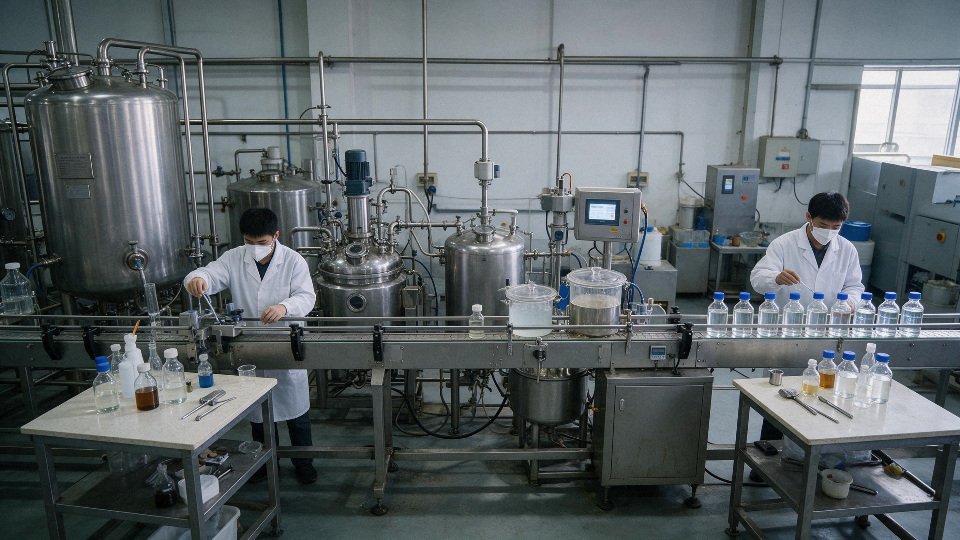
A buyer comparing quotations should read the route behind the product, not just the COA line items. Two suppliers may both offer, say, a 350 cSt PDMS fluid, but if one is making it through purified cyclic equilibration with tight devolatilization and the other is finishing a broader hydrolysis-condensation stream, the fluids can behave differently in foaming, lubrication, dielectric use, or long-term storage. The route stops being the main differentiator only when the application is tolerant of wider impurity and molecular-distribution variation.
Hydrolysis and equilibration chemistry
PDMS is formed by a two-stage chemical logic: first, chlorosilanes are hydrolyzed to reactive silanol-bearing species while liberating hydrochloric acid; then those species condense and redistribute into siloxane chains and rings until the system reaches the target molecular equilibrium. In plant terms, chain length, end groups, cyclic content, and much of the final fluid behavior are set less by one reaction than by how hydrolysis, acid removal, equilibration, and end-blocking are coordinated.
What actually happens during hydrolysis of dimethyldichlorosilane?
Dimethyldichlorosilane, usually written as Me2SiCl2, reacts with water very fast. The Si-Cl bonds are moisture-sensitive and hydrolyze to silanol-type species, with hydrochloric acid generated stoichiometrically. Those silanols are not stable for long under typical process conditions; they condense readily to Si-O-Si bonds, producing low-molecular-weight siloxanes, water, and a shifting mixture of linear and cyclic oligomers.
A simplified reaction sequence looks like this:
- Hydrolysis
- Me2SiCl2 + 2 H2O → Me2Si(OH)2 + 2 HCl
- Condensation
- 2 Me2Si(OH)2 → HO-Me2Si-O-SiMe2-OH + H2O
- Further condensation / cyclization
- Silanol-bearing oligomers continue reacting to form:
- linear siloxane oligomers
- cyclic siloxanes
- water and HCl-containing aqueous phase byproducts
That tidy scheme hides what operators actually deal with. Hydrolysis is strongly exothermic, and if the water-to-silane contact is poor, the reaction can localize at the phase boundary, giving uneven temperature rise, aggressive HCl release, and a broad oligomer distribution before the batch is even transferred downstream. In practice, feed addition rate, agitation intensity, droplet size, and temperature control matter as much as nominal stoichiometry.
How do hydrolysis conditions change the intermediate siloxane mixture?
A narrow, controllable hydrolysis window usually sits somewhere around 20 to 90°C, depending on the route, reactor design, and how the producer manages heat removal and acid handling. Colder operation can improve control of heat release and phase behavior, but it may slow disengagement and leave a more stubborn emulsion. Warmer operation often breaks emulsions faster and improves mass transfer, yet it can also accelerate condensation and side redistribution before the target intermediate profile is established.
The main operating effects show up in a few linked areas:
- Emulsion behavior
- Hydrolysis of chlorosilanes creates an organic siloxane-rich phase and an aqueous HCl-rich phase.
- Fine dispersion improves reaction completeness but can make separation miserable.
- Persistent emulsions increase residence time, complicate washing, and can drag acid and salts into the crude siloxane stream.
- Heat release
- Fast addition of chlorosilane into water, or poor agitation around the feed point, can create local hot spots.
- Hot spots promote uncontrolled condensation and broaden the oligomer slate.
- On larger units, this is where jacket capacity and feed nozzle design stop being secondary details.
- Phase separation
- Good separation reduces residual HCl and dissolved water carried downstream.
- Poor separation means the next vessel is not just processing siloxanes; it is also dealing with acid, moisture, and corrosion risk.
- Oligomer structure
- Early-stage hydrolysis and condensation determine how much of the crude mixture is low linear oligomer, silanol-rich species, or cyclic material.
- That matters because equilibration later starts from whatever structure distribution hydrolysis hands it.
- Byproduct load
- Residual HCl, salts from neutralization, water, and low boilers all affect downstream catalyst performance and stripping efficiency.
- In a plant, a “chemistry problem” often shows up first as foaming under vacuum, off-spec chloride, or faster-than-normal filter plugging.
The mechanism is straightforward: hydrolysis creates silanols, silanols condense to siloxanes, and both acid and water influence how far and how fast those reactions proceed. The trade-off is control versus throughput. High-intensity hydrolysis can push production rate, but if it leaves a dirty or poorly separated intermediate, the penalty shows up later as wider viscosity spread, harder devolatilization, and more variable stability.
Why do cyclic siloxanes form, and are they a problem?
Cyclic siloxanes are a normal consequence of siloxane chemistry, not just contamination. During condensation and later redistribution, siloxane bonds break and reform reversibly, and intramolecular closure can produce rings such as D3, D4, D5, and higher cyclics. Whether a given route treats them as a byproduct to minimize or an intermediate to exploit depends on the process design.
They arise through two main paths:
- Condensation-stage cyclization
- Short silanol-containing oligomers can close into rings as they condense.
- Equilibration-stage redistribution
- Existing linear and cyclic siloxanes exchange siloxane bonds under catalysis until they approach equilibrium.
That second point matters commercially. Many PDMS processes deliberately use cyclic siloxanes, especially purified cyclics, as starting intermediates for controlled ring-opening polymerization or equilibration to target a defined viscosity range. So cyclics are not inherently “bad.” They become a quality issue when their residual level in the finished oil is too high for the application, particularly where volatility, fogging, extractables, or flash behavior matter.
A buyer should not assume that two 100 cSt PDMS fluids are equivalent just because both pass a viscosity check. One may have lower residual cyclic content and tighter devolatilization; the other may carry more D4/D5 or low linear oligomers, which can shift evaporation loss and long-term behavior in service.
How does equilibration control chain length?
Acid- and base-catalyzed equilibration both work by making siloxane bonds exchangeable, but they do not behave identically in production. In either case, the system moves toward a thermodynamic distribution of linear and cyclic species, and average chain length is then set by the ratio of difunctional siloxane units to chain-stopping end groups.
Acid-catalyzed equilibration
Acid catalysts promote cleavage and re-formation of siloxane bonds through protonation pathways. These systems can be effective, but they require tight control because residual acidity can continue changing the product if not neutralized or removed properly. Acid traces also complicate downstream stability and can contribute to corrosion or color issues if cleanup is poor.
Base-catalyzed equilibration
Base catalysis is widely used for controlled equilibration of siloxanes. Basic species open cyclics and redistribute linear chains efficiently, often giving good control over viscosity build when the feed and end-blocker ratio are well managed. The practical catch is that catalyst quenching, filtration, and volatile removal have to be done properly; otherwise the product can keep drifting or carry catalyst residues that show up later in storage or customer processing.
Residual catalyst and residual acid both matter after target viscosity is reached; stopping the reaction on time is only half the job.True
In siloxane manufacture, post-reaction cleanup is critical because ongoing redistribution or contamination can shift viscosity, stability, color, corrosion risk, and volatile profile during storage.
The mechanism worth remembering is this: equilibration does not “grow” one ideal chain. It constantly breaks and reforms siloxane linkages across a population of molecules. That is why residence time, catalyst strength, water level, temperature, and end-blocker charge all interact. A small drift in any one of them can move the final distribution, even if the average viscosity still lands near target.
What do end blockers actually do?
End blockers cap reactive chain ends and determine the average degree of polymerization. Hexamethyldisiloxane is a common example for trimethylsiloxy end-capping, though the exact blocker depends on the desired terminal functionality.
Their effects are direct:
- More end blocker
- lower average molecular weight
- lower viscosity
- higher volatility tendency
- typically better flow at low temperature
- Less end blocker
- higher average molecular weight
- higher viscosity
- lower fraction of short volatile species if devolatilized well
- but more sensitivity to broad distribution and harder stripping at the heavy end
If the end groups are not inert trimethylsiloxy groups but reactive groups such as hydroxyl or functional organic substituents, the fluid behavior changes beyond viscosity. Terminal silanol, for instance, can increase reactivity, moisture sensitivity, and long-term viscosity drift under some storage or use conditions.
The preferred choice flips with the application. For a heat transfer or release-type fluid, a stable, well-capped PDMS with controlled low volatiles is usually the safer commercial target. For a downstream formulator making emulsions, sealants, or reactive silicone derivatives, retained functionality may be necessary even though storage stability is less forgiving.
How does molecular architecture show up in measured properties?
Viscosity is the first property most buyers ask for because it is easy to specify and easy to test. It correlates broadly with average molecular weight, but that correlation has limits. Viscosity is a practical proxy, not a full structural description. Similar-viscosity PDMS fluids can differ materially in cyclic content, end groups, molecular weight distribution, and storage stability.
Here is how structure connects to observable properties:
| Property | Main structural drivers | What commonly shifts it |
|---|---|---|
| Viscosity | Average molecular weight, distribution breadth, temperature | End-blocker level, equilibration extent, residual low boilers |
| Volatility loss | Cyclic content, low linear oligomers, stripping efficiency | Devolatilization conditions, vacuum level, residence time |
| Pour behavior / low-temperature flow | Chain flexibility, low-MW fraction, distribution | End-group type, broadness of oligomer mix |
| Flash point tendency | Low-volatility profile, residual light ends | Cyclic carryover, incomplete stripping |
| Long-term stability | Terminal functionality, catalyst residue, acid residue, moisture | Cleanup quality, neutralization, filtration, packaging discipline |
A broad molecular weight distribution can produce a fluid that looks acceptable on a single viscosity result yet behaves poorly in service. The low end of the distribution drives volatility and fogging; the high end can affect flow, pumpability, and consistency. In one plant this often shows up when two lots both read, say, 350 cSt, but one strips clean and stays stable while the other loses more weight on heat aging and throws off a sharper odor from retained low boilers.
The main conclusion holds only if the fluid is being compared within a similar chemistry family. Once terminal groups change, or residual cyclic content differs significantly, viscosity alone becomes a weak predictor of performance. At that point, buyers need at least volatile content, end-group information where relevant, and some indication of distribution control or application testing rather than a single cSt number.
Process control stages
Consistent PDMS silicone oil is won or lost in the handoff between chemistry and operations. The broad sequence is straightforward, but repeatable viscosity, low residual volatiles, acceptable color, and storage stability depend on how tightly each stage is controlled, not just which reaction route is chosen.
A plant can make usable PDMS with fairly ordinary unit operations; making the same grade week after week is harder. Metering drift, trace acidity, wet packaging, a lazy wash step, or over-stripping under vacuum will show up later as viscosity creep, haze, odor, corrosion complaints, or customer-side foaming. That is why experienced producers treat receiving, reaction, finishing, and filling as one continuous control chain rather than separate departments.
Raw material receiving and verification
Before a reactor starts, most of the future quality risk is already on site.
For PDMS made from chlorosilanes or cyclic siloxanes, incoming control usually covers these material groups:
- Chlorosilanes
- Identity and assay
- Water-reactive behavior and container integrity
- Appearance and absence of hydrolysis haze
- Acidic impurity profile where supplier history justifies it
- Transfer compatibility with dry, corrosion-resistant lines
- Cyclic siloxanes or preformed intermediates
- Composition profile, especially relative cyclic distribution if that matters to the route
- Moisture
- Acidity or residual catalyst carryover
- Color and clarity
- End blockers
- Correct functionality and assay
- Water content
- Compatibility with the selected catalyst system
- Storage condition, since some are less forgiving of ambient moisture than buyers assume
- Catalysts and quench agents
- Concentration verification
- Activity consistency lot to lot
- Solubility or dispersion behavior in the intended process medium
- Shelf-life control
- Water
- Conductivity or ionic cleanliness
- Hardness
- Suspended solids
- Microbial load where long hold times exist, though this matters more in some finishing systems than in the reactor itself
- Packaging components
- Drum or IBC cleanliness
- Liner compatibility
- Seal integrity
- Residual moisture inside small packs
- Correct labeling and traceability coding
In practice, plants often underestimate packaging as a quality variable. A dry, clean fluid filled into a damp drum can come back as a “product instability” complaint. It is not glamorous, but procurement and production need the same discipline on containers as on catalysts.
Metered hydrolysis and primary reaction control
Hydrolysis is usually the first stage where poor control becomes expensive. For chlorosilane-based routes, water addition rate, temperature rise, mixing intensity, and HCl removal strategy all interact; change one and the others move with it.
Typical hydrolysis is run in a controlled range of about 20 to 90°C, depending on route, reactor design, and whether the plant is trying to slow the exotherm, accelerate conversion, or shape the intermediate distribution. Faster addition and weak heat removal tend to create local hot spots. Those hot spots can push side reactions, generate difficult emulsions, or burden the downstream wash train.
Equipment choice matters here more than brochures suggest. Common design priorities include:
- Corrosion resistance
- Glass-lined vessels in some services
- Suitable high-alloy or lined piping for acidic exposure
- Gasket and valve-seat materials that tolerate both chlorosilanes and acidic hydrolysis media
- Agitation
- Enough shear to avoid phase pockets
- Not so much vortexing that vent loading and entrainment become chronic
- Baffling and feed-point design that prevent localized overreaction
- Temperature control
- Jacket or external loop duty sized for exotherm, not just average heat load
- Feed interlocks that slow or stop addition if temperature runs away
- Multiple measurement points where vessel scale justifies them
- HCl handling
- Closed vent collection
- Scrubbing capacity matched to peak generation, not average
- Materials selection in ducting and scrubber sections that survive wet acid service
HCl handling is just an environmental side issue, not a product-quality issue.False
Poor HCl removal and containment can shift local acidity, worsen corrosion, contaminate downstream streams, and disrupt stable hydrolysis control. It affects safety, equipment life, and often product consistency.
Phase separation, washing, and neutralization
Once hydrolysis is complete, separation and cleanup determine whether the later polymerization behaves predictably. Residual acid, dissolved salts, ionic carryover, or poorly broken emulsions can poison catalysts, accelerate unwanted redistribution, or create storage drift.
This stage commonly includes:
- Settling or phase separation
- Adequate residence time for clean interface formation
- Temperature held high enough to reduce viscosity if needed
- Interface control that avoids dragging aqueous phase forward
- Washing
- Water quantity and number of stages chosen based on residual acidity and impurity load
- Gentle enough mixing to contact phases without creating stubborn emulsions
- Water quality control, because dirty wash water simply trades one impurity set for another
- Neutralization
- Used where process design requires it to remove or consume residual acidic species
- Dosed carefully; over-neutralization can leave its own residue problem
- Followed by verification, not assumption
- Drying or pre-drying
- Removal of dissolved water before catalyst-sensitive steps
- Often tied to vacuum, heat, or both depending on viscosity and solvent-free design
The mechanism is simple but easy to ignore: ionic residues remain active long after the obvious reaction is over. They can continue catalyzing bond redistribution, corrode downstream hardware, or seed haze formation through salt traces and micro-droplets. A PDMS fluid that passes viscosity today but drifts after a few weeks often points back to incomplete cleanup, not bad luck.
Equilibration or polymer growth to target viscosity
This is the stage buyers usually care about most, even if they never see it. Viscosity target is set by catalyst system, temperature, residence time, and stoichiometric balance between cyclics or reactive intermediates and end blockers.
For typical commercial PDMS fluids, the practical product window is broad, often from 5 cSt up to 1,000,000 cSt, but the control difficulty rises sharply with viscosity and with tighter customer tolerances. Low-viscosity grades are generally more sensitive to volatile balance and end-group accuracy; higher-viscosity grades are more exposed to mixing limits, heat transfer, and long-tail molecular-weight distribution.
What operators watch closely:
- Catalyst addition accuracy
- End blocker ratio
- Batch or continuous residence time
- Reactor temperature profile
- Moisture ingress
- Sampling timing and sample conditioning before viscosity test
The trade-off here is familiar on the plant floor: stronger catalytic push and longer residence can improve conversion and help reach high viscosity, but they also increase the risk of overshoot, broader distribution, darker color, and more difficult quench timing. The preferred setting flips when the product is a tightly specified low-viscosity fluid for release coating or personal-care intermediate service; then mild, more controllable progression is often worth the longer cycle time.
Catalyst quenching to lock the product
If the product has reached the right molecular weight and the catalyst is not stopped cleanly, the batch is not actually finished. Redistribution can continue in tankage, through the stripper, or even in the customer’s drum.
Common quench or deactivation controls include:
- Correct quench chemistry for the catalyst family used
- Adequate mixing after quench addition
- Hold time sufficient for full deactivation
- Verification by residual activity indicators, not just by recipe completion
- Avoiding excess quench that leaves solids, haze, or ionic residue
This is one of those stages where “close enough” usually is not. A batch that leaves the reactor on target can drift out of spec during storage if catalyst remains active.
Stripping and devolatilization
Vacuum stripping removes cyclics, low boilers, entrained moisture, and part of the odor burden. Typical devolatilization operates somewhere around 1 to 50 mbar, process-dependent, with temperature selected to drive off light components while keeping the polymer within its thermal comfort zone.
The mechanism matters: lowering pressure reduces boiling points, so volatiles leave at lower thermal stress. But vacuum alone does not solve everything. Residence time, film thickness, agitation, and surface renewal govern how efficiently those light fractions actually escape. A wiped-film or thin-film system behaves very differently from a stirred kettle under the same nominal vacuum.
Key controls usually include:
- Vacuum stability rather than occasional deep-vacuum spikes
- Product temperature, not just jacket temperature
- Entrapment management to prevent foaming or carryover
- Condensation and recovery sizing for the stripped fraction
- Moisture monitoring where low water content matters to downstream storage or use
Aggressive stripping is not automatically better. It lowers residual volatiles, but it can also sacrifice yield, pull out useful low-molecular fractions that support the intended viscosity window, and in some systems shift the apparent viscosity upward by removing the light tail. For some grades that is acceptable or even desired; for others it quietly creates release failures, flow changes, or customer dilution complaints. The conclusion stops holding when the specification is driven primarily by ultra-low volatile content for a regulated or high-purity application; then yield loss may be commercially justified, but the plant should expect tighter mass-balance control and usually more sample testing.
Filtration, polishing, blending, and filling
Finishing is where a technically compliant bulk fluid becomes a saleable industrial product. Filtration removes particles, gels, corrosion debris, and sometimes quench residues. Depending on grade and customer expectation, the plant may add polishing filtration or an adsorptive treatment step to reduce color bodies, haze, or trace contaminants.
Typical finishing sequence:
- Primary filtration
- Removes coarse solids and process debris
- Protects downstream pumps, meters, and fine filters
- Polishing
- Fine filtration selected to match cleanliness target and fluid viscosity
- Adsorbent contact if justified for color or trace cleanup
- Final blending
- Viscosity correction with approved base streams or blend components
- Homogenization long enough to eliminate tank stratification
- Controlled recirculation without over-aerating the product
- In-process and release testing
- Viscosity
- Appearance
- Volatiles or low-boiler content where required
- Moisture, acidity, or other agreed quality points
- Packaging condition checks before filling
- Controlled filling
- Drums, IBCs, tankers, or small packs depending on market
- Dry lines and containers
- Fill-weight verification
- Headspace and closure control suited to storage and transport conditions
One practical headache: high-viscosity PDMS does not homogenize or filter like water-thin fluid, and winter makes that obvious. Plants that fill the same grade into tankers and 200 L drums often need different handling logic, line temperatures, and transfer speeds to avoid air entrainment and underfills. If the product is sold across climates, packaging and fill temperature become part of process control, not just logistics.
Quality and specification control
A PDMS grade is only as good as the specification behind it. For most industrial buyers, the useful question is not “Does it meet nominal viscosity?” but “Does this lot behave the same in my process, my blend tank, and my finished product as the last one?” That pushes quality control beyond a simple COA line item and into how the manufacturer defines release limits, analytical methods, packaging cleanliness, and traceability.
In practice, the most valuable PDMS specification set is end-use specific. A defoamer intermediate, a cosmetic fluid, and a release-coating base polymer can all be called “PDMS silicone oil,” but the risks are different: one buyer cares about volatility and odor, another about haze and slip consistency, another about residual catalyst or low-molecular-weight fractions that can move during cure or storage.
Core release tests: what most manufacturers check before shipment
Most plants release standard PDMS lots against a compact group of routine tests. The exact panel varies by grade, but these are the workhorses:
- Viscosity
- Usually the first acceptance criterion.
- Typical PDMS commercial range runs from about 5 cSt to 1,000,000 cSt, but the test method and temperature matter as much as the nominal number.
- Low-viscosity fluids are often checked with capillary or calibrated automated methods; higher viscosities may require rotational viscometry with defined spindle, speed, and temperature.
- A 100 cSt fluid that comes in at 85 or 120 cSt may still look “close” on paper, yet behave very differently in metering pumps, spray application, or blending time.
- Appearance
- Clear, bright, free of visible suspended matter is the common expectation for standard fluids.
- Appearance catches practical failures quickly: entrained gel, particulate contamination from transfer lines, oxidation discoloration, or poor filtration after finishing.
- Color
- Usually specified for more sensitive uses and sometimes ignored for industrial utility grades.
- Slight yellowing may be acceptable in some lubricants or process fluids, but not in personal care or transparent formulations.
- Specific gravity
- Useful as a cross-check on identity and consistency.
- It is not usually the main acceptance driver, but unexpected drift can indicate composition shift, contamination, or unusual low-boiler content.
- Refractive index
- Often used with viscosity and density to confirm grade consistency.
- It is especially practical for lower-viscosity fluids and for customers who blend by optical or sensory performance.
- Moisture
- Critical where downstream hydrolytic stability, emulsification behavior, or catalyst compatibility matters.
- Moisture can come from incomplete drying, humid tank breathing, poor drum handling, or rinsing/cleaning mistakes in packaging lines.
- Acidity or alkalinity
- Residual acid or base matters because it can keep reacting, slowly change viscosity in storage, corrode marginal packaging components, or interfere with downstream formulations.
- This point gets missed surprisingly often on commodity buys.
- Volatile content
- Important for odor, weight loss, flash behavior, emissions profile, and regulatory positioning.
- The method must be defined. “Volatile” by short oven loss and “cyclics by GC” are not interchangeable.
- Flash point, where applicable
- Relevant especially for lower-viscosity fluids or grades containing higher low-boiler fractions.
- Buyers should verify the test method and transport classification basis rather than assuming all silicone fluids are operationally identical.
Why viscosity tolerance matters more than nominal viscosity
A narrow viscosity band is often worth more than a prestigious-looking nominal grade list. If a customer buys “350 cSt” PDMS for a release formulation, what matters on the line is whether each lot feeds the same pump curve, wets the substrate the same way, and dilutes to the same final solids behavior.
The mechanism is straightforward: viscosity reflects average chain length distribution, not just one isolated property. When the molecular-weight distribution broadens or shifts, you can see knock-on effects in:
- mixing time
- air release
- film build
- migration tendency
- antifoam efficiency
- spray pattern
- coating weight control
That is why many experienced formulators prefer a supplier that holds a tighter actual release window than one that merely offers a broad catalog. A stable ± narrow operating band usually saves more money in rejected batches, line tuning, and complaint handling than shaving a little off the drum price.
The limit of that principle is simple: in some rough service applications, such as certain process aids or utility lubricants, paying for a very tight band may not return anything. The right tolerance depends on how sensitive the downstream process is.
Advanced analytical methods: where routine QC stops and real troubleshooting starts
Routine release data are necessary, but they do not answer every complaint or qualification question. For higher-value or regulated applications, better suppliers use deeper analytical tools.
- Gas chromatography (GC)
- Used to quantify cyclic siloxanes and low boilers.
- Especially relevant when buyers request low-D4, low-D5, or low-volatility grades.
- GC helps distinguish a true low-volatile product from one that simply passed a broad weight-loss test under one condition.
- Infrared spectroscopy (IR)
- Confirms siloxane structure and can help verify expected functional groups or detect gross compositional mismatch.
- It is not a substitute for full impurity profiling, but it is a fast structural checkpoint.
- End-group analysis
- Important where terminal functionality affects downstream reactivity, compatibility, or stability.
- Even for nominally non-reactive dimethyl-terminated fluids, end-group control can matter in specialty formulations.
- Particle count, haze, or fine contamination evaluation
- Often ignored until a customer runs the fluid through a precision coating head, optical application, or fine filter.
- A drum can look visually clear and still fail a sensitive use because of sub-visible particulates or haze.

Residual cyclics and low-volatility requirements
Residual cyclics are not just a regulatory talking point. They affect odor, evaporation loss, formulation balance, and in some sectors market access. Cosmetics and personal care buyers may ask directly for low-D4 or low-D5 content; electronics and specialty coatings may care more about total low-boiler residue because of outgassing, deposit risk, or process cleanliness.
Here the trade-off is commercial as much as technical:
- Lower cyclic content often requires tighter devolatilization control, sometimes deeper vacuum, longer residence time, or multiple stripping stages.
- That can reduce throughput, increase energy use, and in some cases lower yield if too much saleable fraction is pulled with the volatiles.
- Buyers should not expect “ultra-low cyclics” at commodity pricing unless the supplier has a route and finishing setup built for it.
A low-viscosity-loss oven test alone is enough to prove low-D4 or low-D5 compliance.False
Weight-loss or volatile-content tests can indicate general low-boiler behavior, but they do not specifically identify individual cyclic species. If D4, D5, or similar components matter for compliance or formulation, GC-based data or equivalent validated analysis is the safer basis.
Application-linked quality metrics: what changes by end use
Different sectors should ask for different evidence.
Cosmetics and personal care
- low cyclics / low volatility where required
- odor control
- color and clarity
- consistency between lots
- packaging cleanliness and contamination control
Electronics
- volatile profile and outgassing sensitivity
- ionic or catalyst residue concerns where relevant
- particle and haze control
- stable viscosity under storage and processing conditions
Release coatings
- tight viscosity control
- low gel or particulate content
- end-group consistency if the fluid is part of a reactive system
- compatibility with cure package and substrate
Textile auxiliaries
- emulsion behavior if further formulated
- softness/slip consistency
- low residual catalyst or pH drift that can destabilize blends
- clarity and storage stability
Lubricants and process fluids
- viscosity repeatability
- flash point where relevant
- volatility and weight loss
- cleanliness, especially for circulating systems or fine metering equipment
Defoamers
- controlled molecular-weight distribution
- spreading behavior in the target medium
- insoluble contamination control
- consistent low-boiler profile if odor or foam-collapse repeatability matters
Quality assurance is not just the lab
A good COA is weakened fast by bad packaging discipline. Drums, IBCs, and lined containers need to be clean, dry, compatible, and sealed correctly. I have seen acceptable bulk fluid become a customer complaint because of wet nitrogen pads, dirty filling wands, reused caps, or packaging stored open too long in humid weather.
Quality assurance should include:
- lot identification and full traceability to production batch
- controlled filling and packaging cleanliness
- seal integrity checks
- COA linked to the shipped lot, not a generic grade sheet
- retention samples kept long enough for complaint investigation
- defined re-test or shelf-review rules for aged inventory
Over-specifying every imaginable test raises cost, slows release, and sometimes creates noise without reducing risk. Under-specifying is worse when the omitted variable is the one that actually drives failure, which is often residual cyclics, catalyst carryover, moisture, or particulate cleanliness. The right specification is the one that matches the application failure modes, then verifies them with methods the supplier can execute consistently lot after lot.
Safety and environmental management
PDMS production is manageable at industrial scale, but it is not forgiving of casual design. The highest-risk points are the front end of hydrolysis, where chlorosilanes meet water and release heat plus HCl, and the back end, where hot silicone fluids, vacuum service, and volatile siloxanes can turn a quality problem into an emissions or maintenance problem very quickly.
Hydrolysis is where most of the acute hazard sits. Organosilicon hydrolysis is exothermic, and the rate is sensitive to feed addition, mixing quality, temperature, and phase contact. If water distribution is poor or chlorosilane feed surges, you can get local hot spots, rapid HCl evolution, foaming, and pressure swings. In practice, stable operation usually comes from controlling three things together, not one at a time:
- Feed ratio and addition rate so heat release stays within the cooling system’s actual capacity, not the nameplate value
- Mixing intensity and dispersion to avoid chlorosilane-rich pockets
- Gas handling capacity for HCl-bearing off-gas during both normal operation and upset release
Hydrolysis temperature is commonly kept somewhere around 20 to 90°C, depending on route, reactor configuration, and how the producer balances reaction rate against control margin. The trade-off is straightforward: warmer operation can improve throughput and phase disengagement, but it narrows the window before vapor generation and corrosion become harder to manage. That conclusion stops holding if the plant uses a route or reactor design specifically built for a different thermal profile; the safe operating window has to be verified against the actual equipment, relief design, and scrubber capacity.
HCl generation drives both equipment selection and emergency planning. Acidic off-gas is typically routed to a dedicated scrubber system sized for routine venting plus a credible upset case. Plants that do this well separate normal vent collection from emergency relief where possible, because the flow and composition can be very different. A scrubber that handles steady-state acid gas nicely may not control a short, heavy surge if the fan, liquid circulation, or demister was only sized for average load.
Materials of construction and maintenance weak points
Materials choice in PDMS plants is not glamorous, but it decides whether the process stays tight after year three.
- Chlorosilane service: dry systems need materials and sealing arrangements compatible with moisture-sensitive, corrosive chemistry. The weak points are often gaskets, valve packing, sight glasses, and small-bore instrument connections rather than the vessel shell.
- Acidic aqueous streams: corrosion allowance, lining choice, and drain design matter. Dead legs become maintenance traps.
- Vacuum systems: these see condensables, acid carryover, and sometimes fine silicone mist. Liquid-ring units, dry pumps, and hybrid systems all have use cases, but the wrong choice shows up later as unstable vacuum, seal fluid contamination, or frequent cleaning.
- Hot silicone service: high-temperature PDMS is generally less corrosive than acidic front-end streams, but it can foul heaters, coat internals, and leak through tired seals because it finds every weakness in housekeeping.
Maintenance teams usually spend more time on flange management, seal compatibility, and cleaning access than on major vessel failures. Silicone residues are slippery, persistent, and annoying to remove from platforms, pump bases, and instrument stands. That is a safety issue, not just a housekeeping issue.
Worker protection on the plant floor
Operator exposure control needs to match the actual task, not just the SDS binder.
- Chlorosilane handling: closed transfer, local exhaust at connection points, splash-resistant chemical PPE, and respiratory protection selected against credible release scenarios
- Acid and catalyst handling: protection against both corrosive contact and inhalation; catalyst charging is often where shortcuts appear
- Hot fluid systems: burn protection, insulated lines where contact is possible, and lockout for pumps and traced piping that stay hot after shutdown
- Confined equipment entry: vessels, condensers, receivers, and scrubber internals may contain residual acid, oxygen-deficient atmospheres, or volatile residues; gas testing and cleaning verification cannot be skipped because the unit “looked empty”
Emissions control: what actually leaves the process
The main air-side concerns are usually:
- HCl from hydrolysis and acidic handling
- VOC-type process vents, depending on solvent use and cleaning practice
- Cyclic siloxanes and other volatile fractions from stripping, devolatilization, storage breathing, and vacuum exhaust
- Silicone mist or entrainment from poorly separated hot or vacuum services
Common control trains include:
- Condensers to recover heavier volatiles before they hit downstream equipment
- Wet scrubbers for HCl and water-soluble acid gases
- Knockout pots and demisters ahead of vacuum pumps or oxidizers
- Thermal treatment where justified by vent composition, local permit limits, and recovery economics
The mechanism matters here: better condensation and tighter closed transfer do not just lower emissions; they also reduce volatile loss from the product stream, which helps viscosity control, flash profile, odor, and batch-to-batch consistency. Plants with disciplined leak prevention and vapor recovery often make more consistent PDMS, because the same controls that keep material out of the air also keep air, moisture, and dirt out of the process.
Wastewater and wash liquor treatment
PDMS production wastewater is rarely high-volume compared with some chemical processes, but it is often awkward to treat.
- Chloride load can be high from neutralization and washing steps
- pH swings can be sharp if acidic and alkaline streams are blended poorly
- Emulsified silicone residues resist simple oil-water separation
- Fine solids and salt sludges complicate dewatering and disposal
A common mistake is assuming standard equalization and neutralization alone will solve it. In practice, treatment may need staged pH adjustment, emulsion breaking, solids handling, and verification that downstream biological or municipal systems can tolerate the chloride burden. Site-specific wastewater design depends heavily on wash strategy, catalyst system, product slate, and how much volatile or oily material is recovered upstream rather than washed out.
Strong environmental controls often improve PDMS product consistency as well as compliance.True
Closed handling, better condensers, effective scrubbers, and disciplined leak prevention reduce volatile loss, moisture ingress, contamination, and cross-batch carryover. The exact gain depends on plant design and operating discipline, but the link is well established in practice.
Why cyclic siloxanes get extra attention
Customer scrutiny of volatile cyclics has increased, especially in personal care, consumer, and export-sensitive applications. The regulatory position is market-specific and changes over time, so no producer should make blanket claims without checking current requirements in the destination country and end use. What buyers increasingly ask for is simpler than the policy debate: disclosure of volatile fractions, control strategy, and whether the product was stripped or finished to a particular residual cyclic target. That request is partly compliance-driven and partly commercial, because downstream formulators do not want a surprise after registration, labeling review, or customer audit.
Cost and supply drivers
PDMS silicone oil pricing is driven less by the drum label and more by the upstream organosilicon chain, purification load, packaging format, and the supplier’s ability to keep material moving through disruptions. For buyers, the lowest quoted price per kilogram is often not the lowest cost in use if volatility, foam behavior, viscosity drift, or batch inconsistency increases consumption, scrap, or reformulation work.
Upstream, the economics start well before PDMS itself is made. Silicon metal, methyl chloride, and energy usually set the floor under chlorosilane costs, and chlorosilane costs flow straight into PDMS. If direct-process yields are off, catalyst life is short, or byproduct recovery is weak, the supplier pays for it somewhere, even if the quote looks attractive for one cycle.
A few upstream levers matter more than buyers sometimes realize:
- Silicon metal quality and price
- Metal purity, particle behavior, and impurity profile affect direct synthesis efficiency.
- Off-spec metal can lower chlorosilane selectivity or create harder-to-handle residues.
- Methyl chloride availability
- Price spikes or supply interruptions can tighten the whole chain quickly.
- Plants without secure contracts tend to pass through volatility faster.
- Energy and utilities
- Organosilicon production is utility-intensive: power, steam, cooling, vacuum, and emissions treatment all add up.
- Energy cost matters more when the product needs deep stripping or tighter finishing.
- Chlorosilane yield and selectivity
- Better selectivity into the required intermediates reduces recycle, waste load, and purification burden.
- Poor selectivity can still produce saleable PDMS, but usually at a higher effective cost.
- Catalyst efficiency
- Catalyst consumption and lifetime affect direct process economics and process stability.
- In practice, unstable catalyst performance often shows up downstream as less predictable lead times.
- Byproduct recovery economics
- Integrated sites that recover and reuse useful streams can absorb cost pressure better.
- Sites that treat byproducts mainly as waste carry a structurally higher conversion cost.
Integrated organosilicon production usually improves PDMS supply resilience and cost stability compared with non-integrated sourcing.True
This is consistent with standard chemical supply-chain economics: internal access to chlorosilanes, shared utilities, and byproduct recovery reduce dependence on external spot markets and shorten response time during disruptions. The exact advantage still depends on the plant’s operating rate, maintenance status, and logistics execution.
Why integration and industrial clusters matter
A supplier inside an organosilicon cluster has practical advantages that do not always show in a basic quote sheet. Feedstock continuity is the obvious one, but utility scale, shared tankage, wastewater treatment, and short-haul intermediate transfer often matter just as much. If chlorosilanes move by internal line or short controlled transfer rather than long external logistics, there are fewer handoff points and fewer chances for delay.
Cluster-based producers also tend to respond faster when demand shifts suddenly. That can mean:
– switching packaging lines more quickly,
– reallocating intermediates among grades,
– holding safer buffer stocks of common viscosities,
– recovering faster after a utility upset or weather delay.
The boundary here is simple: integration helps only if the site is actually well run. A large integrated complex with poor maintenance discipline can still miss shipments.
Product-specific factors that move cost sharply
Not all PDMS fluids are equal to make, even when the viscosity headline looks similar. Two 100 cSt products can sit in very different cost brackets if one is a standard industrial fluid and the other requires low cyclics, tighter color, narrower viscosity distribution, or more demanding packaging cleanliness.
The usual cost adders are:
- High-purity finishing
- More stripping, tighter filtration, cleaner transfer systems, and stricter contamination control.
- Low-cyclic or low-volatile requirements
- Deeper devolatilization, often under roughly 1 to 50 mbar depending on the process and target.
- This increases batch time, utility load, and yield loss.
- Narrow viscosity control
- Tighter cut control means less room to blend broad-spec material into saleable stock.
- The mechanism is straightforward: tighter molecular-weight distribution targets reduce blending flexibility, so off-target fractions become rework or lower-value inventory.
- Custom packaging
- Clean pails, lined drums, IBCs, isotanks, nitrogen blanketing, or customer-specific labeling all add handling cost.
- Small lots
- Short runs carry disproportionate cleaning, sampling, line changeover, and release overhead.
That trade-off flips in some applications. If your process tolerates a standard industrial range, paying extra for premium purification may buy nothing. If the fluid is used in a release coating, personal-care intermediate, or a sensitive defoamer package, the tighter grade can save far more than it costs.
Landed cost is where many comparisons go wrong
For global buyers, freight and handling can move the true delivered cost more than a modest ex-works price difference. Silicone fluids are not automatically simple to ship just because the end product is relatively stable. Packaging class, destination rules, port congestion, and export paperwork can all stretch cost and lead time.
Watch these variables closely:
- Regional freight
- Ocean rates, inland drayage, and destination handling can swing widely by season and route.
- Hazardous handling and documentation
- Some upstream or companion materials in a shipment may trigger stricter handling; confirm the exact product classification and route-specific documentation with the supplier and forwarder.
- Export paperwork
- Certificate of analysis, origin documents, customs coding accuracy, and customer-specific declarations all affect clearance speed.
- Inventory strategy
- Buying only hand-to-mouth stock lowers working capital but raises outage risk.
- Safety stock is expensive until one delayed vessel shuts your line for a week.
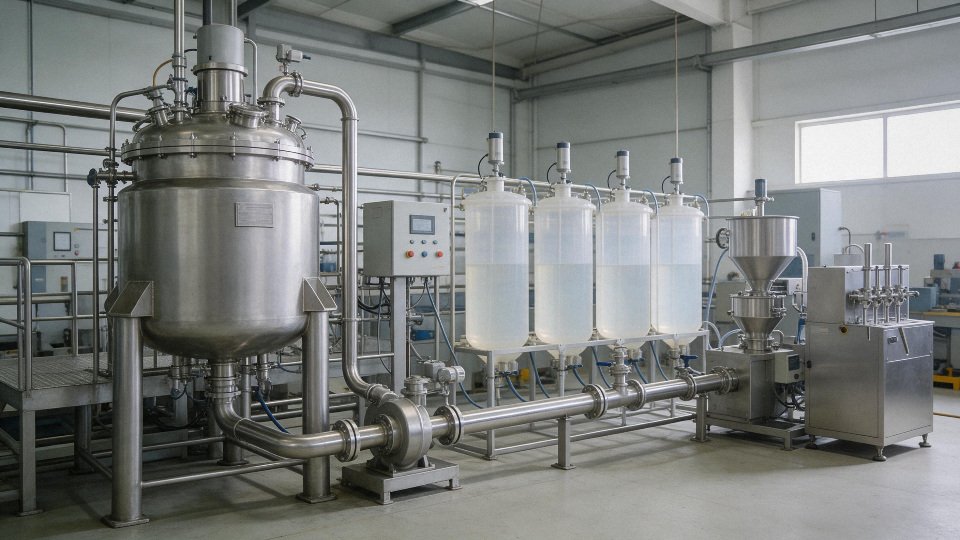
Lead-time risk is usually operational, not theoretical
Lead time slips most often come from a short list of plant realities:
- planned maintenance shutdowns,
- environmental operating restrictions,
- upstream chlorosilane tightness,
- packaging material shortages,
- seasonal port congestion or weather disruption.
In some regions, winter utilities, summer power controls, or holiday logistics gaps are not minor issues; they can add days or weeks. Ask where the supplier’s real bottleneck is: reactor time, stripping capacity, tank availability, packaging line capacity, or export booking.
How buyers should compare offers
A useful comparison has to go beyond nominal viscosity and price.
Check these points side by side:
- Delivered specification
- Viscosity range, volatile content, appearance, acid/alkali residue, cyclic level if relevant, and packaging condition.
- Consistency history
- Batch-to-batch variation, complaint rate, and how often the supplier issues deviations.
- Technical support
- Can they review application fit, not just ship material?
- Change-control discipline
- Will they notify you before altering feedstock source, finishing route, packaging, or spec limits?
- Supply resilience
- Safety stock policy, alternate packaging options, and recovery plan after shutdowns.
The expensive mistake is buying on cSt price alone. A cheaper fluid that evaporates faster, foams in circulation, or destabilizes a formulation can raise use rate, create cleaning downtime, or trigger customer rejects. Procurement should be looking at cost per accepted unit of production, not cost per kilogram unloaded at the dock.
Frequently asked questions
Is PDMS silicone oil made from D4 or directly from chlorosilanes?
Both routes are used industrially. Large-volume standard fluids are often made by ring-opening equilibration of cyclics such as D4, while vertically integrated producers may start upstream from chlorosilanes, hydrolyze them into siloxane intermediates, and then convert those into the target PDMS fluid. The practical difference for the buyer is not that one route is automatically better, but that each route changes impurity profile, flexibility, and how tightly the producer controls the whole chain.
A few plant-floor realities matter here:
- D4-based production is common for standard trimethyl-terminated PDMS grades because it is efficient, scalable, and well suited to broad viscosity coverage.
- Direct chlorosilane-based production gives the manufacturer more upstream control over intermediate composition, but it also means hydrolysis, acid removal, and corrosion control become more critical.
- Integrated producers usually have an advantage when supply is tight because they are less exposed to spot-market swings in key intermediates.
- Toll blenders or downstream finishers may buy D4, prepolymers, or base fluids and tailor them rather than make everything from chlorosilanes.
If you are qualifying a supplier, ask which stage they actually manufacture in-house and which stages are purchased. That tells you more than the marketing phrase “full production line.”
What determines whether the final product is silanol-terminated or trimethyl-terminated?
End-group control comes from formulation and stopping chemistry, not viscosity alone. Silanol-terminated PDMS is obtained when the chain ends remain as Si–OH groups after hydrolysis or controlled polymerization, while trimethyl-terminated PDMS is produced by capping those ends with trimethylsiloxy groups, typically through the choice of end-blocker during equilibration.
In practice, the producer is balancing three things:
- Downstream reactivity
- Silanol-terminated fluids are chosen when the customer wants further condensation, crosslinking, or use as an intermediate.
- Storage stability
- Trimethyl-terminated fluids are usually more storage-stable because they are less reactive toward further condensation.
- Moisture sensitivity
- Silanol grades need tighter handling and packaging discipline; a half-open drum in a humid warehouse can shift behavior over time.
How is viscosity increased or reduced during manufacture?
- To increase viscosity:
- Raise average chain length during equilibration or polymerization.
- Reduce the proportion of chain-stopping end-blocker.
- Continue reaction until the target molecular-weight distribution is reached.
- Strip low-boiling cyclics and light fractions more thoroughly.
- To reduce viscosity:
- Increase end-blocker relative to cyclic or linear siloxane feed.
- Shift the equilibrium toward shorter chains.
- Blend with lower-viscosity PDMS if the grade allows it.
- In some cases, remove heavy fractions that broaden the high end of the distribution.
The mechanism is straightforward: shorter average chain length lowers internal drag and reduces viscosity; longer chains do the opposite. That said, you cannot safely assume that a 100 cSt fluid from one plant was made the same way as a 100 cSt fluid from another, especially if one is narrowly fractionated and the other is simply blended to target.
Why do two fluids with the same viscosity sometimes perform differently?
Viscosity is only one screening number. Two PDMS fluids can match at, say, 350 cSt and still differ in volatility, molecular-weight distribution, residual cyclic content, end groups, trace acidity, odor, foam behavior, dielectric response, or compatibility with fillers and additives.
Common reasons include:
- Different end groups: silanol-terminated and trimethyl-terminated fluids can behave very differently in formulations.
- Different cyclic content: one fluid may have more residual light siloxanes, changing evaporation loss or odor.
- Different breadth of distribution: a broad distribution can change film feel, lubrication, or migration.
- Different cleanliness: trace catalyst or acid residue can upset sensitive downstream systems.
This is where buyers get tripped up. Matching only viscosity often works for a simple release or lubrication duty; it is much less reliable in antifoams, personal care intermediates, electronics, or reactive silicone systems.
What are cyclic siloxanes, and are they always undesirable?
Cyclic siloxanes are ring-shaped siloxane molecules such as D3, D4, D5, and higher homologs that exist as intermediates, equilibrium components, or residual volatiles in PDMS manufacture. They are not automatically “bad”; they are part of normal siloxane chemistry. Whether they are acceptable depends on the end use, regulatory exposure, odor limit, volatility requirement, and customer specification.
A few distinctions matter:
- As feedstock or intermediate
- They are entirely normal and often essential.
- As residuals in finished PDMS
- They may be acceptable within agreed limits for many industrial uses.
- For low-volatility or regulated applications
- Residual cyclics often need tighter control, sometimes much tighter than a general-purpose industrial fluid.
All residual cyclic siloxanes must be fully eliminated from every PDMS silicone oil grade.False
Residual cyclics are commonly reduced to meet product and regulatory needs, but complete elimination is not a universal technical or commercial requirement. Acceptable levels depend on the application, specification, and jurisdiction.
How are residual acid, catalyst, and moisture removed?
- Residual acid removal
- Neutralization, aqueous washing, phase separation, and drying are typical where acid routes are used.
- Catalyst removal or deactivation
- Depends on the catalyst system; the process may use neutralization, adsorption media, filtration, or controlled deactivation.
- Moisture removal
- Vacuum drying or devolatilization is standard, often under roughly 1 to 50 mbar, depending on viscosity, thermal sensitivity, and equipment design.
- Final polishing
- Fine filtration and, in tighter grades, additional stripping to remove lights and improve stability.
High-viscosity fluids are slower to dry and strip. That is not lab theory; on a production kettle or thin-film unit, mass transfer becomes the bottleneck and the residence time starts to matter.
What purity documents should industrial buyers request?
- Certificate of Analysis for the shipped lot
- Typical properties data sheet
- Safety Data Sheet
- Statement of end-group type, if functionally relevant
- Moisture value or test method, where sensitive
- Volatile or cyclic siloxane content, if required by the application
- Residual acidity or neutralization status, if applicable
- Regulatory declarations relevant to the destination market and end use
If the application is sensitive, also ask for the test method, not just the reported number. A viscosity result by one method and a volatile-content result by another are where a lot of supply disputes begin.
Can PDMS silicone oil be customized for volatility, spreadability, or downstream reactivity?
Yes, within the limits of siloxane chemistry and production economics. Suppliers can often tailor these properties by adjusting viscosity range, end groups, cyclic content, molecular-weight distribution, and in some cases by moving from straight PDMS toward modified silicone structures.
Typical customization paths include:
- Lower volatility
- Higher molecular weight, tighter stripping, lower residual light siloxanes
- Higher spreadability
- Often requires a different silicone architecture or blend strategy, not just a viscosity change
- Greater downstream reactivity
- Silanol termination or other functional modification, provided the buyer can manage storage and process sensitivity
The boundary is simple: if you need a big shift in wetting, compatibility, or reactivity, you may no longer be asking for a standard PDMS silicone oil. At that point the discussion usually moves into modified silicone fluids, and the supplier should treat it as an application review rather than a simple catalog-grade quote.
Supplier qualification checklist
A PDMS supplier is qualified only when the offered fluid matches your exact functional definition, the producer can show repeatable process control, and the commercial setup is stable enough to keep that grade coming without quiet substitutions. If any one of those three is weak, you do not have an approved source yet; you have a price indication.
1. Lock the product definition before comparing quotes
Different suppliers can all say “PDMS silicone oil” and still be offering meaningfully different materials. That shows up later as foam drift, wetting changes, odor complaints, or a formulation that suddenly needs rebalancing.
Confirm, in writing:
- Target viscosity and allowable tolerance
- State the nominal grade and acceptable range, not just “100 cSt class” or “high viscosity.”
- For very low or very high viscosities, ask how the supplier controls cut points and blending consistency.
- Terminal group type
- Hydroxy-terminated, trimethylsiloxy-terminated, or other functional end groups affect reactivity, compatibility, and storage behavior.
- This matters immediately if the fluid goes into RTV, release coatings, defoamers, personal care intermediates, or further silicone modification.
- Volatile content
- Ask for the test method and reporting basis.
- A low-volatility requirement usually means tighter stripping or devolatilization control; that can change cost and lead time.
- Cyclic profile
- If your application or market has sensitivity to residual cyclics, request a typical GC profile rather than a generic “low cyclic” statement.
- Do not assume one supplier’s low-cyclic standard matches another’s.
- Appearance requirements
- Color, haze, suspended matter, and odor should be stated explicitly.
- Odor is often treated casually until drums are opened in a blending room and operators reject the lot.
- End-use compliance needs
- Food-contact, cosmetics-related, electronics, medical-adjacent, or other regulated uses need to be screened up front.
- Compliance is application-specific; verify current documentation, not an old declaration forwarded from a trader.
2. Verify how the product is actually made and how exposed the supplier is upstream
A more integrated producer usually has better control over continuity, impurity profile, and cost volatility, though not automatically better finishing discipline. The preferred choice flips if a less-integrated supplier has stronger purification, tighter QA, and a cleaner export track record for your exact grade.
Ask these questions directly:
- Does the producer manufacture key intermediates internally, especially chlorosilane or cyclic siloxane feedstocks, or buy them externally?
- Which route is used for the grade you need?
- Are the stripping and finishing steps done in-house?
- Is the quoted material a standard production grade, a blended grade, or a custom-finished lot?
Upstream integration can reduce supply risk and improve impurity consistency, but it does not by itself guarantee better finished PDMS quality.True
Integration improves control over feed availability and some impurity sources. Finished-fluid quality still depends heavily on equilibration control, devolatilization, contamination control, packaging, and release discipline.
The mechanism here is simple: upstream variability in cyclic composition or residual reactive species feeds straight into equilibration behavior, stripping load, and final impurity profile. In practice, that means two suppliers can hit the same viscosity while one gives a cleaner GC, lower odor, or better storage stability.
3. Ask for evidence of process capability, not just a specification sheet
A decent technical data sheet tells you what the target is. A credible qualification package shows whether the plant actually hits it lot after lot.
Request:
- Recent COA examples from multiple lots
- Typical GC profile, if volatile or cyclic control matters
- Viscosity control history or lot trend data, even if summarized
- Impurity limits relevant to your use: moisture, acidity/alkalinity, residual volatiles, insolubles, metals if applicable
- Packaging cleanliness controls
- Drum or IBC preparation standard
- Liner use, closure type, tamper control
- Lot traceability
- Batch numbering logic
- Retained sample practice
- Ability to trace back to production date and intermediate lot
One practical warning: packaging cleanliness gets underestimated. A well-made PDMS can arrive with fibers, rust fines, or mixed-label confusion if the filling area is sloppy. That is not a chemistry problem, but your production line still pays for it.
4. Check whether the supplier can keep supplying after approval
Qualification effort is expensive. You want to avoid requalification six months later because the supplier has no backup plan, no export discipline, or no change-control habit.
Review:
- Annual capacity for the relevant PDMS family, not just total silicone output
- Standard lead times for sample, trial, and production orders
- Export experience
- Usual shipping regions
- Documentation quality
- Dangerous goods or non-dangerous classification handling as applicable
- Change-notification practice
- Raw material source changes
- process changes
- specification tightening or widening
- packaging changes
- Backup production planning
- Alternate line
- maintenance shutdown planning
- contingency inventory policy
The main boundary here is volume sensitivity. A supplier may perform well for pallet quantities and struggle on container-scale repeatability, or the opposite if they are built for bulk industrial accounts and treat small custom grades as interruptions.
5. Test the technical support, because that is what shows up when something drifts
A supplier worth approving should be able to discuss formulation fit, not just send a PDF and wait for a PO.
Look for support in these areas:
- Grade recommendation based on substrate, contaminant, carrier system, or downstream chemistry
- Sample matching against your incumbent material
- Troubleshooting if you see haze, foam change, separation, odor, or cure interference
- Custom specification development where your application needs tighter windows than the supplier’s house grade
- Clear escalation path between sales, QA, and plant technical staff
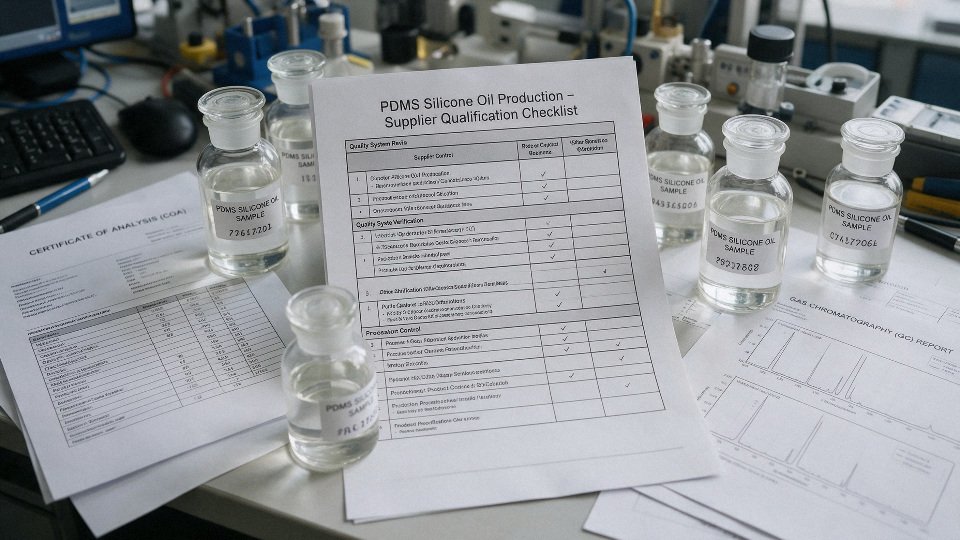
6. Run approval in a controlled sequence
Do not jump from a data sheet to a yearly contract. Use a staged approval path:
- Laboratory sample review
- Confirm viscosity, appearance, odor, and key analytical points against your requirements.
- Bench or pilot trial
- Test the fluid in your actual formulation or process window.
- Include storage, mixing, and compatibility checks where relevant.
- Benchmark against incumbent
- Compare performance, not just specification.
- Watch for dose-rate differences, wetting changes, foam response, cure effects, or residue behavior.
- Commercial trial order
- Use production packaging and normal logistics, not only hand-filled sample bottles.
- Supply agreement
- Freeze the approved specification, test methods, packaging format, change-notification rules, and complaint-handling path.
If you are qualifying PDMS silicone oil for a live industrial use, send the target viscosity, terminal group type, volatile or cyclic limits, required finish, application details, approximate annual volume, and clear current-grade information or photos of the label/COA. SiliconChemicals can review the application, recommend a suitable grade within its organosilicon product range, arrange samples where appropriate, and prepare a quotation against the confirmed specification.