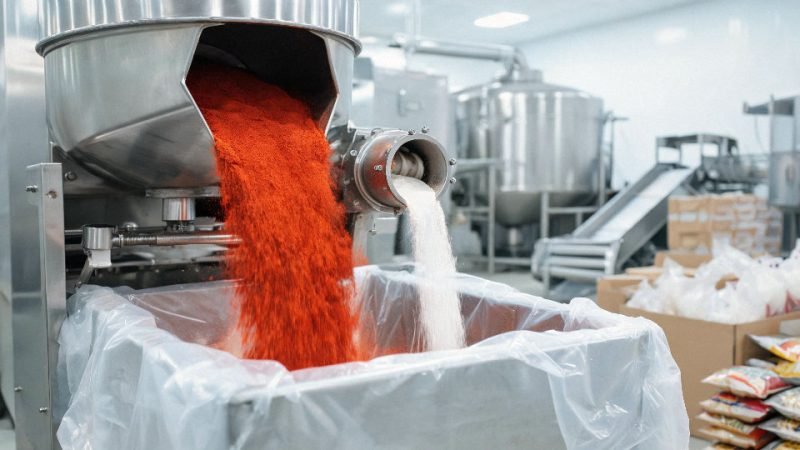
Paprika that bridges, clumps, or packs into hard corners is not just a kitchen nuisance; on a blending line it slows feeders, throws seasoning ratios out of tolerance, and gives operators one more reason to beat a hopper with a rubber mallet. If the powder has drifted above a safe moisture window, often roughly 8% to 12% for well-dried ground paprika depending on grind, oil content, and storage humidity, the cost shows up as rework, rejected lots, extra cleanup, and sometimes customer complaints. The practical answer starts with the spec sheet: ingredient declaration, moisture target, anti-caking allowance, and packaging that actually keeps water vapor out.
No, not all paprika contains silicon dioxide. Pure ground paprika may be sold with no anti-caking agent, while some retail spices and industrial seasoning blends use silicon dioxide, often around 0.5% to 2.0% by weight, depending on flow needs, regulations, and the buyer’s specification. Always verify the label or supplier document.
The confusing part is that “paprika” can mean straight ground pepper, a spice packed for retail, or a component inside a dry rub, snack seasoning, soup base, or meat-processing blend. Those are different procurement animals. A small pouch on a supermarket shelf and a 25 kg lined carton feeding a ribbon blender do not face the same moisture, handling, or dosing problems.
How paprika is manufactured and where flow problems begin
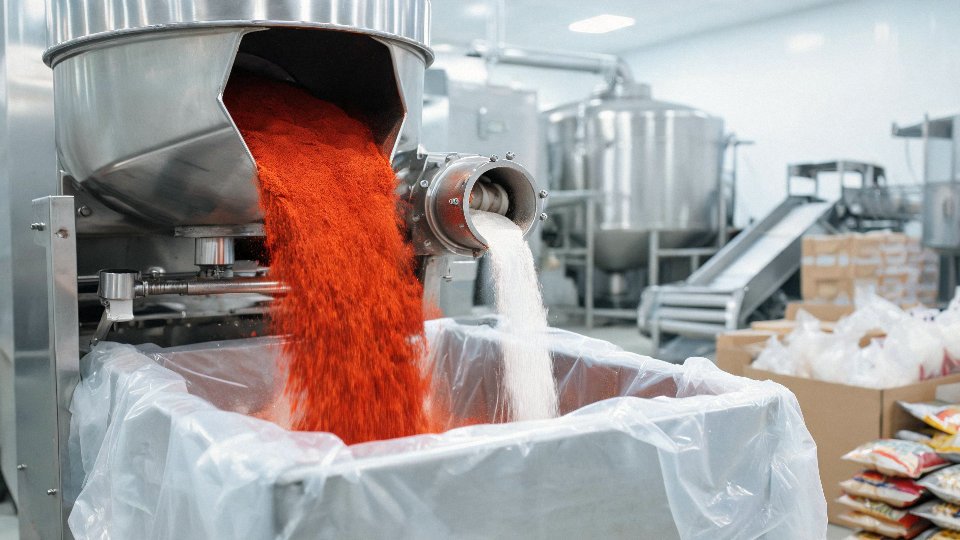
Paprika looks simple in a jar, but the powder has already been through a fairly unforgiving process before anyone argues about silicon dioxide on the label. Most commercial paprika starts with selected red peppers, graded for color, maturity, defects, and sometimes pungency if the buyer has a heat specification. Incoming fruit is washed, drained, and inspected. Stems are removed. Seed content is controlled because seeds dilute color, change oil behavior, and can affect flavor. Then the peppers are dried, milled, sieved, blended to a color or particle-size target, passed through magnets and metal detection, and packed into barrier packaging or bulk-lined cartons.
That is the clean version. On a real line, the headache starts much earlier.
Paprika is not an inert red mineral powder
Ground paprika is a plant material. Its flow behavior changes with crop season, pepper variety, drying history, particle size, and how long the product sat before milling. The powder contains natural sugars, fiber, pigments, small amounts of oil, and moisture. Those components do not behave like salt or sand.
A well-dried ground paprika commonly sits around 8% to 12% moisture, give or take, depending on the origin, drying method, and customer specification. At the low end, it usually flows better but may be more prone to dusting and color oxidation if the process is harsh. At the high end, the powder can start to compact, bridge in hoppers, form soft lumps in bags, or become a microbiological concern if storage is poor. Moisture is not the only variable, but it is usually the first one the plant manager checks when sacks stop discharging cleanly.
Natural oil and pigment matter too. Paprika with strong color release often has a slightly greasy feel compared with leaner dry powders. That is good for sausage makers, snack seasoning blenders, and sauce plants that want color dispersion. It is less good for bin flow. Fine red powder sticking inside a tote outlet is not a lab theory; it is a Monday morning cleanup job.
Drying sets the tone for the whole batch
Drying is where many later flow problems are either prevented or baked into the product. Peppers may be sun-dried, hot-air dried, belt dried, or processed through other controlled systems, depending on region, cost, scale, and color target. Slow or uneven drying leaves wet pockets. Overly aggressive drying can darken color, drive off volatile aroma, or create brittle material that mills into too many fines.
Under-dried material is the bigger operational risk. It can clump during intermediate storage, smear during milling, and bridge in screw feeders. In a warm warehouse, the same batch can also lose color faster or develop musty notes. If the powder is packed into a moisture-barrier pouch while still carrying too much internal moisture, the package may protect it from outside humidity but it cannot remove what is already inside. Barrier packaging is not a dryer. I have seen that misunderstanding cost plants real money.
For industrial spice packaging, the benchmark is usually multilayer moisture-barrier pouches, lined cartons, or lined bags selected for low water vapor transmission during the expected storage period. The exact structure depends on bag size, export route, warehouse conditions, and whether the customer opens and reseals partial bags. A 25 kg lined carton going into a dry blending plant has different abuse than a retail jar shipped through summer distribution.
Milling makes color better and flow worse
Milling is a trade-off. Finer paprika gives stronger apparent color, faster release into oil or water systems, and better dispersion in seasoning blends. That is why snack plants and processed meat producers often care about mesh size, not just color units.
The downside is surface area. Finer particles expose more surface, hold surface moisture more readily, and pack tighter under pressure. They also create more dust, which coats bag seams, filler heads, and operators’ gloves. Coarser paprika may flow better, but it can speckle in a finished sauce or leave visible particles in a dry rub. There is no universal “best” grind. The right grind depends on the customer’s dosing equipment and finished product.
Sieving removes oversize material, but it does not magically eliminate fines unless the process is designed that way. Blending can smooth out crop variation, yet it can also mix a marginal high-moisture lot into an otherwise stable batch if the incoming quality checks are weak. Metal detection and magnets handle physical contamination risk; they do not fix caking.
Warehouses and trucks can undo good processing
After packing, paprika still has to survive storage and transport. Warehouse humidity, container temperature swings, pallet compression, and vibration during shipment all push powder toward compaction. Ocean containers are especially rough: hot days, cool nights, and condensation risk if the load is poorly protected. Even domestic freight can cause trouble when pallets sit near a dock door in wet weather.
Pallet compression is underrated. Bottom bags in a tall stack can cake simply because they carried weight for weeks. Vibration then settles fines into void spaces, making the powder denser. The first few bags may discharge acceptably, while the compressed lower layers need manual breaking or screening before use.
Paprika can cake even without any manufacturing defect if fine particle size, moderate moisture, pressure, and humidity line up during storage or transport.True
Caking is driven by interacting physical conditions, not only by formulation. A compliant, properly milled paprika can still compact under unfavorable handling conditions.
This is why some manufacturers specify an anticaking agent such as silicon dioxide, often in the rough range of 0.5% to 2.0% by weight for dry seasoning applications where local rules allow it and the flow target justifies it. Others avoid it by tightening moisture limits, using coarser milling, shortening storage time, improving liners, or accepting slower discharge. Neither route is automatically superior. The wrong choice shows up as blocked hoppers, extra labor, rejected lumps, color complaints, or a label that no longer fits the customer’s market.
What silicon dioxide does in paprika and seasoning powders
Silicon dioxide, in this context, is a food-grade amorphous silica used as an anti-caking and flow aid. It may be mineral-derived or manufactured under controlled conditions, but the key word is amorphous. It is not the same handling concern as crystalline silica dust from cutting stone or sandblasting. In food plants, it is normally bought against a food additive specification and used at low percentages, often somewhere around 0.5% to 2.0% by weight in dry seasoning systems, depending on the flow target, local rules, particle size, and how wet or oily the blend behaves.
Paprika itself is a ground plant material. Even when it is properly dried, it usually carries roughly 8% to 12% moisture, give or take, depending on pepper variety, drying method, storage humidity, and how aggressively the miller dried it. That moisture is not “free water” sloshing around, but it still affects powder behavior. Paprika particles are irregular, slightly fibrous, and rich in color compounds and natural oils. Under pressure in a carton or hopper, those particles can lock together. Add a humid warehouse, a warm container, or a half-open bag beside a washdown area, and flow problems show up fast.
Silicon dioxide helps by sitting between those paprika particles. Think of it less like a drying chemical and more like microscopic ball bearings with a moisture-management side job. The fine silica particles adsorb a small amount of surface moisture and reduce direct contact points between paprika particles. Less surface tack. Less bridging. Less rat-holing in a hopper. Better discharge through an auger or vibratory feeder.
That sounds simple, but on a line it matters.
A retail jar filler that runs cleanly during the first hour can start giving short fills after lunch if the paprika blend compacts in the feed hopper. Operators tap the cone, maintenance increases vibration, quality starts chasing weight variation. The wrong response is often to “just turn up the agitator,” which can shear a delicate blend, segregate coarse herbs from fine paprika, or drive dust into places nobody wants to clean on second shift. A small amount of the right flow aid can be cheaper than fighting the powder all day.
All paprika needs silicon dioxide to stay usable.False
Well-dried paprika can be sold without anti-caking agents, especially as a single-ingredient spice in moisture-barrier packaging. Silicon dioxide is a handling aid, not a universal requirement.
Silicon dioxide is not the only tool. Calcium silicate is another strong anti-caking agent and can handle troublesome moisture, but it may affect labeling preferences or mineral contribution depending on the market. Tricalcium phosphate is common in some dry blends and can work well where phosphate labeling is acceptable. Rice hull concentrate appeals to buyers looking for a plant-derived flow aid, though its effectiveness depends heavily on particle size, treatment, and the powder system. Starches can help carry flavors or separate particles, but they may dull color, add bulk, or behave poorly if humidity rises. Maltodextrin is widely used as a carrier for sprayed flavors or oleoresins; it can improve handling in some blends, yet it is not a direct substitute for silica in every paprika-heavy formula.
Here is the practical difference I look at during specification work:
| Flow aid or carrier | Where it tends to fit | Watch-outs on the plant floor |
|---|---|---|
| Silicon dioxide | Fine spice blends, automated filling, humid distribution chains | Overuse can make dust worse and may be restricted by local additive limits |
| Calcium silicate | Moisture-sensitive powders, aggressive anti-caking needs | Label acceptance varies; can slightly change mouthfeel in high-use systems |
| Tricalcium phosphate | Seasonings where phosphate is already acceptable | Not always enough for oily paprika or fine chili powders |
| Rice hull concentrate | Cleaner-label seasoning programs | Performance is less predictable; needs real line trials |
| Starch or maltodextrin | Carriers, flavor systems, bulk adjustment | Can dilute color and may cake if the moisture profile is wrong |
None of these materials turns weak paprika into premium paprika. If the raw paprika is faded, overheated during drying, contaminated with stems, or milled into a dusty, uneven grind, silicon dioxide will not restore color strength or flavor. It only manages physical behavior. That distinction matters in procurement. A supplier can make a bad powder flow better and still ship a bad spice.
In industrial buying, silicon dioxide shows up most often where paprika is part of a multi-ingredient seasoning: barbecue rubs, snack coatings, meat marinades, instant noodle sachets, and dry sauce mixes. Those products may contain salt, sugar, garlic powder, onion powder, yeast extract, acids, flavors, and color carriers. Each ingredient brings a different particle size and moisture behavior. The blend has to run through ribbon blenders, totes, sifters, magnets, augers, form-fill-seal machines, and sometimes retail shaker tops. Flow consistency is not cosmetic there; it affects fill weights, seal contamination, rework, and customer complaints.
Single-ingredient paprika is a different purchase. It is more likely to be sold without additives, especially when packed in multilayer moisture-barrier pouches, lined cartons, or tight retail containers designed to keep water vapor pickup low during storage. “More likely” is not “always.” Some brands still use an anti-caking agent for shelf stability or dispensing performance, and some markets allow it if declared properly.
The best specification is plain: define whether the paprika must be single-ingredient, set moisture and microbiological limits, state whether anti-caking agents are allowed, and require the label declaration to match the destination market. That avoids the usual argument after the container lands, when production wants free-flowing powder and marketing wants a clean ingredient line.
How to read paprika labels and specifications for silicon dioxide
Start with the retail ingredient panel
On a retail jar or pouch, silicon dioxide usually shows up in one of three places: the ingredient list, an additive statement, or in parentheses after the spice name. You might see “paprika, silicon dioxide,” “paprika (with silicon dioxide to prevent caking),” or “paprika, anticaking agent: silicon dioxide.” In some markets the wording may lean toward function rather than chemistry, such as “flow agent” or “anticaking agent,” depending on local labeling rules.
If the label says only “paprika,” that generally means no silicon dioxide has been intentionally added to that product. I would treat that as a reasonable consumer reading, not a laboratory guarantee. Spice plants handle many dry powders on shared lines, and trace carryover is possible if the same ribbon blender or filling hopper ran a seasoned salt earlier in the shift. Good suppliers manage that with cleaning and sequencing, but “not listed” is not the same as “tested to zero.”
A paprika label that lists only paprika usually indicates no intentionally added silicon dioxide, but it does not prove absolute absence of incidental trace material.True
Food labels normally declare intentionally added ingredients according to the applicable jurisdiction. Trace carryover, processing aids, and disclosure thresholds depend on local regulation and supplier controls.
Terms worth scanning for include:
- Silicon dioxide
- Silica
- Amorphous silica
- Anticaking agent
- Flow agent
- Anticaking blend
- Processing aid, where the law requires that wording
- “Added to improve flow” or similar functional wording
The phrase “amorphous silica” can confuse buyers because it sounds like a different material. In food and spice specifications, it normally refers to the non-crystalline form used as a flow aid. Do not confuse it with sand or crystalline silica hazards from industrial dust exposure; the regulatory and toxicology context is different. Still, if your purchasing spec says “no silicon dioxide,” “amorphous silica” should be treated as a fail unless your quality team has written a very specific exception.
Do not let front-label claims do the work of a specification
Organic, non-GMO, kosher, halal, gluten-free, vegan, and “clean label” claims are not reliable proof that paprika is free from silicon dioxide. They answer different questions. Organic rules may restrict or condition the use of certain additives, but the exact allowance depends on the certification scheme and product category. Kosher and halal approvals address religious compliance. Gluten-free says nothing about anticaking chemistry unless the certifier or supplier adds a separate declaration.
Clean label is the messiest one. I have seen that phrase used for products with no additives, products with “natural” carriers, and products where the marketing team simply disliked chemical-sounding names. Procurement should not buy against a slogan. Buy against a written specification.
A typical problem scenario: a sauce plant approves “paprika, clean label” from a new broker because the sales sheet looks fine. The powder runs well through a small kitchen shaker during trials. Three months later, the first bulk lot arrives in lined cartons, and the technical sheet lists “anticaking blend less than 2%.” Now the plant has a label mismatch, finished product artwork already printed, and a customer asking why the declaration changed. That is not a spice problem anymore. It is a release-control problem.
What to check on an industrial specification sheet
For food manufacturing, the label is only the starting point. Ask for the current technical data sheet, not an old product flyer. A proper paprika specification should spell out the ingredient declaration and additive status plainly. If it says “100% paprika,” “no additives,” or “silicon dioxide not added,” keep that document with your approved supplier file.
Read the surrounding technical fields too. They tell you whether the supplier understands the material or is just reselling bags.
| Specification field | What to look for | Why it matters on the floor |
|---|---|---|
| Ingredient declaration | Paprika only, or paprika plus declared additive | Drives finished-product labeling |
| Additive statement | “No silicon dioxide added” or listed anticaking system | Prevents surprises during label review |
| Country of origin | Single origin or blended origins | Affects color, heat, regulation, and supplier traceability |
| Moisture range | Often around 8% to 12% for well-dried ground paprika, depending on cut, drying, and storage | Higher moisture raises caking and microbial risk |
| Mesh size | Commonly given as a range or sieve target | Fine powder flows worse and dusts more |
| Microbiological limits | Salmonella absence, total plate count, yeast and mold, coliforms as applicable | Critical for ready-to-eat and low-kill-process foods |
| Certification status | Organic, kosher, halal, non-GMO, gluten-free, BRCGS, SQF, or similar | Useful, but not a substitute for an additive declaration |
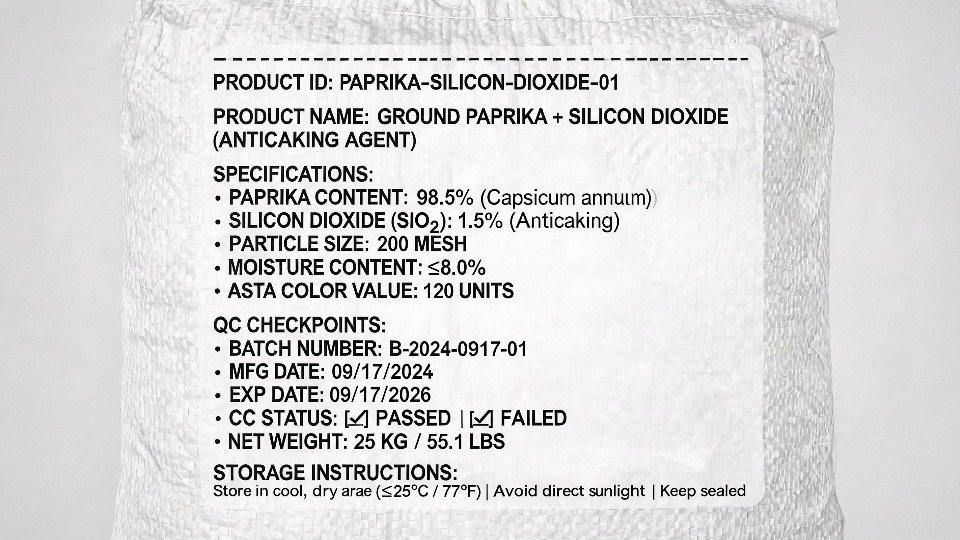
Moisture and mesh size deserve a hard look. A paprika at roughly 8% to 10% moisture and a coarser grind may flow acceptably with no anticaking agent in a small jar line. A very fine powder closer to 11% or 12%, stored through a humid summer in a warehouse with open dock doors, can bridge in a hopper and pack into the auger. That is when purchasing pressure for “no additives” collides with production reality.
What to request from the supplier
If absence of silicon dioxide is a contractual requirement, ask for three documents before approval: a current technical data sheet, a certificate of analysis for the lot, and a written additive declaration. The certificate of analysis will usually report lot-specific items such as moisture, color value, microbiology, and sometimes mesh or ash. It may not list every non-detected additive unless you ask.
Use plain wording in the request: “Confirm in writing whether silicon dioxide, silica, amorphous silica, anticaking agents, flow agents, carriers, or processing aids are intentionally added to this paprika.” That sentence closes a lot of loopholes.
For higher-risk programs, put the requirement into the purchase specification and purchase order notes. Receiving clerks cannot enforce a verbal promise from a salesperson. Quality needs a document they can quarantine against. Procurement needs one they can push back with when a substitute lot arrives two days before a production run.
Why some paprika brands avoid silicon dioxide entirely
Not every paprika producer wants, needs, or is allowed by the customer specification to use silicon dioxide. In many plants, the better question is not “Which anticaking agent do we add?” but “Can we keep this powder dry, stable, and usable without adding one?”
That is a real production strategy, not just a marketing line.
Moisture control can do part of the job
Well-dried ground paprika commonly sits around 8% to 12% moisture, give or take, depending on pepper variety, drying method, mill temperature, and how aggressively the processor protects the powder after grinding. Push moisture toward the upper end, store it in a humid warehouse, then run it through a fine screen, and caking complaints become much more likely.
A disciplined processor can reduce that risk before the label is even discussed. They may use better-controlled drying, slower milling to limit heat buildup, tighter humidity control in the packing room, and shorter hold times between grinding and packing. None of this is glamorous. It is doors kept closed, desiccant maintained, tote liners tied off properly, and operators not leaving ground spice exposed during a lunch break.
In practice, those habits matter.
Fine paprika is more prone to bridging and compacting because it has more surface area and more contact points between particles. Coarser paprika often behaves better, especially in small retail jars where the consumer opens, shakes, and uses it over weeks rather than feeding it through a pneumatic conveying line or screw feeder.
Paprika can be manufactured and sold without silicon dioxide if moisture, grind size, packaging, and inventory age are controlled well enough for the intended use.True
Silicon dioxide is a functional flow aid, not an unavoidable ingredient. The need depends on powder behavior, storage conditions, pack format, and the customer’s flowability requirements.
Packaging can replace the additive in some supply chains
Packaging is often the quiet reason one additive-free paprika performs well and another turns into a brick.
Industrial spice suppliers that want to avoid anticaking agents usually lean on moisture-barrier packaging: multilayer pouches, foil-laminate structures, or lined cartons with inner bags selected for low water vapor transmission. The exact barrier level depends on shelf-life target, climate, shipping route, and whether the product is going into a dry blending plant or a retail jar line.
Nitrogen flushing may also be used, especially where color and aroma retention matter. It does not magically stop all caking, but it can reduce oxygen exposure and help keep the headspace more stable. The bigger gain still comes from preventing moisture pickup after packing.
A typical scenario: a paprika supplier packs additive-free powder into 20 kg lined cartons for a sauce factory. If the inner liner is properly sealed, pallets stay wrapped, and stock turns in two to four months, the material may run acceptably. Put the same powder in a paper sack, leave it near a washdown area in summer, and the purchasing team will hear about it from production by the second shift.
Right packaging, controlled storage, normal flow. Wrong packaging, humid air, long dwell time. Then come clogged hoppers, hand-sieving, rework, and arguments over whether the raw material was “bad” or just mishandled.
Clean-label demand is a strong commercial driver
Many brands avoid silicon dioxide because their customers ask for single-ingredient spices. Retail shoppers often prefer a label that says only “paprika.” Food manufacturers may have clean-label policies written into their raw material standards, especially for premium sauces, snacks, meat rubs, organic-style product lines, or export products where the additive declaration becomes a sales headache.
Procurement people know this trade-off well. A clean label can win business, but it can also narrow the operating window. The supplier has to manage moisture, grind, packaging, and rotation more tightly. The buyer may need to accept that additive-free paprika will not always pour like a treated seasoning blend.
That does not make it inferior. It makes it less forgiving.
Smaller packs and faster stock rotation help
Pack size changes the risk profile. A 45 g retail jar used in a home kitchen is a very different animal from a 25 kg bag sitting open beside a ribbon blender. Small packs have less mass compacting under their own weight, are opened fewer times, and are usually consumed before moisture migration becomes severe.
Shorter inventory cycles help too. Paprika that moves quickly through the supply chain spends less time absorbing humidity through imperfect seals, less time compacting on pallets, and less time exposed to temperature swings in trucks and warehouses. In warm, humid regions, that matters more than people expect.
A buyer specifying additive-free paprika should ask practical questions:
| Control point | What to ask | Why it matters |
|---|---|---|
| Moisture | What is the typical moisture range at release? | Higher moisture raises caking risk |
| Grind | Is it fine, medium, or coarse? | Fine powder usually needs tighter handling |
| Packaging | Is it a moisture-barrier pouch, lined carton, or basic bag? | Barrier quality can substitute for flow aid |
| Stock age | What shelf life is guaranteed, and what is typical dispatch age? | Old inventory is more likely to compact |
| Equipment use | Will it be hand-scooped or dosed automatically? | Automated systems are less tolerant of clumps |
Clumping is not automatically a safety failure
Additive-free paprika may clump. Sometimes it just needs a shake, a tap on the jar, or loosening with a clean dry spoon. In a factory, it may need screening before batching, especially if it has been stored through a humid season.
That alone does not mean the paprika is unsafe. Clumping often reflects moisture absorption, compression during storage, or the absence of a flow aid such as silicon dioxide.
There are warning signs, though. Musty odor, visible mold, wet-looking lumps, major color darkening, insects, or a fermented smell should stop use until quality or food safety personnel review it. Paprika should smell like dried pepper, not like a damp storeroom.
For automated plants, the decision is less sentimental. If additive-free paprika bridges in a hopper, starves a feeder, and throws seasoning addition out of tolerance, the clean label may cost more than expected. For retail jars or chef use, the same clumping may be a minor nuisance. The right answer depends on the route to the consumer, not on the additive question alone.
Safety, exposure, and regulatory context for silicon dioxide in food
Food-grade silicon dioxide is not the same hazard as cutting concrete
The silicon dioxide used as an anticaking agent in paprika and dry seasoning blends is food-grade amorphous silica. That distinction matters. In plant conversations, I still hear people mix it up with respirable crystalline silica, the dust controlled in mining, sandblasting, stone cutting, foundries, and concrete work. Same broad chemistry family, very different physical form and exposure route.
Crystalline silica becomes a serious occupational lung hazard when fine respirable particles are inhaled repeatedly, especially in dry cutting or abrasive environments. Food-grade amorphous silicon dioxide used in seasoning is manufactured and specified for food additive use. It is not treated by food regulators as the same material as uncontrolled quarry dust or construction dust.
That does not mean powder handling is casual. A spice blending room can still be dusty. Operators dumping sacks into a ribbon blender or tote hopper need local extraction, dust masks or respirators where the risk assessment calls for them, and basic housekeeping. Paprika dust itself can irritate eyes and airways. The safety difference is mainly about the toxicological profile and regulatory category of the additive, not permission to run a dusty room.
Food-grade silicon dioxide in paprika has the same occupational hazard profile as respirable crystalline silica from construction dust.False
Food-grade silicon dioxide used as an anticaking agent is typically amorphous silica and is regulated as a food additive. Respirable crystalline silica from industrial dust sources is a separate occupational exposure hazard with different risk controls.
Regulators generally allow it, but the rules are not identical everywhere
Major food safety authorities generally permit silicon dioxide as an anticaking agent in powdered foods, spices, seasonings, salt, and similar dry products, either under good manufacturing practice controls or under specific maximum levels. The exact wording depends on the market. Some jurisdictions use names such as silicon dioxide, silicon dioxide amorphous, silica, or an additive number. Others group it under anticaking agents with category-specific limits.
For a domestic retail paprika supplier, that may be straightforward: comply with the local food additive standard, use a food-grade material, keep records, and label it correctly. For an exporter, it gets less forgiving. A paprika blend legal in one country may need a different declaration format, different maximum percentage, or different approval basis in another.
In practical procurement terms, do not approve “silica” from a vendor spreadsheet and assume it is suitable. That word is too broad.
Dose matters, especially with spices
In dry seasoning manufacture, silicon dioxide is often used around 0.5% to 2.0% by weight, depending on the flowability target, paprika moisture, particle size, oil content, packaging, and local regulation. Paprika that is well dried may sit around 8% to 12% moisture. Once moisture creeps higher, or the powder has a very fine grind and warm warehouse exposure, caking risk climbs. That is when formulators may consider an anticaking agent, tighter packaging, or both.
The exposure from a normal spice serving is usually very small. If a seasoning contains 1% silicon dioxide and someone uses 2 grams of that seasoning in a meal, the silicon dioxide portion is about 20 milligrams before considering how much of the serving is actually eaten. Use more in a dry rub or industrial marinade mix and the number rises, but it is still tied to a small ingredient in a larger food system.
A bulk snack seasoning plant is different from a home kitchen. A line applying paprika-heavy seasoning at high rates onto chips or coated nuts can move a lot of powder in a shift. The consumer dose is still governed by the finished food formulation, but the plant-floor exposure controls also matter because workers may handle sacks, bins, filters, and blender cleanouts every day.
What procurement should verify before buying
A decent supplier approval file for silicon dioxide, or paprika containing it, should include more than a price quote and a label photo. I would expect the basics below before releasing it into a food plant.
| Checkpoint | What to ask for | Why it matters |
|---|---|---|
| Food-grade status | Food additive grade statement and intended-use confirmation | Prevents accidental purchase of industrial silica or non-food processing grades |
| Specification | Purity, particle size range, loss on drying, and functional description | Flow behavior changes with grade; not all silicon dioxide performs the same |
| Contaminant limits | Heavy metals and other regulated impurities, based on target market rules | Import holds and customer rejections often start here |
| Documentation | Certificate of analysis, allergen statement if applicable, safety data sheet, origin and traceability records | Needed for audits, recalls, and customer questionnaires |
| Regulatory fit | Confirmation for the destination country or region | Additive names, numbers, permitted categories, and maximum levels can differ |
A typical failure mode is boring but expensive: purchasing swaps in a cheaper anticaking agent grade, receiving does not catch the documentation gap, and quality only finds it during a customer audit or export review. At that point the paprika may already be blended into finished seasoning. Rework is ugly. Disposal is worse.
Medical and dietary questions need the right adviser
For the general food supply, regulated food-grade silicon dioxide is widely used and accepted by food safety authorities within permitted conditions. That is the balanced position. It is not a reason to make medical promises, and it is not useful to frighten people by comparing it to construction silica.
People with specific medical concerns, unusual additive sensitivities, strict dietary rules, or clinician-directed restrictions should take the label or specification to a qualified health professional. Engineers and buyers can verify identity, grade, exposure level, and compliance. They should not pretend to diagnose tolerance from a material safety sheet.
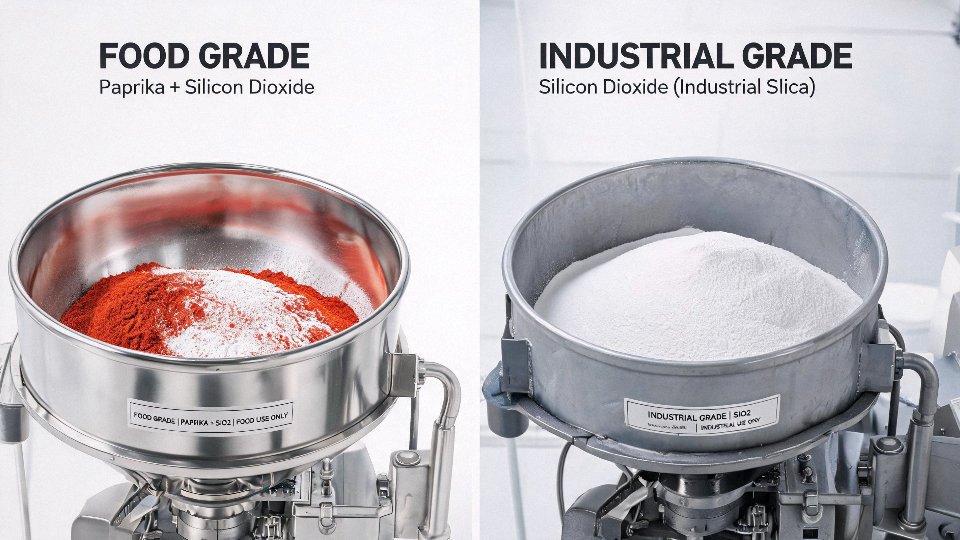
Industrial quality controls that determine whether paprika needs anticaking help
In a plant, the decision to add silicon dioxide is usually not made by opinion. It comes out of test results, customer requirements, packaging limits, and the number of times operators have had to beat a hopper with a rubber mallet to keep a line moving. Paprika can look perfectly dry in a retail jar and still behave badly in a bulk system.
The first control point is moisture. Well-dried ground paprika often sits around 8% to 12% moisture, depending on pepper variety, drying method, grind, and local storage conditions. That number alone is not enough. Water activity matters because it tells you how available that moisture is for microbial growth and caking behavior. A paprika lot at the high end of the moisture range, with fine particles and warm humid storage, is a very different risk from a coarse, lower-moisture lot packed quickly into good barrier material.
A reasonable incoming or in-process inspection plan for industrial paprika usually covers:
- Moisture content, commonly by oven method or moisture analyzer, verified against a reference method if claims or disputes matter.
- Water activity, especially for long storage, export shipments, or humid climates.
- Particle size distribution, because fines bridge, dust, compact, and cling to augers.
- Bulk density, both loose and tapped, since dosing systems depend on volume-to-weight behavior.
- Color value, often tied to ASTA color or customer-specific visual standards.
- Microbial load, including total plate count, yeast and mold, and pathogens according to the buyer’s risk program.
- Foreign material inspection, using magnets, sieves, metal detection, optical sorting upstream, and sometimes X-ray in finished packs.
None of these checks exists in isolation. A fine paprika with strong color may be commercially attractive, but it can be miserable in a vertical form-fill-seal machine if it has borderline moisture and a high fines fraction. The quality lab may approve it. The packaging lead may hate it by noon.
Flow tests tell you what a specification sheet does not
For small lots, buyers may only ask whether the powder “flows freely.” That phrase is too vague for industrial buying. Better plants use simple screening tests and, for difficult applications, more formal powder flow testing.
Angle of repose is the quick shop-floor check: pour the paprika into a pile and measure the slope. It is crude, but it can flag a sticky lot before it reaches the packing line. Funnel flow tests are also common. If paprika stalls in a standard funnel or discharges in pulses, it may cause inconsistent fill weights later.
Compressibility is another useful warning sign. Compare loose bulk density with tapped bulk density. If the powder packs down heavily, it may settle in cartons, bridge in hoppers, and give unstable volumetric dosing. Shear cell testing gives a more serious read on wall friction and cohesive strength; this is the kind of data an engineer wants before designing or changing a hopper, feeder, or bulk discharge station.
Then there is the test I trust most: run it through the actual equipment. A short hopper discharge trial or auger feeder test often reveals what the lab missed. Paprika that looks acceptable in a beaker can smear on screw flights, rat-hole in a tote cone, or surge badly after vibration.
The pack size changes the physics
A 60 g kitchen jar is forgiving. The consumer shakes it, taps it, maybe breaks up a lump with a spoon. Low head pressure, short storage after opening, small mass.
A 20 kg lined carton, a 500 kg tote, or a supersack is a different machine. The powder at the bottom sees consolidation pressure for weeks or months. Fines migrate. Vibration during trucking can compact the load. If the warehouse cycles between cool nights and humid afternoons, moisture can move through weak seals or poor liners. Once paprika cakes in a supersack, nobody wants to be the person standing under it trying to persuade the discharge spout to behave.
Ribbon blenders create another issue. If paprika is one component in a seasoning blend, poor flow can cause uneven distribution, dusting, and longer blend times. Auger feeders care about consistency. High-speed packaging lines care about repeatable fill weights and clean seals. A small amount of anticaking agent may be specified not because the paprika “needs” it in a culinary sense, but because the process needs predictable powder behavior.
Paprika without silicon dioxide can still be industrially acceptable if moisture, particle size, packaging, and storage conditions are controlled.True
Anticaking agents are one control option, not a universal requirement. Many operations manage flow through drying targets, grind control, barrier packaging, and shorter storage windows.
Packaging can save the product or ruin the work
Good packaging is not decorative. For industrial paprika, multilayer moisture-barrier pouches, foil-laminate liners, or lined cartons are common choices when storage stability matters. The target is low water vapor transmission, but the real result depends on film structure, liner thickness, seal quality, handling damage, and warehouse humidity.
Seal integrity deserves more attention than it gets. A beautiful liner with a bad heat seal is just expensive plastic. Headspace control can help in sensitive applications, though paprika is more often managed through moisture control and barrier packaging than through complex gas flushing. Desiccants may be useful in some secondary packaging or export lanes, but they are not a cure for wet product or a torn liner.
Palletization also matters. Do not stack soft cartons until the lower layers deform and compact the powder. Keep pallets off damp floors. Avoid storing paprika next to washdown areas, open dock doors, or steam leaks. I have seen more spice flow problems caused by bad warehouse habits than by bad formulation.
A practical buyer’s decision matrix
| Buying factor | Lower need for anticaking help | Higher need for anticaking help |
|---|---|---|
| Label position | Clean-label or additive-free requirement | Customer accepts declared anticaking agent |
| Pack size | Small jars or short-use foodservice packs | Bulk cartons, totes, supersacks |
| Climate | Dry warehouse, controlled humidity | Humid region, seasonal monsoon, ocean freight |
| Storage duration | Fast turnover, weeks not months | Long inventory hold or export buffer stock |
| Dosing equipment | Manual scooping or low-speed use | Augers, loss-in-weight feeders, high-speed fillers |
| Product behavior | Coarser grind, stable moisture, low fines | Fine grind, dusty, compressible, borderline moisture |
| Customer specification | Ingredient statement restricts silicon dioxide | Fill-weight consistency and uptime take priority |
The commercial trigger is straightforward: if downtime, giveaway, underweight rejects, rework, or customer complaints cost more than the additive and its labeling impact, procurement will usually approve anticaking support. If the brand promise depends on avoiding additives, then engineering has to earn that claim through tighter moisture limits, better packaging, shorter shelf life, or stricter supplier qualification.
That is the real trade. Not ideology. Capability.
Buying guidance for consumers, chefs, and food manufacturers
Buying paprika is simple until it is not. A 60 g jar for a home kitchen, a 5 kg carton for a restaurant, and a pallet of paprika for a snack seasoning line are not the same purchasing problem. The right choice depends less on ideology and more on handling, storage time, humidity, and how much pain a small lump will cause.
If silicon dioxide is intentionally added to retail paprika, it should appear in the ingredient statement or product specification.True
Food labeling rules vary by country, but intentional additives are normally declared by common name, function, code number, or in the supplier specification for industrial material.
Home consumers: buy the label you actually want
If you want to avoid added silicon dioxide, start with the ingredient list. Choose products where the ingredient statement says only “paprika,” “smoked paprika,” or “ground paprika,” depending on the style. If the label lists silicon dioxide, silica, or an anticaking agent, then it is not the product you want.
Small retail jars are the easiest place to go silicon dioxide-free because turnover is usually low-volume but manageable. You open the jar, use a teaspoon here and there, and close it again. Minor clumping is annoying, not catastrophic. If a lump forms, you can break it with a dry spoon or tap the jar against your palm.
The bigger issue at home is storage abuse. Paprika kept beside a kettle, above a range, or near a dishwasher will see warm humid air every week. That is how a good powder turns into a brick. Keep it tightly capped, away from steam and sunlight. Sunlight is not just a caking issue; it also dulls color and aroma. In my own kitchen, the spice rack above the stove is convenient and wrong.
Chefs and restaurants: balance clean labeling with service reality
For restaurants, the question is not only “Does the label look clean?” It is also “Will this powder behave during a Friday night rush?”
Paprika used in a back-of-house measuring spoon is forgiving. Paprika in table shakers, dry rub bins, dredges, breading stations, or garnish dusters is less forgiving. High-humidity kitchens make this worse: open pasta cookers, combi ovens, dish pits, and summer delivery docks all push moisture into powders. Even well-dried ground paprika, often around 8% to 12% moisture depending on crop, drying, and storage, can cake faster once it is repeatedly exposed to humid air.
For chefs who prefer silicon dioxide-free paprika, buy smaller packs and turn them quickly. Decant only what the line needs for the shift. Do not leave a hotel pan of spice rub open under the hood canopy. Use dry scoops, not the same spoon that just touched wet marinade. That one habit causes more clumping than people admit.
If the product must flow through shaker tops or portioning dispensers, test it during real service conditions before changing suppliers. A paprika that pours nicely in an office sample room can bridge badly after two humid nights in a kitchen.
Food manufacturers: specify the powder, not just the name
Industrial buyers should not purchase paprika on the word “paprika” alone. Ask for written confirmation of additive status, including whether silicon dioxide or any other anticaking agent is present and at what declared range if used. For dry seasoning blends, silicon dioxide use is often somewhere around 0.5% to 2.0% by weight, depending on the target flow behavior and local rules, but your supplier should state their own specification rather than leave procurement guessing.
At minimum, request:
- Additive status: silicon dioxide-free, or declared anticaking system with use level range
- Mesh size or particle size distribution, preferably with sieve data rather than “fine”
- Moisture range and test method
- Microbiological standards, including pathogen controls and typical total plate count limits
- Allergen statement and cross-contact controls
- Country of origin, and whether origin may change by crop year
- Packaging format and barrier properties for bulk storage
For manufacturers, silicon dioxide-free paprika is most practical in small-batch production, short storage chains, climate-controlled rooms, and recipes where a little clumping can be screened, mixed out, or manually broken. It is also easier if the paprika is being blended into a wet process quickly, such as a sauce or marinade.
Paprika containing silicon dioxide may be the more practical purchase for high-speed filling, dry rub production, sachet packing, vending or dispensing systems, humid export lanes, and long warehouse dwell times. A filler that stops every 20 minutes because paprika is rat-holing in the hopper will burn labor, giveaway, and patience. Clean label has value, but downtime has a cost you can see on the production report.
Quick buying guide
| Buyer type | Silicon dioxide-free paprika usually fits when | Paprika with silicon dioxide may fit when |
|---|---|---|
| Home consumer | Small jars, dry cabinet storage, simple ingredient preference | Shaker use in humid homes, long storage after opening |
| Restaurant or chef | Fast turnover, dry scoops, closed containers, back-of-house measuring | Table shakers, rub stations, dredges, humid kitchens |
| Food manufacturer | Short runs, controlled storage, screening or mixing can handle small lumps | High-speed packing, long distribution, bulk dispensing, low tolerance for flow stoppages |
Whatever you buy, storage decides a lot of the outcome. Keep paprika sealed. Keep it away from steam, sunlight, and hot equipment. Use clean, dry scoops. Do not store bulk cartons on damp floors or next to washdown zones. Rotate by date, not by memory. Paprika is not a bearing or a pump seal, but poor handling still shows up as waste, rework, and inconsistent product.
Common misconceptions about paprika, silica, and clean labels
Misconception 1: all paprika contains silicon dioxide
No. Many paprika products contain no silicon dioxide at all.
This misunderstanding usually comes from looking at seasoning blends, not straight paprika. A barbecue rub, taco seasoning, snack dust, or instant soup premix may use silicon dioxide because the blend contains salt, sugar, onion powder, cheese powder, hydrolyzed vegetable protein, or other hygroscopic ingredients that turn lumpy in a humid packing room. Plain paprika is a different case. If the pepper powder is well dried, handled gently, screened properly, and packed in a moisture-barrier pouch or lined carton, it may flow well enough without an anticaking agent.
In procurement terms, do not assume. Ask for the ingredient declaration and technical specification. A decent supplier should be able to state whether silicon dioxide is intentionally added, at what range if used, and whether the product is pure paprika or part of a compounded seasoning.
All paprika contains silicon dioxide.False
Some paprika products use silicon dioxide for flow control, but many straight paprika products are sold without added anticaking agents. The answer depends on the brand, specification, moisture control, packaging, and local labeling rules.
Misconception 2: silicon dioxide means the paprika is fake or diluted
This one causes unnecessary arguments between purchasing and quality teams. Silicon dioxide on a label does not automatically mean the paprika is adulterated, low-grade, or “not real paprika.” In many dry seasoning applications, silicon dioxide is used at roughly 0.5% to 2.0% by weight, depending on the flow target, powder fineness, humidity exposure, dosing equipment, and applicable regulation. That is a functional additive range, not a cheap bulk filler strategy.
There is a big difference between “paprika with a small approved anticaking agent” and “paprika adulterated with undeclared fillers, colorants, or cheaper plant material.” The first is a label and formulation choice. The second is a food fraud issue.
On a production line, this distinction matters. A paprika that bridges in a loss-in-weight feeder can stop a batch every 20 minutes. Operators start tapping hoppers with rubber mallets, then someone opens a lid, then airborne dust goes everywhere, and now sanitation has a problem too. A small anticaking addition may be the least bad option if the customer needs stable flow through automatic dosing equipment.
Misconception 3: additive-free paprika always tastes better
Sometimes additive-free paprika is excellent. Sometimes it is flat, stale, and oxidized. The absence of silicon dioxide does not rescue poor raw material or bad storage.
Flavor depends more on pepper variety, maturity at harvest, drying temperature, grind temperature, age, color grade, oil content, and oxygen exposure. A fresh, well-packed paprika with a small amount of silicon dioxide may taste cleaner than an additive-free paprika that sat for eight months in a paper sack near a steam line. I have seen that kind of storage decision ruin good spice. The label looked great. The powder did not.
Well-dried ground paprika often sits around 8% to 12% moisture, give or take, depending on style and supplier target. Push moisture higher and the product may look richer for a while, but caking risk climbs. Push drying too hard and you can lose volatile notes or drive a cooked, dull flavor. The best suppliers manage that balance rather than treating “no additive” as a magic quality certificate.
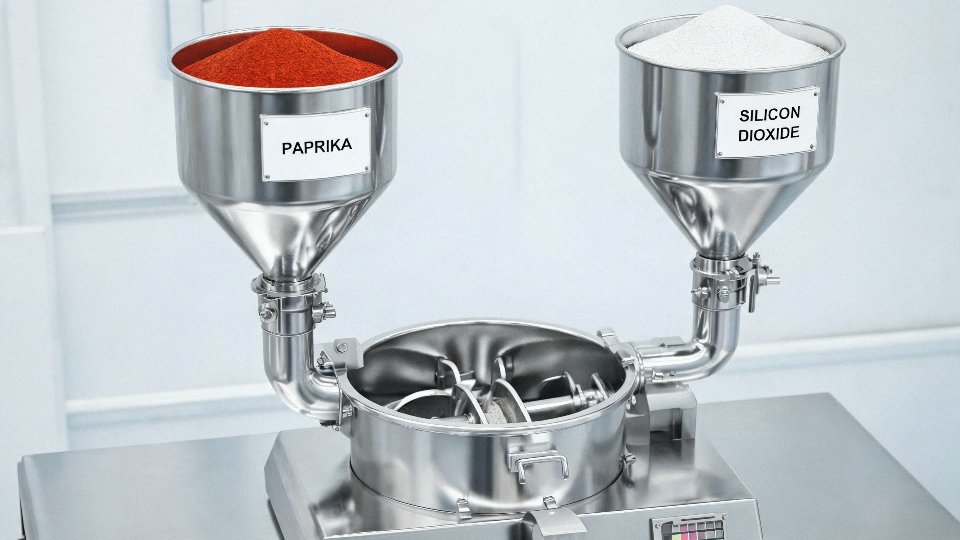
Misconception 4: clumping means contamination
Clumping is not pleasant, but it is not automatic proof of contamination. Most clumping in paprika comes from moisture uptake, compaction during shipping, fine particle size, or temperature cycling. A pallet that moves from a cool warehouse into a humid dock can sweat inside marginal packaging. A half-used jar above a kettle line will pick up moisture every time the lid is left loose. In restaurant kitchens, that happens constantly.
That said, there are limits. If paprika smells sour, musty, fermented, or visibly moldy, do not try to save it by breaking up the lumps. If there is webbing, unusual speckling, insect activity, or a damp paste-like texture, disposal is the sensible call. Moisture clumping is one thing. Spoilage signs are another.
A simple practical check:
| Observation | Likely meaning | Sensible action |
|---|---|---|
| Dry lumps that crush easily | Moisture pickup or compression | Sieve or break up if odor and appearance are normal |
| Hard bricks with stale aroma | Long storage, poor barrier packaging, oxidation risk | Use only after sensory check; reject for high-spec production |
| Musty smell, visible mold, wet patches | Possible spoilage | Discard or quarantine; do not blend into production |
| Repeated hopper bridging | Flowability mismatch, not necessarily safety failure | Review moisture, particle size, packaging, and anticaking specification |
Clean label is a commercial choice, not a safety shortcut
Clean-label requirements are real. Retail customers ask for them. Foodservice brands build menus around them. Export buyers may include them in tender documents. There is nothing wrong with specifying “no silicon dioxide” if the supply chain can support it.
The mistake is treating clean label as the same thing as safer, fresher, or better controlled. It may be. It may not be. A clean-label paprika still needs moisture control, water activity checks where relevant, color monitoring, foreign material control, allergen discipline in the packing facility, and packaging with low water vapor transmission for the intended shelf life. Multilayer moisture-barrier pouches or lined cartons are common industrial choices because plain paper and humid warehouses are a poor combination.
For engineers and procurement managers, the better question is not “Is silicon dioxide good or bad?” The better question is: does this paprika meet the job?
Look at the label. Read the specification. Ask for supplier documentation if you are buying at scale. Check storage conditions at your own site, not just the supplier’s certificate. Then smell it, taste it, and watch how it behaves in your equipment or kitchen. Evidence beats assumptions every time.
Frequently asked questions
Does all paprika have silicon dioxide in it?
No. Only some paprika products include silicon dioxide, usually as an anticaking agent to keep the powder flowing through packaging lines, dispensers, restaurant shakers, or industrial blending systems.
Plain ground paprika can be sold with no anticaking agent at all. You will see plenty of labels that list only “paprika” or “ground paprika.” Other products, especially seasoning blends or paprika packed for food manufacturing, may include silicon dioxide at a low use level, often somewhere around 0.5% to 2.0% by weight in dry blends, depending on the flow target, humidity exposure, particle size, and local rules.
A procurement warning from the plant side: do not assume “paprika powder” means the same thing across suppliers. One lot may be free-flowing because it is drier and packed well. Another may flow because it contains an anticaking agent. Both can be legitimate. The specification tells the truth.
Is silicon dioxide in paprika listed on the label?
In most retail food contexts, intentionally added silicon dioxide should appear in the ingredient declaration. It may be listed as “silicon dioxide,” “silica,” or described with its function, such as an anticaking agent, depending on the market and label format.
Rules vary by country, and bulk industrial materials may rely more on a product specification sheet, technical data sheet, or certificate of analysis than a consumer-style label. For procurement teams, the label is only the first screen. Ask for the full ingredient declaration, allergen statement, additive declaration, and current specification. If the material is going into a clean-label product, get the supplier to confirm the absence of anticaking agents in writing.
All paprika contains silicon dioxide.False
Some paprika contains added silicon dioxide as an anticaking agent, but many products contain only ground paprika with no added flow aid.
Is paprika without silicon dioxide better?
Not automatically.
Paprika without silicon dioxide may be preferred for clean-label products, organic-positioned recipes, or customers who want a shorter ingredient list. That is a valid commercial reason. But quality still depends on the pepper variety, drying conditions, grind, color value, volatile flavor retention, microbial controls, moisture, packaging, and storage age.
A clean-label paprika that sat six months in a damp storeroom can be dull, clumpy, and flat. A paprika with a small amount of anticaking agent may perform better in a dry mix line and give more consistent dosing. Better depends on the job. For a chef finishing plates, aroma and color may matter most. For a snack seasoning plant, flow through a vibratory feeder at 5 a.m. on a humid Monday may matter just as much.
Why does my paprika clump if it has no silicon dioxide?
Paprika is hygroscopic enough to pick up moisture from air, especially after the container is opened. Well-dried ground paprika is often around 8% to 12% moisture, give or take, depending on the drying process, particle size, and storage conditions. Once moisture creeps higher, the powder bridges, cakes, or forms hard lumps.
Pressure makes it worse. A 25 kg lined carton stacked under three pallets for a few warm weeks can compact even if the material looked fine at packing. Temperature cycling is another nuisance. Warehouses that swing from cool nights to warm afternoons can create small moisture migration effects inside packaging. In home kitchens, steam from a saucepan is the usual culprit. Shaking paprika over a boiling pot is a classic way to ruin a container.
Is silicon dioxide the same as sand?
Chemically, sand and silicon dioxide are related in a broad sense because common sand contains crystalline silica. That does not mean food-grade silicon dioxide used as an additive is the same as scooping sand into spice.
Food-grade amorphous silicon dioxide is a refined material made to meet food additive specifications for purity, particle characteristics, and use conditions. The industrial hazard people worry about in mining, blasting, or dry cutting concrete is respirable crystalline silica dust, which is a different exposure situation. Do not mix those two ideas together. Same chemical family, very different specification and risk context.
Can organic paprika contain silicon dioxide?
It depends on the organic certification program, the country, and the exact product specification. Some certification systems restrict synthetic anticaking agents heavily. Others may allow certain processing aids or additives under specific conditions. There is no safe shortcut here.
If the front label says organic, still read the ingredient panel. For bulk purchases, ask for the organic certificate, ingredient declaration, and additive statement. In audits, “we assumed it was additive-free because it was organic” is not a defensible control. I have seen purchasing teams get caught by that kind of assumption on blended seasonings, where the base spice was organic but the blend rules were more complicated.
How can I buy paprika with no silicon dioxide?
For retail buying, choose a product whose ingredient list says only “paprika” or “ground paprika.” Avoid products that list silicon dioxide, silica, anticaking agent, or a seasoning carrier unless you are comfortable with those ingredients.
For foodservice or manufacturing, be stricter:
- Request a current specification sheet showing the full composition.
- Ask the supplier to confirm “no added anticaking agent” in writing.
- Check whether the product is pure paprika or part of a seasoning blend.
- Review moisture range, packaging type, and shelf-life conditions.
- Prefer moisture-barrier packaging, such as multilayer pouches or lined cartons, if the paprika will sit in storage.
The practical tradeoff is simple. No silicon dioxide can work very well if the paprika is properly dried, packed, stored, and used before it degrades. If your plant has humid air, slow stock rotation, open hoppers, or operators who leave bags untied after partial use, an additive-free paprika may clump and cause dosing variation. Fix the handling first. Then decide whether the clean label is worth the extra control.
Final decision framework: when silicon dioxide matters and when it does not
Silicon dioxide in paprika is a choice, not a rule. Some paprika is sold as ground dried pepper only. Some includes food-grade silicon dioxide because the supplier, blender, or end user wants better powder flow and fewer caking complaints. The right answer is not “always avoid it” or “always accept it.” The right answer is tied to how the paprika will be used, stored, dosed, declared, and audited.
Silicon dioxide is optional in paprika, not a universal ingredient.True
Many paprika products are sold as single-ingredient ground pepper, while others use food-grade silicon dioxide or include it through seasoning blends to control caking and improve flow. The answer depends on the label, specification, regulation, and end-use requirements.
Avoid silicon dioxide when the specification demands it
If your product promise is clean label, single-ingredient, organic-compliant, or “no anticaking agents,” then silicon dioxide matters a lot. Not because it is automatically unsafe, but because it may violate the buying requirement.
That distinction saves arguments later.
A retail spice brand may reject silicon dioxide because consumers expect the ingredient panel to say only “paprika.” A sauce manufacturer may avoid it because a customer’s restricted-substance list excludes anticaking agents. A certified organic program may have its own rules on allowed processing aids and additives, and those rules vary by jurisdiction and certifier. A chef may simply want total ingredient transparency for menu documentation.
In those cases, do not rely on the front label. Get the ingredient declaration and the technical specification. If the supplier says “free-flowing paprika” but the ingredient line is vague, ask whether any anticaking agent is added or carried in from a blend component. Procurement has to be boring here. Boring prevents rework.
Accept silicon dioxide when flow reliability is worth more than label purity
There are also operations where rejecting silicon dioxide causes real problems. Automated dosing systems, volumetric fillers, screw feeders, and seasoning applicators do not care about label philosophy. They care whether powder bridges in the hopper at 2 a.m.
In dry seasoning blends, silicon dioxide is often used around 0.5% to 2.0% by weight, depending on the flowability target, particle size, oil content, humidity exposure, and local regulation. Paprika has natural color compounds and some surface oil character, so it does not always behave like a dry mineral powder. Even well-dried ground paprika commonly sits around roughly 8% to 12% moisture. Push storage humidity up, leave bags open near a washdown area, or run it through a warm mezzanine in summer, and caking risk climbs fast.
A typical plant-floor example: a 25 kg lined carton of paprika works fine for hand-scooping in a batch room. Put the same material above a loss-in-weight feeder feeding a snack seasoning drum, and it may rat-hole or dose unevenly. The wrong powder choice shows up as under-seasoned product, color variation, rejected checks, line stops, and operators beating the side of the hopper with a rubber mallet. That is not a process control strategy. It is a symptom.
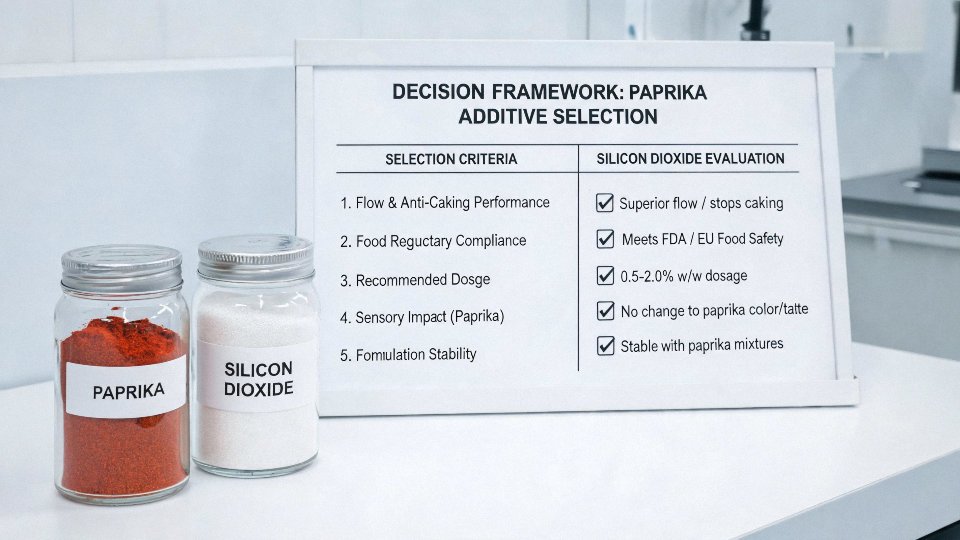
Do not judge paprika by one additive alone
A paprika with no silicon dioxide can be excellent. It can also cake badly, fade quickly, or arrive with weak documentation. A paprika with silicon dioxide can be practical and compliant for a factory. It can also be the wrong choice for a clean-label retail product.
Look at the whole package:
| Use case | Silicon dioxide preference | What to verify before buying |
|---|---|---|
| Home cooking or small restaurant use | Usually optional | Ingredient label, freshness, color, aroma, container seal |
| Clean-label retail product | Usually avoid | Written specification, additive statement, allergen and non-GMO or organic documents if needed |
| Automated industrial dosing | Often acceptable | Flow test data, moisture range, bulk density range, packaging type, feeder trial results |
| Export or long distribution chain | Case by case | Local additive rules, shelf-life data, moisture-barrier packaging, supplier traceability |
| Humid warehouse or frequent bag opening | Often useful | Caking history, water vapor barrier, reseal practice, storage temperature and humidity |
Packaging deserves more respect than it usually gets. Multilayer moisture-barrier pouches, lined cartons, and properly sealed bags can do as much for caking control as a small additive dose, sometimes more. A good paprika in a poor bag will lose the argument to humidity. I have seen operators blame the supplier while half-used sacks sat open beside a kettle line. The powder was not the only problem.
Procurement checklist before you decide
Use this as the final screen before issuing a purchase order or approving a substitute:
- Read the label. Look for “silicon dioxide,” “silica,” or “anticaking agent,” depending on local labeling practice.
- Verify the specification. Ask for a current technical data sheet, ingredient declaration, and additive statement. For industrial use, get the revision date.
- Check moisture and packaging. Well-dried paprika is commonly around 8% to 12% moisture, but the acceptable range depends on grind, origin, storage time, and your process. Packaging should match the distribution route, not just the purchase price.
- Match the product to the application. Hand-scooping into a marinade is not the same as metering through an auger feeder. Color strength, heat level, flavor, microbiological controls, and flow behavior all matter.
- Store it correctly. Keep paprika sealed, dry, cool, and away from steam, washdown drift, and direct sunlight. Rotate stock. Do not let a clean-label powder fail because the warehouse treats it like gravel.
The practical decision is simple: avoid silicon dioxide when your label, customer, certification, or policy requires avoidance. Accept it when controlled flow and distribution stability are the higher priority. Then prove the choice with specifications, trials, and storage discipline.