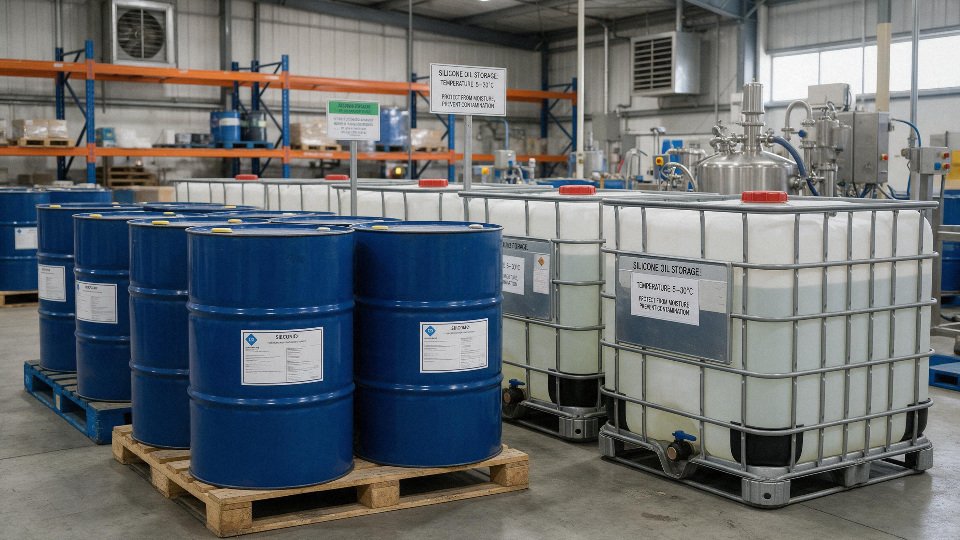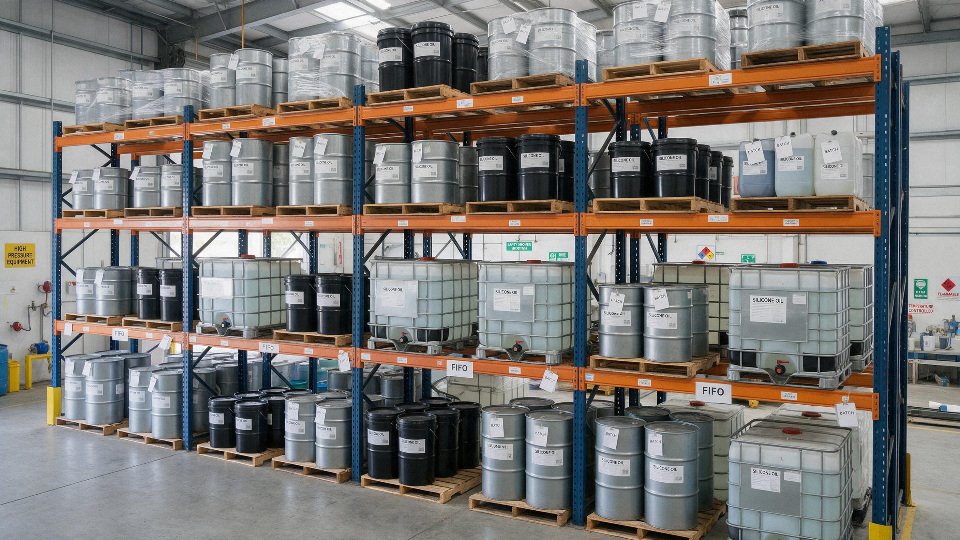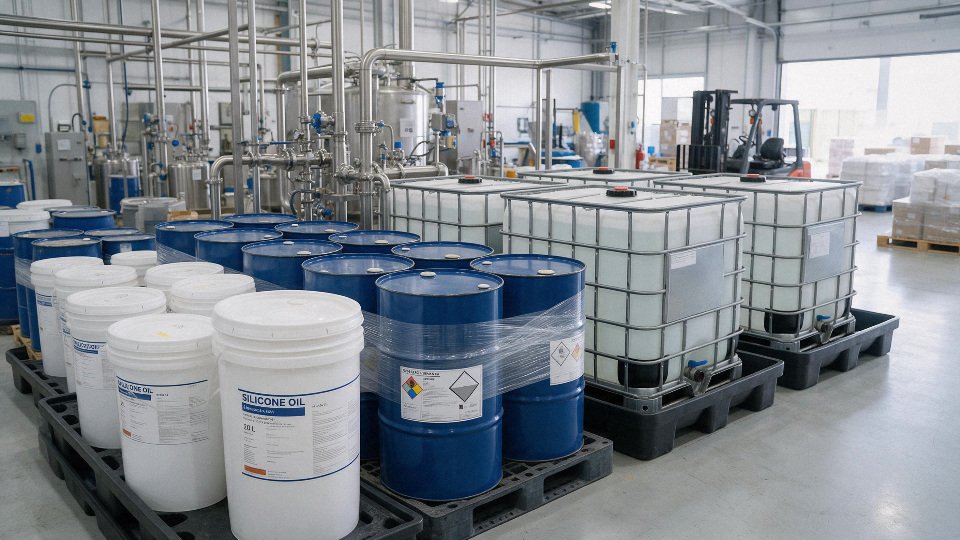
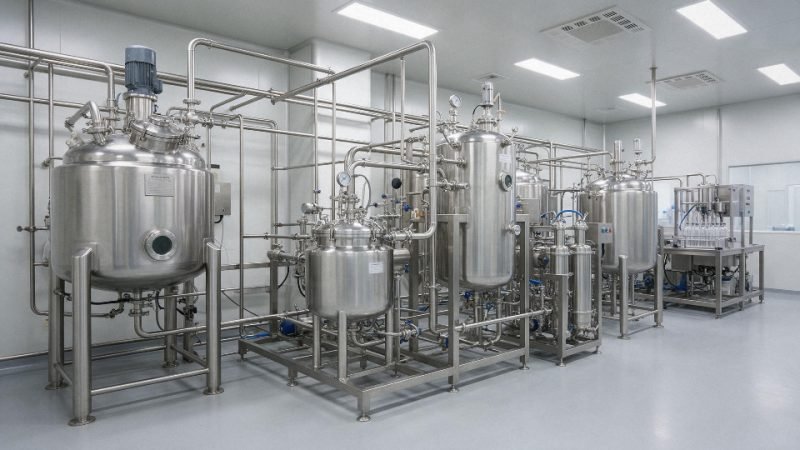
A silicone fluid that looks clean on paper can still fail a medical application if the polymer distribution is loose, residual volatiles are high, or particulate and bioburden control slipped somewhere between reactor and filling. On the plant side, that shows up as unstable viscosity, difficult filtration, batch holds, and long release cycles; on the commercial side, it means scrap, retesting, delayed shipments, and a supplier qualification problem that is expensive to unwind. The production route is not mysterious, but the difference between industrial silicone oil and medical-grade material is the discipline around polymerization control, purification, and contamination management.
Medical silicone oil is typically produced by controlled equilibration or polymerization of siloxane intermediates, then purified to tighten viscosity, reduce residual volatiles, and remove trace contaminants before filtration, cleanliness-controlled filling, and batch release testing. What makes it “medical” is less the basic chemistry than the process control, impurity profile, and verification against application-specific quality requirements.
That is where buyers often underestimate the process. Two drums can carry the same nominal viscosity grade, say 100 cSt or 1,000 cSt, yet behave very differently once you look at volatile content, extractables-related screening, particulate cleanliness, or how tightly the supplier holds the target range batch to batch. The production sequence explains why those differences happen, which controls matter, and where a specification sheet stops being enough.
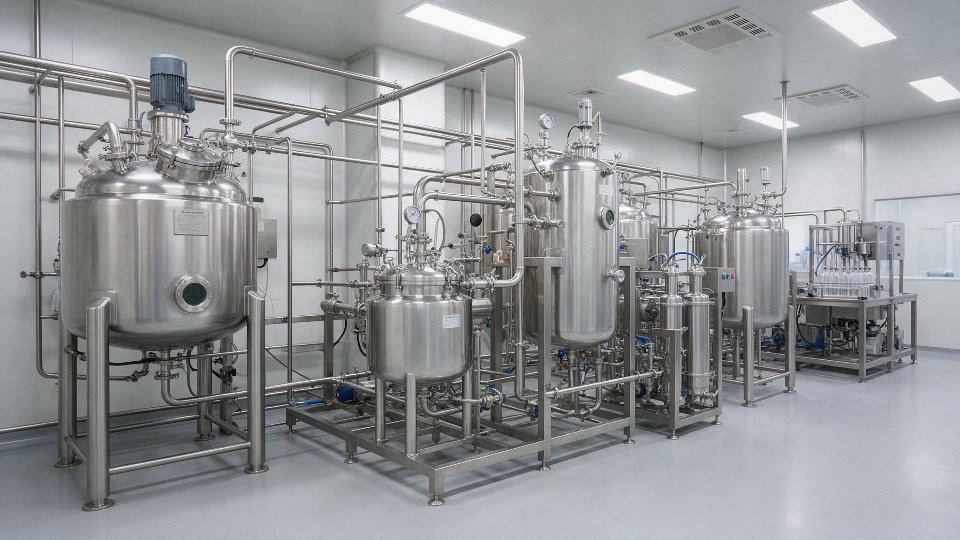
Chemistry and grade definitions
Medical silicone oil is usually a linear polydimethylsiloxane fluid built from repeating dimethylsiloxane units, with chain length and end-group control doing most of the heavy lifting on viscosity and volatility. For buyers and technical teams, the critical point is that “medical grade” is not a chemistry name by itself; it is a specification-and-control claim that only means something when tied to defined tests, manufacturing controls, packaging, and intended use.
At the molecular level, the backbone is a siloxane chain, typically represented as repeating –Si(CH₃)₂–O– units. In simple linear fluids, the chain ends are commonly capped with relatively non-reactive terminal groups such as trimethylsiloxy ends. Those terminal groups matter because they influence stability, residual reactivity, and how the fluid behaves during purification and storage. A short chain gives a low-viscosity fluid; a longer chain gives a thicker one. That sounds basic, but in production and procurement it is where half the misunderstandings start.
Viscosity in these fluids is primarily a chain-length and molecular-weight-distribution issue. As average chain length rises, chain entanglement increases and the fluid resists flow more strongly. A 20 cSt fluid and a 12,500 cSt fluid are not just “thinner” and “thicker” versions of the same buying decision. The lower-viscosity end usually brings higher volatility and a greater chance that low-molecular-weight fractions need tighter control. The high-viscosity end reduces volatility but can make filtration, filling, deaeration, and dose consistency harder, especially in small containers or sterile presentation formats.
What the base molecule is, and what it is not
A lot of specification errors happen because different silicone product families get lumped together under “silicone oil.” On paper they may look adjacent. On the plant floor and in a quality file, they are not.
Linear medical silicone oils
These are the simplest case:
– Predominantly linear siloxane chains
– Usually dimethylsiloxane-based
– Flowable liquids across a defined viscosity range
– Limited functional reactivity if properly end-capped
– Used where a stable, inert, controlled fluid is required
Specialty modified silicone fluids
These are materially different products, even if they still pour:
– Phenyl-modified fluids for altered refractive index or low-temperature behavior
– Fluoro-modified fluids for specific chemical resistance or surface properties
– Amino, epoxy, hydroxyl, or other functional fluids for reactivity or adhesion-related roles
– Mixed copolymer systems with changed wetting or compatibility behavior
These modified fluids can be useful in some technical applications, but they should not be treated as interchangeable with linear medical silicone oil just because the SDS says “siloxane.”
Blends, gels, and elastomer systems often confused with silicone oil
- Blends: mixtures of two or more silicone fluids, sometimes used to hit a target viscosity or handling profile, but not equivalent to a single, narrowly characterized polymer population
- Silicone gels: lightly crosslinked systems where the fluid phase is immobilized in a network
- Crosslinked elastomers: solid or semi-solid networks, not oils
- Filled systems: silicone materials containing silica or other fillers that change rheology, purity risk, and extractables behavior
The trade-off is straightforward: modified or structured systems can deliver a useful property shift, but they also introduce extra compositional complexity, more screening work, and more ways to fail a customer’s incoming qualification.
Which properties matter in medical use
For most medical discussions, viscosity gets the first question because it is easy to specify and easy to measure. It is not the only property that matters.
| Property | What it usually reflects | Why medical teams care |
|---|---|---|
| Viscosity at defined temperature | Average chain length and distribution | Delivery behavior, spreading, damping, fill consistency |
| Molecular weight distribution | Breadth of chain populations | Stability, volatility profile, lot-to-lot repeatability |
| Volatile content | Low-molecular-weight linear/cyclic fractions and residual light ends | Evaporation loss, odor risk, extractables concern, regulatory scrutiny |
| Surface tension | Surface behavior of the fluid | Wetting, coating, migration, interaction with substrates |
| Density | Composition and temperature response | Filling accuracy by mass/volume conversion, process control |
| Refractive index | Molecular structure and purity consistency | Identity check, optical-use relevance in some applications |
| Particulate cleanliness | Process and packaging cleanliness | Device reliability, ophthalmic or sensitive-contact applications |
| Bioburden | Microbial control through handling chain | Required for downstream processing strategy |
Mechanistically, volatility is where chemistry and procurement meet operating cost. Low-molecular-weight species, especially light fractions and some cyclics, can survive synthesis unless stripped effectively. If they remain, they can shift odor, mass loss, extractables profile, and long-term stability behavior. Tightening viscosity alone does not remove them. You can buy a fluid that hits viscosity every time and still creates trouble in validation because the light-end cleanup or packaging discipline was weak.
A narrow viscosity range by itself does not prove a superior medical silicone oil.True
Viscosity mainly indicates flow behavior and average chain length. It does not directly confirm low residual volatiles, low catalyst residues, low particle burden, low bioburden, or packaging compatibility, all of which can matter more in qualification.
What grade language actually means
“Technical grade,” “cosmetic grade,” “pharmaceutical support grade,” and “medical grade” are often used as commercial shorthand. Useful shorthand, yes, but still shorthand.
- Technical grade usually means fit for industrial use with routine physical-property control. Purity, volatiles, cleanliness, and trace-residue expectations may be far looser.
- Cosmetic grade often implies tighter control for personal-care use, but not automatically the documentation depth or biocompatibility support expected for device or pharmaceutical contexts.
- Pharmaceutical support grade may indicate material sold into pharmaceutical processing, formulation support, or contact-related uses with stronger documentation and compendial alignment, but the exact meaning is supplier-specific.
- Medical grade is the most abused term. In practice, it should be tied to a defined quality system, traceability, change control, biocompatibility support logic, and a specification package relevant to the intended use.
The limitation here is important: a supplier can label a product “medical grade,” but the buyer still needs to ask, “Against which standard, for what use case, and with what evidence?” Without that, the term is marketing language.
Standards, systems, and customer specifications that shape the grade
No single universal label settles suitability. Grade definition usually sits at the intersection of several frameworks:
- Pharmacopeial expectations: depending on application and market, buyers may look for alignment with relevant monographs or support data on identity, acidity, volatiles, and purity-related attributes. Exact applicability must be checked against current pharmacopeial text and intended use.
- Medical device quality systems: ISO 13485-oriented controls do not make a fluid biocompatible by themselves, but they do matter for traceability, change control, deviation handling, and document discipline.
- Biocompatibility assessment logic: under ISO 10993-style thinking, material acceptability depends on contact type, duration, patient exposure pathway, and the final finished-device context, not just the neat fluid.
- Customer-specific acceptance criteria: many OEMs or converters add their own limits for particulate cleanliness, bioburden, volatile profile, packaging compatibility, and extractables-related screening.
Common incoming and release checks often include:
– Viscosity at a defined temperature
– Refractive index
– Acid value
– Volatile content
– Particulate cleanliness
– Bioburden
– Extractables-related screening
That last point usually decides whether a nice-looking datasheet survives contact with a regulated project. A fluid can be chemically correct and still be commercially wrong if particles, catalyst residues, cyclics, or packaging-derived extractables are not controlled to the customer’s actual risk profile. In practice, that is why serious qualification starts with the intended application, not with the label on the drum.
Raw materials and feedstocks
Medical silicone oil starts upstream with monomer quality, not at the polishing filter. If the chlorosilane feed, water quality, catalyst choice, and contact materials are not tightly controlled, the plant ends up spending more on stripping, filtration, rework, and testing while still carrying higher compliance risk. That is why experienced buyers look past the finished viscosity grade and ask where the monomers came from, how the siloxane train is integrated, and how segregation is maintained.
The essential inputs are straightforward on paper, but each one can become a contamination path or a yield loss point in production:
- Organosilicon monomers or intermediates
- Most commonly dimethyldichlorosilane (DMDCS) as the main precursor for polydimethylsiloxane-based fluids
- Related chlorosilanes or cyclic siloxane intermediates, depending on the producer’s route and whether part of the process is outsourced upstream
- Water for hydrolysis
- Used to convert chlorosilanes into silanols and then siloxane structures
- Water purity directly affects ionic contamination, haze risk, and downstream neutralization load
- Neutralizing agents
- Used to remove or neutralize hydrochloric acid and other acidic residues generated during hydrolysis
- The exact chemistry varies by process and must be controlled to avoid salt carryover
- Catalysts
- Commonly used in equilibration or polymer growth to reach the target molecular weight distribution and viscosity window
- Must be fully removed, quenched, or deactivated after reaction
- Chain stoppers / end-blockers
- Low-molecular-weight siloxanes or related end-capping materials used to control polymer length and final viscosity
- Process aids and optional solvents
- Some plants use solvents, antifoam-compatible auxiliaries, or transfer aids in specific steps
- In medical grades, every optional addition increases the analytical burden later
- Utility-grade but product-critical materials
- Inert gases, filter media, cleaning chemicals, and packaging-contact components often matter as much as the nominal raw materials
Where the main monomer comes from, and why that matters
For most medical silicone oils based on dimethylsiloxane chemistry, the main upstream building block is DMDCS or a closely related intermediate derived from it. Industrially, that monomer is commonly produced through the direct process, where methyl chloride reacts with silicon in the presence of a catalyst system to form a mixture of methylchlorosilanes. That mixture is then separated, usually by distillation, to isolate the desired fractions.
What matters on the plant floor is not the textbook reaction but the impurity profile coming out of that upstream unit. If the DMDCS cut carries too much of the wrong chlorosilane isomers, heavy ends, light ends, metal traces, or hydrolyzable by-products, those impurities do not simply disappear in hydrolysis. Some shift viscosity, some broaden the molecular weight distribution, and some show up later as volatiles, acidity drift, color instability, or difficult-to-explain lot variation.
A narrow and stable monomer specification usually gives three downstream advantages:
- Lower purification burden
- Less stripping and fewer deep-clean polishing steps to hit volatile and cleanliness targets
- Better batch-to-batch viscosity control
- Particularly important where medical customers buy within a narrow cSt band rather than a broad industrial grade
- Lower deviation risk
- Fewer unusual chromatograms, fewer out-of-trend acid values, fewer investigations nobody wants to write up on a Friday afternoon
This is one of the places where integration can help. A producer with direct access to silicon, chlorosilane, and siloxane infrastructure often has more leverage over cost and lot consistency than a blender buying intermediates on the spot market. The trade-off is that integration alone does not guarantee a medical-suitable feed stream. If the site cannot prove segregation, cleaning validation, and controlled transfer between industrial and medical-oriented campaigns, the theoretical benefit disappears quickly.
Integrated upstream chlorosilane and siloxane production can improve cost control and lot stability for medical silicone oil.True
This is generally credible because fewer third-party transfers and tighter control over monomer cuts can reduce variability and procurement exposure. It only holds if the producer also maintains robust quality segregation and contamination control between product families.
Water, inert gases, solvents, and cleaning chemistry
Hydrolysis water is not just a utility. It becomes part of the contamination balance of the whole batch. Plants aiming at high-purity silicone fluids typically use tightly controlled purified water systems because hardness ions, chlorides, organics, and bioburden can all complicate downstream quality control.
In practice, these support materials deserve procurement-level scrutiny:
- Purified water
- Watch ionic content, total organic carbon, and microbial control
- Seasonal water swings can show up later as inconsistent neutralization demand
- Nitrogen or other inert gas
- Used for blanketing, moisture control, transfer protection, and oxidation risk reduction
- Poor gas quality can introduce particulates, oil aerosols, or moisture
- Solvents, where used
- Must be compatible with medical-grade impurity expectations
- Residual solvent removal then becomes a required validation point, not a nice-to-have
- Cleaning agents
- Alkaline, acidic, or solvent-based cleaning systems can leave residues if rinse verification is weak
- This is a common blind spot in multipurpose plants
The mechanism is simple: impurities introduced early tend to be diluted through the batch but concentrated in the quality effort. A few ppm of ionic or organic residue can trigger extra filtration, stripping, retesting, or hold time, and hold time itself increases handling exposure.
Catalysts, quench strategy, and indirect material contributors
During equilibration or controlled polymer growth, catalyst selection affects both reaction efficiency and cleanup difficulty. Acidic or basic catalyst systems can be effective, but the preferred choice flips depending on the producer’s route, viscosity target, and cleanup capability. A catalyst that gives fast equilibration may still be the wrong commercial choice if deactivation is messy and residues are hard to remove consistently.
What needs checking is not just catalyst identity, but the whole exit plan:
- How the catalyst is charged
- How endpoint is determined
- How the catalyst is quenched, neutralized, or adsorbed
- What residues remain and how they are verified absent or within limit
- Whether the removal method adds its own contamination risk
At this point, indirect raw materials start to matter. Stainless steel grade, fluoropolymer-lined transfer components, gasket elastomers, pump seals, filter housings, and filtration media can all contribute extractables, fibers, fines, or metal traces if selected poorly or maintained badly. A worn gasket in a hot loop can do more damage to a medical batch than a purchaser expects from a “non-product-contact” consumable.
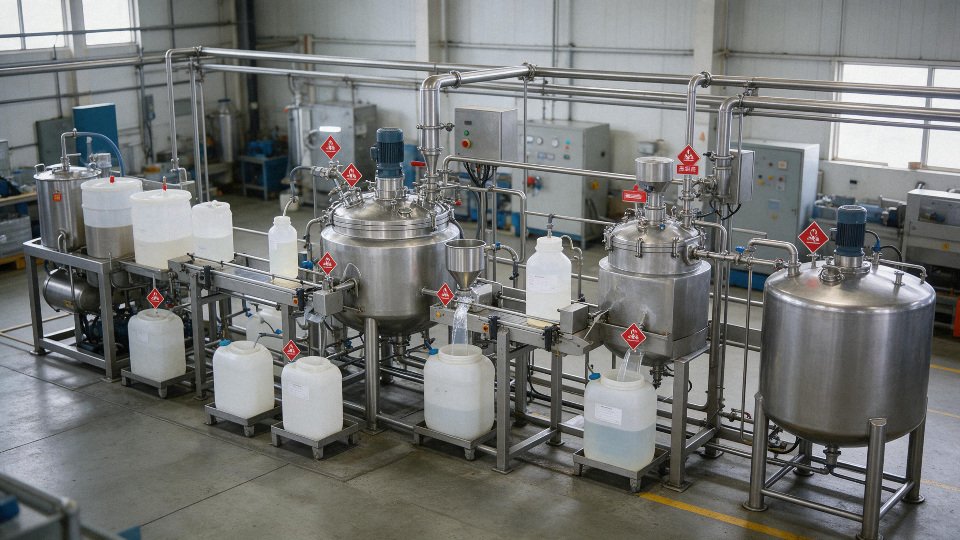
For that reason, strong suppliers usually treat contact materials and utilities as controlled inputs, not maintenance afterthoughts. That boundary matters most in multipurpose facilities: if the same tanks, hoses, or cartridge housings also see industrial silicone products, you need evidence that changeover discipline is robust enough to keep upstream cost advantage from becoming downstream quality noise.
Core manufacturing pathway
Medical silicone oil is usually made through a staged siloxane build-and-purify route, not a single-pass reaction. In practice, the plant is trying to do two things at once: create the target linear polydimethylsiloxane structure and prevent avoidable impurities from ever being generated, because some of the hardest contaminants to remove later are the ones formed early under poor hydrolysis, poor drying, or rough catalyst control.
The broad sequence is consistent across most serious producers: convert organochlorosilanes by hydrolysis, separate and wash the crude siloxane phase, build chain length by equilibration or controlled polymerization, strip out volatiles and moisture, then refine, standardize, and release only after the lot clears a tighter test panel than commodity silicone fluids. The exact equipment train, catalyst system, and number of purification passes depend on grade, viscosity target, and the customer’s downstream use.
Hydrolysis and initial condensation: where the crude siloxane backbone starts
The first critical step is hydrolysis of chlorosilane feedstocks, commonly dimethyldichlorosilane-rich streams for PDMS-type medical fluids. Water reacts with the Si-Cl bonds to form silanols, and those silanols condense rapidly into siloxane oligomers, while hydrochloric acid is generated as a direct byproduct.
That sounds straightforward on paper. On the floor, it is one of the messiest and most consequence-heavy stages in the whole route.
A few operating realities matter immediately:
- The reaction is strongly exothermic.
- Local hot spots accelerate side reactions.
- Poor heat removal can shift the oligomer distribution and increase cyclics or broader molecular variability.
- Corrosion risk rises fast if acid concentration and temperature both spike.
- Mixing quality changes the chemistry.
- If chlorosilane feed enters unevenly, you get local excess reagent and incomplete hydrolysis pockets.
- If water addition is too aggressive, emulsions get worse and downstream phase disengagement slows.
- On larger reactors, impeller choice and feed-point placement are not minor details; they affect both yield and cleanup burden.
- Materials of construction matter early.
- Hydrochloric acid, chlorosilane residues, and wet chloride service are unforgiving.
- Lined vessels, suitable stainless selections, glass-lined systems, or corrosion-resistant transfer components are often chosen based on exact chloride load and temperature profile.
- The wrong gasket or valve-seat material can become a contamination source before the product is even a crude fluid.
The engineering purpose of this stage is not just to “make siloxane.” It is to create a crude oligomer mixture with a manageable impurity profile. If hydrolysis control is poor, later polishing steps become more expensive, less effective, and sometimes insufficient for medical-grade release.
There is a trade-off here. Pushing for faster conversion and shorter cycle time can improve throughput, but it often widens the burden on washing, devolatilization, and final purification. The preferred operating window flips when the plant is feed-limited or utility-limited, but for medical grades, most producers accept slower, more controlled hydrolysis rather than chase reactor turns.
Phase separation, washing, and neutralization: removing acid without creating new problems
Once the crude reaction mass forms, it typically separates into an organic siloxane-rich phase and an aqueous acidic phase. The objective is to get hydrochloric acid, dissolved salts, water-soluble residues, and hydrolysis byproducts out of the organic stream before they continue attacking equipment or interfering with later polymer-building steps.
Typical downstream actions include:
- Gravity settling or centrifugal phase separation
- Used to split the siloxane-rich phase from the acid-water phase.
- Good phase cut discipline matters; dragging aqueous carryover downstream causes trouble in equilibration and vacuum stripping.
- Water washing
- Removes residual HCl and soluble ionic impurities.
- Wash intensity must be enough to reduce acid load, but not so severe that stable emulsions form and hold up production.
- Neutralization
- Applied where residual acidity would damage product quality or catalyst performance later.
- The chosen neutralization chemistry has to be controlled tightly to avoid leaving excess neutralizing agent, salts, or fine solids in the product phase.
- Drying or intermediate moisture reduction
- Even after washing, the organic phase often retains dissolved or entrained water.
- That water can destabilize later processing and push more unwanted low-molecular species formation.
In practice, this is where many plants either keep their process clean or quietly build future headaches. Overwashing can leave the product wet and difficult to dry. Aggressive neutralization can create fine particulate residues that only show up later in polishing filtration. Weak washing leaves residual chloride or acidity that shortens catalyst life and can shift polymer architecture.
A common plant-floor mistake is treating washing as a utility step rather than a quality step. It is neither passive nor forgiving. The wash water quality, conductivity endpoint logic, separator residence time, and transfer discipline all influence final purity. If the plant uses flexible hoses, tote transfers, or open-top intermediate handling at this stage, that is often where secondary contamination starts creeping in.
Equilibration or controlled polymerization: building the target viscosity grade
The next stage sets the molecular weight distribution that drives viscosity. For medical silicone oil, that usually means taking low-molecular siloxane intermediates and converting them into a controlled linear fluid using an equilibration or polymerization approach, with catalysts and chain stoppers chosen to hit the specified viscosity window.
Typical controls in this stage include:
- Catalyst type and dosage
- Strongly affect reaction rate and equilibrium distribution.
- Residual catalyst must later be removed or deactivated adequately.
- Chain stopper level
- End-capping agents limit average chain length.
- More chain stopper generally means lower final viscosity; less allows longer chain build.
- Temperature profile
- Changes reaction rate and affects side-product formation.
- Higher temperature can shorten batch time but may increase low-boiler generation or broaden distribution if not managed well.
- Residence time
- Too short and the lot may drift low in viscosity or remain unstable.
- Too long and the process may generate more unwanted redistribution products.
- Dryness and residual acidity
- Water and acid residues interfere with catalyst performance and reproducibility.
- This is one reason the prior washing/drying section is not optional housekeeping.
The mechanism is simple but commercially important: chain length distribution determines viscosity, and viscosity determines saleable grade. A customer buying about 20 cSt fluid is not buying the same process window as a customer buying several thousand cSt. Typical medical silicone oil viscosity grades may run from about 20 cSt up to 12,500 cSt, but the tighter and more critical the end use, the more important distribution control becomes, not just the nominal target.
There is a trade-off between flexibility and consistency. A plant can hold intermediate sublots and blend toward the target later, which helps salvage yield and improve commercial flexibility. But if the reaction stage is too variable, blending becomes a patch, not a control strategy. That approach stops holding when the application requires very narrow viscosity control or tighter volatile and extractables behavior, where sublot similarity matters more than simple average viscosity.
Stripping and devolatilization: taking out what should not stay in the fluid
After chain build, the product still contains low boilers, cyclic siloxanes, residual moisture, dissolved gases, and traces of entrained impurities. Those species matter because they can affect odor, stability, packaging headspace behavior, downstream sterilization performance, extractables-related screening, and customer acceptance.
This is where vacuum and thermal handling earn their keep.
Common objectives of stripping and devolatilization are:
- Remove residual moisture
- Water can destabilize storage behavior and interfere with later purification.
- It also complicates accurate volatile measurement.
- Reduce low-boiling siloxanes and cyclics
- These are often among the most closely watched volatile components in higher-purity grades.
- Residual volatile targets for high-purity silicone fluids can range from low ppm into the low thousands of ppm, depending on specification and use.
- Drive off entrained solvents or process carryover, if any
- This depends on the specific route and cleanup scheme used.
- Improve lot consistency before final polishing
- A well-devolatilized stream behaves more predictably in filtration, adsorption, and final packaging.
The trade-off is thermal history. More heat and deeper vacuum usually improve removal efficiency, but excessive temperature or hold time can shift the fluid itself, especially if residual catalyst or acidity has not been adequately controlled. In other words, stripping can clean the product or quietly damage it. Plants that do this well monitor not just final volatile content, but the interaction between temperature, pressure, agitation, and residence time.
Fine purification: polishing to the grade, not just to appearance
For medical-grade material, a clear-looking fluid is not the same thing as a sufficiently purified fluid. Fine purification can include vacuum distillation, adsorption on selected media, fine or polishing filtration, and in some cases repeated refining cycles where the intended application justifies the cost and yield loss.
A practical comparison is below.
| Purification step | Main target | What it helps remove | Main limitation |
|---|---|---|---|
| Vacuum distillation | Volatile reduction and fraction cleanup | Low boilers, lighter siloxanes, some odor-causing fractions | Can cost yield; must avoid thermal stress |
| Adsorption | Trace impurity reduction | Polar residues, catalyst traces, color bodies, selected organics depending on media | Media choice can introduce particles or inconsistent performance if poorly controlled |
| Polishing filtration | Particulate cleanliness | Fine solids, adsorbent fines, corrosion debris, environmental contamination | Does not remove dissolved impurities |
| Repeated refining cycle | Tighter quality margin | Residual mixed impurity burden after first pass | Longer cycle, more handling, higher cost |
Common in-process and release-oriented checks around this stage include:
- Viscosity at defined temperature
- Refractive index
- Acid value
- Volatile content
- Particulate cleanliness
- Bioburden
- Extractables-related screening
Medical-grade silicone oil production is not simply 'make then filter'.True
Filtration removes suspended solids, but many critical impurities in silicone fluids are dissolved, volatile, ionic, catalyst-related, or generated by poor early-stage processing. The route has to prevent impurity formation, control carryover, and then apply purification steps matched to the impurity type.
Viscosity adjustment and lot standardization: finishing without losing traceability
Final grade setting is usually done by controlled blending of qualified sublots that already meet internal purity gates. The purpose is to bring viscosity into the contractual range while preserving lot history, analytical traceability, and release confidence.
A disciplined standardization step usually includes:
- Prequalification of each sublot
- No “blend away the problem” practice.
- A sublot that fails a critical purity criterion should not be used to rescue viscosity.
- Defined blend ratios and validated mixing time
- High-viscosity fluids can look mixed before they are analytically homogeneous.
- Tank geometry, agitator type, and recirculation loop design matter.
- Representative sampling protocol
- Top, middle, and bottom grabs are often needed for heavier grades.
- Sampling from a dead-leg valve is a good way to fool yourself.
- Batch genealogy control
- Procurement and QA teams will care about this if there is a later deviation, complaint, or regulatory review.
- Final polish and protected packaging
- Even at the last step, dirty filling heads, poorly cleaned drums, or bad nitrogen practice can undo a clean process.
In my experience, this last stage is where good manufacturing discipline shows. Anybody can talk about viscosity. The harder part is holding a medical fluid inside spec while keeping chloride low, volatiles controlled, particulates clean, and traceability intact from chlorosilane feed to filled package.
Purification and contamination control
Medical silicone oil stops being an ordinary silicone-fluid job at the point where purity, not just viscosity, becomes the governing variable. A batch can hit its target cSt and still fail medical use because low boilers, ionic residues, particles, or cross-product contamination remain high enough to affect extractables, odor, stability, or toxicological review.
The practical shift is this: standard silicone production is usually optimized around conversion, viscosity control, and throughput; medical production adds a second discipline built around residue removal and contamination prevention. That means tighter control of what enters the process, what touches the product, what remains after stripping, and what can be introduced during transfer, storage, filling, or changeover. On the plant floor, this is where a decent silicone unit becomes either a credible medical operation or not.
Which impurities matter most?
The impurity profile is broader than many buyers expect. You are not only chasing one “bad residue”; you are managing several materially different classes, each with its own removal method and failure mode.
- Residual acids or alkali
- Often tied to polymerization or equilibration chemistry.
- Can shift acid value, promote instability, attack packaging components, or alter downstream biocompatibility assessment.
- Usually require neutralization and then effective removal of the resulting salts or ionic traces; neutralizing alone is not enough.
- Catalyst residues
- May include acidic catalysts, basic catalysts, or metal-containing species depending on route.
- Even low residual levels can become a problem if the customer has tight ionic, metal, or extractables-related expectations.
- Some residues are not visible in routine viscosity data, so relying on viscosity alone is a classic buyer mistake.
- Unreacted oligomers and cyclic low-molecular-weight siloxanes
- These are often the hardest impurities to reduce economically because they are chemically similar to the desired fluid.
- They influence volatility, odor, migration behavior, and extractables testing.
- They also matter in packaging stability: low-molecular species can partition more readily into closures, tubing, and elastomeric contact materials.
- Volatile organics
- Can come from feedstocks, solvents if used, cleaning agents, adsorbent treatment, or upstream storage and transfer systems.
- A batch may look clear and stable but still carry residual volatile content above the intended grade target.
- Particles
- Generated from equipment wear, gasket shedding, pump abrasion, filter bypass, poor cleaning, or environmental ingress.
- Particularly relevant where the fluid will be used in device assembly, ophthalmic-related applications, or any controlled-contact use.
- Moisture
- Silicone oil is not as hygroscopic as some chemical systems, but moisture still matters because it can affect storage stability, some analytical results, and contamination load introduced through utilities or vessel opening.
- Metal traces
- Common sources are reactor metallurgy, valves, instruments, transfer lines, maintenance work, and catalyst carryover.
- This is one reason old multipurpose plants can struggle to supply consistent medical grades even if their chemistry is sound.
- Microbiological burden, where relevant
- Silicone oil itself is not a friendly growth medium, but bioburden control still matters in medical supply chains because contamination can be introduced from water systems, air handling, operators, packaging, or wet cleaning practices.
- Usually this is managed as a contamination-prevention issue rather than by treating the oil as a sterile product during manufacture.
Why low-molecular-weight species get so much attention
A fluid can sit exactly where it should on viscosity and still be wrong for medical use if the low-molecular-weight tail is too high. Bulk viscosity mainly reflects the average chain-length distribution; it does not tell you whether the short-chain fraction is low enough for migration, volatility, odor, or extractables expectations.
That short-chain fraction matters through several paths:
- Migration and extractables
- Smaller siloxane molecules move more easily into adjacent polymers, seals, and surfaces.
- In product qualification, this can appear as elevated extractables, fogging, surface transfer, or unexplained mass loss.
- Volatility
- Low-molecular species leave under heat or vacuum more readily.
- That affects weight stability, odor, packaging headspace, and in some uses the consistency of the applied film over time.
- Toxicological evaluation
- Risk review often focuses less on the main polymer and more on what can leach, volatilize, or contact tissue disproportionately.
- That is why many high-purity grades specify residual volatiles in ranges from low ppm to low thousands of ppm depending on use and customer standard, not just nominal viscosity.
- Sensory and downstream processing issues
- Odor complaints, slight haze after storage, or inconsistent wetting on a component can trace back to residual low boilers even when the certificate looks acceptable at first glance.
The boundary here is worth stating: if the intended use is a less sensitive external-contact application, the acceptable low-volatiles profile may be broader than for ophthalmic or tightly regulated device uses. You cannot responsibly generalize one target across all medical silicone oils.
How producers actually remove residues and contamination
The purification train is usually layered because no single step handles every impurity class well.
- Deep vacuum stripping
- Primary tool for removing low boilers, residual cyclics, and volatile organics.
- Effectiveness depends on vacuum level, residence time, temperature, film thickness, and surface renewal.
- The mechanism is straightforward: lower system pressure reduces the boiling threshold of volatile fractions, so they separate before the higher-boiling bulk fluid.
- The trade-off is thermal history. Push temperature or hold time too far and you can darken the product slightly, shift distribution, or pick up degradation byproducts.
- Molecular distillation or wiped-film evaporation
- Used when tighter low-boiler reduction is required without exposing the full batch to long high-temperature residence.
- Particularly useful for separating chemically similar low-molecular species from higher-viscosity silicone fluids.
- Capital cost is higher, and throughput per square meter of evaporative surface is not forgiving; this is where procurement teams need to understand why medical-grade capacity is more expensive than standard bulk silicone output.
- Adsorption media
- Can help reduce polar impurities, color bodies, some trace contaminants, and certain residuals not easily removed by vacuum alone.
- Media choice matters. Activated carbon, bleaching earths, alumina, or specialty adsorbents all have different selectivity and shedding risks.
- Overuse creates another problem: fines release, metal contribution, or unintended adsorption of desirable components.
- Ion removal strategies
- Usually aimed at residual acid/base species, salts, or catalyst-related ionic contamination.
- This can include washing in some process designs, neutralization followed by phase separation, or dry polishing methods depending on product sensitivity and water-management philosophy.
- Wet routes can be effective, but they create a moisture-removal and cleaning burden that many medical operations try to minimize.
- Submicron filtration
- Final polishing commonly includes staged filtration, often ending in fine-rated filters chosen for compatibility and low extractables.
- Filter housings, seals, and changeout practice matter as much as nominal pore rating. A good filter train installed badly is still a contamination source.
- Closed transfer systems
- Once purified, the fluid should move through sealed lines, dedicated hoses, sanitary or high-cleanliness connections, and controlled receiving vessels.
- Open tote filling, drum-top pouring, and ad hoc hose swaps are how a clean batch becomes a questionable batch in one shift.
Utilities, environment, and cleaning discipline
A surprising amount of contamination enters through support systems rather than chemistry.
- Compressed gases and nitrogen blanketing
- Blanket gas should be clean, dry, and filtered. Oil-lubricated compressor carryover is an old but still common headache in mixed-use plants.
- Nitrogen is preferred for blanketing and transfers where oxidation, moisture ingress, or airborne particles need control.
- Water quality
- If water is used for cleaning, washing, or utility contact, its quality and residual removal have to be controlled.
- Poor final rinse quality leaves ionic residues or bioburden risks that show up later as “mystery contamination.”
- Room classification where needed
- Not every step requires a classified cleanroom, but fine filtration, final packaging, and open manipulations often justify tighter environmental control than the reactor area.
- The right level depends on exposure risk, packaging configuration, and customer requirements.
- Validated cleaning between campaigns
- Cleaning needs a defined method, acceptance criteria, and verification sampling, not just operator confidence.
- Silicone plants that also handle release agents, antifoams, amino-modified fluids, or other specialty products face real carryover risk because many of those materials are potent at very low residual levels.
Segregation, line clearance, and changeover control
In a multipurpose silicone facility, cross-contamination is usually the most underestimated risk. A trace of industrial release agent or modified silicone that is irrelevant in general industry can be a batch-rejection event in medical service.
At minimum, robust control includes:
- Dedicated or clearly segregated equipment for final purification and filling
- Documented line clearance before medical campaigns
- Physical identification of hoses, pumps, filters, and portable tanks
- Changeover verification with swabs, rinse checks, or other justified methods
- Packaging segregation to avoid wrong-drum, wrong-liner, or reused-container contamination
- Maintenance controls after gasket changes, welding, or instrument work
- Campaign planning that avoids running medical grades immediately after heavily modified silicone products unless validated cleaning is proven
Medical silicone oil purity can be assured by viscosity control alone.False
Viscosity confirms the bulk fluid grade but does not reliably indicate low-molecular-weight siloxanes, ionic residues, particles, volatile organics, metal traces, or cross-product contamination. Medical-grade release typically depends on multiple in-process and final checks such as viscosity at defined temperature, refractive index, acid value, volatile content, particulate cleanliness, bioburden, and extractables-related screening.
Why more purification is not always better
There is a point where harder polishing stops helping. Excessive post-treatment can add thermal history, reduce batch-to-batch consistency, shed fines from adsorbents, increase handling exposure, and create more opportunities for operator or utility-introduced contamination.
That is the counter-intuitive part many non-plant buyers miss: the best medical process is not the longest process. It is the shortest validated route that reliably reaches the target purity profile with controlled utilities, clean transfers, and minimal intervention. If a producer needs repeated rescue treatments to make a batch pass, the upstream chemistry or segregation discipline is usually the first place to look, not the final filter cart.
Quality testing and release
A medical silicone oil batch should not be released because it “matches silicone chemistry” in a broad sense; it should be released only when its measured properties, contamination profile, cleanliness state, and documentation package all line up with the intended medical specification. The difference between a robust supplier and a nominal one usually shows up here: not in whether they can produce a clear fluid, but in whether they can prove lot suitability, lot traceability, and process consistency without hand-waving.
A clear, colorless silicone oil can still fail medical release requirements due to volatiles, ionic residue, particles, or documentation gaps.True
Appearance alone says very little about low-molecular-weight siloxanes, catalyst carryover, container cleanliness, or change-control status. Medical release relies on analytical and quality-system evidence, not visual acceptability.
Core physical tests that actually matter at release
For most buyers, viscosity is the first line on the certificate of analysis, but on the plant side it is also a process-capability check. If viscosity drifts, it often means the chain length distribution shifted in equilibration, stripping, blending, or final hold. That affects not just handling but application performance, especially where tamponade behavior, lubricity, or film persistence matters.
Typical release checks include:
- Viscosity at a defined temperature
- Usually measured at a tightly controlled temperature such as 25°C, sometimes another specified point depending on the grade and customer method.
- This must be method-linked. A 350 cSt fluid measured on a different instrument setup, or at a temperature that is half a degree off, can create a false out-of-spec result.
- Medical grades commonly span roughly 20 cSt to 12,500 cSt, but the acceptable band around nominal depends on the product specification, not the category.
- Appearance and visual clarity
- Clear, free from haze, visible particles, gel, or phase separation.
- A simple test, but useful for catching bad transfers, filter bypass, or contaminated packaging.
- Color
- Often a low-color requirement rather than a performance driver by itself.
- A slight color rise can indicate thermal history, oxidation, or upstream contamination. It is not always a functional failure, but it is a warning flag.
- Density and refractive index
- These are secondary identity checks and can help confirm composition consistency.
- In practice, refractive index is a quick way to see whether a batch is behaving like the expected silicone fluid family before deeper analysis is finished.
- Flash point, where relevant
- Not every customer treats this as a primary medical-release criterion, but it can matter for transport classification, handling, and as an indirect indicator of residual volatiles.
- A depressed flash point sometimes points to incomplete stripping or solvent residue.
- Volatile content
- This is a high-value test because it connects directly to purity and long-term behavior.
- Representative targets for high-purity silicone fluids can range from low ppm to low thousands of ppm, depending on the grade, application, and customer or pharmacopeial requirement.
- The mechanism is straightforward: low-molecular-weight fractions evaporate first, so poor stripping or recontamination after purification shows up here before it shows up in the field.
The trade-off is familiar. Tight volatile limits usually improve purity assurance, but they can reduce yield, lengthen vacuum-stripping time, and put more thermal stress on the batch if the process is not designed well. The preferred operating point flips when the application tolerates a broader volatile window and the supplier is trying to avoid unnecessary residence time.
Chemical purity tests separate serious medical supply from commodity fluid
A release system worth trusting looks for what should not be there, not just what should be there.
Common chemical purity checks include:
- Acid value or residual acidity/alkalinity
- Used to confirm neutralization and cleanup after polymerization or equilibration chemistry.
- Even trace residual acidity or alkalinity can point to inadequate washing, scavenging, or filtration.
- Ionic contamination
- Sodium, potassium, chloride, sulfate, and related residues matter because they often come from water contact, neutralization chemicals, poor equipment cleaning, or packaging contamination.
- This is one area where a clean-looking fluid can still fail badly.
- Low-molecular-weight siloxane profile
- Typically assessed by a chromatographic method suited to cyclics and short-chain linear siloxanes.
- This is more informative than a single bulk volatile number because it shows which species remain and whether the profile is stable batch to batch.
- Residual catalysts or metals
- Depending on the route, buyers may ask for residues linked to acid catalysts, base catalysts, metal-containing additives, or contact from equipment surfaces.
- Stainless systems help, but they do not eliminate risk. A worn pump, a bad gasket change, or a rough weld can create contamination pathways.
- Solvent or volatile organic residues, if applicable
- Especially relevant if any solvent-assisted cleaning, rework, or analytical preparation could leave traces.
- If the supplier claims “solvent-free process,” the buyer should still verify whether solvents ever touch the product stream, hold vessels, or packaging line.
Cleanliness and microbial-related controls
Medical silicone oil is not automatically sterile, and many grades are not supplied as a sterile product. The right question is whether the cleanliness controls match the intended downstream use.
Release-related cleanliness controls may include:
- Particle count or particulate inspection
- Instrumental count for fine particles, plus visual inspection for visible matter.
- Particle control is often where filling-room discipline shows up. Open transfers, poor hose management, or dirty intermediate totes usually reveal themselves here.
- Filtration verification
- Confirmation of final filter integrity, filter grade, and batch-to-batch replacement control.
- A nominal micron rating on a purchase order means little if there is no integrity check or no proof the product actually passed through the intended final filter.
- Container cleanliness
- Verification that drums, bottles, liners, caps, and fittings are suitable and pre-cleaned to the specified level.
- In practice, a well-made fluid can be downgraded by bad packaging more often than suppliers like to admit.
- Bioburden or endotoxin-related controls when required
- These are application-dependent. Some customers ask for screening or limits; others manage this entirely in downstream sterilization or device processing.
- This is the boundary condition: you cannot generalize one customer’s microbial control package to all medical silicone oil uses. The intended use and regulatory pathway decide what is necessary.

Biological support data should be product-specific or use-specific
Biocompatibility is not something a supplier gets to assume because the base polymer is a silicone. The acceptable evidence may come from testing the finished product, from extractables-focused assessment, or from a justified bridge to an established formulation and use case. What matters is that the logic is documented and defensible.
Buyers should look for clarity on:
- whether biological data apply to the exact commercial grade
- whether testing was done on the final packaged product, a related formulation, or a generic reference material
- whether the evidence supports the intended contact type and duration
- whether the supplier is offering data as background support or as a formal regulatory package element
A supplier who says “medical grade” but cannot explain the basis of the biological claim is asking the customer to carry too much risk.
Documentation and release governance
Release is partly analytical and partly procedural. If either side is weak, the batch is weak from a procurement standpoint.
Expected release documentation usually includes:
- Certificate of analysis
- Specification sheet with test methods or method references
- Lot traceability records from raw material through packaging
- Change notification controls for formulation, process, site, equipment, and key raw materials
- Stability or retest information, where applicable
- Quality agreement terms for deviations, investigations, rework, and complaint handling
The strongest suppliers do one thing that weaker ones rarely manage well: they connect release data to statistical process control and historical trend review. A single passing lot matters, but for medical procurement the better question is whether viscosity, volatiles, particle results, and impurity markers are staying centered over time or just barely scraping through specification. That trend view is what tells you whether the plant is operating a controlled process or simply sorting acceptable barrels from marginal ones.
Applications and grade matching
A 100 cSt fluid and a 100 cSt fluid are not automatically interchangeable in medical work. Grade matching starts with the use case, then works backward into viscosity, purity profile, optical behavior, packaging route, and documentation package; if you buy on viscosity alone, you often discover the mismatch late, during validation, biocompatibility review, or stability work.
The practical reason is simple: the same polymer family gets asked to do very different jobs. In one application it must remain optically clear inside a highly sensitive field of view; in another it only needs controlled lubricity on a device component; in another it serves as a processing aid where trace carryover, extractables, or residual volatiles matter more than appearance. Production and release controls tighten as the oil moves closer to prolonged tissue contact, optical function, implant adjacency, or migration-sensitive formulations.
Matching viscosity grade to end use
The usual medical silicone oil viscosity range runs from about 20 cSt up to 12,500 cSt, but the usable window depends heavily on the application.
- Ophthalmic tamponade
- Often uses narrower, tightly controlled viscosity bands rather than a broad “nominal” grade.
- Higher viscosity can improve persistence and reduce movement, but it also changes injectability, handling, and sometimes the downstream filling method.
- Optical uniformity matters as much as nominal cSt. A batch that sits on target viscosity but shows refractive drift, haze risk, or elevated volatiles may be unusable.
- Syringe, needle, and device lubrication
- Commonly uses lower to mid-range viscosities where a thin, even lubricating film is needed.
- Too low, and migration or loss from the target surface becomes harder to control.
- Too high, and dispensing consistency, coating weight, or break-loose force can become erratic.
- Pharmaceutical processing aid roles
- Selection is usually driven by process behavior: anti-foam response, wetting modification, release performance, or temporary lubrication.
- Here, residual volatile content and cleanliness can matter more than optical properties, especially if trace residues may remain in contact with product-contact equipment or process streams.
- Topical spreadability modifiers
- Lower and medium viscosities are often preferred for slip, sensory feel, and film formation.
- The trade-off is migration: a fluid that spreads well may also move into packaging seals, valve components, or adjacent formulation phases if compatibility work is weak.
- Specialty laboratory and diagnostic uses
- Requirements often center on clarity, consistency, low particulate burden, and restricted background interference.
- Small compositional differences that are acceptable in bulk process uses can create noise in analytical or visual systems.
Where purity requirements become much stricter
If the oil has prolonged tissue contact, optical duty, or sits next to implantable materials, the production target changes from “clean enough” to tightly qualified high purity. That usually means lower residual volatiles, stronger particulate control, closer monitoring of refractive index and acid value, and stricter handling segregation.
A useful rule on the plant floor: the more sensitive the interface, the less freedom you have in purification shortcuts. Residual cyclics, low-molecular fractions, or trace metals may have little consequence in an external processing role but become a major qualification issue in ophthalmic, implant-adjacent, or migration-sensitive applications. The exact allowable level cannot be generalized responsibly; it depends on the customer specification, intended use, and the supporting toxicology and regulatory file.
Optical and physical properties for visually sensitive uses
For ophthalmic and similar visually critical applications, four properties need to be controlled together:
- Optical clarity
- Affected by particulate contamination, gel traces, microbubbles, and poorly removed high- or low-boiling fractions.
- Clarity problems often originate in filtration discipline, tank turnover, or packaging, not only in synthesis.
- Refractive consistency
- Sensitive to composition drift and residual lighter fractions.
- Even when viscosity is on target, refractive variation can signal that the molecular distribution shifted.
- Shear behavior
- Silicone oils are usually treated as Newtonian in many grade discussions, but apparent handling can still change with temperature and entrained air.
- In filling and injection steps, operators often blame viscosity when the actual issue is temperature control or gas entrainment.
- Density control
- Important where positional stability, phase behavior, or optical placement is part of the use case.
- Density is composition-linked, so unusual deviation can indicate broader batch inconsistency.
Packaging route changes what the supplier must control
Bulk intermediate supply and small-volume downstream conversion are different businesses operationally, even when the fluid chemistry starts the same.
| Supply route | Typical expectation | Main control emphasis |
|---|---|---|
| Bulk drums, pails, or totes for further customer processing | Clean, traceable, validated bulk packaging | Container compatibility, headspace control, particulate cleanliness, lot traceability |
| Small-volume sterile or near-sterile downstream conversion | Much tighter environmental and packaging controls | Final fill environment, closure integrity, bioburden management, sterilization compatibility or aseptic pathway verification |
A buyer should not assume that a supplier capable of bulk high-purity fluid automatically supports sterile or near-sterile presentation. Those downstream requirements may involve different rooms, different packaging materials, different hold-time validation, and different release documentation.
Customer-specific restrictions that change manufacturing and qualification
Some of the hardest projects are not viscosity challenges at all; they are specification-structure challenges. Common customer restrictions include:
- Limits on cyclic siloxanes or total volatiles
- Tighter controls on trace metals
- Requirements for animal-origin-free statements
- Additional screening tied to extractables-related risk
- Application-specific expectations for particulate cleanliness or bioburden
Each restriction adds a path through production. Lower volatile targets may require deeper stripping or tighter fraction control, which can reduce throughput or yield. Metal restrictions may force changes in catalyst removal strategy, contact-material selection, or tank dedication. Animal-origin statements sound administrative, but in practice they trigger supplier qualification work all the way back through processing aids, packaging components, and cleaning materials.
Medical silicone oil can be selected reliably by viscosity grade alone.False
Viscosity is only one purchasing variable. End use can impose tighter requirements on volatiles, cyclics, optical properties, particulate cleanliness, packaging route, and documentation support than viscosity alone would suggest.
The main failure mode here is familiar: purchasing approves a fluid because the cSt number matches the drawing or formulation note, then quality or regulatory discovers the supplier cannot support the intended use with the right purity profile, statements, or release data. That usually costs more in delay than the original material saving ever justified.
Supplier qualification checkpoints
A supplier is qualified for medical silicone oil only if it can prove three things at the same time: controlled chemistry, controlled contamination, and controlled change over years, not just one good batch. For procurement and QA, the practical test is whether the supplier’s systems are strong enough that a viscosity-compliant drum arriving today will still be compositionally and documentationally consistent two or five years from now.
Manufacturing integration and segregation
A plant that only brokers or toll-fills silicone fluid is usually a weaker choice than one with direct control over siloxane intermediates, purification, and final packaging. Integration does not guarantee quality, but it gives the manufacturer tighter control over impurity carryover, scheduling, and investigation when something drifts.
Check these points:
- Upstream access to core siloxane materials
- Ask whether the supplier manufactures or contract-controls cyclic siloxanes and related intermediates.
- If upstream material is bought on the spot market, impurity profiles can shift lot to lot. That affects purification burden, volatile residue, odor, and sometimes long-term stability.
- In practice, a supplier with upstream visibility can usually explain not just what the current spec is, but what impurities are structurally expected and how they are removed.
- Dedicated purification assets
- Confirm whether thin-film evaporation, vacuum stripping, fine filtration, and clean transfer systems are dedicated to medical grades or shared with industrial fluids.
- Shared equipment is not automatically disqualifying, but then the burden shifts to validated cleaning, line clearance, and proven campaign segregation.
- The mechanism matters: if commodity antifoam, release-coating, or textile-grade fluids run through the same skid, trace nonvolatile residues can survive ordinary flushes and show up later as particulates, extractables concerns, or unexplained analytical noise.
- Segregation from commodity silicone production
- Walk the plant mentally from reactor to filling line. Separate tanks, hoses, pump carts, filters, and filling heads matter more than a clean-looking conference room.
- Ask how medical lots are scheduled. Back-to-back production after heavily filled or modified silicone products increases contamination risk unless changeover controls are very tight.
- If the supplier cannot describe physical or procedural segregation in concrete terms, assume medical production is being managed as a paperwork category rather than an operational one.
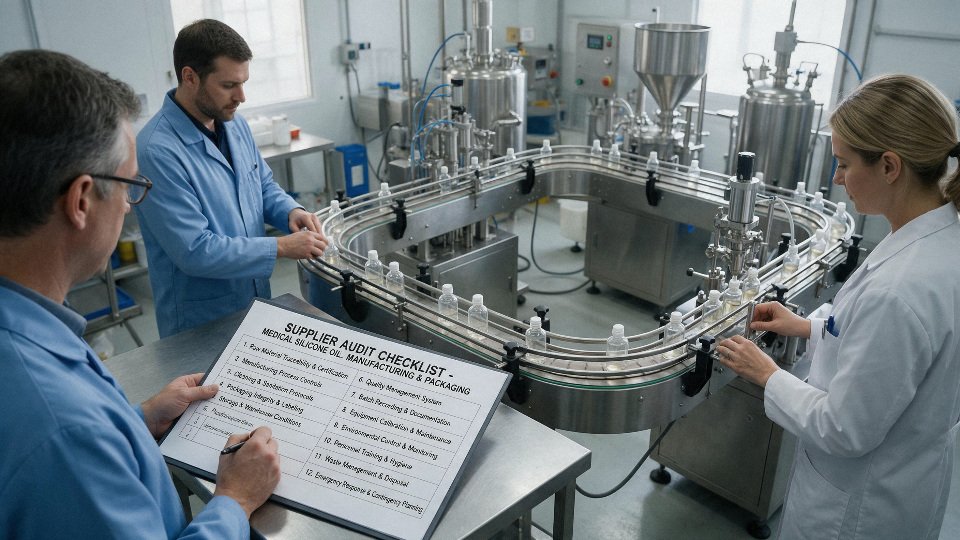
Quality system maturity
Certification alone is a weak screen. What matters is whether the site can detect, contain, investigate, and communicate a deviation before it becomes your complaint.
Review the quality system using a practical checklist:
- Documented batch traceability
- Raw material lot to finished batch linkage
- Equipment and cleaning records
- Operator and release approval records
- Shipment lot traceability to customer
- Deviation and CAPA discipline
- Ask for a redacted example of a deviation investigation.
- Look for root-cause depth, not just “operator error.”
- Good suppliers distinguish between assignable causes, suspected causes, and unresolved hypotheses.
- Change control
- This is one of the biggest lifecycle risk points.
- Verify notification rules for raw material source changes, process parameter window changes, equipment replacement, test method changes, packaging changes, and site transfers.
- A cheap source that cannot manage formal change notification will eventually cost more in requalification, delayed approvals, and internal risk review.
- Retained samples and complaint handling
- Confirm retention period, storage conditions, and re-test capability.
- Ask how complaints are trended: one-off response or pattern analysis across batches and customers.
- Audit readiness
- A capable supplier can support customer audits, answer method questions, and produce records quickly.
- If basic requests take weeks or come back inconsistent, expect the same behavior during an excursion.
ISO certification by itself proves a supplier is suitable for medical silicone oil.False
Certification can indicate baseline system structure, but supplier suitability depends on process segregation, impurity control, traceability depth, deviation handling, and medical-grade change control in actual operation.
Technical package depth
A serious medical silicone oil supplier should provide more than a one-page COA template. The technical package needs enough depth for your quality review, risk assessment, and future troubleshooting.
Look for:
- A complete specification
- Viscosity at defined temperature
- Refractive index where applicable
- Volatile content
- Acid value
- Particulate or cleanliness-related controls
- Any application-specific purity or bioburden expectations
- Analytical method transparency
- Not every proprietary detail must be disclosed, but the supplier should identify the method basis and what the result actually represents.
- If volatile content is reported, ask whether it is loss on heating, vacuum volatilization, or another defined method. Those are not interchangeable.
- Impurity profile disclosure
- At least at the level needed for risk review: residual volatiles, catalyst-related residues if relevant, and known process-derived impurities.
- Exact impurity limits often depend on grade and application, so do not expect one universal industry number.
- Stability and consistency support
- Shelf-life rationale
- Retest or expiry approach
- Evidence that commercial batches match development or sample lots
The trade-off is straightforward: suppliers that disclose more tend to feel slower during qualification, but they are usually easier to keep approved once a product enters routine supply. A thin technical package may speed onboarding and then create months of cleanup when your regulatory, quality, or customer teams ask obvious follow-up questions.
Operational resilience and logistics control
Lead time promises are easy during qualification. The useful question is what breaks supply and how the supplier recovers.
Check resilience in five areas:
- Critical input sourcing
- Dual sourcing where feasible
- Clear qualification rules for substitute sources
- Buffer stock policy for critical feedstocks and packaging
- Utilities and plant continuity
- Backup power for critical control, vacuum, and environmental systems
- Maintenance strategy for bottleneck purification equipment
- Contingency for utility interruptions
- Lot size flexibility
- Can the supplier support both validation-scale and routine production quantities without blending away traceability or delaying the schedule?
- Export and documentation competence
- Commercial invoice, packing list, certificate of analysis, certificate of origin if needed, transport classification, and destination-specific paperwork
- A technically good batch can still miss a production launch because export documents were mishandled.
- Packaging and shipment protection
- Validated or at least application-appropriate container materials
- Cleanliness controls before filling
- Tamper-evident closure
- Shelf-life labeling and lot identification
- Protection against temperature extremes, moisture ingress where relevant, and external contamination during transit
This section’s main conclusion stops holding if your use case is very low-risk internal processing rather than regulated medical service. In that narrower case, a lighter qualification model may be acceptable. For anything that will sit inside a formal quality file, though, the supplier’s ability to maintain impurity consistency, documentation discipline, and controlled change over the full product lifecycle is usually where the winner and the low bidder part ways.
Frequently asked questions
Is medical silicone oil the same as standard silicone fluid?
No. The base chemistry may look similar, often polydimethylsiloxane-based, but medical silicone oil is produced, purified, handled, and released under much tighter controls for volatiles, cyclics, particulates, cleanliness, and documentation. A drum of industrial silicone fluid with the same nominal viscosity is not automatically interchangeable with a medical-grade batch.
What raw material is used to make silicone oil?
Medical silicone oil is typically made from organosilicon feedstocks that lead to linear siloxane polymers, most commonly dimethylsiloxane-based intermediates. In practical production terms, the quality of chlorosilanes, cyclic siloxane intermediates, chain stoppers, catalysts, solvents if used, and process water all matter because every impurity that enters early becomes harder and more expensive to remove later.
How is viscosity controlled during production?
Viscosity is controlled mainly by polymer chain length and chain-length distribution. Producers adjust reaction conditions, end-blocking, equilibration balance, and in some cases blending of tightly controlled cuts to hit the target grade.
A few plant-floor realities matter here:
- Temperature history affects the result. Viscosity is always checked at a defined temperature; a number without test temperature is not very useful.
- Catalyst hold time matters. If neutralization or stripping is late, the batch can keep shifting.
- Over-correction is expensive. Once a batch overshoots viscosity, recovery options narrow and may create a wider distribution than buyers want.
For common medical grades, typical viscosity ranges run from roughly 20 cSt to 12,500 cSt, though ophthalmic grades are often held inside much tighter bands.
Why must low-volatility and cyclic content be controlled?
Because the light ends do not stay politely in the drum. Residual volatiles and cyclic siloxanes can affect odor, weight loss, extractables profile, package headspace, downstream sterilization response, and in some applications the biological risk assessment. The mechanism is simple: lower-molecular-weight fractions migrate and evaporate more readily, so even a batch that looks fine on viscosity can fail where retention, purity, or compatibility matters.
Typical residual volatile targets for high-purity silicone fluids range from low ppm to low thousands of ppm, depending on application and specification. There is no single universal limit; buyers should qualify against the actual intended medical use and required standard.
Can medical silicone oil be sterilized after production?
Sometimes, but not as a default assumption. The right answer depends on viscosity, package type, fill volume, target sterility assurance approach, and whether the product is supplied as a sterile or non-sterile input material.
Common constraints include:
- Heat exposure: can change volatile profile or stress packaging closures
- Radiation: may affect package materials and should be compatibility-checked
- Filtration: only practical within certain viscosity and cleanliness conditions
- Aseptic filling: requires the supplier to actually have that capability; buyers should not infer it from “medical grade”
If sterilization is required, it must be validated on the actual product-package system, not assumed from a datasheet.
What tests are usually required before batch release?
Most suppliers include a mix of identity, physical-property, purity, and cleanliness checks. Common release or in-process checks include:
- Viscosity at defined temperature
- Refractive index
- Acid value
- Volatile content
- Particulate cleanliness
- Bioburden
- Extractables-related screening, where required by the application or customer program
Some buyers also require appearance, density, specific cyclic siloxane monitoring, or residue-on-evaporation style controls. The exact release panel depends on the grade and intended medical use.
How long is typical shelf life under proper storage?
Often around 2 to 5 years under sealed, clean, dry storage conditions, but that is a supplier-specific assignment, not a universal property of the chemistry. Shelf life depends on package integrity, headspace control, storage temperature, light exposure, and how conservative the supplier’s stability program is. Hot warehouses and repeatedly opened containers shorten confidence long before the printed date does.
What packaging formats are common for export supply?
Typical export formats include:
- Small bottles for evaluation or controlled-use filling
- Pails
- HDPE drums or lined steel drums
- IBCs for larger-volume industrial-medical programs
For higher-purity grades, lining material, closure cleanliness, tamper evidence, and inner-bag compatibility matter as much as the outer pack. A cheap cap liner can undo a lot of careful purification.
Does production in China necessarily mean lower quality?
No. Quality is set by feedstock control, purification capability, contamination discipline, quality system execution, and batch consistency, not by country alone. China has both commodity producers and highly capable organosilicon manufacturers; the buyer’s job is to separate process-capable suppliers from traders and nominal grade relabelers.
Production in China necessarily means lower medical silicone oil quality.False
Quality depends on process control, purification depth, clean handling, validated testing, and documentation discipline. Country of manufacture is not a reliable technical proxy by itself.
What documents should buyers request before qualification?
Ask for the documents that let QA, regulatory, and procurement check the same batch from different angles:
- Product specification and test methods
- Recent certificate of analysis from production lots, not just a template
- SDS
- Manufacturing flow summary and contamination-control statement
- Typical impurity or volatile profile, if available
- Packaging specification and closure-contact material information
- Change-control policy
- Batch traceability statement
- Shelf-life and storage statement
- Quality-system certificates where applicable
- Regulatory-support declarations relevant to the intended market and use
If the supplier hesitates on lot-specific data, process consistency evidence, or change notification practice, that usually tells you more than the brochure does.
Your supplier verification step
The right medical silicone oil is selected by verified fit to the application, not by a catalog name or a viscosity number alone. If a supplier cannot show how the grade is made, purified, controlled, packaged, and kept consistent lot to lot, you are still buying uncertainty, even if the headline specification looks acceptable.
Start by fixing the technical profile against the actual medical use. A fluid for ophthalmic use, device lubrication, implant-related processing, or topical formulation support may overlap in chemistry but not in control limits, documentation burden, or packaging expectations. In practice, buyers get into trouble when they approve “350 cSt medical grade” before pinning down what else matters.
- Define the required viscosity window at the stated test temperature, not just a nominal grade
- Set purity expectations: volatile content, acid value, particulate cleanliness, and any customer-specific impurity limits
- Confirm optical requirements where relevant, such as refractive index control, clarity, or appearance standards
- Specify packaging size and format: small clean containers, lined drums, or bulk, depending on contamination risk and usage pattern
- List documentation depth required: CoA detail, lot traceability, quality agreement, regulatory declarations, and change notification terms
- Identify application-specific constraints, including pharmacopeial alignment, customer internal standards, or downstream biocompatibility obligations that must be verified by your own regulatory and quality teams
A practical supplier verification checklist should cover the process, the controls, and the supplier’s behavior when something drifts.
- Process route: equilibrium polymerization or another route, viscosity adjustment method, and whether blending is controlled and traceable
- Purification controls: stripping, filtration, clean transfer, container preparation, and hold-time management
- Impurity evidence: typical and specification limits for volatiles, acidity, particulates, and any extractables-related screening the supplier actually performs
- Quality system evidence: batch records, deviation handling, out-of-specification management, calibration discipline, and retained-sample practice
- Consistency proof: trend data across several lots, not one “golden” batch
- Change control: raw material source changes, equipment changes, cleaning-agent changes, specification revisions, and how customers are notified
Ask for documents and samples early, before commercial discussions become urgent.
- Current specification and a specification history, if available
- Standard certificate of analysis format
- Change-control policy
- Statement on retained-sample availability and retention period
- Representative production-lot samples, not hand-prepared lab samples
- Packaging and labeling details for the grade you would actually buy
The qualification path is usually staged, and that sequence matters because each stage screens a different risk.
- Laboratory screening against your incoming criteria
- Compatibility, stability, or biocompatibility assessment where the application requires it
- Pilot or pre-commercial lot confirmation under your actual process conditions
- Commercial supply agreement with quality, change-control, and supply continuity terms clearly written
That sequence can feel slow, but skipping the pilot-lot step is where many teams discover fill-line foaming, seal interaction, haze, or handling issues after procurement has already committed volume. The article’s central point holds here: manufacturing control is the product.
A medical silicone oil grade should be approved only after matching its documented manufacturing controls and impurity profile to the exact intended use.True
Viscosity alone does not confirm purity, optical suitability, packaging cleanliness, lot consistency, or documentation depth. Those factors depend on the production and control system behind the grade.

If you are qualifying a grade now, send the target application, substrate or contact material, contaminant or exposure concern if relevant, approximate layer or fill thickness, working volume, required finish or optical expectation, target consumption rate, and clear part photos or samples where useful. SiliconChemicals can review the application, recommend a suitable grade profile, and confirm supply feasibility based on the information you provide.