You’ve specified liquid silicone rubber for a medical device component, a food-contact seal, or a wearable — and now someone in the approval chain is asking for documentation that it’s actually safe. That question, when it arrives late, can stall a product launch by weeks or kill a supplier qualification entirely. Get the material science and the regulatory framing wrong and you’re either over-engineering with unnecessary testing spend, or you’re shipping parts that fail an FDA audit.
LSR — liquid silicone rubber — is safe for the vast majority of food-contact, medical, and consumer applications when the correct medical- or food-grade compound is specified, processed at validated cure conditions, and certified against applicable standards such as FDA 21 CFR 177.2600 or ISO 10993. The base polymer is chemically inert, non-toxic, and stable from roughly -60°C up to +200°C in continuous service. Safety failures almost always trace back to wrong grade selection, contaminated tooling, or incomplete post-cure — not to LSR itself.
What makes this material genuinely interesting from an engineering standpoint is how much of the safety story lives in the process, not just the datasheet. Two parts that look identical off the same press can have very different extractable-compound profiles depending on cure temperature, cycle time, and whether a secondary post-cure oven was even in the budget. The global LSR market was sitting around USD 2.8 billion in 2023 and is growing at roughly 7–8% annually — which tells you adoption is accelerating well past the point where this is a niche specialty material. That growth also means more suppliers, more grade variations, and more room for a procurement decision to go quietly wrong.
Chemical composition and toxicological baseline of cured LSR
LSR starts as a two-component system: Part A carries the vinyl-functional polydimethylsiloxane (PDMS) base and the platinum catalyst, Part B carries the same PDMS base plus a methylhydrogensiloxane cross-linker and a small inhibitor package — typically a maleate or alkynol compound — to control pot life at room temperature. When the two parts are mixed at a 1:1 ratio and injected into a heated mold (usually 150–185°C), a hydrosilylation addition reaction fires off. Platinum coordinates the Si–H groups of the cross-linker with the vinyl groups on the PDMS chains, forming Si–C–C–Si bridges. No byproducts are released. This is the reason cured LSR has a fundamentally cleaner extractables profile than peroxide-cured silicones, which leave organic peroxide decomposition fragments behind.
The platinum loading in commercial two-part systems is typically in the 5–15 ppm range by weight in the finished part, depending on the catalyst system and cure speed the formulator targets. Platinum in its metallic form is essentially non-bioavailable. The organometallic complex used during processing — usually a platinum-divinyltetramethyldisiloxane Karstedt catalyst — is the form you’d potentially worry about, but it is consumed during the reaction. Residual soluble platinum in well-cured parts tends to come in at levels below 1 ppm in extraction studies, and the ISO 10993-17 risk assessment framework handles this with established tolerable intake limits that those concentrations don’t approach.
The more honest conversation is about low-molecular-weight cyclic siloxanes — D4 (octamethylcyclotetrasiloxane), D5 (decamethylcyclopentasiloxane), and D6 (dodecamethylcyclohexasiloxane). These aren’t added intentionally; they’re oligomeric fragments present in the base polymer that didn’t get incorporated into the network during cure. In as-molded parts without post-cure, concentrations in the 100–1,000 ppm range are realistic, with the actual number depending heavily on base polymer grade, mold temperature, and dwell time. A 200°C post-cure for 4 hours drives most of it out — validated extraction studies typically show residual cyclic siloxane levels dropping below 50 ppm after that treatment. Some medical and food-contact specifications demand it. If you’re running a production line and skipping post-cure to save cycle time, that’s where the extractables problem lives.
D4 has attracted the most regulatory attention. Animal inhalation studies at high concentrations showed uterine tumor formation in rats, which is why the EU classified D4 as an endocrine disruptor and listed both D4 and D5 as SVHC under REACH. That classification was based on repeated high-dose inhalation exposures — concentrations relevant to occupational settings handling bulk silicone fluid, not consumer contact with a molded part. The dose-response gap matters enormously here. Migration from a cured LSR nipple or medical seal into an aqueous medium at body temperature is orders of magnitude below the exposure levels that drove rodent toxicity. That context doesn’t mean you ignore the cyclic siloxanes, but it means a regulatory classification is not the same as a use-level hazard finding.
Cured LSR is inert and contains no toxic residualsFalse
Well-cured LSR has an excellent safety profile, but as-molded parts can contain low-molecular-weight cyclic siloxanes (D4, D5, D6) in the 100–1,000 ppm range. Post-cure reduces these to below 50 ppm. 'Inert' is a reasonable descriptor for properly processed, post-cured material; it is not automatically true of every part off the mold.
Human biocompatibility data for cured, post-cured LSR is consistently reassuring. ISO 10993-10 skin sensitization studies show no sensitization response — important for wearables and infant contact applications where extended skin contact is the use case. ISO 10993-5 cytotoxicity assays on properly cured material show negligible cell death. And there are decades of in-vivo data from long-term implant applications: the tissue response is fibrous encapsulation, which is the normal foreign body response, with no evidence of systemic toxicity or distant organ effects in the peer-reviewed literature. The fibrous capsule isn’t a toxic event — it’s connective tissue walling off a non-degrading foreign material, mechanically predictable and clinically manageable.
The toxicological baseline for cured LSR is, frankly, one of the better profiles available in elastomer engineering. The residual risk is mostly a processing and quality control question, not a chemistry question.
Regulatory approvals that define food-grade and medical-grade LSR safety
Compliance with a patchwork of overlapping standards is where most procurement errors happen. Knowing that a supplier calls their material “food-grade” or “medical-grade” means almost nothing without knowing which specific tests were run, on which compound, and to which extractable limits.
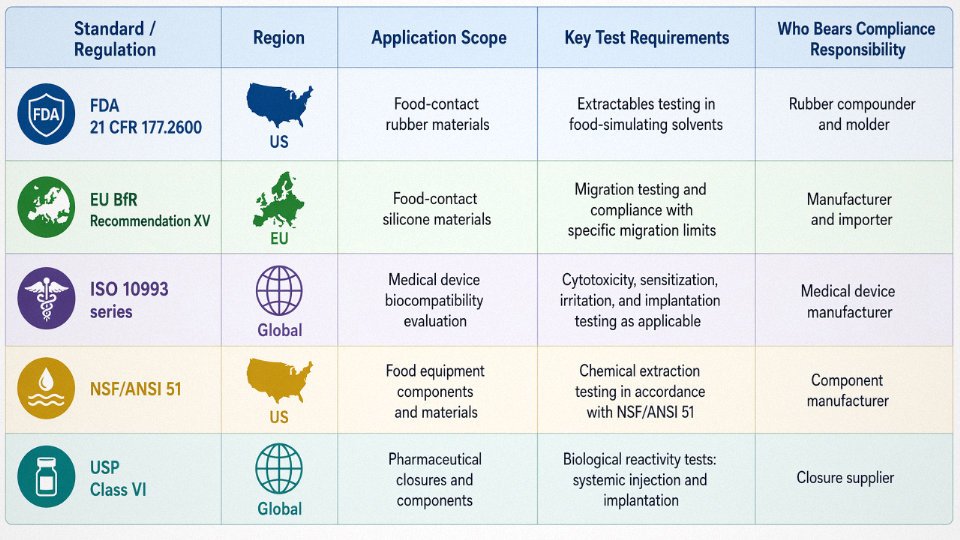
FDA 21 CFR 177.2600 — the baseline for food-contact rubber in the US
This regulation covers rubber articles intended for repeated-use food contact. For an LSR compound to qualify, it must meet extractable thresholds measured after extraction in food-simulating solvents: total extractables are typically limited to roughly 175 ppm or less depending on the solvent and contact scenario. The regulation also restricts filler types and loadings — not all carbon blacks or silica grades are automatically permitted, and compounders formulating to 177.2600 have to select reinforcing fillers from the explicit positive list or demonstrate compliance by composition.
In practice, this means a Wacker Elastosil LR or Dow SILASTIC medical compound may carry a 177.2600 letter of conformance, but the same base polymer crosslinked with a non-compliant peroxide system or tinted with a colorant outside the approved list can fail the standard. Always request the specific SDS and compliance letter tied to the exact compound lot, not just the product family.
FDA 21 CFR 177.2600 compliance applies to the fully cured, post-secondary-cure compound — not to the uncured base resin alone.True
Secondary curing (typically 4 hours at 200°C) is required to reduce residual platinum catalyst and low-molecular-weight siloxane extractables to compliant levels. An LSR part injection-molded without secondary cure may not meet extractable limits even if the base compound is rated.
European food contact — a fragmented but navigable landscape
EU Regulation 10/2011 covers plastic food-contact materials. Silicone is not plastic, so it falls outside that regulation’s direct scope — a fact that genuinely surprises buyers sourcing CE-marked kitchen bakeware. The practical result is that EU food-contact silicone compliance is currently governed at the national level. Germany’s BfR Recommendation XV and France’s DGCCRF guidelines are the most widely cited, and any reputable European LSR supplier will provide a declaration of conformity referencing both. A pan-EU silicone-specific regulation has been in development for years and remains pending; until it arrives, a product compliant with BfR XV and the French guidelines is about as defensible a position as you can take for EU-wide distribution.
For export-focused manufacturers shipping kitchenware to both the US and EU, the practical approach is to qualify the compound against 177.2600 and BfR XV simultaneously, since the extractable test protocols overlap substantially and meeting both doesn’t usually require two separate compound formulations.
ISO 10993 and medical device biocompatibility
The ISO 10993 series is not a single test — it’s a risk-based testing battery that the device manufacturer selects from based on contact type and duration. For an LSR component in prolonged skin contact, you’re typically looking at cytotoxicity (10993-5), sensitization (10993-10), and intracutaneous reactivity (10993-12). Add implantation (10993-6) and hemocompatibility (10993-4) for blood-contacting or implantable applications. Dow, Momentive, and Wacker each maintain master files with FDA and publish ISO 10993 test packages for their medical LSR grades — but the device manufacturer still bears responsibility for final biocompatibility evaluation under the specific end-use geometry and sterilization method.
NSF/ANSI 51, USP Class VI, and REACH obligations
NSF/ANSI 51 is the relevant certification for food-equipment components — seals in dairy lines, beverage dispensing valves, that kind of application. USP Class VI, while technically a pharmaceutical packaging standard predating modern biocompatibility frameworks, remains a common contractual requirement for closures and stoppers, particularly with older procurement specs.
REACH SVHC declarations are a separate obligation. D4 (octamethylcyclotetrasiloxane) and D5 (decamethylcyclopentasiloxane) are both on the SVHC candidate list above 0.1% w/w. When sourcing LSR, request a REACH declaration explicitly covering D4 and D5 content in the cured article. Most qualified suppliers can provide this; a supplier who can’t or won’t is a red flag worth taking seriously.
Heat resistance, thermal stability, and safety during cooking and sterilization
LSR’s thermal performance is probably its most practically important safety attribute, and it’s worth being specific about the chemistry rather than just citing temperature numbers.
The backbone of cured LSR is polydimethylsiloxane — Si–O bonds with methyl side groups. That Si–O bond energy sits around 452 kJ/mol, which is meaningfully higher than the C–C bonds in polyethylene or the C–Cl bonds in PVC. What this means at real operating temperatures is that LSR doesn’t degrade the way most thermoplastics do. Continuous service from roughly -60°C up to +200°C is standard for platinum-cured grades; short excursions to +230°C are handled without structural failure, though long-term mechanical properties will drift if you hold anything above +220°C for extended periods.
What actually happens above 300°C
Above roughly 300°C, PDMS begins to depolymerize — it unzips back toward cyclic siloxanes (primarily D4 and D5) and low-molecular-weight linear oligomers. This is a reversion reaction, not combustion chemistry. Critically, you are not generating HCl (as burning PVC does), dioxins, or styrene. No halogenated decomposition products, no aromatic hydrocarbons. The combustion products of silicone at extreme temperatures are predominantly silicon dioxide — essentially fine silica — carbon dioxide, and water. Compare that to a PVC kitchen utensil failing at temperature, or a nylon spatula catching on a pan edge. The LSR failure mode is far more benign.
That said, 300°C is not a normal oven temperature. Standard baking sits between 150°C and 230°C. At those temperatures, polymer backbone degradation is negligible.
Siloxane migration at oven temperatures: what the data actually shows
The more relevant question for bakeware isn’t catastrophic degradation — it’s low-level migration of cyclic siloxanes during normal use. GC-MS migration studies on LSR bakeware conducted under EU food-contact testing protocols (typically repeated thermal cycling in fatty food simulants) consistently show total siloxane migration below 0.6 mg/dm² after multiple use cycles, and values drop further with each successive cycle as residual volatiles exhaust. Both the German BfR (Bundesinstitut für Risikobewertung) and the French DGCCRF have published action thresholds; migration at these measured levels falls well below those limits.
LSR bakeware releases harmful chemicals during normal oven useFalse
Published GC-MS migration studies show total siloxane migration from LSR bakeware at 150–230°C typically remains below 0.6 mg/dm² after repeated cycling, well within the action limits set by regulatory bodies including the German BfR and French DGCCRF. The primary migrant is residual D5, which at these exposure levels is not acutely toxic.
The single most effective thing a manufacturer can do to drive that migration number down is post-cure: typically 4 hours at 200°C in a circulating-air oven. This volatilizes the bulk of residual D4/D5 before the product ever reaches a consumer kitchen. Skipping post-cure to save cycle time is a false economy — you’ll see more complaints about smell and elevated migration on first-use testing.
Autoclave compatibility and cycle durability
For medical and laboratory equipment, the relevant test isn’t an oven — it’s the autoclave: 134°C, approximately 3 bar saturated steam, typically validated over 500 or more cycles. Platinum-cured LSR performs well here. Tensile strength, elongation at break, and Shore A hardness generally stay within ±10% of baseline after 500 steam cycles, which is why you see platinum-cured grades specified for surgical instrument handles, syringe components, and respiratory masks.
Peroxide-cured silicone behaves differently. Peroxide cure leaves organic decomposition byproducts in the matrix, and repeated steam autoclave cycles tend to accelerate their extraction. Mechanical property drift is wider, and off-gassing on initial autoclave runs is more pronounced. If you’re specifying a part that will see hundreds of sterilization cycles, platinum cure is not optional — it’s the correct decision.
Consumer misconceptions worth addressing directly
The smell from new LSR products is not toxic decomposition. It’s residual D5 volatilizing — a predictable consequence of insufficient post-cure. It dissipates. Color change in heavily pigmented LSR parts after sustained high heat is usually filler oxidation or pigment breakdown, not polymer degradation. The substrate itself remains intact. These two phenomena generate most consumer concern, and both are manufacturing process issues rather than fundamental material safety problems.
LSR safety in infant and pediatric products: teethers, nipples, and pacifiers
Infant oral products sit at the sharpest end of any materials safety discussion. The exposure route is direct, continuous, and involuntary — a three-month-old doesn’t choose to stop chewing. Regulatory bodies know this, which is why the standards governing pacifiers and teethers are among the most demanding migration frameworks applied to any consumer polymer.
What EN 1400, EN 12586, and ASTM F963 actually require from the silicone
EN 1400 covers pacifiers sold in Europe. It mandates both mechanical integrity tests — nipple pull forces typically exceeding 100 N — and chemical migration limits under simulated saliva conditions. EN 12586 applies specifically to bottle teethers and ring teethers, using similar aqueous extraction protocols at 40°C over extended soak periods to mimic prolonged oral contact. Neither standard names silicone explicitly as compliant or non-compliant; they set migration limits for a list of substances and require manufacturers to demonstrate the finished product doesn’t exceed them. The silicone substrate has to prove itself through testing, not assumed approval.
ASTM F963 in the United States takes a slightly different architecture. It’s a broad toy safety standard with a specific clause on soft, flexible polymer components. Silicone teethers that qualify as toys fall under its heavy metal extraction limits and general migration requirements. The standard cross-references CPSIA provisions on certain chemicals. In practice, a product launching in both markets needs to satisfy EN and ASTM simultaneously, which most reputable manufacturers test for in a single laboratory campaign.
The migration picture: what’s actually measurable in compliant LSR
Here’s where LSR’s chemistry becomes a genuine competitive advantage rather than marketing language. Phthalates, bisphenol A, and N-nitrosamines — three substance classes that generate the most toxicological concern in infant products — are simply not present in a properly formulated platinum-cured LSR compound. Phthalates are plasticizers used in PVC; LSR doesn’t use plasticizers. BPA is a polycarbonate and epoxy-resin monomer; again, structurally irrelevant to silicone chemistry. N-nitrosamines are the historic concern with natural rubber latex accelerators, particularly thiurams and dithiocarbamates. Platinum-cure LSR contains none of those accelerators.
Compliant platinum-cured LSR contains no phthalates, BPA, or N-nitrosamines, because none of those chemical classes are used in its synthesis or cure chemistry.True
Phthalates are PVC plasticizers, BPA is a polycarbonate/epoxy monomer, and N-nitrosamines arise from sulfur-based rubber accelerators. Platinum-addition LSR uses none of these inputs. Migration tests on compliant LSR infant products consistently return non-detect for all three substance classes.
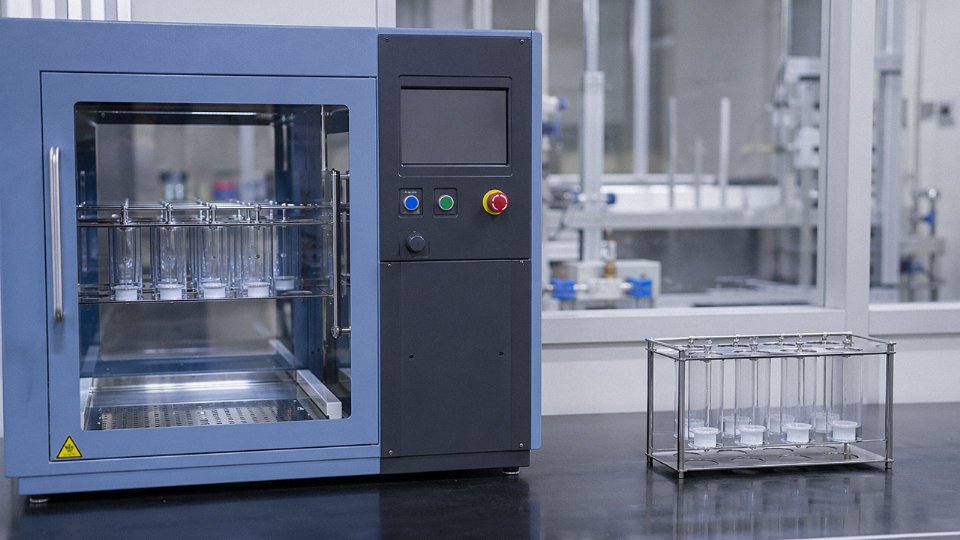
That leaves cyclic siloxanes — primarily D4, D5, and D6 — as the only measurand with any practical relevance. These are low-molecular-weight species that can be present as residuals if post-cure is insufficient or omitted. Properly post-cured LSR (typically 4 hours at 200°C in a ventilated oven, though time and temperature vary by part thickness and mold geometry) reduces cyclic siloxane content to levels well below EU REACH restriction thresholds. Migration values from accredited laboratory studies on post-cured product tend to fall in the range of 0.1–0.5 mg/kg under EN 1400 extraction conditions, comfortably below limits that regulators in Germany, France, and the Nordic countries have been most vocal about.
The latex allergy case for LSR
Cross-reactivity between LSR and Hevea brasiliensis latex proteins is zero. This isn’t a cautious hedge — it’s structural. Natural rubber latex allergy is a type I hypersensitivity to specific plant proteins (Hev b 1, Hev b 3, Hev b 5, and others). Silicone contains no proteins whatsoever. The American Academy of Pediatrics has historically recommended silicone nipples and pacifiers for latex-sensitized infants precisely because there’s no plausible sensitization or cross-reactivity mechanism. For a pediatric ward procurement manager sourcing bottle nipples, LSR isn’t just a preference — for certain patient populations it’s the medically indicated material.
What procurement officers and product safety teams should actually verify
“Medical grade” and “food safe” printed on packaging mean nothing without documentation. Ask for ISO 10993 test reports covering cytotoxicity, sensitization, and — for prolonged oral contact — genotoxicity panels. Confirm the cure system is platinum-addition, not peroxide cure; peroxide systems can leave benzoic acid and acetophenone residuals that require their own post-cure management and still don’t fully disappear. Ask specifically whether the production batch was post-cured, at what temperature, and for how long — this is a quality record, not a trade secret, and any legitimate supplier can provide it.
Unlabeled low-cost imports are the practical risk here. The chemistry of base LSR is tightly controlled among major compounders, but colorants, opacifiers, and functional fillers added downstream are not always subject to the same scrutiny. A blue teething ring might be perfectly safe silicone with a problematic pigment dispersion. Demand full compound disclosure or third-party extraction testing on the finished, colored article — not just the clear base material.
Medical implant and wearable device safety: long-term in-vivo evidence
The clinical track record for silicone in implantable devices stretches back to the early 1960s, and by any reasonable measure it is one of the longer-running material safety datasets in medical device history. Pacemaker lead insulation, hydrocephalus shunts, cochlear implant housings, penile prostheses, testicular implants — LSR and its close relatives have been sitting inside human bodies for decades, and the aggregate adverse event picture is, with some important caveats, remarkably clean.
The controversies surrounding silicone breast implants in the 1990s apply to gel-filled devices, not to solid or LSR-molded implantable components.True
The 1990s litigation and subsequent FDA restrictions targeted silicone gel-filled breast implants, where rupture allowed viscous polydimethylsiloxane gel to migrate. Injection-molded or overmolded LSR components — shunt valves, lead coatings, cochlear housings — contain no free gel phase and have not been implicated in the same systemic concerns. The distinction matters enormously for device engineers citing safety precedent.
That confusion — conflating gel implant data with LSR-molded devices — still surfaces in procurement conversations and in some regulatory submissions from less experienced teams. It is worth being blunt: the safety profile of a solid LSR pacemaker lead insulator and a ruptured gel-filled breast implant are not the same discussion.
Fibrous encapsulation: normal biology, not a toxicity signal
Every implanted synthetic material triggers a foreign body response. With LSR, the predominant outcome is fibrous encapsulation — the body lays down a collagen capsule around the device. This is expected, manageable, and does not indicate cytotoxicity. Problems arise when that capsule contracts severely enough to distort anatomy or compress a device, which is called capsular contracture and is graded on the Baker scale in reconstructive applications.
Surface texturing — micro-scale features in the 50–150 µm range, depending on the molding process — and careful selection of medical-grade LSR formulations with minimal volatile content both reduce contracture incidence. In practice, the platinum-catalyzed, post-cure baked grades designed for Class II and Class III device use show substantially lower inflammatory mediator profiles in tissue culture assays than older tin-catalyzed materials. Post-cure at 200°C for 4 hours is non-negotiable in implantable compounding; skipping it to save cycle time is the kind of shortcut that generates extractables failures during ISO 10993-12 testing, sometimes months into a development program.
Platinum catalyst leaching in vivo
Platinum-catalyzed addition cure is the standard for implantable LSR precisely because the alternative — tin-based condensation cure — carries an organometallic residual burden that regulators in the US, EU, and Japan have become progressively less comfortable with in long-contact applications. In-vivo studies measuring platinum levels in periprosthetic tissue generally find concentrations below 0.1 ppb in adjacent tissue at explant, which sits well beneath the thresholds established by ICH Q3D and the reference documents from SCENIHR. That said, results depend on post-cure completion and lot-specific catalyst loading, both of which should be verified in your incoming material specification — not assumed from a supplier data sheet.
Wearable and epidermal sensor applications
The more recent frontier is continuous-wear epidermal electronics: glucose monitors, ECG patches, motion sensors, drug delivery interfaces. LSR’s oxygen permeability in the 250–500 Barrer range (depending on formulation and cure density) reduces moisture occlusion under long-wear patches — a real problem with less permeable substrates that drives contact dermatitis in 10–30% of users in some CGM clinical trials. Its elastic modulus, roughly 0.05–0.5 MPa depending on Shore hardness and filler loading, sits close enough to human skin (~0.1–0.2 MPa) that it doesn’t create the stress concentration at the device edge that stiffer materials generate. That mechanical mismatch is what causes the redness and irritation marks users report at patch borders, and it’s a documented delamination risk for embedded sensor traces.
Recent work in IEEE Transactions on Biomedical Engineering and Biomaterials has characterized LSR as a substrate for stretchable circuit embedding, with skin sensitization studies under ISO 10993-10 showing negligible reaction at 24- and 72-hour readings for properly compounded, post-cured medical grades. The operating caveat is always “properly compounded and post-cured” — the same base polymer from the same supplier can fail biocompatibility screening if the secondary processing is sloppy.
Identifying unsafe LSR: counterfeits, non-compliant pigments, and supply chain red flags
The LSR supply chain is not as clean as the material’s safety reputation suggests. Counterfeit and adulterated silicone compounds have become a genuine problem — particularly since demand from medical device and infant product manufacturers has pushed reputable platinum-cured compound prices well above what low-cost suppliers want to charge. The gap creates an obvious incentive to adulterate.
How counterfeit LSR is actually built
The most common adulterant is silicone oil extension — blending low-viscosity polydimethylsiloxane fluid into the base compound to increase yield. It’s hard to detect visually, the material molds without obvious defects, and short-term mechanical properties look acceptable. The problem shows up in extractables: silicone oils leach into food contact or biological environments at levels that legitimate platinum-cured, fumed-silica-filled compounds simply don’t produce. Elongation-at-break is a quick field proxy here — properly formulated LSR compound typically runs somewhere between 300% and 600% depending on durometer; oil-extended material often drops below 200%, sometimes well below, because the network density is compromised.
Tin-catalyzed condensation silicone mislabeled as platinum-cured is the second common fraud. Tin systems use dibutyltin compounds as catalysts, and dibutyltins are regulated under REACH Annex XVII with strict concentration limits in consumer articles — they’re not acceptable in food-contact or medical applications. A platinum spot test (ammonium sulfide reagent on a fresh cut surface, confirmed by color change) is a reasonable screen, but ICP-MS on a solvent swab gives you defensible numbers if a supplier pushes back. If a supplier resists sending a sample for independent catalyst verification, that tells you what you need to know.
Calcium carbonate filler substituting for fumed silica is cheaper and increases compound weight — both attractive to a fraudulent compounder. It degrades tear strength and increases water absorption, which matters enormously in autoclave cycling or long-term implant environments. Hardness will often be within range initially, but modulus and tear strength diverge. Running a simple TGA profile and comparing the ash residue signature against the nominal spec will usually catch this — fumed silica and calcium carbonate have very different decomposition signatures.
Pigment risks that procurement teams underestimate
Colorants are where cheap LSR formulations cut corners in ways that are genuinely dangerous. Cadmium- and lead-based pigments were historically used in bright reds, yellows, and oranges precisely because they’re stable at silicone processing temperatures. Both are restricted under RoHS and under REACH Annex XVII, and both show up in migration testing from non-compliant parts more often than the industry publicly acknowledges. Always demand the pigment masterbatch TDS and a RoHS/REACH declaration that names the specific pigment — a generic “compliant” declaration on a part drawing means nothing.
Carbon black masterbatch deserves separate attention. Carbon black itself is fine as a colorant in cured silicone, but certain grades carry polycyclic aromatic hydrocarbon contamination from the manufacturing process. EN 71-3 and REACH Annex XVII both address PAH limits; for any black LSR part going into food contact or children’s products, insist on PAH screening data — specifically the 18-PAH panel — tied to the actual carbon black lot used in your compound.
Supplier qualification: where the red flags concentrate
A supplier offering medical-grade or food-grade LSR compound at more than 35% below prevailing market benchmark pricing cannot be producing genuinely compliant material at that cost.True
Platinum catalyst, fumed silica, and ISO 10993 or FDA 21 CFR testing packages each carry real fixed costs. Compound priced far below market either lacks these inputs or lacks the documentation — both disqualify it for regulated applications.
Beyond pricing, watch for these:
| Red flag | What it likely signals |
|---|---|
| No FDA registration number or EU authorized representative | No regulatory standing for medical/food use |
| Refusal to supply full ISO 10993 test package (cytotoxicity, sensitization, intracutaneous reactivity at minimum) | Testing either not done or failed |
| Lot-to-lot Shore A variation greater than ±5 points | Inconsistent base polymer or filler ratio — process not controlled |
| No post-cure specification or post-cure verification data | Residual D4/D5 cyclosiloxanes not managed; target is below 50 ppm for sensitive applications |
| Generic “food safe” claim with no CFR or EU regulation citation | Marketing language, not compliance |
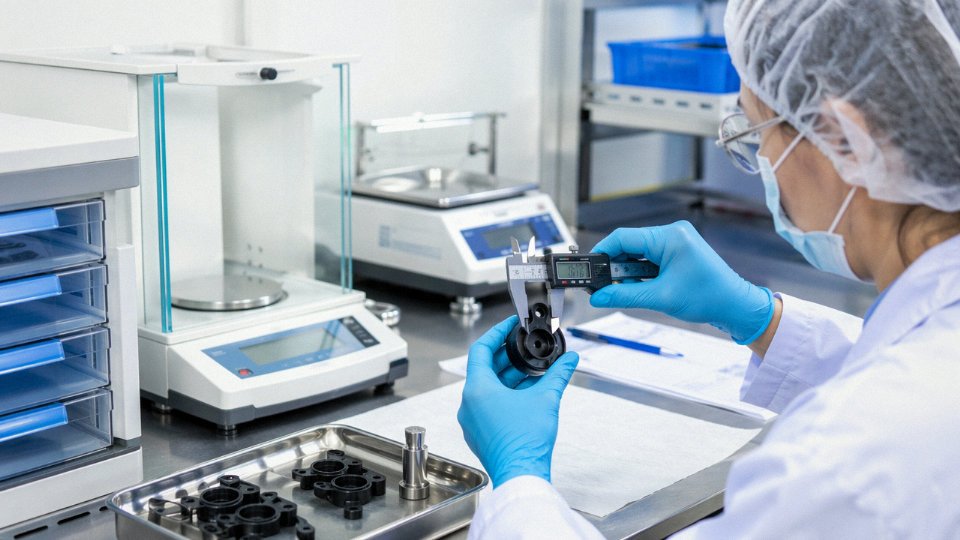
In practice, the post-cure verification step is the one most frequently skipped — even by buyers who otherwise run decent incoming inspection. Headspace GC is the right method for residual D4/D5; TGA will tell you about overall volatile content but won’t speciate. If your supplier can’t provide headspace GC data with lot numbers, and your application involves infants or implantables, run it yourself on incoming lots until you trust the process.
Environmental and Occupational Safety: Manufacturing Workers and End-of-Life Disposal
Most safety discussions about LSR stop at the product itself — the cured part sitting in someone’s hand or mouth. That framing misses two substantial risk areas: the people making the material and the question of where it goes when it’s done.
Occupational Exposure Inside the Molding Cell
The cured elastomer is benign. The processing environment is more complicated.
Injection molding rooms running LSR at mold temperatures of 170–200°C generate low-level vapors from two main sources: residual volatile cyclic siloxanes (primarily D4 and D5) flashing off as the material cures, and the mold-release agents applied between shots. Most commercial mold-release sprays are siloxane-based aerosols, and in poorly ventilated cells, airborne concentrations build up across a shift. This is not an acute-toxicity story — no one is collapsing at the press — but chronic low-level siloxane inhalation is a legitimate industrial hygiene concern, especially for operators running 24/7 production.
ACGIH has not assigned a formal TLV-TWA specifically to D4 or D5 as of the current edition, which puts enforcement under OSHA’s General Duty Clause rather than a hard numerical standard. In practice this means the burden falls on the employer to demonstrate controls are adequate. The reasonable benchmark most EHS consultants use is keeping airborne cyclic siloxanes below roughly 10–20 ppm (8-hour TWA), though this depends on the specific compound and the ventilation model you’re applying. Platinum-catalyst handling in compound mixing rooms is a separate concern: finely divided platinum complexes are sensitizers, and workers who mix or transfer catalyst concentrates without gloves and respiratory protection can develop occupational contact dermatitis or airway sensitization over months to years.
Local exhaust ventilation at the mold parting line, positive-pressure operator stations, and closed-loop mixing systems for catalyst metering are the standard mitigations. Annual air monitoring is not optional if you’re running volume production — it’s the only way to know whether your ventilation is actually performing.
Where D4 and D5 Go After the Plant
The EU’s SVHC (Substances of Very High Concern) listings for D4 and D5 under REACH are grounded in sediment persistence data, not in the acute hazard to molding workers. D5 has a measured bioconcentration factor in aquatic organisms in the range of roughly 1,000 to 10,000 depending on species and lipid content — high enough to qualify as bioaccumulative under standard regulatory criteria. D4 is classified as toxic to aquatic organisms with long-term effects. Both compounds partition strongly to sediments rather than staying dissolved in the water column, which is part of why conventional wastewater treatment removes them poorly.
D5 cyclic siloxane bioaccumulates in aquatic organisms and is listed as an SVHC under EU REACHTrue
The European Chemicals Agency added D5 (decamethylcyclopentasiloxane) to the SVHC candidate list based on persistent, bioaccumulative, and toxic (PBT) properties, supported by BCF data in fish typically ranging from 1,000 to over 5,000.
For a processing plant, the practical implication is that process exhaust streams containing cyclic siloxanes should route through activated-carbon scrubbers before discharge. This is standard in European facilities and increasingly required or expected in North American ones. It is not expensive relative to the compliance exposure of not having it.
Cured LSR Waste: Chemically Inert, Practically Immortal
Cured LSR in a landfill does essentially nothing. It doesn’t leach heavy metals, doesn’t release organochlorines, doesn’t degrade into microplastics on any near-term timescale. From a contamination standpoint, it’s one of the quieter materials in the waste stream.
The real issue is permanence. Cured silicone does not biodegrade meaningfully, full stop.
Pyrolysis at 600–800°C is the technically viable end-of-life route: the polymer backbone breaks down to SiO₂ and recoverable short-chain siloxanes that can re-enter the silicone fluids supply chain as feedstock. Energy input and collection logistics make this expensive at small volumes, and the infrastructure is still patchy — a handful of specialty processors in Germany, Japan, and parts of North America handle it at commercial scale, but most LSR scrap still goes to landfill simply because the collection economics don’t work yet.
The longevity argument partially offsets this. An LSR gasket or diaphragm running in a food-processing or medical application typically lasts 10–20 years before replacement, while a comparable thermoplastic elastomer part might need swapping every 2–5 years depending on thermal cycling and chemical exposure. That difference compounds across millions of units: fewer replacement cycles means lower cumulative siloxane processing emissions, less compound manufactured, and less scrap generated per year of service. It doesn’t resolve the end-of-life problem, but it reframes the life-cycle comparison more honestly than a simple “not biodegradable” dismissal suggests.
Frequently asked questions about liquid silicone rubber safety
Is LSR BPA-free?
Yes, completely. LSR contains no bisphenol A, bisphenol S, or any other phenolic monomer — not as a raw material, not as a processing aid, not as a residual. The polymer backbone is built from chlorosilane precursors reacted with water, producing Si-O linkages that have nothing chemically in common with the polycarbonate and epoxy resin pathways where BPA contamination actually originates. This question comes up constantly in procurement, and the honest answer is that asking “is LSR BPA-free” is a bit like asking whether stainless steel contains wood pulp. The chemistries are entirely separate.
LSR contains no BPA or bisphenol compounds at any stage of synthesis or processingTrue
LSR is synthesized from chlorosilane precursors and water via Si-O bond formation. No phenolic monomers are used or produced. The BPA concern is specific to polycarbonate and certain epoxy resins, which share no synthetic pathway with polysiloxane chemistry.
Can LSR leach chemicals into food or beverages?
Properly post-cured, food-grade LSR is about as inert as anything you will put in a kitchen. The migration story isn’t zero — it never is with any polymer — but what actually transfers in measurable amounts is a small fraction of residual cyclic siloxanes, primarily D4, D5, and D6. At typical food-contact temperatures (below 100°C for most applications), migration levels stay well beneath regulatory action thresholds set by the European Food Safety Authority and the FDA. LSR does not leach phthalates, it does not leach heavy metals, and it does not release estrogenic compounds the way some flexible PVC and polystyrene products do. The critical qualifier throughout is “properly post-cured.” Under-cured material, or material that skipped the secondary oven cure cycle entirely, will show elevated D4/D5 readings. That’s a process control problem, not an inherent material problem — though in practice the distinction matters less if you’re the one buying the product.
Is silicone safe for microwave use?
Yes, for any food-grade LSR rated to 200°C continuous service. A standard consumer microwave generates cavity temperatures that plateau well below 200°C even on maximum power. Microwave-specific migration studies have not identified hazardous compound formation in compliant LSR. The heat is simply not sufficient to initiate the thermal degradation pathways — those begin somewhere above 200°C and don’t produce concerning volatiles in quantity until temperatures climb considerably higher. One practical note: if a silicone bakeware product discolors or becomes tacky in the microwave, it’s almost certainly not genuine LSR and deserves closer scrutiny on material composition.
What is the difference between food-grade, medical-grade, and industrial-grade LSR in terms of safety?
This distinction gets blurred in marketing and it shouldn’t be.
| Grade | Key certification | Processing environment | Suitable for body/food contact? |
|---|---|---|---|
| Food-grade | FDA 21 CFR 177.2600, BfR XV migration limits | Standard cleanroom or controlled production | Yes — food and beverage contact |
| Medical-grade | Above plus full ISO 10993 biocompatibility battery (cytotoxicity, sensitization, implantation testing) | ISO Class 7 or 8 cleanroom minimum | Yes — skin contact, implantable per device class |
| Industrial-grade | None relevant to food or body contact | General manufacturing | No — not suitable for consumer or clinical use |
Industrial-grade LSR may contain pigments, stabilizers, or fillers chosen purely for mechanical or processing performance, with no evaluation for extractables in a biological context. Using it in a consumer product because the raw material cost is 20–30% lower than medical-grade is a liability decision, not just a quality one.
Does LSR cause allergic reactions?
Rarely, and the mechanism is different from latex allergy. LSR contains no allergenic proteins — the platinum-catalyzed PDMS matrix is inert in standardized Buehler and guinea pig maximization tests, showing a very low skin sensitization index. This is why LSR has become the default latex-free alternative in surgical gloves, anesthesia masks, and infant feeding products. True LSR sensitization cases exist in the literature but are uncommon and often traceable to non-silicone additives rather than the base polymer. For patients or infants with confirmed latex hypersensitivity, platinum-cured LSR is the appropriate substitute, and most clinical guidelines treat it as such.
How can I verify that a product is genuinely LSR and not a lower-quality material?
Start with documentation: request the full material safety data sheet, the compound name (it should reference polydimethylsiloxane or a named silicone compound, not “silicone rubber” alone), and the cure chemistry confirmation — platinum cure, not peroxide. Ask for ISO 10993 or FDA compliance certificates with lot-traceable data, not generic brand-level letters. Suppliers who hesitate on lot traceability are telling you something.
Then do a simple physical check. Genuine LSR, even a basic commercial grade, will stretch to roughly 200–400% elongation before tearing — the actual range depends on durometer and formulation, but the material should feel distinctly elastic and recover cleanly. Low-cost PVC or TPE impostors typically tear at much lower elongation, feel slightly greasy or waxy, and sometimes show a faint chemical odor. Burn testing (carefully, outdoors) is a cruder method: silicone leaves a white ash residue; PVC produces acrid black smoke. Neither test replaces documentation, but they’re useful when you’re on a plant floor and need a fast sanity check on incoming goods.