Mislabeling liquid silicone rubber as “just another plastic” causes real procurement pain — wrong material gets specified, the injection molder quotes a thermoplastic tool, and six weeks later you’re staring at parts that crack at –40°C or swell in a silicone-incompatible solvent. On a production line, that’s not a minor substitution error; it’s a line-down event, a scrap bin full of unusable components, and an expediting bill that nobody budgeted for.
LSR is not a plastic. It is a thermoset elastomer based on a silicon-oxygen backbone, not a carbon-chain polymer. It cannot be remelted, does not behave like a thermoplastic in tooling or processing, and sits in a fundamentally different material category — with a Shore A 10–80 hardness range, continuous service from –60°C to +200°C, and chemical resistance profiles that no commodity plastic comes close to matching.
What makes this classification question genuinely tricky is that LSR is processed through injection molding equipment, lives on the same supplier shortlists, and gets lumped into the same “polymers” bucket in procurement databases. The confusion is structural, not just semantic — and it has downstream consequences every time someone selects a material without understanding where the category boundaries actually fall.
Defining Plastics at the Molecular Level: What Qualifies and What Does Not
The word “plastic” gets thrown around loosely on the shop floor and in procurement specs alike, which creates real problems once you’re trying to classify a material for RoHS compliance or write a functional material callout on a drawing. So let’s be precise.
What the Standards Actually Say
ISO 472 defines a plastic as “a material that contains as an essential ingredient one or more organic polymeric substances of large molecular weight.” ASTM D883 is similarly structured: it specifies a polymeric material that at some stage in its processing can be shaped by flow. Both definitions hinge on two things — organic polymer composition and processability through flow under heat or pressure. That second criterion matters more than most people realize.
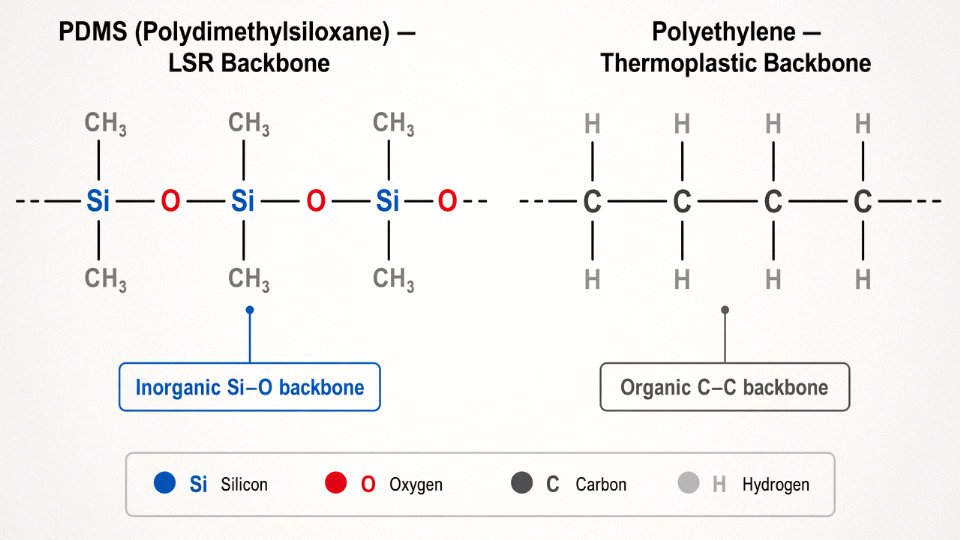
Organic polymers, in this context, means the backbone chain is built primarily from carbon atoms. Polyethylene is the textbook case: a long chain of –CH₂–CH₂– repeat units, nothing but carbon and hydrogen holding the whole thing together. Polypropylene, ABS, nylon, polycarbonate — all of them, whether they’re semi-crystalline or amorphous, share that fundamental carbon–carbon (C–C) backbone architecture. The carbon–hydrogen (C–H) bonds hanging off those backbones are just as characteristic; they’re what makes these materials combust relatively cleanly, respond to organic solvents, and show up reliably in FTIR spectra where you’d expect them.
Thermosets complicate the picture a little. Epoxy resins and phenolic compounds are also carbon-backbone organics, but once they’ve cured, the crosslinks are permanent. You can’t remelt a cured epoxy and inject it again — the network is set. Under both ISO 472 and ASTM D883, thermosets still qualify as plastics because the organic polymer definition applies, and they do flow during processing before cure. The distinction between thermosets and thermoplastics is therefore a processing behavior distinction, not a chemistry-class distinction.
Glass Transition Temperature and Melt-Flow Index — Useful Metrics, with Limits
For any material you’re calling a plastic, two descriptors come up constantly in datasheets and incoming inspection: glass transition temperature (Tg) and melt-flow index (MFI).
Tg is the temperature range below which an amorphous polymer transitions from rubbery to glassy. For polycarbonate it’s around 145–150°C; for standard ABS it’s roughly 100–105°C, depending on the acrylonitrile content. Tg matters on the plant floor because it sets the upper boundary for many structural applications and drives decisions about mold cooling times. Semi-crystalline polymers like nylon or HDPE have a melting point that matters more than Tg for processing, but Tg still governs their glassy-state behavior below the melt.
Melt-flow index is simpler — it’s a measure of how easily a molten polymer flows under a standard load and temperature. Higher MFI means easier flow, thinner walls possible, but often lower molecular weight and reduced toughness. Injection molders live and die by MFI consistency lot-to-lot; a swing of even 2–3 g/10 min on a tight-tolerance part can shift fill pressure enough to cause short shots or flash.
Here’s the catch: both Tg and MFI are meaningful descriptors only for materials that have a glassy state or a melt state to measure. When you’re working with a material whose backbone isn’t carbon-based, whose crosslinked network forms through a fundamentally different chemistry, and that never melts in any conventional sense, these metrics either don’t apply or apply only in a heavily modified way.
ISO 472 and ASTM D883 both define plastics as organic polymers — meaning carbon-backbone materials — that flow during processingTrue
Both standards ground the definition in organic polymer chemistry and processability through flow, which is why the backbone chemistry and thermal processing behavior are the two primary qualifying criteria.
That boundary — where carbon-backbone chemistry ends — is exactly where the LSR conversation gets interesting.
LSR Chemistry: The Silicon–Oxygen Backbone That Sets It Apart
The fundamental reason LSR is not a plastic comes down to one thing: the backbone. Every commodity plastic you’ll find on a plant floor — polyethylene, polypropylene, nylon, ABS — is built on a chain of carbon-to-carbon bonds. LSR is built on silicon and oxygen alternating in a repeating Si–O–Si–O sequence, a structure called polydimethylsiloxane, or PDMS. That single architectural difference cascades into almost every property distinction that matters operationally.
The PDMS Chain: Inorganic Backbone, Organic Side Groups
A PDMS chain looks deceptively simple on paper: each silicon atom is flanked by two methyl groups (–CH₃) and bridged to the next silicon through an oxygen atom. What makes it unusual is that the load-bearing spine is entirely inorganic — silicon and oxygen, not carbon. The methyl side groups are organic, which is why silicones sometimes get lumped into an awkward “organometallic” or “semi-inorganic” category that confuses procurement people trying to fill out a material declaration form.
For LSR-grade polymers specifically, the molecular weight of the base PDMS typically runs somewhere in the 200,000–600,000 g/mol range, depending on the target viscosity and end application. Higher molecular weight chains give you better mechanical properties but also a thicker base compound that requires more careful shot-size calibration on your injection press. The Si–O bond length and bond angle also give PDMS an unusually flexible backbone — bond rotation energy is low, which is a big part of why LSR stays pliable at temperatures where a polypropylene part would be cracking and shedding debris.
The Two-Part Platinum-Catalyzed Cure System
LSR is supplied as a two-component system. Part A carries the vinyl-terminated PDMS chains along with the platinum catalyst — typically a platinum-divinyltetramethyldisiloxane complex, sometimes called Karstedt’s catalyst if you want to be precise about it. Part B contains the hydride-functional cross-linker, a shorter-chain polysiloxane with Si–H groups distributed along its backbone. When the two parts are metered and mixed at a 1:1 ratio and then injected into a heated mold, the platinum catalyzes an addition reaction between the vinyl groups and the Si–H groups. No byproducts, no volatiles released — that’s one practical reason LSR is used in medical and food-contact applications where peroxide residues would be a contamination concern.
Cure temperatures in production typically run 120–200°C, with actual cycle times depending on part wall thickness, tool steel thermal conductivity, and catalyst loading. A 2 mm wall section in a well-designed hot runner tool might fully cure in under 30 seconds at 180°C. Push that to a 6 mm section without adjusting dwell time, and you’ll pull under-cured parts that will physically deform during secondary operations or packaging.
Why Cross-Linking Means LSR Is Not Recyclable Through Plastic Streams
The addition cure creates a three-dimensional covalent network — a thermoset. Every vinyl terminus that reacts with a Si–H group forms a permanent bond, locking the polymer chains into a fixed architecture. There is no melting point, no glass transition you can push through with heat to get the material flowing again. This is categorically different from a thermoplastic, where you can re-melt and re-mold the same material.
LSR can be recycled using standard plastic recycling infrastructureFalse
LSR is a thermoset elastomer with a permanent cross-linked network. It cannot be re-melted or reprocessed through conventional thermoplastic recycling streams. Cured LSR scrap is typically ground for low-grade filler or sent to landfill/energy recovery.
Compare this to high-consistency rubber (HCR), which is the other major silicone elastomer format. HCR uses peroxide-based cure systems — dicumyl peroxide or similar — where the cross-linking mechanism generates reactive radical species and, critically, leaves behind decomposition byproducts that need to be post-cured out. LSR’s platinum addition cure skips that step entirely. Cross-link density in LSR is also more controllable and uniform than in peroxide-cured HCR, which partly explains why LSR parts tend to show tighter dimensional tolerances — important when you’re molding a 0.3 mm membrane for a pressure sensor.
None of this chemistry fits the definition of plastic established by carbon-chain thermoplastic behavior. The inorganic backbone, the irreversible cure, the elastomeric network — LSR belongs to its own material class, and treating it otherwise in a specification or a bill of materials will cause real problems downstream.
Head-to-Head Property Comparison: LSR vs. Common Thermoplastics and Thermoset Plastics
Numbers tell the story faster than arguments about chemistry. The table below pulls together the properties that actually drive material selection decisions on the shop floor — not just tensile strength, which gets quoted constantly but rarely determines the final call by itself.
| Property | LSR | Polypropylene (PP) | Polycarbonate (PC) | TPE (SBC/SEBS) | Epoxy Resin |
|---|---|---|---|---|---|
| Tensile strength | 6–12 MPa | 25–40 MPa | 55–75 MPa | 5–20 MPa | 35–85 MPa |
| Elongation at break | 200–700% | 100–600% | 80–150% | 300–900% | 1–6% |
| Shore hardness | A 10–80 | D 55–75 | D 60–80 | A 20–90 | D 70–90+ |
| Continuous service temp | –60°C to +200°C | –20°C to +100°C | –40°C to +125°C | –40°C to +120°C | –20°C to +150°C |
| Compression set (22 h/175°C) | <10% | fails at temp | fails at temp | 25–60% | rigid/cracks |
| Dielectric strength | 18–25 kV/mm | 20–30 kV/mm | 15–20 kV/mm | 12–20 kV/mm | 14–20 kV/mm |
| Chemical resistance | Good–excellent (alkalis, dilute acids, aqueous) | Good (acids, alkalis); poor (aromatics) | Poor (acetone, alkalis) | Moderate | Excellent |
| Biocompatibility | USP Class VI, ISO 10993 grades available | Limited grades | Limited grades | Some grades | Rare |
| Optical clarity | Available (specific grades) | Semi-opaque to translucent | Excellent | Hazy | Opaque to clear |
Values depend on specific grade, filler loading, and cure conditions. PP elongation, for instance, swings wildly between homo- and copolymer grades.
Where LSR’s Tensile Numbers Are Misleading
LSR loses badly on tensile strength against PC or filled PP — that’s not in dispute. A 10 MPa material handling 70 MPa structural loads is the wrong conversation entirely. The confusion comes when procurement teams see “low tensile strength” and assume LSR is mechanically weak across the board. It isn’t. What you’re looking at is a material engineered for elastic recovery and fatigue resistance, not static load-bearing. An LSR diaphragm in a peristaltic pump may flex 50 million cycles before failure. A PP part wouldn’t survive 200,000 in the same geometry.
The Compression Set Gap Is Where Sealing Applications Get Decided
This is the metric that separates LSR from TPEs in sealing duty, and in my experience it’s underweighted in initial spec reviews. LSR typically achieves compression set below 10% after 22 hours at 175°C per ASTM D395. Most SEBS-based TPEs come in at 30–60% under equivalent conditions — which means after sustained compression, the seal doesn’t fully recover. That residual deformation translates directly to leak paths.
LSR compression set consistently outperforms thermoplastic elastomers under elevated temperature sealing conditionsTrue
Published ASTM D395 test data for platinum-cured LSR formulations routinely show compression set below 10% at 175°C/22h, while comparable SEBS and TPU grades typically measure 25–60% under identical conditions, a difference that directly affects long-term sealing integrity.
In a hot-side automotive sealing application — say, a coolant connector working continuously near the engine block — that gap is the difference between a five-year service life and a warranty claim at 18 months.
Low-Temperature Flexibility: The Property No Commodity Plastic Replicates
Shore A 20 LSR at –60°C is still flexible. It doesn’t embrittle. PP at –20°C is already marginal, and most TPEs above Shore A 60 start going glassy somewhere between –30°C and –40°C depending on grade and strain rate. PC maintains dimensional stability at cold temperatures but it’s rigid — that’s a different function entirely.
The combination of –60°C flexibility, USP Class VI biocompatibility, and optical clarity is available in certain optical-grade LSR formulations. No single commodity plastic delivers all three simultaneously. Usually you’re trading at least one away. For wearable medical devices or infant-contact products where you need translucency, skin contact safety, and cold-chain performance, the substitution options genuinely narrow to a short list with LSR near the top.
Dielectric Strength: Often Overlooked in Electrical Enclosure Design
LSR’s dielectric strength of roughly 18–25 kV/mm is competitive with PP and edges out standard epoxy in many formulations, though highly filled electrical-grade epoxies can exceed it. The practical advantage for LSR in electrical applications isn’t raw dielectric strength — it’s that LSR maintains that performance across temperature cycles without cracking or delaminating from insert-molded metal components. Epoxy encapsulants in connectors subjected to thermal cycling tend to develop micro-cracks at the resin-metal interface over time. LSR bonds more complianty, absorbing the differential thermal expansion rather than fighting it.
Processing Differences: Liquid Injection Molding vs. Thermoplastic Injection Molding
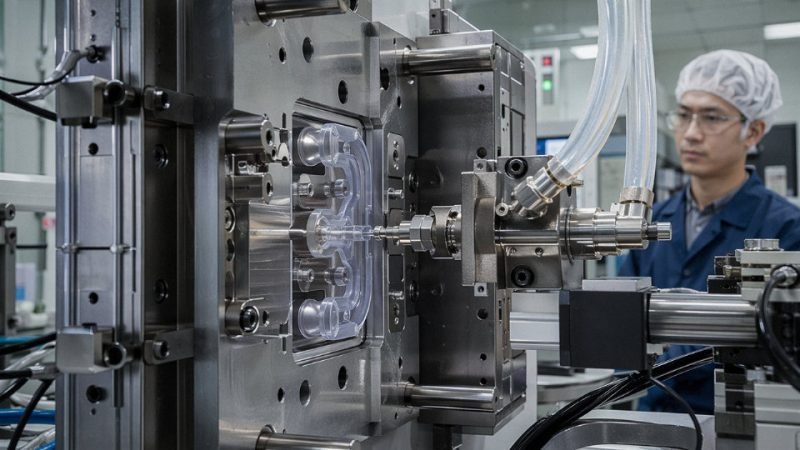
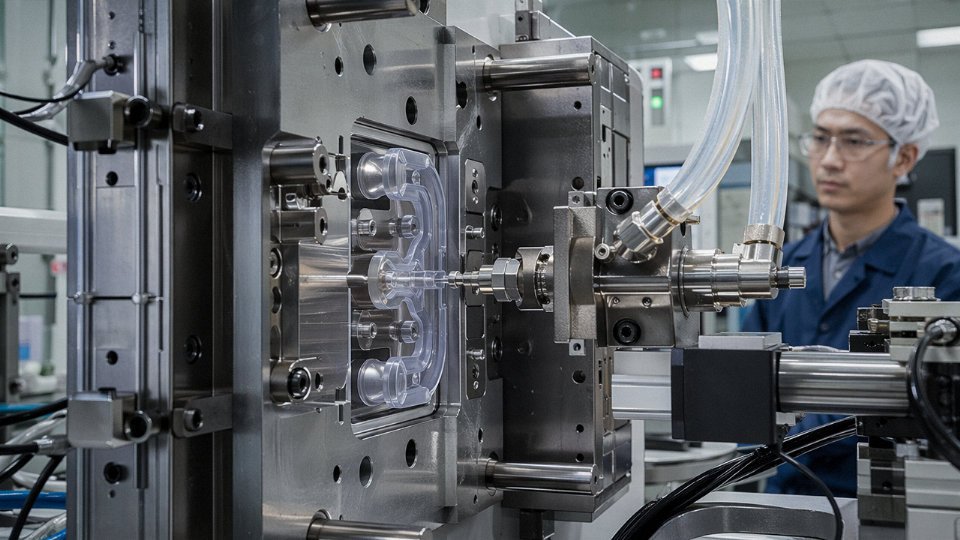
The machinery looks superficially similar — a press, a barrel, a mold — but the underlying logic is almost opposite. In thermoplastic injection molding, you melt a solid pellet and force it into a cold tool. In liquid injection molding (LIM) for LSR, you start with a cold liquid and inject it into a hot tool. That inversion drives every consequential difference in equipment, tooling, cycle management, and quality control.
How the LIM Process Actually Flows
LSR arrives at the press as two separate components — Part A (base polymer with platinum catalyst) and Part B (crosslinker, typically with the inhibitor system) — stored in sealed drums at roughly 15–20°C to keep viscosity stable. A metering pump draws both streams simultaneously at a controlled 1:1 ratio, though some specialty formulations run 9:1 or other ratios depending on the colorant or additive package. From there, a static mixer folds the two streams into a homogeneous blend before the material reaches the cold-runner manifold.
That cold runner is critical. The manifold is actively chilled — usually to somewhere between 15°C and 25°C — to prevent premature platinum-catalyzed cure in the runner system. Run it too warm and you get partial gelation in the manifold, which shows up as short shots, pressure spikes, and eventually a ruined tool. Operators often check manifold temperature at the start of every shift; it’s one of those things that looks fine on the HMI until it isn’t.
Once the shot reaches the heated steel cavity — typically running at 160°C to 200°C depending on part wall thickness and the specific LSR grade — the crosslinking reaction initiates rapidly. Thin-wall parts, say under 2 mm, can cure in 15–30 seconds. Thicker sections or parts with tight tolerance requirements might sit at 45–60 seconds. The press doesn’t open until cure is sufficient for the part to demold without tearing, and with Shore A 10–30 LSR especially, that judgment call matters.
Tooling Requirements Are Fundamentally Different
Thermoplastic tooling engineers spend most of their design effort on cooling channel layout, gate vestige, and draft angles. LSR tooling is a different set of headaches entirely. Because uncured LSR has very low viscosity — often 50,000–200,000 mPa·s depending on durometer — it will find any gap in the parting line. Flash control demands shut-off tolerances of roughly 0.003–0.005 mm, which is tighter than most thermoplastic applications require by an order of magnitude. P20 and H13 tool steels are standard; softer steels simply won’t hold that tolerance over a production run of any real volume.
Vacuum venting is another tooling feature with no strong parallel in thermoplastic work. Air trapped in the cavity can’t escape fast enough if you rely only on conventional venting land geometry, so most LSR tools pull a partial vacuum on the mold before injection. Skipping this step leads to porosity in thick sections and incomplete fill in fine features — a problem that shows up as scrap rate creep over days rather than an immediate obvious failure.
LSR molds require tighter parting-line tolerances than typical thermoplastic molds due to LSR's low pre-cure viscosity.True
Uncured LSR viscosity is low enough (comparable to some heavy oils) that gaps tolerable in thermoplastic tooling will produce unacceptable flash. Shut-off tolerances of 0.003–0.005 mm are a genuine industry requirement, not a conservative suggestion.
Post-Cure and Deflashing: Operations That Don’t Exist in Thermoplastic Production
A freshly demolded LSR part may meet dimensional and hardness specs, but the molding cycle itself leaves residual volatile cyclic siloxanes — primarily D4 and D5 — in the part matrix. For medical, infant, and food-contact applications, an oven post-cure at around 200°C for roughly 4 hours drives these volatiles below regulatory thresholds. It’s not optional if you’re targeting FDA or EU food-contact compliance.
Deflashing is the other operation that surprises engineers coming from a thermoplastic background. Because shut-off geometry keeps flash thin rather than eliminating it entirely, most LSR parts come out of the tool with a thin membrane at the parting line. Cryogenic deflashing — tumbling parts in a chilled enclosure with media or nitrogen blast — is common for high-volume runs. Laser deflashing is used where geometry is too complex for tumbling without part damage. Neither has a routine equivalent in standard thermoplastic processing, and both add cycle time and equipment cost that procurement budgets need to account for upfront rather than after tooling is already cut.
Regulatory and Standards Classification: How ISO, ASTM, FDA, and the EU Officially Categorize LSR
If you’ve ever had a procurement argument about whether an LSR part needs a plastic material declaration or a rubber compliance certificate, the answer is already settled — by multiple independent standards bodies, consistently, across decades. LSR is not a plastic by any regulatory definition that actually matters for documentation purposes.
ASTM D1418 and ISO 1629: The Rubber Nomenclature Systems
ASTM D1418 is the standard classification system for rubber and rubber latices. It groups elastomers by the chemical composition of the polymer backbone. LSR falls under class SI — silicone rubbers with a silicon-oxygen main chain and organic substituents. That class sits entirely outside D1418’s designations for thermoplastic rubbers (which include classes like TP for thermoplastic polyolefin elastomers) and has no overlap with standard plastic material families.
ISO 1629 covers the same ground for international markets, placing silicone rubbers in the Q class — specifically VMQ, PVMQ, or MQ depending on the substituent groups. The Q designation exists because silicone rubbers simply don’t fit anywhere else; the Si–O backbone is chemically distinct from every carbon-chain elastomer in the standard. If you’re filling out a material specification sheet and someone insists on a plastic designation, point them to these documents. The classification isn’t a matter of interpretation.
FDA Regulatory Lanes: 21 CFR 177.2600 vs. 177.1520
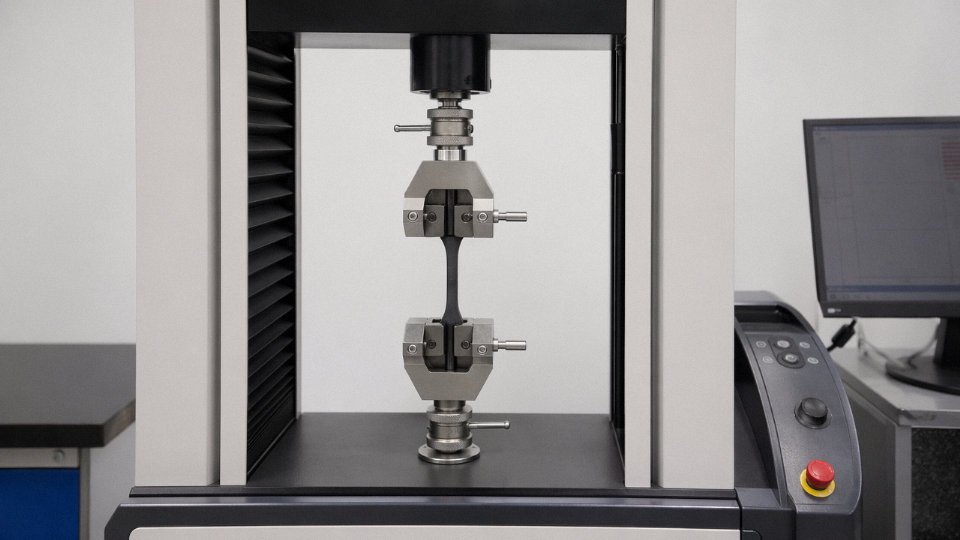
This is where the classification difference has direct operational consequences. In the United States, food-contact materials are regulated under 21 CFR Part 177. Thermoplastic polyolefins — polyethylene, polypropylene and related materials — are governed under 21 CFR 177.1520. LSR used in repeated-use food-contact applications falls under 21 CFR 177.2600, which covers rubber articles for repeated use.
These are different regulatory frameworks with different testing requirements, different lists of permitted adjuvants, and different extraction limits. A supplier who hands you a 177.1520 certificate for an LSR gasket has given you the wrong document — it doesn’t cover the material. In practice, this mistake does happen, usually when a purchasing team specifies “food-grade compliant” without specifying which regulation, and a factory defaults to whichever certificate is easiest to produce. The resulting compliance gap can hold up product launches or, worse, surface during a customer audit after launch.
FDA 21 CFR 177.2600 is the correct food-contact compliance pathway for LSR, not 177.1520 which applies to polyolefin plasticsTrue
21 CFR 177.2600 specifically covers rubber articles intended for repeated use in food contact, and silicone elastomers are assessed under this subpart. 21 CFR 177.1520 applies to olefin polymers — a chemically and regulatorily distinct material family.
EU Frameworks: 10/2011, REACH, and the Cyclic Siloxane Question
In the EU, plastic food-contact materials are regulated under EU Regulation 10/2011, which maintains a Union list of authorized monomers and additives specifically for plastics. Silicones are explicitly not assessed under 10/2011. Instead, LSR for food contact is evaluated against national frameworks (Germany’s BfR recommendations have historically been the practical benchmark) and more recently against evolving EU guidance under REACH.
The ongoing regulatory scrutiny of cyclic siloxanes — specifically D4 (octamethylcyclotetrasiloxane), D5 (decamethylcyclopentasiloxane), and D6 (dodecamethylcyclohexasiloxane) — is a concrete illustration of silicones’ standalone regulatory identity. The EU has restricted D4 and D5 in wash-off consumer products under REACH Annex XVII, and the broader restriction review considers siloxane migration from molded articles separately from any plastic migration assessment. No plastic regulation touches this chemistry. The fact that silicones need their own restriction dossiers, their own test methods, and their own compliance pathways is itself evidence that regulators don’t treat them as plastics.
For procurement managers building supplier qualification documents: request compliance certificates that explicitly reference 177.2600 (US), the relevant BfR category or LFGB test report (EU/Germany), and REACH SVHC declarations covering D4/D5/D6 where applicable. A supplier offering only a generic “RoHS compliant” or “food-grade plastic certified” declaration hasn’t addressed the actual regulatory requirements for LSR.
Where LSR Is Routinely Mistaken for Plastic: Medical, Consumer, and Automotive Case Studies
The classification confusion is not just academic. In three sectors — medical devices, infant consumer goods, and automotive powertrains — treating LSR as a variant of plastic creates downstream problems that range from FDA query letters to field seal failures. Each case has a different failure mode, but the root cause is the same: someone on the specification or documentation chain didn’t understand what LSR actually is.
Neonatal Respiratory Masks: When Material Classification Ends Up in a 510(k)
A neonatal respiratory mask sits against fragile skin for hours at a stretch, gets autoclaved between uses, and must not leach anything into a breathing circuit. TPE and polycarbonate are both cheaper and easier to source, and procurement teams sometimes propose them on that basis alone. The problem is neither survives the full requirements stack.
Autoclave sterilization runs at 134°C under steam pressure. Most TPEs — styrenic block copolymers in particular — soften or creep at that temperature, losing their seal geometry after just a few cycles. Polycarbonate can handle the temperature but is rigid, and the conformable fit a neonatal mask needs requires elastomeric compliance in the Shore A 20–40 range, not a material sitting at Shore D 70+. LSR, cured and cross-linked, holds its geometry through hundreds of autoclave cycles without measurable dimensional change.
The biocompatibility path matters too. ISO 10993-series testing — cytotoxicity, sensitization, systemic toxicity — has to be run on the actual material and its extractables profile. LSR formulated for medical use contains no plasticizers because it doesn’t need them; the softness comes from the Si–O backbone and cross-link density, not additives. A TPE compound achieves its flexibility partly through oil extension or plasticizer loading, and those components show up as extractables. That difference changes the ISO 10993-5 cytotoxicity result, and it changes what you write in your 510(k) substantial equivalence argument.
Misclassify the mask body as “thermoplastic elastomer” or simply “plastic” on the device description, and an FDA reviewer will issue a deficiency letter asking you to justify the biocompatibility data against the declared material. That letter typically costs four to eight weeks of submission delay, minimum.
Baby Soothers and EU EN 1400: Liability Hiding in Packaging Copy
The EU’s EN 1400 standard for infant soothers explicitly separates testing requirements for rubber and silicone components from those for plastic components — different migration limits, different mechanical tests, different sample conditioning protocols. A soother nipple made from LSR is tested as silicone rubber. Full stop.
Where brands get into trouble is in the marketing and labeling layer. “BPA-free plastic” has become a consumer-reassurance phrase, and someone in a packaging design meeting — usually not an engineer — applies it to the nipple because it sounds safe. The nipple is not plastic. It is a cross-linked silicone elastomer. That label is factually wrong under EN 1400 definitions, and in a product liability claim following an adverse event, the mislabeling becomes evidence that the brand did not understand its own material. Regulators in Germany and France have both flagged this kind of labeling inconsistency during routine market surveillance. The correction is cheap — update the copy to “silicone rubber nipple, free of BPA and plasticizers” — but the reputational exposure while the product is in the market is real.
Coolant Circuit Seals: The PA66-GF30 to LSR Switch
Powertrain engineers specifying coolant-circuit seals often start with glass-filled nylon — PA66-GF30 is a common first choice because it’s dimensionally stable, chemically resistant enough for mild coolants, and well within standard machining and injection molding capability. It works fine at ambient to around 90°C service temperature.
Push coolant temperature to the 130–150°C range typical of modern turbocharged engines running long drain intervals with OAT or HOAT coolant chemistry, and the picture changes. PA66-GF30 shows compression set values that climb into the 30–50% range depending on the specific coolant formulation and temperature cycle — meaning the seal relaxes under load and eventually leaks. LSR grades formulated for coolant service routinely achieve compression set below 15% after 1,000 hours at 150°C, which is roughly the threshold where long-term sealing integrity holds across the expected service interval.
The re-qualification under IATF 16949 after a material switch like this is not trivial. You’re looking at a new PPAP submission, dimensional re-validation, and potentially updated DFMEA entries. In practice, the switch typically adds three to five months to the program timeline if it happens mid-development. The lesson most powertrain teams take from this: get the material decision right in the concept phase, not after first-article testing reveals creep data you didn’t anticipate.
LSR seals in coolant circuit applications typically achieve compression set below 15% after extended high-temperature exposure, outperforming glass-filled nylon in that metric.True
This is consistent with published data from major LSR compounders and is well-documented in SAE sealing literature for high-temperature coolant applications. Exact values depend on LSR grade, coolant chemistry, and test protocol.
The thread running through all three cases is the same: LSR’s properties emerge from its chemistry, and that chemistry puts it in a fundamentally different category from plastics. Once you know that, you stop making the substitution errors before they become regulatory, liability, or warranty problems.
Sustainability and End-of-Life: Why LSR Cannot Enter Plastic Recycling Streams
Cross-linking is what makes LSR perform so well in service — and exactly what makes it a recycling dead end. Once the platinum catalyst drives the Si–H and Si–vinyl groups into a permanent three-dimensional network during cure, that network does not come apart with heat or pressure. You cannot re-melt it, re-pelletize it, or re-extrude it. The cured part is, chemically speaking, one enormous molecule. This is fundamentally different from a polyethylene jug or a polypropylene container, where the polymer chains are long but discrete — heat them up and they flow again. LSR just chars.
That distinction has direct operational consequences for anyone managing production waste or post-consumer collection.
Why LSR Contaminates Plastic Recycling Streams
This is a problem the flexible packaging industry has been quietly dealing with for years. Silicone-coated release liners, silicone seals on pouches, and silicone gaskets that end up mixed into HDPE or PP bale streams can wreck an entire batch at the reclaimer. Even small silicone contamination levels — typically above 50–100 ppm depending on the resin and the end application — can cause surface defects, poor adhesion, and film-blowing instability in the recycled output. Reclaimers often reject loads when silicone is suspected; some NIR sorting lines cannot reliably distinguish cured silicone from certain polyolefins, which makes the contamination hard to catch before it causes damage.
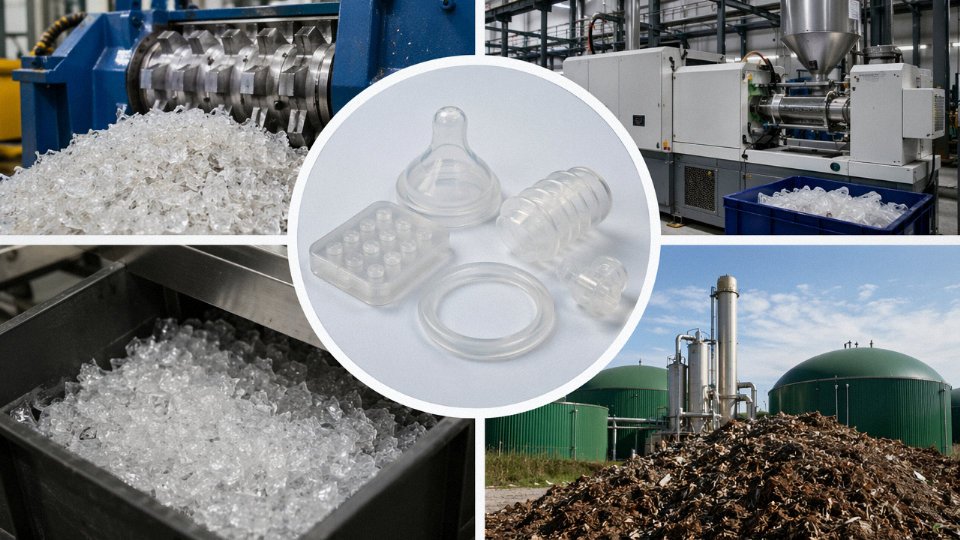
The practical takeaway for procurement and waste management teams: LSR scrap, sprues, and end-of-life LSR parts must be segregated from thermoplastic waste. Mixing them in the same collection bin is not a minor sorting inconvenience — it is a batch-loss risk for whoever processes that material downstream.
What Actually Happens to LSR at End of Life
The most common industrial disposal route today is incineration. Cured LSR has a calorific value in the range of roughly 22–26 MJ/kg depending on filler loading and formulation — comparable to some coals, and meaningfully higher than most wet organic waste. The combustion products are primarily CO₂, water vapor, and silicon dioxide (silica ash), which is inert. Some facilities run LSR waste through co-incineration with municipal solid waste or industrial fuel blending. It is not elegant, but it works and it is widely available.
Pyrolysis is more interesting from a materials-recovery perspective. At temperatures typically between 400°C and 700°C in a low-oxygen environment, LSR breaks down into a silica-rich solid residue and a gas fraction that contains methane and lower siloxanes. The silica can, in principle, be recovered for use as a filler or abrasive. The gas fraction has fuel value. In practice, the economics are marginal unless the pyrolysis unit is already running for other feedstocks — dedicated LSR pyrolysis is not a mainstream commercial operation yet.
Chemical depolymerization is still largely at the research stage, but it is the route that would actually close the loop. The target is recovering cyclic siloxane monomers — primarily D4 and D5 — that could theoretically re-enter silicone polymerization. Several academic groups and at least one major silicone producer have published work on this. The challenge is selectivity and yield in the presence of fillers and pigments. Realistic commercial deployment is probably a decade out, give or take.
The Lifecycle Carbon Nuance
LSR production starts with quartz sand reduction at temperatures above 1,500°C — energy-intensive from the first step. That upstream carbon cost is real and should not be hand-waved away. But it needs to be weighed against service life. A well-specified LSR part in a medical device or industrial seal can run 10–20 years, survive thousands of autoclave cycles, and replace what would otherwise be dozens of single-use TPE or PP components over the same period.
LSR parts' long service life can offset their energy-intensive production in lifecycle assessments for medical and reusable consumer goods applicationsTrue
Life cycle assessment studies comparing single-use thermoplastic components against reusable LSR equivalents consistently show that durability and sterilization resistance reduce cumulative environmental impact per use cycle, even accounting for LSR's energy-intensive upstream production.
In applications where that substitution math works out — reusable baby products, autoclavable surgical tools, long-life industrial seals — the lifecycle picture for LSR is defensible and sometimes clearly favorable. In single-use or short-cycle applications, less so. The honest answer is: it depends on the use case, and anyone claiming LSR is categorically “green” or categorically worse than plastics is oversimplifying.
Frequently Asked Questions About LSR and Plastic Classification
Is silicone rubber considered a plastic by the FDA or EPA?
No. The FDA regulates food-contact silicone under 21 CFR 177.2600, which covers rubber articles intended for repeated use — a separate regulatory bucket from the plastic articles covered under 21 CFR 177.1xxx. That distinction isn’t semantic; it affects which extractables testing protocols you follow, which compliance letter you request from your material supplier, and how your finished product gets categorized during a 510(k) or food-contact notification review. The EPA’s Toxics Release Inventory similarly breaks silicone compounds out of its general plastics grouping. If a contract manufacturer hands you a compliance document that lumps LSR under “food-grade plastic,” send it back.
The FDA regulates food-contact silicone rubber under 21 CFR 177.2600, which is separate from the plastic articles regulations in 21 CFR 177.1xxx.True
21 CFR 177.2600 is titled 'Rubber articles intended for repeated use' and specifically covers silicone elastomers; it is structurally and legally distinct from the plastic-specific subparts of 21 CFR Part 177.
Can LSR be recycled in curbside plastic bins?
No — and this matters practically, not just theoretically. LSR is a thermoset elastomer. Its cross-linked Si–O network cannot be softened and re-melted, which means it behaves like a contaminating inert solid if it enters a PE or PP recycling stream. Sorting facilities that rely on near-infrared spectroscopy will often misidentify it or flag it as a reject, and either outcome degrades the batch. Keep LSR waste out of curbside bins entirely. Industrial composting, energy recovery, or specialist silicone reclaim programs are the responsible routes.
Is liquid silicone rubber BPA-free?
Yes. LSR’s backbone is silicon–oxygen, not carbon-chain polymer chemistry. There is no polycarbonate component, no bisphenol A, and no pathway for BPA to appear even as a trace byproduct of the cure. This comes up frequently in infant-product procurement, where BPA-free claims need to be substantiated. The honest answer is that asking whether LSR contains BPA is a bit like asking whether stainless steel contains wheat gluten — the chemistries are simply unrelated.
What is the difference between LSR and “silicone plastic”?
“Silicone plastic” isn’t a real material category — it’s informal shorthand that creates genuine confusion on purchasing specs. True LSR is a thermoset elastomeric rubber. When people say “silicone plastic,” they usually mean one of two things: rigid silicone composite parts that have been loaded with hard fillers to reduce flexibility, or phenyl-modified silicone resins used in coatings and encapsulants that cure to a harder, more resin-like state. Those materials behave differently from LSR in molding, in service, and in regulatory classification. If a supplier uses “silicone plastic” on a datasheet, ask them to specify the actual material grade and cure chemistry.
Is LSR safe for food contact?
Yes, when formulated to comply with FDA 21 CFR 177.2600 and EU Regulation 10/2011 and tested accordingly. LSR does not contain plasticizers, phthalates, or BPA. It doesn’t need them — flexibility comes from the Si–O backbone and the cross-link density, not from additive chemistry. That said, “LSR” on a spec sheet is not automatically a food-grade guarantee. Pigment packages, release agents, and specialty fillers all affect compliance status. Always request a migration test report and a full formulation disclosure for food-contact applications, not just a generic material safety data sheet.
How do I tell LSR apart from TPE or soft PVC by touch or appearance?
In a lab you’d run FTIR. On the shop floor, a few quick checks usually work. LSR has a distinctly silky, non-tacky surface feel and snaps back from deformation almost instantly — better elastic recovery than most TPEs at room temperature. TPE tends to feel slightly stickier or waxy depending on the base resin, and recovery is a bit slower. Soft PVC has a characteristic smell, especially if warm, and noticeably less elastic rebound. The confirmatory test for field sorting: a small controlled burn. LSR leaves white powdery silica ash. Thermoplastic elastomers and soft PVC produce black sooty smoke and char. Don’t run this test near anything flammable, and ventilate properly — burning PVC releases HCl.
Does LSR contain plastic polymers as fillers?
Standard LSR formulations don’t. The primary reinforcing filler is fumed silica (SiO₂), which is an inorganic mineral, not a plastic. Some specialty compounded grades do incorporate PTFE particles to reduce friction in dynamic sealing applications — and PTFE is technically a fluoropolymer and therefore a plastic. Those grades need to be called out separately in compliance documentation, particularly for medical or food-contact uses, because PTFE introduces different regulatory and extractables considerations. If you’re speccing a self-lubricating LSR grade, confirm with the compounder exactly what the PTFE loading is and whether it’s been tested for your target application.
Why do some manufacturers label LSR products as “food-grade plastic”?
Mostly consumer marketing. “Plastic” is a familiar, non-threatening word to a retail buyer choosing a baby bottle or a kitchen spatula. “Silicone elastomer” is not. The problem is that this shorthand bleeds into B2B contexts — sometimes into actual compliance documentation — and causes real trouble downstream. A procurement manager who classifies LSR parts as plastic in an ERP system may route them to the wrong recycling program, apply the wrong regulatory filing, or spec a replacement part in TPE thinking the properties will be equivalent. From a materials science standpoint and from every relevant regulatory framework, LSR is a silicone elastomer. Professional documentation should say so.
Practical Material Selection Guide: Choosing Between LSR and Engineering Plastics
The chemistry debate is settled elsewhere in this article. Here, the question is simpler and more urgent: given a specific application, which material actually wins? Getting this wrong in either direction costs money — over-specifying LSR where polypropylene would do fine wastes tooling budget and inflates piece-part cost; under-specifying a commodity plastic where LSR is needed produces field failures, warranty claims, and sometimes regulatory consequences you cannot walk back.
When LSR Is the Rational Choice
Sustained high-temperature exposure above roughly 150°C. Most commodity and even mid-tier engineering plastics — nylon 6/6, polycarbonate, ABS — start losing mechanical integrity somewhere in the 100–130°C range under sustained load. PPS and PEEK push higher, but they are expensive and brittle in thin sections. LSR runs continuously from –60°C to around +200°C without dimensional change or oxidative degradation, which is why it appears repeatedly in under-hood automotive applications and industrial ovens. If your component sits near a heat source and needs to maintain a seal or a soft interface, this threshold alone usually ends the conversation.
Elastic recovery with elongation above 150–200%. Engineering plastics deform and stay deformed. A polycarbonate clip flexed repeatedly at high deflection will stress-whiten and eventually crack; it has no meaningful elastic recovery beyond small strains. LSR at Shore A 30–50 can stretch to 400–600% elongation (depending on durometer and compound formulation) and snap back to essentially original geometry. Dynamic gaskets, overmolded cable strain reliefs, peristaltic pump tubing — these applications demand that material behavior.
Biocompatibility certification for medical or food-contact use. This is less a property threshold than a regulatory gate. If your part requires USP Class VI, ISO 10993, or FDA 21 CFR 177.2600 documentation, LSR compounds with established compliance histories are a far lower-risk path than engineering plastics that may contain plasticizers, colorants, or processing aids that complicate clearance. The validation package for a compliant LSR grade already exists; building one from scratch for an unusual plastic grade takes time and money that most programs cannot absorb.
Compression set below 20% in dynamic sealing. A seal that cold-flows under bolt load and never fully recovers is a slow leak waiting to happen. Typical LSR compression set values run 5–15% under standard test conditions (70 hours at 175°C per ASTM D395), versus 30–60% for TPE and well above that for most rigid plastics pressed into a sealing role. For O-rings, face seals, and any interface that cycles between loaded and unloaded states, this number matters more than tensile strength.
When Engineering Plastics Are the Better Call
Structural load-bearing parts needing tensile strength above 40 MPa. LSR is an elastomer. Tensile strength typically runs 6–12 MPa depending on the compound. Glass-filled nylon 6/6 can reach 180–200 MPa; unreinforced polypropylene sits around 30–35 MPa. If the part carries a bracket load, a snap-fit, or a press-fit bearing seat, LSR simply cannot compete structurally.
High-volume, cost-sensitive commodity parts. LSR resin typically costs USD 8–25/kg depending on grade, certification level, and supplier — and platinum-catalyst compounds sit at the high end. Polypropylene runs USD 1–2/kg. At millions of parts per year, that differential is enormous. In practice, a lot of consumer packaging, housings, and non-contact structural components reach for PP, HDPE, or ABS precisely because per-unit material cost dominates the BOM.
Post-mold machining or threaded inserts with high pull-out requirements. LSR cannot be tapped. Insert pull-out forces in silicone are low, and the material’s compliance makes precision machined features essentially impossible. A glass-filled nylon housing with heat-set brass inserts pulls out at 800–1200 N; the equivalent attempt in LSR is not a reasonable comparison.
Optical components requiring precise light transmission and refractive index control. Optical-grade polycarbonate or PMMA offers Abbe numbers in the 30–58 range with well-characterized, consistent refractive indices. LSR optical grades exist but are a niche within a niche, and the supply chain for qualified optical LSR is thin. Unless you specifically need flexible optics, transparent engineering plastics are the standard answer.
Decision Matrix
| Application | Critical Property | Recommended Material | Indicative Cost Range (USD/kg, resin) |
|---|---|---|---|
| Medical wearable skin-contact patch | Biocompatibility, elongation, softness | LSR (USP Class VI grade) | 15–25, depending on pigment and certification |
| Automotive intake manifold gasket | Heat resistance, compression set | LSR or fluorosilicone | 10–20 for LSR; higher for FSR |
| Infant bottle nipple / pacifier | Biocompatibility, FDA compliance, softness | LSR (food-contact grade) | 12–22 |
| Electronic encapsulation / potting | Moisture barrier, dielectric, thermal stability | LSR or two-part silicone encapsulant | 8–18 |
| Industrial hydraulic seal, dynamic | Compression set, chemical resistance | LSR or HNBR depending on fluid | 8–20 for LSR; 6–15 for HNBR |
| Structural pump housing | Tensile strength, stiffness, machinability | Glass-filled nylon or PPS | 3–8 for GF nylon |
| Consumer appliance exterior housing | Cost, aesthetics, rigidity | ABS or PP | 1.5–3.5 |
LSR compression set values typically run 5–15% under ASTM D395 test conditions, significantly lower than TPE alternativesTrue
Published data from major LSR suppliers (Shin-Etsu, Wacker, Momentive) and independent test houses consistently report compression set in this range for standard LSR formulations tested at 70 hours/175°C per ASTM D395 Method B. TPE values vary widely but 30–60% is a reasonable range for common grades under equivalent conditions.
One operational warning worth stating plainly: the cost comparison above is resin-only. LSR tooling — cold-runner systems, precision mold steel tolerances, dosing pump maintenance — typically adds USD 30,000–120,000 to upfront tooling cost versus comparable thermoplastic tooling. At low volumes, that fixed cost per part can dwarf the material savings from choosing LSR. Run the full program economics, not just the resin line.