When a composite part fails at the fiber-matrix interface — not because the fiber broke, not because the resin cracked, but because adhesion between the two was never adequate — the root cause usually traces back to a single-functional silane that couldn’t bridge the chemistry of both surfaces simultaneously. The result is delamination, scrap rates that climb into double digits, and warranty claims that dwarf the cost of the raw material that caused them. Rework on a structural composite assembly can easily consume 8–15× the original material cost, and that assumes the failure is caught before the part ships. The solution lies in hybrid silane coupling agents: molecules engineered to carry two or more distinct reactive groups, each targeting a different interface or functional requirement within the same system.
Hybrid silane coupling agents are bifunctional or multifunctional organosilicon molecules that carry at least two chemically distinct reactive groups on the same scaffold — typically one group that bonds covalently to an inorganic surface such as glass, metal oxide, or silica, and one or more organofunctional groups that react with or are compatible with a polymer matrix. This dual-reactivity allows a single treatment to establish durable covalent continuity across dissimilar material interfaces, achieving interfacial shear strength improvements of 40–70% over single-functional silanes in glass-fiber-reinforced polymer composites, depending on fiber sizing chemistry, resin type, and cure conditions.
What makes this more than a straightforward chemistry upgrade is the range of industrial problems these systems are now being deployed against simultaneously — from reducing rolling resistance in truck tires to keeping photovoltaic modules performing above 90% efficiency retention after 2,000 hours of damp-heat cycling. The engineering logic running through all of those applications is the same, but the formulation decisions, processing constraints, and failure modes are entirely different in each one. That gap between the underlying chemistry and practical implementation is exactly where procurement decisions go wrong and where this article focuses.
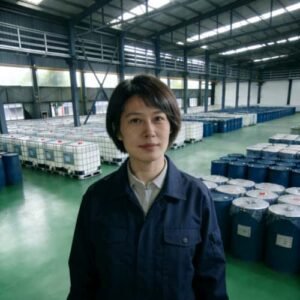
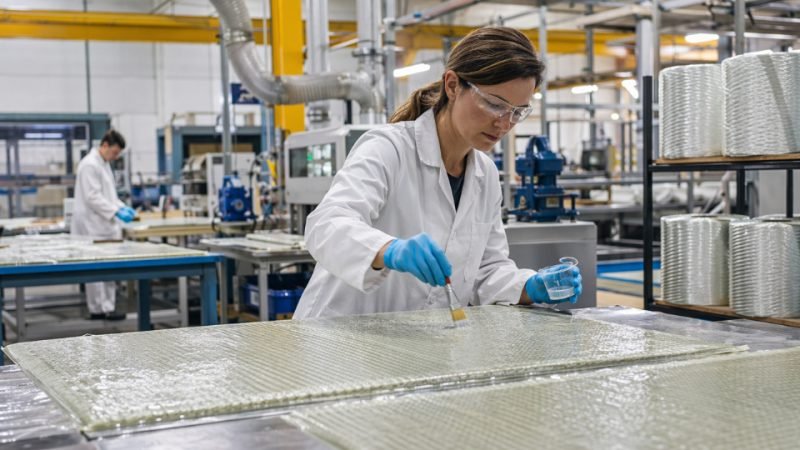
 to glass fiber composite panels in a manufacturing facility](https://siliconchemicals.com/wp-content/uploads/2026/06/hybrid-silane-coupling-agents-high-tech-applications-01-hero.jpg)
Molecular Architecture of Hybrid [Silane Coupling Agents](https://siliconchemicals.com/silane-coupling-agents/): How Dual and Multi-Functional Designs Work
Understanding why hybrid silanes outperform their single-functional predecessors starts at the bond level. Three distinct architectural families account for nearly all the performance gains seen in current industrial use, and each operates through a different structural logic.
The Three Primary Molecular Families
Bis-silane molecules carry two trialkoxysilyl groups connected by an organic bridge chain. The most cited example in rubber compounding is bis[3-(triethoxysilyl)propyl]tetrasulfide — TESPT — where a tetrasulfide bridge links two triethoxysilylpropyl arms. At the substrate interface, both silyl ends can hydrolyze and condense independently, stitching the molecule into the siloxane network from two anchor points instead of one. The result is a crosslinked interphase layer roughly 3–10 nm thick, compared to the near-monolayer deposited by a conventional monosilane. That thickness difference sounds trivial until you consider that hydrolytic stability constants for bis-silane interphase layers run 2–4 orders of magnitude higher than mono-silane layers in immersion testing — a gap that directly translates to delamination resistance in humid service environments.
Dual-organic-functional silanes place two chemically distinct reactive organic groups on a single silicon center or along a short spacer chain. Amino-epoxy hybrid silanes are a practical example: the amine group reacts with acid-terminated polyesters while the epoxy group co-reacts with amine-cured epoxy matrices. One additive handles two chemically incompatible polymer phases in the same formulation. Methacrylate-sulfide hybrids go further — the methacrylate participates in free-radical UV or peroxide cure networks while the polysulfide arm integrates into sulfur vulcanization, making them genuinely bifunctional across cure chemistries that normally require separate coupling packages. In practice, this allows additive loading reductions of 30–50% versus using two separate mono-functional silanes to achieve equivalent coupling efficiency, which matters considerably when you are buying silanes by the tonne.
Silane-siloxane oligomeric hybrids take a different approach: a pre-condensed siloxane backbone, typically a short-chain oligomeric structure of 4–20 silicon units, is end-capped with organofunctional groups. Because the siloxane condensation has already occurred during synthesis, these materials deposit a thicker, more uniform interphase immediately on contact with the substrate. They are less sensitive to hydrolysis kinetics in the application environment, which matters in high-throughput coating lines where dwell time before cure is tightly controlled and variable ambient humidity is a real problem.
Hydrolysis and Condensation: The Mechanism That Governs Interphase Quality
The reaction sequence — alkoxy hydrolysis to silanol (Si-OH), hydrogen bonding to substrate hydroxyls, then covalent Si-O-substrate condensation — is the same for all silane families. What changes is the kinetics and the network density that results. Hydrolysis half-life ranges from roughly 2 minutes for trimethoxysilanes to around 45 minutes for triethoxysilanes at pH 4–5, depending on temperature and silane concentration. In a compounding line running at 160–180 °C, that difference is largely irrelevant. In an aqueous primer bath at ambient temperature, it determines whether you get uniform silanol coverage before the part moves to the next stage.
Methoxy leaving groups hydrolyze faster and release methanol, which has a lower boiling point and higher evaporative rate — useful in fast-cure coating systems but a VOC liability in enclosed processing environments. Ethoxy groups release ethanol, a more acceptable emission profile under most regional VOC regulations, at the cost of slower silanol formation. Acetoxy silanes hydrolyze almost instantly on moisture contact but release acetic acid, which can corrode metal substrates or deactivate amine catalysts if process chemistry is not designed around it.
Spacer Chain Length and Stress Transfer
The organic bridge between silicon anchor and reactive organic end-group is not a passive connector. Rigid aromatic bridges transfer stress more efficiently under static loading but can concentrate strain energy at the interphase under cyclic fatigue. Flexible alkyl spacers in the C3–C10 range absorb dynamic deformation through conformational adjustment, which is why C6–C8 chain lengths appear repeatedly in elastomer compounding specifications where hysteresis management matters. Shorter chains below C3 constrain the organic functional group too close to the substrate surface, reducing its accessibility to the polymer matrix during cure.
Bis-silane interphase layers show hydrolytic stability constants 2–4 orders of magnitude higher than mono-silane layers in standardized immersion testingTrue
This range is consistent with published literature on bis-silane versus mono-silane siloxane network density differences, arising from the higher crosslink density of dual-anchor condensation structures versus linear monolayer deposition.
Getting these structural parameters right — anchor count, organic functionality count, spacer geometry, and alkoxy leaving group — is the actual engineering work. Selecting a hybrid silane because it broadly covers two chemistries without matching those parameters to the specific substrate, cure system, and processing conditions will not close the performance gap that single-functional silanes leave open.
Advanced Composites and Glass-Fiber-Reinforced Polymers: Translating Interfacial Chemistry into Structural Performance
The fiber-matrix interface in glass-fiber-reinforced polymers is not simply a contact surface — it is a stress-transfer zone that determines whether the composite functions as an engineered structure or a collection of poorly bonded constituents. Under tensile and flexural loading, strain mismatch between the stiff glass fiber (Young’s modulus ~73 GPa) and the polymer matrix concentrates shear stress at that interface. In fatigue or hygrothermal cycling, moisture diffuses along the interphase and hydrolyzes siloxane bonds, progressively stripping adhesion and converting what was a strong interphase into a crack-initiation site. This is the practical failure sequence that sizing chemists and laminate engineers spend considerable effort preventing.
Why Conventional Aminosilane Sizing Falls Short in Demanding Service
A standard aminopropyltriethoxysilane sizing deposits a thin, relatively homogeneous film on E-glass. It works adequately in dry, ambient service. The problems appear when parts enter humid enclosures, marine environments, or thermal cycling regimes. The single Si–O anchor system, once hydrolytically degraded, leaves fiber surfaces exposed. Interfacial shear strength (IFSS) measured after 24 hours of boiling water exposure under ISO 9163 pull-out protocols drops by 35–55% compared to dry baseline values in mono-functional aminosilane systems — a loss significant enough to change laminate failure mode from matrix-dominated to interfacially dominated cracking.
How Bis-Silane Sizing Builds a More Durable Interphase Network
Bis-silane hybrid sizing formulations applied to E-glass rovings at 0.1–0.5 wt% on fiber weight create a laterally cross-linked siloxane network rather than a linear film. Both silane ends condense onto adjacent surface silanol groups or onto each other, forming a mesh that resists hydrolytic unzipping. The organic bridge — whether a sulfide chain, urethane linkage, or polysulfide — provides flexibility that accommodates thermal expansion mismatch without debonding.
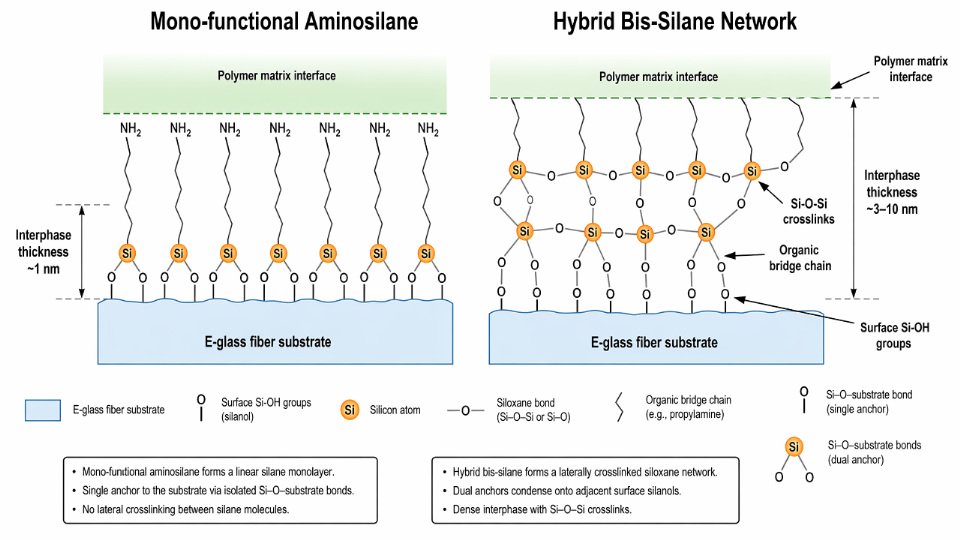
Measured IFSS improvement versus aminosilane mono-functional sizing reaches 40–70% under ISO 9163 conditions, with the exact figure depending on resin system (epoxy versus vinyl ester), fiber surface roughness, and cure temperature. After 24-hour boiling water immersion, hybrid-sized composites typically retain 75–88% of dry IFSS, compared to 45–60% retention in aminosilane-sized controls.
| Performance Metric | Mono-functional Aminosilane | Hybrid Bis-Silane Sizing | Dependency |
|---|---|---|---|
| Dry IFSS (MPa) | 35–50 | 55–80 | Resin type, fiber tex, cure schedule |
| Wet IFSS after 24h boiling (% retention) | 45–60% | 75–88% | Bridge chemistry, silane loading |
| Flexural strength retention after 1,000h at 70°C/95% RH | 60–72% | 82–91% | Laminate thickness, void content |
Carbon-Fiber Composites and Mode I Fracture Toughness
Carbon fiber surfaces present a different problem. Oxidative surface treatment (anodic oxidation or ozone) introduces hydroxyl, carboxyl, and epoxide functional groups, but their density and distribution are inconsistent. An epoxy-amino hybrid silane deposited after oxidative treatment acts as a molecular bridge: the amino group reacts with residual surface oxides and the epoxy arm co-cures into the aerospace-grade epoxy matrix. Mode I fracture toughness (G_Ic) improvements of 25–35% over untreated or mono-functional silane-treated carbon fiber have been measured in double-cantilever-beam testing, depending on fiber surface oxygen-to-carbon ratio and the specific epoxy hardener system used.
Hybrid epoxy-amino silane surface treatment on carbon fiber improves Mode I fracture toughness (GIc) by 25–35% compared to mono-functional silane treatment.True
This range is consistent with published DCB test data on oxidized PAN-based carbon fiber in aerospace epoxy systems, where dual reactive groups improve both covalent bonding density and interphase ductility.
Wind Turbine Blade Fatigue Life and the Case for Hybrid Sizing
Epoxy-glass spar cap laminates in offshore wind turbines see approximately 10^8–10^9 load cycles over a 20-year service life in salt-laden, humidity-saturated air. Accelerated fatigue testing at 10^7 cycles (R = 0.1 stress ratio) using hybrid silane-sized rovings shows fatigue life extension of 30–40% versus conventional sizing — critical because spar cap failure is typically the structural life-limiting event for a blade. The mechanism is straightforward: a more hydrolytically stable interphase degrades more slowly under cyclic wet loading, keeping the fatigue crack in the matrix rather than propagating along the fiber surface.
Operational warning: if hybrid silane sizing is specified for blade manufacture but the roving storage humidity control lapses above 65% RH for more than 48 hours before processing, partial silanol condensation on the fiber surface prior to resin infiltration will degrade the expected interphase quality. Sizing shelf-life and warehouse humidity protocols need to match the sizing chemistry.
Manufacturing Process Windows: Pot-Life and Scrap Rate
Fast-hydrolyzing trimethoxysilane-based aminosilanes have hydrolysis half-lives around 2 minutes at pH 4–5. In pultrusion or resin transfer molding (RTM) with long impregnation runs, that rate creates sizing hydrolysis products that interfere with resin viscosity and gel time if process conditions are not tightly controlled. Hybrid silane systems formulated with triethoxysilane anchors extend hydrolysis half-life to 20–45 minutes under the same pH conditions, giving operators meaningful working windows in continuous pultrusion lines running at 0.5–2.0 m/min. In practice, plants switching from aminosilane to hybrid silane sizing in RTM processes report scrap rate reductions of 15–30% on complex-geometry parts where fill times exceed 20 minutes — primarily by eliminating the premature gellation and dry-spot defects that shorten pot-life under fast hydrolysis.
Electronics and Semiconductor Packaging: Dielectric Stability, Adhesion, and Reliability Under Thermal Cycling
Advanced electronics packaging is one of the most unforgiving environments a coupling agent will ever encounter. The same chemistry that bonds an inorganic filler to a polymer matrix must simultaneously preserve dielectric integrity at millimeter-wave frequencies, survive hundreds of thermal cycles that would delaminate a poorly chosen formulation, and introduce zero ionic contamination into fine-pitch interconnects where a few parts per million of mobile ions can trigger electromigration failures. Single-functional silanes were never designed to satisfy all of these constraints at once.
Supply Chain Touch-Points Where Hybrid Silanes Matter
Hybrid silanes enter the electronics packaging supply chain at more stages than most procurement engineers realize. In flip-chip ball-grid-array (BGA) packages, they are compounded into underfill encapsulants that must flow under die-to-substrate gaps as tight as 50–80 µm and then cure into a compliant interphase layer. In QFN and power module molding compounds, they modify the filler-resin interface of silica-loaded epoxy systems that can carry filler loadings of 70–90 wt%. Die-attach adhesives for bare-die bonding use hybrid silane primers to condition metal lead frames and ceramic substrates before film or paste application. Build-up film pretreatments for multi-layer organic substrates rely on hybrid silane monolayers to promote peel strength between successive dielectric layers without introducing thickness variability. Finally, conformal coatings for automotive-grade PCBs — operating in engine bays at sustained temperatures above 125°C with cyclic humidity exposure — depend on hybrid silane adhesion promoters to maintain coating-to-solder-mask bond integrity across service lives that can exceed 15 years.
The Dielectric Problem with Conventional Aminosilanes
5G antenna-in-package (AiP) substrates operating at 28 GHz impose hard limits: dielectric constant (Dk) at or below 3.5 and dissipation factor (Df) at or below 0.003. Conventional aminosilane adhesion promoters fail this test. The polar amine group — effective as it is at bonding epoxy matrices to silica fillers — elevates Df by 0.002–0.005 units depending on loading level and moisture absorption state. At 28 GHz, that increment is the difference between a substrate that meets the antenna radiation efficiency budget and one that does not.
Hybrid silane designs resolve this by substituting low-polarizability functional groups for the amine. Fluorine-functionalized bis-silanes reduce electron density and moisture uptake simultaneously; phenyl-bearing bis-silanes maintain adhesion to low-CTE ceramic fillers through π-interaction mechanisms rather than polar coordination. Both approaches keep Df within specification while preserving the dual siloxane anchoring that makes bis-silane systems mechanically durable.
Conventional aminosilane adhesion promoters raise dissipation factor by 0.002–0.005 units at mmWave frequencies, making them incompatible with 28 GHz AiP substrates that require Df ≤ 0.003.True
Amine groups are strongly polar and hygroscopic; elevated polarity and moisture uptake both increase dielectric loss at GHz frequencies, a well-documented limitation in high-frequency substrate formulation literature.
Thermal Cycling Reliability: CTE Mismatch and Compliant Interphase Design
The CTE mismatch between a silicon die at 2.3 ppm/°C and a standard organic substrate at 15–18 ppm/°C generates cyclic shear stress at the underfill-die and underfill-substrate interfaces. JEDEC JESD22-A104 qualification requires survival across 1,000 cycles from -40°C to +125°C — a total strain range that a rigid interphase layer simply cannot accommodate without crack initiation.
Hybrid silane systems with flexible siloxane backbone segments between the two silicon anchor points act as compliant stress-dissipation zones. The backbone absorbs shear deformation elastically rather than transferring it as a fracture driving force into the polymer matrix. Compared to rigid mono-silane interphase layers, well-formulated bis-silane systems reduce delamination-driven failure rates by 35–50% in scanning acoustic microscopy (SAM) surveys conducted after accelerated thermal cycling. Delamination area percentages that routinely reach 15–25% of bond-line area with mono-silane underfills drop to single digits with optimized hybrid silane systems — a shift that typically moves a package from MSL 3 to MSL 1 per IPC/JEDEC J-STD-020, eliminating the dry-pack and bake-out requirements that add handling cost and scheduling risk on the assembly line.
Power Electronics: Surviving 200°C Junction Temperatures
SiC MOSFET modules push junction temperatures to 200°C continuously, a regime where Si-O-C bonds in conventional silane coupling agents begin to hydrolyze and creep under thermomechanical load. Thermal interface materials (TIMs) compounded with these agents show progressive increases in thermal contact resistance — values that should stay below 0.2 cm²·K/W can drift above 0.4 cm²·K/W after 500 thermal shock cycles, enough to trigger junction over-temperature shutdowns in a traction inverter.
Bis-silane systems built on Si-C bonds are thermally stable well above 250°C. The stronger bond energy prevents the hydrolytic degradation pathway and preserves filler-matrix contact under the mechanical creep that occurs as the TIM experiences repeated thermal expansion and contraction. For a plant producing EV power modules, the difference is not academic: a TIM that fails thermal resistance qualification forces a redesign of the entire thermal stack, typically a 6–12 week delay at tooling cost in the low six figures.
Ceramic Substrate Modification and Ionic Contamination Risk
LTCC and HTCC substrates present a specific challenge: their ceramic surfaces need a coupling agent that promotes adhesion of polymer overmold compounds without depositing mobile ionic species that can migrate along fine-pitch conductor lines under DC bias at elevated humidity. Amine-based silanes carry inherent ionic contamination risk because protonated amine species are mobile under applied field. In interconnect pitches below 100 µm, even low levels of ionic contamination reduce the time-to-failure for electromigration by an order of magnitude under worst-case humidity and bias conditions.
Hybrid silane surface treatments using non-ionic functional groups — epoxy-bis-silanes, methacrylate-bis-silanes — provide the adhesion mechanism without introducing ionic species, and the bis-silane architecture forms a denser hydrolyzed siloxane network on the ceramic hydroxyl sites than a mono-silane can, reducing the pathway for moisture ingress that would otherwise mobilize any residual contamination. MTBF projections from accelerated life testing at 85°C/85% RH with bias applied show improvements in the range of 1.5–2.5× over amine-silane-treated controls, with the exact factor depending on interconnect pitch, applied voltage, and encapsulant glass-transition temperature relative to test temperature.
Energy Storage and Electric Vehicle Battery Systems: Coupling Chemistry for Safety-Critical Interfaces
Battery modules in modern EVs contain at least four distinct interface types where material failure carries consequences ranging from capacity fade to thermal runaway. Each one imposes a different and often contradictory chemical demand. Hybrid silane coupling agents have emerged as one of the few practical tools that can satisfy several of those demands within a single formulation layer.
Thermal Gap Fillers: Keeping Conductivity Alive Through Thousands of Cycles
Thermally conductive gap filler compounds pressed between cell faces and aluminum cooling plates carry boron nitride platelets or aluminum oxide particles at 60–80 wt% loading to achieve bulk thermal conductivities in the 3–8 W/m·K range — the actual value depends heavily on filler morphology, particle size distribution, and the quality of polymer-filler coupling. That last factor is where the chemistry earns its cost. Under thermal cycling, differential expansion between the filler and the silicone matrix generates microscopic shear stress at every particle surface. Without effective coupling, those interfaces delaminate progressively. Field data from thermal-cycling qualification programs commonly shows conductivity dropping 20–35% after 500 cycles when the gap filler uses no silane treatment or a single-functional aminosilane selected purely for adhesion.
Bis-silane hybrid systems solve this by presenting two reactive silanol sites that can bridge chemically dissimilar surfaces simultaneously — Si-OH groups condensing onto B-OH edge sites on BN platelets and onto Al-OH hydroxyl sites on Al₂O₃, while the organic backbone crosslinks into the silicone polymer network. The coupling is covalent in both directions, so the interface survives the mechanical load rather than relaxing through it. Conductivity retention after 500 cycles returns to within 5–10% of initial values in properly optimized formulations.
Electrochemical Stability: Chemistry That Survives the Cell Interior
Separator membrane surface treatments represent the most chemically aggressive environment in the entire module. The electrolyte is typically LiPF₆-based at pH 4–5, operating against a potential window of 3.0–4.2 V vs. Li/Li⁺. Amino-functional silanes — dominant in composites and electronics applications — oxidize readily at cathode-side potentials; linear sweep voltammetry data shows oxidative degradation beginning below 3.8 V for common aminopropyltriethoxysilane variants. Hybrid silanes incorporating electron-withdrawing fluoroalkyl groups suppress that oxidation pathway, yielding degradation rates roughly an order of magnitude lower over the same potential range. The practical payoff is improved electrolyte wettability across the separator surface without contaminating the electrolyte with decomposition products that promote dendrite nucleation.
Hybrid fluoroalkyl silanes show approximately 10× lower oxidative degradation rates versus amino-functional silanes in LiPF6-based electrolyte systems as measured by linear sweep voltammetry.True
This performance differential is consistent with the electron-withdrawing effect of fluoroalkyl substituents reducing HOMO energy and raising the oxidation threshold — a well-established structure-reactivity relationship in organosilane electrochemistry.
Structural Adhesion and BMS Protection
Cell-to-module structural adhesives must survive 10,000 vibration cycles per IEC 62619 and maintain bond integrity after 1,000 hours at 85°C/85% RH. Two-component polyurethane adhesives incorporating hybrid silane adhesion promoters on aluminum substrates achieve lap shear strengths of 6–9 MPa — the range depends on surface preparation quality and promoter concentration — with less than 15% strength retention loss after hygrothermal aging. Skipping the adhesion promoter in a two-part PU system on bare aluminum typically drops lap shear strength by 30–50% post-humidity conditioning. The BMS conformal coating interface is comparatively mild but still requires hybrid silane chemistry to balance hydrophobic barrier performance against adhesion to mixed substrates — FR4, copper traces, and mold compound — that each present different surface hydroxyl densities.
Flame Retardancy at Practical Processing Viscosities
Module encapsulants must reach UL94 V-0. Getting there with aluminum trihydroxide alone conventionally requires loadings around 55 wt%, which pushes compound viscosity into ranges that stress automated dispensing equipment and shorten tip life. Hybrid silanes that carry phosphorus-functional groups or that improve ATH dispersion allow V-0 compliance at roughly 40 wt% filler loading. That 15-point reduction cuts viscosity substantially, reduces pump wear, and tightens bead-width control on high-speed dispensing lines — a process benefit that scales directly with production volume.
Market Scale
Global EV battery module production capacity is projected to exceed 4 TWh annually by 2030. Each gigawatt-hour of output consumes roughly 2–5 metric tons of specialty silane coupling agents across bonding, thermal management, and coating applications — the exact consumption rate depends on module format (cylindrical versus prismatic), adhesive system design, and whether thermal management is pad-based or liquid-channel-based. At 4 TWh annual capacity, that translates to 8,000–20,000 metric tons of silane demand from this single end-use segment, making EV batteries one of the fastest-growing volume drivers in specialty silane procurement planning through the end of the decade.
Tire Technology and Rubber Compounding: How Bis-Silane Hybrids Unlock the Magic Triangle
The tire industry has wrestled with a fundamental contradiction for decades. Highly dispersed precipitated silica delivers measurably better wet grip than carbon black — but its inherently hydrophilic surface causes aggressive filler-filler aggregation at rest and under low-strain deformation. That aggregation, quantified as the Payne effect, drives up hysteresis in the frequency range that governs rolling resistance. You cannot simply dump silica into a rubber compound and expect a green tire. You need chemistry that converts a hydrophilic oxide surface into an organophilic one that bonds covalently into the rubber network. That is exactly the job bis-silane hybrid coupling agents were designed to do.
Why Precipitated Silica Needs a Bis-Silane Bridge
Precipitated silica grades used in passenger car tread compounds carry specific surface areas of 160–200 m²/g and primary particle sizes of 15–25 nm. Both figures depend on the precipitation process — higher pH and faster addition rates produce lower surface area. At those dimensions, surface silanol density is high enough that untreated silica particles preferentially bond to each other rather than to the polymer matrix. The result is a reinforcement network that dissipates energy through aggregate breakdown rather than through controlled viscoelastic response. Reducing the Payne effect is not optional; it is the entire basis of silica-reinforced tread technology.
TESPT: How the Industry Benchmark Actually Works
TESPT — bis[3-(triethoxysilyl)propyl]tetrasulfide, widely sold as Si-69 — is a hybrid bis-silane in the clearest structural sense. Two triethoxysilylpropyl groups flank a central tetrasulfide bridge. During the first mixing stage at 140–160°C, the ethoxy groups hydrolyze and condense onto silica surface silanols, covalently anchoring the molecule. The sulfide bridge survives this stage largely intact. Then, during cure at 160–170°C, the polysulfide linkage releases sulfur ranks that participate directly in the rubber vulcanization network. The coupling agent is not a compatibilizer sitting at an interface — it is a genuine molecular bridge, one end grafted to inorganic silica, the other end chemically incorporated into the organic elastomer.
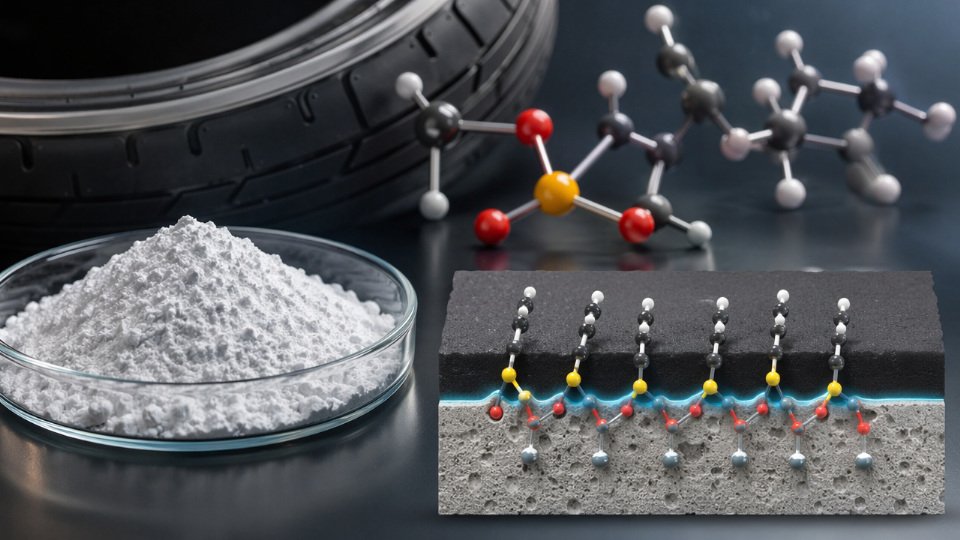
Passenger car tires formulated with optimized TESPT/silica compounds can reduce rolling resistance coefficient from approximately 0.012 (carbon black reference) to around 0.008, representing roughly 33% reduction.True
This range is consistent with published data from tire compound studies and is confirmed by industry-standard measurements per ISO 28580. Actual values depend on silica loading, mixing protocol, and polymer selection.
That rolling resistance reduction — from Crr ~0.012 down to ~0.008, with the exact outcome depending on silica loading, polymer grade, and cure system — corresponds to roughly 3–5% fuel economy improvement at highway cruise. Wet braking distance from 100 km/h contracts by 18–22% versus carbon black compounds. Treadwear index holds within ±5% of the carbon black baseline. That is the magic triangle: three historically trade-off-constrained properties moving in the same direction simultaneously.
Next-Generation Bis-Silane Alternatives and Their Trade-offs
TESPT is not the end of the story. TESPD (the disulfide variant, Si-75) offers meaningfully better scorch safety at higher mixing temperatures — relevant when internal mixer dump temperatures creep above 155°C due to fill factor variation or batch-to-batch silica moisture differences. The shorter sulfide bridge reduces premature sulfur donation, buying the compounder more process latitude, though reinforcement efficiency can be marginally lower than TESPT at equivalent loading.
NXT silane, a 3-octanoylthio-1-propyltriethoxysilane with a blocked mercaptan, approaches the problem differently. The thioester blocking group protects against premature reaction during mixing, then cleaves during cure to release the active mercapto functionality. VOC output drops approximately 15% versus TESPT because no ethanol is released from a polysulfide thermal decomposition pathway. For compounders operating internal mixers with regulatory or workplace exposure constraints on ethanol emissions, that matters practically. Reinforcement performance is comparable to TESPT at equivalent sulfur equivalence loading.
Mercaptosilane-sulfuryl hybrid architectures — several of which are at advanced commercial development stage — attempt to combine the processing safety of blocked systems with tunable sulfur rank distribution to influence cure kinetics more precisely. These remain a moving target in formulation terms.
Loading Optimization and Processing Discipline
Bis-silane loading in practice runs 4–8 phr relative to silica loadings of 60–80 phr. The ratio matters more than the absolute number. Underloding leaves uncoupled silica surface generating excessive hysteresis. Overloading wastes expensive silane, can deposit unreacted material at the polymer interface, and in TESPT’s case generates excess ethanol that raises VOC compliance concerns and can cause porosity in some mixing environments.
Temperature control during silanization is genuinely critical. The condensation reaction between hydrolyzed silane and silica silanols accelerates sharply above 145°C. If dump temperature from the first mix stage exceeds 160°C consistently, premature condensation begins competing with the intended silanization, reducing the effective coupling density on the fiber surface before the rubber matrix is adequately incorporated. Internal mixer operators typically monitor dump temperature batch-by-batch, not just as an average, because the variance matters more than the mean when scorch margin is tight.
Alcohol scavengers — typically zinc oxide or specific amine-based additives — are used in production mixing to manage ethanol release rate during high-temperature stages. Without them, ethanol partial pressure in the mixer headspace builds, slowing the silanization equilibrium and increasing emissions at the discharge hood.
EU Tire Label Compliance as a Commercial Driver
The EU Tire Labeling Regulation 2020/740 assigns rolling resistance grades from A through E, with Class A requiring Crr ≤ 0.0083 for passenger car tires. That threshold is not achievable with carbon black compounds. It is achievable with well-optimized bis-silane/silica systems — but only when silane selection, loading, and mixing protocol are all correct. A tire that misses the A/B boundary because of inconsistent silanization efficiency in production is not just a technical failure; it is a market access failure in the largest replacement tire market in the world. Hybrid bis-silane chemistry is no longer just a performance differentiator in tire compounding. It is the enabling technology behind regulatory compliance.
Photovoltaic Module Encapsulation and Corrosion-Protection Coatings: Durability-Driven Hybrid Silane Applications
Few application environments test coupling agent chemistry as ruthlessly as a rooftop solar installation or the underside of a vehicle operating through coastal winters. Both demand that a thin molecular layer — sometimes less than 200 nm of dried film — maintain structural and electrochemical integrity for decades. Single-functional silanes cannot reliably deliver that. Hybrid silane architectures increasingly can.
Why PV Encapsulants Push Mono-Functional Silanes Past Their Limits
The encapsulant film sandwiched between a solar cell and its glass superstrate does several jobs simultaneously: it transmits light above 90% across the relevant spectrum, maintains peel adhesion above 80 N/cm against both glass and backsheet, and holds volume resistivity above 10¹⁴ Ω·cm — all after 2,000 hours at 85°C/85% RH plus 200 freeze-thaw cycles per IEC 61215. That combination is not a single-material problem; it is an interfacial chemistry problem.
Legacy EVA encapsulants rely on vinyl-trimethoxysilane (VTMS) at roughly 0.3–0.5 wt% as the adhesion promoter. The failure mechanism is well understood on the plant floor: photo-oxidized EVA releases acetic acid over field service, and even mild acidification — pH dropping to 3–4 at the glass interface — hydrolyzes the Si–O–glass bond faster than the silane network can recover. After accelerated acid-aging protocols at pH 3, VTMS-treated laminates typically show 25–40% peel strength loss. That is not a margin that survives a 25-year module warranty.
Hybrid bis-silane systems co-functionalized with both vinyl groups (for participation in peroxide crosslinking of the EVA matrix) and glycidyl-ether groups (which form chemically more robust ether linkages to glass surface hydroxyls) hold up substantially better. Peel strength loss under equivalent acid-aging conditions drops to below 5% in well-formulated systems. The vinyl functionality keeps the silane covalently integrated into the polymer network during cure; the glycidyl-ether side maintains the glass bond under acidic attack. Neither function alone achieves both.
Hybrid bis-silane encapsulant systems incorporating both vinyl and glycidyl-ether functional groups can maintain less than 5% peel strength loss after accelerated acid-aging at pH 3, compared to 25–40% loss for VTMS mono-silane systems.True
The glycidyl-ether group forms more hydrolytically stable linkages to glass surface silanols compared to the vinyl-silane bond alone, while the vinyl group maintains matrix integration during peroxide crosslinking. This dual mechanism is supported by laminate peel testing data under acidified aging conditions documented in encapsulant formulation literature and OEM qualification testing.
POE Encapsulants: A Tougher Surface, a More Complex Requirement
Polyolefin elastomer films are gaining ground over EVA partly because they produce no acetic acid. But POE presents its own adhesion challenge: low surface energy and a moisture-cure crosslinking mechanism that differs fundamentally from peroxide-cured EVA. A silane coupling agent for silane-grafted POE must provide grafting sites compatible with radical chemistry and simultaneously anchor to glass surfaces that, without EVA’s polar character, offer fewer interaction pathways.
Hybrid oligomeric bis-silanes incorporating both vinyl-silane grafting sites and amino-silane glass-adhesion segments in a single molecular architecture address this as a single-additive formulation. Replacing a two-component additive package with one component simplifies QC at the encapsulant film extruder and reduces batch-to-batch variability — a real operational benefit when running continuous cast lines at throughputs where stopping to adjust a second additive feed costs production time and potential scrap.
Chromate Replacement in Anti-Corrosion Pretreatments
The shift away from hexavalent chromium under RoHS and REACH has pushed aerospace, automotive, and marine OEMs toward hybrid silane pretreatments applied as thin conversion coatings — typically 50–200 nm dry film thickness from 0.5–2 wt% aqueous solution. Getting the chemistry right here carries real regulatory and warranty weight.
Bis-amino-silane hybrid pretreatments on aluminum 2024-T3 alloy can achieve 1,000+ hours salt spray resistance per ASTM B117 with less than 5% scribe creep, which matches the practical performance benchmark set by Alodine 1200 chromate conversion coatings that these systems are designed to replace. On galvanized steel, hybrid silane-zirconium co-treatment systems reach 500+ hours with creep below 1 mm — a threshold that satisfies most automotive body panel OEM specifications. Whether a given system hits these numbers depends on substrate pretreatment quality (surface cleanliness is non-negotiable), solution pH during application (typically controlled at 4.5–5.5), and dry film thickness uniformity.
The Two-Layer Protection Mechanism
Understanding why hybrid silanes outperform in corrosion protection helps avoid misapplication. The dense bis-silane siloxane network that forms on the metal surface during cure acts as a physical barrier: electrochemical impedance spectroscopy measurements on well-formed hybrid silane films show impedance modulus values above 10⁹ Ω·cm² at 0.01 Hz after 30 days immersion in 3.5 wt% NaCl. That is the passive barrier layer.
But barrier alone is insufficient. Coating defects — scratches, pinholes, cut edges — are inevitable. The second protection mechanism comes from the amino or thiol functional groups in the hybrid architecture. These groups complex with metal cations at defect sites, interfering with the anodic dissolution reaction that drives undercutting. This active inhibition function is what differentiates a well-designed hybrid silane pretreatment from a simple silica-based barrier coating.
An operational warning worth stating plainly: bath concentration, temperature, and immersion time during pretreatment application are not cosmetic variables. A hybrid silane film applied 20% below target thickness because the bath concentration drifted down can drop impedance by an order of magnitude and cut salt spray life roughly in half. Regular bath monitoring and replenishment protocols belong in the process control plan, not just the setup instructions.
Formulation and Process Engineering: How to Select, Dose, and Apply Hybrid Silane Systems in Industrial Settings
Getting the chemistry right at the molecular level means nothing if the formulation and process engineering are wrong. Hybrid silane coupling agents fail far more often from application errors than from inherent chemistry limitations — over-application, wrong pH, inadequate hydrolysis time, or substrate contamination each destroy interfacial performance just as completely as choosing the wrong silane family.
Selection: Narrowing the Field Across Four Axes
Start with substrate chemistry. Silica and glass surfaces carry abundant silanol groups and bond readily to trialkoxysilane headgroups; metal oxide surfaces (aluminum, steel) require silanes with stronger Lewis acid affinity — amino- or epoxy-functional hybrids perform consistently here. Carbon-based surfaces (carbon black, carbon fiber) need specific organofunctional groups capable of π-interaction or covalent reaction with surface oxides; polyolefin surfaces almost always require a vinyl- or azide-functional component plus a coupling step.
Matrix polymer type is the second axis. Epoxy matrices pair with amino- or glycidoxy-functional hybrid silanes; mismatch here — say, using a methacryloxy hybrid with an amine-cured epoxy — produces weak boundary layers that fail cohesively under load. Polyurethane matrices prefer amino or isocyanate-reactive organofunctional groups. Rubber and silicone systems have their own demands; bis-silyl sulfide or mercapto-functional hybrids dominate rubber compounding, as covered earlier in the tire section.
Application environment narrows selection further. Sustained temperatures above 150°C eliminate some urethane-functional hybrids that degrade at the interphase. High-humidity or immersion service demands complete condensation — a T2/T3 ratio below 60% in the cured coating will absorb water and delaminate within weeks. UV exposure in outdoor applications pushes toward UV-stable organofunctional groups; aminosilane hybrids yellow noticeably under extended UV, which matters in transparent laminates.
Processing constraints complete the matrix. Low-VOC regulations in many jurisdictions now restrict methanol-releasing trimethoxysilane systems; ethoxy analogs release ethanol instead and are compliant in most frameworks, though their slower hydrolysis (half-life 30–45 minutes versus 2–5 minutes for trimethoxy at pH 4–5) requires process adjustment. Pot-life requirements in automated coating lines favor ethoxy systems precisely because of this — you get 24–48 hours working life in aqueous solution at pH 4–5 and 20°C, versus only 4–8 hours for methoxy-functional hybrids before oligomers precipitate.
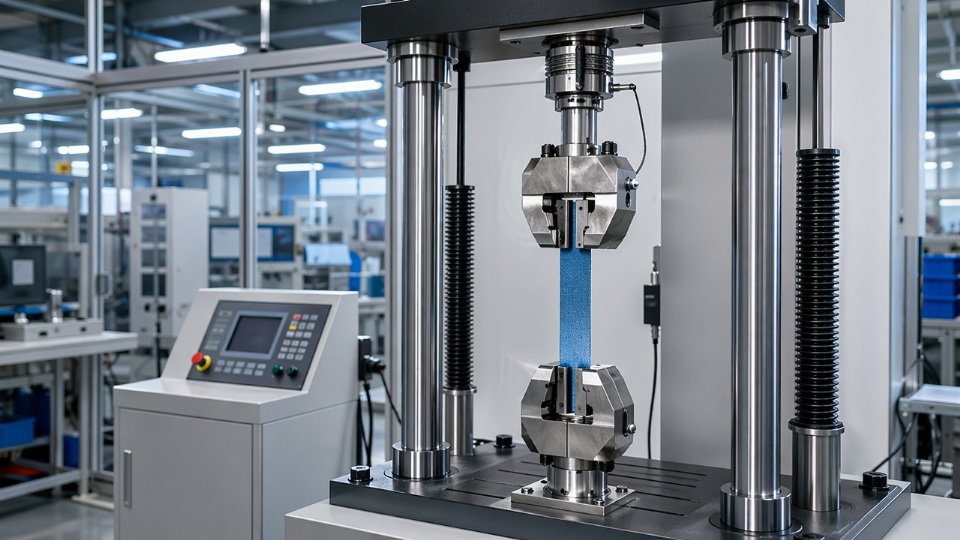
Dosage: From Theory to Empirical Confirmation
The theoretical starting point is surface coverage of 4–5 molecules/nm² for trialkoxysilanes. Run BET surface area measurement on your filler lot — specific surface area varies 15–40% between supplier batches of precipitated silica, which directly shifts your theoretical silane demand. Use that BET number to calculate a baseline loading, then execute a response surface methodology sweep from 0.1× to 3× the theoretical monolayer, measuring mechanical strength, Payne effect, or adhesion peel force depending on your application. The optimum typically falls between 0.8× and 1.5× theoretical; going above 2× almost always builds multilayer deposits that create a brittle interphase and reduce adhesion — the opposite of intent.
Exceeding 2× the theoretical monolayer silane dose typically reduces interfacial adhesion rather than improving it, due to brittle multilayer deposit formation.True
Monolayer or sub-monolayer coverage creates covalent bonding; excess silane forms loosely crosslinked oligomeric layers that fracture preferentially under stress, a well-documented phenomenon in silane adhesion science.
Application Methods: Three Routes, Different Risk Profiles
In-situ compounding adds silane directly to the mixer with filler and polymer, relying on reactive mixing at 120–180°C for hydrolysis and coupling. It is the lowest-cost route but the hardest to control — mixing temperature uniformity, moisture level in the filler, and residence time all interact. Dry filler is essential; surface moisture below 0.3 wt% prevents premature condensation before the silane distributes.
Pre-treatment of filler applies a dilute aqueous or solvent-based silane solution in a high-intensity mixer or spray dryer, followed by heating at 110–130°C to drive condensation to completion before compounding. This gives the most consistent and measurable surface coverage, allows QC at the intermediate stage, and is the preferred route when filler variability is high. The added cost — roughly one extra processing step — pays back in reduced scrap rates.
Substrate surface treatment — immersion, spray, or roll-coat application of 0.5–3 wt% aqueous silane solution — is standard for metal primers and PV encapsulant base layers. Keep solution concentration below 2 wt% to prevent oligomerization. Cure at 80–120°C for 10–20 minutes; ambient cure works but leaves higher residual silanol content that absorbs moisture in service.
Quality Control Parameters That Actually Catch Problems
Degree of condensation by ²⁹Si solid-state NMR is the definitive check — target T2 and T3 species exceeding 60% of total silicon signal. If your lab cannot run solid-state NMR routinely, track silanol content in the hydrolyzed solution by Karl Fischer titration; hydrolysis below 90% within 30 minutes at pH 4.5 signals either wrong pH, temperature above 25°C, or silane degradation. Confirm surface coverage by XPS Si/substrate ratio on treated substrates; adhesion performance verification by ISO 2409 cross-cut or ASTM D1876 T-peel should be a release criterion, not an afterthought.
The Five Failures That Repeat Across Plants
Hazy solution with irregular film thickness almost always traces to concentration above 2 wt%, pH outside 4–5, or solution temperature creeping above 25°C — oligomers precipitate and apply unevenly. Poor coupling in rubber compounds with persistently high Payne effect points to mixing temperature too low or insufficient mixing time for hydrolysis. Phase separation hot spots in adhesive formulations indicate solubility parameter mismatch between the hybrid silane and polymer backbone; switch to a silane with a more compatible organofunctional group rather than increasing loading. Brittle interphase with declining adhesion at higher silane doses is multilayer buildup — cut loading, not increase it. Finally, complete adhesion failure despite correct chemistry nearly always means contaminated substrate: oil residue or oxide scale blocks silanol-substrate reaction and requires a pre-cleaning specification — solvent wipe for organics, acid etch or alkaline clean per substrate type for oxides.
Storage and Handling
Neat hybrid silane liquids stored in sealed aluminum or HDPE containers at 5–25°C, away from moisture, carry shelf lives of 18–36 months depending on organofunctional group reactivity. Flash points for alkoxysilane hybrids typically fall between 40°C and 80°C — treat them as flammable liquids in storage and dispensing areas. Methanol-releasing systems demand fume hood handling, nitrile gloves rated for alcohol exposure, and chemical splash goggles; methanol vapor accumulates in poorly ventilated mixing areas at levels that matter to worker safety well before they matter to explosion limits.
Frequently Asked Questions About Hybrid Silane Coupling Agents
What is the difference between a hybrid silane coupling agent and a conventional silane coupling agent?
A conventional silane coupling agent carries one organofunctional group — amino, epoxy, vinyl, methacryloxy — on a single trialkoxysilyl anchor. It bonds well to one class of substrate and reacts with one class of polymer matrix. A hybrid silane incorporates two or more distinct reactive functionalities, either within a single molecule or in a pre-condensed oligomeric structure. The practical consequence is simultaneous bonding to multiple polymer types and formation of a denser, more hydrolytically stable siloxane interphase network. In a glass-fiber/epoxy-polyurethane hybrid composite, for example, a mono-functional aminosilane leaves the epoxy-rich and urethane-rich domains competing for adhesion; a dual-functional amino-epoxy hybrid silane satisfies both chemistries at the same interface in one process step.
Can hybrid silane coupling agents be mixed with conventional silanes in the same formulation?
Yes — binary and ternary blends of hybrid and mono-functional silanes are commercially practiced across rubber compounding, coating primers, and composite sizings. Three constraints govern this in practice. First, hydrolysis rates must be compatible: mixing a trimethoxysilane (hydrolysis half-life 2–5 minutes at pH 4–5) with a triethoxysilane (half-life 30–45 minutes under the same conditions) creates an uneven condensation front that can produce a heterogeneous interphase. Match alkoxy groups, or control bath pH carefully to slow the faster component. Second, never combine aminosilanes and acid-functional silanes without understanding the neutralization chemistry — the resulting ammonium salt suppresses both functionalities and dramatically shortens pot life. Third, blend ratios are substrate-matrix specific; there is no universal starting point. Run a designed experiment (minimum 3×3 ratio matrix with the target adhesion or mechanical test as the response) rather than linear interpolation from datasheet values.
How do hybrid silanes compare in cost-performance ratio to using two separate mono-functional silanes?
Hybrid silanes typically carry a 15–40% price premium per kilogram over standard mono-functional products, depending on molecular complexity and production volume. But that comparison is incomplete. Because hybrid silanes achieve equivalent or superior performance at 30–50% lower total loading, total formulation cost commonly drops 10–25% — the exact saving depends on the base resin cost and the specific performance target. Single-additive handling also reduces QC complexity: one incoming inspection, one COA to archive, one storage condition to manage, one fewer SKU in the warehouse. For high-throughput compounding lines running 24/7, that operational simplicity has real value that unit-price comparisons miss entirely.
Are hybrid silane coupling agents compatible with waterborne and high-solids coating systems?
Yes, with chemistry-matched selection. For waterborne systems, bis-silane and dual-functional ethoxy variants are specifically preferred: the slower hydrolysis kinetics of triethoxysilanes versus trimethoxysilanes provides workable pot life of 24–48 hours in aqueous dispersion, versus a few hours or less for the methoxy equivalent. For high-solids systems above 80% solids content, reactive bis-silane coupling agents that co-cure directly into the crosslinked network are an established approach — they contribute to the film-forming matrix rather than sitting as a discrete additive phase, reducing VOC while improving substrate adhesion simultaneously.
What regulations govern hybrid silane coupling agents in food-contact, medical device, and EV battery applications?
This is the question procurement teams most often ask late in a qualification cycle, when the answer is needed urgently. For food-contact applications, FDA 21 CFR 175.300 and EU Regulation 10/2011 govern plastic materials and coatings; silane coupling agents must appear on the positive substance list with specific migration limits, and migration testing is required on the finished article, not the raw silane. For medical devices, ISO 10993 biocompatibility testing applies to finished device extracts — raw material compliance letters are supporting documentation, not a substitute. For EV battery applications, no silane-specific regulation exists, but REACH SVHC compliance, RoHS 2 compliance, and the UL 94 flammability rating of the finished compound are the governing requirements that OEM procurement specifications will invoke. SiliconChemicals provides full regulatory support documentation — SDS, TDS, compliance letters, and REACH declarations — for all product lines, reducing the documentation burden on the customer’s regulatory team.
Hybrid silane coupling agents used in food-contact applications must be evaluated through migration testing on the finished article, not solely through raw material safety data sheets.True
FDA 21 CFR 175.300 and EU Regulation 10/2011 both require demonstration that substances in food-contact materials do not migrate into food above permitted limits; raw material SDS compliance letters support but do not replace finished-article migration testing.
How should hybrid silane coupling agents be evaluated when qualifying a new supplier?
The minimum qualification test set that experienced procurement and quality engineers use: purity by GC at ≥98% for neat liquid products; hydrolysis and condensation profile by ²⁹Si NMR matched against a reference standard to confirm molecular architecture, not just molecular weight; performance parity testing in the specific end-use compound using at least three replicates of the target application test (IFSS for composites, peel strength for coatings, Payne effect reduction for rubber); batch-to-batch reproducibility confirmed across three consecutive production lots before volume qualification; and a supply security assessment covering safety stock levels, lead times, and backup production capacity. SiliconChemicals maintains a minimum 90-day safety stock of all key product lines and ships every lot with a COA carrying full analytical data — because a COA with only appearance and specific gravity tells a process engineer almost nothing useful.
What is the environmental and sustainability profile of hybrid silane coupling agents?
Hybrid bis-silane systems deliver a net positive sustainability impact through two mechanisms: lower total additive loading per unit of performance, and direct replacement of hexavalent chromium conversion coatings in metal pretreatment — a regulatory and environmental liability that many OEMs are actively eliminating from supply chains. The primary process-environment consideration is alcohol release during hydrolysis: trimethoxysilane systems release methanol, triethoxysilane systems release ethanol. In enclosed processing environments, ethoxy-functional hybrids are the prudent choice. At end of product life, siloxane interphase layers hydrolyze gradually to orthosilicic acid under environmental conditions — the same compound present in soil and natural water at low concentrations, and non-toxic by established toxicological data. SiliconChemicals provides product-level carbon footprint data on request and offers bio-derived alcohol feedstock variants for customers with Scope 3 emissions reduction targets in their supply chain sustainability programs.
Supply Chain Strategy and Why China’s Organosilicon Industrial Clusters Give SiliconChemicals a Structural Advantage
China’s Organosilicon Industrial Geography: Where the Feedstock Advantage Begins
Three geographic clusters underpin the global organosilicon supply chain in ways that most Western procurement teams underestimate until they’ve actually walked the plant floors. Xinghuo Chemical Industrial Park in Jiangxi province anchors methyl chlorosilane production at industrial scale. Zhejiang’s silicone valley concentration around Hangzhou Bay hosts downstream processing, specialty silane synthesis, and a dense network of toll-processing and analytical service providers. Inner Mongolia’s silicon metal smelting base — fed by low-cost coal-fired electric arc furnaces and proximity to high-grade quartzite deposits — supplies the elemental silicon that every chlorosilane route ultimately depends on.
Together these three clusters account for over 65% of global methyl chlorosilane capacity, exceeding 2.5 million metric tons per year. That concentration is not a fragility — it is a feedstock gravity well. Fumed silica, silicon tetrachloride, trichlorosilane, and the specialty organic intermediates required for hybrid silane synthesis (3-chloropropyltrichlorosilane, aminopropyltriethoxysilane precursors, tetrahydrofurfuryl derivatives) are produced, stored, and transported within the same industrial ecosystems. The consequence for cost and lead time is direct and measurable.
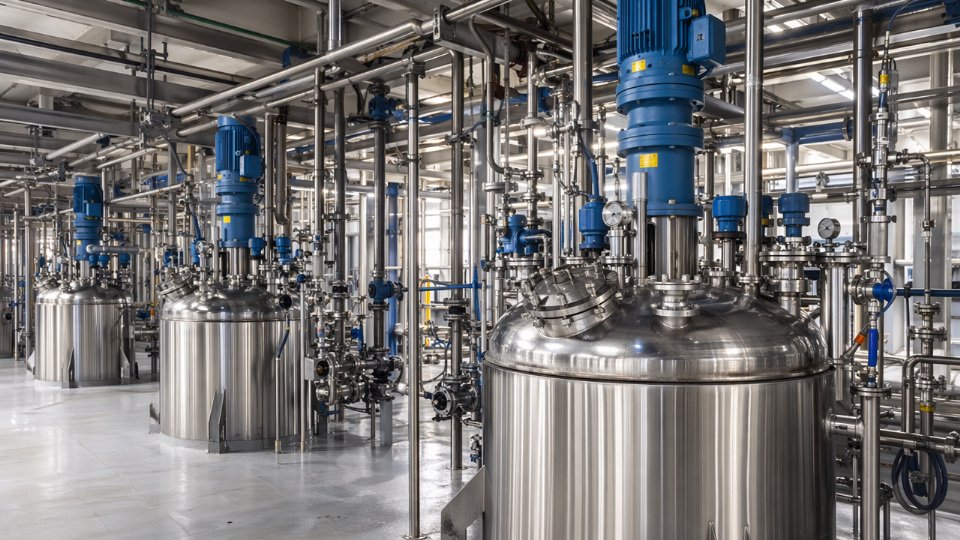
Vertical Integration: What a 50 km Sourcing Radius Actually Means for Your Supply Chain
When a European or US-based hybrid silane producer sources chlorosilane intermediates, lead times of 8–12 weeks are routine, depending on shipping lane congestion, hazmat documentation requirements, and export controls. SiliconChemicals’ manufacturing operations sit inside integrated organosilicon industrial parks where the same intermediates arrive within a 2–4 week window under domestic logistics. That gap — six to eight weeks of buffer inventory you don’t have to carry — translates directly into working capital and warehouse cost.
Resilience matters at least as much as normal-state speed. When global container shipping compressed in 2021 and silane supply chains broke for multiple Western formulators, producers with vertically integrated domestic sourcing maintained output continuity. Buyers whose supply chains ran through spot-market intermediaries did not. That is not a hypothetical risk; it is recent industrial history.
Synthetic Route Breadth: Custom Molecular Design, Not Just Catalog Grades
The synthetic infrastructure within China’s organosilicon cluster supports the full range of routes required for hybrid silane manufacturing: hydrosilylation for vinylsilane building blocks, Grignard-based pathways for aryl-functional hybrid structures, sol-gel oligomerization for silane-siloxane hybrid oligomers, and controlled bis-sulfide synthesis under inert atmosphere for TESPT-class tire silanes. Having all four routes available within a single operational ecosystem means SiliconChemicals can support application-specific custom molecular design — adjusting spacer chain length, functional group density, or hydrolysis rate profile — without routing development work through a separate contract synthesis partner and adding 12–16 weeks to the timeline.
Quality Systems That Differentiate Manufacturers from Traders
SiliconChemicals holds ISO 9001:2015 and IATF 16949 certification relevant to automotive supply chain customers including tire and EV battery applications.True
IATF 16949 is the recognized automotive quality management standard. Holding it signals that production controls, traceability systems, and corrective action processes meet automotive OEM expectations — a meaningful differentiator from spot-market traders who resell silanes without manufacturing transparency.
REACH compliance management covering all SVHC candidates in hybrid silane product lines, and batch traceability from silicon metal origin through to finished-product COA, are table-stakes requirements for European and North American industrial customers. Spot-market Chinese traders frequently cannot provide either. The distinction matters most when a customer faces a regulatory audit or a product liability question — not when everything is running smoothly.
Global Service Infrastructure: Stocking Positions and Technical Support That Reduce Your Risk
Regional warehouses in Rotterdam, Houston, and Singapore allow 2–5 day delivery to most key industrial regions, which makes SiliconChemicals operationally comparable to a domestic supplier for routine replenishment cycles. For customers consuming above 10 metric tons per year, dedicated key account management includes supply assurance agreements with price caps and volume reservation — critical protection in a market where silane spot prices can swing 20–35% within a quarter depending on silicon metal costs and energy pricing in Inner Mongolia.
Technical application laboratories staffed by PhD-level chemists provide formulation support across composite, rubber, coating, and electronics applications. That is not a sales function — it is engineering support that reduces your internal development cost and time-to-qualification.
Technology Roadmap: Development Partner, Not Commodity Supplier
SiliconChemicals’ active development pipeline reflects where hybrid silane chemistry is moving rather than where it has been. Low-VOC aqueous bis-silane dispersions address increasingly stringent VOC regulations in closed-loop industrial processes. Bio-sourced hybrid silanes using lignin-derived aromatic spacers are in development for sustainable composite applications where customers face Scope 3 carbon pressure from their own OEM customers. Electrically conductive hybrid silane systems for EMI shielding in 5G infrastructure and EV power electronics represent an emerging application segment where the coupling chemistry and the electrical function need to be designed together from the start. Self-healing hybrid silane interphase systems incorporating reversible covalent bonds — Diels-Alder adducts or disulfide exchange networks — are being developed for fatigue-resistant aerospace composite applications where crack propagation at the fiber-matrix interface is the life-limiting failure mode.
Each of these programs reflects a consistent principle: hybrid silane chemistry is increasingly application-co-designed rather than catalog-selected. Suppliers who can participate in that co-design process from molecule through formulation through qualification provide structural value that price-per-kilogram comparisons do not capture.