Specifying the wrong silicone oil viscosity is one of those mistakes that rarely shows up on a purchase order and almost always shows up on the maintenance log. A 50 cSt fluid dropped into a damping application that needs 500 cSt will cavitate, lose its damping force, and run hot — and the equipment it was protecting will see shock loads it was never rated for. That translates to premature bearing failure, scrapped parts, unplanned downtime, and a root-cause investigation that eventually traces back to a fluid selection made by someone who picked “medium viscosity” without a clear basis. The fix is not complicated, but it does require knowing which physical and operational variables actually drive the viscosity requirement before you open a supplier catalog.
Silicone oil viscosity is selected by matching the fluid’s resistance to shear — measured in centistokes (cSt) at 25 °C — to the operating temperature range, shear rate, heat-transfer or load-bearing requirement, and equipment clearances of the specific application. Polydimethylsiloxane (PDMS) grades span roughly 0.65 cSt to 2,500,000 cSt; heat-transfer loops typically use 5–100 cSt, damping and hydraulic systems 100–12,500 cSt, and release agents 200–1,000 cSt, with the right grade depending on your operating temperature, flow velocity, and film-thickness requirements.
What makes silicone oil genuinely different from mineral oil — and why the selection logic is not interchangeable — comes down to how flat the viscosity-temperature curve actually is in practice. A mineral oil can swing viscosity by a factor of 1,000 between a cold startup at −20 °C and a hot steady-state at 150 °C; a comparable silicone grade changes by roughly 10× across that same window. That single characteristic reshapes the entire selection conversation, and it is where most engineers who are new to silicone fluids underestimate how much design margin they have — or waste by over-specifying.
Reading the Viscosity–Temperature Curve: How PDMS Behaves from −60 °C to 300 °C
Viscosity doesn’t stay where you set it. Every fluid thickens in the cold and thins under heat — the question is by how much, and whether that shift breaks your process. For silicone oil, the answer is usually reassuring, but you still need to do the math before you size a pump or spec a heat exchanger.
The ASTM D341 Walther Equation and Why VI Matters Here
ASTM D341 gives engineers a structured way to interpolate (and cautiously extrapolate) viscosity across temperatures using the Walther equation, which linearizes the viscosity–temperature relationship on a log-log scale. Feed in two known data points — say, viscosity at 40 °C and 100 °C from the supplier TDS — and you can reasonably predict behavior at −30 °C or 180 °C without waiting for lab measurements. Suppliers don’t always publish the full curve, especially for mid-range grades, so this calculation earns its keep.
The viscosity index captures how flat or steep that curve is. Polydimethylsiloxane (PDMS) typically carries a VI above 300 — often quoted in the 300–400 range depending on molecular weight distribution — versus roughly 120 for a good PAO and 95–110 for standard mineral oil. That’s not a marketing number; it reflects a genuine difference in how the polymer backbone responds to thermal agitation.
The table below makes this concrete. Values are representative midpoints for a 100 cSt (at 25 °C) silicone oil compared against a PAO-4 and a ISO VG 100 mineral oil:
| Fluid | −40 °C | 25 °C | 100 °C | 200 °C |
|---|---|---|---|---|
| Silicone oil 100 cSt | ~800–1,200 cSt | 100 cSt | ~18–25 cSt | ~5–8 cSt |
| PAO-4 | ~2,000–4,000 cSt | ~18 cSt | ~4 cSt | gels / oxidizes |
| Mineral oil ISO VG 100 | severely gels | 100 cSt | ~11 cSt | degrades |
Exact values depend on base stock purity and additive package, but the pattern is consistent: silicone viscosity drops by roughly 10× across a −50 °C to 200 °C span, while mineral oil can swing 1,000× across a narrower range.
PDMS silicone oil viscosity changes approximately 10× from −50 °C to 200 °C, compared to roughly 1,000× for mineral oil over a similar range.True
This follows from the viscosity-temperature coefficient of PDMS (~0.59–0.64) being far lower than mineral oil (~0.82–0.90), a well-documented property of polydimethylsiloxane confirmed by ASTM D341 modeling and supplier viscosity curves.
Pour Point, Flash Point, and the Safe Operating Window
Low-viscosity silicone grades (0.65–10 cSt) typically have pour points below −65 °C. Higher-viscosity grades stay pumpable below −50 °C in most cases. Flash points tell the other side of the story: grades at or above 100 cSt generally flash above 300 °C, and many are above 320 °C. That’s a meaningful safety margin for thermal bath or mold-temperature-controller applications where mineral oil would already be a fire risk past 180 °C.
The practical window for most process applications is −50 °C to 200 °C continuous, with short excursions to 250 °C tolerable for high-viscosity grades in sealed systems. Push past that, and oxidative degradation becomes real — silicone doesn’t burn easily, but it does cross-link and form silica deposits on heat-transfer surfaces.
The Crossover Problem: Specify Viscosity at Operating Temperature, Not Catalog Temperature
This is the mistake I see most often in procurement specs. A buyer writes “100 cSt silicone oil” because that’s what the catalog lists — but that figure is measured at 25 °C. At 150 °C, that same oil is behaving closer to 12–18 cSt, depending on grade. If your damper, gearbox, or circulating pump was designed around 100 cSt film thickness, you may be running metal-on-metal contact by afternoon on a hot production day.
Specify viscosity at your actual bulk operating temperature. If the system cycles, specify at the hottest steady-state condition and verify cold-start torque at the lowest startup temperature separately.
Worked Example: Thermal Management Bath, −30 °C to 180 °C
A typical scenario: a recirculating temperature-control bath cycling between −30 °C (overnight idle, cold climate facility) and 180 °C (process setpoint). The engineer needs to confirm the fluid remains pumpable at cold start and delivers adequate heat transfer at process temperature.
Step 1 — identify required viscosity at process temperature. Heat-transfer applications generally want 5–50 cSt at operating temperature for turbulent flow and reasonable pump head. At 180 °C, a 350 cSt (25 °C reference) silicone oil lands around 20–30 cSt. That’s workable.
Step 2 — check cold-start viscosity. Using D341 with two published datapoints, the same 350 cSt grade reaches roughly 6,000–9,000 cSt at −30 °C. A centrifugal pump sized for warm-running conditions will stall or cavitate at that viscosity; you need either a positive-displacement pump rated for high-viscosity cold start, or a drum heater on the reservoir with a startup interlock that holds the circulation pump off until fluid temperature clears −10 °C or so.
Step 3 — confirm the thermal boundaries. Pour point well below −50 °C: safe. Flash point above 300 °C: safe for 180 °C operation. The window is comfortable — but only because the engineer checked viscosity at both ends of the cycle, not just at the catalog reference condition.
Matching Viscosity Grade to Specific Industrial Applications
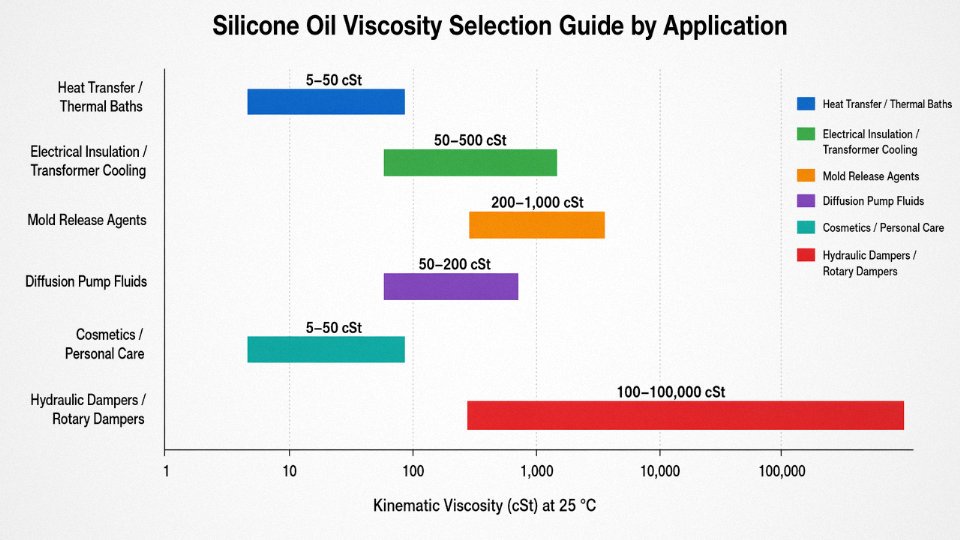
Getting viscosity selection wrong doesn’t just reduce efficiency — it causes seal failures, inadequate damping, flash fires in vacuum systems, or rejected cosmetic batches. The table below gives working starting points; the text after it explains the real engineering behind each range.
| Application | Typical Viscosity Range | Key Selection Driver |
|---|---|---|
| Heat transfer / thermal baths | 5–50 cSt | Nusselt number, pump head, volatility floor |
| Hydraulic dampers / rotary dampers | 100–100,000 cSt | Target torque curve, gap geometry, temperature swing |
| Electrical insulation / transformer cooling | 50–500 cSt | Dielectric strength, convective flow in tank |
| Mold release agents | 200–1,000 cSt | Spread rate, film thickness, substrate temperature |
| Cosmetics / personal care | 5–50 cSt | Skin feel, spreadability, regulatory D4/D5 limits |
| Diffusion pump fluids | 50–200 cSt | Vapor pressure, boiler efficiency, ultimate vacuum |
Heat Transfer and Thermal Baths (5–50 cSt)
Lower viscosity improves the convective heat transfer coefficient directly — the Nusselt number for forced convection scales with Reynolds number, and Reynolds number rises as kinematic viscosity falls. In practice this means a 10 cSt fluid circulating through a jacketed reactor will transfer heat noticeably faster than a 50 cSt fluid at the same pump speed, and the pump motor draws less current doing it.
The tradeoff is volatility. Grades below roughly 10 cSt (trimethylsiloxy-terminated short chains, sometimes sold as 0.65–5 cSt) have measurable vapor pressure at operating temperatures above 100 °C. You’ll see misting in open baths and gradual viscosity creep upward as the lightest fractions evaporate. For closed-loop systems this is manageable; for open laboratory baths running above 150 °C, stay at 20 cSt or above unless you can tolerate regular top-offs. The 20–50 cSt window is the practical sweet spot for most industrial thermal baths operating between 50 °C and 200 °C.
Hydraulic Dampers, Shock Absorbers, and Rotary Dampers (100–100,000 cSt)
Damping force in a Newtonian fluid gap is governed by Newton’s law of viscosity: shear stress = dynamic viscosity × shear rate. For a rotary damper, that back-calculates to a required dynamic viscosity once the OEM has fixed the gap geometry and target torque curve. This is not a loose relationship — an automotive supplier specifying a glove-box damper to 0.3 N·m closing torque at 20 °C has essentially specified the viscosity, give or take manufacturing tolerances on the gap.
Most automotive rotary dampers run 10,000–60,000 cSt. Industrial shock absorbers handling heavier loads push into the 100,000 cSt territory. The critical complication is temperature: a fluid that delivers correct damping at 20 °C will be noticeably stiffer at −20 °C even with silicone’s favorable viscosity-temperature coefficient. Always validate the torque curve across the full operating range, not just at room temperature.
PDMS silicone oil maintains more stable damping force across temperature extremes than equivalent mineral-oil-based damping fluidsTrue
PDMS has a viscosity-temperature coefficient of roughly 0.59–0.64 versus 0.82–0.90 for mineral oils, meaning its viscosity changes far less per degree, which directly translates to more consistent damping force from cold start to operating temperature.
Electrical Insulation and Transformer Cooling (50–500 cSt)
Dielectric strength in silicone oils is high — typically 15–25 kV/mm depending on purity, moisture content, and particulate load, not just viscosity itself. IEC 60296 covers mineral insulating oils; IEC 61203 specifically addresses silicone insulating liquids and is the standard your procurement specs should reference. Purity matters more than viscosity grade for dielectric breakdown, but viscosity still controls cooling.
The failure mode people overlook: specifying too high a viscosity to feel “safe” impairs natural convection inside the transformer tank. In a distribution transformer relying on thermosiphon cooling, a 500 cSt fluid moves sluggishly enough that hot-spot temperatures at the winding can run 10–20 °C higher than they would with a 100 cSt fluid. That directly affects insulation life. The 100–200 cSt range covers the majority of distribution transformer applications; only specialized static capacitors or high-voltage bushings with no cooling requirement push toward 500 cSt.
Mold Release Agents (200–1,000 cSt)
Viscosity here controls three things simultaneously: how fast the fluid spreads when sprayed or wiped, how thick a film it leaves, and how long that film persists at mold temperature before it drains or migrates. A 200 cSt fluid spreads quickly and deposits a thin, relatively uniform film — good for fast-cycling injection molds where you want minimal buildup. A 1,000 cSt fluid stays put longer and gives a thicker boundary layer, which suits compression molding of rubber parts where cycle times are longer and the mold surface runs hotter.
For any food-contact application — baking pans, confectionery molds, pharmaceutical tablet presses — the fluid must comply with FDA 21 CFR 178.3570, which restricts both the viscosity grades permitted and maximum application levels. Don’t assume any silicone oil qualifies; verify the specific grade against the regulation before specifying it.
Cosmetics and Personal Care (5–50 cSt)
Formulators in this space are juggling skin feel, spreadability, and regulatory compliance simultaneously. Low-viscosity fluids (5–10 cSt) give that dry, silky, non-greasy feel that consumers associate with premium skincare. Higher viscosity (20–50 cSt) creates a more occlusive film that helps with moisture barrier function but can feel heavier or tacky on application.
The regulatory constraint that’s reshaping this whole segment is the EU restriction on cyclic siloxanes D4, D5, and D6 under EU Regulation 1223/2009 and subsequent amendments. These are low-molecular-weight cyclics that appear as impurities in low-viscosity linear PDMS, so even nominally “linear” 5 cSt fluids need analytical certification showing cyclic content below the limit. This has pushed some formulators toward slightly higher viscosity linear fluids or phenyl-modified silicones where the cyclic content is easier to control.
Diffusion Pump Fluids and Vacuum Systems (50–200 cSt)
This is a specialized but unforgiving application. A diffusion pump works by vaporizing fluid in the boiler, directing the vapor jets to capture gas molecules, then condensing the fluid in the cold wall. Vapor pressure at the boiler temperature has to be high enough to sustain throughput, but the fluid must not decompose or migrate into the vacuum chamber.
DC-704 and DC-705 equivalents (tetraphenyl and pentaphenyl trimethylsiloxy silicone fluids) are the industry benchmarks, running roughly 50–175 cSt at 25 °C. The phenyl substitution drops vapor pressure at room temperature — critical because backstreaming of pump fluid into the process vacuum space contaminates surfaces. Choosing a fluid with too low a viscosity usually means higher vapor pressure and worse backstreaming. Too high, and the boiler struggles to generate sufficient vapor flux and pump throughput drops. Most high-vacuum system designers don’t actually select by viscosity directly; they select by fluid type and then confirm viscosity compatibility with the boiler heater wattage. The viscosity still matters, though — it affects how quickly the fluid drains from the cold wall back to the boiler sump, and a fluid that’s too viscous at the condenser wall temperature can pool and reduce effective cooling area.
Shear Rate, Flow Regime, and Reynolds Number: Fluid Dynamics Constraints on Viscosity Selection
Picking the right viscosity grade from a datasheet is only half the job. Once that fluid is moving — through a pump, around a bearing, down a heat-exchanger header — the actual dynamic conditions can make a perfectly spec’d oil perform badly. This is where most selection errors happen, and they’re usually invisible until the system is already built.
PDMS Is Newtonian — Until It Isn’t
Polydimethylsiloxane behaves as a true Newtonian fluid up to roughly 100,000 cSt. That means viscosity is independent of shear rate: pump it fast or slow, the resistance stays proportional. For most industrial grades — say, anything below 60,000 cSt — you can trust a single viscosity number to describe the fluid’s behavior across your entire operating shear range.
Above that threshold, things get messier. High-molecular-weight grades (100,000 cSt and up) begin showing mild shear-thinning because the long polymer chains start to align under stress. The practical trap here is that lab viscometers typically measure at very low shear rates (often 1–10 s⁻¹), while a gear pump or narrow bearing clearance can impose shear rates of 10³–10⁵ s⁻¹. A fluid that reads as 500,000 cSt at rest might behave closer to 80,000–120,000 cSt under actual service conditions, depending on molecular weight distribution. If your pump sizing was based on the catalog number, you may have over-engineered the motor — or, worse, under-sized the seal clearances for the actual cold-start condition when shear thinning hasn’t kicked in yet.
PDMS viscosity is shear-rate independent at all viscosity gradesFalse
PDMS is Newtonian up to approximately 100,000 cSt. High-molecular-weight grades above this threshold exhibit measurable shear-thinning at elevated shear rates, which can cause significant discrepancies between datasheet viscosity and in-service effective viscosity.
Reynolds Number and Why Turbulence Is Essentially Off the Table
For pipe flow, the Reynolds number is Re = ρvD/μ, where ρ is density (roughly 960–970 kg/m³ for most PDMS grades), v is flow velocity (m/s), D is pipe inner diameter (m), and μ is dynamic viscosity (Pa·s).
Turbulent flow requires Re > 4,000. Run the numbers with a 100 cSt oil (dynamic viscosity ≈ 0.096 Pa·s) at 1 m/s through a 25 mm pipe: Re comes out around 250. To reach turbulent flow at that viscosity, you’d need velocities above 15 m/s — mechanically impractical and certain to cause cavitation at the pump inlet. With a 500 cSt oil, it’s worse by a factor of five. Everything is laminar, full stop.
This matters because all your pressure-drop math must use the Hagen-Poiseuille equation, not turbulent correlations. Pressure drop scales with viscosity linearly in laminar flow: switch from 10 cSt to 500 cSt and your line losses increase roughly 50-fold at the same flow rate and pipe diameter. That’s not a rounding error — it’s the difference between a 0.5 bar drop and a 25 bar drop, which changes your pump selection entirely.
A quick sizing check: for a target flow of 20 L/min through a 20 mm ID pipe, calculate average velocity (≈ 1.06 m/s), compute Re for each candidate viscosity grade, confirm laminar regime, then apply ΔP = 128μLQ/πD⁴. If the result exceeds your allowable pressure budget — often set by the pump curve or seal rating — you either need a larger pipe, a lower-viscosity grade, or higher operating temperature to reduce viscosity in service. Usually pipe diameter is the cheapest lever.
Bearing Lubrication and the Sommerfeld Number
For rotating equipment — agitator shafts, gearbox bearings, circulating pump journals — viscosity selection involves the Sommerfeld number, which balances viscosity, shaft speed, and bearing load to predict lubrication regime.
Too low a viscosity at operating temperature and the oil film collapses under load, pushing the bearing into boundary lubrication: metal contacts metal, wear accelerates, and in a continuous-process environment you’re looking at unplanned shutdowns measured in hours, not days. A bearing running at 3,000 RPM under moderate radial load typically needs a minimum film thickness condition that demands something in the range of 32–100 cSt at operating temperature, though the exact floor depends on bearing diameter, surface finish, and load intensity.
Too high a viscosity creates its own problem. Viscous shear generates heat — the fluid itself becomes the enemy. In a sealed bearing housing with poor thermal mass, a 1,000 cSt oil at 60 °C can raise local temperature by 15–30 °C above ambient purely from churning losses, which then reduces viscosity anyway, sometimes below the safe minimum. The system finds an ugly equilibrium that wasn’t designed and wasn’t predicted.
The practical approach: size for the minimum acceptable viscosity at your maximum operating temperature, verify it stays below the shear-heating threshold using a simple power-loss estimate (P ≈ μ × (πnD/60)² × bearing area / film thickness), and treat the result as your upper temperature limit, not a suggestion.
Chemical Purity, Additive Packages, and How They Alter Effective Viscosity
Viscosity grades printed on a technical data sheet describe neat polydimethylsiloxane — pure PDMS, no fillers, no modifiers. Most of what actually ships to a plant floor is something more complicated, and treating a formulated silicone oil as interchangeable with a neat grade of nominally identical viscosity is one of the more reliable ways to generate a warranty dispute or a batch failure.
Neat PDMS Versus Modified Silicone Fluids
Standard PDMS is the baseline. It’s well-characterized, widely available from 0.65 cSt up through multi-million cSt grades, and priced accordingly. The moment you move to phenyl-modified silicones (PMPS, where some methyl groups are replaced by phenyl groups), the thermal stability picture changes meaningfully. PMPS fluids typically retain viscosity more consistently above 200 °C — the phenyl substitution raises the decomposition onset and also increases the refractive index to roughly 1.46–1.53 versus about 1.40 for standard PDMS, which matters in optical coupling and certain sensor applications. The tradeoff is cost and slightly higher density; for most shop-floor heat-transfer loops below 200 °C, standard PDMS is perfectly adequate.
Fluorosilicone (FVMQ-based) fluids occupy a different niche entirely. They resist swelling and degradation in hydrocarbon solvents, fuels, and aggressive cutting fluids. In practice they run 5–10× the per-kilogram price of standard PDMS at equivalent viscosity grades, sometimes more depending on fluorine content and supplier. Unless a piece of equipment genuinely contacts hydrocarbons — a gearbox that sees occasional oil splash, a damper embedded in a fuel system — fluorosilicone is unnecessary spending. Misspecifying it as a routine upgrade for “extra protection” is a procurement error I’ve seen repeated more than once.
Cyclic Siloxane Impurities: A Purity Issue, Not a Viscosity Issue
D4, D5, and D6 — the low-molecular-weight cyclic siloxanes — are process byproducts present in virtually all PDMS at some level. At typical concentrations (usually below 1,000 ppm in a well-refined product), they have no measurable effect on bulk viscosity. A 350 cSt fluid with 800 ppm D5 and one with 50 ppm D5 will flow identically through your damping circuit.
Where it matters enormously is regulatory compliance. The EU restricts D4 and D5 in wash-off cosmetics. Electronics manufacturers — particularly those coating circuit boards or potting sensors — face contamination concerns because cyclic siloxanes can migrate and deposit on contact surfaces, interfering with adhesion or outgassing into clean-room environments.
Cyclic siloxane impurity level (D4/D5/D6 content) does not significantly affect the bulk viscosity of a PDMS fluidTrue
D4, D5, and D6 are low-molecular-weight species present in trace concentrations; they do not contribute meaningfully to the polymer chain length or bulk rheological behavior of the silicone oil, though they carry regulatory significance in cosmetics and electronics sectors.
The practical consequence: always specify purity separately from viscosity grade. A supplier quoting a 100 cSt “cosmetic grade” fluid is telling you something about both molecular weight distribution and cyclic siloxane content. Those are two different specifications. Don’t assume one implies the other.
What Additive Packages Actually Do to Viscosity
Antioxidant packages, defoamers, and corrosion inhibitors added to formulated silicone fluids can increase apparent viscosity — particularly at low temperatures. The effect is typically in the range of 5–15% at temperatures below 0 °C, with negligible impact at normal operating temperatures (say, 40–80 °C for most damping and heat-transfer applications). That sounds minor until you’re sizing a pump for cold-start conditions in an outdoor installation in winter.
The straightforward fix: request viscosity data at your actual minimum and maximum use temperatures from the supplier, not just the standard 25 °C datasheet value. Reputable suppliers will provide this without argument. If the datasheet only lists 25 °C viscosity, push back.
Blending Grades When Exact Viscosities Are Out of Stock
Silicone oils of the same chemical type — both neat PDMS, for example — can be blended to reach an intermediate viscosity target. The ASTM D341 logarithmic blending relationship applies reasonably well to PDMS mixtures. The formula is based on log-log viscosity versus blend fraction, and most silicone oil suppliers will provide a blending chart or a simple spreadsheet if you ask.
In practice, blending a 100 cSt and a 1,000 cSt grade to target roughly 300 cSt gives you a workable fluid — though the result sits a bit lower than a true 350 cSt neat grade due to the nonlinear blending curve. Useful when supply is constrained. Not a substitute for correct specification when you’re formulating a finished product that ships to a customer, since a blended fluid may have a slightly different viscosity-temperature profile than a single-grade fluid of equivalent room-temperature viscosity.
Never blend across chemical types — PDMS with fluorosilicone, or standard PDMS with phenyl-modified grades — without compatibility data. Miscibility varies and you can end up with phase separation or unexpected viscosity drift over time.
Measurement Standards and Quality Verification: How to Confirm You Received the Right Grade
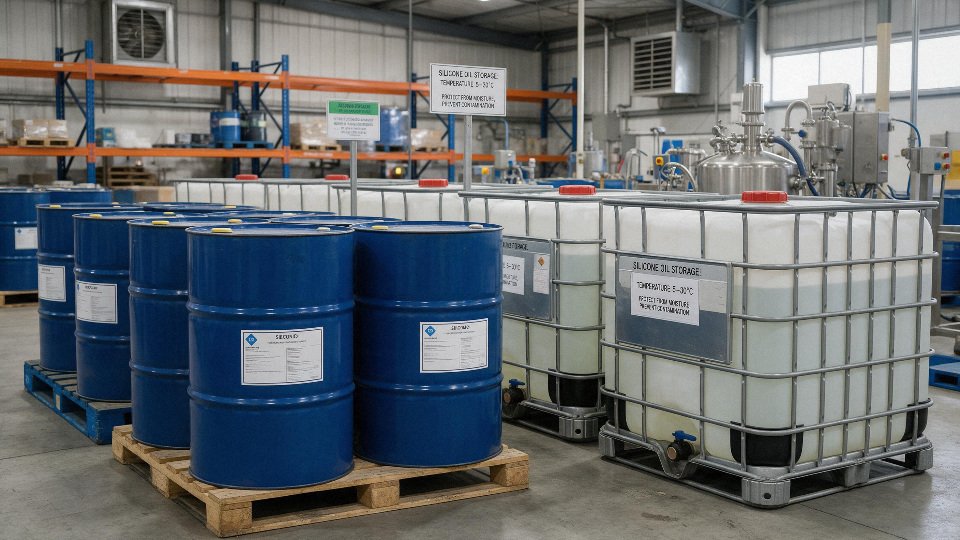
Receiving a drum of 1000 cSt silicone oil and assuming it’s actually 1000 cSt is a mistake that costs real money. Mislabeled grades happen more often than suppliers admit, and degraded stock from a warehouse that got too warm is practically invisible to the naked eye. QC verification before the material enters your process is non-negotiable.
Primary Test Methods and When to Use Each
The reference method is ASTM D445 using a calibrated Ubbelohde capillary viscometer. Repeatability is ±0.35% under controlled conditions, which is tight enough to resolve whether a sample is within a ±5% acceptance band. The physics are simple — gravity-driven flow through a calibrated glass capillary — but execution matters enormously. The bath must hold temperature to ±0.02 °C for high-accuracy work; at 25 °C this is achievable with a good Julabo or similar recirculating bath, but in practice many incoming inspection labs run at ±0.1 °C, which adds roughly 0.3–0.5% uncertainty on top of the method’s baseline. That’s still acceptable for most acceptance checks, but it means you’re working with a real-world combined uncertainty closer to ±0.7–1.0% rather than the textbook ±0.35%.
ASTM D7042, using a Stabinger rotational viscometer (Anton Paar SVM series is the dominant instrument), is faster — typically 3–5 minutes per sample versus 15–30 minutes for capillary — and handles a much broader viscosity range without changing tube sizes. For routine QC on production days when you’re clearing 10–15 drums, this is the practical choice. The tradeoff is slightly higher uncertainty, typically ±0.5–1% depending on the viscosity range and calibration state. It also measures density simultaneously, which is a useful cross-check. ISO 3104 is functionally equivalent to D445 for kinematic viscosity; if your supplier’s certificate of analysis references ISO 3104 results, the numbers are directly comparable.
One practical rule: for any viscosity above roughly 100,000 cSt, capillary methods become awkward — flow times get extremely long, and temperature drift during the run introduces error. Rotational methods handle these ultra-high grades better. Below 10 cSt, capillary is more reliable because the Stabinger’s measurement uncertainty becomes a larger fraction of the reading.
Calibration Chain and Reporting Requirements
Your viscometer must be calibrated against NIST-traceable reference standards — the S-series oils (S3 through S60000) from Cannon Instrument or equivalent certified sources. Don’t accept a calibration certificate that just references “in-house standard.” The calibration interval depends on usage frequency; quarterly recalibration is typical for a busy QC lab, but after any mechanical shock to the instrument or after an out-of-range calibration check, recalibrate immediately regardless of schedule.
Temperature must be reported to three significant figures (e.g., 25.0 °C, not “room temperature” or “25 °C”). Because PDMS viscosity-temperature sensitivity, while lower than mineral oil, still runs roughly 2–3% per degree Celsius in the mid-viscosity range, a sloppy temperature report makes the result essentially useless for dispute resolution with a supplier.
Acceptance Criteria and What Deviation Actually Means
For a labeled 1000 cSt grade, the standard commercial tolerance is ±5%, giving an acceptance window of 950–1050 cSt. Most reputable PDMS suppliers hold tighter than this — often ±3% — but the ±5% band is the floor you should write into your incoming inspection spec.
A deviation of 5–10% is a yellow flag. It could be measurement error on your end (bath temperature, calibration drift), but it warrants a retest with fresh calibration before acceptance. A deviation above 10% is a hard stop.
A >10% viscosity deviation from labeled grade in fresh PDMS almost always indicates mislabeling, cross-batch blending, or storage above 60 °C for extended periods — not normal manufacturing variation.True
Reputable PDMS manufacturers control molecular weight distribution tightly; a >10% viscosity shift in an unopened drum reflects either a supply chain error or thermal degradation, not process noise. PDMS viscosity is set by polymer chain length, which does not drift randomly within specification.
Reject the drum and request a supplier-side retest from the same production batch. If the supplier’s result also falls outside ±5%, you have a genuine mislabeling event and should request traceability documentation back to the polymerization batch.
Field Indicators of Viscosity Change During Service
Once silicone oil is in service — a heat transfer loop, a damper, a diffusion pump — incoming inspection is behind you, but the fluid can still degrade. Sampling intervals depend heavily on thermal load: systems running continuously above 150 °C warrant checks every 2–3 months; systems running below 100 °C can typically go 6–12 months between samples.
Watch for these red flags on samples pulled from service:
- Color shift from water-clear to pale yellow or amber — oxidation, most common when oxygen ingress occurs at elevated temperature. Doesn’t always mean viscosity has changed yet, but it’s the earliest warning.
- Viscosity creep upward on a sample that should be stable — cross-linking is occurring, usually from contamination with reactive species (trace metal catalysts, peroxides) or sustained overtemperature above the fluid’s rated ceiling.
- Foaming during operation — almost always contamination, either water, a low-boiling solvent, or a surfactant introduced during maintenance. Foam collapses film thickness in lubrication applications and wrecks heat transfer coefficients.
- Hazy or cloudy appearance — water contamination or particulate, both of which shift measured viscosity unpredictably and can accelerate degradation.
A viscosity increase of more than 15–20% from the baseline measurement on the same fluid-in-service is typically the threshold for fluid change-out in thermally demanding systems. Below that, judgment depends on the application — a damper tolerates more drift than a precision heat transfer loop.
Regulatory, Safety, and Environmental Constraints That Narrow Your Viscosity Options
Technically optimal viscosity means nothing if the fluid can’t legally touch the product, can’t be stored in your building’s fire zone, or triggers a REACH reporting obligation you didn’t budget for. This is the part of silicone oil selection that procurement managers often miss until a compliance team flags it three weeks before line startup.
Food Contact and Pharmaceutical Grades
FDA 21 CFR 178.3570 permits PDMS as a defoamer at no more than 10 ppm in food, and as a release agent on baking and processing equipment at up to roughly 360 ppm on the contact surface. That sounds permissive, but the regulation ties approval to specific viscosity grades and supplier specifications — you cannot simply grab any 350 cSt drum off the shelf and call it food-grade. In practice, approved food-contact PDMS tends to cluster in the 350–1000 cSt range, because those grades combine low volatility with the film-forming behavior baking and confectionery lines need. Ultra-low grades like 5 cSt or 10 cSt are rarely listed by compliant suppliers for direct food contact; they volatilize too readily and carry higher cyclic siloxane residuals (more on that below).
Medical device applications layer on additional requirements. USP Class VI biocompatibility and ISO 10993 testing are non-negotiable for any silicone oil that contacts an implant, catheter, or syringe plunger. Those certifications are issued to specific lots from specific suppliers, so your viscosity choice is effectively constrained to whatever grades appear on your approved supplier list. A 500 cSt medical-grade fluid from one manufacturer is not automatically interchangeable with a 500 cSt fluid from another, even if both measure in spec on a viscometer. The testing burden and lead time to qualify a new supplier typically runs 6–18 months and tens of thousands of dollars — which means the compliance landscape, not the datasheet, often dictates which viscosity you actually use.

REACH and Cyclic Siloxane Concerns
D4 (octamethylcyclotetrasiloxane) and D5 (decamethylcyclopentasiloxane) are listed as SVHCs under REACH. Low-viscosity PDMS grades — roughly below 10 cSt — carry meaningfully higher residual cyclic content, and if that fraction exceeds 0.1% w/w in an article or mixture, EU reporting obligations kick in. Some grades in the 1–5 cSt range can approach or exceed this threshold depending on the manufacturer’s purification process.
All silicone oils below 10 cSt automatically exceed REACH SVHC thresholds for D4/D5.False
Threshold compliance depends on the specific purification level of the PDMS batch. Some low-viscosity grades are processed to reduce cyclic content below 0.1% w/w. Certificate of Analysis review and direct supplier confirmation are required; viscosity grade alone does not determine compliance.
The practical effect: if you’re formulating a silicone-based product for EU sale and you need very low viscosity for, say, thin-film spreading or volatile carrier behavior, you need to request cyclic siloxane content data explicitly. Don’t assume.
Flash Point and Workplace Safety Classification
Flash point climbs sharply as viscosity rises. Grades below about 10 cSt typically show flash points in the 50–80 °C range, which puts them in OSHA’s flammable or combustible liquid category depending on exact value and test method. That classification cascades directly into storage area requirements — bonded cabinets, fire suppression ratings, vapor monitoring in enclosed spaces. A 100 cSt grade, by contrast, typically has a flash point above 300 °C and is generally handled without the same fire-zone restrictions.
This matters operationally. A plant running a low-viscosity silicone as a mold release in a heated enclosed chamber may need vapor recovery equipment it hadn’t budgeted for. Switching to a 200 cSt grade often eliminates the hazard classification entirely, and in my experience, that tradeoff is worth exploring before committing to process design.
Environmental Fate and Spill Management
High-viscosity PDMS, above roughly 1000 cSt, is essentially non-volatile and adsorbs tenaciously to soil and sediment. A spill doesn’t evaporate — it stays put, and mechanical recovery becomes the only option. Remediation is slow and expensive relative to the fluid’s commodity value, which affects your spill response plan and environmental liability assessment, particularly if the facility sits near waterways.
Low-viscosity grades present the opposite problem. They volatilize quickly in open or warm environments, which is why enclosed manufacturing spaces handling 5–50 cSt silicone fluids at elevated temperatures may require local exhaust ventilation and, in some jurisdictions, VOC reporting. The regulatory and safety profile of silicone oil is, bluntly, not uniform across the viscosity range — treating it as a single “inert, safe fluid” across all grades is a mistake that shows up in audit findings.
Step-by-Step Viscosity Selection Decision Framework for Design Engineers
Every preceding section feeds into this one. The calculations, the compliance checks, the fluid dynamics — none of it matters unless you can synthesize it into a grade decision before the purchase order goes out. Here is the sequence I’d walk through on any new application, whether it’s a damping cylinder or a cosmetic emulsifier.
Step 1 — Define the Operating Envelope Completely
Record three temperatures, not one: T_min (the coldest the fluid will ever see, including cold-start, winter shutdown, or refrigerated transport), T_max (sustained peak operating temperature, not just a brief spike), and T_service (the temperature at which the fluid must actually hit its performance target — which is often neither extreme).
Most specification errors I’ve seen come from engineers anchoring on T_service alone and ignoring T_min. A 500 cSt grade at 25 °C might be perfectly fine for damping at 60 °C, but on a cold January morning startup at −20 °C it can thicken enough to blow a shaft seal or stall a gear pump. Write down all three values before you open a catalog.
Step 2 — Identify the Primary Performance Function
This is where a lot of generic guidance fails — it treats all silicone oil applications as equivalent. They are not. What the fluid is doing determines what viscosity means in practice:
- Heat transfer: lower viscosity improves convective flow; typically 5–50 cSt at T_service. Pumping energy goes up as you climb toward 100 cSt, so there’s a real crossover point worth calculating.
- Damping and force control: viscosity is the literal controlled variable in the damping force equation. Even a 15–20% drift from the target grade changes the damping coefficient meaningfully.
- Hydrodynamic lubrication: use the Sommerfeld number. You need to know shaft speed, bearing clearance, and load to work backward to the minimum film-sustaining viscosity. Guessing here causes premature bearing wear.
- Electrical insulation: purity and dielectric strength constrain the candidate grades more than the viscosity number itself. A nominally correct viscosity from a lower-purity lot can still fail a transformer.
- Release and process aid: film thickness and spread rate matter. Too thin and you get adhesion; too thick and you get buildup that contaminates the substrate.
Be honest about which function is primary. Secondary functions can be checked after, but optimizing for the wrong one wastes time.
Step 3 — Back-Calculate the Catalog Viscosity
Suppliers publish viscosity-temperature curves, and most will also give you ASTM D341 coefficients. Use them. The goal is to find the 25 °C catalog grade that delivers your required viscosity at T_service — not the grade that sounds closest to your target number.
ASTM D341 is a reliable method to extrapolate PDMS viscosity between known temperature points within the typical industrial operating range.True
ASTM D341 (the Walther equation) is well-established for viscosity-temperature interpolation and extrapolation for Newtonian fluids including silicone oils, though accuracy decreases near phase-transition boundaries or at extremely low viscosities below roughly 1 cSt.
If the supplier’s chart only shows two reference temperatures (common for commodity grades), the D341 equation will bridge the gap reasonably well within the −50 °C to 200 °C window. Outside that range, ask for measured data — don’t extrapolate blindly.
Step 4 — Validate Against Cold-Start and Mechanical Constraints
Run the numbers at T_min. Specifically: pump differential pressure, pipe flow velocity, and — for agitated systems — mixer motor load. A grade that looks fine at operating temperature can require 3–4× the pump power at cold start. If the installed pump can’t deliver that without cavitating or overloading, either the grade needs to drop or the system needs a startup heater.
Bearing applications have their own concern: high viscosity at low temperature generates viscous drag heat, which accelerates early-run wear before the film properly establishes. This is a real failure mode in precision instruments left in unheated storage.
Step 5 — Screen for Regulatory Compliance
Before committing to a grade, pull the supplier’s Safety Data Sheet and Certificate of Analysis and cross-reference against applicable regulations. For food-adjacent or pharmaceutical applications, confirm FDA 21 CFR or USP Class VI status. Check cyclic siloxane content (D4, D5, D6) if the product enters the EU market — REACH restrictions on cyclics have tightened and continue to evolve. For electrical applications, verify IEC dielectric strength requirements.
A candidate grade that passes all performance steps but fails a compliance screen costs you weeks of redesign. Do this check before running pilot tests, not after.
Step 6 — Bench-Test the Actual Received Batch
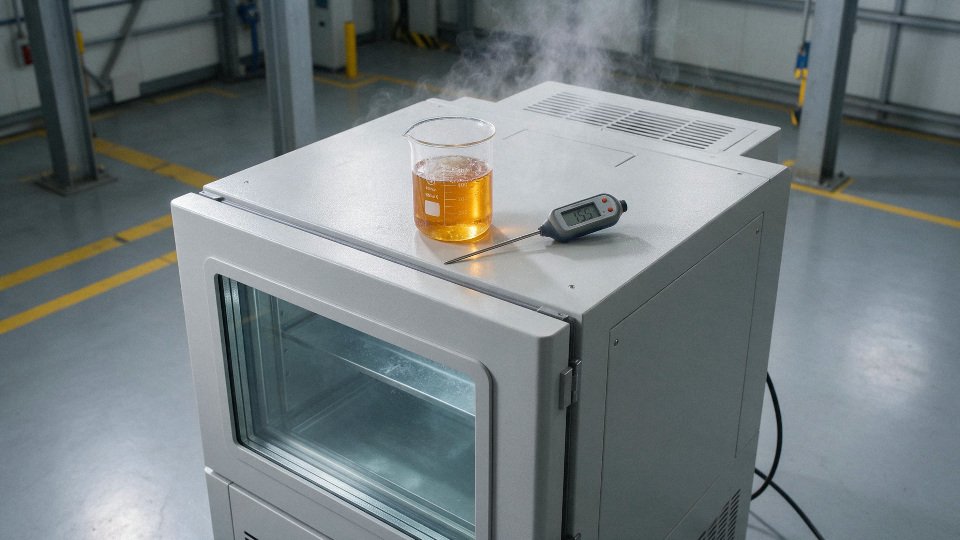
Spec sheets are not batch guarantees. Measure viscosity on the received material per ASTM D445 before it enters production. Then run a 100-hour accelerated thermal aging test at T_max — a standard aging cabinet works fine — re-measure viscosity, and accept only if the drift stays below roughly 5% from the initial measured value. Beyond that threshold, you’re looking at either contamination, an incorrect grade, or a formulation that will degrade unacceptably in service.
This step gets skipped when schedules are tight. That’s usually when a mislabeled drum causes a week of downtime and a scrap batch that nobody wants to explain to the customer.
Frequently Asked Questions About Silicone Oil Viscosity Selection
What viscosity should I use for general-purpose lubrication?
For most light mechanical tasks — O-ring lubrication, plastic gear trains, valve stems, sliding plastic-on-metal interfaces — 100–350 cSt at 25 °C is the practical sweet spot. That range gives you enough film thickness to prevent metal contact under moderate loads while remaining fluid enough to wick into tight clearances and redistribute after displacement. Go below 50 cSt and you risk film starvation on anything but the lightest loads; the oil simply runs off too fast.
Step up to 500–1000 cSt when the operating temperature is consistently above 60–70 °C, when contact pressures are higher (think worm gears or heavily loaded pivot pins), or when the housing geometry makes re-lubrication inconvenient. The viscosity loss with temperature is gentle for PDMS — that’s the whole point — but you still need the film to be thick enough at the hot end, not just at room temperature.
Can I blend two different viscosity grades together?
Yes, provided both are straight dimethyl silicone (PDMS). The grades are fully miscible and blend homogeneously without separation. Use the ASTM D341 logarithmic mixing rule to estimate blend viscosity; it’s the same method used for petroleum oils and works well for PDMS across the practical viscosity range.
Where this gets dangerous: mixing PDMS with phenyl silicone or fluorosilicone grades. Those are chemically distinct backbones. Phase separation is possible, and even when mixing appears uniform, you can get unexpected viscosity behavior or a reduction in the thermal and chemical resistance you were counting on. Always get supplier sign-off before blending across silicone sub-types.
How does viscosity change over years of heat exposure?
Below 200 °C in a closed or inert-atmosphere system, PDMS is remarkably stable — typically less than 5% viscosity drift after several thousand hours of continuous service. That stability is genuine, not marketing.
PDMS silicone oil exposed continuously to temperatures below 200 °C in the absence of oxygen shows less than 5% viscosity change after thousands of operating hoursTrue
This is consistent with published thermal aging data from major silicone fluid suppliers and peer-reviewed polymer degradation studies on polydimethylsiloxane, which shows negligible chain scission or cross-linking below its oxidative threshold.
Above 200 °C in air, oxidative cross-linking sets in and viscosity climbs — slowly at first, then more rapidly. Above roughly 300 °C, chain scission takes over and viscosity can actually drop, which is counterintuitive and catches people off guard. The practical rule: derate the published continuous-use limit by 20–30 °C for real service, because plant conditions are rarely as clean as a lab aging oven.
What does the difference between 50 cSt and 50,000 cSt actually feel like?
50 cSt pours like light motor oil. It flows freely from a drum tap, pumps at low pressure, and spreads across a surface within seconds. 50,000 cSt is closer to thick honey — it moves slowly, requires meaningful pump head or a heated transfer line, and holds its shape briefly when disturbed. Handling logistics alone change: a 200-liter drum of 50,000 cSt silicone oil on a cold January morning is a different proposition from the same drum at 50 cSt.
Does thicker always mean better lubrication?
No. This is probably the most common mistake I see. Excess viscosity generates heat through viscous shear, and in high-speed applications it can actually starve the contact zone because the oil doesn’t flow fast enough to replenish the film. Parasitic energy losses add up quickly. The right answer is the minimum viscosity that maintains a continuous hydrodynamic film under the worst-case combination of load, speed, and temperature — Stribeck curve logic, not “if some is good, more is better.”
How do I convert between cSt and cP?
Dynamic viscosity in cP (or equivalently mPa·s) equals kinematic viscosity in cSt multiplied by fluid density in g/cm³. Most PDMS grades run 0.96–0.98 g/cm³ at 25 °C, so the correction is under 4% — close enough for most purposes that 1000 cSt ≈ 970 mPa·s. For precision pump sizing or rheometer work, pull the actual density from the product datasheet rather than assuming; higher-viscosity grades (above roughly 100,000 cSt) can trend slightly higher in density depending on the polymerization route.