Picking the wrong silicone oil grade doesn’t just mean suboptimal performance — it means a seized bearing at 2 a.m., a batch of molded parts with surface defects your QC team has to sort by hand, or a heat transfer loop that runs 15–20°C hotter than designed because someone swapped in a low-viscosity fluid to “save money.” The cost of the fluid itself is almost never the issue. The cost of the downtime, the scrap, or the re-work almost always dwarfs whatever was saved on procurement.
The right silicone oil comes down to matching four parameters to your actual operating condition: viscosity (which spans from 0.65 cSt for thin, volatile fluids up to several million cSt for near-solid greases), thermal range (usable between roughly -60°C and +300°C depending on formulation), chemical compatibility with the surfaces and media it will contact, and whether a standard PDMS grade covers your application or whether a modified fluid — phenyl, amino, or otherwise — is actually justified by the duty cycle.
What makes this genuinely tricky is that most of those parameters interact. A fluid that performs beautifully at 50°C in a mold release application will oxidize and gum up in a continuous-duty oven at 250°C, even if both applications nominally fall inside the published temperature range. The viscosity-temperature relationship in silicones is unusually flat compared to mineral oils — which is one of their real engineering advantages — but it is not flat enough to ignore, especially at the cold end of the range. The sections below walk through each selection factor in the order that actually matters on the plant floor.
Silicone Oil Chemical Families: PDMS, Phenyl, Amino, and Specialty Variants Explained
Understanding which chemical family you’re actually buying matters before you ever look at a viscosity grade or a price sheet. The six main families behave differently enough that substituting one for another — even at matching viscosity — can cause seal swell, coating failure, or a full batch rejection. Here’s how they differ in practice.
Standard Polydimethylsiloxane (PDMS)
This is the workhorse. The Si–O backbone with methyl side groups gives PDMS its characteristic low surface tension, wide thermal window (roughly -50°C to +200°C in standard grades, up to +300°C with treated or high-MW variants), and chemical inertness against most aqueous systems. Viscosity spans an almost absurd range — 0.65 cSt for the lightest fluid grades up to 2,500,000 cSt for near-gum materials — so a single chemical family covers everything from transformer cooling baths to mold release films.
Cost runs $3–$8 per kg for commodity grades, depending on viscosity (very high and very low viscosities cost slightly more due to process complexity), order volume, and whether you’re sourcing from a domestic distributor or direct from a Chinese or European producer. It’s the default unless something specific about your application rules it out.
Phenyl-Modified [Silicone Oils](https://siliconchemicals.com/silicone-oil/) (Methylphenyl Silicone)
Replacing some methyl groups with phenyl groups raises the refractive index — useful in optical potting compounds and LED encapsulants where index-matching matters — and improves radiation resistance significantly. The phenyl content also raises the flash point and extends useful temperature range toward the high end. Aerospace lubricant specs sometimes mandate phenyl-modified fluids precisely because they hold viscosity more consistently across a wide temperature swing.
You pay for it. Expect $20–$50 per kg, depending on phenyl ratio and grade purity. Don’t specify phenyl-modified when standard PDMS covers the temperature and compatibility requirements; the cost difference is real.
Amino-Functional Silicone Oils
These carry reactive NH₂ groups — either on side chains or at terminal positions — which is what makes them bond to fiber surfaces in textile softening and to hair in conditioning formulations. The reactivity that makes them useful is also their operational liability: amino silicones will discolor or gel if exposed to elevated temperatures for extended periods, and they’re sensitive to pH extremes during processing. Thermal stability typically caps around 150°C–180°C depending on amine content, well below standard PDMS.
In textile finishing plants, amino silicone emulsions are usually prepared fresh or held for short periods — leaving them in a warm tank over a weekend is a reliability risk that’s easy to overlook.
Hydrogen Silicone Oils (Si–H Functional)
These function primarily as crosslinkers in platinum-catalyzed addition-cure silicone systems rather than as end-use fluids. Storage is the critical operational issue: moisture hydrolyzes Si–H bonds and generates hydrogen gas, which creates both performance degradation and a pressure hazard in sealed containers. Keep them cool and dry, minimize headspace, and use within supplier-recommended shelf life.
Hydrogen silicone oil is interchangeable with standard PDMS in lubrication applicationsFalse
Si–H functional fluids are reactive crosslinkers, not inert lubricants. Using them outside a cure system wastes the reactive functionality, and residual reactivity can cause unintended bonding or foaming in the wrong environment.
Fluorosilicone Oils
The fluorinated side chains deliver chemical resistance that standard PDMS simply cannot match — jet fuel, aromatic solvents, hydraulic fluids. That’s the only reason to buy them, because cost runs 5–10× over standard PDMS grades, typically $60–$150 per kg or more at specialty quantities. In fuel system seals and aerospace applications the premium is justified. Anywhere else, it’s overcalling the specification.
Polyether-Silicone Copolymers
Grafting polyether segments onto the silicone backbone creates water-dispersibility and surfactant behavior that pure PDMS lacks. These are the fluids behind most silicone-based antifoams, personal care spreadability agents, and certain agricultural adjuvants. They behave quite differently from the other families — surfactancy and HLB balance matter more than viscosity for most uses.
Quick-Reference Comparison
| Chemical Family | Usable Temp Range | Viscosity Range | Chemical Resistance | Relative Cost | Primary Sectors |
|---|---|---|---|---|---|
| Standard PDMS | -50°C to +300°C | 0.65–2,500,000 cSt | Good (aqueous); limited vs. fuels | $ | Industrial, electrical, release, personal care |
| Phenyl-modified | -60°C to +300°C | Narrow mid-range | Good; radiation-resistant | $$$ | Optical, aerospace, high-temp lubrication | | Amino-functional | Up to ~150–180°C | Low-to-mid | Moderate; pH-sensitive | $$ | Textile, hair care, reactive coatings |
| Si–H functional | Limited (storage risk) | Low-to-mid | Not applicable as lubricant | $$ | Addition-cure crosslinker only | | Fluorosilicone | -60°C to +200°C | Low-to-mid | Excellent vs. fuels/solvents | $$ $$$ | Aerospace, fuel systems, aggressive chemical environments | | Polyether-silicone | -40°C to +150°C | Variable | Moderate; water-dispersible | $$ | Personal care, antifoam, agriculture |
The family choice narrows your options fast. Get this decision wrong upstream and no amount of viscosity tuning fixes it downstream.
Viscosity Grade Selection: Matching Flow Behavior to Mechanical and Thermal Demands
Viscosity is where most specification errors happen. An engineer pulls a data sheet, sees a cSt number, and picks the nearest available grade — without checking whether that number holds at operating temperature, at actual shear rates, or through a 6-meter run of 8mm tubing. The consequences range from inadequate film thickness and accelerated wear to pump cavitation, excessive heat buildup, or a mold-release agent that smears instead of releasing.
Why PDMS Behaves Like a Textbook Newtonian Fluid (and Why That’s Actually Useful)
Standard PDMS — across most of its viscosity range, roughly 1 cSt up into the low thousands — is genuinely Newtonian. Shear rate doesn’t change the viscosity. That’s not marketing language; it’s a real advantage over many mineral and synthetic hydrocarbon oils that exhibit shear thinning under high-speed conditions. In practice, it means you can take the published 25°C cSt value and plug it directly into Reynolds number calculations, Hagen-Poiseuille pressure-drop estimates, or bearing film thickness models without applying an empirical correction factor for shear. The math works. That said, once you climb above roughly 100,000 cSt, you start seeing mild viscoelastic behavior under high shear — worth keeping in mind for rotary damper design.
Standard PDMS silicone oils exhibit Newtonian flow behavior across most commercially available viscosity gradesTrue
PDMS polymer chains are flexible and non-associating, so viscosity remains independent of shear rate throughout most of the practical viscosity range. Viscoelastic effects only become significant at very high molecular weights, typically above ~100,000 cSt.
The Viscosity-Temperature Advantage Over Mineral Oil
Silicone oils carry a viscosity index in the 300–400 range, depending on grade and phenyl content. Mineral oils typically run 90–120 VI, sometimes up to 150–160 for highly refined groups. The practical effect: a 1,000 cSt PDMS at 25°C might drop to only 200–300 cSt at 100°C, whereas a mineral oil starting at the same viscosity could fall to 30–50 cSt. For cold-start applications — outdoor gearboxes in winter, refrigeration compressor auxiliaries, any equipment that sits in an unheated building at -20°C or lower — silicone’s flatter curve means dramatically lower warm-up torque and reduced risk of starvation lubrication during the first few seconds of operation.
Low-Viscosity Grades: 0.65–10 cSt
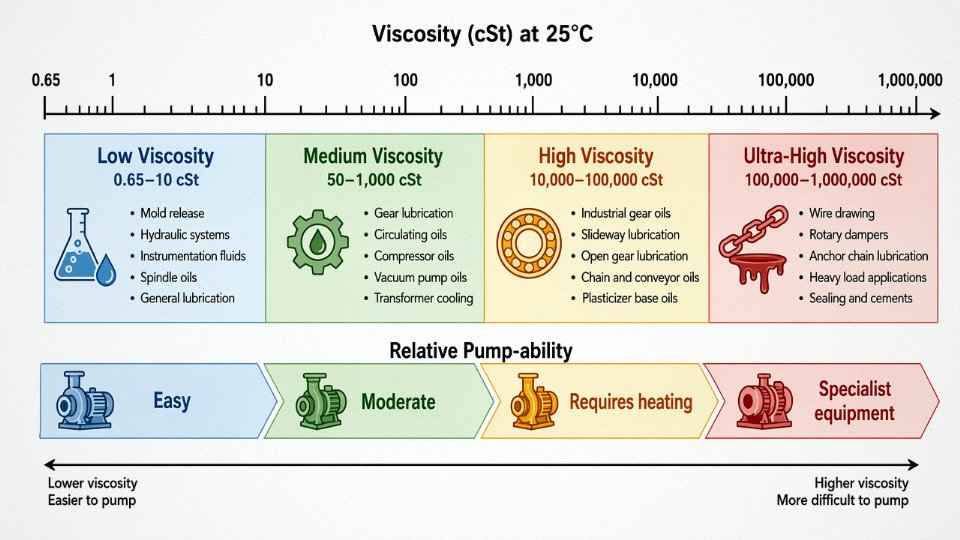
These are thin, mobile fluids. They penetrate tight clearances, atomize well in spray nozzles, and work effectively as release agents on complex mold geometries where a heavier grade would pool. Common applications include electronic component deflashing, thermal spray carriers, and light textile fiber lubrication. The trade-off is volatility. Sub-5 cSt grades typically have flash points below 100°C — some as low as 60°C — so storage and application temperature matter. Evaporation in open systems is a real operating cost, not a theoretical one. If you’re running a continuous spray process and wondering why your consumption is higher than calculated, ambient temperature and air velocity over the sump are likely culprits.
Medium-Viscosity Grades: 50–1,000 cSt
This is the range most industrial users actually need. Mold release, transformer cooling, textile lubricants, hydraulic dampers, diffusion pump fluids, general mechanical lubrication where the load is moderate — 50 to 1,000 cSt covers the vast majority of it. These grades are pumpable at room temperature without heating, stable enough for long-term reservoir use, and available from multiple suppliers at roughly $3–8 per kg for standard PDMS (price depends heavily on order volume and purity grade). They’re also the grades most likely to be in stock.
High-Viscosity Grades: 10,000–1,000,000 cSt
Behavior shifts noticeably here. A 60,000 cSt fluid looks like thick honey; a 500,000 cSt grade flows slowly enough that you’d be forgiven for thinking it’s nearly solid at room temperature. Rotary dampers, shock absorber fluids, and wire-drawing lubricants use grades in this range specifically because the resistance to flow provides the damping force. Handling is the operational challenge — you cannot pump these through standard peristaltic or gear pumps without heating the fluid to 50–70°C first, and even then, you need to spec your pump clearances for the actual cold-fill viscosity, not the warm operating viscosity. A common plant-floor mistake is sizing the transfer pump for operating temperature and then wondering why it stalls or overloads on the first cold morning of the year.
Ultra-High Grades and Gum-State PDMS: Above 1,000,000 cSt
These aren’t really fluids in any conventional sense. At the upper end of this range and into the gum state, PDMS is a compounding base for silicone rubber, or a high-molecular-weight tackifier. It won’t flow without heat or mechanical working. If a supplier quotes you a viscosity above about 2,500,000 cSt, they’re usually describing a neat gum that needs to be blended or processed on a two-roll mill. Useful material — but it belongs in a rubber compounding context, not a lubrication system.
A Practical Viscosity Selection Checklist
Before finalizing a grade, work through these four parameters in order:
| Parameter | What to determine | Why it matters |
|---|---|---|
| Operating temperature range | Min cold-start, max steady-state | Determines actual in-service viscosity, not just 25°C spec |
| Flow path geometry | Tube diameter, length, fittings | Drives pressure-drop and pump sizing |
| Shear rate at operating conditions | RPM, gap dimensions, flow velocity | Confirms Newtonian assumption is valid for your grade |
| Target film thickness or lubrication regime | Boundary, mixed, or hydrodynamic | Sets the floor on minimum viscosity |
If you get the operating temperature range wrong — using only the 25°C cSt value without checking the viscosity-temperature curve — you risk either starvation (too thin at peak temperature) or pump overload (too viscous at cold start). Both failure modes are entirely avoidable with ten minutes and the right data sheet.
Thermal Performance Criteria: Heat Transfer, Thermal Stability, and Maximum Use Temperature
Silicone oil’s thermal properties are well-documented but frequently misapplied. Engineers familiar with water-glycol systems sometimes underestimate how different the design constraints are once you switch to PDMS — and that mismatch shows up as undersized heat exchangers, unexpected degradation, or a bath that can’t hold setpoint under load.
Heat Transfer Capacity: What the Numbers Actually Mean in Practice
Thermal conductivity for standard PDMS sits in the range of roughly 0.15–0.16 W/m·K at 25°C, depending on viscosity grade and temperature. That’s well below water (around 0.6 W/m·K) and below ethylene glycol blends, but it beats most mineral oils and nearly all synthetic organics like PAO or silicone-free esters. In practice, this means your heat exchanger surface area calculation can’t be borrowed from a water-based system — you’ll typically need 20–35% more transfer area, or higher fluid velocity to compensate through improved convective coefficient. In turbulent-regime applications, increasing flow velocity is usually the cheaper fix; in laminar-flow bath systems, it’s not always possible, and area wins.
Specific heat capacity runs roughly 1.46–1.59 J/g·K for mid-viscosity PDMS grades (that range widens slightly with temperature and narrows at very high viscosity), and density sits around 0.96–0.98 g/cm³ at 25°C. These are the two numbers you actually need for your thermal loop energy balance — volumetric heat capacity comes out to approximately 1.4–1.55 J/cm³·K, noticeably lower than water’s ~4.18 J/cm³·K. Sizing a recirculating bath? You can’t ignore that difference.
A practical sizing illustration: a 50 L recirculating bath operating at 150°C with a 2 kW immersion heater and roughly 500 W continuous heat loss to ambient. To maintain setpoint with reasonable temperature uniformity, you’d target a flow rate where the temperature rise across the bath loop stays under about 3–5°C. Using Q = ṁ × Cp × ΔT, with Cp ≈ 1.55 J/g·K and ΔT = 4°C, you need ṁ ≈ 80 g/s, or roughly 5 L/min for a 0.97 g/cm³ fluid. That’s a flow rate a small gear pump handles easily, but it’s twice what many engineers initially spec when they’re mentally anchored to water.
Temperature Limits: Continuous Service vs. Excursion
This is where the most costly misspecifications happen. Standard PDMS carries a continuous-use ceiling of around 150–200°C depending on the formulation and oxygen exposure. High-stability PDMS grades — typically higher molecular weight with end-capping — can handle 200–250°C in continuous service. Phenyl-modified silicones push that to roughly 280–300°C, though they carry a significant cost premium ($20–80/kg versus $3–15/kg for standard PDMS, with the actual figure depending on phenyl content and supplier volume tier).
The distinction between short-term excursion limit and continuous service rating matters enormously. A standard PDMS fluid may survive a 250°C process spike for minutes without visible damage. Run it at 220°C continuously for months, and you’ll see viscosity drift, discoloration, and eventually gel formation.
Standard PDMS silicone oil can be used continuously at temperatures up to 300°CFalse
300°C continuous service requires phenyl-modified silicone formulations. Standard PDMS degrades progressively above 200°C in service, with accelerated chain scission and oxidative byproduct formation. Confusing short-term excursion tolerance with continuous service ratings is one of the most common thermal fluid specification errors.
Oxidative Degradation: What’s Actually Happening Above 200°C
Above roughly 200°C in the presence of oxygen, PDMS undergoes chain scission. The dominant byproducts are low-molecular-weight cyclic siloxanes — D3 through D6 primarily — along with trace acidic species that will slowly attack metal surfaces and seals. Viscosity drift is the first measurable sign: the fluid thins initially as chain scission dominates, then thickens as crosslinking and residue buildup accumulate. A viscosity increase of more than 20% from baseline is a reliable trigger for fluid replacement or reblending.
Running a closed-loop system with an inert gas blanket — dry nitrogen at low positive pressure is the standard approach — dramatically slows this degradation pathway by eliminating the oxygen that drives chain scission. In practice, well-maintained nitrogen-blanketed systems running at 220–240°C can extend fluid service life from a few months to well over a year.
Operational warning: yellowing alone isn’t sufficient justification to replace fluid — some color shift is cosmetic. But yellowing combined with gel particle formation visible through a 25-micron in-line filter, or a pH shift in the sampled fluid below roughly 6.5, indicates you’re past the useful service window.
Cold-End Behavior: Often Overlooked Until Winter
Standard PDMS grades remain fluid down to -50°C or below, with pour points well below anything you’d encounter in a temperate outdoor installation. This is one area where silicone genuinely outperforms most alternatives — a hydraulic damping system or outdoor thermal loop that would require heaters or blend reformulation with a mineral oil works fine year-round with PDMS. High-viscosity grades above roughly 100,000 cSt become sluggish below -30°C even if they don’t solidify, so for cold-climate applications combined with damping or flow requirements, staying in the 100–1,000 cSt range keeps behavior predictable across seasons.
Lubrication, Release, and Surface Application Requirements: Matching Oil to Substrate and Process
Surface-contact applications are where specification errors show up fastest — wrong viscosity on a mold tool means release failure, scrap parts, and a line stoppage before lunch. The selection logic here is genuinely different from thermal or damping applications: film thickness, surface energy, and how far the oil migrates after application matter as much as bulk viscosity.
Mold Release: Viscosity, Format, and Regulatory Grade
For spray-applied mold release, the practical working range sits between roughly 100 and 1,000 cSt. Below 100 cSt the film is too thin and uneven; above 1,000 cSt you’re fighting nozzle clogging and uneven coverage unless you heavily dilute — which introduces its own solvent handling headaches. In practice, 350 cSt PDMS diluted to 2–5% in a light aliphatic hydrocarbon carrier is a common starting point for rubber molding. Adjust up toward 500–750 cSt if your mold geometry has deep draws or blind features where drainage would leave bare metal.
Format matters too. Neat silicone oil, silicone emulsion (water-continuous), and aerosol pre-mixes are not interchangeable. Emulsions are easier to apply uniformly on large flat tools and clean up with water, but they can trap moisture in porous mold surfaces — a real problem with cast aluminum tooling in high-humidity plants. Aerosols are convenient for short runs and manual application but inconsistent for automated spraying.
Food-contact and pharmaceutical applications require compliance with 21 CFR 178.3900 for polydimethylsiloxane. That regulation limits PDMS to certain molecular weight grades and specific use conditions, so confirm with your supplier that the grade is explicitly listed, not just “food safe” in marketing language. The distinction matters during audits.
PDMS silicone oil used in food-contact mold release applications must comply with FDA 21 CFR 178.3900, which specifies permitted molecular weight ranges and application conditions.True
21 CFR 178.3900 is the U.S. FDA regulation governing polydimethylsiloxane (dimethylpolysiloxane) as a release agent and surface lubricant in food-contact applications, with explicit molecular weight and use restrictions.
Plastic-to-Plastic and Rubber Lubrication: The Silicone Rubber Compatibility Trap
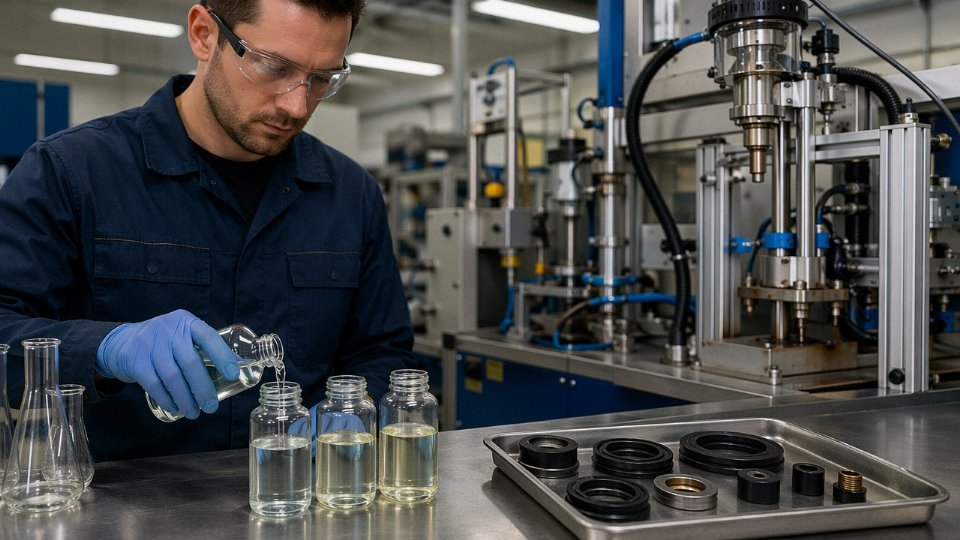
Silicone oil is chemically inert to most thermoplastics and organic rubbers — NBR, EPDM, neoprene all tolerate PDMS well. The dangerous assumption is that silicone oil is safe on all rubber. It isn’t. Silicone oil will swell and soften silicone rubber (VMQ, PVMQ) components over time because like dissolves like. If your assembly has silicone O-rings, lip seals, or gaskets, test compatibility before you commit to silicone oil lubrication. This trips up engineers more often than it should.
Bearing and Gear Lubrication: Know the Limits
Silicone oil has genuinely low friction under light, sliding contact — useful for instrument bearings, cam followers in light-load mechanisms, and plastic gear trains. What it cannot do is protect metal under high Hertzian contact stress. PDMS has poor extreme-pressure (EP) performance and low boundary lubrication capacity compared to mineral oil or PAO with EP additives. In a steel ball-on-race bearing running at significant load and speed, silicone oil will allow adhesive wear at the contact zone in a timeframe that would surprise engineers used to conventional lubricants. Use silicone in metal-on-metal contacts only at very light loads or as a preservative film, not as a working lubricant.
Textile and Fiber Lubrication: Amino vs. Straight PDMS
Straight PDMS gives fibers slip and some softness but washes out easily and contributes little to durable hand feel. Amino-functional silicone oils (typically 0.1–0.5% amino content by weight) bond more tenaciously to cellulosic and polyamide fibers through hydrogen and ionic interaction, delivering significantly better softness retention through laundering cycles. The trade-off: amino silicones can interfere with reactive and direct dyes if applied before dyeing. Standard practice is to apply amino-functional finish after the dye bath. If your customer requires dyeing flexibility or frequent color changes, specify the amino treatment sequence explicitly in your process sheet — it’s an easy thing to get out of order during shift changes.
Electronic and Dielectric Applications
100 cSt PDMS has a dielectric strength in the range of roughly 14–16 kV/mm and volume resistivity above 10¹⁴ Ω·cm, figures that hold reasonably stable across the typical operating temperature range. That combination makes it genuinely useful for transformer cooling, switchgear filling, and high-voltage connector sealing. Moisture exclusion is the main functional job in many of these applications — the oil displaces and seals against humidity ingress, which is why viscosity selection here is driven as much by penetration into tight clearances as by thermal performance. For conformal coating of PCBs, 50–100 cSt is usually the practical ceiling before the oil stops wetting fine-pitch features.
Migration Control and Dilution Practice
Low-viscosity grades — below about 50 cSt — will creep. On a metal part lubricated at one end, you can expect visible migration across unintended surfaces within hours at room temperature, faster at elevated temperatures. If contamination of adjacent surfaces, adhesive bonds, or optical elements is a concern, design with 200 cSt or higher and accept slightly less even initial coverage. It’s a real trade-off, not a recommendation that fits every case.
For spray and wipe application, typical working concentrations run 1–10% PDMS in a hydrocarbon or isopropyl alcohol carrier, depending on the target film weight and substrate. Heavier concentrations above about 8% start to leave visible residue on glossy surfaces and can cause adhesion problems if any bonding operation follows. Mix thoroughly and verify pot life — emulsion-based formulations can separate or degrade over days to weeks depending on emulsifier quality and storage temperature.
Regulatory, Safety, and Environmental Compliance Factors That Narrow Your Shortlist
Compliance rarely gets discussed until someone in QA flags a problem — and by then you’ve already committed to a grade, maybe ordered a drum or two. Getting this step done before performance testing saves real money and prevents the kind of supplier scramble that pushes project timelines out by weeks.
FDA Food-Contact Compliance: 21 CFR 178.3900 and 172.888
If your application involves food processing equipment — conveyor systems, bakery mold release, mixing vessel lubrication, foam suppression in beverage lines — the governing regulations are 21 CFR 178.3900 (lubricants and release agents) and 21 CFR 172.888 (defoaming agents). Both impose viscosity restrictions. Under 178.3900, PDMS grades intended for direct food-contact use must fall within a specified viscosity range, typically 300–30,000 cSt depending on the specific listed application; anything outside that window is technically non-compliant regardless of purity. Additive restrictions matter just as much — many commercially available silicone oils contain proprietary stabilizers or catalysts that are not listed under these regulations, so you need a supplier who can confirm the formulation, not just the base polymer.
Ask for the compliance letter, not just “food-grade” printed on the label. That phrase means nothing legally.
Medical and Pharmaceutical Grades: USP Class VI and ISO 10993
For medical devices, drug delivery components, or any part that contacts biological tissue or implantable assemblies, you’re looking at a distinct tier of qualification. USP Class VI biocompatibility testing evaluates systemic toxicity, intracutaneous reactivity, and implantation response — it’s the baseline for medical-device-grade PDMS. ISO 10993 cytotoxicity evaluation goes further and is typically required for devices that contact blood or mucosal membranes.
Cosmetic-grade PDMS is not the same thing, and the distinction matters operationally. Cosmetic grades may meet basic purity thresholds but lack the documented extraction studies and lot-traceability that medical applications require. Pharmaceutical-grade goes further still, requiring GMP manufacturing conditions and full batch documentation. Expect to pay $30–$80/kg or more for genuinely pharmaceutical-grade material, depending on viscosity and lot size.
REACH, RoHS, and Cyclic Siloxane Restrictions
In Europe, EU Regulations 2018/35 and 2018/36 restrict D4 (octamethylcyclotetrasiloxane) and D5 (decamethylcyclopentasiloxane) in wash-off cosmetic products above 0.1% concentration. For industrial fluids the current direct restriction is narrower, but the downstream risk is real: if your process generates wastewater that enters municipal treatment systems, residual cyclic siloxanes can trigger environmental compliance issues, since D4 is classified as PBT — persistent, bioaccumulative, and toxic — in several jurisdictions. Linear PDMS degrades more predictably in the environment and is the safer default choice wherever drainage contact is possible.
D4 cyclic siloxane is classified as PBT under EU REACH regulationsTrue
The European Chemicals Agency (ECHA) has classified D4 (octamethylcyclotetrasiloxane) as a substance of very high concern (SVHC) under REACH based on its PBT properties — persistent, bioaccumulative, and toxic — which is the basis for restrictions in wash-off cosmetics and ongoing scrutiny of industrial applications.
Occupational Exposure and Handling Safety
Low-viscosity silicone oils — roughly below 10 cSt — carry flash points that can be under 28°C, placing them in the Class IB flammable liquid category under NFPA 30. Most plant EHS teams don’t initially flag silicone oils as fire hazards, and that assumption gets people hurt. Spray application of any viscosity grade creates inhalation risk from fine mist; a half-face respirator with organic vapor cartridge is standard practice in areas with inadequate ventilation. Thicker grades above 1,000 cSt are generally far less hazardous in handling, but spills create serious slip hazards that are easy to underestimate.
Storage, Shelf Life, and Si–H Functional Grades
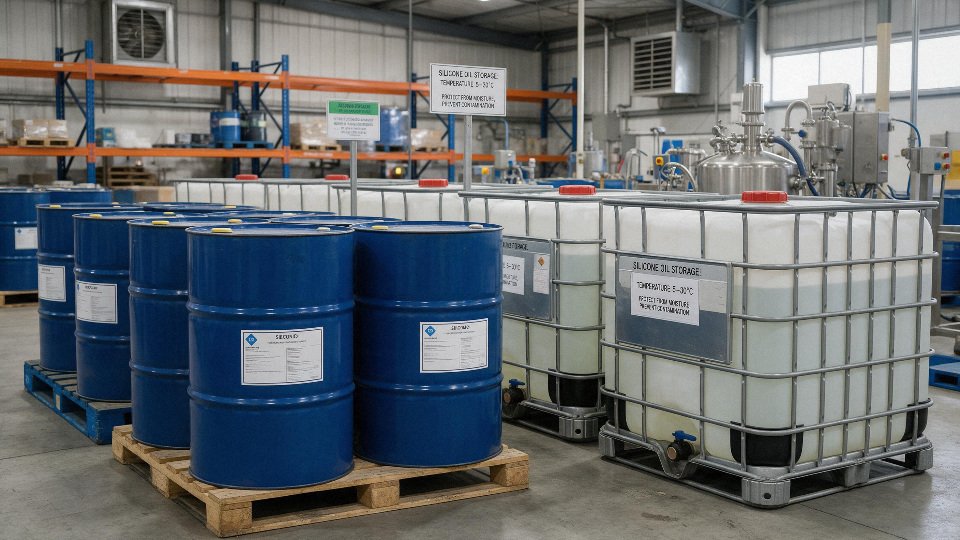
Standard PDMS stores well — 24 to 36 months in sealed HDPE or stainless steel containers kept away from moisture and direct UV. Si–H functional grades (used in crosslinking and surface treatment applications) are more sensitive; moisture exposure triggers premature reaction and viscosity drift, sometimes within weeks of opening. Never store these in carbon steel drums. Dedicated moisture-exclusion protocols — nitrogen blanket or desiccant seals — are worth the small added cost.
Procurement Documentation Checklist
Before approving a new grade or supplier, your file should include the Safety Data Sheet (SDS) and Technical Data Sheet (TDS), a certificate of analysis (CoA) with lot-specific viscosity and purity data, any applicable third-party test reports (USP Class VI, FDA compliance letter, REACH SVHC declaration), and supplier quality certifications. ISO 9001 is a baseline. For automotive lubrication or sealing applications, IATF 16949 certification from the supplier is worth requiring — it signals the process controls and traceability that prevent the quiet substitution of off-spec material mid-contract, which happens more often than procurement managers expect.
Supplier Evaluation and Quality Verification: How to Qualify a Silicone Oil Source
Sourcing silicone oil feels straightforward until you get a drum that visually looks right, passes a quick viscosity check on arrival, and then causes mold sticking or damper drift six weeks into a production run. By that point the batch is consumed and root-cause analysis becomes archaeology. The upstream work — qualifying the source properly — is the only reliable prevention.
Tier-1 vs. Spot-Market Sourcing
Direct supply from major producers (Dow, Momentive, Shin-Etsu, Wacker, Elkem) gives you something a trading company genuinely cannot replicate: a traceable chain from monomer synthesis through finished fluid. That matters when you’re specifying a 50 cSt PDMS for a food-contact release application or a 100,000 cSt fluid for a precision rotary damper, where the actual polymer chain length distribution — not just the average viscosity — determines performance.
Distributors are not automatically suspect. An authorized stocking distributor for Shin-Etsu or Wacker typically re-sells with original documentation intact and can offer genuine flexibility on pack size and lead time, which spot production runs often need. The problem is multi-tier trading chains: the further the fluid travels from the original production batch, the higher the chance that documentation has been retyped, containers have been repacked, or that lower-grade material has been blended in to hit a viscosity target. Gray-market silicone oil from trading companies with no direct producer relationship is where adulteration risk concentrates.
In practice, I’d treat any new supplier that can’t produce the original producer’s Certificate of Analysis (CoA) — not a reissued internal document — as unqualified until proven otherwise.
Incoming Inspection: The Core Test Battery
Don’t rely on the supplier’s CoA alone. Run your own incoming tests. The minimum panel for most industrial PDMS grades:
| Test | Standard | What It Catches |
|---|---|---|
| Kinematic viscosity | ASTM D445 | Grade substitution, blending |
| Refractive index | ASTM D1218 | Off-grade or adulterated fluid |
| Flash point | ASTM D92 (Cleveland Open Cup) | Light-end contamination, solvent carry-in |
| Specific gravity | ASTM D1298 | Density anomalies, heavy adulterants |
| Water content | ASTM E203 (Karl Fischer) | Moisture ingress, emulsification risk |
For critical applications — damping fluids, medical-grade release agents, transformer coolants — add viscosity-temperature profile (viscosity index verification) and, if the application is thermally demanding, a TGA scan to confirm degradation onset temperature.
FTIR as a Rapid Authenticity Screen
Infrared spectroscopy is fast, inexpensive, and surprisingly powerful as a first-pass authentication tool. Authentic PDMS shows strong Si–O–Si absorption in the 1,000–1,100 cm⁻¹ region and methyl C–H stretching around 2,960 cm⁻¹. Mineral oil adulteration — one of the more common adulterants because it hits viscosity targets cheaply — produces additional aliphatic C–H peaks in the 2,850–2,925 cm⁻¹ range that don’t belong in a clean PDMS spectrum. A reference library spectrum from a known-good batch takes minutes to build and gives you a rapid yes/no screen on every future delivery.
FTIR can detect mineral oil adulteration in PDMS silicone oil through additional aliphatic C–H absorption peaks not present in authentic PDMS spectra.True
Mineral oil contains long aliphatic hydrocarbon chains that produce characteristic C–H stretching bands at approximately 2,850–2,925 cm⁻¹ and bending bands near 1,460 cm⁻¹. Authentic PDMS has minimal aliphatic hydrocarbon content, so these peaks indicate contamination or adulteration and are detectable by routine ATR-FTIR.
Batch-to-Batch Consistency and SPC
Viscosity tolerance in supplier datasheets often reads as ±5% for standard industrial grades, tightening to roughly ±2% for precision damping or calibration fluid applications — though what’s actually achievable depends on the producer’s polymerization control. Set your incoming inspection limits tighter than your process tolerance, not equal to it. If your damper application needs ±3%, your incoming spec should flag anything outside ±2%.
Plot every incoming viscosity measurement on a run chart. Gradual drift — say, three consecutive batches trending 1.5% high — is often a process change at the supplier’s reactor before any single value breaches a hard limit. SPC catches that; spot-checking doesn’t.
Supplier Audit Criteria
A supplier audit for silicone oil should cover raw material traceability to the chlorosilane or cyclosiloxane monomer source, in-process viscosity control records, and batch segregation practices. For food-contact or medical-grade material, GMP compliance documentation and third-party audit history are non-negotiable — not because regulators always audit your incoming supply, but because contamination incidents become liability incidents fast. Check environmental permit status for the production facility, especially for suppliers in regions where permit enforcement is variable; a facility operating under a notice of violation is a supply continuity risk regardless of current product quality.
Contractual Quality Assurance
Get the agreed specification written into the purchase order — viscosity range, flash point minimum, water content maximum — not just a reference to “manufacturer’s standard.” Include a first-article qualification protocol for any new supplier or new production site. Require retained samples (typically 500 mL per batch, held for 12–24 months) and specify that liability for off-spec supply includes rework and downtime costs, not just material replacement. Suppliers who push back hard on retained sample requirements or liability language are telling you something useful about their confidence in their own process control.
Approved Vendor List Maintenance
An AVL for silicone oil should specify re-qualification triggers explicitly: supplier facility relocation or capacity expansion, any formulation change notification (however minor it sounds), and any quality incident on a previous shipment. For critical applications, annual re-qualification — even if nothing has gone wrong — is reasonable and cheap relative to a production disruption. Qualification isn’t a one-time event; it’s an ongoing relationship with documented evidence.
Total Cost of Ownership Analysis: Price per Kilogram vs. Real Application Economics
Unit price is the number procurement managers see first and, unfortunately, often the number the decision gets made on. That’s a mistake with real consequences on the plant floor.
Standard PDMS runs roughly $3–$15/kg depending on viscosity grade, order volume, and whether you’re buying from a distributor or direct from a major producer. Phenyl-modified grades sit in the $20–$50/kg range, fluorosilicone typically $60–$120/kg (sometimes higher for tight-spec lots), and medical-grade PDMS usually $15–$40/kg — the spread within that last band depending heavily on whether you need USP, FDA 21 CFR, or full ISO 10993 documentation packages. These aren’t list prices carved in stone; they move with silicone monomer markets, and regional supply tightness can push spot pricing 20–35% above contract rates within a single quarter.
Annualized Fluid Cost: Service Life Changes Everything
A recirculating thermal bath running standard PDMS at 200–230°C typically needs a fluid change every 6–12 months, depending on whether the system is open or closed, how tightly temperature is controlled, and whether the fluid is ever allowed to flash or oxidize at air-exposed surfaces. A high-stability phenyl-modified grade in the same bath might run 24–36 months before acid number or viscosity drift forces a change.
Do the annualized math before dismissing the premium. If your bath holds 400 kg of fluid and you’re paying $7/kg for standard PDMS, a 9-month average change interval costs roughly $370–$560/year in fluid alone, not counting disposal or labor. The same bath filled with a $32/kg high-stability grade, changed at 30 months, works out to around $510/year — nearly identical fluid cost, with half the maintenance events. In practice the high-stability option is often cheaper once you account for everything else.
The Hidden Costs That Don’t Appear on the PO
Disposal is underpriced in most TCO models. Standard PDMS with no halogen contamination disposes as non-hazardous waste in most jurisdictions — tipping fees in the range of $0.10–$0.40/kg, give or take regional variation. Fluorosilicone is a different story; fluorinated waste streams can attract hazardous disposal rates of $1.50–$4/kg or more depending on local regulations and whether blending with other halogenated waste is permitted. That gap alone can erode much of fluorosilicone’s apparent cost advantage in high-volume applications.
System cleaning between fluid changes carries real labor cost — typically 4–12 hours of maintenance technician time on a medium-size recirculating system, plus solvent and PPE costs. If you’re changing fluid twice a year instead of once, you’re absorbing that cost twice. Fluid sampling and analysis (viscosity check, acid number, flash point) runs $80–$250 per sample through an external lab, or less if you have in-house capability. Skipping analysis to save money is how you end up running degraded fluid and then wondering why your heat transfer performance has quietly deteriorated.
Yield Impact in Molding and Release Applications
Switching from a generic, undocumented silicone release oil to a certified-grade PDMS with controlled viscosity and purity can reduce part rejection rates in rubber molding by several percentage points.True
Viscosity consistency and low volatile content directly affect release film uniformity; inconsistent or contaminated oil causes surface defects, incomplete release, and mold fouling — all documented causes of cosmetic and dimensional rejects in rubber and silicone part molding.
A simple break-even calculation: if your line runs 8,000 parts per shift and a 3% reject reduction is achievable by switching from a $5/kg generic to a $12/kg certified grade, and each rejected part costs $0.80 in material and labor, that’s roughly $192 recovered per shift. The premium fluid might cost an extra $15–$25 per shift to apply at typical coating rates. Break-even comes well within the first shift.
Viscosity, Pump Energy, and the Over-Specification Trap
Higher viscosity fluid costs more to pump. In a recirculating system with a centrifugal or gear pump, moving from a 100 cSt fluid to a 500 cSt fluid at the same flow rate typically increases motor power draw by 15–30%, depending on pipe diameter, line length, and pump curve. Over a year of continuous operation, that energy penalty on a modest 2.2 kW pump can add $400–$900 in electricity costs at typical industrial tariffs. Engineers sometimes over-specify viscosity “for safety” — it’s a habit worth examining with an energy meter in hand.
Grade Consolidation vs. Specialized Stocking
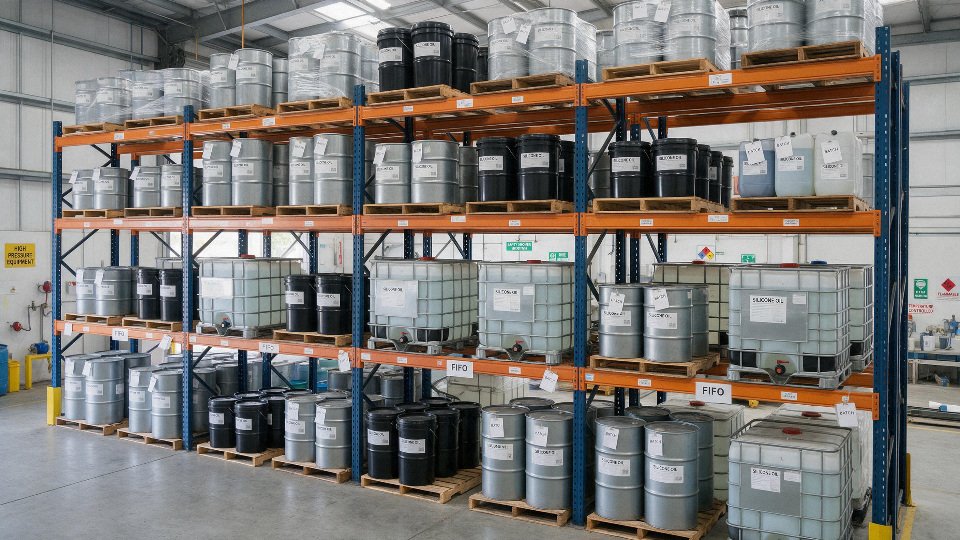
Stocking six specialized viscosity grades sounds like thorough engineering. In practice it creates slow-moving inventory, shelf-life management headaches (silicone oil is stable, but contamination risk grows with time in opened drums), and the real possibility that a rarely-used grade becomes obsolete and has to be written off. In many plants, a single mid-range grade — 100–350 cSt is a common consolidation target — can serve lubrication, damping, and moderate-temperature heat transfer applications adequately, reserving specialized grades only where performance genuinely demands them.
| Scoring Factor | Weight | Standard PDMS | High-Stability Grade | Notes |
|---|---|---|---|---|
| Unit cost | 20% | High | Low | Inverts on annualized basis |
| Service life | 25% | Low | High | Bath temperature is key variable |
| Performance risk | 25% | Medium | Low | Depends on process criticality |
| Compliance cost | 15% | Low | Low–Medium | Regulatory path adds cost |
| Supply chain resilience | 15% | High | Medium | Specialty grades have fewer sources |
Weight these factors to your application. A low-criticality general lubrication job scores differently than a continuous thermal bath running at 260°C with an eight-hour changeover penalty.
Step-by-Step Silicone Oil Selection Workflow: A Practical Decision Framework
Getting to the right silicone oil grade isn’t a single lookup — it’s a sequence of narrowing decisions, and the order matters. Skip regulatory filters until after you’ve picked a chemistry, for instance, and you can end up scrapping weeks of viscosity testing because the grade fails food-contact or environmental requirements. The workflow below is sequential on purpose.
Step 1 — Define Application Function and Operating Envelope
Write it down, even if it feels obvious. State the primary function: heat transfer bath, gear or bearing lubrication, mold release, damping fluid, dielectric coolant, or surface treatment. Then document the actual operating conditions — not the equipment nameplate limits, the real ones. Temperature range during normal operation and during worst-case excursions, contact materials (metals, elastomers, plastics, coatings), mechanical load and shaft speed if lubrication is involved, cycle frequency if it’s damping. This document becomes the acceptance baseline for everything downstream, including supplier disputes.
Step 2 — Run Regulatory and Compliance Filters Before Anything Else
This step eliminates candidates fast and saves wasted effort. If the product contacts food, packaging, or pharmaceutical process streams, FDA 21 CFR or EU 10/2011 compliance isn’t optional — it immediately restricts you to specific low-viscosity PDMS grades and rules out most amino-functional and specialty variants. Medical or implantable applications require USP or ISO 10993 data. Working in an ATEX or NEC Class I hazardous area? Standard silicone oils have high flash points (typically above 300°C for viscosities above 50 cSt), but you still need the actual flash-point value documented for the specific grade, not a family-level assumption.
Environmental zone restrictions — groundwater protection areas, marine applications, certain European regional regulations — may limit you further based on persistence and aquatic toxicity data. Sort these filters out first.
Step 3 — Select Chemical Family
With compliance constraints set, match functional requirements to chemistry. Standard PDMS handles the majority of industrial applications: heat transfer, general lubrication, release, dielectric insulation, damping. Phenyl-modified grades are the call when you need better thermal stability above roughly 200°C, improved compatibility with organic solvents, or specific refractive index for optical applications. Amino-functional silicones serve textile finishing and personal care manufacturing — they don’t belong in most mechanical applications. Fluorosilicone is the answer when the fluid contacts aggressive fuels, concentrated acids, or halogenated solvents that would cause a PDMS fluid to swell a rubber seal or degrade entirely.
Step 4 — Bracket the Viscosity Grade
Use viscosity-temperature charts (every reputable supplier publishes them; if yours doesn’t, that tells you something). For heat transfer applications, lower viscosity reduces pumping losses and improves turbulent heat transfer coefficient, but too low and you lose film strength at elevated temperature. For lubrication, calculate minimum film thickness using the operating speed, load, and bearing geometry — this is the place where guessing costs you a bearing failure at 2 a.m. on a Saturday. Target a viscosity range, not a single point, because you’ll need flexibility when you get to supplier shortlisting.
Step 5 — Verify Thermal and Chemical Compatibility
Cross-reference your operating temperature ceiling against the grade’s rated maximum — and use the conservative end of the published range, not the optimistic one. Request immersion test data for any elastomers, plastics, or coatings in contact with the fluid. Published compatibility tables are a starting point; a 72-hour soak at your actual operating temperature with your actual seal material is the real answer. Silicone oil is broadly inert, but certain amino-functional grades will attack polycarbonate, and some phenyl grades cause unexpected swelling in EPDM seals depending on phenyl content.
Silicone oil is chemically compatible with all common elastomersFalse
While PDMS is broadly inert, amino-functional and phenyl-modified grades can cause swelling or degradation in specific elastomers including polycarbonate-backed seals and certain EPDM compounds. Always verify with immersion testing at operating temperature.
Step 6 — Shortlist Suppliers and Request Samples
Pull from suppliers who passed your qualification process — certificates of analysis with lot-specific viscosity, refractive index, and volatile content values, not just family-level datasheets. Request samples of sufficient volume to run your incoming inspection protocol: viscosity at 25°C (and 40°C if thermal range matters), appearance, flash point, and any application-specific tests like dielectric strength or pour point. Don’t skip this on a reorder from a known supplier; batch-to-batch variation from a trading company reselling repackaged product is a real failure mode.
Step 7 — Total Cost of Ownership Comparison
Lay the shortlisted grades against each other on annualized cost, not price per kilogram. A premium phenyl-modified grade at $45/kg that lasts 18 months in a high-temperature bath beats a standard PDMS at $6/kg that needs draining and replacing every four months — once you factor in fluid disposal, downtime, and labor for the drain-and-refill cycle. Run the numbers for your actual consumption volume and your actual change interval.
Step 8 — Write the Formal Internal Specification
One page, locked under change control. It should capture: trade name and grade designation, viscosity at 25°C with acceptance limits (±10% is typical, tighten it if your process is sensitive), approved supplier and any qualified alternates, incoming test requirements and pass/fail criteria, storage conditions (cool, dry, away from UV and strong oxidizers), shelf life, and the change-control procedure anyone must follow before substituting an alternate. Without this document, institutional knowledge walks out the door with the last person who remembered why you specified 500 cSt instead of 350 cSt.
Frequently Asked Questions About Silicone Oil Selection
Can I substitute silicone oil with mineral oil to reduce cost?
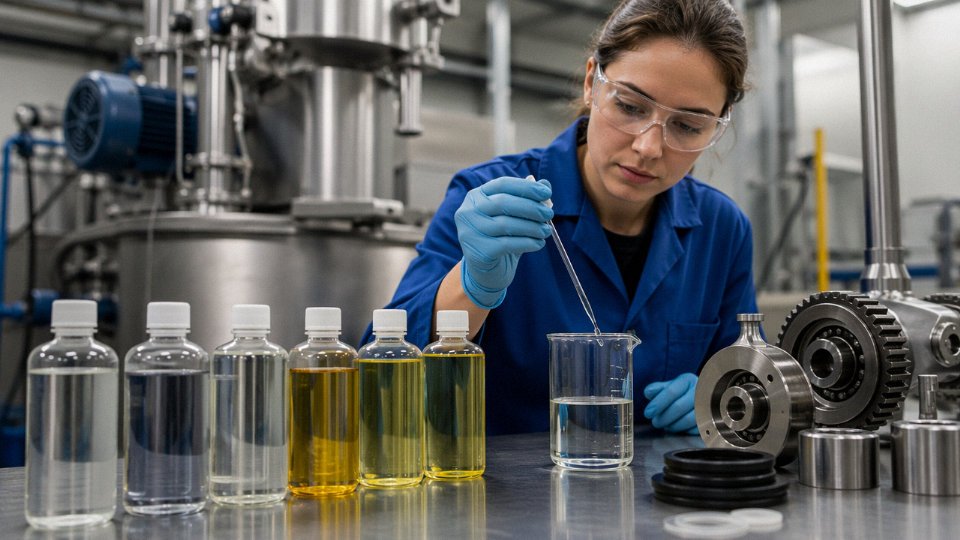
Sometimes, but the failure modes are specific and worth understanding before you try. Mineral oil viscosity index runs roughly 90–110; standard PDMS sits in the 200–400 range depending on grade. That gap translates directly to viscosity swing across temperature — in a heating bath cycling between 20°C and 150°C, a mineral oil that specs fine at room temperature may thin to the point of inadequate film coverage at operating temperature, or flash off if you push past 150°C. Silicone oil handles that range without blinking.
The surface energy difference is the other issue. Silicone oil’s low surface tension (roughly 20–21 mN/m for PDMS versus 28–32 for mineral oil) means better substrate wetting on non-polar surfaces like silicone rubber, polyolefins, and certain mold steels. If your application involves mold release or plastic part lubrication, mineral oil may not spread the same way, and you’ll see uneven coverage, drag marks, or adhesion failures. In thermal management loops and bath heating, mineral oil is workable up to about 200°C with antioxidant additives — push past that and you’re dealing with oxidative breakdown, sludge, and fouling on heater elements. Not a hypothetical: it’s a common cause of unexplained heater burnout on older lab and process baths.
Mineral oil can directly replace silicone oil in most thermal bath and lubrication applicationsFalse
Mineral oil has a significantly lower viscosity index, lower thermal stability ceiling (typically under 200°C for sustained use), and different surface energy characteristics. Substitution without engineering review risks film failure, oxidative sludge, and equipment damage in applications designed around silicone oil properties.
What viscosity silicone oil is best for damping applications?
Rotary dampers typically run in the 10,000–500,000 cSt range, and the right point within that window depends on torque target, shaft speed, and operating temperature — not just one of those. Damper manufacturers almost always specify viscosity at the intended operating temperature, not at 25°C, because PDMS viscosity does change with temperature (less dramatically than mineral oil, but not negligibly at extremes). A fluid specified at 60,000 cSt at 25°C might sit around 20,000–30,000 cSt at 80°C. For a damper that needs consistent torque across seasonal temperature swings, you want to know the viscosity-temperature curve, not just the headline number. Ask your supplier for viscosity data at your actual operating temperature range before committing.
Is silicone oil safe for skin contact and food processing equipment?
Not automatically. Cosmetic-grade PDMS — the kind used in hair serums and skin creams — goes through specific purity testing and formulation review. Food-contact-grade silicone oil must comply with regulations like FDA 21 CFR 178.3570 in the US, which covers silicone compounds used as release agents and lubricants on food processing equipment. Pharmaceutical-grade PDMS has its own specification tier entirely. Standard industrial PDMS is none of those things. If you’re running a food plant and someone proposes using a general-purpose silicone oil on conveyor components or as a release agent on bread pans, push back and ask for the specific regulatory compliance documentation. “It’s silicone” is not sufficient.
How do I dispose of used silicone oil properly?
Linear PDMS is generally classified as non-hazardous waste in most jurisdictions, and spent fluid in good condition sometimes qualifies for fuel blending at cement kilns or industrial burners. The complication is cyclic siloxanes — D4, D5, D6 — which can accumulate in used fluid, particularly if the oil has been thermally stressed or contaminated. Several regulatory bodies (the EU in particular) classify certain cyclics as substances of very high concern. Before disposal, have your used fluid tested for cyclic siloxane content and confirm current local classification requirements. Don’t assume the disposal route that worked two years ago is still compliant.
Why is my silicone oil turning yellow or increasing in viscosity during use?
Yellowing usually means oxidative degradation, typically from sustained operation above the oil’s rated thermal ceiling. Above roughly 200–230°C (depending on grade and oxygen exposure), PDMS undergoes oxidative chain coupling — polymer chains crosslink, viscosity climbs, and eventually you get a gel or a varnish-like residue rather than a fluid. Metal ion contamination accelerates this: iron, copper, and certain catalytic metals present from corroding system components or contaminated process streams can catalyze siloxane rearrangement reactions at temperatures well below the nominal service limit. If you’re seeing viscosity drift or color change, run a temperature audit first. Check whether your actual bath or loop temperature is exceeding spec — thermocouple calibration drift is more common than people admit. Change the fluid, address the contamination source, and consider switching to a phenyl-modified grade with higher oxidative stability if the process genuinely demands the higher temperature.
Can silicone oil be mixed with other lubricants or fluids?
Generally, no — and the consequences of getting this wrong are specific. PDMS is incompatible with mineral oil; the two will phase-separate rather than blend, and the silicone phase tends to cause swelling in nitrile and EPDM seals. Mixing with PAO synthetics or ester-based fluids creates similar compatibility risks, with the added problem that ester fluids can hydrolyze in the presence of moisture, and that interaction becomes unpredictable in a mixed system. In practice, if you’re topping off a system or transitioning between fluids, flush thoroughly rather than blending. The cost of a proper flush is trivial against the cost of seal replacement and system teardown.
What is the difference between silicone oil and silicone fluid?
They refer to the same thing. “Silicone fluid” is the more precise term used in ASTM and ISO standards; “silicone oil” is the term most engineers and procurement teams use on the floor and in purchasing documents. Both describe liquid-state polydimethylsiloxane or its functional derivatives. The terminology doesn’t affect chemistry or specification — just use whichever matches your organization’s documentation standard and make sure the technical specification underneath it is unambiguous.
How long does silicone oil last in storage?
Standard PDMS in sealed original containers, stored away from direct moisture and UV, typically holds specification for 24–36 months. The range depends on the storage environment — a drum sitting in a warehouse that swings between -10°C and 40°C seasonally will age faster than one in a climate-controlled store. Si–H functional grades (used as crosslinkers or reactive intermediates) are more sensitive: 12–18 months is realistic, and moisture ingress can cause premature gelation or loss of reactivity. After opening any container, reseal it immediately and log the date. Before using stored silicone oil in a critical application, re-test viscosity at minimum — it takes ten minutes and catches most degradation problems before they become a production issue.