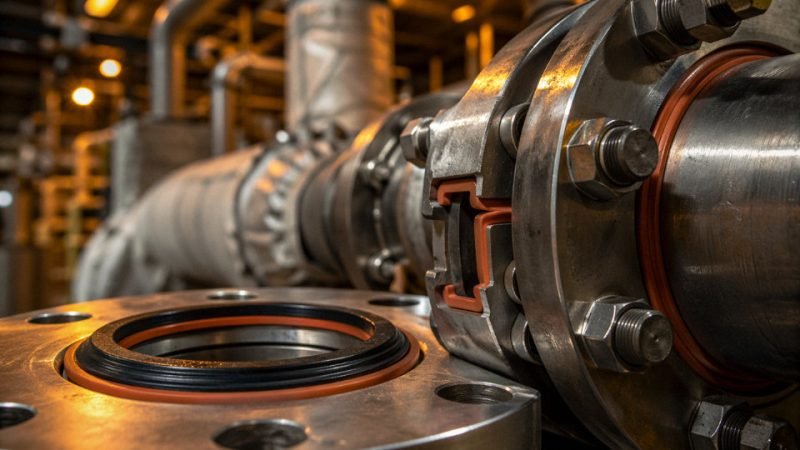
Silicone rubber seals, gaskets, and tubing get specified once and then mostly forgotten — which is fine, until they’re not. A door seal that’s been cycling in a 180 °C oven for eight years starts weeping heat. A pump diaphragm that looked fine on visual inspection tears mid-shift. The downstream cost of that failure — unplanned downtime, scrapped batches, emergency procurement at spot prices — almost always dwarfs whatever was saved by not scheduling a proactive replacement. Knowing the actual service life, and what shortens it, is the difference between a maintenance budget and a crisis fund.
Silicone rubber lifespan depends heavily on grade and operating conditions. General-purpose silicone exposed to outdoor UV and ozone typically lasts 20–30 years. High-temperature VMQ and PVMQ grades can sustain 10,000 or more hours of continuous service at 200 °C before meaningful property loss. Medical-grade implant silicone is tested to functional lifespans exceeding 30 years under ISO 10993 and FDA 510(k) protocols.
What makes silicone genuinely interesting from an engineering standpoint — and what most datasheets understate — is how dramatically that range compresses or expands depending on heat cycling, chemical exposure, mechanical loading, and even the cure system used. A 20-year figure and a 5-year figure can describe the same base polymer in different applications. The rest of this article breaks down exactly what drives that difference.
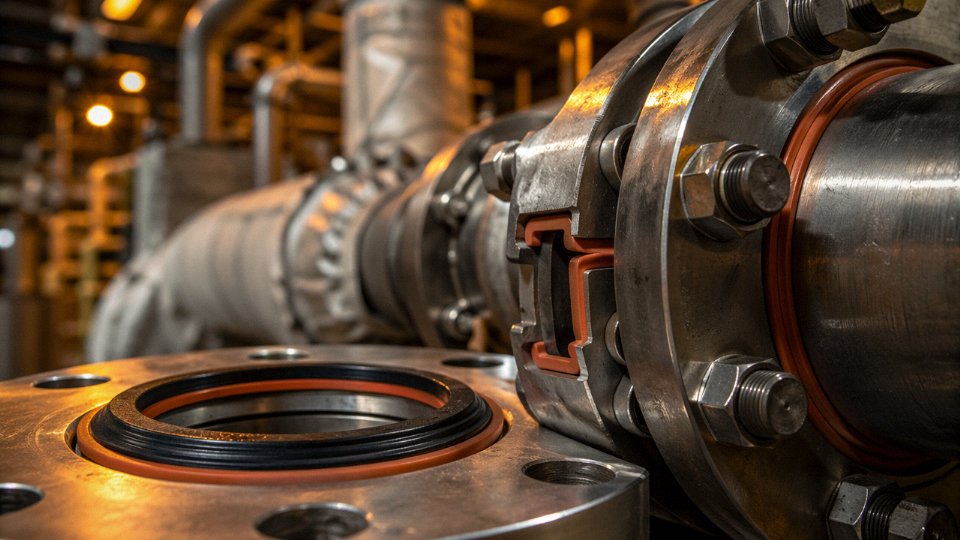
How Temperature Exposure — From Cryogenic Cold to 300°C Heat — Determines Silicone Service Life
Temperature is the single biggest variable in predicting how long a silicone rubber component will actually survive. Get the grade right and a seal might outlast the machine it’s installed in. Get it wrong and you’re looking at hardened, cracked elastomer inside six months — and whatever downtime that causes.
Continuous vs. Intermittent Limits by Sub-Type
Standard polydimethylsiloxane (PDMS) — the workhorse grade you’ll find in most general-purpose gaskets and tubing — is typically rated for continuous service between 150°C and 180°C. Push it to 200°C continuously and oxidative chain scission accelerates noticeably; the material loses elongation and starts to crumble at cut edges within a few thousand hours. That degradation isn’t always obvious until a seal fails under pressure.
High-consistency rubber (HCR) compounds, especially those compounded with fumed silica and heat-stabilizing additives, extend the continuous ceiling to roughly 200–230°C. These are the grades used in oven door seals, automotive exhaust periphery gaskets, and continuous vulcanization lines. The upper limit depends heavily on cross-link density and filler loading — two HCR parts from different compounders can behave quite differently at 220°C, which is worth verifying with supplier time-at-temperature aging data before you commit to a design.
Fluorosilicone (FVMQ) trades some of the upper temperature headroom for dramatically better fluid resistance. Its continuous thermal ceiling sits around 175–200°C, slightly below standard HCR, but it handles fuels, hydraulic oils, and aromatic solvents that would swell a plain VMQ compound. In practice, aerospace and automotive fuel-system applications almost always specify FVMQ precisely because you’re managing both chemical and thermal exposure simultaneously.
Phenyl silicone (PVMQ) solves a different problem entirely: low-temperature embrittlement. Standard VMQ grades start losing flexibility below roughly -55°C to -65°C. PVMQ, depending on the phenyl content, stays pliable down to -115°C — which matters enormously in cryogenic valve seats, aerospace seals exposed to fuel-soaked airframes at altitude, or any outdoor equipment in subarctic environments. The tradeoff is cost; PVMQ is meaningfully more expensive than commodity VMQ, so specifying it when you only need -40°C performance is wasteful.
The Arrhenius Aging Rule and What It Means Practically
The Arrhenius thermal aging model — well established in elastomer science and the basis of most accelerated aging standards including ISO 11346 — gives engineers a usable rule of thumb: every 10°C increase above a material’s rated continuous temperature roughly halves its useful service life. The relationship isn’t perfectly linear and the exact factor varies by formulation and the specific failure criterion you’re tracking (elongation loss, compression set, tensile retention), but as a first-pass planning tool it holds up reasonably well.
Work through a concrete example. A standard VMQ O-ring rated for a 20-year service life at a continuous 150°C — a reasonable spec for a well-compounded HCR grade — might retain acceptable sealing force for only about 10 years at 160°C, roughly 5 years at 170°C, and somewhere around 2.5 years at 180°C. That 30°C gap between design intent and actual process temperature can cost you most of the component’s expected lifespan.
Every 10°C increase above a silicone rubber's rated temperature roughly halves its useful service life according to Arrhenius-based aging models.True
The Arrhenius thermal aging relationship is well-documented in elastomer science and encoded in standards such as ISO 11346. The exact halving factor varies by compound and failure criterion, but the order-of-magnitude estimate is accepted practice in materials engineering.
In practice, process temperatures are rarely stable. A steam-traced pipe that nominally runs at 160°C can spike to 185°C during a startup transient or a control valve hunting event. That’s the temperature your seal actually sees — not the steady-state number on the P&ID.
Thermal Cycling Fatigue: A Separate Failure Mode
Sustained heat is one problem. Repeated cycling is another, and the two compound each other in ways that static aging data doesn’t capture.
Every thermal cycle — heat up, cool down — produces differential expansion and contraction between the silicone matrix and its reinforcing filler (typically silica). Over many cycles, this differential stress nucleates micro-cracks at the filler-matrix interface. Industry test data on standard VMQ grades subjected to 10,000 cycles between -55°C and +200°C shows measurable compression-set increase — the seal doesn’t spring back as far, and sealing force drops. Ten thousand cycles sounds like a lot, but in an industrial oven that cycles four times per day, you’re there inside seven years.
The practical implication: for applications with frequent, wide-range thermal cycling, specify a grade with optimized filler-matrix adhesion or consider post-cure schedules that pre-stress the compound. And document the actual cycle count in your maintenance system. Most plants don’t, which is why thermal fatigue failures get misdiagnosed as chemical attack or installation damage.
UV radiation, ozone, and outdoor weathering: realistic lifespan figures for exposed silicone parts
The degradation story for most elastomers outdoors starts fast and gets ugly. Natural rubber, EPDM without proper compounding, SBR, neoprene — expose them to a southern-facing facade in Phoenix or a petrochemical plant roof in Singapore and you’ll see crazing, cracking, and tensile loss within two to five years. Sometimes faster. The culprit is always the same: carbon–carbon double bonds in the polymer backbone react readily with ozone and UV-generated free radicals. Silicone doesn’t have that problem at the molecular level, which is why the weathering conversation is fundamentally different.
Why the Si–O–Si backbone changes everything outdoors
Silicone’s inorganic silicon–oxygen backbone has bond dissociation energies well above what atmospheric UV (primarily in the 295–400 nm range) can cleave under normal outdoor exposure. Ozone — which tears through diene rubbers by attacking C=C bonds — finds essentially nothing to react with in a properly cured polydimethylsiloxane network. That’s not a marketing claim; it’s a straightforward consequence of the chemistry. Diene-based rubbers require antioxidant packages, ozone-protective waxes, and regular maintenance to survive even 5–7 years exposed. Silicone, specified correctly, needs none of that.
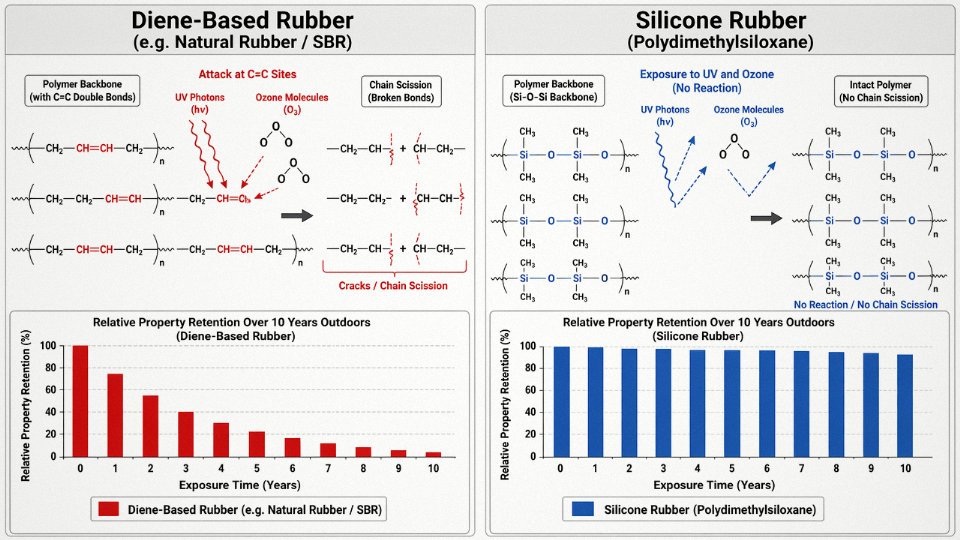
Silicone rubber's Si–O–Si backbone is inherently resistant to UV and ozone degradation, unlike diene-based rubbers which require antioxidant protection for outdoor use.True
The Si–O backbone lacks the C=C unsaturation that ozone attacks in natural rubber and SBR. Bond dissociation energy of Si–O (~452 kJ/mol) exceeds the photon energy of most terrestrial UV, making photolytic chain scission rare under normal atmospheric UV conditions.
What accelerated weathering tests actually show
ASTM G154 runs UV-condensation cycles using a UVA-340 lamp (closely mimicking solar UV between 295–365 nm) combined with moisture condensation cycles — probably the most relevant accelerated protocol for building envelope and outdoor industrial applications. ISO 4892-3 is the near-equivalent international standard, using similar fluorescent UV sources and wet/dry cycling. Under these protocols, well-compounded silicone sealants from reputable producers typically retain acceptable elongation, hardness, and adhesion after 5,000 to 10,000 hours of continuous cycling. Some high-consistency rubber (HCR) profiles tested for transportation sealing push past 10,000 hours without visible cracking.
Translating accelerated hours to real-world years is never a clean calculation — it depends on geographic latitude, orientation, annual UV index, and whether the part sees pooled moisture. A commonly used rough correlation puts 1,000 hours of ASTM G154 at somewhere between 1 and 3 real outdoor years depending on climate, so 5,000–10,000 hours corresponds to roughly 20–30 years in temperate to moderate-sun climates. That 20–30 year range is the honest number. Expect toward the lower end in high-UV environments like high-altitude installations or tropical roofing, and toward the upper end in northern-facing or shaded industrial settings.
Carbon black, pigments, and the grade selection trap
Here’s where a lot of outdoor specifications go wrong. Standard translucent or white silicone grades — common in glazing seals and some architectural profiles — have meaningfully shorter UV service life than carbon-black grades. Adding roughly 2–3% carbon black to the compound acts as both a UV absorber and a free-radical scavenger; it’s cheap insurance and can extend surface integrity by years in high-UV exposure. Black silicone gaskets on rooftop HVAC equipment or solar panel frame seals are black for a reason.
White and light-colored grades used on southern-facing facades need either UV-stabilizer packages (hindered amine light stabilizers adapted for silicone systems) or acceptance that some surface chalking and minor hardness increase will occur over the back half of a 20-year service window. That chalking is mostly cosmetic in structural sealant applications, but in dynamic joints it can contribute to fatigue cracking at the interface. Worth flagging at the specification stage, not during a warranty inspection.
For shaded industrial settings — think underside of a conveyor hood or an interior-facing curtain wall gasket — even translucent grades perform adequately for 15–20+ years, so spending up for a UV-stabilized compound there is usually unnecessary.
| Application | Recommended grade | Expected outdoor lifespan | Key risk if wrong grade used |
|---|---|---|---|
| South-facing glazing seal, high UV | Carbon black or UV-stabilized | 25–30 years | Surface hardening, joint fatigue cracking |
| Rooftop HVAC gaskets | Carbon black | 20–28 years | Chalking, adhesion loss at flange |
| Solar frame seals (desert/tropical) | Carbon black, low-compression-set | 18–25 years | Compression set → water ingress |
| Shaded industrial profiles | Translucent or pigmented acceptable | 15–22 years | Usually none if cured correctly |
| White architectural seals | UV-stabilized white compound | 18–25 years | Chalking, cosmetic degradation |
One practical note: accelerated weathering tests don’t fully replicate thermal cycling fatigue, joint movement, or substrate adhesion loss over decades. A sealant that passes 8,000 hours of G154 is not automatically certified for 25 years in a dynamic facade joint. The chemistry holds up; the mechanical interface is a separate design problem.
Chemical Environment and Fluid Compatibility: Which Exposures Slash Silicone Lifespan and Which Don’t
Thermal data gets most of the attention when engineers specify silicone, but in practice, chemical environment is what kills seals prematurely — and it does so quietly, often not showing up until a gasket extrudes out of its groove or a diaphragm loses spring-back mid-cycle. Knowing which fluids silicone tolerates and which ones destroy it within weeks is genuinely practical knowledge for anyone maintaining process equipment.
What silicone handles well
Standard VMQ silicone is stable against dilute acids and alkalis, most alcohols, water, and steam up to around 120°C. Ketones and esters cause moderate swell — typically 10–20% volume increase depending on concentration and temperature — which is usually acceptable for static seals, less so for dynamic ones. Non-polar aliphatic hydrocarbons (mineral spirits, low-aromatic lubricating oils) cause only minor swelling, usually under 5–8%, and silicone parts in those environments routinely hit 5–10 years of continuous service without meaningful loss of mechanical properties.
Hydraulic fluid compatibility varies more than suppliers sometimes admit. Phosphate-ester fluids are a known problem; silicone swells substantially in them. Petroleum-based hydraulic oils are generally fine. If you’re unsure, run a 72-hour immersion coupon test at operating temperature before committing to a seal design — this takes a day of lab time and saves months of troubleshooting.
The fluids that genuinely shorten silicone life
Concentrated aromatic hydrocarbons are where standard VMQ falls apart. Toluene and benzene are the classic culprits. VMQ can absorb 40–80% of its own volume in toluene within 72 hours at room temperature; at elevated temperature that absorption accelerates. Tensile strength drops 50–70% in parallel, so the part still looks intact but has lost most of its mechanical integrity. A seal that started at 8 MPa tensile can be sitting below 3 MPa after a three-day exposure. It won’t fail dramatically — it’ll just lose compression set recovery and start leaking, usually at the worst possible time.
Chlorinated solvents (trichloroethylene, methylene chloride, perchloroethylene) behave similarly. Strong alkalis above roughly pH 12–13 attack the Si–O–Si backbone directly, and concentrated hydrofluoric acid does the same. These aren’t common process fluids, but they show up in cleaning cycles, and maintenance teams occasionally use aggressive solvents near silicone-sealed equipment without realizing the damage they’re causing.
Standard VMQ silicone can absorb 40–80% by volume in toluene within 72 hours, reducing tensile strength by 50–70%.True
This is consistent with published ASTM D471 immersion test data for VMQ grades in aromatic hydrocarbons. Exact values vary with durometer, crosslink density, and temperature, but the range is accurate for standard 40–70 Shore A VMQ compounds.
Fluorosilicone changes the picture for fuel and oil service
FVMQ (fluorosilicone) is a meaningfully different material in chemical environments, not just a premium version of standard silicone. The fluorine substituents on the polymer backbone reduce swell in aromatic fuels, engine oils, and jet fuel to under 10% by volume — sometimes well under that depending on the specific fuel blend. In fuel-contact applications, this translates directly to lifespan: where VMQ might fail within 3–6 months due to progressive swell and compression set loss, a correctly specified FVMQ seal routinely lasts 10 years or more. The tradeoff is higher material cost (usually 3–5× VMQ on a per-part basis) and slightly narrower low-temperature flexibility. For aerospace fuel systems or automotive fuel injector seals, FVMQ is the obvious call. For a water-service pump, it’s unnecessary spending.
Steam aging deserves its own conversation
Steam is often treated as a benign environment because silicone handles water and moderate temperatures individually. Continuous saturated steam above 150°C is a different situation. At those conditions, water attacks the silicone polymer chain through hydrolytic scission of Si–O–Si bonds — a mechanism that’s slow but cumulative and irreversible. In autoclave gasket service, the practical result is that compression set climbs gradually with each cycle. Expect 200–500 autoclave cycles before compression set exceeds roughly 40% and the gasket can no longer maintain reliable sealing. The range depends heavily on gasket cross-section, clamp load, and whether steam is truly saturated or superheated. Thinner cross-sections degrade faster because the entire volume sees thermal cycling stress. Some plants track this by cycle count and replace gaskets on a fixed schedule; others wait for leaks, which is the more expensive approach.
A structured compatibility overview helps at the point-of-spec:
| Fluid Class | Typical Swell (VMQ) | Swell (FVMQ) | Practical Verdict |
|---|---|---|---|
| Dilute acids (pH > 3) | < 5% | < 3% | Both acceptable |
| Aliphatic hydrocarbons | 5–10% | < 5% | VMQ usually fine |
| Aromatic hydrocarbons (toluene) | 40–80% | 8–15% | Use FVMQ or switch elastomer |
| Chlorinated solvents | 30–60% | 10–20% | Avoid VMQ; evaluate FVMQ case-by-case |
| Jet fuel / engine oil | 20–40% | < 10% | FVMQ required for long life |
| Water / steam ≤ 120°C | < 5% | 150°C | Hydrolytic degradation | Similar | Limit cycles; replace on schedule |
| Strong alkalis (pH > 13) | Backbone attack | Moderate resistance | Avoid both; consider FFKM |
The table is a starting screen, not a final answer. Real process fluids are mixtures, temperatures fluctuate, and part geometry affects how aggressively a fluid can penetrate. When the application is borderline — say, a process stream with 15% toluene in an aliphatic carrier — coupon testing at actual operating temperature and pressure is worth the effort before running 500 seals on a production line.
Mechanical Stress, Dynamic Fatigue, and Compression Set: How Repeated Loading Ages Silicone Seals and Gaskets
Most specification sheets focus on heat resistance and chemical compatibility, which leaves mechanical degradation as the failure mode nobody talks about until a seal starts weeping. In practice, for anything that moves, flexes, or stays compressed for years, mechanical aging is often what kills the part first.
Compression Set: The Number That Decides Whether a Seal Still Works
Compression set is measured per ASTM D395 Method B — you compress a test disc to 25% deflection, hold it at elevated temperature, release it, and measure how much thickness it fails to recover. A value of 0% means perfect recovery. A value of 100% means the material took a permanent set and won’t spring back at all.
The practical cutoff most engineers use is roughly 25–30%. Above that, a static O-ring or gasket can no longer generate enough contact stress against the mating surfaces to maintain a reliable seal, especially where thermal cycling causes flanges to shift slightly. Some applications tolerate up to 35%, but that’s pushing it on anything seeing pressure above a few bar.
Fresh, high-quality silicone — a good VMQ or PVMQ compound, properly post-cured — typically tests in the 10–15% range after 22 hours at 175°C. That’s genuinely good performance. The problem is long-term aging. Hold the same compound at elevated temperature for thousands of hours and compression set climbs, often reaching 40–60% depending on the grade, the peroxide or platinum cure system used, and whether post-cure was done correctly at the factory. Platinum-cured silicone generally ages more gracefully on this metric than peroxide-cured material, all else equal.
Compression set values above 25–30% indicate a silicone seal has reached the practical end of its sealing life under normal bolt-load conditions.True
At compression set values above this threshold, the elastomer cannot generate sufficient residual contact stress to maintain a leak-free interface across thermal cycles or minor flange movement, consistent with field experience and ASTM D395 Method B interpretation in sealing applications.
One thing that catches people out: a seal can look fine visually and still be functionally dead on compression set. You pull it out, it’s not cracked, no obvious oxidation — but squeeze it and it doesn’t spring back the way new material does. I’ve seen maintenance teams reinstall those seals.
Dynamic Fatigue: Where Reinforcement Actually Earns Its Cost
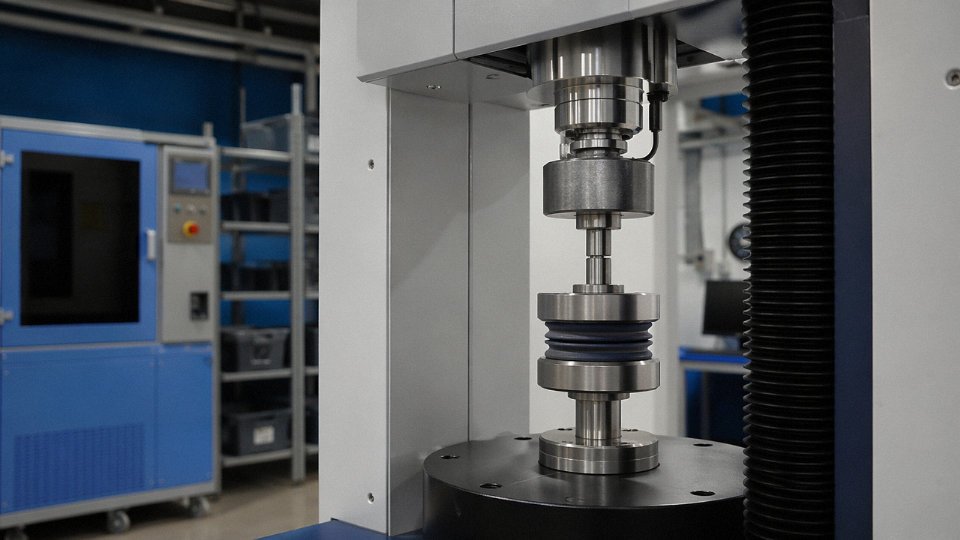
Static seals live a quieter life. Dynamic applications — shaft seals, bellows, vibration mounts, flex connectors — cycle the material repeatedly, and that’s where crack growth becomes the governing failure mechanism. Silicone under cyclic tensile strain follows a Paris-law relationship between crack growth rate and stress intensity factor range, meaning small cracks propagate at a rate that accelerates as crack length increases.
The filler system makes an enormous practical difference. A reinforced HCR (heat-cured rubber) compound with fumed silica filler — the kind used in serious engineering applications — can sustain roughly 1–5 million flex cycles before crack propagation becomes critical failure, depending on strain amplitude and peak elongation. Un-reinforced RTV silicone, which people sometimes use because it’s cheap and convenient to dispense, may fail somewhere in the 50,000–100,000 cycle range under the same conditions. That’s an order of magnitude difference, and it matters a great deal in something like an automotive intake boot or a compressor valve plate gasket.
Keep cyclic tensile strain below about 50% elongation if you want to stay on the safe part of that curve. Above 50%, crack propagation rate accelerates sharply.
Realistic Lifespan by Application Type
These ranges assume proper installation, appropriate compound selection, and conditions within the material’s rated window — which is not always what happens on a real plant floor.
| Application | Typical Lifespan | Primary Limiting Factor |
|---|---|---|
| Static O-ring / gasket (flanged joint) | 15–25 years | Compression set, thermal aging |
| Dynamic shaft seal (rotary) | 3–8 years | Fatigue, lip wear; heavily rpm-dependent |
| Vibration isolation mount (automotive / industrial) | 10–15 years | Dynamic fatigue, ozone, temperature cycling |
| Silicone coolant hose | 8–12 years | Combined compression fatigue, fluid swelling, heat |
The shaft seal range is wide because rpm matters enormously — a seal running at 3,000 rpm accumulates far more fatigue cycles per year than one at 400 rpm, and lubrication at the lip interface is the difference between a seal lasting three years and eight. Dry-running even briefly accelerates lip wear and heat generation, which degrades the elastomer locally much faster than bulk aging would.
Coolant hoses sit at an awkward intersection of static compression (hose clamp), intermittent pressure cycling, and heat soak. Silicone handles that combination better than EPDM in high-temperature applications, but the 8–12 year range assumes the clamp torque has been maintained — a detail that rarely gets checked during routine service.
Grade selection guide: matching silicone type to target lifespan in five major industries
Specifying “silicone rubber” without naming a grade is roughly like ordering “steel” for a structural beam — the family is wide, the performance gap between members is enormous, and the cost of getting it wrong shows up as premature failure or wasteful over-engineering. What follows is a working framework, not a catalog recitation.
Aerospace and defense
Fluorosilicone (FVMQ) compounds qualified to MIL-SPEC A-46146 or AS1523 are the default choice anywhere fuel, hydraulic fluid, or aggressive lubricant contact is possible. Plain VMQ swells badly in jet fuel — sometimes 30–50% volume increase depending on fuel aromatic content — and that alone makes it unusable for fuel-system O-rings regardless of temperature performance.
Airframe sealants in this space typically carry a 20–25 year design life, largely dependent on surface prep, primer adhesion, and how well the joint sees controlled UV exposure versus a hangar environment. Fuel-system dynamic O-rings are a different story: scheduled replacement at 3,000–5,000 flight hours is standard, driven by compression set accumulation and cyclic pressure fatigue rather than any dramatic chemical attack. In practice, operators often replace on the conservative end of that window because the cost of an unplanned seal failure in a pressurized fuel line is catastrophically out of proportion to the price of a new O-ring.
Medical and food-contact applications
Platinum-cured liquid silicone rubber (LSR) is the correct choice for implantable devices and long-term body-contact components — not because it is fashionable, but because peroxide-cured systems leave cure byproducts that complicate USP Class VI and ISO 10993 biocompatibility testing. For implants tested under FDA 510(k) pathways, the target functional lifespan exceeds 30 years, validated through accelerated aging protocols that correlate elevated-temperature exposure to real-time degradation.
Platinum-cured LSR meets FDA 21 CFR 177.2600 and USP Class VI requirements for long-term body contact, while peroxide-cured HCR does not inherently satisfy the same standards without additional extractables testing.True
Platinum catalysis leaves no reactive residues; peroxide-cured silicone retains measurable byproducts that require extraction and testing before regulatory clearance, adding development time and cost.
Food-contact tubing is a different calculus. Bulk degradation is rarely the failure driver — the material can last 10 years mechanically. Sanitary cycles govern replacement instead. Peroxide-cured HCR tubing in dairy or beverage lines typically gets changed every 2–5 years because surface microporosity and minor surface crazing, invisible to casual inspection, create biofilm anchoring sites that CIP chemistry cannot reliably eliminate. This is a hygiene replacement, not a mechanical one, and procurement teams who don’t understand the distinction over-extend service intervals.
Construction and glazing
Neutral-cure and oxime-cure structural sealants qualified to ASTM C1184 or EOTA ETAG 002 are engineered to a 25-year design life for facade glazing. The cure chemistry matters here: acetoxy-cure silicones off-gas acetic acid during cure and will corrode metal substrates and certain stone — a recurring site problem that still catches applicators off-guard. Outdoor electrical encapsulants and potting compounds in switchgear rated per IEC 62772 routinely target 30 years of UV and thermal cycling resistance, which is achievable with properly stabilized high-consistency rubber formulations but not with commodity RTV.
Automotive under-hood
OEM gaskets and seals in powertrain applications are generally designed to a 150,000-mile or 15-year warranty horizon, whichever comes first. The working temperature range under a hood — roughly -40 °C cold-soak to sustained 175–200 °C near exhaust manifolds — demands VMQ or PVMQ grades rather than general-purpose silicone. Compression set at elevated temperature is the dominant aging mechanism; a gasket that has taken permanent set no longer maintains sealing force, and the result is an oil or coolant weep that starts small and becomes a warranty claim. Grades with low compression set ratings (typically under 25% after 70 hours at 175 °C per ASTM D395) are the ones worth specifying here, and it is worth verifying that figure against the actual service temperature, not the standard test temperature, because the relationship is nonlinear.
Accelerated Aging Test Methods and How to Translate Lab Results into Real-World Lifespan Predictions
Lab aging data on a supplier datasheet can look reassuringly precise — “retains 80% tensile strength after 1,000 hours at 200°C” — but pulling a real-world service life number out of that single line requires understanding what the test actually measured, what it didn’t, and where the extrapolation can quietly fall apart. Quality engineers who skip that critical read-through often end up with seals that fail two years into a ten-year design life, with no warning and no recourse.
The Main Standards and What Each One Actually Covers
ASTM D573 is the workhorse for hot-air oven aging. You expose a flat sheet specimen to elevated temperature for a fixed duration, then measure retained tensile strength and elongation. It’s reproducible, cheap, and widely cited. The limitation is that it tests sheet stock in still or mildly circulating air — not a production cross-section under compression, not a part exposed to a fluid on one face, not anything with a stress concentration. It tells you about the polymer matrix. It does not tell you about your gasket.
ASTM D1171 covers ozone resistance. Two variants: static exposure at a fixed strain level, or dynamic bending. Silicone generally performs well here compared to EPDM or neoprene, so the standard is rarely the gating factor for silicone qualification — but it matters if you’re writing a spec that has to stand up in an audit or a product liability context.
ISO 11346 and IEC 60216 are where the math gets serious. Both use Arrhenius-based thermal endurance modeling: the assumption that the rate of chemical degradation follows an exponential relationship with absolute temperature. ISO 11346 applies broadly to rubber and elastomers; IEC 60216 is specific to electrical insulation materials. If you’re qualifying silicone wire insulation or connector boots for switchgear, IEC 60216 is the governing framework and the one certification bodies will ask for.
Walking Through an Arrhenius Calculation
Here’s a simplified version of how the extrapolation works in practice. You run isothermal aging runs at three or four elevated temperatures — say 200°C, 175°C, 150°C, and 125°C — measuring the time at which a chosen property (elongation at break is common; IEC 60216 uses a threshold, often 50% retention) drops below your acceptance criterion. You then plot the natural log of that failure time against the reciprocal of absolute temperature (1/T in Kelvin). If the relationship is genuinely linear, Arrhenius holds. You fit a regression line, read off the extrapolated ln(time) at your service temperature, and convert back to hours.
Concrete example: specimens aged at 200°C lose 50% elongation at roughly 900–1,100 hours depending on grade. At 175°C the same threshold sits around 2,500–3,500 hours. Plot those points, extrapolate to 100°C service, and you might project a B10 life somewhere in the range of 80,000–120,000 hours — call it 9–14 years of continuous service. The confidence interval on that extrapolation is wide, often ±30–40%, which is why responsible datasheets show a range rather than a single number.
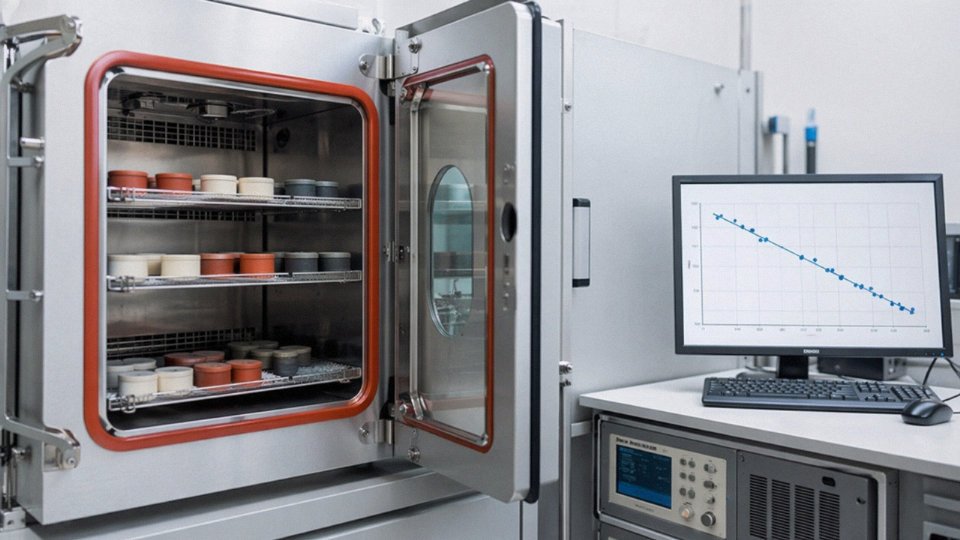
Arrhenius extrapolation from accelerated aging tests can predict silicone lifespan at lower service temperatures with reasonable accuracy when degradation is thermally driven and the regression is linear across the tested temperature range.True
Arrhenius-based models are validated in ISO 11346 and IEC 60216 and are widely accepted in materials science, but accuracy depends on linearity of the ln(time) vs. 1/T relationship and degrades significantly when non-thermal stressors are present simultaneously.
Where the Predictions Break Down
The single biggest source of over-optimistic lifespan predictions is ignoring synergistic degradation. Heat alone, UV alone, and ozone alone each degrade silicone at a certain rate. All three simultaneously can degrade it noticeably faster than any single-factor model would predict — in some outdoor electrical enclosure applications, combined-environment aging produces failure roughly 1.5–2× sooner than the thermal model alone suggests. Most standard test protocols don’t combine stressors. That’s a gap you have to bridge with engineering judgment and a safety factor, not with math.
The second issue is specimen geometry. Sheet stock cures differently than a molded O-ring or an extruded profile. Residual stress, cure gradient, and surface-to-volume ratio all affect how oxidation propagates. A 2 mm flat plaque is not your 6 mm cross-section gasket. If at all possible, age production-representative parts, not cut sheet specimens.
Assembly stress is the third overlooked factor. A flange gasket installed at the torque your technician felt was “tight enough” may be at 30–40% compression set going into service. That pre-stress accelerates creep and shifts the effective starting point of the aging curve. Build a safety factor of at least 1.5×, and 2× if the application involves any combination of elevated temperature, mechanical load, and chemical exposure running simultaneously. That’s not conservatism for its own sake — it’s the gap between what the test measured and what your part actually experiences.
Inspection, Maintenance Intervals, and End-of-Life Indicators for Silicone Components in Service
Silicone’s long service life can actually work against you in a maintenance context. Because parts rarely fail catastrophically without warning, technicians get comfortable — and the subtle early indicators get ignored until there’s a leak or, in electrical applications, a flashover. Building a structured inspection habit around observable degradation markers is how you avoid that.
Visual and Tactile Indicators Worth Knowing
The first thing to check on any silicone part that’s been in outdoor or UV-heavy service is the surface finish. A chalky or powdery film forming on the surface is a classic sign of UV attack on the PDMS backbone — the siloxane crosslinks at the surface oxidize and the polymer essentially dusts off over time. It’s cosmetically alarming but doesn’t always mean the bulk mechanical properties are gone yet. Worth noting, though: if you can wipe a white residue off a silicone weatherstrip or glazing seal with your thumb, that part is in the latter third of its service life outdoors.
Thermal aging shows up differently. Parts running near their upper continuous-use limit — say, silicone oven door gaskets, exhaust flange seals, or motor housing boots — tend to harden rather than surface-degrade. You’ll feel it immediately: a healthy silicone gasket has a characteristic give and spring-back; a thermally aged one feels almost plastic, sometimes slightly brittle at bend radii. This is crosslink densification, and it’s irreversible. Once a seal has lost that elastic recovery, it will not re-conform to the mating face under cycling loads and you’re already leaking, just possibly not enough to notice yet.
Stickiness or tackiness is the opposite failure mode, and it’s equally bad. Chain scission — polymer backbone fragmentation from aggressive chemical exposure, ozone, or simply very high heat over very long durations — leaves a surface that feels almost gummy. In food processing or pharmaceutical environments, this is a contamination risk independent of the sealing failure.
Cracking at bolt-hole edges and at tight bend radii is usually the visible culmination of mechanical fatigue plus thermal cycling. It tends to show up first at stress concentrations, which is exactly where a gasket will lose sealing force first.
Quantitative In-Situ Tests You Can Actually Do
A Shore A durometer is a cheap, underused tool on most plant floors. The baseline is whatever the part specification calls for — typically 40–70 Shore A for most sealing applications — and a drift of more than ±10 points from that baseline is a reliable trigger for replacement review. You don’t need to remove the part to do this on an exposed face; a pocket durometer takes about 15 seconds.
A Shore A hardness change greater than ±10 points from baseline indicates significant silicone aging that warrants replacement evaluation.True
This threshold is consistent with ASTM D2240 practice and widely cited in elastomer qualification standards; hardness change correlates with crosslink density shifts that affect compression set and sealing performance.
For electrical insulation — silicone jacketing on cables, transformer gaskets, switchgear boots — infrared thermography during load is genuinely valuable. Degraded silicone insulation shows elevated surface temperatures at the degraded zone before dielectric failure occurs. It’s not a perfect proxy, but a hot spot of 15–20°C above the ambient conductor temperature on a silicone-insulated run deserves immediate follow-up.
Leak-down and pressure-decay testing on sealed systems is the most direct quantitative check. Run a timed decay test at operating pressure, compare against the as-built baseline, and trend it. A system that held 0.5% pressure loss per hour at commissioning and is now at 2% per hour has a problem somewhere — silicone seals are often the culprit because they’re the softest element in the joint stack.
Replacement Intervals by Criticality Tier
Not every silicone part should be on the same maintenance clock. In practice, a useful three-tier framework looks like this:
| Tier | Application examples | Strategy | Typical interval |
|---|---|---|---|
| Safety-critical | Pressure vessel seals, aircraft door seals, oxygen system gaskets | Fixed calendar replacement regardless of apparent condition | 5–10 years, depending on operating temperature and regulatory requirement |
| General industrial | HVAC duct gaskets, pump housing seals, fluid-line O-rings | Inspect at scheduled PM; replace at first confirmed hardness shift, cracking, or compression set creep | Inspect every 2–3 years; replace as indicated |
| Architectural / civil | Glazing sealants, curtain wall joints, facade weatherseals | Visual inspection cycle; full repointing when adhesion loss or surface chalking is widespread | Inspect every 5 years; full repointing typically at 20–25 years |
The safety-critical tier deserves a specific operational warning: visible condition is not a valid reason to extend the replacement interval on a pressure-rated or life-safety seal. Silicone can look and feel acceptable while its compression set recovery has degraded past the point where it will reseal after a thermal cycle or a flange re-torque. Fixed-interval replacement exists precisely because visual inspection is unreliable at that end of the risk spectrum.
For general industrial applications, the real cost driver is usually unplanned downtime rather than the part itself — a $12 silicone O-ring that fails inside a mixing vessel at 2 a.m. on a Sunday costs nothing, until it costs a full shift of lost production. Tracking hardness trends at scheduled PM intervals and replacing on condition before that point is almost always the cheaper path.
Frequently asked questions about silicone rubber lifespan
Does silicone rubber degrade in sunlight?
Not in any meaningful way over a typical product lifetime. Standard general-purpose silicone sits at the top of the elastomer class for UV resistance — the Si–O backbone simply doesn’t absorb UV energy the way carbon-chain polymers do, so the photodegradation mechanism that cracks nitrile or natural rubber within one to two outdoor seasons barely registers in silicone over decades. Realistic outdoor service life for unfilled silicone profiles and sheeting runs 20–30 years, depending on UV intensity (equatorial versus northern European latitude is a real variable), surface area exposed, and whether the part ever sees pooling water that concentrates contaminants.
Standard silicone rubber shows minimal UV degradation after 20+ years of outdoor exposure, unlike nitrile rubber which can crack within 1–2 years.True
Silicone's inorganic Si–O backbone lacks the chromophores that absorb UV radiation, a well-documented property confirmed by ASTM G154 and ISO 4892-series weathering test data.
Carbon-black-filled or pigmented grades do even better — the black absorbs and dissipates surface UV before it reaches the polymer chains underneath. If you’re specifying a silicone gasket for a rooftop HVAC unit in Arizona or a curtain wall expansion joint, a carbon-black-filled extrusion grade is a simple, low-cost upgrade that’s probably worth it.
Can silicone rubber be used in boiling water continuously?
Intermittent exposure to 100°C water — think a dishwasher seal or a food-processing gasket that gets washed down daily — is generally fine for 10–15 years, give or take, assuming a decent-quality silicone to start with. The problem is steam and extended continuous immersion above roughly 120°C. At those conditions, hydrolytic chain scission starts competing with the material’s natural thermal stability, and you’re looking at a functional life closer to 2–5 years before compression set and softening become a real operational problem.
Platinum-cured liquid silicone rubber (LSR) grades consistently outperform peroxide-cured HCR in steam environments. The reason is residual peroxide byproducts in HCR that accelerate degradation under hydrolytic conditions — it’s one of the less-obvious reasons LSR dominates medical and food-contact hardware even when the mechanical specs on paper look similar. If your application involves autoclaving or continuous steam at 130°C plus, specify platinum-cure and pressure your supplier for steam-aging data, not just air-oven data.
How do I know when silicone seals need replacing?
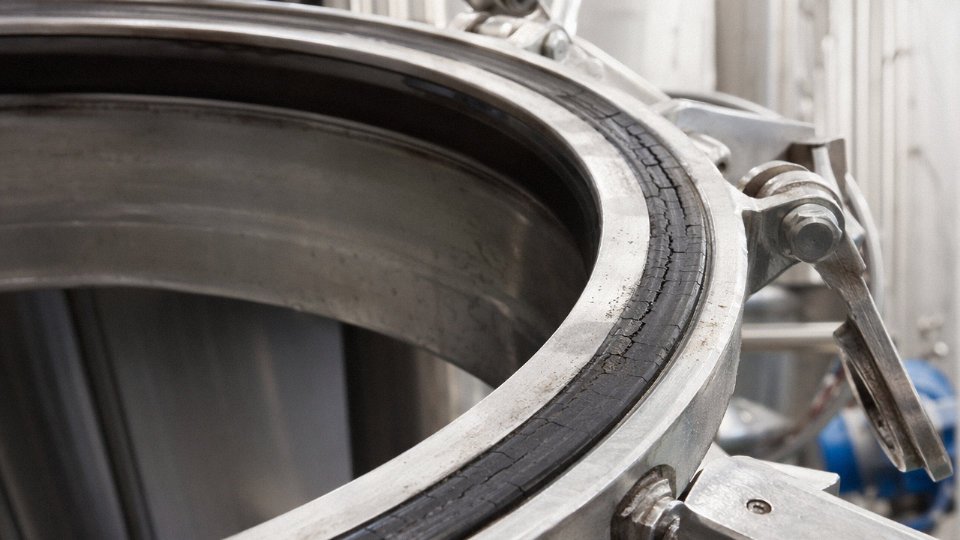
Four practical triggers, in rough order of how you’d catch them on a maintenance walkround: Shore A hardness has drifted more than 10 points from the original specification (a durometer takes about 20 seconds to use and costs almost nothing); compression set has climbed past 30% measured per ISO 815 or ASTM D395; visible surface cracking or chalking is present — don’t dismiss hairline crazing as cosmetic; or the part has simply run out its design-life interval regardless of how it looks. That last one trips people up. A seal that looks intact after 12 years in a hot fluid service may have lost its sealing force even though the surface is clean. Replace on schedule, not just on appearance.
Is silicone rubber recyclable at end of life?
Not through municipal or standard industrial recycling streams — silicone doesn’t melt and reprocess the way thermoplastics do, and thermoset crosslinks make it incompatible with most recycling infrastructure. What does work at industrial scale is cryogenic grinding into silicone powder, which gets used as a filler in coatings, rubber compounding, and as a dry lubricant additive. Some specialty recyclers — primarily in Germany, Japan, and increasingly in China — accept clean industrial silicone scrap in bulk quantities. If you’re running a high-volume molding operation generating significant trim and reject parts, it’s worth a conversation with a silicone reclaimer. Small-volume or mixed-contamination scrap usually ends up in controlled landfill, which is not ideal but is currently the practical reality for most plants.
Does cold temperature permanently damage silicone?
No — and this is one of silicone’s genuinely useful properties versus almost every competing elastomer. Standard VMQ grades flex down to around -55°C to -60°C with no permanent damage; PVMQ (phenyl-modified silicone) extends that to roughly -100°C to -115°C, which is why it shows up in aerospace cold-soak applications and cryogenic valve seats. The key word is “brief exposure” — after the part warms back up, it returns to its original flexibility and hardness with no measurable property loss. Compare that to EPDM or neoprene, which can suffer irreversible crystallization after prolonged sub-zero exposure and come back stiff and compromised. In practice, if you’re cycling a silicone seal between cold storage (-40°C) and a hot process line, the thermal fatigue from that cycling is more likely to limit life than the cold extreme itself.