Foam overruns a kettle, dough sticks to guides, a filler line starts dragging instead of releasing cleanly, and suddenly a minor lubricant or process-aid choice is driving stoppages, extra washdowns, rejected packs, and awkward questions from QA. On a plant floor, those problems rarely stay “small” for long; they turn into lost throughput, wasted product, and maintenance hours at the worst point in the shift. Food grade silicone oil sits in that narrow space between chemistry and operations, where the right material can stabilize processing and the wrong one can create compliance, residue, or performance trouble.
Food grade silicone oil is a silicone-based fluid, usually polydimethylsiloxane or a closely related formulation, selected for incidental food-contact or controlled food-processing use where the product grade, purity, and documentation match the application. In practice, buyers look at compliance status, viscosity, temperature capability, and use rate, not just “silicone oil” as a generic label.
That distinction matters because two drums labeled silicone oil can behave very differently in service. Viscosity can run from roughly 5 cSt to 1000 cSt in common food-contact uses, service temperature often depends on load and formulation more than the datasheet headline, and defoaming performance in food processing is often a ppm-level dosing question, not a “more is better” one. The useful discussion starts where plant conditions get messy: heat, shear, residue risk, paperwork, and whether the supplier can support the exact use case rather than a broad claim.
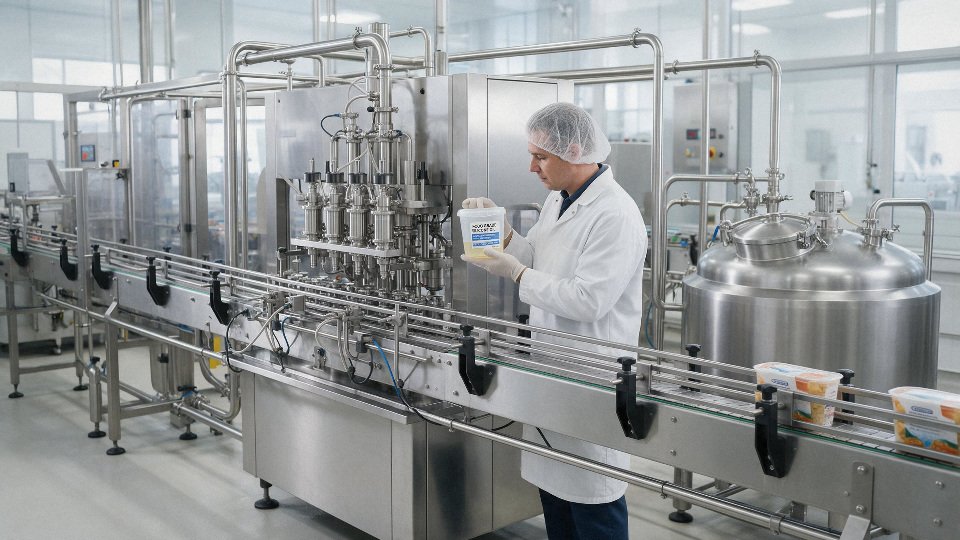
Siloxane chemistry and composition
Food grade silicone oil is usually a polydimethylsiloxane-based fluid, meaning its performance starts with a Si–O–Si backbone carrying mostly methyl side groups. That chemistry is why it spreads easily, resists water, stays usable across a wide temperature window, and remains relatively inert on many food-contact machine surfaces; it is also why purity and formulation details matter more than the label alone suggests.
At the molecular level, the core structure is a repeating siloxane chain:
- Si–O–Si–O–Si backbone
- Organic groups attached to silicon, most commonly methyl groups in dimethyl silicone fluids
- End groups that can vary by process and finishing step, influencing stability and trace volatiles
In food-related applications, the most common base fluid is dimethyl silicone oil, often referred to broadly as PDMS-type fluid. Buyers will see many variations sold under similar names, but from an engineering standpoint the useful question is not just “is it silicone oil?” but “what exact silicone fluid, with what molecular distribution, and in what formulation package?”
Why the Si–O backbone behaves differently from hydrocarbon oils
The siloxane bond geometry is a big part of the story. The Si–O bond is longer and more flexible than a typical carbon-carbon backbone in mineral or synthetic hydrocarbon oils, so the chain rotates easily and does not pack tightly. That loose packing helps explain several operating properties engineers care about:
- Lower surface tension than many conventional oils
- Good spreading over metal, elastomer, glass, and coated surfaces
- Water repellency from outward-facing methyl groups
- Useful thermal and oxidation resistance in many food-processing temperature bands
- Electrically insulating behavior, which matters around sensors, sealing points, and some conveying equipment
That does not make silicone oil universally better. The same low surface tension that helps with release and wetting can make cleanup harder if the wrong product gets onto a line where later printing, bonding, or coating must occur. A trace carryover on packaging film equipment, for example, can turn into adhesion problems downstream. The chemistry is doing exactly what it was designed to do; the process sequence is what makes it acceptable or troublesome.
Chain length, molecular weight, and what they change on the plant floor
A nominal viscosity number is really a shorthand for average chain length and molecular weight distribution. In broad terms, shorter chains mean lower viscosity and higher volatility; longer chains mean higher viscosity, lower volatility, and usually more persistent films.
That affects performance through several paths:
- Viscosity: Longer siloxane chains flow more slowly, so the fluid forms thicker films and drains off surfaces more slowly.
- Volatility: Lower molecular weight fractions evaporate or flash off more readily, especially at heated sealing jaws, ovens, dryers, or hot-fill equipment.
- Spreadability: Lower-viscosity fluids usually spread faster and cover fine surface features more readily.
- Residue behavior: Higher-viscosity fluids tend to remain on equipment longer; lower-viscosity materials may migrate more easily or be removed faster, depending on washdown and substrate.
A common plant-floor mistake is assuming that a lower-viscosity food grade silicone oil is automatically “cleaner.” Sometimes it is cleaner in the sense of leaving a thinner visible film. Sometimes it is worse because the higher low-boiler content can increase odor, migration concern, or volatility around warm equipment. The preferred choice flips with the application: for a controlled defoaming duty, ppm-level addition and rapid dispersion may favor one design; for a release or lubrication duty on a contact surface, persistence and film stability may matter more.
The same nominal viscosity does not guarantee the same performance
Two 100 cSt products can behave differently enough to matter in production. In practice, that difference often comes from composition details buyers do not see on the front page of a data sheet.
Key variables include:
- Breadth of molecular weight distribution
- Level of low-boiling cyclics or short-chain fractions
- End-group profile
- Trace catalyst or neutralization residues
- Filtration quality and particulate cleanliness
- Batch-to-batch consistency in finishing and packaging
A narrower distribution often gives more predictable evaporation and film behavior. A broader distribution may still meet the viscosity spec while carrying more light fractions that affect odor, volatility, or deposit formation. If your line is sensitive to foaming repeatability, release uniformity, or migration control, viscosity alone is not a sufficient buying specification.
Two food grade silicone oils with the same nominal viscosity can perform differently in service.True
Nominal viscosity reflects a bulk flow property, not the full composition. Differences in volatile fraction, molecular weight distribution, emulsion design, and contamination control can change spreading, persistence, odor, and process repeatability.
Pure silicone fluid versus formulated products
Not every product sold into food processing is just neat silicone fluid. Many commercial products are formulated systems designed for a job, not a chemistry lecture. That distinction matters in qualification and procurement.
Typical product forms include:
- Pure silicone fluid
- Usually used where the base polymer itself provides the required lubrication, release, or thermal stability
- Simpler from a composition standpoint, but still dependent on purity and volatile control
- Silicone emulsions
- Silicone dispersed in water with emulsifiers
- Chosen when easier dilution, safer handling, or more even application on certain substrates is needed
- Performance depends heavily on emulsion particle size, surfactant package, dilution water quality, and shear stability
- Antifoam formulations
- Often include silicone fluid plus silica or other functional components, sometimes in an emulsion or carrier system
- The mechanism is not just “silicone is slippery.” The droplet has to enter the foam lamella, destabilize it, and spread efficiently enough to rupture foam films
- Release formulations
- May include carriers, diluents, or additives to improve laydown, cure compatibility, or surface persistence
- These can create the biggest mismatch between expectation and performance if the user assumes the active silicone content tells the whole story
The mechanism matters here. In an antifoam, for instance, droplet size and compatibility determine whether the active material actually reaches and breaks foam or just circulates uselessly in the tank. In a release coating, the wrong emulsifier package can improve initial wetting but leave residues that interfere with subsequent printing or sealing. The formulation around the silicone is often what makes or breaks the process.
How structure drives the familiar performance claims
For technical buyers, the usual property list is only useful if tied back to chemistry and process effect:
- Low surface tension
- Helps the fluid spread quickly over machine parts and contact surfaces
- Useful for release and defoaming
- Can create contamination issues where later adhesion is required
- Hydrophobicity
- Methyl groups repel water, so the film resists wash-off better than many water-soluble materials
- Helpful in wet processing areas, though alkaline cleaners and mechanical action still matter
- Oxidation resistance
- Siloxane backbones generally tolerate heat and oxygen better than many organic oils
- Boundary: this is not unlimited; actual service temperature depends on formulation, residence time, load, contaminants, and airflow. Verify against supplier data and the equipment conditions, not just a generic temperature window.
- Dielectric behavior
- Silicone fluids are electrically insulating, which can be useful around electrical assemblies
- That does not replace proper electrical-grade qualification for specific equipment
- Limited reactivity
- They are relatively unreactive with many metals, ceramics, and common machine materials
- That said, they can still interact badly with some coatings, elastomers, adhesives, and downstream finishing steps, so compatibility testing is still worth doing
Why purity is not a paperwork issue
High purity matters because food-related use is rarely judged by bulk chemistry alone. A technically acceptable polymer can become commercially unacceptable through trace contamination.
Watch these categories closely:
- Low-boilers and unreacted cyclics
- Can increase odor, volatility, and migration concern
- Become more visible on hot surfaces and enclosed lines
- Catalyst residues or process byproducts
- Usually present at low levels, but they can affect color, odor, stability, or acceptance in sensitive applications
- Particulate contamination
- A filtration issue in packaging can become a visual defect
- In precision dosing or spray systems, particulates can plug fine nozzles or upset laydown consistency
- Packaging cleanliness
- Dirty drums, poor liner practice, or bad transfer hygiene undo a lot of upstream quality control
- In my experience, this is where otherwise decent material gets disqualified by a food plant QA team
For procurement, the practical implication is straightforward: specify the base chemistry, yes, but also ask how the supplier controls volatile fraction, cleanliness, and formulation consistency. If the application is sensitive, request the composition type, typical viscosity range, appearance, packaging controls, and any available information on volatile content or emulsion design rather than buying on viscosity grade and “food grade” labeling alone.
Performance properties that matter
A food grade silicone oil earns its keep when its viscosity, spreading, thermal behavior, and compatibility line up with the actual duty on the line. The same fluid can work beautifully as a ppm-level antifoam and fail as a chain lubricant or mold-release aid, because the property balance that helps one job often hurts another.
That is the point most buyers miss on first pass. They ask for “food grade silicone oil” as if the compliance status settles the selection. It does not. In practice, the useful choice sits inside a narrower window defined by equipment speed, contact time, surface material, cleaning method, temperature exposure, and whether the fluid is meant to stay put or disappear after doing its job.
Kinematic viscosity: where most selection decisions start
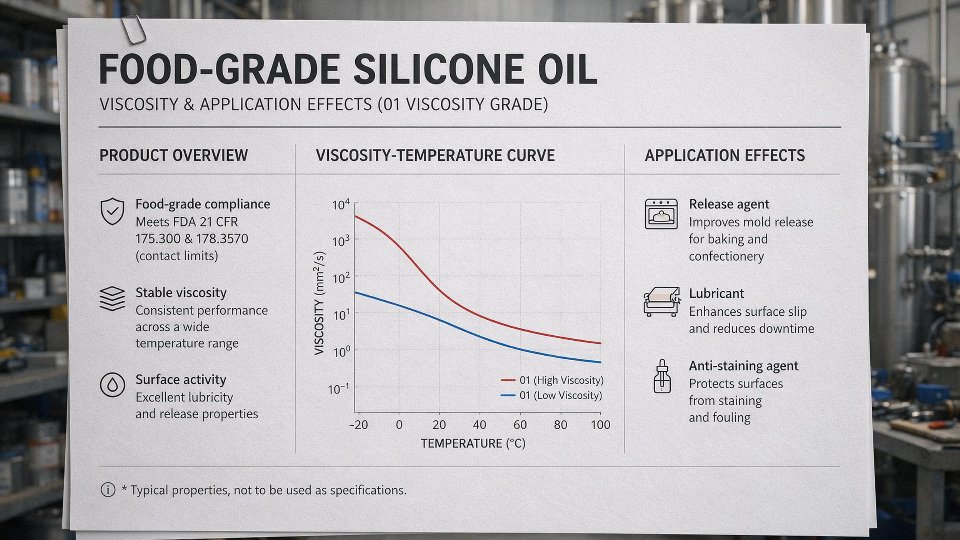
Typical food-contact grades used in industry often sit somewhere around 5 cSt to 1000 cSt, but that range only matters after you map the duty. Lower-viscosity fluids pump easily, wet surfaces fast, and spread into thin films; higher-viscosity fluids resist squeeze-out better and usually persist longer on parts, but they are harder to meter, harder to clean off, and less forgiving in fine-spray systems.
A few practical effects matter most:
- Pumping and metering
- Low viscosity reduces line losses and makes small dosing pumps more stable, especially in long narrow tubing.
- Higher viscosity can need heat tracing, larger lines, slower pump speeds, or positive-displacement equipment to avoid erratic feed.
- In winter, this shows up fast. A fluid that meters cleanly in July may hunt and pulse in an unheated utility room in January.
- Coating uniformity
- Lower-viscosity oils generally form thinner, more even films on molds, guides, knives, and conveyor-contact points.
- If the surface is rough or the part geometry has corners and recesses, too low a viscosity can run off before it does any useful work.
- Too high, and you start seeing streaking, droplets, or transfer to product where a cleaner dry-looking film was expected.
- Antifoam persistence
- Lower viscosity often gives faster initial spreading at the gas-liquid interface, which helps knock down foam quickly.
- Higher viscosity may persist longer once dispersed, but it can also be harder to distribute effectively in the first place.
- In food-processing defoaming, dosage is often at ppm level under validated controls, so small changes in feed behavior can matter more than a lab beaker test suggests.
- Lubrication film strength
- Higher-viscosity fluids usually maintain thicker separating films under slow-moving, lightly loaded contact.
- That does not make them universal lubricants. In heavily loaded boundary conditions, the chemistry of the interface and the machine design matter as much as bulk viscosity.
- Cleanability
- Lower-viscosity grades are usually easier to remove during wipe-down or detergent cleaning.
- Thick films can survive where you want washdown resistance, but they can also build up dust, fines, or product residue.
The mechanism is straightforward: viscosity governs how readily the fluid flows, spreads, and remains in place under gravity, shear, and contact pressure. That one parameter pushes performance through several different paths at once, which is why selection by “thicker is better” or “thin is cleaner” usually ends badly.
Surface tension and spreading: why silicone fluids suppress foam and help release
Silicone fluids are valued partly because they have low surface tension and spread readily over many surfaces. That gives them two especially useful behaviors in food and packaging operations: they can disrupt foam films, and they can create a low-adhesion interface on contact parts.
For foam control, the useful effect is not just “oil on top of bubbles.” The fluid must enter the foam lamella, spread fast enough, and destabilize the film so bubbles collapse. In many systems, that makes silicone-based materials unusually efficient at very low dose compared with many organic oils. Still, process chemistry matters:
- Proteins, sugars, surfactants, and suspended solids can change how well an antifoam disperses.
- Agitation intensity affects whether the fluid reaches the foam where needed or simply circulates below it.
- Temperature shifts can flip performance if viscosity and dispersion behavior move out of the useful zone.
For release duties, rapid spreading helps cover molds, chutes, seals, guides, and contact hardware with a low-energy film. That can reduce sticking on gummy or tacky products and can lower the force needed to demold or transfer parts. The trade-off is contamination risk downstream. A fluid that spreads exceptionally well can migrate farther than expected, reaching printing, labeling, heat sealing, adhesive bonding, or coating steps where even a trace residue causes fisheyes, weak bonds, or poor grip.
A good release film is often the enemy of downstream adhesion. If the process includes printing, gluing, or secondary coating, compatibility trials on finished parts are not optional.
The best antifoam fluid is not always the best lubricant or release agent.True
The preferred viscosity, spreading rate, film persistence, and migration behavior differ by duty. Fast-spreading low-dose antifoam performance does not automatically translate into durable lubrication or controlled release on moving contact surfaces.
Thermal stability: broad utility, but not unlimited
Food grade silicone oils are often chosen because they remain functional across a wide temperature range, commonly around -40 C to 200 C depending on formulation, load, oxygen exposure, and time at temperature. That broad window is useful in bakeries, thermal sealing equipment, intermittent hot-fill support systems, chilled conveying, and mixed hot-cold washdown environments.
The limit is not usually a single sharp failure point. It is cumulative exposure.
- At low temperature
- Silicone oils generally stay more fluid than many mineral oils.
- That helps startup torque, pumpability, and film continuity in cold rooms or winter ambient areas.
- At elevated temperature
- Short exposure may be acceptable where continuous residence is not.
- Open systems with high airflow and long dwell time lose fluid faster than closed or shielded systems.
- Oxygen exposure accelerates degradation pathways that may be minor in sealed service.
- Under thermal cycling
- Repeated heating and cooling can shift viscosity, increase loss by evaporation, and change how well the film stays on metal or elastomer surfaces.
- Deposits are more likely where a thin film sits on hot metal for long periods than where fresh fluid is replenished continuously.
So the broad temperature capability is real, but the conclusion stops holding when the fluid sees long residence at the hot end in an oxygen-rich, open, high-airflow zone. In that case, volatility and oxidation resistance matter as much as nominal temperature rating.
Volatility, flash behavior, and evaporation loss
Open kettles, tunnel ovens, hot conveyors, and high-speed packaging lines expose a weak point that purchasing specs often miss: some silicone fluids gradually disappear. Evaporation loss is not only a material-cost issue. It changes film thickness, antifoam persistence, surface cleanliness, and the frequency of reapplication.
Watch for these plant-floor consequences:
- More top-up demand than the trial suggested
- Drifting release performance across a shift
- Residue patterns near hotter zones and not cooler ones
- Airborne transfer to nearby sensors, photo-eyes, or packaging surfaces
- Ventilation or odor complaints even when gross degradation is not occurring
Flash behavior and safe handling must be checked against the current supplier documentation and the actual operating temperature. You cannot generalize one product’s flash point across the whole category. If the duty involves heated open application, ask for volatility data, not just a nominal service-temperature statement.
Water repellency, washdown resistance, and humid-service lubrication
Silicone oils repel water well, which is valuable where lubrication or release performance has to survive condensation, humid rooms, or frequent washdown. On conveyors, guides, and lightly loaded contact points, that can help maintain a lubricating film after incidental water exposure when some other fluids would emulsify or wash off more quickly.
That said, water repellency cuts both ways:
- Good water shedding can preserve function on exposed parts.
- The same non-wetting behavior can make alkaline cleaners less effective unless the cleaning chemistry and time are adjusted.
- In food plants with aggressive sanitation, surviving washdown is only an advantage if sanitation validation still passes.
If your sanitation program relies on complete fluid removal each cycle, a very persistent hydrophobic film may create more work than benefit.
Shear stability and mechanical durability
Silicone oils generally handle shear well in mixers, pumps, recirculation loops, and repetitive surface contact, which is one reason they hold performance in systems with constant motion. But “shear stable” does not mean invulnerable. In gearboxes, heavily loaded rolling contacts, or systems with contamination by powders and fines, mechanical wear modes can dominate regardless of the fluid’s molecular backbone.
The practical question is whether the fluid maintains enough viscosity and film behavior after repeated recirculation and contact stress to keep the process stable. In antifoam service, severe mixing can either help dispersion or destroy useful droplet size distribution depending on the formulation. In lubrication or release service, repeated wiping contact can polish the film off faster than the feed system replaces it.
Compatibility with seals, plastics, coatings, adhesives, and process chemistry
A food grade declaration does not guarantee compatibility with your machine materials or your downstream process. Silicone fluids are usually benign with many metals, but the trouble spots are often elsewhere:
- Elastomers and seals
- Verify with the actual seal material, not just “rubber.”
- Swelling, softening, or compression-set changes can appear in some compounds over time.
- Plastics and transparent parts
- Check stress-cracking risk and appearance changes, especially on sight glasses, guards, or polymer guides.
- Coatings and painted surfaces
- Silicone contamination can interfere with recoating or touch-up paint adhesion.
- Adhesives, inks, and sealants
- Very small carryover can create wetting defects, print skips, poor bond strength, or fisheyes.
- Process chemicals
- Caustics, surfactants, oxidizers, and cleaning agents can change retention, dispersion, or residue behavior.
- Validate under actual CIP or washdown conditions, not only on a fresh clean panel.
If the fluid must move across several functions in one plant, rank the duty that is least forgiving. A line can usually tolerate a lubricant that is slightly inconvenient to pump; it usually cannot tolerate a release fluid that ruins package printing two stations later. That is where a bench test with actual substrates, contaminants, and cleaning conditions saves money faster than another round of catalog comparison.
Food industry application map
The useful answer is this: food grade silicone oil is not one use case, but a family of controlled-use roles across foam control, release, lubrication, packaging support, and certain regulated additive applications. The right application depends less on the fluid alone than on where it can reach food, how much can transfer, and what the local regulatory route actually permits.
A lot of buying mistakes start here. Plants hear “food grade” and treat every silicone fluid as interchangeable across the line. In practice, a pan release film, a fermenter defoamer, and a conveyor lubricant may all involve silicone chemistry, but they sit in very different exposure categories, with different dosage logic, migration concerns, and verification requirements.
Process antifoam in liquid food production
Foam control is one of the most common and economically justified uses. In fermentation, sugar handling, starch processing, beverage operations, and other aerated liquid systems, small and controlled additions of silicone-based defoamers can recover usable vessel volume, stabilize transfer, and cut sanitation headaches caused by overflow and dried residue.
The mechanism is straightforward but worth stating properly. Foam becomes a production problem when gas bubbles are stabilized by proteins, surfactants, dissolved solids, or process shear. A silicone antifoam works by spreading at the gas-liquid interface and destabilizing the lamella around bubbles, so bubbles collapse faster than new foam builds. That shifts the process from “tank headspace consumed by foam” back to “tank volume available for product.” In a crowded plant, that can be the difference between a line that runs to nameplate and one that keeps tripping level alarms.
Typical food-sector antifoam applications include:
- Fermentation systems
- Yeast, enzyme, and other biologically active vessels often foam hard during peak metabolic activity.
- Foam can foul probes, blind level sensors, and carry biomass into vent systems.
- Silicone defoamers are often selected when low treat rates matter; common use levels are ppm-scale under validated process control, not broad hand-dosing from the operator platform.
- Sugar processing
- Evaporation, liquor handling, and transfer steps can generate persistent foam, especially when impurities vary with crop or feedstock.
- Good foam control improves evaporator stability and reduces contamination of adjacent areas from carryover.
- Starch and carbohydrate processing
- Wet milling, hydrolysis, slurry transfer, and high-agitation holding tanks can all build foam.
- Here the trade-off is clear: stronger foam suppression helps throughput, but overuse can interfere with downstream filtration, surface wetting, or analytical consistency if the process has not been validated.
- Edible oil refining support operations
- Not usually the core oil itself, but auxiliary aqueous or mixed-phase operations may need foam control.
- Suitability has to be checked step by step because contact profile, temperature, and downstream removal can differ sharply between refineries.
- Beverage lines
- Syrup rooms, blending tanks, CIP return tanks, and some filling-related support systems may require foam suppression.
- Carbonated beverage systems are a special case; the process physics are different enough that product-contact use cannot be assumed from general foam-control practice.
- Other aerated liquid systems
- Protein solutions, flavor-processing streams, and wash or recovery loops where foam reduces pump efficiency or causes erratic flow.
The boundary on this conclusion is simple: antifoam logic stops being transferable when you move from process aid use to direct addition in finished food, because legal status, maximum use conditions, and label implications may change. That must be checked against the applicable regulation for the market you sell into, not guessed from chemistry alone.
Bakery and confectionery release use
In bakeries and confectionery plants, silicone oil is often part of release systems for trays, pans, molds, cutters, and contact surfaces where sticking drives scrap, operator intervention, and cleanup time. If your release step is unstable, you usually see it first as torn products, uneven surface finish, residue bake-on, or pan washing frequency that creeps up week by week.
Common release-use surfaces include:
- Bread and bun pans
- Biscuit and cookie molds
- Candy molds
- Extrusion dies and cutters
- Cooling table contact surfaces
- Depositor-adjacent tooling
- Specialty trays for sticky or sugar-rich products
What changes from one line to another is not just the substrate but the food itself. A high-sugar confection behaves differently from a lean dough; fat content, moisture, bake temperature, and dwell time all affect release performance. Lower-viscosity silicone fluids may wet a surface quickly and form a thin film, while heavier systems may persist longer but can be harder to meter evenly. The best release program is usually the one that prevents buildup without creating visible excess on the part or attracting flour and fines on the line.
A practical trade-off shows up in application rate. Too little film and you get sticking, scrap, and aggressive pan cleaning. Too much and you may see surface defects, housekeeping issues, smoke generation at hot zones, or operator overconfidence that masks worn tooling. If a line suddenly “needs more release,” inspect the pan condition first; scratched or carbonized surfaces often get blamed on chemistry.
Machinery lubrication where incidental food contact may occur
Silicone-based fluids and compounds also appear in food machinery where the operating need is light lubrication, seal conditioning, water resistance, or smooth low-load motion. Typical points include seals, O-rings, valve components, guide rails, slides, and some conveyor-related parts.
This is not a blanket recommendation for all machine lubrication. Silicone oil has useful properties, but it is not the universal answer for bearings, high-load gear trains, or heavily loaded chain systems. Film strength, compatibility with elastomers, washdown persistence, and contamination risk all have to be checked against the actual duty.
Typical machinery-use zones:
- Seals and O-rings
- Assembly aid, anti-stick surface film, and protection against drying or tearing.
- Especially common where elastomer compatibility matters more than extreme-pressure performance.
- Valves and low-load moving parts
- Helps smooth operation where product area proximity makes incidental-contact status relevant.
- Verify material compatibility with seat materials and any cleaning chemistry.
- Guide rails and slides
- Can reduce stick-slip and noise on lightweight motions.
- In dusty plants, over-application becomes a dirt magnet fast.
- Conveyor and transfer components
- Only in selected low-load cases and only where approved conditions fit the exposure profile.
- Many conveyor issues blamed on lubricant are actually alignment, wear strip, or tension problems.
In washdown-heavy facilities, a silicone-based lubricant may be chosen because it resists water better than some alternatives and stays usable through thermal cycling. But the preferred choice flips if the component sees high contact stress or needs a grease with a defined extreme-pressure package; then another food-grade lubricant chemistry may be the better fit.
Packaging and converting uses
Food-contact packaging is one of the areas where people get casual and should not. Silicone oil or silicone-derived systems may be used in release coatings, web handling support, anti-block support in specific constructions, and as processing aids in making food-contact materials. The commercial value is real: cleaner release from tooling, steadier web movement, fewer converting stops, and less surface damage on delicate films or papers.
The technical constraint is migration control. A packaging aid that performs beautifully on the line can still be the wrong choice if transfer into the packed food is not adequately controlled or documented.
Common packaging-related roles include:
- Release coating support
- For papers, liners, molds, or converting surfaces where clean separation matters.
- Web handling and slip control support
- Helps reduce drag, chatter, or surface pickup in some processes.
- Needs careful tuning; too much surface slip can create stacking or downstream registration issues.
- Anti-block support in selected systems
- Used where film-to-film sticking needs to be reduced.
- Must be evaluated with the full structure, storage temperature, and packed-food interaction.
- Processing aid use in food-contact material manufacture
- Can assist extrusion, coating, converting, or mold release steps.
- The acceptance route depends on the substrate, intended food contact, and applicable migration framework.
A silicone fluid acceptable for incidental contact on machinery is not automatically acceptable for use in food-contact packaging manufacture or direct food addition.True
These uses sit in different regulatory and technical exposure categories. Suitability depends on the specific formulation, intended use, transfer potential, and the rules in the target market.
Ingredient and additive use in regulated contexts
In some jurisdictions and product categories, dimethylpolysiloxane is permitted as a defoaming agent under defined legal conditions. That is a tightly regulated use, not a marketing adjective.
For technical buyers, the important distinctions are:
- The permission may apply only to specific foods or process categories.
- Maximum use level, residual expectations, and purity criteria may be specified by law.
- A material sold for equipment lubrication or surface release is not automatically the right grade for food additive use.
- Export plants must check destination-market rules, because permitted uses are not globally uniform.
This is one of those areas where procurement shortcuts create expensive rework. If the product is going into food, even at ppm-level addition, the purchasing file should match the exact intended use, not just the broad phrase “food grade.”
Brewery, dairy, and beverage maintenance contexts
Brewery, dairy, and beverage plants often select silicone-based fluids or compounds in maintenance because these sites combine washdown, thermal cycling, elastomer-rich equipment, and uptime pressure. You see that on filler valves, gasket assembly, sight-glass seals, small pneumatic components, and other places where moisture and cleaning chemistry punish ordinary lubricants.
What makes these plants tricky is hygiene discipline. A maintenance-friendly silicone compound that works well on a gasket bench can become a contamination issue if technicians apply it too heavily near exposed product zones. In practice, the maintenance standard matters as much as the material choice:
- Use defined application points, not “wherever it looks dry”
- Control quantity with swabs, metered dispensers, or pre-set work instructions
- Separate direct-contact, incidental-contact, and non-contact inventory
- Recheck after CIP or hot caustic exposure if the service condition is severe
Exposure scenario is the map that matters
The sharp line is not between “food industry” and “non-food industry.” It is between direct food addition, incidental food contact, food-contact material processing, and non-contact equipment service. The same silicone family can appear in all four areas, but the approval route, documentation package, and risk controls are different enough that they should be treated as separate applications during specification and procurement.
If you are mapping a new use, start with the exposure scenario before you compare viscosity, cost, or supplier lead time. That one decision usually narrows the field faster than any product brochure.
Regulatory and compliance framework
A food grade silicone oil is not “compliant” in any universal sense unless you tie the claim to a jurisdiction, a legal route, the finished formulation, and the actual use conditions. For buyers, the practical rule is simple: if a supplier cannot tell you which regulation, which article or substance listing, and which contact scenario the claim covers, you do not yet have a compliance basis for purchase.
On plant projects, this is where a lot of confusion starts. People ask for a “food certificate” as if one document settles everything. It does not. The same silicone fluid might be acceptable as a defoamer at ppm-level addition under one set of controls, questionable as a repeated-contact release aid under another, and completely outside scope if someone tries to use it as a lubricant where only incidental-contact lubricant classification was reviewed. Procurement needs a structure, not a slogan.
Compliance starts with the intended use, not the product name
The legal path depends first on how the material is used in the process.
- Direct food additive or processing aid
- The silicone oil is intentionally introduced into the food process, usually at very low dosage.
- Typical example: defoaming in fermentation, beverage processing, sugar processing, or other wet operations.
- The key questions are whether the relevant substance and composition are permitted, under what use limitations, and at what concentration or functional conditions.
- Food-contact substance in an article or coating
- The silicone oil is part of something that contacts food: a release coating, elastomer system, molded part, conveyor contact surface, paper treatment, or other article.
- Compliance depends on the whole contact article, not just the neat fluid. Cure system, additives, residual volatiles, fillers, and migration all matter.
- Incidental contact lubricant
- This is a different category. A lubricant may be used on food-processing equipment where accidental contact can occur, but that does not make it a direct additive or a generally food-contact-approved ingredient.
- Buyers regularly mix this up with silicone oil used as a process aid. The legal review route and supporting documentation are different.
- Technical aid with no intended food contact
- Used somewhere in the plant, but not supposed to contact food or food-contact surfaces.
- In practice, some plants over-specify “food grade” here for housekeeping or risk management reasons, but that is an internal policy choice, not proof of regulatory need.
That distinction sounds administrative, but it changes everything: which regulation applies, what test data is relevant, what documentation you need, and what happens if an auditor asks why the material was approved for that line.
Which regulatory frameworks do buyers usually ask for?
The usual buyer requests center on United States rules, European framework requirements, and any destination-market requirements tied to export.
United States references
In the U.S., buyers often ask whether a silicone oil is “FDA compliant.” That phrase is too broad to stand on its own.
What matters is:
- the specific food-contact or additive provision being relied on
- the substance identity and restrictions
- the use mode: direct additive, secondary direct additive, processing aid, component of a food-contact article, and so on
- any limitations on food type, temperature, contact duration, or maximum use level
For direct process use, the relevant path may involve food additive provisions or other specific clearances. For food-contact articles, the route may instead depend on the applicable food-contact regulations and the composition of the finished article. If a supplier says “meets FDA” but cannot identify the exact provision or clearance route, that is not enough for a technical file.
European references
Europe works differently. Buyers should separate:
- general framework principles for materials intended to contact food
- any specific measures that apply to a material class
- broader obligations around good manufacturing practice, traceability, and support for declaration of compliance where relevant
One common mistake is assuming that if a base silicone fluid is acceptable somewhere in the U.S., the same statement automatically covers an EU article or process. It does not. In Europe, the burden often shifts toward demonstrating that the final material or article does not transfer constituents to food in unacceptable amounts and remains suitable under intended conditions of use.
Other market-specific requirements
Export programs can trigger local requirements in:
- Gulf markets
- Southeast Asia
- Japan
- Australia and New Zealand
- customer-specific retailer or brand-owner standards
Some of these are legal requirements; some are private specifications. From a procurement standpoint, both matter if they affect release to production. A supermarket own-brand audit can stop a product launch just as effectively as a customs hold.
Positive lists, composition restrictions, and use conditions
A positive list approach means the acceptable substances are specifically listed, often with restrictions. That is very different from saying “silicone oil is generally food safe.”
You need to know:
- exact chemical identity
- whether the substance is listed or otherwise authorized
- purity expectations
- permitted co-components, residuals, or stabilizers
- concentration limits where applicable
- temperature and contact-time assumptions
- whether the use is single-contact, repeated-contact, or process-only
Mechanistically, migration risk usually increases when you combine lower molecular weight fractions, higher temperature, longer dwell time, fatty food contact, and repeated exposure cycles. That is why a fluid that looks fine in a short, cool, aqueous process may need much tighter review in bakery release systems, high-heat sealing areas, or reusable food-contact components.
The trade-off is familiar on the plant floor: lower-viscosity silicone fluids often spread and wet surfaces more easily, which can improve release or antifoam distribution, but those same lower molecular weight fractions can raise more questions around volatility, extractables, and migration. The compliance preference can flip toward higher-viscosity or more tightly controlled formulations when contact is hotter, longer, or repeated, even if handling becomes less convenient.
Why “FDA compliant” and “food safe” are weak claims
A generic 'FDA compliant' statement is sufficient for supplier approval.False
The claim is incomplete unless it identifies the applicable legal provision, the covered formulation, and the intended conditions of use. Without scope, the statement cannot be evaluated by QA, regulatory, or procurement.
A credible compliance statement should tell you, at minimum:
- the market or jurisdiction covered
- the specific regulatory reference or conformity basis
- the product grade or formulation covered
- intended use category
- any restrictions on dosage, food type, temperature, or contact duration
- whether the statement applies to the neat fluid, a blend, or a finished article
If the wording is vague, assume the supplier is giving you a marketing statement, not an auditable compliance position.
Documents a serious buyer should verify
For silicone oil purchases going into food processing or food-contact systems, I would want the following package before final approval:
- Technical Data Sheet
- Confirms viscosity grade, appearance, typical physical properties, and recommended use range.
- Useful for process fit, but not a compliance document by itself.
- Safety Data Sheet
- Identifies hazards, handling, storage, and transport information.
- Important, but again, it does not prove food-contact legality.
- Statement of Compliance or Statement of Conformity
- This is where the supplier should identify the actual regulatory basis.
- It should be product-specific and version-controlled.
- Composition statement or restricted-substance declaration
- Sometimes full composition is confidential, fair enough.
- But the supplier should still address intentionally added restricted substances, heavy metals where relevant, residual solvents if applicable, and other substances of concern tied to the intended market.
- Allergen status, if relevant to customer systems
- Usually not the primary issue with silicone fluids, but many food plants require it in the raw-material review workflow.
- Manufacturing site controls
- GMP discipline, contamination prevention, change control, and packaging controls matter.
- A compliant formula can be undermined by poor line segregation or unlabeled rework practices.
- Lot traceability and certificate of analysis, where applicable
- You need to be able to tie delivered lots to the approved product.
- This becomes critical when a customer complaint or recall investigation starts with “which totes fed Line 3 last Tuesday?”
- Packaging suitability information
- Drums, pails, liners, seals, and transfer containers can introduce contamination risk.
- I have seen decent material compromised by sloppy repacking into unsuitable containers.
Migration, extractables, purity, and repeated-use risk
For higher-risk applications, paperwork alone is not enough. Heat, long contact time, fatty food exposure, or repeated-use articles raise the standard.
Focus review on:
- migration potential
- Especially for components intended to remain in contact with food or food-contact surfaces over time
- extractables profile
- Useful as a screening tool for what could potentially move under aggressive conditions
- volatile or low molecular weight fractions
- These often drive odor, fogging, deposition, or migration concerns more than the bulk viscosity number does
- purity and residual processing aids
- Catalysts, neutralization residues, solvents, or side products may matter depending on formulation route
- application-specific testing
- For repeated-use articles or heat-exposed systems, migration or extraction under representative conditions is often the point where assumptions get corrected
The boundary here is straightforward: the more your use moves toward high temperature, long residence time, direct food contact, oily food, or repeated reuse, the less safe it is to rely on generic category claims. At that point you need application-specific review, and often testing tied to the finished article or actual process.
Compliance is a system property, not just a base-fluid property
This is the piece many teams miss. A base silicone oil can be well characterized and still fail your compliance needs once it is blended, repackaged, reformulated, contaminated in transfer, or used outside its reviewed conditions.
In practice, compliance depends on all of these together:
- base fluid identity and purity
- additives or co-formulants
- manufacturing change control
- packaging materials and repacking practices
- storage and handling on site
- intended use conditions at the customer
- traceability from supplier lot to production lot
That is why disciplined buyers do supplier approval jointly across procurement, QA, regulatory, and engineering. The cheapest drum on paper gets expensive fast if the supplier cannot support a scope-specific conformity statement, maintain lot consistency, or notify changes before shipment. If there is one thing worth insisting on up front, it is change-control transparency tied to the exact grade you qualified.
Grades and formulation options
The right grade is less about the label and more about how you need the silicone to arrive at the point of use. Neat fluids are usually the cleanest choice when you want maximum active content and tight dosage control; emulsions make sense when the process is water-based or operator handling matters; antifoam compounds earn their keep when ordinary silicone fluid drops foam fast but does not hold it down long enough.
A lot of buying mistakes start with treating these as interchangeable delivery forms. They are not. The same underlying silicone chemistry can behave very differently once it is diluted, emulsified, thickened, or combined with structure-enhancing solids.
Neat silicone oils
Neat food grade silicone oil is the simplest form: high active content, no water phase, and usually the best option when purity, consistency, and metering accuracy matter.
Typical situations where neat fluid is preferred:
- Lubrication of food-contact equipment components, where a controlled film is needed and excess water would be a problem
- Release applications, especially where a very thin, uniform silicone layer is applied to tooling, chutes, guides, or contact surfaces
- Blending into a finished approved formulation, where the processor wants to control final concentration directly
- Antifoam concentrate preparation, when the user or formulator is making a downstream diluted system under validated controls
The mechanism is straightforward. With neat fluid, every pump stroke or weighed addition is mostly active silicone, so the process engineer has a cleaner relationship between feed rate and performance. That matters in ppm-level defoaming, where a small overfeed can leave more residue than expected, and underfeed simply wastes troubleshooting time.
Trade-off:
- You gain high activity, fewer formulation variables, and better storage robustness.
- You give up easy water-based handling, and on some lines you make application harder because neat fluid can spread too aggressively or, in other cases, not wet the target surface evenly enough without mechanical assistance.
Low-viscosity neat grades usually penetrate tighter clearances and spread faster. Higher-viscosity grades stay put better on vertical or intermittent-contact surfaces, but they can be harder to meter through small lines, especially in cold weather or in an unheated warehouse.
Silicone emulsions
If the process is already water-based, emulsions are often the practical answer. They let operators apply silicone through spray, wipe, dip, or inline dilution systems without handling a fully neat oil, and that can reduce mess, improve coverage on some substrates, and simplify dose adjustment.
Common reasons plants choose emulsions:
- Water-based application systems already installed on the line
- Large-area surface treatment, where thin, even coverage is more important than maximum active loading
- Safer, cleaner operator handling in manual or semi-automatic operations
- Substrates that accept aqueous wetting better than a straight oil film
That said, emulsions come with maintenance and stability baggage.
Main trade-offs to check:
- Freeze-thaw sensitivity: many emulsions lose stability if they freeze in transport or winter storage
- Mechanical shear sensitivity: aggressive recirculation, a bad transfer pump, or a half-blocked nozzle can break some systems
- Residue behavior: the water phase evaporates, but the emulsifier package and deposition pattern can affect appearance, friction, or downstream adhesion
- Microbial control after opening: once you open and repeatedly sample a water-based package, housekeeping starts to matter much more than with neat fluid
All food grade silicone emulsions can be frozen and thawed without performance loss.False
Freeze-thaw stability depends on the emulsion system. Many water-based silicone emulsions can separate or lose application consistency after freezing, so storage limits must be verified against supplier documentation and, if the route is harsh, with a retained-sample test.
The conclusion here stops holding if the application requires no water at all on the part or process. In those cases, even a well-behaved emulsion can be the wrong tool.
Antifoam formulations and compounds
For foam control, plain silicone oil is often not enough. More persistent antifoam systems typically combine silicone fluid with hydrophobic silica or other structure-enhancing components so the active phase can enter the foam lamella more effectively and keep working after the first knockdown.
In practice, buyers should separate two jobs:
- Foam knockdown: how fast the product collapses visible foam
- Foam control persistence: how long it prevents re-foaming under ongoing agitation, aeration, protein load, starch, sugar, surfactant, or cleaning carryover
A stronger antifoam formulation usually performs better because the dispersed structured phase destabilizes foam films more efficiently than silicone fluid alone. But that gain can come with trade-offs:
- More residue risk if overdosed
- Greater sensitivity to how it is dispersed into the process
- More difficult cleaning validation in some systems
- Compatibility limits with certain formulations or filtration steps
That is why broad dosage claims are unreliable. Food-processing additions are often at ppm level, but the right starting point depends on foam chemistry, temperature, agitation intensity, hold time, and where the antifoam enters the process.
Viscosity grades: low, medium, and high
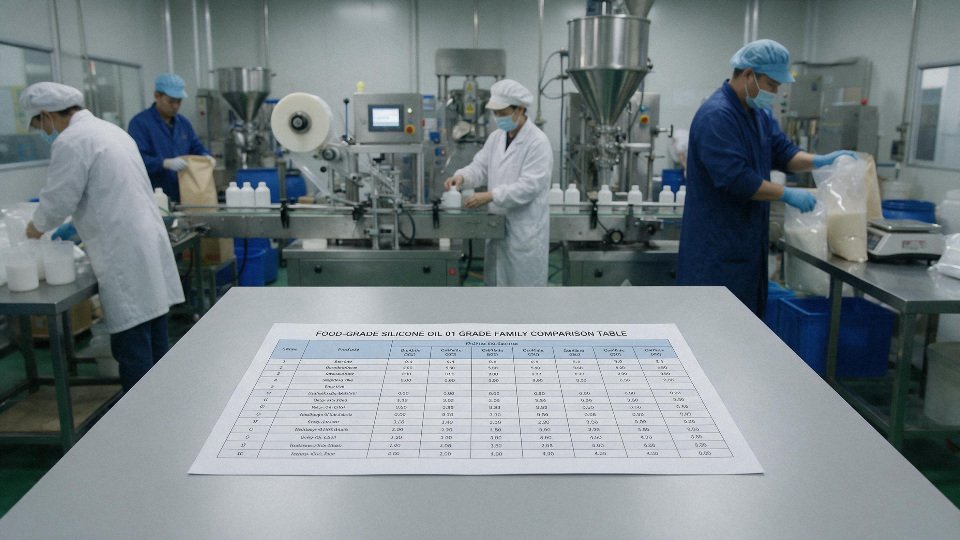
A common food-contact viscosity range is roughly 5 cSt to 1000 cSt, but selection should be driven by function, not by catalog habit.
| Viscosity tendency | Usually preferred for | Main benefit | Main risk |
|---|---|---|---|
| Lower viscosity | Fine spreading, penetration, rapid surface coverage | Easy distribution, low drag | Migration, carryover, shorter residence on surface |
| Mid-range | General release, balanced lubrication, controlled blending | Easier handling-performance balance | Can be a compromise that is ideal for neither extreme |
| Higher viscosity | Retention on surfaces, thicker film, lower mobility | Better staying power | Harder pumping, poorer penetration, application inconsistency in cold conditions |
Selection logic is usually this:
- Choose lower viscosity when you need fast wet-out, narrow-gap penetration, or very light films.
- Choose higher viscosity when the film must stay in place under gravity, intermittent washdown, or repeated contact.
- Stay in the middle when neither extreme dominates and the line needs predictable handling.
One shop-floor caution: a fluid that looks perfect in a beaker can behave badly through 10 meters of small-bore tubing with a tired diaphragm pump and a cold plant at 8 am.
Specialty modified silicones
Modified silicones can offer better wetting, compatibility, or surface effects, but they are not automatically suitable for food-related use. Functional modification changes not only performance but also the compliance path, extractables profile, and sometimes the way the material deposits or interacts with packaging, coatings, or product residues.
Procurement should verify, not assume:
- Food-contact status of the specific grade, not the silicone family in general
- Additive package and any carrier components
- Intended use limitation: direct process use, incidental contact, release, or indirect contact only
- Supporting regulatory documentation for the target market
Attractive wetting behavior is not enough if the modified chemistry pushes the product outside the required food-contact framework.
Packaging, shelf life, and storage
Packaging choice affects contamination risk and day-to-day handling more than many buyers expect.
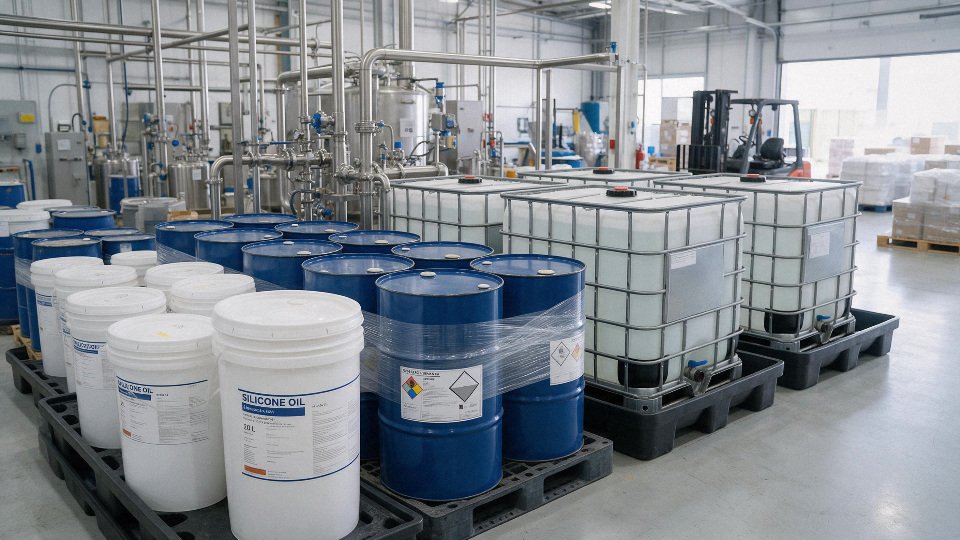
Common formats and practical differences:
- Small pails or cans: good for low-volume validated use; more manual handling; more opening events
- Drums: standard industrial choice; manageable with common plant equipment; lower contamination exposure than repeated small-pack opening
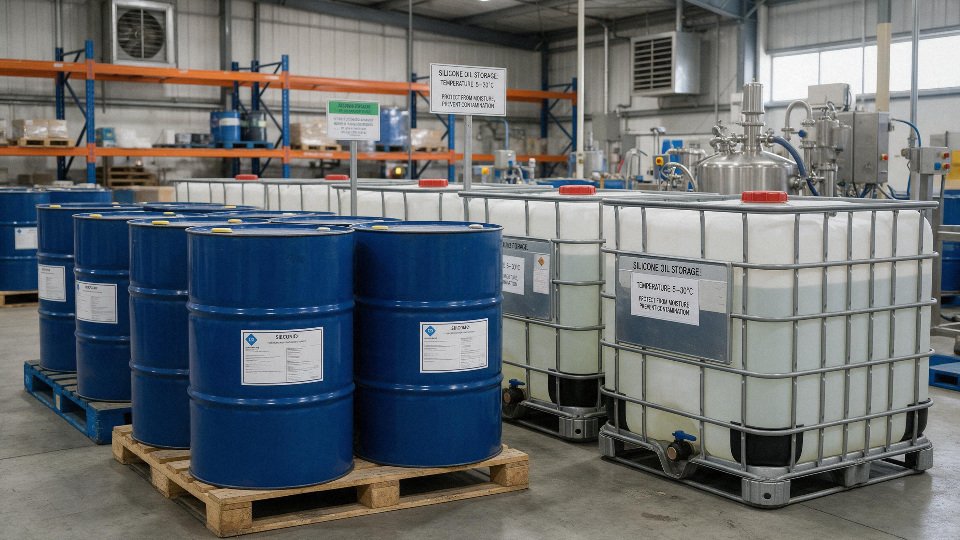
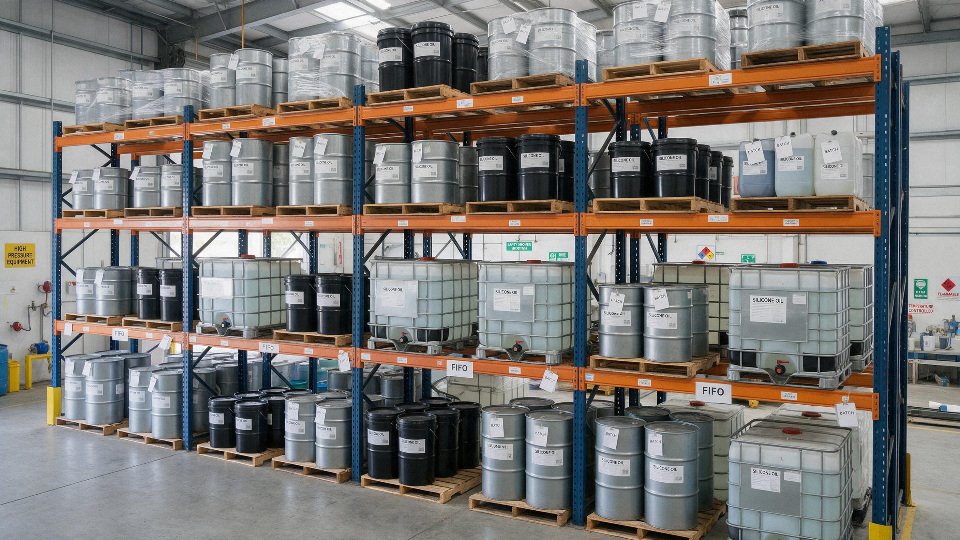
- IBCs: efficient for higher-volume users; fewer changeovers; but require better transfer discipline and more attention to partial-use storage
What to check before purchase:
- Shelf life in unopened package
- Recommended storage temperature range
- Freeze-thaw limits for emulsions
- Whether headspace contamination after opening affects stability
- Transfer method compatibility with your pumps, seals, hoses, and cleanout practice
Once opened, the failure mode is often not chemical degradation first; it is plant contamination. A loose bung, reused transfer lance, dusty tote top, or washdown splashback can turn a stable material into a quality complaint. If the line draws slowly, smaller packs sometimes cost more per kilogram but save money in waste, requalification, and housekeeping.
Selection criteria for buyers
Start with the exposure model, not the product brochure. The right food grade silicone oil for a direct process additive is often the wrong choice for a conveyor guide, release wipe, or intermittent contact point, because the compliance burden, cleanliness risk, and cost structure change with the way the oil can reach food. Buyers who skip that first classification usually end up overbuying on one line and under-controlling risk on another.
A practical selection sequence is below. It works better than shopping by viscosity alone.
- Define how the silicone oil can contact food
- Direct addition into the process
- Incidental contact from machinery or tooling
- Repeated surface contact with food-contact parts
- Non-contact support use where migration, misting, drip, or operator transfer is still possible
- Map the operating conditions
- Temperature range in service
- Mechanical load, line speed, dwell time
- Substrate type and surface energy
- Foam behavior, if used as a defoamer
- Application method: manual wipe, spray, metered drop, bath, emulsion dilution, automated dosing
- Check compatibility and side effects
- Elastomers, plastics, coatings, labels
- Printing, heat sealing, gluing, carton coding
- Cleaning chemicals and sanitation cycle
- Verify market-specific compliance
- Destination country
- Customer specifications
- Intended-use statement from supplier
- Supporting documents for audits
- Compare total cost in use
- Consumption rate
- Downtime avoided or created
- Cleaning burden
- Scrap and rejection risk
- Supplier consistency
Begin with the actual exposure route
If the oil is directly dosed into food processing, the selection window is narrow: you need formulation suitability, tightly controlled use rate, and documentation that matches the exact intended use. If the product is only used on external machine components with no credible path to food, the technical priority shifts toward stability, compatibility, and housekeeping rather than paying for a grade level you do not actually need.
These exposure models are materially different:
| Exposure model | Typical example | Main buyer concern | What usually drives selection |
|---|---|---|---|
| Direct food addition | Defoaming in processing under controlled dosing | Compliance, dosage control, carryover | Validated formulation, ppm-level use control, process fit |
| Incidental contact | Lubricated component above or near product zone | Migration, drips, audit defensibility | Cleanliness, controlled application, documentation |
| Repeated surface contact | Release or anti-stick use on food-contact surfaces | Residue, transfer, sensory effect | Viscosity, film behavior, reapplication interval |
| Non-contact support use with migration risk | Bearings, guides, chains, adjacent tooling | Mist, overspray, operator transfer | Application discipline, location, housekeeping, compatible ancillary materials |
The mechanism matters here. A low-viscosity fluid spreads easily and can solve wetting or defoaming issues fast, but that same mobility increases migration, misting, and transfer onto films, labels, or seals. A higher-viscosity fluid stays where you put it better, though it can trap dust, leave a heavier film, and be harder to meter accurately in small doses. The preferred choice flips once the dominant failure mode changes from “not enough coverage” to “too much movement.”
This section stops holding if the supplier cannot define the intended use in writing. Without that, you are comparing generic fluids against a regulatory and process requirement that is application-specific by nature.
Match viscosity and formulation to the process, not to habit
For common food-contact uses, buyers usually encounter silicone oils in roughly the 5 cSt to 1000 cSt range, plus emulsions and specialty blends. That range is broad because the same chemistry is being asked to do very different jobs.
Use these practical matching rules:
- Lower viscosity fluids
- Better spreading on smooth surfaces
- Easier pumping and fine metering
- Faster response in some defoaming applications
- Higher chance of creep, migration, and light carryover
- Mid-range viscosities
- Often the best compromise for general release, wipe-on surface conditioning, and some incidental-contact points
- Easier to control than very thin fluids
- Usually less residue-prone than very heavy grades if the application amount is controlled
- Higher viscosity fluids
- Better film persistence
- Lower tendency to run off vertical or warm surfaces
- Can be difficult in automated dosing, especially with small-bore lines, cheap diaphragm pumps, or cold-room viscosity rise
- More likely to attract fines if overapplied
Formulation matters as much as viscosity:
- Neat fluids suit controlled metering, precise film formation, and applications where water is unwanted.
- Emulsions help with dilution, wider wetting, and easier handling on some lines, but they introduce water and surfactant behavior into the process. That can change drying time, residue pattern, and compatibility with certain coatings or adhesives.
- Specialty compounds or blends may improve release or defoaming performance, but every added component increases the need for use-specific compliance review.
A shop-floor example: on a fast packaging line, a thin silicone oil may look great during setup because friction drops immediately. Two shifts later, it has migrated onto label panels or seal zones and the complaint becomes “the machine runs fine but packaging quality is unstable.” In slower equipment with rougher hardware, that same thin grade may be perfectly workable.
Check hidden compatibility points before trialing on production
A surprising number of silicone-related complaints are not caused by the silicone oil failing at its primary job. They come from secondary interactions the buying team never screened.
Check these interfaces early:
- Elastomers and seals
- Gaskets, O-rings, valve seats, hose liners
- Verify swelling, softening, extraction, or loss of compression set resistance under actual temperature and cleaning conditions
- Plastics
- Polycarbonate, acrylic, some engineering plastics, flexible packaging structures
- Watch for stress cracking, haze, slip change, or surface-energy effects
- Coatings and painted guards
- Silicone contamination can create fish-eyes or poor repaintability in maintenance environments
- Labels, adhesives, and glues
- Surface transfer can reduce adhesion or cause edge lift
- This is common on secondary packaging lines where operators wipe too generously
- Printing and coding
- Ink adhesion, thermal transfer marking, date coding legibility
- Silicone transfer onto the print field is a quiet scrap generator
- Heat sealing and lamination
- Even trace contamination can alter seal initiation or seal consistency on some structures
- This must be checked on the actual substrate and sealing window, not assumed from generic chemistry
- Cleaning chemicals
- Caustic washdowns, oxidizers, quats, alcohol-based cleaners
- A fluid that survives production may still create sanitation headaches if it smears under CIP or leaves persistent films on manual-clean areas
A food grade designation alone does not guarantee compatibility with labels, heat-seal areas, or downstream printing.True
Food-contact suitability and process compatibility are different tests. A silicone oil can be acceptable from a food-contact standpoint yet still interfere with adhesion, printing, sealability, or cleaning on a specific line.
Screen sensory and cleanliness risk like a quality issue, not a materials issue
If the process is sensitive, odor neutrality and visual cleanliness matter as much as lubricity or defoaming efficiency. Most buyers focus on whether the fluid works. Auditors and customers often notice whether it leaves evidence.
Review these points during qualification:
- Odor neutrality under ambient and hot-process conditions
- Visible residue on stainless steel, belts, molds, or packaging
- Carryover onto product or interior package surfaces
- Staining or gloss change on porous substrates
- Dust pickup on exposed films
- Effect on package sealability and secondary operations
The mechanism is simple but costly: a persistent low-surface-energy film can remain after the immediate operation is complete. The line may hit target speed, yet a downstream adhesive, print head, or seal jaw now sees a contaminated surface. That pushes the cost from maintenance into quality and customer returns.
Demand application-specific compliance evidence
Documentation should match the destination market and the exact use statement, not just prove that the supplier has a generic food-contact product in the catalog.
Require, at minimum:
- A product technical data sheet
- A current regulatory or food-contact statement tied to intended use
- Lot identification and traceability format
- Statement of relevant composition or restricted-substance controls, where applicable
- Supplier confirmation of what the product is not intended for, if limits exist
Customer audits often ask a plain question that catches teams out: “Show me why this material is suitable for this exact contact scenario on this line.” If the paperwork only says “food grade” in broad terms, you are exposed.
Judge supplier consistency, not just drum price
A cheaper drum is expensive if one lot behaves differently in dosing, foaming response, residue level, or cleanliness. In practice, stable supply beats nominally lower unit price.
Ask about:
- Lot-to-lot viscosity control
- Volatile content or low-molecular-weight fraction control where relevant
- Particle cleanliness for sensitive dispensing or high-visibility applications
- Packaging integrity and contamination prevention
- Change-control procedure
- Quality system and complaint handling
- Ability to retain and reference production records
This is where procurement and engineering should stay aligned. The line does not care what the PO savings were if operators have to wipe guides twice a shift or if a filler starts entraining foam because the replacement lot behaves differently.
Compare total cost of ownership, not price per kilogram
In many plants, food grade silicone oil is a low-volume purchase with outsized operational consequences. The cheapest product on a per-kilogram basis is often the most expensive option once overapplication, sanitation labor, rejection risk, and line interruptions are counted.
Include these cost elements:
- Actual use rate at stable production
- Metering accuracy and waste from manual application
- Downtime from reapplication or cleanup
- Sanitation time and chemical use
- Scrap from label, print, or seal defects
- Product rejection risk from visible residue or carryover
- Maintenance interval changes
- Supplier lead time and emergency substitution risk
One point buyers often miss: over-specifying purity or viscosity can raise cost without improving performance where the use case is only incidental-contact machinery lubrication. If the fluid is applied in a controlled way, outside the product path, and the main requirement is clean film stability plus audit-ready documentation, paying for a highly specialized grade intended for direct process addition may not change line performance at all. The right answer depends on exposure route first, then process conditions, then evidence.
If you are down to two candidates, run a controlled plant trial with defined acceptance criteria: consumption rate, residue observations, cleaning effort, and any effect on labels, seals, or coding after a full production shift. That usually settles the argument faster than another round of supplier claims.
Quality risks and failure modes
Most food grade silicone oil problems are not caused by the base chemistry alone. They usually come from a mismatch between grade and duty, weak contamination control, unstable application, or undocumented supply changes that only show up once the line is under heat, speed, and sanitation pressure. If you treat silicone oil as a simple commodity instead of a controlled process aid or lubricant, the failure mode often appears somewhere else first: foam, label adhesion, slippery floors, seal life, or audit paperwork.
Wrong grade selection: the oil is compliant, but the job still fails
A food grade declaration does not guarantee functional fit. In practice, the wrong viscosity, wrong form, or wrong use pattern shows up as one of four plant-floor complaints:
- weak or short-lived foam control
- poor mold or surface release
- visible residue or haze
- inadequate lubrication film under load
For defoaming, low-viscosity material may disperse quickly but collapse too fast in a hot, recirculating system. A heavier fluid may persist longer, but if the dosing and dispersion are poor, it can sit on the surface and never act where bubbles are forming. The mechanism matters: antifoam performance depends on how the silicone phase enters the foam lamella, spreads, and destabilizes it. Viscosity, droplet size in emulsified systems, temperature, and local shear all affect that path.
Release applications have a different trap. A fluid that releases well on stainless, belts, or molds may leave too much transfer on the product or downstream packaging contact points. That can turn into sealing or printing trouble later, which production often blames on the packaging line rather than the release step.
Lubrication failures are often even less obvious. Silicone oil has useful lubricity in certain low- to moderate-load interfaces, but it is not a universal substitute for every food machinery lubricant duty. Under boundary lubrication, oscillating motion, or high unit loads, a fluid chosen for incidental food-contact comfort rather than film strength can lead to chatter, wear, and heat. The conclusion that “silicone does not work” is usually too broad; the actual issue is that the duty point sat outside what that grade could support.
This conclusion stops holding if the supplier has application-specific validation for the exact substrate, speed, temperature, and contact mode. Without that, bench performance does not mean line performance.
Contamination pathways: most are mundane, and that is why they get missed
The highest-risk contamination routes are usually basic handling failures, not exotic chemistry.
- storage tanks previously used for non-food materials
- transfer pumps with residual oil or grease from another service
- open pails or drums left near washdown splash or dust sources
- dirty brushes, rollers, wipes, or spray applicators
- mixed lots in day tanks or tote top-ups without segregation
- non-food-contact packaging components such as liners, gaskets, or reused caps
A common plant mistake is assuming the product remains “food grade” regardless of what touches it after receipt. It does not. If a food grade silicone oil is decanted through a pump cart that was also used for non-approved maintenance fluid, the compliance file may still look fine while the material in use is no longer controlled.
Mixed lots create a quieter problem. Even when both lots are nominally acceptable, small differences in viscosity, additive package, or emulsion stability can show up as changed spray pattern, carryover, or foam break behavior. Procurement sees continuity; operations sees drift.
A compliant product can become a non-compliant process input through poor transfer, storage, or packaging-contact control after delivery.True
Conformity applies to the supplied material under stated conditions. Post-delivery contamination or uncontrolled repackaging can invalidate practical food-contact suitability even if the original certificate remains unchanged.
Over-application: the line looks protected, but downstream losses start accumulating
Too much silicone oil rarely fails at the point of application first. It tends to create side effects downstream:
- slippery floors, guards, hand-contact areas, and access steps
- glossy spots, haze, or surface appearance defects on product
- package sealing interference
- print, ink, coating, or adhesive wet-out problems
- elevated carryover or migration concerns that trigger internal review
The trade-off is straightforward. More application often improves short-term release or lubrication margin, but it also raises residue load and transfer risk. This is why ppm-level defoamer dosing under validated control is common in food processing rather than broad “a little extra for safety” practice. Once operators start trimming by feel, housekeeping cost and quality variation usually follow.
Under-application and unstable dosing: intermittent faults are the hardest to pin down
Too little material, or material applied unevenly, produces the kind of complaint that burns maintenance hours because it comes and goes.
- intermittent foam bursts in tanks or filling systems
- sticking on molds, chutes, guides, or belts
- stick-slip motion, chatter, or squeal
- accelerated wear on contact points
- nuisance stops that disappear during inspection and return at production speed
The mechanism is usually variability, not simply low average dose. A pulsing metering pump, air entrainment on the suction side, poor drum changeover practice, or emulsion separation in a day tank can create alternating over- and under-dose conditions. Operators then chase symptoms in the wrong place: changing belt tension, adjusting nozzles, or blaming product recipe variation.
Thermal, oxidative, and sanitation-related breakdown
Food grade silicone oils are often selected because they handle a broad temperature window, but prolonged high temperature with air exposure is still a failure path. In hot zones, especially where thin films are exposed to oxygen for long residence times, reduced functionality and deposit formation can develop over time. The practical symptom is usually a gradual change: more residue, less release consistency, harder cleanup.
Watch these conditions closely:
- hot plates, sealing areas, ovens, and heated guides
- thin-film exposure rather than bulk fluid storage
- repeated heating and cooling cycles
- aggressive alkaline or oxidizing cleaning regimes
- long idle periods with baked-on residue
The chemistry may remain generally stable in bulk, yet the service film at the metal-air interface can age much faster. That difference catches people out.
Incompatibility with adjacent materials
Silicone oil can interfere with materials around the process even when it performs well at its primary task.
| Affected material or system | Typical symptom | What to verify |
|---|---|---|
| elastomer seals and hoses | swelling, softening, leakage, shortened seal life | elastomer compatibility from supplier and in-service test |
| plastics | stress effects, haze, dimensional change in some polymers | resin-specific compatibility, temperature exposure |
| inks and coatings | fisheyes, crater defects, poor wetting | print/coating line trial under production conditions |
| adhesives and sealants | adhesion loss, seal weakness, cure disruption | packaging or assembly validation |
| CIP and cleaning chemistry | persistent residues, hard-to-rinse films, sanitation complaints | detergent compatibility and rinse verification |
Many packaging defects blamed on “bad ink” are actually silicone transfer problems from an earlier station. Once the contamination reaches a print or adhesive interface, the surface energy problem is already built in.
Documentation and change control failures
A clean certificate file today does not protect next quarter’s production if the supplier changes something without clear notification.
Watch for changes in:
- raw material source
- manufacturing route or processing aid
- packaging material, liner, cap, or gasket
- specification range widening
- document version, declaration scope, or legal entity issuing it
Technical buyers should require revision control and change notification, not just a one-time compliance packet. If your process is sensitive to residue, release force, packaging adhesion, or defoaming efficiency, even a legal formulation change can still become an operational problem.
Advanced diagnosis: many “silicone failures” are actually application-system failures
Before rejecting the material, check the system applying it.
- Verify metering pump calibration and pulse stability
- Check dilution ratio and whether the water quality is suitable
- Inspect for emulsion separation in tanks, long dead legs, or recirculation shear damage
- Confirm nozzle condition, spray pattern, and line-of-sight coverage
- Review recent cleaning chemistry, concentration, and rinse completeness
- Compare actual substrate temperature and line speed to the original validation point
Wrong dilution water is a regular offender. Hard water, contaminated make-up water, or biologically dirty day tanks can destabilize some application systems and make a good product look inconsistent. Cleaning interactions are another one: a sanitizer or alkaline wash can leave a surface state that changes spreading, adhesion, or defoaming response on the next shift.

If the failure only appears on one line, one shift, or after a sanitation cycle, start with the application system before changing suppliers. If you want a useful technical review, send the substrate material, contaminant or duty type, approximate layer thickness or dosage, working area, required finish, target rate, and clear photos or retained samples; SiliconChemicals can review the application and advise on a more suitable food grade silicone material path based on the process conditions you are actually running.
Frequently asked questions
Is food grade silicone oil safe for direct food contact?
Only some food grade silicone oils are acceptable for direct or incidental food contact, and only within the supplier’s stated regulatory scope and use conditions. “Food grade” is not a blanket permission for unrestricted addition to food, coating any surface, or use at any dose.
In practice, buyers need to separate three cases:
- Processing aid or defoamer use
- Often controlled at ppm-level addition
- Requires validation of dosage, product form, and intended food process
- Must match the applicable regulatory framework and supplier declaration
- Incidental contact on equipment
- Used on guides, release points, seals, or moving parts where trace contact could occur
- Needs food-contact suitability documentation, but the use case is different from direct addition
- No-contact or external mechanical use
- Food plant location alone does not make a lubricant or fluid acceptable for food-contact risk zones
Any silicone oil sold into a food factory is automatically safe for direct food contact.False
Plant use, food-contact suitability, and direct-addition approval are different decisions. The exact use must be supported by compliance documents and process-specific validation.
Is food grade silicone oil the same as silicone lubricant?
No. Food grade silicone oil is a base fluid category; a silicone lubricant is usually a formulated product built around that fluid. The lubricant may include thickeners, carriers, additives, or packaging formats that change both performance and compliance status.
That distinction matters on the plant floor. A neat silicone fluid used as an antifoam or release aid is not automatically a good chain lubricant, and a food-grade aerosol lubricant is not automatically suitable for direct food processing contact. Always check the full formulation, not just the words “silicone” and “food grade.”
What viscosity should be used for antifoam versus lubrication?
For antifoam duty, lower-viscosity fluids or validated emulsified systems are commonly preferred because they disperse more readily into the foaming phase and act faster at low dosage. For lubrication or release, medium to higher viscosities are often chosen because they stay in place longer and resist squeeze-out better.
The exact choice depends on:
– Product form: neat fluid, emulsion, compound
– Application method: metered addition, wipe-on, spray, bath
– Surface speed and load
– Exposure to washdown or steam
– Required residue control
A universal viscosity number would be misleading. For most food-contact commercial ranges, suppliers offer roughly 5 cSt to 1000 cSt, but the right point in that range depends on whether you need fast spreading, film persistence, or controlled carryover.
Can food grade silicone oil be used at high temperatures?
Often yes, but not without limits. Typical service windows are roughly -40 C to 200 C, depending on formulation, dwell time, oxygen exposure, load, and whether the oil is static on a surface or mechanically stressed in service.
Two practical cautions:
– Short temperature spikes are not the same as continuous operating temperature.
– Hot metal, thin films, and air exposure can age a fluid faster than a bulk liquid held at the same measured temperature.
For ovens, heated sealing zones, or hot-fill equipment, verify the supplier’s current data and, if the process is critical, run a line trial with residue and odor checks afterward.
Does silicone oil migrate into food or packaging?
It can, depending on viscosity, dosage, substrate, contact time, temperature, and whether the film is free or absorbed into a porous or polymeric surface. Lower-viscosity fluids usually have a greater tendency to spread and transfer if the system is overapplied.
Migration risk is usually highest in these situations:
– Thin wipe films on warm contact parts
– Overdosed release or lubrication points
– Flexible packaging or elastomer contact under pressure
– Long residence time before product leaves the line
If migration matters commercially or regulatorily, the answer should come from application-specific testing, not assumption.
How is food grade silicone oil different from mineral oil?
Silicone oil and mineral oil behave differently in volatility profile, surface tension, oxidation behavior, elastomer interaction, and low/high temperature performance. In many applications, silicone oil gives better spreading, defoaming efficiency, and temperature stability; mineral oil may be preferred where lower cost, different solvency, or established legacy approvals drive the decision.
The trade-off is straightforward:
– Silicone oil: stronger performance in difficult temperature or foam-control conditions, but often higher unit cost and tighter application discipline
– Mineral oil: cheaper in many markets, but may oxidize or change behavior faster in demanding service
The better choice flips when process severity is low and cost pressure dominates.
Can it be used on rubber seals and plastic parts?
Sometimes, but compatibility has to be checked. Many silicones are broadly compatible with common elastomers and plastics, yet swelling, softening, stress cracking, or extraction can still occur with certain compounds, fillers, or molded part formulations.
Before plant-wide use, check:
– Exact seal material, not just “rubber”
– Plastic grade and additives
– Contact temperature
– Dwell time
– Whether the part is under compression or cyclic motion
A quick bench soak and fit check often catches problems earlier than a maintenance shutdown does.
How should it be stored and what is its shelf life?
Store it sealed, clean, and out of unnecessary heat or direct sunlight. In most plants, the bigger issue is not intrinsic shelf life but contamination from dirty transfer pumps, open drums, mislabeled tote returns, or water ingress during washdown season.
Good storage practice:
1. Keep containers tightly closed.
2. Use dedicated transfer tools.
3. Protect labels and batch identity.
4. Avoid mixing old and new lots without review.
5. Follow the supplier’s stated storage temperature range.
Shelf life varies by product form. Neat fluids often store longer than emulsions, but buyers should use the supplier’s current certificate or technical data rather than a generic assumption.
What documents should a supplier provide?
At minimum, ask for:
– Technical data sheet
– Safety data sheet
– Certificate of analysis or typical quality parameters
– Regulatory or food-contact compliance declaration relevant to your market
– Composition or statement of intentionally added restricted substances, where commercially available
– Batch traceability information
– Recommended use, storage, and handling guidance
If the application is sensitive, also ask whether migration, extractables, or application-specific support data exists. If it does not, that is not automatically disqualifying, but you should know early.
How can a manufacturer validate a new silicone oil on the line?
- Define the exact duty: defoaming, release, lubrication, seal protection, or packaging contact.
- Record current baseline:
- Foam level
- Scrap rate
- Cleanup time
- Lubricant consumption
- Downtime or maintenance calls
- Run a controlled trial on one line or one product family.
- Lock the application rate and method.
- Inspect for side effects:
- Surface defects
- Residue
- Seal swell
- Label or print problems
- Unexpected slip hazards
- Review compliance documents against the actual use case.
- Approve only after production, quality, and maintenance all sign off.
Your qualification checklist
A food grade silicone oil is only “suitable” when the grade, documentation, and use conditions all line up with your actual exposure model. If you cannot clearly state where the silicone goes, how long it stays there, what temperature it sees, and which market the finished product enters, any supplier recommendation is still provisional.
Start with the application facts before you ask for a sample or a quote. This is where many buying teams lose a week, especially when procurement asks for a “food grade silicone oil” but production means anti-foam in one line, while maintenance means a release or lubricant use on another.
- Define the exact use point
- Direct process aid in food manufacturing
- Indirect food-contact on equipment surfaces
- Release aid on molds, chutes, knives, or conveyors
- Defoaming in aqueous process streams
- Lubrication in food-contact or near-food-contact mechanisms
- Map the contact pathway
- Direct contact with product
- Incidental contact only
- No intended contact, but splash or carryover is possible
- Contact with primary packaging equipment rather than the food itself
- Set the operating envelope
- Normal and upset temperature range
- Contact duration: seconds, minutes, or continuous exposure
- Mechanical load or shear
- Washdown frequency, cleaning chemistry, and steam exposure if applicable
- Identify the destination market
- Domestic only
- Export to one jurisdiction
- Multi-country supply where the compliance burden is tighter
That last point changes the whole buying process. A grade that is technically fine for one market may create paperwork delays or a relabeling problem in another.
Shortlist candidates the way the plant will actually use them
Shortlisting should be done against the exposure model, not just against a familiar viscosity. Common food-contact silicone oils often fall somewhere around 5 cSt to 1000 cSt, but that range is too broad to be useful on its own.
Use these screening filters:
- Viscosity
- Lower viscosity grades usually spread more easily and may suit light release or fast wetting
- Higher viscosity grades usually stay in place longer, which can help on slower-moving surfaces or where migration control matters
- Formulation type
- Neat fluid
- Emulsion
- Compound or specialty modified form
- Performance target
- Foam knockdown
- Persistent release
- Boundary lubrication
- Surface conditioning with minimal visible residue
- Application method
- Metered dosing
- Spray
- Wipe-on
- Dip, roll, or automated applicator system
The mechanism matters here. A viscosity that improves film persistence can also increase visible residue, dust pickup, or cleaning burden. On the other hand, a very light fluid may look cleaner at first but disappear too quickly under heat, water, or repeated contact. The preferred choice flips once sanitation frequency rises or the line speed pushes the film out faster than it can be reapplied.
Ask for the supplier package before you approve anything
Do not qualify on a sales sheet alone. At minimum, request:
- Technical Data Sheet
- Safety Data Sheet
- Conformity or compliance statement relevant to the intended food-contact pathway
- Lot traceability approach
- Packaging specification including container type, net weight, sealing method, and storage guidance
- Change-notification policy for raw material, formulation, manufacturing site, or labeling changes
A complete document package reduces both technical and commercial qualification risk.True
The issue is not paperwork for its own sake. Without traceability, packaging detail, and change control, a plant may qualify one delivered lot profile and later receive a commercially acceptable but operationally disruptive variation.
If your QA team runs supplier audits, ask who issues the compliance documents and whether they are lot-linked, product-family statements, or generic declarations. That difference matters during customer audits.
Run a controlled plant trial
A useful trial is small, documented, and tied to measurable acceptance criteria.
- Define the baseline
- Current product used
- Current dosing or application rate
- Existing defects, foam level, sticking frequency, or lubrication interval
- Set success metrics
- Foam reduction
- Release consistency
- Residue level on food, packaging, or machine surfaces
- Lubrication life
- Sanitation impact
- Product quality effects such as appearance, texture, seal performance, or downstream printability where relevant
- Control the trial conditions
- Same line speed if possible
- Same substrate or product type
- Same cleaning routine
- Defined test duration long enough to catch buildup or instability
- Record what operators notice
- Spray pattern changes
- Nozzle fouling
- Slippery floor risk from overspray
- Drum or pail handling issues
- Any smell, haze, or visible carryover
A one-hour trial often overstates success. Residue, washdown interaction, and dosing drift usually show up later, sometimes on the second or third production cycle.
Check the commercial fit before release to purchasing
Technical fit without supply fit is just deferred downtime. Review:
- Lead time and stock position
- Supply stability across seasons and demand spikes
- MOQ relative to your actual consumption
- Packaging sizes that match your handling practice
- Customization ability, if your process needs a specific viscosity window or form
- Support for multi-country compliance documentation, if your finished goods move across borders
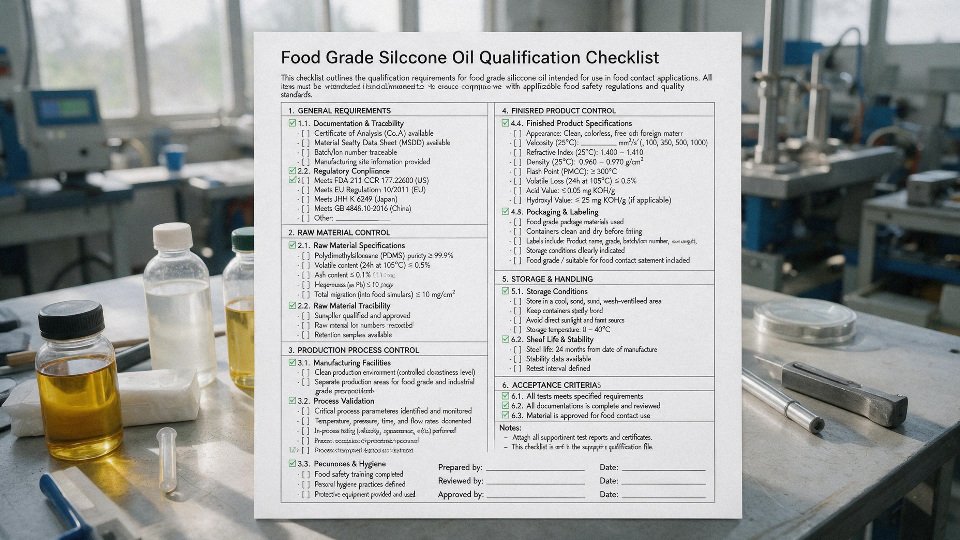
If you are narrowing down a food grade silicone oil for a live application, send SiliconChemicals the practical details that determine grade fit: substrate or equipment material, contaminant or process issue, approximate layer or dosing level, working area, required finish, target rate, and clear part photos or representative samples where relevant. SiliconChemicals can then review the application, match candidate grades, provide the available documentation package, and support sample-based qualification.