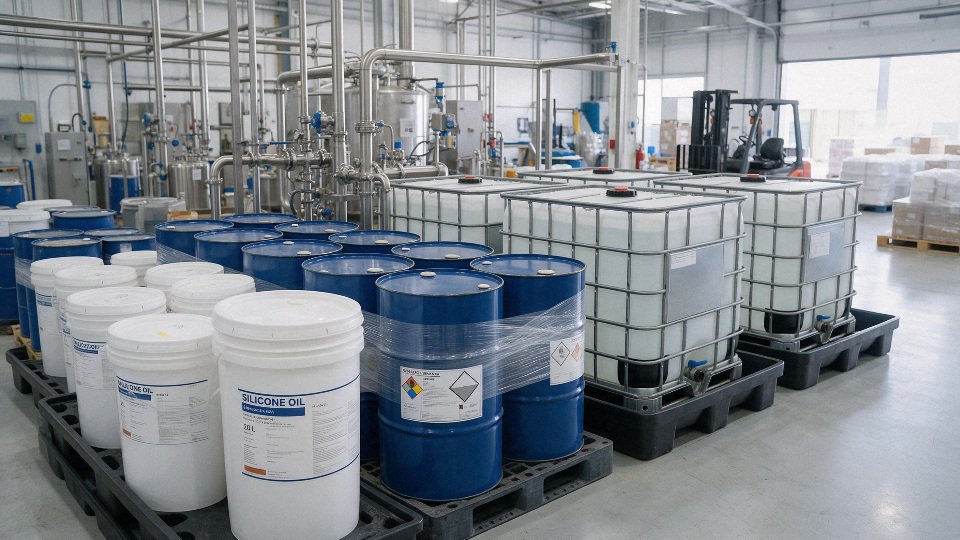
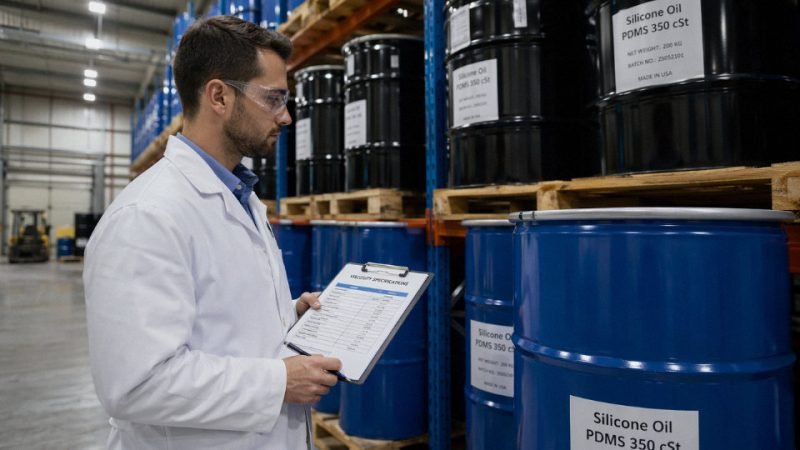
Wrong silicone oil supplier — and you find out the hard way, usually mid-production. A viscosity drift of 8–10% outside spec in a release coating application doesn’t just flag in QC; it shows up as torn labels, mis-formed gaskets, or contaminated pharmaceutical fill lines, any of which can ground an entire batch. Depending on the application, that translates to scrap costs ranging from a few thousand dollars to six figures, plus the supplier audit and requalification cycle that follows. The fix isn’t switching suppliers on price alone — it’s knowing which technical, logistical, and compliance variables actually separate a reliable source from one that holds up only until your volume scales.
To choose a silicone oil supplier, evaluate four things in order: product purity and viscosity consistency against your spec (pharmaceutical-grade PDMS should hit ≥99.5% assay with ±1–2% viscosity tolerance), quality system certification (ISO 9001 minimum, GMP or FDA registration for regulated uses), supply reliability including lead times and safety stock depth, and total landed cost — not just unit price.
What makes this harder than sourcing most commodity chemicals is the range. Standard dimethyl silicone oil at 100–1000 cSt runs USD 2.50–6.00/kg on current spot markets; phenyl or amino-functional specialty grades can run USD 18–45/kg, and that spread interacts with lead times, minimum order quantities, and your own batch frequency in ways that aren’t obvious until you’re three months into a production ramp and your supplier’s “stock grade” turns out to be a four-week make-to-order.
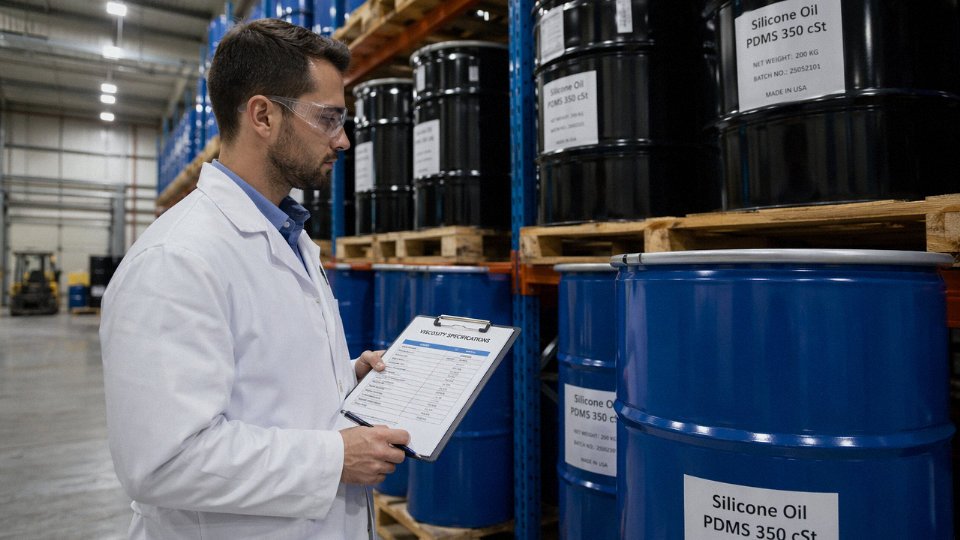
Mapping the Global Silicone Oil Supply Chain: Manufacturer vs. Distributor vs. Trader
Understanding who actually made the fluid in your drum is not an administrative nicety — it determines whether your certificate of analysis means anything at all.
Tier 1: Integrated Producers
A handful of companies control the entire silicone chain from raw silicon metal and methanol through chlorosilane synthesis, hydrolysis, polymerization, and final fluid finishing. Dow, Wacker Chemie, Shin-Etsu Chemical, Elkem Silicones, Momentive, and Bluestar Silicones (now part of Elkem) sit at this tier. Each runs captive monomer production, which means they can issue traceable lot documentation all the way back to the reactor batch — not just the filling line.
That chain-of-custody depth matters in practice. When a pharmaceutical customer needs to reconcile a viscosity drift complaint, a Tier 1 supplier can pull the polymerization conditions, the catalyst lot, and the stripping temperature for that specific batch. A trader who rebottled fluid from a warehouse in Rotterdam cannot do that, no matter how professional their letterhead looks.
Tier 1 producers also publish proprietary performance specifications — not just CAS numbers and viscosity ranges, but flash point tolerances, volatile content limits, ionic impurity ceilings — and they defend those specs across production lots. That consistency is what lets you lock in a validated process. The tradeoff: minimum order quantities from integrated producers often start at 200–1,000 kg per grade, lead times for non-stock specialty viscosities can run 45–90 days, and their commercial teams are not structured to service a buyer who needs 25 kg of 500 cSt fluid once a quarter.
Tier 2: Specialty Compounders and Toll Blenders
This tier is legitimate and genuinely useful, but it requires more scrutiny. A Tier 2 compounder purchases base PDMS fluid — typically undisclosed-viscosity or broad-cut feedstock — from one or more Tier 1 producers, then blends, functionalizes, or dopes it to hit a target specification. Amino-functional and phenyl-modified silicone oils are frequently made this way; the Tier 2 shop adds value through formulation expertise rather than monomer chemistry.
The key question to ask any Tier 2 supplier: who makes your base fluid, and will you disclose it? Reputable compounders will name their base-fluid source, provide the original manufacturer’s spec sheet alongside their own blended-product CoA, and can usually arrange a tri-party audit if your application warrants it. A compounder who stonewalls on base-fluid origin — citing “proprietary sourcing” — is telling you something.
Tier 3: Distributors and Trading Companies
For buyers who need stock grades in quantities below a Tier 1 minimum, or who need regional availability on short notice, distributors and traders are often the only practical option. Domestic stock grades typically ship in 7–15 days from a regional distributor, versus weeks or months direct from a producer. That has real value in a scheduled-maintenance scenario.
The risk is re-drumming and relabeling. Some traders buy bulk fluid, transfer it into their own branded packaging, and issue a CoA that looks original but is essentially a transcription — sometimes with errors, sometimes with deliberate misrepresentation of grade or origin.
A certificate of analysis issued by a trading company carries the same quality assurance as one issued directly by the original manufacturer.False
A trader-issued CoA is only as reliable as the trader's own QC testing and honesty. It does not provide chain-of-custody traceability back to the production batch unless the original manufacturer lot number and authenticated documentation are included.
Red flags worth treating as disqualifying:
- CoA lot numbers that cannot be verified against the named manufacturer’s batch records (call the manufacturer’s technical service line directly and ask)
- Font inconsistencies, logo pixelation, or mismatched document headers across the CoA and safety data sheet — these appear more often than you’d expect
- Pricing more than roughly 20% below published distributor list for the same grade and pack size; standard dimethyl [silicone oils](https://siliconchemicals.com/silicone-oil/) in the 100–1000 cSt range run about USD 2.50–6.00/kg depending on volume and grade, so a quote at USD 1.80/kg deserves a hard question
- Flat refusal to allow a plant audit or even a video-call facility walkthrough
Using Supplier Disclosure Forms to Map Every Node
A supply chain questionnaire sent before issuing a purchase order should ask for: the name and site address of the Tier 1 manufacturer, the specific product code from that manufacturer, whether any re-drumming or repackaging occurs and where, how the distributor stores the fluid (temperature range, UV exposure, contamination controls), and the shelf-life policy on stock inventory. Ask for the last three consecutive lot numbers and their CoAs. If the lots look suspiciously uniform — identical viscosity to the decimal, identical test dates — that sometimes indicates a single re-tested drum being sold as multiple “lots.”
In high-stakes applications like medical device lubrication or food-contact processing, consider requiring a supplier declaration form that names every entity in the chain from monomer to your dock. It takes ten minutes to send. The audit trail it creates has saved more than a few compliance headaches during FDA or customer inspections.
Defining Your Technical Specification Before Contacting Any Supplier
Most procurement problems with silicone oil start before the first email is sent. A buyer calls three suppliers, asks for “350 cSt dimethyl silicone oil,” gets three different prices, picks the cheapest, and then spends the next six months troubleshooting inconsistent release performance or failed dielectric testing. The specification was never written down, so every supplier quoted something slightly different and nobody was wrong.
Write a Technical Requirement Document before you contact anyone. It doesn’t need to be a 40-page monster — a well-structured one-page data sheet with hard limits is enough to eliminate ambiguity and give you a real basis for comparison.
Core Physical Parameters
Kinematic viscosity at 25 °C is the obvious starting point, but state it with an explicit tolerance. “350 cSt” is not a specification. “350 cSt ± 5 cSt at 25 °C per ASTM D445” is. For applications where viscosity-temperature behavior matters — transformer cooling, for instance — require viscosity at 100 °C as well, because two fluids with identical 25 °C viscosity can behave very differently at operating temperature depending on their methyl-to-phenyl ratio.
Specify density (g/cm³ at 25 °C), refractive index (useful as a fast incoming QC check — deviations of more than ±0.002 from nominal often flag blending errors or substitution), flash point by ASTM D93 or ISO 2719, and pour point if your process runs below 0 °C. Volatility matters for any elevated-temperature application: require TGA loss at 150 °C for 1 hour, expressed as maximum weight percent. Low-viscosity grades (below roughly 50 cSt) will show meaningfully higher volatility, and if you don’t cap it, you’ll get complaints from operators about oily vapor or baseline drift in heated equipment. Surface tension (mN/m at 25 °C) belongs on the TRD for any coating, mold release, or defoamer application where spreading behavior is load-bearing.
Chemical Identity and Purity
Don’t just write “dimethyl silicone oil” — specify the silicone type explicitly: polydimethylsiloxane (PDMS), phenylmethyl silicone, amino-functional, fluorosilicone. These are not interchangeable and a trader who is short on one grade has been known to substitute another without disclosure, especially if your TRD is vague.
End-group chemistry matters more than most buyers realize. Trimethyl-terminated PDMS is stable and non-reactive. Hydroxyl-terminated fluid will condense with certain substrates, catalysts, and metal oxides — great if you want crosslinking, disastrous if you don’t. State explicitly which you need. For pharmaceutical-grade PDMS, specify ≥99.5% assay with GC purity documentation and require absence of cyclic siloxanes (D4, D5, D6) above your regulatory threshold, since several jurisdictions now restrict these.
Hydroxyl-terminated silicone oil and trimethyl-terminated silicone oil are interchangeable for most industrial applications.False
End-group chemistry directly affects reactivity. Hydroxyl-terminated PDMS can condense with moisture, metal hydroxides, and certain substrates, causing gelation, adhesion failures, or crosslinking where none was intended. Specifying the wrong end group is a real substitution risk when supplier documentation is inadequate.
Application-Driven Compliance Requirements
If the fluid contacts food, packaging, or pharmaceutical product, state the compliance framework in the TRD: FDA 21 CFR 178.3570 for direct food-contact, EU Regulation 10/2011 for plastic food contact materials, or ISO 10993 biocompatibility series for medical devices. Don’t assume a supplier knows which applies — they don’t know your end product. For high-voltage dielectric applications, add a thermal stability cycle requirement and an oxidation induction time minimum.
Packaging, Shelf Life, and Version Control
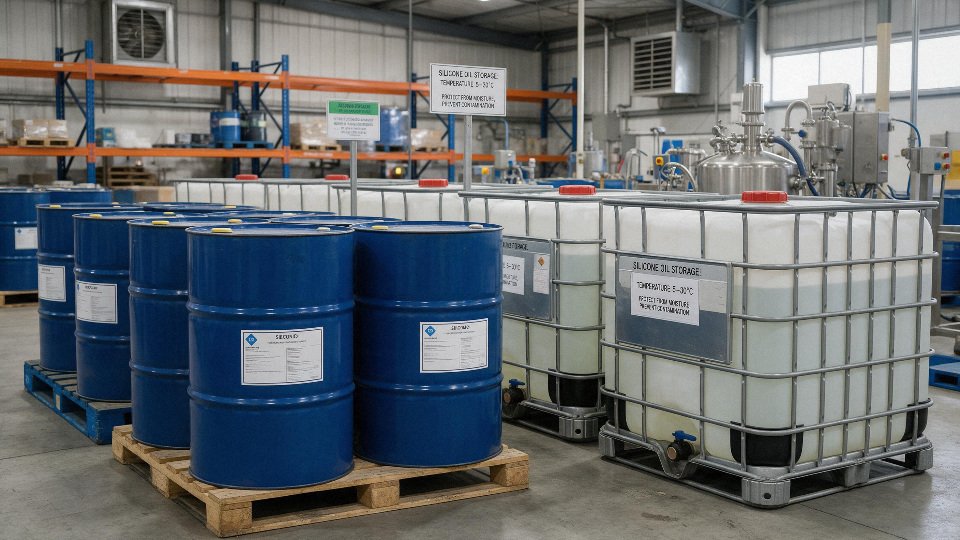
Specify drum material (HDPE for most grades, steel for anything above roughly 200 °C service temperature rating or where static charge is a concern), and require a nitrogen blanket for moisture-sensitive hydroxyl-terminated grades. Minimum 18-month shelf life from date of manufacture, with defined storage conditions (typically 5–30 °C, away from UV), should be standard language.
The clause most buyers omit: require the supplier in writing to notify you at least 60 days before any change to raw material source, manufacturing site, or formulation. This is routine in aerospace and pharma supply chains and should be routine everywhere. Without it, you may not discover a reformulation until your process starts failing — and by then the root cause is buried under six weeks of production data.
Quality Management System Credentials and Regulatory Compliance Verification
A supplier’s sales team will tell you whatever gets the purchase order signed. The QMS documentation — when you actually read it carefully — tells a different story. Certificates get photocopied, scopes get misrepresented, and audit findings from three years ago get quietly buried. Your job is to verify, not accept.
Start With ISO 9001:2015, Then Read the Scope Statement
Every credible silicone fluid manufacturer should hold a current ISO 9001:2015 certificate. That part is table stakes. What most buyers miss is the scope statement printed on the certificate itself. A supplier certified for “trading and distribution of specialty chemicals” is categorically different from one certified for “manufacture of polydimethylsiloxane and functional silicone fluids.” The scope has to match what they’re actually doing for you.
Don’t rely on a PDF attachment in an email. Look up the certificate number directly with the issuing certification body — most accredited CBs (SGS, Bureau Veritas, TÜV, Intertek, and others) maintain online registries where you can confirm validity, expiry date, and scope in under five minutes. Certificates do lapse. In my experience, roughly one in eight certificates submitted during supplier qualification is either expired, suspended, or has a scope that doesn’t cover the relevant product category.

Industry-Specific Overlays You Cannot Skip
ISO 9001 is the floor, not the ceiling. The overlay certifications are where the real differentiation happens, and they’re non-negotiable depending on your application.
Automotive: IATF 16949 is the baseline expectation for suppliers of damping fluids or release agents used in component manufacturing. Confirm the certificate covers the relevant manufacturing site, not just a corporate entity.
Medical devices: ISO 13485 certification with a scope that explicitly includes silicone fluids as a manufactured product (not just purchased components). Ask for the most recent surveillance audit report. A clean certificate with zero nonconformities across three consecutive audits is a green flag; a certificate reinstated after a major NC is something to probe hard.
Pharmaceutical excipients: GMP compliance under ICH Q7 or 21 CFR Part 211 is the requirement for PDMS used as a pharmaceutical excipient or processing aid. These audits are resource-intensive to conduct, so expect legitimate pharma-grade suppliers to be selective about which customers they support at this tier. If a supplier claims GMP compliance but can’t produce a batch manufacturing record or a site master file, walk away.
Food contact and food-grade: FSSC 22000 or SQF certification. Some regional applications also require NSF H1 registration for incidental food contact. Confirm the specific listing, not just the claim.
A supplier holding ISO 9001:2015 certification is automatically qualified to supply pharmaceutical-grade silicone oil.False
ISO 9001 covers quality management system processes only. Pharmaceutical excipient supply requires GMP compliance under ICH Q7 or 21 CFR Part 211, which involves separate audits, batch manufacturing records, and regulatory documentation well beyond the scope of ISO 9001.
Environmental and Safety Documentation
REACH compliance declarations matter if you’re importing into the EU or supplying customers who are. Ask for a substance declaration that identifies whether any SVHC (substance of very high concern) is present above 0.1% w/w. For electronic-grade silicone oils, RoHS conformity documentation should list which directive revision applies and which substances were tested.
The SDS is often treated as a formality. It shouldn’t be. Check that it conforms to GHS Rev. 9 formatting and — if you’re in a US facility — OSHA HazCom 2012 section structure. An SDS dated before 2021 with no revision note is a quiet signal that a supplier’s regulatory affairs function isn’t keeping up.
Reading a Certificate of Analysis Without Getting Fooled
The CoA is your primary incoming quality document, and a lot of them are written to look thorough while committing to almost nothing. Every parameter should carry a specification limit — an upper bound, a lower bound, or both — not a “typical” value. “Typical viscosity: 350 cSt” tells you nothing enforceable. “Viscosity at 25°C: 350 ± 5 cSt per ASTM D445” is a real specification.
Check the test method references. Viscosity should cite ASTM D445 (kinematic) or an equivalent ISO method. Flash point should reference ASTM D92 or D93, depending on the expected range. No test method citation means no independent verification is possible.
Look at the authorized signatory. The signature should come from a QC or analytical function — lab manager, QA director, or equivalent — not a sales or logistics contact. If the CoA was generated by whoever shipped the drum, that’s a workflow problem.
Supplier Audits: Remote and On-Site
Remote audits have become more common since 2020 and they’re workable for a preliminary qualification, but they have real limits. You can review documentation, walk through a process FMEA over video, and interview the QC manager. What you can’t do remotely is verify that the viscometer in the finished goods lab is actually calibrated, or that the raw material holding area is segregated the way the procedure says it is.
A structured on-site audit checklist should cover at minimum: incoming raw material acceptance criteria and testing, in-process viscosity monitoring frequency and equipment calibration records, finished goods release testing with retention samples, batch traceability from raw material lot to shipping document, and the complaint handling log including closure timelines.
Any supplier that declines an audit without providing a documented reason — a confidentiality agreement requirement, a scheduling constraint with a proposed alternative date — should be flagged. Outright refusal is, in practice, an answer in itself.
Evaluating Production Capacity, Lead Times, and Supply Continuity Risk
Most procurement teams treat this evaluation as a formality — they ask a supplier “can you handle our volume?” and accept whatever answer comes back. That works fine until your line stops.
Request a Formal Capacity Declaration, Not a Sales Pitch
Ask for the supplier’s annual nameplate capacity specifically for your grade, not for silicone oil in general. A facility that produces 20,000 MT/year of 100 cSt dimethyl fluid may only run your 1,000 cSt phenyl-modified grade on one dedicated reactor with 800–1,200 MT/year capacity. Those are very different supply conversations.
Get current utilization rate in writing. Utilization above roughly 80–85% is a yellow flag — at that level, surge requests, equipment downtime, or a competing customer’s emergency order will push your delivery out. Ask explicitly what their maximum surge capacity looks like within a 30-day window. Then compare that against your own 12-month rolling forecast with seasonal peaks included. If your Q3 demand spikes 40% due to personal care formulation cycles and their reactor is already running at 90%, you have a structural mismatch that no spot purchase agreement will reliably fix.
Safety Stock and Vendor-Managed Inventory
For any grade that touches a critical process — transformer cooling fluid, injectable-device lubrication, high-volume release coating — negotiate safety stock terms before you sign the supply agreement, not six months later when you’re already locked in.
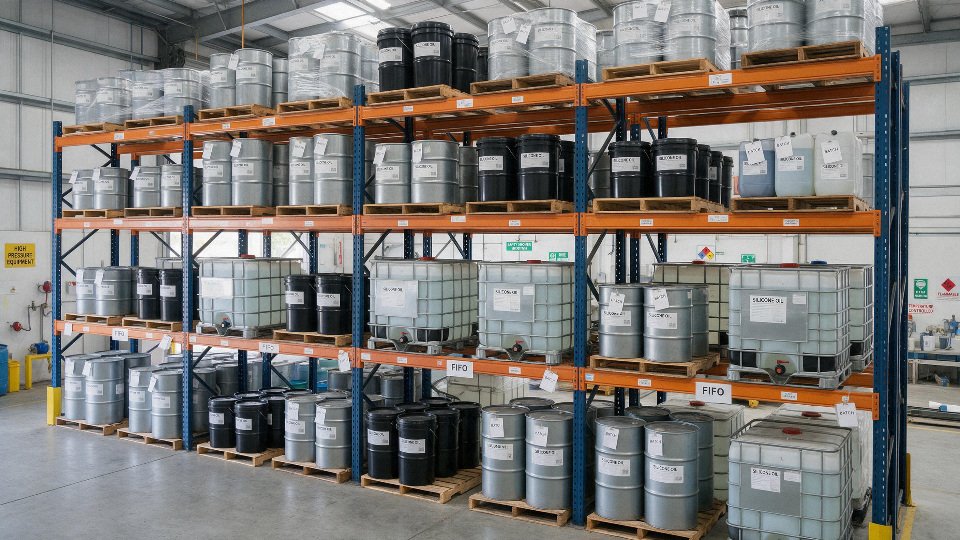
Top-tier suppliers will maintain 30–45 days of safety stock for their A-category SKUs. If your supplier can’t tell you their current inventory position for your grade, that’s telling. VMI arrangements, where the supplier holds consignment stock at your warehouse or a nearby 3PL, are increasingly common for annual spend above roughly USD 150,000–200,000 per grade. The supplier carries the working capital; you get pull-on-demand security. Not every supplier will offer this, but any serious one in the specialty fluids space should at least negotiate it.
Seasonal demand is easy to overlook. If you’re in textile finishing or agricultural silicone emulsions, demand seasonality can be extreme — 2:1 or higher peak-to-trough ratios. Build that pattern explicitly into your VMI target levels.
Single-Source vs. Dual-Source: Run the Math
Single-sourcing a critical silicone grade typically saves 3–8% on unit price through volume commitment and reduced qualification overhead. In practice that might represent USD 12,000–40,000 annually depending on your spend. A two-week production stoppage from a supply failure — accounting for idle labor, missed customer commitments, expedite freight, and raw material substitution scrambling — routinely costs 10–40× that figure.
A two-week supply disruption on a critical raw material typically costs far more than the annual savings from single-sourcing it.True
This is a well-established principle in supply chain risk management; the asymmetry between unit price savings (3–8% of annual spend) and production downtime costs (idle capacity, customer penalties, expedited logistics) is consistently documented in manufacturing operations literature and aligns with standard risk-adjusted cost frameworks.
A reasonable threshold: dual-source any grade where annual spend exceeds roughly USD 80,000–100,000 or where a stockout would shut down a production line within 72 hours. Below that, managed safety stock from a single qualified supplier is usually enough.
Geopolitical and Logistics Exposure
Asia-origin silicone fluids move heavily through Shanghai and Tianjin. Port concentration at either creates real vulnerability — typhoon season, labor actions, inspection backlogs, and the occasional regulatory disruption all hit those nodes. Ask your supplier where their finished goods warehouse sits relative to the loading port, and whether they have documented alternative routing. A supplier whose only exit is one container terminal in one port city is a fragility you should price into your risk model.
Review their business continuity plan specifically for force-majeure events. “We have insurance” is not a BCP. You want to see documented alternative production sites or qualified toll-manufacturing agreements, supplier-tier mapping for their own dimethylchlorosilane feedstock, and a communication protocol with realistic timeline commitments.
Lead Time Validation: Ignore Quoted Numbers
Ask for actual shipped-order data covering the past 12 months — purchase order date, confirmed ship date, and actual ship date. Calculate their on-time delivery rate yourself. A world-class silicone fluid supplier should be hitting ≥95% OTD against confirmed ship dates; anything below 90% on standard grades should prompt serious questions about production scheduling discipline or feedstock reliability.
Quoted lead times — “7–10 business days for stock grades” — are marketing. Actual OTD data is reality. The gap between those two numbers is where supply chain pain lives.
Analyzing Total Cost of Ownership Beyond the Unit Price Per Kilogram
Unit price per kilogram is the number that shows up in every supplier comparison spreadsheet. It is also, in most cases, the least useful number for making a sound procurement decision. Experienced buyers — the ones who’ve lived through a production line stoppage caused by off-spec material that was technically the cheapest option on the market — already know this. For everyone else, a structured total cost of ownership (TCO) model is the fastest way to make that lesson concrete before it costs you a production run.
Building the TCO Framework
The full cost of a silicone oil supply relationship includes unit price, yes, but also inbound freight and applicable import duties (which can swing 3–8% of landed cost depending on HS code classification and origin country), incoming inspection labor and consumables, yield losses attributable to off-spec material, line changeover and cleaning costs when a batch fails mid-process, regulatory requalification expenses triggered by batch deviations, and the often-underestimated cost of switching suppliers once you’ve embedded one into your process. Strip any of these out of the comparison and you’re not comparing suppliers — you’re comparing invoices.
The Incoming Inspection Cost Gap
This one tends to surprise procurement teams when you actually model it. Take two suppliers: Supplier A has a 2% incoming failure rate on viscosity or purity; Supplier B holds a 0.1% failure rate. Assume you receive 50 deliveries per year of 1,000 kg each. At 2%, you’re handling roughly one failed lot per month. Each failed lot means lab retesting (2–4 hours of technician time, say USD 60–120/hour all-in with overhead), a disposition decision meeting, potential hold inventory carrying cost at 15–25% annual cost of capital on the held material, and, worst case, a production schedule disruption that ripples into overtime or customer delay penalties. Conservatively, a 2% failure rate at that volume costs USD 18,000–40,000 per year in direct quality costs alone, depending on your plant’s hourly burden rate and whether you can absorb the schedule hit or not. Supplier B’s 0.1% rate might cost you one incident per year — call it USD 1,000–3,000 in absorbed cost. That gap, USD 15,000–37,000 annually, can comfortably justify a unit price premium of USD 0.30–0.60/kg on a 50-tonne annual buy.

Qualification Investment and Amortization
In regulated industries — pharmaceutical fill-finish, medical device lubrication, food-contact applications — qualifying a new silicone oil supplier is not a paperwork exercise. First-article qualification routinely runs USD 15,000–80,000 in analytical testing, documentation review, regulatory filing preparation, and internal validation time. The range is wide because it depends heavily on whether the material contacts a drug product directly, which country’s regulatory framework applies, and how much of the testing your internal lab can absorb versus what goes to a contract lab. Amortize that over a realistic contract volume of, say, 20–60 tonnes per year, and a three-year supply agreement, and the per-kilogram qualification burden adds roughly USD 0.08–0.45/kg. This cost is sunk the moment you approve the supplier. It also means that switching suppliers mid-contract carries a real reinvestment penalty — which is exactly why getting the qualification right the first time matters more than saving USD 0.15/kg on the initial PO.
First-article qualification for a new silicone oil supplier in a regulated pharmaceutical or medical device application typically costs USD 15,000–80,000 before volume discounts or amortization are applied.True
This range reflects realistic internal labor, third-party analytical testing, regulatory documentation preparation, and validation activities required under frameworks such as FDA 21 CFR Part 211 or ISO 13485 supplier qualification requirements. Actual cost depends on material contact classification, number of test parameters, and whether a site audit is required.
Freight, Packaging, and Scale Effects
Silicone oils in standard dimethyl grades are non-hazardous liquids under most transport regulations, which opens up cost-efficient shipping options that lower-volume buyers often leave on the table. The packaging format alone materially affects your unit economics: 200 kg drums versus 1,000 kg IBC totes typically yield a 12–18% reduction in unit cost at IBC scale, driven by reduced packaging material, less handling labor per kilogram, and better freight cube utilization. If your plant has IBC handling capability — a decent drum tipper and a decant station, nothing exotic — the payback on that infrastructure investment can be under six months on volumes above roughly 10 tonnes per year. ISO tank quantities push savings further, though that requires either a bulk storage tank on-site or a very predictable consumption rate.
Payment Terms and Currency Levers
A supplier quoting USD 3.80/kg with 60-day net terms, invoicing in your functional currency, and offering a 3–5% volume rebate at annual tier thresholds is a fundamentally different proposition than a supplier at USD 3.50/kg demanding 30-day TT in advance, invoicing in CNY on a floating exchange rate. The nominal price gap is USD 0.30/kg. After financing cost, FX hedging, and the rebate trigger, the effective difference often inverts. Push suppliers on these terms — established, well-capitalized suppliers will usually accommodate 60–90 day net for accounts with clean payment history, and the conversation itself tells you something about their financial stability and how much they want your business.
Sampling, Testing, and Incoming Qualification Protocol for New Silicone Oil Suppliers
Qualification is where supplier selection stops being paperwork and starts being engineering. A certificate of analysis is a claim. Your lab either confirms it or it doesn’t.
Phase 1 — Desktop Qualification Before You Order a Single Sample
Pull every document the supplier can provide: CoA, SDS, product data sheet, regulatory compliance declarations (REACH, RoHS, FDA food-contact status if relevant), and ideally a redacted reference customer list showing industries served. Score each candidate line-by-line against your TRD. This sounds obvious, but in practice most teams skip systematic scoring and end up comparing a supplier with a full pharmaceutical dossier against one with a single-page spec sheet — apples and oranges.
Eliminate non-compliant candidates here, not after you’ve spent three weeks running lab tests. If the viscosity grade is listed as “nominal 350 cSt” with no stated tolerance, that’s a red flag. If the CoA shows a single flash point value with no test method cited, ask which method — ASTM D92 and D93 give different results on the same fluid, and a supplier who doesn’t know that is telling you something about their QC culture.
Phase 2 — Laboratory Qualification: The Panel That Actually Matters
Request 500 mL to 2 kg of material drawn from a production lot — not a bench-prepared sample mixed to hit your spec sheet. Make this explicit in writing when you submit the sample request. Some suppliers, not all, will send you a carefully blended lab sample that bears no relationship to what comes off their reactor train at scale. Asking for a lot number you can cross-reference later is a reasonable requirement.
Run a full incoming panel. Kinematic viscosity by ASTM D445 is non-negotiable; for most PDMS grades in the 100–1000 cSt range, a credible pharmaceutical-grade supplier should hold ±1–2% of nominal. Refractive index (ASTM D1218) is a fast, cheap cross-check on purity and molecular weight distribution — it catches gross adulteration quickly. Flash point by ASTM D92 matters for storage classification and safe handling, especially if your plant runs near ignition sources. TGA volatility screening tells you what leaves the oil at process temperature; residuals that volatilize inside a sealed assembly or a cosmetic emulsion create completely different failure modes than they do in a transformer coolant, so weight your acceptance criteria accordingly.
Metals scan by ICP-OES is the test most buyers skip and then regret. Platinum, iron, tin — catalyst residues and process contamination — show up here. For electronic potting or medical device lubrication, even low-ppm metal contamination can cause adhesion failure or cytotoxicity issues. The cost of an ICP-OES run is roughly USD 80–150 per sample depending on your lab; that is trivially cheap against the cost of a field return.
Then run application-specific tests. Dielectric constant for transformer or capacitor applications. Emulsion stability for personal care. Lubrication film durability under load for mechanical applications. Generic panel results tell you what the oil is; application tests tell you whether it will work in your process.
Phase 3 — Process Qualification on a Pilot Scale
Bench data is necessary but not sufficient. Run the candidate oil through a small-scale process simulation — pilot line, test rig, benchtop reactor — and measure yield, product quality KPIs, equipment wear indicators, and cleaning effectiveness versus your qualified incumbent. In my experience, cleaning behavior is underestimated. Silicone oils vary significantly in how easily they flush from equipment between batches, and a slightly higher-viscosity lot can double your cleaning cycle time on a heat exchanger or a blending vessel.
A new silicone oil supplier passing laboratory CoA review alone is sufficient for production approvalFalse
CoA verification confirms stated parameters on a single lot sample but does not validate process compatibility, scale-up consistency, or long-term batch-to-batch capability. Process qualification on representative production equipment is required before full production approval.
Statistical Acceptance Criteria and Capability Targets
Define AQL for each parameter before testing begins, not after you see the results. For viscosity-critical applications — lubrication, damping fluids, medical device filling — set your acceptance window at ±1.5% around nominal as a starting point. That’s tighter than a typical supplier’s published spec, which often runs ±5% or wider, but it’s defensible if your process has a narrow operating window. Set a long-term capability target of Cpk ≥ 1.33 for viscosity; ask the supplier for their internal SPC data across recent lots to assess whether they can realistically hit it before you write it into the contract.
Reference Standards and Documentation
Retain a 500 mL sealed reference sample from the qualification lot, stored at 15–25 °C, away from UV and away from anything that could contaminate the container. Keep it for 36 months minimum. If a dispute arises 18 months into a supply agreement over whether a batch has drifted from the qualified specification, you need a physical comparator. Without it, the argument becomes subjective.
For regulated industries — pharmaceutical, medical device, food processing — compile the full supplier qualification report, test data package, risk assessment, and a change control record. Format it to be compatible with FDA 21 CFR Part 211 requirements if you’re in drug manufacturing, or EU GMP Annex 11 if your process involves computerized systems. This documentation isn’t bureaucracy for its own sake; it’s what stands between you and a Form 483 observation when an inspector asks how you qualified your raw material supplier.
Negotiating Contracts, Pricing Structures, and Long-Term Partnership Terms
Most procurement teams spend months qualifying a silicone oil supplier, then hand the contract to a junior buyer who locks in a fixed unit price for 24 months and calls it done. That’s where the real exposure lives. A well-structured supply agreement is essentially a risk-allocation document — it determines who absorbs raw material swings, who bears the cost of a bad batch, and who gets allocation first when the market tightens.
Price Indexing to Upstream Raw Materials
Silicone oil pricing tracks D4/D5 cyclosiloxane monomer costs with a lag of roughly 4–8 weeks, depending on how integrated your supplier’s production is. Fixing a price for longer than one quarter without an indexing mechanism means one party is speculating against the other — and in a volatile year, that price gap can hit 15–25% in either direction.
The practical approach: link your contract price to a recognized published reference — ICIS silicone intermediates or the Chinese domestic D4 spot price published by relevant trade associations are commonly used benchmarks — with a defined quarterly adjustment window. Then build a collar: a band of roughly ±7–9% around the base price within which no adjustment is triggered. Swings inside that band are absorbed. Outside it, the formula kicks in automatically, no negotiation required. This removes the renegotiation friction that strains supplier relationships and slows purchasing decisions during volatile periods.
Quality Warranty Language That Actually Has Teeth
A certificate of analysis attached to an invoice is not a warranty. What you need in the contract is an explicit statement that the supplier warrants every delivered lot against your TRD parameters — viscosity tolerance, purity assay, volatile content, whatever your process requires — and that a confirmed non-conformance triggers replacement or full credit within 30 days, not “at the supplier’s discretion.”
Silicone oil viscosity drift of more than ±3% from nominal can cause measurable fill-weight variation in automated lubrication or cosmetic filling linesTrue
Viscosity directly governs volumetric pump displacement and flow resistance; even a calibrated gear pump will deliver off-spec volumes if the fluid's viscosity has shifted outside the pump's compensation range, which is typically narrower than buyers assume.
On liability caps: most suppliers will push back hard on covering consequential losses. Realistically, you can negotiate coverage up to a defined cap — often 2–3× the invoice value of the non-conforming lot — and for high-stakes pharmaceutical or electronics applications, a separate product liability insurance certificate should be a contract condition. Don’t accept a blanket exclusion of consequential damages without at least a meaningful direct-loss cap.
Audit Rights and Change Notification
Annual on-site audit rights with 14-day notice are a reasonable ask and most ISO 9001-certified suppliers will accept them. The clause that matters more, in practice, is the change notification requirement. Suppliers change raw material sources, swap siloxane monomer suppliers, or shift blending operations to a different facility without telling customers — not out of malice, but because internally it looks like a minor operational adjustment. From your process validation standpoint, it can be a requalification event.
Specify 60-day written advance notice for any change to: manufacturing site, monomer source, catalyst system, or packaging configuration. Include the right to request bridging samples and comparative analytical data before the change takes effect.
Volume Commitment Structure
A take-or-pay floor at around 65–75% of your annual forecast gives the supplier enough revenue predictability to hold safety stock and prioritize your orders. In exchange, you should negotiate a flexible upside — typically up to 125–130% of forecast at pre-agreed spot-linked pricing — so that a demand spike doesn’t leave you rationed. The floor also strengthens your position during allocation crunches; suppliers protect customers who represent guaranteed baseline revenue.
Trading Preferred Status for Real Value
Preferred supplier designation sounds ceremonial, but structured correctly it’s a negotiating lever. Offer early roadmap visibility, first-call involvement in new product development, and introductions to your contract manufacturers if relevant. In exchange, ask for best-available pricing, a written priority allocation commitment during shortage periods (defined as X weeks of your average monthly consumption held in reserve), and a named technical support contact with a defined response SLA — 24 to 48 hours for urgent process questions is a reasonable benchmark. Most quality-tier suppliers will accept these terms because the relationship stability is genuinely worth something to them.
Get the contract language reviewed by someone who has actually dealt with a supplier dispute over a contaminated batch. The standard boilerplate from a supplier’s legal team is written to protect them, not you.
Sustainability, ESG Compliance, and Responsible Sourcing Considerations
Procurement teams that treated silicone oil as a pure commodity for the past two decades are now getting surprised by customer questionnaires, regulatory audits, and, in some sectors, outright delistings. The pressure is real and it’s accelerating. The good news is that most of this is manageable if you build ESG criteria into supplier qualification upfront rather than retrofitting them under deadline pressure.
Carbon Footprint Benchmarking
Integrated silicone producers — the ones that run the full chain from quartz to PDMS fluid — typically report cradle-to-gate GHG intensity somewhere in the 4–9 kg CO₂e per kg of finished fluid range. That spread is wide because it depends heavily on how the upstream silicon metal was smelted and what energy grid powers the polymerization plant. A supplier running a modern continuous-process facility on hydropower-heavy grid power can land near the low end. One sourcing silicon metal from coal-heavy regions and running batch reactors will sit at the top or beyond it.
Ask for Scope 1 and Scope 2 emissions data specifically — not a general sustainability brochure. A supplier that has actually done the calculation will give you a product carbon footprint (PCF) document tied to a specific grade and production site. One that hands you a glossy PDF about tree-planting programs hasn’t done the work yet.
Integrated silicone producers typically report cradle-to-gate GHG intensity of 4–9 kg CO₂e per kg of PDMS fluid depending on energy source and process configurationTrue
This range aligns with published lifecycle assessment data from major silicone producers and independent LCA studies on polydimethylsiloxane; the spread is driven primarily by upstream silicon metal smelting energy intensity and the electricity grid mix at the polymerization facility
Cyclic Siloxane Regulatory Exposure
The EU REACH restriction on D4 and D5 — both capped at ≤ 0.1% w/w in rinse-off cosmetic formulations — has been in force long enough that reputable suppliers already have this under control. The issue is verifying it properly. Ask for GC-MS method validation documentation, not just a certificate of analysis showing a result below the limit. You want to know the detection limit of the method itself. If a supplier’s GC-MS method can only confidently detect D4 at 0.08% w/w, a result reported as “< 0.1%” is essentially uninformative — you cannot distinguish compliant material from marginal material.
D6 regulation is still evolving but the trend is obvious. Build D6 testing into your incoming specification now if you’re selling into the EU personal care or household products markets. It costs almost nothing to add it while you’re already running D4/D5 analysis.
Silicon Metal Origin and Upstream Energy Disclosure
This is the ESG question most silicone oil buyers haven’t started asking yet, which means asking it now distinguishes you as a serious buyer and tends to get honest answers. Silicon metal smelting is brutally energy-intensive — roughly 11–13 MWh per tonne, depending on process design. Whether that electricity comes from Norwegian or Sichuan hydropower or from a coal grid matters enormously to the upstream carbon footprint. A handful of producers in Norway, Brazil, and certain regions of China running on renewable hydro grids can document meaningfully lower upstream emissions.
Some suppliers genuinely don’t know the origin of their silicon metal feedstock because they buy it on spot markets. That’s a disclosure gap, not necessarily a disqualification, but it needs to be noted in your supplier risk register.
End-of-Life Claims and Recycling Programs
Used silicone fluids from industrial applications — transformer cooling, release agent sumps, heat transfer loops — can in principle be cracked and repolymerized. A few specialty chemical processors offer exactly this, though volumes are still small. If a supplier offers a take-back program, ask for the actual processing pathway and where the recovered material goes. “Recycled” can mean thermally recovered as fuel rather than chemically reprocessed, which is a much weaker circularity claim.
Be skeptical of any “biodegradable silicone” marketing that isn’t backed by OECD 301 test data. PDMS degrades slowly under specific conditions but is not readily biodegradable in the conventional sense. Suppliers making strong biodegradability claims without test data are either confused or hoping you are.

ESG Questionnaire Platforms and Minimum Score Thresholds
Rather than building your own supplier sustainability questionnaire from scratch — which is time-consuming and hard to benchmark — use an established platform. EcoVadis, Sedex, and CDP Supply Chain each have their particular strengths. EcoVadis is well-suited for chemical and materials suppliers because its methodology explicitly covers environmental management, labor practices, ethics, and sustainable procurement as separate scored domains.
A practical starting threshold for new supplier qualification from 2025 onward: EcoVadis Silver, which corresponds to a score of roughly 45 out of 100. That isn’t a high bar — it means the supplier has documented policies, partial implementation evidence, and no significant uncorrected findings. It does filter out suppliers with no ESG infrastructure at all.
The one practical caveat: smaller specialty producers and toll blenders often haven’t gone through EcoVadis assessments because their customer base hasn’t required it. If you’re sourcing a niche functional grade from a manufacturer with 50 employees, a direct audit questionnaire and a site visit is more proportionate than demanding a platform score. Reserve the platform threshold for suppliers at meaningful annual spend levels — say, above USD 50,000–100,000 per year — and apply a lighter-touch self-assessment below that.
Frequently Asked Questions About Choosing Silicone Oil Suppliers
What MOQ should I expect from a Tier 1 manufacturer, and how do smaller buyers get access?
Tier 1 manufacturers — the ones actually polymerizing PDMS from chlorosilane intermediates — typically won’t quote below 1,000 kg per order for standard viscosity grades, and for specialty or custom-blended products that floor often sits at 3,000–5,000 kg. That’s a real barrier for a maintenance shop or a small-batch compounder running maybe 200 kg per month.
The practical workaround is an authorized distributor who buys in bulk and breaks it down. Quality doesn’t degrade just because the product changed hands once, provided the distributor stores it correctly (sealed, away from moisture and UV, ideally below 40°C ambient). The other angle — especially if you’re growing — is a blanket purchase order with the manufacturer: commit to, say, 6,000 kg over twelve months with scheduled monthly releases. You meet their MOQ threshold on paper; they produce in one or two runs and hold the stock. Most ISO 9001-certified Tier 1 suppliers are set up for exactly this arrangement and will usually maintain a 30-day safety stock for your SKU once you’re on their top-10 list.
How do I know a Certificate of Analysis is genuine?
CoA fraud is more common than people like to admit, particularly from trading intermediaries. The simplest verification step: take the manufacturer’s lot number printed on the CoA, then call or email the manufacturer’s technical service or quality department directly — not the supplier who sent you the document — and ask them to confirm that lot was produced and tested at their facility. Legitimate manufacturers do this routinely. If the “manufacturer” contact on the CoA is a generic Gmail address or redirects back to the same trading company, that’s a clear signal.
Cross-check the reported test values against the published product data sheet. A 350 cSt grade should show viscosity within roughly ±1–2% of nominal. If the CoA shows exactly 350.00 cSt with zero deviation, be skeptical — real lab measurements have variance.
Can food-grade silicone oil work as a pharmaceutical excipient?
No, not automatically. FDA 21 CFR 178.3570 compliance tells you the material is acceptable for incidental food contact — it says nothing about GMP manufacturing, elemental impurity limits, or compendial testing. A pharmaceutical excipient needs a supplier running under GMP, capable of providing a Drug Master File (DMF) or equivalent regulatory filing, and issuing a CoA that references USP or EP testing methods for PDMS. The viscosity grade might look identical on paper, but a food-grade product won’t carry the batch documentation, impurity profiling, or regulatory traceability your QA team needs.
FDA 21 CFR 178.3570 food-grade compliance is sufficient for pharmaceutical excipient use of silicone oilFalse
Food-grade status covers incidental food contact only. Pharmaceutical excipient use requires GMP manufacturing, a Drug Master File or equivalent, and compendial testing per USP or EP — none of which are required for 21 CFR 178.3570 compliance.
How often should I requalify an approved supplier?
At minimum, do a desktop review annually — look at complaint rate, on-time delivery, and CoA conformance trends across the previous twelve months. That review should be documented, not just a conversation.
Trigger a full requalification — laboratory testing, potentially a site audit — if any of the following happen: the supplier issues a manufacturing change notification, you receive two or more non-conforming lots within any rolling twelve-month window, or a regulatory inspection at their site produces findings relevant to your product. Don’t wait for a third bad lot to act.
What viscosity grades make a sensible starter inventory for general industrial maintenance?
Four grades cover the majority of situations: 10 cSt for light lubrication and mold release, 100 cSt for general-purpose dampening and bearing lubrication, 350 cSt for heat transfer and hydraulic applications, and 1,000 cSt for heavy damping, gasket conditioning, and sealant blending. In practice, these four handle roughly 70–80% of typical industrial silicone oil demand — the exact share depends on your equipment mix and industry. Stocking these in modest quantities (say, 20–50 kg drums for each) gives you flexibility without tying up working capital in slow-moving specialty grades.
Is it safe to swap suppliers for the same viscosity grade without requalification?
In regulated applications — pharmaceutical, medical device, food processing — the answer is no, full stop. Two suppliers’ 350 cSt PDMS products can look identical on a standard viscosity CoA yet differ meaningfully in cyclic siloxane content (D4, D5, D6), end-group chemistry, or trace metal levels. Those differences can affect coating adhesion, shelf life of finished products, or create a regulatory deviation if your submission references a specific manufacturer.
Even in industrial applications, switching without at least a bench-level Phase 2 qualification is a gamble. The cost of one contaminated batch or a line shutdown almost always exceeds the time saved by skipping qualification. Run the comparison test first.
Building a Supplier Scorecard and Continuous Improvement Program
Most supplier selection processes end the moment the purchase order is signed. That’s a mistake. The real work — keeping a supplier performing at the level they promised during the sales process — requires a structured management system that runs for the entire contract lifetime. A well-designed scorecard converts a one-time qualification decision into a living performance loop.
Scorecard Architecture and Weighted Pillars
The framework I’d recommend weights four pillars: Quality at 40%, Delivery at 25%, Service at 20%, and Sustainability/ESG at 15%. Quality gets the heaviest weight because silicone oil variability directly reaches your process — a batch of 350 cSt PDMS that’s drifted to 310 cSt doesn’t just fail incoming inspection, it shows up as inconsistent coating thickness or a seized damper assembly three shifts later.
Under Quality, track incoming conformance rate (percentage of lots accepted without deviation), CoA accuracy (does the certificate match your independent lab results within stated tolerances?), and complaint response time. That last one is surprisingly diagnostic. A supplier who responds to a quality complaint within 24 hours and assigns a named engineer to it has a fundamentally different internal culture than one who takes eight days to acknowledge receipt.
Delivery metrics should focus on OTD rate, lead time consistency (variance matters as much as the mean — a supplier who quotes 10 days and delivers anywhere from 7 to 22 is operationally worse than one who reliably hits 14), and emergency order fulfillment capability. The Service pillar covers technical support responsiveness and, critically, application troubleshooting depth. Can their application engineer actually explain why your phenyl silicone oil is clouding at low temperatures, or do they just re-send the TDS? Sustainability/ESG at 15% tracks ESG score trend over time, carbon data transparency, and regulatory compliance record — not a checkbox, but a trend line.

Data Collection Cadence
Pull incoming inspection data monthly and feed it directly into the scorecard without manual re-entry if you can manage it. Review OTD performance weekly — this catches a developing logistics problem before it becomes a stockout. Quarterly business reviews (QBRs) with strategic suppliers are worth the calendar time; they give both sides visibility into upcoming demand changes, new regulatory requirements, or formulation development needs. Once per year, complete a full formal scorecard evaluation and assign one of four ratings: Preferred, Approved, Conditional, or Disqualified. These ratings should carry real commercial consequence — Preferred suppliers get first access to new business, Conditional suppliers get a 90-day remediation window, Disqualified suppliers are removed from the approved vendor list.
Corrective Action Loop
When any pillar drops below its threshold, issue a Supplier Corrective Action Request (SCAR) within 10 business days. Require an 8D root cause analysis and containment plan within 30 days of issuance. Track SCAR closure rate as its own meta-KPI — a supplier closing 90%+ of SCARs on time, with verified containment, has quality discipline embedded in their operations. One who consistently requests extensions or submits 8Ds that recycle the same corrective action language doesn’t.
Suppliers with a SCAR closure rate above 85% statistically show lower repeat nonconformance rates over a 12-month period.True
This reflects well-documented patterns in supplier quality management literature and is consistent with the logic of closed-loop corrective action systems — effective root cause analysis prevents recurrence.
Recognition, Co-Development, and Exit Planning
Preferred-rated suppliers should receive something tangible: first-look access to development projects, longer-term contract horizons, or joint work on next-generation grades — specialty amino-functional or high-phenyl content silicone oils that your competitors aren’t yet sourcing. Packaging optimization and digital lot traceability (blockchain-based lot tracking is moving from pilot to mainstream faster than most procurement teams expect) are realistic co-development targets that reduce your own internal cost while deepening the partnership in ways a pure price relationship never does.
Exit planning is unglamorous but essential. Maintain a pre-qualified backup supplier for every critical grade, with transition lead time under 30 days. Run a small qualifying order with that backup every 18 months — roughly one or two drums, enough to confirm their process hasn’t drifted and the commercial relationship stays warm. Annual review of backup qualification status should be a standing item on your QBR agenda, not something you remember only when your primary supplier goes on allocation.