Wrong silicone oil in a cosmetic formulation doesn’t just mean a subpar skin feel — it can collapse an emulsion batch, trigger incompatibility with active ingredients, or leave a greasy residue that kills consumer re-purchase faster than any negative review. At scale, that translates to rejected lots, reformulation costs, and the kind of supply-chain scramble that procurement managers remember for years. The silicone category alone spans viscosities from 0.65 cSt volatile fluids to 60,000 cSt heavy film-formers, and picking the wrong grade is easier than most formulators admit.
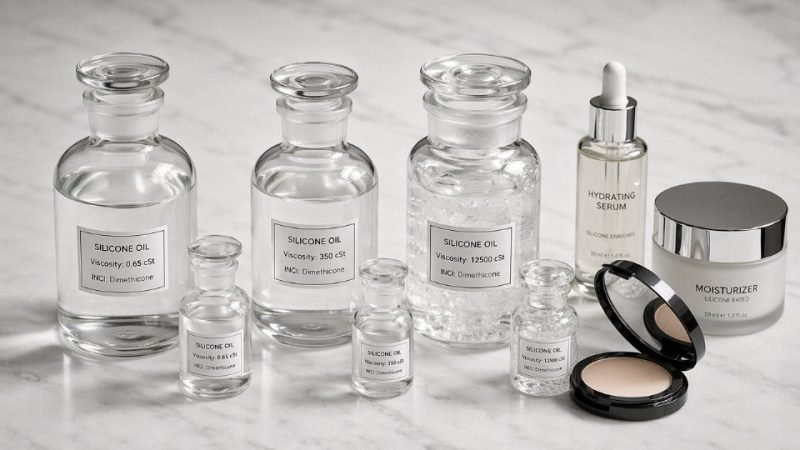
Choose silicone oil for cosmetics by matching viscosity grade to your application: low-viscosity dimethicone (0.65–10 cSt) for lightweight serums and volatile carriers, mid-range 350 cSt for general skin-care emulsions, and high-viscosity grades (1,000 cSt and above) for occlusive or film-forming products. Factor in regulatory status — cyclic siloxanes like D5 are now capped at 0.1% w/w in EU wash-off products — alongside spreadability, compatibility with actives, and your finished-product texture target.
What makes this genuinely difficult is that the global cosmetic silicone market sits at roughly USD 2.1 billion and keeps growing, which means suppliers are pushing more grades, more blends, and more marketing claims than any specification sheet can keep up with. A 350 cSt dimethicone from two different suppliers can behave noticeably differently in an emulsion depending on purity, trace silanol content, and how the drum was stored. The regulatory picture shifted sharply after the EU’s 2018/1516 restriction gutted D5’s role in rinse-off conditioners, and more restrictions are in discussion. Knowing which silicone to reach for — and which to avoid — starts with understanding what each type actually does on skin, in the mixer, and on the stability shelf.
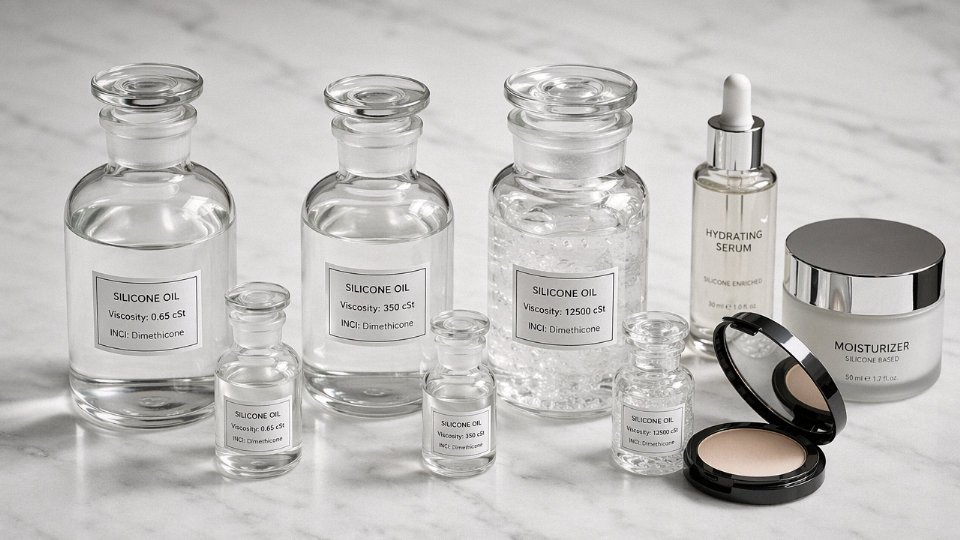
Silicone Oil Taxonomy: Linear, Cyclic, and Functional Grades Explained
Walk through a supplier’s silicone catalog for the first time and the sheer number of INCI names is genuinely disorienting. Dimethicone, cyclopentasiloxane, phenyl trimethicone, bis-PEG/PPG-20/20 dimethicone — these are not interchangeable, and treating them as “silicone oil, pick whichever” is how a formulation ends up pilling on skin or getting flagged at EU customs.
Linear Polydimethylsiloxanes (PDMS / Dimethicone)
The backbone of the category. The repeating –Si(CH₃)₂–O– chain gives PDMS its characteristic low surface tension and thermal stability. What changes across the viscosity ladder is almost everything else that matters practically.
At the low end — 0.65 to 2 cSt — PDMS behaves more like a volatile solvent than an emollient. It evaporates from skin reasonably quickly, leaves minimal residue, and is used mainly as a carrier or to thin down heavier grades in spray formulations. The INCI name here is typically dimethicone or sometimes polydimethylsiloxane, though at these very low molecular weights a few suppliers still list it under older trade-name conventions, so check the CAS number (9006-65-9 for the polymer series).
350 cSt is the workhorse grade — widely stocked, relatively forgiving in emulsification, and it delivers that clean, non-greasy slip most consumers associate with “good” skin care. Use levels in moisturizers typically run 2–8%, though silicone-heavy serums can push to 15% without the formula turning tacky, depending on the rest of the oil phase.
Move up to 1,000–12,500 cSt and you’re building occlusion and film-forming character. These grades add perceptible weight; they’re the right choice for barrier creams, certain hair serums where coating is the explicit goal, and long-wear foundation matrices. At 60,000 cSt the material is nearly a gum — some suppliers supply it pre-dissolved at 40–60% in a lighter dimethicone because handling neat high-viscosity PDMS on a plant floor at scale is a practical nightmare. Pumps cavitate, transfer lines clog in cooler ambient conditions, and you’ll lose significant batch yield to vessel walls if you don’t account for it.
Cyclic Siloxanes: D4, D5, D6
Cyclics — specifically D4 (octamethylcyclotetrasiloxane), D5 (decamethylcyclopentasiloxane), and D6 (dodecamethylcyclohexasiloxane) — were once the go-to volatile carriers because of their exceptionally clean evaporation and unusual ability to dissolve film-forming polymers and certain actives that don’t disperse well in straight dimethicone.
D5 historically accounted for more than 40% of rinse-off hair conditioner formulas before regulatory pressure changed the picture. EU Regulation 2018/1516 capped D4 and D5 at 0.1% w/w in wash-off products effective January 2020, driven by persistence and bioaccumulation concerns in aquatic environments. The UK retained equivalent restrictions post-Brexit. D6 currently sits under active review — it would be unwise to reformulate away from D5 by simply swapping in D6 and assuming long-term regulatory stability.
EU Regulation 2018/1516 restricts D5 to a maximum of 0.1% w/w in wash-off cosmetic productsTrue
The regulation entered into force targeting decamethylcyclopentasiloxane (D5) and octamethylcyclotetrasiloxane (D4) in wash-off products, citing environmental persistence (PBT/vPvB classification). Leave-on products were not restricted under this specific regulation, though ongoing ECHA review means that status could change.
For leave-on applications, cyclics remain permitted, but any formulator building a new platform today should at least model the cost of a future reformulation — especially for global brands selling into markets that may follow the EU trajectory.
Phenyl Silicones
Phenyl trimethicone and diphenyl dimethicone bring something plain PDMS cannot: a higher refractive index, typically 1.46–1.53 versus roughly 1.40 for standard dimethicone. That difference matters concretely in color cosmetics and sunscreen. Organic UV filters like octyl methoxycinnamate tend to recrystallize or fall out of suspension in straight PDMS — phenyl silicones are genuinely better solvents for these materials, which is why you’ll find them in SPF-heavy tinted moisturizers and glossy lip products where clarity and gloss depth matter.
The sensory premium is real, not marketing copy. Phenyl silicones impart a slightly richer, more “skin-like” slip compared to the somewhat clinical slip of 350 cSt dimethicone. The trade-off is cost — phenyl variants typically run 3–6× the price per kilogram of commodity dimethicone, so use levels are usually kept to 1–5% as a modifier rather than the primary oil-phase component.
Functionalized Silicones
This is where the chemistry gets genuinely interesting and where most of the performance differentiation in premium products comes from.
Amino silicones (amodimethicone, INCI: amodimethicone) carry amine groups that bond electrostatically to the negatively charged surface of damaged hair. They don’t just coat — they preferentially deposit on high-damage zones, which is why they outperform plain dimethicone in repair-claim conditioners. The catch: poorly rinsed amino silicone builds up aggressively over repeated washes, which is a real consumer complaint if your use level or molecular weight is miscalibrated.
Dimethicone copolyols (polyether-modified silicones, e.g., PEG-12 dimethicone, bis-PEG-18 methyl ether dimethyl silane) act as silicone emulsifiers and sensory modifiers simultaneously. They’re what allows water-in-silicone emulsions to stay stable without conventional surfactant-heavy emulsifier systems. Use levels are typically 0.5–3%.
Silicone elastomers — dimethicone crosspolymer, vinyl dimethicone/methicone silsesquioxane crosspolymer — are suspended in a carrier fluid and function as soft-focus agents and long-wear binders in makeup. They’re not “silicone oil” in the strict sense, but they appear on the same datasheets and serve as critical co-ingredients.
Quick-Reference Silicone Type Comparison
| Silicone Type | Viscosity Range | Volatility | Polarity | Typical Use Level | Primary Application |
|---|---|---|---|---|---|
| Dimethicone (low) | 0.65–10 cSt | High | Very low | 1–5% | Spray, serum carrier |
| Dimethicone (mid) | 100–1,000 cSt | None | Very low | 2–15% | Moisturizer, foundation |
| Dimethicone (high) | 5,000–60,000 cSt | None | Very low | 0.5–5% | Barrier cream, hair serum |
| D5 / D6 (cyclic) | N/A (volatile liquid) | Very high | Low-moderate | 5–30% | Leave-on spray, dry-touch finish |
| Phenyl trimethicone | ~20–100 cSt equiv. | Very low | Moderate | 1–5% | Lip gloss, SPF, color cosmetics |
| Amodimethicone | Varies by MW | None | Moderate (cationic) | 0.5–3% | Rinse-off/leave-on hair conditioning |
| Dimethicone copolyol | Varies | Low-moderate | High (amphiphilic) | 0.5–3% | W/Si emulsions, skin feel modifier |
| Silicone elastomer blend | Gel/paste | None | Low | 2–10% | Long-wear makeup, soft-focus skin care |
Reading a supplier datasheet without this mental map leads to real procurement errors — ordering a high-viscosity grade when the formula needs volatility, or substituting a cyclic for a linear and watching the emulsion break in stability testing three weeks before launch.
Matching Viscosity Grade to Product Category and Desired Skin Feel
Viscosity is the single number most formulators reach for first when selecting a dimethicone, and it’s easy to see why — it correlates directly with how a product feels the moment it touches skin. But cSt is not a skin-feel guarantee. It’s a starting point, and the wrong starting point costs you consumer panel scores, rework batches, or both.
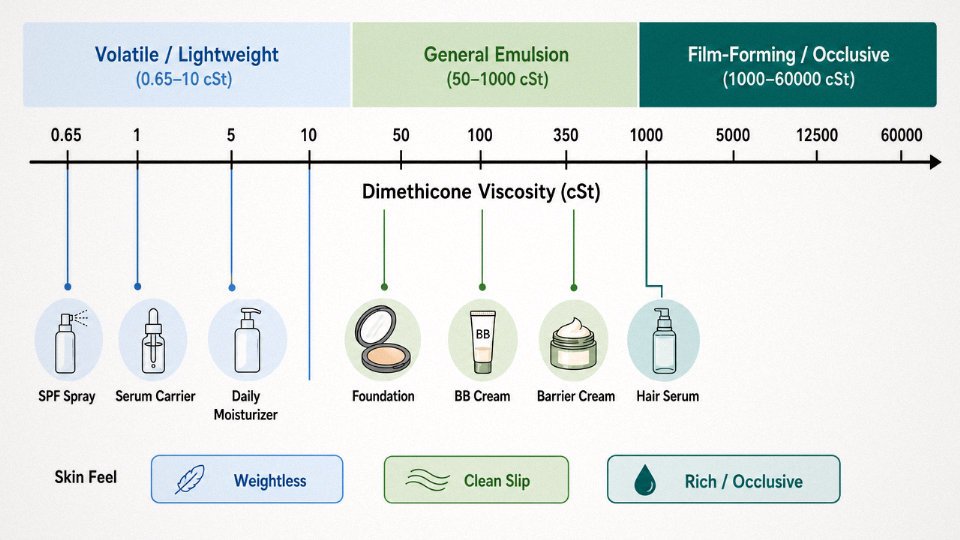
Low-Viscosity Grades: 0.65–10 cSt
These grades spread fast and essentially disappear. A 1 cSt dimethicone on skin evaporates in seconds, leaving almost no perceptible residue — which is exactly what you want in an SPF spray, an aftershave gel, or a serum base where the consumer brief says “weightless.” The dry, powdery finish that cyclomethicone used to deliver in rinse-off products (before D5 was capped at 0.1% w/w in EU wash-off applications under Regulation 2018/1516) is now largely replicated with blends of 1–5 cSt dimethicone in leave-on formats.
The operational trap here is volatility-driven phase separation. Low-viscosity silicones have high vapor pressure, and if your emulsifier package isn’t matched to the lower surface tension of these grades, you’ll see creaming or oil separation within a few weeks of storage — sometimes faster under accelerated stability testing at 45°C. In practice, nonionic emulsifiers in the HLB 10–12 range tend to hold these grades better than lower-HLB options. That’s not universal; it depends on your aqueous phase composition, but it’s a useful first assumption.
Mid-Range Grades: 50–500 cSt
This is where most skin-care and color-cosmetic formulation happens. The 350 cSt grade specifically has become a de facto global benchmark — it shows up in reference formulas from every major silicone supplier, it’s stocked by virtually every cosmetic raw material distributor, and there’s a reason for that. It provides enough lubricity to give good slip without the heavy, greasy drag you get above roughly 500 cSt, while still being stable in standard hot-process O/W emulsions without special handling.
Foundations, BB and CC creams, daily moisturizers, and tinted sunscreens — 350 cSt covers most of them adequately. At 50–100 cSt you get a slightly lighter, more fluid feel suitable for lightweight day creams or fluid foundations where buildability matters more than coverage density.
350 cSt dimethicone is the most widely used viscosity grade in skin-care emulsion formulations globally.True
350 cSt dimethicone appears as the reference grade in formulation guides from Dow, Momentive, and Shin-Etsu, and is consistently cited as the highest-volume cosmetic silicone grade in procurement data and supplier technical literature.
High-Viscosity Grades: 1,000–60,000 cSt
Above 1,000 cSt, you’re in barrier-film territory. These grades don’t spread easily on their own — at 12,500 cSt you’re working with something that has the body of a thick gel, and at 60,000 cSt it’s closer to a soft elastomer precursor than a conventional fluid. They’re well suited to barrier creams, wound-care cosmetics, hair gloss serums, and any formulation where occlusion or a “glassy” film is the explicit goal.
The processing implication is real. You cannot simply drop a high-viscosity dimethicone into a standard cold-mix emulsification process and expect a stable emulsion. Most plants need either hot-process emulsification (typically 75–85°C, depending on the emulsifier system) or pre-dispersion in a lighter carrier — say, 5–10% of a 5 cSt dimethicone — before adding to the water phase. Skipping this step produces visible grease pockets and inconsistent particle size that no amount of homogenization time will fully correct.
What Happens When You Get It Wrong: A Realistic Scenario
Consider a tinted moisturizer originally formulated with 350 cSt dimethicone. A procurement team switches to 1,000 cSt from a different supplier — same INCI name, no formulation adjustment, driven by a small price-per-kg saving. The emulsifier HLB remains unchanged. Result: finished product viscosity climbs noticeably, application drag increases, and consumer panel feedback shifts negative within one test cycle. The “saving” gets wiped out by one reformulation round plus a delayed launch. This is a well-documented pattern in color cosmetics; the emulsifier HLB must be re-optimized whenever the silicone viscosity shifts by more than roughly one order of magnitude.
Translating Viscosity Into Sensory Language
R&D specs and marketing briefs rarely speak the same language, and that gap causes real friction. A rough translation map:
| Viscosity Range | Typical Sensory Descriptor | Suitable Product Category |
|---|---|---|
| 0.65–5 cSt | Dry, powdery, fast-vanishing | SPF sprays, aftershave, light serums |
| 10–50 cSt | Clean, silky, low residue | Fluid foundations, light day creams |
| 100–500 cSt | Slip, cushiony, emollient | Moisturizers, BB/CC creams, primers |
| 1,000–5,000 cSt | Rich, film-forming, slightly occlusive | Barrier creams, night treatments |
| 10,000–60,000 cSt | Glassy, heavy, protective | Hair gloss serums, wound-care cosmetics |
The Blending Shortcut Worth Knowing
If you need a functional mid-range feel but want to optimize cost or manage inventory, blending works. Mixing 5 cSt and 12,500 cSt dimethicone at roughly a 3:1 ratio by weight produces a blend viscosity in the 300–400 cSt range — close enough to the 350 cSt benchmark to be a viable formulation substitute in many non-critical applications. The blend doesn’t behave identically to a neat 350 cSt grade (the molecular weight distribution is different, and some formulators notice a slightly less uniform skin feel), but for barrier creams or hair products where sensory precision is secondary to film performance, it’s a legitimate cost-management tactic. Verify with your own stability and sensory panel before committing to production volumes.
Volatility and Evaporation Rate: Choosing Between Staying Power and Clean Finish
Volatile and non-volatile silicones are not interchangeable carriers. Using the wrong one in a long-wear foundation or a dry-touch SPF isn’t a minor formulation tweak — it’s the difference between a product that transfers cleanly onto a shirt collar and one that sits on skin as an intact, matte film hours later. This distinction gets glossed over in supplier technical sheets, which tend to lead with viscosity and spreadability while burying evaporation data.
What “Volatile” Actually Means in Practice
A silicone oil is considered volatile when its boiling point falls below roughly 250°C. Evaporation rate is usually benchmarked against n-butyl acetate (defined as 1.0). Cyclopentasiloxane (D5) sits in the 0.8–2.0 range depending on temperature and airflow conditions over the skin surface; D6 (cyclohexasiloxane) evaporates more slowly, typically 0.3–0.8. A 350 cSt polydimethylsiloxane, by contrast, has an evaporation rate that is effectively zero — it stays on skin indefinitely, which is exactly what you want in an occlusive moisturizer and exactly what you don’t want in a transfer-proof liquid lipstick.
The mechanism in long-wear color cosmetics is worth spelling out clearly. Volatile silicones act as a temporary vehicle: they disperse film-formers (usually acrylate copolymers or polyurethane dispersions) and coated pigments, allow the blend to spread evenly across skin texture, then evaporate within 5–15 minutes post-application, collapsing the film-former network into a continuous, adherent layer. No volatile carrier, no collapse — you’re left with a plasticized film that moves with skin oils and transfers.
D5 has been restricted to 0.1% w/w in wash-off cosmetics in EU markets since January 2020True
EU Regulation 2018/1516 imposed this limit on cyclopentasiloxane in rinse-off products effective January 26, 2020, based on environmental persistence concerns identified by ECHA.
D5 Restriction and the Practical Shift to D6
Post-restriction, most EU and UK formulators have moved to D6-dominant cyclomethicone blends or dropped cyclic siloxanes from rinse-off entirely. In leave-on products — foundations, primers, sunscreens — D5 is still permitted, but the regulatory trajectory has made brand owners nervous about using it even where it’s technically legal. D6 performs comparably in long-wear foundations: slightly lower evaporation rate does mean a marginally longer dry-down time (roughly 20–40 seconds longer in typical ambient conditions), but most consumer panels can’t reliably detect the difference.
The cost premium for D6-dominant blends typically runs 15–25% over equivalent D5 grades, though this varies with contract volume and whether you’re sourcing from a Chinese distributor or a European toll manufacturer. On a finished formula cost basis, at typical silicone loading of 20–35% in a foundation, that premium translates to roughly USD 0.08–0.20 per unit — manageable, but it adds up at commercial scale.
Volatile Linear Silicones as Regulatory-Safer Alternatives
Caprylyl methicone and trimethylsiloxyphenyl dimethicone have gained traction as alternatives with evaporation profiles broadly comparable to D5. They’re linear rather than cyclic, which sidesteps the D4/D5/D6 environmental persistence debate entirely. Caprylyl methicone in particular has a clean sensory profile — lighter than most non-volatiles, with less of the characteristic silicone slip — and plays reasonably well with organic UV filters. The trade-off is cost: expect 30–50% higher raw material cost versus D5 at equivalent functional loading.
Matching Volatiles to Film-Former Polarity
This is where formulations genuinely fail in practice. Volatile silicones have solubility parameters around δ ≈ 12–15 MPa^0.5. Acrylate film-formers designed for silicone systems are specifically engineered to sit in that window; standard acrylic emulsions are not. If you drop D5 into a formula built around a water-borne polyurethane without checking polarity compatibility, you get phase separation during spread, which reads on skin as white cast or uneven pigment distribution. The fix is either switching to a silicone-compatible polyurethane or introducing a small amount (3–8%) of a bridging ester like isododecane to nudge the solubility envelope.
The decision logic below covers the most common production scenarios:
| Product type | Rinse-off? | Target region | Recommended silicone class |
|---|---|---|---|
| Long-wear foundation | No | EU/UK | D6 or caprylyl methicone blend |
| Long-wear foundation | No | US/APAC | D5/D6 blend or caprylyl methicone |
| Dry-touch sunscreen | No | Global | D6 or volatile linear (caprylyl methicone) |
| Hair conditioner | Yes | EU/UK | Non-cyclic volatile or 350 cSt PDMS |
| Hair conditioner | Yes | US | D5/D6 permitted; check brand sustainability policy |
| Occlusive moisturizer | No | Any | Non-volatile PDMS (200–1,000 cSt) |
One operational warning: formulators sometimes use volatiles to thin a high-viscosity PDMS for easier processing, treating them as a viscosity-adjustment tool. That works at bench scale. At manufacturing scale, if your holding tank sits at 35–40°C in summer, you’ll lose a meaningful fraction of your volatile silicone before fill, shifting the formula’s evaporation profile batch to batch. Always account for seasonal temperature variation in your production environment when setting volatile silicone specification tolerances.
Compatibility Assessment: [Silicone Oils](https://siliconchemicals.com/silicone-oil/) with Actives, Pigments, and Emulsifiers
Viscosity selection gets most of the attention in silicone formulation, but incompatibility failures are where batches actually get scrapped. The root cause is almost always the same: PDMS is essentially non-polar, with a surface tension around 20 mN/m, and it simply does not want to interact with polar ingredients. That gap causes phase separation, pigment agglomeration, UV filter precipitation, and emulsion breakdown — often not immediately, but at the three-month mark when you’re already planning your launch.
The Polarity Mismatch and What You Can Do About It
Vitamin C (ascorbic acid), niacinamide, hyaluronic acid — all highly polar, all water-soluble, all incompatible with neat PDMS in a simple mixed system. You have three real options: keep them in entirely separate phases and rely on emulsion architecture to keep them stable; encapsulate the active before it ever contacts the silicone phase (silica or polymeric microcapsules are common, though they add cost and a minimum order commitment that hurts small-batch development); or use a functionalized silicone with polar side groups to create a bridge. None of these is painless. Encapsulation usually adds 15–30% to that ingredient’s cost depending on the supplier and encapsulation method, and phase segregation demands tight control of processing temperature and shear rate during emulsification — get either wrong and you get a lotion that separates on the shelf in six weeks.
Emulsifier Selection: Getting the System Architecture Right
The choice between a silicone-in-water and a water-in-silicone emulsion is not just aesthetic — it determines which emulsifier class will actually work.
For water-in-silicone (W/Si) systems, dimethicone copolyols are the standard answer. Their HLB varies considerably, roughly 2 to 10 depending on the ethylene oxide/propylene oxide chain length and degree of polymerization, so “dimethicone copolyol” on a datasheet tells you almost nothing useful without the actual HLB and the supplier’s recommended use level. For a true W/Si system — common in long-wear foundations and some sunscreens — you typically want HLB in the 4–6 range. Using a conventional non-ionic emulsifier (polysorbate 20, glyceryl stearate) in a W/Si system is a formulation error that will pass initial bench mixing and then fail accelerated stability. I’ve seen this mistake made more than once when a lab inherits a formula from a supplier sample without understanding the continuous-phase logic.
Conversely, if silicone is just part of your oil phase in an O/W emulsion, standard non-ionic emulsifiers perform fine — you don’t need specialty silicone emulsifiers, and adding them can actually destabilize the system.
Pigment Wetting in Color Cosmetics
Untreated iron oxides and titanium dioxide are hydrophilic. Put them in a silicone-rich matrix and you get poor dispersion, color drift, and a gritty skin feel. The fix is surface treatment: methicone-treated or hydrogen dimethicone-treated pigments are specifically designed to make the pigment surface silicone-compatible. Phenyl silicone also acts as a wetting aid because its higher refractive index and slightly increased polarity improve pigment interaction — useful for shimmer formulations where you want optical clarity around the mica particles.
UV Filter Compatibility
Avobenzone and octocrylene dissolve well in phenyl silicone but may precipitate in pure PDMS at concentrations above roughly 8% w/w.True
Phenyl trimethicone has a higher solubility parameter than PDMS due to the phenyl side group, making it a significantly better solvent for aromatic UV filters; PDMS's non-polarity limits UV filter solubility and precipitation risk rises with concentration.
Phenyl trimethicone is not just a luxury ingredient in SPF formulas — it functions as a solubilizer. If you’re trying to hit SPF 50 with octocrylene as your primary organic filter in a PDMS base, you will likely see crystallization at the upper concentration range. Blending in 10–20% phenyl trimethicone in the oil phase typically resolves it, though the exact ratio depends on your total UV filter load and whether you’re also running an inorganic filter alongside.
Amino-Functionalized Silicones and Oxidative Actives
This one catches people off guard. Amino-functionalized silicones — amodimethicone, for instance, widely used in hair conditioning — react with oxidative actives through Schiff base formation, producing a yellowing discoloration that worsens with time and heat. Retinol and benzoyl peroxide are the usual culprits. If your formula includes either, substituting with a non-amino silicone elastomer or a dimethicone/vinyl dimethicone crosspolymer is the safer path. Don’t assume the yellowing will show up at room temperature bench testing; it often only appears after the 45°C accelerated stability cycle.
Minimum Stability Screening Before You Commit to Pilot Scale
Three steps, non-negotiable: three months at 45°C, three freeze-thaw cycles between −10°C and +25°C, and a centrifuge test at roughly 3,000 rpm for 30 minutes. That combination will catch phase separation, emulsifier failure, and pigment settling before you’ve scaled to a 500 kg batch. Some labs skip the centrifuge step because it feels redundant — it isn’t. Centrifugation stress-tests the emulsion architecture in an hour versus waiting months for gravity to do the same work on a finished product sitting in a warehouse.
| Incompatibility Risk | Ingredient Pair | Recommended Fix |
|---|---|---|
| Phase separation | PDMS + polar water-soluble actives | Phase segregation or encapsulation |
| Emulsion failure | W/Si system + non-ionic emulsifier | Switch to dimethicone copolyol HLB 4–6 |
| Pigment agglomeration | Untreated TiO₂/iron oxide + PDMS | Use surface-treated pigments or phenyl silicone |
| UV filter precipitation | PDMS + avobenzone >8% | Blend phenyl trimethicone as co-solvent |
| Yellowing/discoloration | Amodimethicone + retinol or BPO | Substitute non-amino silicone elastomer |
Global Regulatory Landscape: What Is Permitted, Restricted, and Under Review
Regulatory compliance is not a formulation afterthought. A product that performs beautifully in bench trials can be blocked at customs, recalled, or quietly blacklisted by a retail buyer because the silicone grade used was restricted in the destination market. The rules differ significantly across regions, and they keep changing — D5 caught many brands off-guard in 2020, and D6 is now heading down the same path.
EU: The Most Restrictive Major Market
Under EU Cosmetics Regulation (EC) No. 1223/2009, supplemented by REACH restriction entries, the cyclic siloxane restrictions are already in force. D4 (octamethylcyclotetrasiloxane) has been prohibited in wash-off cosmetics at concentrations ≥ 0.1% w/w since February 2018. D5 (decamethylcyclopentasiloxane) followed with the same 0.1% threshold in wash-off products from January 2020 under Commission Regulation (EU) 2018/1516. These are not labeling thresholds — they are hard use limits. A rinse-off conditioner at 0.09% D5 is technically compliant; at 0.11% it isn’t, and reformulation costs at that stage are painful.
D6 (dodecamethylcyclohexasiloxane) is currently an SVHC (substance of very high concern) candidate on the ECHA list as of 2024 evaluation cycles. Restriction proposals typically lag SVHC listing by two to four years depending on dossier workload, but the trajectory is clear. If your leave-on serum uses D6 as a carrier, build the substitution work into your 2025–2026 R&D roadmap now, not after the restriction is gazetted.
D5 is banned in all cosmetic products in the EUFalse
The EU restriction applies only to wash-off (rinse-off) cosmetics at ≥0.1% w/w. D5 remains permitted in leave-on cosmetic products under current EU Cosmetics Regulation, though ECHA continues monitoring.
US FDA and MoCRA: Permissive but Evolving
The US position has historically been accommodating. Silicones including dimethicone are listed as permitted cosmetic ingredients under 21 CFR, with no concentration ceiling currently specified. That latitude is real and formulators have used it — high-load dimethicone leave-on products (think 15–25% in some primers) have existed without regulatory interference for decades.
What changed is the documentation burden. The Modernization of Cosmetics Regulation Act of 2022 (MoCRA) requires manufacturers and responsible persons to maintain adequate safety substantiation for every cosmetic product. For high-concentration dimethicone leave-ons, that means having toxicological summaries, dermal absorption estimates, and supplier safety data on file — not just relying on INCI listing. FDA hasn’t issued specific silicone guidance under MoCRA yet, but auditors are increasingly asking for these files during facility inspections. The brands that already maintain a proper silicone ingredient dossier are fine. Those who assumed “it’s on the INCI list, we’re covered” are scrambling.
China NMPA: Active Safety Review, Act Proactively
China’s Cosmetic Supervision and Administration Regulation (CSAR, effective May 2021) placed D4, D5, and D6 on its safety review list. The NMPA has not yet issued a final restriction notice as of mid-2024, but products launched in China with these ingredients face the real possibility of mid-cycle reformulation if a restriction lands while the product registration is still active. Registration in China is expensive and time-consuming — typically 12 to 18 months for new non-special-use cosmetics, longer for special-use categories. Building a proactive restriction dossier now, showing alternative silicone grades evaluated and safety data package ready, gives you a much faster pivot path if needed.
Ecocert / COSMOS: Silicones Are Out Entirely
This one is simple and absolute. COSMOS organic and natural standards do not permit any silicone oils. If you are formulating for certified organic positioning, the entire silicone toolbox is unavailable. Plant-derived squalane, rice bran wax emollients, and certain isostearate esters can approximate some of the slip and emolliency, but their rheological behavior is genuinely different — heavier, less thermally stable, and usually requiring emulsifier adjustment. It is not a drop-in swap, and pretending otherwise leads to texture failure.
Watch List: D3 and Branched Siloxanes
D3 (hexamethylcyclotrisiloxane) is under regulatory scrutiny in the EU. Branched siloxanes, which appear in some specialty emollient blends, are also drawing attention. Neither is restricted yet, but “not yet restricted” is a poor basis for a five-year product strategy.
Documentation Practice That Actually Holds Up
Every silicone ingredient used across your portfolio should have a dossier entry covering: the full INCI name, CAS number, supplier-specific SDS, the actual concentration range used in each formula, and a region-by-region compliance memo updated at least annually. Keep the supplier’s C of A tied to each batch — regional regulators increasingly ask for lot-level traceability. One file, maintained properly, handles an FDA MoCRA query, a China NMPA registration package, and an EU compliance sign-off without rebuilding from scratch each time.
Functional Silicones for Specific Performance Claims: Elastomers, Resins, and Copolyols
Plain dimethicone is a workhorse, but it can’t blur a pore, hold a matte lip through a meal, or repair a split end. That’s where the specialized functional grades earn their place on the formula sheet — and their higher price tags.
Silicone Elastomers: Optical Blurring, Not Film Formation
Dimethicone/vinyl dimethicone crosspolymer and its close relatives are crosslinked silicone networks milled down to soft, deformable particles — typically 3–15 µm — that sit on skin rather than spread into it. The mechanism is physical: elastic particles scatter and diffuse light, softening the appearance of pores and fine lines without any occlusive film. Formulators sometimes describe this incorrectly as a “filling” effect. It isn’t. Remove the particles and the pore looks exactly the same.
Use level in primers and cushion foundations runs roughly 3–15% by weight, with most commercial primers sitting around 5–8%. Go higher and you risk a sticky, almost gummy skin feel that consumers return. Go lower and the blurring effect barely registers against a pigmented background. Elastomers supplied as gels (pre-dispersed in cyclopentasiloxane or dimethicone) need to have their carrier solvent accounted for in your viscosity and volatile balance — this trips up bench formulators more often than it should.
[Silicone Resins](https://siliconchemicals.com/silicone-resin/) (MQ Resins): The Backbone of Long-Wear Color
Trimethylsiloxysilicate — usually called an MQ resin because of its monofunctional (M) and tetrafunctional (Q) siloxane unit ratio — is not a fluid. It’s a solid or semi-solid at room temperature and will not incorporate directly into a formula as-is. It must be dissolved first, almost always in a volatile carrier: caprylyl methicone, isododecane, or cyclopentasiloxane before that was restricted. Skipping this step and trying to disperse resin chunks directly into a lip formula is a reliable way to ruin a batch.
Typical use levels range 5–20%, calibrated to the target wear time and gloss level. Higher resin loads extend wear but reduce initial gloss and can make application feel draggy. Long-wear liquid lipsticks usually sit in the 12–18% range; mascaras with film-former claims tend toward 8–14%. The resin forms a genuine film on the substrate after the volatile carrier evaporates — that’s the real difference from elastomers, which stay particulate.
Silicone resins provide long-wear performance by forming a physical film on skin after volatile carrier evaporationTrue
MQ resins crosslink loosely on the surface as the volatile silicone carrier evaporates, creating a flexible, low-surface-energy film that resists transfer. This is well-established in color cosmetic formulation literature and confirmed by standard transfer-resistance testing protocols.
Dimethicone Copolyols: Bridging Silicone and Water
PEG/PPG-dimethicone grades are amphiphilic by design. The polyether grafts make an otherwise water-hostile silicone backbone miscible with aqueous systems — useful for water-based serums that still need silicone’s characteristic slip, and indispensable in conditioning shampoos where a fully hydrophobic silicone would separate immediately.
The EO/PO ratio directly controls HLB value and, consequently, whether the material behaves more as an O/W emulsifier or a W/O co-emulsifier. High EO content pushes HLB above 10 and produces water-dispersible grades suited to gel serums. Lower EO, higher PO pushes toward feel modifiers in richer creams. Suppliers don’t always make this obvious on the front page of a datasheet — you have to dig into the mole ratio specification.
Amodimethicone: Hair Repair That Builds Up
Amino-functional silicones attach to damaged keratin electrostatically. Bleached or repeatedly heat-styled hair carries more negative surface charge, so amodimethicone deposits preferentially where the damage is worst — a genuinely useful selectivity. Combing force reductions in standard wet-combing studies typically fall in the 30–60% range depending on hair damage level and rinse-off formula design.
The build-up risk is real. Successive wash cycles without an adequate surfactant concentration in the rinse-off system let amodimethicone accumulate into a heavy, limp coating that consumers describe as “weighed down.” Balancing deposition against wash-off requires careful surfactant selection — usually a mild anionic at sufficient level to partially desorb the silicone without stripping all of it.
Phenyl Silicones: Refractive Index as a Formulation Tool
Diphenylsiloxane-containing grades have a refractive index around 1.46, which is close enough to skin lipids that they visually “disappear” on application — or more accurately, they don’t create the slightly artificial sheen that pure PDMS sometimes leaves. Premium facial oils use phenyl silicones at 5–20% specifically to support a “luminous” or “second skin” claim. The effect is subtle and depends heavily on the surrounding formula, but in side-by-side sensory panels it’s consistently detectable.
Surface-Treated Powders: Water Resistance From the Outside In
Hydrogen dimethicone-treated talc and silicone-coated mica are workhorses in pressed powder and SPF formulations that often get overlooked in favor of the more glamorous fluid silicones. The surface treatment — applied during powder manufacturing, not in your lab — creates a hydrophobic shell that slows moisture penetration, reduces cake compaction during pressing, and synergizes with mineral UV filters to improve water resistance in SPF powders. An untreated mica and a silicone-treated mica can produce measurably different SPF retention after water exposure even at identical UV filter loadings. Not a dramatic effect, but real enough to matter in a water-resistant label claim.
Supplier Qualification and Raw Material Quality Control for Silicone Oils
Formulation teams spend weeks optimizing a silicone blend, then procurement buys the “same” grade from a spot-market distributor to save 8%, and suddenly the emulsion breaks or the dry-down feel is completely off. This happens more often than it should. The root cause is almost always a gap between what’s on the technical datasheet and what’s actually in the drum — and the fix is a purchase specification with real teeth, not just a nominal viscosity and a supplier name.
The Purchase Specification That Actually Protects You
A bare minimum cosmetic-grade silicone specification needs to pin down at least six parameters. Kinematic viscosity measured by ASTM D445 at 25°C, held to ±5% of nominal — so a 350 cSt dimethicone should arrive between 332 and 368 cSt; anything outside that range will shift your emulsion rheology or skin-feel profile in ways that may not be caught until consumer paneling. Refractive index and specific gravity give you a rapid sanity check at goods receipt without specialized equipment. Volatile content at 150°C for 2 hours should run below 0.5% for cosmetic grade — higher volatiles suggest incomplete stripping during manufacture and will affect your dry-down kinetics unpredictably. Color should be APHA below 20; anything visibly yellowish in a 100 mm cell is a red flag for thermal degradation or contamination. Heavy metals matter more than people remember: Pb below 1 ppm and As below 1 ppm per ISO 22718 is the floor, not a target to negotiate down on.
Water content for anhydrous grades — particularly relevant if you’re blending into anhydrous formulas or working with moisture-sensitive actives — should come in below 100 ppm by Karl Fischer titration. This one is frequently omitted from CoAs unless you specifically ask for it.
Reading a CoA Without Being Fooled
A CoA is only as useful as the traceability behind it. When reviewing incoming documentation, confirm the batch code maps to the supplier’s internal manufacturing lot, not just a repackager’s inventory number. Check that flash point is reported (typically above 300°C for high-viscosity PDMS; volatile grades like 0.65–5 cSt are a different story and need separate fire-safety handling protocols). Odor should be noted as odorless or near-odorless — any detectable oily or chemical note in a cosmetic-grade material warrants rejection and a quality inquiry. Appearance should be confirmed as clear, colorless, free of haze or particulate.

Tier-1 Suppliers: What You’re Actually Getting
The major global producers — Dow (XIAMETER and the legacy Dow Corning product lines), Shin-Etsu (KF series), Wacker (BELSIL), Momentive, and Elkem Silicones (Silbione) — all manufacture cosmetic-grade PDMS to tightly controlled internal specs that typically exceed generic pharmacopoeial requirements. Lead times from these suppliers run roughly 4–10 weeks for standard grades depending on region and volume; specialty functional grades or custom viscosities can stretch to 16 weeks or longer. Distributors can compress that lead time, but you’re adding a handling step and a traceability gap. Know which one you’re accepting.
In practice, Shin-Etsu KF-96 series and Dow 200 Fluid are the most benchmarked grades in Asian and North American formulation labs respectively, which is useful when you’re troubleshooting against published literature.
Tier-1 silicone manufacturers like Dow, Shin-Etsu, and Wacker produce cosmetic-grade PDMS that meets or exceeds pharmacopoeial purity standards for heavy metals and volatile content.True
These companies publish detailed specifications for their cosmetic-grade lines that include APHA color, Karl Fischer water content, volatile matter, and heavy metal limits consistent with or stricter than ISO 22718 and Ph. Eur. monograph requirements.
Incoming QC That Earns Its Keep
Retain a sealed reference sample — at least 500 mL — from your first qualified batch of each critical silicone grade. This becomes your physical comparator for viscosity, appearance, and odor checks on every subsequent delivery. For viscosity verification, a rotational viscometer (Brookfield RV or Anton Paar Lovis) is more than adequate for mid-range grades; cone-and-plate geometry is worth the setup time for anything below 50 cSt. If your formula sits in a region that touches D4/D5 regulatory limits — rinse-off hair products especially — run GC headspace analysis on incoming cyclic siloxane content. Don’t rely on the supplier’s CoA alone for this one; the analytical cost is low relative to a compliance recall.
Sustainability and Sole-Source Risk
Several Tier-1 suppliers now offer ISCC PLUS mass-balance certified bio-based silicone derived from bio-silica feedstocks, with published Scope 1 and 2 carbon intensity data. Under EU CSRD reporting obligations rolling out through 2024–2026, procurement teams at mid-to-large brands are already fielding questions from sustainability officers about raw material carbon data. Getting this documentation early is easier than reconstructing it during an audit.
On supply security: qualify at least two suppliers for any silicone grade used in a high-volume SKU, full stop. A 90-day safety stock sounds conservative until a logistics disruption or a Tier-1 plant maintenance shutdown — which happen, seasonally in some cases — leaves you allocating finished goods. Single-source convenience is a quiet liability that shows up at the worst possible moment.
Cost-Performance Optimization: Silicone Blending Strategies and Ingredient Substitution
Raw material cost is where formulation decisions meet business reality. A technically elegant silicone system that blows the ingredient budget on a mid-tier moisturizer doesn’t survive the NPD gate review — and it shouldn’t. The good news is that most of the sensory work in a silicone-based formula is done by relatively cheap commodity materials, which gives you genuine room to engineer cost out without the consumer noticing.
Blending Economics: Where the Money Actually Goes
As of 2024 spot pricing, standard 350 cSt dimethicone runs roughly USD 2.5–4.0/kg depending on order volume, origin, and whether you’re buying through a distributor or direct from a Momentive or Shin-Etsu account. Silicone elastomer blends sit in the USD 15–40/kg range, varying considerably by active content and the carrier oil used. Phenyl silicones are higher still — USD 20–60/kg is a reasonable working range, with price depending heavily on phenyl substitution level and supplier.
Those price gaps matter enormously at scale. A foundation running 6% elastomer blend and 4% phenyl silicone in a 50-million-unit production year represents a very different cost structure than one running 9% dimethicone and 1% elastomer. Blend optimization — getting the base dimethicone grade right first, then adding functional silicones at minimum effective levels — routinely delivers 80% of the premium sensory profile at 40–50% lower raw material cost. That’s not a theoretical number; it comes out of comparative panel testing where consumers can’t reliably distinguish a well-optimized dimethicone/elastomer blend from a much more expensive all-functional system.
The 80/20 Rule in Practice
In most foundations and daily moisturizers, the base dimethicone grade drives the majority of what the consumer feels — spreadability, initial skin feel, the absence of tackiness. The functional silicone (elastomer, copolyol, phenyl silicone) delivers differentiation at the margin. That top 20% of sensory experience typically comes from ingredients used at 3–8% in the formula.
The practical implication: optimize your base first. Getting from 350 cSt to the right viscosity for your specific emulsion type, at the right loading, is worth more iteration time than hunting for exotic functional silicones. Once the base is locked, add functional components in small increments and test at each step. Many formulators do this backwards — they spec in a premium functional silicone early, then try to cut costs by swapping the base, which destabilizes the emulsion.
Partial Substitution with Non-Silicone Emollients
C12-15 alkyl benzoate, isononyl isononanoate, and squalane can substitute 20–40% of dimethicone in emollient-heavy formulas without a detectable sensory penalty in blind consumer panels — provided the viscosity and polarity balance is maintained. Alkyl benzoate in particular gives a dry, non-greasy feel that mimics lighter dimethicone grades reasonably well in leave-on applications. This substitution also improves the biodegradability profile, which matters if you’re selling into markets where environmental claims carry commercial weight.
The limit of this approach is longevity. Non-silicone esters don’t film-form the same way, and in long-wear color cosmetics or SPF products where water resistance is a label claim, pushing silicone substitution past about 30% typically starts showing up in wear-test data.
Replacing up to 30% of dimethicone with squalane or C12-15 alkyl benzoate causes no perceptible sensory difference in consumer blind panels for standard moisturizersTrue
Multiple published sensory studies and internal panel data from contract formulators support this substitution range; beyond 30–40%, film-forming and longevity differences become detectable, particularly in color cosmetics
Silicone-Free Feasibility: Honest Assessment
For brands pursuing COSMOS certification or carrying a “silicone-free” on-pack claim, a workable system exists: hydrogenated polyisobutene for slip, tapioca starch for the soft-focus texture and oil absorption that elastomers normally provide, and a polyglyceryl emulsifier to manage the emulsion architecture. In a straightforward day cream or tinted moisturizer, this combination gets you close.
It doesn’t fully replicate silicone in every application. Water resistance suffers. Longevity in high-wear scenarios (transfer-resistant foundation, sport SPF) is noticeably shorter. And the formulation is generally less forgiving across different skin types and climates — a silicone-free foundation that performs well in temperate European conditions can pill badly in humid Southeast Asian markets. That’s a real commercial risk worth quantifying before committing to a silicone-free architecture across an entire line.
Tiered Line Architecture and Shared Base Strategy
The most cost-efficient approach for brands managing both mass and prestige SKUs is to maintain a shared dimethicone base formula and differentiate by swapping in functional silicones at the prestige tier. This reduces manufacturing changeover complexity, keeps your dimethicone purchasing volume consolidated (which helps on price), and means your QC team is validating one emulsion platform rather than two.
Reserve phenyl silicone and elastomer combinations for the prestige SKUs where the price point justifies the ingredient cost and where the consumer has higher sensory expectations. The mass SKU runs the optimized dimethicone blend, possibly with partial ester substitution for cost and sustainability narrative.
A Quick ROI Frame
When finance asks you to justify staying with a silicone system versus going silicone-free, the comparison is never just raw material cost. Factor in reformulation hours (a proven dimethicone grade saves months of stability and compatibility work), consumer return rates from sensory complaints (a poorly performing silicone-free formula in a high-expectation category can run 3–5× the return rate of a well-formulated silicone system), and regulatory approval timeline risk in markets like China where novel ingredient combinations require additional review. The cheapest ingredient on the spec sheet is not always the cheapest path to market.
Frequently Asked Questions About Silicone Oil in Cosmetics
Is silicone oil safe for sensitive skin?
Cosmetic-grade polydimethylsiloxane — the dimethicone you see on nearly every moisturizer label — is one of the better-characterized ingredients in the CIR (Cosmetic Ingredient Review) database. It is non-irritating, non-sensitizing, and non-comedogenic at the use levels you’ll encounter in real formulations, typically somewhere between 0.5% and 25% depending on product type. The CIR Expert Panel and IFRA safety assessments both confirm this, and dermatologist-tested claims built around dimethicone-heavy formulas hold up in repeat insult patch test (RIPT) protocols pretty consistently.
That said, “sensitive skin” is a broad category. In practice, if someone reacts to a silicone-containing product, the culprit is almost always something else in the formula — a fragrance, a preservative, a botanical extract — not the silicone itself. Functional silicones like aminosilicones carry slightly more sensitization risk in leave-on applications at high concentrations, so those deserve closer scrutiny if you’re positioning for sensitive-skin claims.
Dimethicone is non-comedogenic and non-irritating for sensitive skin at standard cosmetic use levelsTrue
Supported by CIR Expert Panel safety assessments and multiple RIPT studies; its large polymer chain size prevents follicular penetration, and it lacks the reactive chemistry that triggers contact sensitization.
What is the difference between dimethicone and cyclomethicone?
Dimethicone is a linear, non-volatile polymer. It stays on the skin after application, which is exactly what you want for moisturization, barrier protection, or long-wear film formation. Cyclomethicone is an umbrella term for the cyclic siloxanes — D4, D5, D6 — all of which evaporate after application, leaving a dry, almost powdery finish with no residual weight. That volatility is why D5 was the workhorse of rinse-off hair conditioners for years before EU Regulation 2018/1516 capped it at 0.1% w/w in wash-off products.
The functional consequence of confusing the two is real. Substituting dimethicone for cyclomethicone in a dry-touch sunscreen, for example, will destroy the texture entirely — you’ll get a greasy, heavy residue that consumers reject on first application.
Can silicone oil clog pores?
High-molecular-weight PDMS molecules are physically too large to penetrate the pore opening. Dimethicone’s comedogenicity rating sits at roughly 1 out of 5 on the Kligman scale — that’s genuinely low. The nuance is formulation-level: dimethicone itself isn’t the problem, but if it’s combined with heavy occlusive waxes at high concentrations in a poorly balanced formula, that combination can contribute to congestion in acneic skin. Blame the system, not the silicone.
Why does my silicone-based foundation pill on application?
Pilling is almost always a polymer incompatibility problem. Silicone elastomers or resins in a foundation film coming into contact with residual acrylate-based film-formers from a serum or primer — especially if that prior product hasn’t fully dried — triggers mechanical conflict between incompatible polymer matrices. The fix usually involves one or more of the following: reducing elastomer particle size distribution, dropping resin concentration by a few percent and checking texture again, or simply giving consumers clear wait-time guidance (30–60 seconds after skincare before foundation application). In a lab context, running a quick spreading compatibility test on a glass slide with your actual skincare reference products before stability can save a lot of reformulation cycles later.
Are silicones environmentally harmful?
D4 and D5 are persistent in aquatic sediments — that’s a documented environmental concern, which is exactly why the EU moved to restrict them. Non-cyclic PDMS degrades differently: slow abiotic hydrolysis ultimately yields silica, water, and CO₂, and ECHA classifies it as low environmental concern. The distinction matters for your marketing and your sourcing decisions. Brands that switch from cyclic to non-cyclic silicones and communicate that clearly — with supporting data, not just claims — are in a much stronger position as green-chemistry scrutiny intensifies in the EU and increasingly in China’s NMPA review processes.
What silicone oil works best in a hair serum?
The current industry standard for a leave-on hair serum is a blend rather than a single ingredient. Amodimethicone provides substantivity on damaged hair surfaces and real frizz control. Caprylyl methicone brings lightweight slip without the heaviness that amino-functional silicones can leave on fine hair. If you’re in a spray format, dimethicone copolyol helps the whole system disperse in water without phase separation. The exact ratio depends heavily on hair type targeting and your carrier system, but a rough starting point might be 1–3% amodimethicone, 2–5% caprylyl methicone, and 0.5–1.5% copolyol — then adjust from there based on sensory panel feedback.
How do I test whether two silicone oils are compatible in my formula?
Mix the two silicones at your intended use ratio, heat the blend to around 70°C, then cool to 5°C and watch for phase separation, haze, or any unexpected viscosity shift. That thermal cycling tells you a lot quickly. The minimum qualification screen before committing to a full stability program is accelerated stability at 45°C for four weeks, checking appearance, viscosity, and odor at intervals. If you skip this and go straight to a consumer pilot, you’re taking a formulation risk that tends to surface at the worst possible time — usually during a production campaign.