Silane coupling agent buyers running on spot purchases face a compounding problem most don’t fully price in: the quoted per-kilogram rate is only part of the cost. Freight minimums on small drum orders, expedite fees when a formulation line runs short, and the price swings that follow raw silicon metal and methanol markets mean your actual landed cost can jump 20–40% above what procurement budgeted in Q1. For a composite manufacturer consuming several tonnes per month, that volatility isn’t just a finance headache — it directly threatens production scheduling, because even a two-week delay on KH-550 or A-174 can stall an entire coating or fiber-sizing operation.
Bulk purchasing and long-term supply contracts for silane coupling agents typically reduce unit pricing by 15–35% versus spot rates, compress effective lead times from 10–20 business days down to 2–5 days through vendor-managed inventory arrangements, and unlock per-kilogram freight savings of USD 0.08–0.25 by consolidating shipments into full container loads — with the exact benefit depending on annual volume commitment, grade complexity, and contract structure.
What most procurement managers underestimate is how much of that savings potential sits not in the headline price negotiation, but in the logistics architecture and inventory risk-sharing built into the contract itself. The difference between a well-structured blanket purchase agreement and a poorly written one can be the difference between a buffer stock that actually protects your line and a minimum-volume clause that just locks you into a price with none of the operational upside.
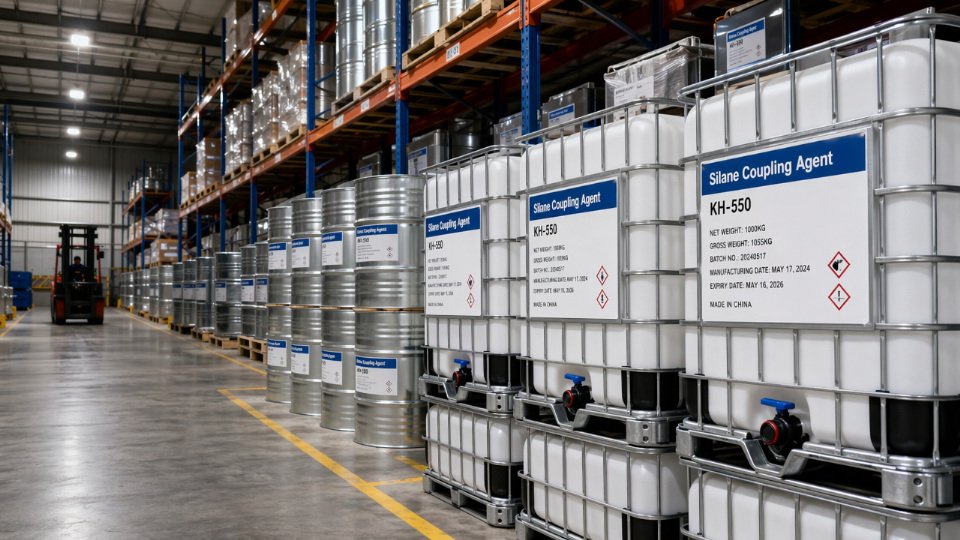
How Purchase Volume Tiers Translate into Specific Price Breaks Across Key Silane Grades
Procurement managers who benchmark silane coupling agent costs purely against spot quotes are measuring the wrong number. The real leverage sits in understanding why manufacturers price each order-size bracket differently — and which grades respond most aggressively to volume commitment.
The Three Practical Order-Size Brackets
Small lot (25–200 kg, drum stock). This is the spot market. Standard 25 kg polyethylene-lined fiber drums or 200 L steel drums, shipped as LCL or express freight. Ex-works pricing from Chinese manufacturers in this bracket typically runs USD 5.50–12.00/kg for KH-550, USD 7.00–12.00/kg for KH-560, USD 4.50–9.00/kg for A-171, and USD 8.00–12.00/kg for A-174 — the spread within each range depending on purity grade (industrial 97% vs. reagent 99%+), current trichlorosilane feedstock costs, and order lead time urgency. You are effectively paying for the manufacturer’s warehouse handling, partial-batch production economics, and their inventory carrying risk.
Medium volume (500 kg–4 MT, pallet or IBC tote). At this tier, typically fulfilled in 1,000 kg IBC totes or drum pallets occupying part of a 20-ft container, pricing can drop 10–20% versus small-lot spot rates depending on grade and supplier relationship maturity. KH-550 in this bracket often settles between USD 4.50–8.00/kg ex-works; A-171, which has simpler synthesis chemistry, can reach USD 3.80–7.00/kg. This is where annual framework agreements start paying off even without a full FCL commitment.
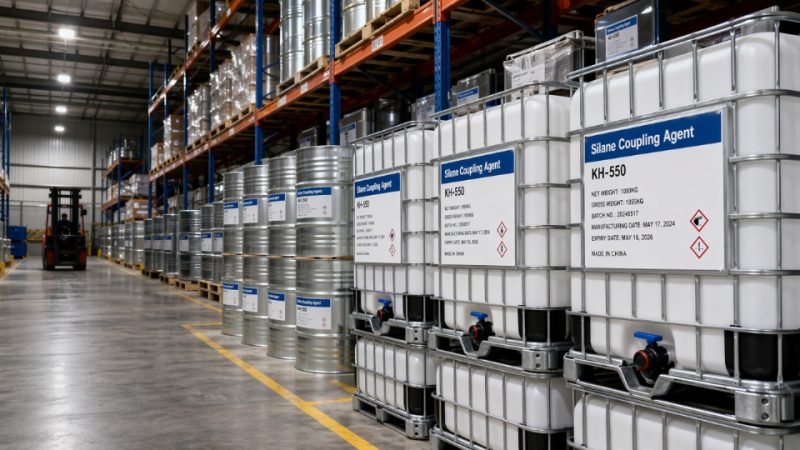
Bulk FCL / ISO tank (14–18 MT per shipment). A 20-ft ISO tank holds approximately 16–18 MT of liquid silane; drum-palletized FCLs run 14–16 MT. Here, well-structured long-term contracts unlock ex-works price reductions of 20–35% versus small-lot spot — meaning KH-550 can reach USD 3.50–5.50/kg and A-171 as low as USD 3.50–4.80/kg for buyers with predictable annual volumes and scheduled shipment calendars.
The Manufacturer Cost Logic Behind the Tiers
These discounts are not arbitrary commercial gestures. Fixed overhead — reactor depreciation, utility base loads, EHS compliance costs, quality laboratory staffing — gets amortized across every kilogram produced in a campaign. A 500 kg batch and a 10 MT batch consume nearly the same reactor preparation time. At scale, that fixed cost component per kilogram shrinks meaningfully.
Raw material procurement compounds the effect. Trichlorosilane, the dominant feedstock for most trialkoxysilane coupling agents, is itself a commodity subject to spot-versus-contract pricing differentials. A manufacturer running predictable 20–30 MT monthly production campaigns for a contracted customer can lock trichlorosilane volumes with its own upstream suppliers at 8–15% below spot rates, depending on market timing. Methanol and ethanol — solvents and co-reactants used in methoxysilane and ethoxysilane synthesis respectively — similarly benefit from forward purchase scheduling. Those savings flow, in part, to the contracted buyer.
Grade Complexity as a Pricing Variable
KH-550 (3-aminopropyltriethoxysilane) and A-171 (vinyltrimethoxysilane) are the commodity workhorses. Both have well-established continuous synthesis routes, stable feedstock chains, and high annual demand across rubber, coatings, and composites applications globally. These grades show the steepest volume discount curves — up to 30% from small-lot to FCL pricing — because manufacturers can justify dedicated production campaigns with minimal changeover loss.
KH-560 (3-glycidoxypropyltrimethoxysilane) is one tier more complex in synthesis, with epoxide ring integrity requiring tighter process controls. Volume discounts still reach 20–28% at FCL scale but require tighter specification agreements to unlock the best pricing.
Specialty grades — isocyanatopropyltriethoxysilane, chloropropyltriethoxysilane, bis-silyl polysulfides — discount less steeply (typically 10–18% even at FCL volume) because batch sizes remain smaller industrywide and raw material economics don’t scale the same way. Annual volume commitment still matters here, though: it allows the manufacturer to consolidate campaigns and reduces per-kilogram QC cost.
Indicative Price Premium/Discount vs. Mid-Market Spot
| Grade | 25–200 kg drum (LCL) | 500 kg–4 MT (IBC/pallet FCL) | 14–18 MT FCL / ISO tank | Typical Packaging | Incoterms Often Applied |
|---|---|---|---|---|---|
| KH-550 | +15 to +25% | Flat to –15% | –20 to –30% | 200 L drum / ISO tank | EXW / FOB Shanghai |
| KH-560 | +12 to +22% | Flat to –12% | –18 to –28% | 200 L drum / IBC | EXW / FOB |
| A-171 | +15 to +28% | –5 to –18% | –22 to –32% | IBC / ISO tank | EXW / FOB |
| A-174 | +10 to +18% | Flat to –10% | –15 to –22% | 25 kg drum / IBC | EXW / CIF negotiable |
Percentages are directional benchmarks. Actual discounts depend on annual committed volume, payment terms, shipment scheduling regularity, and prevailing feedstock costs at time of negotiation.
Specification Consistency as a Hidden Cost in Spot Purchasing
Bulk contract customers who negotiate dedicated production lot traceability and tighter CoA windows typically see lower incoming QC rejection rates than spot buyers receiving material from mixed production batches.True
Spot orders are frequently fulfilled from warehouse stock aggregated across multiple production campaigns with varying raw material lots. Bulk contract customers can specify single-campaign production with traceable batch documentation, reducing variability in purity, hydrolysis sensitivity, and residual chloride content — all parameters that drive incoming inspection failures in sensitive composite and adhesive applications.
The indirect cost of receiving an off-spec drum of KH-560 mid-production is rarely captured in procurement’s cost-per-kilogram calculation, but plant operations managers recognize it immediately: a batch of epoxy-glass composite with poor fiber-matrix adhesion may not fail incoming QC — it fails in the field. Bulk contract structures that include tighter CoA windows (for example, purity ≥98.5% vs. a spot market’s nominal ≥97%, residual HCl ≤50 ppm vs. ≤200 ppm) shift quality risk upstream to the manufacturer’s process, where it belongs and where it can actually be controlled.
Long-Term Supply Agreements: Contract Structures, Pricing Mechanisms, and Negotiation Levers
Three pricing architectures dominate long-term silane supply contracts out of Chinese manufacturers, and choosing the wrong one for your operating conditions can quietly erode the discount you thought you locked in.
Fixed-Price Contracts
A fixed unit price held for 6–24 months is the simplest structure and the easiest to budget against. It suits buyers with stable, predictable consumption — a compounder running the same filled-rubber formulation year-round, for instance — and delivers maximum value when you execute it at a feedstock cycle low. Trichlorosilane and silicon metal are the two primary cost drivers for most functional silanes, and both commodities move in recognizable multi-year cycles tied to polysilicon capacity expansions in China. Signing a 12-month fixed-price agreement when those inputs are near cycle highs locks in the manufacturer’s elevated cost base and leaves you holding the risk of a price correction you can’t capture. Timing matters more than most procurement teams acknowledge.
Index-Linked Contracts
For multi-year agreements — anything beyond 18 months — cost-index-linked pricing has become the structure most Chinese silane producers will actively push, and for legitimate reasons on both sides. The mechanism ties the contract unit price to a published or bilaterally agreed trichlorosilane or silicon metal index, with a fixed margin floor that protects the manufacturer’s processing margin regardless of feedstock direction. The buyer’s protection comes from transparency: price movements are traceable and auditable rather than discretionary. During the 2021–2022 organosilicon input-cost spike, buyers holding fixed contracts found suppliers requesting renegotiation or citing force majeure; buyers on index-linked agreements with proper floor/ceiling language absorbed a cost increase but avoided supply interruptions entirely.
Index-linked silane contracts with defined margin floors reduced supply disruption risk during the 2021–2022 organosilicon cost spike compared to fixed-price agreements that suppliers sought to exit.True
Fixed-price contracts create margin compression for producers during input-cost spikes, creating rational incentive to deprioritize or renegotiate; index-linked contracts preserve producer margin, reducing this incentive and improving supply continuity.
Hybrid Base-Price-Plus-Adjustment
The hybrid model — a negotiated base price with a defined adjustment band (typically ±8–15% from base, reviewed quarterly or semi-annually) — splits the difference. It gives buyers a price ceiling to budget against and gives manufacturers room to recover genuine input cost increases without renegotiating the whole agreement. This structure works well for mid-volume buyers running 20–80 MT per year who want contract pricing but cannot commit to the volume certainty a pure index-linked multi-year deal requires.
Volume Commitment Mechanics
Take-or-pay thresholds in most Chinese silane contracts land between 70–85% of committed annual volume, depending on the supplier’s capacity utilization and the grade involved. How the reconciliation is structured determines whether that threshold is a real risk or a paper obligation. Quarterly reconciliation credits — where unused committed volume rolls forward as a credit rather than triggering an immediate surcharge — are negotiable and worth pushing for explicitly. Over-shipment flexibility bands of 10–15% above committed volume at the contract price are equally valuable during demand surges. Both provisions tend to disappear quietly after the first contract year if the renewal clause doesn’t explicitly carry them forward. Get them written into each contract year individually.
Underutilized Negotiation Levers
Multi-product bundling is the most consistently underutilized lever. Committing volume across two or more grades — say KH-550 alongside KH-560 or A-174 — with a single supplier typically unlocks an additional 3–8% discount beyond volume tier pricing alone, because the supplier gains more stable reactor scheduling and reduces grade-changeover losses. Payment terms also carry real price weight: moving from net-60 to prepayment or net-15 is commonly worth 1.5–3% off the unit price, depending on the supplier’s working capital position. Technical support packages — application development assistance, formulation troubleshooting, regulatory documentation — are frequently negotiable as embedded contract deliverables rather than paid services, and cost-conscious buyers who treat them as afterthoughts leave real value on the table.
Contract Pitfalls That Create Hidden Exposure
Three specific clause types generate most of the downstream commercial pain. Price review clauses with no upward cap on adjustment frequency allow a supplier to trigger reviews quarterly even during stable markets, eroding the price certainty the contract was supposed to deliver — insist on maximum one review per contractual period with a defined notice window. Force majeure language that excludes Chinese export control or customs inspection actions leaves buyers exposed to a category of disruption that is neither hypothetical nor rare for specialty chemicals shipping internationally; this exclusion should be flagged and negotiated out. Finally, quantity flexibility provisions — the over/under bands described above — that are written into Year 1 but not explicitly referenced in renewal terms lapse by default under most standard commercial law frameworks. Buyers discover this at the worst possible moment, when they actually need the flexibility.
Logistics Cost Architecture for Silane Coupling Agents: From Factory Gate to Your Production Line
Understanding where freight cost actually accumulates — and where volume or contract commitments can meaningfully reduce it — requires mapping every link in the export chain, not just the ocean leg that typically dominates attention.
The Standard China-Origin Export Chain
Most silane coupling agent production in China is concentrated in Jiangxi, Zhejiang, and Hubei provinces. From the plant gate, product moves by road to a major export gateway: Shanghai or Ningbo for most Jiangxi and Zhejiang origins, Tianjin for northern customers, or Guangzhou/Shekou for certain southern facilities. Inland trucking costs for a full 20-ft container run roughly USD 250–600 depending on origin province and current fuel surcharges — a largely fixed cost per shipment that gets heavier, on a per-kg basis, the smaller your load.
At the port, IMDG hazardous goods classification adds a layer most buyers underestimate. KH-550 (3-aminopropyltriethoxysilane) is typically Class 8 corrosive; KH-560 (glycidoxypropyltrimethoxysilane) and A-171 (vinyltrimethoxysilane) commonly fall under Class 3 flammable liquid. Each shipment requires a Dangerous Goods Declaration, UN-rated packaging certification, and hazmat surcharges from the carrier — typically USD 80–220 per Bill of Lading regardless of shipment size. Ship ten small parcels a year and you pay that surcharge ten times. Consolidate into two FCL movements and you pay it twice. That arithmetic matters more than many buyers realize.
Packaging Format and Its Direct Effect on Freight Rate per Kilogram
Packaging choice is a freight cost decision, not just a handling convenience.
| Packaging Format | Typical Net Weight per Unit | Relative Ocean Freight Cost (per kg) | Practical Minimum Shipment |
|---|---|---|---|
| 25-kg drums, palletized | 25 kg | Highest (index: 1.00) | 200 kg (LCL) |
| 200-L drums (~180 kg net) | ~180 kg | Moderate (index: ~0.72) | ~1 MT (LCL) |
| 1,000-L IBC totes (~900 kg net) | ~900 kg | Better (index: ~0.55) | 1–4 MT |
| ISO tank container | 14–18 MT total | Lowest (index: ~0.35–0.40) | ~14 MT minimum |
These index values depend on trade lane, carrier rate cycles, and hazmat surcharge allocation. The key point: switching from palletized 25-kg drums to IBC totes for the same shipment volume can reduce ocean freight per kg by 40–50% before you change anything about order frequency.
ISO tanks deliver the best freight economics but require the buyer to have tank discharge capability at the destination — a capital requirement that rules them out for smaller operations or facilities without adequate containment infrastructure.
The FCL vs. LCL Decision: Where Contract Volume Creates Real Savings
Consider a concrete scenario: a composites manufacturer consuming 10 MT/year of KH-560. If that buyer purchases reactively — ten spot orders of roughly 1 MT each, shipped LCL — total logistics cost (inland, ocean LCL rate, hazmat documentation, destination port handling, drayage) typically lands in the range of USD 1.10–1.45/kg of silane delivered, depending on trade lane. That buyer under a blanket contract, restructuring delivery into two FCL shipments of approximately 5 MT each, can bring the same delivered logistics cost down to USD 0.65–0.85/kg. The difference — USD 0.45–0.65/kg — on 10 MT annually is USD 4,500–6,500 saved purely on logistics, without touching the product price negotiation at all.
FCL consolidation compresses ocean freight per kg by roughly 40–65% versus equivalent total volume shipped in multiple LCL lots across a year. The mechanism is straightforward: a 20-ft container has a fixed slot cost on the vessel. Fill it completely and that fixed cost amortizes across 14–18 MT. Ship the same 14 MT in fourteen LCL parcels and the carrier bills each parcel as an independent revenue unit.
A buyer purchasing 10 MT/year of KH-560 in two FCL shipments pays approximately USD 0.45–0.65/kg less in total delivered logistics cost than one shipping ten equivalent LCL lots across the same year.True
This range reflects realistic LCL vs. FCL rate differentials on China–Europe and China–North America trade lanes, including IMDG surcharge dilution, port handling, and inland cost allocation across shipment frequency. Actual savings depend on trade lane, carrier, port pair, and packaging format.
Last-Mile and Destination Clearance: Where Fixed Costs Hide
Ocean freight gets negotiated. Destination port handling and customs clearance often don’t. Customs brokerage fees, hazmat inspection fees at certain ports, and the cost of a licensed dangerous goods customs entry are largely fixed per clearance event — typically USD 150–400 per entry in major European or North American ports. Same logic as the DGD surcharge: fewer, larger shipments dilute these costs. A buyer clearing ten small shipments a year may spend USD 1,500–4,000 in destination brokerage and inspection fees that two FCL clearances would reduce to USD 300–800.
Last-mile drayage from destination port to warehouse is charged per truck movement. Two deliveries versus ten is not a trivial difference when regional dray rates run USD 350–900 per move depending on distance and local market.
The operational warning here is real: buyers who optimize only the product unit price while ignoring shipment frequency and packaging format often discover — when they finally model their true delivered cost — that the “cheaper” spot supplier was not cheaper at all.
Vendor-Managed Inventory and Bonded Warehouse Programs: Compressing Lead Times Without Holding Capital
For most industrial buyers sourcing silane coupling agents from China, the default assumption is a 20–35 day ocean transit window plus inland handling — a lead time that forces them to carry 6–10 weeks of domestic safety stock just to avoid line stoppages. That safety stock ties up real working capital, typically USD 15,000–80,000 per SKU depending on consumption rate and grade cost, and it still fails when a demand spike or a delayed shipment collide. VMI and bonded warehouse programs dissolve that forced trade-off, but only if the contract structure supporting them is built correctly from the start.
How VMI Actually Works in a Silane Supply Context
Under a vendor-managed inventory arrangement, SiliconChemicals or its designated regional logistics partner holds a pre-agreed buffer — commonly 4–12 weeks of the customer’s rolling consumption — in a bonded or duty-paid warehouse. The customer raises a draw-down request, stock ships domestically within 2–5 business days, and invoicing triggers on confirmed delivery rather than on the original inbound shipment from China. The supplier owns and replenishes the buffer continuously; the buyer never carries the capital position of a 20-MT drum order sitting in transit.
The qualifying threshold from the supplier’s side is a minimum annual purchase volume commitment, typically the equivalent of 3–6 FCL shipments per year depending on grade. That commitment is what justifies the warehousing investment. The program fee — usually USD 0.02–0.06/kg/month — covers storage, insurance, and inventory management. Run the numbers: a buyer consuming 500 kg/month of KH-560 at a USD 0.04/kg/month program fee pays roughly USD 240/month. The domestic safety stock that same buyer would otherwise need to hold at current spot rates would represent USD 8,000–25,000 in tied-up cash. The math is not close.
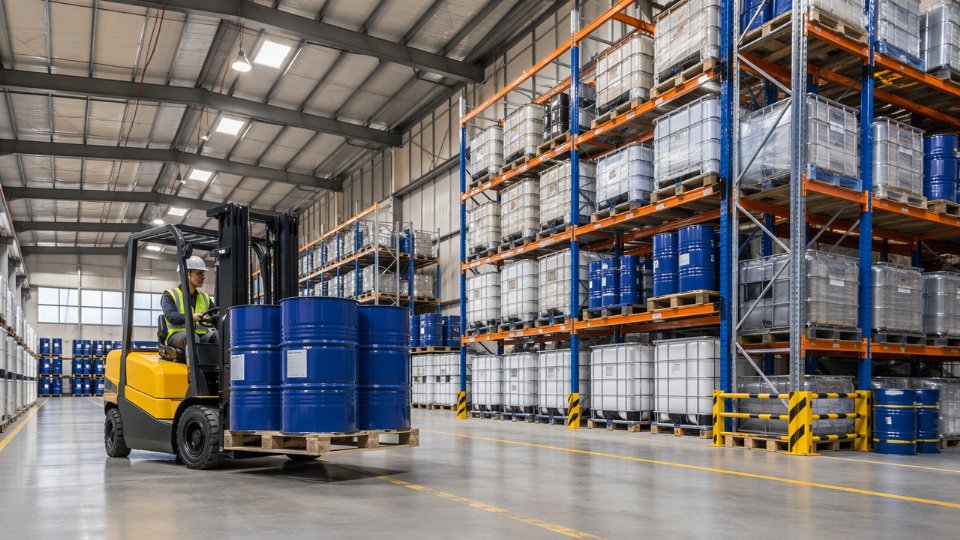
Regional Distribution Hubs and What They Actually Enable
Bonded warehouse nodes in Singapore, Rotterdam, and Houston are not simply storage locations. Stock held in bond at these hubs has cleared export but not yet triggered import duties in the destination country, which preserves flexibility when a customer’s facility is in Germany versus Poland, or in Texas versus Mexico. Duty-paid facilities in the same cities eliminate customs clearance time entirely for the final domestic leg. Either configuration shrinks effective lead time to the 2–5 business day range that most production schedulers treat as equivalent to a local supplier.
The grade mix held at each hub is calibrated to regional demand patterns. KH-550 and KH-560 move heavily in European rubber and coatings markets; A-174 and A-172 carry more weight in North American composites and electronics applications. A regional hub holding the wrong grades solves nothing operationally, so demand-signal sharing during contract setup is not a formality — it directly determines whether the buffer stock is useful or just expensive.
ERP Integration and Collaborative Planning
VMI programs perform proportionally to the quality of demand data flowing upstream. Customers sharing rolling 13-week consumption forecasts via EDI or a supplier web portal allow replenishment cycles to be timed against actual production schedules rather than calendar guesses. The practical result is stockout frequency dropping to near zero while buffer stock size often decreases 15–25% versus the initial setup level — a direct reduction in the supplier’s holding cost that typically gets passed back as a lower program fee over time.
VMI arrangements that include 13-week rolling forecast sharing consistently outperform static reorder-point replenishment on both stockout frequency and total buffer inventory level.True
This is consistent with published supply chain literature on collaborative planning, forecasting, and replenishment (CPFR) outcomes across multiple process-chemical categories, and reflects operational experience with industrial VMI deployments.
Quality Continuity: The Undervalued Advantage
One consequence of VMI that procurement managers frequently overlook until they lose it: lot-to-lot consistency. Buffer stock drawn from a single validated production campaign means every drum in a quarterly draw carries the same gas chromatography profile, the same moisture content, the same viscosity. For a customer running aerospace composite layups or medical-grade adhesive cure cycles with a qualified process window, a mid-year lot change from a spot purchase can trigger a full requalification event — weeks of delay and process engineering time that dwarf any price saving from shopping spot. VMI effectively extends the qualification window by design, not by accident.
Raw Material Volatility and How Contract Structures Absorb or Transfer Feedstock Price Risk
Silane coupling agents are not commodity plastics — their cost structure is anchored in a feedstock chain that swings with semiconductor capital cycles and solar build-out waves, not just with oil. Buyers who treat silane procurement as a simple commodity purchase tend to discover this the hard way when a Q2 spot quote arrives 20–30% above the Q4 number they budgeted against.
The Cost Stack: Where the Exposure Actually Lives
Trichlorosilane (TCS) typically represents 35–55% of variable production cost for standard coupling agents such as KH-550, KH-560, or A-174, with the exact share depending on grade complexity and synthesis route. Tetrachlorosilane, used as an alternative starting material for certain grades, follows a similar pricing pattern. Methanol and organochloride reagents — the Grignard-route inputs and chloroalkyl intermediates — add another 15–25% depending on order mix. Energy, direct labor, depreciation, and plant overhead account for the remainder.
That breakdown means roughly half to two-thirds of your supplier’s variable cost is directly exposed to petrochemical and silicon-chain markets simultaneously. When both move in the same direction — as they did sharply across 2021–2023 — the effect on silane pricing is compounded, not additive.
The Trichlorosilane–Polysilicon Link Most Buyers Miss
TCS is not produced primarily for the silane coupling agent industry. It is a co-product — and in some facilities a precursor — of polysilicon manufacturing, which feeds photovoltaic cell production. Global solar capacity expansion cycles therefore drive TCS availability and spot pricing in ways that have nothing to do with your adhesive, rubber, or composite plant’s demand schedule.
Between 2021 and 2023, aggressive solar capacity additions in China tightened TCS supply significantly. Coupling agent manufacturers operating on spot TCS purchases faced input cost spikes that compressed margins and, in some cases, forced allocation of product to highest-bid customers. A buyer locked into a fixed annual price with one of those manufacturers was sitting in a structurally uncomfortable position for the supplier — and suppliers remember that.
Fixed-Price Contracts: Who Actually Carries the Risk
A fixed-price, multi-year supply agreement sounds like procurement success. It is — until input costs rise sharply, at which point you own 100% of the upside while your supplier absorbs losses, shortens lead times selectively, or quietly deprioritizes your orders during allocation events. Manufacturers with thin margin buffers under fixed contracts have genuine operational incentive to manage supply quality and service to committed minimum levels, nothing more.
This is why reputable silane manufacturers have shifted toward index-linked pricing structures over the past several years. A typical arrangement ties the contract base price to a published TCS or silicon metal index, with quarterly review cycles and a defined adjustment formula — transparent to both sides. Price movement is shared, not hidden in the next renewal negotiation.
Index-linked supply contracts for silane coupling agents typically include a defined price adjustment formula tied to a feedstock index such as silicon metal or trichlorosilane spot pricing, reviewed quarterly or semi-annually.True
This structure has become standard practice among Chinese silane manufacturers offering long-term supply agreements, replacing opaque annual renegotiation with formula-based transparency that reduces disputes and allows both parties to budget more accurately.
Practical Hedging Options for Buyers
Three approaches work in practice, and they are not mutually exclusive:
Forward inventory purchases during demonstrated low-cost windows — typically when polysilicon demand softens and TCS supply loosens — can lock in material at 10–20% below cycle-peak pricing, depending on timing and storage capacity. This requires working capital and adequate warehouse conditions (sealed, dry, temperature-stable storage for most coupling agents with 12–24 month shelf life in original packaging).
Index-linked contracts with negotiated price caps offer a middle path. The buyer accepts index linkage on the downside but negotiates a ceiling above which the supplier absorbs further cost increases. Suppliers will price that cap as a premium — typically 3–8% above pure index pricing — but for a buyer with tight formulation margins, that ceiling has real value.
Dual-supplier qualification — splitting volume between two qualified manufacturers with different contract structures, say one fixed-price and one index-linked — averages the risk across market cycles without full exposure in either direction. The operational cost is maintaining two approved supply chains, which is non-trivial but manageable for annual volumes above roughly 20–40 MT depending on grade.
Why Vertical Integration Changes the Math
A trading company or regional distributor buying silane coupling agents and reselling to you carries the same TCS price exposure you would carry, plus its own margin layer. It has no structural mechanism to absorb feedstock volatility — it passes it through, with lag.
A manufacturer-integrated supplier operating adjacent to Chinese silicon metal and TCS production clusters — as SiliconChemicals does within the Zhejiang and Jiangsu organosilicon industrial belts — has direct scale purchasing leverage on inputs, shorter logistics chains to feedstock, and the operational flexibility to adjust production scheduling in response to input cost windows. That structural position creates a genuine cost buffer. For long-term committed customers, that buffer translates into price stabilization programs: agreed mechanisms that smooth quarter-to-quarter price movement within a defined corridor rather than passing through every feedstock tick. Spot buyers get no access to those programs. That asymmetry is, itself, a strong argument for moving off purely reactive purchasing.
Regulatory Compliance, Documentation, and How Contract Relationships Streamline Cross-Border Hazmat Logistics
Silane coupling agents — KH-550, KH-560, A-174, and their relatives — are classified as flammable liquids and corrosive or irritant substances under GHS. That classification follows the product across every border it crosses, generating a documentation stack that procurement teams frequently underestimate until a shipment is held at port or a facilities team rejects a delivery because the SDS on file is two revisions old.
The Full Compliance Document Set Every Import Requires
For a standard FCL shipment of a silane coupling agent arriving into the EU, US, or Southeast Asian markets, the minimum document package includes: a 16-section GHS-compliant Safety Data Sheet in the destination country’s official language; a Dangerous Goods Declaration (DGD) prepared to IMDG code standards, correctly citing the UN number, packing group, and emergency response information; a Certificate of Analysis (CoA) tied to the specific production batch; a Certificate of Origin (CoO) for customs preference and anti-dumping determination; and, depending on destination, China Inspection and Quarantine (CIQ) or commodity inspection certificates for the exporting party. EU buyers importing above 1 MT/year must confirm the substance appears on the REACH registration dossier under their supplier’s registration — ECHA’s registry is public, but confirming registration scope, tonnage band, and use descriptors requires direct dialogue with the supplier. US buyers need TSCA inventory confirmation; most common silane coupling agents are listed, but specialty or modified grades require checking.
Taken individually, none of these documents is exotic. Taken together, for a procurement team sourcing across three or four spot suppliers simultaneously, the administrative load compounds fast.
Why Spot Sourcing From Multiple Suppliers Multiplies Hidden Costs
Each time a buyer switches to a new Chinese silane manufacturer — even for the same nominal grade — the EHS team must treat it as a new substance source. The SDS may carry different formulation notes, different impurity profiles, or a different GHS classification revision. If the product is used in a finished article exported to Europe, the supply chain due diligence obligation under REACH Article 33 requires tracing the substance back to a registered source. A supplier not registered under REACH — or registered at a lower tonnage band than your annual volume — means your company, as importer of record into the EU, becomes the registrant and inherits full registration obligations.
Switching silane suppliers for a spot price advantage of 5–8% can trigger re-qualification costs — EHS review, SDS translation, internal risk assessment, REACH due diligence — that easily consume that margin within the first order cycle.True
Industrial EHS teams in chemical-using manufacturing facilities routinely estimate internal re-qualification at 8–20 person-hours per new hazardous substance supplier, not including any external regulatory consultancy fees or formal substance dossier work.
How a Long-Term Supplier Relationship Systematically Eliminates That Overhead
A structured supply agreement with a single qualified manufacturer changes the compliance dynamic entirely. The supplier maintains the regulatory dossier, tracks GHS revision cycles, and pushes updated SDS versions to the customer proactively — rather than the buyer chasing documents before each shipment. HS code consistency across shipments reduces the frequency of customs queries; when the declared value, origin, and HS code are identical quarter after quarter, customs authorities in most jurisdictions develop a predictable clearance pattern for that importer-supplier pair.
For EU buyers, co-investment in REACH substance registration with a long-term supplier is a genuinely underused lever. Registration costs per substance typically run EUR 15,000–80,000 depending on tonnage band and whether existing study data covers the required endpoints. Shared between supplier and buyer under a Letter of Access arrangement, that cost becomes manageable, and the buyer gains documented registration coverage that competitors sourcing spot cannot easily replicate.

China Export Controls and Why Supplier History Matters
Certain organosilicon intermediates relevant to silane production fall within China’s dual-use export licensing framework. A manufacturer with a clean, well-documented export compliance record — consistent end-use declarations, established commercial relationships, no prior licensing irregularities — moves through the licensing queue materially faster than a first-time or infrequent exporter. Buyers who treat silane as a pure commodity and rotate suppliers on price alone occasionally discover that their cheapest quoted supplier cannot actually ship on schedule because a license is pending. The delay is rarely disclosed upfront. A long-term contract relationship gives your supplier both the incentive and the administrative infrastructure to keep export licensing current, and gives you the documentary trail — purchase history, end-use certificates, established consignee identity — that Chinese licensing authorities look for when processing applications.
The compliance cost is real, it is recurring, and it scales with supplier count. That is the correct frame for evaluating whether a long-term supply agreement justifies its commitment terms.
Evaluating Total Cost of Ownership: Spot Purchasing vs. Bulk Contract — A Worked Numerical Comparison
A price-per-kilogram comparison between a spot purchase and a contract purchase will almost always understate the true financial gap. The real test is a full cost-of-ownership build-up — every dollar spent getting product from a supplier’s factory gate onto your production line and through your quality system. The scenario below is constructed to be realistic and replicable, not illustrative in the vague sense. Use it as a template, substitute your own volume and internal cost rates, and the structure will hold.
The Comparison Scenario
A European composite materials manufacturer consumes 15 MT of KH-550 (aminopropyltriethoxysilane, technical grade 97%) annually. Currently, they place 10 spot orders of 1.5 MT each through a regional distributor, each order arriving in LCL (less-than-container-load) consolidation with mixed hazmat cargo. They are evaluating a 2-year blanket purchase agreement directly with SiliconChemicals covering 2 × 7.5 MT FCL shipments per year in 200-L drum pallets loaded into 20-ft ISO-equivalent containers.
Spot-Purchase TCO: Line-by-Line
Product cost. Spot ex-works price for KH-550 at 1.5 MT order size sits in the upper band of the USD 4.50–7.00/kg range for this grade, depending on market tightness. Distributor markup adds 18–30% over ex-works — call it USD 1.00–1.80/kg on a mid-market base price. That markup exists because the distributor is absorbing their own inventory risk, repackaging cost, and credit exposure. You are paying for a service, but most buyers do not explicitly see it as a line item.
Freight. LCL hazmat surcharges on flammable/corrosive silane shipments typically add USD 0.30–0.55/kg over a comparable FCL rate, and that spread widens significantly when ocean freight markets are tight — the LCL consolidator passes peak-season surcharges with less price resistance than a direct FCL contract allows.
Hazmat documentation and customs brokerage. Each of 10 shipments requires a Dangerous Goods Declaration, MSDS/SDS submission to the carrier, and customs entry at the European port. Brokerage fees per LCL hazmat entry typically run USD 180–320, and internal staff review time adds another USD 60–120 per shipment. Across 10 orders: USD 2,400–4,400 per year.
Internal procurement processing. Most procurement teams undercount this. A spot purchase PO for a hazmat chemical — supplier evaluation, quote comparison, order placement, expediting, goods receipt, invoice matching — realistically consumes USD 250–400 in staff time per order. Ten orders: USD 2,500–4,000 per year.
Safety stock carrying cost. Spot buyers hold roughly 45 days of buffer stock to guard against lead-time variance. At 15 MT/year that is approximately 1.85 MT on-shelf. At a landed cost of roughly USD 6/kg and a working-capital cost of 8–12% per year, that stock costs USD 890–1,330 annually just in capital, before warehouse space.
Incoming QC testing. Ten receipt lots, each requiring full identity and purity testing at USD 250–350/test: USD 2,500–3,500 per year.
Contract-Purchase TCO: Line-by-Line
Direct ex-works pricing at 7.5 MT per shipment (15 MT annual commitment) attracts a volume discount of 15–25% versus the spot distributor-inclusive price — eliminating the distributor layer and the per-order risk premium simultaneously. FCL ocean freight on 2 shipments saves USD 0.08–0.25/kg versus LCL on a per-kilogram basis. Documentation reduces to 2 DGD sets and 2 customs entries: roughly USD 700–1,100 annually. SDS management, regulatory updates, and REACH compliance documentation are supplier-borne under a structured agreement. Contract administration — annual price review, volume reconciliation — runs approximately 8 hours of procurement staff time, call it USD 400–600. VMI program fees, where applicable, typically run USD 800–1,500 per year but effectively replace the safety stock carrying cost.
The TCO Comparison Table
| Cost Element | Spot Purchasing (10 orders/yr) | Contract Purchasing (2 FCL/yr) |
|---|---|---|
| Product unit cost (ex-distributor or direct) | USD 5.80–7.50/kg | USD 4.50–5.80/kg |
| Ocean freight (per kg, landed) | USD 0.55–0.90/kg | USD 0.30–0.65/kg |
| Hazmat documentation and brokerage | USD 0.16–0.29/kg | USD 0.05–0.07/kg |
| Internal PO processing cost | USD 0.17–0.27/kg | USD 0.03–0.04/kg |
| Safety stock carrying cost | USD 0.06–0.09/kg | USD 0.05–0.10/kg (VMI fee) |
| Incoming QC testing | USD 0.17–0.23/kg | USD 0.07–0.10/kg (2 lot tests) |
| Indicative total landed cost | USD 6.91–9.28/kg | USD 4.90–6.76/kg |
| Annual spend at 15 MT | USD 103,650–139,200 | USD 73,500–101,400 |
Indicative annual saving: USD 18,000–42,000, or USD 1.20–2.80/kg, depending on which end of each range reflects your actual conditions.
Sensitivity Considerations That Shift the Outcome
The saving is not static. Three variables move it meaningfully. First, when ocean freight rates spike — as they do during port congestion cycles — the FCL-versus-LCL spread can widen to USD 0.40–0.60/kg, amplifying the freight line alone to a five-figure annual difference. Second, contract price stability carries option value that the table does not capture: if spot market prices for KH-550 rise 20% during a silicon metal supply squeeze, a fixed or index-capped contract price converts that market event from a budget crisis into a non-event. Third, the internal processing cost per PO is the line item most commonly underestimated in naive price-only analyses — procurement managers who calculate only the product price difference while ignoring staff time, expediting calls, and invoice exceptions will undercount the true cost of the spot model by USD 4,000–6,000 per year at 10-order frequency.
Eliminating the distributor layer and consolidating to 2 FCL shipments per year can reduce the total landed cost of KH-550 by USD 1.20–2.80/kg versus a 10-order annual spot-purchase pattern through a distributor.True
This range is derived from combining documented cost elements: distributor markup (18–30% over ex-works), LCL vs. FCL freight differential (USD 0.08–0.25/kg), hazmat documentation reduction (8 vs. 2 DGD sets), and internal PO processing cost (USD 250–400 per order). Each element is independently verifiable; the combined range reflects realistic operating conditions rather than a single-point estimate.
The TCO framework above is deliberately modular. If your annual volume is 8 MT rather than 15, or if your internal PO cost is closer to USD 150 due to a highly automated ERP, the absolute savings figure changes — but the structural argument does not. Spot purchasing trades lower commitment for higher per-unit and per-transaction cost at every line. The point of this analysis is to make that trade-off visible and measurable before the procurement decision is made, not after a year of fragmented ordering reveals what it actually cost.
Frequently Asked Questions: Bulk Purchasing and Long-Term Contracts for Silane Coupling Agents
What is the minimum volume to qualify for bulk pricing on silane coupling agents?
First-tier volume discounts from most silane manufacturers, including SiliconChemicals, activate at roughly 500 kg per order for standard grades such as KH-550, KH-560, A-171, and A-174. That threshold reflects a meaningful reduction in batch scheduling overhead and packaging labor per kilogram shipped. The most favorable pricing tier — FCL-level — requires a single shipment of 14–18 MT, which fills either an ISO tank or a pallet configuration of 200-L drums in a 20-ft container. The exact breakpoint depends on grade density and packaging format. For contract pricing structures (as distinct from one-off volume discounts), the common gateway is an annual commitment of 5 MT or more across all grades under the agreement. Below that, most suppliers treat orders as spot regardless of frequency.
If raw material prices fall sharply, does a long-term contract trap me at the higher price?
Only if you sign the wrong contract. Well-constructed agreements include explicit downward adjustment mechanisms — either automatic index-linked reductions tied to published trichlorosilane or silicon metal benchmarks, or scheduled renegotiation windows every six to twelve months. Either approach ensures that a significant feedstock cost drop flows through to your purchase price rather than staying as margin with the supplier. Fixed-price contracts without any downward clause should not be accepted for terms longer than twelve months. The risk is asymmetric: the supplier is protected on the upside by the fixed floor, while you carry all the downside of a falling market. Always confirm whether a price review clause triggers in both directions before signing.
Fixed-price silane contracts without downward price adjustment clauses expose buyers to full market downside if feedstock costs decline significantly within the contract period.True
Trichlorosilane and silicon metal prices can shift 20–40% within a 12-month window during commodity cycles. A fixed-price contract with no downward review mechanism means the buyer continues paying the original contracted price while spot market rates fall, effectively subsidizing the supplier's margin.
Does bundling multiple silane grades under one agreement actually improve pricing?
Yes, and it is genuinely one of the most underused levers in silane procurement. When a buyer commits to two or more grades — say KH-550 plus KH-560 plus A-171 — under a single annual volume agreement, the supplier gains scheduling visibility across multiple production campaigns simultaneously. That reduces changeover risk and raw material pre-positioning costs. In practice, multi-grade bundling typically generates an additional 3–8% improvement over what single-grade volume pricing alone would yield. The exact improvement depends on how complementary the grades are from a production standpoint and the total combined annual volume.
What shelf life and storage constraints should I account for when sizing bulk orders?
Standard silane coupling agents carry a shelf life of 12–24 months in sealed original containers stored below 25°C and protected from moisture ingress. The practical ceiling is shorter in real warehouse conditions. Aminosilanes — KH-550 being the most common example — are particularly sensitive to moisture and hydrolysis. A partially filled drum left open between uses degrades noticeably faster than stated shelf life suggests. As a working rule, no single delivery of moisture-sensitive grades should exceed a six-month supply based on your actual consumption rate. Ordering twelve months of KH-550 at once to capture freight savings is a poor trade if the last quarter of stock is compromised by slow drawdown and inadequate sealing discipline on the plant floor.
How does SiliconChemicals ensure supply continuity if production is disrupted?
Long-term contract customers are covered through three overlapping mechanisms. Dedicated safety stock held at production or regional bonded facilities provides a buffer against short-duration disruptions. Secondary production campaign scheduling allows priority allocation to contract customers when capacity is constrained. Contract terms include force majeure provisions with defined notification timelines — typically 48–72 hours — and documented customer-priority allocation protocols during restricted supply. Spot buyers have no claim on any of these mechanisms, which is worth factoring into a total risk calculation beyond unit price.
Which Incoterms work best for bulk silane shipments?
For buyers purchasing directly from a Chinese manufacturer, CFR or CIF to the destination port keeps freight optimization in the supplier’s hands and typically produces better ocean freight rates than buyers can source independently at lower volumes. Risk transfers at the port of origin under both terms. DDP (Delivered Duty Paid) simplifies the entire logistics chain for the buyer and is available for key markets, but carries a higher landed price that reflects the supplier absorbing customs and last-mile costs. FOB Shanghai or Ningbo suits buyers who have established freight forwarder relationships and want full control over the shipment from loading. There is no universally correct answer — the right term depends on your internal logistics capability and whether you can genuinely improve on the supplier’s freight rates at your volumes.
How long does it take to set up a VMI or bonded warehouse arrangement?
From agreement in principle to the first replenishment cycle operating automatically, expect six to twelve weeks. That window covers contract drafting and legal review, product registration at the bonded facility, the first inbound shipment, and any systems integration needed for real-time inventory visibility. The setup effort is front-loaded. Once the program is running, replenishment triggers automatically based on consumption thresholds — no purchase orders, no manual lead-time management per cycle. For facilities running silane-intensive processes with frequent small drawdowns, the operational simplicity alone often justifies the setup time, before the lead-time compression from 10–20 business days down to 2–5 days is even considered.