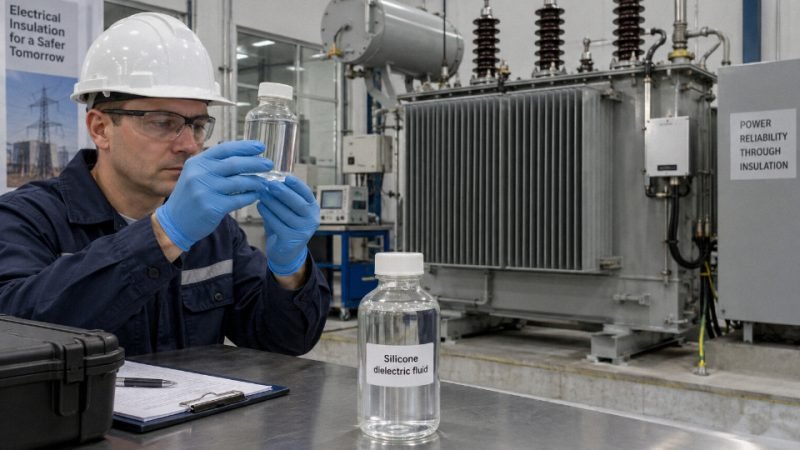
An insulating fluid that loses dielectric strength or cannot carry heat away puts electrical equipment at risk of breakdown and overheating. The cost is rarely just replacement oil: a failed transformer can stop production and damage connected equipment. Electrical-grade silicone oil offers a useful combination of insulation, thermal stability, and high fire point where the application justifies its cost.
Silicone oil is used as a dielectric fluid because suitable electrical grades combine high electrical resistivity with thermal stability and a relatively high fire point. It insulates energized components while transferring heat. Performance depends on fluid cleanliness, moisture content, viscosity, and equipment design; silicone oil is not nonflammable or interchangeable with every insulating fluid.
The less obvious question is whether those advantages survive the conditions inside your equipment. A fluid can perform well in a dielectric test yet circulate poorly through narrow cooling passages. That gap between a supplier’s data sheet and the operating system is where fluid selection gets interesting.
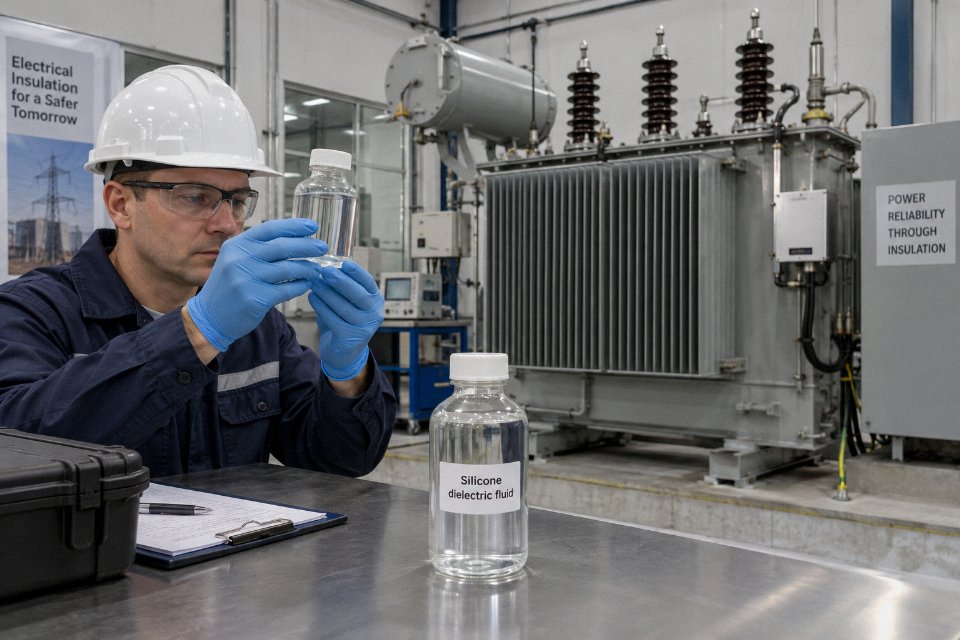
Electrical insulation mechanisms and performance limits
Silicone oil acts as a dielectric because a clean, suitable grade contains few mobile charge carriers and can fill spaces that would otherwise contain electrically weak air gaps. Its molecular structure supports thermal stability, but equipment withstand depends on the complete insulation system—not simply the fluid’s chemistry or a breakdown-voltage figure on a certificate.
What the molecular structure contributes
Conventional polydimethylsiloxane (PDMS) has an alternating silicon–oxygen backbone with methyl groups attached to silicon. The flexible backbone and methyl substitution influence its liquid behavior, compatibility, and thermal properties. Strong silicon–oxygen bonding contributes to thermal stability; it does not, by itself, establish resistance to electrical breakdown.
Low conductivity chiefly reflects the scarcity of mobile charge carriers in clean fluid. Ionic residues, contamination, and aging products can change that condition without changing the product’s generic “silicone oil” description. Thermal stability is also conditional: prolonged exposure to heat, oxygen, and incompatible materials can alter fluid condition.
Specify an electrical grade with documented properties; a chemical identity or viscosity designation is not an insulation qualification.
Electrical properties answer different design questions
These measurements are related, but they are not interchangeable. Compare supplier data only after checking the test method and conditions.
| Property | What it measures | Practical design use and limitation |
|---|---|---|
| Dielectric breakdown voltage | Voltage at which a test specimen breaks down in a specified electrode arrangement | Useful for fluid acceptance and condition checks; highly sensitive to gap, electrode shape, contamination, and preparation |
| Dielectric strength | Breakdown voltage divided by the specified test gap, commonly expressed in kV/mm | A comparative test result, not a constant that can be multiplied by any equipment clearance |
| Volume resistivity | Resistance to conduction through the fluid, normalized for specimen geometry | Helps assess conductive leakage; depends strongly on temperature and ionic contamination |
| Relative permittivity | Permittivity relative to vacuum | Used to calculate capacitance and field distribution across insulation interfaces |
| Dielectric dissipation factor, tan δ | Loss component relative to the capacitive response under stated AC conditions | Indicates dielectric heating and can reveal contamination or deterioration; frequency and temperature must accompany the result |
For unfilled PDMS near room temperature, approximately 2.6–2.8 is a useful relative-permittivity benchmark—not a released design value. Verify the grade, frequency, and temperature. A high breakdown result does not compensate for excessive dielectric loss, nor does high resistivity prove adequate impulse withstand.
Contamination and electrode conditions often control failure
A small laboratory gap filled with carefully prepared fluid is a different proposition from a tank containing leads, pressboard, seals, and debris left after assembly. Several mechanisms deserve separate attention:
- Mobile ions: Dissolved ionic contaminants carry charge, increasing leakage current and conductive heating. Supplier cleanliness and handling practices matter, not just base-polymer purity.
- Moisture: Dissolved water, droplets, and moisture held in solid insulation behave differently. Temperature changes can redistribute moisture; free water is especially troublesome. Interpret water-content results against the fluid’s temperature-dependent saturation behavior.
- Particles: Conductive debris can concentrate the field or form bridges. Fibers may carry moisture and collect in high-field regions. Filtration cannot remove every dissolved contaminant.
- Electrode condition: Burrs, sharp edges, rough surfaces, and poor connections create local stress that a bulk-fluid test does not reproduce.
- Gas bubbles: Entrained or generated gas can create weak regions, particularly where bubbles collect near energized surfaces.
Sample handling can obscure the diagnosis. A damp sampling bottle or dirty valve can produce a poor result that does not represent the tank; a clean sample cannot prove that an inaccessible lead exit is free of debris.
Impregnation helps, but interfaces still govern local stress
In suitable insulation assemblies, liquid penetration displaces air from accessible voids and wets solid surfaces. That can improve insulation performance, provided the fluid is compatible with the solid materials and the filling process actually reaches the spaces concerned. Blind cavities, tight windings, and inadequately dried porous insulation need a validated preparation and filling procedure.
The diagram below shows the interfaces that require attention: an energized conductor surrounded by solid insulation and silicone fluid, a cooling-flow path, and a trapped gas pocket at the solid–liquid interface.
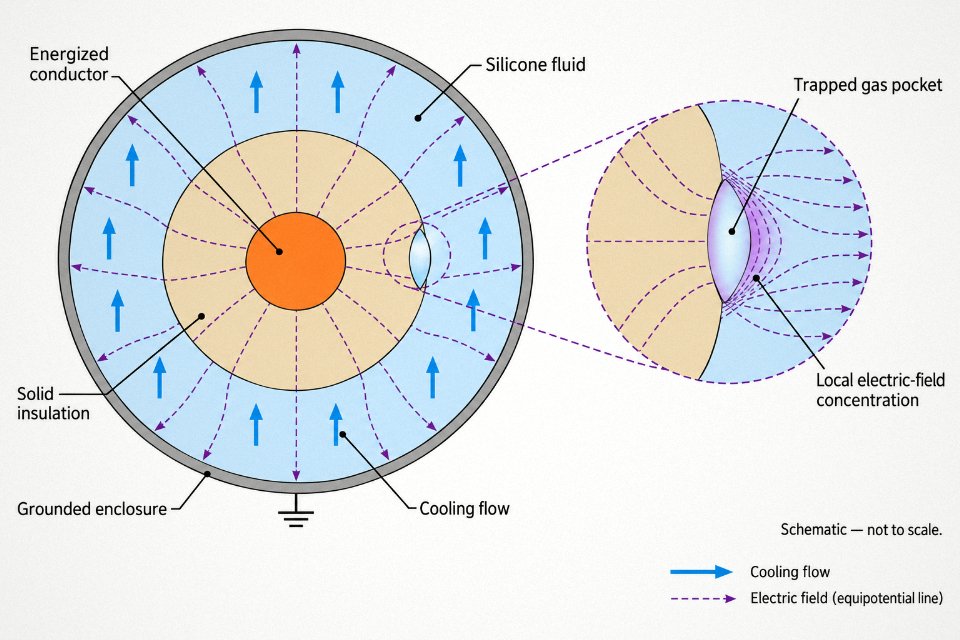
Diagram labels: Energized conductor; Solid insulation; Silicone fluid; Cooling flow; Trapped gas pocket; Local electric-field concentration. Alt text: Cross-section of a silicone-fluid insulation assembly showing an energized conductor, solid insulation, cooling flow, and a trapped gas pocket where local electric-field stress can increase.
Field distribution depends on geometry and permittivity; interfacial charge can also matter, particularly under DC or transient conditions. A low-permittivity gas pocket may experience elevated local stress and initiate partial discharge even while the surrounding liquid remains below its tested breakdown level. Fluid selection therefore cannot replace insulation coordination, clearance design, or assembly-level verification.
Temperature, waveform, and viscosity set further limits
Room-temperature, power-frequency results do not establish suitability for every duty:
- Temperature: Conductivity, viscosity, moisture distribution, and dielectric losses change with temperature. Check both cold starting and maximum operating conditions.
- Frequency and waveform: Higher frequency changes capacitive currents and losses. Fast converter edges create transient voltage distributions that differ from steady power-frequency conditions.
- Impulse duty: Short-duration withstand depends on polarity, rise time, gap geometry, and the liquid–solid arrangement. Require representative equipment testing rather than extrapolating from an AC fluid test.
Higher viscosity does not automatically mean higher dielectric strength. It can slow particle settling, bubble escape, impregnation, and circulation; reduced contaminant mobility is not equivalent to cleaner fluid. A more viscous grade may meet a mechanical requirement while complicating filling and cooling. Confirm the grade against the actual assembly, operating envelope, and applicable equipment test requirements.
Thermal performance and fire behavior
Silicone dielectric fluid can offer useful high-temperature stability and reduced fire risk, but neither establishes superior cooling performance or a fire-safe installation. The engineering decision depends on heat removal at the worst operating condition, the specific grade’s temperature limits, and how the equipment contains leaks and responds to overheating—not simply its published fire point.
Cooling depends on the complete thermal circuit
Five properties need separate treatment in a specification:
- Thermal stability: Resistance to chemical change during temperature exposure. It concerns fluid life and condition, not how quickly heat leaves a winding.
- Thermal conductivity: Conventional polydimethylsiloxane fluids typically measure approximately 0.14–0.16 W/(m·K) near 25 °C. Verify the grade and measurement conditions; this benchmark does not establish an advantage over every alternative.
- Heat capacity: Determines how much energy a given fluid mass absorbs per degree of temperature rise. Density is also needed when translating mass-based capacity into tank volume or volumetric flow.
- Viscosity: Controls resistance to circulation and strongly influences convection, pumping demand, and heat-exchanger performance.
- Operating temperature: Must stay within both fluid and equipment limits. Bulk temperature, local hot spots, seals, and other wetted components may impose different constraints.
For forced circulation, the heat carried away depends on mass flow, specific heat capacity, and temperature rise. Heat must still cross the component-to-fluid interface and leave through the cooler. A fluid that tolerates higher temperatures may still require more heat-exchanger area or pumping capacity to hold the same winding temperature.
Viscosity generally falls as silicone fluid warms. At cold start, thicker fluid increases circuit pressure drop; a fixed-speed centrifugal pump may deliver less flow, while a positive-displacement pump may encounter its relief setting or drive-torque limit. Natural-convection systems have no pump to compensate: higher viscosity resists the buoyancy-driven circulation they depend on.
Some electrical-grade silicone fluids use a nominal viscosity of 50 mm²/s at 25 °C, but that reference says little about a winter start without the supplier’s viscosity–temperature curve. Size the circuit against:
- Minimum starting temperature and permissible startup load.
- Pump curves, motor margin, and relief arrangements.
- Pressure losses through narrow passages, valves, filters, and coolers.
- Cooler performance at actual viscosity, coolant temperature, and fouling allowance.
The trade-off is straightforward: accepting a higher fluid temperature can reduce cooler duty, but consumes equipment thermal margin. That option disappears where insulation, seals, or product-temperature requirements set a lower ceiling.
Fire-point data are not an installation fire assessment
These terms describe different test conditions:
- Flash point: The temperature at which sufficient vapor forms to ignite momentarily when an ignition source is applied under the specified test.
- Fire point: The temperature at which burning becomes sustained under the specified test.
- Autoignition temperature: Ignition without an externally applied flame or spark under defined conditions; it cannot be inferred from flash or fire point.
Some transformer-grade silicone fluids have fire points above 300 °C. Confirm the grade’s measured values and test methods. A high fire point does not make silicone oil nonflammable, particularly where a leak reaches a sufficiently hot surface or forms a spray.
Installation risk also depends on:
- Enclosure and ventilation: Heat accumulation, vapor movement, and oxygen availability affect the event; ventilation is not automatically a fire safeguard.
- Liquid inventory and containment: A small contained leak presents a different exposure from a tank draining across a cable trench.
- Protective systems: Temperature trips, flow monitoring, leak detection, isolation, and suitable fire protection determine how long a fault can develop.
Stability has an operating boundary
Sustained overheating can change fluid condition even without ignition. Depending on grade, temperature, air exposure, and contamination, oxidation or thermal degradation may alter viscosity or produce deposits; volatilization can also reduce inventory. Do not treat an open reservoir like a sealed system.
Use the fluid and equipment documentation to set operating limits, inspection intervals, and condition-testing criteria. Reduced fire risk and operating stability may justify a higher purchase price where fire consequences or shutdown costs dominate. That case still requires local code, insurer, and equipment approval checks—not substitution based on a favorable fluid datasheet alone.
Dielectric fluid alternatives and selection tradeoffs
Screen fluids against the equipment approval and operating envelope before comparing price. A liquid with attractive laboratory properties can still be unsuitable for the winding insulation, pump, seals, or protection scheme already installed.
Comparison matrix: technically viable does not mean interchangeable
The table describes typical tendencies, not guaranteed specifications. Compare supplier results only where test methods and conditions are compatible; a commercial “dielectric coolant” designation does not establish transformer suitability.
| Fluid category | Electrical qualification and typical fit | Fire behavior | Cooling and cold operation | Aging and environmental considerations |
|---|---|---|---|---|
| Silicone fluid | Electrical grades serve approved transformers and specialized insulation duties; general-purpose silicone oil is not equivalent | Some transformer grades have fire points above 300 °C; still combustible | Select viscosity for circulation and starting temperature; heat removal remains equipment-dependent | Generally oxidation-resistant, not immune to degradation; conventional PDMS is generally not readily biodegradable |
| Conventional mineral insulating oil | Established transformer specifications, operating history, and service support | Generally lower flash and fire points than high-fire-point silicone and ester grades | Often favorable viscosity for circulation; cold performance varies with formulation | Oxidation can produce acids and sludge; inhibitors and oxygen exposure matter. Spill consequences require assessment |
| Natural ester | Suitable grades are qualified for transformer service, subject to equipment approval | Many electrical grades offer high fire points; verify classification | Often more viscous than mineral oil; cold-start and crystallization behavior need attention | Often readily biodegradable; oxidation resistance varies, with oxygen exposure particularly relevant. Hydrolysis remains possible |
| Synthetic ester | Dedicated electrical grades are available; not interchangeable with natural esters by default | Many electrical grades offer high fire points | Some grades provide better low-temperature performance than natural esters; verify viscosity and pour point | Biodegradability and oxidation resistance depend on chemistry. Water uptake and hydrolysis require grade-specific assessment |
| Application-specific synthetic hydrocarbons | Relevant to some electronics-cooling and specialized dielectric duties; transformer qualification must be demonstrated separately | Wide formulation-dependent range; no category-wide high-fire-point assumption | Formulations can target low viscosity or cold service, but volatility and operating temperature constrain selection | Oxidation stability depends on base stock and additives; biodegradability and disposal requirements vary |
Mineral oil’s advantage extends beyond the drum price: utilities and service contractors generally have established sampling, reclamation, diagnostic, and replacement practices. Specialized higher-fire-point hydrocarbon products require separate evaluation; they should not inherit conventional mineral oil’s specifications or service assumptions merely because both are hydrocarbons.
Moisture: compare saturation, not just mg/kg
Equal water content in mg/kg does not mean equal moisture saturation or equal electrical risk across fluid chemistries. Esters generally dissolve considerably more water than mineral oil; therefore, the same measured concentration can represent very different proximity to saturation.
Temperature changes that comparison. As fluid cools, water solubility generally falls, potentially increasing relative saturation and the likelihood of free water. In paper-insulated equipment, water also redistributes between cellulose and liquid; a single oil sample does not directly establish paper dryness.
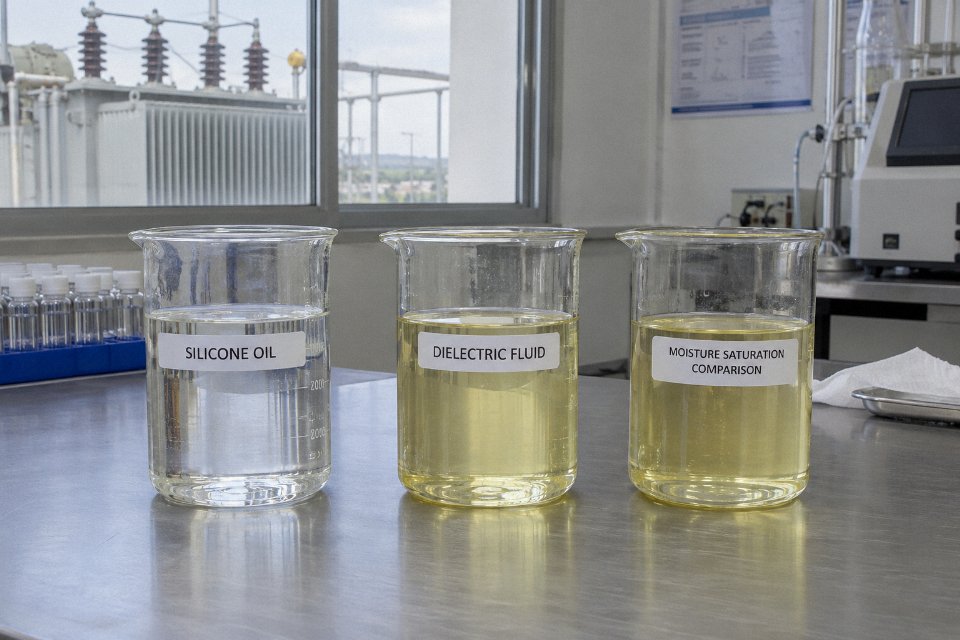
Use the following information to interpret a moisture result:
- Fluid-specific saturation data: Use a validated relationship for the actual chemistry, preferably the grade.
- Sample and operating temperatures: A warm sample and a cold shutdown condition are not equivalent.
- Insulation condition and history: Include cellulose moisture assessment where applicable, plus loading and recent drying.
- Electrical test results: Assess breakdown behavior using the specified method rather than inferring it from moisture alone.
Esters’ moisture capacity can favor water partitioning out of cellulose under suitable conditions, but it does not eliminate water management. Water can participate in ester hydrolysis, producing acidic species; temperature, formulation, and exposure determine the significance. Nor does greater dissolved-water capacity automatically guarantee better equipment insulation performance.
Compatibility and operating limits
A fluid change needs engineering review, not just a drain-and-fill instruction. Approval for one liquid does not establish acceptable cooling, insulation coordination, or material life with another.
- Cooling circuit: Higher viscosity increases hydraulic resistance and can reduce natural circulation or pump flow. Larger passages or more cooling surface may compensate, but add size and cost. Check cold-start viscosity, not pour point alone: a fluid can remain liquid yet circulate poorly.
- Wetted materials: Verify seals, hoses, varnishes, adhesives, coatings, and solid insulation. Changed swelling or extraction behavior can turn an apparently sound gasket into a leak after conversion.
- Residual fluid: Establish allowable carryover and a validated changeover procedure. Mixing can alter fire performance, environmental claims, and diagnostic interpretation.
- Process contamination: Silicone carryover can cause serious defects in sensitive painting or bonding operations. Dedicated handling equipment may be necessary; shared transfer hoses are an easily overlooked route.
- Oxygen exposure: Natural ester suitability depends strongly on formulation and preservation design. Synthetic esters deserve separate evaluation: neither oxidation resistance nor cold-temperature capability can be inferred from the word “ester.”
The preferred low-viscosity fluid can change once fire restrictions or containment requirements enter the design. Conversely, selecting a high-fire-point liquid without checking circulation can sacrifice thermal margin.
Purchase price versus ownership cost
Compare compliant equipment-and-fluid packages over the intended service life, rather than ranking liquid prices alone:
- Installed cost: Fluid charge, cooling hardware, pumps, containment, and fire protection required by the applicable installation rules.
- Operating cost: Pump energy, inspections, sampling, treatment, replacement inventory, and specialist service availability.
- Failure exposure: Leak consequences, overheating-related outages, production downtime, and replacement lead time.
- Handling and retirement: Segregated storage, contamination control, spill response, transport, and locally permitted recovery or disposal.
Silicone can justify a higher initial cost where approved equipment benefits from its fire behavior and stability. It is a poor fit where ready biodegradability is mandatory, silicone contamination is unacceptable, or the equipment lacks approval for that fluid.
There is no universal winner. Mineral oil often wins on service infrastructure and economics; qualified esters may better satisfy environmental or fire constraints; specialized hydrocarbons may suit electronics cooling. The selection holds only for the verified grade, equipment duty, installation requirements, and available maintenance support—not the fluid family name.
Equipment applications and suitability boundaries
Silicone dielectric fluid is suitable where the equipment is designed and qualified around its electrical, thermal, and material behavior—not simply wherever liquid insulation is needed. Established applications include certain liquid-filled transformers and specialized insulation systems; electronics immersion and small enclosed components require separate qualification against their actual construction and operating duty.
Transformers and high-voltage equipment
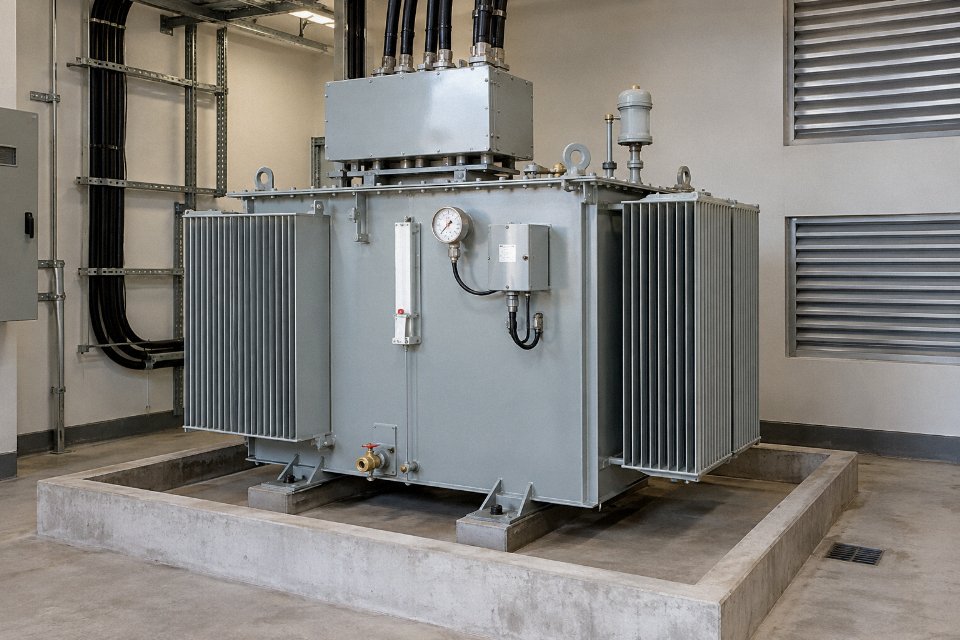
- Liquid-filled transformers: Indoor substations and fire-sensitive installations can benefit from qualified silicone-fluid designs. Adoption still depends on the transformer’s cooling passages, winding insulation, seals, expansion provision, and applicable approvals. Do not treat a mineral-oil transformer as silicone-ready merely because the replacement fluid passes a dielectric-strength test. Retrofilling requires manufacturer review; residual oil and changed flow behavior can affect the resulting installation.
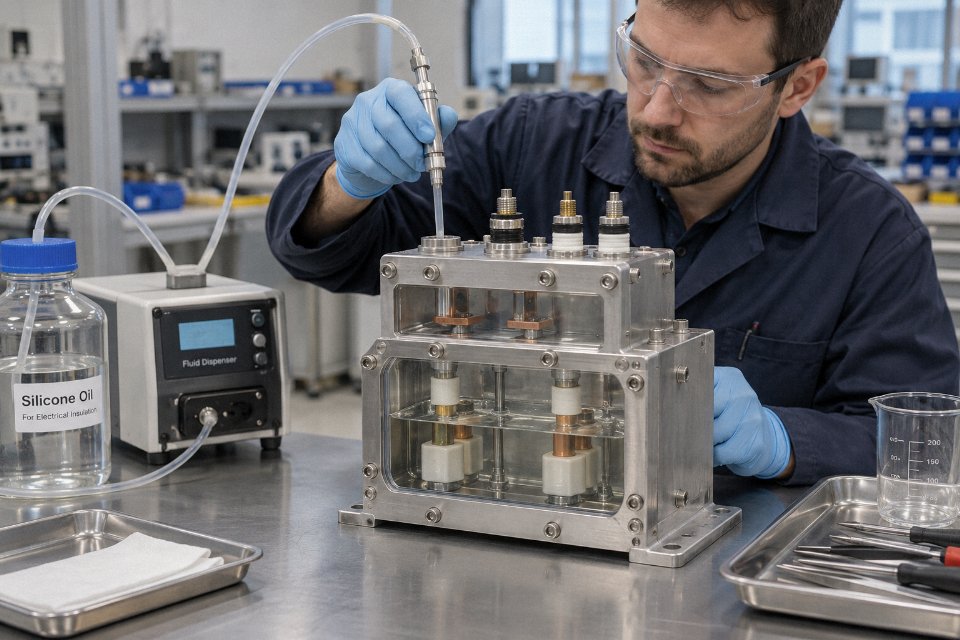
- High-voltage test equipment and insulation assemblies: Silicone fluid can provide liquid insulation around electrodes and complex geometries where controlled cleanliness matters. Filling procedures must address trapped gas, moisture, and particles. A bubble retained beneath an electrode can become a local discharge site even when the bulk fluid meets its acceptance specification.
- Selected capacitors, bushings, and instrument assemblies: Use is component-specific. Qualification must cover impregnation or wetting, internal pressure changes, dielectric losses, and compatibility with internal insulation. A fluid approved for one bushing design is not automatically acceptable in another manufacturer’s unit.
Electronics immersion and specialty cooling
Selected immersion systems can use silicone liquids, but transformer-fluid specifications do not establish electronics compatibility. Qualification should cover:
- Connectors and cables: Check housings, jackets, identification sleeves, and fluid wicking along conductors.
- Seals and adhesives: Evaluate swelling, softening, extraction, and bond strength after representative hot exposure—not just a short room-temperature soak.
- Maintenance: Establish draining, cleaning, and repair procedures. Persistent silicone residue can complicate subsequent adhesive bonding or coating operations.
Lower viscosity may improve circulation, but it also changes leakage behavior and potentially volatility, depending on the grade. The preferred fluid therefore depends on the complete wetted assembly, not just the heat load.
Similar chemistry, different functions
These materials are not interchangeable:
- Dielectric liquids flow, fill clearances, and may circulate.
- Silicone gels provide compliant, localized insulation but do not function as circulating coolants.
- Greases remain at interfaces; their thickeners and additives require separate assessment.
- Cured encapsulants form solid insulation, while thermally conductive filled compounds have filler-dependent electrical and flow properties.
Duties requiring separate qualification
- Arc interruption: Insulation performance does not establish arc-quenching capability. Switching duty requires equipment-specific interruption and decomposition assessment.
- Vacuum service: Verify vapor pressure, outgassing, and degassing requirements for the actual grade and vacuum level.
- High-frequency fields: Assess frequency-dependent losses and resulting local heating; power-frequency data are insufficient.
- Extreme cold: Confirm viscosity, starting circulation, and heat removal at the minimum operating temperature.
- Sensitive contacts and switching zones: Control leakage, vapor transport, and surface migration. Under discharge conditions, silicone-derived material can form insulating deposits that increase contact resistance. Physical separation and contamination control may matter more than bulk-fluid purity.
Electrical-grade qualification and procurement evidence
“Electrical-grade silicone oil” is not a complete purchase specification. A defensible order identifies the fluid, ties acceptance limits to named test methods, and makes every delivered batch traceable to its release evidence; a catalog value or “equivalent grade” statement cannot do that job.

Define the material before requesting quotations
- Fix chemistry, viscosity, and intended service. Identify the required silicone chemistry, such as unfilled polydimethylsiloxane, rather than accepting “silicone fluid.” Specify nominal kinematic viscosity, reference temperature, and acceptance tolerance. Some transformer fluids use nominal 50 mm²/s at 25 °C, but that is an application reference—not a universal requirement. State the equipment, voltage duty, cooling arrangement, and whether the purchase is for initial filling or topping up.
- Control formulation and substitutions. Declare the permitted additive status and restrict unapproved blends, reclaimed content, viscosity changes, or alternative chemistries. Record equipment-approved continuous, startup, and short-duration temperature limits, distinguishing these from supplier recommendations. A matching viscosity does not establish interchangeability: formulation changes can affect electrical losses, seal response, and aging.
Make acceptance results reproducible
Specify electrical tests and contractual limits. Require breakdown voltage, dissipation factor, relative permittivity, resistivity where specified, and moisture content. Each result needs its method, units, relevant temperature and frequency, conditioning, and acceptance limit. Reference IEC 60836 for unused silicone insulating liquids where applicable; IEC 60156 for power-frequency breakdown testing; IEC 60247 for relevant electrical properties; and IEC 60814 for water determination. Verify current editions, method suitability for the fluid, and contractual applicability before issuing the specification.
Do not compare unlike breakdown numbers. IEC 60156, ASTM D1816, and ASTM D877 use different test arrangements and procedures. Electrode geometry, gap, fluid movement, and conditioning change the electrical stress and the movement of moisture or particles through the stressed region. Require the applicable electrode geometry and gap, conditioning sequence, individual readings or prescribed reported statistic, and sampling and handling details.
A higher breakdown number from a different method does not demonstrate a better fluid. For disputed results, arrange comparison testing under the same method and conditions rather than applying a conversion factor.
Include physical and safety properties. Require viscosity and density at stated temperatures, measured flash and fire points with methods, and low-temperature data appropriate to startup conditions. Pour point alone does not establish pumpability. Request viscosity-temperature data, thermal conductivity, specific heat, or expansion measurements where the cooling or expansion-volume calculation needs them; distinguish measured results from estimates.
Qualify the interfaces, not just the liquid
- Request representative compatibility evidence. Cover each relevant material family:
- Metals and actual surface finishes, including plated parts.
- Elastomers and plastics, identified by compound or grade where practical.
- Coatings, varnishes, and adhesives, including their cure condition.
- Paper and other solid insulation.
Connected service hardware, including hose liners, gaskets, pump seals, and filter components.
Exposure conditions should represent temperature, duration, and service duty, with checks suited to the component: swelling, hardness, strength, adhesion, leaching, or electrical performance. A generic “compatible with rubber” declaration is not useful qualification evidence. Laboratory immersion can screen materials economically, but it does not prove that an aged seal assembly will remain leak-tight through thermal cycling.
Close the documentation and delivery gaps
Define the batch evidence package. Require a lot-linked certificate of analysis, current technical and safety data sheets, batch traceability, and an agreed retained-sample policy. Specify clean, dry packaging and closures, storage guidance, any assigned shelf life or retest interval, and receiving-sample procedures. Poorly controlled transfer equipment can introduce contamination after an acceptable batch leaves the supplier.
Separate guarantees from supporting information. Mark each property as a guaranteed release limit, periodically verified qualification property, or typical value. Require documented scope for claimed equipment approvals; a supplier declaration is not independent qualification. Agree notification and requalification triggers for changes to formulation, raw-material source, manufacturing site, process, or packaging.
Tighter release testing adds cost and lead time. Put routine batch controls on properties that govern acceptance, and reserve broader qualification testing for initial approval and relevant changes—unless the equipment contract requires otherwise.
Fluid handling and service-condition monitoring
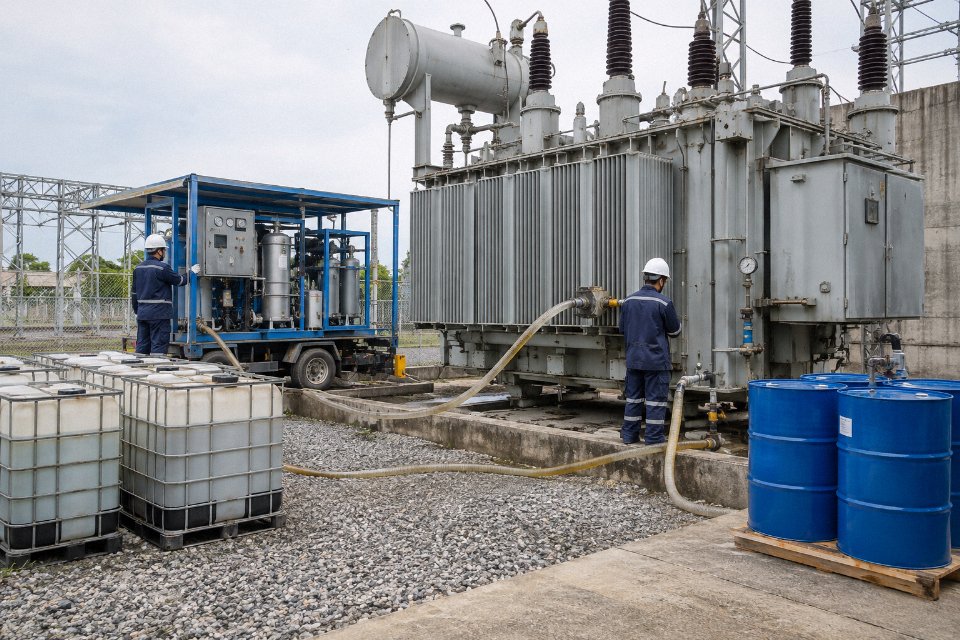
Qualified silicone fluid can lose its service margin before energization if it passes through a wet hose or enters equipment containing cleaning residue. Treat receiving, transfer, filling, and sampling as controlled maintenance operations—not simply drum handling.
Keep contamination out during receiving and transfer
- Storage and receiving: Keep containers sealed, under cover, and within supplier storage limits. Check closures, damage, identification, and batch traceability before acceptance. Quarantine containers with compromised seals rather than topping them up or blending away uncertainty.
- Transfer equipment: Use clean, dry, dedicated hoses, pumps, containers, and sampling fittings. Protect disconnected ends with clean caps. Verify seal and hose compatibility against the actual fluid grade and operating temperature; elastomer family names alone are insufficient.
- Particles: Control dust, fibers, rust, and wear debris through housekeeping and suitable filtration. Particles can concentrate electric fields or bridge stressed gaps, particularly when moisture is also present.
- Water: Prevent both free-water ingress and dissolved-moisture pickup. Free water requires source investigation; dissolved-water results need temperature context and a fluid-appropriate method. A clear sample does not establish dryness.
- Gas and chemical contamination: Avoid aerating transfer streams and drawing air through suction leaks. Separately control ionic contamination from dirty equipment, cleaning residues, incompatible additives, and other insulating liquids. These require more than a particle filter: verify cleaning procedures and prohibit shared containers unless cleanliness has been demonstrated.
Condition and fill for the specific equipment
- Select treatment deliberately. Filtration removes particles; drying targets moisture; vacuum treatment can remove dissolved gases and moisture under suitable conditions. Specify filter compatibility, treatment temperature, vacuum, and circulation rate with the fluid supplier and equipment manufacturer. Do not copy a mineral-oil processing recipe without checking it.
- Respect treatment limits. Higher temperature may accelerate moisture removal, but equipment seals, internal materials, and fluid limits constrain the process. Filtration cannot reliably remove dissolved ionic contamination or undo incompatible-fluid mixing. The correct response may be replacement rather than repeated processing.
- Control filling and expansion. Follow the approved filling sequence, including vacuum filling only where the vessel and internal components permit it. Remove trapped air from designated high points and establish liquid level at the specified reference temperature, preserving the required expansion allowance.
- Verify before energization. Check leaks, valves, vents, and actual circulation—not merely pump motor operation. Confirm level indication and protective devices. Take a representative baseline sample after the specified settling or circulation period, recording sampling point, fluid temperature, treatment history, and test methods.
Trend condition against an equipment-specific baseline
Use a risk-based panel, with frequency driven by electrical stress, loading, operating temperature, sealing arrangement, and failure consequence:
- Visual condition: Track haze, sediment, discoloration, and free water; investigate changes without treating appearance as a dielectric test.
- Moisture and breakdown behavior: Compare results obtained by consistent, appropriate methods. Breakdown testing is sensitive to sample handling and contamination; one favorable result does not clear the entire insulation system.
- Dissipation factor: Use where relevant to the equipment to detect changing dielectric losses, controlling test temperature and frequency.
- Viscosity and thermal trends: Compare viscosity at the same reference temperature. Relate temperature rise to load, ambient conditions, and circulation performance before blaming fluid aging.
- Dissolved gases: DGA can support diagnosis in silicone-filled equipment, but gas generation and interpretation differ from mineral-oil systems. Use silicone-appropriate guidance and experienced interpretation, not mineral-oil diagnostic ratios by default.
Set alarm and action limits from current equipment documentation and qualified engineering review. Trend changes may justify investigation before an absolute limit is exceeded.
Respond without creating a second problem
- Confirm the evidence. Repeat questionable samples using clean equipment and review laboratory methods.
- Locate the source and assess risk. Investigate ingress, overheating, discharge activity, seal deterioration, and maintenance contamination. Decide whether continued operation is acceptable before scheduling treatment.
- Choose a justified remedy. Recondition only when the identified contaminant is removable and the treated fluid can be requalified.
- Treat retrofill as an engineering change. Porous insulation retains old liquid despite draining. Residual mixtures can alter fire behavior, electrical properties, and material compatibility, potentially affecting approvals. Obtain equipment-manufacturer acceptance and verify applicable classification requirements.
- Control spills and waste. Contain leaks promptly: silicone films create persistent slip hazards. Segregate waste by composition and contamination history, prevent drain discharge, and use disposal routes permitted locally. Low acute hazard does not establish environmental acceptability or biodegradability.
Frequently asked questions
Is all silicone oil electrically insulating?
Many unmodified silicone oils are inherently good insulators, but that does not make every commercial product suitable for electrical equipment. Conductive fillers or contamination can change performance substantially. Purchase a verified electrical grade; a generic viscosity certificate does not establish dielectric suitability.
What viscosity should a dielectric silicone oil have?
Use the viscosity specified for the equipment and its operating temperature range. Nominal 50 mm²/s at 25 °C is a reference for some transformer fluids, not a universal requirement. Higher viscosity can restrict circulation, especially during cold starts; lower viscosity is not automatically an approved substitute.
Is silicone oil nonflammable?
No. Some transformer-grade silicone fluids have fire points above 300 °C, but they can still burn under sufficient heat exposure. Check the grade-specific flash point and fire point, including test methods. A high fire point does not eliminate equipment fire-protection requirements.
Can silicone oil replace transformer mineral oil?
Sometimes, but this is an engineered retrofill, not a drain-and-refill maintenance job. Before proceeding:
- Obtain equipment approval for the proposed fluid and operating duty.
- Verify compatibility with internal materials and the cooling system.
- Establish an approved procedure covering residual mineral oil, fluid processing, filling, and acceptance testing.
Residual mineral oil can affect the resulting mixture’s fire behavior; use the approved residual-content limit rather than assuming complete drainage.
Can silicone oil be mixed with another insulating liquid?
Do not mix fluids without documented approval for the specific combination and proportions. A clear, uniform mixture proves neither electrical performance nor fire classification. Even apparently compatible liquids may change viscosity enough to impair cooling or invalidate equipment qualification.
How long does silicone dielectric fluid last?
There is no defensible universal replacement interval. Clean fluid under controlled loading may remain serviceable for many years, while contamination can demand intervention much sooner. Base decisions on condition trends and equipment-specific limits; fluid age alone is a poor rejection criterion.
Is silicone dielectric fluid suitable for electronics immersion cooling?
Potentially, but electrical insulation is only the first qualification. Seal swelling or extraction from cable jackets can undermine an otherwise promising fluid. Cooling trials must also demonstrate acceptable component temperatures: viscosity affects circulation, so satisfactory bulk-fluid temperature does not rule out local hot spots.
Dielectric fluid specification and sample validation
Choose qualified silicone dielectric fluid when its electrical performance, thermal stability, and fire behavior fit the equipment better than the available alternatives—not simply because the product is described as silicone oil. The purchase decision should connect a defined operating duty to a documented grade, then to an equipment-relevant acceptance test.
Before requesting a final grade recommendation, close these decision gates:
- Equipment approval: Confirm that the equipment manufacturer permits silicone fluid, including any restrictions on retrofilling or mixing.
- Duty conditions: Establish electrical stresses, temperature extremes, overload duration, and expected service life.
- Cooling adequacy: Verify heat rejection at the proposed viscosity, especially during cold starts. Greater viscosity can restrict circulation and raise winding temperatures even when the fluid remains chemically stable.
- Compatibility: Check seals, coatings, insulation, and residual fluid against supplier or equipment-manufacturer evidence.
- Standards and lifecycle constraints: Agree applicable specifications, testing responsibilities, maintenance provisions, disposal requirements, and acceptable delivered cost.
A fluid that passes laboratory electrical tests is not automatically acceptable in equipment with inadequate circulation or incompatible seals.
Send SiliconChemicals a focused inquiry containing:
- Equipment and electrical duty: Equipment type, voltage, frequency, and waveform, including relevant switching pulses.
- Thermal and hydraulic conditions: Operating temperature range, cooling arrangement, and required viscosity with its reference temperature.
- Current installation: Existing fluid, whether this is a new fill or retrofit, and known compatibility restrictions.
- Acceptance requirements: Applicable standards, equipment approvals, and project-specific test limits.
- Commercial requirements: Annual demand, initial fill quantity, packaging needs, and delivery destination.
SiliconChemicals combines organosilicon manufacturing and integrated supply capabilities in China with service to customers across more than 30 countries and regions. Ask whether it can propose a candidate electrical-grade fluid and provide supporting technical documentation, proposed batch acceptance criteria, and a representative sample for validation; confirm availability rather than assuming dielectric approvals or project suitability.
Approve production supply only after the proposed grade passes the agreed documentation review and equipment-relevant validation, with the accepted grade and batch criteria recorded in the purchase specification.